
Organic search still drives roughly a third of all ecommerce website traffic. Yet most online stores leave that channel underbuilt -- relying on paid ads alone while competitors quietly capture high-intent buyers through search. A strong ecommerce SEO strategy changes that equation, turning your product catalog into a compounding traffic asset that reduces acquisition costs over time.
If you run a DTC brand or growth-stage store, this guide gives you the framework to build (or fix) your organic search foundation -- from keyword research through technical execution to the emerging AI search surfaces that now influence how shoppers discover products.
SEO for ecommerce websites is fundamentally different from SEO for content sites or SaaS companies. The challenges are specific:
These realities mean you need a purpose-built approach, not a generic checklist. The payoff is significant: organic traffic compounds month over month, and unlike paid channels, it does not reset to zero when you pause spend. For a deeper look at how search engine positioning directly impacts traffic volume, the data is clear -- ranking improvements translate directly to revenue.
Effective ecommerce keyword research starts with intent, not volume. Organize your keyword targets into three tiers:
| Intent Tier | Example Keywords | Target Page Type |
|---|---|---|
| Transactional | "buy organic cotton sheets queen" | Product page |
| Commercial investigation | "best organic cotton sheets 2026" | Category or comparison page |
| Informational | "organic cotton vs bamboo sheets" | Blog post or buying guide |
Practical steps to build your keyword map:
An experienced ecommerce SEO specialist will typically start here, because the keyword map dictates every optimization decision that follows.
Technical issues kill ecommerce sites quietly. A store can have great products and strong content, but if search engines cannot efficiently crawl and index the catalog, none of it surfaces in results.
Search engines allocate a finite crawl budget to each domain. Ecommerce sites waste that budget when faceted navigation creates thousands of parameter-based URLs that add no unique value. Address this by:
noindex or blocking them via robots.txtGoogle's Core Web Vitals remain a ranking factor, and for ecommerce, speed directly affects conversion rates. Key metrics to monitor:
Schema markup is no longer optional for ecommerce stores. Implementing Product schema enables rich results that display price, availability, ratings, and shipping information directly in search results.
Priority schema types for ecommerce:
Proper technical execution is where comprehensive ecommerce SEO packages deliver the most immediate impact, because these fixes often unlock rankings that content alone cannot achieve.
Your product and category pages are your money pages. Optimizing them correctly determines whether search traffic converts.
Category pages often have the highest ranking potential for competitive head terms. Strengthen them by:
Building brand trust through your SEO presence matters here -- shoppers who land on a well-structured category page with clear product information, reviews, and transparent policies are far more likely to convert.
Product pages alone will not capture the full range of search queries your buyers use. A content strategy fills the gaps, targeting informational and commercial investigation keywords that product pages cannot rank for.
High-performing content types for ecommerce:
Each piece should link to relevant product and category pages. This creates a content hub structure where blog posts feed authority and traffic into your commercial pages.
Content also plays a critical role in earning backlinks. Authoritative buying guides and original research attract links from publications, bloggers, and industry sites -- which strengthens your entire domain's ability to rank.
Search behavior is shifting. Buyers now discover products through AI-powered surfaces like Google's AI Overviews, ChatGPT, and Perplexity. This means your SEO for ecommerce websites strategy needs to account for how AI systems select and cite sources.
Key principles for AI search visibility:
This is still an emerging area, but brands that invest in structured, authoritative content now will have a meaningful advantage as AI search adoption continues to grow.
The strongest ecommerce search strategies do not treat SEO and paid search as separate channels. They work together. Paid search data reveals which keywords convert, informing your organic priority list. Organic rankings reduce your dependence on ad spend for branded and high-volume terms, freeing budget for prospecting campaigns.
For a detailed breakdown of how to build a balanced search marketing plan that combines SEO and SEM, the integrated approach consistently outperforms either channel in isolation.
Many brands work with an ecommerce SEO consultant or dedicated ecommerce SEO services team to run this combined model, because it requires coordination between content, technical SEO, and media buying -- disciplines that rarely sit in the same person's skillset. EmberTribe's SEO services are built around this integrated model, connecting organic performance directly to revenue outcomes.
Ecommerce SEO is not a one-time project. It is an ongoing system that compounds over time -- each technical fix, each optimized product page, each piece of content strengthens your store's ability to capture organic demand.
The priority order is clear:
Stores that treat SEO as infrastructure -- not a checkbox -- consistently see lower customer acquisition costs, more resilient traffic, and stronger brand positioning in their category. The work is methodical, but the results compound in ways that paid channels simply cannot replicate.

If you think about what makes modern marketing so powerful, all roads lead to one thing: personalization.
Facebook ads are powerful because of how precisely we can target an audience. Search ads are powerful because we can target the intent of a potential customer based on what they're searching for in Google.
This high degree of personalization turns advertisers into snipers who find the right people at the right time with the right offer.
Let's get started.
Big picture
We're going to:
You don't have to be a technical whiz. Just follow the directions and you'll do great.
We wrote a script that calls on a free service, Snoopi.io. Snoopi.io detects the visitor's IP address, then looks it up in a database to find the city and state names. It also can find things like latitude and longitude, ISP provider, if the user is using a mobile device; which is cool if you wanted to geek out and show a map with a user's current location or get additional information to help with marketing efforts.
The script we wrote acts as a bridge between this service and your landing page, so you can store and use that information in your landing page's content.
NOTE: To use this lookup service, you'll need to create a free account and get an API key which allows 10k free requests per month. API key is not required for testing purposes.
We're using Unbounce for this particular tutorial, but any platform will do just fine, provided you have the ability to add Javascript to your pages.
Now that you downloaded the script in the step above, add it to your landing page.
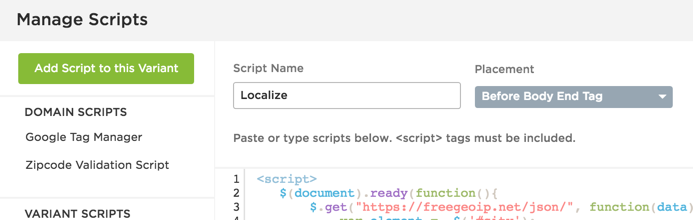
So remember, we called up Snoopi.io to retrieve the city name, we grabbed that information with the script, now we need to tell the script where to put it on your page.
Typically, we'd recommend adding a user's location somewhere in the headline of your page so that it stands out. But you can also get creative, and work it into other places like your CTA button text. The key here is to make it as natural as possible, so the user feels like you created this lander just for them.
In any case, we're going to use a tag to identify where the script should insert the city name.
Name the span id "location".
Let's clarify what's happening here. You're adding this element right within the HTML of a headline. Think of that entire span tag as the city name. In the example above, you can see that we added a contrasting color for it to pop.
The script is looking for the id "location" if you've followed these instructions. But if you want to add the city to some other element, you just have to change the "id" in the script to look for that element.
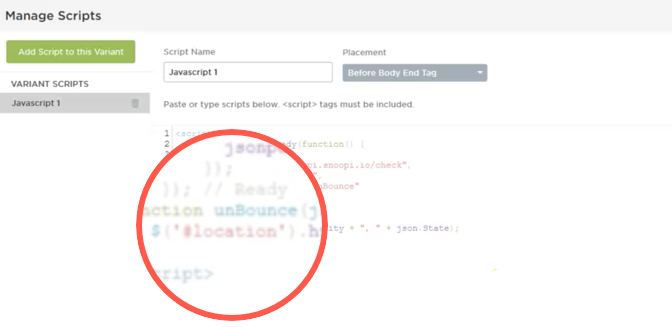
If the IP lookup service can't find a city name in their database, our script will fall back on a state name. So keep that in mind when using the script to avoid any awkward phrasing.
Here is an overview video to help with implementation...
Just because you can do something doesn't mean you should. Is your offer dependent on location? Then it might make sense to add it dynamically to your landing page. Think: events, job openings, dating, etc.
🤔 Can I optimize my landing page too much? Turns out, yes. →
If a user's location has no bearing on the offer, don't force it. We've seen instances where using this tactic can actually lower conversion rates if it's out of place.
Don't forget that once you're able to capture location, that's where the fun begins. Adding a city name as text to your copy is only one simple application, but the possibilities are endless: pre-populating form fields, customizing a checkout experience, etc.
Now go forth and personalize!

Many businesses struggle with creating an effective Instagram ads strategy that delivers the desired results. If you find yourself in this situation, fret not! Just keep cool, and read on.
A well-defined Instagram ads strategy is the foundation for success in advertising on this platform. It allows you to align your ads with your business goals, target the right audience, and maximize your return on investment (ROI). Without a clear strategy in place, your ads may fall flat and fail to generate the desired engagement or conversions.
Developing a solid Instagram ads strategy starts with defining your objectives. Are you looking to increase brand awareness, drive website traffic, or boost sales? Once you have a clear goal in mind, you can then determine the best approach to achieve it. This may involve selecting the right ad formats, crafting compelling ad copy, and optimizing your targeting parameters.
Understanding the common mistakes made in Instagram advertising is crucial in identifying the root causes of your strategy's underperformance. Some common mistakes include:
One of the most common mistakes businesses make in Instagram advertising is creating ads that are irrelevant or poorly targeted. If your ads are not reaching the right audience, they are unlikely to generate the desired results. It's important to take the time to understand your target audience and tailor your ads to their interests and preferences.
In addition to targeting, the quality of your content plays a crucial role in the success of your Instagram ads. Inconsistent or low-quality content can deter users from engaging with your ads and may even damage your brand's reputation. It's important to invest in creating visually appealing and compelling content that captures the attention of your audience.
Data and analytics are valuable tools that can provide insights into the performance of your Instagram ads. Ignoring this data can prevent you from identifying areas for improvement and optimizing your ads for better results. By regularly reviewing your analytics, you can uncover trends, identify successful strategies, and make informed decisions to enhance your advertising efforts.
Lastly, many businesses overlook ad optimization opportunities. Instagram offers various features and tools that can help improve the performance of your ads, such as A/B testing, ad scheduling, and ad placement optimization. By taking advantage of these opportunities, you can refine your ads and maximize their impact.
Identifying and rectifying these mistakes is the first step towards rejuvenating your advertising efforts. Let's explore how you can identify the specific problem areas within your Instagram ads strategy.
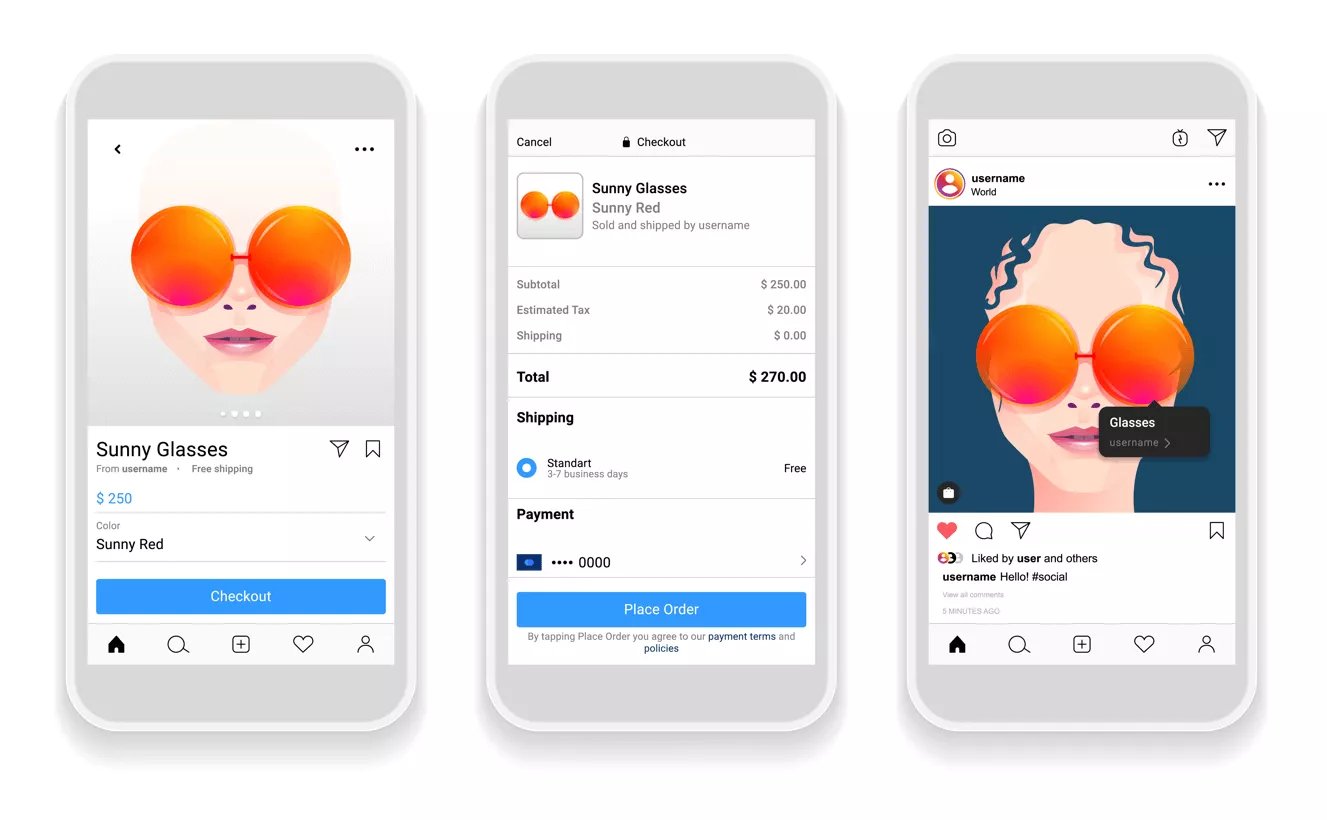
Scrutinize your ad campaign performance metrics, such as click-through rates (CTR), impressions, and engagement rates. This analysis will shed light on which ads are underperforming and where improvements can be made. Utilize Instagram's analytics tools to gain valuable insights into your audience's behavior and preferences.
When analyzing your Instagram ad performance, it's important to take a deep dive into the data. Look beyond the surface-level numbers and try to understand the underlying factors that may be impacting your ads' performance. Are there specific demographics that are not responding well to your ads? Is there a particular time of day when your ads receive higher engagement? By answering these questions, you can refine your targeting and scheduling strategies to optimize your ad performance.
Take the time to read through the comments and feedback left by your audience. This qualitative data can provide valuable insights into how your audience perceives and interacts with your ads. Look for common themes or recurring feedback that may indicate areas for improvement.
Be on the lookout for warning signs that indicate your Instagram ad strategy is not delivering the desired results. For instance, consistently low engagement rates, high bounce rates, or declining conversion figures may indicate areas that need attention. Recognizing these signs early on will enable you to take timely action.
One important aspect to consider when recognizing signs of a failing Instagram ad strategy is the alignment between your ads and your target audience. Are you targeting the right audience with your ads? Are you using the right messaging and visuals to capture their attention? It's crucial to ensure that your ads resonate with your target audience and effectively communicate your brand's value proposition.
In addition to analyzing the performance metrics, it's also beneficial to conduct competitor research. Look at what your competitors are doing on Instagram and analyze their ad strategies. Are they targeting a similar audience? What types of content are they using? By understanding what works for your competitors, you can gain insights that can inform your own ad strategy and help you stand out in the crowded Instagram landscape.
Remember, identifying the problem with your Instagram ads is just the first step. Once you have identified the issues, it's important to develop a plan of action to address them. Experiment with different ad formats, messaging, and targeting strategies to find what works best for your brand. Continuously monitor and analyze your ad performance to ensure ongoing success.
Once you have identified the problem areas in your Instagram ads strategy, it's time to revamp and breathe new life into your campaigns. Here are some essential steps to help you get back on track:
One common mistake is failing to understand your target audience thoroughly. Revisit and refine your buyer personas to ensure your ads align with your audience's needs, preferences, and demographics.
By understanding their motivations and pain points, you can tailor your ad strategy to resonate with them on a deeper level. Consider segmenting your target audience into different groups based on demographics, interests, or buying stages. This segmentation allows you to create more personalized and targeted ads, increasing the likelihood of engagement and conversions.
Reevaluate the content and design of your ads. Experiment with different formats, visuals, and messaging to capture your audience's attention. Ensure your ad content is compelling, concise, and aligned with your brand's voice. When it comes to ad content, storytelling can be a powerful tool. Craft narratives that connect with your audience on an emotional level, evoking their curiosity and interest. Use persuasive language and compelling visuals to create a memorable experience for viewers. Testimonials, reviews, and customer stories can be powerful assets in boosting the credibility of your brand.
Stay informed about the latest tools and features offered by Instagram for advertising. Explore options such as carousel ads, video ads, and Instagram Shopping to enhance the effectiveness of your campaigns. Continually educate yourself about the platform's capabilities and evolving trends. Carousel ads, for example, allow you to showcase multiple products or features within a single ad, providing a more immersive experience for your audience. Video ads, on the other hand, can convey your brand's message in a dynamic and engaging way, capturing attention and driving higher engagement rates.
Instagram Shopping is another valuable feature to consider. It enables users to browse and purchase products directly within the app, streamlining the buying process and increasing conversion rates. By leveraging these tools and features, you can elevate your Instagram ads strategy and stay ahead of the competition.
Set up a routine for monitoring your ad campaign performance. Regularly assess key metrics and compare them with your predefined goals to gauge performance accurately. Leverage data and analytics tools to gain insights into your audience's preferences and behavior.
Based on your performance analysis, make data-driven decisions and adjust your strategy accordingly. This may involve tweaking your target audience, refining your ad content, or experimenting with new ad formats. Continuously learn from your campaign results and iterate to optimize your results.
Stay abreast of the latest trends and updates in Instagram advertising. The social media landscape is constantly evolving, and what works today might not work tomorrow. Adaptation and agility are key to staying ahead of your competition and capitalizing on new opportunities.

Invest in continuous learning and enhancement of your Instagram ads strategy. Attend webinars, industry conferences, or join online communities to stay connected with fellow marketers and gain valuable insights. Engage in A/B testing and experimentation to keep refining your approach and optimizing your ad performance.
If your Instagram ads strategy is not delivering the desired results, don’t fret, strive. Just take care of it. By understanding the basics, analyzing your performance, making necessary adjustments, and future-proofing your strategy, you can turn your Instagram ads into a powerful tool for achieving your business goals. Embrace creativity, data-driven decision-making, and a willingness to adapt, and watch as your Instagram ads soar to new heights of success!

TikTok, the popular social media platform known for its short-form videos, has taken the world by storm. With over millions of users worldwide, it offers a unique opportunity for brands and individuals alike to grow their presence and engage with their audience (take a look at the graph below to get an idea about the age range of TikTok users). With a specialized e-commerce agency, you can make the most of it to boost sales, drive traffic or create brand awareness. Keep reading to delve into some strategies and techniques that can be employed to enhance your presence on TikTok.

One of the key factors to consider when aiming for organic growth on TikTok is understanding the algorithm that determines the visibility of your content. The platform's algorithm takes into account factors such as user interactions, video completion rates, and engagement levels to determine the reach of your videos.
For example, if your video receives a high number of likes, comments, and shares, it is more likely to be shown to a wider audience. On the other hand, if your video has a low completion rate or lacks engagement, it may not be promoted as prominently. By understanding how the algorithm works, you can optimize your content to increase its visibility and attract a larger audience.
It is important to note that the TikTok algorithm is constantly evolving, so staying up to date with the latest trends and changes is crucial. By keeping an eye on the platform's updates and experimenting with different content strategies, you can stay ahead of the curve and maximize your organic growth potential.
Organic growth on TikTok refers to the process of attracting genuine followers and engagement without resorting to paid promotions or advertisements. While paid promotions can certainly be effective, organic growth allows for a more authentic connection with your audience and can lead to long-term success on the platform.
By focusing on organic growth, you can build a loyal following and establish a strong presence on TikTok. This involves creating high-quality content that resonates with your target audience, engaging with your followers through comments and collaborations, and staying consistent with your posting schedule.
Additionally, organic growth allows you to tap into the viral nature of TikTok. With the right content and strategy, your videos have the potential to reach millions of users and become a trending sensation. This can significantly boost your visibility and attract even more followers and engagement.
Remember, building a successful presence on TikTok takes time and effort. It requires a deep understanding of your target audience, consistent content creation, and a willingness to adapt to the ever-changing trends. But with dedication and creativity, you can unlock the full potential of TikTok and take your content to new heights.
Once you have a good understanding of TikTok and its algorithm, it's time to dive into the strategies that can help you achieve organic growth on the platform.
But what exactly is organic growth? Organic growth refers to the process of gaining followers and engagement on TikTok without resorting to paid advertising or other artificial means. It's all about attracting genuine interest from users who are genuinely interested in your content.
Your TikTok profile serves as your virtual identity on the platform, so it's important to optimize it to attract and engage with your target audience. Follow this steps:
When it comes to creating content for TikTok, there are a few best practices to keep in mind.
TikTok is constantly evolving, with new trends and challenges emerging on a regular basis. To maximize your organic growth, it's important to stay up-to-date with the latest TikTok trends and incorporate them into your content.
Jumping on the bandwagon of a viral dance challenge, a popular meme, or a trending hashtag can help increase your visibility and attract new followers. However, it's important to put your own unique spin on these trends to stand out from the crowd and showcase your creativity.
Keep an eye on the Discover page and follow other popular TikTok creators in your niche to stay in the loop about the latest trends. By participating in these trends, you can tap into the existing user base and potentially reach a wider audience.
Remember, organic growth on TikTok takes time and effort. It's important to consistently create high-quality content, engage with your audience, and stay active on the platform. By implementing these strategies and staying true to your brand, you can build brand awareness, drive traffic, generate leads, and eventually increase conversions.

Engagement is a crucial aspect of growing your TikTok presence and building a community of loyal followers. Here are some strategies to enhance engagement on the platform.
Building a strong relationship with your audience is key to increasing engagement on TikTok. Respond to comments on your videos, engage in conversations, and show appreciation for your followers. This not only fosters a sense of community but also encourages others to engage with your content.
When responding to comments, take the time to craft thoughtful and personalized replies. This shows your followers that you value their input and encourages them to continue engaging with your content. Additionally, consider asking your audience questions in your videos or captions to prompt further discussion. By actively engaging with your audience, you create a welcoming and interactive environment that encourages others to join in.
Another way to enhance engagement with your audience is by hosting live streams. Live streaming allows you to directly interact with your followers in real-time, answering their questions, and addressing their comments. This personal connection can significantly boost engagement and create a stronger bond between you and your audience.
Collaborating with other TikTok creators can be a powerful way to expand your reach and engage with a wider audience. By duetting or creating videos together, you can tap into each other's follower base and attract new followers. Look for creators in your niche or with a similar target audience to collaborate with.
When collaborating, it's important to choose partners who align with your brand and values. This ensures that the collaboration feels authentic and resonates with both your audiences. Consider reaching out to creators who have a slightly larger following than you, as this can help expose your content to a broader audience.
When duetting with another creator, aim to add value to the original video. Whether it's through humor, a unique perspective, or additional information, providing something extra can make your duet stand out and encourage viewers to engage with your content.
(If you want real-life examples, here are The Best TikTok Campaigns for 2023)
Creating challenges or contests is another effective strategy to enhance engagement on TikTok. Encourage your followers to participate by using a specific hashtag or creating their own videos based on a theme or prompt. Not only does this foster creativity and engagement, but it also helps spread your content to a wider audience.
When designing challenges or contests, make sure they are relevant to your niche or brand. This ensures that participants are genuinely interested in your content and increases the likelihood of attracting new followers who share similar interests. Consider offering incentives, such as prizes or shoutouts, to further motivate your audience to participate.
Additionally, actively engage with participants by liking and commenting on their challenge entries. This shows appreciation for their efforts and encourages others to join in. You can also feature standout entries in your own videos, giving participants recognition and further boosting engagement.

Tracking your performance and analyzing key metrics is crucial to understand the effectiveness of your strategies and optimize your TikTok presence. Here are some important metrics to monitor.
TikTok provides a built-in analytics tool that gives you insights into your account's performance. It allows you to track metrics such as video views, followers gained, and engagement rates. Explore the analytics dashboard to gain a better understanding of your audience and make data-driven decisions.
While the specific metrics you track may depend on your goals and objectives, some key metrics to monitor include video views, likes, comments, and shares. Tracking these metrics over time can help you identify trends, understand what content resonates with your audience, and apply a data driven approach to your strategy.
Regularly analyzing your TikTok analytics and adjusting your strategy based on the data is crucial for continued growth and engagement. If certain types of content are performing exceptionally well, consider creating more of that content. Likewise, if certain videos are not resonating with your audience, try to identify the reasons behind it and make changes accordingly.
A growth agency can help you achieve exponencial growth in a cost-effective manner. For TikTok, growth requires a combination of understanding the platform's basics, implementing effective strategies, and monitoring your performance. By optimizing your profile, creating compelling content, staying up-to-date with trends, and engaging with your audience, you can grow your presence and establish a strong community on TikTok. Remember to continuously analyze your performance, make data-driven decisions, and adapt your strategy as needed. With persistence and creativity, TikTok can become a powerful platform for organic growth and engagement.

Email marketing remains one of the most profitable marketing channels available to brands today. With average returns exceeding $36 for every dollar spent, getting your email strategy right is not optional; it is essential. One of the most persistent questions marketers face is straightforward: how long should a newsletter actually be?
The answer is not a single number. The ideal newsletter length depends on your audience, your goals, and the type of content you are delivering. But there are clear, data-backed guidelines that can help you find the right length for your specific situation.
The length of your newsletter directly impacts three critical metrics: open rate, click-through rate, and unsubscribe rate. Get the length wrong in either direction and you will see measurable drops in performance.
Too long: Subscribers see a wall of text, skim past the important parts, and eventually stop opening your emails altogether. Long newsletters also increase load times on mobile devices, where the majority of emails are now read.
Too short: Subscribers feel that the content is not worth their time. They may question why you are emailing at all if the content is thin. Short newsletters with little substance train your audience to ignore you.
The goal is not to hit a magic word count. The goal is to deliver enough value to justify the subscriber's attention without exceeding the point where engagement drops off.

While the exact sweet spot varies by industry and audience, research consistently points to a few key benchmarks:
The key insight is that newsletter length should match subscriber expectations. If someone signs up for a daily news digest, they expect brevity. If they subscribe to a weekly strategy breakdown, they expect depth.
Understanding your target audience is the most important factor in determining newsletter length. Some subscribers prefer short, actionable updates they can scan in 30 seconds. Others want comprehensive analysis they can read over coffee.
The best way to learn what your audience prefers is to ask them directly. A one-question survey embedded in your newsletter asking readers to choose between "shorter and more frequent" versus "longer and less frequent" can provide clear directional data.
You can also analyze behavioral data. If your click-through rates are highest on shorter newsletters, your audience is telling you something. If engagement drops after a certain scroll depth, you have found your natural length ceiling.
Different types of newsletters serve different purposes, and each purpose has an ideal length range:
The frequency at which you send newsletters directly influences how long each one should be. There is an inverse relationship: the more frequently you send, the shorter each individual newsletter should be.
Daily newsletters should rarely exceed 200 to 300 words. Subscribers receiving daily emails will not commit significant time to each one. Respect their inbox by being concise.
Weekly newsletters have more room. The 300 to 700 word range tends to perform well for weekly sends. Subscribers have had a week between messages and are more willing to invest a few minutes.
Monthly newsletters can be the most comprehensive. With four weeks of content to cover, monthly newsletters in the 700 to 1,200 word range can work well. However, even monthly newsletters should be scannable, with clear section breaks and visual hierarchy.
This balance between frequency and length ties into your broader email marketing strategy. Every email you send either builds or erodes subscriber trust, so getting this balance right is critical.
Newsletter length does not directly affect open rates, since subscribers decide whether to open based on the subject line, sender name, and preview text. However, length has an indirect effect. If subscribers consistently find your newsletters too long or too short, they will stop opening them over time. The cumulative effect of poorly calibrated length shows up in declining open rates over weeks and months.
This is where length has the most direct impact. Research shows that newsletters with a single, clear call to action outperform those with multiple competing links. Shorter newsletters naturally lend themselves to focused CTAs, while longer newsletters risk diluting attention across too many options.
If your newsletter is long, prioritize your most important CTA at the top and repeat it at the bottom. Do not bury critical links in the middle of a long block of text.
Consistently sending newsletters that are too long for your audience will drive unsubscribes. Subscribers who feel overwhelmed by content volume will eventually opt out. This is especially true for daily and weekly newsletters where the cumulative time commitment adds up quickly.
On the flip side, newsletters that are too short and lack substance can also trigger unsubscribes. If subscribers feel they are not getting value, they will leave.
Rather than guessing, use this structured approach to find the right newsletter length for your audience:
Send three newsletters at different lengths over three consecutive sends: one short (under 300 words), one medium (400 to 600 words), and one long (700 to 1,000 words). Keep subject lines, send times, and audience segments consistent across all three.
Track open rates, click-through rates, time on email (if your ESP provides this), and unsubscribes for each length variation. Create a simple scorecard to compare performance across the three lengths.
Many email service providers now offer scroll tracking or heat map data. Use this to identify exactly where readers stop engaging. If most of your audience drops off after 400 words, that is a strong signal about your ideal length.
Different segments of your audience may prefer different lengths. Power users and highly engaged subscribers may welcome longer, more detailed content. New subscribers or less engaged segments may respond better to shorter, more focused newsletters.
Understanding how different segments respond ties into broader funnel strategy. Top-of-funnel subscribers typically prefer shorter introductory content, while bottom-of-funnel subscribers are ready for more detailed information.
Newsletter length is not a set-it-and-forget-it decision. Audience preferences shift over time, and the competitive landscape of the inbox changes constantly. Review your length performance quarterly and make adjustments based on the data.
Regardless of how long your newsletter is, formatting can make or break the reading experience:
These formatting principles work across any email platform and can significantly improve engagement regardless of total word count. If your newsletters feed into a broader content marketing strategy, consistent formatting also reinforces brand recognition.

Once you have established your target newsletter length, track these key performance indicators consistently:
If you notice a decline in engagement, consider adjusting the length or content to better align with subscriber preferences. If open rates are high but click-through rates are low, the problem is likely in the newsletter content or length rather than the subject line. If click-through rates are strong but conversions are low, the issue may be on your landing page or sales funnel rather than in the email itself.
The ideal newsletter length is not a universal constant. It is a variable that depends on your audience, your content type, your sending frequency, and your business goals. The brands that consistently win at email marketing are the ones that treat length as a testable hypothesis rather than a fixed rule.
Start with the benchmarks outlined in this guide, run your own tests, and let the data guide your decisions. The most important thing is to stop guessing and start measuring. Your subscribers will tell you exactly what they want if you pay attention to the metrics.
For brands looking to optimize their entire email marketing program alongside paid acquisition and growth channels, a data-driven approach to newsletter length is one of the highest-leverage improvements you can make.

Having an effective advertising strategy is crucial for businesses to reach their target audience and drive success. Google Ads is a powerful tool that allows businesses to advertise their products and services to millions of users across the globe. One essential component of Google Ads is the Customer ID, which plays a significant role in optimizing your advertising efforts, including search and social media ads. In this article, we will discuss the importance of understanding and utilizing your Google Ads Customer ID, as well as ways to protect and maximize its potential.

Your Google Ads Customer ID is a string of numbers that is assigned to your account. It serves as a way for Google to track your campaigns, ads, and overall account performance. Think of it as a digital fingerprint that is unique to your account.
With your Customer ID, Google can easily identify and organize all the data related to your advertising efforts. This includes information about your campaigns, ad groups, keywords, and more. It helps Google keep everything organized and makes it easier for you to manage your account.
First and foremost, your Customer ID is the backbone of your Google Ads account. It is the key that unlocks access to all aspects of your campaigns. With your Customer ID, you can monitor your advertising spend, track conversions, analyze performance metrics, and make data-driven decisions to optimize your campaigns.
But the importance of your Customer ID doesn't stop there. It also enables you to link your Google Ads account to other Google services, such as Google Analytics and YouTube. By doing so, you gain access to a wealth of additional data and enhanced targeting capabilities.
For example, by linking your Google Ads account to Google Analytics, you can get a deeper understanding of how your ads are performing and how they are driving traffic to your website. You can track user behavior, identify which keywords are driving the most conversions, and even set up custom reports to get the insights you need.
Similarly, linking your Google Ads account to YouTube Ads allows you to run video ads and reach a wider audience. You can leverage the power of video marketing and tap into the massive user base of YouTube to promote your products or services.
Overall, your Google Ads Customer ID is not just a random string of numbers. It is the key that unlocks the full potential of your advertising efforts. Understanding its importance and leveraging its capabilities can help you take your Google Ads campaigns to new heights.
Locating your Google Ads Customer ID is an essential step in managing your advertising campaigns effectively. Your Customer ID is a unique identifier that allows you to access and control your account. Follow the steps below to find your Customer ID:
Locating your Google Ads Customer ID is a straightforward process. Simply follow the steps below:
Once you have obtained your Customer ID, you can use it to access various features and settings within your Google Ads account. It is important to keep your Customer ID secure and confidential to protect your account from unauthorized access.
While finding your Customer ID is generally simple, there may be instances when you encounter difficulties. Some common issues and their solutions include:
Remember, your Customer ID is a crucial piece of information that allows you to manage your Google Ads account effectively. By following the steps outlined above and addressing any common issues that may arise, you will be able to locate your Customer ID and take full control of your advertising campaigns.
When it comes to running successful advertising campaigns on Google, your Google Ads Customer ID is a powerful tool that can greatly enhance your marketing strategy. Not only does it provide you with a unique identifier for your account, but it also offers a range of features and benefits that can help you achieve your advertising goals.
One of the key advantages of your Google Ads Customer ID is its ability to integrate with other Google services, such as Google Analytics. By linking these accounts, you can gain a deeper understanding of your advertising performance and audience behavior. With Google Analytics, you can track important metrics like website traffic, conversions, and user engagement, allowing you to make data-driven decisions to optimize your campaigns.
Additionally, linking your Customer ID to YouTube opens up a world of video advertising opportunities. With the rise of video content consumption, leveraging YouTube as a platform for your ads can significantly expand your reach and engagement. By connecting your Customer ID to YouTube, you can create and manage video campaigns, target specific audiences, and measure the success of your video ads.
For businesses or advertisers who manage multiple Google Ads accounts, the Customer ID becomes invaluable in streamlining their efforts. Instead of juggling multiple logins and interfaces, consolidating all accounts under one Customer ID allows for a more efficient and seamless management experience.
With a single Customer ID, you can access and manage all your accounts simultaneously, saving time and effort. This feature provides a holistic view of your advertising campaigns, making it easier to analyze performance trends, identify areas for improvement, and make strategic adjustments. Whether you're running multiple campaigns for different products or targeting different regions, having all your accounts accessible through one Customer ID simplifies administrative tasks and ensures consistency in your advertising strategy.
The Customer ID also enables you to set different access levels and permissions for team members or agencies who work on your accounts. This allows for better collaboration and control over who can make changes or view sensitive information, ensuring the security and integrity of your advertising campaigns.
Protecting your Google Ads Customer ID is crucial to maintain the security and integrity of your advertising account. Your Customer ID is a unique identifier that grants access to your account and holds sensitive information. Taking the necessary security measures will help prevent unauthorized access and potential breaches.
To safeguard your Customer ID, it is important to implement the following security measures:
In the unfortunate event that your Customer ID is compromised, it is vital to take immediate action to secure your account. Follow these steps:
By following these security measures and taking immediate action if your Customer ID is compromised, you can help protect your Google Ads account from unauthorized access and potential harm.

Your Google Ads Customer ID generates a wealth of valuable data that can provide insights into your advertising performance. By analyzing this data, you can identify trends, optimize campaign targeting, and make data-driven decisions. Key metrics include impressions, clicks, conversions, cost per click, and return on ad spend, among others. By understanding these metrics and how they relate to your business goals, you can refine your campaigns to maximize results.
Effective utilization of your Google Ads Customer ID data can significantly contribute to your business growth. By identifying profitable keywords, analyzing audience demographics, and tracking conversion rates, you can fine-tune your targeting strategy and allocate resources efficiently. Additionally, comparing data across different time periods can help identify seasonal trends, allowing you to optimize your campaigns accordingly.
Your Google Ads Customer ID is a fundamental element in unlocking the full potential of your advertising campaigns, even if they are managed by you or by a specialized ads agency. By understanding the importance of your Customer ID, locating it easily, maximizing its use, and protecting it diligently, you can harness the power of data-driven marketing to drive business growth and achieve your advertising goals effectively.

The fashion industry on Facebook is fiercely competitive. Thousands of clothing brands fight for the same audience's attention in a feed that moves fast and forgives nothing. Running ads alone is not enough. The brands that win are the ones that approach Facebook advertising with clear strategies for targeting, creative, ad formats, and retargeting.
Below, we break down four strategies that consistently drive results for clothing brands on Facebook, with actionable steps you can implement immediately.
Facebook's advertising platform offers a combination of scale and precision that is difficult to replicate on other channels. With billions of monthly active users and granular targeting options based on demographics, interests, and behaviors, clothing brands can reach exactly the right audience at exactly the right moment.
Several features make Facebook particularly effective for fashion:
The brands that extract the most value from Facebook do not just use these features. They build systematic strategies around them.
The most compelling ad creative in the world will underperform if it reaches the wrong people. Audience targeting is the foundation of any successful Facebook advertising campaign, and for clothing brands, getting it right requires understanding both who your customer is and how they behave online.
Start by building a detailed profile of your target buyer. Go beyond basic demographics like age and gender. Consider:
For example, a streetwear brand targeting 18-to-30-year-olds interested in music, urban culture, and sneakers will use fundamentally different targeting than a premium workwear brand targeting professionals aged 30 to 50 who follow business publications and luxury travel accounts.
Facebook provides three powerful audience targeting tools that clothing brands should use in combination:
Custom audiences allow you to upload your existing customer list or email subscribers and target them directly. This is invaluable for launching new collections to people who have already purchased from you, or for creating lookalike audiences based on your best customers.
Lookalike audiences use Facebook's algorithm to find users who share characteristics with a source audience you define (typically your customer list or high-value purchasers). Start with a 1% lookalike for the closest match, and test expanding to 2-3% as you scale.
Detailed targeting lets you layer demographics, interests, and behaviors to reach cold audiences. For clothing brands, this includes interests in specific fashion publications, competitor brands, fashion influencers, and shopping behaviors like "engaged shoppers" or "online clothing buyers."
The key to effective targeting is continuous refinement. Monitor which audience segments produce the best return on ad spend (ROAS), and systematically shift budget toward the highest performers while testing new audience hypotheses.
In the fashion industry, visual quality is everything. Your ad creative is the first and often only impression you make on a potential customer scrolling through their feed. Mediocre imagery or uninspiring copy will get scrolled past in milliseconds.
Product photography for Facebook ads needs to be substantially better than standard ecommerce product shots. The feed is competitive, and clothing brands that invest in strong visuals consistently outperform those that rely on basic product images.
Effective approaches include:
Test your creative concepts broadly. A video testimonial from a customer might dramatically outperform a professional photoshoot, or vice versa. The point is to let data guide your creative direction rather than assumptions.
Ad copy for clothing brands should be concise, benefit-driven, and aligned with your audience's values.
Focus on what the customer gains from wearing your clothing, not just what the product is. Instead of describing fabric composition, speak to how it feels. Instead of listing features, paint a picture of the experience.
If sustainability is a core brand value, weave it into your copy naturally. Customers who care about ethical fashion respond to messaging about organic materials, ethical sourcing, and environmental impact, but only when it is authentic to the brand.
End every ad with a clear, specific call to action. "Shop the Collection," "Get Your Size Before It Sells Out," or "See the Full Lookbook" are more compelling than generic "Learn More" buttons.

Carousel ads are one of the most effective ad formats for clothing brands because they allow you to showcase multiple products or angles within a single ad unit. Users can swipe through cards, creating an interactive browsing experience that mirrors the act of flipping through a lookbook.
The carousel format provides several distinct advantages for clothing brands:
To maximize performance from carousel ads, follow these guidelines:
Lead with your strongest card. The first image determines whether someone engages with the rest of the carousel. Use your most visually striking product or your best-selling item.
Maintain visual consistency. All cards should feel like they belong to the same brand and campaign. Consistent lighting, background treatment, and styling create a cohesive browsing experience.
Include individual card copy. Each carousel card has its own headline and description. Use these to highlight specific product benefits, price points, or differentiating features.
End with a clear call to action. The final card can serve as a call-to-action card linking to your full collection, a sale page, or a best-sellers category.
Test carousel against single image and video. Carousel ads consistently perform well for clothing brands, but they do not always win. Test the format against strong single-image and video ads to determine what works best for your specific audience and product line.
Retargeting is where clothing brands often see their highest return on ad spend. These campaigns target people who have already demonstrated interest in your brand by visiting your website, viewing specific products, or starting the checkout process.
The reality of ecommerce is that most visitors do not buy on their first visit. For clothing brands, where purchase decisions often involve considerations of size, fit, style, and price, the path from first visit to purchase typically requires multiple touchpoints.
Retargeting keeps your brand visible during this consideration period. It reminds the prospect of the specific items they were interested in, addresses potential objections, and provides incentives to complete the purchase.
The most effective retargeting strategies segment audiences by the specific action they took (or did not take) and serve tailored messaging to each segment:
Product viewers who did not add to cart. These prospects showed interest but were not compelled enough to take the next step. Serve ads that reinforce the product's value proposition, showcase customer reviews, or offer a different angle on the same product.
Cart abandoners. These prospects were close to purchasing but dropped off at checkout. This is often the highest-ROAS retargeting segment. Address common objections: highlight free shipping, easy returns, or flexible payment options. A modest discount (10-15%) can be effective at recovering these sales without training customers to wait for discounts.
Past purchasers. Existing customers are your most valuable audience for cross-sell and upsell campaigns. Show them complementary products, new arrivals that match their purchase history, or exclusive loyalty offers.
Engaged non-visitors. People who have interacted with your Facebook or Instagram content (liked, commented, saved, or watched a video) but have not yet visited your site. These are warm audiences that may need one more push to click through.
The foundation of retargeting is the Facebook Pixel installed on your website. Ensure your pixel is tracking all key events: page views, product views, add to cart, initiate checkout, and purchase.
Set your retargeting windows based on your typical sales funnel length. For a $40 t-shirt, a 7-day retargeting window may be sufficient. For a $200 jacket, you might extend to 14 or 30 days to account for the longer consideration period.
Frequency capping is also important. Showing the same retargeting ad 20 times in a week creates fatigue and negative brand associations. Set frequency limits and rotate creative to keep your retargeting campaigns fresh.
Optimization is not a one-time effort. The clothing brands that achieve sustained success on Facebook treat advertising as a continuous cycle of testing, measuring, and refining.
Monitor these metrics at each level of your advertising operation:
Track these metrics by audience segment, ad format, and creative concept. The combination that works best today may not be the same one that works best next quarter as audiences evolve and creative fatigue sets in.
Adopt a structured approach to testing:
This systematic approach prevents the common trap of making random, reactive changes that make it impossible to understand what is actually driving results.
Optimizing your Facebook clothing ads is not about finding a single winning formula and running it forever. It is about building a system that consistently identifies opportunities, tests improvements, and scales what works.
The four strategies outlined here, precise audience targeting, compelling ad creative, strategic use of carousel formats, and systematic retargeting, form the foundation of that system. Each strategy reinforces the others: better targeting puts your best creative in front of the right people, carousel ads increase engagement and consideration, and retargeting captures the value from every visitor who does not convert immediately.
The brands that invest in building this system, rather than chasing individual ad hacks, are the ones that build durable competitive advantages in the fast-moving world of Facebook advertising for ecommerce.
This is the first installment of a tutorial video series called, Quick Tip Tuesday #QTT! It's a weekly series of videos that bring you highly actionable advertising tactics in 90 seconds or less.
In this first episode of "Quick Tip Tuesday", we'll walk you through how Facebook advertisers can grow their audience for free while they run their campaigns.
If you want to make the most of your campaigns, spending 10 minutes or less each week, this tip is for you!
💡 Boost your Custom Audience match rate with this quick tutorial. →
Hey there, in this quick video I wanna show you how you can get more mileage out of your Facebook advertising campaigns without spending more money and really spending no more than 10 minutes a week.
This is going to make your advertising campaign more effective, it's going to let you take advantage of interacting with
some of the people who have been interested in your ads, but haven't taken action yet.
So let's take a look.
The beauty of running Facebook ads is that it's a social platform, so as you run ads, people are going to start liking and sharing your ads. So what I want to show you is in three easy steps, how to make the most of when people engage with your ad.
Step one is you have to find your ad in the Ad Manager. Now, we're gonna click Preview which is that little eyeball in the upper right.
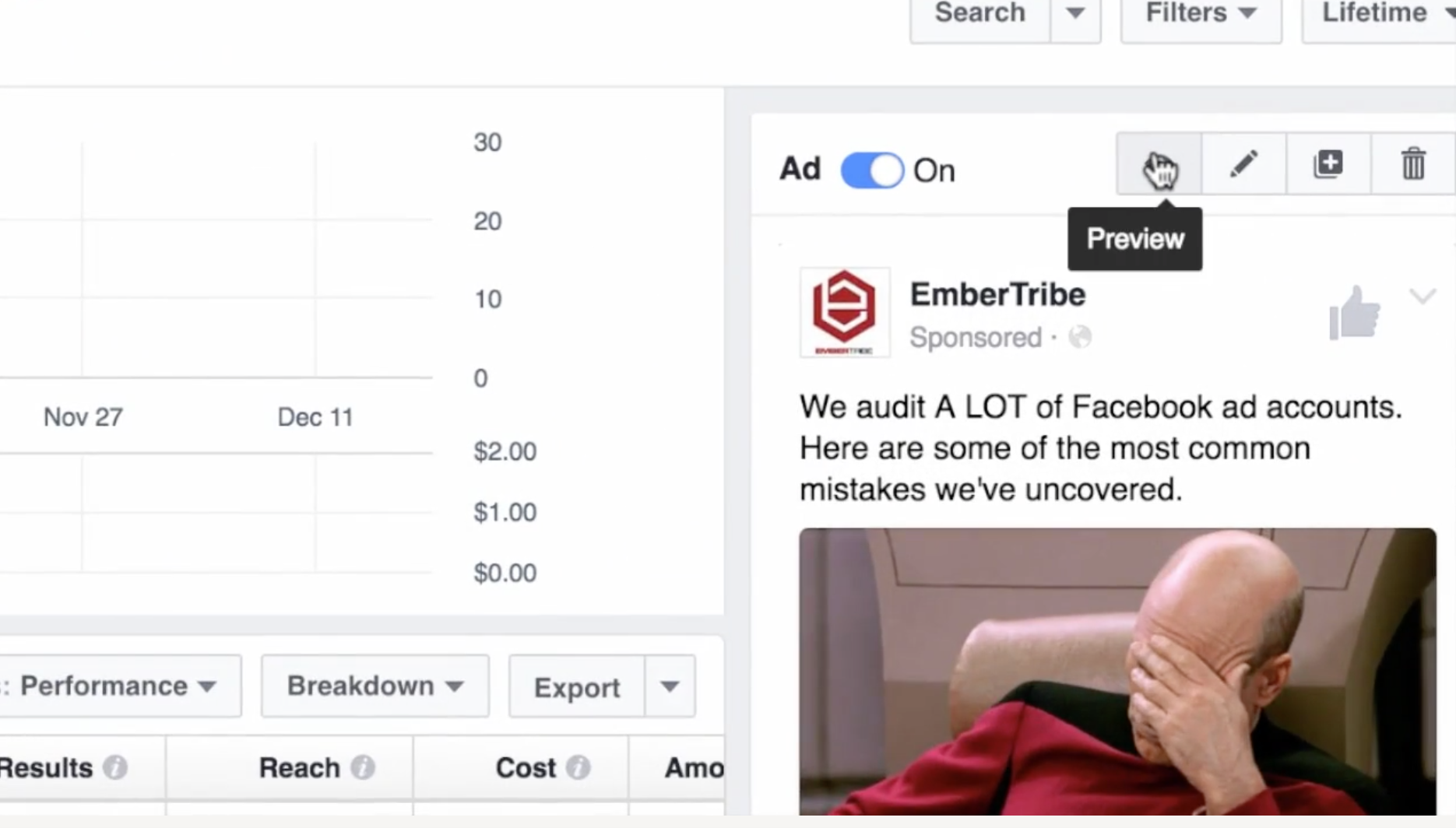
Okay that this point, scroll down and click the link where it says View Post Permalink with Comments. Okay, (step two) the next thing that you're gonna do is go down here.
You're going to see where people have liked or engaged with your ad.
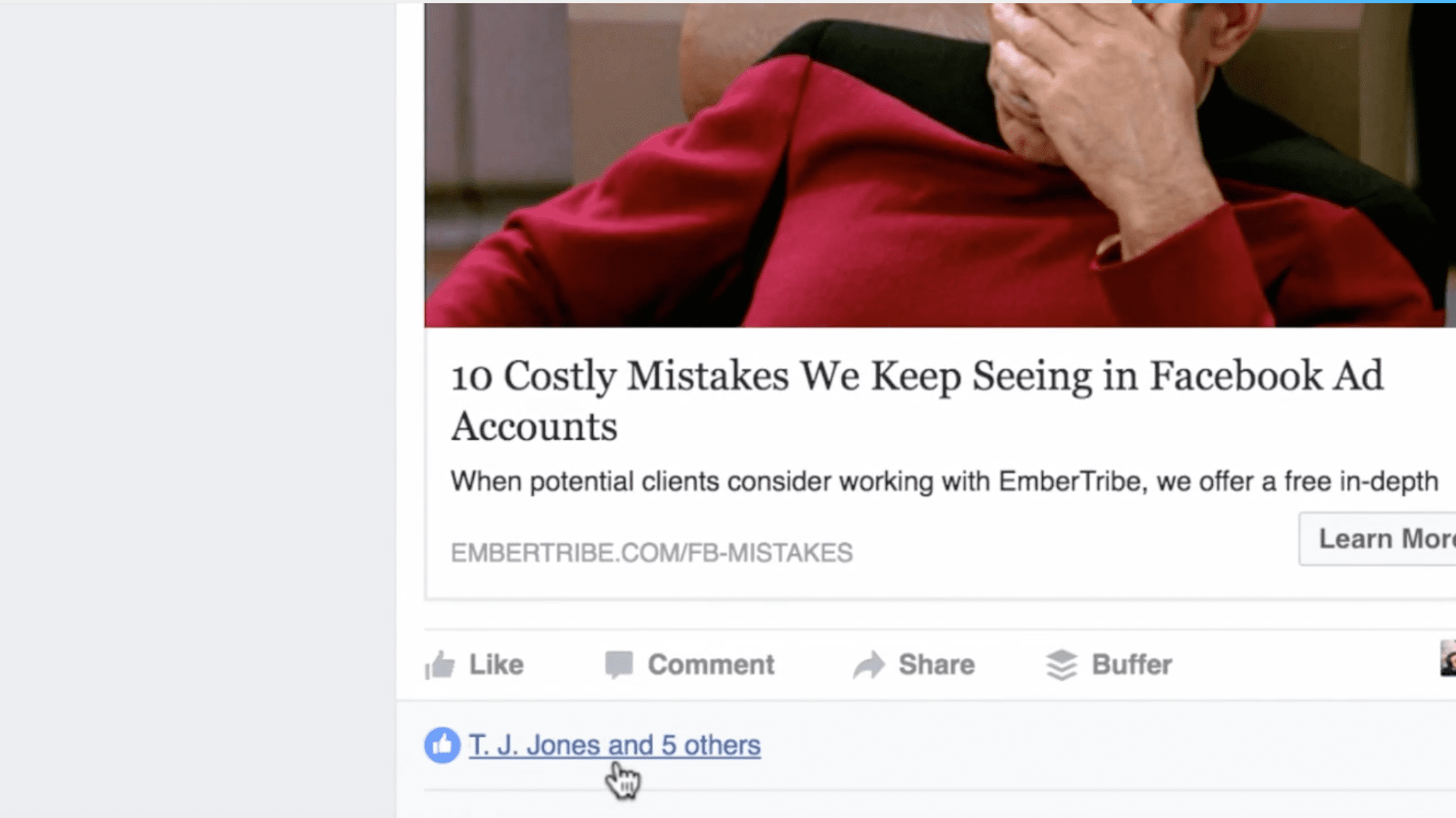
Now step three, there's an option here to invite the people who have liked this post.
Now here's the beauty of this; you might have paid for the ad to get it out there and to get it in front of people, but inviting people to like your page is actually completely free.
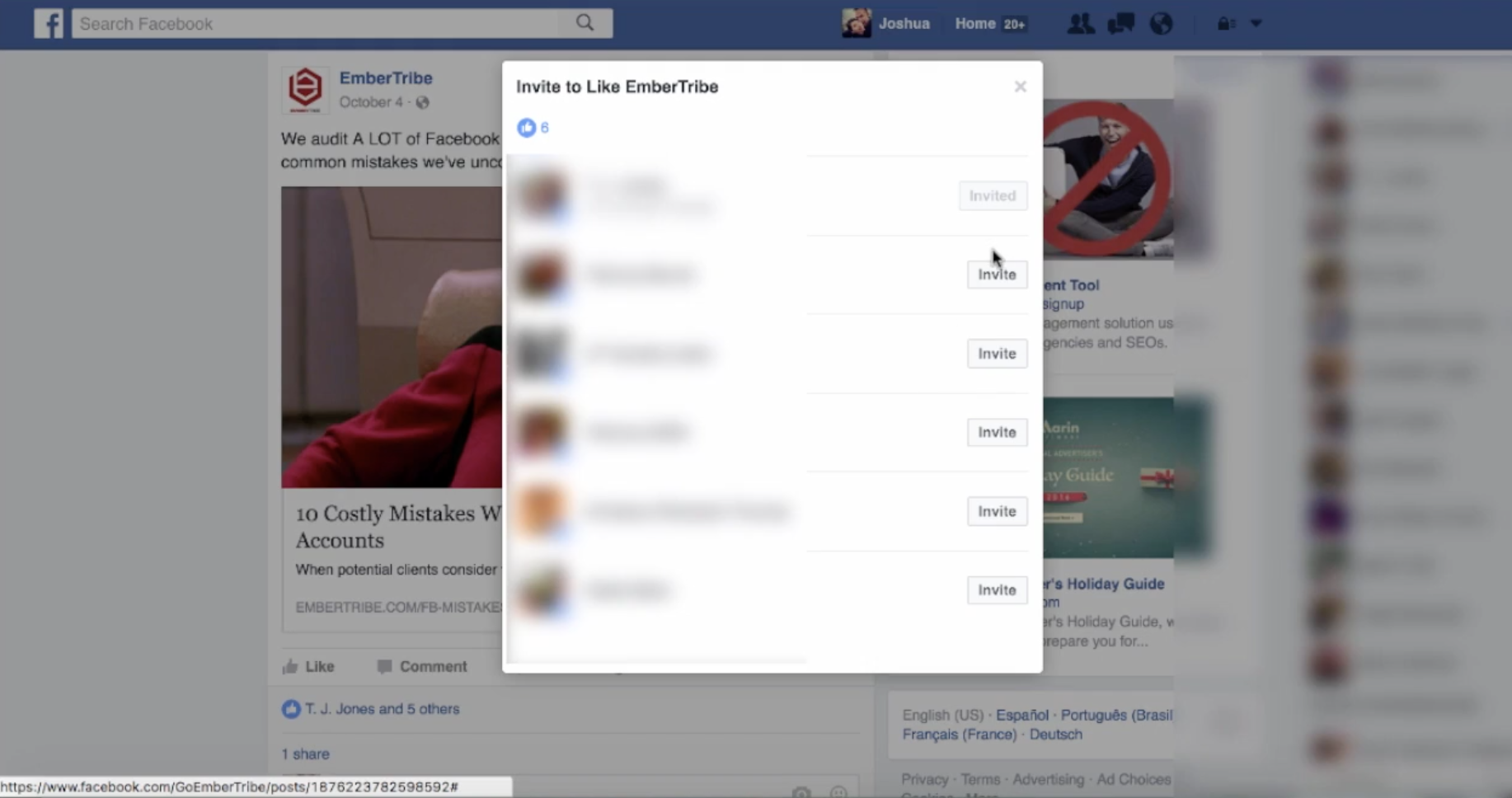
Now great, six people, big deal. We attracted some new followers to the page, but what if you have an ad that you run for a lot longer and say there's like a thousand or so people who liked it?
Well now you can go through and start inviting all sorts of people who have engaged with your ad and showed interest in the content that you're sharing. When you've built up a decent amount of social proof (which is basically digital advertising gold), you can reuse that ad with social proof for different audiences.
So use this tactic to make the most out of your Facebook advertising by inviting people for free to your site to like your page.
Growing up, I loved visiting my grandparents out in the country.
One humid August afternoon, I grabbed a pail and headed out to the farm. It was blueberry season. If I could bring back enough blueberries to Grandma's kitchen, it would turn into pie (aka a slice of heaven on earth).
So I picked blueberries like a madman that day, furiously grabbing at the bushes. But no matter how hard I worked, the pail would barely fill.
It was far too late before I noticed the quarter-sized hole in my pail. A cluster of blueberries trailed behind me, never to be recovered again.
Here's a troubling fact: 95% of the visitors who reach your website will never come back again.
That's not a quarter-sized hole in your pail, it's a crater.
Of course, the 95% rule will vary depending on your industry. If you want a quick gut check on where you stand, just open up your Google Analytics profile and look at the ratio between new/returning visitors.
Wherever the numbers fall for your site, the story is probably the same: the majority of people aren't coming back.
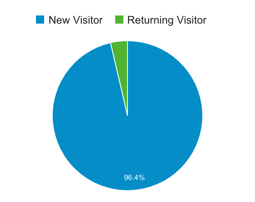
You've worked so hard to drive traffic to your site. Furiously writing content, hustling on social media and even paying for visitors.
But that hard work is wasted when users visit your site, don't convert, then leave and never come back.
Most marketers make the mistake of treating their visitors as a "disposable audience". Our answer to losing 95% of our blueberries is to...pick more and more blueberries.
There's a better way to fix this problem and it can lead to explosive growth for your business.
Retargeting is a tool that's been around for awhile now, but a lot of marketers still haven't put it into practice.
Retargeting, also known as "remarketing", is a way to stay in front of your prospective customers with display ads that follow them around the web.
Ever shop online? You've probably been retargeted. Let's say you've been window shopping for a new laptop. Somehow, magically, that same laptop starts showing up in your Facebook news feed, on the sidebar of some random blog you're reading, etc.
It's not a coincidence, it's retargeting!
There are two ways to approach retargeting:
Site-Based: Site-based retargeting is the most common approach. When a user visits your site, they are "tagged" (cookied) through a pixel provided by a retargeting platform. Once a user is tagged, you'll be able to serve them ads throughout a broad network of websites and apps.
The beauty of this approach is that you can set up refined campaigns based on the pages that users did (or didn't) view. For example, a user reached a checkout page but did not complete their order.
Why didn't they buy? Maybe they didn't have their credit card on hand, maybe they ran out of time, maybe they wanted to shop around. Whatever the reason, retargeting gives you a second, third, fourth chance to close the deal.
List-Based: List-based retargeting is also known as "custom audience targeting" and "CRM Retargeting". Unlike site-based retargeting, which targets visitors of specific pages on your site, list-based retargeting uses email addresses.
With site-based retargeting, users are tagged directly when they interact with your site. With the list-based approach, a retargeting vendor will use a network of data partners to tag a user based on their email address.
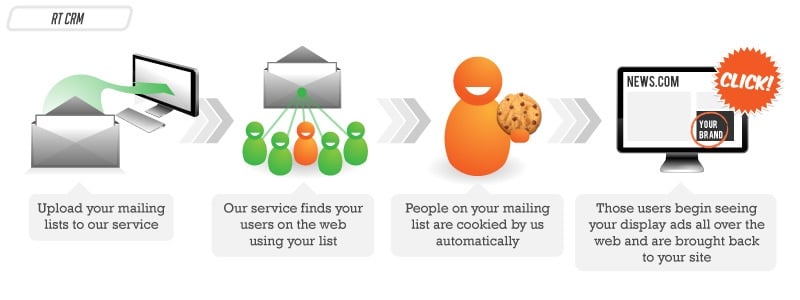
Image credit: Retargeter
The applications are endless. Do you want to re-awaken cold leads that haven't visited your site in awhile? Segment your list and get back in front of them. Want to up-sell existing customers or advertise a complementary product? List-based retargeting is a powerful tool at your disposal.
Retargeting isn't just a tactic to increase sales. It can be used to build brand awareness and amplify your content marketing efforts.
A key ingredient to building trust with your audience is to get repeat visits to your site. The more value you can provide with free content upfront, the more people will trust your brand.
Larry Kim of Wordstream implemented retargeting to re-engage their blog visitors. They saw a 50% lift in repeat visits once retargeting ran its course.
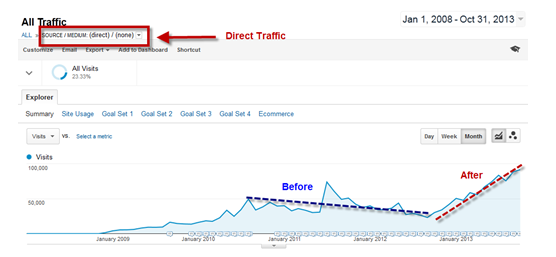
Site-based retargeting is a powerful way to re-engage your audience. If your blog is organized by categories in the URL, like, "YourDomain.com/blog/PPC/Blog-Post", it's easy to create retargeting rules that promote new content to past site visitors based on what they've read previously.
For example, create a retargeting rule that serves ads to visitors who read anything on your blog in the "PPC" category over the last 90 days. Did you just publish a new blog post that fits into that category? Serve ads to those audience segments and jumpstart traffic to your post.
Worried about breaking the bank for something that doesn't necessarily have a direct impact on sales?
Good news. Getting people back to your site is typically less expensive than getting them there in the first place. I say "typically", because costs will vary between ad exchanges and there's always an exception to the rule.

⏱️ This post is part of a blog series, “Great Scott! The Future of Marketing is...” that will answer questions about marketing trends from emerging technologies to changing views about the role and purpose of marketing.
From the Four Ps to the Four Es: Time to Remix the Traditional Marketing Mix
In 1960, Xerox introduced the first photocopier, minimum wage was $1, and cassette tapes were on the verge of being invented. Our phones were rotary, our news was delivered by hand, and milk men were heartily employed.
It was also the year that marketer and academic E. Jerome McCarthy introduced the Four P’s—product, price, place, and promotion—in his book Basic Marketing: A Managerial Approach. This foundational text has been taught in university marketing courses ever since, leading to widespread acceptance of the Four P’s as the pillars of a solid marketing framework.
Considering milk men and cassette tapes feel several lifetimes behind us, it’s not hard to fathom that this paradigm might be in need of a face lift (which interestingly, has been around since 1916).
McCarthy’s first P, product, refers to the tangible good or intangible service being sold to consumers. Marketers must have a solid grasp on their product’s value, strengths, and weaknesses. What makes your product unique? Can you find it on every street corner? How will you stand out from the competition?
Long considered to be the primary driver of sales, price impacts everything from profit margins to perception and is particularly important if you’re entering into a crowded market, which almost everyone is.
Place is the physical or digital location where your product can be purchased, and promotion refers to the ways in which you disseminate information about your product.
In 2009, thought leader and CEO of Ogilvy & Mather, Brian Fetherstonhaugh, proposed a new formula that replaces the Four P’s with the Four E’s—experience, exchange, every place, and evangelism—repositioning the marketing framework to center around delivering meaningful value to the customer.
In Fetherstonhaugh’s new model, experience is the new product. It’s no longer enough to simply fill the need provided by the product itself. Today’s consumer is looking to buy an experience, and every moment they invest in your brand factors into their ultimate satisfaction. This is especially true for e-commerce and SaaS companies, whose interactions and customer service form the basis of the product itself.
Fetherstonhaugh posits that price has been replaced by exchange. So much is offered for free today that brands cannot depend on price alone. Price now represents an exchange for value, and that value includes the entire customer journey experience, before and beyond the point of purchase.
Thanks to the most transformative invention of our lifetimes (hint: you’re holding it), place becomes every place. We live in an era of immediateness, where almost anything is obtainable from the palm of our hand and deliverable to our doorstep within hours to days. Brands need to meet customers where they’re at, whether that be a physical location or online via your website, social media, or other channels.
In 1960, promotion meant utilizing various channels controlled by large media organizations. Today, promotion is replaced by evangelism. Depending on their following, any one of your customers holds the same power to reach the masses. Social media has granted word-of-mouth marketing unlimited potential. Marketers must embrace customers’ power and inspire them to be ambassadors for the brand.
The silver lining to this new power dynamic? If marketers provide a valuable experience with a meaningful exchange and meet customers where they’re at, placing a megaphone in their hands is a good thing. Transparency is welcomed by those who have nothing to hide. And similar to earned versus paid media, positive testimonials carry more weight. One study found that online reviews impact 67.7% of respondents' purchasing decisions.
What’s the takeaway here? The future of marketing can be summed up with an age-old mantra: the customer is king. Scratch that: customer-generated content is king, and if you execute the Four E’s correctly, you’ll reign supreme.
Amazon has become the default launchpad for many small to medium-sized ecommerce brands looking to get products in front of buyers quickly. The marketplace's massive reach, built-in logistics infrastructure, and consumer trust make it an attractive starting point. But that convenience comes with trade-offs that many sellers do not fully appreciate until they are deep into the platform.
Selling directly to consumers (D2C or DTC) offers a fundamentally different model. One where you own the customer relationship, control the brand experience, and retain the data that drives long-term growth. Understanding the real differences between these two approaches is essential for building a sustainable ecommerce business.

Amazon offers two seller plans: Professional and Individual. Both carry subscription fees plus per-item selling fees on every transaction. Sellers can handle their own fulfillment or opt into Fulfillment by Amazon (FBA), which adds another layer of fees for picking, packing, shipping, and returns handling.
FBA does solve real operational headaches. Returns processing, customer service for shipping issues, and Prime badge eligibility are genuine advantages. For brands without established logistics capabilities, these services can be the difference between scaling and stalling.

But the costs extend far beyond fees. Here is what many Amazon sellers do not account for:
Most ecommerce brands frame this as an either-or decision, but the real question is about strategic emphasis and resource allocation. Understanding the strengths and limitations of each model helps you make informed decisions about where to invest.
Amazon's strengths are undeniable for certain use cases:
The limitations become more significant as your brand matures:
Direct-to-consumer selling provides advantages that compound over time:
The D2C model is not without its challenges:
The most sophisticated ecommerce brands do not choose one channel exclusively. They use Amazon strategically while building their D2C business as the primary growth engine.
Here is how a hybrid strategy works in practice:
Amazon can serve as a product discovery and validation channel. New products can be tested on the marketplace to gauge demand, collect reviews, and generate initial revenue while your D2C infrastructure scales.
Once a customer discovers your brand, the goal is to move that relationship to your owned channels. This is where packaging inserts, brand registry content, and post-purchase strategies become critical. Every Amazon sale should be viewed as an opportunity to earn a future D2C customer.
Early-stage brands might allocate 70% of resources to Amazon for immediate revenue and 30% to building D2C infrastructure. As the D2C channel matures, that ratio should shift. Mature brands often target an 80/20 split favoring D2C, using Amazon primarily for incremental reach.
Track profitability by channel, not just revenue. Many brands discover that their Amazon revenue looks impressive on the top line but delivers minimal profit after accounting for all fees, advertising costs, and operational overhead. That analysis often accelerates the shift toward D2C investment.
If you are ready to invest in direct-to-consumer growth, these are the foundational elements that drive results:
Your website is your most important asset. It needs to load fast, communicate your value proposition clearly, and guide visitors through a frictionless purchase experience. Platforms like Shopify, BigCommerce, and WooCommerce provide the infrastructure. Your job is to optimize the experience through testing and iteration.
Paid social advertising is the fastest way to drive qualified traffic to a D2C storefront. Start with the platforms where your target audience spends time, test creative aggressively, and scale what works. Build lookalike audiences from your best customers and use retargeting to capture visitors who did not convert on the first visit.
Every visitor who gives you their email address represents a relationship you own. Unlike Amazon customers, these contacts can be nurtured through email sequences, product launch announcements, and personalized offers that drive repeat purchases and increase lifetime value.
Organic traffic through content marketing and SEO is the long-term play that reduces your dependence on paid channels. Create content that addresses your audience's questions, showcases your products in context, and builds the topical authority that drives sustainable search traffic.
Subscription-based models and loyalty programs create predictable revenue and increase customer lifetime value. For consumable products, subscriptions are an obvious fit. For durable goods, loyalty programs with early access, exclusive products, or referral rewards can drive similar retention outcomes.

You should not abandon Amazon overnight. But you should start building your D2C channel with the same urgency you brought to your marketplace presence. The brands that thrive long-term are the ones that own their customer relationships, control their brand experience, and build the data assets that enable smarter marketing decisions over time.
The path from Amazon-dependent to D2C-primary is not instant, but every step in that direction builds equity in a business you fully control. Start with a solid storefront, invest in acquiring customers directly, and use the data you collect to continuously optimize your cash flow and growth runway.

The question is not whether you should sell on Amazon or go D2C. The question is how quickly you can build a direct channel strong enough that Amazon becomes optional rather than essential.

There is a phrase we repeat often at EmberTribe: always be testing.
Testing, especially structured, methodical testing, is the foundation of sustainable marketing performance. The most effective growth marketing strategies are built on the scientific method applied to advertising: develop a hypothesis, design a test, analyze results, and iterate based on data.
This approach stands in direct contrast to the "set it and forget it" mindset that plagues most advertising programs. Running ads without a structured testing framework is essentially gambling with your budget. You might get lucky, but you cannot replicate luck, and you cannot scale what you do not understand.

Growth marketing relies on repeatable processes to develop hypotheses, discover results, draw conclusions, and iterate on findings. This is smart testing, and the five case studies below demonstrate exactly how it translates into measurable business results.
Before diving into the case studies, it is worth understanding why most paid advertising programs fail to reach their potential.
The typical approach looks like this: a brand creates a handful of ads based on internal assumptions about what will resonate, launches them with broad targeting, and waits for results. When performance is mediocre, the response is usually to increase budget or swap in new creative, again based on assumptions rather than data.
Smart ad testing takes a fundamentally different approach. It treats every campaign as an experiment with controlled variables:
By isolating and testing these variables systematically, you move from guessing to knowing. The following case studies illustrate what happens when brands commit to this methodology.
Result: Second highest sales day ever, trailing only Black Friday
Read the full case study here.
A gift and accessories brand came to EmberTribe looking to expand its cold audience reach ahead of a major new collection launch. Rather than relying on a single creative concept and hoping it would land, we built a systematic testing program.
The approach: We launched multiple campaign ads spanning a variety of messaging angles, from product-focused to lifestyle-oriented to value-driven. Each angle was tested against distinct audience segments to identify which combinations of message and audience produced the strongest engagement and purchase signals.
The insight: The winning creative was not the one the brand's internal team would have predicted. Testing revealed that a specific messaging angle resonated far more strongly with cold audiences than the brand's default positioning.
The result: Armed with this data, we rapid-tested ads for the new collection launch to identify winning creative before committing significant spend. The launch produced the brand's second highest sales day in company history, surpassed only by Black Friday, a day with built-in consumer demand.
Key takeaway: Testing before a major launch reduces risk and amplifies results. The cost of running test campaigns is a fraction of the cost of launching with the wrong creative and wasting your biggest promotional window.
Result: 8.77x return on ad spend
Read the full case study here.
A sports coaching subscription service faced a common challenge: they could not find enough qualified audiences on Facebook to validate their advertising strategy. Their target market was real, but conventional interest-based targeting was not surfacing it.
The approach: Instead of assuming we knew the audience, we treated audience discovery as the first testing objective. We began running traffic across multiple targeting approaches to identify which generated the best engagement signals and build the brand's Pixel data from scratch.
The insight: Lead generation campaigns offering valuable content (an ebook) proved to be the most effective audience-building mechanism. Each download gave us conversion data that refined our targeting further, creating a compounding improvement loop.
The result: By continuing to optimize ads for audience definition, urgency messaging, and cost efficiency, the campaign achieved 8.77x ROAS, an exceptional return for a subscription-based service with a niche audience.
Key takeaway: When your target audience is difficult to identify through standard targeting options, use testing as a discovery tool. Let the data reveal your audience rather than forcing assumptions onto the platform. This approach is especially valuable for brands with unique value propositions that do not fit neatly into predefined interest categories.
Result: 2.71x ROAS through targeted audience refinement
Read the full case study here.
A children's clothing boutique had a strong product but faced a significant challenge: their price point was higher than most competitors in the children's wear market. Generic audience targeting was attracting price-sensitive shoppers who were unlikely to convert at premium pricing.
The approach: We extensively tested creative formats for cold audiences segmented by interests, behaviors, and lookalike profiles. But the real breakthrough came from restructuring the strategy entirely, moving from broad reach campaigns to a testing-and-refining approach focused on smaller, highly targeted audience segments.
The insight: Consistent retargeting of all engaged users proved to be a critical component. Visitors who had already interacted with the brand but had not purchased needed multiple touchpoints before converting at the higher price point.
The result: The combination of refined cold audience targeting and persistent retargeting delivered 2.71x ROAS, transforming what had been a traction-focused campaign into a genuine revenue driver.
Key takeaway: Premium products require a different testing methodology than commodity products. Price-sensitive audiences need to be filtered out early, and retargeting becomes essential to convert the qualified prospects who need more time and exposure to justify a higher purchase price.
Result: 400,000 unique user sign-ups per month
Read the full case study here.
This client needed to scale user acquisition through Facebook traffic, but the target audience, competitive landscape, and optimal messaging were all unknowns at the start of the engagement.
The approach: EmberTribe began with extensive market research, analyzing the client's target audience, competitors' advertising campaigns, and competitors' content strategies. This research informed the initial hypotheses that guided the first round of testing.
The insight: Creating and testing hundreds of ad variations was necessary to find the winners. The process was not about creating one perfect ad. It was about systematically eliminating underperformers and iterating on the elements that showed traction.
The result: Through continuous testing, iteration, and scaling of winning combinations, the campaign scaled to 400,000 unique user sign-ups per month. This kind of scale is only achievable when you have a testing framework that identifies what works and enables confident budget allocation.
Key takeaway: Scale requires volume testing. You cannot find the winning ad combinations by testing five or ten variations. Systematic testing of hundreds of variations across audience, creative, and copy variables is what separates campaigns that plateau from campaigns that scale. A strong ad creative testing framework is the foundation of scalable acquisition.

Result: 300% lift in revenue compared to the previous period
Read the full case study here.
A high-end lingerie brand needed to communicate product fit, a critical purchase factor, through digital advertising. Static images alone could not convey the comfort and quality that differentiated the brand from competitors.
The approach: We focused testing on video content showing models moving in the products, combined with testimonials, social proof from awards, and concise copy addressing the discomfort that many consumers associate with the product category.
The insight: Our team tested and iterated extensively across multiple creative formats including dynamic broad reach targeting, single images, videos, carousels, and Dynamic Product Ads (DPAs). The video-first approach consistently outperformed static creative, but the specific combination of video format, testimonial integration, and copy framing required significant testing to optimize.
The result: The testing program delivered a 300% lift in revenue compared to the previous period, proving that creative format testing is as important as audience testing for brands where product experience drives the purchase decision.
Key takeaway: When your product's key differentiator is experiential (fit, feel, taste, usability), video creative that demonstrates that experience will likely outperform static imagery. But you still need to test the specific execution: format, length, messaging angle, and proof elements.
Across all five case studies, the winning formula is consistent:
You do not need a massive budget to start testing smarter. Begin with these fundamentals:
The brands that treat advertising as a discipline, grounded in structured experimentation rather than creative guesswork, are the ones that consistently outperform. These five case studies prove it, and the methodology is available to any brand willing to commit to the process.
Tracking every dollar you spend on Facebook advertising is not optional -- it is foundational to running profitable campaigns. Your Facebook ads receipt is the primary record of what you paid, when you paid it, and which campaigns drove those charges. Whether you need receipts for accounting, tax documentation, or performance analysis, knowing where to find them and how to interpret them is critical.
This guide walks you through accessing your Facebook ad receipts in Ads Manager, reading the billing summary and transaction history, and using that data to calculate and improve your return on investment.
A Facebook ads receipt is a detailed billing document generated by Meta that records every advertising transaction on your account. Each receipt includes the campaigns that incurred charges, the total amount spent, applicable taxes, payment method used, and the date of each transaction.
Receipts differ from your Ads Manager performance reports. While performance reports show metrics like impressions, clicks, and conversions, your receipt focuses specifically on the financial side -- what was charged, when, and how. Together, these two data sources give you a complete picture of campaign economics.
There are several concrete reasons to review your receipts on a consistent schedule:
If you are managing ad spend across multiple campaigns or clients, systematic receipt review becomes even more important. This is especially true for agencies and ecommerce businesses scaling their Facebook ads across product lines.
Accessing your receipt takes just a few steps inside Meta Ads Manager. Here is the process:
Log into your Facebook account and open the Ads Manager dashboard. In the left-hand sidebar, look for the Billing section (sometimes listed under Payment Settings depending on your account type). Click on it to access all payment-related settings and records.
Within the Billing section, click on Payment History. This view displays a chronological list of every transaction processed against your ad account. Each entry shows the transaction date, the amount charged, and the payment method used.
To download an individual receipt, locate the specific transaction in your payment history and click the Download link or receipt icon next to it. Facebook generates a PDF receipt that includes a full breakdown of charges, taxes, and payment details.
You can also set a custom date range to view receipts for a specific billing period. This is particularly useful when you need to pull receipts for monthly accounting, quarterly reporting, or tax preparation.
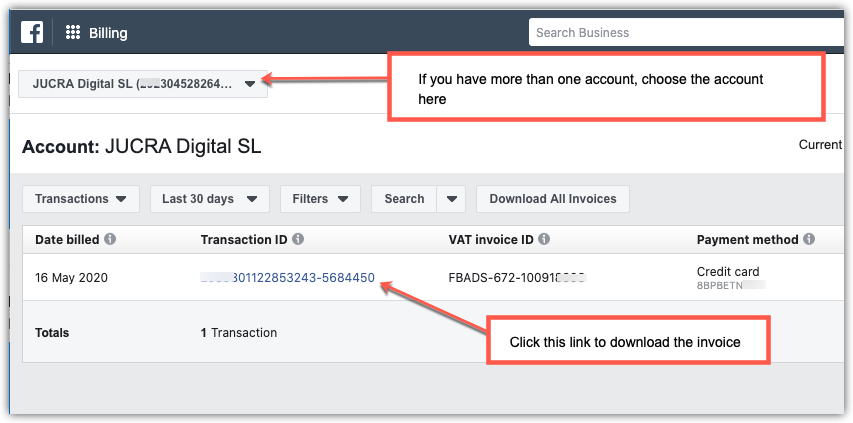
Facebook can also send receipt notifications to the email address associated with your ad account. To verify this is enabled, check your Notification Settings within the Ads Manager. If you need to forward receipts to an accountant or bookkeeper, ensure that your notification preferences include billing-related emails. You can then set up email forwarding rules to automatically route receipt emails to the appropriate team member.
For businesses managing multiple ad accounts, consider exporting receipts in bulk by selecting a date range in the Payment History view and downloading all transactions at once.
Once you have your receipt, understanding what it tells you is the next step. The billing summary section at the top of each receipt provides a high-level overview of your charges.
Below the billing summary, the transaction history provides a line-by-line breakdown of individual charges. Each entry includes:
This level of detail is critical for identifying which campaigns are consuming the most budget and whether that spend is justified by results. Cross-referencing transaction amounts with your campaign performance data reveals whether high-spend campaigns are also your highest-performing ones.
Beyond downloading receipts, there are several ways to monitor your total Facebook ad spend:
For teams that need spend visibility across multiple accounts, the Meta Business Suite provides an aggregated view of billing and payment data across all ad accounts within a business portfolio.
Your receipt tells you what you spent. Calculating return on investment tells you whether that spend was worth it.
The standard formula for return on investment is:
ROI = (Revenue - Cost of Ads) / Cost of Ads x 100
For example, if you spent $2,000 on Facebook ads and generated $8,000 in revenue directly attributable to those ads, your ROI would be:
($8,000 - $2,000) / $2,000 x 100 = 300% ROI
This means you earned $3 for every $1 spent on advertising.
Return on investment and return on ad spend are related but distinct metrics.
A campaign with a 4x ROAS means you earned $4 in revenue for every $1 in ad spend. But that does not account for the $500 you paid a designer for the creative or the monthly fee for your analytics tools. ROI gives you the complete profitability picture.
Understanding the distinction between these metrics is essential for making sound budget decisions. For a deeper look at why ROAS alone can be misleading, see our guide on going beyond ROAS for ecommerce brands.
To calculate ROI accurately, you need to connect your receipt data (the cost side) with your revenue data (the return side). Here is how:
A positive ROI is the starting point. Consistently improving it requires disciplined optimization.
Not every campaign deserves equal budget. Review your receipts and performance data together to identify:
Reallocating budget from underperforming campaigns to proven winners is one of the fastest ways to improve overall account ROI. For specific tactics on managing budget at scale, review our guide on scaling Facebook ads without killing performance.
Ad spend efficiency is directly tied to audience quality. Poor targeting means your budget reaches people who are unlikely to convert. Focus on:
Even with precise targeting, your ROI will suffer if your creative does not convert. Test variations of headlines, images, and calls to action systematically. Ensure that your landing pages match the promise of your ad and that the path from click to conversion is as short as possible.
If your campaigns are generating clicks but not conversions, the problem often sits on the landing page rather than in the ad itself. Review your Facebook ad strategy to diagnose common failure points.
Your Facebook ads receipt is more than a billing record -- it is a performance tool. By regularly accessing your receipts through Ads Manager, reading the billing summary carefully, and connecting that cost data to revenue outcomes, you gain the clarity needed to make better allocation decisions.
Calculate your ROI at the campaign level, not just the account level. Compare your ROI and ROAS metrics to understand true profitability. And use the spend data from your receipts to continuously shift budget toward what works.
The advertisers who treat receipt analysis as part of their optimization workflow -- not just a bookkeeping task -- are the ones who consistently improve their return on every dollar spent.


.svg)