

Most B2B advertisers default to Google Ads as their primary search advertising channel. It is the largest search platform, it has the most sophisticated tooling, and it is where the majority of search volume lives. But this default behavior creates an opportunity that many B2B marketers overlook entirely: Microsoft Advertising (formerly Bing Ads).
Microsoft Advertising consistently delivers lower costs per click, less competition, and access to a high-value professional audience that skews toward exactly the decision-makers B2B brands need to reach. For advertisers willing to look beyond Google, Microsoft's platform offers one of the best risk-adjusted returns in paid search.
The single most compelling reason for B2B advertisers to invest in Microsoft Advertising is audience composition. Microsoft's search network benefits from deep integration with the enterprise software ecosystem that dominates corporate America.
Microsoft still holds significant market share in enterprise environments where IT departments control browser and search engine defaults. In many corporate settings, employees use Edge as their primary browser with Bing as the default search engine. This is not a matter of consumer preference. It is a function of enterprise software policy.
This means that when a procurement manager researches software solutions, when an operations director evaluates service providers, or when a C-suite executive investigates strategic tools, there is a meaningful probability they are doing that research through Bing. These are exactly the high-value searchers B2B advertisers need to reach.
Microsoft Advertising's user base skews toward higher household incomes compared to the general search population. For B2B advertisers selling premium solutions, professional services, or enterprise software, this demographic alignment means your ads reach people with both the authority and the budget to make purchasing decisions.
Microsoft's acquisition of LinkedIn created a unique targeting capability that Google cannot replicate. Through Microsoft Advertising, B2B advertisers can layer LinkedIn profile data, including company, industry, and job function, onto their search campaigns. This means you can bid more aggressively when a searcher matches your ideal customer profile, or exclude searches from industries or roles that are unlikely to convert.
This integration is a game-changer for B2B lead generation. No other search platform offers this level of professional demographic targeting within the search environment.
Beyond audience quality, the economics of Microsoft Advertising work strongly in B2B advertisers' favor.
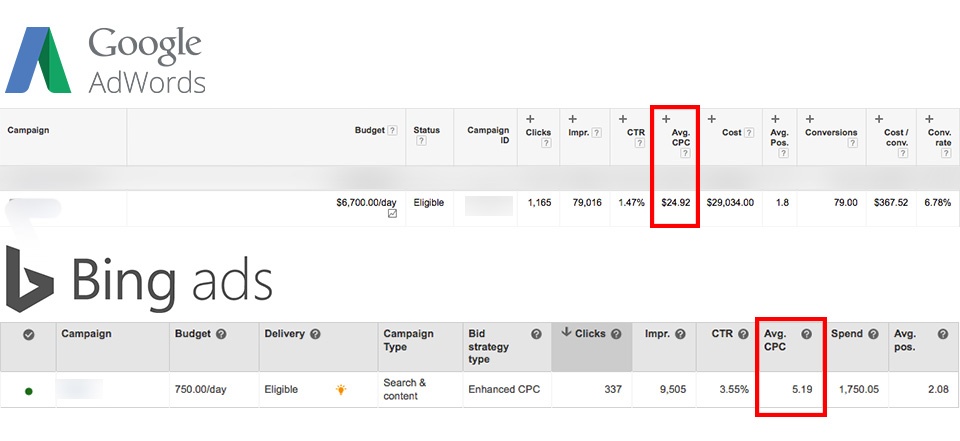
Because most advertisers default to Google, Microsoft Advertising sees significantly less competition for the same keywords. Fewer advertisers bidding on the same terms means lower costs per click across the board. For competitive B2B keywords where Google CPCs can exceed $20-50 per click, the savings on Microsoft's platform can be substantial.
This reduced competition also means higher ad positions are more accessible. On Google, achieving a top position for competitive B2B terms often requires aggressive bidding that eats into margins. On Microsoft, the same top positions are achievable at a fraction of the cost.
Microsoft Advertising consistently delivers lower CPCs than Google Ads for equivalent keywords. For B2B advertisers where search volumes are already lower and each click carries significant value, this cost efficiency directly improves the economics of your lead generation funnel.
When you combine lower CPCs with the platform's professional audience composition, the cost per qualified lead often outperforms Google significantly. The leads may be fewer in total volume, but the quality and cost efficiency frequently make Microsoft Advertising the higher-ROI channel.
B2B advertising budgets are often more constrained than B2C budgets. Microsoft Advertising's lower costs allow smaller budgets to go further, making it an ideal channel for B2B SaaS companies and professional services firms that need to maximize every dollar.
Microsoft Advertising offers several platform features that provide distinct advantages for B2B campaign management.
In Google Ads, managing campaigns across multiple business locations requires either grouping all locations into a single campaign or creating separate campaigns for each location. Microsoft Advertising offers a more flexible approach: you can run a single campaign with ad groups broken out by location. This simplifies account management while maintaining the geographic granularity that multi-location B2B businesses need.
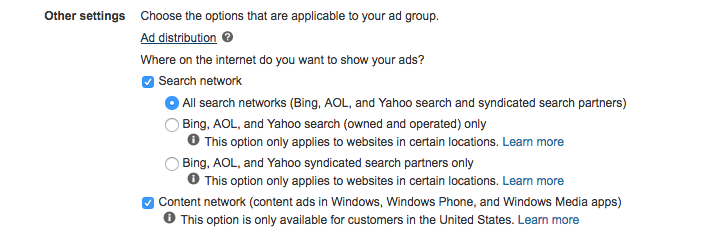
Both Google and Microsoft distribute ads across search partner networks, but they handle transparency differently. Microsoft lets you choose which search partners to include and provides transparent reporting on where your ads appear. You can specifically opt into or out of properties like Yahoo and AOL, and you can see exactly which partners are delivering results.
Google, by contrast, bundles search partners without giving advertisers the ability to select or exclude specific properties, and its reporting on partner performance is less granular.
If you are already running Google Ads campaigns, Microsoft makes it straightforward to import your existing campaign structure, keywords, and ads directly into the platform. This reduces the barrier to entry significantly. You can have a Microsoft Advertising campaign live within hours, using your proven Google Ads structure as the starting point, and then optimize from there based on Microsoft-specific performance data.
Microsoft's Audience Network extends your reach beyond search into native placements across Microsoft-owned properties including MSN, Outlook.com, and Edge. For B2B advertisers, these placements reach professionals during their workday browsing, creating additional touchpoints with your target audience outside of search intent moments.
Getting started with Microsoft Advertising for B2B lead generation follows a structured process.
Start by importing your top-performing Google Ads campaigns. This gives you a proven foundation. Then review and adjust keyword bids downward, since Microsoft's lower competition typically means you can achieve comparable positions at reduced bids.
Apply LinkedIn profile targeting to your campaigns. Start with job function and industry targeting that aligns with your ideal customer profile. Monitor performance by segment and adjust bids to allocate more budget toward the profiles that generate qualified leads.
B2B campaigns should optimize for lead quality, not just lead volume. Set up conversion tracking that captures not just form submissions but downstream indicators of lead quality. Use this data to inform bid adjustments and audience targeting refinements over time.
Once your core campaigns are performing, test expansion into Microsoft's Audience Network, experiment with additional keyword themes, and iterate on ad copy to improve conversion rates. Apply the same structured testing methodology that drives results in any paid channel.
When evaluating Microsoft Advertising performance for B2B, focus on metrics that reflect lead quality and pipeline impact:
These metrics provide a more accurate picture of channel value than surface-level indicators like click-through rate or raw conversion volume.
Microsoft Advertising should be a standard component of any serious B2B search advertising program. The combination of a professional audience, lower competition, reduced costs, and unique LinkedIn targeting capabilities creates a channel that consistently delivers high-quality leads at favorable economics.
The platform is not a replacement for Google Ads. It is a complement that extends your reach into an audience segment that many competitors ignore entirely. For B2B advertisers, that neglected audience often includes the exact decision-makers you need to reach.
Start by importing your existing Google Ads campaigns, layering LinkedIn targeting, and measuring performance against lead quality metrics rather than volume alone. The results will likely make a compelling case for increasing your Microsoft Advertising investment as a core pillar of your B2B growth marketing strategy.

Don't let your old content go to waste.
Building a content inventory can help you build better funnels, boost your retargeting campaign efforts and better learn your audience. Fill in your content gaps with this quick and easy strategy.
Every marketer needs to have a content inventory. Basically a lay of the land of all the content that you have in your website, that can turn visitors into customers.
I want to show you how to build one of those today in 10 minutes or less.
What it's gonna do is it's going to let you build better funnels, have a more strategic retargeting campaign for your paid acquisition stuff, and really just get a better handle on who you're speaking to and where you have gaps in your content already.
Okay, so let's get to building this content inventory real fast, probably take us 10 minutes or less.
If you're like me or my team, we'll forget often, about how much content we already have on our website. So that when we go to build a funnel, or we go to build an email automation, we forget that we already have some really great stuff that we could be using, and instead just start trying to create new stuff.
Let's take a look at how to do this. The first thing you need to know is I'm building this tutorial for WordPress users, but a very similar type of thing can be repeated, no matter what platform you're on.
The first thing that you're gonna wanna do, if you're on WordPress, is to go to this plugin. You can search for it in the plugin section of your WordPress instance, but I'm using WP CSV.

Now, what this is going to do is export all of your posts into a spreadsheet format.
There's another plugin here, too, that you can use, Phimind Excel Export Plus. Just do a search for "posts to CSV," and you'll find a bunch of different solutions. But I'm gonna show you how to use WP CSV.
This is already installed on our side, and what you're gonna do is go to the plugin, go to settings, and this screen will come up.
Now you're going to choose filters. I chose to exclude all. And what this is doing is it's essentially saying, "Listen, we don't want all this other junk from WordPress," like attachments or actual pages on our site. "I just want posts."
So exclude everything, but then just deselect the option for publish, because that's the one thing we want is posts that are published.
After you've done that, you can basically go back and run this. Save it and run it, and it's gonna export a CSV of all your posts. It's gonna look something like this.
We actually cleaned ours up quite a bit. There's gonna be quite a few columns here that you don't need to use, just delete those.
Now, essentially what you've done, in one really quick step, is export all of your blog posts to a CSV format.
Now, I put it here in a Google Doc just because it's a little bit easier to share and use. That means that we have a nice, quick look at titles, the URLs, the post author, the category that it's in.

Now, I should say that, in the course of cleaning up this spreadsheet, you're going to get a slug from WordPress. So you're not gonna get the full URL. This is what it looks like. It's missing the http, www, whatever it might be. So just add a column with that right here. I'm just gonna add a column here to the left, and just put http://www, and then just paste that down for the whole column.
Now what you can do is put your top level domain in here as well. So, for us, that's EmberTribe, and then don't forget to put a little slash at the end.
Once you've done that, just paste it down to the rest of this column, and what we'd recommend is doing a concatenate function. That basically just combines these two columns into one.
I'll put a link to that resource here, but just combine these two, and then you're gonna have, at the end, one nice little group of URL here to make it complete.
After you've done that, you have a nice quick look here at a spreadsheet with your title, your URL, the author, and category.
Now, this time you can go and you can add other things in here. Like, for instance, if you wanted to put personas, like this blog post is perfect for this type of persona that you've created. Or maybe you have a certain funnel stage in mind, like this is top of funnel, or this is bottom of funnel, you can do that. Just add columns for those and you can type it in.
But what I wanted to do is show you another way to make this even more data-driven, even more actionable. And what we're gonna do for that first is actually get the shared counts, so the social sharing counts for any of these posts.
For this, we're gonna use a free tool called SharedCount.

I've already created a free account here, but you can do that on your own. You're gonna go to URL Dashboard, and we're gonna click bulk upload.
This is where we're gonna upload all the URLs that we have for our posts, and for our entire site. Just do a quick copy, a paste, and then click import URLs. Now, when we do that, this tool is going out and it's finding all the different share counts across these different social media platforms.
Right here you can see, here's a post that did really well for us. It had 382 shares on Facebook, and 68 LinkedIn shares.
If you scroll all the way down, what you can do is take this, and then export it to CSV. So now we have that CSV here, we can open it up, and there we go, boom, we have our URLs and all the share counts.
Now, if you keep the same order here, you can just actually take this, copy it, go back over to your master spreadsheet, which for us is in Google Docs, and you can paste it right here at the top.
Let me get rid of this and paste it in. Okay, so now we have all the share counts, comment, etc., all in one sheet here, which is really, really nice.
Now, if you wanna take this even further, I'm not gonna demonstrate this in this video, but you can also go to your Google Analytics, and you can pull a content report maybe for the past year, even just for all time.
Pull all the traffic and whatever other metrics you wanna pull, and then export that to a spreadsheet, and then there's a simple function in Excel called a VLOOKUP, that would very quickly kind of look up a URL, and then go have it add all the Google Analytics stated here too.
So we won't do that for our case, but what we've done is we built a really nice, robust profile of what's on our website for content, maybe how popular it's been, and what categories they belong to.
So what do you do from here? At this point, what's really interesting is that we can take this and start doing things like sorting and filtering.
Like, maybe I want to build a retargeting campaign for anybody who's viewed tutorials that we've written about Facebook.

Well, to do that, I'm just gonna go and I'm going to sort by this category for anything related to Facebook. I'm gonna add a filter, and then it'll be anything having to do with Facebook, and there we go. Now we have a nice little list here of all the things we've written about Facebook ads.
Now what I would do is maybe go to my Google Remarketing, or my Facebook website custom audiences, and add all these URLs as ones that belong to Facebook stuff. Now, anybody who visits any of these pages will automatically be retargeted with something related to Facebook that's maybe a little bit farther down the funnel in the buyer's journey.
You can do the same for really anything. Actually, this filtering is a great tactic if you wanted to add some of that qualitative data about these posts, so maybe persona, or a funnel stage, you can group things together and just in one fell swoop add it all at once.
That's how to make a content inventory that's more data-driven. Again, you can use this to figure out where you have gaps on your website, where you're missing content. You can use it to create a better funnel, so you can pick and choose from stuff that you already have. Or, you can use it to have better retargeting campaigns that really are grouping together like category types of posts.
Hope it works great for you. If you have a variation of this that you wanna share, I'd love to see it. There's a lot of ways to skin this cat, but I hope that this one's helpful to you.
It happens to the best of us. We all hit a content creation wall.
Where do you turn to generate fresh ideas for new and engaging content?
Here are 3 fast and easy ways to get the wheels turning, and to get your growth content back on the right track.

We use Ubersuggest as a great way to again, generate some quick ideas to see what people are searching for.
I'm gonna pretend that I have a stand-up paddle board company. I love stand-up paddle boards. I'm trying to understand what's some content that I can create. To attract my audience or answer questions they may have.
I'm gonna search for stand-up paddle board here. And what it's doing is it's coming up with all the things that Google will suggest in the search bar.
So when people are typing stuff into Google you know how you see those words come up beneath the search, that's what we're looking at here but all in one place.
There are some obvious ones here stand up paddle boards for sale. Stand-up paddle boarding in different cities. But, we also see like stand-up paddle board yoga.
Okay, so this is an interest to some people is to do yoga on their stand-up paddle boards. You can go through here, there's also a Workcloud option. If you really are short on time and just kinda want to look from the top down, you can pick up on the most common keywords that show up here.
Ubersuggest is the first place to go to kind of generate some new angles to approach here. You can go all the way down the alphabet, and just see what is on here.
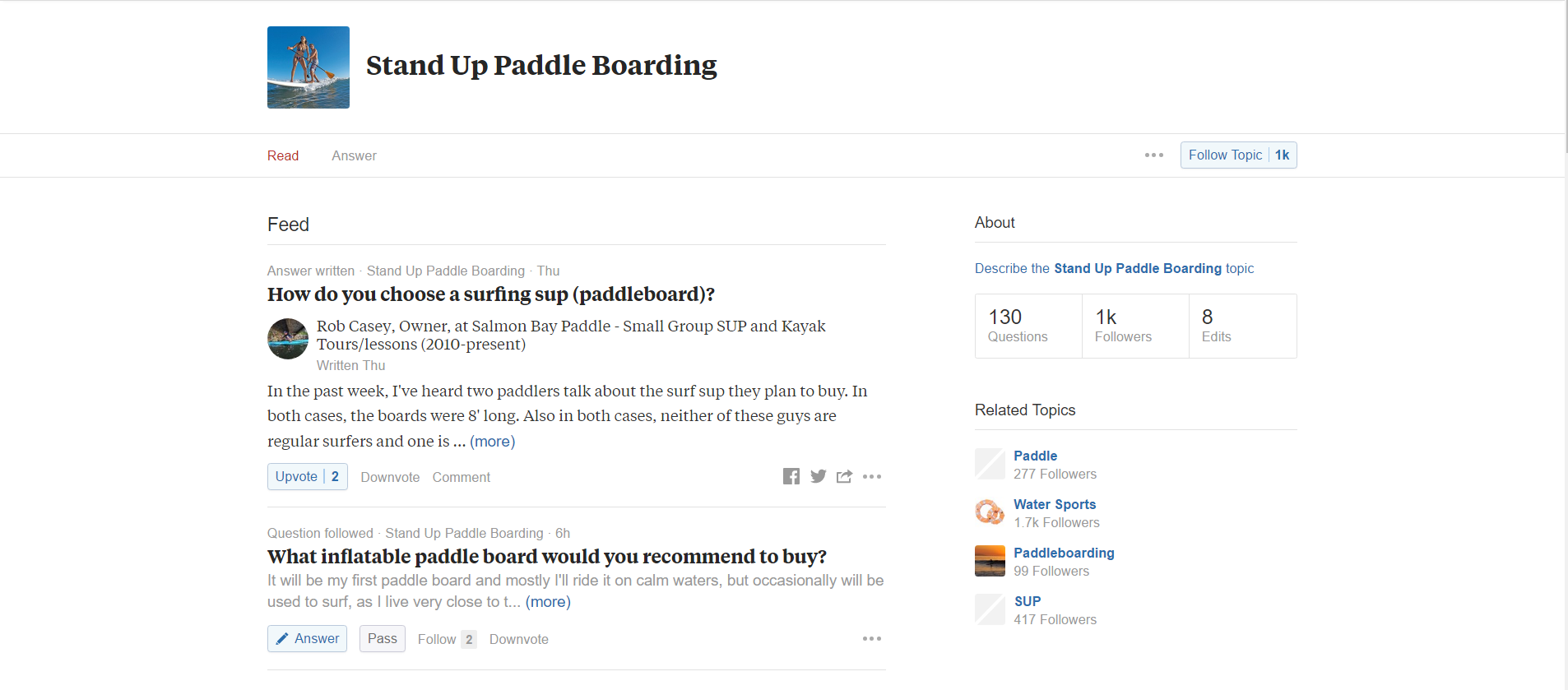
Now, the second site that I like to use is a site called Quora. Quora is basically a question and answer site where people ask questions and then other people come and answer them.
It's great if you want to set yourself apart as an expert in the space, you can answer a lot of questions.
But, kind of a separate strategy. I searched for stand-up paddle here. You can see there's a lot of great questions.
Now, Ubersuggest is good for the keywords. But, there's not a lot of context here. With Quora, we're able to see people's questions and what people are discussing in the answers about this.
Here's a question about inflatable stand-up paddle boards, are they worth buying? Here's some other stuff about related activities in kayaking. But here's one, what about paddle boards for beginners? People just getting into this.
You can see there's a lot of great stuff here. And if I click through I'm gonna see what answers are on here. And maybe there's an opportunity for me to even answer that question here and then build a blog post off of it.
Quora is a great place to get a little bit more context and understanding. Talk about idea generation and you just scroll down here and you're gonna see tons of great questions from people who are probably in the buying process already.
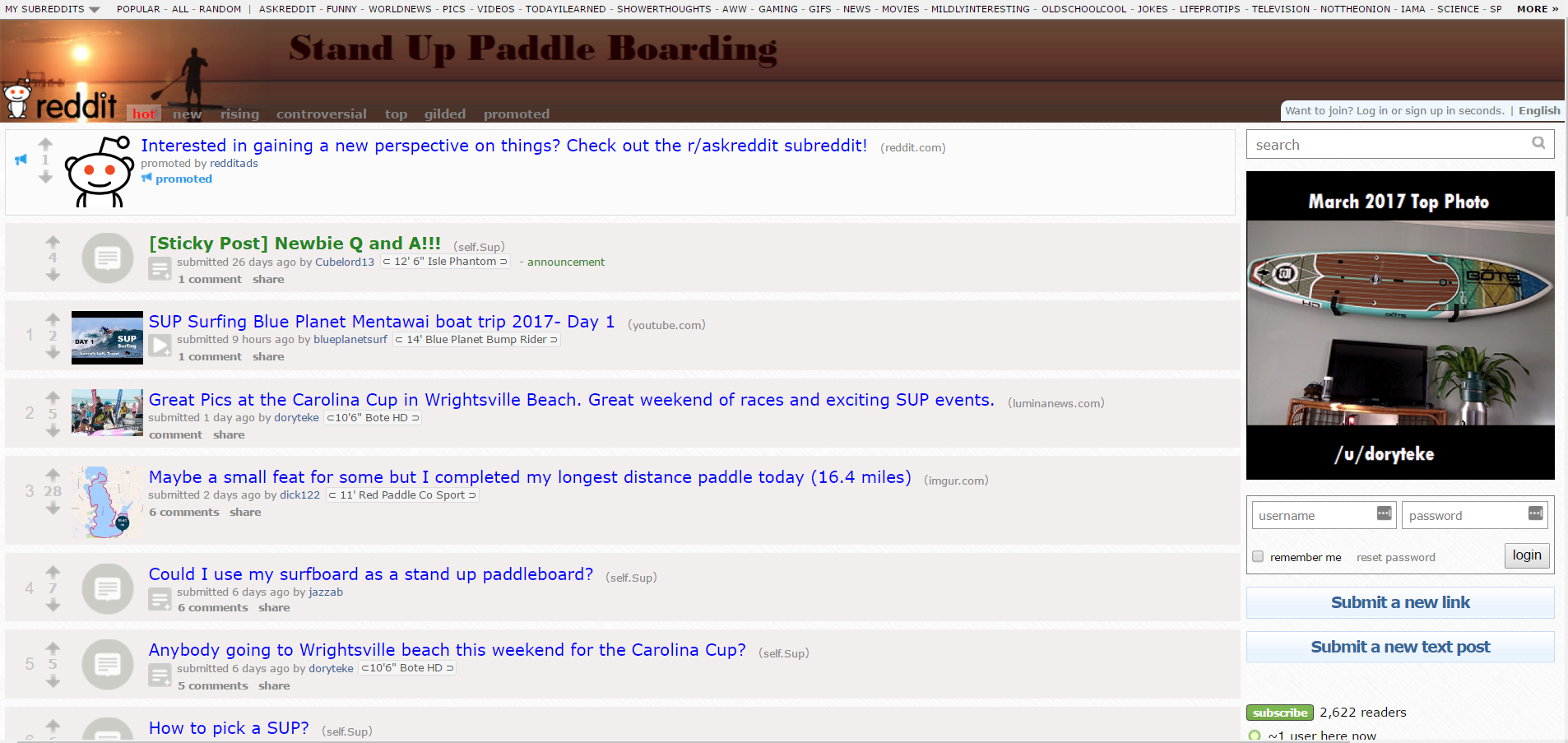
All right, the last thing I'm gonna show you is Reddit. Reddit is just another social bookmarking site but there's literally something for everything in here.
Every topic you could imagine is on Reddit.
Here is what is called a subreddit, and it is dedicated to stand-up paddle boarding.
Now, I like going to Reddit to see what people are asking, just like Quora. But Reddit is also a place where people can share cool content.
You can see what's getting the most upvotes, and you can see maybe what other content creators are doing, and how that might give you some ideas. Maybe you can take an idea and make it even better.
But could I use my surfboard as a stand-up paddle board? Okay, well which surfboards could feasibly do that? I don't know. But there's comments here, we could read through those. And just lots and lots of content here to generate ideas where you can maybe chime in.
What's a decent board under $800? Maybe that's an entire content series is based on people's price points. What should they expect and what should they look for in a board.
Lots and lots of great stuff here, but you can also see how detailed it gets. People talking about specific boards.

Between these three sites, if you just spent 15 minutes a week looking at what people are asking, what people are sharing and know what some of the general searches are out there, you're gonna have more than enough fuel to create content. And, I would just say that if you see themes pop up across each of these channels or each of these websites then make those a priority.
If you keep seeing stuff about inflatable paddle boards, make sure that you have a piece on that. Or, if you see stuff about yoga, make sure you have a piece on that.
But try to pick up on the trends and on the recurring themes across each of these sites.
All right, I hope that's helpful for you. Again, none of this is meant to replace great keyword research or great audience research. We all know that our ideas can run dry, and you need a quick boost every now and then to keep you going with your content creation.
In this post:
A Facebook ad that accumulates hundreds of likes, shares, and comments is one of the most valuable assets in your advertising account. That engagement - known as social proof - signals trust to new audiences and makes your ad significantly more effective.
But here is the problem most advertisers run into: when you duplicate a high-performing ad to target a new audience, all of that engagement disappears. The likes, the comments, the shares - gone.
The good news is there is a straightforward workaround. In this guide, we will cover what social proof is, how to build it, how to preserve it across campaigns using the existing post ID method, and four real examples of social proof in Facebook ad creative.
Social proof is the psychological principle that people look to the behavior of others when making decisions. In the context of Facebook ads, social proof takes two primary forms:
Engagement-based social proof refers to the visible reactions, comments, and shares on your ad. When a potential customer sees that an ad has 500 likes and dozens of positive comments, their natural response is to pay attention. This type of engagement creates a self-reinforcing loop: more reactions lead to more trust, which leads to more clicks and conversions.
Content-based social proof involves incorporating customer reviews, testimonials, and user-generated content directly into your ad creative or copy. Rather than relying on the ad's engagement metrics, you proactively place trust signals into the ad itself.
Both forms work because of a fundamental truth in digital advertising: your potential customer needs an external factor to rely on when making a purchase decision online. Unlike a brick-and-mortar store where shoppers can physically compare products, online buyers depend heavily on social signals to evaluate whether a product or brand is worth their money.
This is why social proof is part of nearly every successful social media advertising campaign. It can be the difference between a prospect scrolling past your ad and stopping to learn more.
Before you can reuse social proof, you need to build it. There are several proven strategies for generating engagement on your Facebook ads:
Target warm audiences first. Launch your ad to audiences that already know your brand - email subscribers, website visitors, or past customers. These audiences are more likely to engage with your content, giving your ad an initial boost of social proof before you expand to cold traffic.
Use compelling creative. Ads that provoke an emotional response, ask a question, or share a bold claim tend to generate more comments and reactions. The more people interact, the more social proof you build.
Incorporate reviews and testimonials. Including real customer feedback in your ad copy or creative adds an immediate layer of trust. We will cover specific examples of how to do this later in this article.
Run engagement-optimized campaigns. While your primary Facebook ad campaign objective might be conversions or traffic, consider running a short engagement-focused campaign first to accumulate reactions before switching objectives.
Respond to comments. When people comment on your ad, reply to them. This increases total comment count and shows potential customers that there is a real team behind the brand.
Once your ad has built up meaningful engagement, the next step is making sure you do not lose it when scaling to new audiences.
One of the most common mistakes Facebook advertisers make is duplicating a high-performing ad to show it to a new audience. The duplication creates a completely new ad with zero engagement - all of the social proof from the original is left behind.
The solution is to use the existing post ID method. This approach lets you run the same ad (with all its accumulated likes, shares, and comments) across multiple ad sets, campaigns, and audiences. Every new impression and reaction continues to build on the original post's engagement.
Here is how to do it in six steps.
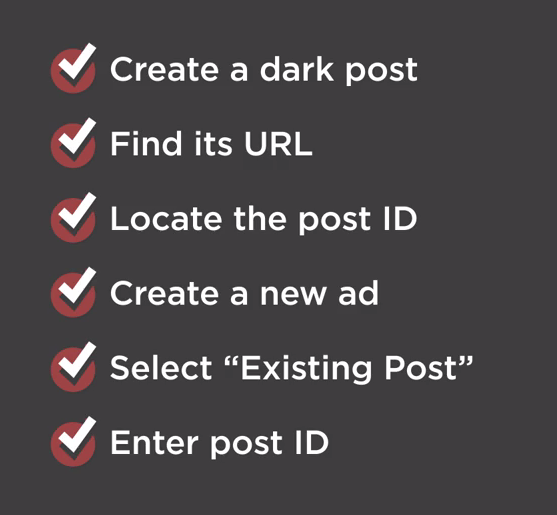
For this tactic to work, you need to start with a dark post - an unpublished page post that does not appear on your Facebook page's timeline. Dark posts are created through Ads Manager and give you the ability to:
If you are unfamiliar with dark posts, the setup takes just a few minutes and is well worth learning.
In Ads Manager, find the ad that has accumulated the engagement you want to preserve. This is the ad whose social proof you will carry forward into new campaigns.
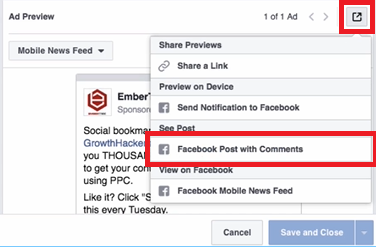
Select the ad and click the edit button. Under Ad Preview, locate the box icon in the right corner and click it, then scroll down to select the Facebook Post with Comments option.
This loads the full ad with all of its accumulated engagement:

Copy the entire URL from the browser bar. We recommend pasting it into a text editor so you can easily isolate the post ID.

The post ID is the number that appears after
/posts/in the URL. Copy everything from that number up to the question mark.

Save this number - you will need it in a later step.
Create a new ad just as you normally would for any Facebook ad campaign. Choose the objective that aligns with your goals, and set up your new target audience.
Here is where the key difference comes in. Navigate to the Ads section and click the Use Existing Post button instead of creating a new ad from scratch.


Click Enter Post ID and paste the ID you copied earlier. Click Submit.
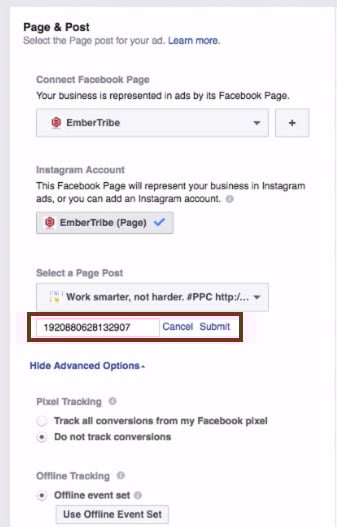
The ad appears with all of its original reactions, comments, and shares intact.

You can now go back to the ad set level, choose any audience segment, and run the ad wherever you want - all while keeping the same engagement and social proof attached to the creative.
You can repeat this process as many times as needed for new campaigns and ad sets. Every impression and reaction across all placements feeds back into the same post, continuously building your social proof.
Quick reference:
Beyond preserving engagement across campaigns, you can also build social proof directly into your ad creative by featuring customer reviews and testimonials. This approach works especially well for retargeting warm audiences who are already familiar with your brand and need a final push to convert.
Here are four proven formats for incorporating social proof into your Facebook ad creative.
Placing a short customer quote directly in the ad headline is one of the most eye-catching approaches. The headline is one of the first elements a user reads, and leading with a real customer's words immediately establishes credibility.

This format works best when the review is concise - a single sentence or phrase that captures the core benefit of the product.
Overlaying a customer testimonial directly onto the ad image makes the social proof impossible to miss. The review becomes part of the visual, which can stop users mid-scroll.
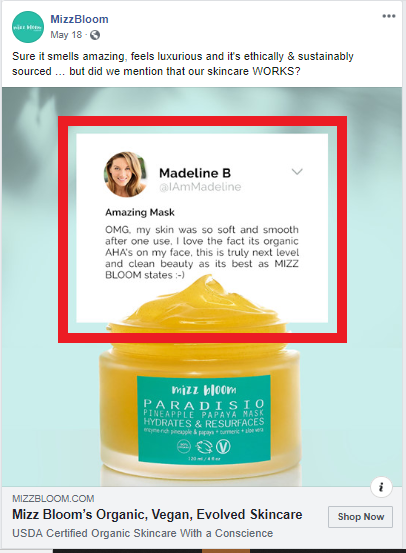
When using this approach, make sure the text is large enough to read on mobile devices and that you stay within Facebook's advertising guidelines for text-to-image ratios.
The primary text field above the ad image gives you room to share a longer customer review. This format is effective for products or services that benefit from detailed testimonials where the customer explains their experience.

For maximum impact, you can stack multiple short reviews in the primary text field. This creates a wall of positive feedback that is difficult for prospects to ignore.

When using customer reviews in your ads, keep these best practices in mind:
When incorporating reviews into your ad images, be aware of Facebook's text overlay guidelines. While Facebook previously enforced a strict 20 percent text rule on ad images, the platform now uses a more nuanced approach. However, ads with less text on the image generally perform better and receive wider distribution.
Key guidelines to follow:
For a deeper understanding of what Facebook will and will not approve, review our guide to Facebook advertising policies.
The most effective approach is to combine both social proof strategies covered in this guide. Start by creating ads that feature customer reviews in the creative, then use the existing post ID method to preserve the engagement those ads accumulate as you scale to new audiences.
This creates a compounding effect: the review in the creative builds initial trust, while the visible likes, comments, and shares reinforce that trust. Over time, your best-performing ads become increasingly powerful assets that you can deploy across your entire Facebook advertising strategy.
Have you tested the existing post ID method with your campaigns? If you are looking for more ways to optimize your Facebook ad performance, explore our guides on scaling Facebook ads without killing performance and identifying audience overlap to maximize your results.
Custom audiences remain one of the most powerful targeting features in the Facebook advertising platform. The ability to upload a list of customers or prospects and serve them ads directly is a game-changer for performance marketers.
But here is the problem most advertisers overlook: when you upload a list of 1,000 contacts, Facebook does not automatically match all of them. In many cases, match rates fall between 30% and 50%, which means more than half of your carefully curated audience never sees a single ad.
That gap between your uploaded list and the matched audience represents real revenue left on the table. Every unmatched contact is a missed opportunity to retarget a buyer, re-engage a lapsed customer, or nurture a warm lead through your sales funnel.
The good news: with the right data preparation and enrichment strategies, you can push match rates well above 70%, and in many cases above 90%.
Before diving into optimization tactics, it helps to understand the matching process itself.
When you upload a customer list, Facebook takes the identifiers you provide (email addresses, phone numbers, names, etc.) and hashes them using SHA-256 encryption. It then compares those hashes against its own database of user profiles. When a hash matches, that person becomes part of your custom audience.
The key insight is that Facebook can accept up to 15 different data points per contact to attempt a match. Most advertisers only upload email addresses. That single data point gives Facebook one shot at finding a match. If that email address is not the one the user registered with on Facebook, the match fails.
By providing multiple identifiers, you give Facebook more chances to find each person. First name, last name, phone number, city, state, zip code, date of birth, and gender all serve as additional matching signals.
Here is the full list of identifiers Facebook will use for matching:
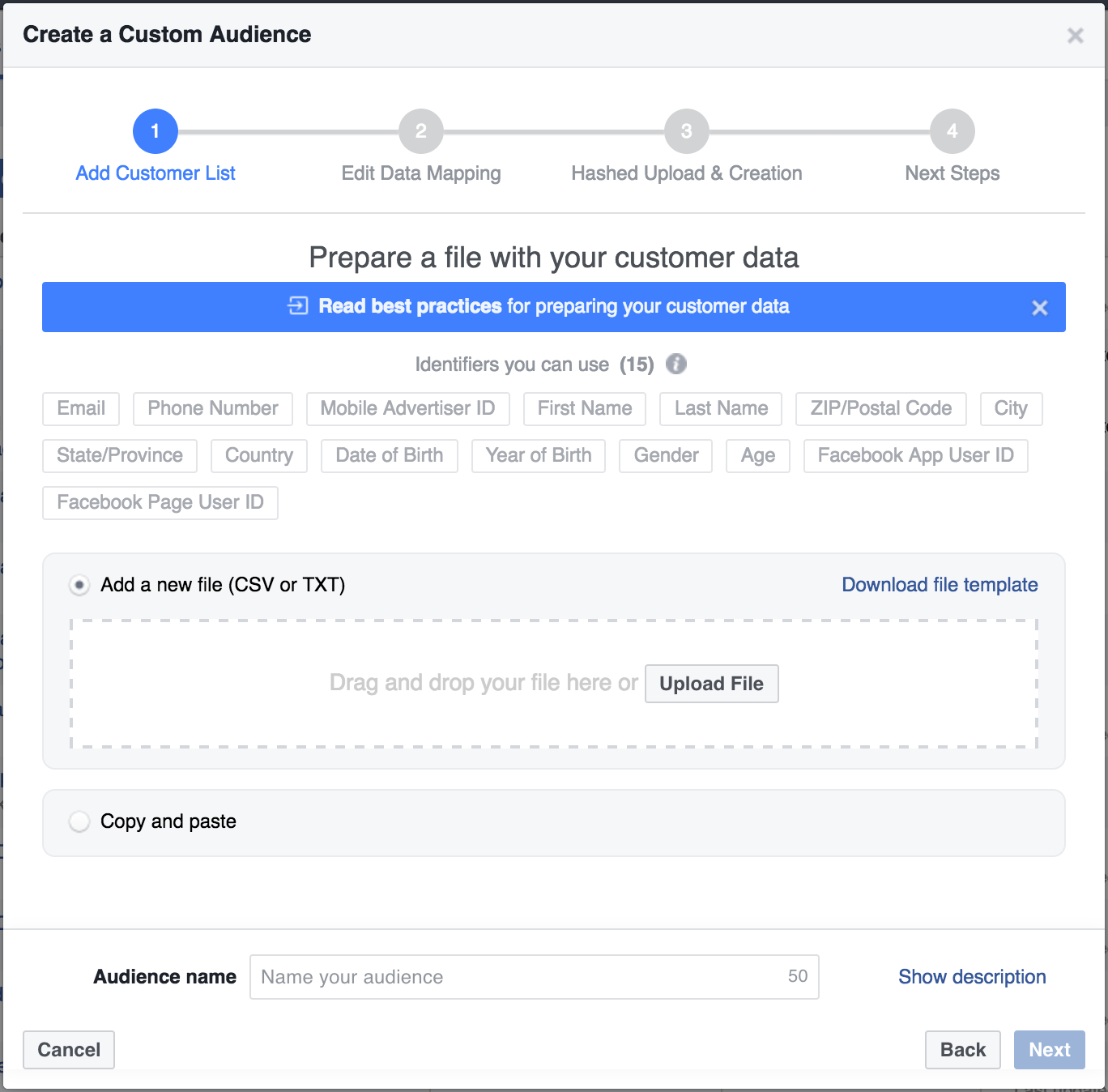
The more of these fields you populate, the higher your match rate will climb. Even partial information helps. A first name combined with a zip code might be enough for Facebook to confirm a match that email alone could not.
The most effective way to boost match rates is to enrich your existing data before uploading it to Facebook. If you have a newsletter list with thousands of email addresses, those emails alone are just the starting point.
Tools like Clearbit, ZoomInfo, and Apollo can take a single email address and return dozens of additional data points. For custom audience optimization, the most valuable enrichments are:
Here is a practical workflow using Clearbit as an example:
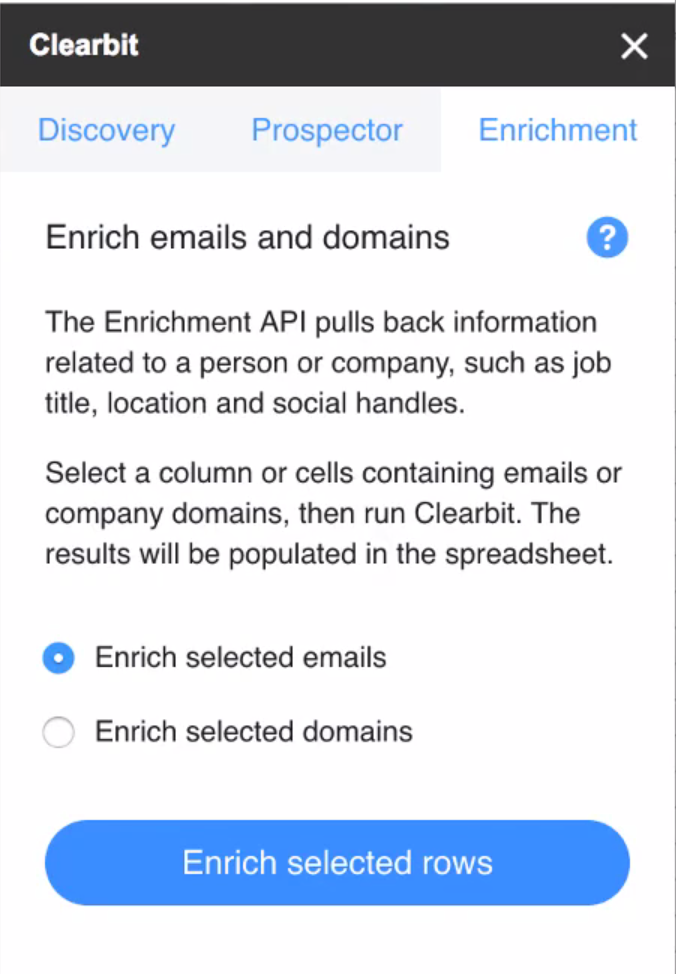
Even before using the enriched data for ad targeting, take time to analyze what the enrichment reveals. Build pivot tables around job titles, company sizes, and locations. This analysis often surfaces audience insights that inform not just targeting but creative strategy and offer positioning.
Data formatting errors are a silent killer of match rates. Facebook's matching algorithm is strict about format. Common mistakes include:
Facebook provides a downloadable CSV template specifically for custom audience uploads. Use it. The template ensures your columns align with the expected identifiers and reduces formatting errors that silently degrade your match rate.
Beyond basic data enrichment, several advanced tactics can push your match rates even higher.
Rather than uploading one massive list, break your audience into segments based on data quality. Upload your most complete records (those with email, phone, name, and location) separately from email-only records. This approach lets you:
Many people have separate personal and work email addresses. If your CRM captures both, include them in your upload. Facebook will hash and check each one independently. A contact who does not match on their work email might match perfectly on their personal Gmail address.
Customer data decays over time. People change email addresses, phone numbers, and locations. An audience that matched at 80% six months ago may have dropped to 60% today. Set a recurring schedule to re-enrich and re-upload your custom audiences at least quarterly.
Website custom audiences built from pixel data typically have near-perfect match rates because Facebook already knows those visitors. Combining pixel-based audiences with uploaded list audiences gives you broader reach with strong match quality. Use the overlap analysis in Ads Manager to understand how your audience segments intersect.
After uploading your custom audience, Facebook displays the audience size alongside your uploaded list count. The ratio tells you your match rate.
Here are general benchmarks to gauge your performance:
If your match rate falls below expectations, run a diagnostic check. Look for formatting inconsistencies, outdated email addresses, or missing country codes. Even small fixes can produce meaningful lift.
Here is the complete workflow for maximizing your custom audience match rates:
Every percentage point of match rate improvement translates directly to more of your target audience seeing your ads. For ecommerce brands spending significant budgets on Facebook, the ROI of data enrichment often pays for itself many times over.
Custom audience targeting only works as well as your data allows it to. Most advertisers accept low match rates as an unavoidable cost of the platform, but they are not. By investing time in data enrichment, proper formatting, and regular audience maintenance, you can dramatically increase the reach and effectiveness of your Facebook campaigns.
The advertisers who win on Facebook are not just the ones with the best creative or the biggest budgets. They are the ones who treat their first-party data as a strategic asset and invest in making every contact matchable, targetable, and reachable.
Facebook is a powerful paid social advertising platform, but it doesn’t scale the same way as paid search. In this post, you'll learn the 3 rules for Facebook ad scaling that we swear by (and why).
In this quick tip video, we’ll demonstrate how you can best scale your ad spend without killing the performance of key metrics like cost per lead.
These three "rules" are what we used to scale one client's efforts on Facebook from 0 to 400k new users every month (you can check out that case study here).
We're going to share the scaling strategy we use for our clients that allows us to spend more each month, increase the volume of incoming qualified leads, all without hurting the performance of those campaigns.
When you follow these three rules for scaling Facebook ad campaigns, you can help save your performance as you increase ad spend.
There are so many targeting options to choose from on Facebook, it's easy to get excited about getting very, very granular, and specific about who you want to target.
But if your audience size is too small, you're not going to have enough runway to scale your ads. Remember: there's always going to be opportunities down the line to create more segments. Don't overdo it from the jump!
Instead, if you find that a certain segment of your target audience has responded well to your campaigns so far, you should optimize for that segment. It's important that you don't shoot yourself in the foot by creating a too-small audience size from the start.
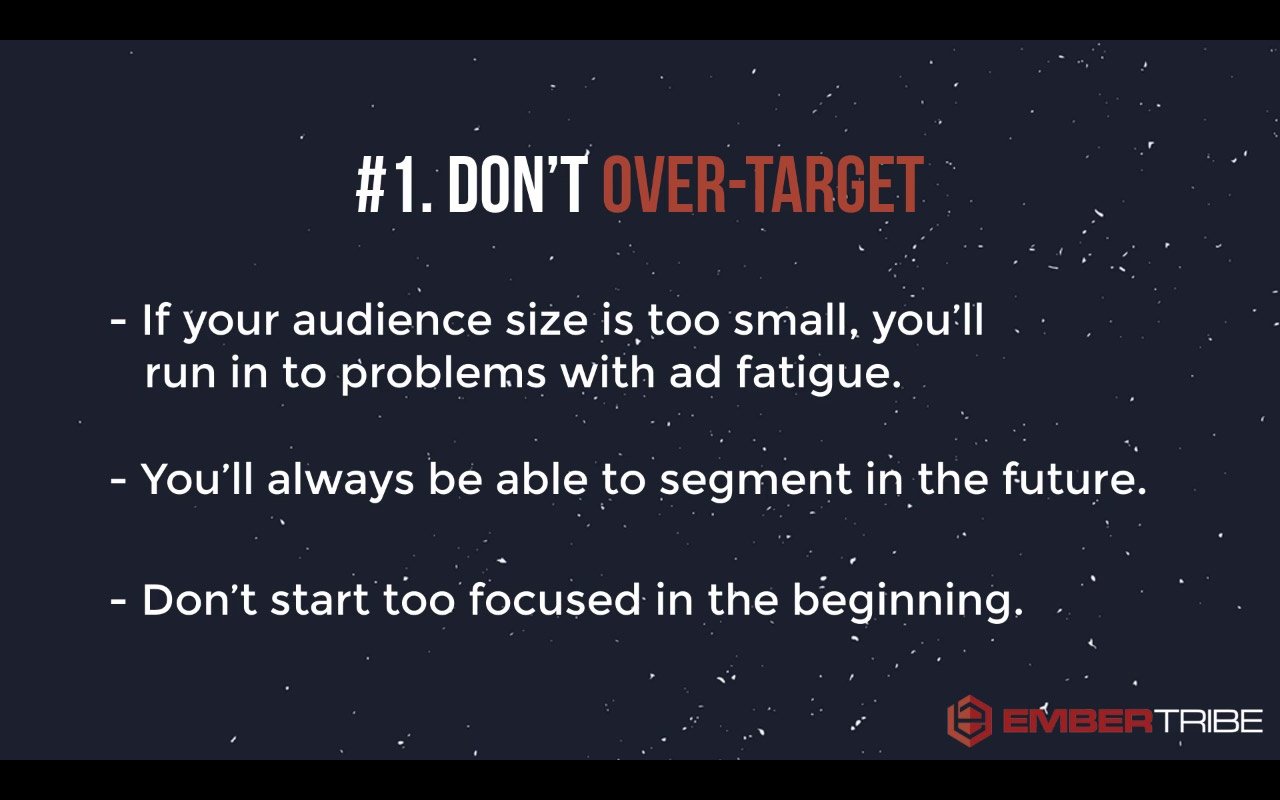
Don't get so locked in on one audience segment that you're going after because eventually, you're going to wear them out.
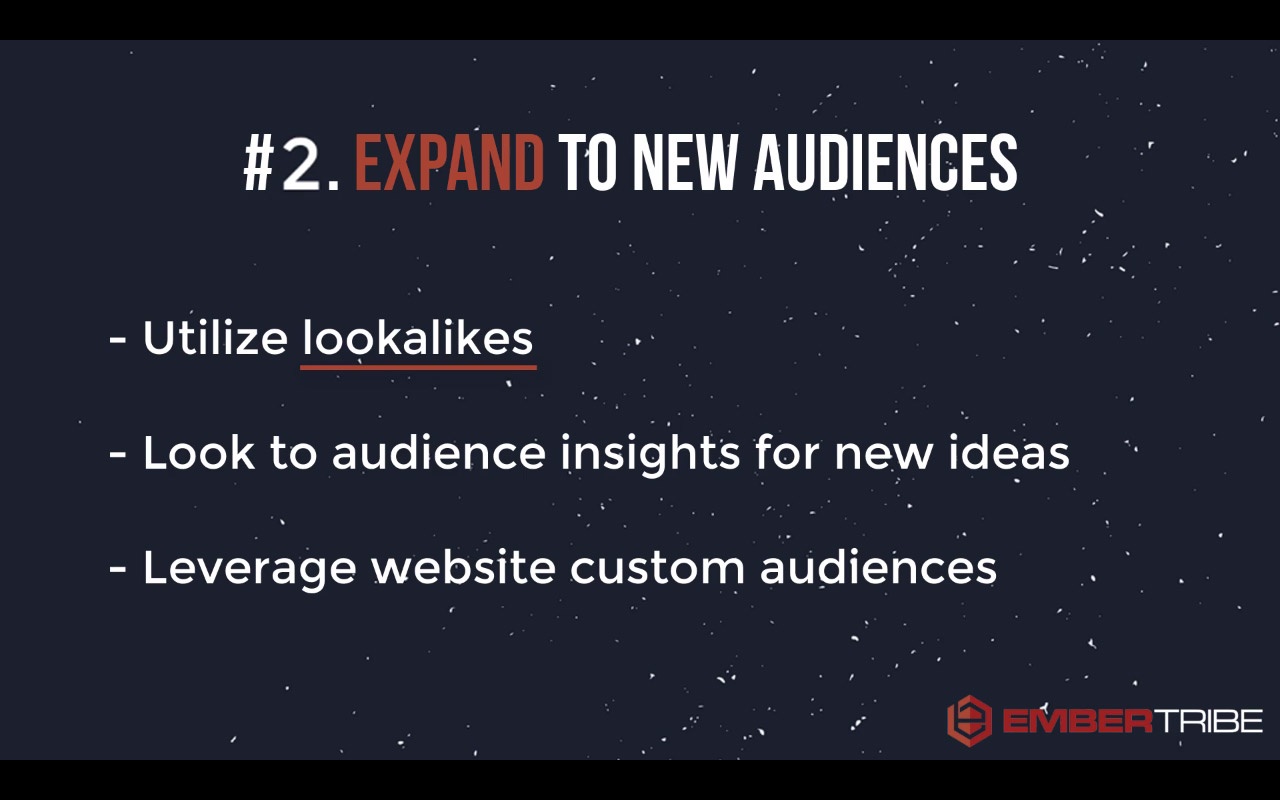
You need to get creative about the ways that you can expand to new audiences. That means taking full advantage of partner categories in Facebook, different interest targets, and especially using options like lookalike audiences.
Make sure that once you've converted a healthy number of people, you want to create a lookalike audience to allow Facebook to start expanding the target reach of your ads.
This third rule is very important. It's probably the most important rule when it comes to scaling your campaign—be mindful about how you manage your budget.
Oftentimes, the biggest mistake that we see advertisers make is that when they see something work, they have a knee-jerk reaction that they need to pump ad spend in their campaign. Unfortunately, this turns into blowing the doors off of their budget.
What you want to do instead is very incrementally increase the budgets.
The reason for this incremental increase is that Facebook optimizes through an algorithm that determines who they should show your ads to, based on who they think will respond most to your message.
If you give them too much information to optimize for, the algorithm can't work correctly. In other words, if you've increased your budget too much and try to get too many people through the funnel, Facebook just won't be able to keep up.
So, your Facebook ad campaigns need time to adjust to a new level of budget.
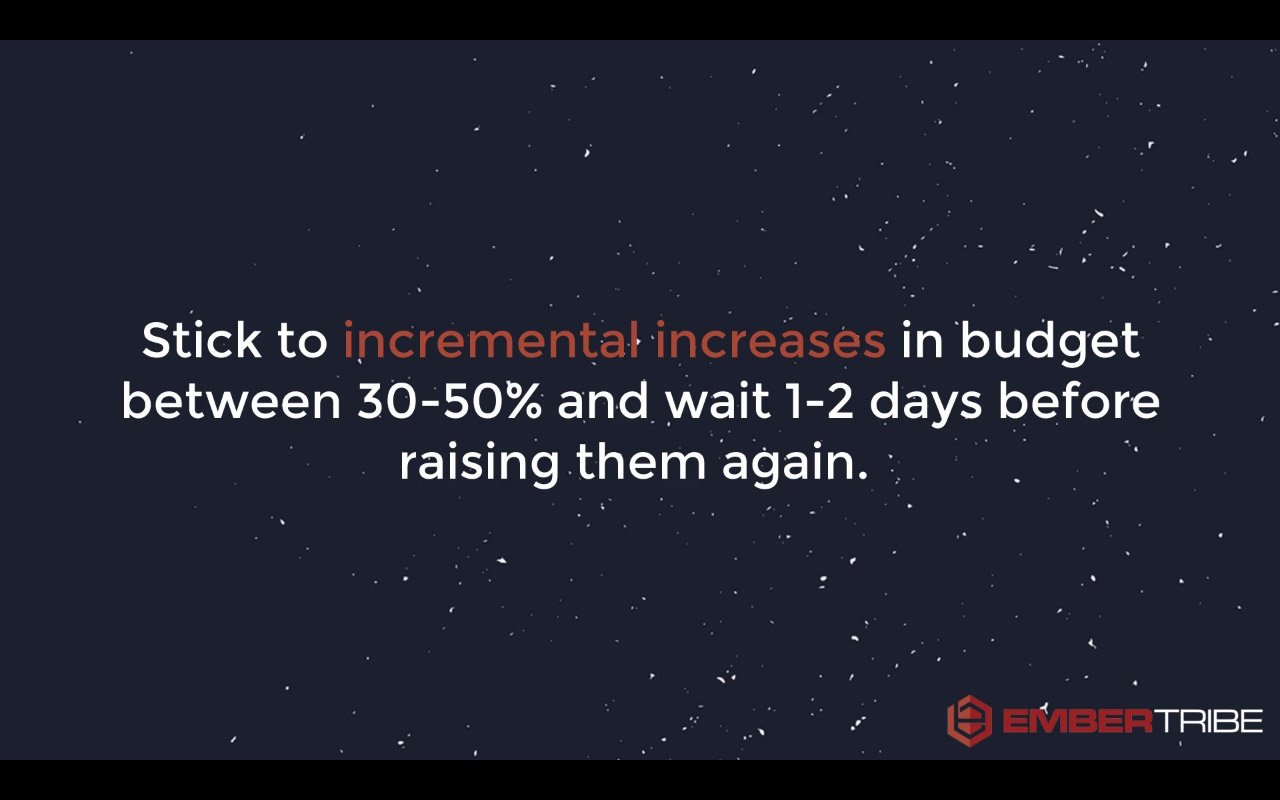
Try to wait two or three days before raising the budgets on your campaigns if you're testing a new angle or you launching a new ad set.
When you do raise the budget, keep each budget increase as incremental gains, like 30 to 50 percent increases to the budget.
That's going to safeguard your ads against seeing major campaign performance decline. Over time, you'll be able to scale to a higher budget...but without tanking all the hard work the algorithm has done for you so far.
There's a lot more that goes into managing your campaign than these three rules. But with these principles, you're going to be head and shoulders above 90 percent of the advertisers that don't have this 3-rule framework to scale their campaigns.
Good luck, and may your next campaign scale beyond your wildest dreams!
Find out how EmberTribe can manage your Facebook ad campaigns for you by booking a call with one of our growth experts.
In order to scale your campaigns and avoid past mistakes, it's VERY important to keep track of what you're doing. This is why we plan ahead and keep track of our results using a "testing queue."
However, just keeping track is not enough. Understanding your audience, what you can offer them, and the timing of your offer is what will set you apart and lead to success in your campaigns.
In Today's Quick Tip Tuesday, JP gives you another perspective when handling your PPC campaigns and tells how to breathe new life into them with these simple pointers:
Josh: "All right, so, J.P., one of the things that we do uniquely at EmberTribe is we manage this thing called a testing-queue to try to breathe new life into campaigns. Can you explain a little bit about what that is?"
J.P: "Yeah, it's a really intentional, planned out way of documenting what steps we're gonna take to expand campaigns both horizontally and vertically to keep them going, scale up, and be really responsive."
Josh: "Awesome. So, I know that this has been a breakthrough strategy for a lot of our clients and really the fuel for this process is asking really good questions.
So like, the better questions you can ask about how these different paid advertising channels are working, the better outputs you're gonna get.
So what's kind of your process for asking those questions and maybe what are the categories that they fall into?"
J.P: "Sure, ultimately, they usually come down to audience, offer, and timing.

When you're thinking about audience, you're really trying to figure out what makes your user, your target, unique?

Is it their job title? Maybe you wanna consider how old they are or what ethnicity they are, where they live, what interests they have like television shows or cars that they drive.
What is it that sets them apart from anybody else on the street?
For offer, you wanna consider what problem you solve. Does your user even know they have a problem? Do they care? Is it costing them time? Is it costing them money?

And then, how do you solve that problem better than the 14 other companies that are trying to do the same thing? Or are you unique in the space? You're the only one solving it.
And finally, when it comes down to timing. And by timing, I don't mean day parts, or days of the week, or anything like that. I'm considering where they are in the purchase funnel.
What's their familiarity with you brand?

Are you re-targeting them or is this a cold outreach?
Are they aware of your competitors?
Do they know what to look for?
Have they engaged with any of your content before?
Do you maybe have an offer like a white paper or a webinar that can help educate them about those needs and how you solve them.
And then how do you match that offer up to where they are in the purchase funnel?"
Josh: "Awesome. So it's a really holistic way to think about your target audience and about, really, the message that you're bringing to them. And I guess at the end of the day it is about just asking good questions.
If you have an organized framework like this to use, seems like anybody can improve or optimize their campaigns or take it to the next level."
J.P: "It sure beats off-the-cuff strategies and a wall of Post-it notes."
Josh: "Yeah, definitely. Well, thanks for sharing, J.P."
J.P: "You bet."
Most B2B advertisers default to Google Ads as their primary search advertising channel. It is the largest search platform, it has the most sophisticated tooling, and it is where the majority of search volume lives. But this default behavior creates an opportunity that many B2B marketers overlook entirely: Microsoft Advertising (formerly Bing Ads).
Microsoft Advertising consistently delivers lower costs per click, less competition, and access to a high-value professional audience that skews toward exactly the decision-makers B2B brands need to reach. For advertisers willing to look beyond Google, Microsoft's platform offers one of the best risk-adjusted returns in paid search.
The single most compelling reason for B2B advertisers to invest in Microsoft Advertising is audience composition. Microsoft's search network benefits from deep integration with the enterprise software ecosystem that dominates corporate America.
Microsoft still holds significant market share in enterprise environments where IT departments control browser and search engine defaults. In many corporate settings, employees use Edge as their primary browser with Bing as the default search engine. This is not a matter of consumer preference. It is a function of enterprise software policy.
This means that when a procurement manager researches software solutions, when an operations director evaluates service providers, or when a C-suite executive investigates strategic tools, there is a meaningful probability they are doing that research through Bing. These are exactly the high-value searchers B2B advertisers need to reach.
Microsoft Advertising's user base skews toward higher household incomes compared to the general search population. For B2B advertisers selling premium solutions, professional services, or enterprise software, this demographic alignment means your ads reach people with both the authority and the budget to make purchasing decisions.
Microsoft's acquisition of LinkedIn created a unique targeting capability that Google cannot replicate. Through Microsoft Advertising, B2B advertisers can layer LinkedIn profile data, including company, industry, and job function, onto their search campaigns. This means you can bid more aggressively when a searcher matches your ideal customer profile, or exclude searches from industries or roles that are unlikely to convert.
This integration is a game-changer for B2B lead generation. No other search platform offers this level of professional demographic targeting within the search environment.
Beyond audience quality, the economics of Microsoft Advertising work strongly in B2B advertisers' favor.
Because most advertisers default to Google, Microsoft Advertising sees significantly less competition for the same keywords. Fewer advertisers bidding on the same terms means lower costs per click across the board. For competitive B2B keywords where Google CPCs can exceed $20-50 per click, the savings on Microsoft's platform can be substantial.
This reduced competition also means higher ad positions are more accessible. On Google, achieving a top position for competitive B2B terms often requires aggressive bidding that eats into margins. On Microsoft, the same top positions are achievable at a fraction of the cost.
Microsoft Advertising consistently delivers lower CPCs than Google Ads for equivalent keywords. For B2B advertisers where search volumes are already lower and each click carries significant value, this cost efficiency directly improves the economics of your lead generation funnel.
When you combine lower CPCs with the platform's professional audience composition, the cost per qualified lead often outperforms Google significantly. The leads may be fewer in total volume, but the quality and cost efficiency frequently make Microsoft Advertising the higher-ROI channel.
B2B advertising budgets are often more constrained than B2C budgets. Microsoft Advertising's lower costs allow smaller budgets to go further, making it an ideal channel for B2B SaaS companies and professional services firms that need to maximize every dollar.
Microsoft Advertising offers several platform features that provide distinct advantages for B2B campaign management.
In Google Ads, managing campaigns across multiple business locations requires either grouping all locations into a single campaign or creating separate campaigns for each location. Microsoft Advertising offers a more flexible approach: you can run a single campaign with ad groups broken out by location. This simplifies account management while maintaining the geographic granularity that multi-location B2B businesses need.
Both Google and Microsoft distribute ads across search partner networks, but they handle transparency differently. Microsoft lets you choose which search partners to include and provides transparent reporting on where your ads appear. You can specifically opt into or out of properties like Yahoo and AOL, and you can see exactly which partners are delivering results.
Google, by contrast, bundles search partners without giving advertisers the ability to select or exclude specific properties, and its reporting on partner performance is less granular.
If you are already running Google Ads campaigns, Microsoft makes it straightforward to import your existing campaign structure, keywords, and ads directly into the platform. This reduces the barrier to entry significantly. You can have a Microsoft Advertising campaign live within hours, using your proven Google Ads structure as the starting point, and then optimize from there based on Microsoft-specific performance data.
Microsoft's Audience Network extends your reach beyond search into native placements across Microsoft-owned properties including MSN, Outlook.com, and Edge. For B2B advertisers, these placements reach professionals during their workday browsing, creating additional touchpoints with your target audience outside of search intent moments.
Getting started with Microsoft Advertising for B2B lead generation follows a structured process.
Start by importing your top-performing Google Ads campaigns. This gives you a proven foundation. Then review and adjust keyword bids downward, since Microsoft's lower competition typically means you can achieve comparable positions at reduced bids.
Apply LinkedIn profile targeting to your campaigns. Start with job function and industry targeting that aligns with your ideal customer profile. Monitor performance by segment and adjust bids to allocate more budget toward the profiles that generate qualified leads.
B2B campaigns should optimize for lead quality, not just lead volume. Set up conversion tracking that captures not just form submissions but downstream indicators of lead quality. Use this data to inform bid adjustments and audience targeting refinements over time.
Once your core campaigns are performing, test expansion into Microsoft's Audience Network, experiment with additional keyword themes, and iterate on ad copy to improve conversion rates. Apply the same structured testing methodology that drives results in any paid channel.
When evaluating Microsoft Advertising performance for B2B, focus on metrics that reflect lead quality and pipeline impact:
These metrics provide a more accurate picture of channel value than surface-level indicators like click-through rate or raw conversion volume.
Microsoft Advertising should be a standard component of any serious B2B search advertising program. The combination of a professional audience, lower competition, reduced costs, and unique LinkedIn targeting capabilities creates a channel that consistently delivers high-quality leads at favorable economics.
The platform is not a replacement for Google Ads. It is a complement that extends your reach into an audience segment that many competitors ignore entirely. For B2B advertisers, that neglected audience often includes the exact decision-makers you need to reach.
Start by importing your existing Google Ads campaigns, layering LinkedIn targeting, and measuring performance against lead quality metrics rather than volume alone. The results will likely make a compelling case for increasing your Microsoft Advertising investment as a core pillar of your B2B growth marketing strategy.
This is the first installment of a tutorial video series called, Quick Tip Tuesday #QTT! It's a weekly series of videos that bring you highly actionable advertising tactics in 90 seconds or less.
In this first episode of "Quick Tip Tuesday", we'll walk you through how Facebook advertisers can grow their audience for free while they run their campaigns.
If you want to make the most of your campaigns, spending 10 minutes or less each week, this tip is for you!
💡 Boost your Custom Audience match rate with this quick tutorial. →
Hey there, in this quick video I wanna show you how you can get more mileage out of your Facebook advertising campaigns without spending more money and really spending no more than 10 minutes a week.
This is going to make your advertising campaign more effective, it's going to let you take advantage of interacting with some of the people who have been interested in your ads, but haven't taken action yet.
So let's take a look.
The beauty of running Facebook ads is that it's a social platform, so as you run ads, people are going to start liking and sharing your ads. So what I want to show you is in three easy steps, how to make the most of when people engage with your ad.
Step one is you have to find your ad in the Ad Manager. Now, we're gonna click Preview which is that little eyeball in the upper right.
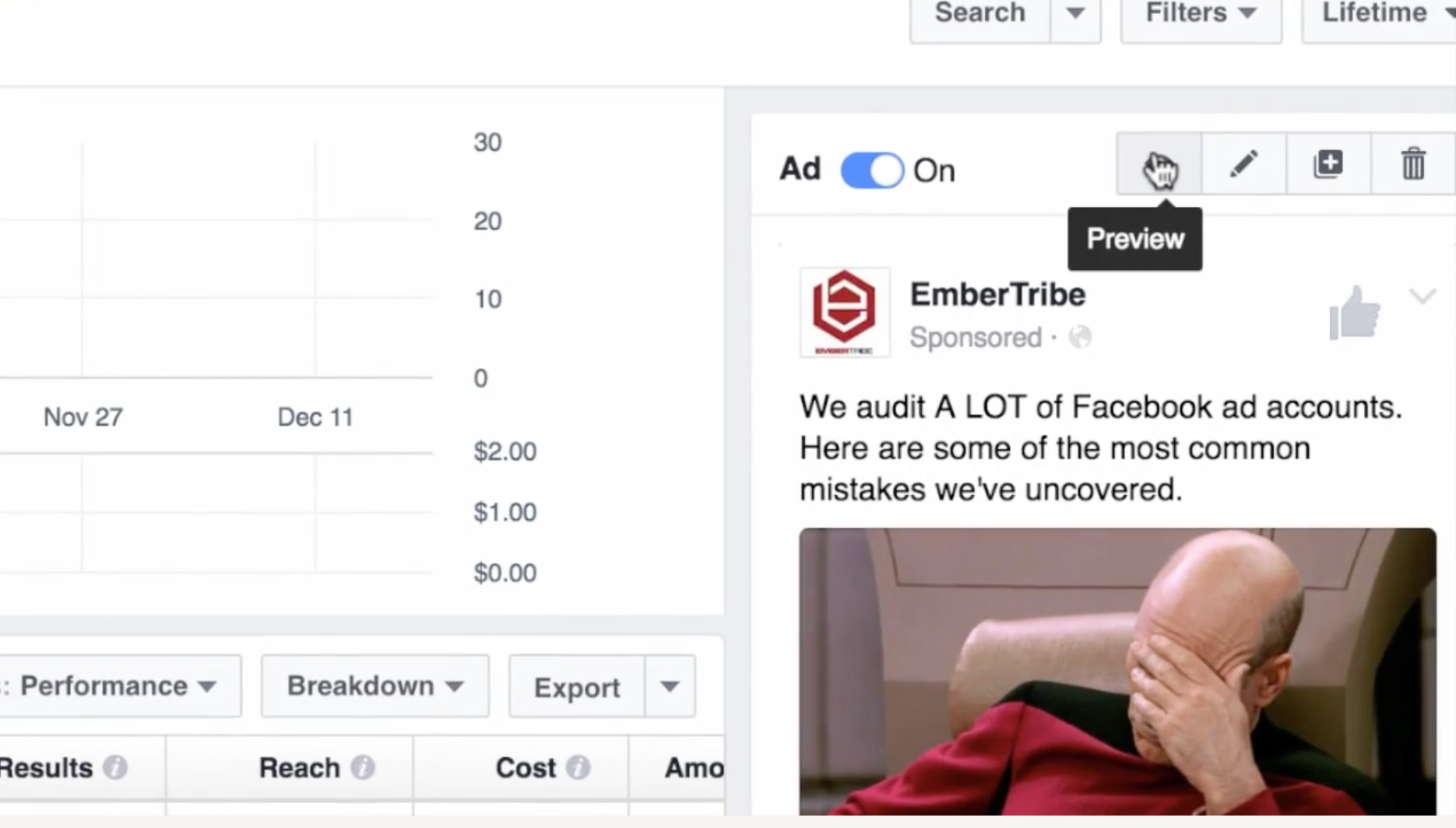
Okay that this point, scroll down and click the link where it says View Post Permalink with Comments. Okay, (step two) the next thing that you're gonna do is go down here.
You're going to see where people have liked or engaged with your ad.

Now step three, there's an option here to invite the people who have liked this post.
Now here's the beauty of this; you might have paid for the ad to get it out there and to get it in front of people, but inviting people to like your page is actually completely free.

Now great, six people, big deal. We attracted some new followers to the page, but what if you have an ad that you run for a lot longer and say there's like a thousand or so people who liked it?
Well now you can go through and start inviting all sorts of people who have engaged with your ad and showed interest in the content that you're sharing. When you've built up a decent amount of social proof (which is basically digital advertising gold), you can reuse that ad with social proof for different audiences.
So use this tactic to make the most out of your Facebook advertising by inviting people for free to your site to like your page.


.svg)