
Cost per user acquisition (also called customer acquisition cost, or CAC) is the single metric that determines whether a growth strategy is sustainable or just fast. Companies that grow their revenue while holding or reducing CAC build durable businesses. Companies that grow revenue while CAC climbs quietly are building a funding dependency.
Most companies calculate it wrong, benchmark it against the wrong reference points, and address it with the wrong levers. This guide covers all three.
CAC is not one number. It is three different calculations that serve three different purposes, and conflating them causes expensive decisions.
Blended CAC is total sales and marketing spend divided by all new customers acquired in the same period, regardless of channel. This includes customers from organic search, word-of-mouth, referrals, and direct traffic alongside paid acquisition. Blended CAC is what investors and finance teams typically want to see. It reflects the true average cost of growth.
Because it absorbs "free" customers from organic channels, blended CAC is always lower than paid CAC.
Paid CAC is only paid-channel spend divided by customers attributable to those channels. Paid CAC is consistently higher than blended CAC. The gap between the two quantifies how much your organic acquisition is subsidizing your paid media.
A company with a $200 blended CAC and a $600 paid CAC has a strong organic engine. If that organic engine weakens, the true cost of growth surfaces fast.
Channel-level CAC breaks acquisition cost out per channel: paid search, paid social, email, organic SEO, referral, outbound SDR. This is the most operationally useful view for budget allocation. A blended CAC of $400 can mask a paid social CAC of $900 and an organic SEO CAC of $80. Without channel-level breakdowns, you are allocating budget based on averaged-out noise.
The practical rule: use blended CAC to benchmark and communicate. Use paid CAC to evaluate paid media efficiency. Use channel-level CAC to allocate budget and cut underperforming channels.
The formula is simple: total sales and marketing spend divided by new customers acquired. The application is where teams go wrong.
What belongs in the numerator (spend): ad spend, marketing software and tools, sales team salaries and commissions, marketing team salaries, content production costs, and overhead allocated to those teams. Personnel costs represent 50 to 70% of true acquisition cost in most companies, yet many teams only count ad spend. Excluding salaries understates true CAC by 30 to 50%.
What belongs in the denominator (customers): net-new customers only. Reactivated churned customers and expanded accounts should not go here. If they do, CAC is artificially deflated and the business looks more efficient than it is.
Time-period mismatches are the other common error. Attributing one quarter's marketing spend against that same quarter's new customer count ignores conversion lag: campaigns take weeks or months to produce closed customers. A rolling three-month average, or lagging the denominator by one period, produces more accurate numbers.
Benchmarks are only useful when compared at the right level of specificity. Industry-wide averages obscure category and motion differences that determine whether a given CAC is healthy or alarming.
DTC Ecommerce benchmarks (2025-2026):
According to Userpilot's CAC benchmark research, fully loaded CAC across tracked ecommerce businesses averages significantly higher once personnel costs are included.
B2B SaaS benchmarks by motion:
The 16x gap between PLG and sales-led acquisition reflects the fundamental cost difference between product-driven trial conversion and outbound-heavy enterprise selling. Most SaaS companies should know which motion dominates their revenue and benchmark accordingly, not against a blended SaaS average that mixes both.
By acquisition channel (B2B SaaS, per First Page Sage's CAC report):
The channel-level data is the most actionable benchmarking layer. If your paid search CAC is $1,400 and the benchmark is $802, the gap is a diagnostic: you have a conversion problem, a targeting problem, or both.
CAC in isolation is incomplete. A $1,000 CAC for a customer worth $10,000 in lifetime gross profit is excellent. A $200 CAC for a customer worth $350 is a slow bleed.

The standard benchmark is a 3:1 LTV:CAC ratio as the minimum for sustainability: for every $1 spent acquiring a customer, the customer should generate $3 in lifetime gross profit. The median across tracked SaaS companies is approximately 3.2:1.
The ratio is only as good as the LTV estimate. Gross profit LTV, not revenue LTV, is the correct input. A SaaS company with 40% gross margins calculating LTV on revenue is overstating the ratio by 2.5x. A DTC brand calculating LTV on 12-month windows without modeling declining repurchase probability is making the same error in a different form.
The ratio also sets a per-customer budget ceiling: if average customer LTV is $10,000, maximum allowable CAC is $3,333 to maintain 3:1. This gives marketing a hard number to optimize toward, rather than an abstract efficiency goal.
The payback period answers a different question than LTV:CAC: not whether acquisition is profitable, but when it becomes profitable. For capital-constrained companies, this is often the more important metric.
Formula: CAC divided by (average monthly revenue per customer multiplied by gross margin percentage).
SaaS benchmarks:
According to The SaaS CFO's analysis of CAC payback benchmarks, self-serve B2B SaaS typically achieves 8.6-month payback while sales-led enterprise averages 14 to 24 months, reflecting the higher CAC and longer ramp to recognized revenue.
A rising payback period is a leading indicator of capital inefficiency before it shows up in the P&L. A company with 24-month payback is effectively lending its CAC to each new customer for two years. In a high-growth environment with available capital, that is fundable. In a capital-scarce environment, it becomes an existential constraint.
For DTC ecommerce, subscription conversion is the single biggest lever on payback period. A brand selling consumables with a 20% subscription take rate recovers CAC in 2 to 3 purchases; a brand with no subscription mechanic may need 5 to 7.
According to Paddle's analysis of CAC trends over time, average CAC has increased approximately 60% across B2B and B2C businesses since 2021. The proximate cause was Apple's iOS 14.5 ATT rollout in April 2021, which allowed approximately 75% of iOS users to opt out of cross-app tracking.
The downstream effect: Meta and Instagram lost the attribution layer their performance advertising was built on. Advertisers could not prove ROI with precision, so they bid more conservatively, CPMs rose, and acquisition costs climbed. Meta Q1 2025 CPMs hit $10.88, up 19.2% year-over-year.
The structural problem is broader than a single policy change. More brands compete on fewer dominant platforms. Cookie deprecation in Chrome has extended attribution gaps beyond mobile. Lookalike audiences are saturated from heavy use, forcing advertisers into colder inventory.
Creative fatigue cycles have shortened from 6 to 8 weeks to 2 to 3 weeks, increasing creative production cost as a share of total acquisition cost.
An important distinction: some of the observed CAC increase is real (higher CPMs, more competition) and some is measurement noise (lost attribution making conversion tracking incomplete, so reported CAC rises without actual costs rising equivalently). Both are real problems, but they require different solutions.
Not all CAC reduction levers are equivalent. Three have disproportionate impact.
Conversion rate optimization. Improving landing page or checkout conversion from 1% to 2% cuts CAC by 50% with zero change in spend. A 20% improvement at the highest-drop-off funnel stage has the same CAC impact as cutting the entire marketing budget by 20%. This is consistently the highest-ROI intervention available and the most neglected.
Referral programs. Referral CAC in B2B SaaS averages approximately $150, compared to $802 for paid search. Referred customers also show 16% higher lifetime value and 37% higher retention than non-referred customers. Referral programs are underused because the attribution is lagged and the economics only become obvious in hindsight.
Organic channel investment. Organic SEO CAC runs materially below paid equivalents in every measured category. The tradeoff is time: organic channels take 6 to 18 months to ramp, but they compound and do not reprice with every platform auction. As paid CAC continues climbing, the comparative economics of organic improve each year. For companies with a long enough horizon, investing in customer acquisition through organic channels produces the widest CAC differential over time.
Channel mix optimization, first-party data improvement, and retention investment all contribute as well. But the leverage hierarchy matters: fix conversion rates first, then build referral mechanics, then invest in organic, then optimize channel mix. Doing them in reverse order optimizes around a leaking funnel.
Cost per user acquisition is not just a marketing metric. It is the variable that determines how much capital a business needs to grow, how long investors will stay patient, and whether a company can reach profitability before its runway ends. The brands and SaaS companies that get this right are not necessarily spending less than their competitors. They are spending on channels with better unit economics, converting more of the traffic they already have, and building acquisition motions that improve over time.
If you want to audit your acquisition economics and identify where the highest-leverage improvements are, EmberTribe works with growth-stage DTC and B2B brands on programs designed to grow revenue without proportionally growing the cost to acquire it.
Most growth-stage brands treat channel marketing as a reach problem. They add channels to increase exposure and assume more distribution means more revenue. The brands that end up over-extended, margin-thin, or locked into platform dependency usually made that assumption.
Channel marketing is actually two separate problems that most companies conflate: where your product is sold (distribution channels) and how you reach buyers (marketing channels). Treating them as the same question causes allocation mistakes that compound over time.
Distribution channels are the pathways through which a product moves from brand to buyer: your own direct website, Amazon and Walmart marketplaces, wholesale and retail partners, social commerce storefronts like TikTok Shop and Instagram Shopping. The question here is where the transaction happens.
Marketing channels are how you reach and influence buyers before the transaction: paid social, SEO, email, SMS, influencer, retail media networks. The question here is how you drive awareness and conversion.
These two dimensions interact in ways that create strategic blind spots. Amazon is simultaneously a distribution channel (where people buy) and a marketing channel (where you run Sponsored Product ads to drive discovery). A brand that runs paid social to drive DTC traffic while its own Amazon listing shows the same product at a lower price is spending against itself. Most brands discover this conflict after the fact.
The strategic framework that works: decide your distribution channel mix first, based on contribution margin and customer ownership goals. Then build the marketing channel mix to serve that distribution strategy, not the other way around.
The single most common channel selection mistake is evaluating channels by gross margin. The same $50 product can show 65% gross margin on Shopify, 60% on Amazon, and 48% at wholesale. Gross margin says DTC wins by a mile. Contribution margin, which accounts for all variable costs including CAC, platform fees, fulfillment, and returns, often tells a very different story.
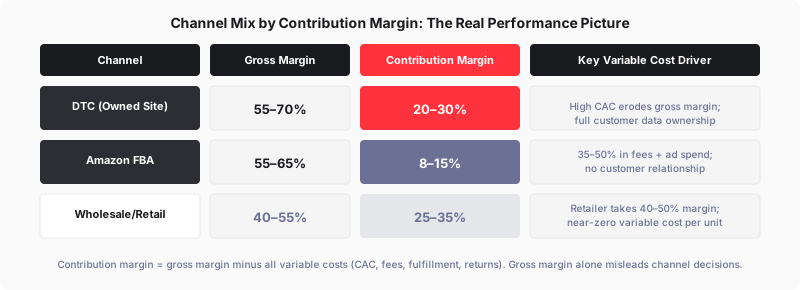
The implication is counterintuitive: Amazon's fee structure consumes 35 to 50% of revenue depending on category, but the customer acquisition cost is embedded in the platform. DTC's higher gross margin often narrows to a lower contribution margin once blended paid media CAC is included. Wholesale shows the lowest gross margin but often the highest contribution margin per unit because the variable cost per unit sold approaches zero.
Brands with strong omnichannel engagement retain 89% of customers versus 33% for single-channel brands, and omnichannel buyers show 13% higher average order value, according to research aggregated by Capital One Shopping. But reaching those retention rates requires that each channel is economically defensible first.
Early-stage and growth-stage brands face different channel problems. The right sequencing matters more than the right mix.
Early stage (pre-PMF or early traction): Marketplaces offer immediate access to existing demand without requiring you to build traffic from scratch. Amazon and TikTok Shop can prove demand faster than DTC because the platform supplies the audience. The tradeoff is that marketplace customers belong to the platform, not to you. Use early marketplace traction to validate demand, not as a long-term customer acquisition strategy.
Growth stage: DTC investment begins to compound. An email list, organic search presence, and returning customer base start delivering acquisition that does not depend on ad spend. Build owned channels in parallel before marketplace dependency becomes structural. The target allocation for most growth-stage DTC brands is roughly 60 to 70% DTC, 20 to 30% marketplace, with wholesale entering the mix once the brand has pricing leverage.
Scale stage: Wholesale and retail partnerships make sense when the brand can command premium shelf placement and pricing concessions rather than being commoditized. Omnichannel customers at this stage spend 13% more per order and have 30% higher LTV than single-channel customers.
US social commerce hit $87 billion in 2025, up 21.5% year-over-year, according to eMarketer. TikTok Shop alone grew 108% to $15.8 billion, representing 18.2% of total US social commerce.
TikTok Shop converts at 4.7% compared to Instagram Shopping at 2.1%. For mid-price visual products in beauty, wellness, and apparel, social commerce has become a first-tier channel, not an experiment.
The platform dependency risk is equally significant. TikTok's regulatory uncertainty in early 2025 demonstrated what happens when a channel that represents 15 to 20% of a brand's revenue faces potential shutdown. Brands with first-party data assets (email lists, SMS subscribers, loyalty programs) had a mitigation path. Brands without them had no way to reach those customers outside the platform.
The rule that applies to every channel: no single platform should exceed 60% of total revenue. This is not just a margin rule. It is a business continuity rule.
Channel conflict is one of the most expensive and most preventable mistakes for growth brands. It happens when distribution channel expansion creates direct competition between the brand's own channels or between the brand and its partners.
The Amazon versus DTC conflict is the most common form. If a third-party seller lists your product on Amazon at a lower price than your DTC site, customers find you through paid ads, check Amazon for the price, and buy there at lower margin. If you discount to win the Amazon Buy Box, retail partners demand matching price concessions. Margin pressure cascades.
The wholesale versus direct conflict creates similar tension. Retailers who carry your product will pull back, demand exclusivity, or reduce shelf space when they see aggressive DTC pricing. This is why many brands run channel-exclusive SKUs or colorways to prevent direct price comparison across channels.
Practical approaches that manage this without eliminating channel diversification:
The brands that manage channel conflict effectively address it in channel policy before expansion, not in crisis management after a partner complaint.
Brands with 90% or more Amazon concentration trade at 3.0 to 3.5x EBITDA at acquisition, compared to 4.5 to 5.5x for brands with meaningful off-Amazon channels, per Canopy Management's analysis of ecommerce brand acquisitions. Single-channel dependency carries a roughly 40% valuation discount.
Platform risk includes algorithm changes, fee increases, policy shifts, regulatory action, account suspension, and competitive moves (Amazon launching a private-label product in your category). The mitigation is building owned channels that the platform cannot take away.
Owned channels worth prioritizing in order of defensibility: email list, SMS subscribers, loyalty program membership, organic search presence. These compound over time and do not reset when a platform changes its algorithm or fee structure.
For DTC brands building their ecommerce marketing strategy, channel diversification is not about pursuing every available channel. It is about building the owned-channel foundation that makes all other channels less risky.
In B2B SaaS, channel marketing refers specifically to indirect go-to-market through partner ecosystems. The structural logic is the same as ecommerce channel strategy, with different vocabulary.
Partner types include resellers and value-added resellers (VARs), managed service providers (MSPs), independent software vendors (ISVs) who integrate your product, referral and affiliate partners, and system integrators for enterprise deployments.
The economics make indirect channels necessary at certain ACV thresholds. If your average contract value is below $15,000 to $25,000, a direct enterprise sales rep for every deal is not economically viable. Partners cover that market cost-effectively. Forrester research cited across B2B practitioners estimates that nearly 70% of B2B buyers purchase through an indirect channel partner rather than directly from the vendor.
The same channel conflict logic applies: if your direct sales team sells into territories where a partner is also working, conflict erupts. Deal registration systems, territory exclusivity agreements, and Partner Relationship Management (PRM) tools like PartnerStack or Impartner are the B2B equivalent of MAP policies.
For brands building a broader omnichannel marketing strategy, the underlying principle across both DTC and B2B is identical: distribution channel decisions constrain and enable marketing channel decisions. Building them in the right sequence, with contribution margin as the scorecard, is what separates brands that scale profitably from those that grow into a margin problem.
Channel strategy is one of the highest-leverage decisions a growth-stage brand makes and one of the hardest to reverse once distribution commitments are made. Wholesale relationships, Amazon seller accounts, and retail partnerships create obligations and dependencies that take years to unwind.
Getting channel strategy right requires contribution margin visibility by channel, clear policies against conflict before it starts, and a disciplined ceiling on any single platform's share of revenue. The brands that compound fastest are not the ones that found the best single channel. They are the ones that built a mix where each channel reinforces the others without undermining their economics.
If you want to audit your current channel mix and build a program that protects contribution margin at scale, EmberTribe works with growth-stage DTC and B2B brands on the kind of channel strategy that holds up as the brand grows.
The distinction that separates high-performing retail brands from the rest is not how many channels they operate. It is whether those channels share a single view of inventory, customer data, and purchase history. That distinction is the difference between multichannel and omnichannel commerce, and the performance gap between them is large enough that every growth-stage brand building a channel strategy needs to understand it clearly.
Omnichannel commerce means a customer's cart, purchase history, support interactions, and preferences follow them across every touchpoint. A study of 46,000 shoppers by Harvard Business Review found that 73% of buyers use multiple channels during a single shopping journey, and that customers who engaged across four or more channels spent 9% more in-store than single-channel shoppers and logged 23% more repeat visits within six months of an omnichannel experience. The compounding effect on retention and lifetime value is why Manhattan Associates' 2025 Omnichannel Trends research shows only 17% of retailers have mature capabilities despite 54% listing it as their top strategic priority.
The vocabulary matters because confusing these terms leads to misallocated investment.
Multichannel means selling across multiple independent channels: a website, Amazon, retail stores, social commerce. Each channel operates with its own inventory count, its own customer data, and its own messaging. A brand can be present on six channels and still be multichannel. The internal question for multichannel is: how do we get the most out of each channel independently?
Omnichannel connects those channels into a coordinated customer experience. The customer's identity and behavior history follow them across touchpoints. A buyer who browses on mobile, adds to cart on desktop, and purchases in-store is recognized as the same customer across the journey. The internal question shifts to: how do we give each customer the best experience regardless of where they engage?
Unified commerce is where omnichannel is heading in 2025 and 2026. The distinction, articulated by Sitoo's unified commerce research, is in the architecture. Omnichannel often connects existing siloed systems via APIs and middleware. Unified commerce runs all channels from a single backend: one order management system, one inventory ledger, one customer record, no integration layer to maintain.
Brands with unified commerce report 27% lower fulfillment costs and 18% reduced cart abandonment, per Manhattan Associates data.
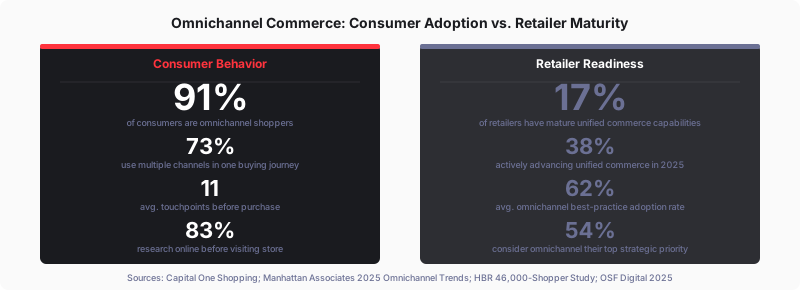
The numbers from Capital One Shopping's omnichannel statistics research show the magnitude of what is at stake. Companies with strong omnichannel engagement retain 89% of customers, compared to 33% for brands with weak omnichannel strategy. Omnichannel customers spend 16% more per order and purchase 250% more frequently. Their lifetime value is 30% higher.
The HBR finding that 73% of shoppers use multiple channels in a single journey, combined with 91% of consumers qualifying as omnichannel shoppers, means the question for most brands is not whether to pursue omnichannel. It is how far behind they currently are and what the cost of that gap is in retention, LTV, and competitive position.
The market is moving. Capital One Shopping's omnichannel research reports that curbside pickup increased conversion rates by 25.8% in 2024 among the top 1,000 retailers. Real-time inventory visibility online drives significant cart completion improvements when customers can see whether a product is available at a nearby location.
The infrastructure investment is what separates a genuine omnichannel program from channel coordination with good marketing. The core components:
The brands executing omnichannel at scale demonstrate the revenue impact concretely. Warby Parker started as a direct-to-consumer online brand and now operates 276 or more stores generating 70% of total revenue. Full year 2024 revenue reached $771.3 million with 15.2% year-over-year growth, per Warby Parker's Q4 2024 results.
Physical stores did not cannibalize digital. They amplified total customer acquisition and LTV by bringing try-on and optometry into the physical world while keeping digital as the discovery and repurchase layer.
Starbucks runs 70% of US sales through mobile and drive-thru orders. Its 31 million active loyalty members generate over 50% of US revenue and spend three times more than non-members. The deep brew AI system personalizes recommendations across the app, drive-thru, and in-store touchpoints from a single customer data record.
Sephora has unified online and offline customer profiles since 2010. The Color IQ tool links in-store skin tone scans to customer profiles and surfaces personalized online product recommendations in subsequent digital sessions. That single data integration turns a physical in-store moment into a durable digital personalization signal.
Most omnichannel failures trace to a small set of structural problems that brands underestimate before launch.
The 91% consumer omnichannel adoption rate versus 17% retailer maturity rate defines a competitive landscape where the gap between infrastructure leaders and laggards is widening. The brands getting this right are demonstrating the results: 89% customer retention, 250% purchase frequency lift, 30% LTV premium. The brands behind the curve are funding customer acquisition into a leaky retention system.
For growth-stage DTC and ecommerce brands evaluating their channel infrastructure and cross-channel marketing strategy, EmberTribe works with brands on the demand generation and channel investment decisions that determine whether omnichannel infrastructure pays off or underperforms.

Cost per user acquisition (also called customer acquisition cost, or CAC) is the single metric that determines whether a growth strategy is sustainable or just fast. Companies that grow their revenue while holding or reducing CAC build durable businesses. Companies that grow revenue while CAC climbs quietly are building a funding dependency.
Most companies calculate it wrong, benchmark it against the wrong reference points, and address it with the wrong levers. This guide covers all three.
CAC is not one number. It is three different calculations that serve three different purposes, and conflating them causes expensive decisions.
Blended CAC is total sales and marketing spend divided by all new customers acquired in the same period, regardless of channel. This includes customers from organic search, word-of-mouth, referrals, and direct traffic alongside paid acquisition. Blended CAC is what investors and finance teams typically want to see. It reflects the true average cost of growth.
Because it absorbs "free" customers from organic channels, blended CAC is always lower than paid CAC.
Paid CAC is only paid-channel spend divided by customers attributable to those channels. Paid CAC is consistently higher than blended CAC. The gap between the two quantifies how much your organic acquisition is subsidizing your paid media.
A company with a $200 blended CAC and a $600 paid CAC has a strong organic engine. If that organic engine weakens, the true cost of growth surfaces fast.
Channel-level CAC breaks acquisition cost out per channel: paid search, paid social, email, organic SEO, referral, outbound SDR. This is the most operationally useful view for budget allocation. A blended CAC of $400 can mask a paid social CAC of $900 and an organic SEO CAC of $80. Without channel-level breakdowns, you are allocating budget based on averaged-out noise.
The practical rule: use blended CAC to benchmark and communicate. Use paid CAC to evaluate paid media efficiency. Use channel-level CAC to allocate budget and cut underperforming channels.
The formula is simple: total sales and marketing spend divided by new customers acquired. The application is where teams go wrong.
What belongs in the numerator (spend): ad spend, marketing software and tools, sales team salaries and commissions, marketing team salaries, content production costs, and overhead allocated to those teams. Personnel costs represent 50 to 70% of true acquisition cost in most companies, yet many teams only count ad spend. Excluding salaries understates true CAC by 30 to 50%.
What belongs in the denominator (customers): net-new customers only. Reactivated churned customers and expanded accounts should not go here. If they do, CAC is artificially deflated and the business looks more efficient than it is.
Time-period mismatches are the other common error. Attributing one quarter's marketing spend against that same quarter's new customer count ignores conversion lag: campaigns take weeks or months to produce closed customers. A rolling three-month average, or lagging the denominator by one period, produces more accurate numbers.
Benchmarks are only useful when compared at the right level of specificity. Industry-wide averages obscure category and motion differences that determine whether a given CAC is healthy or alarming.
DTC Ecommerce benchmarks (2025-2026):
According to Userpilot's CAC benchmark research, fully loaded CAC across tracked ecommerce businesses averages significantly higher once personnel costs are included.
B2B SaaS benchmarks by motion:
The 16x gap between PLG and sales-led acquisition reflects the fundamental cost difference between product-driven trial conversion and outbound-heavy enterprise selling. Most SaaS companies should know which motion dominates their revenue and benchmark accordingly, not against a blended SaaS average that mixes both.
By acquisition channel (B2B SaaS, per First Page Sage's CAC report):
The channel-level data is the most actionable benchmarking layer. If your paid search CAC is $1,400 and the benchmark is $802, the gap is a diagnostic: you have a conversion problem, a targeting problem, or both.
CAC in isolation is incomplete. A $1,000 CAC for a customer worth $10,000 in lifetime gross profit is excellent. A $200 CAC for a customer worth $350 is a slow bleed.
The standard benchmark is a 3:1 LTV:CAC ratio as the minimum for sustainability: for every $1 spent acquiring a customer, the customer should generate $3 in lifetime gross profit. The median across tracked SaaS companies is approximately 3.2:1.
The ratio is only as good as the LTV estimate. Gross profit LTV, not revenue LTV, is the correct input. A SaaS company with 40% gross margins calculating LTV on revenue is overstating the ratio by 2.5x. A DTC brand calculating LTV on 12-month windows without modeling declining repurchase probability is making the same error in a different form.
The ratio also sets a per-customer budget ceiling: if average customer LTV is $10,000, maximum allowable CAC is $3,333 to maintain 3:1. This gives marketing a hard number to optimize toward, rather than an abstract efficiency goal.
The payback period answers a different question than LTV:CAC: not whether acquisition is profitable, but when it becomes profitable. For capital-constrained companies, this is often the more important metric.
Formula: CAC divided by (average monthly revenue per customer multiplied by gross margin percentage).
SaaS benchmarks:
According to The SaaS CFO's analysis of CAC payback benchmarks, self-serve B2B SaaS typically achieves 8.6-month payback while sales-led enterprise averages 14 to 24 months, reflecting the higher CAC and longer ramp to recognized revenue.
A rising payback period is a leading indicator of capital inefficiency before it shows up in the P&L. A company with 24-month payback is effectively lending its CAC to each new customer for two years. In a high-growth environment with available capital, that is fundable. In a capital-scarce environment, it becomes an existential constraint.
For DTC ecommerce, subscription conversion is the single biggest lever on payback period. A brand selling consumables with a 20% subscription take rate recovers CAC in 2 to 3 purchases; a brand with no subscription mechanic may need 5 to 7.
According to Paddle's analysis of CAC trends over time, average CAC has increased approximately 60% across B2B and B2C businesses since 2021. The proximate cause was Apple's iOS 14.5 ATT rollout in April 2021, which allowed approximately 75% of iOS users to opt out of cross-app tracking.
The downstream effect: Meta and Instagram lost the attribution layer their performance advertising was built on. Advertisers could not prove ROI with precision, so they bid more conservatively, CPMs rose, and acquisition costs climbed. Meta Q1 2025 CPMs hit $10.88, up 19.2% year-over-year.
The structural problem is broader than a single policy change. More brands compete on fewer dominant platforms. Cookie deprecation in Chrome has extended attribution gaps beyond mobile. Lookalike audiences are saturated from heavy use, forcing advertisers into colder inventory.
Creative fatigue cycles have shortened from 6 to 8 weeks to 2 to 3 weeks, increasing creative production cost as a share of total acquisition cost.
An important distinction: some of the observed CAC increase is real (higher CPMs, more competition) and some is measurement noise (lost attribution making conversion tracking incomplete, so reported CAC rises without actual costs rising equivalently). Both are real problems, but they require different solutions.
Not all CAC reduction levers are equivalent. Three have disproportionate impact.
Conversion rate optimization. Improving landing page or checkout conversion from 1% to 2% cuts CAC by 50% with zero change in spend. A 20% improvement at the highest-drop-off funnel stage has the same CAC impact as cutting the entire marketing budget by 20%. This is consistently the highest-ROI intervention available and the most neglected.
Referral programs. Referral CAC in B2B SaaS averages approximately $150, compared to $802 for paid search. Referred customers also show 16% higher lifetime value and 37% higher retention than non-referred customers. Referral programs are underused because the attribution is lagged and the economics only become obvious in hindsight.
Organic channel investment. Organic SEO CAC runs materially below paid equivalents in every measured category. The tradeoff is time: organic channels take 6 to 18 months to ramp, but they compound and do not reprice with every platform auction. As paid CAC continues climbing, the comparative economics of organic improve each year. For companies with a long enough horizon, investing in customer acquisition through organic channels produces the widest CAC differential over time.
Channel mix optimization, first-party data improvement, and retention investment all contribute as well. But the leverage hierarchy matters: fix conversion rates first, then build referral mechanics, then invest in organic, then optimize channel mix. Doing them in reverse order optimizes around a leaking funnel.
Cost per user acquisition is not just a marketing metric. It is the variable that determines how much capital a business needs to grow, how long investors will stay patient, and whether a company can reach profitability before its runway ends. The brands and SaaS companies that get this right are not necessarily spending less than their competitors. They are spending on channels with better unit economics, converting more of the traffic they already have, and building acquisition motions that improve over time.
If you want to audit your acquisition economics and identify where the highest-leverage improvements are, EmberTribe works with growth-stage DTC and B2B brands on programs designed to grow revenue without proportionally growing the cost to acquire it.

Revenue is growing but slower than it should. CAC keeps climbing while retention wobbles. Leadership debates whether the problem is the channel mix, the team, the positioning, or something upstream in the product. Nobody inside the building has a clean answer because everyone is too close to the work, and that is the exact moment companies start looking for growth strategy consulting.
The term gets used loosely, with some vendors applying it to paid media management and others using it for quarterly strategy decks with no implementation path. Real growth strategy consulting is something more specific: a structured process for diagnosing what is actually limiting growth, prioritizing the highest-leverage opportunities, and building a roadmap the internal team can execute against. Understanding what it is, and what separates useful engagements from expensive noise, is worth getting right before you open any conversation with a consultant.
Growth strategy consulting sits at the intersection of diagnosis and planning. A consultant's job is not to run your campaigns or manage your team. It is to figure out why growth is not compounding the way the model says it should, then design a system that changes the trajectory.
A typical engagement starts with a diagnostic phase. The consultant runs cohort analysis on acquisition and retention data, maps the full customer journey, interviews key customers and internal stakeholders, and benchmarks performance against comparable companies. The output is a clear picture of where value is being created, where it is leaking, and which constraints are structural versus fixable.
From that diagnostic, the consultant builds a prioritized growth roadmap. This document defines which levers to pull, in what sequence, with what success metrics and team accountabilities attached. The Ansoff matrix, the BCG growth-share framework, and the three-horizons model are common structural tools, but the useful consultant adapts these to your specific stage and market rather than applying a template. BCG's business strategy practice describes the process as identifying the intersection between market opportunity and organizational capability, which is a reasonable summary of what a strong engagement produces.
Deliverables typically include a diagnostic summary, a prioritized growth roadmap with timelines and owners, a measurement framework with KPI definitions and tracking infrastructure, and a summary of customer research findings. Some engagements include ongoing advisory support through implementation. Others are purely diagnostic, handing off a roadmap and exiting.
The distinction matters because buyers often conflate the two, end up with the wrong type of engagement, and then blame consulting as a category when the real problem was a mismatch in scope.
Management consulting focuses on internal operations: organizational structure, process efficiency, cost reduction, and team design. The question being answered is usually "how do we run this business better." Growth strategy consulting focuses on external trajectory: market positioning, acquisition, retention, and revenue expansion. The question being answered is "how do we grow faster and more efficiently."
A management consultant brought in to solve a growth problem is likely to audit your org chart and recommend a restructure. A growth strategy consultant brought in to solve an operational problem is likely to identify revenue opportunities that do not actually fix the underlying bottleneck. Clarity about which problem you have determines which type of engagement you need.
Growth marketing consultants, a related category, sit closer to execution and typically own specific channels or programs rather than the full strategic picture. If you need someone to run paid acquisition or optimize your email flows, that is a growth marketing consultant or an agency. If you need someone to tell you which of those channels deserves investment in the first place, that is a growth strategy consultant. Our guide on SEM marketing agencies covers what to look for when the paid search component specifically is what needs fixing.
The most effective growth strategy engagements follow a consistent arc regardless of company stage or market.
Week one through three: Discovery and data audit. The consultant collects existing performance data, customer research, financial models, and competitive intelligence. Gaps in data quality become visible immediately and are often themselves diagnostic. A company with no cohort-level retention data is operating blind on one of the most important growth levers available.
Week three through six: Diagnostic synthesis. Quantitative findings from the data audit get combined with qualitative findings from customer and stakeholder interviews. The goal is to identify the two or three constraints that are actually limiting growth, not the ten things that could theoretically be improved. Most companies have more opportunities than capacity, so prioritization is the real work.
Week six through eight: Roadmap development. The consultant builds a sequenced roadmap with defined milestones, success metrics, and resource requirements. This is where the Outcome-Driven Innovation framework becomes useful: defining growth opportunities around the specific jobs customers are trying to get done rather than around the company's existing product or channel assumptions. GrowthMentor's guide on growth consultants describes this as designing a custom growth system, which captures why roadmap quality depends heavily on the diagnostic work that precedes it.
Weeks eight through twelve (if applicable): Implementation support. Some engagements include a structured handoff period where the consultant works alongside the internal team to implement the first set of initiatives and establish measurement infrastructure. This phase is where most of the strategic value either compounds or evaporates depending on execution quality.
Understanding the metrics that matter at each stage is foundational to this process. Our breakdown of SaaS marketing metrics and KPIs covers the core performance indicators a growth consultant will use to assess health and track progress.
The market for growth consulting ranges from solo operators with strong track records to large strategy firms with brand names and commodity outputs. The consultant's pedigree matters less than a few specific signals.
Evidence of diagnosis before prescription. A consultant who presents a generic growth framework in the first sales conversation without understanding your specific data and market is a red flag. The diagnostic phase exists because the answer is almost never obvious without it.
Relevant stage and market experience. A consultant who has worked exclusively with enterprise software companies may not have useful mental models for a DTC brand navigating a crowded paid social environment. The frameworks transfer, but the benchmarks, the channel assumptions, and the customer behavior patterns often do not. Ask for specific examples of companies at a similar stage in a similar market.
Transparency about what they will not do. Good consultants are clear about the boundary between strategy and execution. If a consultant says they will handle both the strategic roadmap and the day-to-day channel management, get specific about how the hours are allocated. Strategy and execution require different cognitive modes and the work usually suffers when one person is expected to do both.
Measurement-first orientation. If a consultant cannot tell you precisely how you will know whether the engagement worked, the engagement is probably not structured around outcomes. Ask what the measurement framework looks like before you sign.
DesignRush's guide to business growth consultants notes that the best engagements define success criteria before work begins and build reporting infrastructure that outlasts the consulting relationship. That framing is useful when evaluating proposals.
Growth strategy consulting pricing varies significantly based on the consultant's track record, the engagement scope, and whether implementation support is included. These are realistic benchmarks for 2026.
Hourly rates for independent growth consultants with proven track records run between $150 and $400. Senior partners at established firms run higher.
Diagnostic projects, typically two to six weeks with a defined deliverable package, run between $10,000 and $40,000 depending on company complexity and the depth of data analysis required.
Full strategy engagements covering diagnosis, roadmap, and implementation support run between $30,000 and $150,000 for multi-month work with substantive deliverables.
Monthly retainers for ongoing advisory, typically eight to fifteen hours per month, run between $3,000 and $15,000 depending on seniority and scope.
Pricing at the lower end of these ranges typically reflects a narrower scope or a less experienced operator. Pricing at the higher end reflects either a firm with significant overhead or a consultant with a demonstrable track record of ROI that justifies the premium. Before comparing prices across options, align on exactly what deliverables are included and who owns implementation.
The build-versus-hire question comes down to time, capability gap, and how structural the problem is.
Hire a growth strategy consultant when: growth has plateaued despite reasonable product-market fit and you cannot identify the constraint internally; you lack a senior growth leader who has scaled a similar business and need to fill that gap while you decide whether to hire for it permanently; you are entering a new market or channel and need an outside perspective on prioritization before committing internal resources; or you are preparing for a fundraise and need a credible growth narrative backed by data.
Build in-house when: the strategic direction is clear and what you need is execution capacity; the growth problems are channel-specific rather than strategic; or you have the internal leadership to run a disciplined growth process and the consultant would be replicating work the team can do itself.
For B2B SaaS companies and growth-stage ecommerce brands, the decision often comes down to whether the constraint is strategic clarity or execution bandwidth. A consultant solves the first. An agency or internal hire solves the second. Our overview of ecommerce digital marketing covers the execution layer for brands where the channel strategy is already defined.
EmberTribe works with DTC brands and growth-stage companies to build data-driven growth systems that compound over time. Engagements start with a structured diagnostic that identifies the real growth constraint, not the symptoms, and build toward a prioritized roadmap the team can actually execute.
The difference between a useful engagement and an expensive slide deck is whether the work stays grounded in your specific data, your specific customer, and your specific market. That requires asking different questions before prescribing anything. If your growth has stalled and you want an outside read on why, connect with the EmberTribe team to start with the diagnostic.

Every brand is on social media. The question is whether your social media company is actually moving the needle — or just filling a content calendar.
The market for social media companies has expanded dramatically. You can hire a one-person freelance shop, a full-service agency, a platform-native specialist, or a growth partner that integrates social into your broader acquisition strategy. The differences between them aren't always obvious at the pitch stage. By the time you notice the gap, you've already spent months and budget.
This guide breaks down what actually differentiates social media companies in 2026, what to look for when evaluating them, and the questions you should ask before signing a contract.
The term "social media company" covers a wide range of service models. At the most basic level, some companies offer content creation and scheduling — captions, graphics, and a posting cadence. At the other end, high-performance partners manage full-funnel social strategy, paid media, creative testing, community management, and attribution reporting.
Most brands underestimate this range. They hire for one expectation and get another.
Here's how the main models break down:
Content-only agencies handle production — copywriting, design, video editing — and schedule posts. They're not running ads, not analyzing performance at depth, and not integrating with your broader marketing funnel.
Managed social agencies take ownership of both organic and paid social. They run campaigns, manage community responses, optimize creative, and report on performance. This is the most common model for growth-stage brands.
Integrated growth partners treat social as one lever in a larger acquisition system. They connect social performance to revenue data, coordinate with email and paid search, and adjust strategy based on full-funnel outcomes.
Which model you need depends on your stage, goals, and internal team structure — but it's critical to know which one you're actually buying.
The social media landscape has shifted significantly. Platform engagement patterns have changed, authenticity outperforms polished production, and AI-generated content is flooding every feed. The social media companies that deliver results in this environment share a few common traits.
Follower counts and impressions don't pay salaries. The best social media companies connect their work to pipeline and revenue, not just reach. Look for partners who track leads generated, conversion rates from social traffic, and attributed revenue — and who build their reporting around those numbers.
If a prospective partner's pitch deck is heavy on engagement metrics and light on business outcomes, that tells you how they define success.
Research consistently shows that audiences in 2026 respond better to authentic, raw content than to polished brand productions. The best social media companies know when to use UGC (user-generated content), how to coach founder-led content, and how to build a content strategy that feels real — not just aesthetically sharp.
Volume without strategy isn't a differentiator. A company that posts five times a week with mediocre creative will underperform one that posts twice a week with compelling storytelling.
Some agencies offer to manage every platform simultaneously. That's often a sign of spread-thin resources rather than genuine expertise. The better question is: where does your audience actually spend time, and does this company have demonstrated depth on those specific platforms?
A DTC brand with a strong visual product likely needs Instagram and TikTok expertise above all else. A B2B SaaS company needs a partner who understands LinkedIn's algorithm and professional content formats. Ask for platform-specific results and case studies, not generic social media performance claims.
Posting content is table stakes. How a social media company handles comments, DMs, and community engagement separates transactional vendors from genuine brand builders. Fast, on-brand responses to customer questions and complaints directly influence purchase decisions — community-led growth is one of the biggest differentiators among top-performing agencies in 2026.
Virtually every social media company now uses AI to accelerate content production. The relevant question isn't whether they use AI — it's how. The best partners use AI to speed up research, generate drafts, and optimize scheduling, while human strategists handle storytelling, brand judgment, and creative direction. AI-generated content without human editorial oversight is increasingly obvious to audiences, and it hurts brand credibility.
Before committing to a contract, get specific answers to these:
Several patterns reliably predict a poor agency relationship:
Guaranteed follower growth. Followers can be bought. Engagement and revenue cannot. Any guarantee around follower counts is a proxy metric with no business value.
No access to your own accounts. You should always own the login credentials and admin access to your social profiles. An agency that controls your accounts is holding your audience hostage.
Reporting that never shows what's not working. Good social media companies present learning from failures alongside wins. If every monthly report is green, either they're cherry-picking or they're not testing enough.
One-size-fits-all creative. If you see the same graphic templates across their client portfolio, your brand is not getting a differentiated creative strategy — you're getting repurposed assets.
Long contracts with no performance clauses. A 12-month commitment with no performance reviews or exit provisions benefits the agency, not you.
Social media management pricing varies widely. Basic content-only packages typically run $1,500–$3,000/month. Full-service managed social — including paid campaigns, community management, and performance reporting — commonly ranges from $3,500–$10,000/month depending on platform scope and ad spend.
Integrated growth partnerships that include social as part of a broader paid media and growth strategy tend to be priced at the higher end or structured around a percentage of ad spend. Know what you're paying for before comparing quotes across agencies with different scope definitions.
For DTC brands and growth-stage companies, the most important filter is whether the social media company thinks in terms of acquisition and revenue or in terms of content and followers. These are fundamentally different orientations.
If you're evaluating partners that also offer broader growth marketing services — paid media, SEO, email — it's worth considering whether your social program would benefit from integration with those channels. Our post on how to choose the best ecommerce marketing agency covers what that integrated evaluation looks like.
A social media company that operates as a standalone vendor can deliver results. But a social media company that connects your content strategy to your acquisition funnel will compound those results across every channel.
The social media company landscape in 2026 offers more options than ever — and more ways to waste budget on the wrong partner. The differentiators that actually matter aren't follower counts, posting frequency, or slick pitch decks. They're revenue-linked reporting, platform-specific expertise, authentic creative strategy, and a genuine integration with how your business grows.
Define what success looks like for your brand before the first conversation. Ask hard questions about team structure, creative process, and account ownership. Look for transparency over promises.
The right social media company isn't just a vendor — it's a growth lever. Evaluate them that way.

Most SaaS founders assume SaaS SEO works the same way it does for any other business: pick keywords, publish blog posts, wait for traffic, watch signups climb. That mental model is the reason so many SaaS SEO programs underperform for 12 months and then get quietly defunded.
The buyer journey is longer, the intent signals are weirder, and the pages that actually generate pipeline rarely live on the blog. If your program is optimized around sessions, you are almost certainly measuring the wrong thing. This guide walks through how SaaS SEO is structurally different, what a full-funnel content strategy looks like, where technical foundations trip teams up, and how to measure the work so it survives the next budget cycle.
General SEO is about matching a query to a page. SaaS SEO is about matching a query to a buying committee that may take six to eighteen months to decide. Everything downstream, from keyword selection to content architecture to reporting, changes because of that.
B2B buyers are methodical by design. Gartner's research on the B2B buying journey describes a non-linear path where groups of stakeholders move in and out of jobs like problem identification, solution exploration, and supplier selection. Buyers spend only about 17% of their total purchase time meeting with vendors, which means the rest is spent reading, comparing, and filtering solutions on their own. Your organic content is the substitute for a sales rep during most of that window.
That single fact reshapes SaaS SEO strategy in four concrete ways:
If you remember one thing from this guide, it is this: SaaS SEO is a pipeline strategy disguised as a content strategy. Teams that treat it otherwise end up trapped in traffic charts that never translate to revenue.
Top-of-funnel content is where most programs start, and for good reason. Educational posts build topical authority and capture buyers before they know what category of product they need. The mistake is stopping there. A mature SaaS SEO program covers three clearly different jobs, and each job needs a different content type.
These searches use pain language, not product language. Think "how to forecast hiring budget" rather than "workforce planning software." The goal of top-funnel content is not to sell the product on the page. It is to show up in the reader's first three searches and establish your brand as a voice they trust when they move into the consideration phase. Top-funnel pieces work best when they solve the problem completely, even if the solution does not require your product.
By the time a buyer searches "project management software for remote teams" or "best customer onboarding tools," they have named the problem and are scoping the solution space. Middle-funnel content needs to shape the shortlist. Common formats include category roundups, feature comparisons, and use-case pages for specific job titles or team types. These pages are where a lot of SaaS SEO programs get their first meaningful MQLs, and they are the pages most often neglected in favor of blog volume.
Bottom-funnel SaaS SEO is where revenue lives, and it looks almost nothing like traditional content marketing. Effective bottom-funnel pages include "[your product] vs [competitor]," "[competitor] alternatives," integration pages, pricing explainers, and security or compliance documentation. These are the queries where buyers are already in the shortlist phase and need a final reason to move.
Reviews on sites like G2 also play an outsized role here. Branded comparison pages and alternative roundups on review platforms rank for many of the same queries your bottom-funnel pages target, which makes category presence on third-party review sites part of a serious SaaS SEO strategy, not an afterthought.
For a deeper framework on how content types map to the full buyer journey, our SaaS content marketing strategy guide covers the editorial planning side of this.
Most SaaS platforms run on JavaScript-heavy stacks. That is not a problem in itself, but it introduces failure modes a generalist SEO agency will miss entirely. Server-side rendering, pre-rendering, or hybrid approaches are usually necessary for pages that matter for rankings. Google's JavaScript SEO basics documentation is the canonical reference, and it is worth reading even if your engineering team swears React Helmet has the meta tags covered. Rendering bugs are the single most common technical issue we see in SaaS SEO audits.
A few other patterns cause recurring pain:
docs.yourdomain.comon a separate subdomain splits authority. Google treats subdomains as separate sites, so link equity does not flow between marketing and documentation. Subfolders almost always win.
These issues are fixable, but only if someone is actually looking. Monthly rank reports will not surface a rendering bug that is suppressing half your product pages from the index.
Link building for SaaS has changed substantially in the last two years, and the tactics that worked in 2020 are mostly dead. Guest posting on low-quality blogs and paid directory listings are now a net liability. What still works is earning links through assets worth linking to.
Three approaches consistently drive high-quality backlinks for growth-stage SaaS:
Original research and data reports. Surveys of your user base, aggregated benchmarks, and industry studies get cited by journalists because they fill a gap in the reporting ecosystem. A single well-executed industry report can generate more authoritative backlinks than six months of outreach.
Free tools and calculators. A product-led free tool that solves a specific problem (an ROI calculator, a compliance checker, a budget template) earns links because it provides utility. Tools also double as top-of-funnel acquisition assets. Competitive research platforms like Ahrefs are useful for finding which of your competitors' pages are earning links, and why.
Digital PR and thought leadership. Pitching founder expertise to journalists, landing quotes in trade publications, and contributing to industry conversations builds domain authority while shaping how your category perceives you. Slower than content outreach, but the compounding effect is higher.
Notice what is missing: link farms, PBNs, comment spam, and mass guest posting. Those tactics never built durable growth, and post-2024 Google updates have made them harmful. Agency selection matters here, which is why our SaaS SEO agency guide goes deep on separating specialists from generalists.
Ranking reports are a useful diagnostic tool and a terrible scorecard. A SaaS SEO program that cannot tie organic traffic to pipeline will be defunded the first time the CFO asks hard questions. The metrics that actually matter for SaaS SEO in 2026 look like this: MetricWhy it mattersOrganic-sourced pipelineDollar value of opportunities attributed to organic searchSQLs from organicSales-qualified leads, filtered for real buying intentOrganic-influenced ARRRevenue from deals where organic was a touchpointPipeline velocityHow long organic leads take to close vs other sourcesCAC payback from organicMonths until organic-acquired customers pay back their cost
These metrics require marketing, sales, and RevOps to agree on attribution, which is hard political work but the only way to make SEO accountable to revenue. Rankings, sessions, and impressions are fine as leading indicators. They should never be the headline numbers on a board deck.
A practical starting point: build a dashboard that shows organic traffic broken out by funnel stage, paired with MQL and SQL volume each stage produces. That view exposes most of the honest problems in a SaaS SEO program, including that most blog content drives sessions but not pipeline, and that a handful of bottom-funnel pages usually drive the majority of revenue impact. Our B2B SaaS lead generation playbook covers the measurement side of this in more depth.
Failure patterns across SaaS SEO programs are surprisingly consistent. If you are building or auditing a program, these are the traps worth guarding against.
If you are starting from scratch, the highest-leverage first move is to audit your product's bottom-funnel search landscape. Look at what buyers search in shortlist mode: alternatives, comparisons, integrations, and category roundups. Most SaaS companies find the pages with the highest potential revenue impact do not yet exist, and building them is a faster path to organic pipeline than any amount of blog content.
If you already have a program generating traffic but not pipeline, the diagnostic work is different. Audit which pages are producing MQLs, which are producing vanity sessions, and where the technical architecture is suppressing rankings on pages that matter. SaaS SEO rewards programs willing to look at their own reporting honestly, even when the honest answer is that half the blog archive is not pulling its weight.
Either way, the shift separating SaaS SEO programs that scale from those that stall is the same: stop treating organic search as a traffic channel and start treating it as a pipeline channel. That shift changes what you build, how you measure it, and ultimately whether it earns a seat at the budget table for the next five years.

Most growth-stage SaaS teams hire their first product marketer about two years too late, then ask that person to own three jobs that belong to three different functions. The result is a saas product marketing strategy that looks like a pile of launch checklists and one-pagers, not a system that actually moves pipeline or win rates. The b2b saas marketing stack gets more crowded every quarter, and the companies that cut through are the ones treating product marketing as a strategic discipline, not a production line.
This guide is the version we wish our SaaS clients had before they hired their first PMM. It covers what SaaS product marketing actually is, how to build positioning that cuts through, tiered launches that match real business impact, pricing and packaging as a PMM concern, win/loss as a continuous pulse check, and how product marketing should work with sales.
Product marketing sits at the intersection of product, sales, and marketing, and owns the translation layer between what the product can do and why any specific customer should care. In SaaS, that translation is the job. Features are easy to copy. Positioning, messaging, and the sales narrative are much harder to replicate, and they do more to protect margin than any feature roadmap.
A useful way to define the role is by what product marketing owns outright versus what it influences.
Product marketing owns:
Product marketing strongly influences:
A growth marketer owns acquisition channels and pipeline targets. A demand gen marketer owns the programs that fill the funnel. A product marketer owns the story that makes those programs actually convert. Confusing these roles is the most common way the first PMM hire fails, and it shows up as a talented operator drowning in ad copy requests while the positioning question no one has answered quietly kills win rates.
If your homepage says "the fastest, easiest, most intuitive platform for growing teams," your positioning does not exist. That sentence could be pasted onto five hundred SaaS websites without the reader noticing. Generic positioning loses deals before you ever get the call.
The framework we point SaaS clients to is April Dunford's, laid out in Obviously Awesome. The core insight is that positioning should start from your competitive alternatives, not from your features. What would your best customers use if you did not exist? A spreadsheet, a different tool, a consultant, an internal build.
The answer to that question frames how you should describe yourself, because buyers evaluate you against that specific alternative, not against an abstract ideal.
From there, positioning becomes a chain of decisions: the unique attributes you have that the alternative lacks, the value those attributes create for a buyer, and the specific market category you want to be compared to. Skip any step and you end up back in generic messaging territory.
A practical test. Pull five sentences from your current homepage. Replace your product name with three competitors' names, one at a time. If any of those sentences still feel true for the competitor, that sentence is not doing positioning work. Rewrite it until it only makes sense about your product.
This is the work most SaaS teams skip because it feels philosophical. It is not. Weak positioning shows up in messy sales calls, long sales cycles, high churn, and content that does not convert. Strong positioning does not guarantee growth, but trying to grow without it is a tax you pay every day in slow pipeline and lost deals.
The other thing a SaaS PMM does badly without a framework is treat every launch the same. A new AI copilot and a minor UI polish both get a blog post, a sales email, and a product update page. The copilot deserved a full go-to-market push, and the UI change deserved a changelog entry. Both got the same effort, and neither moved the needle.
Tiered launches solve this. Most teams we work with use a three-tier model, adapted loosely from the Product Marketing Alliance launch tier framework and the Pragmatic Institute launch tiers approach.
Tier 1. A strategic launch that changes the company story, opens a new market, or shifts the competitive narrative. Eight to twelve weeks of prep. Executive sponsorship. Full enablement, press, analyst briefings, and a coordinated campaign. Maybe two or three per year if you are honest about what qualifies.
Tier 2. An important feature or capability that expands what existing customers can do or unlocks a new segment. Two to four weeks of preparation. Updated sales collateral, an email to customers, a blog post, and an in-app announcement. Not a press cycle. Maybe one per month.
Tier 3. Incremental improvements, bug fixes, and quality-of-life updates. Release notes, a changelog entry, and an in-app notification. No sales enablement required unless it affects a live deal. Happens weekly, quietly, and that is exactly the point.
The gift of tiered launches is that the PMM can say no. Without the tiers, every engineering ticket that ships gets treated as a launch, the team burns out producing low-leverage assets, and the actually-important launches do not get the attention they deserve. With tiers, the PMM has a defensible filter, and the rest of the org understands why a minor update does not warrant a webinar.
In most growth-stage SaaS companies, pricing and packaging belong to everyone and no one. Finance cares about margin, product cares about adoption, sales cares about close rates, and the CEO rewrites the pricing page every six months based on the last board meeting. The result is a pricing structure that reflects internal politics, not buyer psychology.
Product marketing is the natural owner of pricing and packaging because the team already holds the buyer research, the win/loss data, the competitive landscape, and the positioning narrative. Pricing is the most concrete expression of positioning. Every tier boundary, every feature gate, every usage metric is a statement about what you think your buyer values and what they will pay for it. OpenView's deep dive on pricing and packaging missteps is worth reading for any PMM about to touch this area.
Packaging questions that PMMs should lead on:
A quarterly pricing review led by product marketing, with finance and sales at the table, is one of the highest-leverage meetings most SaaS teams do not hold.
The fastest way to find out whether your positioning, pricing, and sales narrative are actually working is to ask the people who just made a decision. Win/loss analysis is not a quarterly research project. In the companies where it actually moves the needle, it is a continuous intake that feeds messaging, enablement, and roadmap.
The mechanics are not complicated. You need a sample of ten or more closed deals on each side, structured interviews run by someone who was not in the sale, and a clear set of questions covering how the buyer discovered you, how they evaluated alternatives, what drove the decision, and what almost killed the deal. Klue's seven-step win/loss guide covers the process in practical detail.
What makes win/loss powerful is the pattern recognition across interviews. One lost deal is an anecdote. Ten lost deals where three buyers name the same competitor objection is a messaging problem you can fix this week. Win/loss also catches positioning drift: the moment your sales team starts describing the product differently from how marketing is positioning it, you have a leak, and win/loss interviews catch that leak faster than almost any other mechanism.
The output should not be a slide deck that gets presented once and filed. The output is a set of changes: updated battlecards, revised objection handling, new proof points on the website, and a feedback loop to product on the top two or three feature gaps driving losses.
The fastest way to tell whether your product marketing is working is to listen to a sales call. If the rep is telling your positioning story in their own words, badly, your enablement is broken. If the rep is reading from a deck slide by slide, your enablement is broken differently. The goal is a rep who has internalized the narrative and can riff on it based on the specific buyer in front of them.
That kind of enablement has three components. A message house that defines the problem, the stakes, the solution, and the proof points in plain language. A living deck that sellers can trust and adapt, not a 60-slide corporate brochure. And ongoing reinforcement, weekly or biweekly, that keeps the narrative fresh as the market moves.
The best SaaS PMMs we work with spend at least one day a week embedded with sales, listening to calls, joining deal reviews, and updating materials based on what actually closes deals. The PMMs who fail treat sales enablement as a one-time handoff and wonder why their beautiful narrative never makes it into a discovery call.
This is also where product marketing connects back to pipeline. We dig into the sales-side mechanics in our B2B SaaS lead generation playbook, and the hiring question of when to bring in senior marketing leadership in our guide to fractional CMOs for B2B SaaS.
If you are building a product marketing function from scratch, the order of operations matters. Start with positioning. Without it, launches fall flat, pricing decisions are guesswork, and sales enablement is a collection of slides no one trusts.
Once positioning is stable, layer in launch tiering so the team can say no to low-impact work. Then put win/loss on a continuous cadence so the feedback loop stays fresh. Pricing and packaging work comes next, because it should follow positioning rather than lead it.
The SaaS companies that get this right do not treat product marketing as a department that writes launch copy. They treat it as the discipline that decides what the company sounds like in the market and which deals it can win. Everything downstream, from acquisition spend to retention mechanics, gets easier when product marketing is doing its job.
If your current marketing feels like tactics without a core narrative, the gap is almost always here. When that foundation is in place, broader acquisition work, covered in our SaaS customer acquisition strategies guide, starts to compound instead of leak.

Most growth-stage SaaS founders we talk to built their first $1M to $3M in ARR on referrals, word of mouth, and a handful of warm intro sales. Then the well runs dry. The next million feels three times harder than the first, and the real cost of saas customer acquisition becomes painfully visible for the first time. Suddenly the question is no longer "how do we keep up with demand?" but "how do we create demand that doesn't depend on who our founder knows?"
This is the wall. Most SaaS companies hit it between $2M and $8M in ARR, and it's the hardest transition in the company's life. The businesses that get past it tend to share a clear-eyed view of what acquisition really costs, which channels actually work at their stage, and what to stop doing.
Before talking about strategies, it helps to look at the numbers. Acquisition is more expensive than it used to be, and anyone telling you otherwise is selling something.
The median B2B SaaS company is now spending about $2.00 to acquire every $1 of new ARR, a roughly 14% jump from 2023 driven by higher ad costs, more competition, and longer buying cycles. Median CAC payback sits around 6.8 months, and the average B2B SaaS CAC lands near $1,200 per customer across blended channels. Drill into specific motions and the picture is wider: organic channels average closer to $205, paid channels around $341, and outbound-heavy SaaS motions can push toward $1,900 or higher when loaded costs are included. These are directional numbers from Genesys Growth's customer acquisition cost benchmarks, not physical laws, but they reflect what most of our SaaS clients see when they audit honestly.
Here is the uncomfortable part. Most SaaS founders quote their cost per user acquisition based on platform-reported numbers from Google, LinkedIn, or their CRM. The real number, once you include sales salaries, tooling, content production, and attribution leakage, is usually 1.5 to 2x higher. We covered the full accounting picture in our customer acquisition cost guide, and the short version is that if you have not loaded fully burdened costs into your CAC, you do not actually know what your CAC is.
Early SaaS growth is deceptive. A founder with strong network credibility can sell their first 30 customers without ever running a single ad or hiring a single BDR. It feels like product-market fit, and sometimes it is. But it's also a narrow, non-repeatable distribution channel, and it hides the real work of building scalable acquisition.
The plateau arrives when warm intros dry up before you've built any cold systems. The symptoms are recognizable: new logos get lumpy, sales cycles lengthen as reps work less-qualified leads, and the founder gets pulled back into closing deals. Pipeline reviews turn into "we need more at the top of the funnel" meetings, and three quarters go by without a clear answer to where new customers should come from.
The fix is not a single silver bullet channel. It's a deliberate, stage-appropriate acquisition strategy that treats the transition from founder-sales to systematic demand as its own company-wide project.
Five motions move the needle for most growth-stage SaaS companies. None of them are new, and all of them take longer than founders want. The brands that win are the ones that pick two or three, invest seriously, and resist the urge to abandon ship at month four.
Organic search is still the highest-leverage inbound channel for SaaS, with SEO leads closing at roughly 14.6% compared to 1.7% for cold outbound, according to data summarized by TripleDart. The catch is that it takes 6 to 9 months to compound, which is precisely why most teams quit too early.
The strategy that works in 2026 is commercial-intent first, then topical authority. Start with bottom-funnel pages ranking for "{category} software," "{competitor} alternatives," and "{use case} tool" queries. Only after those are shipped should you build out top-funnel education content. Most SaaS blogs fail because they invert the order and spend a year writing "what is" posts that bring traffic but not buyers.
Google Ads on category and competitor terms is one of the few channels where you can buy pipeline within weeks. For growth-stage SaaS, the right structure is a small number of tightly-scoped campaigns on high-intent terms, paired with fast-loading landing pages tied to a specific offer.
Paid search gets a bad reputation in SaaS because teams run it without CRO discipline, dump traffic onto a generic homepage, and conclude it doesn't work. A well-structured paid search program can deliver a CAC within 1.5x of organic, and it starts producing signal in weeks instead of quarters.
Product-led growth has moved from novel strategy to default expectation, and the math explains why. Per OpenView's PLG research, PLG companies grow roughly 20 to 30% faster at comparable revenue levels than purely sales-led peers. A free trial or freemium tier turns the product into the top of the funnel and lets self-serve users pre-qualify themselves before sales ever touches the account.
PLG isn't the right fit for every product. Complex enterprise tools, anything with heavy implementation, or products that require admin setup typically need sales assist. But even in those cases, a lightweight PLG layer can serve as a lead generation engine that feeds the sales team higher-intent accounts. We wrote about the fuller mechanics of this approach in our product-led growth guide.
Outbound has been declared dead every year for a decade, and it still isn't. For SaaS products with ACVs above $15K, tightly targeted outbound remains one of the fastest ways to generate pipeline because you can start getting meetings within weeks instead of waiting for inbound to compound.
What has changed is the bar. Generic sequences hitting 10,000 contacts a month are spam and get filtered accordingly. The outbound that works in 2026 uses intent data, segment-specific messaging, multi-channel touches across email and LinkedIn, and tight ICP definitions that filter out most of the list before anyone gets an email. The tradeoff is clear: outbound CAC runs higher than inbound, but the payback is faster, which matters enormously when cash runway is tight.
Most SaaS teams obsess over the top of the funnel and leave the middle untouched. The result is wasted traffic, unconverted trials, and warm prospects who go cold because no one followed up. Lifecycle marketing, specifically trial conversion sequences, abandoned-signup retargeting, and re-engagement campaigns for dormant leads, often delivers a better return than any new acquisition channel. We cover the middle-of-funnel tactics in more depth in our B2B SaaS lead generation playbook.
Before adding channels, check whether your unit economics can carry them. CAC to LTV is the single most important metric in SaaS acquisition, and most companies either don't calculate it or calculate it wrong.
The benchmarks we see tracked across sources like Wall Street Prep and growth reports generally align: ARR StageTarget LTV:CACTarget PaybackUnder $2M ARR2.5:1 minimumUnder 18 months$2M to $10M ARR3:1 to 4:1Under 12 months$10M+ ARR3.8:1 to 5:1Under 12 months
If your ratio is below these numbers, adding more acquisition spend makes the problem worse, not better. You are not underinvested, you are leaking value, and the fix starts with retention, onboarding, expansion revenue, or pricing rather than new channels.
After advising SaaS growth clients across a wide range of stages, a handful of mistakes show up repeatedly.
There is no universal answer to SaaS customer acquisition, and anyone promising one is either inexperienced or selling a template. What works depends on ACV, ICP, product complexity, sales motion, and where you are in your ARR journey.
The companies that scale past the referrals plateau do three things in order. They audit their unit economics honestly, they pick a stage-appropriate channel mix and commit to it for at least two quarters, and they build the measurement discipline to know which channels are actually producing pipeline versus which ones are just producing activity.
When we work with SaaS growth clients inside EmberTribe's strategy consulting engagements, the first 30 days are almost always spent on the audit before a single new dollar gets deployed. It is slower than founders want and it saves them far more than it costs. The plateau is not a sign that growth is impossible, it is a sign that the old playbook has run out of room. Building the next one is harder, but it is also what turns a scrappy startup into a durable business.

Most brands still treat keyword research like a volume report. They export a list from a tool, sort by search volume, pick the biggest numbers they think they can win, and hand the list off. Then they wonder why ranking pages do not convert and why the articles they published never built real authority.
That workflow was already breaking in 2022. In 2026, with AI Overviews appearing on a large share of informational queries and search engines reading entities instead of strings, it does not work at all. Modern keyword research is less about finding big numbers and more about mapping what people actually want, which pages should earn the clicks, and how each keyword fits into a cluster your brand can legitimately own.
This guide covers how we approach keyword research at EmberTribe for DTC brands and growth-stage SaaS companies, and the mistakes we see burning budget on content and paid search.
The short version: keyword research is the process of discovering the queries your potential customers type, ask, or prompt, then understanding the intent behind each one well enough to decide what type of asset should answer it.
The old definition stopped at "find search terms with good volume and low difficulty." The new definition has to account for four shifts:
Keyword research that ignores any of these produces the same thing it always did: a spreadsheet with big numbers and no plan.
The biggest upgrade you can make to your keyword research process is to lead with intent and treat volume as a tiebreaker, not a filter.
Every query sits in one of four traditional intent buckets: informational, navigational, commercial investigation, or transactional. In 2026, that classification is not granular enough. The pages that win now match narrower sub-intents, things like comparative, instructional, reassurance, and problem-solving intent, each of which calls for a different content format.
A keyword like "best running shoes for flat feet" looks transactional on the surface. Look at the SERP and you see listicles, shoe brand category pages, and a People Also Ask block full of medical questions. The real intent is comparative and reassurance-driven, so a product page will not win that query. A comparison guide built around pain points will.
The practical workflow we use:
This is slower than sorting a CSV. It stops you from chasing terms you cannot rank for, and it tells you exactly what kind of page to build.
General SEO advice falls apart fast when applied to an ecommerce catalog. Ecommerce brands do not need one keyword per post. They need an architecture that maps collections, products, and content to different layers of demand.
As an ecommerce SEO consultant, the first thing we do with a new DTC client is separate their keyword universe into three jobs:
Collection page queries. These are your category-level commercial terms, things like "merino wool base layers" or "leather crossbody bags." They have the broadest commercial intent and drive the most organic revenue per page. Each collection page should own one primary keyword and three to five secondary terms, with supporting content cleaned up so the collection is the clear canonical answer.
Product page queries. These are the narrower, often long-tail terms that signal a shopper near the bottom of the funnel. "Smartwool 250 base layer men's medium" converts at rates a generic category page cannot touch. Most brands underinvest here because the volume looks small, even though revenue per click is the highest in the catalog.
Informational queries. These are the upper-funnel questions, buying guides, and problem-led searches that feed category pages with topical authority. They rarely convert directly. They exist to help collections rank and to earn citations in AI answer engines. This is where most brands working with ecommerce seo companies fall short: they either skip informational content entirely, or publish it in isolation with no link path to the commercial pages.
The mistake we see most often is treating every keyword as equally valid for any page type. If product pages target the same terms as collection pages, you are competing with yourself. If blog content is not explicitly feeding topical authority into your collections, it is a cost center pretending to be ecommerce content marketing.
Clustering is where intent work turns into a content plan. A good cluster is a small set of related keywords that share a primary intent and can be answered by one page well enough to compete. A bad cluster is a dumping ground for anything that shares a noun.
Our rule of thumb: if you can write one honest answer that satisfies every keyword in the group without contradicting itself, it is a cluster. If you cannot, split it.
Inside a cluster, one keyword is the anchor. That is the term that drives the URL, the H1, and the canonical intent of the page. The rest are secondary terms you weave into H2s, FAQs, and body copy. This matches how search engines actually read pages in 2026, where entity relationships and semantic context matter more than exact-match keyword density.
Across a site, clusters roll up into pillars. A pillar is a broad topic your brand wants to be known for, supported by five to twenty interlinked cluster pages. That is how topical authority gets built, and why one-off posts rarely move rankings anymore.
For a SaaS company, a pillar might be "product-led growth" with clusters for activation metrics, freemium models, onboarding flows, and expansion revenue. We walk through how this shows up in practice inside our complete guide to SaaS SEO, and it is one of the specific things to ask about when you are vetting a SaaS SEO agency.
One quiet upgrade modern keyword research makes possible is using the same work to brief both SEO and paid search teams. They are usually treated as separate workstreams with separate keyword lists. That is wasted effort, and it creates inconsistent messaging across the funnel.
The paid team cares about commercial intent, cost per click, and conversion rate. The SEO team cares about volume, difficulty, and topical fit. Intent-tagged, clustered keyword research gives both teams what they need from one source of truth.
A few patterns we use consistently:
One well-built keyword map can inform ad group structure, negative keyword lists, ad copy angles, and a content calendar at the same time.
There is no shortage of keyword research tools. The honest answer is that most of the best data comes from combining two or three, not from buying the most expensive all-in-one platform.
The tool matters less than the workflow. A disciplined researcher with Search Console and the actual SERPs will beat a sloppy operator with a five-figure SaaS stack.
The mistakes we see most often when we audit a brand's keyword strategy:
If your current keyword research is a spreadsheet sorted by volume, start over. Pull your list, open the SERPs, tag intent, and regroup everything into clusters mapped to the page type that should own each group. That single exercise is usually worth more than a new tool subscription.
From there, decide which two or three clusters your brand can legitimately own in the next two quarters, map them to specific collection pages, product pages, or content hubs, and use the same research to sharpen your paid search targeting. The payoff is a keyword strategy that pulls its weight in both channels instead of living in isolation on a strategist's laptop.
EmberTribe runs keyword research as part of every integrated paid media and SEO engagement for DTC and SaaS clients, which means the work never sits on a shelf. If your keyword strategy feels more like a list than a plan, we can help you rebuild it around intent and clusters that hold up in AI search.

If you searched ecommerce news today hoping for a feed of headlines, stop scrolling. The brands winning in 2026 are not reacting to yesterday's press release. They are quietly rebuilding around three or four structural shifts that will decide which DTC companies survive the next 18 months and which spend themselves into a corner. This is our version of the piece we wish someone had handed us at the start of the quarter: the stories that actually matter, filtered through a growth agency that watches where the money goes.
We will not pretend every trend is equal. A lot of "top ecommerce trends" content reads like a bingo card. The real picture is messier, and a handful of shifts matter more than the rest.
The ecommerce market keeps expanding. Depending on which analyst you trust, global ecommerce is projected at roughly 21 to 24 percent of total retail in 2026, with the total pie north of six trillion dollars. That is the headline. The subhead is less fun: customer acquisition costs are up roughly 40 to 60 percent from 2023 to 2025, and the average DTC brand now loses money on the first order.
That is the real story behind every other trend. The era when a founder could spin up a Shopify store, buy Meta ads, and ride performance marketing to a nine-figure exit is over. What replaces it is less glamorous and more durable: operators who understand the difference between growing and scaling and who build around unit economics instead of top-line revenue.
We have been hearing about AI shopping assistants for two years. In 2026, they stopped being a demo and started moving real money. ChatGPT Instant Checkout has been live since late 2025. Google's Universal Commerce Protocol launched in January with Walmart, Target, and Shopify already backing it. Bain and Company estimates 30 to 45 percent of US consumers are already using generative AI to research and compare products.
Here is the uncomfortable version. Agentic commerce breaks the classic funnel. When an AI agent is doing the browsing, comparing, and even the checkout, your beautiful product page, your retargeting stack, and your DTC brand storytelling all get bypassed. The agent reads structured data, compares price and reviews, and completes the purchase. Meta and Google have not priced this in yet. You should.
What we would do right now: audit your product feed, structured data, and review schema with the assumption that a machine, not a human, will make the next purchase decision. This is not a hypothetical. Conversions from AI referrals grew over 1,200 percent in late 2025 according to multiple retail analytics providers. If that trendline continues, AI-sourced traffic will be a real acquisition channel by Q4.
This fight gets framed as a platform war. It is actually a margin war. Amazon now accounts for roughly 40 percent of all US ecommerce, and four mass merchants (Amazon, Walmart, Target, Costco) take nearly 60 percent of all online sales. The platform is crushing independent brands on search, pricing, and logistics. And still, for most serious DTC operators, running everything on Amazon is a slow-motion business disaster.
Amazon keeps 15 to 45 percent of gross revenue depending on category and advertising. Shopify, for all its faults, charges a fraction of that and lets you own your customer data. Most brands that try to build on Amazon alone hit a ceiling around $3M to $5M because ad costs rise faster than revenue. The brands that scale past that line almost always use a hybrid: Shopify as the primary business that owns the relationship, Amazon as a fulfillment and discovery channel for buyers who were going to shop there anyway.
The question is not which platform to bet on. It is how to compare selling on Amazon to direct-to-consumer marketing and then decide what percentage of revenue you are willing to rent versus own.
TikTok Shop crossed $15 billion in US sales in 2025, up over 100 percent year over year. Big brands finally stopped pretending it was not a real channel. Crocs is the top footwear brand on the platform. Samsung, Disney, and Ralph Lauren all joined.
But let us be honest about the reality. TikTok Shop is not evenly easy. Beauty and wellness dominate. Apparel works. Food has real volume. For a lot of categories (furniture, electronics, anything with a considered purchase cycle), it is still mostly noise. And the platform is volatile: in February, TikTok reversed its plan to force sellers onto TikTok-controlled logistics after weeks of merchant pushback. That kind of whiplash is not great for brands trying to build a real channel strategy.
If your product fits the platform, TikTok Shop is probably the fastest new-customer-acquisition channel available in 2026. If it does not fit, stop forcing it. The opportunity cost of building content and ops for a channel that does not convert is real, and so is the distraction. For brands evaluating the question seriously, our broader view on why TikTok is reshaping brand marketing still holds, but the specific channel fit matters more than the hype.
Apple's iOS 26 update landed in September 2025 and tightened the screws again. Meta cut default attribution windows to 7 days view-through and 1 day click-through on iOS. Click IDs get stripped in more contexts. "Unknown source" conversions are climbing, and most dashboards that a brand looks at in the morning are quietly wrong.
The uncomfortable truth for operators: if you are still optimizing toward platform-reported ROAS, you are almost certainly over-allocating to lower-funnel campaigns that would have converted anyway and under-allocating to prospecting that is building the pipeline for next quarter. We wrote about this tension in more depth in our piece on going beyond ROAS as an ecommerce operator. The short version: first-party data, media-mix modeling, and incrementality testing are no longer nice-to-haves. They are table stakes for any brand spending over $50K per month.
What we would do right now: run a proper holdout test on one campaign this month. Not a correlation study. An actual geo-split or spend-cut holdout that tells you what would happen if the campaign went away. It will probably surprise you.
Here is the stat that rewires how we think about every brand we work with: roughly 60 percent of DTC revenue comes from returning customers. Loyal customers convert at 60 to 70 percent versus 5 to 20 percent for new prospects. Acquiring a new buyer still costs five to seven times what it costs to retain one, and that multiple keeps getting worse.
If paid acquisition has become unreliable and attribution is broken, the brands that win are the ones that squeeze more LTV from every customer they already paid to acquire. That means email and SMS flows that actually work, subscription programs for consumables, post-purchase experiences that generate reviews and referrals, and first-party data collection that survives cookie deprecation and iOS updates. Retention is not sexy. It is just where the margin lives.
Creator marketing in 2026 looks different from the influencer gold rush of 2022. The winners are not one-off posts from macro influencers with a bloated fee. They are nano and micro creators (1K to 100K followers) on long-term deals, tracked by CAC and AOV instead of impressions and likes. Creator storefronts and affiliate-style commission structures are replacing flat-fee sponsorships.
According to eMarketer's ongoing coverage of the creator economy, brands are treating creators less like media placements and more like distributed commerce partners. The measurable version of creator marketing is finally here, and the brands that scale it systematically are outperforming the ones still running it as a campaign line item.
If we zoom out, the signal underneath all six stories is the same: the ecommerce stack is re-pricing itself. Paid media is more expensive and less measurable. Retention is the new moat. AI is quietly rewriting the funnel. TikTok Shop and Amazon are eating share. The brands that thrive in 2026 will not be the ones chasing every new channel. They will be the ones who pick two or three levers and pull them hard, with clear unit economics underneath.
A few questions every founder should be able to answer by end of Q2:
We run the math on this almost every day for the brands we work with. The allocation we would push hardest right now, if someone handed us a growth-stage DTC P&L in April 2026, looks something like this:
Protect the acquisition engine, but stop pretending it scales linearly. Keep prospecting on Meta and Google at a level that feeds the funnel. Accept that blended CAC is going up and plan for it in pricing, not just in ads manager.
Reinvest in retention infrastructure. Email and SMS flows, subscription where it fits, loyalty programs that actually change behavior. This is where the next 10 points of margin come from.
Get serious about first-party data. Not just "we collect emails." Real profiles, real segmentation, real attribution models that do not depend on Meta's honor system.
Build a test budget for the new stuff. TikTok Shop if your product fits. Creator partnerships on long-term deals. AI-optimized product feeds and structured data. Small bets, real tracking, kill what does not work.
Every quarter some new headline claims to be the future of ecommerce. Most of them are not. The signal in spring 2026 is consistent with what has been true for 18 months: acquisition is harder, retention is the hidden leverage point, and the brands that build around unit economics will outlast the ones chasing the latest platform play. If you want a partner that thinks about growth this way, the EmberTribe strategy and consulting team spends its days helping DTC brands figure out exactly where the next dollar of spend belongs.
Pick two of these stories to act on this quarter. Let the rest be background noise.

Most SaaS teams treat their customer onboarding strategy as a UX problem. It is actually a retention and unit economics problem wearing a UX costume. The fix is not a prettier welcome screen, it is a framework that gets new users to real value before the honeymoon window closes.
Here is the uncomfortable math. Research shows that roughly 23% of customer churn stems from ineffective onboarding, and structured onboarding programs can reduce churn by meaningful double-digit percentages. Meanwhile, the median SaaS company has a CAC payback period of around 11 months, while top-quartile performers recover acquisition costs in under seven. That gap is not an acquisition problem, it is an onboarding problem.
This guide covers the customer onboarding process we use with growth-stage SaaS clients: why onboarding is a retention lever, the first 30 days framework, how to define activation events, what to measure, and the common mistakes that quietly drain pipeline.
When a product team talks about onboarding, they usually mean the first-run experience: the signup flow, the tooltips, the empty state. When a growth team talks about onboarding, they mean the system that turns a signup into a habitual user before the trial ends or the first invoice posts.
These two definitions answer different questions. The product version asks "can the user find the button?" The growth version asks "does the user hit their first real outcome fast enough to justify the next login?" The growth version is the one that moves your retention curve.
Industry benchmarks suggest B2B SaaS teams should target 7 to 14 days for initial value realization, and the first 30 to 90 days after signup largely determine the lifetime of that account. Treating onboarding as a retention investment, not a UI polish pass, is the first strategic shift. The second is accepting that onboarding owns the CAC payback period, which means it sits at the intersection of growth, product, and finance rather than living inside design sprints.
The useful shape for a customer onboarding strategy is a three-phase structure anchored to the first 30 days. Each phase has a single job. When one phase fails, the next phase cannot compensate.
The first 72 hours are for getting a new user to their first meaningful outcome. Not a tour of every feature. Not a personalized welcome from the CEO. A real, usable, "this product just did something valuable for me" moment.
What this phase must do:
The enemy of this phase is feature tours. Three-step product tours have a completion rate of roughly 72%, while seven-step tours land around 16%. Every extra step costs you users. The design goal is ruthless subtraction, not comprehensive coverage.
Phase two is where a user either becomes a regular or ghosts. The activation event from phase one needs to get repeated, and the user needs to discover at least one additional use case that extends the initial value. This is where contextual guidance beats generic help.
The teams that do this well deploy in-product nudges at the moment they are relevant, not all at once on day one. They also use email and in-app messaging together rather than treating them as separate channels. When an activation milestone stalls, a well-timed email plus a contextual tooltip produces more movement than either alone.
Phase three is about making the product hard to leave. This looks like integrations, teammate invites, workflow automation, or data volume that would be painful to rebuild somewhere else. It is also where expansion revenue begins, which is why onboarding and account expansion are the same conversation in most PLG businesses.
Teammate invitation is a strong predictor. Accounts that add a second user within the first 30 days retain materially better than single-user accounts. If your onboarding process does not actively prompt invitations during the first two weeks, that is a free optimization you are leaving on the table.
Every customer onboarding process needs one specific activation event. Not a vibe, not a milestone, an event that can be logged in analytics and counted. The activation event is the in-product action that most strongly predicts long-term retention and paid conversion.
For different businesses, activation looks different:
The activation event is not guessed, it is found through cohort analysis. You look at users who retained past 30 days, work backwards, and find the shared behavior that distinguishes them from users who churned. That behavior is your activation event. Tools like Amplitude and Mixpanel are built for this analysis, and most SaaS teams already pay for one without running it rigorously.
The related concept is the aha moment, which is the subjective experience of the activation event from the user's point of view. Activation is the data, aha moment is the feeling. You need both, and the flow should be designed so the activation event produces the aha moment. Resources from Appcues and similar product-growth platforms are useful starting points.
Revenue is a lagging indicator of onboarding quality. By the time churn shows up in MRR, the fix is already months delayed. The metrics that matter for onboarding are earlier in the chain and directly actionable.
The core onboarding metrics to track: MetricWhat It MeasuresBenchmarkTime to valueDays from signup to activation event7 to 14 daysActivation ratePercent of signups hitting activation within 7 days25% to 40%30-day retentionPercent of signups still active after 30 daysVaries by segmentOnboarding completionPercent finishing the guided flow60% or higherEarly churnCancellations within the trial or first invoiceUnder 10%
These numbers tell a story together. A high onboarding completion rate with a low activation rate means your flow is pretty but not valuable. A high activation rate with weak 30-day retention means you are delivering a first win but not a habit. Reading them individually wastes the diagnostic power of the set.
Cohort analysis is the right lens here. Watching aggregate churn go up or down tells you almost nothing about what your recent changes actually did. Comparing the 30-day activation rate of the March cohort to the February cohort tells you whether the change you shipped in late February worked.
This is where the retention framing gets practical for the finance conversation. CAC payback is the time it takes for a customer's contribution margin to pay back the cost of acquiring them. The shorter the payback, the more efficiently you can reinvest into growth. CAC payback period benchmarks for healthy SaaS companies cluster under 12 months, with best-in-class under 7.
Onboarding affects CAC payback in three direct ways. Higher activation rates reduce early churn, which means more customers reach the point where they pay back acquisition costs. Faster time to value moves users from free trial to paid subscription sooner, and stronger phase-three embed behavior drives expansion revenue that pulls payback even closer. A 15% improvement in activation rate typically shows up as a meaningful drop in blended CAC payback within a quarter or two, which is why we treat onboarding as a growth strategy lever rather than a product detail.
The link to SaaS customer acquisition is worth naming directly. Brands that cannot onboard well should not scale paid acquisition. More volume into a leaky funnel just produces a bigger leak. If you are evaluating whether to invest in paid channels or product-led growth motions, your current activation rate is the gating question.
Across the SaaS teams we have advised, the same onboarding mistakes repeat with remarkable consistency. Here are the ones worth flagging.
These are not exotic problems. They are the default state of SaaS onboarding until a team decides to treat it as a system. The same patterns show up when we work with clients on broader SaaS growth questions, because onboarding is where most retention problems actually live.
The framework is only useful if it changes what your team does Monday morning. Here is the short version of what we recommend growth-stage SaaS clients implement first.
Run the cohort analysis, name the event, and make sure your analytics tool is actually tracking it. Then measure your current activation rate, time to value, and 30-day retention by cohort. You now have a baseline.
Look at the current experience against phase one. How many steps sit between signup and the activation event? Where do users drop off? Remove the steps that are not load-bearing.
Then build phase two and phase three deliberately: contextual in-product nudges tied to milestones, email sequences timed to behavioral triggers rather than arbitrary days, and invite prompts and integration suggestions surfaced at the moment of highest relevance. Review the metrics monthly and treat onboarding ship decisions the same way you treat acquisition channel decisions, with data, cohorts, and a clear hypothesis.
A customer onboarding strategy built this way is not a quick project. It is a compounding investment, and in SaaS it is one of the few investments where the returns keep growing without additional spend. If your team is scaling acquisition without a clear activation rate, that is where the real growth work starts, and the activation question is almost always where the highest-leverage fix lives.

The content marketing strategies that drove results in 2022 are quietly breaking. AI Overviews now intercept the click before a reader ever sees your blog post. Organic CTRs on informational queries have fallen sharply. And the SEO-first playbook that growth teams leaned on for a decade is no longer enough to generate pipeline on its own.
That doesn't mean content is dead. It means the work got harder and the winners look different. The brands outperforming right now are the ones that stopped treating content as "produce more articles" and started treating it as a system: authority, distribution, measurement, and a point of view that AI models can't reproduce. Our team runs programs for growth-stage DTC and SaaS brands, and the shift is obvious in the data we see every month.
This guide lays out the five content marketing strategies that actually work in 2026, plus how to measure them and the traps that stall most programs.
For years, the formula was simple. Pick a keyword, write a 2,000-word post, get a few backlinks, watch the traffic compound. That model relied on three assumptions that no longer hold.
First, Google sends less traffic per query. Research on the zero-click search landscape shows that roughly 80% of searches now end without a click, as AI summaries, featured snippets, and knowledge panels satisfy the query directly in the SERP. Second, buyers start their research in ChatGPT, Claude, Perplexity, and Google's AI Overviews, not on page one of a traditional search result. Third, the marginal value of another generic "what is X" article dropped to zero because AI can generate a competent version of it in seconds.
The implication is not "write less." It's "write differently, distribute harder, and measure what actually moves revenue."
We think of modern content programs as a five-part system. Miss any one part and the program underperforms. Run all five together and they compound on each other.
The unit of value is no longer a single ranking page. It's a coherent body of work that covers a topic thoroughly enough that search engines, language models, and human buyers all trust you as the authority.
This is the core logic behind topic clusters and pillar pages. A pillar page covers the topic at a high level, while cluster pages cover specific subtopics in depth. Every page links back to the pillar, and the pillar links out to every cluster. The structure signals comprehensive coverage rather than isolated keyword hunting.
The practical test: pick the three topics your business most needs to own, then audit whether you have 10 to 20 genuinely useful pieces on each. If the answer is no, you don't have a content strategy. You have a blog. For software companies, the shape of that work looks different from DTC, and our SaaS content marketing strategy framework walks through how topical authority plays out in a longer sales cycle.
The biggest mental shift in 2026 is that your content has two audiences now: the human reader and the retrieval model that decides whether to cite you. Getting cited inside an AI Overview or an LLM answer is the new page-one ranking.
What retrieval models reward looks different from what traditional SEO rewarded. Direct answers in the first 50 to 80 words, clear headings that frame a question, tables and lists that are easy to parse, entity-rich language, and specific claims with attribution. The 2026 B2B content marketing trends research shows a clear shift toward owned media and original research as the formats buyers trust most, which happens to be exactly what language models prefer to cite.
Stop burying the answer under 400 words of stage-setting. Lead with the conclusion, then defend it.
The assumption that Google would find your content and deliver readers is gone. If you want the work to compound, you need an active distribution layer across the channels your buyers actually use.
Owned channels and human-distributed content are absorbing the pipeline value that SEO-only strategies used to capture. The four channels that matter most for growth-stage brands:
A piece of content without a distribution plan is a draft, not a strategy.
Anything AI can generate from public sources, AI will generate. What it cannot generate is your data, your customers' outcomes, your opinion, or the specific way your product solves a problem. Those are the only angles that stay defensible as content supply inflates.
Original data means survey results, aggregated product usage trends, benchmark studies, and case study numbers you own. Point of view means taking a position competitors won't. Product-led angles mean teaching your buyer how to do something in a way that naturally introduces your product as the obvious tool. This is the lineage of our growth content framework, and it's become more important as generic educational content loses oxygen.
The question to ask before you publish: could a competitor with a different product write this exact piece with minor edits? If yes, it's not defensible.
Most content programs still report on sessions, rankings, and engagement. Those are activity metrics, not outcome metrics. The programs that survive board review in 2026 report on content-influenced pipeline, content-assisted conversions, and CAC payback attributed to organic channels.
This is the measurement discipline most growth teams skip, and it's the reason content budgets get cut first during downturns. If you can show that organic content generated a share of qualified pipeline, or shortened the sales cycle for leads who touched a specific pillar before converting, content becomes a growth lever that finance defends. If all you can show is traffic, it's a cost center.
Our team at EmberTribe builds this reporting into every content and SEO engagement from day one because retrofitting attribution later almost never works.
Your measurement stack should answer three questions: Is the audience growing? Is the audience converting? Is the content influencing revenue?
For audience growth, track owned metrics that correlate with intent: email subscribers, direct traffic, branded search volume, and share of voice inside AI retrieval (tools now track citation rates across models). Raw sessions matter less than they used to, and visibility-first measurement in the zero-click world is becoming the default framing for senior SEO teams.
For conversion, track content-assisted conversions in GA4, MQL-to-SQL rates segmented by first-touch content, and landing page conversion rates on your pillar pages. These numbers tell you whether the content is doing more than entertaining.
For revenue influence, build a simple multi-touch attribution view in your CRM. Tag every piece of content with a pillar and a funnel stage, then report on the pillars that appear most often in closed-won deal journeys. You don't need a perfect model. You need a defensible one that answers "does this program pay for itself."
The growth marketing channels analysis we've done shows that content's compounding value usually shows up 9 to 18 months in, which is why reporting on short-horizon metrics alone almost always misleads.
A few traps catch even experienced teams.
Optimizing for traffic at the expense of fit. Ranking for a high-volume term that doesn't match your ICP brings visitors who never convert. Measure qualified traffic, not raw traffic.
Publishing cadence as a KPI. "Four posts per week" is a vanity goal. Publishing less often with more original research, better distribution, and tighter ICP alignment beats a content treadmill every time.
Ignoring the gap between brand and performance content. Brand content builds trust over time. Performance content converts in the current quarter. Most programs do one or the other. The best do both, and they track them with different metrics.
Treating content as a solo function. Content compounds when it's connected to SEO, paid, email, sales enablement, and product. When it lives in isolation inside marketing, it underperforms its potential.
If you're running a growth-stage brand and your content is underperforming, the fix is almost never "hire more writers." It's usually some combination of narrower topical focus, stronger distribution, sharper POV, and better measurement tied to revenue.
Start with an honest audit. Which topics do you actually own, and where do your qualified leads first touch your content? Which pieces are getting cited by AI retrieval, and which are ghosts? What's your content-influenced pipeline number, and do you even track it?
When growth-stage brands partner with EmberTribe for content and SEO, the first 30 days are about that audit, not about producing more work. The programs that compound are the ones built on the right foundation, not the ones built on the highest word count. If you're ready to build a content strategy that reports in pipeline instead of pageviews, we'd love to talk about what that looks like for your business.


.svg)