
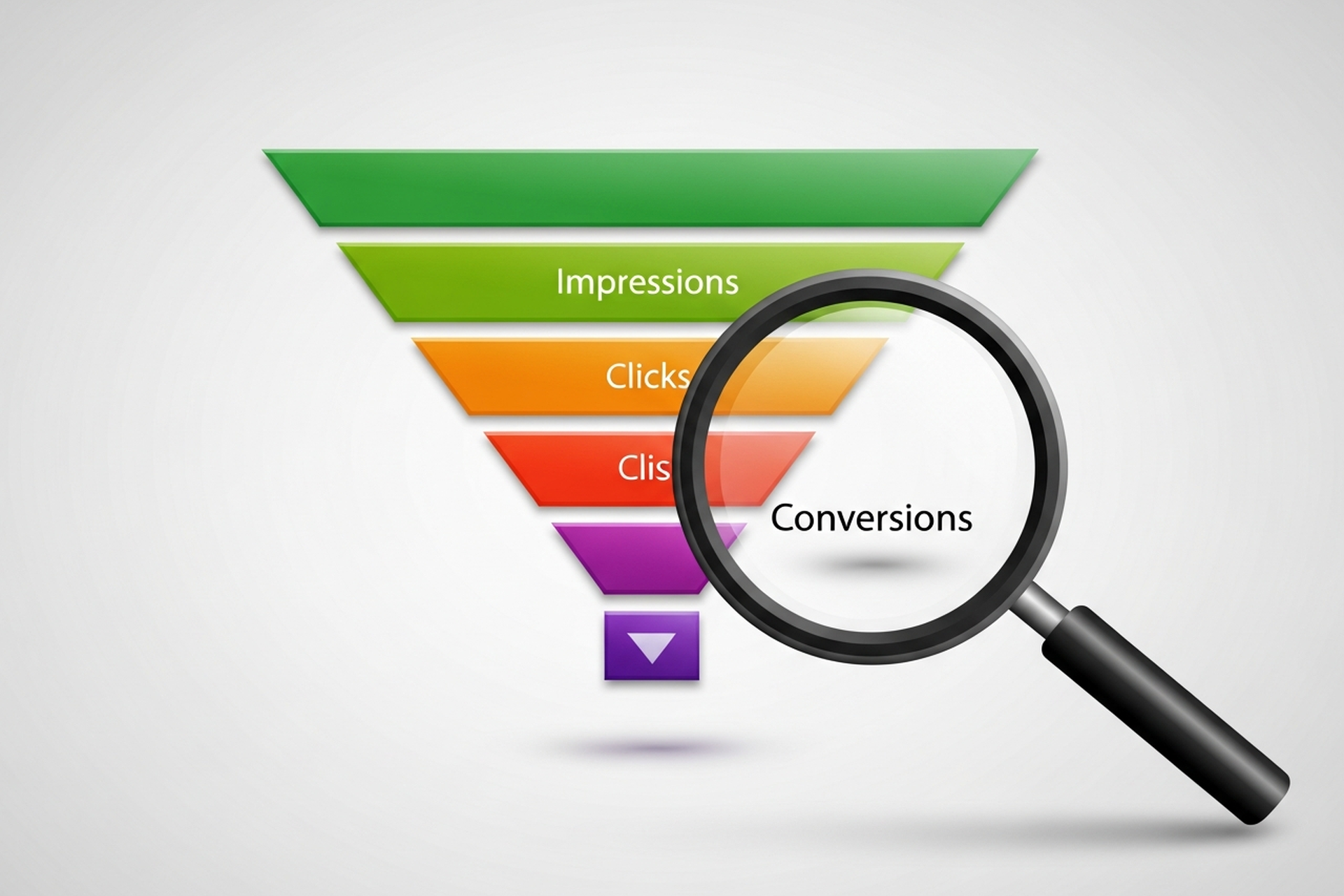
If you're spending money on paid media or investing in content to drive organic traffic, conversion rate optimisation is the discipline that determines whether that traffic actually turns into revenue. Done well, CRO compounds your existing acquisition investment — you get more customers from the same traffic, without needing proportionally more spend.
Conversion rate optimisation (note the British spelling — this is how the keyword is commonly searched, and how teams across the UK, Australia, and much of Europe refer to the practice) is one of the highest-ROI investments a growth-stage brand can make. Yet it's often deprioritised in favour of acquisition channels that are more immediately visible.
This guide explains what conversion rate optimisation actually is, how it works in practice, which tools matter, and how to build a CRO programme that generates compounding returns.
Conversion rate optimisation is the systematic process of increasing the percentage of website visitors who complete a desired action — a purchase, a sign-up, a demo request, a form submission.
The conversion rate itself is simple to calculate:
Conversion Rate = (Conversions ÷ Total Visitors) × 100
If your store receives 10,000 visitors per month and 200 of them purchase, your conversion rate is 2%. CRO is the discipline of understanding why the other 9,800 didn't convert — and systematically fixing it.
What CRO is not is a collection of random button-colour tweaks. Real conversion rate optimisation is a research-driven, hypothesis-led methodology that produces learning as well as results. Even a test that doesn't improve conversion rate is valuable if it teaches you something about why visitors behave the way they do.
The economics of CRO are compelling compared to acquisition-focused alternatives.
Doubling your traffic through paid media doubles your ad spend. Doubling your conversion rate doubles your revenue from the same traffic. In practice, getting from a 1.5% to a 3.0% conversion rate is faster and cheaper than doubling your qualified traffic — and the improvement is permanent rather than dependent on ongoing spend.
Consider a store with 20,000 monthly visitors, a 1.5% conversion rate, and a £60 AOV:
A one percentage point improvement in conversion rate produces £12,000 in additional monthly revenue without a single additional pound of ad spend. That's the return profile that makes CRO so powerful for growth-stage ecommerce and DTC brands.
The best conversion rate optimisation teams operate as a structured research function, not a testing team. The process looks like this:
Before you test anything, you need to understand where and why visitors are dropping off. This means:
This research phase is where most CRO programmes stumble. Teams jump to testing without first understanding the actual problem — and end up testing solutions to problems that don't exist.
A good CRO hypothesis follows a specific structure:
"We believe that [specific change] will [expected outcome] because [evidence or reasoning]. We'll know it worked if [measurable metric] improves."
For example: "We believe that adding a 30-day returns guarantee to the product page hero will increase add-to-cart rate because customer interviews show purchase hesitation is primarily driven by returns uncertainty. We'll know it worked if add-to-cart rate improves by 10%+."
This structure keeps experiments focused and ensures that every test — whether it wins or loses — produces actionable learning.
The most common CRO test format is A/B testing — showing one version of a page to 50% of visitors and a variant to the other 50%, then measuring which version produces a higher conversion rate.
For more complex changes involving multiple elements, multivariate testing allows you to test combinations simultaneously — but requires significantly more traffic to reach statistical significance.
A common mistake is running tests for too short a period. Traffic and conversion patterns vary by day of week, time of month, and seasonal factors. Most tests need a minimum of two full business cycles (typically two to four weeks) before results are reliable.
When a test concludes, the analysis should go beyond "did it win or lose?" Ask:
A test that loses overall may reveal that a specific user segment (mobile users, returning visitors, users from organic search) responded positively — leading to a more targeted follow-up test.
Winning tests should be implemented permanently and documented clearly. Every CRO programme should maintain a library of test results that new experiments can reference — so the programme builds on its own learning over time rather than starting from scratch with each test cycle.
Not all pages and elements are equal. The areas that typically yield the greatest conversion rate improvement:
Product pages: Hero imagery, trust signals (reviews, guarantees, security badges), product descriptions focused on outcomes rather than features, variant selection clarity
Checkout flow: Form length, payment method options, shipping cost transparency, order summary clarity, guest checkout availability
Landing pages: Headline and value proposition alignment with traffic source, above-the-fold CTA clarity, page load speed on mobile
Cart and bag pages: Abandoned cart drivers (shipping cost shock is the most common), cross-sell placement, urgency signals
Site navigation and search: Can users find what they're looking for? Poor navigation is a conversion killer that's easy to overlook.
A complete CRO tech stack typically requires four categories of tools:
Google Analytics 4 — free, covers traffic, funnel events, and conversion tracking. Essential baseline for any CRO programme.
Hotjar or Microsoft Clarity (free) — heatmaps, session recordings, and on-site surveys. These tools show you how users interact with pages, which quantitative analytics alone can't reveal.
VWO (Visual Website Optimizer) — a full-stack testing platform that covers A/B testing, multivariate tests, split URL tests, and personalisation. One of the most widely used CRO platforms across ecommerce and SaaS. Other options include Optimizely (enterprise) and AB Tasty.
On-site survey tools (Hotjar, Typeform, or Medallia) that capture exit intent and post-purchase feedback. The qualitative data from surveys often generates the most actionable hypotheses.
Testing too many changes at once: If you change the headline, the hero image, the CTA colour, and the product description simultaneously, you won't know which change drove the result.
Stopping tests too early: A test that appears to be winning in week one often converges toward parity by week three. Statistical significance requires patience.
Ignoring mobile: In most ecommerce categories, mobile accounts for 60–70%+ of traffic. A page that converts well on desktop but fails on mobile is still failing.
Treating all traffic equally: A visitor arriving from a branded search query has very different intent than one arriving from a generic informational post. Conversion rate benchmarks should be segmented by traffic source, not just measured as a site-wide average.
Skipping the research phase: Running tests without first understanding why users aren't converting is like writing solutions before diagnosing the problem. The research phase isn't optional — it's what makes your tests likely to succeed.
Individual test wins are valuable. A systematic CRO programme is transformative. The difference is whether your testing generates accumulated learning — a growing body of insight about your specific customers, their objections, their decision triggers, and what makes them trust your brand.
At EmberTribe, conversion rate optimisation sits at the centre of how we approach growth for ecommerce and DTC clients — because improving conversion makes every other channel more efficient. A higher CVR means paid media generates more revenue from the same spend, organic traffic converts into customers at a higher rate, and email flows close more of the customers who were already considering.
The goal isn't a single winning test. It's a programme that makes your business structurally more profitable over time.
For more on applying CRO principles in practice, see our guide to ecommerce conversion rate optimisation tactics and our breakdown of the ecommerce analytics metrics that drive decisions.
If you're spending money on paid media or investing in content to drive organic traffic, conversion rate optimisation is the discipline that determines whether that traffic actually turns into revenue. Done well, CRO compounds your existing acquisition investment — you get more customers from the same traffic, without needing proportionally more spend.
Conversion rate optimisation (note the British spelling — this is how the keyword is commonly searched, and how teams across the UK, Australia, and much of Europe refer to the practice) is one of the highest-ROI investments a growth-stage brand can make. Yet it's often deprioritised in favour of acquisition channels that are more immediately visible.
This guide explains what conversion rate optimisation actually is, how it works in practice, which tools matter, and how to build a CRO programme that generates compounding returns.
Conversion rate optimisation is the systematic process of increasing the percentage of website visitors who complete a desired action — a purchase, a sign-up, a demo request, a form submission.
The conversion rate itself is simple to calculate:
Conversion Rate = (Conversions ÷ Total Visitors) × 100
If your store receives 10,000 visitors per month and 200 of them purchase, your conversion rate is 2%. CRO is the discipline of understanding why the other 9,800 didn't convert — and systematically fixing it.
What CRO is not is a collection of random button-colour tweaks. Real conversion rate optimisation is a research-driven, hypothesis-led methodology that produces learning as well as results. Even a test that doesn't improve conversion rate is valuable if it teaches you something about why visitors behave the way they do.
The economics of CRO are compelling compared to acquisition-focused alternatives.
Doubling your traffic through paid media doubles your ad spend. Doubling your conversion rate doubles your revenue from the same traffic. In practice, getting from a 1.5% to a 3.0% conversion rate is faster and cheaper than doubling your qualified traffic — and the improvement is permanent rather than dependent on ongoing spend.
Consider a store with 20,000 monthly visitors, a 1.5% conversion rate, and a £60 AOV:
A one percentage point improvement in conversion rate produces £12,000 in additional monthly revenue without a single additional pound of ad spend. That's the return profile that makes CRO so powerful for growth-stage ecommerce and DTC brands.
The best conversion rate optimisation teams operate as a structured research function, not a testing team. The process looks like this:
Before you test anything, you need to understand where and why visitors are dropping off. This means:
This research phase is where most CRO programmes stumble. Teams jump to testing without first understanding the actual problem — and end up testing solutions to problems that don't exist.
A good CRO hypothesis follows a specific structure:
"We believe that [specific change] will [expected outcome] because [evidence or reasoning]. We'll know it worked if [measurable metric] improves."
For example: "We believe that adding a 30-day returns guarantee to the product page hero will increase add-to-cart rate because customer interviews show purchase hesitation is primarily driven by returns uncertainty. We'll know it worked if add-to-cart rate improves by 10%+."
This structure keeps experiments focused and ensures that every test — whether it wins or loses — produces actionable learning.
The most common CRO test format is A/B testing — showing one version of a page to 50% of visitors and a variant to the other 50%, then measuring which version produces a higher conversion rate.
For more complex changes involving multiple elements, multivariate testing allows you to test combinations simultaneously — but requires significantly more traffic to reach statistical significance.
A common mistake is running tests for too short a period. Traffic and conversion patterns vary by day of week, time of month, and seasonal factors. Most tests need a minimum of two full business cycles (typically two to four weeks) before results are reliable.
When a test concludes, the analysis should go beyond "did it win or lose?" Ask:
A test that loses overall may reveal that a specific user segment (mobile users, returning visitors, users from organic search) responded positively — leading to a more targeted follow-up test.
Winning tests should be implemented permanently and documented clearly. Every CRO programme should maintain a library of test results that new experiments can reference — so the programme builds on its own learning over time rather than starting from scratch with each test cycle.
Not all pages and elements are equal. The areas that typically yield the greatest conversion rate improvement:
Product pages: Hero imagery, trust signals (reviews, guarantees, security badges), product descriptions focused on outcomes rather than features, variant selection clarity
Checkout flow: Form length, payment method options, shipping cost transparency, order summary clarity, guest checkout availability
Landing pages: Headline and value proposition alignment with traffic source, above-the-fold CTA clarity, page load speed on mobile
Cart and bag pages: Abandoned cart drivers (shipping cost shock is the most common), cross-sell placement, urgency signals
Site navigation and search: Can users find what they're looking for? Poor navigation is a conversion killer that's easy to overlook.
A complete CRO tech stack typically requires four categories of tools:
Google Analytics 4 — free, covers traffic, funnel events, and conversion tracking. Essential baseline for any CRO programme.
Hotjar or Microsoft Clarity (free) — heatmaps, session recordings, and on-site surveys. These tools show you how users interact with pages, which quantitative analytics alone can't reveal.
VWO (Visual Website Optimizer) — a full-stack testing platform that covers A/B testing, multivariate tests, split URL tests, and personalisation. One of the most widely used CRO platforms across ecommerce and SaaS. Other options include Optimizely (enterprise) and AB Tasty.
On-site survey tools (Hotjar, Typeform, or Medallia) that capture exit intent and post-purchase feedback. The qualitative data from surveys often generates the most actionable hypotheses.
Testing too many changes at once: If you change the headline, the hero image, the CTA colour, and the product description simultaneously, you won't know which change drove the result.
Stopping tests too early: A test that appears to be winning in week one often converges toward parity by week three. Statistical significance requires patience.
Ignoring mobile: In most ecommerce categories, mobile accounts for 60–70%+ of traffic. A page that converts well on desktop but fails on mobile is still failing.
Treating all traffic equally: A visitor arriving from a branded search query has very different intent than one arriving from a generic informational post. Conversion rate benchmarks should be segmented by traffic source, not just measured as a site-wide average.
Skipping the research phase: Running tests without first understanding why users aren't converting is like writing solutions before diagnosing the problem. The research phase isn't optional — it's what makes your tests likely to succeed.
Individual test wins are valuable. A systematic CRO programme is transformative. The difference is whether your testing generates accumulated learning — a growing body of insight about your specific customers, their objections, their decision triggers, and what makes them trust your brand.
At EmberTribe, conversion rate optimisation sits at the centre of how we approach growth for ecommerce and DTC clients — because improving conversion makes every other channel more efficient. A higher CVR means paid media generates more revenue from the same spend, organic traffic converts into customers at a higher rate, and email flows close more of the customers who were already considering.
The goal isn't a single winning test. It's a programme that makes your business structurally more profitable over time.
For more on applying CRO principles in practice, see our guide to ecommerce conversion rate optimisation tactics and our breakdown of the ecommerce analytics metrics that drive decisions.

Here at EmberTribe, we are continually running different tests and helping our clients find their best approach for their growth marketing. This is not a cut-and-dry approach because every brand and their target audience is different.
When it comes to some of ourbest-performing ads, you will notice they are all very diverse and customized for the brand they represent.
Here are some key ad creation concepts that are currently working to boost engagement for some of our clients.
Get a look inside how we develop ad angles, experiment with creative, and generate ads that get results with these 9 components of a high-performing ad.

This ad may not necessarily seem like a show-stopper, but it’s pulling in 80% of this client's email leads. Between the alluring look of the image with the message overlay and the direct call to the customer within the first two lines of the ad copy, people are drawn to stop.
The copy is direct and engaging for the people it’s supposed to be engaging for. The people who aren’t within the target audience will just scroll right by (which means fewer wasted clicks for the client).
You don’t need to target everyone. In fact, you shouldn’t target everyone. Pinpointing a very select audience is the best way to create the kind of ad that is going to speak to the right people.

Targeting the middle-of-the-funnel crowd worked well for Casa Pilates Equipment. Rather than shoot for those at the very beginning of the buyer’s journey, this ad is jumping right into that mid-point, where the targeted audience has beyond beginner knowledge about yoga and may be looking to add some equipment to their home studio.
Adding the title “My Self-Quarantine Savior!” resonated with the users who were feeling stuck at home. The copy stays focused on the buyer, clarifying how the Casa Pilates team is there to help, how customers are happy with the great service, and how the machines are made to be durable investments.
This ad worked well for remarketing purposes, targeting the crowd that was already somewhat familiar with Casa Pilates Equipment.

For this ad, the client clearly had an edge—they had their product on Kelly Ripa and we were able to include this 50-second clip of her raving about it. This was paired with a very short, interest-piquing quote from Kelly (“This is quite possibly the greatest thing ever”) and a quick two-liner about the product.
If you have a high-quality asset, like this video, you don’t have to try to add competing text. We let the asset shine on its own and it quickly became a high-performer for this client.
Essentially, you want to get out of the way and let a video like this do all the talking for you.

This ad is another one that might not seem like much at first glance, but all the elements are working for it.
These are top-sellers on the site and the ad plays blinking text that is just enough to catch someone’s eye as they are scrolling past. It is a great ad for a top-of-the-funnel lead because it showcases these products and offers a simple introduction to the brand.
“The best yard games for any age” is a title that communicates plenty of other game options. The text itself on the image “NEW GAMES, NEW ARRIVALS” is a call to novelty, which is often a great tool for piquing interest and getting the click-thru.
This example is the top-earning ad for this client.
A 10-second smack-in-the-face video of images with text overlay is very attention-grabbing for just about anyone, but really speaks to the Bulletprute audience.
We know that we're targeting a very cut-and-dry audience that is after quality and wants to know what they're getting for the money. Knowing your audience well is a huge asset that is crucial for a successful campaign.
An ad trying to evoke sadness, joy or excitement just wouldn’t go over nearly as well with this audience. This ad feels inspirational and gritty but places a lot of focus on the product's durability and value.
Including the link within the ad text offers a double CTA that often works well.

This product is targeting a very specific type of hair (3-4C curls), so the video of it in action offers a lot of impact. Showing the brush gently and easily slide through the thick, healthy hair is a huge selling point.
Anyone with this type of hair is familiar with how much the small bristles can get caught and tangle the hair. The thick nature of the product is a huge selling point and this ad centered in on that value. The ad copy backs this value with the 100% satisfaction guarantee promise.

This is a story-telling ad with a powerful video that reveals the story behind Combat Flags. Telling the audience about the company’s “why” often makes a big difference in how customers perceive the value.
There are a lot of people who make similar kinds of patches, but Dan is a veteran who creates patches from retired fatigues. His mission really sets apart his brand.
In the past, he was able to get traffic by just including product images. But, this story-telling ad really took the attention to the next level. People want to know about the companies they are supporting. They will choose a good story over a generic one just about every time.

This stunning image showcases everything beautiful about beachwear. The women pictured are in a natural element and look like they are just walking through the seagrass near beach dunes. From their hair to their outfits and surroundings—nothing looks contrived or overdone. They look comfortable and happy—which are huge selling points for swimsuits.
The ad copy mentions “luxe” which is then repeated in concept by the title, “Inspired by the lush textures found in a Moroccan market…”
This ad appeals to an unusual product value for this industry and it uses an authentic (but polished) approach that is very appealing to those in its target audience.

Don’t be afraid to let the focus fall directly on the product. This appealing image is very reminiscent of the flat lays that are popular on Instagram. It lets the coffee speak for itself. And, the audience targeted here is one seeking out simply good brands and love pour-over coffee.
The “FREE Shipping over $25” is an offer that is likely to pique some interest. Many free shipping promises start at $35 (Target) or higher, and $25 doesn’t sound like an unreasonable amount to spend on coffee to someone who will go through a few bags in just as many weeks.
Getting an offer into the ad can sometimes get a click-through. In this case, the product looks good, plus interests leads to check out how many bags they need to buy to get to the free shipping.
Are you trying to up your ad game? Our growth marketing agency team could help.
We work with clients spanning all industries to pinpoint their audience and increase their traffic through paid social. We focus on the metrics to find the growth marketing ads that work best for you.
If you're ready to outsource, we can help take the load off.
Talk to us today about how to get better results with your ad spend.

There is a phrase we repeat often at EmberTribe: always be testing.
Testing, especially structured, methodical testing, is the foundation of sustainable marketing performance. The most effective growth marketing strategies are built on the scientific method applied to advertising: develop a hypothesis, design a test, analyze results, and iterate based on data.
This approach stands in direct contrast to the "set it and forget it" mindset that plagues most advertising programs. Running ads without a structured testing framework is essentially gambling with your budget. You might get lucky, but you cannot replicate luck, and you cannot scale what you do not understand.

Growth marketing relies on repeatable processes to develop hypotheses, discover results, draw conclusions, and iterate on findings. This is smart testing, and the five case studies below demonstrate exactly how it translates into measurable business results.
Before diving into the case studies, it is worth understanding why most paid advertising programs fail to reach their potential.
The typical approach looks like this: a brand creates a handful of ads based on internal assumptions about what will resonate, launches them with broad targeting, and waits for results. When performance is mediocre, the response is usually to increase budget or swap in new creative, again based on assumptions rather than data.
Smart ad testing takes a fundamentally different approach. It treats every campaign as an experiment with controlled variables:
By isolating and testing these variables systematically, you move from guessing to knowing. The following case studies illustrate what happens when brands commit to this methodology.
Result: Second highest sales day ever, trailing only Black Friday
Read the full case study here.
A gift and accessories brand came to EmberTribe looking to expand its cold audience reach ahead of a major new collection launch. Rather than relying on a single creative concept and hoping it would land, we built a systematic testing program.
The approach: We launched multiple campaign ads spanning a variety of messaging angles, from product-focused to lifestyle-oriented to value-driven. Each angle was tested against distinct audience segments to identify which combinations of message and audience produced the strongest engagement and purchase signals.
The insight: The winning creative was not the one the brand's internal team would have predicted. Testing revealed that a specific messaging angle resonated far more strongly with cold audiences than the brand's default positioning.
The result: Armed with this data, we rapid-tested ads for the new collection launch to identify winning creative before committing significant spend. The launch produced the brand's second highest sales day in company history, surpassed only by Black Friday, a day with built-in consumer demand.
Key takeaway: Testing before a major launch reduces risk and amplifies results. The cost of running test campaigns is a fraction of the cost of launching with the wrong creative and wasting your biggest promotional window.
Result: 8.77x return on ad spend
Read the full case study here.
A sports coaching subscription service faced a common challenge: they could not find enough qualified audiences on Facebook to validate their advertising strategy. Their target market was real, but conventional interest-based targeting was not surfacing it.
The approach: Instead of assuming we knew the audience, we treated audience discovery as the first testing objective. We began running traffic across multiple targeting approaches to identify which generated the best engagement signals and build the brand's Pixel data from scratch.
The insight: Lead generation campaigns offering valuable content (an ebook) proved to be the most effective audience-building mechanism. Each download gave us conversion data that refined our targeting further, creating a compounding improvement loop.
The result: By continuing to optimize ads for audience definition, urgency messaging, and cost efficiency, the campaign achieved 8.77x ROAS, an exceptional return for a subscription-based service with a niche audience.
Key takeaway: When your target audience is difficult to identify through standard targeting options, use testing as a discovery tool. Let the data reveal your audience rather than forcing assumptions onto the platform. This approach is especially valuable for brands with unique value propositions that do not fit neatly into predefined interest categories.
Result: 2.71x ROAS through targeted audience refinement
Read the full case study here.
A children's clothing boutique had a strong product but faced a significant challenge: their price point was higher than most competitors in the children's wear market. Generic audience targeting was attracting price-sensitive shoppers who were unlikely to convert at premium pricing.
The approach: We extensively tested creative formats for cold audiences segmented by interests, behaviors, and lookalike profiles. But the real breakthrough came from restructuring the strategy entirely, moving from broad reach campaigns to a testing-and-refining approach focused on smaller, highly targeted audience segments.
The insight: Consistent retargeting of all engaged users proved to be a critical component. Visitors who had already interacted with the brand but had not purchased needed multiple touchpoints before converting at the higher price point.
The result: The combination of refined cold audience targeting and persistent retargeting delivered 2.71x ROAS, transforming what had been a traction-focused campaign into a genuine revenue driver.
Key takeaway: Premium products require a different testing methodology than commodity products. Price-sensitive audiences need to be filtered out early, and retargeting becomes essential to convert the qualified prospects who need more time and exposure to justify a higher purchase price.
Result: 400,000 unique user sign-ups per month
Read the full case study here.
This client needed to scale user acquisition through Facebook traffic, but the target audience, competitive landscape, and optimal messaging were all unknowns at the start of the engagement.
The approach: EmberTribe began with extensive market research, analyzing the client's target audience, competitors' advertising campaigns, and competitors' content strategies. This research informed the initial hypotheses that guided the first round of testing.
The insight: Creating and testing hundreds of ad variations was necessary to find the winners. The process was not about creating one perfect ad. It was about systematically eliminating underperformers and iterating on the elements that showed traction.
The result: Through continuous testing, iteration, and scaling of winning combinations, the campaign scaled to 400,000 unique user sign-ups per month. This kind of scale is only achievable when you have a testing framework that identifies what works and enables confident budget allocation.
Key takeaway: Scale requires volume testing. You cannot find the winning ad combinations by testing five or ten variations. Systematic testing of hundreds of variations across audience, creative, and copy variables is what separates campaigns that plateau from campaigns that scale. A strong ad creative testing framework is the foundation of scalable acquisition.

Result: 300% lift in revenue compared to the previous period
Read the full case study here.
A high-end lingerie brand needed to communicate product fit, a critical purchase factor, through digital advertising. Static images alone could not convey the comfort and quality that differentiated the brand from competitors.
The approach: We focused testing on video content showing models moving in the products, combined with testimonials, social proof from awards, and concise copy addressing the discomfort that many consumers associate with the product category.
The insight: Our team tested and iterated extensively across multiple creative formats including dynamic broad reach targeting, single images, videos, carousels, and Dynamic Product Ads (DPAs). The video-first approach consistently outperformed static creative, but the specific combination of video format, testimonial integration, and copy framing required significant testing to optimize.
The result: The testing program delivered a 300% lift in revenue compared to the previous period, proving that creative format testing is as important as audience testing for brands where product experience drives the purchase decision.
Key takeaway: When your product's key differentiator is experiential (fit, feel, taste, usability), video creative that demonstrates that experience will likely outperform static imagery. But you still need to test the specific execution: format, length, messaging angle, and proof elements.
Across all five case studies, the winning formula is consistent:
You do not need a massive budget to start testing smarter. Begin with these fundamentals:
The brands that treat advertising as a discipline, grounded in structured experimentation rather than creative guesswork, are the ones that consistently outperform. These five case studies prove it, and the methodology is available to any brand willing to commit to the process.

When am I going to start seeing results?
How fast can we scale to $25,000?
How much am I going to spend on testing?
These questions (and more) come up frequently as we're talking to companies who are considering working with us to grow their business. Whether they are just starting out on a new eCommerce store or looking to increase their app signups 3x in Q2, the underlying question is really the same.

Let's face it: digital marketers (and marketing agencies) have really turned their approach into a "black box" over the years. Whether they do it by hiding behind jargon, slapping clever branding over the top, or creating complex or confusing diagrams, the end result is confused business owners who don't really understand what their dollars are going towards, or why.
Now, take a deep breath.
For you, with us, that stops here.
We're about to open the box.
I have two little kids, one preschooler and one toddler. Both are (alarmingly) ambulatory, moving all over the house and getting into everything they aren't supposed to. The older one can unlock deadbolts, push open screen doors, climb ladders and stairs, while the younger is content with simple seeing how fast she can get her body moving in a single direction before she either topples forward or encounters an object that refuses to budge when she slams into it.
Why do I bring this up? Because they didn't start this way.
Yes, it's a tired cliche, but it's so true: you have to walk before you can run.
If your business has never run an ad before, never used marketing to sell, never attempted to convince someone unfamiliar with the brand, product, or service that they should part with their hard-earned Benjamin Franklins, then your first question should not be, "How much can I make?"
You don't have TRACTION yet.
By traction I mean a pattern of desired behavior occurring in a consistent, somewhat predictable fashion. This could mean generating leads, getting purchases, onboarding new users or whatever else your business goal, it doesn't matter. The point is that you need to be able to say that you can cause it to happen, repeatedly, with your efforts.
When we work with clients who have never run ads before, or who are just starting out, our first forays out into the marketplace are focused on finding who will buy and what will cause them to buy. Put another way, this is about audience and creative/offer.
Let's bust a myth: just because you have a product or service does not mean people will buy it. This is not Field of Dreams.
On the contrary, you have to wade through scores of unqualified or uninterested people to find your best candidates, and then test multiple different messages, angles, images, videos, taglines and more in order to find traction.
"Okay, but how long does that take?"
Well, that depends.
I know, that's not what you were hoping for. And if I can tell you that it would take 2 weeks or 2 months or whatever, I definitely would. Instead, here's what I can tell you:
When you work with us, you aren't hiring wizards (or gurus or ninjas) - you're hiring data-driven marketers. So we're going to test, and test, and test, and generate lots of data, and then we're going to do what the data tells us.
👉 Set up your campaigns to get more qualified leads. →
Sometimes it's fast, and we see traction in just a few weeks. Sometimes it takes less time, sometimes it takes longer. All the factors above impact that.
But the good news is, once you have TRACTION, you can move on to start thinking about...
Too many times we'll talk to a business owner who is putting money into ads and wants to see immediate return. If they don't get a certain CPA or ROAS in the first 3 weeks, they think there's something "wrong" with the ads. They don't realize they are trying to run before walking, that you can't build a house without the foundation, or whatever analogy you best identify with.
💡 ROAS isn't everything, it's just a part of the equation. →
Once we help our clients find TRACTION, then (and only then) is it time to start discussing PROFIT.
Why?
If you don't have enough data points, you can't optimize.
Put another way, if you don't have anyone buying from you, how do you know who your best customers are?
Getting this data and acting on it is the basis of improving your PROFIT metrics. If you want a better CPA, you need to find out which creative gets the best response and then test small optimizations on it - a new emoji, a different headline, a carousel vs a static image. If you want better ROAS, you can segment by device type or placement or time of day that gives you the best baseline.
The key to the PROFIT stage is having goals. And I don't mean "I want to retire and sleep on a bed of Andrew Jacksons every night" type goals, more like "If I can generate new users for $20 each that means I'm profitable and am basically printing money" goals.
We help our clients walk through some simple calculations to set their goals. For an eCommerce store this might include repeat purchase rate, average order value (AOV), and cost of goods sold (COGS). For a SaaS client, we would consider lifetime value (LTV), profit margins, and upsells. Whatever the case, we want to end up with a single number.
That number is our PROFIT goal. If we can hit that goal with consistency, it unlocks us to move on the third and final stage.
Ah yes, scaling. The magical, mystical land of unicorns and rainbows where you trade $1 for $4 ten thousand times while eating ice cream in your pajamas.
Okay, well, not quite, but that's how the "get rich quick" YouTube personalities pitch it. Sounds fun, huh?
Truth is, scaling isn't the end - it's the beginning.
When this client partnered with EmberTribe, their goal was to find strategies to scale sales. Now our client has experienced scale from $18K to $370K lifetime revenue, with an $111K lifetime spend.
You can't start putting more dollars into your campaigns until they are making you money back consistently, and you can't do that until you build a system of repeatable client generation. Hence the reason it's the final step. But there's another reason we counsel clients to be smart about getting to this stage: the game changes.
If you want to triple your investment in ads, especially on a channel like Facebook Ads, just about the worst thing you can do is start jacking your budgets up quickly.
😑 Facebook ads not working? This could be why. →
This causes the algorithm to have to start relearning, and oftentimes can tank your PROFIT, forcing you to go back to the drawing board. Instead, you have to be intentional, constantly revisiting your PROFIT goals and testing new TRACTION experiments to widen your funnel. And this is why we insist on walking through the process with clients - because failing to do the hard work on the front end ends up in a house of cards that falls apart, leaving everyone unhappy.
Some of our best success stories are clients who did things the right way, worked with us to build a repeatable system for growth and testing, and then let us run wild with new audiences, creative, automation, rules and more. Their accounts grew from 5 to 7 figures in ad spend profitably not by some mystical proprietary technology or the wizardry of a paid acquisition savant, but by being intentional, creating a solid foundation, and trusting the process.
It's not easy. It's not as fast as we'd like. But the results are worth it, and the potential that it opens up are amazing.
No black box. No magic. No single genius with the inside track on the algorithm.
Just lots of testing, patience, observation, analysis, failure, growth and consistency.
That's the secret sauce of EmberTribe, and it's one of the reasons we've had such great success for ourselves and our clients since our inception: a three-step process of TRACTION, PROFIT, SCALE that works across industries, across business models, regardless of the age or success of the business to date.


.svg)