
In the age of rapid digital transformation, AI has seeped into almost every industry, revolutionizing how we conduct business, design products, and even create content. The ClusterMagic service is a great example, which seamlessly integrates AI for content generation in a hybrid model, providing significant benefits in the SEO results of brands seeking a massive increase in organic traffic. But while AI holds immense promise, it has its limitations. Let's explore the pros and cons of using AI for content creation and understand why a hybrid approach might be the way forward.
Major publishers in sensitive niches like CNET.com, Bankrate.com, and Creditcard.com have already integrated AI-generated content. Other large companies, such as CNN and Forbes, might also be doing so. Countless smaller companies and publishers are utilizing AI, not only on their websites but also on social media, in email marketing, and virtually everywhere else.
Google's stance on AI-generated content is neutral, emphasizing that content should primarily be user-centric. In fact, Google's September 2023 Helpful Content Update removed the mention of "written by people" from their helpful content system guidelines.
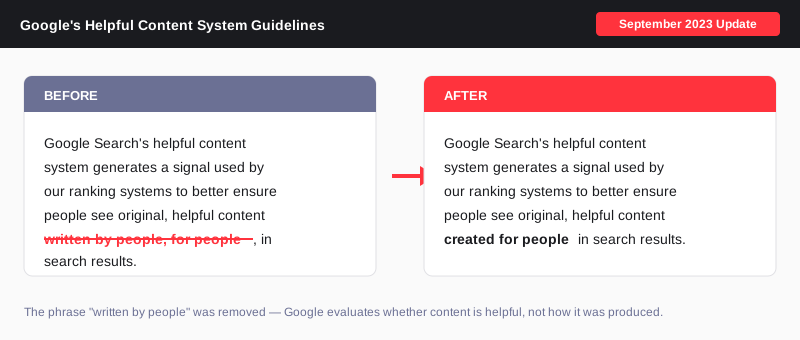
The message is clear: for content to rank well, it must be informative, answer users' queries satisfactorily, and showcase genuine expertise - regardless of how it's created.
AI Content Detectors like GPTZero, ZeroGPT, and many others are not reliable. Even OpenAI has said as much. They consistently produce false positives about human-written content. Conversely, they can be easily fooled with creative prompting or a bit of human editing.
An interesting note from OpenAI: "we found that it labeled human-written text like Shakespeare and the Declaration of Independence as AI-generated."
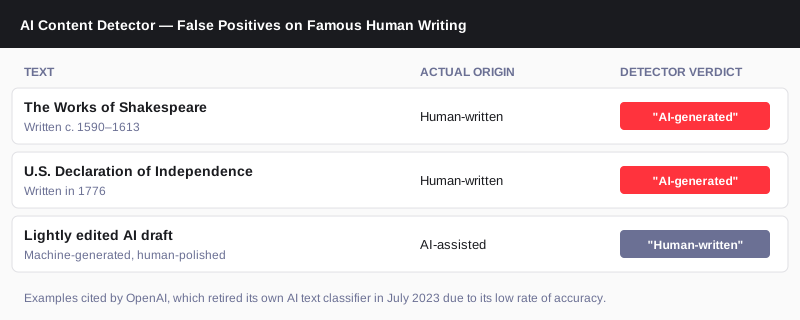
Anecdotal evidence and real-life ranking data suggest that while AI-generated content isn't penalized by search engines, it might only achieve high rankings if it meets the above criteria. The role of AI in content creation is still a developing narrative, and its significance is indispensable for maintaining a competitive edge in the future.
At EmberTribe, the understanding is clear - AI serves as a foundation, not the final product. With ClusterMagic, while AI aids in the initial draft based on expert-driven keyword research, human experts step in for the crucial phases of editing, fact-checking, and final review. This hybrid approach ensures the content is accurate and helpful, has the potential to rank, and truly represents their business.

Every article about B2B SEO companies is written by a B2B SEO company that ranked itself first on the list. That's a reasonable thing to be skeptical about. This guide takes a different approach: an evaluation framework built for the buyer, not the vendor.
Growth-stage companies hiring a B2B SEO firm are making a 6–12 month financial commitment with delayed returns. Getting it wrong costs more than the fee. It costs the time, the opportunity, and sometimes the willingness to try again.
B2B SEO isn't harder than B2C SEO. It's different enough that a firm without genuine B2B experience will optimize for the wrong signals and you'll spend months chasing traffic that never converts.
The structural differences that matter:
For companies building the content foundation that B2B SEO requires, working with a strong B2B content writing partner is often the highest-ROI input in the first six months.
The deliverable gap between agencies is wide. Here's what separates a real B2B SEO engagement from a blog retainer with an SEO label on it.
Audit and strategy (months 1–2): A comprehensive technical audit covering crawl health, indexing issues, Core Web Vitals, structured data, and internal link architecture, paired with a keyword and topic cluster map scoped to your buyer's job-to-be-done. This phase should produce a sequenced 6–12 month roadmap, not a list of recommendations.
Ongoing technical work: Monthly crawl monitoring, issue remediation, Core Web Vitals tracking, and structured data updates. Most agencies treat technical SEO as a one-time audit. Ongoing technical hygiene is what keeps an otherwise strong content program from leaking rankings.
Content production: The best B2B SEO firms staff domain-expert writers, not generalists. The quality gap between a writer who understands your product category and one who doesn't shows up immediately in how they handle comparison pages, product-led content, and thought leadership.
Link acquisition: Organic rankings for competitive B2B terms require authority that content alone can't build. Digital PR, data studies, and strategic placements in industry publications are how credible agencies build links. Any firm that won't describe its link methodology in detail is hiding something worth knowing.
Pipeline reporting: The KPI isn't keyword rank. It's organic-sourced MQLs, demo requests, and trial starts. A B2B SEO company that can't connect its work to your CRM data by month four is not actually optimizing for your business.
Timeline expectations are where the most expensive misalignments happen. Here's what actually happens, month by month.

The break-even point for B2B SEO is typically around seven months. From there, returns compound. B2B SaaS companies report a median 702% ROI over a full program lifecycle, with organic search driving 44.6% of total B2B revenue.
The companies that don't get there usually quit at month three. They see traffic numbers that look modest, conclude SEO doesn't work for their category, and move budget back to paid search. The compounding never happens because the program never reached the inflection point.
Budget context prevents the most common mistakes. Here's a realistic range by company stage:
| Company Stage | Monthly Range | What's Covered |
|---|---|---|
| SMB / seed-stage | $2,500–$5,000 | Strategy, 2–4 content pieces, technical monitoring |
| Growth-stage B2B | $5,000–$10,000 | Full strategy + content + link building + reporting |
| B2B SaaS scaling | $6,000–$15,000 | Dedicated strategist + programmatic + AI visibility |
| Enterprise | $10,000–$50,000+ | Multi-market, multiple content tracks, full attribution |
Most credible firms require a 6–12 month minimum commitment. Shorter engagements exist, but they don't produce the compound returns the channel is known for. Any firm offering 90-day ROI guarantees is either selling PPC dressed as SEO, or lying.
Hourly consulting from a senior B2B SEO specialist runs $75–$400/hour. Useful for audits and strategy reviews, but not a substitute for an ongoing engagement if you need results.
These questions aren't a formality. Each one reveals something specific about how the agency operates and whether they've actually done B2B SEO before.
"Can you show me a case study where you attributed pipeline to organic?" You want to see organic-sourced MQLs or demo requests in a real client's data, not just traffic growth graphs. If every case study shows traffic doubling but never mentions revenue, that's the metric they're optimizing for.
"Who specifically will manage my account and how many accounts do they manage?" Agencies that keep strategist-to-account ratios above 20 consistently underperform on B2B accounts. Senior talent in the sales pitch becomes junior talent on the account. Confirm names and current loads before signing.
"What's your content production model?" Are writers subject matter experts in your category, or generalists who research before writing? For B2B, this difference is visible in the output within two articles.
"How do you approach AI search optimization?" In 2026, a B2B SEO company without a GEO/AEO strategy is ignoring a growing share of buyer discovery. The answer should include structured data, entity optimization, and some methodology for tracking LLM citation.
"What does your link building process look like?" Specific, transparent answers only. "We have proprietary methods" is a red flag. Credible link acquisition strategies can be explained without revealing every vendor relationship.
For a broader evaluation of what makes any marketing agency worth hiring at the growth stage, the same principles apply — specificity, accountability, and named team members.
Some signals predict a bad engagement before it starts.
Ranking guarantees. No legitimate B2B SEO company guarantees keyword positions. Google's algorithm and your competitive landscape aren't controllable. Guarantees are either meaningless or tied to terms designed to ensure they're technically met.
Traffic-first reporting. If the monthly report is all traffic charts and keyword rank tables with no pipeline attribution, you're paying for an activity tracker, not a growth program.
Template content strategies. If the proposed content plan reads like it could have been written for any company in any B2B category, it wasn't built for you. B2B SEO strategies should reflect your buyer's specific job-to-be-done and your product's competitive positioning.
No discussion of technical SEO. Content-only agencies running on a "more posts = more traffic" model skip the foundation work. Technical issues that go unaddressed quietly kill rankings regardless of output volume.
Vague timelines. "SEO takes time" is not a timeline. A legitimate agency can tell you what to expect at months 3, 6, and 12 based on your domain authority, competitive landscape, and content investment level.
The differentiator that SEO experts who specialize in B2B consistently cite in successful engagements: the agency understood the business, not just the algorithm. That means understanding your ICP, your sales cycle, and what a qualified lead actually looks like before they ever start writing.
The economics are compelling when done right. Organic leads close at 14.6% compared to 1.7% for outbound. The cost per organic lead runs about $31 versus $181 for paid search. The channel delivers 76% of all trackable B2B website traffic.
Those numbers aren't available to every company that hires a B2B SEO firm. They're available to companies that hire the right one, stay long enough for the compounding to work, and hold their agency accountable to pipeline metrics from day one.
If you want to evaluate what a results-oriented B2B SEO engagement looks like in practice, EmberTribe works with growth-stage B2B and DTC brands that need organic programs connected to revenue — not traffic dashboards.

Finding the best SEO companies for small business is harder than it looks. The market is crowded with agencies that promise the same things, charge wildly different rates, and rarely explain how they'll actually move the needle for a business your size. This guide cuts through that noise with specific criteria, real pricing data, and the questions you need to ask before signing anything.

Large enterprise brands have dedicated in-house teams, established domain authority, and budgets that can absorb 12-month ramp periods. Small businesses operate under very different constraints: tighter budgets, faster ROI pressure, and usually a single decision-maker who's also handling everything else.
The right SEO company for a small business is not just a scaled-down version of an enterprise agency. It's one that understands your market footprint (often local or regional), speaks to your customer's specific search intent, and can show meaningful traction within 3 to 6 months. Local SEO specifically tends to produce faster early results than broad national campaigns, which matters when cash flow is on the line.
Small business SEO also tends to focus on a narrower keyword set. Rather than chasing thousands of terms, effective small business SEO identifies the 20 to 50 keywords that actually drive qualified leads, then builds content and authority around those. That kind of focus requires an agency that asks good questions upfront about your business goals, not one that jumps straight to a keyword list without understanding your funnel.
The strongest small business SEO agencies share a few non-negotiable practices. Understanding these will help you separate agencies that earn their retainer from those that produce reports without results.
They tie strategy to business outcomes. Rankings are a means to an end. An agency worth hiring will frame its work around revenue, leads, or conversions, not just keyword positions. If the first conversation is entirely about traffic and impressions with no mention of your actual business goals, that's a signal.
They operate with full transparency. You should have direct access to your Google Analytics and Google Search Console accounts at all times. According to Clutch's agency selection guide, agencies that restrict data access or only share curated reports are a consistent red flag across industries. Your data belongs to you, not your vendor.
They cover the full SEO stack. Content without technical health leaks rankings. Links without content have nowhere to send authority. The best small business SEO companies address all three pillars: technical site health, content depth, and link equity. Agencies that focus on only one tend to hit a ceiling quickly.
They give you a realistic timeline. Meaningful organic traffic growth typically begins at the 3 to 6 month mark, with significant ROI usually materializing between 6 and 12 months. Research from First Page Sage puts median SEO ROI at approximately 748%, meaning roughly $7.48 returned for every $1 spent, but that return compounds over time rather than arriving immediately. Any agency promising dramatic results within 30 days is either overpromising or using shortcuts that will cost you later.
Pricing has increased since 2023, driven partly by the additional scope that Answer Engine Optimization (AEO) and Generative Engine Optimization (GEO) now require. AI-driven search results in platforms like Google AI Overviews, ChatGPT, and Perplexity have expanded what "full-service SEO" means, and that expanded scope is reflected in retainer rates.
Here's where the market sits in 2026:
Budget below $500 per month almost always means templated work, automated reporting, and minimal human strategy. It's not that affordable SEO can't work. Below a certain threshold, the inputs simply aren't there to produce meaningful results in a competitive market.
Knowing which agencies to avoid saves as much money as finding the right one. These are the warning signs that appear consistently across industry evaluations:
Guaranteed rankings. No SEO agency can guarantee a #1 position. Google's own guidance is explicit: any company making this promise is either misrepresenting how search works or planning to use tactics that will eventually trigger a penalty. Walk away from any agency that leads with a guarantee.
Vague strategy language. "We use proprietary techniques" and "our process is proven" are ways of saying nothing. A legitimate agency can explain, in plain terms, what they're going to do in months one through three. If they can't, they probably don't have a real plan.
Cookie-cutter packages. A local restaurant and a regional SaaS company do not need the same SEO package. Agencies that sell identical plans to every client are optimizing for their own margins, not your results.
No access to your own data. You should always have direct access to your Google Analytics, Search Console, and any platform they set up on your behalf. An agency that controls access to your accounts has misaligned incentives.
Pricing that seems too low. The floor for real SEO work in 2026 is around $500 per month, and that's for very local, low-competition situations. If someone's pitching a full-service plan at $200 per month, the math doesn't support actual human work being done.
On the other side, the agencies worth hiring tend to share these characteristics:
They ask about your business before talking tactics. A strong SEO partner wants to understand your revenue model, your customer acquisition funnel, and where organic search fits into your growth plan. If the first call goes straight to keywords, they're starting in the wrong place.
They provide case studies in your vertical. Ranking a local dentist and ranking a DTC skincare brand require different skill sets. Relevant portfolio work shows the agency understands your market dynamics, not just generic SEO theory.
They report on metrics that matter to you. Monthly reports should connect SEO activity to business outcomes: leads generated, revenue attributed to organic, conversion rates by landing page. Traffic-only reporting is a distraction from what actually matters.
They communicate proactively. Algorithm updates, ranking fluctuations, and technical issues happen. A good agency reaches out before you notice a problem, not after you send an anxious email asking what's going on.
For more on evaluating SEO partners generally, the EmberTribe guide on finding the best SEO agency covers the full evaluation framework. And if you're weighing SEO against paid channels, the marketing agency overview breaks down how different agency types fit different growth stages.
Before committing to any retainer, get clear answers to these five questions:
Vague, deflective, or overly salesy answers to any of these are informative. A confident, specific agency will answer all five without hesitation.
The right SEO company for your small business depends on where you are in your growth trajectory.
If you're a new or very local business with limited competition, a Starter-tier engagement ($500 to $1,000 per month) focused on technical cleanup and Google Business Profile optimization can produce real results within 90 days. The ROI potential is high because the competition bar is low.
If you're competing regionally or in a moderately competitive vertical, a Growth-tier engagement ($1,000 to $2,000 per month) with active content production and link outreach is the right starting point. You're building topical authority and should see meaningful organic lead growth by month six.
If you're a DTC brand or a multi-location business competing at a national level, the Competitive tier ($2,000 to $3,500 per month) is where you need to operate. Anything less and you're bringing a limited budget to a fight where your competitors are spending more. The EmberTribe SEO agency guide goes deeper on what full-service SEO looks like at this level.
The key is matching your investment to your competitive environment, not just your budget ceiling. Underfunding SEO in a competitive market produces nothing. Funding it appropriately in a local market can deliver outsized returns faster than almost any other channel.
EmberTribe works with DTC brands and growth-stage companies that are serious about organic search as a revenue channel. We handle the full SEO stack: technical audits, content strategy, link development, and performance reporting, all connected to your actual business metrics.
If you're evaluating SEO partners for your small business, embertribe.com is a good place to start. We'll show you what the work actually looks like before you commit to anything.

Finding the best SEO firm requires a different lens than finding a large agency. A firm, by definition, is smaller, more specialized, and consulting-forward. The word signals something specific: strategic ownership, senior-level execution, and a tighter client-to-strategist ratio. If you are a DTC brand or growth-stage company evaluating your options, that distinction matters more than it might seem.
This guide covers what defines a top SEO firm, how to evaluate quality, and the specific questions that separate a capable partner from a capable-sounding one.
The terms "firm" and "agency" are often used interchangeably, but they describe meaningfully different operating models. A large agency typically employs 50 or more specialists across multiple service lines. An SEO firm is usually under 20 people, focused primarily or exclusively on search, and structured so that senior strategists remain accountable for client outcomes throughout an engagement.
According to research compiled by NinjaPromo, boutique SEO firms consistently deliver 30 to 40 percent increases in organic traffic compared to the 12 to 15 percent average at large agencies. The gap is not about resources. It is about attention, accountability, and the absence of layers between strategy and execution.
At a large agency, the strategist who sells you the engagement is rarely the person who runs it. Account managers coordinate between specialists, and junior staff handle the day-to-day work. At a well-run SEO firm, the senior strategist who scoped your project is the same person writing your content brief, reviewing your technical audit, and presenting results in the quarterly review.
That continuity compounds over time. It means faster iteration, fewer handoff errors, and a partner who genuinely understands your business model rather than managing it from a dashboard. For brands where organic search is a primary acquisition channel, this is not a marginal difference.
The best SEO firms share a set of operational habits that separate their results from the field. These are not claims you can assess from a website. They are behaviors you surface through a proper evaluation process.
They diagnose before prescribing. A quality firm will slow down your initial conversation, ask about your revenue model, your current traffic mix, and your conversion funnel before recommending anything. Firms that lead with a standard deliverable list are not doing strategy. They are selling a package.
They connect SEO to revenue, not just rankings. Search Engine Land's benchmarking guidance is clear that traffic volume is a lagging indicator. The firms worth hiring define success in terms of pipeline contribution, lead quality, and conversion data, not monthly position reports.
They have demonstrable track records in your category. General SEO expertise is table stakes. The firms that move the needle for DTC brands have run campaigns for DTC brands before. They know the content formats that convert, the technical issues that surface on commerce platforms, and the link-building approaches that work at that scale.
They are honest about timelines. Legitimate SEO takes three to six months to show meaningful movement and twelve or more months to compound. Firms that promise fast results are either using tactics that create short-term gains followed by penalties, or they are not being truthful about how search works.
The table below summarizes the five criteria that matter most when evaluating any SEO firm, including what to look for and what signals a problem.

Use these criteria as a structured checklist during your evaluation calls. Each one surfaces a different risk: track record catches firms that are better at selling than delivering; senior ownership reveals staffing realities; reporting depth shows whether their definition of success aligns with yours; specialization fit identifies category-specific gaps; and client retention is the most honest proxy for actual satisfaction, because clients who are not getting results leave.
On retention specifically: strong SEO firms average client relationships of 18 months or more. If a firm cannot point you to clients who have been with them for at least two years, ask why.
The quality of a firm's answers to specific questions tells you more than any case study. These are the questions worth asking in your evaluation conversation.
Who specifically will own my account, and what is their experience level? You want a name, a title, and a description of their background. If the answer is "our team" or "we assign based on fit," push for specifics.
How do you define success for an engagement like mine? A firm that immediately pivots to rankings is telling you something. The right answer names a business outcome: qualified traffic growth, lead volume, revenue from organic, or some combination.
Can I speak with a current client in a similar category? References are table stakes, but the key word is "current." Past clients speak to what the firm was capable of before. Current clients reflect what they are doing now, under current search conditions.
What is your approach to AI-generated overviews and zero-click searches? Gartner research has noted the shift in search behavior as AI-assisted results absorb a growing share of informational queries. Firms that have not adapted their content strategy to account for this are operating on an outdated playbook.
What does the first 90 days look like? Strong firms have a defined onboarding sequence: a technical audit in weeks one and two, a content and keyword strategy by week four, and initial optimizations live by day 60. Vague answers here typically mean vague execution later.
Pricing for a quality SEO firm typically ranges from $2,000 to $6,000 per month for growth-stage DTC and SaaS brands. That range reflects senior-level access, a meaningful content output cadence, and active link-building, not just maintenance.
Firms priced below $1,500 per month are generally running templated processes at scale. That model can produce results for low-competition niches, but it does not work for brands operating in competitive categories where differentiation and content depth are the actual ranking factors.
Firms priced above $8,000 per month without a clear deliverable structure should be asked to justify the overhead. You are not necessarily getting better strategy at that price point. You may be paying for a brand name and an account management layer.
The middle range ($3,000 to $5,000 per month) is where most top-performing boutique SEO firms operate. At that price, you should receive direct access to a named senior strategist, a monthly content delivery, an ongoing technical monitoring process, and quarterly business reviews tied to revenue metrics.
If you want a broader comparison of how SEO firms fit into the larger agency landscape, see our post on finding the best SEO agency, which covers the full spectrum from boutique firms to enterprise shops. For brands specifically evaluating the U.S. market, our guide to the best SEO company in the USA covers regional considerations and how to assess domestic expertise.
The short version: if your business needs a strategic partner who will be accountable for outcomes from month one, a firm is the right structure. If you need a full-service marketing department with multiple specializations under one contract, a larger agency may be a better fit, with different tradeoffs on attention and execution depth.
EmberTribe is a specialized SEO firm working with DTC brands and growth-stage companies. Our engagements are structured around a small client roster so that every account gets senior-level attention throughout, not just during onboarding.
We build content strategies grounded in keyword intent, competitive analysis, and conversion data, and we report on outcomes that connect to your revenue model. If you want to understand what that looks like for your specific situation, embertribe.com is the right place to start.

According to Backlinko's SEO statistics research, 96.55% of all pages on the web receive zero organic traffic from Google. The problem is rarely that organic search does not work. It is that the execution, or the agency executing it, is not doing the things that actually move the needle in Google's current algorithm environment.
Hiring a Google SEO agency is not the same decision it was three or four years ago. The algorithm priorities have shifted fundamentally, and agencies that have not kept pace are burning budgets on tactics that have since been explicitly penalized.
General SEO as a category covers everything from Pinterest optimization to Amazon listing copy. A Google SEO agency is specifically focused on the signals Google measures, the tools Google provides, and the way Google's crawlers evaluate a site.
The four areas where Google-specific expertise is most consequential:
The playbook for SEO has changed substantially since 2022, and agencies that have not adapted are operating on outdated assumptions.
The Helpful Content System launched in August 2022 and was fully integrated into Google's core ranking algorithm by 2024. It now runs continuously rather than as discrete updates. Its effect: content that exists primarily to rank, rather than to genuinely serve a reader, has been systematically downranked. "SEO content" written without subject-matter input no longer works the way it once did.
The "Experience" addition to E-E-A-T was added in December 2022 and is widely interpreted as Google's direct response to the proliferation of AI-generated content. It rewards content that demonstrates first-hand experience or genuine expertise: bylines, case studies with verified data, original analysis. It deprioritizes content that could have been written by anyone about anything.
2025 Core Updates continued targeting scaled content abuse, link spam, and AI-generated content without human review or editorial value. According to Search Engine Journal's coverage of Google's guidance on hiring SEO agencies, Google's own engineers have made clear that any agency operating through link schemes or scaled templated content is building on unstable ground.
The practical implication: a Google SEO agency that has survived and grown client traffic through 2022 to 2025 without penalties has a materially different skillset than one that was riding pre-2022 tactics. Ask specifically about this.
Several patterns reliably indicate an agency that will underdeliver or create cleanup work down the road.
Guaranteed rankings are the clearest red flag. No agency can guarantee specific rankings: Google's systems are not predictable at that granularity, and Mueller has stated this explicitly. Any agency making guarantees is either misrepresenting their influence or planning to use tactics Google has specifically targeted.
Unsolicited outreach with a "free audit" is another signal. Google itself flags this practice as a marker of low-quality providers. Legitimate agencies with strong track records do not need to cold-email domain owners with manufactured urgency.
Links as the primary selling point indicates a misaligned strategy. Link building is a component of SEO, not a complete strategy. Agencies that lead with backlink volume rather than technical health and content quality are operating on a pre-2022 framework.
Traffic-only reporting (session volume without conversion data, rankings without CTR context) mirrors the same issue as traffic-only paid media reporting. If an agency cannot connect organic activity to revenue, they cannot tell you whether the program is working.
Ahrefs' SEO pricing research covering 439 practitioners provides the most granular current benchmarks. Monthly retainers are the dominant model, used by 78.2% of SEO providers.
For growth-stage DTC ecommerce and B2B SaaS brands operating in competitive verticals, the relevant range is $2,500 to $5,000 per month for a quality US-based agency delivering full-service work: technical monitoring, content strategy with brief development, on-page optimization, link building, and reporting tied to GSC and GA4. At this tier, 79.1% of US and Canada-based providers operate.
Entry-level retainers ($500 to $2,000/month) typically cover one or two service areas rather than a complete program, and are more appropriate for smaller sites with limited competition. Enterprise or highly competitive verticals typically run $5,000 to $15,000+ monthly, reflecting the content velocity and technical complexity required.
Project-based engagements are common for defined scopes: technical SEO audits run $1,000 to $10,000+ depending on site size, and site migration support typically runs $5,000 to $20,000+.
The pricing floor to watch: any agency offering comprehensive, full-service SEO for a growth-stage brand under $500/month is cutting corners on quality, coverage, or ethical standards. That price point does not cover the labor required to do the work correctly.
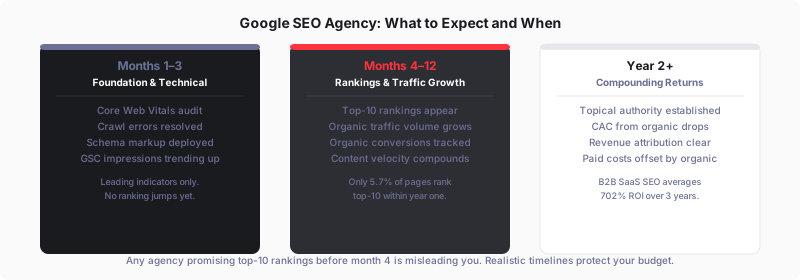
Setting expectations correctly at the start of an engagement prevents the most common failure mode: cutting a program before it has had time to work. B2B SaaS SEO data from Ahrefs' B2B SEO statistics research shows an average 702% ROI with a roughly seven-month break-even over a three-year horizon. Organic search also produces a lower customer acquisition cost ($147 average for SaaS versus $280 for paid search), which means the compounding value is in the long tail, not the first quarter.
For DTC ecommerce, the organic advantage compounds differently: brands with strong SEO reduce their dependence on paid acquisition during peak periods, creating margin protection when CPMs spike. This is the channel mix diversification case for organic, and it takes 12 to 18 months to materialize.
Organic search accounts for more than 57% of all web traffic globally, but nearly all of it concentrates in a small number of pages that are technically sound, genuinely authoritative, and aligned with how Google evaluates quality in 2026. Getting a B2B SaaS brand or DTC ecommerce site into that group is not a volume problem. It is a strategy and execution problem that a Google SEO agency with current expertise can solve.
If you want to evaluate where your organic program stands against Google's current technical and quality standards, EmberTribe works with growth-stage DTC and B2B brands on SEO strategy built around the signals that actually drive rankings today.

Most SaaS companies over-tool their SEO stack before they under-execute it. You'll find seed-stage companies paying $800/month for Semrush, Ahrefs, Clearscope, and SE Ranking simultaneously, with no clear owner for any of them. Meanwhile, their Google Search Console hasn't been reviewed in three months.
The problem isn't access to SaaS SEO tools. It's using the right tools for the right stage and actually acting on what they surface.
Standard SEO tool recommendations don't translate cleanly to SaaS. The buying journey is different. A DTC brand can optimize a product page and see conversion lift in a week. A SaaS company targeting enterprise buyers is competing on category authority over a 6–18 month sales cycle. That changes which tool capabilities actually matter.
SaaS-specific needs that affect tool selection:
For a full strategic view of how these tools fit into a broader SaaS SEO program, the architecture matters more than any single tool.
Before looking at specific products, understand the categories. A complete stack covers all five. Most seed-stage teams can cover the first three with free or low-cost tools.
1. Keyword research and competitive intelligence. Finding what buyers search for, what competitors rank for, and where the gap is. This is where most teams overspend on premium tools they use at 20% capacity.
2. Technical SEO auditing. Crawl health, indexing issues, Core Web Vitals, structured data. A broken technical foundation quietly kills your content investment; none of the content-side tools will fix this.
3. Content optimization. NLP-based scoring to ensure posts cover the right semantic signals. Matters most when you're producing 6+ posts per month and need consistent quality.
4. Rank tracking and reporting. Knowing where you stand on target keywords, how that changes week to week, and whether movement correlates to business metrics. Free tools can cover this well if set up correctly.
5. AI/LLM visibility monitoring. Emerging but increasingly critical: tracking whether your brand and content are being cited in ChatGPT, Perplexity, Gemini, and AI Overviews. According to research on LLM-driven traffic, traffic referred by LLMs converts 4.4x better than standard organic search, making LLM citation a revenue variable worth tracking.
Not every team needs the same stack. Here's how to think about tooling across three maturity stages.

Spend $0–$200/month on tools. The constraint isn't tools: it's time and focus.
Google Search Console is non-negotiable and free. Indexing status, Core Web Vitals, CTR data, and which queries are already driving impressions. Most teams aren't using this data well.
Ahrefs Webmaster Tools (free tier) gives you backlink monitoring and keyword tracking for your own domain. Covers 60% of what most teams need from a paid platform at zero cost.
Screaming Frog (free tier crawls up to 500 URLs) handles technical auditing for small sites. If your site is under 500 pages, you don't need the paid version yet.
LowFruits is worth adding when you're ready to produce content systematically. It surfaces low-competition keywords where newer domains can rank without a large backlink profile, which is exactly what seed-stage SaaS needs.
Budget $400–$700/month for tools. The focus shifts to producing content at scale and tracking what's converting.
Ahrefs or Semrush (pick one). They're not interchangeable. Ahrefs has the strongest backlink index and is preferred by link-building-focused teams. Semrush covers more channels (PPC, social, AI visibility) and fits multi-channel marketing teams better. Running both is redundant. Choose based on your team's primary use case.
Screaming Frog paid (£149/year) unlocks unlimited crawls, JavaScript rendering, and custom extraction. At this stage you probably have more than 500 pages.
Surfer SEO or Clearscope for content optimization. Surfer SEO ($99–$219/month) integrates AI writing assistance and works well for teams producing 8+ posts monthly. Clearscope ($189+/month) has a cleaner editorial workflow for teams with dedicated writers who don't want to optimize in a cluttered interface.
SE Ranking for rank tracking. It includes an AI Overviews Tracker on its base plan, which is unusually strong value compared to dedicated rank trackers at 2x the price.
Budget $700–$1,400/month. At this stage you're optimizing for attribution depth and LLM visibility alongside traditional SEO.
Semrush and Ahrefs together becomes defensible when you have dedicated SEO headcount using both strategically. Semrush for keyword research, competitive PPC intelligence, and the AI Visibility Toolkit. Ahrefs for link prospecting and content gap analysis.
MarketMuse ($149–$999+/month) for full topical modeling. At scale, understanding your site's entire topical authority map prevents content cannibalization and surfaces compound authority opportunities.
Profound for LLM citation tracking. As a standalone tool focused entirely on AI visibility, Profound shows which of your content assets are generating citations in ChatGPT, Perplexity, and Claude, and which competitor content is being cited instead of yours.
Google Looker Studio (free) paired with GA4 and Search Console for custom revenue-attribution dashboards. At this stage, rankings aren't the KPI. Organic pipeline contribution is.
Keyword research is where the most expensive tool mistakes happen. Teams pay for all-in-one platforms and use the keyword explorer at 20% capacity, missing the features that actually drive SaaS SEO results.
Three things a good keyword research process for SaaS should surface that most teams ignore:
Comparison and alternatives queries. "Best [category] tools for [use case]" and "[Competitor] alternatives" searches are BOFU gold. They're often lower volume than informational queries but convert at multiples higher. Most keyword tools surface these. The failure is in how teams prioritize them.
Jobs-to-be-done queries. The actual problem the buyer is trying to solve, not the category name they'll eventually land on. "How to reduce churn in free trial users" leads to very different content than "trial conversion software."
Cannibalization detection. When two pages on your site are targeting the same query, they split your ranking potential. Any serious keyword research process should include a monthly cannibalization audit.
Tools that generate reports but don't drive decisions are overhead, not investment. The test for any SEO tool: can your team point to a specific action taken in the last 30 days based on data from that tool?
The benchmarks are real: B2B SaaS achieves a median 702% ROI from SEO, and 8.5% of organic visitors convert to free trial, the highest rate of any acquisition channel, according to SaaS SEO benchmark data from Powered by Search. Those numbers require the right tools, used correctly, connected to revenue metrics.
Stack bloat is the enemy. The average SaaS company already spends $4,830 per employee per year on software. Adding SEO tools without auditing what's already running and underused is budget waste disguised as investment.
The right SaaS SEO tool stack for a seed-stage company can cost $0/month and still generate signal. The right stack for a scaling Series A company runs $400–$700/month and directly supports a content engine tied to pipeline. What kills results isn't having the wrong tools: it's buying too many of them too early and using none of them consistently.
If you want to audit your current SEO stack and build a program that connects organic to revenue, EmberTribe works with SaaS and DTC brands that need more than a tool list. They need a strategy that uses those tools to drive measurable growth.

Most SaaS companies that fail at SEO don't fail because organic search doesn't work for them. They fail because they hired the wrong kind of agency, budgeted for the wrong tier, or started expecting results before the engine had time to build momentum.
SaaS SEO services aren't a commodity, and the agencies that sell them aren't interchangeable. The difference between a generic SEO retainer and a genuinely SaaS-native strategy is the difference between traffic that looks good in a dashboard and traffic that converts to signups and MRR.
Generic SEO advice doesn't translate to SaaS. The buyer journey is different, the content architecture is different, and what "success" looks like is measured in activated trials and reduced CAC, not just keyword rankings.
A few things that make SaaS SEO structurally different:
For a deeper look at content architecture, see the complete SaaS SEO guide.
Not all SaaS SEO content is built the same. The most effective programs use four distinct pillar types, each serving a different role in the buyer journey.
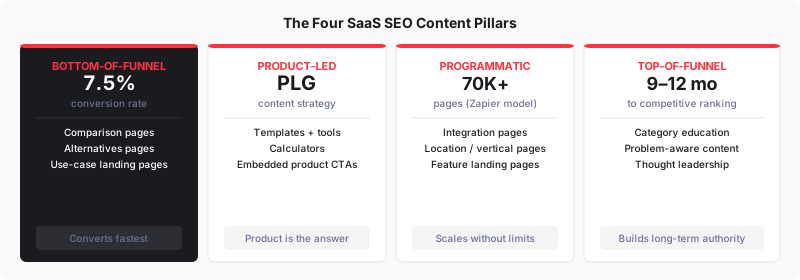
Bottom-of-funnel: comparison and alternatives pages. These convert at roughly 7.5% because the searcher is already in buying mode. Someone searching "Intercom vs Zendesk" or "best Salesforce alternatives for mid-market" is days from a decision, not months. Most SaaS companies under-invest here, building awareness content while their pipeline leaks at the bottom.
Product-led content. This is content where your product is the actual answer, not just mentioned in a paragraph. A template library that requires a signup to download. A free calculator that showcases your product's methodology.
A tool comparison landing page where your product wins. Product-led content drives qualified visits because users are self-selecting into your workflow before they've committed to anything.
Programmatic SEO. Zapier's approach is the canonical example: 70,000+ integration pages (each following a template) generating millions of monthly visitors. Your SaaS has the same opportunity at whatever scale fits your product: integration pages for every tool in your stack, vertical pages for every industry you serve, feature-specific landing pages for every use case. Most agencies don't offer programmatic build capability, so this is worth asking about directly.
Top-of-funnel category content. Blog posts, guides, and thought leadership that capture buyers who are problem-aware but not yet solution-aware. These take 9–12 months to compete for meaningful rankings, but they build the authority that makes everything else work harder. This is where most SaaS companies start, and where most SEO agencies camp out permanently.
A credible SaaS SEO service builds across all four. An agency only doing one isn't running a SaaS SEO program: they're running a content calendar.
Setting scope expectations early prevents the most common disappointments. A full-service SaaS SEO engagement should cover:
Technical SEO. Crawl health, page speed, indexing issues, structured data, and Core Web Vitals. Many agencies deprioritize this in favor of content, which is backwards: if your technical foundation is broken, the content investment is partially wasted. Companies looking for specialists in this area should read our breakdown of what a technical SEO agency actually does.
Keyword and content strategy. Not just a keyword list: a buying-stage-mapped content architecture that identifies what to produce for each phase of your funnel, in priority order.
The remaining deliverables that separate full-service from partial-service engagements:
SaaS SEO services price across a wide range. Here's a realistic map of what each tier delivers:
| Tier | Monthly Range | What's Included |
|---|---|---|
| Startup | $3,000–$5,000 | Keyword research, on-page optimization, 2–4 content pieces/month |
| Growth | $5,000–$12,000 | Technical SEO, link building, 4–8 content pieces/month, reporting |
| Scale | $12,000–$25,000+ | Dedicated team, programmatic builds, digital PR, international expansion |
| AI-assisted boutique | $499–$2,000 | Productized, lower-touch, limited strategy and customization |
Budget mismatch is the leading cause of early SEO churn. A SaaS company with a $10M ARR target that's spending $1,500/month on SEO is not running an SEO program. They're running a content calendar with a strategy problem.
For most growth-stage SaaS companies, the $5,000–$8,000/month range is the minimum to build a compound program. Below that, output is too thin to generate real data about what's working. The economics still hold: organic CAC for SaaS typically runs $480–$942 in year one, declining to around $290 as the program matures, compared to $800+ for paid search.
Timelines are where the most expectation-setting work needs to happen. A well-documented SaaS content strategy helps set internal benchmarks, but here's the practical month-by-month arc:
| Phase | Months | What's Happening |
|---|---|---|
| Foundation | 1–2 | Technical audit, keyword mapping, content architecture. Zero traffic impact expected. |
| First signals | 3–4 | Long-tail rankings start appearing. Branded search improves. Early organic sessions. |
| BOFU traction | 4–6 | Comparison and alternatives pages begin ranking. First attributable trials. |
| Compound growth | 6–12 | Well-performing content updated and expanded. Internal link equity builds. Pipeline impact measurable. |
| Competitive TOFU | 9–12+ | Informational content starts competing for non-branded terms at volume. Category authority established. |
SaaS companies publishing 9 or more posts per month see 35.8% higher year-over-year organic traffic growth. The compounding is real, but only if the output is high-quality and strategically directed. Volume without quality or strategy accelerates nothing.
Choosing the wrong partner is expensive in multiple ways: the direct fee, the opportunity cost, and the time lost before you course-correct. These signals predict problems before you sign.
They lead with rankings, not pipeline. If the pitch is all about keyword positions and domain authority, ask them directly: "How do you connect SEO to trial starts or MRR?" If they can't answer clearly, they're measuring the wrong things.
No discussion of technical SEO. Agencies that treat technical SEO as an afterthought or a one-time audit are underselling what's often the highest-ROI work. Crawl issues, indexing problems, and Core Web Vitals failures can cut organic traffic in half regardless of how much content you produce.
Three more signals to end the conversation:
B2B SaaS companies report a median 702% ROI on SEO, with break-even at around seven months. Powered by Search's B2B SaaS SEO benchmarks show the channel delivers 44.6% of B2B revenue and generates leads at roughly one-sixth the cost of paid search. Those numbers are available to companies that build the program correctly.
The firms that don't see those numbers are usually either spending at the wrong tier, working with an agency running a generic playbook, or measuring the wrong metrics and concluding SEO doesn't work.
If you're evaluating SaaS SEO services and want to talk through what a growth-stage engagement actually looks like in practice, EmberTribe works with SaaS and DTC brands to build organic programs that connect directly to pipeline and revenue.
A generalist SEO practitioner and a SaaS SEO expert are not interchangeable. The mechanics of keyword research and technical audits carry over, but the strategy layer is fundamentally different. SaaS buyers take three to twelve months to convert, they research across dozens of intent signals, and the pages that generate pipeline are often not the ones that rank for high-volume keywords. Getting those things wrong for twelve months is how SEO programs at SaaS companies get defunded.
This post covers what a SaaS SEO expert actually does, what makes SaaS SEO structurally different, which specializations separate strong candidates from general practitioners, and how to evaluate whether someone has the depth to deliver results on a SaaS timeline.
SaaS SEO is optimized around a buying journey that general SEO frameworks were not built for. The fundamental differences:
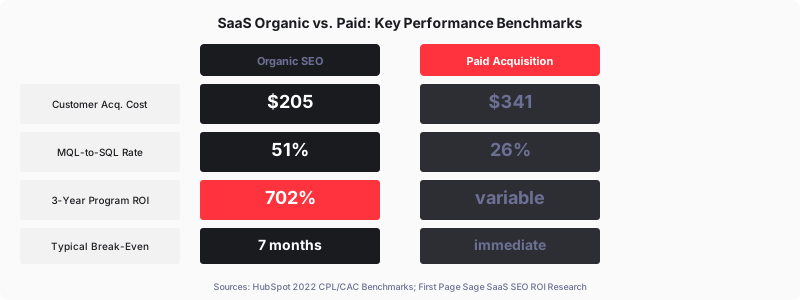
First Page Sage's SaaS SEO ROI research puts the 3-year program ROI at 702% with a 7-month break-even. Backlinko's B2B SEO statistics show that organic search drives 53% of total website traffic across B2B sectors, compared to 15% from paid. The CAC differential is substantial: HubSpot benchmarks put B2B SaaS organic CAC at $205 versus $341 for paid acquisition channels.
The compounding effect is the economic argument that most SaaS founders underweight. Paid acquisition cost is linear: double spend, roughly double leads, roughly double CAC. Organic compound: rankings built in Year 1 continue generating traffic and leads in Year 2 and 3 without proportional reinvestment. The ROI curves diverge sharply after the break-even point.
A SaaS SEO expert owns a set of interconnected responsibilities that most job descriptions underspecify:
The role contains several distinct specializations. Evaluating a SaaS SEO expert requires understanding which of these they are strongest in and whether your current growth stage needs.
Technical SEO is the infrastructure layer: indexation, site architecture, Core Web Vitals, schema markup, and crawl efficiency. Companies in the 0 to 5 million session range often have significant technical debt that limits the impact of any content program.
Content strategy and cluster building is the publishing layer: defining the topics, formats, and sequences that build topical authority in a specific SaaS category. This is where B2B SaaS experts often have the most differentiated skill relative to generalists who optimize single pages.
Programmatic SEO is the product-adjacent layer: building scalable page templates using product data, integrations, use cases, or locations. It requires both SEO judgment and enough technical fluency to collaborate with engineering.
Link building for SaaS requires a different strategy than for e-commerce or media sites. SaaS link programs typically center on original research, product integrations, and digital PR rather than the guest post and link exchange approaches common in other verticals.
The evaluation criteria that reliably separate SaaS-fluent practitioners from generalists who have worked with one SaaS client:
The hiring model matters as much as the individual. Three configurations are common:
A solo SaaS SEO consultant owns strategy and may direct execution through your internal team or freelancers. This works when you have content production capacity internally and need the strategic layer filled. It breaks down when execution bandwidth is the bottleneck.
A SaaS SEO agency embeds both strategy and an execution team. The SEO expert sets direction; specialists handle technical work, content, and link building. The all-in cost is higher, but the execution gap that undermines solo consultant engagements does not exist.
An in-house SEO hire is appropriate when organic is large enough to justify full-time specialization, typically above 100,000 monthly organic sessions or above $20 million in ARR where SEO is a primary acquisition channel. Below that threshold, the fractional or agency model usually produces better outcomes per dollar.
SaaS SEO expertise is specific enough that hiring for it requires looking past the general SEO credential. The pipeline attribution question, the BOFU architecture question, and the technical SEO-for-web-applications knowledge are the filters that matter. A program run by someone with genuine SaaS depth returns 702% over three years and generates MQLs at half the cost of paid. A program run by a competent generalist often does not compound the same way.
For SaaS and B2B brands that need performance marketing and organic working from the same strategic layer, EmberTribe works with growth-stage companies on demand programs where organic and paid are measured against the same pipeline outcomes.

When someone in the UK searches "SEO York," they are looking for an agency that understands the local competitive landscape: the density of professional services firms in the city centre, the tourism-driven seasonal search patterns, the businesses competing for "solicitor York" and "accountant York" and "hotel near York Minster" simultaneously. When someone in Pennsylvania searches the same phrase, they are looking at a smaller, less competitive market with a different industry mix entirely.
This post addresses both. York, UK is the primary focus, a £5 billion economy with 8,900 businesses and a distinctive set of local SEO dynamics. York, PA receives coverage for US-market readers. The underlying principles apply to both.
SEO for York businesses operates at two levels, and the failure to separate them is the most common source of wasted budget.
Local SEO handles the queries that contain geographic intent: "restaurants in York," "plumber York," "IT support York UK." These queries trigger the Google local pack, the three-business map result that appears above organic results and captures 42% of searcher clicks, according to Backlinko's local search research cited by BrightLocal. Ranking in the local pack depends on Google Business Profile optimization, citation consistency, reviews, and local backlinks. It is managed through Google's local infrastructure, not through standard organic ranking signals alone.
National and technical SEO handles everything else: the informational and commercial queries that are not location-bounded. A York-based B2B SaaS company wants to rank for "[software category] for manufacturers" nationally, not just locally. A York DTC brand selling pottery wants organic visibility across the UK. These require the same technical SEO foundation, Core Web Vitals, site architecture, schema markup, authoritative backlinks, that any national competitor needs.
Most York businesses need both. The mistake is optimizing for one while neglecting the other.
York, UK's economy creates a specific competitive density that makes local SEO more consequential than in smaller regional cities.
Tourism accounts for a significant share of York's commercial activity, with 8.4 million annual visitors pre-pandemic. This creates an unusual dynamic: local pack competition is not just between businesses serving residents, it is between businesses competing for visitors searching from outside the city. A York hotel competes for "boutique hotels in York" queries coming from London, Manchester, and Edinburgh. A York restaurant competes for "best places to eat in York" queries from travelers planning a day trip.
This out-of-town intent means local visibility has national customer acquisition value.
The professional services sector, solicitors, accountants, financial advisers, management consultants, is dense for a city of York's size, partly because of York's role as an administrative hub for North Yorkshire. The top three positions in the local pack for "solicitor York" attract the substantial majority of inbound calls. Being in position four or below is effectively invisible for most searchers.
The rail industry cluster around York (including several major rail operators and Network Rail functions) adds a B2B layer: vendors serving that cluster compete for procurement-adjacent searches with a professional services format.
In York, PA, the competitive dynamics are different. The market is smaller and less saturated digitally. Healthcare, manufacturing, and professional services dominate by employment. For businesses willing to invest consistently in structured local SEO, the opportunity to dominate "[service] York PA" queries is achievable with less effort than comparable UK-market competition.
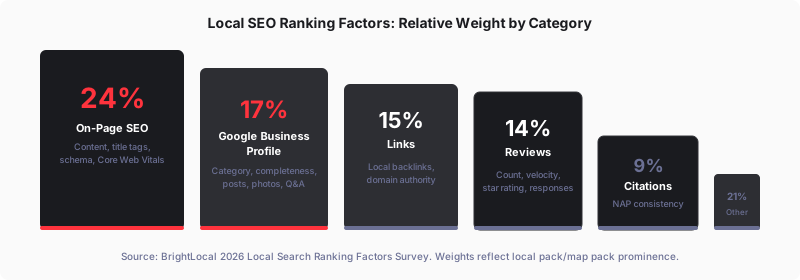
BrightLocal's 2026 Local Search Ranking Factors survey identifies on-page SEO as the single largest factor at 24%, followed by Google Business Profile signals at 17%, links at 15%, reviews at 14%, and citations at 9%.
Most evaluation criteria for a Google SEO agency apply here: no guaranteed rankings, transparent methodology, case studies with verified data, reporting tied to business outcomes rather than vanity metrics. For local SEO specifically, two additional questions matter.
Do they actively manage Google Business Profiles? Not set-up-and-leave management, but ongoing optimization: updating seasonal hours, posting regularly, monitoring and responding to reviews, building out the Q&A section, uploading fresh photos. This is operational work that many agencies underprice or underdescribe in proposals. Ask for specifics on what GBP management actually includes.
Do they build local citations and links, or just national ones? A York business benefits from links in The York Press more than links in a generic UK business directory. An agency with genuine local market knowledge will have a list of York-specific and Yorkshire-specific sources they work with. If their link-building pitch focuses on generic DA30+ placements without mentioning any local publications, they are not optimized for local pack rankings.
Red flags in local SEO proposals are consistent with those in any SEO engagement: guarantees of map pack positions within 30 days, pricing under £500/month for comprehensive coverage, reports that only show impressions without clicks or conversions, and agencies that will not grant access to the client's own Google Business Profile account.
Local SEO results operate on a longer timeline than paid search. Meaningful local pack movement typically takes three to six months from the start of consistent optimization. The measurement framework breaks into two layers.
Leading indicators (months 1-3): GBP completeness score improving, citations audited and corrected, new review velocity established, Core Web Vitals passing thresholds. These do not directly show business impact but confirm the inputs are in place.
Lagging indicators (months 3-12): Local pack rankings for target "[service] York" queries, organic traffic to location-specific landing pages, GBP website clicks and call clicks, direction requests from Google Maps. For DTC brands, organic-attributed revenue from GA4. For B2B SaaS companies with York offices, organic pipeline contribution.
The framing that matters: local SEO should ultimately be measured by leads, calls, footfall, or revenue, not by ranking position alone. A position-one map pack result for a query that generates no commercial intent produces nothing. Tracking the connection from visibility to conversion is what separates an SEO agency that manages rankings from one that manages growth.
For York businesses in competitive local categories, whether tourism and hospitality in York, UK or healthcare and professional services in York, PA, local SEO is not optional, it is the primary mechanism through which new customers find you. The 42% map pack click share means that businesses outside the top three are effectively invisible to nearly half of all searchers with local intent.
Getting into and staying in the top three is a sustained technical and operational commitment. If you want to evaluate where your local presence stands against competitors and what the highest-leverage improvements are, EmberTribe works with growth-stage DTC and B2B brands on local and national SEO programs built around measurable business outcomes.
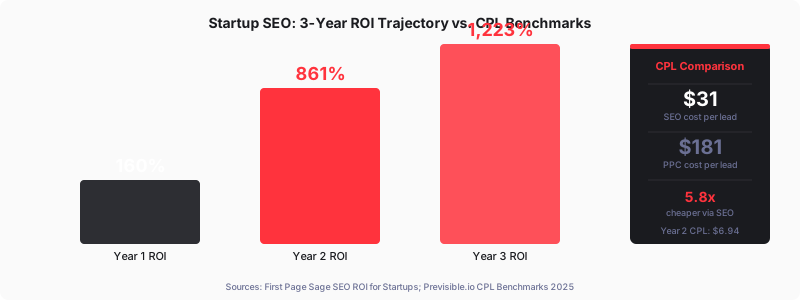
Most startup companies approach SEO the same way they approach paid acquisition: spend, measure immediately, cut what does not convert in 90 days. That mental model produces mediocre results from a channel that rewards patience with compounding returns. First Page Sage's SEO ROI research for startups puts Year 1 ROI at 160%, Year 2 at 861%, and Year 3 at 1,223%.
The compounding dynamic is not a promise. It is the mathematical consequence of rankings that continue generating leads without proportional reinvestment.
This post covers how SEO startup companies should think about the channel, what the cost economics actually look like, which strategies compound fastest at the growth stage, and how to decide between an agency and an in-house hire.
The argument for startups starting SEO earlier than feels comfortable: the break-even point for a well-run program is typically 7 to 12 months, and the opportunity cost of starting late is the 12-18 months of compounding you give up. A program started at $2 million ARR that is still running at $15 million ARR has built an organic asset that paid acquisition cannot replicate.
Previsible's CPL benchmarks document the cost per lead comparison: SEO generates leads at $31 average CPL versus $181 for PPC. By Year 2, as rankings consolidate and content compounds, the effective CPL drops to $6.94. The paid acquisition benchmark stays constant. The divergence is the economic case for prioritizing SEO at the growth stage.
The 94% figure from B2B buying research is important context: 94% of B2B buying groups now use large language models during purchase decisions, per recent buyer behavior data. The implication is that organic content is no longer just ranking in Google. Well-structured, authoritative content surfaces in AI-assisted research sessions. Startups that build content depth now are positioning for both traditional search and AI-assisted discovery.
The most common startup SEO failure is treating the channel as a content blog with keyword optimization. The companies that see meaningful pipeline from SEO in the first year take a different approach.
The programmatic SEO playbook is underutilized by startups for a predictable reason: it feels like an engineering project, not a marketing project. Most growth teams do not own the engineering relationship.
The opportunity is substantial. Ahrefs' analysis of SaaS SEO documents how companies like Zapier and Notion have turned product data into organic traffic machines. The pattern: identify a class of queries that share a structure (app + integration, template + use case, city + product category), build a scalable page template, populate with product data, and let the search index do the rest.
For early-stage startups, this might mean city-based landing pages if the product has geographic relevance, integration pages if the product connects to a large ecosystem, or use-case pages segmented by industry vertical. The entry point is usually lower than teams assume. A well-structured template and 200 pages of product data can generate meaningful organic traffic within six months.
The binary "SEO or paid" framing is wrong for startups. The correct framing is sequencing. Most growth-stage startups need paid acquisition to generate immediate pipeline while SEO compounds. The mistake is either ignoring SEO until paid costs become unsustainable, or abandoning paid prematurely because the SEO program is showing early signals.
A common effective configuration: paid acquisition carries 60-70% of pipeline in Year 1 while SEO infrastructure and early rankings build. By Year 2, organic's share grows as content matures and programmatic pages index. By Year 3, the channels reach parity in pipeline contribution but SEO's effective CPL is a fraction of paid. The total acquisition cost structure improves significantly.
B2B SEO companies that specialize in growth-stage work understand this sequencing. Agencies that treat SEO as a standalone channel, disconnected from the paid media strategy, produce programs that are harder to measure and harder to justify to a board that is watching paid CAC closely.
The hire-or-outsource decision for startup SEO comes down to three variables: how much execution capacity exists internally, what the monthly SEO budget justifies, and how quickly the startup needs organic to contribute to pipeline.
An in-house SEO hire at the seed or early Series A stage typically means a generalist who can own content strategy and some technical execution. The risk is limited specialization: a single hire cannot be excellent at technical SEO, content strategy, link building, and programmatic development simultaneously. The fully-loaded cost of a US-based SEO specialist runs $120,000 to $180,000 annually. At that price point, a SaaS SEO agency often provides more specialized depth for the same or lower total cost.
An agency or specialist engagement makes sense when the startup needs the full stack (technical, content, programmatic, link building) without building a four-person team. The key evaluation criteria for a startup SEO agency:
Do they report to pipeline and revenue, or to traffic and rankings? Any agency still reporting primarily on keyword position improvements is measuring inputs, not outputs. Ask specifically: how do you attribute organic traffic to MQL and pipeline contribution in the client CRM?
What is their process for BOFU content? Can they walk through a specific example where comparison pages or alternative pages generated measurable pipeline for a startup client? This is the differentiation that compounds fastest and requires the most strategic sophistication.
Do they have programmatic SEO capability? For SaaS startups in particular, the leverage from scalable page templates is often 3-5x higher than equivalent editorial investment. If the agency does not have a specific process and examples here, that lever stays unexercised.
The case for startup SEO is a compounding ROI argument: 160% in Year 1, 861% in Year 2, 1,223% in Year 3. The case for starting earlier rather than later is that every month of delay is a month of compounding foregone. The case for doing it correctly is that a program optimized around traffic rather than pipeline will eventually disappoint the same board that funded it.
For growth-stage SaaS and B2B companies building organic alongside paid acquisition, EmberTribe works with startups on programs where SEO investment is measured against the same revenue metrics as paid, not tracked in a separate reporting silo.

Most SEO programs collect data. Few actually use it. The gap between teams that rank and teams that stall often comes down to one thing: whether analytics is guiding decisions or just filling dashboards.
Connecting the right data sources, tracking the metrics that signal real search performance, and building a repeatable workflow to act on what you find is what separates SEO programs that grow from ones that plateau. This guide covers exactly that.
Search engine optimization without analytics is guesswork. You might publish consistently, build links, and optimize pages, but without measurement you cannot tell which efforts are compounding and which are wasting budget.
The strongest SEO programs treat analytics as a feedback loop. Content goes live, data comes back, priorities shift based on what the numbers show. That cycle, done weekly, is what drives compounding organic growth. For a deeper look at how analytics fits into a broader web measurement strategy, the guide on SEO web analytics covers the foundational layer in detail.
Most SEO analytics workflows run on two free platforms: Google Analytics 4 and Google Search Console. Each tells a different part of the story, and they are most powerful when used together.
GA4 is an event-based analytics platform. Every interaction on your site, whether a scroll, a form fill, or a page view, is captured as an event. For SEO purposes, the most important GA4 reports are:
GA4's shift to event-based measurement also means conversions are now called "key events." You can mark specific actions, such as form submissions, purchases, or demo requests, as key events, then filter organic traffic data against those conversions to understand which organic pages actually drive business outcomes.
Search Console shows what happens in the SERP before users reach your site. The Performance report is the core tool, surfacing four metrics for every query and page combination:
The Google Search Central documentation notes that combining Search Console with GA4 gives you a more complete view of how audiences discover and experience your site. That integration is worth setting up immediately.
The integration is straightforward. Inside GA4, go to Admin, then Property Settings, then Search Console Links. You will need to be a verified owner of the property in Search Console and have Editor access in GA4.
Once linked, a Search Console collection appears in your GA4 reports under Reports Library. You get two reports: Queries (showing keyword data alongside GA4 engagement metrics) and Google Organic Search Traffic (landing page performance with Search Console signals layered in). New integrations can take 24 to 48 hours to populate data.
This linked view is where the most actionable insights come from. You can see not just which queries drive traffic, but whether that traffic engages and converts once it arrives.
Not every metric in GA4 or Search Console deserves weekly attention. The ones below have a direct line to rankings, traffic quality, and revenue.
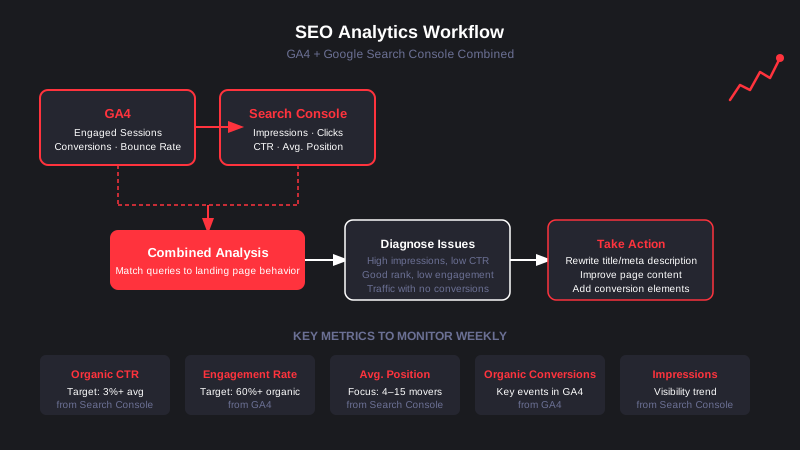
Click-through rate measures how often searchers choose your result after seeing it. A keyword with high impressions and low CTR is ranking but failing to earn the click, usually because the title tag or meta description is not compelling enough. The benchmark to watch: a CTR under 3 percent for positions 1 through 5 usually signals a weak title or mismatched intent.
If users arrive from organic search and immediately leave, that signals a mismatch between what the SERP promised and what the page delivered. A healthy engagement rate for organic traffic sits at 60 percent or higher. Pages below that threshold need a content or UX audit.
Pages ranking in positions 4 through 15 are the highest-leverage targets in any SEO program. They have already established relevance with Google but are not yet earning the click volume they could. A focused optimization effort on these pages, updating content, improving internal linking, and strengthening the page's topical depth, often produces meaningful traffic lifts within 60 to 90 days.
Raw traffic numbers are vanity metrics if they do not tie back to business outcomes. In GA4, segment key event completions by "Organic Search" to see which landing pages produce qualified leads, purchases, or sign-ups from search. According to AgencyAnalytics' 2026 SEO KPI guide, practitioners consistently rank conversions and revenue as the most valuable SEO metrics, while raw rankings are treated as secondary signals.
Impressions measure your overall search visibility. A growing impressions trend, even before clicks increase, often indicates that content is gaining traction and freshness in Google's index. A sudden impressions drop is an early warning signal worth investigating in the Coverage and Index reports inside Search Console.
The research process and publish cadence matter less than the review loop. A consistent weekly workflow turns data into action.
Step 1: Open Search Console Performance and filter the last 28 days. Sort by impressions. Identify pages with high impressions but CTR below 3 percent. These are rewrite candidates.
Step 2: Pull the same pages in GA4 under Reports, then Engagement, then Pages and Screens. Filter by organic traffic. Review engagement rate and key event conversion data for each page.
Step 3: Cross-reference. A page with strong impressions, decent position, but low engagement rate likely has an intent mismatch. A page with strong CTR but no conversions likely has a conversion barrier (weak CTA, poor UX, or misaligned offer).
Step 4: Prioritize fixes based on traffic potential and business value. A mid-funnel page driving 2,000 organic sessions per month with a 0.2 percent conversion rate has far more leverage than a top-of-funnel page with 300 sessions and 5 percent engagement.
This workflow scales. Once it is in muscle memory, running it takes 30 minutes a week and consistently surfaces the highest-ROI SEO work on your site.
GA4 and Search Console handle the core workflow. For teams that need more, a handful of tools layer in additional capability.
Looker Studio (free): Combines GA4 and Search Console data into visual dashboards that update automatically. Useful for presenting SEO performance to stakeholders without exporting spreadsheets.
Ahrefs / Semrush: Third-party rank trackers and backlink tools that supplement Search Console's keyword data with competitive benchmarks, keyword difficulty scores, and backlink monitoring. Neither replaces Search Console, but both add context that GSC cannot provide.
Screaming Frog: A technical SEO crawler that identifies indexing issues, broken links, duplicate content, and missing metadata at scale. Complements analytics data by showing what Search Console might flag in Coverage reports.
For a structured comparison of analytics platforms including GA4 alternatives, the analytics platforms guide breaks down the full stack with pricing and use cases.
Data has no value until it changes what you do. The teams that get the most from analytics for SEO are not the ones with the most sophisticated dashboards. They are the ones with the clearest decision rules.
If CTR drops below 3 percent on a page ranking in the top 5, rewrite the title tag. If engagement rate on an organic landing page falls below 50 percent, audit the content for intent match. If impressions grow but clicks plateau, check whether a Featured Snippet or AI Overview is intercepting the click. These rules, applied consistently, make analytics a decision engine rather than a reporting exercise.
Building that discipline takes time, but the compound effect is significant. Backlinko's 2026 SEO metrics hub notes that teams tracking organic conversion rate alongside traffic consistently outperform teams optimizing for rankings alone, because they optimize toward outcomes rather than vanity signals.
If you are building or auditing your analytics foundation, the web analytics tool comparison covers which platforms work best at different stages of growth, including when GA4 alone is sufficient and when to add a more specialized layer.
A mature SEO analytics practice has three characteristics: it measures both visibility (impressions, position) and quality (engagement, conversions), it connects those metrics to decisions on a regular cadence, and it is simple enough to run without a data analyst.
GA4 and Search Console, linked and reviewed weekly, give most teams everything they need to build that practice. The goal is not more data. It is clearer signals and faster action on what the data reveals.

The search for the best SEO agency is one of the most consequential decisions a DTC brand or growth-stage company makes. Get it right and you build a compounding organic channel that pays dividends for years. Get it wrong and you lose six to twelve months of budget while your competitors pull ahead in the SERPs.
This guide is direct and practical. No rankings, no sponsored placements, no vague advice to "look for experience." What follows are the actual criteria, pricing benchmarks, and evaluation questions you need to make a confident decision in 2026.
Most agencies offer the same surface-level services: keyword research, on-page optimization, link building, monthly reports. The difference between the best and the mediocre is not what they offer on paper. It is how they execute and how they connect activity to outcomes.
The agencies worth your budget share a few defining traits. They treat SEO as a revenue channel, not a traffic channel. They can explain exactly how a keyword ranking connects to a conversion event. And they build strategies that work across traditional search results, AI-generated overviews, and voice-based queries simultaneously, because search behavior in 2026 demands all three.
According to Backlinko's SEO pricing research, agencies that deliver consistent results typically operate with a full-stack approach: technical audits, content production, and authority building working in concert. Firms that specialize in only one layer tend to plateau.
Specialization also matters more than most buyers realize. The best SEO company for a B2B SaaS startup is not the best one for a fashion DTC brand. Vertical expertise shapes keyword strategy, content format, and the backlink profile that makes sense for your category. Ask any agency you're evaluating where the majority of their clients operate. If the answer is vague, that tells you something.
Pricing clarity is itself a quality signal. The best agencies publish their retainer structure or give a straight answer on a first call. The ones that hide pricing behind lengthy discovery processes often do so because the number is not defensible.
Here is what the market looks like in 2026, based on data from Digital Applied and Search Scale AI's agency pricing analysis:
The average agency retainer for a growth-stage company lands around $3,200 to $5,000 per month. Rates below $1,500 per month typically indicate either highly automated output or a junior team. Rates above $10,000 are justified for companies in competitive verticals or those needing technical depth at scale.
One pricing shift worth noting: AI tools have compressed the labor cost of routine SEO tasks. Agencies that have not passed any of those savings on to clients while raising rates are worth questioning.
For more on building a full evaluation framework before hiring, our SEO agency guide covers the due diligence process in detail.
1. Case studies with revenue data, not just traffic data
Traffic is a leading indicator. Revenue is the outcome. Any agency calling itself a top SEO agency should be able to show you a case study that traces organic traffic growth to pipeline or revenue, not just to a ranking milestone. Ask for a client in your vertical.
2. Transparency in strategy and reporting
Request a sample report before signing. A strong report connects keyword ranking changes to traffic deltas to conversion events. A weak report shows total keywords ranking, total sessions, and a green arrow. If the report cannot explain why numbers moved, the agency cannot either.
3. Realistic timeline commitments
SEO takes four to twelve months to produce meaningful results. This is not a caveat: it is a structural reality of how search engines evaluate authority. Any agency promising top rankings in 30 to 60 days is using tactics that will erode rather than build equity over time.
4. Technical plus content capabilities under one roof
The best agencies handle both. Technical SEO without content creates a structurally sound site with nothing to rank. Content without technical SEO creates well-written pages that load slowly, have poor crawlability, and lose ground on Core Web Vitals. Ask specifically how their technical and content teams collaborate on a typical engagement.
5. Communication cadence and access to senior strategists
You should know who is working on your account. Junior analysts executing templated strategies with no senior oversight is a common failure mode at mid-sized agencies. Ask who attends your monthly calls and who is responsible for strategy decisions.
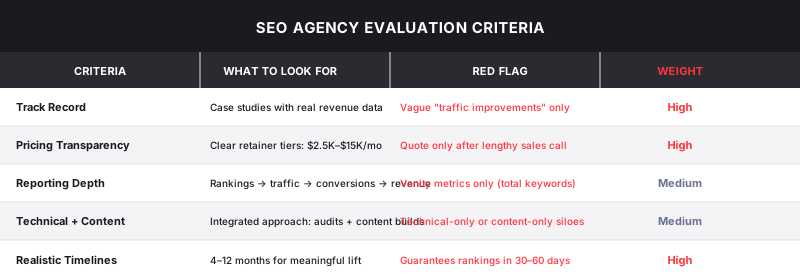
Some signals should end the conversation before it goes further.
Guaranteed rankings. No agency has a relationship with Google's algorithm. Guarantees on specific positions or timelines are either naive or dishonest. Either one is disqualifying.
No clarity on who does the work. Many agencies pitch senior strategists and deliver junior execution. Ask directly: who runs your account day-to-day? If the answer is vague, the answer is a junior team member following a template.
Reporting that only shows vanity metrics. Total keywords ranking, total impressions, and total sessions are not outcomes. An agency that cannot connect their work to conversions either does not track that data or does not want you to see it.
White-labeled services. Some agencies resell generic SEO packages from a third party and present them as proprietary strategy. Ask who produces the content, who conducts technical audits, and what tools they use. If the answer is vague, you may be paying a markup for commodity work.
Contracts with no performance benchmarks. A 12-month contract with no defined KPIs is a contract that protects the agency, not you. Reasonable milestones should be agreed upon at the start, even with the understanding that SEO results vary.
The metrics you track determine whether you can hold an agency accountable. Focus on these:
Organic revenue or qualified lead volume from organic: This is the ultimate KPI. If the agency cannot connect their work to revenue or pipeline, the engagement is missing its purpose.
Keyword ranking changes for target terms: Track specific keywords tied to buying intent, not just broad informational terms. Informational traffic is valuable for awareness but rarely converts at the rates that justify an SEO investment for growth-stage companies.
Conversion rate on organic landing pages: Rankings and traffic matter less if users bounce without converting. A strong agency pays attention to what happens after the click.
Organic share of total pipeline: As SEO compounds, the share of deals sourced from organic should grow. This is one of the clearest indicators of whether the investment is paying off at the business level.
For companies evaluating multiple service providers as part of a broader growth stack, our guide on best digital marketing firms covers how SEO fits alongside paid, content, and conversion work.
Use these questions in your final evaluation conversations:
The answers reveal process, accountability, and whether the agency thinks about your business or their deliverable list.
For SaaS companies in particular, the evaluation has additional layers given the nuances of free-trial funnels and product-led growth. Our SaaS SEO guide covers the specific criteria relevant to that segment.
The best SEO agencies are not always the most visible ones. Agencies that spend heavily on their own marketing sometimes do so because it is easier than retaining clients through results. Start with referrals from companies at a similar growth stage. Ask who they use and whether they would sign again.
Supplement referrals with research. Review sites like Clutch and G2 publish verified client reviews. Look specifically at companies that match your size and vertical. A five-star review from a Fortune 500 enterprise tells you little about how the agency handles a $4,000-per-month DTC brand account.
Finally, use the evaluation framework above as a filter, not a checklist. Every strong agency will have a gap somewhere. What matters is whether their strengths align with your biggest growth lever right now.
EmberTribe works with DTC brands and growth-stage companies to build organic search programs that connect to revenue, not just rankings. We combine technical audits, content strategy, and authority building into a single integrated program with reporting that ties activity to business outcomes.
If you are evaluating your options for 2026, embertribe.com is a good place to start.
B2B keyword research is not a volume game. The brands that win organic search in competitive B2B categories are not targeting the highest-traffic terms. They are targeting the right terms: the ones that signal buyer intent, match specific funnel stages, and attract the decision-makers who control budget.
This guide walks through how B2B keyword research works, where it differs from B2C approaches, which tools to use, and how to build a prioritized keyword strategy that generates qualified pipeline rather than unqualified traffic.
The mechanics of B2B search are fundamentally different from consumer search. In B2C, a single person searches, decides, and converts, often within minutes. In B2B, a single deal might involve three to eight stakeholders, a buying cycle of weeks or months, and a sequence of searches that map across entirely different roles.
A VP of Operations searching for "automated inventory management" is not the same buyer as a CFO searching for "inventory management software ROI." Both are part of the same deal. Both use different language. Effective B2B keyword research surfaces both sets of queries and maps them to content that speaks to each role.
Volume also matters less in B2B than most marketers assume. A keyword with 200 monthly searches and strong commercial intent is worth more than a keyword with 20,000 searches and informational intent if your product costs $50,000 per year. High CPC bids (often $15 or more in competitive B2B categories) are a reliable signal that advertisers consider a keyword worth paying for because it converts. That signal belongs in your research process.
Effective B2B keyword strategies organize keywords into three layers that map to the buyer journey. Each layer requires different content formats and serves a different purpose in the funnel.
Top-of-funnel keywords attract buyers who are identifying a problem or starting to research a category. These terms tend to be educational and high-volume relative to the other layers. Examples include "what is revenue operations," "b2b demand generation strategies," or "how to reduce customer churn." Content here builds brand awareness and positions your company as a credible source.
Middle-of-funnel keywords attract buyers who understand the category and are evaluating approaches. These terms are more specific and often include modifiers like "best," "top," "how to choose," or "for [industry]." Examples include "best b2b seo tools," "keyword research for b2b saas," or "content strategy for manufacturing companies." The buying intent is higher here, and conversion rates from this layer tend to be meaningfully better than top-of-funnel traffic.
Bottom-of-funnel keywords attract buyers who are actively selecting a vendor or evaluating specific solutions. These include comparison searches ("vs." terms), pricing searches, review searches, and branded terms. While volume is lower, conversion rates are significantly higher. A single page ranking for "best b2b seo agency for saas" can drive more revenue than a dozen top-of-funnel posts.
The best B2B keyword research starts before you open any tool. Sales conversations, support tickets, and customer interviews reveal the specific language your buyers use to describe their problems, which is often different from the language your marketing team uses to describe your product.
Ask your sales team what questions prospects ask in early discovery calls. Ask customer success what problems customers were trying to solve when they first started searching. These answers surface the naturalistic keyword language that SEO tools often miss because the search volume is distributed across many variations.
Once you have that foundation, move into tool-based research.
Ahrefs and Semrush are the two most capable platforms for B2B keyword research. Both provide keyword volume estimates, keyword difficulty scores, CPC data, and SERP analysis. Semrush has stronger competitive gap analysis features. Ahrefs has a more reliable backlink index, which matters when evaluating keyword difficulty.
Google Search Console is underused for B2B research. If your site already has organic traffic, GSC shows exactly which queries are driving impressions and clicks. It surfaces real demand from real searchers at your site, which is more reliable than volume estimates from third-party tools.
Google Keyword Planner is useful for CPC data even if you are not running paid campaigns. High CPCs reliably signal commercial intent. A B2B keyword with a $25 CPC is worth investigating regardless of its monthly search volume.
For B2B-specific research, LinkedIn's search behavior and job postings are underused intelligence sources. The language companies use in job descriptions to describe problems they are hiring to solve often maps directly to the search queries their leaders are typing into Google.
Not every keyword deserves the same content format. Mapping keywords to their primary search intent before writing anything is one of the most important steps in a B2B keyword strategy, and one of the most commonly skipped.
Run a keyword through Google and study the current SERP carefully. The existing top results tell you what Google believes searchers want to find. If the top results are all long-form guides, a long-form guide is likely the right format. If the top results are tool comparison pages or listicles, that is the format Google is rewarding for that query.
Intent mapping also affects conversion strategy. A top-of-funnel informational post should convert to a lead magnet or newsletter, while a middle-of-funnel comparison page should convert to a demo or consultation. A bottom-of-funnel pricing page should convert to a sales conversation. Misaligning content format and conversion strategy is one of the main reasons B2B content generates traffic but not pipeline.
Individual keywords produce individual pages. Topic clusters produce authority. The brands that dominate B2B search are not publishing one post per keyword. They are building interconnected content systems where a pillar page covers a broad topic and supporting cluster posts cover specific subtopics, all linked together in a way that signals deep expertise to search engines.
For a B2B company in the CRM space, a cluster might look like this: a pillar page on "CRM for manufacturing" supported by cluster posts on "how to track customer orders in CRM," "CRM integration with ERP systems," and "CRM for mid-market manufacturers." Each cluster post reinforces the authority of the pillar, and the pillar passes that authority back to the cluster.
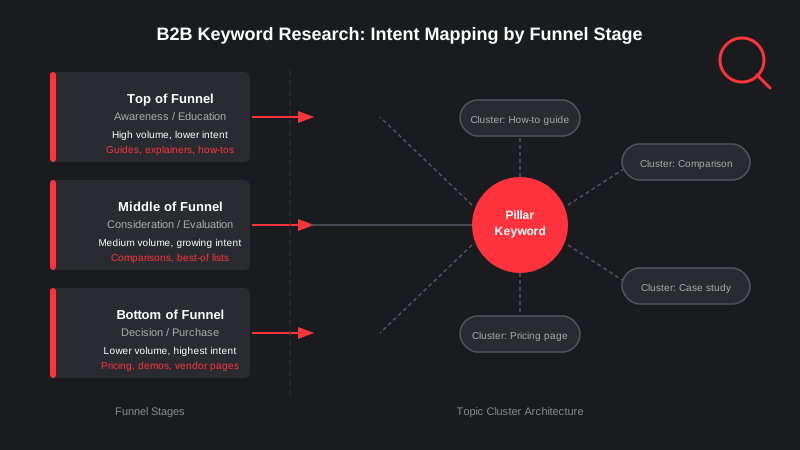
Building clusters requires deliberate internal linking. Every cluster post should link back to the pillar page, and the pillar should link forward to each supporting post. This architecture is one of the fastest ways to build topical authority in a competitive B2B category. Our guide to analytics for SEO covers how to measure topical authority gains over time.
Once you have a keyword list, prioritization determines where you spend content resources first. Use four criteria to score and rank keywords:
Search intent fit. Does this keyword map cleanly to a content format you can execute? High-intent keywords you can rank for are worth more than high-volume keywords where your content format is a poor fit for the SERP.
Keyword difficulty relative to your domain authority. A keyword difficulty of 30 is approachable for a site with meaningful backlinks. A keyword difficulty of 70 requires significant link equity. Target opportunities where your domain can compete within six to twelve months.
Business value. Keywords that attract buyers close to a purchase decision have higher business value than keywords that attract researchers. Weight your prioritization toward terms that appear in the middle and bottom of your funnel.
Competitive gap. Identify keywords where your competitors rank but you do not. These represent traffic you are currently losing to competitors and are often faster to capture than entirely new territory. Our post on competitor AdWords keywords covers how to find gaps in paid search that often mirror organic opportunities.
Effective keyword prioritization is covered in depth by resources like Moz's Keyword Research guide and Search Engine Land's B2B SEO coverage. Both are worth bookmarking as reference material.
B2B keyword research is the foundation of every content engagement we run. Before writing a single post, we map keywords to funnel stages, score intent, and build cluster architecture that compounds over time.
The brands that get the most out of B2B search are not the ones publishing the most content. They are the ones publishing the most targeted content, built on keyword research that reflects how their buyers actually search, not how the marketing team talks about the product.
If you are evaluating SEO partners and want to understand how strategic keyword research fits into a broader engagement, our guide to finding the best SEO firm walks through the evaluation criteria that matter most. And if you want to understand what the top B2B SEO companies actually do differently, our roundup of the best SEO companies in the USA covers the operational patterns that drive results.
B2B keyword research is not a one-time exercise. The B2B search landscape shifts as competitors publish, search engines evolve, and buyer language changes. Build your keyword strategy as a living document, revisit it quarterly, and let intent signals from your existing content guide where you expand next.


.svg)