

Most B2B SaaS companies outgrow generalist marketing help faster than they expect. The moment you're optimizing for pipeline quality, CAC payback, and expansion revenue simultaneously, a generalist agency that doesn't understand recurring revenue models becomes a liability. A specialized b2b saas marketing agency is built for that environment specifically.
This guide explains what these agencies do, how their work differs from standard B2B or DTC marketing, and how to evaluate one before committing budget.
SaaS has structural dynamics that generalist agencies consistently underestimate. The most significant: acquiring a customer is not the goal. Retaining and expanding that customer is what drives compounding ARR growth.
A generalist agency optimizing for lead volume can look productive while your funnel economics deteriorate. They may drive MQL counts up while CAC climbs and payback periods stretch. Benchmarkit's 2025 SaaS benchmarks show that the average B2B SaaS company now spends $2.00 in sales and marketing for every $1.00 of new ARR, and the average sales cycle has extended to 134 days. Neither of those realities is reflected in how most general-purpose agencies plan or measure work.
SaaS-specific agencies understand the buying committee problem. Enterprise SaaS deals typically involve six to ten stakeholders, each with different concerns, at different stages of awareness. Campaigns that reach only the economic buyer while ignoring the security team, the end users, and the IT evaluators leave enormous conversion opportunity on the table.
The best SaaS agencies are full-funnel rather than channel-narrow. Their service mix typically includes:
Demand gen for SaaS is not a synonym for lead generation. It encompasses the full motion of creating awareness, educating the market, and moving qualified buyers from dark funnel to pipeline. Agencies that lead with demand gen typically build integrated programs across content, SEO, paid search, and paid social rather than running those channels in isolation.
Good demand gen programs are tracked against revenue-connected metrics: cost per SQL, pipeline influenced, and CAC payback. See our breakdown of the metrics that actually matter for SaaS growth for what a rigorous measurement framework looks like at each funnel stage.
ABM flips the traditional funnel. Instead of casting wide and filtering down, you identify the accounts most likely to become high-LTV customers and build campaigns specifically for them. A SaaS-focused ABM program typically includes firmographic targeting on LinkedIn and programmatic display, personalized content for each target segment, and coordinated outreach sequences timed to buying signals.
Gartner's B2B buying research shows that B2B buyers spend only 17% of their total buying process talking to potential vendors. The rest is independent research. ABM closes the gap by placing your content and messaging inside that research window before a prospect ever raises their hand.
Organic search is the most scalable channel for SaaS companies with long sales cycles because content compounds over time while paid spend does not. A SaaS-specialized agency approaches content differently than a generalist: they map content to buying stages, prioritize topics based on commercial intent, and build topical authority rather than chasing isolated keyword rankings.
The content strategy also serves sales enablement. High-quality comparison pages, technical guides, and use-case documentation reduce friction in the sales cycle and shorten time-to-close. Internal linking between those assets reinforces both SEO and buyer education simultaneously.
SaaS paid programs require a different bidding logic than e-commerce. You're not optimizing for a single transaction; you're optimizing for pipeline quality. That means targeting by job title, company size, and intent signals rather than demographic lookalikes, and measuring success by SQL volume and pipeline contribution rather than click-through rate.
LinkedIn Ads is the dominant B2B paid social channel for SaaS because of its firmographic targeting precision. Agencies that specialize in SaaS typically run thought leadership ads, sponsored content, and retargeting sequences layered on top of each other, rather than running single-offer campaigns.
Most SaaS buying decisions don't happen on the first visit. Prospects enter the funnel, go dark, reengage months later, and convert after multiple touchpoints. Effective nurture sequences segment by ICP fit, engagement level, and buying stage, serving content that matches where each prospect actually is. Agencies with SaaS expertise build these systems in HubSpot, Marketo, or similar platforms, and they wire attribution tracking so every touchpoint is connected to revenue outcomes.
The differences show up in measurement first. A general B2B agency will typically report on impressions, clicks, and MQL volume. A SaaS-specialized agency ties everything to SQL creation, pipeline influenced, and CAC payback. If an agency can't articulate how their work connects to revenue, they're operating at the wrong level of accountability for a SaaS business.
The second difference is channel mix. Generalists tend to default to whatever channel they execute best. SaaS agencies build programs around where B2B SaaS buyers actually spend time: LinkedIn, targeted podcast sponsorships, review sites like G2 and Capterra, and high-intent search terms. They also tend to have stronger opinions about what not to do, particularly around vanity metrics and low-intent lead sources that inflate volume without improving pipeline.
Third is understanding of the SaaS sales motion. An agency that has never worked with a product-led growth model, a self-serve freemium funnel, or an enterprise direct-sales motion will be learning on your budget. Agencies that have worked across multiple SaaS growth stages bring frameworks you can skip straight to rather than rebuilding from first principles.
Ask for case studies from companies at a comparable ARR stage and growth motion. An agency that has worked primarily with early-stage PLG companies may not be the right fit for a $10M ARR company transitioning to enterprise direct sales. The specifics matter.
Request a sample report or attribution model before signing. If their standard reporting doesn't include pipeline contribution or CAC payback, they're not measuring what matters. Strong agencies connect every channel to revenue impact, even when attribution is imperfect.
Some agencies present a strategy and hand execution off to your team. Others own the full execution stack. Know what you're buying before you sign. If your internal team is thin, an agency that does strategy-only will leave you without the capacity to execute against the plan.
Our growth strategy consulting overview covers when to bring in external strategy versus execution help.
Most mid-market SaaS agencies charge $8,000 to $15,000 per month for a retainer covering strategy and multi-channel execution. Enterprise-level engagements run $25,000 to $50,000 per month. Flat-fee retainers are preferable to percentage-of-spend models because they align the agency's incentives with efficiency rather than media volume.
Avoid agencies that require six to twelve month minimum commitments without performance milestones built in. A confident agency will agree to quarterly checkpoints with defined metrics.
Long setup periods with no deliverables, reporting that defaults to impression and click metrics, inability to explain how they attribute pipeline, and case studies from industries entirely unlike SaaS are all warning signs. So is any agency that pitches a "proprietary methodology" without being able to explain the underlying mechanics.
A well-run SaaS agency engagement delivers measurable progress within one quarter. Not necessarily closed revenue, but leading indicators that are moving in the right direction: SQL volume increasing month over month, cost per SQL declining as targeting sharpens, organic traffic growing on high-intent terms, and a documented attribution model that shows where pipeline is being created.
By month three, you should have a clear picture of which channels are generating qualified pipeline and which are not. If the agency can't show you that, the engagement is running on faith rather than data.
The SaaS brand building dimension matters here too. Demand gen without brand investment creates a ceiling that compounds over time. Companies that build category awareness alongside direct response programs consistently outperform those running paid channels alone.
EmberTribe works with growth-stage B2B SaaS companies to build integrated demand gen programs that connect organic, paid, and content into a single revenue-accountable system. Every engagement starts with ICP alignment and attribution setup before any campaign goes live, because the measurement infrastructure is what separates programs that compound from ones that plateau.
If you're evaluating marketing partners for your SaaS company, the first conversation should be about your funnel economics, not your budget. Learn more about how EmberTribe structures SaaS growth engagements or explore the full range of EmberTribe services.
The US digital marketing industry employs more than 200,000 people across 100,202 agencies as of 2026, up 14.9% year-over-year according to IBISWorld's digital advertising agency data. At that scale, choosing a digital marketing company in USA means evaluating everything from a two-person paid search shop in Austin to a 500-person full-service firm in New York. Navigating that range requires knowing what to look for, what questions to ask, and how to compare US-based options against the offshore alternatives that have become more compelling at the execution level.
The US digital advertising agency market was worth $58.2 billion in 2025 and has grown at 16.6% annually since 2021. The growth has been driven by two structural shifts: the continued migration of brand advertising budgets from traditional to digital, and the fragmentation of the media landscape across search, social, streaming, and retail media networks that requires specialized expertise to navigate.
Eighty-nine percent of US agencies now offer paid advertising as their most widely provided service, overtaking SEO and web design, per AgencyAnalytics' 2025 benchmarks. That near-universal adoption of paid media reflects where client demand has concentrated: measurable, performance-oriented channels where attribution is tractable.
Sixty-six percent of brands that report the highest satisfaction with their marketing results use multiple agency partners, combining a full-service firm for strategy with specialists for channel execution, according to AskNeedle's 2025 agency survey. That model reflects the practical reality that no single firm is best-in-class across all channels at all budget levels.
Offshore digital marketing agencies charge $800 to $3,500 per month for work priced at $6,000 to $10,000 at comparable US firms. The stated savings of 40 to 70% are real at the line-item level. What changes the calculation is the full cost of the engagement.
Only 34% of businesses cite cost savings as their primary outsourcing driver in 2024, down from 70% in 2020, per 1840 and Co.'s outsourcing guide. The shift reflects accumulated experience with offshore models: the cost reduction often comes with slower iteration cycles, cultural misalignment in ad creative and brand voice, and reduced real-time responsiveness for time-sensitive campaigns.
US agencies operate in matching business hours, enabling real-time collaboration on campaign launches, creative testing decisions, and crisis responses. For paid media campaigns where decisions compound in hours (a failing creative needs rotation before it drains budget, a spike in CPC needs an immediate structural response), the synchronous communication advantage is material, not theoretical. The privacy compliance dimension also favors US partners: US agencies operate under clear contract law with defined IP ownership, and navigating CCPA and the 19 distinct state privacy laws active in 2025 is substantially cleaner when your agency is subject to the same regulatory environment as your business.
The quality of available talent varies significantly by market, and understanding regional concentration helps match the firm's expertise to your business model.
New York City houses approximately 410,000 marketing professionals and dominates in media buying, brand strategy, B2B account-based marketing, and finance and fashion verticals. Los Angeles, with 190,000 marketing professionals, leads in creator marketing, lifestyle DTC, and entertainment-adjacent brand work. San Francisco and the Bay Area carry the highest salaries in the country and concentrate the strongest B2B SaaS demand generation, martech stack expertise, and product-led growth capability.
Austin has emerged as a high-density growth marketing hub at lower cost-of-living rates than coastal markets, making it a strong source of performance marketing firms for ecommerce and DTC brands. Dallas, Miami, and Chicago have established concentrations in ecommerce operations, LATAM-adjacent brand work, and B2B integrated campaigns respectively. Remote-first agencies expand the talent pool beyond any single market, which is why digital marketing agencies in the USA increasingly operate distributed teams regardless of their headquarters location.
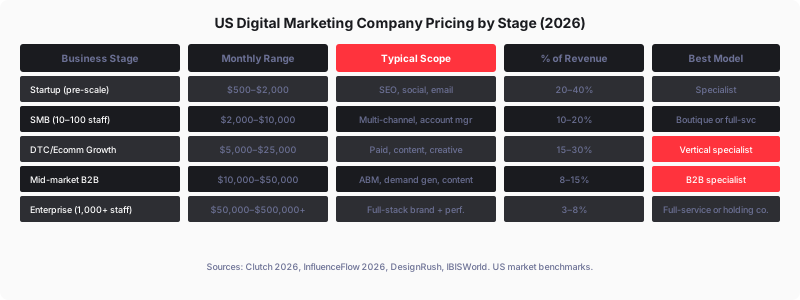
Two pricing trends are reshaping the 2026 market. AI tooling has reduced execution costs for content creation and reporting by 20 to 35% at agencies that have adopted it, creating downward pressure on execution-heavy retainers. Simultaneously, strategy, technical SEO, and conversion rate optimization pricing has held flat or increased, because those disciplines require human judgment that AI does not replace. Agencies that lead with execution are facing price compression; strategy-led firms are holding premium rates.
The practical implication: a $2,000 per month retainer with a US firm that uses AI tooling for execution can now deliver comparable output to a $3,000 retainer from two years ago. But a $2,000 retainer for strategic work (campaign architecture, channel mix decisions, creative brief development) is structurally insufficient regardless of AI adoption.
The seven criteria that consistently separate high-performing US digital marketing companies from ones that win pitches are specific and testable before signing a contract.
Require three case studies with named clients or independently verifiable outcomes. Generic logos with percentage improvements are not evidence. A firm that cannot produce real case studies in your category has not achieved the results it claims, or has not worked with brands comparable to yours.
Ask to meet the specific people who will work on your account before signing. The most common complaint in agency relationships is that senior sellers run the pitch and junior staff run the account. Confirming the actual execution team and their workload before onboarding prevents the most common failure mode.
Confirm that you will own all ad accounts, tracking pixels, and first-party data. Agencies that retain ownership of your accounts or resist giving direct platform access create dependency that is difficult and expensive to unwind. Any firm that resists this question is structurally misaligned with your interests.
Ask for the attribution methodology before the engagement starts. Firms that cannot articulate how they connect spend to revenue before onboarding will not be able to demonstrate it after. Attribution ambiguity protects the agency, not the client.
Require 30-day exit notice rather than 12-month lock-ins. Eight-figure US agencies retain 92% of clients annually versus 78% for seven-figure agencies, per Predictable Profits' agency benchmark report. Firms confident in their results do not need extended contracts to protect revenue.
Ask specifically about AI tooling and how it affects your account. AI-readiness now includes optimization for AI-driven search and LLM visibility, not just traditional SEO rankings. Firms that cannot explain their approach to emerging search formats are optimizing for a channel configuration that is actively changing.
Check client retention directly: ask for their average client relationship length over the last three years and whether you can speak to two current clients. The number below 18 months is a signal; the resistance to direct client contact is a disqualifier.
Best-in-class digital marketing firms across the US share the same structural characteristics regardless of size: senior execution on client accounts, clear attribution methodology, and performance-based contract terms that align incentives. The right marketing agency for your stage is the one with vertical pattern recognition in your business model and the operational capacity to act on what they find.
For growth-stage ecommerce and DTC brands evaluating US digital marketing partners, EmberTribe works on the demand generation programs that compound over time rather than producing isolated campaign results.

Most B2B SaaS companies outgrow generalist marketing help faster than they expect. The moment you're optimizing for pipeline quality, CAC payback, and expansion revenue simultaneously, a generalist agency that doesn't understand recurring revenue models becomes a liability. A specialized b2b saas marketing agency is built for that environment specifically.
This guide explains what these agencies do, how their work differs from standard B2B or DTC marketing, and how to evaluate one before committing budget.
SaaS has structural dynamics that generalist agencies consistently underestimate. The most significant: acquiring a customer is not the goal. Retaining and expanding that customer is what drives compounding ARR growth.
A generalist agency optimizing for lead volume can look productive while your funnel economics deteriorate. They may drive MQL counts up while CAC climbs and payback periods stretch. Benchmarkit's 2025 SaaS benchmarks show that the average B2B SaaS company now spends $2.00 in sales and marketing for every $1.00 of new ARR, and the average sales cycle has extended to 134 days. Neither of those realities is reflected in how most general-purpose agencies plan or measure work.
SaaS-specific agencies understand the buying committee problem. Enterprise SaaS deals typically involve six to ten stakeholders, each with different concerns, at different stages of awareness. Campaigns that reach only the economic buyer while ignoring the security team, the end users, and the IT evaluators leave enormous conversion opportunity on the table.
The best SaaS agencies are full-funnel rather than channel-narrow. Their service mix typically includes:
Demand gen for SaaS is not a synonym for lead generation. It encompasses the full motion of creating awareness, educating the market, and moving qualified buyers from dark funnel to pipeline. Agencies that lead with demand gen typically build integrated programs across content, SEO, paid search, and paid social rather than running those channels in isolation.
Good demand gen programs are tracked against revenue-connected metrics: cost per SQL, pipeline influenced, and CAC payback. See our breakdown of the metrics that actually matter for SaaS growth for what a rigorous measurement framework looks like at each funnel stage.
ABM flips the traditional funnel. Instead of casting wide and filtering down, you identify the accounts most likely to become high-LTV customers and build campaigns specifically for them. A SaaS-focused ABM program typically includes firmographic targeting on LinkedIn and programmatic display, personalized content for each target segment, and coordinated outreach sequences timed to buying signals.
Gartner's B2B buying research shows that B2B buyers spend only 17% of their total buying process talking to potential vendors. The rest is independent research. ABM closes the gap by placing your content and messaging inside that research window before a prospect ever raises their hand.
Organic search is the most scalable channel for SaaS companies with long sales cycles because content compounds over time while paid spend does not. A SaaS-specialized agency approaches content differently than a generalist: they map content to buying stages, prioritize topics based on commercial intent, and build topical authority rather than chasing isolated keyword rankings.
The content strategy also serves sales enablement. High-quality comparison pages, technical guides, and use-case documentation reduce friction in the sales cycle and shorten time-to-close. Internal linking between those assets reinforces both SEO and buyer education simultaneously.
SaaS paid programs require a different bidding logic than e-commerce. You're not optimizing for a single transaction; you're optimizing for pipeline quality. That means targeting by job title, company size, and intent signals rather than demographic lookalikes, and measuring success by SQL volume and pipeline contribution rather than click-through rate.
LinkedIn Ads is the dominant B2B paid social channel for SaaS because of its firmographic targeting precision. Agencies that specialize in SaaS typically run thought leadership ads, sponsored content, and retargeting sequences layered on top of each other, rather than running single-offer campaigns.
Most SaaS buying decisions don't happen on the first visit. Prospects enter the funnel, go dark, reengage months later, and convert after multiple touchpoints. Effective nurture sequences segment by ICP fit, engagement level, and buying stage, serving content that matches where each prospect actually is. Agencies with SaaS expertise build these systems in HubSpot, Marketo, or similar platforms, and they wire attribution tracking so every touchpoint is connected to revenue outcomes.
The differences show up in measurement first. A general B2B agency will typically report on impressions, clicks, and MQL volume. A SaaS-specialized agency ties everything to SQL creation, pipeline influenced, and CAC payback. If an agency can't articulate how their work connects to revenue, they're operating at the wrong level of accountability for a SaaS business.
The second difference is channel mix. Generalists tend to default to whatever channel they execute best. SaaS agencies build programs around where B2B SaaS buyers actually spend time: LinkedIn, targeted podcast sponsorships, review sites like G2 and Capterra, and high-intent search terms. They also tend to have stronger opinions about what not to do, particularly around vanity metrics and low-intent lead sources that inflate volume without improving pipeline.
Third is understanding of the SaaS sales motion. An agency that has never worked with a product-led growth model, a self-serve freemium funnel, or an enterprise direct-sales motion will be learning on your budget. Agencies that have worked across multiple SaaS growth stages bring frameworks you can skip straight to rather than rebuilding from first principles.
Ask for case studies from companies at a comparable ARR stage and growth motion. An agency that has worked primarily with early-stage PLG companies may not be the right fit for a $10M ARR company transitioning to enterprise direct sales. The specifics matter.
Request a sample report or attribution model before signing. If their standard reporting doesn't include pipeline contribution or CAC payback, they're not measuring what matters. Strong agencies connect every channel to revenue impact, even when attribution is imperfect.
Some agencies present a strategy and hand execution off to your team. Others own the full execution stack. Know what you're buying before you sign. If your internal team is thin, an agency that does strategy-only will leave you without the capacity to execute against the plan.
Our growth strategy consulting overview covers when to bring in external strategy versus execution help.
Most mid-market SaaS agencies charge $8,000 to $15,000 per month for a retainer covering strategy and multi-channel execution. Enterprise-level engagements run $25,000 to $50,000 per month. Flat-fee retainers are preferable to percentage-of-spend models because they align the agency's incentives with efficiency rather than media volume.
Avoid agencies that require six to twelve month minimum commitments without performance milestones built in. A confident agency will agree to quarterly checkpoints with defined metrics.
Long setup periods with no deliverables, reporting that defaults to impression and click metrics, inability to explain how they attribute pipeline, and case studies from industries entirely unlike SaaS are all warning signs. So is any agency that pitches a "proprietary methodology" without being able to explain the underlying mechanics.
A well-run SaaS agency engagement delivers measurable progress within one quarter. Not necessarily closed revenue, but leading indicators that are moving in the right direction: SQL volume increasing month over month, cost per SQL declining as targeting sharpens, organic traffic growing on high-intent terms, and a documented attribution model that shows where pipeline is being created.
By month three, you should have a clear picture of which channels are generating qualified pipeline and which are not. If the agency can't show you that, the engagement is running on faith rather than data.
The SaaS brand building dimension matters here too. Demand gen without brand investment creates a ceiling that compounds over time. Companies that build category awareness alongside direct response programs consistently outperform those running paid channels alone.
EmberTribe works with growth-stage B2B SaaS companies to build integrated demand gen programs that connect organic, paid, and content into a single revenue-accountable system. Every engagement starts with ICP alignment and attribution setup before any campaign goes live, because the measurement infrastructure is what separates programs that compound from ones that plateau.
If you're evaluating marketing partners for your SaaS company, the first conversation should be about your funnel economics, not your budget. Learn more about how EmberTribe structures SaaS growth engagements or explore the full range of EmberTribe services.

Picking the right sem marketing agency is one of the highest-leverage decisions a growth-stage brand can make. Get it right and paid search becomes a scalable, predictable acquisition channel. Get it wrong and you burn budget on clicks that never convert while the agency sends you a PDF with a rising impressions chart. This guide breaks down exactly what to look for, what to avoid, and how to structure the conversation before you sign anything.
Search engine marketing agencies manage paid search campaigns across platforms such as Google Ads and Microsoft Advertising. The core work includes keyword research, bid strategy, ad copy creation, landing page recommendations, audience targeting, and ongoing optimization. Most agencies also handle conversion tracking setup, which is the foundation everything else depends on.
The scope varies considerably by agency size and specialty. A boutique paid search agency might embed directly in your growth team and act as a strategic partner. A larger, full-service shop might assign you to an account manager who runs dozens of accounts simultaneously. What matters most is the ratio of strategic attention to the retainer you are paying.
In-house teams have one advantage over agencies: institutional knowledge. They understand your product margins, your seasonal patterns, and your customer segments. A strong SEM agency closes that gap through a rigorous onboarding process, clear documentation, and regular communication. If an agency skips discovery and launches campaigns in week one, that is your first warning sign.
The paid search market has grown considerably. According to AgencyHandy's 2026 SEM statistics report, the global SEM services market is projected to expand from roughly $120 billion in 2024 to over $278 billion by 2034, a compound annual growth rate of approximately 8.8%. AI-powered campaign automation, smarter audience segmentation, and intensifying competition for high-intent keywords are all driving that growth.
For brands competing in ecommerce and direct-to-consumer categories, that growth in the market means more advertisers bidding on the same keywords. Cost-per-click rates have increased in most verticals over the past two years. A competent SEM agency helps you maintain profitable returns by tightening targeting, improving quality scores, and building out the long-tail keyword structure that most brands neglect.
Pricing is where a lot of brands get confused or, worse, overcharged. There are four common models. Understanding each one before your first agency conversation puts you in a much stronger negotiating position.
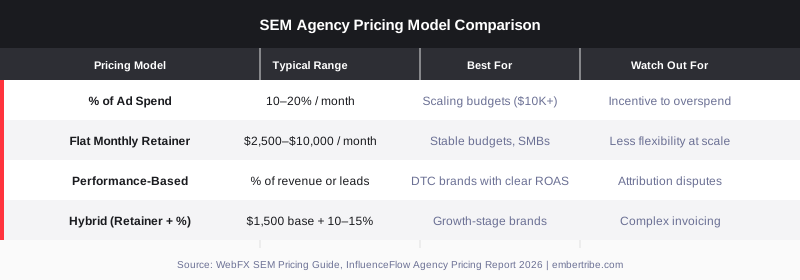
According to WebFX's SEM pricing guide, about 70% of businesses spend between $251 and $10,000 per month on SEM management, not including the actual ad spend. Most agencies charge either a flat retainer, a percentage of ad spend, or some combination of both.
Percentage of ad spend is the most common model for performance agencies. Rates typically fall between 10% and 20% monthly. At lower spend volumes (under $25K per month), you will often see a minimum fee apply because the account still requires the same hours regardless of how much you are spending. One structural downside of this model: an agency paid on percentage has a financial incentive to increase your budget even when the marginal return does not justify it.
Flat monthly retainers offer more predictability for brands with stable budgets. The InfluenceFlow 2026 agency pricing report puts the typical range for a small to mid-sized business SEM engagement at $2,500 to $10,000 per month. Mid-market companies managing $50,000 or more in monthly ad spend often pay $10,000 to $25,000 in management fees.
Performance-based pricing ties fees to results such as a target ROAS, cost per acquisition, or revenue generated. This model aligns incentives better, but attribution becomes a point of contention quickly. Clarify exactly how conversions are counted before agreeing to any performance clause.
Hybrid models combine a lower base retainer with a percentage component. This is increasingly common among growth-focused agencies because it reduces risk for both parties during ramp-up and scales fees alongside results.
Return on ad spend benchmarks vary widely by industry and by the maturity of your campaigns. A brand new to paid search will rarely hit efficient ROAS in month one. Healthy accounts take 60 to 90 days of learning before performance data is statistically meaningful.
According to First Page Sage's ROAS statistics report, ecommerce brands average approximately 2.05x ROAS on paid search. That number represents the mean across a broad range of verticals and campaign types. DTC brands with strong creative, tight audience targeting, and well-optimized landing pages routinely exceed that benchmark.
A more practical frame: calculate your break-even ROAS before you set any agency targets. If your gross margin is 50%, you need at least a 2x ROAS to break even on the ad spend alone, before accounting for management fees. Factor in the agency fee and you need to perform considerably higher just to stay profitable. Be explicit with any agency about your break-even ROAS, because an agency unwilling to anchor their strategy around your margin reality is not the right partner.
Evaluating a sem agency is not just about reviewing a pitch deck. The best agencies reveal themselves through the quality of their discovery questions, not their case study slides. Here is a practical framework for the evaluation process.
Ask every agency candidate the same set of questions and compare responses directly. The consistency of the process matters as much as any individual answer.
An agency that answers these questions with specificity and without hesitation has processes in place. An agency that pivots to case studies without addressing the mechanics of their process is giving you a sales pitch, not an operational preview.
According to Accelerated Digital Media's SEM agency red flags guide, the most consistent warning signs fall into three categories: communication, strategy, and reporting.
On communication: if you cannot get direct answers on calls and response times are consistently slow before you sign, expect that pattern to continue after you sign. On strategy: agencies that are always in "maintenance mode" without proactively testing new approaches are not earning their retainer. On reporting: if your monthly report is a static PDF showing impressions and click-through rate without connecting to revenue or conversions, your agency is optimizing for optics, not outcomes.
Other concrete red flags to watch for:
Owning your ad account is non-negotiable. If an agency insists on running campaigns through their own account rather than granting access to yours, walk away. You would be renting access to your own campaign history.
For most growth-stage brands spending under $500,000 per year in ad budget, a specialized digital marketing agency will outperform an in-house hire on a cost-adjusted basis. A senior paid search manager carries a total cost of $90,000 to $130,000 per year in salary plus benefits, and they still need tools, training, and management overhead.
An agency at a comparable cost brings a full team: strategist, account manager, conversion rate specialist, and creative support. The leverage is real, particularly in the early stages when your account needs more active optimization than a single in-house hire can provide.
The calculus shifts at scale. Brands spending $2 million or more annually in paid search often benefit from bringing core channel ownership in-house while using an agency for specific functions such as creative testing or international expansion.
Whatever pricing model you choose, get these terms in writing before you start:
Getting these terms defined before the relationship starts protects you from the most common agency disputes. Related reading: our full breakdown of what to look for in PPC companies covers the contract terms that matter most for paid channels.
Start by defining what "right" means for your specific situation. A brand spending $15,000 per month on Google Ads needs a different type of partner than one scaling toward $200,000 per month. Consider:
Once you have that picture, evaluate three to five agencies using the framework above. Ask for references from clients in similar verticals, not just from whoever they feature in the case study section of their website.
EmberTribe works specifically with DTC and ecommerce brands that are ready to scale paid search beyond the basics. Our approach is built around margin-aware ROAS targets, rigorous testing cadences, and transparent reporting that connects directly to revenue. If you are evaluating SEM partners for 2026, we would like to talk. Visit embertribe.com to learn more about how we work and what we focus on.

Hiring a marketing agency is one of the highest-stakes vendor decisions a growth-stage company makes. Get it right and you compress months of channel development into weeks. Get it wrong and you spend a quarter paying for deliverables that don't move the needle, then burn more time unwinding the relationship.
The challenge is that "marketing agency" describes an enormous range of organizations — from a two-person boutique specializing in email sequences to a 400-person integrated firm managing nine-figure ad budgets. Picking between them without a clear framework leads to mismatched expectations on both sides.
This guide gives you that framework: what types of marketing agencies exist, when it makes more sense to hire in-house, and what separates agencies worth working with from the rest.
Understanding agency types is the first step to knowing which one fits your situation.
Full-service agencies cover strategy, creative, paid media, SEO, content, and analytics under one roof. The appeal is coordination — you get one account team managing an integrated program rather than juggling multiple vendors.
The tradeoff is depth. Full-service agencies spread their expertise across many disciplines, which means they're rarely the sharpest practitioners in any single channel. They work best for companies with diverse channel needs and large enough budgets to warrant the overhead.
Performance agencies specialize in paid acquisition — Google Ads, Meta, programmatic display, and increasingly connected TV. They're built around ROAS, CAC, and MER optimization and tend to operate with tighter feedback loops and more rigorous testing than generalist shops.
For ecommerce brands and DTC companies where paid media drives the majority of revenue, a performance specialist often outperforms a full-service agency on the channels that matter most. Google's own Smart Bidding documentation underscores how much campaign-level strategic oversight matters — automation amplifies good structure, but it doesn't replace it.
These agencies focus on organic growth — keyword strategy, content production, technical SEO, and link building. The economics are compelling over a 12-to-24-month horizon (traffic compounds without ongoing ad spend), but the timeline to meaningful results is longer than most early-stage companies can tolerate.
SEO agencies work best for companies with at least 6–12 months of runway and a content-driven customer acquisition model.
Social agencies specialize in organic social content, community management, paid social (sometimes), and influencer partnerships. The best ones understand both the creative and the distribution sides of social — the worst ones produce content without any performance accountability.
Be cautious of agencies that separate "organic social" and "paid social" into entirely different offerings — the two should inform each other.
Growth agencies operate across the full funnel — acquisition, conversion, retention — and are defined less by channel and more by a testing-and-iteration methodology. They're typically a better fit for companies that need strategic direction alongside execution, rather than pure channel specialists.
The distinction from a full-service agency: growth agencies are generally smaller, more senior, and more accountable to business outcomes rather than deliverable volume.
This is the question companies get wrong most often, and the answer depends almost entirely on your growth stage.
Before you've validated your core message and conversion funnel, an agency is almost always the wrong move. Agencies require clear direction to be effective — if you don't yet know who your customer is, what drives their decision, and what messaging resonates, you'll spend months paying for campaigns that teach you very little.
At this stage, hire a versatile in-house marketer (or a fractional CMO) who can run experiments quickly and is close enough to the product to iterate the message in real time.
This is the sweet spot for agency engagement. You know your customer, your conversion funnel is working at a basic level, and the question is how to scale acquisition efficiently across channels. An agency can compress the learning curve significantly — they've seen what works across dozens of similar businesses and can apply that pattern recognition to your situation.
At this stage, look for agencies with demonstrable experience in your category and a clear testing-and-optimization methodology. The best ones will tell you within the first 60 days what's working, what isn't, and why. The DTC landscape in particular is demanding: customer acquisition costs have risen 222% over the past eight years, which means a poorly structured agency relationship compounds the damage quickly.
At scale, the value of an agency shifts from execution to decision-quality. You likely have in-house capability on your core channels. What you need is a partner who can improve measurement infrastructure, accountability frameworks, and coordination across a more complex channel mix.
At this stage, a specialist agency that improves one channel meaningfully often generates more ROI than a full-service relationship that spreads across everything.
Regardless of type, strong agencies share a common set of operational characteristics.
Clear accountability to revenue metrics: The agency's reporting should speak the language of your P&L — CAC, LTV, ROAS, pipeline contribution — not just traffic and impressions. If their default reporting is engagement-focused, their incentives are misaligned with your growth. For ecommerce brands, that means tying reporting to actual purchase conversion rates, which vary widely by category and traffic source — not blended traffic metrics that hide where problems actually live.
Documented process, not just talent: Great agencies have repeatable systems — for onboarding, creative testing, campaign management, and performance review. Agencies that depend entirely on individual talent are fragile; the process matters more than any single person.
Relevant experience in your category: Case studies from companies with similar business models, price points, and customer demographics are worth more than impressive names in a deck. Ask for references from clients with a profile similar to yours and follow up.
Transparency over access and data: You should own your ad accounts, analytics properties, and content. Agencies that maintain ownership of campaign infrastructure are creating leverage over you — that's a red flag regardless of their performance.
Honest timelines: Legitimate agencies set realistic expectations. SEO takes 6–12 months. Paid media requires 60–90 days of optimization before you can evaluate performance fairly — Google's Smart Bidding, for instance, needs at least 30 conversions to evaluate performance accurately. Any agency promising significant results in two to four weeks is either misleading you or inheriting a well-built account and claiming credit for existing momentum.
The answers reveal how the agency actually operates. Specificity is a good sign; vagueness is not.
A common mistake is treating in-house and agency as binary choices. Most growth-stage companies run a hybrid: one or two senior in-house marketers who own strategy, channel mix, and reporting — paired with a specialist agency that executes on one or two high-leverage channels. Sagefrog's 2026 B2B Marketing Mix Report confirms this shift — 46% of B2B companies now use a hybrid model, up from 36% the year before, with "faster execution" overtaking "specialized expertise" as the top reason companies bring agencies in.
This structure keeps strategy under your control while getting the benefit of agency expertise and capacity on the execution side. It also gives you a cleaner offboarding path if the agency relationship doesn't work out — because your strategy stays in-house regardless.
At EmberTribe, we've found this hybrid model produces the best outcomes for DTC and ecommerce brands: an internal owner who understands the business deeply, paired with an external team that brings channel-specific depth and creative velocity.
The agencies that consistently deliver are the ones that:
That last point is the most important. A marketing agency should make your marketing program more capable over time, not more dependent on the agency's continued involvement.
The "right" marketing agency isn't necessarily the largest or most well-known. It's the one that has solved the specific problem you're facing, speaks the language of your business stage, and operates with the transparency and accountability you need to make confident decisions.
Take the time to verify claims with real references, review actual reporting (not a sample dashboard), and understand exactly who will be doing the work before you sign.
For more on evaluating specific agency types, see our guides to the best SaaS marketing agencies and the best ecommerce marketing agencies, along with our breakdown of when a fractional CMO makes sense for B2B SaaS companies.

If you're evaluating marketing partners, you've probably encountered the phrase "boutique marketing agency" more than once. But what does it actually mean — and more importantly, does it mean better results for your business?
For growth-stage brands and DTC companies, the answer is often yes. A boutique marketing agency typically offers something the major holding-company shops struggle to replicate: senior attention, genuine specialization, and the ability to move fast. In 2026, with marketing channels becoming more fragmented and performance accountability tighter than ever, these qualities matter.
This guide breaks down exactly what a boutique agency is, how it stacks up against larger firms, and how to evaluate one before you commit.
A boutique marketing agency is a smaller, independently operated firm that focuses on a defined set of services or industry verticals rather than trying to cover everything. Team sizes typically range from 5 to 30 people, though some go slightly larger while maintaining the same operating model.
What distinguishes a boutique isn't just headcount — it's the working model. At a boutique, the strategists who pitch your business are usually the same people executing your campaigns. There's no bait-and-switch where senior leaders close the deal and then hand you off to a junior team.
Boutique agencies are also sometimes called small marketing agencies, independent marketing agencies, or niche marketing agencies. These terms are largely interchangeable, though "niche" often implies a tighter vertical focus — for example, an agency that works exclusively with B2B SaaS companies or ecommerce brands in a specific category.
A boutique digital marketing agency specifically signals that the firm's core capabilities live in digital channels: paid media, SEO, content, email, social — rather than traditional advertising or PR.
The marketing agency landscape in 2026 sits at two ends of a wide spectrum, and the differences aren't just about team size.
Senior access
At large agencies, senior strategists are typically involved at the proposal stage and then step back. Day-to-day work is handled by account managers and junior staff. At a boutique, senior practitioners are often the people doing the work — reviewing ad creative, writing strategy briefs, reading the data. This distinction has a direct effect on output quality.
Speed and adaptability
Large agencies operate with layered approval chains. When a platform algorithm changes or a campaign isn't performing, getting approval to pivot can take days. Boutiques are built to move faster. Decisions happen in a conversation, not a committee.
Specialization depth
A boutique agency chooses what it's good at and builds around that. If you're a DTC brand evaluating a small agency that runs paid social and email exclusively, you're working with a team that has seen hundreds of campaigns in your category. Contrast that with a generalist agency where your paid social work is handled by someone also managing TV buys and out-of-home campaigns.
Transparency and pricing
Large agency retainers are frequently built around overhead — multiple account managers, project coordinators, enterprise tooling — that small clients don't necessarily benefit from. Boutique agencies typically have leaner cost structures and are more willing to show you what you're paying for. Monthly retainers for boutique digital marketing agencies commonly range from $2,500 to $10,000 for growth-stage brands, depending on scope and media budget.
Capacity constraints
The tradeoff is real: boutique agencies have limited bandwidth. A team of eight cannot execute an integrated global campaign across 20 markets simultaneously. If your needs require massive scale, parallel execution across many channels, or international coordination, a larger firm may be the right operational fit.
Most growth-stage and mid-market brands — particularly DTC brands scaling past their initial traction phase — are better served by a boutique agency than a large one. Here's when that's especially true:
You're past product-market fit but haven't yet built out an internal marketing function. You need expertise you don't have in-house, without paying large-agency overhead. Understanding how to choose between an agency, freelancer, or in-house marketer is a useful starting point before you evaluate agency size.
You're growing fast and need a team that can move with you. If your business is changing month over month — new SKUs, new channels, seasonal spikes — you need a partner that can adapt without a lengthy change-order process.
You want strategic thinking without a 12-month lag. Boutique agencies work in shorter feedback loops. You're not waiting for a quarterly business review to find out your campaigns need a change in direction.
You need someone who actually knows your industry. A niche marketing agency with deep experience in your category will spot opportunities and avoid pitfalls that a generalist firm might miss entirely. This is closely related to what separates good growth marketing channels execution from mediocre: channel expertise compounds over time.
Not all boutique agencies are equal. The following criteria separate the firms worth working with from the ones that are simply small.
Documented process
A credible boutique agency should be able to show you how they work — how they onboard clients, how they build strategy, how they report on performance. Vague answers about "custom approaches" without underlying frameworks are a red flag.
Relevant case studies
Ask for results from brands similar to yours in size, stage, and category. Revenue-stage context matters. A case study from a $500M brand isn't highly predictive of what they'll do for a company doing $5M in annual revenue.
Who actually works on your account
Get this in writing before you sign. Ask specifically which individuals will be assigned to your account, what their backgrounds are, and whether those people could change during your engagement.
Channel depth over breadth
Evaluate whether their depth in the specific channels you care about is real. A boutique agency claiming expertise in every major channel is often a boutique agency that's spread too thin. Focused expertise wins.
Reporting and visibility
You should have clear visibility into performance, spend, and decisions. Ask what your regular reporting cadence looks like, what data you'll have direct access to, and how quickly they respond when something isn't working.
Before committing to a boutique marketing agency, walk through these questions in your evaluation conversations:
That last question is telling. A strong agency will have a clear answer because they've thought seriously about fit. An agency that never fires clients is often one that doesn't have high standards for the work.
EmberTribe is a boutique digital marketing agency built specifically for DTC brands and growth-stage companies. We're small enough that senior strategists work directly on your account, and specialized enough that we've built repeatable frameworks across paid media, ecommerce growth, and performance creative.
We don't work with every company that comes to us. We work with brands where we can drive a measurable outcome, and we're transparent about when we're the right fit and when we're not.
For brands evaluating whether a fractional leadership model makes more sense than a retained agency, our guide on fractional CMO services for B2B SaaS covers when that model outperforms a traditional agency structure. And if you're specifically evaluating marketing agencies for SaaS growth, our breakdown of what to look for in a SaaS marketing agency covers the selection criteria in detail.
The right boutique agency won't promise you everything. They'll tell you what they're great at, show you the evidence, and give you a realistic picture of what results look like and how long they take. If that's the kind of partner you're looking for, we'd like to talk.

If you've typed "digital marketing agency near me" into Google, you're probably at a decision point. Maybe in-house marketing has stalled, a freelancer disappeared mid-project, or your current agency stopped returning emails. Whatever the reason, you need a partner who can actually move the numbers, and you want to know someone reliable is on the other end of the call.
Here's the uncomfortable truth about that search phrase: proximity is the least reliable predictor of whether an agency will get you results. The difference between a good digital marketing agency near me and a bad one has almost nothing to do with the zip code and almost everything to do with process, transparency, and how they approach your unit economics.
This guide walks through what actually matters when evaluating a digital marketing partner, what "local" really buys you in 2026, realistic pricing, and the red flags that should send you running.
A decade ago, searching for a local agency made practical sense. You wanted someone you could meet in person, who understood your regional market, and who could walk into your office when a campaign went sideways. Those instincts weren't wrong.
What changed is the work itself. Paid media is platform-native and remote by definition. SEO work lives inside tools like Ahrefs and Semrush. Creative review happens in Figma and Frame.io. Reporting runs through dashboards you can open anywhere. The physical location of the people doing the work stopped mattering around the same time the dominant collaboration tools became cloud-based.
There are still legitimate reasons to want a local agency. If your business depends on hyper-local SEO, traditional media buying for a regional market, or field production with in-person shoots, proximity has real value. For almost everything else, you're optimizing for the wrong variable when you filter by geography first.
The better framing isn't "near me or remote." It's "which agency model fits the work I actually need done?"
The evaluation criteria that predict a good agency relationship are largely the same whether the agency is down the street or across the country. Here's what to dig into during the sales conversation.
Ask what percentage of the agency's clients look like you, in size, business model, and channel mix. A DTC skincare brand doing $3M on Shopify has radically different needs than a B2B SaaS company running LinkedIn ads, and an agency that serves both equally well is rare. Specialization matters more than breadth. If you're a growth-stage ecommerce brand, this guide to choosing the right ecommerce marketing agency goes deeper on what to look for in that specific fit.
Agencies sell deals through charismatic founders and close deals through account managers you never met during the pitch. Ask who will actually run your account day-to-day. Ask what the weekly cadence looks like. Ask how they document strategy decisions and how you'll see what's being tested and why. Process documentation is the single best predictor of whether the relationship will feel organized or chaotic six months in.
A good partner tells you which metrics matter, why, and how they'll be reported. They distinguish platform-reported ROAS from blended acquisition cost, and they're comfortable showing you data that makes them look bad when something isn't working. Vague reporting that focuses on "engagement" without tying it to revenue is one of the clearest warning signs in the business.
Read the contract carefully. Who owns the ad accounts, pixels, analytics properties, and creative files? The answer should always be "you." If an agency wants to own your domain, ad accounts, or data infrastructure, walk away. A trustworthy agency makes the offboarding path easy because they don't plan to use it as leverage.
Pricing varies more than most buyers realize, and "you get what you pay for" is only partially true. Some of the most expensive agencies deliver mediocre work, and some mid-market retainers buy genuine senior expertise. The honest ranges look roughly like this: Business StageTypical RetainerWhat It BuysSmall / local$1,000 to $5,000/moSingle-channel focus, often junior account managementGrowth-stage$5,000 to $15,000/moMulti-channel strategy, senior oversight, regular reportingMid-market DTC$10,000 to $25,000/moFull paid media plus CRO, creative, retentionEnterprise$25,000 to $75,000+/moDedicated team, custom analytics, executive access
Retainers have become the dominant model. Industry data shows the majority of digital agencies now price on retainer because clients want predictable costs and agencies need stable revenue for capacity planning.
Be skeptical of pricing at the extremes. Sub-$1,000 "agencies" are usually reselling white-label services from overseas teams, with the middleman adding no real strategic value. On the high end, a $40,000 retainer is only worth it if the team attached to it has the senior experience to justify it. Ask who specifically will work on your account, what their track record looks like, and how many other accounts they handle simultaneously.
The bad agency experiences that business owners describe at conferences and on Reddit share a surprisingly consistent pattern. Watch for these signals before you sign anything:
These aren't edge cases. They're the dominant failure modes, and they show up in agencies of every size and geographic location.
Remote-first agencies fit most use cases, but there are specific scenarios where local beats remote clearly. If your growth plan leans heavily on hyper-local search (multi-location restaurants, medical practices, home services), an agency that understands your specific market dynamics and Google Business Profile nuances can move faster than a generalist. If your marketing requires significant in-person production, product photography, video shoots, or event marketing, local logistics save real time and money.
For everyone else, the better question is whether you need a generalist or a specialist, and whether your stage fits the agency's sweet spot. If you're weighing whether to hire an agency at all, our breakdown of agencies vs freelancers vs in-house marketers covers the tradeoffs in more depth, and the SaaS-specific agency guide is useful if you're on the B2B side of that decision.
After dozens of discovery calls with prospects, the questions that separate serious agencies from smooth talkers are usually the simple ones. Bring these to any evaluation:
Agencies that answer these crisply are worth a second conversation. Ones that dodge, deflect, or reframe are telling you something important.
The search "digital marketing agency near me" is a reasonable starting point, but geography should be a tiebreaker, not a filter. Evaluate specialization, process, transparency, and contract terms first. Then, if a local agency clears those bars, proximity is a genuine bonus. If it doesn't, don't sign for the wrong reasons.
The goal isn't to find an agency. It's to find a partner whose process, expertise, and incentives align with your business trajectory. The best signal that you've found one is the discovery call itself. They ask sharper questions than you expected, they push back on assumptions politely but firmly, and you leave the conversation thinking about your business differently than you did going in.
At EmberTribe, we've worked with hundreds of growth-stage brands across paid media, SEO, and lifecycle marketing, and the pattern holds: the best relationships start with clear expectations and honest unit economics conversations, not with a zip code match. If you're evaluating agencies right now, focus on the fit questions above. The right partner is usually one or two phone calls away, wherever they happen to be sitting.

Choosing a B2B marketing firm in 2026 is harder than it should be. Every agency deck looks the same, every case study promises 3x pipeline, and the gap between one that moves your numbers and one that quietly bills you for a year is almost impossible to spot from the outside.
The stakes are real. Recent B2B content marketing research shows 91% of B2B marketers use content marketing as a core channel, and budgets are tilting toward SEO, AI tooling, and owned media rather than pure paid spend. Pick the wrong partner at this point in the cycle and you're not just wasting retainer dollars, you're ceding ground to competitors whose firms actually know what they're doing.
This guide walks through what a B2B marketing firm actually does today, how the main firm types compare, realistic pricing, and the evaluation checks that separate firms worth hiring from firms worth avoiding.
A modern B2B marketing firm is less about ads and more about building the machinery that feeds pipeline. Research on the modern B2B buying journey shows most of the purchase decision now happens before a buyer ever talks to sales, which means the firm's real product is visibility and trust across the channels where buyers research on their own.
In practice, that work usually covers five areas:
Not every firm does all five well. The mistake buyers make is assuming a firm that nails paid media will also nail content and SEO, or that a great content firm can run an ABM program. The skill sets are different, and firms that claim everything usually specialize in nothing.
The right firm for you depends on your stage, your growth motion, and whether you need depth in one area or coverage across many. Here's how the main options compare. Firm TypeBest ForStrengthWatch Out ForSpecialist agencyCompanies with one clear channel gapDeep expertise in a single disciplineBlind spots outside their laneFull-service agencyMid-market companies needing coverageCoordinated strategy across channelsUneven quality by disciplineFreelancer or consultantEarly-stage or tactical needsSenior talent, low overheadNo bench, single point of failureIn-house teamStable, well-funded companiesDeep product knowledgeSlow to hire, expensive to scale
Specialists focus on one thing. A B2B SEO firm, a content firm, an ABM firm, a paid media firm. Their entire business depends on being genuinely good at that discipline, which usually means they are. If you already know your bottleneck, a specialist is usually the fastest path to fixing it.
The trade-off is coordination. You'll need either an in-house owner or a fractional CMO to keep multiple specialists pointed at the same goal. If nobody holds that seam, you end up with a content team, an SEO team, and a paid team running three separate strategies that never add up to a pipeline number.
A full-service professional services marketing agency bundles strategy, content, SEO, paid, and reporting under one roof. The pitch is coordination, a single account manager, and fewer vendors to manage.
That's the pitch. The reality is that most full-service firms are strong in two disciplines and mediocre in the others. Before signing, ask which two they're known for and who on the team would actually be running the weaker ones. If the answer is vague, you're about to pay retainer rates for someone's on-the-job training.
A senior freelancer with 15 years of operating experience can outperform a mid-tier agency on a narrow brief. You get direct access to the person doing the work, no account management layer, and usually faster turnarounds on strategy and execution.
What you give up is scale and redundancy. A freelancer can't run paid, content, SEO, and RevOps simultaneously, and if they get sick or take on a new client, your program pauses. For tactical projects and fractional roles, freelancers are often the right answer. For a full growth engine, they rarely are.
In-house teams have two advantages no agency can match: full product immersion and long-term memory. A senior in-house marketer knows the product, the sales team, the customers, and the internal politics in a way no outside firm ever will.
The downside is cost and speed. Building a senior in-house team takes 6-12 months before it's operational, and you commit to salaries and tooling that don't flex down when priorities shift. We break down the full trade-off in our guide on choosing between an agency, freelancer, or in-house marketer.
Pricing varies wildly, and "you get what you pay for" is only partly true. Some of the most expensive firms produce generic output, and some mid-market firms deliver genuine senior talent at half the cost. The honest ranges for a B2B marketing firm in 2026 look roughly like this: Engagement TypeTypical Monthly RangeWhat You Should ExpectTactical specialist$3,000 to $8,000Single-channel execution with senior oversightMid-market full-service$8,000 to $20,000Multi-channel strategy plus execution across 3-4 disciplinesEnterprise full-service$20,000 to $75,000+Dedicated pod, custom reporting, executive accessProject-based$10,000 to $75,000One-time strategy work, rebrand, or buildSenior freelancer$150 to $400/hourDirect access, no account management layer
Retainers dominate the market because predictability benefits both sides. Most reputable firms require a 3-6 month minimum commitment so the work has enough runway to show results. Be suspicious of firms pushing 12-month contracts before you've seen any output, and equally suspicious of firms under $2,500 a month, which usually means white-label reselling from overseas with a middleman taking the margin.
Current marketing budget statistics show B2B spend is rising across the board, but the winners aren't the companies spending more. They're the companies spending the same with firms that understand their specific motion.
The evaluation work is where most buyers drop the ball. The sales process is designed to make every firm look competent. Here's what to check before you sign.
Ask what percentage of the firm's clients look like you in size, revenue model, and growth stage. A firm that mostly serves $500M enterprises will bring the wrong instincts to a Series A startup, and a firm that mostly serves seed-stage startups will be out of its depth at a mid-market SaaS company. B2B marketing benchmark data points to vertical expertise as one of the strongest predictors of pipeline results, which tracks with what we see in practice.
Ask for two or three case studies from companies that closely match yours, not just logos on a wall. Specific numbers, specific time frames, specific starting conditions. If a firm can't produce that, assume they haven't done it.
Agencies sell deals through charismatic founders and deliver them through account managers you never met during the pitch. Ask directly who will run your account day-to-day, what their experience looks like, and how many other accounts they handle simultaneously. Ask to meet them before signing.
Then ask about the first 30, 60, and 90 days. A good firm can describe exactly what happens in each phase: audit, strategy, activation. A firm that waves their hands and says "we'll figure it out together" hasn't done this enough times to systematize it. That's fine for a freelancer, but not for a retainer.
A strong firm tells you which metrics matter, why, and how the reporting cadence works. They distinguish between marketing-sourced pipeline and marketing-influenced pipeline. They're comfortable showing you numbers that make them look bad when something isn't working.
Vague reporting focused on "engagement" and "brand lift" without a clear line back to pipeline or revenue is one of the clearest warning signs in the business. If you can't tie the firm's work to a business outcome after 90 days, either the firm can't measure it or doesn't want you to.
The firms worth hiring in 2026 have already moved on AI in two ways: they use it internally to move faster, and they optimize content for answer engines like ChatGPT and Perplexity, not just Google. Ask how the firm thinks about AEO and whether they've started tracking brand visibility in LLM responses. Firms that haven't thought about this are already behind the curve.
The bad agency stories you hear at conferences share a consistent pattern. If you spot any of these during evaluation, move on.
These aren't edge cases. They're the dominant failure modes, and they show up regardless of firm size or price point.
After hundreds of discovery calls with B2B buyers, the questions that separate serious firms from smooth talkers are usually the boring ones. Bring these to every evaluation.
Firms that answer these crisply are worth a second conversation. Firms that dodge, deflect, or reframe are telling you something important.
The B2B marketing firm you pick in 2026 should feel like a senior hire, not a vendor. You're bringing someone in to own a growth engine that needs to work in 12 months, not 12 weeks. Treat the evaluation like a hiring decision: references, stage-specific case studies, meetings with the people who will do the actual work, and a clear read on how the firm thinks about measurement.
Before shortlisting firms, answer two questions. What's your real bottleneck, and what stage are you at? A content and SEO problem calls for a different firm than a paid acquisition problem, and a $3M ARR company needs different things than a $30M one. Our breakdown of B2B lead generation in 2026 is a good next step if you're still framing the work.
At EmberTribe, we've spent years helping B2B companies build demand gen and SEO programs that compound over time rather than burn out at month four. The pattern is consistent across the best engagements: clear expectations, honest conversations about what the firm can and cannot move, and a shared definition of what success looks like at 90 days. Do the evaluation work upfront and you'll recognize the right partner when you're in the room.
Most brands searching for an ecommerce marketing agency find the same thing: listicles written by agencies ranking themselves first. The advice is self-serving, the criteria are vague, and the "frameworks" rarely reflect how agency relationships actually work.
This guide is different. It's written by a DTC-focused agency that has worked across hundreds of ecommerce accounts — and it's designed to help you evaluate any agency, including us, with clear eyes. The goal is a good fit, not a signed contract.
The US direct-to-consumer ecommerce market hit approximately $240 billion in 2025, and competition for customer attention has never been more expensive. Roughly 79% of DTC brands now partner with external agencies for at least one marketing function — and the majority report higher customer acquisition costs than three years ago.
That CAC pressure is reshaping what brands actually need from agency partners. The ROAS-obsessed era is fading. Sophisticated operators have shifted their primary metrics to Marketing Efficiency Ratio (MER) and LTV:CAC ratio — measures that capture whole-funnel performance rather than last-click attribution. Agencies still selling on ROAS alone are behind where the market has moved.
At the same time, most ecommerce brands now prioritize first-party data collection as third-party cookie deprecation reshapes targeting options. An agency that doesn't have a concrete answer to your first-party data strategy in 2026 is not operating at the level your business needs.
Understanding this backdrop matters before you evaluate a single agency. The best partner isn't the one with the biggest client list — it's the one that understands the specific conditions your business is competing in right now.
The category is broad enough to be confusing. "Ecommerce marketing agency" can mean a performance media buyer, a full-service growth partner, a creative studio, or an SEO shop — sometimes all four under one roof.
Core services typically include:
Some agencies specialize deeply in one channel. Others take a unified approach across the full funnel. Neither model is inherently better — what matters is whether the agency's scope of work matches where your actual revenue gaps are. A brand with strong organic traffic but poor retention doesn't need another paid media agency. A brand burning budget on underperforming creative doesn't need more media spend.
Before evaluating agencies, get specific about which levers actually move your business.
Not all ecommerce agencies are built the same, and the differences matter when you're making a hiring decision.
These agencies manage multiple channels together and build strategy at the business level, not the channel level. They're built for brands that want a single accountable partner coordinating paid media, SEO, CRO, and creative. The tradeoff is cost — retainers typically run $5,000-$15,000+/month — and the risk that no single channel gets the depth of attention a specialist would bring.
For growth-stage brands above $2M in annual revenue, this model often produces the best results because the channels reinforce each other. A business growth agency operating at this level is making decisions about your whole funnel, not just optimizing a single ad account.
Paid social, paid search, SEO, or email — these agencies go deep on one discipline. They're the right choice when you have specific, isolated problems and existing in-house capacity to manage the broader strategy. They tend to run $2,500-$6,000/month per channel.
The risk: channel specialists can optimize their channel at the expense of your overall economics. An agency that only owns paid social may push spend aggressively without accounting for what's happening downstream in retention or average order value.
Smaller teams — sometimes 5-15 people — that work exclusively with ecommerce or direct-to-consumer brands. They often punch above their weight on strategic thinking because the senior team is directly involved. The constraint is bandwidth; if your account grows significantly, a boutique agency may not scale with you.
These are not agencies in the traditional sense, but they're worth understanding as a comparison point. If you're early-stage or have very narrow needs, an agency vs. freelancer vs. in-house comparison can clarify whether you even need a retained agency relationship at this stage.
The criteria that appear in most agency comparison articles — "proven track record," "transparent reporting," "dedicated account manager" — are table stakes, not differentiators. Every agency claims them. Here's what to actually evaluate.
Ask any agency you're considering: "What's your primary success metric?" If they lead with ROAS, dig deeper. The best agencies in 2026 are measuring MER and blended CAC payback period, because those metrics account for the full cost of acquisition across channels and time.
Case studies from brands in a different category, at a different price point, or at a different growth stage don't tell you much. A $50M fashion brand's media strategy doesn't translate to a $3M supplement brand. Ask for references from businesses similar in size and vertical to yours — and call those references.
Performance without creative strategy is increasingly unsustainable. Platforms like Meta reward novelty and relevance at the creative level. The best ecommerce agencies either have in-house creative capabilities or a structured process for briefing and evaluating creative. An agency that treats creative as someone else's problem will hit a ceiling on your account. See how this applies to finding the right Facebook ads agency for ecommerce.
With third-party signals degrading, the brands that win in paid media are the ones with the best data infrastructure — post-purchase surveys, clean email lists, server-side tracking, and strong CRM practices. Ask how the agency has helped clients build first-party data assets. If the answer is vague, that's a signal.
A weekly dashboard full of impressions, reach, and engagement metrics isn't useful if it doesn't connect to revenue. The best agencies present reporting that answers the question: "What do we do next and why?" Ask to see a sample report before you sign.
The goal of a discovery call isn't to be sold — it's to qualify the agency as rigorously as they're qualifying you.
The quality of the answers matters less than whether they're honest. A good agency will acknowledge uncertainty, point to real constraints, and give you a grounded picture of what to expect. An agency that only has confident, polished answers to hard questions is a red flag.
Some warning signs are obvious — no references, no case studies, vague deliverables. Others are easier to miss:
Long-term contracts with limited exit clauses. Reputable agencies are confident enough in their work to offer 30-90 day out clauses. A 12-month lock-in with steep exit penalties is not a partnership structure.
Overclaiming on attribution. If an agency presents ROAS numbers without acknowledging incrementality questions or platform-reported vs. revenue-reported discrepancies, they're not being rigorous.
Reactive communication as the default. You shouldn't have to chase your agency for updates. Proactive communication — especially when something isn't working — is a baseline expectation.
No honest onboarding timeline. Real results from a new agency relationship typically take 60-90 days to materialize as campaigns are built, tested, and iterated. An agency promising strong returns in week two is setting you up for disappointment.
Pricing structures vary, but here's a realistic picture of the current market: Agency TypeTypical Monthly RetainerChannel specialist (single channel)$2,500 - $5,000Mid-size full-service agency$5,000 - $10,000Senior full-service or boutique DTC$8,000 - $15,000+Performance-based (% of ad spend)10-20% of managed spend
Most agencies combine a base retainer with a performance component at higher spend levels. The cheapest option is rarely the best value — an agency charging $1,500/month to manage your paid media is either running very junior talent on your account or managing too many clients to give your business real attention.
Budget for the tier that matches the revenue at stake. If paid media represents $1M or more in annual revenue influence, the difference between a $3,000/month and $7,000/month agency is not the primary variable in your economics.
Choosing an ecommerce marketing agency is a business decision, not a marketing decision. The right agency is the one whose expertise matches your actual gaps, whose communication style matches how your team operates, and whose incentive structure is aligned with your long-term economics — not short-term spend volume.
The services that matter most depend entirely on where your funnel is breaking down. If paid acquisition is efficient but retention is poor, more media spend won't fix it. If conversion rate is low, investing in CRO or SEO may outperform any new channel investment. If you need to scale paid media profitably, that requires a partner who understands the full picture.
The best agencies will tell you this. The ones to avoid will tell you they can fix everything.
Take your time, ask hard questions, and evaluate the answer quality over the polish. The right partner will hold up to scrutiny — and will appreciate the rigor.

Email marketing remains one of the most profitable marketing channels available to brands today. With average returns exceeding $36 for every dollar spent, getting your email strategy right is not optional; it is essential. One of the most persistent questions marketers face is straightforward: how long should a newsletter actually be?
The answer is not a single number. The ideal newsletter length depends on your audience, your goals, and the type of content you are delivering. But there are clear, data-backed guidelines that can help you find the right length for your specific situation.
The length of your newsletter directly impacts three critical metrics: open rate, click-through rate, and unsubscribe rate. Get the length wrong in either direction and you will see measurable drops in performance.
Too long: Subscribers see a wall of text, skim past the important parts, and eventually stop opening your emails altogether. Long newsletters also increase load times on mobile devices, where the majority of emails are now read.
Too short: Subscribers feel that the content is not worth their time. They may question why you are emailing at all if the content is thin. Short newsletters with little substance train your audience to ignore you.
The goal is not to hit a magic word count. The goal is to deliver enough value to justify the subscriber's attention without exceeding the point where engagement drops off.

While the exact sweet spot varies by industry and audience, research consistently points to a few key benchmarks:
The key insight is that newsletter length should match subscriber expectations. If someone signs up for a daily news digest, they expect brevity. If they subscribe to a weekly strategy breakdown, they expect depth.
Understanding your target audience is the most important factor in determining newsletter length. Some subscribers prefer short, actionable updates they can scan in 30 seconds. Others want comprehensive analysis they can read over coffee.
The best way to learn what your audience prefers is to ask them directly. A one-question survey embedded in your newsletter asking readers to choose between "shorter and more frequent" versus "longer and less frequent" can provide clear directional data.
You can also analyze behavioral data. If your click-through rates are highest on shorter newsletters, your audience is telling you something. If engagement drops after a certain scroll depth, you have found your natural length ceiling.
Different types of newsletters serve different purposes, and each purpose has an ideal length range:
The frequency at which you send newsletters directly influences how long each one should be. There is an inverse relationship: the more frequently you send, the shorter each individual newsletter should be.
Daily newsletters should rarely exceed 200 to 300 words. Subscribers receiving daily emails will not commit significant time to each one. Respect their inbox by being concise.
Weekly newsletters have more room. The 300 to 700 word range tends to perform well for weekly sends. Subscribers have had a week between messages and are more willing to invest a few minutes.
Monthly newsletters can be the most comprehensive. With four weeks of content to cover, monthly newsletters in the 700 to 1,200 word range can work well. However, even monthly newsletters should be scannable, with clear section breaks and visual hierarchy.
This balance between frequency and length ties into your broader email marketing strategy. Every email you send either builds or erodes subscriber trust, so getting this balance right is critical.
Newsletter length does not directly affect open rates, since subscribers decide whether to open based on the subject line, sender name, and preview text. However, length has an indirect effect. If subscribers consistently find your newsletters too long or too short, they will stop opening them over time. The cumulative effect of poorly calibrated length shows up in declining open rates over weeks and months.
This is where length has the most direct impact. Research shows that newsletters with a single, clear call to action outperform those with multiple competing links. Shorter newsletters naturally lend themselves to focused CTAs, while longer newsletters risk diluting attention across too many options.
If your newsletter is long, prioritize your most important CTA at the top and repeat it at the bottom. Do not bury critical links in the middle of a long block of text.
Consistently sending newsletters that are too long for your audience will drive unsubscribes. Subscribers who feel overwhelmed by content volume will eventually opt out. This is especially true for daily and weekly newsletters where the cumulative time commitment adds up quickly.
On the flip side, newsletters that are too short and lack substance can also trigger unsubscribes. If subscribers feel they are not getting value, they will leave.
Rather than guessing, use this structured approach to find the right newsletter length for your audience:
Send three newsletters at different lengths over three consecutive sends: one short (under 300 words), one medium (400 to 600 words), and one long (700 to 1,000 words). Keep subject lines, send times, and audience segments consistent across all three.
Track open rates, click-through rates, time on email (if your ESP provides this), and unsubscribes for each length variation. Create a simple scorecard to compare performance across the three lengths.
Many email service providers now offer scroll tracking or heat map data. Use this to identify exactly where readers stop engaging. If most of your audience drops off after 400 words, that is a strong signal about your ideal length.
Different segments of your audience may prefer different lengths. Power users and highly engaged subscribers may welcome longer, more detailed content. New subscribers or less engaged segments may respond better to shorter, more focused newsletters.
Understanding how different segments respond ties into broader funnel strategy. Top-of-funnel subscribers typically prefer shorter introductory content, while bottom-of-funnel subscribers are ready for more detailed information.
Newsletter length is not a set-it-and-forget-it decision. Audience preferences shift over time, and the competitive landscape of the inbox changes constantly. Review your length performance quarterly and make adjustments based on the data.
Regardless of how long your newsletter is, formatting can make or break the reading experience:
These formatting principles work across any email platform and can significantly improve engagement regardless of total word count. If your newsletters feed into a broader content marketing strategy, consistent formatting also reinforces brand recognition.

Once you have established your target newsletter length, track these key performance indicators consistently:
If you notice a decline in engagement, consider adjusting the length or content to better align with subscriber preferences. If open rates are high but click-through rates are low, the problem is likely in the newsletter content or length rather than the subject line. If click-through rates are strong but conversions are low, the issue may be on your landing page or sales funnel rather than in the email itself.
The ideal newsletter length is not a universal constant. It is a variable that depends on your audience, your content type, your sending frequency, and your business goals. The brands that consistently win at email marketing are the ones that treat length as a testable hypothesis rather than a fixed rule.
Start with the benchmarks outlined in this guide, run your own tests, and let the data guide your decisions. The most important thing is to stop guessing and start measuring. Your subscribers will tell you exactly what they want if you pay attention to the metrics.
For brands looking to optimize their entire email marketing program alongside paid acquisition and growth channels, a data-driven approach to newsletter length is one of the highest-leverage improvements you can make.

Have you ever heard of the acronym UGC? It refers to User-Generated Content. It relates to any form of content that is created by individuals who are not professionally affiliated with a brand. This can include customer reviews, testimonials, social media posts, photos, and videos. UGC is important in advertising because it adds credibility and authenticity to a brand's message. Consumers are more likely to trust content created by their peers rather than traditional, branded advertising. UGC also allows brands to engage with their customers on a personal level and tap into the creativity of their audience, and its complementary to other marketing tactics, like Instagram Ads. In this piece we will explore its details.

Imagine a clothing brand (maybe like this one) that encourages its customers to share photos of themselves wearing their products on social media using a specific hashtag. These user-generated photos not only showcase the brand's clothing in real-life situations but also demonstrate how customers style and enjoy the products. This type of UGC serves as a powerful marketing tool, as it allows potential customers to see the brand's products in action and gain a sense of trust and confidence in their quality.
UGC can also take the form of written reviews and testimonials. Many online retailers provide a platform for customers to leave reviews and ratings for products they have purchased. These reviews serve as a valuable source of information for potential buyers, as they provide insights into the product's performance, quality, and overall customer satisfaction. By incorporating UGC in the form of reviews, brands can showcase the positive experiences of their customers and build trust with potential buyers.
UGC ads have a significant impact on brand perception. They help build trust and credibility by providing real-life evidence of a brand's offerings. Let's explore two key ways that UGC ads can positively influence brand perception.
Trust is a crucial factor in any consumer-brand relationship. UGC ads help build trust by showcasing the experiences, opinions, and recommendations of real customers. When potential customers see that others have had positive interactions with a brand, they are more likely to trust that brand and consider its products or services.
For example, a brand can display UGC ads featuring satisfied customers using their products. These ads can include testimonials or quotes from customers, along with images or videos of them using the product. By showing real people with positive experiences, the brand builds credibility and trust with its audience.
Imagine a UGC ad for a skincare brand where customers share their before and after photos, along with their personal stories of how the brand's products transformed their skin. These authentic testimonials provide social proof and reassure potential customers that the brand's claims are genuine. This trust-building aspect of UGC ads can have a lasting impact on brand perception.
Consumers value authenticity more than ever. UGC ads provide an opportunity for brands to showcase their authenticity by giving their customers a voice. By featuring content created by users and customers, brands can demonstrate that they value their audience's opinion and are willing to engage with them on a personal level.
For instance, a brand can run a UGC campaign encouraging customers to share their experiences or creative interpretations of the brand's products. By highlighting this content in their ads, the brand shows that they appreciate their customers' input and are genuinely interested in their stories. This authenticity resonates with consumers and can positively impact their perception of the brand.
Consider a UGC ad for a fashion brand where customers are encouraged to share their unique styling ideas using the brand's clothing. By featuring these creative interpretations in their ads, the brand not only showcases the versatility of their products but also celebrates their customers' individuality. This approach fosters a sense of community and connection between the brand and its customers, enhancing brand authenticity.
Implementing UGC ads requires careful planning and execution. Here are two key strategies to consider when incorporating UGC into your advertising campaigns.
Not all UGC is suitable for every brand. It's important to identify UGC that aligns with your brand's values and resonates with your target audience. Conduct thorough research and analysis to understand the type of UGC that works best for your brand. Look for UGC that showcases your products or services in a positive light and reflects the desired image of your brand.
For example, if you are a beauty brand, you may want to focus on UGC that features customers demonstrating makeup tutorials or showcasing the results of using your products. On the other hand, if you are a travel brand, you may want to highlight UGC that captures scenic views or customer experiences during their travels.
Once you have identified suitable UGC, it's essential to integrate it seamlessly into your advertising campaigns. Ensure that the UGC ads align with your brand's visual identity and messaging. This can be achieved by incorporating your brand's logo, color scheme, and taglines into the UGC ads.
Consider using different formats such as social media posts, videos, or testimonials to keep your ad campaign dynamic and engaging. You can also leverage social media platforms and user-friendly tools to collect and curate UGC for your ads.
Measuring the success of UGC ads is crucial to understand their impact and make informed decisions for future campaigns. Here are two key performance indicators to consider when evaluating the effectiveness of your UGC ads.
One key performance indicator for UGC ads is engagement. Monitor the number of likes, comments, and shares that your UGC ads receive on social media platforms. This metric indicates how well your UGC ads are resonating with your audience and whether they are encouraging active engagement.

Another important metric to consider is conversion rate. Track the number of conversions, such as purchases or sign-ups, that result from your UGC ads. This metric illustrates how well your UGC ads are driving actual customer action and generating a return on investment.
To analyze the effectiveness of your UGC ads, compare the performance of your UGC ads to other types of ads. Analyze metrics such as click-through rates, conversion rates, and return on ad spend for UGC ads versus non-UGC ads. This analysis will help you determine the impact of UGC on your advertising campaigns and identify areas for improvement.
While UGC ads offer numerous benefits, brands may face challenges when implementing them in their advertising campaigns. Here are two common challenges and strategies to overcome them.
When using UGC in your ads, it's important to ensure that you have the necessary rights and permissions from the creators of the content. This includes obtaining consent to feature the content in your ads, giving proper attribution to the creators, and complying with copyright laws.
Develop a clear policy and guidelines for obtaining and using UGC in your ads. Educate your customers about your policy and encourage them to share their content within those guidelines. Additionally, consider using a legal team or consulting with experts to ensure that you are compliant with all legal requirements.
With UGC ads, maintaining quality and consistency can be challenging since the content is created by different individuals. To overcome this challenge, establish clear guidelines and provide examples of the type of content you are looking for. Encourage your audience to submit high-quality content that aligns with your brand's standards.
Additionally, consider implementing a review and approval process for UGC content. This way, you can ensure that the content meets your brand's guidelines before featuring it in your ads. Provide feedback to contributors to help them improve their content submissions and align with your brand's expectations.
UGC ads have proven to be a powerful tool for brands in enhancing brand perception, building trust, and boosting engagement. By incorporating UGC into their advertising campaigns, brands can tap into the authenticity and creativity of their audience. However, brands must carefully strategize and measure the success of their UGC ads while overcoming legal and quality challenges. By understanding the power of UGC and implementing it effectively, brands can elevate their advertising efforts and connect with their audience on a deeper level.

Did you know that 52% of US millennials use Pinterest? Among the myriad of platforms available, Pinterest has emerged as a powerful platform for enhancing e-commerce businesses. It allows to showcase their products and engage with potential customers. In this comprehensive guide, we will delve into the world of Pinterest Marketing Services, including its e-commerce ads, while exploring its basics, setting up a business account, developing a marketing strategy, and optimizing SEO to maximize your business's presence on Pinterest.
Pinterest is a visual discovery and bookmarking platform where users can discover and save ideas for various aspects of their lives. It provides a unique opportunity for businesses to showcase their products and services through visually appealing pins, which users can save and share.
When it comes to understanding the basics of Pinterest marketing, it's important to recognize the platform's user base. Pinterest has a predominantly female audience, with women in the age range of 18 to 34 years being the primary users. This demographic presents valuable opportunities for businesses targeting this specific audience.
One of the key aspects of Pinterest marketing is creating visually appealing pins that capture the attention of users. High-quality images, creative designs, and engaging content are essential for standing out in the Pinterest feed. Businesses can use this platform to showcase their products in a way that resonates with their target audience.
Pinterest marketing has proven to be a highly effective strategy for businesses in various industries. With over 450 million active users worldwide, businesses have the potential to reach a vast audience and increase brand visibility. The platform's user base is highly engaged, with users spending an average of 14.2 minutes per visit, making it an ideal platform for businesses to capture the attention of their target audience.
One of the key reasons why Pinterest marketing is essential for businesses is the strong intent to purchase among Pinterest users. According to a study conducted by Pinterest, 85% of weekly Pinners have made a purchase based on content they saw from brands on Pinterest. This presents a significant opportunity for businesses to drive conversions and increase sales.

In addition to the large user base and high intent to purchase, Pinterest offers unique features that make it a valuable platform for businesses. Rich Pins, for example, allow businesses to provide detailed information about their products, such as pricing, availability, and product descriptions. This additional information helps users make informed decisions and increases the chances of conversions.
Another valuable feature offered by Pinterest is Buyable Pins. These pins enable users to make purchases directly through the platform, without having to leave the site. This seamless shopping experience makes it easier for users to convert and provides businesses with a direct channel to drive sales.
Setting up a Pinterest business account is an important step towards establishing a strong online presence for your brand. By utilizing the platform's unique features and tools, you can effectively showcase your products or services to a wider audience. In this guide, we will explore the key elements of creating a compelling business profile and utilizing Pinterest Analytics to measure your success.
When it comes to creating your Pinterest business profile, attention to detail is crucial. Start by selecting a profile picture that accurately represents your brand. This could be your company logo or a visually appealing image that reflects your brand identity, and therefore, it will be the initial flag of your brand awareness in the mind of the consumer. Make it count!
In addition to a captivating profile picture, it is essential to provide a concise yet informative bio that highlights your business's unique selling points. Use this space to briefly explain what sets your brand apart from the competition and why users should follow or engage with your content.
Completing your profile with contact information and links to your website and other social media platforms is also crucial. This allows users to easily connect with your brand and explore your offerings further. By providing multiple avenues for engagement, you increase the chances of converting Pinterest users into loyal customers.
Once your business account is set up, it's time to dive into the world of Pinterest Analytics. This powerful tool provides valuable insights into your audience and the performance of your pins. By understanding these analytics, you can make data-driven decisions to optimize your marketing strategy and drive better results.

One of the key metrics to track is impressions, which refers to the number of times your pins are seen by users. By monitoring impressions, you can gauge the reach of your content and identify trends that resonate with your audience. Engagements, another important metric, measure the number of interactions users have with your pins, such as saves, clicks, and comments. By analyzing engagements, you can determine which pins are most effective in capturing users' attention and driving engagement.
Click-through rates (CTR) are yet another crucial metric to keep an eye on. CTR measures the percentage of users who click on your pins to visit your website or landing page. By tracking CTR, you can assess the effectiveness of your call-to-action and optimize your pins to drive more traffic to your desired destination.
By utilizing Pinterest Analytics, you can gain a deeper understanding of your audience's preferences, behaviors, and interests. This Data-Driven-Marketing allows you to tailor your content to better resonate with your target audience, resulting in increased engagement, conversions, and ultimately, business growth.
When it comes to developing a successful Pinterest marketing strategy, there are several key factors to consider. One of the first steps is identifying your target audience and understanding their preferences and interests. This can be done through thorough research and analysis of Pinterest Analytics.
By delving into the data provided by Pinterest Analytics, you can gain valuable insights into your target audience's behavior. This information will help you create content that not only resonates with them but also meets their needs and desires.
Then you should analyze your competitors. By studying what your competitors are doing on Pinterest, you can gain inspiration and identify opportunities to differentiate your brand.
Once you have a clear understanding of your target audience and have analyzed your competitors, it's time to start crafting your brand's Pinterest content strategy. Creating compelling and visually appealing content is crucial for success on this platform.
Pinterest encourages businesses to not only promote their products but also provide inspiration and helpful information to users. This means that your content strategy should go beyond simply showcasing your products. It should also include lifestyle pins, tutorials, and user-generated content.
By blending promotional pins with other types of content, you can establish your brand as an authority in your niche. This will help build trust with your audience and keep them coming back for more.
Overall, developing a Pinterest marketing strategy requires a deep understanding of your target audience, careful analysis of your competitors, and a thoughtful approach to content creation. By taking these steps, you can position your brand for success on Pinterest and tap into the platform's vast potential.
When it comes to advertising on Pinterest, there are several tools and strategies that businesses can leverage to maximize their reach and drive more traffic to their websites. Two of the most effective advertising tools on Pinterest are Promoted Pins and Pinterest Shopping Ads.
Promoted Pins are a powerful advertising tool that allows businesses to boost the visibility and reach of their pins. By strategically targeting specific keywords, interests, and demographics, promoted pins can help drive more traffic to your website, increase brand awareness, and generate leads and sales.
But how can you optimize your promoted pins to ensure they resonate with your target audience and encourage engagement? Crafting compelling visuals is key. Eye-catching images and videos can capture the attention of users as they scroll through their Pinterest feed. Additionally, compelling copy is essential. Your pin's description should be concise, yet persuasive, highlighting the unique selling points of your product or service. Finally, don't forget to include clear calls to action. Whether it's "Shop Now," "Learn More," or "Sign Up," a strong call to action can prompt users to take the desired action.
Pinterest Shopping Ads provide businesses with a unique opportunity to showcase their products to users actively searching for inspiration and research. These paid ads feature product information, pricing, and availability directly on Pinterest, making it convenient for users to explore and purchase products without leaving the platform.
For businesses looking to leverage Pinterest Shopping Ads effectively, there are a few key steps to consider. First and foremost, ensure that your product catalog is up to date and accurately reflects your inventory. This will help avoid any discrepancies or disappointments for potential customers. Additionally, optimizing your ads for mobile is crucial. Pinterest is primarily accessed through mobile devices, so it's essential to ensure that your ads are visually appealing and user-friendly on smaller screens. By doing so, you can maximize your reach and conversion potential.
Overall, Pinterest offers a range of advertising tools that businesses can utilize to expand their online presence and drive more traffic and sales. Whether it's through Promoted Pins or Pinterest Shopping Ads, taking advantage of these tools can help businesses connect with their target audience and achieve their marketing goals.
Keywords play a crucial role in Pinterest's search algorithm, making it essential to optimize your pins and boards with relevant keywords. Conduct thorough keyword research to identify popular search terms in your niche and strategically incorporate them into your pin descriptions, titles, and board names.
Consider using long-tail keywords to target specific niches and optimize your pins for different seasons, events, or trends to increase their visibility in search results.
Hashtags are another powerful tool to maximize your visibility on Pinterest. Research popular and relevant hashtags in your industry and incorporate them into your pin descriptions to increase the discoverability of your content.
Be strategic with your hashtags, using a combination of broad and specific terms to reach a wider audience while targeting users interested in your specific niche.
Mastering Pinterest marketing services is very helpful for businesses looking to expand their online presence and connect with their target audience. By understanding the basics, setting up a business account, developing a marketing strategy, utilizing advertising tools, and optimizing SEO, businesses can leverage Pinterest's potential to drive brand awareness, engagement, and conversions. Keep in mind that Pinterest is a dynamic platform, so continuously monitor analytics, adapt your strategy, and stay up to date with the latest trends to maintain a competitive edge in the ever-evolving world of social media marketing.
Facebook's Ad Policy can be a complex and daunting task, but it is crucial for advertisers to understand and comply with these policies in order to run successful ad campaigns on the platform. This policy serves as a set of guidelines that outline what types of ad content are allowed, what is prohibited, and what advertisers need to do to ensure compliance.
It is a comprehensive document that covers a wide range of topics, ensuring that advertisers adhere to ethical and legal standards. It not only protects users from misleading or offensive content but also maintains the integrity of the platform as a whole.
Facebook's Ad Policy covers a wide range of topics, including prohibited content such as illegal products, misleading claims, and offensive material. It also addresses rules regarding targeting, ad formats, and landing pages. Advertisers must familiarize themselves with these policies to avoid running afoul of the rules.
When it comes to targeting, Facebook's Ad Policy ensures that advertisers cannot discriminate based on factors such as race, ethnicity, religion, or gender. This promotes fairness and equality in advertising, preventing any form of discrimination or bias.
In terms of ad formats, Facebook provides various options such as image ads, video ads, carousel ads, and more. Advertisers must ensure that their ads meet the specified requirements for each format, including image dimensions, video length, and other technical specifications.
It also addresses landing pages. Advertisers must ensure that the landing page associated with their ads complies with the policy as well. This means that the landing page should provide accurate information and not contain any prohibited content or misleading claims. Be attentive at the development stage and reach out a web-development expert if necessary.
As you navigate Facebook's Ad Policy, you will come across various key terms that are important to understand. These include terms like "prohibited content," "restricted content," "ad disapproval," and "policy violations." Knowing the definitions of these terms will help you effectively navigate and comply with the policy.
"Prohibited content" refers to the types of content that are strictly forbidden on Facebook's platform. This includes illegal products, misleading claims, offensive material, and other content that violates the Ad Policy.
"Restricted content," on the other hand, refers to content that is allowed under certain conditions or restrictions. This may include content related to alcohol, gambling, or other sensitive topics that require additional scrutiny to ensure compliance with legal and ethical standards.
If an ad does not comply with Facebook's Ad Policy, it may be subject to "ad disapproval." This means that the ad will not be allowed to run on the platform until the issues are addressed and the ad complies with the policy.
Lastly, "policy violations" refer to instances where an advertiser repeatedly fails to comply with Facebook's Ad Policy. In such cases, Facebook may take further action, such as disabling the advertiser's account or limiting their access to certain ad features.
Understanding these key terms is essential for advertisers to navigate Facebook's Ad Policy effectively and ensure compliance with the guidelines set forth by the platform.
Compliance with Facebook's Ad Policy is critical for advertisers for several reasons. Failure to comply can result in serious consequences that may impact your ability to run ads on the platform. On the other hand, adhering to the policy can bring numerous benefits, including increased ad performance, improved ad placements, and increased trust from Facebook and its users.
Facebook's Ad Policy is designed to maintain a safe and positive advertising environment for users. By following the guidelines set by Facebook, advertisers can ensure that their ads are relevant, trustworthy, and respectful of user experience. This not only benefits the advertisers themselves, but also contributes to a better user experience on the platform and, at the end, boost sales.
Non-compliance with Facebook's Ad Policy can lead to a range of consequences, from ad disapprovals and restrictions to temporary or permanent account suspensions. These actions can severely impact your ability to reach your target audience and achieve your advertising goals. It is essential to understand the potential consequences and take steps to avoid them.
When an ad is found to be in violation of Facebook's Ad Policy, it may be disapproved, meaning it will not be shown to users. This can be a significant setback for advertisers who have invested time and resources into creating their campaigns. Additionally, repeated violations can result in further restrictions, such as limited ad delivery or even a complete suspension of the advertising account.
Temporary or permanent account suspensions can have far-reaching consequences. They not only prevent the advertiser from running ads but also disrupt ongoing campaigns, potentially leading to missed opportunities and loss of revenue. Rebuilding trust with Facebook after a suspension can be challenging and time-consuming, making it crucial to prioritize compliance from the start.
On the other hand, complying with Facebook's Ad Policy offers numerous benefits. Advertisements that adhere to the policy have a higher chance of being approved and reaching their intended audience. Compliance also helps build trust with Facebook and its users, which can lead to increased ad performance and better placements.
When an ad complies with Facebook's guidelines, it is more likely to be shown to the target audience, increasing the chances of engagement and conversions. By following the policy, advertisers can ensure that their ads are relevant, accurate, and respectful, enhancing the overall user experience on the platform.
Plus, compliance with Facebook's Ad Policy helps build a positive reputation for advertisers. When users see ads that are trustworthy and aligned with their interests, they are more likely to engage with them. This increased trust can lead to higher click-through rates, improved ad performance, and ultimately, better return on investment for advertisers.
By following the guidelines, you can ensure that your ad campaigns run smoothly and effectively. Adhering to Facebook's Ad Policy not only helps you avoid the negative consequences of non-compliance but also opens up opportunities for success and growth in your advertising efforts.
Now that you understand the basics of Facebook's Ad Policy and the importance of compliance, let's explore how you can ensure that your ads adhere to the policy guidelines.

Regularly reviewing your ads for compliance is essential. Carefully examine the content of your ads, including the text, images, and landing pages, to ensure they align with Facebook's guidelines. Keep in mind the guidelines regarding prohibited and restricted content, avoiding misleading claims, and using appropriate targeting criteria.
When reviewing your ads, pay close attention to the text used. Make sure it is clear, concise, and does not contain any language that could be considered misleading or deceptive. Additionally, check that the images used are relevant to the product or service being advertised and do not violate any copyright or intellectual property rights.
Another important aspect to consider is the landing page that users are directed to when they click on your ad. Ensure that the landing page provides accurate and relevant information related to the ad. It should also have a clear call-to-action that aligns with the purpose of the ad.
By thoroughly reviewing your ads, you can identify any potential issues and make the necessary adjustments to ensure compliance with Facebook's policy. It would be suitable to work with experts in the ad world to avoid any mistakes and ensure effectiveness.
Facebook provides a range of ad tools that can help you stay compliant with their policy. These tools include features that allow you to check your ad's compliance status, get feedback on policy violations, and resolve any issues that arise. Make use of these tools to proactively identify and address compliance concerns.
One of the key ad tools provided by Facebook is the Ads Manager. This tool allows you to manage and monitor your ads, providing insights into their performance and compliance status. It also offers a policy checker feature that scans your ads for any potential policy violations and provides recommendations on how to address them.
In addition to the Ads Manager, Facebook also offers a policy support team that can provide guidance and assistance in ensuring your ads comply with their policy. If you have any questions or concerns regarding your ad's compliance, you can reach out to this team for expert advice.
By utilizing these ad tools, you can stay proactive in maintaining compliance with Facebook's policy. Regularly check the compliance status of your ads, address any violations promptly, and seek assistance when needed to ensure your ads meet Facebook's guidelines.
Even with careful review and diligent adherence to the guidelines, issues with Facebook's Ad Policy can still arise. Here are some common issues you may encounter and their possible solutions.
If your ad has been disapproved, carefully review the feedback provided by Facebook to understand the specific violation. Make the necessary edits to bring your ad into compliance and then resubmit it for review. It is important to understand why your ad was disapproved to avoid similar issues in the future.
In some cases, you may receive a policy violation notice from Facebook. This typically occurs when multiple ads or your entire ad account has been found in violation of the policies. Take the time to thoroughly review the violations and implement the necessary changes to ensure future compliance. Consider seeking expert advice or consulting Facebook's support resources for additional guidance.
As an advertiser, staying up to date with policy changes and best practices is crucial for successful navigation of Facebook's Ad Policy.
Facebook's Ad Policy is dynamic and subject to regular updates. It is crucial to stay informed about these changes to maintain compliance. Subscribe to relevant newsletters, follow Facebook's official updates, and engage in industry forums to stay up to date with the latest policy modifications and best practices.
With all this, you have a complete notion of what it takes to ensure your ads comply with Facebook's policy and enjoy the benefits of successful ad campaigns on the platform.


.svg)