








Choosing the Right eCommerce Platform for Your Business
Deciding to launch an eCommerce business is a significant milestone. But before you make your first sale, one of the most consequential decisions you will face is selecting the platform that powers your online store. The platform you choose affects everything from site speed and checkout experience to long-term scalability and total cost of ownership.
Three platforms dominate the conversation for direct-to-consumer brands and growth-stage retailers: Shopify, BigCommerce, and WooCommerce. Each takes a fundamentally different approach to eCommerce, and the right choice depends on your technical resources, growth trajectory, and operational priorities.
Below, we break down the features, limitations, and ideal use cases for each platform so you can make a data-informed decision.

Shopify: The All-in-One Standard
Shopify has become the default recommendation for D2C brands and for good reason. The platform packages hosting, a drag-and-drop site builder, payment processing, and analytics into a single subscription. You do not need to source separate hosting, worry about SSL certificates, or patch security vulnerabilities yourself.
Key Strengths
- Speed to launch. A new merchant can go from zero to a functioning storefront in a single afternoon. Shopify's guided setup and pre-built themes remove the friction that stalls many first-time store owners.
- App ecosystem. The Shopify App Store houses thousands of integrations covering everything from subscription management and loyalty programs to advanced email marketing and post-purchase upsells.
- Built-in marketing tools. Shopify includes native integrations with Google Smart Shopping, Facebook and Instagram Shops, and email campaigns, making it straightforward to launch paid advertising directly from the admin panel.
- Reliability and security. As a hosted solution, Shopify manages server uptime, PCI compliance, and automatic software updates without any action from the merchant.

Limitations to Consider
- Transaction fees on third-party gateways. Shopify charges an additional 0.5 percent to 2 percent per transaction if you use a payment processor other than Shopify Payments. For high-volume stores, this can add up quickly.
- App dependency and cost creep. While the base plans are competitively priced, many essential features such as advanced reporting, multi-currency support, or custom checkout scripts require paid apps or an upgrade to Shopify Plus.
- Theme customization ceiling. Shopify uses its proprietary Liquid templating language. Developers accustomed to standard HTML, CSS, and JavaScript frameworks may find it limiting compared to a fully open-source environment.
Who Shopify Is Best For
Shopify is the strongest choice for merchants who prioritize speed, simplicity, and a managed infrastructure. If you want to focus on product, marketing, and customer experience rather than server management, Shopify removes the technical overhead that slows teams down.
WooCommerce: The Open-Source Powerhouse
WooCommerce takes the opposite approach. Rather than a standalone platform, it is a free, open-source plugin that transforms any WordPress site into a fully functional online store. This architecture gives merchants complete control over every line of code, every design element, and every server configuration.
Key Strengths
- Unlimited customization. Because WooCommerce is open source, developers can modify the checkout flow, product pages, and backend logic without any platform-imposed restrictions. If you can code it, you can build it.
- No revenue caps or transaction fees. Unlike hosted platforms that charge percentage-based fees or impose annual sales limits, WooCommerce does not penalize you for growing.
- Content-first architecture. Built on WordPress, WooCommerce inherits the most widely used content management system on the web. For brands that invest heavily in content marketing and SEO, this is a meaningful advantage.
- Massive extension library. The WooCommerce Marketplace and the broader WordPress plugin ecosystem provide functionality for nearly any use case, from multi-vendor marketplaces to complex B2B pricing structures.

Limitations to Consider
- Higher technical burden. Merchants are responsible for securing hosting, managing SSL certificates, applying plugin updates, and maintaining site backups. A dedicated developer or agency is often necessary to keep everything running smoothly.
- Unpredictable total cost. The plugin itself is free, but premium themes, essential extensions for payments, shipping, and tax calculations, and quality hosting can push monthly costs above what a comparable Shopify plan would run.
- Performance management. Site speed depends on your hosting provider, theme optimization, and the number of active plugins. Without careful management, WooCommerce sites can slow down as the catalog and traffic grow.
Who WooCommerce Is Best For
WooCommerce is the right fit for brands with in-house development resources or an agency partner who can manage the technical stack. If your business model demands deep customization, complex integrations, or a content-driven growth strategy, WooCommerce offers a flexibility ceiling that hosted platforms cannot match.
BigCommerce: The Enterprise-Ready Contender
BigCommerce occupies a middle ground between Shopify's simplicity and WooCommerce's flexibility. It is a hosted, SaaS platform like Shopify, but it ships with more built-in features out of the box, reducing the need for paid add-ons.
Key Strengths
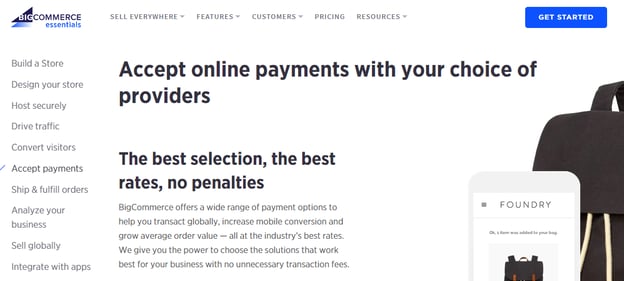
- No transaction fees. BigCommerce does not charge additional transaction fees regardless of which payment gateway you use. For high-volume merchants, this can result in significant savings compared to Shopify's third-party gateway fees.
- Built-in B2B features. BigCommerce includes native support for customer groups, custom pricing tiers, and quote management, features that other platforms typically reserve for enterprise plans.
- Headless commerce readiness. BigCommerce offers robust APIs and a headless architecture option, allowing brands to decouple the frontend presentation layer from the commerce engine. This is increasingly important for brands using modern frontend frameworks.
- Multi-channel selling. The platform supports native integrations with Amazon, eBay, Facebook, Instagram, and Google Shopping, enabling true omnichannel strategies from a single dashboard.
Limitations to Consider
- Annual revenue thresholds. BigCommerce plans cap your annual online sales based on your pricing tier. Exceeding your plan's limit triggers an automatic upgrade to the next tier, which can catch fast-growing brands off guard.
- Fewer free themes. While the paid theme selection is solid, the free options are limited compared to Shopify. Non-developers who want a distinctive storefront may need to invest in a premium theme or custom design work.
- Smaller app ecosystem. BigCommerce's app store is growing but remains smaller than Shopify's. For niche integrations, you may find fewer plug-and-play options.

Who BigCommerce Is Best For
BigCommerce works well for mid-market and B2B-adjacent brands that need advanced features without the overhead of managing their own infrastructure. If you are scaling past $1 million in annual revenue and want built-in functionality that would require multiple paid apps on Shopify, BigCommerce deserves serious consideration.
Side-by-Side Comparison
FactorShopifyWooCommerceBigCommerceHostingIncludedSelf-managedIncludedTransaction Fees0.5-2% on third-party gatewaysNoneNoneCustomizationModerate (Liquid templates)Unlimited (open source)Moderate (Stencil framework)Time to LaunchFastSlow to moderateFastBest ForD2C brands wanting speedDevelopers wanting full controlMid-market brands wanting built-in features
How to Make Your Decision
Selecting a platform is not purely a feature comparison. Consider these practical factors before committing:
1. Your team's technical capacity. If you have no developers on staff and no agency partner, a hosted solution like Shopify or BigCommerce will save you from the operational burden of managing servers, security patches, and plugin conflicts.
2. Your growth trajectory. Model your costs at current revenue and at two times and five times your current volume. Shopify's transaction fees and app costs scale linearly. BigCommerce's tier-based pricing can jump at revenue thresholds. WooCommerce's costs are more variable but can be optimized with the right hosting setup.
3. Your marketing and advertising stack. Consider how each platform integrates with your paid media, email, and analytics tools. Shopify's native ad integrations and WooCommerce's WordPress-based SEO advantages each serve different acquisition strategies.
4. Your need for customization. If your business model requires a unique checkout flow, complex product configurations, or custom integrations with ERP and inventory systems, the flexibility ceiling of your platform matters.
The Bottom Line
Shopify gets the EmberTribe seal of approval. Our team of growth experts swear by Shopify's functionality and ease of use. For the majority of D2C brands and growth-stage eCommerce companies, Shopify delivers the best balance of speed, reliability, and ecosystem support.
BigCommerce is a strong alternative for mid-market brands that need built-in B2B features and want to avoid transaction fees. WooCommerce remains the go-to for technically capable teams that require full customization and a content-driven approach to growth.
If you are looking for the simplest path to launching and scaling your eCommerce business, Shopify is the best place to start. But whichever platform you choose, the real differentiator is not the technology itself. It is how effectively you leverage it to acquire customers, optimize conversions, and build a brand that lasts.

.webp)

.svg)


