
In the age of rapid digital transformation, AI has seeped into almost every industry, revolutionizing how we conduct business, design products, and even create content. The ClusterMagic service is a great example, which seamlessly integrates AI for content generation in a hybrid model, providing significant benefits in the SEO results of brands seeking a massive increase in organic traffic. But while AI holds immense promise, it has its limitations. Let's explore the pros and cons of using AI for content creation and understand why a hybrid approach might be the way forward.
Major publishers in sensitive niches like CNET.com, Bankrate.com, and Creditcard.com have already integrated AI-generated content. Other large companies, such as CNN and Forbes, might also be doing so. Countless smaller companies and publishers are utilizing AI, not only on their websites but also on social media, in email marketing, and virtually everywhere else.
Google's stance on AI-generated content is neutral, emphasizing that content should primarily be user-centric. In fact, Google's September 2023 Helpful Content Update removed the mention of "written by people" from their helpful content system guidelines.
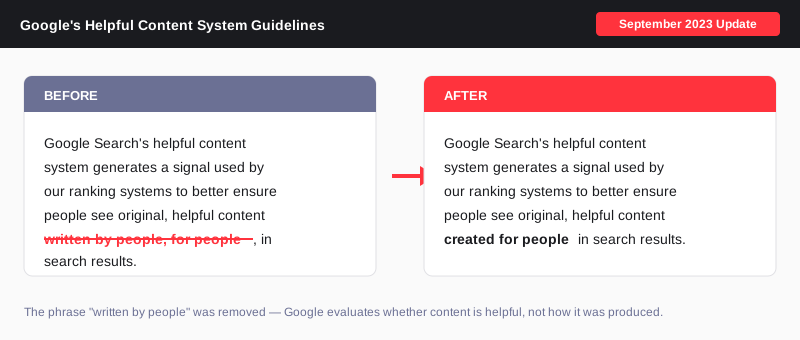
The message is clear: for content to rank well, it must be informative, answer users' queries satisfactorily, and showcase genuine expertise - regardless of how it's created.
AI Content Detectors like GPTZero, ZeroGPT, and many others are not reliable. Even OpenAI has said as much. They consistently produce false positives about human-written content. Conversely, they can be easily fooled with creative prompting or a bit of human editing.
An interesting note from OpenAI: "we found that it labeled human-written text like Shakespeare and the Declaration of Independence as AI-generated."
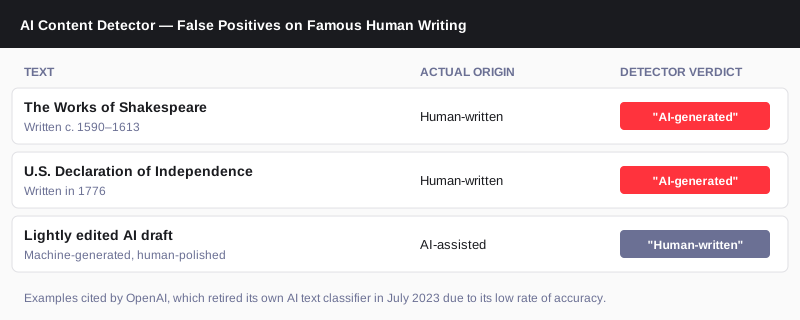
Anecdotal evidence and real-life ranking data suggest that while AI-generated content isn't penalized by search engines, it might only achieve high rankings if it meets the above criteria. The role of AI in content creation is still a developing narrative, and its significance is indispensable for maintaining a competitive edge in the future.
At EmberTribe, the understanding is clear - AI serves as a foundation, not the final product. With ClusterMagic, while AI aids in the initial draft based on expert-driven keyword research, human experts step in for the crucial phases of editing, fact-checking, and final review. This hybrid approach ensures the content is accurate and helpful, has the potential to rank, and truly represents their business.

Every article about B2B SEO companies is written by a B2B SEO company that ranked itself first on the list. That's a reasonable thing to be skeptical about. This guide takes a different approach: an evaluation framework built for the buyer, not the vendor.
Growth-stage companies hiring a B2B SEO firm are making a 6–12 month financial commitment with delayed returns. Getting it wrong costs more than the fee. It costs the time, the opportunity, and sometimes the willingness to try again.
B2B SEO isn't harder than B2C SEO. It's different enough that a firm without genuine B2B experience will optimize for the wrong signals and you'll spend months chasing traffic that never converts.
The structural differences that matter:
For companies building the content foundation that B2B SEO requires, working with a strong B2B content writing partner is often the highest-ROI input in the first six months.
The deliverable gap between agencies is wide. Here's what separates a real B2B SEO engagement from a blog retainer with an SEO label on it.
Audit and strategy (months 1–2): A comprehensive technical audit covering crawl health, indexing issues, Core Web Vitals, structured data, and internal link architecture, paired with a keyword and topic cluster map scoped to your buyer's job-to-be-done. This phase should produce a sequenced 6–12 month roadmap, not a list of recommendations.
Ongoing technical work: Monthly crawl monitoring, issue remediation, Core Web Vitals tracking, and structured data updates. Most agencies treat technical SEO as a one-time audit. Ongoing technical hygiene is what keeps an otherwise strong content program from leaking rankings.
Content production: The best B2B SEO firms staff domain-expert writers, not generalists. The quality gap between a writer who understands your product category and one who doesn't shows up immediately in how they handle comparison pages, product-led content, and thought leadership.
Link acquisition: Organic rankings for competitive B2B terms require authority that content alone can't build. Digital PR, data studies, and strategic placements in industry publications are how credible agencies build links. Any firm that won't describe its link methodology in detail is hiding something worth knowing.
Pipeline reporting: The KPI isn't keyword rank. It's organic-sourced MQLs, demo requests, and trial starts. A B2B SEO company that can't connect its work to your CRM data by month four is not actually optimizing for your business.
Timeline expectations are where the most expensive misalignments happen. Here's what actually happens, month by month.

The break-even point for B2B SEO is typically around seven months. From there, returns compound. B2B SaaS companies report a median 702% ROI over a full program lifecycle, with organic search driving 44.6% of total B2B revenue.
The companies that don't get there usually quit at month three. They see traffic numbers that look modest, conclude SEO doesn't work for their category, and move budget back to paid search. The compounding never happens because the program never reached the inflection point.
Budget context prevents the most common mistakes. Here's a realistic range by company stage:
| Company Stage | Monthly Range | What's Covered |
|---|---|---|
| SMB / seed-stage | $2,500–$5,000 | Strategy, 2–4 content pieces, technical monitoring |
| Growth-stage B2B | $5,000–$10,000 | Full strategy + content + link building + reporting |
| B2B SaaS scaling | $6,000–$15,000 | Dedicated strategist + programmatic + AI visibility |
| Enterprise | $10,000–$50,000+ | Multi-market, multiple content tracks, full attribution |
Most credible firms require a 6–12 month minimum commitment. Shorter engagements exist, but they don't produce the compound returns the channel is known for. Any firm offering 90-day ROI guarantees is either selling PPC dressed as SEO, or lying.
Hourly consulting from a senior B2B SEO specialist runs $75–$400/hour. Useful for audits and strategy reviews, but not a substitute for an ongoing engagement if you need results.
These questions aren't a formality. Each one reveals something specific about how the agency operates and whether they've actually done B2B SEO before.
"Can you show me a case study where you attributed pipeline to organic?" You want to see organic-sourced MQLs or demo requests in a real client's data, not just traffic growth graphs. If every case study shows traffic doubling but never mentions revenue, that's the metric they're optimizing for.
"Who specifically will manage my account and how many accounts do they manage?" Agencies that keep strategist-to-account ratios above 20 consistently underperform on B2B accounts. Senior talent in the sales pitch becomes junior talent on the account. Confirm names and current loads before signing.
"What's your content production model?" Are writers subject matter experts in your category, or generalists who research before writing? For B2B, this difference is visible in the output within two articles.
"How do you approach AI search optimization?" In 2026, a B2B SEO company without a GEO/AEO strategy is ignoring a growing share of buyer discovery. The answer should include structured data, entity optimization, and some methodology for tracking LLM citation.
"What does your link building process look like?" Specific, transparent answers only. "We have proprietary methods" is a red flag. Credible link acquisition strategies can be explained without revealing every vendor relationship.
For a broader evaluation of what makes any marketing agency worth hiring at the growth stage, the same principles apply — specificity, accountability, and named team members.
Some signals predict a bad engagement before it starts.
Ranking guarantees. No legitimate B2B SEO company guarantees keyword positions. Google's algorithm and your competitive landscape aren't controllable. Guarantees are either meaningless or tied to terms designed to ensure they're technically met.
Traffic-first reporting. If the monthly report is all traffic charts and keyword rank tables with no pipeline attribution, you're paying for an activity tracker, not a growth program.
Template content strategies. If the proposed content plan reads like it could have been written for any company in any B2B category, it wasn't built for you. B2B SEO strategies should reflect your buyer's specific job-to-be-done and your product's competitive positioning.
No discussion of technical SEO. Content-only agencies running on a "more posts = more traffic" model skip the foundation work. Technical issues that go unaddressed quietly kill rankings regardless of output volume.
Vague timelines. "SEO takes time" is not a timeline. A legitimate agency can tell you what to expect at months 3, 6, and 12 based on your domain authority, competitive landscape, and content investment level.
The differentiator that SEO experts who specialize in B2B consistently cite in successful engagements: the agency understood the business, not just the algorithm. That means understanding your ICP, your sales cycle, and what a qualified lead actually looks like before they ever start writing.
The economics are compelling when done right. Organic leads close at 14.6% compared to 1.7% for outbound. The cost per organic lead runs about $31 versus $181 for paid search. The channel delivers 76% of all trackable B2B website traffic.
Those numbers aren't available to every company that hires a B2B SEO firm. They're available to companies that hire the right one, stay long enough for the compounding to work, and hold their agency accountable to pipeline metrics from day one.
If you want to evaluate what a results-oriented B2B SEO engagement looks like in practice, EmberTribe works with growth-stage B2B and DTC brands that need organic programs connected to revenue — not traffic dashboards.
B2B keyword research is not a volume game. The brands that win organic search in competitive B2B categories are not targeting the highest-traffic terms. They are targeting the right terms: the ones that signal buyer intent, match specific funnel stages, and attract the decision-makers who control budget.
This guide walks through how B2B keyword research works, where it differs from B2C approaches, which tools to use, and how to build a prioritized keyword strategy that generates qualified pipeline rather than unqualified traffic.
The mechanics of B2B search are fundamentally different from consumer search. In B2C, a single person searches, decides, and converts, often within minutes. In B2B, a single deal might involve three to eight stakeholders, a buying cycle of weeks or months, and a sequence of searches that map across entirely different roles.
A VP of Operations searching for "automated inventory management" is not the same buyer as a CFO searching for "inventory management software ROI." Both are part of the same deal. Both use different language. Effective B2B keyword research surfaces both sets of queries and maps them to content that speaks to each role.
Volume also matters less in B2B than most marketers assume. A keyword with 200 monthly searches and strong commercial intent is worth more than a keyword with 20,000 searches and informational intent if your product costs $50,000 per year. High CPC bids (often $15 or more in competitive B2B categories) are a reliable signal that advertisers consider a keyword worth paying for because it converts. That signal belongs in your research process.
Effective B2B keyword strategies organize keywords into three layers that map to the buyer journey. Each layer requires different content formats and serves a different purpose in the funnel.
Top-of-funnel keywords attract buyers who are identifying a problem or starting to research a category. These terms tend to be educational and high-volume relative to the other layers. Examples include "what is revenue operations," "b2b demand generation strategies," or "how to reduce customer churn." Content here builds brand awareness and positions your company as a credible source.
Middle-of-funnel keywords attract buyers who understand the category and are evaluating approaches. These terms are more specific and often include modifiers like "best," "top," "how to choose," or "for [industry]." Examples include "best b2b seo tools," "keyword research for b2b saas," or "content strategy for manufacturing companies." The buying intent is higher here, and conversion rates from this layer tend to be meaningfully better than top-of-funnel traffic.
Bottom-of-funnel keywords attract buyers who are actively selecting a vendor or evaluating specific solutions. These include comparison searches ("vs." terms), pricing searches, review searches, and branded terms. While volume is lower, conversion rates are significantly higher. A single page ranking for "best b2b seo agency for saas" can drive more revenue than a dozen top-of-funnel posts.
The best B2B keyword research starts before you open any tool. Sales conversations, support tickets, and customer interviews reveal the specific language your buyers use to describe their problems, which is often different from the language your marketing team uses to describe your product.
Ask your sales team what questions prospects ask in early discovery calls. Ask customer success what problems customers were trying to solve when they first started searching. These answers surface the naturalistic keyword language that SEO tools often miss because the search volume is distributed across many variations.
Once you have that foundation, move into tool-based research.
Ahrefs and Semrush are the two most capable platforms for B2B keyword research. Both provide keyword volume estimates, keyword difficulty scores, CPC data, and SERP analysis. Semrush has stronger competitive gap analysis features. Ahrefs has a more reliable backlink index, which matters when evaluating keyword difficulty.
Google Search Console is underused for B2B research. If your site already has organic traffic, GSC shows exactly which queries are driving impressions and clicks. It surfaces real demand from real searchers at your site, which is more reliable than volume estimates from third-party tools.
Google Keyword Planner is useful for CPC data even if you are not running paid campaigns. High CPCs reliably signal commercial intent. A B2B keyword with a $25 CPC is worth investigating regardless of its monthly search volume.
For B2B-specific research, LinkedIn's search behavior and job postings are underused intelligence sources. The language companies use in job descriptions to describe problems they are hiring to solve often maps directly to the search queries their leaders are typing into Google.
Not every keyword deserves the same content format. Mapping keywords to their primary search intent before writing anything is one of the most important steps in a B2B keyword strategy, and one of the most commonly skipped.
Run a keyword through Google and study the current SERP carefully. The existing top results tell you what Google believes searchers want to find. If the top results are all long-form guides, a long-form guide is likely the right format. If the top results are tool comparison pages or listicles, that is the format Google is rewarding for that query.
Intent mapping also affects conversion strategy. A top-of-funnel informational post should convert to a lead magnet or newsletter, while a middle-of-funnel comparison page should convert to a demo or consultation. A bottom-of-funnel pricing page should convert to a sales conversation. Misaligning content format and conversion strategy is one of the main reasons B2B content generates traffic but not pipeline.
Individual keywords produce individual pages. Topic clusters produce authority. The brands that dominate B2B search are not publishing one post per keyword. They are building interconnected content systems where a pillar page covers a broad topic and supporting cluster posts cover specific subtopics, all linked together in a way that signals deep expertise to search engines.
For a B2B company in the CRM space, a cluster might look like this: a pillar page on "CRM for manufacturing" supported by cluster posts on "how to track customer orders in CRM," "CRM integration with ERP systems," and "CRM for mid-market manufacturers." Each cluster post reinforces the authority of the pillar, and the pillar passes that authority back to the cluster.
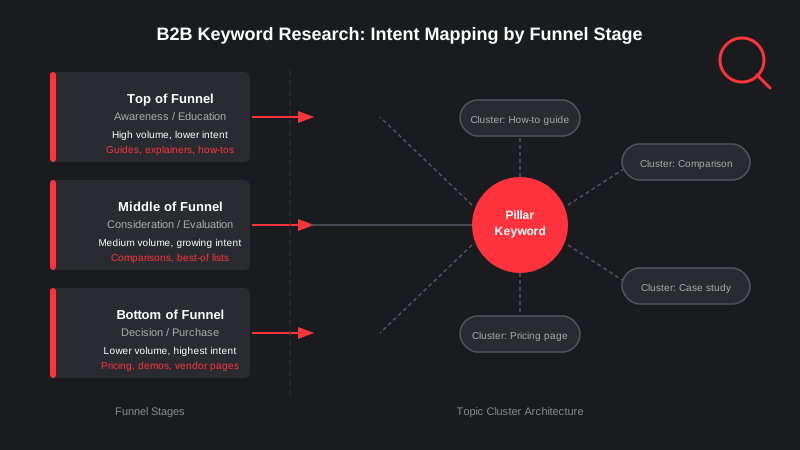
Building clusters requires deliberate internal linking. Every cluster post should link back to the pillar page, and the pillar should link forward to each supporting post. This architecture is one of the fastest ways to build topical authority in a competitive B2B category. Our guide to analytics for SEO covers how to measure topical authority gains over time.
Once you have a keyword list, prioritization determines where you spend content resources first. Use four criteria to score and rank keywords:
Search intent fit. Does this keyword map cleanly to a content format you can execute? High-intent keywords you can rank for are worth more than high-volume keywords where your content format is a poor fit for the SERP.
Keyword difficulty relative to your domain authority. A keyword difficulty of 30 is approachable for a site with meaningful backlinks. A keyword difficulty of 70 requires significant link equity. Target opportunities where your domain can compete within six to twelve months.
Business value. Keywords that attract buyers close to a purchase decision have higher business value than keywords that attract researchers. Weight your prioritization toward terms that appear in the middle and bottom of your funnel.
Competitive gap. Identify keywords where your competitors rank but you do not. These represent traffic you are currently losing to competitors and are often faster to capture than entirely new territory. Our post on competitor AdWords keywords covers how to find gaps in paid search that often mirror organic opportunities.
Effective keyword prioritization is covered in depth by resources like Moz's Keyword Research guide and Search Engine Land's B2B SEO coverage. Both are worth bookmarking as reference material.
B2B keyword research is the foundation of every content engagement we run. Before writing a single post, we map keywords to funnel stages, score intent, and build cluster architecture that compounds over time.
The brands that get the most out of B2B search are not the ones publishing the most content. They are the ones publishing the most targeted content, built on keyword research that reflects how their buyers actually search, not how the marketing team talks about the product.
If you are evaluating SEO partners and want to understand how strategic keyword research fits into a broader engagement, our guide to finding the best SEO firm walks through the evaluation criteria that matter most. And if you want to understand what the top B2B SEO companies actually do differently, our roundup of the best SEO companies in the USA covers the operational patterns that drive results.
B2B keyword research is not a one-time exercise. The B2B search landscape shifts as competitors publish, search engines evolve, and buyer language changes. Build your keyword strategy as a living document, revisit it quarterly, and let intent signals from your existing content guide where you expand next.

The best saas company examples share one thing: their growth was engineered, not accidental. Each company made a deliberate bet on a specific go-to-market motion, product mechanic, or distribution channel, then doubled down on what worked. Understanding those bets, and the underlying mechanics, gives you a replicable framework rather than a list of buzzwords.
This post covers five SaaS brands that built substantial, defensible businesses, breaking down not just what they did but how the mechanism actually worked.

No two of the companies below used the same growth motion. That's intentional. The goal here isn't to rank them but to show the range of viable approaches and what each one requires to function.
HubSpot's growth is inseparable from its content strategy, but "we published a lot of blogs" undersells the mechanism. The company built a flywheel in which free educational content attracted prospects, free tools converted them into leads, and the CRM product delivered enough value that customers became advocates who attracted new prospects.
The HubSpot blog publishes over 100 posts monthly and maintains evergreen content with ongoing optimization. Free lead magnets, templates, and the HubSpot Academy credential program created compounding organic reach. HubSpot's content-driven leads close at 14 times the rate of outbound leads, which means the economics improve the longer the flywheel spins. By 2022 the model had generated over $2 billion in ARR, and the company has continued scaling from there.
What made it work was specificity. HubSpot didn't produce generic marketing content; it produced content aimed at the exact persona it was selling to, with free tools that made those personas dependent on HubSpot before they ever paid a dollar.
Notion's growth story is a saas example of community-led product distribution at scale. The company created an Ambassador program that enrolled only the most passionate users (no monetary incentives, no low-bar entry) and turned them into a volunteer sales force. Those ambassadors built templates, YouTube tutorials, certified consulting practices, and an organic community that now exceeds 500,000 members on Reddit alone.
The product mechanics reinforced this. Collaboration features made every new workspace member a potential new user. Every shared Notion document pulled a non-user into the product. Notion hit an estimated $500 million ARR in September 2025, with roughly 95% of traffic arriving through organic and community channels and a free-to-paid conversion rate above 5% across 30 million users.
The lesson isn't "build a community." It's that community compounds when the product itself gives community members something worth sharing. Templates were the mechanism; the community was the distribution.
Figma is the textbook case for bottoms-up SaaS growth. A single designer shares a Figma URL with a product manager, that PM invites engineers, and the engineering team loops in a second designer. Before the company's IT department has approved any software procurement, Figma has six seats inside the organization.
Figma's S-1 filing showed that 70% of new Organization and Enterprise customers in 2024 and Q1 2025 included at least one user who had previously been on a Professional plan. Individual paid users became the entry point for six-figure enterprise contracts. Revenue reached $749 million in 2024, up 48% year-over-year, with $912 million in ARR as of Q1 2025. Notably, non-designers make up two-thirds of Figma's 13 million monthly active users, which means the product long ago escaped the "design tool" category and became a cross-functional collaboration platform.
The free tier wasn't a charity play. It was the top of a deliberate expansion funnel.
Calendly's growth model is elegant because the product advertises itself with every use. When someone books a meeting through Calendly, they see the Calendly branding on the scheduling page. That exposure converts recipients into users at a meaningful rate. Every booking link becomes an acquisition channel.
The company grew to $276 million in revenue while remaining bootstrapped for seven years, which is rare in SaaS. This is a saas marketing example worth studying because the acquisition cost was structurally embedded in the product workflow rather than layered on top through paid channels. No SDR team, no enterprise sales motion, just the product placed in front of new users every time an existing user sent a link.
The mechanic works because Calendly's core use case is inherently social. Scheduling requires two parties. That constraint became the growth engine.
Datadog represents a different class of saas growth examples: the land-and-expand motion executed at infrastructure scale. The company starts with a free or low-cost monitoring tier that developers adopt within a single team. Once the product proves its value, it expands into the full observability platform, logging, APM, security, and more, across the entire organization.
Datadog reached $3.4 billion in revenue for fiscal year 2025, up 28% year-over-year. The key to this model is that expansion revenue comes from existing customers, which compresses sales costs and produces strong net revenue retention. Datadog's NRR has historically run above 130%, meaning existing customers generate 30 cents of new ARR for every dollar of existing ARR without any new customer acquisition required.
The model requires genuine multi-product depth. Land-and-expand fails when there's nowhere to expand into. Datadog's decade-long investment in adjacent monitoring products created the expansion surface that makes the economics work.
These five examples aren't outliers. They reflect broader patterns visible in benchmark data. According to Benchmarkit's 2025 SaaS Benchmarks Report, median B2B SaaS ARR growth sits at 19 to 21 percent, with the CAC payback period at 15 months for the median company and under 12 months for best-in-class performers. The benchmark LTV-to-CAC ratio is 3:1, with enterprise SaaS ($100K+ ACV) averaging 4.5:1.
Net revenue retention is becoming the primary separator between strong and weak performers. Companies with NRR above 130% compound without needing proportional new acquisition spend. Companies with NRR below 100% are leaking revenue even while acquiring new customers.
The other standout data point: SaaS companies with AI deeply integrated into their products are growing roughly twice as fast as peers. This isn't AI as a marketing claim, it's AI embedded in onboarding, product features, and customer workflows in ways that drive measurable retention and expansion.
Every one of these saas brand examples succeeded because their growth mechanism matched their product's natural behavior. Figma's product is collaborative by design, so virality was built-in. Calendly's core use case requires two people, so distribution was built-in. Notion's product is highly personal and endlessly customizable, so community builders had something real to build around.
Choosing the wrong GTM motion for your product's natural behavior is one of the most common ways SaaS companies plateau. A product that is inherently single-player and private cannot rely on the same viral loops that Figma uses. A product with high setup complexity cannot expect PLG to carry it the way Calendly does.
The useful question isn't "which of these models should I copy" but "what does my product do naturally that I can turn into distribution?" That's the underlying pattern in every successful saas example above.
If you're building or scaling a SaaS company and want to develop a growth strategy grounded in how your product actually behaves, the posts on SaaS SEO and maximizing ROI for SaaS companies cover the channel-level tactics. For the business fundamentals underneath all of it, the SaaS business guide is the right place to start.
EmberTribe helps growth-stage SaaS companies build content and SEO programs that compound over time, not just generate traffic. If you want to talk through what the right motion looks like for your product, visit embertribe.com.

Most SaaS companies focus heavily on performance channels: paid search, retargeting, sales sequences. Those channels produce leads, but they produce leads from people who already knew to look. Brand building is how you get on the radar before the search happens. SaaS PR is one of the most underused levers in growth-stage marketing, and the companies that master it build durable competitive advantages that performance spend alone cannot replicate.
This post breaks down how to build SaaS brand awareness through PR, thought leadership, and content, with specific tactics you can act on rather than principles you already know.
The SaaS market has matured significantly. In most categories, a prospect can name three to five competitors before they ever book a demo. When buyers research solutions, they are not discovering your product from scratch. They are filtering a pre-formed list.
Brand building determines whether you make that list. According to research cited by Growfusely, buyers in 2026 are also increasingly influenced by AI-generated responses when forming that shortlist. Getting cited by AI assistants like ChatGPT and Perplexity now functions similarly to getting coverage in top-tier media: it validates your brand as a credible source in your category. The companies that earn consistent brand mentions across trusted publications, analyst reports, and high-authority sites are the ones AI tools surface in response queries.
There is also a pipeline effect that operates over a longer arc. PRLab notes that most SaaS companies see non-referral inquiry increases within two to three months of active PR campaigns, with revenue impact materializing between months three and six. Brand building is not slow, but it rewards consistency over bursts.
SaaS brand building is not a single tactic. It is a coordinated system across four channels: media coverage, thought leadership content, community presence, and strategic positioning. Each one reinforces the others.
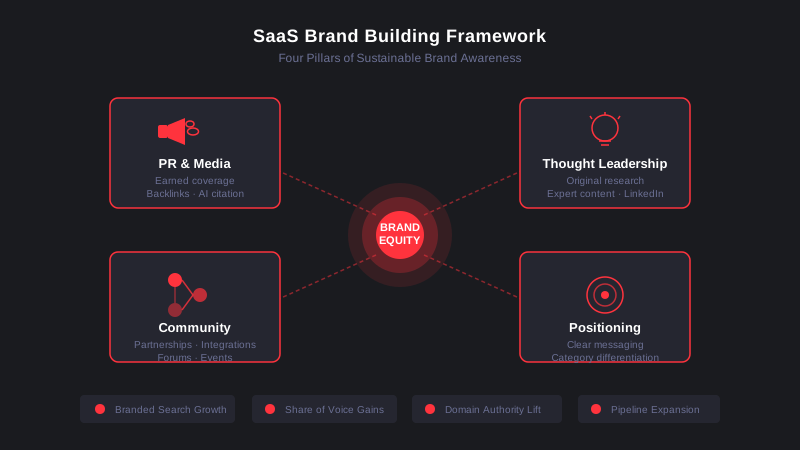
Traditional PR means pitching journalists. Modern SaaS PR is broader: it includes digital coverage, backlinks, podcast appearances, analyst relations, and any earned placement that builds credibility at scale.
A strong SaaS PR program starts with a clear editorial angle. Journalists covering SaaS do not want to write about software features. They want to write about market trends, founder perspectives, funding rounds, customer outcomes, and proprietary data. The companies that land consistent coverage are the ones that give journalists something worth writing about.
Practical starting points:
The SEO value of earned media is significant on its own. A placement in a high-authority publication generates backlinks that compound over time, improving your domain authority and the ranking potential of every other page on your site. For growth-stage SaaS companies, that dual benefit of brand and SEO is one of the strongest ROI arguments for investing in PR.
Thought leadership is not blogging more. It is publishing perspectives that only your company is positioned to share, because of your data, your customer base, or your founders' specific expertise.
Research from the B2B Institute shows that B2B decision-makers are 48% more likely to do business with a company that produced thought leadership content they found valuable, and 54% more likely to purchase from them. Those numbers reflect a buyer behavior that SaaS marketers often underestimate: content builds trust before a prospect is ready to evaluate products, and that trust influences vendor selection when they finally are ready.
Effective SaaS thought leadership looks like:
For a deeper look at how content fits into SaaS growth, see our guide to content marketing as a full-funnel channel.
Brand awareness builds fastest in communities where your buyers already spend time. That means participating in industry communities, partnering with non-competing tools your customers use, and showing up at the events, forums, and Slack groups that matter in your category.
Integration partnerships are especially effective for early and mid-stage SaaS. If your product connects to tools your customers already trust, being listed in those tools' marketplaces puts your brand in front of buyers who are already qualified by context. Being featured by a larger partner also carries implicit endorsement.
Community presence compounds. A SaaS brand that is consistently visible in the forums, newsletters, and podcasts that serve its target market builds familiarity that makes every downstream touchpoint more effective. Cold outreach converts better, demo requests require less explanation, and sales cycles shorten because the brand has already done part of the work.
PR and content only work if the underlying brand positioning is clear. According to SaaS branding experts surveyed by Overpass Studio, the biggest branding priority for SaaS companies in 2026 is clarity: being instantly understood, not louder. When a prospect encounters your brand for the first time, the message needs to answer three questions immediately: what problem do you solve, who do you solve it for, and why are you the best answer to that problem.
Vague positioning is a brand building killer. Generic messages like "the all-in-one platform for teams" or "the smarter way to manage X" do not create memory. Specific positioning does. If your messaging cannot fit on a single note card and be understood by a cold reader in under ten seconds, your PR and content spend will underperform because no amount of coverage fixes a blurry brand.
Brand building has a reputation for being expensive and slow. Neither is necessarily true for SaaS companies that are strategic about it.
The highest-leverage early moves tend to be:
For companies building a more complete go-to-market system, these PR and brand tactics connect directly to the broader frameworks we cover in our growth strategy consulting content.
Brand awareness is measurable, though the metrics require a different lens than performance campaigns. The key signals to track:
For a full breakdown of how to connect brand metrics to growth KPIs, see our SaaS marketing metrics and KPIs guide.
The brands that win in SaaS are not always the ones with the best product. They are the ones that made it easiest for buyers to trust them before the buying process started. PR and brand building are how you do that at scale, starting with a clear position, finding the channels where your buyers pay attention, and publishing content worth citing. The compounding effect takes time, but it builds a moat that paid channels cannot replicate.
When buyers search for business lead generation companies and end up researching Ironpaper, they are usually looking for one of two things: a direct evaluation of Ironpaper as a vendor, or a reference point for understanding what a serious B2B lead generation company actually looks like. This post serves both purposes.
Ironpaper is a useful benchmark because they are transparent about their methodology, publish original research, and have been operating in B2B for over 20 years. Walking through how their model works, who it is built for, and how to apply the same evaluation criteria to other vendors gives you a reusable framework regardless of which agency you ultimately choose.
The phrase "lead generation company" gets applied to services that range from selling contact lists to running integrated demand generation programs. The category called full-service B2B lead generation, where Ironpaper sits, means something specific.
A full-service model covers the entire pipeline from demand creation to sales-ready lead delivery. That includes content and thought leadership (to educate buyers during the 83% of their buying process that happens before they contact a vendor), demand generation campaigns (paid and organic channels that put the content in front of the right audiences), conversion infrastructure (landing pages, lead scoring, nurture sequences), and sales enablement (the handoff material that helps sales teams close what marketing generated).
Ironpaper's demand generation services are a practical illustration: they sequence their work by optimizing existing assets before building net-new campaigns, integrate marketing automation and lead scoring from the start, and measure attribution at the pipeline level, not just the lead level. This is what separates a growth system from a campaign service.
The distinction matters because it sets the right expectations. A full-service B2B lead generation company is not a vendor you hire to generate leads this quarter. You are hiring them to build the infrastructure that generates leads consistently, which compounds over time but requires six to twelve months before the return is visible.
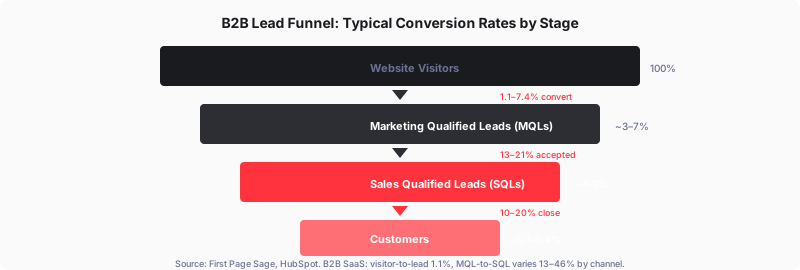
First Page Sage's B2B conversion rate research benchmarks visitor-to-lead rates at 1.1% for B2B SaaS, with MQL-to-SQL acceptance running 13% to 21% on average and improving to 46% for email-sourced leads per HubSpot benchmarks. The compounded result: a fraction of a percent of total site visitors become customers.
This is why lead quality matters more than lead volume. A lead generation company that delivers 500 MQLs with a 2% MQL-to-SQL rate produces 10 SQLs. A company that delivers 150 MQLs with a 20% MQL-to-SQL rate produces 30 SQLs. The second program produces three times the qualified pipeline at 30% of the volume.
The agencies that understand this build programs around ICP targeting and conversion rate optimization. The ones that do not optimize for volume because that is what clients can measure most easily.
Ironpaper's own research found that only 8.1% of B2B leaders describe their messaging as "very effective," which is the root cause of most MQL-to-SQL attrition. When marketing content does not resonate with buyer pain, leads do not convert to sales-accepted opportunities regardless of how well-targeted the acquisition campaign was.
The evaluation framework that applies to Ironpaper applies equally to every competitor in the category:
For B2B companies in competitive markets with complex buying processes, the full-service model produces outcomes that campaign-by-campaign approaches structurally cannot: a compounding content and demand system that improves over time, a defined handoff from marketing to sales, and attribution that connects spend to pipeline.
The fit conditions: deal size that justifies a 6 to 18-month nurture cycle, sufficient budget to sustain the engagement through the ramp period, and internal sales capacity that can follow up on the SQL volume the program produces.
When those conditions are not met, such as early-stage companies testing channels, brands that need immediate pipeline rather than infrastructure, or companies with high-velocity sub-$10K ACV products, the full-service model adds overhead without proportional return. In those cases, a performance marketing agency focused on paid demand generation with shorter feedback loops, or an SDR-as-a-service firm for immediate outbound coverage, will produce faster results at the current stage.
Business lead generation companies like Ironpaper represent a specific and well-defined category: integrated B2B growth agencies that build demand infrastructure rather than buy leads. The model works reliably for mid-market and enterprise technology companies with the budget and patience to let the compounding effects materialize.
For growth-stage B2B SaaS and DTC brands that need demand generation performance connected to revenue rather than just pipeline volume, EmberTribe works with brands at the intersection of paid media and organic demand programs tied directly to measurable business outcomes.
Most SaaS teams run competitor analysis the wrong way. They compare feature lists, copy pricing pages, and call it strategy. What they miss is the underlying performance data that separates companies growing efficiently from those burning capital to maintain headcount. SaaS industry benchmarks give you that data, and a structured competitor analysis process gives you context for interpreting it.
This guide covers how to collect meaningful competitive intelligence, which SaaS benchmarks actually matter in 2026, and how to use both to set growth targets your team can execute against.
Competitive research typically surfaces product capabilities, messaging, and pricing. That information tells you what a competitor sells and how they position it. It rarely tells you how efficiently they acquire customers, how well they retain revenue, or whether their growth is sustainable.
SaaS benchmarks fill that gap. When you know that the median LTV:CAC ratio for B2B SaaS sits at 3:1, you can assess whether your own unit economics justify current acquisition spend. When you know that median CAC payback has extended to 18 months, you understand why your investors care so much about cash efficiency. Benchmarks convert raw competitive data into decisions.
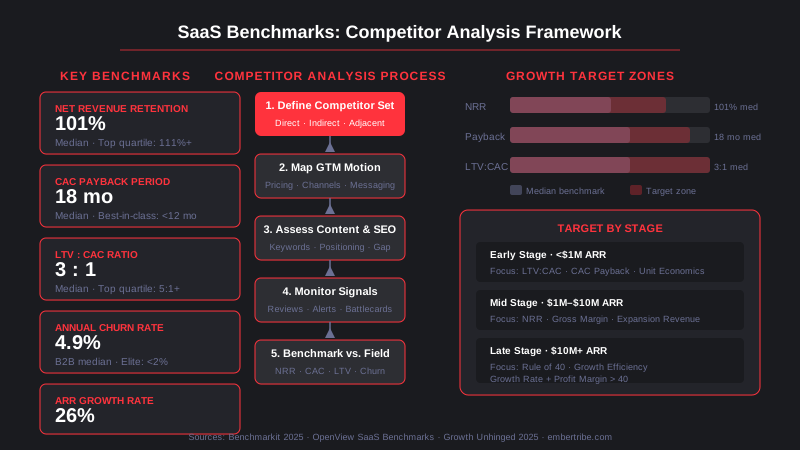
These figures represent industry medians and top-quartile ranges compiled from multiple research sources including Benchmarkit's 2025 SaaS Performance Metrics report, OpenView's annual SaaS benchmarks, and Growth Unhinged's 2025 benchmarks analysis.
NRR measures how much revenue you retain from existing customers over a period, including expansion from upgrades and cross-sells minus churn and downgrades. Industry median NRR sits at approximately 101%, while top performers sustain 111% or higher. Companies achieving NRR above 100% grow at roughly 2x the rate of companies below that threshold, according to Benchmarkit's 2025 data.
The NRR benchmark splits sharply by customer segment. Enterprise-focused SaaS companies, where expansion opportunities are larger and churn is stickier, achieve NRR far above SMB-focused products. If your NRR falls below 95%, expansion revenue or churn improvement should take priority over new acquisition spend.
CAC payback, the number of months to recover what you spent to acquire a customer, has lengthened across the industry. The median has reached 18 months, up from roughly 14 months two years prior. Best-in-class companies still maintain payback under 12 months regardless of segment.
A payback period above 24 months is a red flag for most growth-stage companies, particularly in uncertain macro environments. If you're in that range and raising capital, expect pressure to demonstrate a path toward 15 months or better before your next round.
The ratio of customer lifetime value to acquisition cost remains one of the most scrutinized SaaS metrics. The current median for growth-stage B2B SaaS is 3:1. Top quartile companies achieve 5:1 or better. By segment, enterprise SaaS averages closer to 4.5:1 while SMB SaaS averages 2.5:1, reflecting higher churn rates in the SMB cohort.
A 3:1 ratio is often cited as the minimum threshold for sustainable growth. Below 3:1, you're likely spending too much to acquire customers relative to what they return. Above 5:1, you may be under-investing in acquisition and leaving growth on the table.
B2B SaaS median annual churn sits around 4.9%, though this varies significantly by customer size. SMB churn runs 8x higher than enterprise churn on a percentage basis. If your customer base skews toward small businesses, expansion revenue from retained accounts becomes critical: losing 20% of your SMB cohort each year requires significant new business just to maintain flat ARR.
Top performers keep annual churn below 2% by investing in onboarding, customer success coverage, and product stickiness early in the customer lifecycle.
Median ARR growth for private SaaS companies has settled around 26%, with top performers reaching 50% or higher. Early-stage companies (under $1M ARR) can sustain top-quartile growth of 250% to 300% year-over-year. Context matters: a $50M ARR company growing at 40% is exceptional, while the same rate at $2M ARR is table stakes for raising a Series A.
The Rule of 40 (growth rate plus profit margin should exceed 40%) remains a common efficiency benchmark for Series B and beyond. In a tighter market, investors increasingly favor companies above 40 with a path to profitability over those burning capital for headline growth.
Understanding benchmarks is one thing. Applying them through a structured competitive analysis is another. Here is a repeatable process for gathering competitive intelligence that goes beyond surface-level product comparisons.
Sort competitors into three buckets: direct, indirect, and adjacent. Direct competitors sell the same product to the same buyer. Indirect competitors solve the same problem with a different approach. Adjacent competitors overlap on one dimension, often a single feature set or a shared buyer persona.
Aim for a field of 5 to 10 companies: three direct competitors, two to three indirect, and two to four adjacent. Trying to track more than 10 competitors dilutes your attention without adding strategic value.
For each competitor, identify how they acquire customers. Review their website messaging, pricing page structure, free trial or freemium availability, case study library, and content strategy. Tools like Semrush and Similarweb surface traffic data, keyword rankings, and estimated traffic volume that reveal where they invest for organic growth.
Pay particular attention to how they structure pricing tiers. Pricing architecture tells you who they're targeting and how they think about expansion revenue. A seat-based model with an enterprise tier suggests a land-and-expand motion. Flat-rate pricing suggests they're optimizing for simplicity over expansion.
For a deeper look at how pricing structure connects to growth strategy, see our guide to SaaS customer acquisition strategies.
Analyze what your competitors publish and where they rank. Look for keyword gaps where you can capture search intent they're missing. Examine how they frame their core value proposition: do they lead with ROI, ease of use, integrations, or category creation?
Category creation is worth flagging specifically. When a competitor positions around a problem frame they coined (think "revenue intelligence" or "product-led growth"), they're building brand equity in a space they define. That's harder to displace than competing on features.
Competitive intelligence isn't a quarterly exercise. Set up ongoing monitoring using tools like Crayon or Klue for AI-powered battlecards and win-loss analysis, Google Alerts for brand mentions, and review site tracking on G2 or Capterra for shifting customer sentiment.
Review aggregator data is underrated. Customer reviews often surface honest assessments of competitor weaknesses, including support gaps, product limitations, and pricing friction, that you won't find in any marketing material.
Once you've gathered competitive data, map your own metrics against industry benchmarks. This is where the two streams of analysis converge. If your NRR is 98% while the industry median is 101%, you know churn or contraction is eroding expansion gains. If your CAC payback is 22 months while best-in-class is under 12, you know acquisition efficiency is a prioritized problem.
For a broader look at how to build out your measurement framework, our SaaS marketing metrics and KPIs breakdown covers the full metric stack with context for each stage.
Benchmarks set a reference point. Growth targets require you to pick a position within or above those benchmarks and build a plan to reach it.
Early-stage companies (pre-$1M ARR) should obsess over CAC payback and LTV:CAC. If unit economics aren't working at this stage, growth amplifies a broken model. Mid-stage companies ($1M to $10M ARR) should shift attention toward NRR and gross margin as expansion revenue becomes a material part of the growth equation.
Late-stage companies ($10M+ ARR) need to balance growth rate with efficiency, particularly the Rule of 40. Investors at this stage expect a clear view of how the business reaches profitability while sustaining competitive growth.
A 3:1 LTV:CAC ratio is healthy for a company with a $10K ACV product selling to SMBs. The same ratio is underwhelming for an enterprise product with a $100K ACV and a two-year sales cycle. Use your segment and ACV as the lens for interpreting where industry benchmarks apply to your specific situation.
The most effective growth targets are set at the 75th percentile of your peer cohort. That's aspirational enough to require real improvement, but grounded enough in peer data to be defensible with your board and investors.
Once targets are set, trace the line back to marketing investment. If you need to reduce CAC payback from 22 months to 15 months, that's a lever question: do you reduce acquisition costs, improve conversion rates, or improve initial ACV? Each answer has a different marketing implication.
For a structured approach to connecting marketing investment to growth outcomes, our team at EmberTribe works specifically with growth-stage SaaS companies building data-driven acquisition programs that benchmark against these standards.
SaaS competitor analysis without benchmarks gives you a picture of what your competitors do. Adding benchmarks gives you a picture of how well they do it, and how your own performance compares to the field. The companies that win on this are the ones that run both streams in parallel, using competitive intelligence to understand positioning and market context, and benchmarks to evaluate efficiency and set targets that reflect where the industry is actually heading.
Start with the five metrics outlined above. Establish your current position on each. Then use the competitive analysis framework to understand who you're chasing and what their strengths actually are. That combination is where durable growth strategy gets built.

Sixty-eight percent of Shopify stores already run an active loyalty program, and 44% of those without one are actively implementing one, according to Rivo's 2026 Shopify loyalty statistics. Loyalty platforms have moved from a competitive differentiator to baseline infrastructure for ecommerce brands. The question is no longer whether to run a program; it is which platform serves your GMV stage, tech stack, and analytics requirements.
The loyalty platform market reached $12.89 billion in 2025 and is growing at a 13.1% CAGR, per Grand View Research. With that growth has come meaningful product differentiation: the right platform for a $3 million Shopify brand is not the right platform for a $30 million multi-channel retailer.
The loyalty platform you choose determines the quality of data flowing into your marketing stack. Every platform can run points and tiers. What separates them is how deeply loyalty data integrates with your email and SMS platform, how much behavioral data they capture, and how easily you can act on that data without developer involvement.
Loyalty members who redeem rewards spend 67% more than non-members, and VIP members in tiered programs show 73% higher AOV and 3.6 times more purchases than non-VIP customers, per Rivo's VIP program benchmarks. Those numbers assume the program is actually driving behavior. A platform with weak Klaviyo integration, no tier urgency mechanics, or a redemption experience buried in a separate portal will underperform against those benchmarks regardless of how the program is structured on paper.
The market has consolidated around a small number of platforms that dominate Shopify installs. Each has a distinct GMV fit and a specific integration advantage.
Smile.io is the most-installed loyalty app on the Shopify App Store and the default starting point for most ecommerce brands. Its free tier handles basic points and referrals for stores processing up to 200 orders per month. The Growth plan at $199 per month adds VIP tiers, points expiry, and the Klaviyo Customer Hub integration that surfaces loyalty data natively inside Klaviyo's account experience.
Smile.io can be live within hours and requires no developer involvement. The ideal profile is a Shopify brand under $15 million GMV that wants quick time-to-value without complex setup.
LoyaltyLion is the analytics-first choice for brands that will actually use program data to drive decisions. Its Advanced Klaviyo Events integration is the deepest in the category: loyalty triggers, tier changes, reward milestones, and points balances flow into Klaviyo in real time with conditional logic and A/B testing built into the flow architecture. The analytics dashboard surfaces CLV, repeat purchase rate, and program ROI by cohort. Starting at $199 per month with order-volume-based scaling, LoyaltyLion fits brands between $5 million and $50 million GMV with a dedicated marketing team.
Yotpo Loyalty makes the most sense for brands already using Yotpo Reviews or operating in the Yotpo product suite. Cross-product data sharing means review activity can unlock points and subscription status can affect tier placement. The free tier handles up to 100 orders per month, and the Pro plan at $199 per month covers most growth-stage needs. One important change: Yotpo discontinued its email and SMS products at the end of 2025, which means brands now need Klaviyo or Attentive separately for loyalty communications.
Zinrelo (recently rebranded TrueLoyal) targets mid-market to enterprise brands with a focus on zero and first-party data capture and AI-driven personalization. Its multi-dimensional loyalty framework covers transactional, social, referral, behavioral, and emotional engagement rather than just purchases.
Starting at $199 per month for up to 1,000 members, Zinrelo fits brands at $10 million or above that prioritize data strategy alongside program mechanics. The setup is more complex than Smile.io or LoyaltyLion, which requires allocating internal resources to implementation.
Antavo operates at the enterprise end of the market. Its Timi AI automates program management, and its Loyalty Planner reduces program design time by 10x according to the company. Clients include KFC, Skims, and Scandic Hotels. Antavo's own platform data shows an average 5.2x ROI across its client base, per the Antavo Global Customer Loyalty Report 2025, with 83% of programs reporting positive ROI.
Pricing is custom and requires a sales process. Antavo fits brands above $25 million GMV with complex multi-brand, multi-country, or experience-based loyalty requirements.
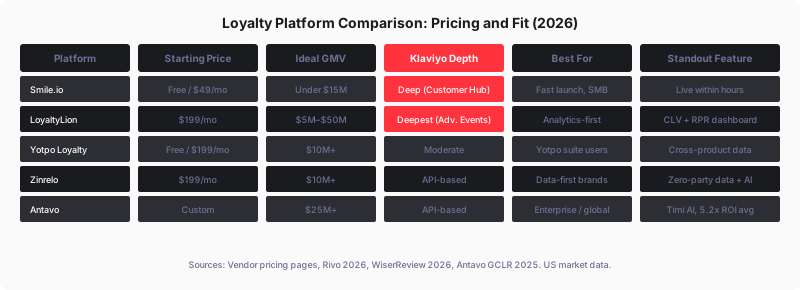
For DTC brands running email and SMS through Klaviyo, the loyalty platform is only as useful as the data it sends to Klaviyo. A platform that sends basic triggered emails but does not feed real-time tier status, points balance, and reward milestone data into Klaviyo segments cannot power the personalized flows that drive the retention benchmarks above.
LoyaltyLion's Advanced Klaviyo Events integration is the current category leader. It passes event-level data that Klaviyo can use to trigger flows, build dynamic segments, and personalize content based on loyalty status. Smile.io's Customer Hub integration is less flexible but more accessible: it surfaces loyalty data directly inside the native Klaviyo customer account portal without requiring custom development. The customer loyalty campaigns that consistently outperform are the ones where loyalty data is fully wired into the email and SMS stack, not sitting in a separate platform dashboard.
Custom loyalty platform builds cost $10,000 to $20,000 at MVP and $20,000 to $60,000 for full-featured versions, per Raftlabs' loyalty development cost analysis. First-year total costs including integrations, hosting, compliance infrastructure, and support run $30,000 to $80,000. A SaaS platform average spend is $14,200 per year, according to Rivo's platform cost data.
For ecommerce brands under $50 million GMV, SaaS loyalty platforms consistently deliver lower total cost of ownership than custom builds. SaaS platforms also ship product updates continuously, which means AI features, new channel integrations, and platform algorithm changes get incorporated without internal engineering resources. Custom builds require ongoing maintenance investment to stay current.
The only cases where custom builds make sense are brands above $100 million GMV with coalition loyalty programs, multi-country compliance requirements, or highly unique program mechanics that no platform supports. That is a narrow slice of the ecommerce market.
Enterprise migrations from legacy loyalty platforms take 4 to 12 months from decision to full decommission, per Antavo's loyalty replatforming research. The primary blockers are points balance migration accuracy, tier mapping, customer communication during the transition, and engineering bandwidth. Poor integration architecture is cited as a major challenge by 71% of loyalty program owners globally, per the Antavo GCLR 2025.
Choosing the right platform at each growth stage reduces switching frequency. The practical migration path for most DTC brands: Smile.io from launch to $5 million GMV, LoyaltyLion from $5 million to $25 million, and an enterprise platform like Antavo or Zinrelo above that. Some brands stay on LoyaltyLion past $25 million when the analytics depth and Klaviyo integration justify the continuity over a complex migration.
Across platforms and program types, the retention math is consistent. A 5% improvement in customer retention produces a 25 to 95% increase in profit, a benchmark rooted in Harvard Business School research. Customer loyalty programs that reach 40 to 60% of total revenue flowing through loyalty-eligible orders after 18 months are operating at the level that produces those margins.
For ecommerce brands evaluating their loyalty infrastructure alongside their demand generation programs, EmberTribe works on the acquisition side that fills the top of the funnel while retention programs improve the return on every customer acquired.

Good ads don't happen by accident. The brands consistently outperforming on Meta, TikTok, and Google share a set of creative principles grounded in how people actually pay attention, process information, and decide to buy. Understanding those principles is the clearest path to better performance without simply spending more.
According to Nielsen and Supermetrics research, creative quality accounts for up to 47-70% of campaign performance outcomes, making it the single highest-leverage variable in paid advertising. Audience targeting, bidding strategy, and placement all matter, but creative is where performance is won or lost before any of those levers are pulled.
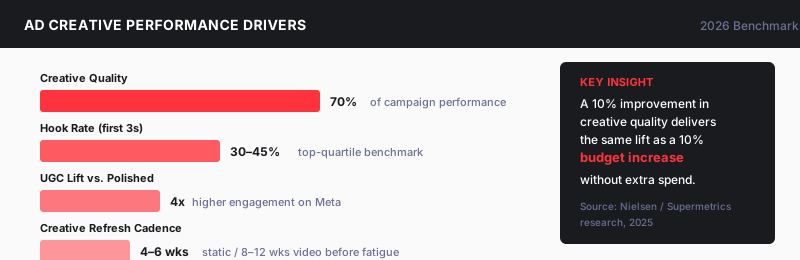
Across formats and platforms, high-performing ads share a handful of consistent traits. They communicate a clear benefit within the first few seconds. They feel native to the platform. And they give viewers a specific reason to act rather than a vague invitation to "learn more."
The following principles apply whether you're building static images for Google Display, short-form video for TikTok, or carousel ads for Meta Feed.
Platforms like Meta and TikTok use early engagement signals to decide how broadly to distribute your creative. A video that loses most viewers in the first three seconds signals low relevance to the algorithm, triggering reduced delivery and higher CPMs.
Research from Sovran's Meta ads analysis defines a strong hook rate as 25-30% for the Meta platform average, with top-quartile creatives reaching 35-45%. On TikTok, the average across analyzed accounts sits at 30.7%, while elite performers push past 40%. The practical takeaway: your first frame must earn the watch. State the problem, show an unexpected visual, or call out your target customer by name.
Good ads resist the temptation to say everything at once. Each piece of creative should communicate a single benefit or solve a single problem. The moment an ad tries to serve multiple messages, viewers' attention splits and the main offer gets lost.
This applies to copy length too. Lead with the most compelling claim in the headline. Use body copy to support, not introduce, the core promise. If your ad needs three sentences to get to the point, the hook is already working against you.
Formats perform differently across placements, and the gap is meaningful. Data from Superads and LeadsBridge's 2026 Meta analysis shows Reels delivering 26% lower CPC than Feed placements, making them the most cost-efficient format for top-of-funnel reach. Carousel ads can achieve 30-50% lower cost-per-click compared to static single-image ads when used correctly for product catalogs.
Video leads all formats in click-through rate at approximately 0.98% across Meta. But "video" is not a monolithic category. A 60-second brand story performs differently than a 15-second product demo. Match format to the job: awareness, consideration, or conversion.
TikTok's own Creative Center data shows ads mimicking organic creator content outperform polished brand videos by 22% on view-through rate. The same dynamic plays out on Meta Reels. When an ad looks like an ad from the first frame, viewers scroll past it faster than anything else in the feed.
This doesn't mean every creative needs to look lo-fi. It means every creative should feel like it belongs in the context where it's shown. On TikTok, that usually means vertical video with direct-to-camera delivery. On Google Display, it means clean visuals and a clear value proposition without clutter.
The debate between user-generated content and polished brand production has a clearer answer now than it did two years ago. According to admetrics and DTC brand analysis, UGC-style ads see 4x higher engagement than polished brand content on Meta, and 81% of ecommerce marketers report that real customer visuals outperform professional production.
The nuance: UGC wins on trust and conversion for most DTC categories. Polished creative wins on brand perception and higher-AOV purchases. The brands performing best in 2026 are running both, using a creative matrix that combines authentic customer content with professional brand assets, then letting performance data decide the allocation.
For DTC brands running paid social campaigns, starting with UGC and testing into polished creative is a lower-risk, higher-return approach in most categories under $150 AOV.
Understanding abstract principles is one thing. Seeing how they apply to specific formats is more useful.
Meta Feed (static or carousel): The best-performing static ads on Meta lead with a bold claim in the first line of copy, use an image that communicates the product benefit rather than the product itself, and include a CTA that's specific to the offer ("Get 20% off this week" vs. "Shop now").
Meta and Instagram Reels: Top-performing Reels hooks start with motion or a direct statement. The first two seconds show something unexpected or validate a viewer's problem. The middle third demonstrates the product. The final third shows social proof or states the offer with urgency.
TikTok: The platform rewards raw authenticity. First-person delivery, real-environment filming, and creator-style pacing outperform scripted ads. Overlaying text captions is critical because a significant share of TikTok is watched without sound.
Google Display and Performance Max: Clarity wins. The best Google display ads have a single dominant image, a headline under 5 words, and a CTA button that states the action. Avoid busy backgrounds or competing visual elements.
Even the best creative fatigues. According to 2026 performance benchmarks from Fluency, static creative should be refreshed every 4-6 weeks, while video creative typically has a longer shelf life of 8-12 weeks before performance degrades meaningfully.
Creative fatigue shows up as rising CPMs, falling CTRs, and declining hook rates on the same audience segments. The brands that avoid fatigue don't necessarily produce more creative: they test systematically and retire underperformers before spend compounds on a declining asset.
For a structured approach to testing creative at scale, the ad creative testing framework covers how to set up controlled experiments without polluting data across campaigns.
The gap between understanding creative principles and actually executing them consistently is where most brands lose ground. Here is a practical checklist for evaluating any ad before it goes live:
These are not complicated criteria. What's complicated is building the operational process to apply them consistently across every creative in rotation.
Good ads are not accidents, and they're not purely the product of creative talent. They come from a system: clear briefs, structured testing, performance monitoring, and a refresh cadence that treats creative as a continuous investment rather than a campaign deliverable.
The brands that work with experienced digital marketing firms to build that system consistently outperform those treating creative as a one-time expense. The difference shows up in CPM trends, hook rates, and ROAS stability over time.
If you're rebuilding your creative strategy or want an outside perspective on what your ad creative is missing, EmberTribe works with DTC and growth-stage brands to develop performance creative systems grounded in data. Reach out at embertribe.com to start a conversation.

Customer loyalty campaigns return $2.71 for every dollar invested in year one. By year three, that figure compounds to $7.93 per dollar, according to Smile.io's 2025 loyalty benchmark data. The compounding effect is what separates brands that treat loyalty as a retention tactic from those that treat it as a revenue system: the math gets dramatically better the longer the program runs.
This guide covers the campaign types that drive retention, the channel economics behind email, SMS, and referral, what separates tiered programs from flat-rate approaches, and the metrics that tell you whether a loyalty investment is working.
The core dynamic is that loyalty members change their behavior in measurable ways. Members who redeem rewards spend 2.5 times more than non-members, and brands with active loyalty programs see 28% higher customer retention and 18% higher average order value, according to LoyaltyLion's 2025 ecommerce loyalty benchmarks. Higher retention directly reduces reliance on paid acquisition: every customer who makes a third and fourth purchase reduces the customer acquisition cost burden on the next campaign cycle.
The compounding effect comes from behavioral lock-in. A customer tracking toward a tier upgrade or a reward threshold has an active reason to return before the competition reaches them. That friction to switch is structural, not emotional, which makes it more durable than brand preference alone.
The strongest loyalty programs combine multiple campaign types rather than relying on a single mechanism. Each type addresses a different behavioral lever.
Points-on-purchase campaigns are the foundation of most programs and the easiest to execute. Customers earn points per dollar spent and redeem them for discounts or products. The risk is commoditization: if every brand in your category runs a points program, it stops being a differentiator. Points programs work best when the earn rate is generous enough to feel meaningful within one to two purchase cycles.
Tiered programs create aspiration and urgency. Customers at higher tiers receive better earn rates, early access, or exclusive perks, and they are motivated to maintain their tier status even when they do not need to buy. Tiered programs deliver 1.8 times higher ROI than flat points programs, per Ringly.io's loyalty benchmarks, because the tier mechanic increases both purchase frequency and average order value simultaneously.
Referral campaigns are the highest-leverage loyalty investment at the growth stage. Referred customers have a higher lifetime value, lower churn rate, and 16% higher average spend than customers acquired through paid channels, per ReferralCandy's program data. Referral programs reduce new customer acquisition cost by 40 to 60 percent when the reward structure is calibrated correctly, typically a dual-sided incentive where both the referrer and the new customer receive value.
Three additional campaign types address the relationship layer, milestone timing, and win-back mechanics that points and referral programs do not cover on their own.
VIP and early-access campaigns reward top customers with exclusivity rather than purely monetary value. First access to new products, private sales, or direct access to a founder or brand team creates a relationship layer that points programs cannot replicate. Brands in premium and lifestyle categories find that exclusivity perks outperform discount perks for high-LTV customer segments.
Birthday and milestone campaigns activate at natural moments of receptivity. Customers are more likely to convert on a promotional offer during a personal milestone than during a general sale. Klaviyo data shows birthday campaigns generate 481% higher transaction rates than standard promotional emails.
Win-back campaigns target customers who have lapsed beyond their expected purchase window. A well-structured win-back sequence with a time-limited loyalty incentive reactivates 5 to 15% of lapsed customers who would otherwise require full paid acquisition cost to recover. Ecommerce marketing programs that include win-back in the loyalty stack reduce net customer attrition without increasing acquisition spend.
The channel choice for loyalty campaign delivery has significant ROI implications.
Email remains the highest-volume channel for loyalty communication. Customer acquisition through email costs $8 to $15 per retained customer, and email loyalty sequences consistently outperform broad promotional sends in conversion rate and revenue per send, per Baesman's loyalty channel analysis. The limitation is deliverability pressure: loyalty emails in crowded inboxes require strong subject line performance to generate opens.
SMS delivers the highest per-message ROI in the loyalty stack at $71 return per dollar invested, according to Omnisend's 2025 SMS benchmarks. SMS is most effective for time-sensitive triggers: expiring points reminders, tier upgrade notifications, and limited-access sale alerts. The constraint is that SMS lists are smaller than email lists for most brands, and high-frequency SMS fatigue customers faster than email.
Push notifications through a branded app or loyalty platform occupy a middle position: higher open rates than email, lower friction than SMS, but dependent on app install rates that most DTC brands have not achieved at scale.

The 1.8x ROI differential between tiered and flat programs is driven by two mechanics. First, tiered programs create what loyalty researchers call "aspirational spend": customers purchase specifically to reach or maintain a tier status, which increases purchase frequency beyond what they would have done without the tier structure. Second, higher-tier customers receive better earn rates, which compounds the points balance and increases redemption frequency.
Flat programs are easier to implement and communicate, which makes them the right starting point for brands under $2 million in annual revenue that do not have the operational infrastructure to manage multiple tier communications. The migration from flat to tiered is worth building when annual revenue exceeds $5 million and the retention data shows meaningful differences in LTV between high-frequency and low-frequency buyers.
Four platforms dominate ecommerce loyalty infrastructure: Smile.io, LoyaltyLion, Yotpo Loyalty, and Klaviyo's native loyalty tools.
Smile.io covers points, referrals, and VIP tiers with strong Shopify integration and starts at $49 per month. It is the most commonly deployed platform for brands under $5 million in revenue. LoyaltyLion offers deeper analytics and more customizable program structures, starting at $399 per month, and is better suited to brands with complex segmentation needs.
Yotpo Loyalty integrates tightly with Yotpo's review and SMS products, making it the strongest option for brands already in the Yotpo ecosystem. Klaviyo's native loyalty tools are earlier in development but offer the deepest integration with email and SMS flows for brands already on the platform.
Three metrics determine whether a loyalty program is generating returns worth the operational investment.
Redemption rate measures what percentage of earned points or rewards are actually used. A redemption rate below 20% signals that the earn rate is too low or the reward options are insufficiently compelling. A rate above 80% signals that the discount liability may be outpacing the retention benefit.
Repeat purchase rate for members versus non-members is the clearest signal of program effectiveness. If loyalty members are not purchasing at meaningfully higher rates than the baseline, the program is adding cost without changing behavior.
Program contribution to revenue measures what percentage of total revenue flows through loyalty-eligible orders. Brands with healthy programs typically see 40 to 60% of revenue from members after 18 months. Below 20% suggests the program is too small relative to the total customer base to have a meaningful retention impact.
For ecommerce brands building growth programs where retention efficiency compounds over time, EmberTribe works on the demand generation and content programs that fill the top of the funnel while loyalty programs improve the return on each acquired customer.

Paid search spending in the US crossed $110 billion in 2025, and the agency you choose to manage that investment will either compound your returns or quietly drain them. Most SEM agencies pitch the same credentials: Google Partner badges, certified specialists, and case studies from a different industry than yours. The difference between a good partner and an expensive mistake shows up in the details of how they structure campaigns, report results, and respond when performance slides.
This guide covers what search engine marketing agencies actually do, how pricing works, what to expect from the best ones, and the questions that reveal which category an agency falls into before you sign a contract.
A search engine marketing agency manages paid placement in search engine results, primarily through Google Ads and Microsoft Advertising. The core service covers campaign strategy, keyword research, ad copy development, bid management, and performance reporting. Most agencies also handle conversion tracking setup, audience segmentation, and landing page recommendations.
The scope has expanded significantly in recent years. Campaigns that once lived cleanly in keyword-based search now intersect with Performance Max, which blends Search, Shopping, Display, YouTube, and Discover into a single AI-managed budget. A competent search engine marketing services provider understands how to structure these campaigns, what signals to feed the algorithm, and where human judgment still outperforms automated defaults.
Beyond campaign mechanics, a strong SEM agency functions as a growth partner. They bring competitive intelligence, audience insights, and creative testing disciplines that translate raw ad spend into measurable revenue outcomes.
Pricing varies based on agency size, campaign complexity, and the fee structure the agency uses. Understanding the model matters because incentives differ across structures.
Percentage of ad spend is the most common model, typically ranging from 10% to 20% of monthly ad spend. At lower spend levels, a minimum monthly management fee usually applies, often between $1,500 and $3,000. This model aligns the agency's revenue with your spend, which creates a potential conflict: agencies benefit when you spend more, whether or not that additional spend is efficient.
Flat monthly retainer removes the spend-based incentive. Retainers for small to mid-market businesses typically range from $2,000 to $6,000 per month and are more common for agencies with defined service packages. This structure works well when budgets are stable and the scope of work is clearly defined.
Hourly billing is common for project-based engagements, audits, and consulting work. Rates from experienced SEM specialists run $100 to $300 per hour. Hourly arrangements are harder to budget for ongoing management but appropriate for discrete work.
Performance-based models tie fees to business outcomes rather than spend or time. These arrangements typically include a base retainer plus a variable component tied to revenue or leads. They are less common because measurement alignment is difficult to establish upfront, but they signal an agency confident enough in their work to share the risk.
For most growth-stage businesses, expect to pay $2,500 to $8,000 per month in management fees on top of ad spend. Budget less than that and you are either working with a small specialist or accepting a lower tier of service.
The technical baseline is not the differentiator. Any credentialed agency can build campaign structure, set up conversion tracking, and write ad copy. What separates the best search engine marketing companies is the quality of judgment they apply when the data is ambiguous, performance shifts, or the platform changes the rules.
Conversion architecture depth. Smart Bidding optimizes toward whatever signal you define as a conversion. The strongest agencies audit conversion definitions before launching anything, deduplicate events, apply value rules by customer segment, and build feedback loops from CRM data when the business goal is qualified leads rather than raw form fills. An agency that takes your existing conversion tracking at face value is skipping the most important upstream work.
Creative velocity. Performance Max and Demand Gen campaigns reward agencies that ship high volumes of creative across formats. Video assets, image variants, and headline combinations need regular refresh cycles, not quarterly updates. The best partners treat creative as a standing production workflow.
Negative keyword discipline. Broad match and Performance Max surface queries beyond your explicit keyword list. Without aggressive negative keyword management, spend leaks into irrelevant traffic, branded terms get cannibalized, and the algorithm learns from bad conversion signals. Weekly search term reviews are table stakes.
Diagnostic precision. When ROAS drops or CPA spikes, the explanation matters as much as the response. A strong agency can isolate whether the cause is auction pressure, match type drift, creative fatigue, landing page degradation, or tracking failure. Agencies that blame "the algorithm" or recommend increasing budget as a first response are operating without real diagnostic capability.
Platform currency. The paid search landscape changed substantially between 2024 and 2026. Agencies still pitching tightly themed exact-match ad groups and manual bidding as core strategy are a product cycle behind.
The right questions reveal operational capability faster than reviewing case studies or badge counts. Use these across any sem agency evaluation.
Ask the agency to walk through their first 30 days on a new account. A strong answer covers conversion audit, baseline performance benchmarking, campaign structural review, audience analysis, and a testing roadmap. A weak answer jumps immediately to campaign builds without mentioning measurement.
Ask how they handle Performance Max budget share versus standard Search campaigns for a business like yours. The answer should be specific to your situation, not a default recommendation.
Ask what they report on and how often. Look for a combination of leading indicators (CTR, Quality Score, impression share) and business outcomes (CPA, ROAS, revenue, lead quality). If the answer centers exclusively on clicks and impressions, that agency is not measuring what drives business results.
Ask what attribution model they use and why. There is no single right answer, but an agency that cannot articulate the tradeoffs between last-click, data-driven, and third-party attribution lacks the measurement sophistication your spend requires.
Ask whether you own the ad accounts and data if you end the relationship. Any reputable search marketing agency will confirm account ownership belongs to you. An agency that builds campaigns in their own MCC and withholds accounts on exit has engineered a lock-in, not a partnership.
Ask who specifically will work on your account and whether the senior person who sold you walks away after onboarding, leaving a junior coordinator to manage the day-to-day.
Ask how they communicate performance anomalies. A proactive agency surfaces problems before you notice them and brings a hypothesis alongside the alert. An agency that waits for you to ask is reactive by design.
If the agency cannot clearly explain where every dollar goes and what it is optimizing toward, that transparency gap will cost you.
Start with agencies that specialize in your business model. A DTC ecommerce brand has different campaign architecture needs than a B2B SaaS company or a local service business. Generalist agencies can be competent, but vertical specialists bring pattern recognition that shortens the optimization learning curve.
Check whether they use your ad budget to experiment on your behalf or charge separately for testing. The best agencies build creative and landing page testing into the core engagement, not as an upsell.
Ask for references from clients in a similar growth stage. Case studies from enterprise brands do not tell you how the agency operates when the monthly budget is $20,000 rather than $2 million. Understanding what is Google Adwords and how it connects to a broader growth strategy is the foundation any good SEM partner builds on.
Look for agencies that can speak fluently to your full growth picture. Paid search does not operate in isolation. The best partners understand how paid search interacts with SEO, landing page conversion rates, and customer lifetime value in ways that make their channel contribution legible.
Before engaging an agency, WordStream's paid search resource center and the Google Ads Help Center provide useful grounding on what the channel covers.
The first three months with any SEM agency should follow a clear progression. The first 30 days are diagnostic: account audit, conversion verification, baseline benchmarking, and initial campaign restructuring if needed. Days 31 through 60 introduce new tests, clean up technical issues, and begin generating performance data under the agency's management. By day 90, you should have enough signal to evaluate whether their strategic hypotheses are translating to improved outcomes.
If an agency promises significant revenue impact in the first 30 days, treat that with skepticism. Smart Bidding systems require conversion data volume to optimize accurately, and account restructuring often causes short-term performance dips before performance improves. An agency that sets realistic early expectations is more trustworthy than one that overpromises to close the deal.
The right SEM agency brings a point of view on your business, not just your campaigns. When the prospecting calls focus entirely on what they will do inside the platform and nothing on how they will understand your margins, customer quality, and revenue model, that conversation is telling you something important about how the engagement will go.

Businesses that run Google Ads well earn an average of $2 for every $1 spent, and Google itself estimates the platform can deliver up to 800% ROI for advertisers who structure their campaigns correctly. The gap between those results and the advertisers who burn through budget without traction almost always comes down to setup decisions made in the first few hours. This guide walks you through every step, from opening your account to launching a campaign built to convert.
Before logging into Google Ads, two things need to be in place: a Google account linked to your business and a clear conversion goal. That goal could be a purchase, a form submission, a phone call, or a page visit. Without it, you have no signal to optimize toward and no way to know whether your spend is working.
You also need a landing page that matches your ad's promise. Sending traffic to a generic homepage is one of the most common reasons new campaigns underperform. The page a user lands on should directly address whatever the ad offered.
Go to ads.google.com and sign in with your Google account. Google will walk you through a "Smart campaign" setup by default, but skip past it to access Expert Mode. Expert Mode gives you access to all campaign types, full bidding controls, and manual keyword management, which is what you need to run campaigns that scale.
Set your billing country, time zone, and currency carefully. These settings cannot be changed after account creation and affect how your reporting data lines up with your business records.
Conversion tracking is the most important step in this entire process, and it comes before you create a single campaign. In Google Ads, go to Tools, then Measurement, then Conversions. Define your conversion action, whether that is a purchase, a lead form, or a button click.
Install the Google tag on your site and set up the specific conversion event. For purchase-based businesses, enhanced conversions are worth enabling immediately. Enhanced conversions use hashed first-party data to improve measurement accuracy by 20 to 30%, which means your bidding algorithms have better data to work with from day one. Without solid conversion tracking, automated bidding strategies have nothing to learn from.
Google Ads offers several campaign types, each suited to a different goal. For most brands running their first campaign, Search is the right starting point.
Search campaigns show text ads to people actively searching for your product or service. They capture high-intent traffic, and the keyword control makes them easier to manage than other formats. Understanding the full landscape of search advertising helps you fit Search campaigns into a broader paid media strategy.
Performance Max campaigns run across all Google inventory, including Search, Display, YouTube, Gmail, and Shopping, using Google AI to allocate budget. They work best when you already have conversion history and creative assets ready. Starting a brand-new account with PMax before you have conversion data usually leads to wasted spend in the first few weeks.
Shopping campaigns are built for ecommerce and pull product data from your Merchant Center feed. If you sell physical products, a well-structured ecommerce PPC approach treats Shopping and Search as complementary rather than competing channels.
Display and Video campaigns run on Google's network of websites and on YouTube. They are better suited for awareness and retargeting than for direct response in most cases.
Campaign structure directly affects your Quality Score, your budget efficiency, and your ability to read performance data. A common mistake is putting every keyword into one ad group with generic ad copy. Tight structure prevents this.
Organize campaigns around a single product category, service line, or funnel stage. Inside each campaign, create ad groups around tightly related keyword themes. Each ad group should have five to fifteen closely related keywords and ad copy that speaks directly to that specific intent. When your keywords, ads, and landing page all point to the same topic, Google rewards you with a higher Quality Score, which lowers your cost per click.
Keywords are the mechanism that connects your ads to the right search queries. Start with terms your customers actually use, not internal product terminology. Tools like Google Keyword Planner are built into your account and show estimated search volume and bid ranges for any term.
Use a mix of match types strategically. Exact match gives you precise control over which queries trigger your ads. Phrase match expands reach to queries containing your keyword phrase. Broad match, especially when paired with Smart Bidding, lets Google's algorithm discover related queries, but it requires enough conversion data to work well.
Negative keywords are just as important as your target keywords. Add irrelevant terms from the start so your budget is not wasted on queries that will never convert. Review your search terms report weekly in the early weeks of a campaign to catch new negatives before they accumulate cost.
If you want to see what queries are driving results for competitors, reverse-engineering a competitor's keyword strategy can surface opportunities you would not have found through keyword tools alone.
Google Search ads use a Responsive Search Ad format. You provide up to fifteen headlines and four descriptions, and Google tests combinations to find what performs best. Write headlines that include your primary keyword, a specific benefit, and a call to action. Avoid vague phrases like "great service" or "learn more." Specificity converts better.
Pin a headline only when accuracy requires it, such as a brand name or a specific offer. Otherwise, letting Google rotate through combinations gives the algorithm more data to optimize. Include at least one description that provides proof, whether that is a number, a guarantee, a result, or a customer outcome.
Enable ad extensions, now called assets, across the board. Sitelinks, callouts, structured snippets, and call assets expand your ad's footprint on the search results page and improve click-through rate without adding cost per click.
Bidding strategy determines how Google spends your budget and how aggressively it competes in each auction. The right strategy depends on where your account is in its data lifecycle.
For a new account with no conversion history, start with Maximize Clicks with a cost-per-click cap. This gets impressions and clicks while limiting exposure until your tracking is validated. Once you have at least 30 conversions in a 30-day window, switch to Maximize Conversions. After you reach 50 or more weekly conversions consistently, you can layer in a Target CPA to hold Google to a specific cost per acquisition.
Target ROAS is the right choice once you have consistent purchase data and want to optimize for revenue rather than conversion volume. It works well for ecommerce brands where order values vary and you want Google to prioritize higher-value transactions. According to Google's own bidding guidance, Smart Bidding strategies perform best when campaigns are given enough conversion data and are not interrupted by frequent structural changes.
Set a daily budget at the campaign level. A realistic starting budget for Search is enough to generate at least ten to twenty clicks per day based on the average CPC in your category. The average CPC across all industries in Google Ads is $4.22, so a $50 to $100 daily budget gives you enough volume to start seeing meaningful data within a week.
Review your campaign settings before going live. Confirm that your location targeting is set to your actual service area, not a broader default. Check that the Google Search Network is included and that Search Partners and Display Network are turned off until you have baseline data.
Set an ad schedule only if you have a specific business reason to limit hours. Otherwise, let the campaign run and use the data to identify any time-of-day patterns worth acting on.
Google Ads is not a set-it-and-forget-it channel. The first two weeks are about validating your tracking and catching early issues. After that, shift to a weekly optimization rhythm.
Each week, review your search terms report and add negatives, check quality scores by ad group, and compare conversion rates across keywords. Pause keywords that have spent beyond three times your target CPA without converting. Test one new headline or description variant per ad group per month rather than changing everything at once. Isolating variables is the only way to know what actually moved the needle.
Monthly, assess campaign-level performance against your goals, review impression share to understand whether budget or bid constraints are limiting reach, and consider whether your landing pages need updates based on the traffic data you are collecting.
For brands that want support building campaigns from scratch or scaling an existing account, EmberTribe's Google Ads management services cover full-funnel paid search strategy built around measurable growth.
Google Ads excels at capturing demand that already exists. When someone searches for what you offer, Search campaigns put your brand in front of them at exactly the right moment. That makes it one of the most efficient channels for converting high-intent prospects.
What it cannot do is create demand for something people are not actively searching for. If your product or category is new to the market, you may need Display or Video campaigns to build awareness before Search campaigns can reach their potential. Understanding how Google Ads works as a platform gives you a sharper view of where it fits in your overall growth model.
The brands that get the most from Google Ads treat it as a data system, not just an advertising channel. Every campaign generates information about what your customers are searching for, what language converts, and which offers drive action. Run it with that lens and you are building an asset that compounds over time.
Sources:
The distinction that separates high-performing retail brands from the rest is not how many channels they operate. It is whether those channels share a single view of inventory, customer data, and purchase history. That distinction is the difference between multichannel and omnichannel commerce, and the performance gap between them is large enough that every growth-stage brand building a channel strategy needs to understand it clearly.
Omnichannel commerce means a customer's cart, purchase history, support interactions, and preferences follow them across every touchpoint. A study of 46,000 shoppers by Harvard Business Review found that 73% of buyers use multiple channels during a single shopping journey, and that customers who engaged across four or more channels spent 9% more in-store than single-channel shoppers and logged 23% more repeat visits within six months of an omnichannel experience. The compounding effect on retention and lifetime value is why Manhattan Associates' 2025 Omnichannel Trends research shows only 17% of retailers have mature capabilities despite 54% listing it as their top strategic priority.
The vocabulary matters because confusing these terms leads to misallocated investment.
Multichannel means selling across multiple independent channels: a website, Amazon, retail stores, social commerce. Each channel operates with its own inventory count, its own customer data, and its own messaging. A brand can be present on six channels and still be multichannel. The internal question for multichannel is: how do we get the most out of each channel independently?
Omnichannel connects those channels into a coordinated customer experience. The customer's identity and behavior history follow them across touchpoints. A buyer who browses on mobile, adds to cart on desktop, and purchases in-store is recognized as the same customer across the journey. The internal question shifts to: how do we give each customer the best experience regardless of where they engage?
Unified commerce is where omnichannel is heading in 2025 and 2026. The distinction, articulated by Sitoo's unified commerce research, is in the architecture. Omnichannel often connects existing siloed systems via APIs and middleware. Unified commerce runs all channels from a single backend: one order management system, one inventory ledger, one customer record, no integration layer to maintain.
Brands with unified commerce report 27% lower fulfillment costs and 18% reduced cart abandonment, per Manhattan Associates data.
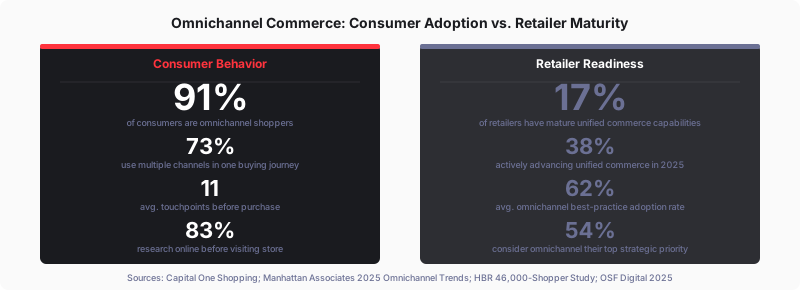
The numbers from Capital One Shopping's omnichannel statistics research show the magnitude of what is at stake. Companies with strong omnichannel engagement retain 89% of customers, compared to 33% for brands with weak omnichannel strategy. Omnichannel customers spend 16% more per order and purchase 250% more frequently. Their lifetime value is 30% higher.
The HBR finding that 73% of shoppers use multiple channels in a single journey, combined with 91% of consumers qualifying as omnichannel shoppers, means the question for most brands is not whether to pursue omnichannel. It is how far behind they currently are and what the cost of that gap is in retention, LTV, and competitive position.
The market is moving. Capital One Shopping's omnichannel research reports that curbside pickup increased conversion rates by 25.8% in 2024 among the top 1,000 retailers. Real-time inventory visibility online drives significant cart completion improvements when customers can see whether a product is available at a nearby location.
The infrastructure investment is what separates a genuine omnichannel program from channel coordination with good marketing. The core components:
The brands executing omnichannel at scale demonstrate the revenue impact concretely. Warby Parker started as a direct-to-consumer online brand and now operates 276 or more stores generating 70% of total revenue. Full year 2024 revenue reached $771.3 million with 15.2% year-over-year growth, per Warby Parker's Q4 2024 results.
Physical stores did not cannibalize digital. They amplified total customer acquisition and LTV by bringing try-on and optometry into the physical world while keeping digital as the discovery and repurchase layer.
Starbucks runs 70% of US sales through mobile and drive-thru orders. Its 31 million active loyalty members generate over 50% of US revenue and spend three times more than non-members. The deep brew AI system personalizes recommendations across the app, drive-thru, and in-store touchpoints from a single customer data record.
Sephora has unified online and offline customer profiles since 2010. The Color IQ tool links in-store skin tone scans to customer profiles and surfaces personalized online product recommendations in subsequent digital sessions. That single data integration turns a physical in-store moment into a durable digital personalization signal.
Most omnichannel failures trace to a small set of structural problems that brands underestimate before launch.
The 91% consumer omnichannel adoption rate versus 17% retailer maturity rate defines a competitive landscape where the gap between infrastructure leaders and laggards is widening. The brands getting this right are demonstrating the results: 89% customer retention, 250% purchase frequency lift, 30% LTV premium. The brands behind the curve are funding customer acquisition into a leaky retention system.
For growth-stage DTC and ecommerce brands evaluating their channel infrastructure and cross-channel marketing strategy, EmberTribe works with brands on the demand generation and channel investment decisions that determine whether omnichannel infrastructure pays off or underperforms.


.svg)