
Picking the wrong FB ads agency costs you more than the monthly retainer. It costs you months of stalled growth, creative that never improves, and data you can't use after you leave. For DTC brands running serious budgets on Meta, the agency selection decision carries real stakes.
This guide cuts through the noise: what a strong facebook ads agency actually does, how to evaluate candidates before you sign, what pricing structures to expect, and what results a competent meta ads agency should deliver.
A facebook advertising agency manages your paid campaigns across Meta's platforms: Facebook, Instagram, and the Audience Network. That scope includes campaign strategy, audience architecture, creative production and testing, budget allocation, and performance reporting.
The agencies that consistently deliver for DTC brands go further. They operate as a creative testing engine, producing a high volume of ad variations every month to feed Meta's algorithm with fresh signal. The best facebook ads agencies run 50 or more creative assets per month per client, with clear testing cadences that isolate variables rather than guessing.
What separates a strong meta ads agency from a reseller or generalist is specialization. An agency that understands DTC unit economics, contribution margin, and blended return on ad spend will make different (and better) decisions than one optimizing for platform-reported ROAS in isolation.

Creative is the primary performance lever on Meta. The algorithm has enough data to find buyers if you give it enough quality signal. An agency that produces 5-10 creative assets per month and calls it "testing" is not testing anything meaningful.
Ask specifically: how many creative variants do you produce per client per month? How do you structure tests? What is your process for identifying a winning angle and scaling it? A credible best fb ads agency can answer these questions with specifics, not vague references to "our proven process."
This is non-negotiable. Your Business Manager, your ad account, and your pixel should all be owned by your company, with the agency added as a partner. If an agency insists on running ads from their own account, you lose all your historical data, custom audiences, and pixel history the moment the engagement ends. That is a structural conflict of interest, and it is one of the clearest red flags in any agency evaluation.
Any agency can report clicks, reach, and impressions. A strong meta ads agency ties campaign performance to real business outcomes: cost per acquisition, marketing efficiency ratio, new customer acquisition cost, and contribution margin. If their reporting centers on platform-reported ROAS without accounting for attribution windows or channel overlap, that is a sign they are managing to the dashboard rather than to your business.
For DTC brands with margins of 30-40%, a blended Meta ROAS of 3.5x to 4.5x on a 7-day click basis is a healthy target in 2026. Retargeting campaigns can reach 6x to 10x, while prospecting typically starts at 2x to 3x. Any agency quoting you guaranteed results without understanding your margin structure is making promises they cannot keep.
An ecommerce brand needs a different agency than a B2B SaaS company. Ask for case studies from clients in your category, at your spend level. Look for specifics: what ROAS did they achieve, at what budget, in which vertical?
Vague testimonials and logo walls are not evidence. Sanitized dashboards with real performance metrics are.
For more on how Meta fits into a broader paid strategy, see our breakdown of meta advertising fundamentals.
Facebook advertising agencies typically use one of three pricing structures, and each creates different incentives.
Flat monthly retainer: The most straightforward model. For smaller accounts (under $10,000 in monthly ad spend), expect retainers between $1,000 and $3,000. Mid-market advertisers ($10,000-$50,000 in spend) typically pay $2,500 to $6,000 monthly. Enterprise accounts above $50,000 often negotiate custom rates above $10,000. Flat retainers align well with scope-defined work and give you predictable costs.
Percentage of ad spend: Commonly set at 10%-20% of monthly spend, with lower percentages for larger budgets. This model creates a structural problem: the agency earns more when you spend more, regardless of efficiency. It is not always a dealbreaker, but it means you need to watch budget decisions carefully.
Hybrid retainer plus performance bonus: A smaller base fee combined with additional compensation when defined targets are hit. This can align incentives well, but the performance metrics need to be agreed on in advance and must be tied to real business outcomes, not platform metrics.
Most agencies also charge a one-time setup fee ranging from $500 to $3,000 to audit your account, restructure campaigns, and configure tracking. Factor this into your total cost of engagement. According to Meta's own advertising resources, proper account structure and pixel setup are foundational to campaign performance, so agencies that skip this step are cutting corners.
Some warning signs appear before you even sign a contract.
Guaranteed ROAS: No agency can guarantee specific returns. Meta's auction environment, your creative quality, your landing page, your offer, and your margins all affect performance. An agency that promises a specific ROAS is either lying or planning to misattribute results.
Vanity metric reporting: If their sample reports show impressions, likes, and follower growth without CPA or revenue data, their definition of success is not aligned with yours.
Opaque team structure: Ask during the sales process to meet the team that will actually manage your account. Agencies that deflect this request often assign junior or outsourced staff after the contract is signed. The person selling you the engagement should be able to introduce you to your day-to-day contact.
Percentage-of-spend pricing without accountability: If the pricing model rewards spend growth rather than efficiency, watch for campaigns that run well past their productive window and resistance to scaling back even when margins compress.
No creative production capability: If they manage the campaigns but rely entirely on you to produce creative, they cannot execute fast-enough testing cadences. In-house creative production enables tighter feedback loops between performance data and creative decisions.
For additional context on evaluating service providers across paid and organic channels, our guide on SEM marketing agency selection covers overlapping evaluation criteria.
The interview process matters as much as the pitch deck. These questions reveal operational competence rather than sales polish.
A strong facebook advertising agency should be moving key metrics within 60 to 90 days of launch. Early indicators include improving creative performance signals (higher click-through rates, lower CPMs as the algorithm optimizes), not just end-of-funnel ROAS.
By month three, you should see a clear picture of which creative angles and audience structures perform, a declining cost per acquisition trend, and reporting that connects campaign activity to business outcomes. Meta's Advantage+ Shopping campaigns, when properly structured, have delivered a 32% lower cost per acquisition compared to manual configurations across ecommerce verticals in recent benchmark data.
If you are not seeing movement on CPA by month three, that is not a "Meta problem" or a seasonality issue. That is an agency execution problem.
For DTC brands scaling to six or seven figures in monthly ad spend, the right fb ads agency becomes a core growth infrastructure decision. It connects directly to your broader ecommerce growth strategy, particularly how paid acquisition interacts with retention, email, and organic channels. Our guide on ecommerce digital marketing covers how Meta fits into a full-funnel DTC growth model.
The best fb ads agency for your brand is not necessarily the biggest or the cheapest. It is the one that owns creative testing as a competency, aligns its incentives with your outcomes, gives you full account ownership, and reports against metrics that connect to your margins.
Treat the selection process as seriously as a key hire. Ask hard questions. Demand specific answers. And walk away from any agency that cannot show you real results from real clients.
If you want to see how EmberTribe approaches Meta advertising for DTC brands, we break down our exact framework here.
Sources:

Picking the wrong FB ads agency costs you more than the monthly retainer. It costs you months of stalled growth, creative that never improves, and data you can't use after you leave. For DTC brands running serious budgets on Meta, the agency selection decision carries real stakes.
This guide cuts through the noise: what a strong facebook ads agency actually does, how to evaluate candidates before you sign, what pricing structures to expect, and what results a competent meta ads agency should deliver.
A facebook advertising agency manages your paid campaigns across Meta's platforms: Facebook, Instagram, and the Audience Network. That scope includes campaign strategy, audience architecture, creative production and testing, budget allocation, and performance reporting.
The agencies that consistently deliver for DTC brands go further. They operate as a creative testing engine, producing a high volume of ad variations every month to feed Meta's algorithm with fresh signal. The best facebook ads agencies run 50 or more creative assets per month per client, with clear testing cadences that isolate variables rather than guessing.
What separates a strong meta ads agency from a reseller or generalist is specialization. An agency that understands DTC unit economics, contribution margin, and blended return on ad spend will make different (and better) decisions than one optimizing for platform-reported ROAS in isolation.
Creative is the primary performance lever on Meta. The algorithm has enough data to find buyers if you give it enough quality signal. An agency that produces 5-10 creative assets per month and calls it "testing" is not testing anything meaningful.
Ask specifically: how many creative variants do you produce per client per month? How do you structure tests? What is your process for identifying a winning angle and scaling it? A credible best fb ads agency can answer these questions with specifics, not vague references to "our proven process."
This is non-negotiable. Your Business Manager, your ad account, and your pixel should all be owned by your company, with the agency added as a partner. If an agency insists on running ads from their own account, you lose all your historical data, custom audiences, and pixel history the moment the engagement ends. That is a structural conflict of interest, and it is one of the clearest red flags in any agency evaluation.
Any agency can report clicks, reach, and impressions. A strong meta ads agency ties campaign performance to real business outcomes: cost per acquisition, marketing efficiency ratio, new customer acquisition cost, and contribution margin. If their reporting centers on platform-reported ROAS without accounting for attribution windows or channel overlap, that is a sign they are managing to the dashboard rather than to your business.
For DTC brands with margins of 30-40%, a blended Meta ROAS of 3.5x to 4.5x on a 7-day click basis is a healthy target in 2026. Retargeting campaigns can reach 6x to 10x, while prospecting typically starts at 2x to 3x. Any agency quoting you guaranteed results without understanding your margin structure is making promises they cannot keep.
An ecommerce brand needs a different agency than a B2B SaaS company. Ask for case studies from clients in your category, at your spend level. Look for specifics: what ROAS did they achieve, at what budget, in which vertical?
Vague testimonials and logo walls are not evidence. Sanitized dashboards with real performance metrics are.
For more on how Meta fits into a broader paid strategy, see our breakdown of meta advertising fundamentals.
Facebook advertising agencies typically use one of three pricing structures, and each creates different incentives.
Flat monthly retainer: The most straightforward model. For smaller accounts (under $10,000 in monthly ad spend), expect retainers between $1,000 and $3,000. Mid-market advertisers ($10,000-$50,000 in spend) typically pay $2,500 to $6,000 monthly. Enterprise accounts above $50,000 often negotiate custom rates above $10,000. Flat retainers align well with scope-defined work and give you predictable costs.
Percentage of ad spend: Commonly set at 10%-20% of monthly spend, with lower percentages for larger budgets. This model creates a structural problem: the agency earns more when you spend more, regardless of efficiency. It is not always a dealbreaker, but it means you need to watch budget decisions carefully.
Hybrid retainer plus performance bonus: A smaller base fee combined with additional compensation when defined targets are hit. This can align incentives well, but the performance metrics need to be agreed on in advance and must be tied to real business outcomes, not platform metrics.
Most agencies also charge a one-time setup fee ranging from $500 to $3,000 to audit your account, restructure campaigns, and configure tracking. Factor this into your total cost of engagement. According to Meta's own advertising resources, proper account structure and pixel setup are foundational to campaign performance, so agencies that skip this step are cutting corners.
Some warning signs appear before you even sign a contract.
Guaranteed ROAS: No agency can guarantee specific returns. Meta's auction environment, your creative quality, your landing page, your offer, and your margins all affect performance. An agency that promises a specific ROAS is either lying or planning to misattribute results.
Vanity metric reporting: If their sample reports show impressions, likes, and follower growth without CPA or revenue data, their definition of success is not aligned with yours.
Opaque team structure: Ask during the sales process to meet the team that will actually manage your account. Agencies that deflect this request often assign junior or outsourced staff after the contract is signed. The person selling you the engagement should be able to introduce you to your day-to-day contact.
Percentage-of-spend pricing without accountability: If the pricing model rewards spend growth rather than efficiency, watch for campaigns that run well past their productive window and resistance to scaling back even when margins compress.
No creative production capability: If they manage the campaigns but rely entirely on you to produce creative, they cannot execute fast-enough testing cadences. In-house creative production enables tighter feedback loops between performance data and creative decisions.
For additional context on evaluating service providers across paid and organic channels, our guide on SEM marketing agency selection covers overlapping evaluation criteria.
The interview process matters as much as the pitch deck. These questions reveal operational competence rather than sales polish.
A strong facebook advertising agency should be moving key metrics within 60 to 90 days of launch. Early indicators include improving creative performance signals (higher click-through rates, lower CPMs as the algorithm optimizes), not just end-of-funnel ROAS.
By month three, you should see a clear picture of which creative angles and audience structures perform, a declining cost per acquisition trend, and reporting that connects campaign activity to business outcomes. Meta's Advantage+ Shopping campaigns, when properly structured, have delivered a 32% lower cost per acquisition compared to manual configurations across ecommerce verticals in recent benchmark data.
If you are not seeing movement on CPA by month three, that is not a "Meta problem" or a seasonality issue. That is an agency execution problem.
For DTC brands scaling to six or seven figures in monthly ad spend, the right fb ads agency becomes a core growth infrastructure decision. It connects directly to your broader ecommerce growth strategy, particularly how paid acquisition interacts with retention, email, and organic channels. Our guide on ecommerce digital marketing covers how Meta fits into a full-funnel DTC growth model.
The best fb ads agency for your brand is not necessarily the biggest or the cheapest. It is the one that owns creative testing as a competency, aligns its incentives with your outcomes, gives you full account ownership, and reports against metrics that connect to your margins.
Treat the selection process as seriously as a key hire. Ask hard questions. Demand specific answers. And walk away from any agency that cannot show you real results from real clients.
If you want to see how EmberTribe approaches Meta advertising for DTC brands, we break down our exact framework here.
Sources:

Meta advertising remains the highest-volume paid acquisition channel for DTC brands in 2026. Facebook and Instagram together reach more than 3 billion daily active users, and Triple Whale data shows that brands running performance campaigns still allocate 68% of their total ad budget to Meta. But the playbook that worked in 2022 is obsolete. Two major shifts, a new ranking algorithm called Andromeda and a fundamental redesign of campaign automation through Advantage+, have changed how ads get delivered, which creative wins, and how DTC brands need to structure their accounts.
This guide covers what the platform looks like now, how to structure campaigns that compound, and where brands leave the most performance on the table.
Meta's Andromeda update, announced in December 2024 and fully rolled out by October 2025, is the most significant change to the ad delivery system since Advantage+ campaigns launched in 2022. The shift is conceptual as much as technical: Meta moved from an audience-first model to a creative-first delivery model. The system now matches the most relevant creative to each individual user based on thousands of behavioral signals, rather than showing your ad to everyone in a predefined audience.
The infrastructure behind this shift is substantial. Andromeda enables a 10,000x increase in model complexity and uses NVIDIA Grace Hopper Superchips alongside Meta's own MTIA hardware. Meta's internal testing shows +6% recall improvement and +8% ad quality improvement on selected segments. From a practical standpoint, this means your creative assets are now the primary lever for distribution, not your audience targeting.
What that means for advertisers: broad targeting outperforms narrow targeting because the model needs room to find the best creative-to-user match across a large pool. Tightly constrained audiences limit the algorithm's ability to optimize. Meta now officially recommends minimal audience constraints as default campaign behavior.
Creative diversity requirements also increased significantly. Meta's internal guidance post-Andromeda recommends 8 to 15 distinct creative assets per ad set, with each asset representing a meaningfully different angle, format, or message. The algorithm has similarity detection built in: near-duplicate variations are recognized and deprioritized.
Volume alone does not satisfy the requirement. Brands need genuine creative variety across hooks, formats, and messages to give the algorithm sufficient input for effective distribution.
Understanding where your account stands requires current reference points. US CPM on Meta averaged $23.00 in 2026, against a global median of $13.48. CPMs follow a predictable seasonal pattern: the global median opened at $17.73 in January 2025, peaked at $25.22 in November during Q4, then reset to $15.74 in January 2026 before climbing again. For DTC brands planning budgets, this seasonality means Q4 costs roughly 40% more per impression than Q1.
ROAS benchmarks for ecommerce brands on Meta sit at a median of 1.93x across all categories, but that number is not a target. For a DTC brand to be profitable, a 3x to 4x ROAS is the practical floor, and top performers regularly achieve 8x or higher on well-optimized accounts. Creative quality is now the single biggest driver: 70 to 80% of Meta ad performance is attributed to creative quality, and video ads under 15 seconds outperform longer formats by 31% on click-through rate.
The diagram below compares Advantage+ Shopping and manual campaigns across the metrics that matter most for DTC brands:

The debate over Advantage+ Shopping versus manual campaign structures is more nuanced than most guides acknowledge. Advantage+ Shopping Campaigns (ASC) use AI to automatically test up to 150 creative combinations and reallocate budget dynamically. The aggregate ROAS numbers favor Advantage+: Black Friday 2024 testing showed ASC delivering 3.14x ROAS versus 2.70x for manual campaigns. But ROAS is not the full picture.
Wicked Reports analyzed 55,661 Meta campaigns and found a meaningful divergence in new customer acquisition cost. Advantage+ campaigns saw new customer acquisition cost climb from $257 in May 2024 to $528 in May 2025, more than doubling in twelve months. Manual campaigns held stable or slightly improved over the same period. The implication is that Advantage+ re-converts existing customers at a good ROAS but struggles to acquire net-new buyers cost-effectively, which matters significantly for growth-stage DTC brands where new customer growth is the primary objective.
The practical recommendation based on 2025-2026 data is a hybrid structure: Advantage+ for bottom-of-funnel retargeting, where its creative testing and budget reallocation work best, and manual campaigns for top-of-funnel cold traffic where advertiser-defined audiences control who actually sees the ads. This split gives you the AI efficiency for conversion-ready audiences while preserving cost control on new customer acquisition.
Effective meta advertising strategy for DTC brands in 2026 is built on three pillars: creative system, campaign structure, and measurement discipline.
Creative system. Post-Andromeda, creative velocity is the primary competitive advantage. Brands running 10 to 20 unique creative concepts per campaign outperform brands recycling the same 3 to 5 assets. The key word is "concepts," not variations. Slight copy changes or recolored backgrounds register as near-duplicates and receive limited distribution.
Distinct angles mean different hooks, formats, and messages targeting different awareness stages. Video ads under 15 seconds, with a hook that communicates the offer or problem within the first 2 seconds, consistently outperform longer content on Meta's current algorithm.
Campaign structure. Simplified structures outperform complex ones. Meta now recommends fewer ad sets with more creative per set, letting the algorithm allocate budget within a broad audience rather than spreading spend across many narrow targeting groups. For a DTC brand starting a new campaign, a single Advantage+ ad set with 10 to 15 creatives loaded at launch gives the algorithm the input it needs to find early signals without fractured data.
Measurement discipline. Meta's Aggregated Event Measurement (AEM) was updated in 2025 to remove the 8-event limit and auto-process eligible conversion events. This simplifies setup but raises the stakes on understanding what the model is measuring. Meta's conversion API remains essential for DTC brands running any significant volume: server-side events supplement browser-based tracking and improve signal quality for both optimization and attribution. Accounts with strong CAPI implementation consistently show lower CPAs and faster learning phase exits.
Meta's bidding system gives DTC brands three primary levers: cost per result goal, ROAS goal, and highest volume (no bid cap). For brands with fewer than 50 weekly conversions per ad set, highest volume bidding is the correct starting point. Cost-per-result and ROAS goal bidding require a sufficient conversion volume to function, and constraining the bid before the algorithm has enough data produces underdelivery and poor results.
Advantage+ Audiences, Meta's AI-powered audience tool, is now the recommended setting for most campaigns. It uses a "suggestion" rather than a constraint: you provide seed audience data and the algorithm expands from there. This works better than manual interest stacking for established brands with existing pixel data. For brands newer to the platform, a broad open targeting approach with Advantage+ Audiences enabled is a better starting point than narrow interest targeting, which the algorithm will override anyway as it learns.
Budget scaling follows a 20% weekly increment rule as a ceiling, not a floor. Scaling faster than that resets the learning phase and can cause delivery instability. For DTC brands running Advantage+ Shopping, budget can often be scaled more aggressively because the campaign type is designed for stability at higher spend levels, but the principle of gradual testing still applies when moving into new creative strategies or audience territory.
Creative quality determines performance more than any structural or bidding decision. The benchmarks are clear: hook rate above 30% on ecommerce video ads and video length under 15 seconds are the two variables most correlated with strong CTR and downstream conversions. Understanding what makes a good ad is the foundation before any of the campaign mechanics matter.
The formats performing best for DTC brands right now include: lo-fi UGC video with a clear problem-solution structure, static image ads with bold typography and one primary value claim, and carousel formats showing product benefits rather than product photos. The common thread is specificity. Generic brand awareness creative performs poorly on Meta's current algorithm because it generates low engagement signals, which the model interprets as poor creative quality and limits distribution.
For ecommerce digital marketing more broadly, Meta is one piece of a larger acquisition system. The brands that get the most from their Meta spend typically run it in coordination with strong email and SMS retention programs, because the repeat purchase revenue that comes from retained customers is what makes the blended economics of Meta acquisition work at scale.
For brands spending above $30,000 per month on Meta, the complexity of managing Advantage+, Andromeda-optimized creative systems, AEM configuration, and incrementality measurement justifies a dedicated partner. A paid social media agency that specializes in Meta can compress the learning curve significantly and bring test-and-learn infrastructure that most in-house teams can't build from scratch.
The signal to look for in a Meta partner is not a ROAS case study. It's their creative operation: how many unique concepts they produce per month, how they test and kill underperformers, and whether they understand the difference between in-platform ROAS and incrementally attributable revenue. Those questions reveal whether an agency is operating at the level the platform currently requires.
If you're evaluating Meta advertising as a growth channel or looking to rebuild a stalled account, a Facebook ads agency with DTC-specific experience is the most direct path to getting the structural and creative foundations right.
EmberTribe runs paid social programs for growth-stage DTC brands, with a specific focus on Meta advertising systems built for scale. If your current account isn't generating the returns your product margin supports, talk to our team at embertribe.com.

Your competitors are bidding on keywords right now, and some of those keywords are ones you've never tested. Every dollar they spend in Google Ads carries a signal: what they believe converts, what audiences they're chasing, and where they see margin. Knowing how to read those signals is one of the highest-leverage moves in paid search.
This guide covers the full playbook for competitor AdWords keyword research, from Google's built-in free tools to the paid platforms that surface historical bidding data. Whether you're launching a new campaign or looking to reclaim impression share you've been losing, this is where to start.
Google Ads CPCs have risen an average of 12.88% year-over-year across most industries, according to recent benchmark data. When your cost-per-click climbs, every keyword decision carries more weight. Understanding what your competitors are bidding on helps you avoid expensive keyword traps, identify gaps they've missed, and build a more defensible keyword strategy.
Competitors' keyword data also reveals their strategic priorities. A brand aggressively bidding on your branded terms is signaling intent. A competitor that suddenly appears in your Auction Insights report means they've entered your space or increased their budget. These are real business signals disguised as advertising data.
The important caveat upfront: there is no legal way to see a competitor's exact keyword list. What you can do is build a highly accurate picture of their strategy using publicly available ad data, third-party tools, and smart inference. That picture is more than enough to act on.
Before paying for any third-party platform, exhaust what Google already gives you.
The Auction Insights report is the most underutilized free tool in Google Ads. Found inside your active campaigns, it shows how your ads perform relative to competitors in the same auctions. Key metrics include Impression Share Overlap (how often you and a competitor appear in the same auction), Position Above Rate (how often they outrank you), and Top of Page Rate (how frequently they land in the premium positions).
Run this report at the ad group level, not the account level, for meaningful data. An account-level view blends too many campaigns and obscures which specific topics or product categories a competitor is targeting hard. Review it weekly for core campaigns rather than monthly so you catch emerging threats before they cost you meaningful impression share.
The Google Ads Transparency Center lets you search any domain and see all the ads they're currently running across Search, Display, and YouTube. For competitor keyword research, look at their search ad headlines and descriptions. The language they use is a direct window into which keywords they're bidding on, because their copy will align with the intent of those searches.
Pay attention to themes across multiple ads: product-focused ads suggest transactional keywords, comparison-focused copy suggests they're targeting bottom-funnel evaluation queries, and educational messaging suggests they're investing in top-of-funnel awareness terms. Building this thematic map takes 20 minutes and costs nothing.
Inside Google Keyword Planner, you can enter a competitor's website URL instead of a seed keyword to generate keyword suggestions. Google analyzes their content and returns keyword ideas based on what they rank for organically. This doesn't show what they're bidding on directly, but it surfaces the keyword universe they're operating in, and those organic rankings often mirror their paid strategy.
This approach works especially well for identifying long-tail keywords a competitor is targeting that you haven't considered. Low-competition terms in the 20-40 monthly search range can drive incremental revenue when grouped strategically into tightly themed ad groups.
Free tools give you directional signals. Paid platforms give you historical data, estimated spend, and keyword-level ad copy analysis.
SpyFu is built specifically for competitive PPC research. Enter any competitor domain and you'll see the keywords they're bidding on, their estimated monthly Google Ads spend, their ad history going back years, and which keywords are performing well enough for them to keep running. The historical data is particularly valuable because it filters out short-term tests and shows you the campaigns that actually work for them.
SpyFu's "Kombat" feature lets you overlap three domains and visualize where your keyword sets intersect and diverge. This is useful for finding the keywords your competitors bid on that you don't, which represents your clearest expansion opportunity.
SEMrush's Advertising Research module is part of a broader marketing suite, which makes it useful if you're already paying for it. Enter a competitor domain and you'll see their estimated paid keyword list, the ad copy they've run, which landing pages those ads point to, and CPC trend data over time. SEMrush also shows you the keywords they appear to be testing versus the ones they consistently run, which helps distinguish their core strategy from experimental campaigns.
The Position Changes report is worth bookmarking: it shows when competitors enter or exit specific keyword auctions, giving you a real-time view of how their strategy is shifting.
Ahrefs is primarily known for SEO, but its Site Explorer tool includes a Paid Keywords report that shows estimated paid search traffic, the keywords driving it, and the landing pages those campaigns point to. For brands that run tightly integrated SEO and PPC strategies, this is useful because it reveals where a competitor is willing to pay for traffic they can't fully capture organically.
The overlap between a competitor's top organic keywords and their paid keywords tells you which terms they've decided are so valuable they're investing in both channels. Those are almost always worth evaluating for your own campaigns.

Gathering intelligence is step one. The more important step is knowing what to do with it. Here is a practical framework.
Identify keyword gaps. Use SpyFu's Kombat feature or SEMrush's gap analysis to find keywords competitors are bidding on that you're not. Filter for terms with meaningful estimated volume and check whether you have a relevant landing page. If you do, these are fast additions to your existing campaigns.
Analyze their ad copy for messaging signals. Competitors spend money testing headlines. When you see the same value proposition repeated across dozens of their ads, that's a signal the market responds to it. Don't copy their copy, but understand the underlying promise they're making and decide whether you can make it better.
Watch for brand keyword targeting. If a competitor starts appearing in your branded search terms, you'll see it in Auction Insights. The appropriate response is usually to increase your own branded bid floors and strengthen your brand campaign ad copy, not necessarily to retaliate by bidding on their brand in return.
Use competitive data as inspiration, not a blueprint. A former Google account strategist with 10,000+ optimized accounts advises treating competitor keywords as starting points for your own research, not a list to replicate. What works for their offer, landing page, and margin structure may not work for yours.
Competitor keyword research is one input into a larger paid advertising system. If you're running Google Ads as part of a broader search engine marketing strategy, the competitive layer helps you prioritize where to invest first. High-competition keywords with multiple aggressive bidders may warrant testing more specific long-tail variations rather than fighting head-on for impression share.
For ecommerce brands specifically, the Merchant Center Price Competitiveness tool adds another dimension: it shows where your product pricing sits relative to industry benchmarks, which directly affects whether your shopping ads convert even when you win the auction. A 60-70% impression share is considered a strong benchmark, but if your pricing is 13% above the market average on a category page, winning more auctions won't solve the conversion problem. Pairing competitive keyword intelligence with competitive pricing data creates a more complete picture.
If you're building out a PPC strategy for ecommerce, start with Auction Insights to understand your current competitive position, then use SpyFu or SEMrush to identify expansion keywords, and revisit the Transparency Center monthly to track how competitors' messaging evolves season to season.
Most brands check on their competitors once when setting up a campaign and then forget about it. The brands that consistently gain ground treat competitor keyword research as a recurring process, not a one-time setup task.
CPCs rise when competitors get more aggressive. New entrants appear in your auctions. Categories shift.
Running a monthly Auction Insights pull, a quarterly SpyFu competitive review, and a biweekly Transparency Center check takes less than two hours per month total. That time investment gives you the context to make better bid decisions, smarter keyword expansions, and more relevant ad copy without relying on guesswork.
The information is available. The question is whether you build a system to use it consistently.
Want help building a competitive paid search strategy for your brand? Explore EmberTribe's Google Ads management services to see how we approach competitive intelligence for DTC and growth-stage brands.
Most ecommerce brands waste significant ad budget before realizing the problem is structural, not tactical. The campaigns are live. The spend is real. But without the right service components in place, a Google Ads account becomes an expensive way to generate traffic that doesn't convert at a sustainable rate. Ecommerce PPC services are what bridge that gap between spending money on ads and building a repeatable acquisition engine.
This guide covers what those services actually include, what the right agency brings to the table, how pricing works, and what performance benchmarks you should hold your campaigns to.
Ecommerce pay per click management is not a single campaign type. It's a coordinated system of campaign structures, feed optimization, audience targeting, and conversion tracking that work together to drive profitable revenue. Top agencies build and manage all of these components.
Shopping campaigns are the foundation of most ecommerce Google Ads services. Unlike text search ads, Shopping ads pull directly from your product feed in Google Merchant Center, displaying product images, prices, and store names in search results.
Feed quality is what determines who sees your Shopping ads and how often. A strong ecommerce PPC agency audits your product titles, descriptions, GTINs, and category mappings before launching, because even well-structured campaigns underperform when the underlying feed has gaps. Google's Merchant Center Help Center outlines the technical requirements, but turning those requirements into competitive advantage is the agency's job.
SKU-level bidding is where experienced teams separate winners from losers. Segmenting campaigns by margin, conversion rate, and inventory level gives you precise control over which products get budget and at what cost.
Performance Max (PMax) gives Google's AI access to your entire inventory across Search, Shopping, Display, YouTube, Gmail, and Maps from a single campaign. It's powerful and increasingly dominant in ecommerce accounts, but it requires active management to prevent it from cannibalizing your branded terms and existing high-performing campaigns.
The core of effective PMax management is asset group architecture. A competent ecommerce PPC agency builds asset groups around product categories or customer segments, not as a single catch-all campaign. Audience signals guide the algorithm toward your best-fit customers rather than letting it learn from scratch on your budget. Negative keyword and brand exclusion lists prevent PMax from taking credit for sales that your other campaigns or organic search would have closed anyway.
For a deeper look at how PMax fits into a full paid search strategy, Store Growers' Performance Max guide is one of the most thorough independent resources available.
Text search ads complement Shopping and PMax in three specific ways: brand defense, competitor targeting, and long-tail keyword coverage. Brand campaigns protect your name in results when competitors bid against your terms. Competitor campaigns capture high-intent buyers who are actively evaluating alternatives. Long-tail campaigns reach shoppers with specific product intent that Shopping ads sometimes miss.
Search campaigns also give you direct control over messaging that Shopping and PMax don't. When you need to promote a specific offer, communicate a guarantee, or address a common objection, text ads let you say exactly what needs to be said.
Remarketing is where ecommerce PPC recaptures revenue that would otherwise leave permanently. Dynamic remarketing shows users the exact products they viewed, with current pricing and availability, as they browse other sites across Google's Display Network.
The three segments that matter most are cart abandoners, product viewers who didn't add to cart, and past customers primed for repeat purchases. Each requires different bid strategies and creative approaches. Cart abandonment campaigns typically justify the highest bids because purchase intent has already been demonstrated. Past customer campaigns often deliver the highest ROAS in an account because you're not paying to build trust from scratch.
For more on how remarketing fits into a full ecommerce Google Ads strategy, see our guide to ecommerce Google Ads agency selection.
No service component matters if you can't accurately measure what's working. Conversion tracking setup, verification, and maintenance is a core part of any serious ecommerce PPC service.
This includes confirming that purchase events fire correctly, that values pass accurately, that attribution windows align with your sales cycle, and that you have visibility into which campaigns drive new customers versus return purchases. Brands that rely on last-click attribution consistently make worse budget decisions than those with full-funnel measurement in place.
Understanding how agencies charge helps you evaluate proposals accurately and avoid structures that create misaligned incentives.
The most common model: the agency charges 10% to 20% of your monthly ad budget as a management fee. At $20,000 per month in spend, that's $2,000 to $4,000 in fees. This model scales naturally as your account grows, but it creates an incentive to increase spend before performance fully justifies it. Watch for agencies pushing budget increases before establishing strong ROAS at current spend levels.
A fixed fee regardless of spend volume, typically $1,500 to $10,000 per month depending on account complexity and agency tier. This model works well for brands with stable budgets and benefits you as spend grows without a corresponding fee increase. It also removes the perverse incentive to chase spend for its own sake.
Some agencies combine a lower base retainer with a performance bonus tied to revenue or ROAS above a threshold. When structured well, this aligns agency incentives with your actual business outcomes. When structured poorly, it can push short-term tactics over sustainable account health. Scrutinize what the performance triggers actually measure.
Resources like WordStream's PPC benchmarks and industry research from Search Engine Land can help you calibrate whether proposed fee structures are in line with market norms.
Return on ad spend is the primary performance metric for most ecommerce accounts, but raw ROAS numbers without context are easy to misread.
The standard benchmark is a 3:1 to 5:1 ROAS for ecommerce, meaning $3 to $5 in revenue for every $1 spent on ads. High-ticket categories like furniture or electronics can operate profitably at 3:1 to 4:1 because average order values are large. Fast-moving consumer goods and apparel often need 5:1 or higher to cover thin margins and return rates.
What matters more than hitting a benchmark is hitting your specific breakeven ROAS. That number comes from your gross margin: if your margins are 50%, you break even at 2:1 ROAS and become profitable above it. If your margins are 25%, you need 4:1 just to cover costs. A strong ecommerce PPC agency starts the engagement by calculating your target ROAS from your actual unit economics, not by quoting industry averages.
Attribution methodology also shifts apparent ROAS significantly. Brands measuring on last-click attribution will report higher ROAS than those using data-driven attribution or marketing mix modeling, because last-click gives full credit to the final touchpoint and ignores assists. Be skeptical of ROAS numbers from agencies that haven't disclosed how they're measuring.
For context on how PPC management fits into broader paid acquisition strategy, our guide to PPC management for ecommerce covers the full decision framework.
The service list above is table stakes. What differentiates high-performing agencies is how they apply those components to your specific business.
Business economics first. The first conversation with a serious agency covers your average order value, customer lifetime value, gross margins, and target CPA. An agency that jumps straight to campaign structure before understanding your unit economics is optimizing for activity rather than outcomes.
Feed quality as a competitive advantage. Most ecommerce brands treat their product feed as a technical requirement to satisfy, not a performance lever to optimize. Agencies that treat feed titles, attributes, and category mappings as creative and strategic inputs consistently outperform those that set and forget.
Creative involvement. In 2026, ad creative is where performance is increasingly won or lost, especially across Shopping, PMax asset groups, and remarketing display. Agencies that treat creative as something the client provides are operating with one hand tied.
Account ownership. You should own every ad account, pixel, audience list, and conversion event from day one. Agencies that house accounts under their own management umbrella and retain ownership when you leave create leverage that works against you. This is a non-negotiable.
Conversion rate perspective. The best ecommerce PPC teams treat your landing page performance as their problem, not yours. Traffic without conversion rate context leads to spend increases that improve revenue at the cost of efficiency. Look for agencies that raise CRO questions without being prompted.
For a broader view of how ecommerce digital marketing channels work together, our ecommerce marketing guide covers the full picture beyond paid search.
Ask for case studies with real numbers from brands in your category and at a comparable spend level. Broad claims about client growth don't tell you whether those results are repeatable in your competitive environment.
Request a sample reporting dashboard before you commit. The structure of an agency's reporting tells you what they think matters. Dashboards heavy on impressions and clicks with revenue buried five pages in signal a disconnect from business outcomes. Dashboards that lead with revenue, ROAS, CPA, and new customer percentage signal the right orientation.
Confirm technical setup standards: tag audits before launch, conversion testing protocols, and negative keyword management processes. Gaps in any of these create measurement errors and wasted spend that compound over time.
Finally, ask directly how they think about the relationship between PMax and Shopping campaigns. The answer reveals whether they're managing your account proactively or letting Google's automation run unattended. Both require budget.
Ecommerce PPC services done well are a systematic investment in repeatable revenue. The campaign types, the feed, the creative, and the measurement infrastructure all have to work together. When they do, paid search becomes one of the most predictable acquisition channels in your growth stack.
If you're evaluating what a structured ecommerce PPC engagement looks like, reach out to the EmberTribe team. We'll start with your unit economics and build from there.


Paid search accounts for a large share of ecommerce revenue for growth-stage brands, but running ads and running a profitable ecommerce PPC program are two different things. The channels have multiplied, automation has reshaped bidding, and customer acquisition costs have climbed 40 to 60 percent over the past two years. Brands that treat PPC as a simple traffic tap get squeezed. Those that build a structured, multi-channel strategy around real ROAS targets consistently outperform the market.
This guide covers how to build that kind of program, from channel selection to campaign structure to the benchmarks worth caring about.
Ecommerce pay per click advertising is any paid channel where you bid for placement and pay based on clicks, conversions, or impressions tied to a commercial action. The dominant channels for ecommerce brands are Google Search, Google Shopping, Performance Max, and Meta (Facebook and Instagram). Each serves a different role in the purchase funnel, and the strongest programs use all of them in combination rather than betting on a single channel.
Understanding what Google Ads is and how it works is a useful starting point before diving into ecommerce-specific strategy.
Google Shopping remains the most direct-intent ecommerce PPC channel available. Ads appear in the Shopping carousel when someone searches for a specific product, and clicks come from buyers who are already comparison shopping. The average Shopping CTR sits at 0.86 percent with an average CPC of $0.66, making it one of the more efficient traffic sources available. Conversion rates average 1.91 percent, and top-quartile ecommerce brands report Shopping ROAS above 6x.
Shopping campaigns are driven by your product feed, not keywords. Feed quality, accurate pricing, detailed product titles, and clean categorization determine who sees your ads and at what cost. Brands that invest in feed optimization see compounding gains that keyword-only campaigns cannot replicate.
Performance Max (PMax) is Google's AI-driven campaign type that runs across Search, Shopping, Display, YouTube, and Discover from a single campaign. As of 2026, PMax captures 62 percent of Shopping spend among ecommerce advertisers and is the primary campaign type for 72 percent of ecommerce brands running Google Ads. The results are real: PMax Shopping outperforms Standard Shopping by 15 to 20 percent on ROAS when conversion data is sufficient, typically 50 or more conversions per month.
The caveat is control. PMax limits keyword-level transparency and audience segmentation. Brands that run PMax alongside Standard Shopping campaigns rather than replacing them see the most consistent results. The hybrid approach lets Standard Shopping capture high-intent branded and product queries while PMax expands reach across Google's inventory.
Google's own documentation on Performance Max is available at support.google.com/google-ads.
Search ads are the right tool when you need to capture high-intent branded queries, competitor terms, or problem-aware searches that Shopping ads do not reach. Average Search CPC for ecommerce sits at $1.16, with a 4.9 percent CTR and a 2.81 percent conversion rate. The higher CPC compared to Shopping is usually justified when ads are tightly matched to transactional intent.
The most common mistake ecommerce brands make with Search campaigns is running broad match on product names without negative keyword discipline. Broad match has its place for discovery, but unchecked it inflates spend on irrelevant queries and dilutes ROAS. Exact and phrase match with a maintained negative keyword list should anchor any Search campaign before broad match is layered in.
Meta functions differently from Google. Google finds customers who are searching for what you sell. Meta finds customers by matching your offer to their interests and behaviors. For ecommerce brands, that distinction matters because Meta is better suited to cold audience acquisition, product discovery, and retargeting than it is to capturing in-market demand.
Average ecommerce CPC on Meta runs around $0.78, below Google's rates, but conversion intent is lower, so the comparison is not direct. The strongest use case for ecommerce pay per click on Meta is at the top of the funnel: building awareness for new products, reaching lookalike audiences, and retargeting site visitors who did not convert. Advantage+ Shopping campaigns now deliver 4.52x ROAS on average, 22 percent above manual campaigns, and account for 62 percent of ecommerce spend on Meta.
Meta's advertising tools and targeting options are documented at meta.com/business.
Our meta advertising guide covers campaign setup and creative strategy specific to ecommerce brands.
A high-performing ecommerce PPC budget allocation typically follows this structure:
This is a starting framework, not a fixed rule. Brands with strong brand recognition can shift more budget toward Shopping. Brands launching new products should weight Meta higher in the early stages.
Bidding strategy drives more of your ROAS outcome than most brands realize. The options that matter most for ecommerce:
Target ROAS (tROAS): Tell Google what ROAS to hit, and the algorithm adjusts bids in real time to meet it. This is the right choice once campaigns have 30 to 50 conversions per month. Campaigns with insufficient data will underdeliver because the algorithm lacks signal. Setting tROAS too aggressively restricts volume; a target of 90 to 95 percent of your actual historical ROAS gives the algorithm room to learn.
Maximize Conversion Value: Optimizes for the highest total revenue within your budget without a ROAS floor. Useful in scaling phases or when entering new product categories. Research from WordStream shows 95 percent of successful PMax campaigns use Maximize Conversion Value, achieving a median conversion rate of 2.22 percent versus 1.98 percent for Maximize Conversions.
Manual CPC: Gives precise control but demands constant monitoring. It is the right choice during campaign launches when there is no conversion history, and for branded campaigns where you want exact bid control.
Average ROAS benchmarks for ecommerce PPC in 2026:
| Channel | Average ROAS | Top Quartile |
|---|---|---|
| Google Shopping | 5.17x | 6x+ |
| Performance Max | 4.1x | 5x+ |
| Meta Advantage+ Shopping | 4.52x | 6x+ |
| Google Search (ecommerce) | 3.68x | 5x+ |
Break-even ROAS depends on your margins. A brand with a 40 percent gross margin needs at least 2.5x ROAS to cover ad spend before accounting for other costs. Most ecommerce brands need 3.5 to 4.5x on Google Search and 3.0 to 4.0x on PMax to maintain profitability. Chasing benchmark averages without anchoring targets to your own unit economics is one of the most common ways brands overspend on ecommerce pay per click.
Campaign structure determines how clearly the algorithm understands your goals. The principle is: separate campaigns with distinct intent levels should not share budgets or bidding logic.
A sound structure for an ecommerce brand running Google Ads:
Mixing branded and non-branded traffic in the same campaign lets high-converting branded queries mask poor performance from non-branded terms, which inflates apparent ROAS and hides waste.
The gap between the average ecommerce PPC program and a top-quartile one usually comes down to three factors. First, feed quality for Shopping and PMax campaigns. Second, the discipline of negative keyword management, which prevents budget from leaking into irrelevant queries. Third, consistent creative testing on Meta and Display, where ad fatigue erodes performance faster than brands expect.
Brands that track ROAS at the campaign level, monitor impression share trends weekly, and rotate creative on a set schedule tend to maintain profitability as they scale. Those that set campaigns and check results monthly tend to discover problems after they have already cost money.
If you are evaluating whether to manage ecommerce PPC in-house or with a partner, our ecommerce PPC services guide covers what a full-service program looks like and what to expect from an agency engagement.
Click-through rate and impressions are visibility metrics, not performance metrics. The numbers that drive ecommerce PPC decisions:
Attribution is a growing challenge as privacy changes have reduced Meta's pixel accuracy and multi-touch attribution has become harder to model. Brands running both Google and Meta should use data-driven attribution in Google Ads and supplement with platform reporting to build a composite picture of channel contribution.
If you are starting from zero, the sequence that works is: launch Shopping first to capture in-market demand, add Search once you have branded query volume, layer in PMax after Shopping campaigns have 50 or more conversions per month, and bring Meta in for prospecting once Google is profitable.
If you are scaling an existing program, the constraint is usually one of three things: insufficient conversion data limiting smart bidding performance, ad creative fatigue on Meta, or a product feed with gaps that limit Shopping reach. Fixing the constraint in your specific funnel produces more lift than adding new channels.
Ecommerce PPC is a compounding system, not a switch. The brands that treat it as a discipline rather than a media buy tend to build sustainable acquisition economics. Those that chase short-term ROAS by cutting bids at the wrong moment often sacrifice the volume that keeps algorithms performing.
For a broader look at how paid search fits into a full growth stack, our PPC advertising agency guide walks through what to look for in a managed program and how to evaluate performance over time.

Paid social media advertising is a $227.95 billion global market in 2026, up from $202.63 billion in 2025, according to eMarketer's global social ad forecast. At that scale, the category includes agencies ranging from single-channel Meta specialists to multi-platform shops running creative production alongside media buying. Choosing a paid social media agency without understanding what separates these models costs most brands 60 to 90 days of wasted spend and a failed relationship before they make a better choice.
This guide covers platform benchmarks, creative evaluation criteria, pricing structures, and the specific signals that separate competent paid social agencies from ones that know how to win pitches.
The paid social landscape has fragmented significantly over the past three years. Meta, TikTok, Pinterest, LinkedIn, and YouTube each operate on distinct auction mechanics, content formats, and audience signals. An agency that runs all five with the same framework is running none of them well.
Meta remains the dominant paid social platform for DTC and ecommerce brands. Meta CPM averaged $16.80 in 2025, up 18.3% year-over-year, per Trendtrack's social advertising benchmarks. The median ROAS across 20,000-plus DTC brands tracked by Triple Whale is 1.93x.
Meta's Andromeda algorithm update has fundamentally changed how the platform distributes ads: where audience signals once drove distribution, creative signals now dominate. An agency that has not updated its Meta strategy post-Andromeda is running a 2022 playbook.
TikTok offers a different economic profile: CPM averaging $8.30 globally, with TikTok-reported ROAS of 2.21x for commerce-focused campaigns. The lower CPM creates more efficient reach, but TikTok demands a specific creative format. User-generated content outperforms brand-produced creative by two to three times on the platform, per Motion's creative benchmarking data. Agencies that run TikTok with polished brand creative consistently underperform agencies that produce native-style UGC content.
Creative is the single most important variable in paid social performance. Google's internal research, widely cited across the industry, attributes 70% of campaign success to creative quality rather than targeting or bidding. Meta's own platform data confirms that creative signals have replaced audience signals as the primary distribution driver.
This means evaluating a paid social media agency primarily on its creative process, not its media buying sophistication. The media buying side has been largely automated: Smart Bidding, Advantage+, and algorithmic audience optimization have compressed the performance differential between buyers. The creative production side has not been automated. The agency that generates more creative variants, tests them systematically, and scales winners faster wins.
Specific creative questions to ask before hiring: How many ad variants do you launch in the first 30 days? What is your creative iteration frequency? Do you produce creative in-house or through a third party? What is your process for identifying creative fatigue and rotating assets? Agencies that cannot answer these questions in specific, measurable terms are not operating a creative testing system.

The benchmark gap between Meta and TikTok CPMs creates a common misconception: that TikTok is automatically more efficient. Efficiency depends on whether your audience is on the platform and whether your creative converts in TikTok's native format. A brand with a 45-plus core demographic and a catalog-based product will underperform TikTok CPM benchmarks because the audience-product fit is wrong, not because the agency is failing.
LinkedIn's CPM of $33.80 to $45.00 looks expensive relative to Meta, but for B2B brands targeting specific job functions, company sizes, or industries, LinkedIn's targeting precision reduces wasted impressions in ways that justify the CPM premium. A paid social agency that runs both DTC and B2B accounts has likely accepted that it will underperform specialists in both categories.
Paid social agencies use two primary pricing models: percentage of ad spend and flat monthly retainer, with hybrid approaches becoming more common at the growth stage.
Percentage of spend (10 to 20% of monthly media budget) is the most common structure for accounts spending between $10,000 and $100,000 per month. The incentive misalignment risk is that the agency benefits financially from increasing your budget regardless of performance. Flat retainers ($3,000 to $10,000 per month for growth-stage brands) align incentives toward quality because the fee does not change with spend. Hybrid models typically include a flat management fee plus a smaller performance percentage tied to specific ROAS or CPA targets.
For brands evaluating whether to hire a specialist or a full-service digital marketing firm, the decision depends on channel complexity. If paid social is the primary acquisition channel and creative iteration speed matters, a specialist outperforms a generalist. If you need paid social to integrate closely with paid search and email attribution, a broader firm with coordinated reporting infrastructure may deliver better outcomes even if per-channel performance is slightly weaker.
The most predictive evaluation of a paid social agency is reviewing its existing creative output, not its pitch deck or case study performance metrics. Ask for examples of creative work produced in the last 60 days for a brand in your category. Evaluate: Is the creative thumb-stopping in the first two seconds? Does it communicate the offer within the first three seconds without requiring sound? Does the creative match the native aesthetic of the platform it was produced for?
Agencies that show you polished brand video as their primary paid social creative have not adapted to the UGC-first creative environment on TikTok and Reels. The best paid social agencies for ecommerce produce creative that looks indistinguishable from organic content because that is what performs.
Ask also about creative volume: how many net new creative variants are produced per month for a typical account at your spend level? Fewer than 8 to 10 new variants per month at $20,000 or more in monthly spend suggests creative testing is not a core part of the engagement.
Several patterns consistently appear in failing paid social relationships and are visible before signing a contract.
Agencies that lead with audience strategy and targeting segmentation are describing 2021 Meta. Platform algorithms now outperform manual audience segmentation for most objectives. An agency whose pitch centers on custom audience layering and lookalike structures is not operating a creative-first system.
Reporting that shows ROAS without clarifying attribution window is meaningless. A 7-day click, 1-day view attribution window tells a very different story than a 1-day click, 0-day view window. Agencies that report ROAS without specifying the attribution model are presenting the most favorable number rather than the most accurate one.
Monthly retainer agreements with 12-month lock-ins and no performance exit clause protect the agency, not the client. Strong agencies do not need 12-month contracts. If early exit requires penalty payments rather than 30-day notice, that clause exists because the agency expects underperformance complaints.
For growth-stage ecommerce and DTC brands building paid social alongside content and search programs, EmberTribe works on the demand generation infrastructure that reduces paid CAC by creating organic discovery alongside paid acquisition.
Hiring a Google Ads management agency is a bet on expertise you do not yet have. When that bet pays off, Google Ads becomes a predictable acquisition channel with compounding efficiency. When it does not, you spend months funding campaigns that generate traffic but not revenue, and trying to figure out whether the problem is the platform, the agency, or the strategy.
Most of the companies that end up in the second scenario did not vet their agency carefully before signing. This guide covers what to look for, what to ask, and what to walk away from.
Managing Google Ads is not the same as running Google Ads. The distinction matters because many agencies do the latter: they set up campaigns, press go, and report on what happened. A genuine management agency does something more operationally demanding.
The actual work spans six areas:
Strategy and account architecture. Translating business goals into campaign structure, budget allocation by funnel stage, and bidding strategies tied to actual conversion data. This includes attribution modeling and GA4 configuration so the numbers in reports reflect real revenue.
Technical infrastructure. Conversion tracking implementation, audience list building, Shopping feed management for DTC, and CRM integration for B2B lead quality optimization. Broken conversion tracking is the single most common inherited account problem. Any agency that does not audit tracking in week one is building on a broken foundation.
Ongoing optimization. Negative keyword harvesting, search term report analysis, bid adjustments by device and time of day, and Quality Score improvement. This work is continuous, not a one-time setup task. If the change history log in your account shows fewer than 20 documented changes per month, the account is on autopilot.
Three paths exist for managing Google Ads. Each has a different tradeoff profile.
An agency buys expertise and bandwidth at the cost of some internal context and control. The practical advantages: according to analysis from Echelonn, only 55% of in-house marketers managing Google Ads hold current Google certifications, compared to 92% at specialist agencies. Platform fluency degrades fast. Google made significant changes to match types, Smart Bidding, and Performance Max in 2023 through 2025; staying current is effectively a full-time job at an account with meaningful spend.
In-house management makes sense when budgets exceed $500,000 per month and justify a dedicated performance marketing team, when the product is complex enough that domain knowledge is hard to transfer, or when internal data infrastructure (clean CRM data, revenue attribution) gives an internal team a meaningful advantage.
Automation tools like Optmyzr or Skai reduce manual workload but require a skilled person to direct strategy. They solve bid management and pacing problems but do not solve negative keyword management, creative, attribution, or the judgment calls that separate efficient accounts from wasteful ones. Automation tools are a complement to expertise, not a replacement.
Google certifies agencies at two levels above baseline: Partner and Premier Partner. The distinction matters, but not for the reasons most agencies advertise.
Reaching Partner status requires $10,000 in managed ad spend over 90 days, a 70% optimization score across managed accounts, and at least 50% of strategists holding current Google Ads certifications. It is a baseline operational signal.
Reaching Premier Partner status requires $150,000 or more in managed ad spend over 90 days, 50% client revenue growth year-over-year, 90% client retention, and annual renewal. According to Google's Partner Program requirements, Premier Partners represent the top 3% of agencies globally.
What Premier status provides in practice: direct access to Google account managers, early access to beta features before public release, and dedicated technical support for complex tracking or billing issues. These are operational advantages, not performance guarantees.
What it does not guarantee: better results, lower CPCs, or ethical practices. A smaller specialist agency without Premier status but with deep vertical expertise may consistently outperform a large Premier Partner running your account with generalist managers. Use Partner status as a necessary-but-not-sufficient filter, not as a selection criterion.
Four pricing models are in active use. Each has a structural implication for how the agency behaves.
Percentage of ad spend (10 to 20%) is the most common model at mid-market spend levels. A DTC brand spending $20,000 per month should expect $2,000 to $4,000 in management fees on this model. The structural misalignment: the agency earns more when you spend more, regardless of whether efficiency improves. Watch for routine budget increase recommendations before demonstrating that current campaigns are working.
Flat monthly retainer ($1,500 to $10,000 per month depending on scope) is more common with B2B SaaS accounts, where campaign complexity does not scale linearly with spend. No incentive to inflate budgets, but fixed fees may not cover scope as an account grows.
Hybrid (flat base fee plus a lower percentage) is the most aligned structure. The base covers management; the percentage component scales with the work complexity at higher spend levels.
Setup fees of $500 to $5,000 are common and legitimate for account buildouts. The flag to watch is contract length: 3 to 6 months is standard. Nine to 12 month lock-ins without performance-based exit clauses are a red flag, not a commitment indicator.
According to LocaliQ's 2025 search advertising benchmarks, 87% of industries saw CPCs increase in 2025, with the cross-industry average reaching $5.26. In a rising-cost environment, management quality has a bigger impact on efficiency than it did when CPCs were lower.
These questions are not formalities. Each one reveals something specific about how the agency operates and whether they have managed accounts at your stage before.
On account ownership: "Will the account be created under my Google Ads account or yours? If we part ways, do we retain 100% of the account, history, and data?" The answer must be yes on both counts. Any hesitation is a dealbreaker. Losing campaign history and audience lists when switching agencies is a preventable and expensive problem.
On team structure: "Who manages my account day-to-day, what is their title, and how many accounts do they currently manage?" Strategist-to-account ratios above 20 reliably underperform on growth-stage accounts. The senior person in the sales conversation is rarely the person running your campaigns at a mid-size agency.
On Performance Max: "What role does PMax play in our account versus traditional Search? What brand exclusions will you apply, and how will you distinguish PMax conversions from branded traffic that would have converted anyway?" An agency that cannot answer these questions specifically is treating PMax as a black box, which means they are potentially claiming credit for organic or direct conversions.
For additional context on how these criteria apply when evaluating PPC advertising companies more broadly, the framework overlaps closely with Google Ads-specific evaluation.
Timeline expectations are the source of most costly misalignments with a new agency. Here is what a competent agency actually delivers across three phases.

The 90-day arc matters because Smart Bidding requires data to optimize effectively. Google's algorithms typically need 30 to 50 conversions per campaign per month to exit the "learning" phase and move to efficient optimization. Accounts that launch with low conversion volume or without proper tracking stay in learning mode indefinitely.
The red flag across all three phases is the same: if the change history log shows the same campaign structures from day one through day 90 with no documented optimization rationale, the agency is billing for activity that is not happening.
Performance Max is now the default Google recommendation for most campaign types. Understanding how a prospective agency approaches it reveals their depth quickly.
PMax runs across all Google channels (Search, Display, YouTube, Discover, Gmail, Maps) driven by machine learning. Traditional Search campaigns are keyword-controlled and channel-specific. The tradeoffs are real: DemandSage's analysis of Google Ads data shows Google's overall ad revenue grew 14% year-over-year in Q4 2025, driven largely by Performance Max adoption across ecommerce.
For DTC ecommerce, PMax typically converts 30 to 40% better than Search alone when properly configured. For B2B SaaS, traditional Search campaigns generally outperform PMax for high-intent term capture by a similar margin, because the intent-filtering that keywords provide is more valuable in longer sales cycle categories.
A credible agency should be able to explain clearly: what role PMax plays in your funnel, what brand exclusions and placement exclusions they apply, how they attribute PMax conversions without counting branded or organic conversions, and under what circumstances they would shift budget back to Search. An agency that "just uses PMax because Google recommends it" is delegating strategy to an algorithm.
Guaranteed rankings or ROAS targets before seeing account history. Google's auction is not controllable. Anyone promising specific performance numbers before running a single campaign either does not understand the platform or is telling you what closes deals.
Percentage-of-spend model with routine budget increase recommendations. This is not inherently disqualifying, but it requires explicit attention. Ask how the agency handles the structural conflict of interest between their fee model and your efficiency goals.
No documented optimization cadence in the contract. The statement of work should specify hours per week committed to the account and a minimum change cadence. Without this, "ongoing management" means whatever the agency decides it means.
According to Google's own economic impact data, businesses earn an average of $2 for every $1 spent on Google Ads. That return is an average across all advertisers.
Well-managed accounts perform substantially above that average. Poorly managed accounts perform below it, sometimes significantly. The management quality is the variable.
The companies that reach above-average returns share a common pattern: they vetted the agency on account ownership, reporting methodology, and team structure before signing. They reviewed the first 90-day plan and confirmed it included conversion tracking and campaign architecture work, not just campaign launch. And they held the engagement to CPA and ROAS targets, not impression counts.
If you want to see what a revenue-accountable Google Ads program looks like in practice, EmberTribe works with growth-stage DTC and B2B brands that need paid programs connected to real business outcomes.
Most companies that hire for paid media services think they are buying campaign management. What they are actually buying, or should be buying, is a system: channel strategy, creative infrastructure, attribution setup, and reporting tied to business outcomes. The difference between those two things is the difference between an agency that manages traffic and one that manages growth.
Pay-per-click (PPC) management is a subset of paid media. Historically, PPC meant Google Search and Bing Ads: keyword lists, match types, Quality Scores, bidding. Paid media is the broader discipline.
A complete paid media program spans:
A PPC manager optimizes within a platform. A paid media strategist manages channel mix, cross-channel budget allocation, full-funnel messaging sequencing, and unified attribution across all of them. If your current engagement only touches one or two platforms, you have PPC management, not paid media services.
Understanding scope prevents the most common agency misalignment: discovering that "creative included" means templates, or that the monthly report shows clicks but not revenue.
The service components that should be clearly defined before any retainer is signed:
Strategy and channel selection. Audience research, funnel mapping, budget modeling across channels, competitive landscape analysis, and offer and angle development per funnel stage. This work happens before any campaign launches and should produce a written brief, not just a channel checklist.
Creative services. Ad concepting, copy, production (or direction of production), creative testing frameworks, and refresh cadence to fight ad fatigue. Many agencies separate creative production fees from management fees without surfacing this in the proposal. Ask specifically: how many static ads per month, is video included, how many revision rounds, who owns final assets if the relationship ends.
Media buying and campaign management. Account architecture, pixel and tag implementation, audience segmentation (prospecting versus retargeting), bid strategy, budget pacing, negative keyword management for search, and placement exclusions for programmatic. The ongoing component includes A/B testing of creatives, audiences, and landing pages on a documented cadence.
Every paid channel serves a different role in the buying journey. Running channels without mapping them to funnel stages results in either over-investing in awareness when the conversion bottleneck is at the bottom, or under-investing in demand generation when the issue is not enough people entering the funnel at all.

The most expensive mistake is treating all paid channels as interchangeable. Meta Ads at the awareness stage requires different creative, different success metrics, and different optimization logic than branded Google Search at the bottom. An agency that runs the same optimization playbook across all channels is not running a paid media program.
Retail media has become the highest-growth segment of paid advertising and one of the most under-utilized by growth-stage DTC brands. US retail media ad spend reached $60.32 billion in 2025 and is growing 17.8% year-over-year, outpacing both social and search, according to retail media network analysis from Improvado.
Amazon holds 79.7% of US retail media share. Amazon Ads (Sponsored Products, Sponsored Brands, Sponsored Display) are effectively a requirement for brands selling on Amazon, because not advertising means ceding shelf position to competitors who are.
How to think about retail media budget: it is closer to trade spend than brand or performance budget. It should not compete with DTC acquisition spend. Start with defensive campaigns protecting your own product pages from competitor conquesting. Once that is covered, test conquest and category awareness campaigns.
The attribution challenge with retail media is significant. Retail media platforms over-attribute: they report all sales where an ad was shown, not only the incremental sales driven by the ad. Run holdout tests or use third-party attribution tools to find true incremental ROAS before scaling investment.
Scope varies substantially by retainer size. Knowing what is reasonable at your budget prevents signing a contract that is under-resourced for your actual goals.
$5,000 to $10,000 per month: One to two channel management (typically Meta plus Google, or Google plus LinkedIn for B2B), monthly creative consultation (not production), conversion tracking setup, monthly performance report with a strategy call, and basic audience segmentation. Landing page CRO and advanced attribution are generally separate at this tier.
$10,000 to $30,000 per month: Full multi-channel management, creative strategy and light production or direction, weekly reporting with biweekly strategy calls, an A/B testing program, attribution consultation including pixel setup and data hygiene, first-party data integration (customer match, lookalikes), and competitive analysis. Fee structure is typically a flat retainer of $8,000 to $15,000 or 12 to 18% of managed ad spend.
$30,000 or more per month: Full-stack management across all channels, a dedicated creative team or embedded creative director, custom reporting dashboards and data warehouse integrations, an incrementality testing program, retail media management, and programmatic via a DSP. Fee structure compresses to 8 to 12% of spend at this scale. Quarterly strategy reviews with senior involvement should be standard.
Before signing at any tier, confirm four things: whether creative production is included or billed separately, who pays platform and tool software fees, the minimum contract length and exit terms, and who owns all ad accounts and assets if the relationship ends.
Post-iOS 14.5 privacy changes broke pixel-based attribution for Meta and most social platforms. By 2025, last-click attribution in GA4 dramatically over-credits search and under-credits social and upper-funnel channels. Meta's in-platform reported ROAS is often inflated by 30 to 50% due to modeled conversions.
This creates a predictable failure mode: a brand cuts Meta spend because in-platform ROAS looks weak, then sees revenue drop without an obvious cause. This pattern is documented repeatedly by Adjust's analysis on attribution and incrementality: the real issue is measurement, not performance.
Three methodologies handle this correctly:
Incrementality testing divides audiences into exposed and control groups by geography and measures actual lift versus what would have happened without the ad. This is the gold standard for channel-level budget decisions. Tools that run these tests include Meta's Conversion Lift, Measured, Haus, and Triple Whale.
Marketing Mix Modeling (MMM) correlates marketing spend by channel with revenue over time, controlling for seasonality and external factors. Open-source tools Meridian (Google) and Robyn (Meta) have made MMM accessible to brands that could not previously afford it.
Marketing Efficiency Ratio (MER), the ratio of total revenue to total ad spend, serves as a blended north star metric that cuts through cross-channel attribution debates. It does not tell you which channel drove what, but it tells you whether total paid media is profitable.
A paid media agency at any serious budget level should have a clear answer for how they handle attribution post-iOS 14. If the answer is "we report what the platforms say," that is not good enough.
Agency-owned ad accounts. If the agency runs campaigns inside their own Business Manager rather than granting partner access to your account, you own nothing when the relationship ends. Campaign history, audiences, pixel data, and conversion history all disappear. Require account ownership language in the contract.
Vague creative clauses. "Creative support included" with no specifics on format, volume, or revision rounds is a scope ambiguity that reliably creates billing disputes. Require explicit deliverables: number of static ads per month, video yes or no, revision rounds, and asset ownership at termination.
Traffic-only reporting. Reports showing impressions, clicks, CTR, and CPM with no conversion data, no ROAS, and no cost per acquisition. This is a measurement failure dressed as a reporting cadence. Revenue attribution is not optional.
For a closer look at how these standards apply specifically to PPC advertising companies, the evaluation criteria are consistent. The scope just narrows to search and shopping campaigns rather than the full paid media mix.
Global digital ad spending surpassed $750 billion in 2025, representing more than 75% of worldwide total media spend, according to Statista's digital advertising market data. That scale means the stakes of paid media decisions have compounded. A well-structured program with clean attribution and disciplined channel allocation performs very differently from one that is technically running but flying blind on what is actually working.
The companies that get the most from paid media services are not the ones that found the best individual channel. They are the ones that built a coherent program: funnel-mapped channels, real attribution, creative that is systematically tested, and an agency relationship accountable to business outcomes from day one.
If you want to build that kind of program, EmberTribe works with growth-stage DTC and B2B brands on paid media strategy connected to revenue, not activity reports.
Most PPC advertising companies are competent at buying ad traffic. Far fewer are competent at connecting that traffic to revenue. The difference between those two categories determines whether a paid media engagement becomes your best acquisition channel or a slow drain on budget.
This guide is built for the buyer: growth-stage DTC and B2B SaaS companies deciding whether to hire a PPC advertising company, which type fits your situation, and how to tell them apart before you sign anything.
A PPC company manages paid advertising campaigns across one or more platforms: Google, Meta, LinkedIn, Microsoft Ads, Amazon, YouTube, and programmatic channels. The core work spans every layer of the funnel.
At the strategic level, a PPC company decides which channels deserve budget based on your business model, funnel stage, and competitive landscape. A DTC brand selling a visual product and a B2B SaaS company selling enterprise software need fundamentally different channel mixes, and a credible agency starts there.
At the execution level, the work covers keyword research and audience targeting, ad creative and copy production, landing page optimization, bid management, conversion tracking setup, ongoing optimization, and reporting. That last item, reporting, is where most agencies differ most visibly from each other.
What PPC companies typically do not own: brand strategy, organic SEO, email marketing (unless explicitly bundled), or website development. If an agency pitches you all of those things equally, PPC is probably not their primary competency.
A specialist PPC company dedicates 100% of team capacity to paid media. A generalist digital agency splits attention across SEO, social, web development, PR, and paid ads. That distinction matters more than it sounds.
Specialist agencies typically have proprietary systems for bid management, testing cadence, and attribution that generalists have not built. They optimize toward business-level KPIs: CAC payback period, MRR impact, trial-to-paid conversion rate for SaaS, and repeat purchase rate for DTC. They understand COGS, LTV:CAC ratios, and seasonal demand curves in your specific category.
The performance gap between specialist and generalist usually becomes visible within 60 to 90 days. The clearest early signal is what each agency measures and reports on. A specialist reports on ROAS, CPA, and CAC from day one. A generalist reports on clicks and impressions, then adds revenue metrics when you ask.
Practical guidance: if PPC accounts for more than 40% of your acquisition spend, a specialist is almost always the better call. For companies just starting paid media at under $5,000 per month in ad spend, a generalist can be fine short-term. The cost of that tradeoff grows with budget.
Before evaluating agencies, understand what you are buying across the three primary PPC channels. A company that runs campaigns on all three without understanding the strategic logic behind each is running activity, not a program.

Google Ads captures existing demand. Users who search a term are already aware of the category and looking for a solution. Search campaigns for well-optimized accounts convert at 3 to 5%. According to WordStream's 2025 Google Ads benchmarks, the average CPC across all industries is $4.22, with B2B and legal verticals running significantly higher.
Meta Ads creates and captures latent demand. Targeting is behavioral and interest-based, not intent-based. CPC is lower at $0.50 to $3.00, but conversion rates are also lower at 1 to 2% because the user is not actively looking. Meta requires a Conversions API (CAPI) integration for accurate attribution post-iOS 14 changes.
Agencies running Meta without server-side tracking are flying blind on performance data.
LinkedIn Ads is the primary channel for account-based B2B targeting: job title, company size, industry, and seniority. CPCs are high at $8 to $15 or more. LinkedIn only makes financial sense when your average contract value is high enough to justify the cost per lead, typically $10,000 ACV or above.
A multi-channel program requires coordinated strategy and unified attribution. If an agency cannot explain how the channels work together in your funnel and how they avoid double-counting conversions, they are running independent campaigns, not an integrated program.
PPC advertising companies use three primary pricing structures, and each has structural implications for how the agency behaves.
Percentage of ad spend is the most common model at mid-market levels: typically 10 to 20% of monthly media spend. At $30,000 per month in ad spend, that is a $3,000 to $6,000 management fee. The structural problem is alignment: the agency earns more when you spend more, not when you perform better. Agencies on this model sometimes recommend budget increases before demonstrating that current campaigns are working.
Flat monthly retainer is more common at startup and growth stages: typically $2,500 to $6,000 per month for accounts spending $10,000 to $40,000 in media. Better budget predictability and no incentive to inflate spend. The tradeoff is that fixed fees may not scale well as your account grows complex.
Hybrid (base fee plus performance bonus) aligns incentives better but adds contract complexity. The base fee covers management; a bonus triggers when ROAS or CPA targets are hit. Ask specifically how targets are defined and what data determines whether the bonus is paid.
Minimum thresholds matter: most credible specialist agencies require $5,000 to $10,000 per month in media spend (separate from management fees) to justify dedicated management. Agencies willing to run $1,000 per month accounts are typically using junior staff or semi-automated tools.
These questions are not formalities. Each one reveals something specific about how the agency operates.
"Who will manage my account day-to-day, and how many accounts do they manage?" Strategist-to-account ratios above 20 consistently underperform on growth-stage accounts. The senior talent in the sales pitch is not always the person running your campaigns. Confirm names and current loads before signing.
"Can you give me admin access to my own ad accounts?" This is non-negotiable. If the agency owns the account, you lose all historical data and campaign architecture if you part ways. Any agency that will not grant you admin access to your own Google Ads and Meta Business Manager should be disqualified immediately.
"How do you report on revenue, not just traffic?" You want a methodology connecting organic sessions and paid clicks to purchases or pipeline. Ask to see a sample report before signing. If every metric on the page is clicks and impressions with no CPA or ROAS, the agency is measuring the wrong thing.
For a comparison with how these standards apply to small business PPC agencies, the evaluation criteria are similar but budget thresholds differ.
Some signals reliably predict a bad engagement before it starts.
Account ownership refusal. The most serious flag. If the agency will not give you admin access to your own campaigns, walk away. You have no visibility into what is actually being spent and no data to take with you if the relationship ends.
Reporting that shows only clicks and impressions. According to Digital Silk's analysis of PPC advertising statistics, search advertising accounts for roughly 40% of all digital ad spend. Companies investing that share of budget deserve revenue attribution, not vanity metrics. If the sample report you request before signing is all traffic charts, the agency is not optimizing for your business outcomes.
Guaranteed specific results. No legitimate PPC company can guarantee keyword positions or lead volumes. The ad auction, competitive landscape, and algorithm changes are not controllable. Guarantees are either meaningless or attached to terms designed to technically satisfy them without actually performing.
For context on how PPC management companies structure their services and contracts, those evaluation criteria overlap significantly with this framework.
The KPI set tells you whether an agency understands your business or just your ad account.
Primary metrics for any engagement: ROAS (revenue per dollar of ad spend), CPA (cost per customer or qualified lead), and CAC (total acquisition cost including fees). Secondary metrics that matter: conversion rate by campaign, impression share, and Quality Score trends. For SaaS, add trial-to-paid conversion rate from PPC traffic and CAC payback period.
Good reporting shows trend lines over time, segment breakdowns by campaign type, and a clear narrative on what changed and why in the reporting period. A monthly PDF with screenshots from Google Ads is not reporting. A live dashboard tied to your actual revenue data is.
Conversion lag matters: a B2B prospect may click a Google Ad and not request a demo for two weeks. A DTC buyer may click a Meta ad and not purchase for five to seven days. Agencies that report on same-day attribution will systematically understate performance. Ask specifically how the agency handles attribution windows.
The economics of PPC are real when the program is built correctly. According to widely cited Google Ads return data, businesses earn an average of $2 for every $1 spent, and optimized accounts perform substantially higher. But those returns require the right channel mix, accurate attribution, and a management team accountable to revenue metrics from the first campaign.
The companies that get there are the ones that vetted the agency before signing: confirmed account ownership, reviewed the reporting methodology, and held the engagement to CPA and ROAS targets, not clicks.
If you want to evaluate what a revenue-accountable paid media program looks like in practice, EmberTribe works with growth-stage DTC and B2B brands that need paid programs connected to checkout, not traffic dashboards.
Most small businesses hire the wrong PPC agency for the wrong reasons. They go with the lowest quote, the flashiest deck, or whoever called them first. Six months later, they've burned through budget, seen flat results, and written off paid search entirely.
The agency wasn't right for them. This guide will help you avoid that outcome.
A small business PPC agency manages your paid search campaigns so you don't have to become a Google Ads expert yourself. The right one will grow your revenue. The wrong one will drain your account and hand you a polished report explaining why it isn't their fault.
If you're new to paid search, understanding how Google Ads work is the right place to start. But here's the short version of what a PPC agency handles once you hand them the keys.
A competent agency takes ownership of your entire campaign lifecycle:
What most agencies won't do: build your landing pages, handle your SEO, run your social ads, or guarantee specific outcomes. Any agency promising a guaranteed ROAS before seeing your account has never managed a real campaign.
PPC makes sense before it's self-managing. You're ready to work with an agency when:
You have a minimum viable ad budget. Agencies generally need $2,000 to $3,000 per month in ad spend to run meaningful tests. Below that, there isn't enough data to optimize against. If you're working with $500/month, you're better off learning the basics yourself first.
Your unit economics support paid acquisition. If your average order value is $30 and your gross margin is 40%, paid search will be very difficult to make profitable. If your AOV is $200+ or you have strong repeat purchase rates, the math starts to work.
You've run ads and they're not working. Sometimes the signal is that you tried it yourself, wasted money, and concluded that Google Ads doesn't work for your category. Usually the real problem is poor campaign structure or mismatched landing pages. An agency can diagnose that.
You're scaling and need leverage. Paid search management is time-intensive. If you're running campaigns yourself and they're producing results, but you don't have the hours to optimize, an agency buys that time back.
Pricing varies more than most small businesses expect. There are three standard models, and each has a different risk profile for you.

Flat monthly retainer ranges from $1,000 to $4,000/month for most small business accounts. The fee is fixed regardless of what you spend on ads. This is predictable for you but can misalign incentives, since an agency on a flat fee has no reason to push you toward higher spend.
Percentage of ad spend typically runs 10–20% of your monthly budget. This aligns the agency's revenue with your investment, but it creates an incentive to spend more (not necessarily spend better). According to agency pricing research from AgencyAnalytics, the percentage model is most common for larger budgets.
Hybrid combines a base retainer (often $1,500 or more) with a smaller percentage of spend (6–10%). This is the most common structure at mid-market agencies and balances predictability with growth alignment.
For most small businesses spending $3,000–$8,000/month in ads, expect to pay $750–$1,600/month in management fees. That's a blended rate of roughly 15–20% of spend.
Vetting an agency before you sign is the most valuable 60 minutes you'll spend. These five questions separate capable teams from good sales teams.
1. "Can you walk me through a campaign you've built for a business like mine?" You want to see actual campaign structure, not a case study PDF. Ask them to screen share a real account (anonymized is fine). If they won't, that's a data point.
2. "Who specifically will manage my account?" Many agencies sell on senior talent and execute on junior talent. The person in the pitch meeting may never touch your account. Confirm the account manager, their experience level, and their typical client load.
3. "How do you handle negative keywords?" This is a litmus test. Strong PPC managers build exhaustive negative keyword lists before a campaign goes live and update them weekly from search term reports. If they give you a vague answer, they're not doing it.
4. "What's your reporting cadence and format?" You want a weekly or biweekly performance summary with cost, clicks, conversions, CPA, and ROAS, not a monthly PDF that buries the bad news. Ask to see a real report from an existing client.
5. "What do you need from us to be successful?" A thoughtful agency will ask for conversion tracking access, landing page control, and clear business goals. One that says "just give us the ad spend" isn't planning to optimize much.
Some agencies will waste your money faster than you can make it. The warning signs are predictable.
Guaranteed results. No one can guarantee a specific ROAS or CPL before running campaigns in your account. The competitive landscape, your landing pages, your product economics, and Google's auction system all interact in ways that make guarantees meaningless at best and fraudulent at worst.
Owning your ad account. Your Google Ads account should be under your billing account and in your name. Agencies that insist on managing from their own account hold your data and history hostage. If you leave, you start from zero. This is a deal-breaker. Review how PPC management companies should structure client accounts before you sign any agreement.
No clear onboarding process. Good agencies have a structured onboarding: access requests, audit period, strategy alignment, and a launch timeline. An agency that wants to "just get started" without a plan will run disorganized campaigns.
Vague attribution. If an agency can't clearly explain how they're tracking conversions (what counts as a conversion, how it's tagged, and how it ties to your actual revenue), their reporting means nothing.
Lock-in contracts longer than 3 months. A 90-day initial engagement is reasonable. A 12-month contract with an agency you've never worked with is not.
Benchmarks help calibrate expectations. According to WordStream's 2025 Google Ads industry benchmarks, the average click-through rate across industries is 6.66%, average conversion rate is 7.52%, and average cost per lead is $70.11. Your numbers will vary significantly by category, competition, and how well your landing pages convert.
For DTC and ecommerce brands, a realistic performance arc looks like this:
| Months | Expected ROAS | What's Happening |
|---|---|---|
| 1–2 | 1–2x | Learning phase. Algorithms need data. Budget is burn while signals accumulate. |
| 3–4 | 2–3x | Optimization takes hold. Negative lists mature. Best-performing segments emerge. |
| 5–6 | 3–5x | Stable performance. Smart Bidding strategies have enough conversion data to perform. |
| 6+ | 4–6x+ | Compound improvement. Remarketing layers work. Audience signals are strong. |
LocaliQ's benchmark report shows similar patterns across service businesses and local advertisers. Month one is rarely when you measure ROI.
The most important metric in months one and two isn't ROAS. It's whether conversion tracking is working correctly, whether search term reports are generating useful negative keywords, and whether the agency is communicating proactively when something isn't working.
Finding the right small business PPC agency is mostly about avoiding the wrong ones. The market has far more agencies that sell well than ones that execute well. Protect yourself by owning your ad account from day one, demanding real reporting, and holding agencies accountable to the optimization work, not just the spend.
A well-run paid search program is one of the highest-leverage growth channels available to a small business. Budget goes in, buyers come out, and the system gets smarter over time. It just requires the right team running it.
If you're evaluating paid search partners and want to talk through what a results-focused engagement looks like, EmberTribe works with DTC and ecommerce brands to build and manage Google Ads programs that compound over time.

Good ads don't happen by accident. The brands consistently outperforming on Meta, TikTok, and Google share a set of creative principles grounded in how people actually pay attention, process information, and decide to buy. Understanding those principles is the clearest path to better performance without simply spending more.
According to Nielsen and Supermetrics research, creative quality accounts for up to 47-70% of campaign performance outcomes, making it the single highest-leverage variable in paid advertising. Audience targeting, bidding strategy, and placement all matter, but creative is where performance is won or lost before any of those levers are pulled.
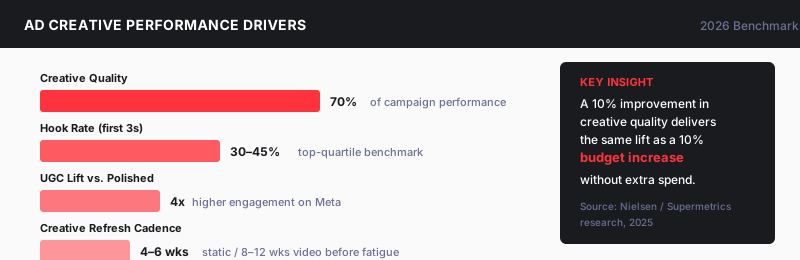
Across formats and platforms, high-performing ads share a handful of consistent traits. They communicate a clear benefit within the first few seconds. They feel native to the platform. And they give viewers a specific reason to act rather than a vague invitation to "learn more."
The following principles apply whether you're building static images for Google Display, short-form video for TikTok, or carousel ads for Meta Feed.
Platforms like Meta and TikTok use early engagement signals to decide how broadly to distribute your creative. A video that loses most viewers in the first three seconds signals low relevance to the algorithm, triggering reduced delivery and higher CPMs.
Research from Sovran's Meta ads analysis defines a strong hook rate as 25-30% for the Meta platform average, with top-quartile creatives reaching 35-45%. On TikTok, the average across analyzed accounts sits at 30.7%, while elite performers push past 40%. The practical takeaway: your first frame must earn the watch. State the problem, show an unexpected visual, or call out your target customer by name.
Good ads resist the temptation to say everything at once. Each piece of creative should communicate a single benefit or solve a single problem. The moment an ad tries to serve multiple messages, viewers' attention splits and the main offer gets lost.
This applies to copy length too. Lead with the most compelling claim in the headline. Use body copy to support, not introduce, the core promise. If your ad needs three sentences to get to the point, the hook is already working against you.
Formats perform differently across placements, and the gap is meaningful. Data from Superads and LeadsBridge's 2026 Meta analysis shows Reels delivering 26% lower CPC than Feed placements, making them the most cost-efficient format for top-of-funnel reach. Carousel ads can achieve 30-50% lower cost-per-click compared to static single-image ads when used correctly for product catalogs.
Video leads all formats in click-through rate at approximately 0.98% across Meta. But "video" is not a monolithic category. A 60-second brand story performs differently than a 15-second product demo. Match format to the job: awareness, consideration, or conversion.
TikTok's own Creative Center data shows ads mimicking organic creator content outperform polished brand videos by 22% on view-through rate. The same dynamic plays out on Meta Reels. When an ad looks like an ad from the first frame, viewers scroll past it faster than anything else in the feed.
This doesn't mean every creative needs to look lo-fi. It means every creative should feel like it belongs in the context where it's shown. On TikTok, that usually means vertical video with direct-to-camera delivery. On Google Display, it means clean visuals and a clear value proposition without clutter.
The debate between user-generated content and polished brand production has a clearer answer now than it did two years ago. According to admetrics and DTC brand analysis, UGC-style ads see 4x higher engagement than polished brand content on Meta, and 81% of ecommerce marketers report that real customer visuals outperform professional production.
The nuance: UGC wins on trust and conversion for most DTC categories. Polished creative wins on brand perception and higher-AOV purchases. The brands performing best in 2026 are running both, using a creative matrix that combines authentic customer content with professional brand assets, then letting performance data decide the allocation.
For DTC brands running paid social campaigns, starting with UGC and testing into polished creative is a lower-risk, higher-return approach in most categories under $150 AOV.
Understanding abstract principles is one thing. Seeing how they apply to specific formats is more useful.
Meta Feed (static or carousel): The best-performing static ads on Meta lead with a bold claim in the first line of copy, use an image that communicates the product benefit rather than the product itself, and include a CTA that's specific to the offer ("Get 20% off this week" vs. "Shop now").
Meta and Instagram Reels: Top-performing Reels hooks start with motion or a direct statement. The first two seconds show something unexpected or validate a viewer's problem. The middle third demonstrates the product. The final third shows social proof or states the offer with urgency.
TikTok: The platform rewards raw authenticity. First-person delivery, real-environment filming, and creator-style pacing outperform scripted ads. Overlaying text captions is critical because a significant share of TikTok is watched without sound.
Google Display and Performance Max: Clarity wins. The best Google display ads have a single dominant image, a headline under 5 words, and a CTA button that states the action. Avoid busy backgrounds or competing visual elements.
Even the best creative fatigues. According to 2026 performance benchmarks from Fluency, static creative should be refreshed every 4-6 weeks, while video creative typically has a longer shelf life of 8-12 weeks before performance degrades meaningfully.
Creative fatigue shows up as rising CPMs, falling CTRs, and declining hook rates on the same audience segments. The brands that avoid fatigue don't necessarily produce more creative: they test systematically and retire underperformers before spend compounds on a declining asset.
For a structured approach to testing creative at scale, the ad creative testing framework covers how to set up controlled experiments without polluting data across campaigns.
The gap between understanding creative principles and actually executing them consistently is where most brands lose ground. Here is a practical checklist for evaluating any ad before it goes live:
These are not complicated criteria. What's complicated is building the operational process to apply them consistently across every creative in rotation.
Good ads are not accidents, and they're not purely the product of creative talent. They come from a system: clear briefs, structured testing, performance monitoring, and a refresh cadence that treats creative as a continuous investment rather than a campaign deliverable.
The brands that work with experienced digital marketing firms to build that system consistently outperform those treating creative as a one-time expense. The difference shows up in CPM trends, hook rates, and ROAS stability over time.
If you're rebuilding your creative strategy or want an outside perspective on what your ad creative is missing, EmberTribe works with DTC and growth-stage brands to develop performance creative systems grounded in data. Reach out at embertribe.com to start a conversation.

Businesses that run Google Ads well earn an average of $2 for every $1 spent, and Google itself estimates the platform can deliver up to 800% ROI for advertisers who structure their campaigns correctly. The gap between those results and the advertisers who burn through budget without traction almost always comes down to setup decisions made in the first few hours. This guide walks you through every step, from opening your account to launching a campaign built to convert.
Before logging into Google Ads, two things need to be in place: a Google account linked to your business and a clear conversion goal. That goal could be a purchase, a form submission, a phone call, or a page visit. Without it, you have no signal to optimize toward and no way to know whether your spend is working.
You also need a landing page that matches your ad's promise. Sending traffic to a generic homepage is one of the most common reasons new campaigns underperform. The page a user lands on should directly address whatever the ad offered.
Go to ads.google.com and sign in with your Google account. Google will walk you through a "Smart campaign" setup by default, but skip past it to access Expert Mode. Expert Mode gives you access to all campaign types, full bidding controls, and manual keyword management, which is what you need to run campaigns that scale.
Set your billing country, time zone, and currency carefully. These settings cannot be changed after account creation and affect how your reporting data lines up with your business records.
Conversion tracking is the most important step in this entire process, and it comes before you create a single campaign. In Google Ads, go to Tools, then Measurement, then Conversions. Define your conversion action, whether that is a purchase, a lead form, or a button click.
Install the Google tag on your site and set up the specific conversion event. For purchase-based businesses, enhanced conversions are worth enabling immediately. Enhanced conversions use hashed first-party data to improve measurement accuracy by 20 to 30%, which means your bidding algorithms have better data to work with from day one. Without solid conversion tracking, automated bidding strategies have nothing to learn from.
Google Ads offers several campaign types, each suited to a different goal. For most brands running their first campaign, Search is the right starting point.
Search campaigns show text ads to people actively searching for your product or service. They capture high-intent traffic, and the keyword control makes them easier to manage than other formats. Understanding the full landscape of search advertising helps you fit Search campaigns into a broader paid media strategy.
Performance Max campaigns run across all Google inventory, including Search, Display, YouTube, Gmail, and Shopping, using Google AI to allocate budget. They work best when you already have conversion history and creative assets ready. Starting a brand-new account with PMax before you have conversion data usually leads to wasted spend in the first few weeks.
Shopping campaigns are built for ecommerce and pull product data from your Merchant Center feed. If you sell physical products, a well-structured ecommerce PPC approach treats Shopping and Search as complementary rather than competing channels.
Display and Video campaigns run on Google's network of websites and on YouTube. They are better suited for awareness and retargeting than for direct response in most cases.
Campaign structure directly affects your Quality Score, your budget efficiency, and your ability to read performance data. A common mistake is putting every keyword into one ad group with generic ad copy. Tight structure prevents this.
Organize campaigns around a single product category, service line, or funnel stage. Inside each campaign, create ad groups around tightly related keyword themes. Each ad group should have five to fifteen closely related keywords and ad copy that speaks directly to that specific intent. When your keywords, ads, and landing page all point to the same topic, Google rewards you with a higher Quality Score, which lowers your cost per click.
Keywords are the mechanism that connects your ads to the right search queries. Start with terms your customers actually use, not internal product terminology. Tools like Google Keyword Planner are built into your account and show estimated search volume and bid ranges for any term.
Use a mix of match types strategically. Exact match gives you precise control over which queries trigger your ads. Phrase match expands reach to queries containing your keyword phrase. Broad match, especially when paired with Smart Bidding, lets Google's algorithm discover related queries, but it requires enough conversion data to work well.
Negative keywords are just as important as your target keywords. Add irrelevant terms from the start so your budget is not wasted on queries that will never convert. Review your search terms report weekly in the early weeks of a campaign to catch new negatives before they accumulate cost.
If you want to see what queries are driving results for competitors, reverse-engineering a competitor's keyword strategy can surface opportunities you would not have found through keyword tools alone.
Google Search ads use a Responsive Search Ad format. You provide up to fifteen headlines and four descriptions, and Google tests combinations to find what performs best. Write headlines that include your primary keyword, a specific benefit, and a call to action. Avoid vague phrases like "great service" or "learn more." Specificity converts better.
Pin a headline only when accuracy requires it, such as a brand name or a specific offer. Otherwise, letting Google rotate through combinations gives the algorithm more data to optimize. Include at least one description that provides proof, whether that is a number, a guarantee, a result, or a customer outcome.
Enable ad extensions, now called assets, across the board. Sitelinks, callouts, structured snippets, and call assets expand your ad's footprint on the search results page and improve click-through rate without adding cost per click.
Bidding strategy determines how Google spends your budget and how aggressively it competes in each auction. The right strategy depends on where your account is in its data lifecycle.
For a new account with no conversion history, start with Maximize Clicks with a cost-per-click cap. This gets impressions and clicks while limiting exposure until your tracking is validated. Once you have at least 30 conversions in a 30-day window, switch to Maximize Conversions. After you reach 50 or more weekly conversions consistently, you can layer in a Target CPA to hold Google to a specific cost per acquisition.
Target ROAS is the right choice once you have consistent purchase data and want to optimize for revenue rather than conversion volume. It works well for ecommerce brands where order values vary and you want Google to prioritize higher-value transactions. According to Google's own bidding guidance, Smart Bidding strategies perform best when campaigns are given enough conversion data and are not interrupted by frequent structural changes.
Set a daily budget at the campaign level. A realistic starting budget for Search is enough to generate at least ten to twenty clicks per day based on the average CPC in your category. The average CPC across all industries in Google Ads is $4.22, so a $50 to $100 daily budget gives you enough volume to start seeing meaningful data within a week.
Review your campaign settings before going live. Confirm that your location targeting is set to your actual service area, not a broader default. Check that the Google Search Network is included and that Search Partners and Display Network are turned off until you have baseline data.
Set an ad schedule only if you have a specific business reason to limit hours. Otherwise, let the campaign run and use the data to identify any time-of-day patterns worth acting on.
Google Ads is not a set-it-and-forget-it channel. The first two weeks are about validating your tracking and catching early issues. After that, shift to a weekly optimization rhythm.
Each week, review your search terms report and add negatives, check quality scores by ad group, and compare conversion rates across keywords. Pause keywords that have spent beyond three times your target CPA without converting. Test one new headline or description variant per ad group per month rather than changing everything at once. Isolating variables is the only way to know what actually moved the needle.
Monthly, assess campaign-level performance against your goals, review impression share to understand whether budget or bid constraints are limiting reach, and consider whether your landing pages need updates based on the traffic data you are collecting.
For brands that want support building campaigns from scratch or scaling an existing account, EmberTribe's Google Ads management services cover full-funnel paid search strategy built around measurable growth.
Google Ads excels at capturing demand that already exists. When someone searches for what you offer, Search campaigns put your brand in front of them at exactly the right moment. That makes it one of the most efficient channels for converting high-intent prospects.
What it cannot do is create demand for something people are not actively searching for. If your product or category is new to the market, you may need Display or Video campaigns to build awareness before Search campaigns can reach their potential. Understanding how Google Ads works as a platform gives you a sharper view of where it fits in your overall growth model.
The brands that get the most from Google Ads treat it as a data system, not just an advertising channel. Every campaign generates information about what your customers are searching for, what language converts, and which offers drive action. Run it with that lens and you are building an asset that compounds over time.
Sources:


.svg)