








Good ads don't happen by accident. The brands consistently outperforming on Meta, TikTok, and Google share a set of creative principles grounded in how people actually pay attention, process information, and decide to buy. Understanding those principles is the clearest path to better performance without simply spending more.
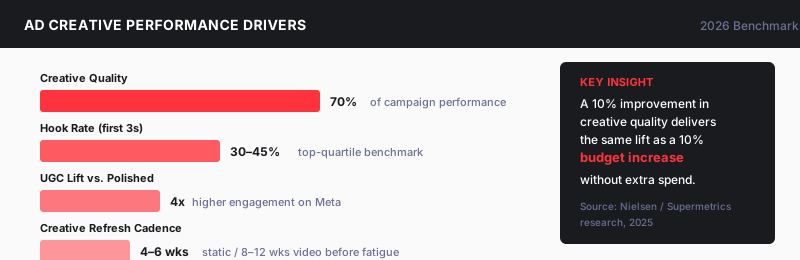
According to Nielsen and Supermetrics research, creative quality accounts for up to 47-70% of campaign performance outcomes, making it the single highest-leverage variable in paid advertising. Audience targeting, bidding strategy, and placement all matter, but creative is where performance is won or lost before any of those levers are pulled.
What Good Ads Have in Common
Across formats and platforms, high-performing ads share a handful of consistent traits. They communicate a clear benefit within the first few seconds. They feel native to the platform. And they give viewers a specific reason to act rather than a vague invitation to "learn more."
The following principles apply whether you're building static images for Google Display, short-form video for TikTok, or carousel ads for Meta Feed.
1. A Hook That Earns Attention in Three Seconds
Platforms like Meta and TikTok use early engagement signals to decide how broadly to distribute your creative. A video that loses most viewers in the first three seconds signals low relevance to the algorithm, triggering reduced delivery and higher CPMs.
Research from Sovran's Meta ads analysis defines a strong hook rate as 25-30% for the Meta platform average, with top-quartile creatives reaching 35-45%. On TikTok, the average across analyzed accounts sits at 30.7%, while elite performers push past 40%. The practical takeaway: your first frame must earn the watch. State the problem, show an unexpected visual, or call out your target customer by name.
2. One Clear Offer Per Ad
Good ads resist the temptation to say everything at once. Each piece of creative should communicate a single benefit or solve a single problem. The moment an ad tries to serve multiple messages, viewers' attention splits and the main offer gets lost.
This applies to copy length too. Lead with the most compelling claim in the headline. Use body copy to support, not introduce, the core promise. If your ad needs three sentences to get to the point, the hook is already working against you.
3. Format That Matches Platform Behavior
Formats perform differently across placements, and the gap is meaningful. Data from Superads and LeadsBridge's 2026 Meta analysis shows Reels delivering 26% lower CPC than Feed placements, making them the most cost-efficient format for top-of-funnel reach. Carousel ads can achieve 30-50% lower cost-per-click compared to static single-image ads when used correctly for product catalogs.
Video leads all formats in click-through rate at approximately 0.98% across Meta. But "video" is not a monolithic category. A 60-second brand story performs differently than a 15-second product demo. Match format to the job: awareness, consideration, or conversion.
4. Creative That Feels Native
TikTok's own Creative Center data shows ads mimicking organic creator content outperform polished brand videos by 22% on view-through rate. The same dynamic plays out on Meta Reels. When an ad looks like an ad from the first frame, viewers scroll past it faster than anything else in the feed.
This doesn't mean every creative needs to look lo-fi. It means every creative should feel like it belongs in the context where it's shown. On TikTok, that usually means vertical video with direct-to-camera delivery. On Google Display, it means clean visuals and a clear value proposition without clutter.
UGC vs. Polished Creative: What the Data Says
The debate between user-generated content and polished brand production has a clearer answer now than it did two years ago. According to admetrics and DTC brand analysis, UGC-style ads see 4x higher engagement than polished brand content on Meta, and 81% of ecommerce marketers report that real customer visuals outperform professional production.
The nuance: UGC wins on trust and conversion for most DTC categories. Polished creative wins on brand perception and higher-AOV purchases. The brands performing best in 2026 are running both, using a creative matrix that combines authentic customer content with professional brand assets, then letting performance data decide the allocation.
For DTC brands running paid social campaigns, starting with UGC and testing into polished creative is a lower-risk, higher-return approach in most categories under $150 AOV.
Good Ad Examples by Platform
Understanding abstract principles is one thing. Seeing how they apply to specific formats is more useful.
Meta Feed (static or carousel): The best-performing static ads on Meta lead with a bold claim in the first line of copy, use an image that communicates the product benefit rather than the product itself, and include a CTA that's specific to the offer ("Get 20% off this week" vs. "Shop now").
Meta and Instagram Reels: Top-performing Reels hooks start with motion or a direct statement. The first two seconds show something unexpected or validate a viewer's problem. The middle third demonstrates the product. The final third shows social proof or states the offer with urgency.
TikTok: The platform rewards raw authenticity. First-person delivery, real-environment filming, and creator-style pacing outperform scripted ads. Overlaying text captions is critical because a significant share of TikTok is watched without sound.
Google Display and Performance Max: Clarity wins. The best Google display ads have a single dominant image, a headline under 5 words, and a CTA button that states the action. Avoid busy backgrounds or competing visual elements.
The Creative Refresh Problem
Even the best creative fatigues. According to 2026 performance benchmarks from Fluency, static creative should be refreshed every 4-6 weeks, while video creative typically has a longer shelf life of 8-12 weeks before performance degrades meaningfully.
Creative fatigue shows up as rising CPMs, falling CTRs, and declining hook rates on the same audience segments. The brands that avoid fatigue don't necessarily produce more creative: they test systematically and retire underperformers before spend compounds on a declining asset.
For a structured approach to testing creative at scale, the ad creative testing framework covers how to set up controlled experiments without polluting data across campaigns.
How to Apply These Principles
The gap between understanding creative principles and actually executing them consistently is where most brands lose ground. Here is a practical checklist for evaluating any ad before it goes live:
- Hook audit: Watch the first three seconds with the sound off. Is there a reason to keep watching?
- Single message check: Can you state the core benefit in one sentence?
- Native feel: Does this creative look like something a real person would post on this platform?
- Format match: Is the aspect ratio, length, and pacing appropriate for the placement?
- Offer clarity: Is it obvious what the viewer should do next, and why now?
- Fatigue plan: Is there a refresh scheduled before expected performance decline?
These are not complicated criteria. What's complicated is building the operational process to apply them consistently across every creative in rotation.
Thinking About Creative as a System
Good ads are not accidents, and they're not purely the product of creative talent. They come from a system: clear briefs, structured testing, performance monitoring, and a refresh cadence that treats creative as a continuous investment rather than a campaign deliverable.
The brands that work with experienced digital marketing firms to build that system consistently outperform those treating creative as a one-time expense. The difference shows up in CPM trends, hook rates, and ROAS stability over time.
If you're rebuilding your creative strategy or want an outside perspective on what your ad creative is missing, EmberTribe works with DTC and growth-stage brands to develop performance creative systems grounded in data. Reach out at embertribe.com to start a conversation.

.webp)

.svg)


