








The distinction that separates high-performing retail brands from the rest is not how many channels they operate. It is whether those channels share a single view of inventory, customer data, and purchase history. That distinction is the difference between multichannel and omnichannel commerce, and the performance gap between them is large enough that every growth-stage brand building a channel strategy needs to understand it clearly.
Omnichannel commerce means a customer's cart, purchase history, support interactions, and preferences follow them across every touchpoint. A study of 46,000 shoppers by Harvard Business Review found that 73% of buyers use multiple channels during a single shopping journey, and that customers who engaged across four or more channels spent 9% more in-store than single-channel shoppers and logged 23% more repeat visits within six months of an omnichannel experience. The compounding effect on retention and lifetime value is why Manhattan Associates' 2025 Omnichannel Trends research shows only 17% of retailers have mature capabilities despite 54% listing it as their top strategic priority.
Omnichannel vs. Multichannel vs. Unified Commerce
The vocabulary matters because confusing these terms leads to misallocated investment.
Multichannel means selling across multiple independent channels: a website, Amazon, retail stores, social commerce. Each channel operates with its own inventory count, its own customer data, and its own messaging. A brand can be present on six channels and still be multichannel. The internal question for multichannel is: how do we get the most out of each channel independently?
Omnichannel connects those channels into a coordinated customer experience. The customer's identity and behavior history follow them across touchpoints. A buyer who browses on mobile, adds to cart on desktop, and purchases in-store is recognized as the same customer across the journey. The internal question shifts to: how do we give each customer the best experience regardless of where they engage?
Unified commerce is where omnichannel is heading in 2025 and 2026. The distinction, articulated by Sitoo's unified commerce research, is in the architecture. Omnichannel often connects existing siloed systems via APIs and middleware. Unified commerce runs all channels from a single backend: one order management system, one inventory ledger, one customer record, no integration layer to maintain.
Brands with unified commerce report 27% lower fulfillment costs and 18% reduced cart abandonment, per Manhattan Associates data.
The Performance Data Behind Omnichannel
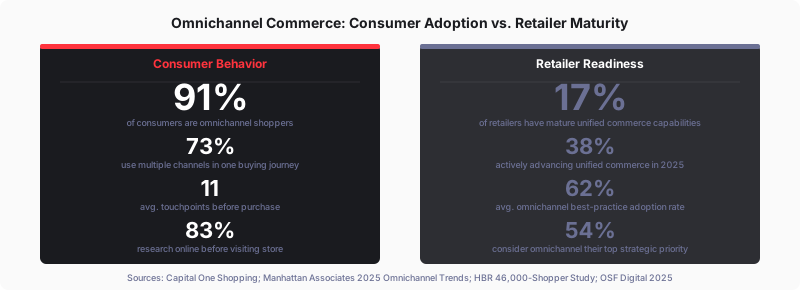
The numbers from Capital One Shopping's omnichannel statistics research show the magnitude of what is at stake. Companies with strong omnichannel engagement retain 89% of customers, compared to 33% for brands with weak omnichannel strategy. Omnichannel customers spend 16% more per order and purchase 250% more frequently. Their lifetime value is 30% higher.
The HBR finding that 73% of shoppers use multiple channels in a single journey, combined with 91% of consumers qualifying as omnichannel shoppers, means the question for most brands is not whether to pursue omnichannel. It is how far behind they currently are and what the cost of that gap is in retention, LTV, and competitive position.
The market is moving. Capital One Shopping's omnichannel research reports that curbside pickup increased conversion rates by 25.8% in 2024 among the top 1,000 retailers. Real-time inventory visibility online drives significant cart completion improvements when customers can see whether a product is available at a nearby location.
The Technology Stack Omnichannel Commerce Requires
The infrastructure investment is what separates a genuine omnichannel program from channel coordination with good marketing. The core components:
- Order Management System (OMS). The operational backbone. A real-time OMS routes orders across fulfillment channels, manages inventory allocation between online and in-store demand, and enables BOPIS (buy online, pick up in store) and ship-from-store. Without a unified OMS, inventory discrepancies between channels are inevitable, leading directly to oversells, cancellations, and customer trust erosion.
- Customer Data Platform (CDP). A CDP unifies raw behavioral data from every touchpoint, resolves customer identities across devices and channels, and feeds clean, unified customer records to the CRM. Without identity resolution, brands lose track of 10% to 50% of their audience during acquisition, compounding measurement errors across the entire funnel. For DTC brands above $10 million in revenue with physical retail or marketplace presence, a CDP is no longer optional.
- Real-time inventory synchronization. A single source of truth for stock across all locations. Brands running channel-specific inventory counts create the H&M scenario from 2019: products appearing available online while sitting unsold in stores, leading to oversells, cancellations, and ultimately a $4 billion inventory write-down that traced directly to unsynchronized systems.
- Unified point of sale. In-store transactions must connect to the same customer record as digital activity. A customer who purchases in-store should be recognized on the website the next day and vice versa. Without a unified POS, the in-store customer is invisible to every digital retention program the brand runs.
Brands Getting Omnichannel Right
The brands executing omnichannel at scale demonstrate the revenue impact concretely. Warby Parker started as a direct-to-consumer online brand and now operates 276 or more stores generating 70% of total revenue. Full year 2024 revenue reached $771.3 million with 15.2% year-over-year growth, per Warby Parker's Q4 2024 results.
Physical stores did not cannibalize digital. They amplified total customer acquisition and LTV by bringing try-on and optometry into the physical world while keeping digital as the discovery and repurchase layer.
Starbucks runs 70% of US sales through mobile and drive-thru orders. Its 31 million active loyalty members generate over 50% of US revenue and spend three times more than non-members. The deep brew AI system personalizes recommendations across the app, drive-thru, and in-store touchpoints from a single customer data record.
Sephora has unified online and offline customer profiles since 2010. The Color IQ tool links in-store skin tone scans to customer profiles and surfaces personalized online product recommendations in subsequent digital sessions. That single data integration turns a physical in-store moment into a durable digital personalization signal.
The Six Failure Modes That Kill Omnichannel Programs
Most omnichannel failures trace to a small set of structural problems that brands underestimate before launch.
- Siloed team structures. When online and offline divisions operate with separate P&Ls, separate technology stacks, and separate customer data, channel coordination is politically and technically impossible. GAP Inc.'s channel inconsistency problems over multiple rebranding cycles trace directly to interdepartmental silos that created different messaging, pricing, and promotions per channel.
- Treating omnichannel as a marketing initiative. Omnichannel is an infrastructure and operations transformation first. Brands that launch new channels without resolving backend integration create fragmented customer experiences at scale. The integration investment comes before the channel activation investment.
- Inconsistent pricing across channels. A customer who finds a lower price online and is charged more in-store experiences immediate trust collapse. Channel conflict around pricing is one of the most damaging and common execution errors, per Omniful's omnichannel channel conflict analysis.
- Siloed customer data. The root cause of most downstream omnichannel failures. Without a unified customer ID, personalization cannot work, attribution is unreliable, and service representatives cannot see the full customer picture when handling support interactions.
- Launching mobile as an afterthought. Mobile represents 57% of global ecommerce traffic. An omnichannel experience that creates friction on mobile is not omnichannel for the majority of customers.
- Activating channels before resolving integration. Brands that expand into TikTok Shop, physical pop-ups, or wholesale without first connecting those channels to a shared data and inventory layer grow revenue while fragmenting customer experience. The cost compounds over time as more channels are added to an unintegrated foundation.
What This Means for You
The 91% consumer omnichannel adoption rate versus 17% retailer maturity rate defines a competitive landscape where the gap between infrastructure leaders and laggards is widening. The brands getting this right are demonstrating the results: 89% customer retention, 250% purchase frequency lift, 30% LTV premium. The brands behind the curve are funding customer acquisition into a leaky retention system.
For growth-stage DTC and ecommerce brands evaluating their channel infrastructure and cross-channel marketing strategy, EmberTribe works with brands on the demand generation and channel investment decisions that determine whether omnichannel infrastructure pays off or underperforms.

.webp)

.svg)


