








Picking the right sem marketing agency is one of the highest-leverage decisions a growth-stage brand can make. Get it right and paid search becomes a scalable, predictable acquisition channel. Get it wrong and you burn budget on clicks that never convert while the agency sends you a PDF with a rising impressions chart. This guide breaks down exactly what to look for, what to avoid, and how to structure the conversation before you sign anything.
What a SEM Marketing Agency Actually Does
Search engine marketing agencies manage paid search campaigns across platforms such as Google Ads and Microsoft Advertising. The core work includes keyword research, bid strategy, ad copy creation, landing page recommendations, audience targeting, and ongoing optimization. Most agencies also handle conversion tracking setup, which is the foundation everything else depends on.
The scope varies considerably by agency size and specialty. A boutique paid search agency might embed directly in your growth team and act as a strategic partner. A larger, full-service shop might assign you to an account manager who runs dozens of accounts simultaneously. What matters most is the ratio of strategic attention to the retainer you are paying.
In-house teams have one advantage over agencies: institutional knowledge. They understand your product margins, your seasonal patterns, and your customer segments. A strong SEM agency closes that gap through a rigorous onboarding process, clear documentation, and regular communication. If an agency skips discovery and launches campaigns in week one, that is your first warning sign.
The SEM Market in 2026
The paid search market has grown considerably. According to AgencyHandy's 2026 SEM statistics report, the global SEM services market is projected to expand from roughly $120 billion in 2024 to over $278 billion by 2034, a compound annual growth rate of approximately 8.8%. AI-powered campaign automation, smarter audience segmentation, and intensifying competition for high-intent keywords are all driving that growth.
For brands competing in ecommerce and direct-to-consumer categories, that growth in the market means more advertisers bidding on the same keywords. Cost-per-click rates have increased in most verticals over the past two years. A competent SEM agency helps you maintain profitable returns by tightening targeting, improving quality scores, and building out the long-tail keyword structure that most brands neglect.
How SEM Agency Pricing Works
Pricing is where a lot of brands get confused or, worse, overcharged. There are four common models. Understanding each one before your first agency conversation puts you in a much stronger negotiating position.
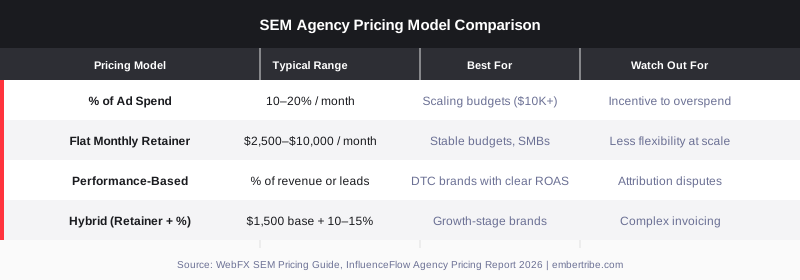
According to WebFX's SEM pricing guide, about 70% of businesses spend between $251 and $10,000 per month on SEM management, not including the actual ad spend. Most agencies charge either a flat retainer, a percentage of ad spend, or some combination of both.
Percentage of ad spend is the most common model for performance agencies. Rates typically fall between 10% and 20% monthly. At lower spend volumes (under $25K per month), you will often see a minimum fee apply because the account still requires the same hours regardless of how much you are spending. One structural downside of this model: an agency paid on percentage has a financial incentive to increase your budget even when the marginal return does not justify it.
Flat monthly retainers offer more predictability for brands with stable budgets. The InfluenceFlow 2026 agency pricing report puts the typical range for a small to mid-sized business SEM engagement at $2,500 to $10,000 per month. Mid-market companies managing $50,000 or more in monthly ad spend often pay $10,000 to $25,000 in management fees.
Performance-based pricing ties fees to results such as a target ROAS, cost per acquisition, or revenue generated. This model aligns incentives better, but attribution becomes a point of contention quickly. Clarify exactly how conversions are counted before agreeing to any performance clause.
Hybrid models combine a lower base retainer with a percentage component. This is increasingly common among growth-focused agencies because it reduces risk for both parties during ramp-up and scales fees alongside results.
What Good ROAS Looks Like (and What to Expect)
Return on ad spend benchmarks vary widely by industry and by the maturity of your campaigns. A brand new to paid search will rarely hit efficient ROAS in month one. Healthy accounts take 60 to 90 days of learning before performance data is statistically meaningful.
According to First Page Sage's ROAS statistics report, ecommerce brands average approximately 2.05x ROAS on paid search. That number represents the mean across a broad range of verticals and campaign types. DTC brands with strong creative, tight audience targeting, and well-optimized landing pages routinely exceed that benchmark.
A more practical frame: calculate your break-even ROAS before you set any agency targets. If your gross margin is 50%, you need at least a 2x ROAS to break even on the ad spend alone, before accounting for management fees. Factor in the agency fee and you need to perform considerably higher just to stay profitable. Be explicit with any agency about your break-even ROAS, because an agency unwilling to anchor their strategy around your margin reality is not the right partner.
How to Evaluate a SEM Agency: A Practical Framework
Evaluating a sem agency is not just about reviewing a pitch deck. The best agencies reveal themselves through the quality of their discovery questions, not their case study slides. Here is a practical framework for the evaluation process.
Questions to Ask Before You Sign
Ask every agency candidate the same set of questions and compare responses directly. The consistency of the process matters as much as any individual answer.
- How do you structure the first 30 days? What does onboarding look like?
- Who specifically will manage our account day to day, and how many other accounts do they manage?
- How do you approach bid strategy when ROAS drops below our target threshold?
- What does your testing roadmap look like in months two and three?
- How do you handle attribution, particularly for customers who convert across multiple touchpoints?
- What reporting cadence do you use, and what does a standard report include?
An agency that answers these questions with specificity and without hesitation has processes in place. An agency that pivots to case studies without addressing the mechanics of their process is giving you a sales pitch, not an operational preview.
Red Flags to Watch For
According to Accelerated Digital Media's SEM agency red flags guide, the most consistent warning signs fall into three categories: communication, strategy, and reporting.
On communication: if you cannot get direct answers on calls and response times are consistently slow before you sign, expect that pattern to continue after you sign. On strategy: agencies that are always in "maintenance mode" without proactively testing new approaches are not earning their retainer. On reporting: if your monthly report is a static PDF showing impressions and click-through rate without connecting to revenue or conversions, your agency is optimizing for optics, not outcomes.
Other concrete red flags to watch for:
- No conversion tracking audit in the first week
- Guaranteed results in the sales pitch (no one can guarantee ROAS before seeing your data)
- Lock-in contracts longer than three months without a performance clause
- Vague answers about who owns your ad account (you should always own your own account)
- No structured testing roadmap after month one
Owning your ad account is non-negotiable. If an agency insists on running campaigns through their own account rather than granting access to yours, walk away. You would be renting access to your own campaign history.
SEM vs. In-House: When an Agency Makes More Sense
For most growth-stage brands spending under $500,000 per year in ad budget, a specialized digital marketing agency will outperform an in-house hire on a cost-adjusted basis. A senior paid search manager carries a total cost of $90,000 to $130,000 per year in salary plus benefits, and they still need tools, training, and management overhead.
An agency at a comparable cost brings a full team: strategist, account manager, conversion rate specialist, and creative support. The leverage is real, particularly in the early stages when your account needs more active optimization than a single in-house hire can provide.
The calculus shifts at scale. Brands spending $2 million or more annually in paid search often benefit from bringing core channel ownership in-house while using an agency for specific functions such as creative testing or international expansion.
What to Include in Your Agency Contract
Whatever pricing model you choose, get these terms in writing before you start:
- Account ownership: your brand retains full access and ownership of all ad accounts
- Reporting cadence and format: weekly or bi-weekly performance summaries, not monthly PDFs
- Minimum performance clause: what happens if ROAS falls below a defined threshold for two consecutive months
- Notice period: 30 days is reasonable, 60 days or more is not
- Scope of work: exactly which platforms, campaigns, and services are included
- Communication standards: who is your point of contact, and what is the response time SLA
Getting these terms defined before the relationship starts protects you from the most common agency disputes. Related reading: our full breakdown of what to look for in PPC companies covers the contract terms that matter most for paid channels.
How to Find the Right SEM Partner for Your Brand
Start by defining what "right" means for your specific situation. A brand spending $15,000 per month on Google Ads needs a different type of partner than one scaling toward $200,000 per month. Consider:
- Your current monthly ad spend and where you want it in 12 months
- Whether you need full-service management or a focused specialist in one area
- How much internal capacity you have to collaborate on creative and strategy
- Your primary platform (Google Search, Google Shopping, Microsoft, or a combination)
Once you have that picture, evaluate three to five agencies using the framework above. Ask for references from clients in similar verticals, not just from whoever they feature in the case study section of their website.
Work with EmberTribe
EmberTribe works specifically with DTC and ecommerce brands that are ready to scale paid search beyond the basics. Our approach is built around margin-aware ROAS targets, rigorous testing cadences, and transparent reporting that connects directly to revenue. If you are evaluating SEM partners for 2026, we would like to talk. Visit embertribe.com to learn more about how we work and what we focus on.

.webp)

.svg)


