
In the age of rapid digital transformation, AI has seeped into almost every industry, revolutionizing how we conduct business, design products, and even create content. The ClusterMagic service is a great example, which seamlessly integrates AI for content generation in a hybrid model, providing significant benefits in the SEO results of brands seeking a massive increase in organic traffic. But while AI holds immense promise, it has its limitations. Let's explore the pros and cons of using AI for content creation and understand why a hybrid approach might be the way forward.
Major publishers in sensitive niches like CNET.com, Bankrate.com, and Creditcard.com have already integrated AI-generated content. Other large companies, such as CNN and Forbes, might also be doing so. Countless smaller companies and publishers are utilizing AI, not only on their websites but also on social media, in email marketing, and virtually everywhere else.
Google's stance on AI-generated content is neutral, emphasizing that content should primarily be user-centric. In fact, Google's September 2023 Helpful Content Update removed the mention of "written by people" from their helpful content system guidelines.
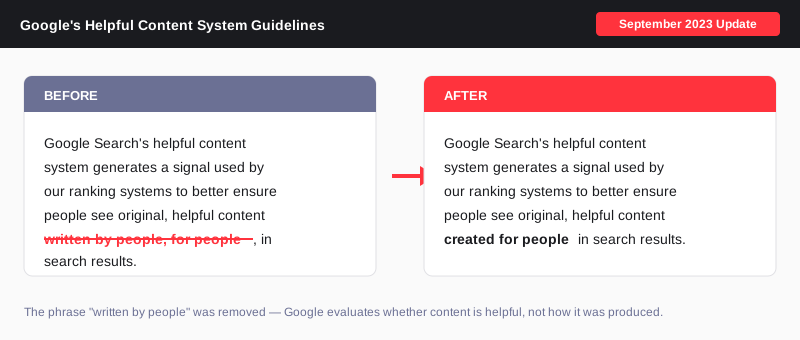
The message is clear: for content to rank well, it must be informative, answer users' queries satisfactorily, and showcase genuine expertise - regardless of how it's created.
AI Content Detectors like GPTZero, ZeroGPT, and many others are not reliable. Even OpenAI has said as much. They consistently produce false positives about human-written content. Conversely, they can be easily fooled with creative prompting or a bit of human editing.
An interesting note from OpenAI: "we found that it labeled human-written text like Shakespeare and the Declaration of Independence as AI-generated."

Anecdotal evidence and real-life ranking data suggest that while AI-generated content isn't penalized by search engines, it might only achieve high rankings if it meets the above criteria. The role of AI in content creation is still a developing narrative, and its significance is indispensable for maintaining a competitive edge in the future.
At EmberTribe, the understanding is clear - AI serves as a foundation, not the final product. With ClusterMagic, while AI aids in the initial draft based on expert-driven keyword research, human experts step in for the crucial phases of editing, fact-checking, and final review. This hybrid approach ensures the content is accurate and helpful, has the potential to rank, and truly represents their business.
The ecommerce statistics that matter most are not the ones that confirm what you already believe. They are the ones that force you to reconsider where to invest, how to price, and which channels to prioritize. This post compiles verified 2025-2026 data across market size, mobile, social commerce, and conversion benchmarks so you can make decisions grounded in evidence.
Before diving into each category, here is a summary of the most actionable benchmarks for DTC and growth-stage ecommerce brands in 2026.
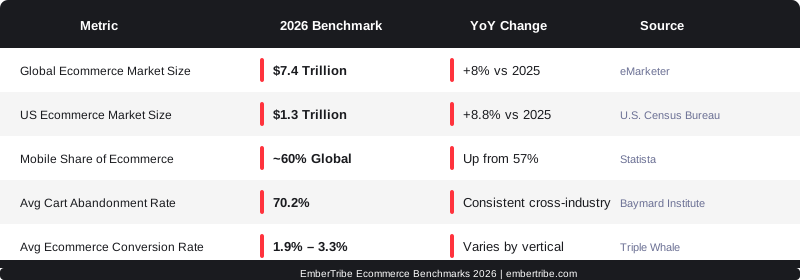
Global ecommerce sales are projected to reach $7.4 trillion in 2026, up roughly 8% from an estimated $6.86 trillion in 2025, according to eMarketer. Ecommerce now accounts for approximately 20.5% of all global retail sales, up from 19.9% in 2024. China's outsized online retail penetration is lifting the global average significantly.
For brands building long-term plans, Grand View Research projects a CAGR of 21.6% from 2026 to 2033 for the broader ecommerce ecosystem when alternative commerce models (marketplaces, social, B2B digital) are included. The takeaway: the market is expanding faster than most incumbent retail categories, but that also means competitive pressure on customer acquisition is rising in parallel.
If you are building an ecommerce strategy from scratch or looking to expand internationally, understanding the scope of the market is a prerequisite. See our guide to building an ecommerce business for a framework on how to position within this landscape.
The United States ecommerce market reached approximately $1.23 trillion in 2025, and 2026 projections point to $1.3 trillion, representing growth of around 8.8%, per the U.S. Census Bureau's quarterly retail ecommerce report. That compares to total retail sales growth of just 2.8% in the same period, underscoring how consistently ecommerce is outpacing in-store shopping.
US ecommerce penetration as a share of all retail is expected to reach 18% in 2026, up from approximately 17.1% in 2025. The gap between online and offline growth is narrowing year over year, which means brands that have already built their digital infrastructure are better positioned than those still catching up.
Mobile commerce accounted for approximately 60% of global ecommerce sales in 2026, up from 57% the prior year. In the US, mobile's share sits at 44.6%, reflecting a market where desktop still drives meaningful volume but mobile is clearly the channel of first contact. During the 2025 holiday season, mobile represented 56.4% of all online sales (November 1 through December 31), up from 54.5% in 2024.
Approximately 1.65 billion people will shop via smartphone in 2026, nearly one in three internet users globally. For DTC brands, that number has a direct implication: your mobile checkout experience is not a secondary priority. Slow load times, multi-step forms, and non-native payment options (no Apple Pay or Shop Pay) are conversion killers at scale.
The mobile commerce market itself is projected to grow from $2.42 trillion in 2026 to over $5 trillion by 2034 at a CAGR of 9.5%. Brands that invest in mobile-first site performance now are building durable advantages.
Social commerce is maturing from a novelty into a reliable channel. TikTok Shop's global gross merchandise value (GMV) reached $64.3 billion in 2025, nearly doubling from $33.2 billion in 2024, and the platform is projected to hit $112.2 billion in GMV by 2026. In the US, TikTok Shop generated $15.82 billion in GMV in 2025, representing 120% annual growth.
TikTok Shop now holds approximately 20% of total social commerce in the US, per eMarketer. The platform counts over 15 million active merchants globally and 475,000 US-based shops as of 2026. Nearly 58% of TikTok's 2 billion active users have shopped directly within the app.
For DTC brands, TikTok Shop is no longer optional to evaluate. The brands capturing share are those building authentic content pipelines (not just paid ads) and integrating creator affiliate programs with real product economics. The channel also compresses the discovery-to-purchase funnel in ways that traditional paid social cannot replicate. For a broader view of how to integrate social into your full funnel, see our breakdown of ecommerce digital marketing.
The global average ecommerce conversion rate sits between 1.9% and 3.3%, depending on vertical and traffic source. Shopify stores typically land in the 2.5% to 3% range. Reaching 4% or higher generally requires a combination of strong brand awareness, optimized UX, and consistent CRO investment, according to Triple Whale's 2025 benchmark data.
Industry-level variation is substantial. Food and beverage converts at 3.21% on average, beauty and personal care sits at 2.98%, and electronics drops to 2.71%, partly due to higher price points and longer consideration cycles.
AOV is one of the strongest predictors of conversion rate: stores selling products under $60 see median conversion rates of 4.63%, while stores with average orders above $200 see median rates closer to 0.95%.
Cart abandonment remains a persistent challenge. Baymard Institute's aggregated research, compiled from 50 studies, puts the average cart abandonment rate at 70.2%. The primary drivers are unexpected shipping costs at checkout (cited by 55% of abandoners), complicated checkout flows (21%), and trust concerns (17%). Abandoned cart email sequences still represent one of the highest-ROI recovery tactics available, with open rates around 41.8% and conversion rates near 10.7%.
Acquisition cost pressure makes retention economics more critical than ever. The average ecommerce repeat purchase rate is 28.2%, meaning slightly over one in four customers returns without additional acquisition spend. Brands above 40% are typically operating with subscription mechanics or high-frequency consumable products.
The financial case for retention is straightforward: the top 20% of customers typically account for around 80% of sales, and retained customers spend up to 67% more than new ones over time. For DTC brands scaling past $5M in annual revenue, a retention strategy is not an optional optimization, it is a core P&L lever.
Understanding how to sustain this growth over time requires a clear view of the trajectory. See our analysis of ecommerce growth strategies for brands moving into their next revenue tier.
The macro numbers confirm that ecommerce is growing, but the operational benchmarks are where the real decisions live. A 70% cart abandonment rate means that on average, seven out of ten shoppers who intend to buy do not complete the transaction. A 2% conversion rate means 98 out of 100 visitors leave without purchasing. These are not alarming outliers; they are the baseline most brands operate against.
The brands that compound growth are the ones that treat these benchmarks as specific problems to solve, not background noise. That means investing in mobile UX before mobile revenue justifies it, building TikTok Shop infrastructure before competitors saturate it, and building email and SMS retention programs before paid CAC forces the issue.
If you want to understand how your current metrics stack up and where to prioritize, EmberTribe works with DTC and growth-stage ecommerce brands to build data-driven marketing strategies that improve conversion, retention, and channel efficiency. The numbers above are the benchmark. The goal is to beat them.
Sixty-two percent of ecommerce businesses plan to hire within the next six months, and 55% of ecommerce professionals plan to explore new opportunities in the same period, per Cranberry Panda's 2025 hiring survey. The market is active on both sides. The brands that win the talent competition are not necessarily offering the highest salaries. They are hiring for clearly scoped roles, moving through the process quickly, and onboarding in ways that make strong candidates want to stay.
This guide covers the roles ecommerce brands are hiring most in 2025 and 2026, salary benchmarks by position, the decision between in-house and fractional talent, how specialized ecommerce recruitment agencies work, and the seven hiring mistakes that cost growth-stage brands the most.
Ecommerce hiring maps closely to revenue stage. A brand at $500,000 in annual revenue needs different roles than a brand at $10 million. Constant Hire's DTC ecommerce staffing roadmap provides a practical framework:
At $0 to $1 million: a customer service representative to handle support volume, a digital marketer to own acquisition, and a fulfillment or 3PL relationship. At $1 million to $5 million: an ecommerce manager as the P&L owner, channel specialists in paid social, email, and SEO, and a designer or copywriter for creative production. At $5 million to $15 million: a supply chain or operations manager, a retention and CRM specialist with Klaviyo fluency, and a data analyst. At $15 million and above: a CMO or head of marketing, director of operations, VP of customer experience, and a finance manager.
The roles hardest to fill regardless of stage: performance marketing managers with cross-platform fluency across Google, Meta, and TikTok Shop; ecommerce data analysts who can script, manage GA4, and interpret attribution data; and hybrid profiles who can move between channel management and creative strategy. Mid-level and specialized roles frequently extend to 31 to 60 days, with senior and technical hires often exceeding 90, per Mitratech's 2025 hiring benchmarks.
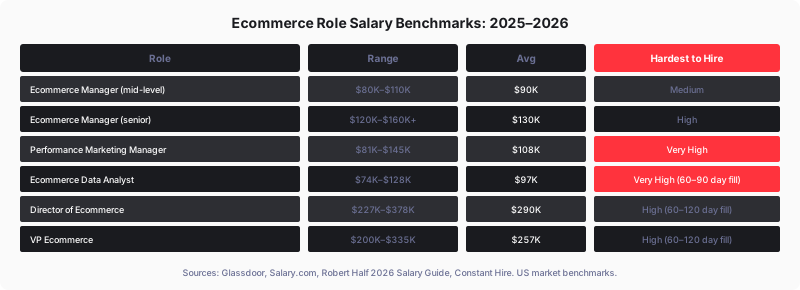
Robert Half's 2026 Salary Guide documents that 78% of marketing and creative leaders now offer higher salaries for candidates with specialized skills in AI, analytics, and automation. The premium for analytics fluency is growing faster than base salary: marketing analytics is seeing 3.3% year-over-year salary growth, the strongest category in the marketing function.
Geographic premium matters for senior roles. An ecommerce marketing manager averages $114,445 nationally but reaches $132,630 in New York City, per Salary.com. Brands hiring remotely can access talent priced at national rather than coastal rates, which is one reason remote ecommerce roles fill 16% faster than in-person roles, according to hiring data analyzed by Second Talent.
The hiring model decision depends on revenue stage and execution velocity requirements.
In-house hiring is the right choice for brands past $10 million to $50 million that need continuous campaign management, permanent marketing leadership, and forecasting beyond a single quarter. The fully-loaded cost is significant: a senior ecommerce manager runs $130,000 to $160,000 in salary alone, plus 25% to 30% for benefits, and recruiting fees of 15% to 31% of first-year compensation. A bad hire costs at least 30% of the employee's first-year pay to correct, per Soocial's bad hire statistics, and that figure rises sharply at the manager and director level.
Fractional talent is the right model for brands between $1 million and $10 million that need senior expertise without permanent overhead. A full-time marketing team might run $481,000 per year in total compensation; the equivalent fractional configuration runs approximately $220,500, a 54% savings, per ATTN Agency's fractional DTC analysis. Brands using fractional performance marketers and creative strategists report 35% faster campaign launches and 45% higher marketing efficiency at the sub-$10 million stage. The graduation threshold to full-time is typically $10 million to $50 million in revenue, where continuity and institutional knowledge become worth the permanent investment.
Recruitment agency support is appropriate for brands at $10 million or above that need to hire multiple roles annually and lack the internal recruiting infrastructure to source, screen, and close competitive candidates. Contingency recruiters charge 15% to 25% of placed first-year base salary. Retained search for director and VP level roles runs 25% to 31% of projected first-year compensation, paid in milestones.
General recruitment firms rarely understand platform-specific requirements well enough to vet ecommerce candidates accurately. A recruiter who cannot assess Shopify Plus fluency, GA4 attribution configuration, or triple-attribution tool experience (Triple Whale, Northbeam) will surface candidates with the right job titles and the wrong competencies.
Several agencies specialize in ecommerce and DTC talent. Constant Hire focuses on DTC and CPG brands and was founded by operators who scaled Shopify brands to $30 million and sold Amazon brands, giving them the operator-level vetting capability that generalist recruiters lack. eCommerce Placement covers US, Canada, and UK ecommerce from ICs to directors. Talentfoot claims a 98% placement success rate defined as placed candidates staying twelve months or longer.
Using a specialist significantly reduces the cost of a wrong hire at senior levels. The vetting gap between a generalist and a specialist recruiter matters most for roles that require hands-on platform expertise.
Constant Hire's analysis of ecommerce hiring failures documents the most consistent failure patterns:
Generic job descriptions. Vague scope with no tools specified, no budget ownership defined, and no KPIs listed. The result is a pipeline of candidates who match the title but not the actual role. Strong candidates self-select out when they cannot assess fit from the description.
Role overloading. Expecting one hire to own paid ads, email, SEO, design, and reporting. Each function requires scoped ownership. Overloaded roles attract generalists who will underperform at each function, or strong candidates who negotiate the role down after starting.
Chasing big-brand logos. Candidates from large corporations often struggle in lean, fast-moving DTC environments. The operator who scaled a Shopify brand from $3 million to $15 million with a team of four is a better fit than someone who managed a single channel at a Fortune 500 with a 20-person support staff.
Slow process. The US average time to fill a role is 36 to 44 days. Competitive ecommerce candidates are fielding multiple offers. A process that takes longer than 10 business days to reach a decision is losing candidates to faster-moving competitors.
Skipping onboarding. No 30/60/90-day plan, no documentation, no playbooks. Even strong hires underperform without context. Poor onboarding is the primary cause of failed in-house hires that otherwise had the right competencies.
Skipping reference checks. Especially common under time pressure. References reveal collaboration style and real results better than any interview process.
Hiring too late. Most DTC founders wait until they are overwhelmed to hire, which compresses the search, inflates the offer, and creates a poor onboarding environment. The right time to hire is when the role scope is clear and the outcomes are defined, not when the workload becomes unmanageable.
Ecommerce recruitment is a specialized discipline, and brands that treat it like general hiring lose their best candidates to faster, better-prepared competitors. The fractional model is the most underutilized tool in the growth-stage hiring toolkit: access to senior expertise at 46% to 54% of the fully-loaded cost, with a clear graduation path to full-time when revenue and organizational complexity justify it.
For growth-stage ecommerce brands evaluating whether their marketing function needs a full-time hire, an agency, or a fractional performance marketing team, EmberTribe works with DTC and B2B brands on the demand generation programs that generate the pipeline justifying those investments.
The biggest ecommerce news story of 2026 is not a single event. It is a set of structural shifts that are changing how brands acquire customers, fulfill orders, and compete for attention. Global online retail is closing in on $7 trillion in annual sales, and the platforms, technologies, and regulations shaping that market look meaningfully different than they did two years ago.
For DTC brands and growth-stage companies, staying current with the ecommerce industry news that actually matters requires filtering signal from noise. This post covers the five shifts with the most direct impact on how brands operate and grow in 2026.
The numbers are large, but the trajectory is what matters. According to Statista's ecommerce market forecast, global ecommerce sales reached $6.86 trillion in 2025, representing 8.3% year-over-year growth. The 2026 projection lands at $6.88 trillion, accounting for 21.1% of all global retail, up from 19.9% in 2024.
The US market continues to grow, but the fastest-moving regions are Southeast Asia (18.6% projected growth, on track for $230 billion GMV) and Latin America. These numbers matter for US-based brands building international expansion strategies.
The share-of-retail figure is the more important benchmark. Crossing 21% means ecommerce is no longer a secondary channel for most categories. It is the primary or co-primary sales environment. Brands that still treat their online store as a supplement to physical retail are increasingly out of step with where their customers are buying.
Online retail is also concentrating. Amazon, Walmart, and a small number of major platforms continue to capture a disproportionate share of volume, which makes owned-channel strategy, particularly direct-to-consumer email and loyalty, more valuable for independent brands.
For a detailed breakdown of how to build a growth engine on top of these trends, see our guide to ecommerce growth.
The social commerce story in 2026 is largely a TikTok Shop story. According to EMARKETER, TikTok Shop grew US sales by 407% in 2024, then added another 108% in 2025, reaching $15.82 billion. 2026 projections put US sales above $20 billion. Globally, TikTok Shop's GMV is forecast to hit $112.2 billion in 2026.
The platform now commands 18.2% of total US social commerce, with that share expected to climb to 24.1% by 2027. More than half of US social media shoppers will make a purchase on TikTok in 2026, a milestone that shifts the platform from "emerging channel" to a required consideration in most consumer brands' channel mix.
What makes this different from earlier social commerce attempts is the native purchase flow. Users discover, evaluate, and convert without leaving the app. That shortens the funnel dramatically and changes the economics of content investment. Brands that can produce authentic short-form video consistently are seeing cost-per-acquisition advantages that paid search and display cannot match in certain demographics.
The practical implication: social commerce is not a replacement for owned channels, but ignoring it means ceding reach to competitors who have figured out the format. The brands winning on TikTok Shop in 2026 treated it as a distribution channel with its own content logic, not an extension of their existing ad creative.
AI in ecommerce moved from a competitive advantage to a baseline operational expectation faster than most forecasts predicted. According to data from EComposer's analysis of AI ecommerce statistics, 77% of ecommerce professionals now use AI tools daily, and 84% of ecommerce businesses are either actively integrating AI or in active planning to do so.
The revenue impact is measurable. Businesses implementing AI personalization report an average revenue lift of 10-40%, and 89% report positive ROI with a payback period averaging nine months. Personalized product recommendations alone can drive up to 31% of a store's revenue.
The highest-value applications in 2026 are not the most visible ones. Personalization engines, AI-driven product search, and dynamic pricing models are delivering the most consistent ROI. Customer service automation is reducing support costs meaningfully without degrading satisfaction scores when implemented with appropriate human escalation paths.
The threshold question for most brands is no longer whether to adopt AI tools but which ones integrate with their existing stack and which problems have the clearest return. For brands just beginning to evaluate options, our guide to ecommerce digital marketing covers how AI is changing channel strategy specifically.
Consumer expectations around delivery have reset. The ShipBob 2026 Fulfillment Trends Report shows that 80% of consumers now expect same-day delivery options, 67% of US consumers consider same-day availability a factor in purchase decisions, and 28% have abandoned a cart because estimated delivery was too slow.
The same-day delivery market reached $14.7 billion in 2025, growing at 20.8% annually. Amazon's continued investment in one-day and same-day Prime shipping has effectively set the delivery standard that independent brands now have to compete with or at least narrow the gap on.
The strategic response for independent DTC brands is distributed inventory. Rather than fulfilling from a single warehouse, more brands are pre-positioning inventory in regional fulfillment centers close to population clusters. This reduces transit times and shipping costs simultaneously. Third-party logistics providers have built infrastructure around this model, making it accessible to brands that are not at Amazon-scale volume.
Automation is also accelerating inside fulfillment operations. Robotic picking and AI-driven demand forecasting are reducing labor costs and improving order accuracy. The 87% same-day fulfillment rate benchmark from 2025 peak season data illustrates what well-resourced operations can achieve when technology and distributed inventory work together.
For brands earlier in their operations journey, the first priority is not robotics. It is choosing fulfillment partners with the network density to enable two-day shipping to most US addresses at a cost that preserves margin.
The privacy landscape in 2026 is the most complex it has ever been for US ecommerce operators. Three states (Indiana, Kentucky, and Rhode Island) added comprehensive consumer data privacy laws on January 1, 2026, bringing the total number of active US state privacy statutes to more than two dozen. The pattern across all of them is consistent: expanded consumer rights over personal data, stricter limits on data sale and sharing, and new duties for businesses collecting that data.
Several developments have direct operational implications for ecommerce brands. California's CCPA updates, effective January 1, 2026, expanded the definition of sensitive personal information, added cybersecurity audit requirements, and strengthened protections for data involving minors. Oregon now bans the sale of precise location data. Multiple states require opt-in or opt-out mechanisms for targeted advertising to users under 16.
The Global Privacy Control (GPC) signal is now effectively mandatory in California, Colorado, Connecticut, and Oregon. Brands that have not implemented GPC compliance face real enforcement risk. According to IAPP's coverage of the new state requirements, 2026 marks a shift from law creation to law enforcement, with regulators now applying the settlement precedents and technical expectations established over the last two years.
For brands running retargeting, behavioral advertising, or third-party data partnerships, an audit of data practices against current state requirements is not optional. The Ketch 2026 privacy law overview provides a useful state-by-state reference. The cost of non-compliance, including potential seven-figure settlements for GPC failures, now exceeds the cost of getting compliant.

The five trends above are not separate stories. They interact. A brand that adopts AI personalization but ignores privacy compliance is building on a foundation that regulators will challenge. A brand that masters social commerce but lacks the fulfillment speed to deliver within two days will lose repeat purchase rate to competitors who do.
The ecommerce updates that matter most in 2026 are the ones where multiple forces converge.
For brands assessing where to start, the highest-leverage moves are:
First, audit your data practices against current state privacy requirements before adding new tracking or retargeting capabilities. Compliance is cheaper before an investigation than after. Second, evaluate your fulfillment network against the same-day and two-day benchmarks your customers now expect.
Third, prioritize AI tools that have clear, measurable ROI within your existing stack rather than deploying AI broadly. Fourth, develop a content strategy for at least one social commerce channel, even if TikTok Shop is not your primary revenue driver today.
Understanding how the ecommerce industry news cycle translates into specific business decisions is something we work through with brands at every stage. If you are building a DTC operation or scaling an existing one, how to start an ecommerce business covers the foundational decisions that upstream all of the trends covered here.
EmberTribe partners with DTC brands and growth-stage ecommerce companies to build content and marketing systems that compound over time. If the trends in this post are shaping decisions you are navigating right now, we would like to talk. Visit embertribe.com to learn more about how we work.

Global ecommerce sales reached $6.86 trillion in 2025, and ecommerce now accounts for more than 20% of all retail worldwide. For any brand selling online, ecommerce digital marketing is the core operating system of growth. The challenge is not whether to invest, but knowing which channels to prioritize, how to allocate budget, and how to build a system that compounds over time.
This guide covers every major channel, what the data says about ROI, and how to build a marketing strategy that scales.
Marketing for an online store differs meaningfully from B2B or lead-generation marketing. The sales cycle is shorter, purchase decisions are more impulsive, and the economics are driven by metrics like average order value, customer acquisition cost, and lifetime value rather than pipeline velocity or cost per lead.
Ecommerce brands also face a structural challenge: acquiring new customers continuously while retaining existing ones. According to Shopify's global ecommerce report, retention-focused brands consistently outperform acquisition-only brands on profitability. That tension shapes how every channel should be used.
The other key difference is attribution complexity. A customer might discover a product through a TikTok ad, research it via organic search, and convert through an email. Each channel played a role, and a single-touch attribution model will misrepresent the economics of every one of them.
Email marketing delivers the highest ROI of any digital channel available to ecommerce brands. Omnisend data shows merchants averaged $79 in revenue for every $1 spent on email in 2025, with the industry benchmark at $36 to $42 per dollar. Automated flows, including welcome sequences, abandoned cart emails, and post-purchase sequences, drove 37% of all email-attributed revenue while representing only 2% of total sends.
SMS marketing is growing fast alongside email. Sixty-seven percent of businesses increased their SMS budgets in 2025, recognizing it as a high-conversion complement to email, particularly for time-sensitive offers and cart recovery. The key to email and SMS performance is list quality and segmentation. A large, unsegmented list with poor deliverability will underperform a smaller, highly engaged one.
For brands building their email program from scratch, see our guide to email marketing for ecommerce.
SEO is the channel most likely to transform the economics of an ecommerce business over a 12-to-24-month horizon. First Page Sage's 2026 report puts ecommerce SEO ROI at approximately $22 per dollar spent, driven by compounding traffic gains and decreasing marginal cost over time. Unlike paid channels, organic rankings do not disappear when you stop spending.
For DTC brands, SEO works at two levels: product and category page optimization for transactional queries, and content marketing for informational queries that build brand authority. A brand that ranks for "best running shoes for wide feet" and "how to choose running shoes" captures customers at every stage of the funnel. For a deeper look at how to build this foundation, see our ecommerce growth strategy guide.
Paid search delivers immediate, scalable traffic with measurable intent. Google Ads median ROAS in ecommerce sits around 2.95, meaning roughly $2.95 in revenue per dollar of ad spend. Google Shopping campaigns surface product ads directly in search results and typically outperform standard text ads because they match how shoppers visually compare prices and products.
CPCs in competitive categories have increased steadily, compressing margins. Paid search works best as a complement to organic search, capturing demand that SEO cannot yet capture and retargeting visitors who discovered the brand through other channels.
Paid social is the primary new-customer acquisition channel for most DTC brands. Meta (Facebook and Instagram) remains the dominant platform for ecommerce advertising based on targeting precision and purchase intent data, though TikTok has become essential for brands with a visual or lifestyle angle. Typical ROAS on paid social ranges from 2x to 4x for well-optimized campaigns, though this varies significantly by category, creative quality, and audience maturity.
The creative is the variable that matters most on paid social. A mediocre offer with exceptional creative will almost always outperform the reverse. Brands that treat creative as a fixed cost rather than a testing discipline consistently underperform. For brands considering outsourcing this work, our guide to choosing a paid social media agency covers what to look for.
Influencer marketing has matured into a measurable performance channel rather than a brand-awareness luxury. Macro-influencer sales programs deliver 200% to 400% ROI on average, and micro-influencer programs targeting niche audiences often outperform on cost per acquisition. The shift toward creator content has also blurred the line between influencer marketing and content production, as brands repurpose creator-generated content into paid social ads with strong performance lift.
The key discipline here is tracking. Unique discount codes, UTM parameters, and affiliate links are the minimum required to measure performance. Brands that cannot attribute revenue to individual creators cannot optimize their programs.
Retention marketing is the lever most ecommerce brands underinvest in relative to its impact on profitability. Acquiring a new customer typically costs five to seven times more than retaining an existing one. Loyalty programs, post-purchase email sequences, subscription models, and VIP tier structures all drive repeat purchase rates and extend customer lifetime value.
According to research cited in our customer loyalty program guide, brands with structured loyalty programs see repeat purchase rates 30% to 40% higher than those without. For growth-stage DTC brands, building retention infrastructure early is one of the highest-leverage decisions available.
The table below summarizes the five core channels by ROI, best use case, and relative cost:
The most common mistake ecommerce brands make is treating channels as independent programs rather than a coordinated system. A customer's path to purchase rarely involves a single touchpoint, and optimizing each channel in isolation without considering how they interact will produce suboptimal results across the board.
A sound strategy starts with the funnel. Paid social and influencer marketing build awareness, while SEO captures existing demand and educates researchers. Paid search closes high-intent buyers, and email retains customers for repeat purchases. Each channel feeds the next, and measurement should reflect that interdependence.
Budget allocation should follow a simple principle: maximize spend in channels with proven ROI before expanding into experimental ones. For most ecommerce brands at the $1M to $10M revenue stage, that means owning email, building SEO, and scaling one paid channel before diversifying. Getting the foundational channels right compounds over time. Spreading budget thin across every channel simultaneously produces mediocre results in all of them.
For brands just getting started, our guide on how to start an ecommerce business covers the foundational steps before marketing investment makes sense.
Tracking the right metrics prevents the common trap of optimizing for vanity numbers. For ecommerce digital marketing, the metrics that drive actual business decisions are:
Customer acquisition cost (CAC) by channel, customer lifetime value (LTV), LTV:CAC ratio, email revenue as a percentage of total revenue, blended ROAS across paid channels, and organic traffic as a percentage of total sessions. A healthy DTC brand typically targets an LTV:CAC ratio of 3:1 or higher and derives at least 25% to 30% of revenue from owned channels like email and SMS.
HubSpot's 2026 marketing benchmarks confirm that brands with the strongest LTV:CAC ratios are disproportionately invested in retention and organic channels, with paid channels used to scale rather than sustain.
Building and executing a multi-channel ecommerce marketing strategy requires both technical expertise and creative judgment. The brands that grow fastest are the ones that invest in the right channels early and build measurement infrastructure that gives them a real feedback loop.
If you are ready to build a marketing strategy that compounds, EmberTribe works exclusively with DTC and ecommerce brands. Visit embertribe.com to see how we approach growth.

Building an ecommerce business that survives launch is one challenge. Building one that compounds past $1 million, scales past $5 million, and still grows at $10 million is a completely different problem. The data confirms this: roughly 80 to 90% of ecommerce businesses fail within their first few years, and of those that survive, only a fraction break through meaningful revenue thresholds.
The gap between stores that plateau and brands that scale is not product quality. It is structural, rooted in business model selection, unit economics discipline, and the specific levers operators pull at each growth stage.
This post is not about how to get started. It focuses on how to build for longevity once you are past the initial setup and ready to grow deliberately.
The business model you choose determines your ceiling before you acquire a single customer. Each model carries distinct margin structures, scalability characteristics, and unit economics requirements. Choosing the wrong one for your product category and capital position is one of the most common and costly early mistakes.
Direct-to-consumer (DTC) is the highest-potential model for brands with differentiated products and strong creative capabilities. Gross margins typically run 50 to 70%, and the brand owns the customer relationship entirely. Customer acquisition costs average $68 to $84 across ecommerce categories in 2025, according to Swell's DTC ecommerce benchmark report, and those costs have risen 40 to 60% since 2023. DTC rewards brands that generate organic demand, not just those buying paid traffic.
Marketplace selling (Amazon, Walmart, Target Plus) trades margin for distribution. Gross margins compress to 20 to 40% after fees, but the built-in traffic removes much of the acquisition cost burden. The fundamental limitation: the customer belongs to the marketplace, not the brand. Marketplace brands that do not build a parallel DTC presence are renting their customer base indefinitely.
Subscription is the highest-LTV model when executed in the right category. Replenishment products, curated boxes, and software-adjacent physical goods all work well in this structure. Gross margins of 60 to 80% are achievable, and the predictable recurring revenue dramatically improves cash flow planning. The challenge is churn: brands that grow subscriber counts without managing churn simply acquire and replace customers in an expensive loop.
Dropshipping has the lowest barrier to entry and the lowest ceiling. Gross margins of 10 to 30% leave almost no room for paid acquisition at current CAC levels. According to TrueProfit's 2026 dropshipping analysis, only 1 to 5% of dropshippers build a profitable, sustainable business. The model can work as a low-capital test vehicle but rarely supports a brand at meaningful scale.
B2B ecommerce offers the strongest LTV by absolute dollar amount. Longer sales cycles extend CAC payback to 120 to 365 days, but deal sizes and contract values compress LTV:CAC ratios to 4:1 to 8:1 once accounts are established. B2B ecommerce rewards brands that can build product catalogs and customer portals that reduce reorder friction.
The table below summarizes the key unit economics benchmarks by model.
Most ecommerce businesses that plateau are not failing at marketing. They are failing at math. The brands that scale have a clear, repeatable understanding of three numbers: gross margin per order, LTV:CAC ratio, and CAC payback period.
Gross margin is the foundation. Before any marketing spend, the product needs to carry enough margin to support acquisition, fulfillment, and platform costs while leaving a contribution to growth. For DTC brands targeting paid social as a primary channel, gross margins below 50% create a structural problem: there is not enough margin per unit to absorb rising ad costs and still generate profit. Brands with margins below 40% typically need either very high purchase frequency (subscription mechanics) or very low CAC (strong organic channels) to make the math work.
LTV:CAC ratio is the measure of business model health. A 3:1 ratio means the brand generates three dollars of lifetime revenue for every dollar spent acquiring a customer. According to Eightx's 2026 LTV:CAC guide, 3:1 is the minimum threshold for sustainable growth, and 4:1 or higher signals a strong model. Ratios below 3:1 require either lower CAC (better creative, organic channels) or higher LTV (improved retention, higher AOV, cross-sell penetration).
CAC payback period is the timing metric that determines cash requirements. A brand paying $80 to acquire a customer who generates $30 in gross margin on the first order needs 2.7 orders before recovering acquisition cost. If those orders take 18 months, the brand needs enough capital to fund that gap across its entire customer base. Compressing payback by improving conversion rates, increasing AOV through bundles, and activating repeat purchase flows within 30 to 60 days is one of the highest-leverage moves available to growth-stage operators.
Repeat purchase rate is the underlying driver of all three metrics. Health and beauty brands achieve repeat purchase rates around 21.5% in the first year, according to AdZeta's LTV:CAC benchmark analysis. Brands with structured post-purchase flows, SMS programs, and loyalty mechanics see rates 30 to 50% higher than category averages.
For context on what those flows look like in practice, the ecommerce digital marketing framework covers the channel mix that drives repeat purchase at each stage.
Ecommerce brands that scale past $5 million are almost always doing at least two of the following four things systematically.
Owned channel depth. Brands that scale have large, engaged email and SMS lists. These are not vanity metrics. Every subscriber on a retention channel is a future customer who costs near zero to re-engage. Brands allocating 25 to 30% of marketing resources to owned channel growth consistently outperform acquisition-only operators on efficiency metrics.
The customer loyalty program framework is one structured approach to building owned channel depth alongside transactional retention.
Creative velocity. Paid acquisition at scale is a creative problem, not a targeting problem. Brands that maintain a library of 15 to 25 tested creative concepts, rotate regularly, and have a production system for net-new assets sustain paid channel efficiency far longer than brands running two or three ads. Creative fatigue is the primary driver of paid CAC increases at the $500,000 to $2 million annual spend level.
Product expansion with retention in mind. The brands that move from $2 million to $10 million almost always have expanded their product line to increase purchase frequency or introduced a subscription or replenishment mechanic. A one-product brand cannot increase purchase frequency, which means it depends entirely on new customer acquisition to grow. Every dollar of revenue requires a new customer. A product line that gives customers a reason to return every 60 to 90 days changes the economic model entirely.
Margin protection at scale. This one is counterintuitive. Many ecommerce brands that hit $3 to $5 million in revenue see margins compress because they discount aggressively to hit revenue targets, or because unit costs fail to improve with volume. Brands that scale sustainably protect gross margins by negotiating supplier terms at volume and reducing returns through better sizing and photography. Discounting as the primary retention lever trains customers to wait for sales and permanently erodes the margin structure the business was built on.
The ecommerce growth data consistently points to the same pattern: brands that scale through $1 million, $5 million, and $10 million thresholds have built systems, not just stores. They have a documented acquisition channel with known CAC and conversion benchmarks. They have a retention stack that activates automatically after every purchase.
They also have a gross margin floor below which no promotional activity is approved, and a product expansion strategy that increases LTV without increasing acquisition cost.
The brands that plateau have usually succeeded at product selection and initial launch, but have not built the operational and financial infrastructure to grow without proportionally increasing headcount and spend. Every incremental dollar of revenue costs roughly the same as the last because nothing compounds. The difference between those two states is almost always one of deliberate systems investment, not better marketing or better products.
For ecommerce brands working on the content and performance marketing infrastructure that drives compounding growth, EmberTribe builds the acquisition and retention programs that move the metrics above the thresholds that predict scale.

Customer acquisition costs in ecommerce have risen 40% to 60% from 2023 to 2025 across major DTC categories, with CAC up 222% over eight years, per Yotpo's ecommerce benchmarks. That pressure is why 79% of DTC brands now employ external marketing partners, per AskNeedle's full-service vs. specialist agency research.
The question is not whether to work with an agency. It is which type, at what budget, and at what stage.
This guide covers the six types of ecommerce agencies, what each costs, how to evaluate them, and a revenue-stage framework for deciding between a full-service partner and a network of specialists.
Not every agency that describes itself as an ecommerce agency does the same work. Understanding the distinctions saves significant evaluation time.
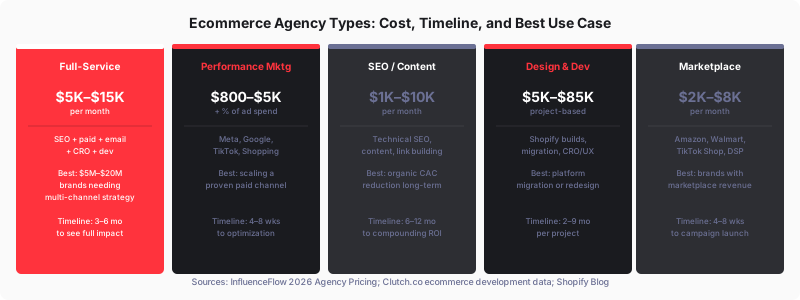
Full-service growth agencies cover the full acquisition and retention stack: paid media, SEO, email, CRO, and often development under one contract. Monthly retainers run $5,000 to $15,000 for growth-stage brands, per InfluenceFlow's 2026 agency pricing guide. The case for full-service is integrated cross-channel strategy: when paid and organic teams share data, when email nurture sequences are built from the same customer insights as acquisition campaigns, the sum is greater than the parts. The risk is depth: a shop that does everything may do nothing as well as a specialist.
Performance marketing agencies specialize in paid channels: Meta, Google, TikTok, and shopping campaigns. Fee structures typically combine a monthly management fee of $800 to $5,000 with 10% to 20% of ad spend. For brands with a proven channel they need to scale, or brands testing a new channel with aggressive ROAS targets, a performance specialist delivers faster optimization cycles than a generalist.
SEO and content agencies focus on organic acquisition: technical SEO, product page optimization, content programs, and link building. Monthly retainers run $1,000 to $10,000. The timeline to compounding ROI is six to twelve months, but the CAC differential is substantial. Ecommerce SEO packages from strong agencies produce organic traffic that compounds without proportional reinvestment, while paid acquisition cost stays linear.
Design and development agencies handle platform builds, migrations, and conversion-focused redesigns. They bill project-based: $5,000 to $85,000 per project, with average project durations of two to nine months. Brands moving from a legacy platform to Shopify Plus, building headless commerce infrastructure, or investing in checkout optimization as a standalone project are the natural fit.
Marketplace agencies manage Amazon, Walmart, and TikTok Shop presence: listings, DSP advertising, review management, and Buy Box strategy. Monthly retainers typically run $2,000 to $8,000. For brands generating significant marketplace revenue, a specialist creates substantially better outcomes than a generalist who manages the channel as an afterthought.
Strategy and consulting firms provide positioning, international expansion planning, P&L audits, and supplier strategy without execution. They serve brands needing senior-level guidance on specific decisions rather than ongoing execution partnerships.
The global digital marketing agency market is valued at $8.27 billion in 2026 and projected to reach $27.57 billion by 2035, per Business Research Insights. Retail and ecommerce command approximately 20% of US agency revenues.
The pricing range within that market is wide and reflects genuine scope differences.
Clutch's ecommerce development pricing data documents the average project cost at $51,943 over nine months for development work, with smaller builds commonly under $10,000. US-based development agencies bill $100 to $149 per hour; offshore firms below $25 per hour. For ongoing marketing retainers, the Clutch average across social media and content engagements runs $5,107 per month, or approximately $61,000 annually.
The pricing range by tier:
The in-house comparison matters here. A digital marketer costs $60,000 to $80,000 in annual salary, a social media manager $55,000 to $75,000, and a content manager $65,000 to $85,000, per Shopify's ecommerce agency guide.
An agency retainer at $5,000 to $8,000 per month replaces what would cost $180,000 to $240,000 annually in full-time staff across those three roles, before benefits, management overhead, and recruiting costs.
AskNeedle's research shows that 56% of brands work with two to three agencies simultaneously, and 66% of the most satisfied brands use multiple partners. The implication is that neither full-service nor specialist is universally correct.
The revenue-stage framework:
Under $2 million ARR: A single specialist agency maximizes ROI. Full-service overhead exceeds its value at this stage. Pick the highest-leverage channel, exhaust it, and add channels sequentially.
$2 million to $5 million ARR: One or two specialist agencies, with brand coordination managed internally. Test channel mix, identify what compounds, and build the internal marketing infrastructure that allows eventual full-service coordination.
$5 million to $20 million ARR: The inflection point. Too many channels to manage through single specialists, not enough internal infrastructure to coordinate a multi-agency stack. Full-service or an orchestrated two-to-three-agency configuration with clear internal ownership makes sense here.
Above $20 million ARR: A hybrid model: internal team plus specialist agencies for specific gaps. Build internal strategic capability; use agencies for channel-specific depth.
The questions that reveal the most about agency quality before signing a contract:
What specific results have you achieved for brands at our revenue stage and in our product category, and can you connect those results to business outcomes rather than channel metrics? Who will actually work on our account, and will we have access to that person? How do you attribute results across channels: what attribution model, what tracking setup, what does the reporting show?
How do your paid and organic teams share data? (Agencies that keep channels in silos produce worse outcomes than agencies with integrated data.) What happens in the first 30, 60, and 90 days? What is your process if a channel underperforms for two consecutive months?
Who owns our ad accounts, analytics, and content assets if we end the engagement? Can you show us a real client reporting dashboard? Can we speak with two CEO or founder references from comparable brands?
Guaranteed rankings or guaranteed ROAS. No agency can guarantee search rankings or a specific return on ad spend: channels are too variable and the variables outside any agency's control are too numerous. Pressure to sign immediately signals a poorly run sales process.
Vague case studies with no client-verifiable metrics or reference contacts. Reporting that centers on impressions, clicks, and follower counts rather than revenue, pipeline, or CAC. Cookie-cutter strategy with no customization to your product category.
An agency pitching the same channel mix to a $200 ACV software company and a $50 apparel brand does not understand the fundamental economics that should drive channel selection. Lack of clarity on who does the actual work day-to-day. High account manager turnover means your institutional knowledge walks out the door every eight months.
Channel-specific ROAS benchmarks from Foundry CRO's 2026 ecommerce marketing data: email generates $36 to $79 per dollar spent; SMS generates $71 to $79 per dollar; Google Shopping averages 5.17:1 ROAS; Meta standard campaigns average 1.86 to 2.19:1 ROAS.
Blended ROAS across channels averages 2.87:1 and is declining 4% to 10% annually as platforms capture more of the value they create.
Retention economics deserve equal weight. A 5% increase in customer retention correlates with 25% to 95% profitability gains, per Yotpo benchmarks. Existing customers convert at 60% to 70% versus 5% to 20% for new prospects.
Agencies that build acquisition-only programs and ignore retention economics produce top-line growth that does not compound into profitability.
The right ecommerce agency model depends on revenue stage, existing internal capability, and which channels have proven economics at your current CAC and ROAS. The common failure is hiring a full-service agency before the brand has enough scale to utilize the full scope, or hiring specialist agencies without the internal coordination infrastructure to make them work together.
For growth-stage DTC and ecommerce brands evaluating their agency stack, EmberTribe works at the intersection of paid acquisition and organic demand programs, building channel strategies accountable to revenue rather than managed in isolated reporting silos.
Most growth-stage brands treat channel marketing as a reach problem. They add channels to increase exposure and assume more distribution means more revenue. The brands that end up over-extended, margin-thin, or locked into platform dependency usually made that assumption.
Channel marketing is actually two separate problems that most companies conflate: where your product is sold (distribution channels) and how you reach buyers (marketing channels). Treating them as the same question causes allocation mistakes that compound over time.
Distribution channels are the pathways through which a product moves from brand to buyer: your own direct website, Amazon and Walmart marketplaces, wholesale and retail partners, social commerce storefronts like TikTok Shop and Instagram Shopping. The question here is where the transaction happens.
Marketing channels are how you reach and influence buyers before the transaction: paid social, SEO, email, SMS, influencer, retail media networks. The question here is how you drive awareness and conversion.
These two dimensions interact in ways that create strategic blind spots. Amazon is simultaneously a distribution channel (where people buy) and a marketing channel (where you run Sponsored Product ads to drive discovery). A brand that runs paid social to drive DTC traffic while its own Amazon listing shows the same product at a lower price is spending against itself. Most brands discover this conflict after the fact.
The strategic framework that works: decide your distribution channel mix first, based on contribution margin and customer ownership goals. Then build the marketing channel mix to serve that distribution strategy, not the other way around.
The single most common channel selection mistake is evaluating channels by gross margin. The same $50 product can show 65% gross margin on Shopify, 60% on Amazon, and 48% at wholesale. Gross margin says DTC wins by a mile. Contribution margin, which accounts for all variable costs including CAC, platform fees, fulfillment, and returns, often tells a very different story.
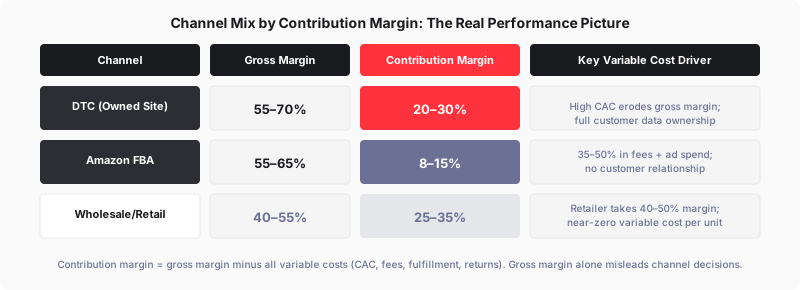
The implication is counterintuitive: Amazon's fee structure consumes 35 to 50% of revenue depending on category, but the customer acquisition cost is embedded in the platform. DTC's higher gross margin often narrows to a lower contribution margin once blended paid media CAC is included. Wholesale shows the lowest gross margin but often the highest contribution margin per unit because the variable cost per unit sold approaches zero.
Brands with strong omnichannel engagement retain 89% of customers versus 33% for single-channel brands, and omnichannel buyers show 13% higher average order value, according to research aggregated by Capital One Shopping. But reaching those retention rates requires that each channel is economically defensible first.
Early-stage and growth-stage brands face different channel problems. The right sequencing matters more than the right mix.
Early stage (pre-PMF or early traction): Marketplaces offer immediate access to existing demand without requiring you to build traffic from scratch. Amazon and TikTok Shop can prove demand faster than DTC because the platform supplies the audience. The tradeoff is that marketplace customers belong to the platform, not to you. Use early marketplace traction to validate demand, not as a long-term customer acquisition strategy.
Growth stage: DTC investment begins to compound. An email list, organic search presence, and returning customer base start delivering acquisition that does not depend on ad spend. Build owned channels in parallel before marketplace dependency becomes structural. The target allocation for most growth-stage DTC brands is roughly 60 to 70% DTC, 20 to 30% marketplace, with wholesale entering the mix once the brand has pricing leverage.
Scale stage: Wholesale and retail partnerships make sense when the brand can command premium shelf placement and pricing concessions rather than being commoditized. Omnichannel customers at this stage spend 13% more per order and have 30% higher LTV than single-channel customers.
US social commerce hit $87 billion in 2025, up 21.5% year-over-year, according to eMarketer. TikTok Shop alone grew 108% to $15.8 billion, representing 18.2% of total US social commerce.
TikTok Shop converts at 4.7% compared to Instagram Shopping at 2.1%. For mid-price visual products in beauty, wellness, and apparel, social commerce has become a first-tier channel, not an experiment.
The platform dependency risk is equally significant. TikTok's regulatory uncertainty in early 2025 demonstrated what happens when a channel that represents 15 to 20% of a brand's revenue faces potential shutdown. Brands with first-party data assets (email lists, SMS subscribers, loyalty programs) had a mitigation path. Brands without them had no way to reach those customers outside the platform.
The rule that applies to every channel: no single platform should exceed 60% of total revenue. This is not just a margin rule. It is a business continuity rule.
Channel conflict is one of the most expensive and most preventable mistakes for growth brands. It happens when distribution channel expansion creates direct competition between the brand's own channels or between the brand and its partners.
The Amazon versus DTC conflict is the most common form. If a third-party seller lists your product on Amazon at a lower price than your DTC site, customers find you through paid ads, check Amazon for the price, and buy there at lower margin. If you discount to win the Amazon Buy Box, retail partners demand matching price concessions. Margin pressure cascades.
The wholesale versus direct conflict creates similar tension. Retailers who carry your product will pull back, demand exclusivity, or reduce shelf space when they see aggressive DTC pricing. This is why many brands run channel-exclusive SKUs or colorways to prevent direct price comparison across channels.
Practical approaches that manage this without eliminating channel diversification:
The brands that manage channel conflict effectively address it in channel policy before expansion, not in crisis management after a partner complaint.
Brands with 90% or more Amazon concentration trade at 3.0 to 3.5x EBITDA at acquisition, compared to 4.5 to 5.5x for brands with meaningful off-Amazon channels, per Canopy Management's analysis of ecommerce brand acquisitions. Single-channel dependency carries a roughly 40% valuation discount.
Platform risk includes algorithm changes, fee increases, policy shifts, regulatory action, account suspension, and competitive moves (Amazon launching a private-label product in your category). The mitigation is building owned channels that the platform cannot take away.
Owned channels worth prioritizing in order of defensibility: email list, SMS subscribers, loyalty program membership, organic search presence. These compound over time and do not reset when a platform changes its algorithm or fee structure.
For DTC brands building their ecommerce marketing strategy, channel diversification is not about pursuing every available channel. It is about building the owned-channel foundation that makes all other channels less risky.
In B2B SaaS, channel marketing refers specifically to indirect go-to-market through partner ecosystems. The structural logic is the same as ecommerce channel strategy, with different vocabulary.
Partner types include resellers and value-added resellers (VARs), managed service providers (MSPs), independent software vendors (ISVs) who integrate your product, referral and affiliate partners, and system integrators for enterprise deployments.
The economics make indirect channels necessary at certain ACV thresholds. If your average contract value is below $15,000 to $25,000, a direct enterprise sales rep for every deal is not economically viable. Partners cover that market cost-effectively. Forrester research cited across B2B practitioners estimates that nearly 70% of B2B buyers purchase through an indirect channel partner rather than directly from the vendor.
The same channel conflict logic applies: if your direct sales team sells into territories where a partner is also working, conflict erupts. Deal registration systems, territory exclusivity agreements, and Partner Relationship Management (PRM) tools like PartnerStack or Impartner are the B2B equivalent of MAP policies.
For brands building a broader omnichannel marketing strategy, the underlying principle across both DTC and B2B is identical: distribution channel decisions constrain and enable marketing channel decisions. Building them in the right sequence, with contribution margin as the scorecard, is what separates brands that scale profitably from those that grow into a margin problem.
Channel strategy is one of the highest-leverage decisions a growth-stage brand makes and one of the hardest to reverse once distribution commitments are made. Wholesale relationships, Amazon seller accounts, and retail partnerships create obligations and dependencies that take years to unwind.
Getting channel strategy right requires contribution margin visibility by channel, clear policies against conflict before it starts, and a disciplined ceiling on any single platform's share of revenue. The brands that compound fastest are not the ones that found the best single channel. They are the ones that built a mix where each channel reinforces the others without undermining their economics.
If you want to audit your current channel mix and build a program that protects contribution margin at scale, EmberTribe works with growth-stage DTC and B2B brands on the kind of channel strategy that holds up as the brand grows.
Ecommerce brands spend $92 on customer acquisition for every $1 they spend on conversion rate optimization. That ratio, documented by InvespCRO's industry research, explains why most DTC brands have a traffic problem that is actually a conversion problem. They are paying to bring visitors to stores that are structurally set up to lose them.
Ecommerce conversion rate optimization services are the systematic fix: research, testing, and design work that improves the percentage of visitors who complete a purchase. A documented CRO program produces an average 223% ROI, per We Are Tenet's CRO statistics. At a 2.5% baseline conversion rate, a 30% relative improvement on a $10 million annual revenue store is approximately $300,000 in incremental annual revenue without adding a dollar of ad spend.
Before evaluating CRO services, it helps to understand where your store sits relative to benchmarks. Littledata's study of 2,800 Shopify stores puts the platform average at 1.4%. The top 20% hit 3.2% or better. The top 10% reach 4.7% or better. Top performers exceed 11%.

The spread is not random. Traffic source has an outsized effect on conversion rate. VWO's ecommerce conversion research shows email traffic converting at 4.0% to 5.3%, organic search at 2.7%, and paid social at approximately 1.5%. Brands that run paid social as their primary acquisition channel are starting with the lowest-converting traffic type and often misattribute low conversion to creative or audience problems when the real issue is site experience.
Cart abandonment data from Baymard Institute adds the most actionable context: 70.19% average abandonment rate, with mobile abandonment at 85.65%. The top five abandonment triggers are unexpected extra costs (39% of cases), delivery time objections (21%), trust issues with credit card entry (19%), forced account creation (19%), and checkout complexity (18%). Baymard's large-scale checkout research found the average large ecommerce site could achieve a 35.26% increase in conversion rate through better checkout design alone, representing roughly $260 billion in recoverable lost orders across US and EU ecommerce.
A complete ecommerce CRO engagement runs through five phases that most brands do not execute independently.
Agency pricing for ecommerce CRO runs on a wide range that tracks closely with the scope of testing and the size of the client's traffic base. We Are Tenet's pricing data shows growth-stage brands paying $2,000 to $5,000 per month for a full retainer engagement, with enterprise-tier programs running $8,000 to $31,000 per month.
Project-based engagements for standalone audits run $2,800 to $85,000 depending on scope and agency tier. The audit-to-retainer path is common: brands commission an audit to understand their conversion gap, then convert to a retainer once the opportunity size is clear.
The in-house team alternative is rarely the cost-effective option at growth stage. A minimum viable internal CRO team (CRO manager, UX designer, data analyst, front-end developer) runs $420,000 to $650,000 annually in salaries, benefits, tools, and training, per Elsner's in-house vs. agency CRO analysis. The break-even point for hiring in-house is typically above $50 million in revenue with 200,000 or more monthly conversions generating enough volume to sustain 20 or more experiments monthly.
Several questions reliably distinguish genuine testing-and-optimization programs from design-plus-copy rebrands.
Ask specifically: what experiment generated the most revenue for a brand similar to mine, and how do you measure that? A CRO agency that measures success in conversion rate percentage rather than revenue per visitor is optimizing a metric that can be gamed. Moving low-quality traffic off the page improves conversion rate without improving revenue. The right metric is revenue per visitor.
Ask how they handle statistical significance. Agencies that run tests for arbitrary two-week windows and declare winners without reaching required sample sizes are producing noise, not signal. A competent answer references minimum detectable effect sizes, required sample calculations, and sequential testing methods.
Ask whether checkout and pricing pages are in scope. Checkout is where 35% of improvable conversion opportunity lives, per Baymard's research. If a CRO agency treats it as out of scope, they are avoiding the highest-impact surface in ecommerce.
Ask for an example of a test that failed and what they learned from it. Good CRO agencies have extensive loss libraries. Agencies that only show winning case studies are either cherry-picking results or have not been running programs long enough to accumulate meaningful learnings from failures.
The ten red flags documented by Logiciel's CRO agency evaluation guide are worth reviewing in full. The most consistently problematic: pitching tools before discussing strategy, optimizing for test volume rather than impact, and reporting on engagement metrics rather than revenue outcomes.
The traffic threshold matters. A/B tests require sufficient sample sizes to reach statistical significance within a reasonable testing window. Brands with fewer than 5,000 monthly sessions face a practical constraint: low-traffic stores cannot run valid tests fast enough to justify a full retainer program. The better approach at that stage is qualitative research and heuristic audit work, implemented as best practices rather than tested sequentially.
Above 10,000 monthly sessions, an ecommerce CRO retainer produces measurable results within two to three months. Above 50,000 monthly sessions, a full testing program running six to twelve experiments simultaneously generates compounding improvements across the funnel. The math favors CRO investment heavily: a $3,000 monthly retainer that improves conversion from 2.5% to 3.25% on a store generating $500,000 monthly revenue produces $30,000 in incremental monthly revenue, a 10:1 return.
For growth-stage ecommerce brands investing in paid acquisition while their conversion rate sits below the top 20% benchmark of 3.2%, the sequence is clear. The dollars spent acquiring traffic to an unconverted store are partially wasted. Every percentage point of conversion improvement compounds across every future acquisition dollar spent.
Ecommerce CRO services close the gap between traffic investment and revenue return. The $1 to $92 spend ratio across the industry means most brands are dramatically underinvested in conversion relative to acquisition. The documented 223% average ROI and Baymard's 35.26% checkout improvement benchmark both point to the same conclusion: for brands between 10,000 and 200,000 monthly sessions, a well-run agency engagement is likely the highest-leverage growth investment available.
For DTC and ecommerce brands building performance programs that connect paid acquisition economics to site conversion, EmberTribe works at this intersection, ensuring that demand generation spend lands on optimized experiences rather than leaking through unclosed funnel gaps.
Most brands hit a wall at some point: traffic is growing, ad spend is holding steady, but revenue isn't following. The issue isn't usually the volume of visitors. It's what happens after they arrive. A conversion rate optimisation agency solves exactly this problem, turning existing traffic into more leads, purchases, and revenue without requiring more spend to acquire that traffic.
This guide covers what a CRO agency actually does, what services to expect, how to evaluate candidates, what good results look like, and how to know when hiring makes sense for your stage.
A CRO agency studies why visitors leave without converting and then runs structured experiments to fix those friction points. The work spans research, design, development, and statistical analysis, which is why most in-house teams struggle to run it properly alongside their other responsibilities.
Every credible CRO engagement follows a similar arc. The agency starts with a deep diagnostic phase: reviewing analytics data, auditing goal tracking, mapping your funnel, and identifying where the largest drop-offs occur. That quantitative analysis is paired with qualitative research (heatmaps, click maps, scroll-depth analysis, session recordings, and user surveys) to understand the why behind the numbers.
From there, the agency builds a prioritized hypothesis backlog. Each hypothesis is a testable idea: "If we move the CTA above the fold on the product page, we expect checkout starts to increase by X%." Testing is where the agency earns its fees. Well-run A/B and multivariate tests separate signal from noise and produce wins you can compound over time.
The specific services offered vary by agency, but most full-service conversion optimization agencies cover:
Boutique shops typically focus on A/B testing and landing pages. Full-service CRO teams include UX researchers, data analysts, copywriters, designers, and developers working together on every conversion touchpoint. Understanding which model fits your needs is part of the evaluation process.
The CRO industry has no formal certification that guarantees quality, so evaluation comes down to evidence. Here's what separates strong agencies from ones that will run a few tests and report inconclusive results.
Ask how they build and prioritize a hypothesis backlog. A serious agency uses frameworks like PIE scoring (Potential, Importance, Ease) or ICE scoring to prioritize experiments by potential impact and implementation cost. If they can't articulate a structured methodology, expect ad hoc testing that wastes months.
Running a test and calling a winner is not CRO. The results need statistical significance before you can trust them, and a good agency will explain their significance thresholds and minimum sample size requirements before a test begins. Agencies that declare winners after two days of data are giving you noise, not insight.
Ask for case studies with before-and-after conversion rates, traffic volumes, and test durations. Generic claims like "we improved conversions by 47%" mean little without context. Specifics matter: which page, what was the change, how long did the test run, and how large was the sample?
A proper CRO engagement starts with confirming your analytics are trustworthy. If an agency skips the tracking audit, they're building experiments on bad data. This matters significantly for DTC and ecommerce brands where small measurement errors can mislead an entire testing program. Our guide on ecommerce analytics covers what a clean measurement foundation looks like.
You should receive regular reports that connect test outcomes to business metrics, not just conversion rate changes. A good agency explains what a win means for revenue, not just which variant performed better.
CRO agency pricing varies considerably based on scope, traffic volume, and the seniority of the team you're accessing. Rough ranges for 2026:
| Agency Tier | Monthly Retainer |
|---|---|
| Entry-level / newer teams | $2,000 - $5,000 |
| Mid-tier with solid track record | $5,000 - $8,000 |
| Senior full-service agencies | $10,000 - $35,000+ |
Most engagements run on a monthly retainer model with a minimum 6-month commitment. That minimum exists for a reason: CRO requires time to build a hypothesis backlog, run tests to statistical significance, and implement wins. Agencies that offer month-to-month engagements with no minimum are often running too few tests to generate meaningful results.
Some agencies offer hybrid models that combine a lower base retainer with a performance component tied to conversion improvements. These reduce upfront risk but require agreed attribution methodology and clean baseline tracking before the engagement starts.
One-time audits are also available, typically ranging from $3,000 to $10,000, and can be a useful starting point if you want to understand your conversion gaps before committing to a full retainer.
Benchmarks help calibrate expectations. The global average website conversion rate sits around 3.68%, while top-performing sites achieve 11% or higher. For ecommerce, average rates vary significantly by vertical and traffic source.
What a well-run CRO program should produce:
These numbers assume your analytics are clean, your traffic volume supports statistical significance, and the agency is running tests with proper rigor. Lower traffic sites require longer test durations and may see slower progress.
Understanding how your marketing analytics tools feed into the testing process makes a material difference in how quickly you can generate reliable results.
CRO agencies aren't right for every stage. Here are the clearest signals that hiring makes sense:
Traffic exists but conversions have plateaued. If you're generating meaningful traffic but revenue isn't scaling proportionally, the problem is almost certainly in what happens after the click. More ad spend compounds the problem rather than solving it.
Your ROAS is declining and you've already optimized your ads. Once campaigns are dialed in, the next lever is on-site performance. Paid traffic that doesn't convert is just an expensive way to build session data. Our broader overview of conversion optimization maps out the full system.
You're investing in paid acquisition at scale. The larger your ad budget, the more a 1-2% conversion rate improvement is worth. At $100,000 per month in paid spend, doubling your conversion rate has the same effect on revenue as doubling your budget.
You have enough traffic to run valid tests. A/B tests require meaningful sample sizes to reach statistical significance. As a general rule, you need at least 1,000 monthly conversions per page to run tests that produce reliable results in a reasonable timeframe. Smaller sites can still benefit from CRO audits and qualitative research, but the testing cadence will be slower.
You've exhausted what your in-house team can execute. CRO requires skills across analytics, UX, design, copywriting, and development. Most in-house teams are strong in one or two areas. Agencies bring the full stack.
A conversion rate optimisation agency has a narrower focus than a full-service growth marketing partner. CRO agencies specialize in on-site behavior and experiment design. Growth marketing spans acquisition, retention, and the full customer lifecycle.
For many brands, the right answer is both: a growth agency managing acquisition channels while CRO work runs in parallel, maximizing the value of every visitor driven by paid and organic efforts. For brands at earlier stages, growth consulting often makes more sense as a starting point before isolating CRO as a dedicated workstream. Understanding how your analytics stack connects those two disciplines helps ensure the insights from one feed directly into the other.
The best CRO agency for your business is the one that matches your traffic volume, funnel complexity, and internal bandwidth. A boutique shop focused on ecommerce A/B testing is a poor fit for a B2B SaaS company with a multi-touch sales cycle. A full-service enterprise team is overkill for a DTC brand with $50K in monthly revenue.
Before any sales call, clarify: their experience with your business model, their testing methodology, minimum sample size requirements, reporting cadence, and what happens when a test is inconclusive. The answers will tell you more than any case study deck.
If you're evaluating whether CRO fits your current growth phase or want to understand what a data-driven optimization program looks like in practice, EmberTribe works with DTC and growth-stage brands to build and execute programs that compound over time.

Your website generates data every second. Every pageview, scroll, click, and abandoned cart is recorded somewhere. The challenge most growth-stage brands face is not a shortage of website data. It is knowing which data to act on, and building a system that turns signals into decisions fast enough to matter.
This guide covers the core categories of website data, the metrics that drive real business outcomes, the tools that collect and surface them, and a repeatable framework for turning raw numbers into revenue.
Website data is the collective record of how users find, interact with, and respond to your site. It spans traffic sources, behavioral patterns, technical performance, and conversion events. Analyzed together, these data streams reveal where growth is happening, where it is leaking, and what to fix first.
Most teams track website data across four categories: acquisition (how users arrive), behavior (what they do), performance (how fast and reliably the site delivers), and conversion (what percentage of users complete meaningful actions). Each category answers different questions and informs different decisions.
Acquisition data tells you which channels are sending users to your site and, critically, how valuable those users are compared to one another. Organic search accounts for roughly 53% of total website traffic across industries, making it the single largest acquisition source for most brands. Paid accounts for around 5%, direct 25%, and referral 13%.
But raw channel volume is not the right optimization target. Two channels can deliver identical session counts and wildly different revenue. Always segment acquisition data by downstream behavior: which sources produce the longest sessions, the highest conversion rates, and the best customer lifetime value. That segmentation is where channel strategy gets defensible.
Behavioral data is where most brands underinvest. Acquisition data shows you who arrived. Behavioral data shows you whether the site delivered on the promise that brought them there.
Google Analytics 4 replaced the traditional bounce rate with engagement rate, a more useful metric for modern browsing patterns. An engaged session meets at least one of three criteria: it lasts more than 10 seconds, includes a conversion event, or contains at least two pageviews. The median engagement rate across industries sits around 52.6%, which means almost half of all sessions show no meaningful interaction.
Bounce rate benchmarks vary significantly by industry and channel, but the cross-industry median hovers near 47.4%. Mobile sessions bounce at 51.8% versus 39.7% on desktop, a 12-point gap that reflects the friction many sites still create for mobile users. If your mobile bounce rate significantly exceeds your desktop rate, that gap is worth investigating with session recordings before touching anything else.
Average session duration across all industries is approximately 4 minutes and 41 seconds, but ecommerce benchmarks sit lower, closer to 2 minutes. B2C ecommerce visitors average about 92 seconds per session, which means the UX work of surfacing the right product quickly is not optional.
Pages per session reveals how deeply users explore the site. The B2B average lands near 1.89 pages per session. For DTC brands, higher pages-per-session often correlates with higher intent, especially in browse-heavy categories like apparel or home goods.
Beyond aggregate engagement metrics, path analysis reveals the specific pages where users exit your funnel. Most analytics platforms let you build custom funnel reports: product page to cart to checkout to purchase. Each drop-off point is a conversion optimization opportunity with a quantifiable revenue impact. For a systematic approach to improving these conversion steps, see our guide to analytics dashboards and how to build one that tracks funnel health in real time.
Conversion data ties behavioral signals to business outcomes. Tracked correctly, it answers the question every growth team needs to answer: what is a session actually worth?
Ecommerce conversion rates typically range from 2% to 4% for organic traffic, while SaaS landing pages convert between 1% and 3% depending on offer complexity and traffic quality. These benchmarks are starting points, not targets. The more useful comparison is your own site's conversion rate over time, segmented by source, device, and landing page.
Not every meaningful action is a purchase. Micro-conversions (email list signups, add-to-cart events, video plays, quiz completions) give you leading indicators of intent before the final transaction. When macro-conversions are low, micro-conversion data often reveals whether the problem is traffic quality, product-market fit, or funnel friction.
Revenue per session is a composite metric that captures both traffic quality and conversion rate in one number. It is calculated by dividing total revenue by total sessions over a given period. Tracking this metric by acquisition source quickly shows which channels deliver profitable traffic and which inflate session counts without contributing to revenue.
Website performance data is frequently siloed in engineering teams, but it belongs in every marketer's dashboard. Site speed directly affects both search rankings and conversion rates. Google's Core Web Vitals data consistently links faster load times to lower bounce rates and higher conversion rates across every device type.
If your LCP is above 4 seconds on mobile, no amount of CRO work on the product page will compensate. The technical debt is upstream of everything else.
Selecting the right tool stack depends on your team's technical resources, traffic volume, and privacy obligations. For a full comparison of analytics platforms by category and use case, see Analytics Platforms: How to Choose the Right One.
GA4 remains the dominant platform with over 44% market share across tracked websites. Its event-based data model, machine learning-powered insights, and BigQuery integration make it the default choice for brands that need depth. GA4's AI-generated insights surface anomaly detection and predictive metrics like purchase probability and churn likelihood automatically.
The constraint is privacy compliance. Several European data protection authorities have ruled GA4 non-compliant under GDPR. Brands with significant EU traffic need a supplemental or replacement solution.
For a deeper orientation to GA4's reporting interface and configuration, see Google Analytics 4: The Complete GA4 Overview.
Plausible Analytics and Fathom Analytics are cookieless, consent-free platforms that measure 100% of traffic without requiring a cookie banner. They sacrifice the depth of GA4 for simplicity and compliance. Both are appropriate as primary tools for lean teams or EU-heavy audiences, and as supplemental tools for brands that want cookieless data alongside their GA4 implementation.
Hotjar and Microsoft Clarity add the qualitative layer that quantitative traffic data cannot provide. Session recordings, heatmaps, and rage-click reports show you exactly how users are failing to engage with a page, not just that they bounced. Pairing a behavioral tool with GA4 gives you the "what" and the "why" in one stack.
Collecting website data is the easy part. Turning it into decisions that produce revenue is where most teams stall. This four-step framework structures the analysis so insights translate to action.
Before any optimization, record current performance across your core metrics: sessions by channel, engagement rate, conversion rate, revenue per session, and Core Web Vitals scores. Baselines give you a before state to measure against and prevent the common error of celebrating short-term variance as a trend.
Aggregate data hides the truth. A 2% conversion rate across all sessions might mask a 5% rate on organic desktop and 0.8% on paid mobile.
Before drawing conclusions, segment by source, device, landing page, and user type (new vs. returning). Segmentation is where the actionable signal separates from the noise.
Not all website data problems are equal. A broken checkout flow that affects 100% of purchase-intent visitors deserves more urgency than a suboptimal blog post meta title. Prioritize fixes by the product of: traffic volume affected multiplied by conversion impact multiplied by revenue per conversion. This calculation prevents the team from optimizing low-stakes pages while high-stakes leaks persist.
Every change should be treated as a hypothesis. Whether you are modifying a CTA button, restructuring a product page, or shifting budget between channels, define the expected outcome, set a measurement window, and record the result. Data-driven marketing requires systematic experimentation, not one-time fixes. Teams that build testing cadences compound their learning over time in ways that make individual optimizations look small by comparison.
Website data tells different stories depending on where in the funnel you look. Top-of-funnel analysis is about acquisition efficiency: which channels bring quality traffic at sustainable cost. Mid-funnel analysis is about engagement: are users finding what they came for, and are they progressing through the site in meaningful ways. Bottom-of-funnel analysis is about conversion: where do purchase-intent visitors fall out, and why.
Tying these three views together requires consistent UTM tagging, clean event tracking configuration, and a reporting cadence that surfaces each layer of the funnel to the right stakeholders. For brands building out their SEO channel, understanding how website data connects to search performance is particularly valuable. Our analytics for SEO guide covers that intersection in detail.
Most teams focus almost exclusively on sessions and conversion rates. Two categories of website data consistently go undertracked.
Return visit patterns: The ratio of returning visitors to new visitors signals brand equity. A site that can only grow by acquiring new traffic is vulnerable to paid media cost inflation. A site with strong returning visitor rates has compounding organic momentum.
Revenue attribution by landing page: Most analytics configurations track conversions at the session level without connecting them back to the first page a user landed on in that session. When you can map landing pages to revenue, content decisions become financial decisions.
Fixing these tracking gaps typically requires clean event implementation and a few custom GA4 explorations, but the payoff is a website data picture that is significantly more complete than what most competitors are working from.
Website data is only as useful as your ability to act on it quickly and correctly. The brands that compound growth are not necessarily the ones with the most data. They are the ones with the tightest loop between measurement, interpretation, and execution. Build that loop, and the data starts working for you.

Choosing the right web analytics tool is one of the highest-leverage decisions a growth-stage brand can make. The wrong choice means months of collecting data that doesn't answer your actual questions. The right one means every channel decision, landing page test, and funnel optimization sits on a foundation of reliable evidence.
The market in 2026 is more fragmented than it was three years ago. Google Analytics 4 still dominates raw market share at roughly 44% of all tracked websites, but privacy legislation across Europe has accelerated adoption of cookieless alternatives. European data protection authorities have ruled GA4 non-compliant in multiple countries, including Austria, France, Italy, Denmark, Finland, and Norway, pushing brands to evaluate the full landscape rather than defaulting to the familiar.
This guide organizes the major tools by type, maps them to realistic use cases, and helps you decide whether one tool is enough or whether a layered approach serves you better.
Not all analytics tools measure the same things. Before comparing specific products, it helps to understand the three distinct categories. Most mature ecommerce and DTC brands use tools from more than one category.
Quantitative traffic analytics tools (GA4, Matomo) track sessions, pageviews, acquisition channels, conversion events, and funnel steps. They answer "what is happening and how often." They are the foundation of any analytics stack.
Behavioral and heatmap tools (Hotjar, Microsoft Clarity) record sessions, generate click and scroll heatmaps, and surface rage clicks or dead clicks. They answer "how are users physically interacting with the page." They are the diagnostic layer on top of traffic data.
Privacy-first lightweight tools (Plausible, Fathom) are cookieless, consent-free alternatives that measure 100% of your traffic without a cookie banner. They sacrifice depth for simplicity, speed, and compliance. They are increasingly the primary analytics tool for brands selling into the EU.
Understanding which category you need most, and which combination, is the real evaluation question.
The table below covers the six tools most commonly evaluated by DTC and ecommerce brands in 2026. For a deeper breakdown of broader analytics platforms including product analytics and attribution tools, see Analytics Platforms.

| Tool | Type | Starting Price | Privacy-First | Best For |
|---|---|---|---|---|
| Google Analytics 4 | Quantitative | Free | No (cookie-based) | Traffic + conversion reporting |
| Plausible | Privacy-first | $9/mo (10k PV) | Yes (cookieless) | Simple, GDPR-compliant reporting |
| Fathom | Privacy-first | $14/mo (100k PV) | Yes (cookieless) | Agencies, multi-site management |
| Matomo | Quantitative + full features | Free (self-hosted) | Yes (configurable) | Data ownership, enterprise |
| Hotjar | Behavioral / heatmap | Free / $32+/mo | Partial | Heatmaps, session replay, UX |
| Microsoft Clarity | Behavioral / heatmap | Free | Partial | Free heatmaps + session replay |
GA4 is free and integrates natively with Google Ads, Looker Studio, and BigQuery. Its event-based data model is more flexible than Universal Analytics was, and the Explore reports enable sophisticated funnel analysis without a separate tool. The tradeoffs are real: a default data retention window of just two months, a complex interface that requires training, and ongoing legal challenges in the EU that make it unsuitable as the sole analytics tool for brands with heavy European traffic.
For brands primarily serving the US market, GA4 remains the logical starting point. It is worth understanding how much Google Analytics actually costs at scale before assuming it is truly free for high-volume sites.
Both tools are built in Europe, operate without cookies, and require no consent banner under GDPR. Plausible starts at $9/month for 10,000 pageviews and fits all key metrics onto a single dashboard: sessions, bounce rate, top pages, referrers, and goal conversions. Fathom starts at $14/month for 100,000 pageviews and includes unlimited sites on every plan, making it particularly strong for agencies managing multiple properties.
Neither tool offers heatmaps, session replay, A/B testing, or ecommerce funnel depth. They are deliberately minimal. For brands that need clean, compliant traffic data and nothing else, this simplicity is a feature.
Matomo is the most feature-complete open-source alternative to GA4. The self-hosted version is free and keeps all data on your own servers. The cloud version charges per hit (any pageview or event), with pricing that scales to approximately $170/month at one million hits. Matomo includes heatmaps, session recordings, A/B testing, and a tag manager in its premium add-ons, making it the closest single-tool alternative to a full analytics stack.
The practical limitation is implementation complexity. Self-hosting requires server maintenance, and the interface is more demanding than GA4. Matomo is most appropriate for brands with an in-house technical team or a strong preference for data sovereignty.
Hotjar and Microsoft Clarity occupy the behavioral analytics category. Hotjar's free tier supports 35 daily sessions; paid plans start at $32/month and scale with session volume. Microsoft Clarity is entirely free, with no session caps, no feature gating, and AI-powered insight summaries added in recent updates. Clarity added code-free funnel tracking in 2025, which meaningfully reduces the setup barrier.
The compliance note: as of October 2025, Clarity enforces consent signals for sessions from the EEA, UK, and Switzerland. Neither tool is cookieless in the way Plausible or Fathom are. Both require a consent mechanism for EU traffic.
The most effective analytics stacks combine a quantitative tool with a behavioral tool. GA4 tells you that your checkout page has a 70% drop-off rate. Hotjar or Clarity shows you where users are clicking, where they stop scrolling, and what they do right before abandoning. Together they create a feedback loop: metric surfaces the problem, behavior data diagnoses the cause.
For brands with EU traffic concerns, the common combination is Plausible or Fathom for compliant traffic measurement plus Microsoft Clarity for behavioral data (with a consent banner). This setup covers the "what" and the "how" without exposing you to GDPR risk on traffic counting.
For a broader look at how web analytics fits into a full measurement strategy, see Marketing Analytics Software.
The three practical combinations by use case:
Early-stage brand (US-focused): GA4 plus Microsoft Clarity. Both are free. GA4 handles traffic and conversion reporting. Clarity handles behavioral diagnostics.
EU or privacy-sensitive brand: Plausible or Fathom for traffic plus Microsoft Clarity (with consent) for behavioral data. Clean, compliant, and low-cost.
Scaling brand needing full ownership: Matomo self-hosted covers both traffic and behavior in one platform. Higher setup cost, but complete data sovereignty and no recurring vendor fees.
Before committing to a tool, evaluate four dimensions. Start with your traffic geography: US-only brands have more flexibility than brands with significant EU or UK audiences. Then consider who will use the data. A solo founder needs a simple dashboard, while an analyst team needs event flexibility and export options.
Next, decide whether you need behavioral data alongside traffic data. If yes, plan for two tools or choose Matomo's all-in-one approach. Finally, audit your required integrations. GA4's native Google Ads connection is hard to replicate, and PostHog covers web analytics, product analytics, and feature flags for stacks that lean toward product-led growth.
The goal is not to collect the most data. It is to collect the data that directly informs decisions your team is actually making.
Getting the analytics foundation right early prevents the painful migration projects that consume engineering and marketing cycles later. The best web analytics tool is not the one with the most features; it is the one your team will actually use, that answers your actual questions, and that keeps you compliant in every market you sell into.
If you want help auditing your current analytics setup or building a measurement strategy that connects traffic data to revenue, EmberTribe works with growth-stage brands to do exactly that. Start with a clear picture of what you need to know, then choose the tools that get you there.

Most brands collect website data. Few know what to do with it. The gap between having access to site web analytics and actually using that data to grow revenue is where most growth-stage companies stall. The numbers sit in a dashboard, updated daily, mostly ignored.
This guide closes that gap. We cover what site web analytics actually measure, which metrics matter for DTC brands, how to read a report without drowning in noise, and how to translate data into decisions that move the business forward.
Site web analytics is the collection, measurement, and analysis of data about how visitors interact with your website. At its core, the goal is simple: understand what people do when they arrive, where they came from, and whether they completed a valuable action.
Web analytics tools capture this data by placing a tracking script on every page. That script fires events, sends pageview data to a collection server, and stores behavioral patterns that you can query through a reporting interface. The raw data falls into four categories.
Acquisition data shows where your visitors came from: organic search, paid ads, email, social media, referral sites, or direct traffic. This data answers "which channels are working?" before you spend another dollar.
Behavior data captures what visitors do once they arrive: which pages they view, how long they stay, where they click, and at what point they leave. This reveals friction in your funnel before you notice it in revenue.
Conversion data tracks whether visitors completed a goal, whether that's a purchase, email signup, or a product page visit. According to Contentsquare, conversion rate is one of the ten most critical web analytics metrics for any site measuring business outcomes.
Technical data covers page load speed, device type, browser, and screen size. Slow pages and broken mobile layouts are conversion killers that only show up when you look at this layer.
There are dozens of metrics available in any analytics platform. These are the ones that consistently drive decisions for growth-stage DTC brands.
A session is a single visit to your site. One user can generate multiple sessions across different days or after the session timeout window expires. Watching the ratio of sessions to users helps you understand how often your audience is returning versus how heavily you rely on first-time traffic. A returning visitor rate below 15% often signals weak retention or email engagement.
Google Analytics 4 defines bounce rate as the percentage of sessions that were not engaged, meaning the visitor left without spending 10 or more seconds, converting, or viewing a second page. A bounce rate of 40-55% is typical for most industries, though ecommerce sites with strong landing page intent can see higher rates without negative consequences. Context matters more than the raw number.
Knowing your sessions count tells you how busy the site is. Knowing where those sessions came from tells you why. A brand that attributes 70% of sessions to paid search and 5% to organic is one ad account suspension away from losing most of its pipeline. Traffic mix is a risk management metric as much as a performance metric.
Overall conversion rate is a blunt instrument. Breaking it down by traffic source reveals which channels send ready-to-buy visitors and which send browsers. Email subscribers typically convert at 3-5x the rate of cold paid traffic. If they don't, that signals a messaging misalignment in your flows.
Understanding website analytics reporting at the channel level is where the real optimization leverage lives.
These two metrics together tell you whether content is doing its job. If visitors from organic search spend under 45 seconds on a product category page and view only one page, the content probably isn't answering their question or the page experience isn't compelling enough to explore further.
Google's Core Web Vitals measure Largest Contentful Paint (LCP), Interaction to Next Paint (INP), and Cumulative Layout Shift (CLS). Poor scores directly correlate with higher bounce rates and lower conversion. For DTC brands running paid acquisition, slow pages are among the most expensive problems you can ignore because you pay to bring visitors to pages that immediately lose them.
Opening an analytics dashboard without a clear question is the fastest way to waste an hour. Structure your review around a repeatable framework instead.
Start with the trend line. Before you look at any single metric, compare the current period to the same period last week, last month, or last year. Is overall traffic up or down? Is conversion rate moving in the right direction? Anomalies in the trend line tell you where to investigate.
Segment before you conclude. A flat conversion rate can hide a strong organic channel masked by a collapsing paid channel. Never interpret a top-line number without breaking it down by at least one dimension, whether that's traffic source, device type, landing page, or geography.
Identify the constraint. At any given moment, one part of your funnel limits growth more than any other. If you have strong traffic but weak conversion, the constraint is on-site experience or offer clarity. If you have strong conversion but declining traffic, the constraint is acquisition. How to read web analytics starts with identifying where visitors are dropping off relative to where you want them to go.
Look at exit pages. The pages where visitors most frequently leave your site are the most honest signal of where your funnel breaks. High exits on a product detail page suggest pricing, trust, or product-fit issues. High exits on checkout suggest UX friction or payment anxiety.
Review on a fixed cadence. Ad hoc analysis is reactive. Building a weekly or biweekly analytics reporting rhythm lets you spot trends before they become problems and catch wins before they're forgotten in the noise.
Data without action is just a bill for server storage. Here is how high-performing DTC brands translate site web analytics into growth moves.
Once you can see conversion rate by traffic source, budget allocation becomes clearer. A channel driving 20% of traffic at a 4% conversion rate deserves more spend than one driving 30% of traffic at a 0.8% rate. Research from McKinsey found that companies using data to drive marketing decisions are significantly more likely to outperform competitors on profitability. Web analytics is where that data starts.
High exit rates on high-traffic pages represent recoverable revenue. If 3,000 visitors per month land on your primary product page and 70% exit without acting, a conversion rate improvement of even 1% on that page is worth tracking down. Whether the fix is a faster load time, stronger social proof, or a clearer call to action, the analytics report gives you the starting point.
Organic search analytics shows which keywords bring visitors to which pages, and whether those visitors convert. Pages with strong traffic and low conversion often need better intent alignment. Pages with strong conversion and low traffic are candidates for link building or content expansion. SEO-focused web analytics connects content investments directly to business outcomes.
A/B tests without analytics are guesses. Analytics without A/B tests are observations. The two work together: analytics reveals which pages have the most impact potential, and test results confirm whether a hypothesis improved performance. Never run a test on a low-traffic page, and never trust a test result that doesn't have statistical significance backing it up.
The brands that get the most out of site web analytics are the ones that build it into their workflow rather than treating it as a one-off audit. Weekly reviews take 20 minutes when you have a standard template. Monthly reviews go deeper into trends and channel mix. Quarterly reviews inform budget allocation and content strategy.
The goal is not to know every number in the dashboard. The goal is to know which numbers answer the questions that matter most to the business right now, and to check those numbers on a cadence short enough to act on what you find.
If your analytics setup isn't giving you clear answers to the questions above, the problem is usually setup, not the tool. Verify that goals and conversions are tracked correctly, that UTM parameters are consistently applied across every paid campaign, and that your reporting views are segmented in a way that matches how you actually make decisions.
Start with the data you already have. The next marketing decision you make will be better for it.


.svg)