
Most B2B content programs look busy but produce nothing. Traffic ticks up, a whitepaper gets downloaded 47 times, and someone in marketing declares it a success. Meanwhile, sales still has no qualified leads and the CEO is asking why they're spending $12,000 a month on content.
The problem usually isn't the content itself. It's that most B2B content writing services optimize for output, not outcomes. Getting this right requires understanding what you're actually buying.
B2B content operates under fundamentally different constraints than B2C. The buyer isn't making an impulse decision with their own money. They're building a business case for a committee, managing internal politics, and assessing vendor risk over a sales cycle that might run 6 to 18 months.
This changes what good content looks like:
For companies exploring content marketing strategies that connect to revenue, the first step is usually accepting that B2B content requires a different investment than what most agencies pitch.
Not all content formats work equally in B2B contexts. The ones worth investing in depend on where your buyers are in the decision process.

SEO blog posts are the workhorse of top-of-funnel B2B content. A well-optimized post on a high-intent search term brings in buyers actively researching solutions. This is where most B2B content budgets should start, and most agencies underproduce here in favor of flashier formats.
Case studies are the most underrated mid-funnel asset. A specific, detailed case study with real numbers does more work than any brochure. The challenge: most companies either don't write them or write them in a format so generic they're useless.
Whitepapers and long-form guides matter when your buyer needs to make a business case internally. The research has documented a significant disconnect here: according to Scribewise's 2024 B2B content report, 86% of B2B marketers still prioritize whitepapers, but only 27% of buyers find them useful. Invest selectively.
Email nurture sequences keep warm leads from going cold. A well-written 6-email sequence tied to a content download or demo request is often worth more per dollar than a new blog post.
Thought leadership content (LinkedIn articles, bylined pieces, contributed content) builds the personal credibility that enterprise buyers use to validate vendor choices. This is usually founder or executive-authored but requires a skilled writer to execute well.
According to the Content Marketing Institute's 2025 B2B benchmarks, 87% of B2B marketers report content helped with brand awareness, but only 62% say it generated leads and even fewer say it drove revenue. The gap between content activity and content results is wide.
The reasons are consistent:
No documented strategy. Most companies produce content without a documented strategy connecting topics to buyer personas, funnel stages, or revenue goals. You end up with a content calendar that feels busy but doesn't address what buyers actually search for.
Wrong funnel targeting. Many B2B content programs over-invest in awareness content and under-invest in consideration and decision-stage content. Someone searching "best [category] software for mid-market companies" is much closer to buying than someone reading a trend piece.
Volume-first execution. Commodity writing services optimize for throughput. You get 20 posts a month written by generalists with no domain expertise. None of them rank. None of them convert.
No performance loop. Content gets published, traffic gets tracked, and that's where the measurement ends. Revenue attribution, pipeline influence, and lead quality analysis are rarely built in.
Choosing a writing service deserves the same rigor as hiring any other revenue-generating vendor. Here's what separates competent from mediocre:
Ask to see ranking examples. Any serious B2B writing service should be able to show you organic ranking samples for posts they've written. Not just "this post is live": posts that rank on page one for competitive terms.
Test subject matter depth. Give them a topic in your category and ask for a sample outline. Generalist writers produce generic outlines. Writers with domain fluency immediately identify the sub-questions that matter.
Understand their SEO process. B2B content that doesn't rank is just expensive brand awareness. Ask specifically how they approach keyword research, content structure for search intent, and internal linking.
Check their analytics integration. Do they track content's influence on leads and pipeline, or just pageviews? Services that measure only traffic are optimizing for the wrong thing.
Verify their revision process. You will need revisions. A service that treats revisions as exceptions rather than part of the process will create friction every cycle.
Pricing varies by scope, expertise level, and delivery model. Here's a realistic breakdown:
| Engagement Type | Typical Range | What You Get |
|---|---|---|
| Per blog post (generalist) | $300–$700 | 1,000–1,500 word posts, limited SEO |
| Per blog post (specialist) | $800–$2,500 | Deep research, SEO-optimized, subject matter expertise |
| Monthly retainer (agency) | $5,000–$15,000 | 4–12 pieces/month + strategy + distribution |
| Whitepaper or long-form guide | $2,000–$8,000 | 3,000–10,000 words, research-heavy |
| Case study | $1,500–$4,000 | Interview-based, customer-validated |
For SaaS companies building a content strategy around pipeline, a realistic starting budget for meaningful organic results is $4,000–$7,000/month, enough to produce 4–6 substantive posts with proper SEO, not 15 thin ones.
The 62% cost advantage content marketing holds over outbound channels is real, but only when the content is built to rank and convert. Cheap volume defeats the economic case entirely.
Not every company should hire an external writing service immediately.
Start with freelancers when you have a small budget, a clear topic area, and enough internal subject matter knowledge to brief and edit writers effectively. Platforms like Contently and ClearVoice vet specialist writers for B2B verticals.
Move to an agency when you need consistent volume, strategic guidance, and a team that can handle content planning, SEO, and distribution together. A good marketing agency with content capabilities will tie content output to business metrics from day one.
Build an internal function when content is a primary growth channel and you're producing enough volume (10+ pieces per month) that the economics of a full-time hire become favorable.
The wrong time to hire an external service: before you have a clear point of view on what your buyers care about and what makes your company's perspective worth reading.
Set realistic expectations before you start. Content marketing requires 6 to 12 months before meaningful organic traction. Anyone promising significant organic traffic gains in 90 days is either selling paid placement or overpromising.
A realistic arc for a B2B content program:
The 87% of B2B marketers who report content helping with brand awareness are largely measuring the right thing wrong. The question isn't "did content help?": it's "which specific posts drove which pipeline, and what would we have paid for that traffic through paid channels?"
Companies that document a content strategy see 33% higher ROI than those that don't. The operational difference between the two is usually having a writing service that can execute against a real brief, not just fill a content calendar.
The decision isn't whether to invest in B2B content. It's whether to invest in content that compounds or content that just accumulates. The difference is expertise, strategy, and measurement, all of which show up clearly in how a writing service talks about their work before you hire them.
If you're ready to build a content program that ties directly to pipeline, EmberTribe works with B2B and growth-stage brands to build and execute content strategies that show up in revenue, not just traffic reports.
When buyers search for business lead generation companies and end up researching Ironpaper, they are usually looking for one of two things: a direct evaluation of Ironpaper as a vendor, or a reference point for understanding what a serious B2B lead generation company actually looks like. This post serves both purposes.
Ironpaper is a useful benchmark because they are transparent about their methodology, publish original research, and have been operating in B2B for over 20 years. Walking through how their model works, who it is built for, and how to apply the same evaluation criteria to other vendors gives you a reusable framework regardless of which agency you ultimately choose.
The phrase "lead generation company" gets applied to services that range from selling contact lists to running integrated demand generation programs. The category called full-service B2B lead generation, where Ironpaper sits, means something specific.
A full-service model covers the entire pipeline from demand creation to sales-ready lead delivery. That includes content and thought leadership (to educate buyers during the 83% of their buying process that happens before they contact a vendor), demand generation campaigns (paid and organic channels that put the content in front of the right audiences), conversion infrastructure (landing pages, lead scoring, nurture sequences), and sales enablement (the handoff material that helps sales teams close what marketing generated).
Ironpaper's demand generation services are a practical illustration: they sequence their work by optimizing existing assets before building net-new campaigns, integrate marketing automation and lead scoring from the start, and measure attribution at the pipeline level, not just the lead level. This is what separates a growth system from a campaign service.
The distinction matters because it sets the right expectations. A full-service B2B lead generation company is not a vendor you hire to generate leads this quarter. You are hiring them to build the infrastructure that generates leads consistently, which compounds over time but requires six to twelve months before the return is visible.
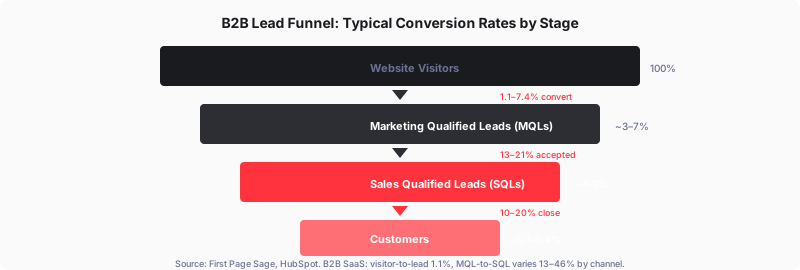
First Page Sage's B2B conversion rate research benchmarks visitor-to-lead rates at 1.1% for B2B SaaS, with MQL-to-SQL acceptance running 13% to 21% on average and improving to 46% for email-sourced leads per HubSpot benchmarks. The compounded result: a fraction of a percent of total site visitors become customers.
This is why lead quality matters more than lead volume. A lead generation company that delivers 500 MQLs with a 2% MQL-to-SQL rate produces 10 SQLs. A company that delivers 150 MQLs with a 20% MQL-to-SQL rate produces 30 SQLs. The second program produces three times the qualified pipeline at 30% of the volume.
The agencies that understand this build programs around ICP targeting and conversion rate optimization. The ones that do not optimize for volume because that is what clients can measure most easily.
Ironpaper's own research found that only 8.1% of B2B leaders describe their messaging as "very effective," which is the root cause of most MQL-to-SQL attrition. When marketing content does not resonate with buyer pain, leads do not convert to sales-accepted opportunities regardless of how well-targeted the acquisition campaign was.
The evaluation framework that applies to Ironpaper applies equally to every competitor in the category:
For B2B companies in competitive markets with complex buying processes, the full-service model produces outcomes that campaign-by-campaign approaches structurally cannot: a compounding content and demand system that improves over time, a defined handoff from marketing to sales, and attribution that connects spend to pipeline.
The fit conditions: deal size that justifies a 6 to 18-month nurture cycle, sufficient budget to sustain the engagement through the ramp period, and internal sales capacity that can follow up on the SQL volume the program produces.
When those conditions are not met, such as early-stage companies testing channels, brands that need immediate pipeline rather than infrastructure, or companies with high-velocity sub-$10K ACV products, the full-service model adds overhead without proportional return. In those cases, a performance marketing agency focused on paid demand generation with shorter feedback loops, or an SDR-as-a-service firm for immediate outbound coverage, will produce faster results at the current stage.
Business lead generation companies like Ironpaper represent a specific and well-defined category: integrated B2B growth agencies that build demand infrastructure rather than buy leads. The model works reliably for mid-market and enterprise technology companies with the budget and patience to let the compounding effects materialize.
For growth-stage B2B SaaS and DTC brands that need demand generation performance connected to revenue rather than just pipeline volume, EmberTribe works with brands at the intersection of paid media and organic demand programs tied directly to measurable business outcomes.
B2B keyword research is not a volume game. The brands that win organic search in competitive B2B categories are not targeting the highest-traffic terms. They are targeting the right terms: the ones that signal buyer intent, match specific funnel stages, and attract the decision-makers who control budget.
This guide walks through how B2B keyword research works, where it differs from B2C approaches, which tools to use, and how to build a prioritized keyword strategy that generates qualified pipeline rather than unqualified traffic.
The mechanics of B2B search are fundamentally different from consumer search. In B2C, a single person searches, decides, and converts, often within minutes. In B2B, a single deal might involve three to eight stakeholders, a buying cycle of weeks or months, and a sequence of searches that map across entirely different roles.
A VP of Operations searching for "automated inventory management" is not the same buyer as a CFO searching for "inventory management software ROI." Both are part of the same deal. Both use different language. Effective B2B keyword research surfaces both sets of queries and maps them to content that speaks to each role.
Volume also matters less in B2B than most marketers assume. A keyword with 200 monthly searches and strong commercial intent is worth more than a keyword with 20,000 searches and informational intent if your product costs $50,000 per year. High CPC bids (often $15 or more in competitive B2B categories) are a reliable signal that advertisers consider a keyword worth paying for because it converts. That signal belongs in your research process.
Effective B2B keyword strategies organize keywords into three layers that map to the buyer journey. Each layer requires different content formats and serves a different purpose in the funnel.
Top-of-funnel keywords attract buyers who are identifying a problem or starting to research a category. These terms tend to be educational and high-volume relative to the other layers. Examples include "what is revenue operations," "b2b demand generation strategies," or "how to reduce customer churn." Content here builds brand awareness and positions your company as a credible source.
Middle-of-funnel keywords attract buyers who understand the category and are evaluating approaches. These terms are more specific and often include modifiers like "best," "top," "how to choose," or "for [industry]." Examples include "best b2b seo tools," "keyword research for b2b saas," or "content strategy for manufacturing companies." The buying intent is higher here, and conversion rates from this layer tend to be meaningfully better than top-of-funnel traffic.
Bottom-of-funnel keywords attract buyers who are actively selecting a vendor or evaluating specific solutions. These include comparison searches ("vs." terms), pricing searches, review searches, and branded terms. While volume is lower, conversion rates are significantly higher. A single page ranking for "best b2b seo agency for saas" can drive more revenue than a dozen top-of-funnel posts.
The best B2B keyword research starts before you open any tool. Sales conversations, support tickets, and customer interviews reveal the specific language your buyers use to describe their problems, which is often different from the language your marketing team uses to describe your product.
Ask your sales team what questions prospects ask in early discovery calls. Ask customer success what problems customers were trying to solve when they first started searching. These answers surface the naturalistic keyword language that SEO tools often miss because the search volume is distributed across many variations.
Once you have that foundation, move into tool-based research.
Ahrefs and Semrush are the two most capable platforms for B2B keyword research. Both provide keyword volume estimates, keyword difficulty scores, CPC data, and SERP analysis. Semrush has stronger competitive gap analysis features. Ahrefs has a more reliable backlink index, which matters when evaluating keyword difficulty.
Google Search Console is underused for B2B research. If your site already has organic traffic, GSC shows exactly which queries are driving impressions and clicks. It surfaces real demand from real searchers at your site, which is more reliable than volume estimates from third-party tools.
Google Keyword Planner is useful for CPC data even if you are not running paid campaigns. High CPCs reliably signal commercial intent. A B2B keyword with a $25 CPC is worth investigating regardless of its monthly search volume.
For B2B-specific research, LinkedIn's search behavior and job postings are underused intelligence sources. The language companies use in job descriptions to describe problems they are hiring to solve often maps directly to the search queries their leaders are typing into Google.
Not every keyword deserves the same content format. Mapping keywords to their primary search intent before writing anything is one of the most important steps in a B2B keyword strategy, and one of the most commonly skipped.
Run a keyword through Google and study the current SERP carefully. The existing top results tell you what Google believes searchers want to find. If the top results are all long-form guides, a long-form guide is likely the right format. If the top results are tool comparison pages or listicles, that is the format Google is rewarding for that query.
Intent mapping also affects conversion strategy. A top-of-funnel informational post should convert to a lead magnet or newsletter, while a middle-of-funnel comparison page should convert to a demo or consultation. A bottom-of-funnel pricing page should convert to a sales conversation. Misaligning content format and conversion strategy is one of the main reasons B2B content generates traffic but not pipeline.
Individual keywords produce individual pages. Topic clusters produce authority. The brands that dominate B2B search are not publishing one post per keyword. They are building interconnected content systems where a pillar page covers a broad topic and supporting cluster posts cover specific subtopics, all linked together in a way that signals deep expertise to search engines.
For a B2B company in the CRM space, a cluster might look like this: a pillar page on "CRM for manufacturing" supported by cluster posts on "how to track customer orders in CRM," "CRM integration with ERP systems," and "CRM for mid-market manufacturers." Each cluster post reinforces the authority of the pillar, and the pillar passes that authority back to the cluster.
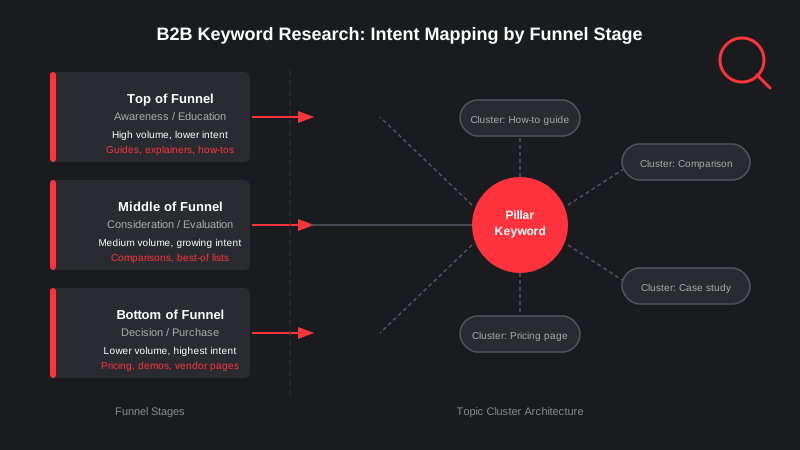
Building clusters requires deliberate internal linking. Every cluster post should link back to the pillar page, and the pillar should link forward to each supporting post. This architecture is one of the fastest ways to build topical authority in a competitive B2B category. Our guide to analytics for SEO covers how to measure topical authority gains over time.
Once you have a keyword list, prioritization determines where you spend content resources first. Use four criteria to score and rank keywords:
Search intent fit. Does this keyword map cleanly to a content format you can execute? High-intent keywords you can rank for are worth more than high-volume keywords where your content format is a poor fit for the SERP.
Keyword difficulty relative to your domain authority. A keyword difficulty of 30 is approachable for a site with meaningful backlinks. A keyword difficulty of 70 requires significant link equity. Target opportunities where your domain can compete within six to twelve months.
Business value. Keywords that attract buyers close to a purchase decision have higher business value than keywords that attract researchers. Weight your prioritization toward terms that appear in the middle and bottom of your funnel.
Competitive gap. Identify keywords where your competitors rank but you do not. These represent traffic you are currently losing to competitors and are often faster to capture than entirely new territory. Our post on competitor AdWords keywords covers how to find gaps in paid search that often mirror organic opportunities.
Effective keyword prioritization is covered in depth by resources like Moz's Keyword Research guide and Search Engine Land's B2B SEO coverage. Both are worth bookmarking as reference material.
B2B keyword research is the foundation of every content engagement we run. Before writing a single post, we map keywords to funnel stages, score intent, and build cluster architecture that compounds over time.
The brands that get the most out of B2B search are not the ones publishing the most content. They are the ones publishing the most targeted content, built on keyword research that reflects how their buyers actually search, not how the marketing team talks about the product.
If you are evaluating SEO partners and want to understand how strategic keyword research fits into a broader engagement, our guide to finding the best SEO firm walks through the evaluation criteria that matter most. And if you want to understand what the top B2B SEO companies actually do differently, our roundup of the best SEO companies in the USA covers the operational patterns that drive results.
B2B keyword research is not a one-time exercise. The B2B search landscape shifts as competitors publish, search engines evolve, and buyer language changes. Build your keyword strategy as a living document, revisit it quarterly, and let intent signals from your existing content guide where you expand next.

Most B2B content programs look busy but produce nothing. Traffic ticks up, a whitepaper gets downloaded 47 times, and someone in marketing declares it a success. Meanwhile, sales still has no qualified leads and the CEO is asking why they're spending $12,000 a month on content.
The problem usually isn't the content itself. It's that most B2B content writing services optimize for output, not outcomes. Getting this right requires understanding what you're actually buying.
B2B content operates under fundamentally different constraints than B2C. The buyer isn't making an impulse decision with their own money. They're building a business case for a committee, managing internal politics, and assessing vendor risk over a sales cycle that might run 6 to 18 months.
This changes what good content looks like:
For companies exploring content marketing strategies that connect to revenue, the first step is usually accepting that B2B content requires a different investment than what most agencies pitch.
Not all content formats work equally in B2B contexts. The ones worth investing in depend on where your buyers are in the decision process.
SEO blog posts are the workhorse of top-of-funnel B2B content. A well-optimized post on a high-intent search term brings in buyers actively researching solutions. This is where most B2B content budgets should start, and most agencies underproduce here in favor of flashier formats.
Case studies are the most underrated mid-funnel asset. A specific, detailed case study with real numbers does more work than any brochure. The challenge: most companies either don't write them or write them in a format so generic they're useless.
Whitepapers and long-form guides matter when your buyer needs to make a business case internally. The research has documented a significant disconnect here: according to Scribewise's 2024 B2B content report, 86% of B2B marketers still prioritize whitepapers, but only 27% of buyers find them useful. Invest selectively.
Email nurture sequences keep warm leads from going cold. A well-written 6-email sequence tied to a content download or demo request is often worth more per dollar than a new blog post.
Thought leadership content (LinkedIn articles, bylined pieces, contributed content) builds the personal credibility that enterprise buyers use to validate vendor choices. This is usually founder or executive-authored but requires a skilled writer to execute well.
According to the Content Marketing Institute's 2025 B2B benchmarks, 87% of B2B marketers report content helped with brand awareness, but only 62% say it generated leads and even fewer say it drove revenue. The gap between content activity and content results is wide.
The reasons are consistent:
No documented strategy. Most companies produce content without a documented strategy connecting topics to buyer personas, funnel stages, or revenue goals. You end up with a content calendar that feels busy but doesn't address what buyers actually search for.
Wrong funnel targeting. Many B2B content programs over-invest in awareness content and under-invest in consideration and decision-stage content. Someone searching "best [category] software for mid-market companies" is much closer to buying than someone reading a trend piece.
Volume-first execution. Commodity writing services optimize for throughput. You get 20 posts a month written by generalists with no domain expertise. None of them rank. None of them convert.
No performance loop. Content gets published, traffic gets tracked, and that's where the measurement ends. Revenue attribution, pipeline influence, and lead quality analysis are rarely built in.
Choosing a writing service deserves the same rigor as hiring any other revenue-generating vendor. Here's what separates competent from mediocre:
Ask to see ranking examples. Any serious B2B writing service should be able to show you organic ranking samples for posts they've written. Not just "this post is live": posts that rank on page one for competitive terms.
Test subject matter depth. Give them a topic in your category and ask for a sample outline. Generalist writers produce generic outlines. Writers with domain fluency immediately identify the sub-questions that matter.
Understand their SEO process. B2B content that doesn't rank is just expensive brand awareness. Ask specifically how they approach keyword research, content structure for search intent, and internal linking.
Check their analytics integration. Do they track content's influence on leads and pipeline, or just pageviews? Services that measure only traffic are optimizing for the wrong thing.
Verify their revision process. You will need revisions. A service that treats revisions as exceptions rather than part of the process will create friction every cycle.
Pricing varies by scope, expertise level, and delivery model. Here's a realistic breakdown:
| Engagement Type | Typical Range | What You Get |
|---|---|---|
| Per blog post (generalist) | $300–$700 | 1,000–1,500 word posts, limited SEO |
| Per blog post (specialist) | $800–$2,500 | Deep research, SEO-optimized, subject matter expertise |
| Monthly retainer (agency) | $5,000–$15,000 | 4–12 pieces/month + strategy + distribution |
| Whitepaper or long-form guide | $2,000–$8,000 | 3,000–10,000 words, research-heavy |
| Case study | $1,500–$4,000 | Interview-based, customer-validated |
For SaaS companies building a content strategy around pipeline, a realistic starting budget for meaningful organic results is $4,000–$7,000/month, enough to produce 4–6 substantive posts with proper SEO, not 15 thin ones.
The 62% cost advantage content marketing holds over outbound channels is real, but only when the content is built to rank and convert. Cheap volume defeats the economic case entirely.
Not every company should hire an external writing service immediately.
Start with freelancers when you have a small budget, a clear topic area, and enough internal subject matter knowledge to brief and edit writers effectively. Platforms like Contently and ClearVoice vet specialist writers for B2B verticals.
Move to an agency when you need consistent volume, strategic guidance, and a team that can handle content planning, SEO, and distribution together. A good marketing agency with content capabilities will tie content output to business metrics from day one.
Build an internal function when content is a primary growth channel and you're producing enough volume (10+ pieces per month) that the economics of a full-time hire become favorable.
The wrong time to hire an external service: before you have a clear point of view on what your buyers care about and what makes your company's perspective worth reading.
Set realistic expectations before you start. Content marketing requires 6 to 12 months before meaningful organic traction. Anyone promising significant organic traffic gains in 90 days is either selling paid placement or overpromising.
A realistic arc for a B2B content program:
The 87% of B2B marketers who report content helping with brand awareness are largely measuring the right thing wrong. The question isn't "did content help?": it's "which specific posts drove which pipeline, and what would we have paid for that traffic through paid channels?"
Companies that document a content strategy see 33% higher ROI than those that don't. The operational difference between the two is usually having a writing service that can execute against a real brief, not just fill a content calendar.
The decision isn't whether to invest in B2B content. It's whether to invest in content that compounds or content that just accumulates. The difference is expertise, strategy, and measurement, all of which show up clearly in how a writing service talks about their work before you hire them.
If you're ready to build a content program that ties directly to pipeline, EmberTribe works with B2B and growth-stage brands to build and execute content strategies that show up in revenue, not just traffic reports.

Ironpaper is a B2B growth agency founded in 2003 and based in New York City with a 70-person team. They specialize in lead generation, demand generation, account-based marketing, and sales enablement for B2B companies with complex, long-cycle sales processes. Understanding what they actually do, and what they do not do, is a useful starting point for any company evaluating B2B lead generation options.
This post covers Ironpaper's model specifically, then maps the broader landscape of B2B lead generator types so you can evaluate fit across the category.
Ironpaper positions itself as a systems builder rather than a campaign vendor. Their stated differentiation: they treat marketing as an interconnected growth ecosystem rather than a series of individual tactics. The practical translation of that framing is a service model that spans strategy, content, demand generation, ABM, and sales enablement under one retainer.
Their core service lines:
Ironpaper's primary client profile is mid-market and enterprise B2B companies in technology-adjacent sectors: SaaS, IoT, IT services, energy, fleet management, and recruiting. They report a 50/50 split between mid-market and enterprise clients. The common thread across their client base is a long or complex sales cycle: deals that involve multiple stakeholders, 3 to 18 months to close, and a sales process that requires significant buyer education before the first qualified conversation.
Ironpaper's approach to B2B lead generation references the Gartner finding that B2B buyers spend only 17% of their purchase process time interacting with potential vendors. The implication they draw: the 83% of the buying journey that happens without vendor contact is shaped almost entirely by content. Their model is built around owning that phase.
Minimum engagement size starts at $25,000+ per project at $200 to $300 per hour based on Clutch data, which positions them solidly in the mid-market and enterprise tier. Early-stage startups and SMBs with limited marketing budgets will not find a natural fit here.
Ironpaper occupies one segment of a market with at least four distinct agency types, each serving a different need.

Full-service growth agencies like Ironpaper are suited for companies investing in a compounding, systems-based approach to B2B pipeline. The timeline to meaningful results is 6 to 12 months, which is the right expectation to set going in.
Demand generation specialists focus on paid media and pipeline metrics with shorter feedback loops. For SaaS companies that need to generate qualified pipeline in four to eight weeks while longer-term organic programs ramp, a demand gen specialist operating alongside a content agency is a common configuration.
SDR-as-a-service firms handle outbound: cold email sequences, cold calling, and appointment booking. Ironpaper does not run outbound cold outreach programs. Companies that need a BDR function without the cost of hiring in-house ($150,000 to $200,000 annually for a fully loaded US-based SDR) will need a separate partner for that layer.
ABM-specific agencies concentrate on enterprise named account programs, often integrating with intent data platforms like Demandbase, 6sense, or Terminus. This is highest-investment, highest-target-size territory.
Understanding which layer of the stack you actually need shapes which type of agency makes sense, and whether a single partner or a combination is the right answer.
Several things Ironpaper does well are worth noting regardless of whether they are the right fit for your company.
Their 20-plus years of B2B-only focus is genuine domain depth. B2B sales cycles, multi-stakeholder dynamics, and the content types that actually move enterprise buyers differ materially from B2C. Agencies that have worked across both tend to underestimate how different these environments are.
Their original research is a credible signal. Publishing a proprietary study on B2B messaging effectiveness, and building service lines around fixing the problem that data identifies, is the kind of thought leadership that separates a domain expert from a content mill. It also tells you something about how they approach client engagements.
Their integrated model reduces coordination overhead. A single agency managing strategy, content, demand gen, and sales enablement means fewer handoff failures than a multi-agency configuration.
A $25,000 minimum engagement is the clearest filter. Growth-stage companies with annual marketing budgets under $200,000 will find the cost structure difficult to justify, particularly in the first six months before the content and demand gen programs compound into consistent pipeline.
Companies that need immediate pipeline, such as a fundraising round that requires demonstrated revenue growth in the next 90 days, may need performance marketing tactics with shorter feedback loops alongside or instead of a content-ecosystem approach.
Companies outside Ironpaper's primary verticals (SaaS, IT, IoT, energy, tech) will find fewer directly relevant case studies and may encounter a steeper ramp as the team learns their market dynamics.
High-velocity sales motions with small deal sizes are a structural mismatch. Ironpaper's model is calibrated for complex, considered purchases. If you are selling $10,000 ACV SaaS with a product-led growth motion, an agency that thinks in terms of nurturing long buying journeys may add friction rather than remove it.
Before committing to any B2B lead generator, the questions that matter most:
How do you define a qualified lead, and how does that definition align with our sales team's? How does your reporting connect marketing spend to pipeline and revenue, not just MQLs? What does the first 90 days look like before results materialize?
What industries and deal sizes do you have documented results in? How does your team structure support both strategy and execution, and who is doing the work day-to-day?
The answers to those five questions reveal more about fit and likely outcomes than any case study on the agency's website.
Ironpaper is a well-constructed B2B growth agency for mid-market and enterprise technology companies with complex sales cycles and the budget to invest in a compounding content and demand system. For companies that match that profile, they are worth serious evaluation.
For growth-stage B2B companies that need a performance marketing layer focused on measurable pipeline metrics alongside content strategy, EmberTribe works with DTC and B2B brands on programs that connect demand generation investment directly to revenue, not activity reports.

According to SeoProfy's lead generation statistics research, 80% of new leads never convert to sales. For companies paying business lead generation companies by volume, that number is the most important context in the decision: you are not buying leads. You are buying the fraction of leads that will eventually become customers, and the agency you choose determines whether that fraction is 5% or 25%.
The problem is that the category called "lead generation companies" covers at least five fundamentally different service models. An outbound appointment-setting firm and an inbound SEO agency both call themselves lead generation companies. They do completely different work, serve different sales motions, and produce different lead quality. Choosing without that distinction in mind produces the misalignment that drives the 80% non-conversion rate.
Not all lead generation companies are solving the same problem. Understanding the model is the first step to knowing whether a company can actually help you.
The differences between B2B and B2C lead generation are structural, not just tactical.
B2C generates roughly seven times more leads per month than B2B (an average of 196.5 leads per month at B2C companies versus 28 for B2B), but individual B2B leads carry far higher lifetime value. B2C conversions are often impulse-driven with short decision cycles. B2B deals involve 12 or more average touchpoints before a sales-qualified lead is created.
The platform split reflects this: 89% of B2B marketers use LinkedIn for lead gen, and 62% say LinkedIn generates leads at twice the rate of other platforms, per SeoProfy's research. B2C lead generation runs primarily through Meta (Facebook and Instagram), Google Shopping, and increasingly TikTok. An agency optimized for one side of this divide is not automatically equipped for the other.
The evaluation framework differs too. B2B lead quality is assessed by job title, company size, budget authority, and pain signal, criteria that take time to verify and require ICP-specific targeting. B2C lead quality is assessed faster, by behavioral signals: email open rates, click patterns, abandon cart events. Agencies that conflate these frameworks produce misaligned results in both directions.

The pricing model is the first signal. Retainer arrangements ($2,500 to $12,000 or more per month) indicate a strategic partnership focused on program quality. Pay-per-lead models create an incentive toward volume over quality, since the vendor gets paid the same whether the lead converts or not. Pay-per-appointment aligns incentives better for outbound firms, since the vendor only gets paid when a qualified meeting is booked.
Regardless of the model, several green flags indicate a trustworthy vendor:
The agency discloses exactly how leads are sourced and how contact data is verified. It provides sample lead records before signing. It can show historical MQL-to-SQL rates with real client data, not just industry averages. It offers CRM integration with real-time delivery and a defined policy for replacing invalid contacts.
Red flags that reliably predict future problems: the vendor refuses to disclose lead sourcing methodology. The pricing and volume promises look too good relative to industry CPL benchmarks. The case studies only show anonymous testimonials without named clients or specific metrics. The leads being sold are non-exclusive and shared across multiple buyers in your category.
There is no minimum contract length (which means they are not confident in results) or there is an unusually long lock-in with no performance-based exit clause.
One of the most costly red flags is a vendor that sells recycled lists. Recycled leads have already been contacted by competitors and are statistically much less likely to convert. If an agency cannot explain specifically how their contact database is sourced and refreshed, assume the data quality is poor.
First Page Sage's B2B conversion rate data shows website visitor-to-lead conversion averaging 1.1% for B2B SaaS and up to 7.4% for legal services. These are the starting points for evaluating funnel performance.
The metrics that matter from a lead generation company relationship:
Digitechniks' outsourced lead generation analysis shows outsourced campaigns launching in two to four weeks versus three to six months for in-house builds, with 71% of organizations that outsource reporting higher conversion rates than purely in-house management.
Outsourcing makes sense when the fully loaded cost of an in-house SDR ($150,000 to $200,000 annually in the US) exceeds the cost of an outsourced program ($7,000 to $12,000 per month for mid-market coverage). It also makes sense when you are entering a new market, when the sales team is prospecting instead of closing, or when you want to test a channel before committing to headcount.
Building in-house makes sense when brand narrative is highly complex and requires deep product knowledge, when you have a product-led growth motion that requires sophisticated lifecycle nurturing, or when lead volume is high enough to support and manage a dedicated SDR team effectively.
The reality for most growth-stage companies is a hybrid: outsource pipeline acceleration while building internal content and nurture capability in parallel. 82% of companies plan to outsource at least part of their lead generation in 2025, which is consistent with programs that treat outsourced agencies as a complement to in-house capability rather than a replacement.
Lead generation companies are not interchangeable. The model, the channel focus, the pricing structure, and the lead sourcing methodology all determine whether an engagement produces pipeline or just activity. Companies that treat lead gen as a commodity purchase, choosing on price per lead, reliably end up with the 80% non-conversion problem the industry is defined by.
If you want to evaluate which lead generation approach best fits your current stage, budget, and sales motion, EmberTribe works with growth-stage DTC and B2B brands on performance programs that connect lead generation spend directly to revenue outcomes.
Most B2B SaaS pipelines have the same structural problem: turn off the paid ads, and the leads disappear. That's not a pipeline — it's a purchase order for attention.
SaaS demand generation done right creates pipeline that compounds. It builds brand presence in the channels where your buyers actually research decisions, generates inbound interest from content and community rather than from clicks, and produces leads that convert at higher rates because they already understand what you do and why it matters.
This guide covers how to build a SaaS demand generation strategy that doesn't collapse the moment your paid budget is cut.
These terms get used interchangeably, but they describe different activities with different timelines.
Lead generation is transactional. You run a campaign, someone fills out a form, you get a contact. The buyer may or may not be ready to purchase. The relationship starts at the conversion event.
Demand generation is upstream. It's about creating awareness, building credibility, and shaping how potential buyers think about the problem your product solves — before they're even in buying mode. When done well, demand generation means that when a buyer is finally ready to evaluate solutions, your brand is already in the consideration set.
The consensus among B2B marketers is that most demand generation budgets are heavily weighted toward demand capture — capturing people who are already searching — with far less going toward demand creation. That ratio is almost exactly backwards from what drives optimal pipeline.
The SaaS companies that are winning pipeline in 2026 have invested in demand creation. Here's how they're doing it.
Organic content is the most durable demand generation channel available to SaaS companies. Done correctly, a blog post, case study, or comparison page generates qualified traffic every month for years — with no incremental cost per visitor.
The key distinction: most SaaS content marketing is built around keywords, not around buyer education. Those are different strategies. Keyword-driven content targets people already searching for something; buyer education content creates awareness for people who don't yet know they have a problem your product solves.
A strong SaaS content strategy includes both. High-volume search terms bring in buyers at the evaluation stage. Educational content on adjacent topics pulls in buyers earlier in the journey and builds the brand authority that accelerates trust during the sales process.
For more on building this type of system, our post on SaaS content marketing strategy covers the framework in depth.
A significant share of B2B buyer research happens in channels you can't directly track: private Slack communities, LinkedIn DMs, peer conversations, and niche podcasts. This is "dark social" — influence that doesn't show up in your attribution model but drives purchase decisions constantly.
Getting into these channels requires investment in presence, not just in paid placement. Tactics that work:
The companies that win in dark social are consistently helpful before they're ever promotional.
If your product has a freemium tier or free trial, it's one of your most powerful demand generation assets — and often underused as such.
Product-led growth compresses the sales cycle by letting buyers experience value before the sales conversation begins — and free trials are consistently among the highest-converting demand generation tactics for B2B SaaS. The demo becomes a conversation about expansion, not a pitch from zero.
PLG also generates organic word-of-mouth when the product is good. Users recommend tools they use to peers in those dark social channels mentioned above. Every satisfied free-tier user is a potential demand generation asset in their professional network.
Being in the right ecosystem puts you in front of buyers who are already spending in your category.
Integrations with platforms like Salesforce, HubSpot, or Slack expose your product to buyers who are actively looking for complementary tools. A listing in a marketplace (HubSpot App Marketplace, Salesforce AppExchange) functions as inbound demand generation with no ongoing ad spend.
Co-marketing with adjacent SaaS products — joint webinars, co-authored guides, shared distribution lists — can reach audiences you'd otherwise need to pay to access. These partnerships work best when both products serve the same ICP without competing directly.
Traditional demand generation casts wide. Account-based marketing (ABM) reverses the funnel — you identify target accounts first, then build demand within those specific organizations.
For SaaS companies with a defined ICP and a sales team capable of working enterprise or mid-market accounts, ABM can dramatically improve pipeline quality. Rather than generating hundreds of low-fit MQLs, ABM generates fewer, higher-converting opportunities from accounts already identified as good fits.
ABM tactics include targeted LinkedIn campaigns to specific job titles at named accounts, direct outbound sequences triggered by intent signals, and personalized content delivered to specific organizations. A B2B demand generation agency with ABM experience can help structure this program without requiring a large internal operations team.
Organic demand generation requires infrastructure to capture and nurture the interest it creates:
Marketing automation. Email nurture sequences that educate buyers over weeks or months, not a single follow-up after a form submission.
Intent data. Tools like G2, Bombora, or 6sense identify accounts that are actively researching your category — even before they've visited your site. This turns demand generation activity into a signal you can act on with outbound.
Content distribution. Creating content is only half the work. Systematic distribution through LinkedIn, email newsletters, partnerships, and republication platforms determines how much of your audience actually sees it.
Attribution that accounts for dark social. Standard last-click attribution will chronically undervalue demand generation. Building in a self-reported attribution question ("How did you hear about us?") alongside your standard UTM tracking gives a more accurate picture of what's actually working.
Demand generation operates on longer timelines than lead generation, which means the metrics that matter are different:
If you're only measuring MQL volume and CAC, you're measuring demand capture, not demand generation. The upstream metrics reveal whether you're building durable pipeline or renting it.
This isn't an argument against paid advertising. It's an argument against building your entire pipeline on it.
Paid ads are excellent for amplifying content that's already performing, retargeting audiences who have engaged with your organic channels, and accelerating demand capture for buyers who are actively in-market. They're a poor foundation for demand generation because they generate no durable asset — the moment you stop paying, the exposure stops.
The optimal SaaS demand generation model uses paid as an accelerant on top of an organic foundation: content and community build brand presence and trust; paid distribution amplifies the content that's already resonating; retargeting converts the intent that organic has built.
Our team at EmberTribe structures demand generation programs for growth-stage SaaS companies around this model — building the organic infrastructure first, then layering in paid where it compounds existing momentum. For more on how pipeline generation fits into a broader B2B SaaS lead generation playbook, see our full guide on that topic.
The brands that win B2B SaaS pipeline in 2026 aren't the ones running the most ads. They're the ones that buyers already know, trust, and have heard about from peers — before the first sales conversation.
SaaS demand generation built on content, community, and product creates pipeline that compounds over time. It fills the top of funnel with buyers who already understand your value proposition, shortens sales cycles, and reduces dependence on paid channels that are getting more expensive every year.
The infrastructure takes longer to build than a Google Ads campaign. The returns last longer, too.
Start with one channel — typically content SEO or community — and build the distribution and automation to capture the demand it generates. Then add channels systematically. Three years from now, you'll have a pipeline that doesn't disappear when the quarterly budget gets cut.

Most growth-stage SaaS founders we talk to built their first $1M to $3M in ARR on referrals, word of mouth, and a handful of warm intro sales. Then the well runs dry. The next million feels three times harder than the first, and the real cost of saas customer acquisition becomes painfully visible for the first time. Suddenly the question is no longer "how do we keep up with demand?" but "how do we create demand that doesn't depend on who our founder knows?"
This is the wall. Most SaaS companies hit it between $2M and $8M in ARR, and it's the hardest transition in the company's life. The businesses that get past it tend to share a clear-eyed view of what acquisition really costs, which channels actually work at their stage, and what to stop doing.
Before talking about strategies, it helps to look at the numbers. Acquisition is more expensive than it used to be, and anyone telling you otherwise is selling something.
The median B2B SaaS company is now spending about $2.00 to acquire every $1 of new ARR, a roughly 14% jump from 2023 driven by higher ad costs, more competition, and longer buying cycles. Median CAC payback sits around 6.8 months, and the average B2B SaaS CAC lands near $1,200 per customer across blended channels. Drill into specific motions and the picture is wider: organic channels average closer to $205, paid channels around $341, and outbound-heavy SaaS motions can push toward $1,900 or higher when loaded costs are included. These are directional numbers from Genesys Growth's customer acquisition cost benchmarks, not physical laws, but they reflect what most of our SaaS clients see when they audit honestly.
Here is the uncomfortable part. Most SaaS founders quote their cost per user acquisition based on platform-reported numbers from Google, LinkedIn, or their CRM. The real number, once you include sales salaries, tooling, content production, and attribution leakage, is usually 1.5 to 2x higher. We covered the full accounting picture in our customer acquisition cost guide, and the short version is that if you have not loaded fully burdened costs into your CAC, you do not actually know what your CAC is.
Early SaaS growth is deceptive. A founder with strong network credibility can sell their first 30 customers without ever running a single ad or hiring a single BDR. It feels like product-market fit, and sometimes it is. But it's also a narrow, non-repeatable distribution channel, and it hides the real work of building scalable acquisition.
The plateau arrives when warm intros dry up before you've built any cold systems. The symptoms are recognizable: new logos get lumpy, sales cycles lengthen as reps work less-qualified leads, and the founder gets pulled back into closing deals. Pipeline reviews turn into "we need more at the top of the funnel" meetings, and three quarters go by without a clear answer to where new customers should come from.
The fix is not a single silver bullet channel. It's a deliberate, stage-appropriate acquisition strategy that treats the transition from founder-sales to systematic demand as its own company-wide project.
Five motions move the needle for most growth-stage SaaS companies. None of them are new, and all of them take longer than founders want. The brands that win are the ones that pick two or three, invest seriously, and resist the urge to abandon ship at month four.
Organic search is still the highest-leverage inbound channel for SaaS, with SEO leads closing at roughly 14.6% compared to 1.7% for cold outbound, according to data summarized by TripleDart. The catch is that it takes 6 to 9 months to compound, which is precisely why most teams quit too early.
The strategy that works in 2026 is commercial-intent first, then topical authority. Start with bottom-funnel pages ranking for "{category} software," "{competitor} alternatives," and "{use case} tool" queries. Only after those are shipped should you build out top-funnel education content. Most SaaS blogs fail because they invert the order and spend a year writing "what is" posts that bring traffic but not buyers.
Google Ads on category and competitor terms is one of the few channels where you can buy pipeline within weeks. For growth-stage SaaS, the right structure is a small number of tightly-scoped campaigns on high-intent terms, paired with fast-loading landing pages tied to a specific offer.
Paid search gets a bad reputation in SaaS because teams run it without CRO discipline, dump traffic onto a generic homepage, and conclude it doesn't work. A well-structured paid search program can deliver a CAC within 1.5x of organic, and it starts producing signal in weeks instead of quarters.
Product-led growth has moved from novel strategy to default expectation, and the math explains why. Per OpenView's PLG research, PLG companies grow roughly 20 to 30% faster at comparable revenue levels than purely sales-led peers. A free trial or freemium tier turns the product into the top of the funnel and lets self-serve users pre-qualify themselves before sales ever touches the account.
PLG isn't the right fit for every product. Complex enterprise tools, anything with heavy implementation, or products that require admin setup typically need sales assist. But even in those cases, a lightweight PLG layer can serve as a lead generation engine that feeds the sales team higher-intent accounts. We wrote about the fuller mechanics of this approach in our product-led growth guide.
Outbound has been declared dead every year for a decade, and it still isn't. For SaaS products with ACVs above $15K, tightly targeted outbound remains one of the fastest ways to generate pipeline because you can start getting meetings within weeks instead of waiting for inbound to compound.
What has changed is the bar. Generic sequences hitting 10,000 contacts a month are spam and get filtered accordingly. The outbound that works in 2026 uses intent data, segment-specific messaging, multi-channel touches across email and LinkedIn, and tight ICP definitions that filter out most of the list before anyone gets an email. The tradeoff is clear: outbound CAC runs higher than inbound, but the payback is faster, which matters enormously when cash runway is tight.
Most SaaS teams obsess over the top of the funnel and leave the middle untouched. The result is wasted traffic, unconverted trials, and warm prospects who go cold because no one followed up. Lifecycle marketing, specifically trial conversion sequences, abandoned-signup retargeting, and re-engagement campaigns for dormant leads, often delivers a better return than any new acquisition channel. We cover the middle-of-funnel tactics in more depth in our B2B SaaS lead generation playbook.
Before adding channels, check whether your unit economics can carry them. CAC to LTV is the single most important metric in SaaS acquisition, and most companies either don't calculate it or calculate it wrong.
The benchmarks we see tracked across sources like Wall Street Prep and growth reports generally align: ARR StageTarget LTV:CACTarget PaybackUnder $2M ARR2.5:1 minimumUnder 18 months$2M to $10M ARR3:1 to 4:1Under 12 months$10M+ ARR3.8:1 to 5:1Under 12 months
If your ratio is below these numbers, adding more acquisition spend makes the problem worse, not better. You are not underinvested, you are leaking value, and the fix starts with retention, onboarding, expansion revenue, or pricing rather than new channels.
After advising SaaS growth clients across a wide range of stages, a handful of mistakes show up repeatedly.
There is no universal answer to SaaS customer acquisition, and anyone promising one is either inexperienced or selling a template. What works depends on ACV, ICP, product complexity, sales motion, and where you are in your ARR journey.
The companies that scale past the referrals plateau do three things in order. They audit their unit economics honestly, they pick a stage-appropriate channel mix and commit to it for at least two quarters, and they build the measurement discipline to know which channels are actually producing pipeline versus which ones are just producing activity.
When we work with SaaS growth clients inside EmberTribe's strategy consulting engagements, the first 30 days are almost always spent on the audit before a single new dollar gets deployed. It is slower than founders want and it saves them far more than it costs. The plateau is not a sign that growth is impossible, it is a sign that the old playbook has run out of room. Building the next one is harder, but it is also what turns a scrappy startup into a durable business.

Most companies reach a point where growth stalls and nobody inside the building can explain why. Revenue flattens, CAC creeps up, the marketing team is busy but not compounding, and the founder starts wondering whether the problem is the strategy, the team, or the market. A business growth consultant is the outside operator companies bring in at exactly this moment, to diagnose what is actually broken and design a path forward that the in-house team can execute.
The role is often confused with fractional CMOs, management consultants, and agencies, partly because the labels overlap and partly because vendors use whatever title sounds most attractive to the buyer. This guide explains what a business growth consultant actually does, how engagements are typically structured, what they cost, and how to tell whether hiring one is the right move for your company.
A business growth consultant is a senior operator who works with leadership to identify growth constraints and build a plan to remove them. The work is almost always a mix of diagnosis, strategy, and guided execution, not pure advice delivered in a slide deck. HBR's research on growth strategy has consistently shown that the companies pulling out of stalls treat growth as a system problem, not a marketing problem, which is the mental model a good consultant brings to the engagement.
Most engagements cover some combination of these areas:
A good growth consultant will not promise to personally run your ad accounts, write all your content, or become your head of marketing. They bring judgment, frameworks, and an outside perspective, then hand the execution back to a team that is equipped to deliver it.
The three roles solve different problems, and the most common hiring mistake is picking the wrong one because the labels sound similar. Here is the practical breakdown. RolePrimary jobTime commitmentBest fitGrowth consultantDiagnose and planProject-based, 4 to 16 weeksOne specific growth problemFractional CMOLead marketing ongoing10 to 40 hours per monthNo marketing leadership in placeAgencyExecute in a specific channelMonthly retainerStrategy exists, execution needed
A growth strategy consulting engagement is typically scoped, finite, and output-oriented. You hire them to answer a specific question, such as why our paid media is stalling or what our next growth channel should be, and the output is a plan plus guidance during early implementation.
A fractional CMO is a longer-term relationship. They become part of the leadership team on a part-time basis, own marketing outcomes, and manage internal and external resources against a roadmap. If you are weighing this path, the deep dive on the fractional CMO model for B2B SaaS covers when it works and when it does not.
An agency executes. A good one will contribute strategic input, but its primary job is to run the campaigns, build the content, or deliver the technical work in a defined scope. The post on how to choose between an agency, freelancer, or in-house marketer goes deeper on this decision.
Many companies eventually use all three, in sequence or in parallel. A growth consultant diagnoses the problem, a fractional CMO or in-house hire owns the ongoing leadership, and one or more agencies execute the work.
Most growth strategy consulting services fall into one of four structures. Knowing which one you are buying matters, because the shape of the engagement determines what you can reasonably expect from the relationship.
Diagnostic sprint. A fixed-scope audit, typically 2 to 6 weeks, that produces a written growth diagnostic and a recommended action plan. This is the cleanest way to test whether a consultant is worth a longer engagement without committing to a six-figure contract.
Strategy engagement. Usually 8 to 16 weeks, this includes the diagnostic plus deeper work on positioning, channel strategy, and go-to-market planning. The consultant typically runs working sessions with leadership and leaves behind playbooks the internal team can execute.
Retainer advisory. A monthly commitment, usually 5 to 20 hours, where the consultant stays involved as a sounding board and reviews progress against the plan. This is most useful immediately after a strategy engagement, to keep the work on track during implementation.
Outcome-based. Less common, but growing. The consultant ties fees to specific metrics such as pipeline growth, CAC reduction, or qualified lead volume. This works when the metric is clearly attributable and the consultant has meaningful influence over execution, which is not always the case.
The structure matters more than the title. Ask any consultant you are considering to walk you through the exact shape of the engagement, including deliverables, timeline, and what happens after the initial scope ends.
Pricing varies widely based on experience, scope, and how much implementation support is included. Using public benchmarks from Clutch's consulting pricing guide and the Consulting Success fees guide, typical ranges in 2026 look like this:
Experienced operators who have run growth at a comparable company tend to price at the higher end. Earlier-career consultants or those running their first independent engagements may price significantly below these ranges. Price alone is a weak proxy for fit, but if the number feels far outside these ranges in either direction, that is worth asking about directly.
A growth consultant is the right hire when your problem is clarity, not capacity. Specifically, look for these signals:
Growth has stalled and nobody can explain why. Revenue is flat or declining, CAC is climbing, and the team is running the same plays that used to work. An outside operator can spot structural issues that internal teams are too close to see.
You are deciding between major strategic directions. Should you invest in outbound sales or content-led growth? Move from product-led to sales-led? Enter a new market segment? A consultant can stress-test the decision before you commit resources to the wrong direction.
You are preparing for a significant inflection. Fundraising, a new product launch, a market expansion, or a transition from founder-led marketing to a scaled team all benefit from a clean growth plan built before the inflection, not during it.
You do not have senior marketing leadership in place. If there is nobody on the team who has scaled growth at a similar company, a consultant can temporarily fill the strategic gap while you decide whether to hire a full-time executive.
A consultant is not the right hire when the problem is execution capacity. If you already know what to do and just need someone to run campaigns, write content, or manage ad accounts, you need an agency or an in-house hire, not a strategic advisor. The related post on growth marketing channels and business success covers how to tell these situations apart.
The biggest mistake companies make when hiring a business growth strategy consultant is picking on credentials instead of fit. A consultant with a strong resume can still be wrong for your stage, industry, or problem. Use these questions to pressure-test the match.
Beyond these questions, look for someone who has actually done the work at a company like yours. Advisors who have only ever consulted, without operational reps, tend to produce plans that are theoretically sound but difficult to execute in practice.
Hiring the wrong kind of growth help is expensive, not because of the fees but because of the months lost running the wrong plan. Before you start interviewing consultants, take a hard look at what is actually broken. If the problem is that the team does not know what to do, you need a consultant. If the team knows what to do but cannot get it done, you need execution capacity, whether that is an agency, a hire, or both.
The best business growth consultant engagements end with a leadership team that understands its own growth model better than when the consultant arrived. The plan is documented, the metrics are installed, the execution handoff is clean, and the relationship tapers off on a predictable schedule. If the engagement creates ongoing dependency instead of capability, something is off.
If you are early in this decision and still mapping out whether a consultant, agency, or in-house hire is the right fit, the companion post on how a business growth agency can help your company reach new heights is a good next read. It covers the agency side of the equation in more depth.
EmberTribe works with DTC brands and growth-stage SaaS companies on growth strategy and execution. If you want to talk through whether consulting, a fractional role, or an agency engagement is the right fit for your situation, learn more about our strategy consulting services.

Choosing a B2B marketing firm in 2026 is harder than it should be. Every agency deck looks the same, every case study promises 3x pipeline, and the gap between one that moves your numbers and one that quietly bills you for a year is almost impossible to spot from the outside.
The stakes are real. Recent B2B content marketing research shows 91% of B2B marketers use content marketing as a core channel, and budgets are tilting toward SEO, AI tooling, and owned media rather than pure paid spend. Pick the wrong partner at this point in the cycle and you're not just wasting retainer dollars, you're ceding ground to competitors whose firms actually know what they're doing.
This guide walks through what a B2B marketing firm actually does today, how the main firm types compare, realistic pricing, and the evaluation checks that separate firms worth hiring from firms worth avoiding.
A modern B2B marketing firm is less about ads and more about building the machinery that feeds pipeline. Research on the modern B2B buying journey shows most of the purchase decision now happens before a buyer ever talks to sales, which means the firm's real product is visibility and trust across the channels where buyers research on their own.
In practice, that work usually covers five areas:
Not every firm does all five well. The mistake buyers make is assuming a firm that nails paid media will also nail content and SEO, or that a great content firm can run an ABM program. The skill sets are different, and firms that claim everything usually specialize in nothing.
The right firm for you depends on your stage, your growth motion, and whether you need depth in one area or coverage across many. Here's how the main options compare. Firm TypeBest ForStrengthWatch Out ForSpecialist agencyCompanies with one clear channel gapDeep expertise in a single disciplineBlind spots outside their laneFull-service agencyMid-market companies needing coverageCoordinated strategy across channelsUneven quality by disciplineFreelancer or consultantEarly-stage or tactical needsSenior talent, low overheadNo bench, single point of failureIn-house teamStable, well-funded companiesDeep product knowledgeSlow to hire, expensive to scale
Specialists focus on one thing. A B2B SEO firm, a content firm, an ABM firm, a paid media firm. Their entire business depends on being genuinely good at that discipline, which usually means they are. If you already know your bottleneck, a specialist is usually the fastest path to fixing it.
The trade-off is coordination. You'll need either an in-house owner or a fractional CMO to keep multiple specialists pointed at the same goal. If nobody holds that seam, you end up with a content team, an SEO team, and a paid team running three separate strategies that never add up to a pipeline number.
A full-service professional services marketing agency bundles strategy, content, SEO, paid, and reporting under one roof. The pitch is coordination, a single account manager, and fewer vendors to manage.
That's the pitch. The reality is that most full-service firms are strong in two disciplines and mediocre in the others. Before signing, ask which two they're known for and who on the team would actually be running the weaker ones. If the answer is vague, you're about to pay retainer rates for someone's on-the-job training.
A senior freelancer with 15 years of operating experience can outperform a mid-tier agency on a narrow brief. You get direct access to the person doing the work, no account management layer, and usually faster turnarounds on strategy and execution.
What you give up is scale and redundancy. A freelancer can't run paid, content, SEO, and RevOps simultaneously, and if they get sick or take on a new client, your program pauses. For tactical projects and fractional roles, freelancers are often the right answer. For a full growth engine, they rarely are.
In-house teams have two advantages no agency can match: full product immersion and long-term memory. A senior in-house marketer knows the product, the sales team, the customers, and the internal politics in a way no outside firm ever will.
The downside is cost and speed. Building a senior in-house team takes 6-12 months before it's operational, and you commit to salaries and tooling that don't flex down when priorities shift. We break down the full trade-off in our guide on choosing between an agency, freelancer, or in-house marketer.
Pricing varies wildly, and "you get what you pay for" is only partly true. Some of the most expensive firms produce generic output, and some mid-market firms deliver genuine senior talent at half the cost. The honest ranges for a B2B marketing firm in 2026 look roughly like this: Engagement TypeTypical Monthly RangeWhat You Should ExpectTactical specialist$3,000 to $8,000Single-channel execution with senior oversightMid-market full-service$8,000 to $20,000Multi-channel strategy plus execution across 3-4 disciplinesEnterprise full-service$20,000 to $75,000+Dedicated pod, custom reporting, executive accessProject-based$10,000 to $75,000One-time strategy work, rebrand, or buildSenior freelancer$150 to $400/hourDirect access, no account management layer
Retainers dominate the market because predictability benefits both sides. Most reputable firms require a 3-6 month minimum commitment so the work has enough runway to show results. Be suspicious of firms pushing 12-month contracts before you've seen any output, and equally suspicious of firms under $2,500 a month, which usually means white-label reselling from overseas with a middleman taking the margin.
Current marketing budget statistics show B2B spend is rising across the board, but the winners aren't the companies spending more. They're the companies spending the same with firms that understand their specific motion.
The evaluation work is where most buyers drop the ball. The sales process is designed to make every firm look competent. Here's what to check before you sign.
Ask what percentage of the firm's clients look like you in size, revenue model, and growth stage. A firm that mostly serves $500M enterprises will bring the wrong instincts to a Series A startup, and a firm that mostly serves seed-stage startups will be out of its depth at a mid-market SaaS company. B2B marketing benchmark data points to vertical expertise as one of the strongest predictors of pipeline results, which tracks with what we see in practice.
Ask for two or three case studies from companies that closely match yours, not just logos on a wall. Specific numbers, specific time frames, specific starting conditions. If a firm can't produce that, assume they haven't done it.
Agencies sell deals through charismatic founders and deliver them through account managers you never met during the pitch. Ask directly who will run your account day-to-day, what their experience looks like, and how many other accounts they handle simultaneously. Ask to meet them before signing.
Then ask about the first 30, 60, and 90 days. A good firm can describe exactly what happens in each phase: audit, strategy, activation. A firm that waves their hands and says "we'll figure it out together" hasn't done this enough times to systematize it. That's fine for a freelancer, but not for a retainer.
A strong firm tells you which metrics matter, why, and how the reporting cadence works. They distinguish between marketing-sourced pipeline and marketing-influenced pipeline. They're comfortable showing you numbers that make them look bad when something isn't working.
Vague reporting focused on "engagement" and "brand lift" without a clear line back to pipeline or revenue is one of the clearest warning signs in the business. If you can't tie the firm's work to a business outcome after 90 days, either the firm can't measure it or doesn't want you to.
The firms worth hiring in 2026 have already moved on AI in two ways: they use it internally to move faster, and they optimize content for answer engines like ChatGPT and Perplexity, not just Google. Ask how the firm thinks about AEO and whether they've started tracking brand visibility in LLM responses. Firms that haven't thought about this are already behind the curve.
The bad agency stories you hear at conferences share a consistent pattern. If you spot any of these during evaluation, move on.
These aren't edge cases. They're the dominant failure modes, and they show up regardless of firm size or price point.
After hundreds of discovery calls with B2B buyers, the questions that separate serious firms from smooth talkers are usually the boring ones. Bring these to every evaluation.
Firms that answer these crisply are worth a second conversation. Firms that dodge, deflect, or reframe are telling you something important.
The B2B marketing firm you pick in 2026 should feel like a senior hire, not a vendor. You're bringing someone in to own a growth engine that needs to work in 12 months, not 12 weeks. Treat the evaluation like a hiring decision: references, stage-specific case studies, meetings with the people who will do the actual work, and a clear read on how the firm thinks about measurement.
Before shortlisting firms, answer two questions. What's your real bottleneck, and what stage are you at? A content and SEO problem calls for a different firm than a paid acquisition problem, and a $3M ARR company needs different things than a $30M one. Our breakdown of B2B lead generation in 2026 is a good next step if you're still framing the work.
At EmberTribe, we've spent years helping B2B companies build demand gen and SEO programs that compound over time rather than burn out at month four. The pattern is consistent across the best engagements: clear expectations, honest conversations about what the firm can and cannot move, and a shared definition of what success looks like at 90 days. Do the evaluation work upfront and you'll recognize the right partner when you're in the room.
Hiring a full-time CMO at a B2B SaaS company costs $200,000–$300,000 per year before equity and benefits. For most Series A companies - and nearly all post-seed startups - that's a budget-breaking decision that locks you into one hire before you fully know what you need from marketing leadership.
A fractional CMO for B2B SaaS is the alternative that actually gets used: senior marketing leadership at 10–40 hours per month, costing $5,000–$20,000/month depending on scope, according to Kalungi. The pitch sounds almost too good. And sometimes it is.
This guide covers when the fractional CMO model works, when it falls apart, and what separates a high-impact engagement from one that burns six months and leaves you back at square one.
The job description varies more than most people expect. In a SaaS context, a fractional CMO typically owns some combination of:
What they usually don't do: execute. A fractional CMO is strategic leadership, not a full-time producer. If your current problem is that nobody is writing content or running campaigns, a fractional CMO won't solve that alone - you still need execution capacity underneath them.
This distinction matters enormously when deciding whether a fractional CMO is actually what you need.
The most common trigger is a founder who has been doing all the marketing themselves and has hit the limit of what that model can scale. You've found product-market fit, you're closing deals, but marketing is ad hoc, undocumented, and completely bottlenecked on one person.
A fractional CMO can come in and build the systems, establish the playbook, and hire or direct the team that executes - without requiring the $250K+ of a full-time executive hire.
When a full-time CMO leaves, the typical hire cycle takes 3–6 months. A fractional CMO can fill the gap, stabilize the team, and even help scope the full-time hire correctly - so you don't walk into the same problems with a new person.
Switching your SaaS go-to-market strategy from product-led to sales-led (or the reverse) is a major motion that requires senior marketing judgment. A fractional CMO with SaaS-specific experience can own the transition strategy without requiring a full-time organizational shift.
The fractional CMO model fails in predictable ways. Watch for these conditions:
No execution capacity underneath. A fractional CMO spending 20 hours per month cannot also write all the content, run the campaigns, and manage the CRM. If there's no execution layer - whether in-house or through agencies - strategy documents pile up and nothing ships. Before bringing in fractional marketing leadership, audit your execution capacity honestly.
Founder doesn't buy in. In early-stage SaaS, the fractional CMO needs to work alongside the founder, not around them. If the founder continues to override messaging decisions, second-guess positioning, or bypass the marketing plan, the engagement stalls. The fractional CMO can only be as effective as the authority they're actually given.
SaaS-naive candidates. Not every fractional CMO has done this in a SaaS context. Someone with strong DTC or agency experience may not understand subscription economics, CAC:LTV ratios, or the difference between top-of-funnel brand plays and bottom-of-funnel activation content. Ask specifically: How many B2B SaaS engagements have you led? What were the ARR ranges? What channels drove the most pipeline?
Expecting short-term revenue. The fractional CMO builds the system - positioning, team, playbook, channel strategy. The revenue output of that system takes time. If you need immediate pipeline, a fractional CMO alone won't deliver it; you also need an agency or contractor who can execute campaigns immediately.
Fractional CMOMarketing AgencyFocusStrategy, positioning, team leadershipExecution: content, SEO, paid, creativeAccountabilityPipeline and MQL targetsDeliverables and channel KPIsTime commitment10–40 hours/monthDefined retainer scopeBest forCompanies without marketing leadershipCompanies with direction, needing executionCost range$5K–$20K/month$3K–$25K/month (varies by scope)
The cleanest setup in B2B SaaS is both: a fractional CMO owning strategy and managing a specialized agency (or agencies) for execution. EmberTribe works with exactly this kind of structure - a fractional or in-house marketing lead sets the content and SEO strategy, and we execute. When that coordination works, it's efficient and accountable.
If you're still figuring out how to choose the right SaaS marketing agency to pair with marketing leadership, the criteria overlap: you want SaaS-specific experience, pipeline accountability, and a clear scope of execution that complements strategy work.
A strong fractional CMO for B2B SaaS will typically structure the first engagement in three phases:
Days 1–30: Diagnosis. ICP audit, competitive positioning review, funnel analysis, team assessment. The output is usually a positioning document and a 6-month marketing plan. No major campaigns launch yet. GoFractional's SaaS CMO playbook calls this the "strategy sprint" - the period that determines whether the rest of the engagement succeeds.
Days 31–60: Foundation. Messaging framework finalized, channel strategy selected, execution vendors or hires in place. First campaigns planned and handed off to execution.
Days 61–90: Execution in motion. First pipeline-focused campaigns live. Metrics baseline established. Weekly reporting cadence in place with the founder or CEO.
If the engagement hasn't produced a clear positioning document, a defined channel plan, and at least one campaign in motion by day 90, something is off - either scope mismatch, poor fit, or execution capacity problems.
If you're at Series A or earlier, have founder-led marketing that's hit its ceiling, and need senior go-to-market judgment without a full-time commitment - a fractional CMO is often the right call.
If you have marketing direction but need more content, more campaigns, more pipeline - an agency that specializes in your stage and channel is usually the right first move. If you're not sure how your agency options stack up, the post on how to choose the best ecommerce marketing agency covers a transferable evaluation framework that applies equally well to SaaS.
The worst outcome is hiring the wrong model for the wrong problem. Get clear on whether you need strategic leadership or execution capacity - and in most cases, you'll eventually need both.
EmberTribe works with B2B brands and growth-stage SaaS companies on content strategy and execution. If you're building a marketing system that needs senior-level execution alongside leadership, explore our services.


.svg)