








When buyers search for business lead generation companies and end up researching Ironpaper, they are usually looking for one of two things: a direct evaluation of Ironpaper as a vendor, or a reference point for understanding what a serious B2B lead generation company actually looks like. This post serves both purposes.
Ironpaper is a useful benchmark because they are transparent about their methodology, publish original research, and have been operating in B2B for over 20 years. Walking through how their model works, who it is built for, and how to apply the same evaluation criteria to other vendors gives you a reusable framework regardless of which agency you ultimately choose.
What Full-Service B2B Lead Generation Companies Actually Do
The phrase "lead generation company" gets applied to services that range from selling contact lists to running integrated demand generation programs. The category called full-service B2B lead generation, where Ironpaper sits, means something specific.
A full-service model covers the entire pipeline from demand creation to sales-ready lead delivery. That includes content and thought leadership (to educate buyers during the 83% of their buying process that happens before they contact a vendor), demand generation campaigns (paid and organic channels that put the content in front of the right audiences), conversion infrastructure (landing pages, lead scoring, nurture sequences), and sales enablement (the handoff material that helps sales teams close what marketing generated).
Ironpaper's demand generation services are a practical illustration: they sequence their work by optimizing existing assets before building net-new campaigns, integrate marketing automation and lead scoring from the start, and measure attribution at the pipeline level, not just the lead level. This is what separates a growth system from a campaign service.
The distinction matters because it sets the right expectations. A full-service B2B lead generation company is not a vendor you hire to generate leads this quarter. You are hiring them to build the infrastructure that generates leads consistently, which compounds over time but requires six to twelve months before the return is visible.
The Lead Funnel Most Business Lead Generation Companies Are Optimizing
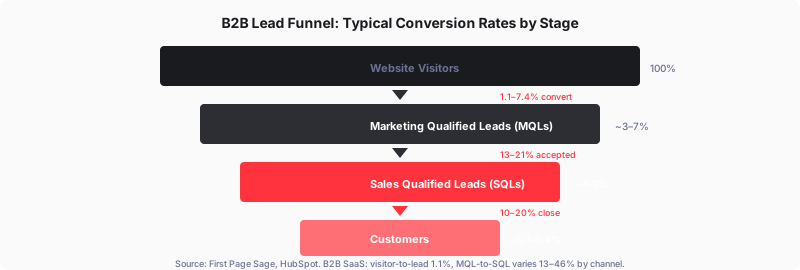
First Page Sage's B2B conversion rate research benchmarks visitor-to-lead rates at 1.1% for B2B SaaS, with MQL-to-SQL acceptance running 13% to 21% on average and improving to 46% for email-sourced leads per HubSpot benchmarks. The compounded result: a fraction of a percent of total site visitors become customers.
This is why lead quality matters more than lead volume. A lead generation company that delivers 500 MQLs with a 2% MQL-to-SQL rate produces 10 SQLs. A company that delivers 150 MQLs with a 20% MQL-to-SQL rate produces 30 SQLs. The second program produces three times the qualified pipeline at 30% of the volume.
The agencies that understand this build programs around ICP targeting and conversion rate optimization. The ones that do not optimize for volume because that is what clients can measure most easily.
Ironpaper's own research found that only 8.1% of B2B leaders describe their messaging as "very effective," which is the root cause of most MQL-to-SQL attrition. When marketing content does not resonate with buyer pain, leads do not convert to sales-accepted opportunities regardless of how well-targeted the acquisition campaign was.
How to Evaluate Any Business Lead Generation Company
The evaluation framework that applies to Ironpaper applies equally to every competitor in the category:
- What is their definition of a qualified lead, and how does it align with your sales team's? The most common failure mode in B2B lead generation is a marketing-sales definition gap. Marketing generates MQLs that meet their criteria. Sales rejects them as unqualified. The agency reports positive results; the sales team sees no improvement in pipeline. Any agency that does not start the engagement by aligning these definitions with both marketing and sales is building on a misaligned foundation.
- What does their reporting connect to? Activity metrics (impressions, clicks, MQLs) are inputs. Pipeline generated, opportunities created, and revenue influenced are outputs. A lead generation company should be able to show a traceable line from their spend to your pipeline. If the reporting stops at MQL count, the program is not being measured against the metric that matters.
- What is their process for the first 90 days? Good agencies have an explicit answer: what gets audited, what gets built, what gets launched, and what the lagging indicators are for the 6-month mark. "We will optimize as we go" is not a process.
- What industries and deal sizes are in their portfolio? Ironpaper's sweet spot is B2B technology companies (SaaS, IT, IoT, energy) with deal sizes that justify 3 to 18-month sales cycles. The case studies they use to demonstrate results come from that specific context. An agency with strong results in a $200,000 ACV enterprise software sale may not transfer those results to a $12,000 ACV mid-market SaaS motion.
- What is the minimum engagement and how does it scale? Ironpaper's documented minimum is $25,000+ at $200 to $300 per hour, positioning them for mid-market and enterprise budgets. Full-service B2B lead generation agencies generally range from $5,000 to $30,000 per month depending on scope and specialization depth.
When the Full-Service Model Is the Right Choice
For B2B companies in competitive markets with complex buying processes, the full-service model produces outcomes that campaign-by-campaign approaches structurally cannot: a compounding content and demand system that improves over time, a defined handoff from marketing to sales, and attribution that connects spend to pipeline.
The fit conditions: deal size that justifies a 6 to 18-month nurture cycle, sufficient budget to sustain the engagement through the ramp period, and internal sales capacity that can follow up on the SQL volume the program produces.
When those conditions are not met, such as early-stage companies testing channels, brands that need immediate pipeline rather than infrastructure, or companies with high-velocity sub-$10K ACV products, the full-service model adds overhead without proportional return. In those cases, a performance marketing agency focused on paid demand generation with shorter feedback loops, or an SDR-as-a-service firm for immediate outbound coverage, will produce faster results at the current stage.
What This Means for You
Business lead generation companies like Ironpaper represent a specific and well-defined category: integrated B2B growth agencies that build demand infrastructure rather than buy leads. The model works reliably for mid-market and enterprise technology companies with the budget and patience to let the compounding effects materialize.
For growth-stage B2B SaaS and DTC brands that need demand generation performance connected to revenue rather than just pipeline volume, EmberTribe works with brands at the intersection of paid media and organic demand programs tied directly to measurable business outcomes.

.webp)

.svg)


