

Most B2B SaaS companies outgrow generalist marketing help faster than they expect. The moment you're optimizing for pipeline quality, CAC payback, and expansion revenue simultaneously, a generalist agency that doesn't understand recurring revenue models becomes a liability. A specialized b2b saas marketing agency is built for that environment specifically.
This guide explains what these agencies do, how their work differs from standard B2B or DTC marketing, and how to evaluate one before committing budget.
SaaS has structural dynamics that generalist agencies consistently underestimate. The most significant: acquiring a customer is not the goal. Retaining and expanding that customer is what drives compounding ARR growth.
A generalist agency optimizing for lead volume can look productive while your funnel economics deteriorate. They may drive MQL counts up while CAC climbs and payback periods stretch. Benchmarkit's 2025 SaaS benchmarks show that the average B2B SaaS company now spends $2.00 in sales and marketing for every $1.00 of new ARR, and the average sales cycle has extended to 134 days. Neither of those realities is reflected in how most general-purpose agencies plan or measure work.
SaaS-specific agencies understand the buying committee problem. Enterprise SaaS deals typically involve six to ten stakeholders, each with different concerns, at different stages of awareness. Campaigns that reach only the economic buyer while ignoring the security team, the end users, and the IT evaluators leave enormous conversion opportunity on the table.
The best SaaS agencies are full-funnel rather than channel-narrow. Their service mix typically includes:
Demand gen for SaaS is not a synonym for lead generation. It encompasses the full motion of creating awareness, educating the market, and moving qualified buyers from dark funnel to pipeline. Agencies that lead with demand gen typically build integrated programs across content, SEO, paid search, and paid social rather than running those channels in isolation.
Good demand gen programs are tracked against revenue-connected metrics: cost per SQL, pipeline influenced, and CAC payback. See our breakdown of the metrics that actually matter for SaaS growth for what a rigorous measurement framework looks like at each funnel stage.
ABM flips the traditional funnel. Instead of casting wide and filtering down, you identify the accounts most likely to become high-LTV customers and build campaigns specifically for them. A SaaS-focused ABM program typically includes firmographic targeting on LinkedIn and programmatic display, personalized content for each target segment, and coordinated outreach sequences timed to buying signals.
Gartner's B2B buying research shows that B2B buyers spend only 17% of their total buying process talking to potential vendors. The rest is independent research. ABM closes the gap by placing your content and messaging inside that research window before a prospect ever raises their hand.
Organic search is the most scalable channel for SaaS companies with long sales cycles because content compounds over time while paid spend does not. A SaaS-specialized agency approaches content differently than a generalist: they map content to buying stages, prioritize topics based on commercial intent, and build topical authority rather than chasing isolated keyword rankings.
The content strategy also serves sales enablement. High-quality comparison pages, technical guides, and use-case documentation reduce friction in the sales cycle and shorten time-to-close. Internal linking between those assets reinforces both SEO and buyer education simultaneously.
SaaS paid programs require a different bidding logic than e-commerce. You're not optimizing for a single transaction; you're optimizing for pipeline quality. That means targeting by job title, company size, and intent signals rather than demographic lookalikes, and measuring success by SQL volume and pipeline contribution rather than click-through rate.
LinkedIn Ads is the dominant B2B paid social channel for SaaS because of its firmographic targeting precision. Agencies that specialize in SaaS typically run thought leadership ads, sponsored content, and retargeting sequences layered on top of each other, rather than running single-offer campaigns.
Most SaaS buying decisions don't happen on the first visit. Prospects enter the funnel, go dark, reengage months later, and convert after multiple touchpoints. Effective nurture sequences segment by ICP fit, engagement level, and buying stage, serving content that matches where each prospect actually is. Agencies with SaaS expertise build these systems in HubSpot, Marketo, or similar platforms, and they wire attribution tracking so every touchpoint is connected to revenue outcomes.
The differences show up in measurement first. A general B2B agency will typically report on impressions, clicks, and MQL volume. A SaaS-specialized agency ties everything to SQL creation, pipeline influenced, and CAC payback. If an agency can't articulate how their work connects to revenue, they're operating at the wrong level of accountability for a SaaS business.
The second difference is channel mix. Generalists tend to default to whatever channel they execute best. SaaS agencies build programs around where B2B SaaS buyers actually spend time: LinkedIn, targeted podcast sponsorships, review sites like G2 and Capterra, and high-intent search terms. They also tend to have stronger opinions about what not to do, particularly around vanity metrics and low-intent lead sources that inflate volume without improving pipeline.
Third is understanding of the SaaS sales motion. An agency that has never worked with a product-led growth model, a self-serve freemium funnel, or an enterprise direct-sales motion will be learning on your budget. Agencies that have worked across multiple SaaS growth stages bring frameworks you can skip straight to rather than rebuilding from first principles.
Ask for case studies from companies at a comparable ARR stage and growth motion. An agency that has worked primarily with early-stage PLG companies may not be the right fit for a $10M ARR company transitioning to enterprise direct sales. The specifics matter.
Request a sample report or attribution model before signing. If their standard reporting doesn't include pipeline contribution or CAC payback, they're not measuring what matters. Strong agencies connect every channel to revenue impact, even when attribution is imperfect.
Some agencies present a strategy and hand execution off to your team. Others own the full execution stack. Know what you're buying before you sign. If your internal team is thin, an agency that does strategy-only will leave you without the capacity to execute against the plan.
Our growth strategy consulting overview covers when to bring in external strategy versus execution help.
Most mid-market SaaS agencies charge $8,000 to $15,000 per month for a retainer covering strategy and multi-channel execution. Enterprise-level engagements run $25,000 to $50,000 per month. Flat-fee retainers are preferable to percentage-of-spend models because they align the agency's incentives with efficiency rather than media volume.
Avoid agencies that require six to twelve month minimum commitments without performance milestones built in. A confident agency will agree to quarterly checkpoints with defined metrics.
Long setup periods with no deliverables, reporting that defaults to impression and click metrics, inability to explain how they attribute pipeline, and case studies from industries entirely unlike SaaS are all warning signs. So is any agency that pitches a "proprietary methodology" without being able to explain the underlying mechanics.
A well-run SaaS agency engagement delivers measurable progress within one quarter. Not necessarily closed revenue, but leading indicators that are moving in the right direction: SQL volume increasing month over month, cost per SQL declining as targeting sharpens, organic traffic growing on high-intent terms, and a documented attribution model that shows where pipeline is being created.
By month three, you should have a clear picture of which channels are generating qualified pipeline and which are not. If the agency can't show you that, the engagement is running on faith rather than data.
The SaaS brand building dimension matters here too. Demand gen without brand investment creates a ceiling that compounds over time. Companies that build category awareness alongside direct response programs consistently outperform those running paid channels alone.
EmberTribe works with growth-stage B2B SaaS companies to build integrated demand gen programs that connect organic, paid, and content into a single revenue-accountable system. Every engagement starts with ICP alignment and attribution setup before any campaign goes live, because the measurement infrastructure is what separates programs that compound from ones that plateau.
If you're evaluating marketing partners for your SaaS company, the first conversation should be about your funnel economics, not your budget. Learn more about how EmberTribe structures SaaS growth engagements or explore the full range of EmberTribe services.

Most B2B SaaS companies outgrow generalist marketing help faster than they expect. The moment you're optimizing for pipeline quality, CAC payback, and expansion revenue simultaneously, a generalist agency that doesn't understand recurring revenue models becomes a liability. A specialized b2b saas marketing agency is built for that environment specifically.
This guide explains what these agencies do, how their work differs from standard B2B or DTC marketing, and how to evaluate one before committing budget.
SaaS has structural dynamics that generalist agencies consistently underestimate. The most significant: acquiring a customer is not the goal. Retaining and expanding that customer is what drives compounding ARR growth.
A generalist agency optimizing for lead volume can look productive while your funnel economics deteriorate. They may drive MQL counts up while CAC climbs and payback periods stretch. Benchmarkit's 2025 SaaS benchmarks show that the average B2B SaaS company now spends $2.00 in sales and marketing for every $1.00 of new ARR, and the average sales cycle has extended to 134 days. Neither of those realities is reflected in how most general-purpose agencies plan or measure work.
SaaS-specific agencies understand the buying committee problem. Enterprise SaaS deals typically involve six to ten stakeholders, each with different concerns, at different stages of awareness. Campaigns that reach only the economic buyer while ignoring the security team, the end users, and the IT evaluators leave enormous conversion opportunity on the table.
The best SaaS agencies are full-funnel rather than channel-narrow. Their service mix typically includes:
Demand gen for SaaS is not a synonym for lead generation. It encompasses the full motion of creating awareness, educating the market, and moving qualified buyers from dark funnel to pipeline. Agencies that lead with demand gen typically build integrated programs across content, SEO, paid search, and paid social rather than running those channels in isolation.
Good demand gen programs are tracked against revenue-connected metrics: cost per SQL, pipeline influenced, and CAC payback. See our breakdown of the metrics that actually matter for SaaS growth for what a rigorous measurement framework looks like at each funnel stage.
ABM flips the traditional funnel. Instead of casting wide and filtering down, you identify the accounts most likely to become high-LTV customers and build campaigns specifically for them. A SaaS-focused ABM program typically includes firmographic targeting on LinkedIn and programmatic display, personalized content for each target segment, and coordinated outreach sequences timed to buying signals.
Gartner's B2B buying research shows that B2B buyers spend only 17% of their total buying process talking to potential vendors. The rest is independent research. ABM closes the gap by placing your content and messaging inside that research window before a prospect ever raises their hand.
Organic search is the most scalable channel for SaaS companies with long sales cycles because content compounds over time while paid spend does not. A SaaS-specialized agency approaches content differently than a generalist: they map content to buying stages, prioritize topics based on commercial intent, and build topical authority rather than chasing isolated keyword rankings.
The content strategy also serves sales enablement. High-quality comparison pages, technical guides, and use-case documentation reduce friction in the sales cycle and shorten time-to-close. Internal linking between those assets reinforces both SEO and buyer education simultaneously.
SaaS paid programs require a different bidding logic than e-commerce. You're not optimizing for a single transaction; you're optimizing for pipeline quality. That means targeting by job title, company size, and intent signals rather than demographic lookalikes, and measuring success by SQL volume and pipeline contribution rather than click-through rate.
LinkedIn Ads is the dominant B2B paid social channel for SaaS because of its firmographic targeting precision. Agencies that specialize in SaaS typically run thought leadership ads, sponsored content, and retargeting sequences layered on top of each other, rather than running single-offer campaigns.
Most SaaS buying decisions don't happen on the first visit. Prospects enter the funnel, go dark, reengage months later, and convert after multiple touchpoints. Effective nurture sequences segment by ICP fit, engagement level, and buying stage, serving content that matches where each prospect actually is. Agencies with SaaS expertise build these systems in HubSpot, Marketo, or similar platforms, and they wire attribution tracking so every touchpoint is connected to revenue outcomes.
The differences show up in measurement first. A general B2B agency will typically report on impressions, clicks, and MQL volume. A SaaS-specialized agency ties everything to SQL creation, pipeline influenced, and CAC payback. If an agency can't articulate how their work connects to revenue, they're operating at the wrong level of accountability for a SaaS business.
The second difference is channel mix. Generalists tend to default to whatever channel they execute best. SaaS agencies build programs around where B2B SaaS buyers actually spend time: LinkedIn, targeted podcast sponsorships, review sites like G2 and Capterra, and high-intent search terms. They also tend to have stronger opinions about what not to do, particularly around vanity metrics and low-intent lead sources that inflate volume without improving pipeline.
Third is understanding of the SaaS sales motion. An agency that has never worked with a product-led growth model, a self-serve freemium funnel, or an enterprise direct-sales motion will be learning on your budget. Agencies that have worked across multiple SaaS growth stages bring frameworks you can skip straight to rather than rebuilding from first principles.
Ask for case studies from companies at a comparable ARR stage and growth motion. An agency that has worked primarily with early-stage PLG companies may not be the right fit for a $10M ARR company transitioning to enterprise direct sales. The specifics matter.
Request a sample report or attribution model before signing. If their standard reporting doesn't include pipeline contribution or CAC payback, they're not measuring what matters. Strong agencies connect every channel to revenue impact, even when attribution is imperfect.
Some agencies present a strategy and hand execution off to your team. Others own the full execution stack. Know what you're buying before you sign. If your internal team is thin, an agency that does strategy-only will leave you without the capacity to execute against the plan.
Our growth strategy consulting overview covers when to bring in external strategy versus execution help.
Most mid-market SaaS agencies charge $8,000 to $15,000 per month for a retainer covering strategy and multi-channel execution. Enterprise-level engagements run $25,000 to $50,000 per month. Flat-fee retainers are preferable to percentage-of-spend models because they align the agency's incentives with efficiency rather than media volume.
Avoid agencies that require six to twelve month minimum commitments without performance milestones built in. A confident agency will agree to quarterly checkpoints with defined metrics.
Long setup periods with no deliverables, reporting that defaults to impression and click metrics, inability to explain how they attribute pipeline, and case studies from industries entirely unlike SaaS are all warning signs. So is any agency that pitches a "proprietary methodology" without being able to explain the underlying mechanics.
A well-run SaaS agency engagement delivers measurable progress within one quarter. Not necessarily closed revenue, but leading indicators that are moving in the right direction: SQL volume increasing month over month, cost per SQL declining as targeting sharpens, organic traffic growing on high-intent terms, and a documented attribution model that shows where pipeline is being created.
By month three, you should have a clear picture of which channels are generating qualified pipeline and which are not. If the agency can't show you that, the engagement is running on faith rather than data.
The SaaS brand building dimension matters here too. Demand gen without brand investment creates a ceiling that compounds over time. Companies that build category awareness alongside direct response programs consistently outperform those running paid channels alone.
EmberTribe works with growth-stage B2B SaaS companies to build integrated demand gen programs that connect organic, paid, and content into a single revenue-accountable system. Every engagement starts with ICP alignment and attribution setup before any campaign goes live, because the measurement infrastructure is what separates programs that compound from ones that plateau.
If you're evaluating marketing partners for your SaaS company, the first conversation should be about your funnel economics, not your budget. Learn more about how EmberTribe structures SaaS growth engagements or explore the full range of EmberTribe services.

Pricing is one of the highest-leverage decisions a SaaS company makes. Get it right and you accelerate growth, reduce churn, and attract the right customers. Get it wrong and even a strong product can stall out at scale. Yet most SaaS founders spend more time on their go-to-market motion than on the pricing model that underlies it.
The good news: benchmarks from 100+ SaaS companies show clear patterns in what works at each stage. This guide breaks down the core software pricing models, when each fits, and how to avoid the traps that slow growth.
Most teams obsess over the number on the pricing page. The model that number sits inside matters far more. The wrong model creates misaligned incentives, confusing packaging, and a sales cycle that fights itself. The right model aligns what you charge with how customers experience value, which is the foundation of any sustainable growth strategy.
According to OpenView Partners, SaaS companies that use value metrics to set pricing grow at twice the rate of companies that don't. That's a structural advantage you can build in from day one.
If you're also thinking through how pricing connects to broader acquisition strategy, our guide on SaaS customer acquisition strategies covers the full top-of-funnel picture.

Per-seat pricing charges a fixed amount per user per month. It's the most widely adopted model, used by 57% of SaaS companies, though that share is declining as hybrid models grow.
The appeal is predictability: customers know exactly what they'll pay, and vendors get a clean revenue signal tied to organizational growth.
Works best for: Collaboration tools, project management, and CRM platforms where value scales with the number of users.
Examples: Salesforce, HubSpot, Notion, Linear.
Pros:
Cons:
The median per-seat price across SaaS companies is $45/month at the entry tier, with a year-over-year increase of about 11% as of 2025.
Usage-based pricing (also called consumption pricing) charges customers based on how much they use: API calls, messages sent, data processed, or transactions run. This model has moved from niche to mainstream fast.
Roughly 38% of SaaS companies now use it in some form, up significantly from just a few years ago.
Works best for: Infrastructure, APIs, communication tools, and any product where usage varies significantly across customers.
Examples: Twilio charges per SMS and voice call. Stripe takes a percentage of each transaction. AWS prices every compute resource by consumption. All three have built multi-billion dollar businesses on this model.
Pros:
Cons:
For SaaS companies targeting developers or technical buyers, usage-based pricing often outperforms seat-based models because it removes the commitment friction that slows initial adoption.
Tiered pricing offers multiple plans at different price points, each with a defined feature set. It's the dominant structure for packaging: 68% of SaaS companies use tiered packaging in some form, often combined with another model.
Works best for: Companies with a broad customer base spanning SMB, mid-market, and enterprise, where different segments have meaningfully different needs.
Examples: Intercom, Mailchimp, Zapier, Zendesk.
Pros:
Cons:
The data on tier count is clear: companies with three tiers convert at 1.4x the rate of those with two tiers and at 1.8x the rate of those with four or more.
Three tiers with a visible "Most Popular" badge on the middle plan is the highest-converting structure by a wide margin.
For a deeper look at the metrics that pricing strategy should connect to, see our breakdown of SaaS marketing metrics and KPIs.
Flat-rate pricing charges one price for full access, regardless of users or usage. Basecamp is the canonical example: a single fixed monthly fee for unlimited users. It's simple to communicate and easy for customers to budget.
Works best for: Products with a defined feature set targeting a narrow, homogeneous customer segment.
Pros:
Cons:
Flat-rate pricing works well at early stage when you're targeting one specific customer profile. As your product and customer base diversify, it typically gets replaced by tiered or hybrid models.
Freemium gives users a free tier with limited features or capacity, with paid plans unlocking more. It's a top-of-funnel strategy as much as a pricing model. Only 19% of SaaS companies rely on pure freemium, because conversion rates are notoriously low: typically 2-5% of free users convert to paid.
Works best for: Products with strong network effects, viral loops, or a large addressable market where free distribution has real compounding value.
Examples: Slack, Dropbox, Figma, Calendly.
Pros:
Cons:
The freemium trap is building a great free product that users love but never upgrade. The free tier must be genuinely useful while leaving a clear, felt gap that the paid plan fills.
The biggest shift in SaaS pricing over the past two years is the move to hybrid models that combine elements of multiple approaches. As of 2025, 61% of SaaS companies use some form of hybrid pricing, up from 49% in 2024.
A common hybrid: a base platform fee (flat-rate) plus per-seat charges plus usage overages. HubSpot uses this structure. So does Salesforce at the enterprise tier. The combination lets you capture predictable base revenue while still expanding with customer growth.
High-growth SaaS companies (those growing more than 40% year-over-year) show a 21% higher median growth rate when using hybrid models compared to pure single-model approaches. That gap is significant enough to revisit if you're still on a purely flat or purely seat-based structure.
No model is universally correct. The right choice depends on four factors:
1. Where does value live in your product? If customers experience value every time they use a specific action or output, usage-based fits. If value comes from access and collaboration, seat-based fits. If value is in capabilities unlocked, tiered fits.
2. Who is your buyer? Technical buyers and developer-led companies tend to respond well to usage-based because it removes commitment risk. Business buyers and procurement-driven organizations often prefer predictable flat or seat-based costs.
3. What does your expansion motion look like? Per-seat grows with headcount. Usage-based grows with adoption depth. Tiered grows through upgrades. Align your model to how you actually want customers to expand.
4. What stage is your company at? Early-stage companies benefit from simplicity (flat or tiered). Growth-stage companies often need usage or hybrid models to capture more of the value they're delivering to larger customers.
If you're working through how pricing fits into a broader go-to-market build, our team covers this in depth through growth strategy consulting.
Even well-designed products lose revenue to avoidable pricing errors. The most common:
Pricing to cost, not value. Cost-plus pricing tells you what you need to break even, not what customers will pay. The gap between those two numbers is your margin opportunity.
Too many tiers. Four or more plans reduce conversions, confuse prospects, and create internal support overhead. If you have four tiers, cut one.
Hiding complexity. Every hidden fee or usage cap discovered post-purchase damages retention. Transparent pricing, even if complex, outperforms obscured simplicity in LTV because it builds trust at the start of the relationship.
Never testing price. Pricing pages are among the highest-leverage things to A/B test, and most SaaS companies never run a single pricing experiment. Even a modest optimization can produce an 11-15% revenue increase according to pricing research from ProfitWell.
Pricing is not a one-time decision. The best SaaS companies revisit their model as they learn more about their customers, expand into new segments, and develop new product capabilities. Start with the model that fits your current stage and customer profile, then build the instrumentation to know when it's time to evolve.
The companies that get this right don't just convert better at the top of the funnel. They retain longer, expand faster, and build the kind of unit economics that make every other growth investment more effective. For SaaS teams building toward that outcome, getting the pricing model right is one of the most important moves you can make.
Most SaaS companies focus heavily on performance channels: paid search, retargeting, sales sequences. Those channels produce leads, but they produce leads from people who already knew to look. Brand building is how you get on the radar before the search happens. SaaS PR is one of the most underused levers in growth-stage marketing, and the companies that master it build durable competitive advantages that performance spend alone cannot replicate.
This post breaks down how to build SaaS brand awareness through PR, thought leadership, and content, with specific tactics you can act on rather than principles you already know.
The SaaS market has matured significantly. In most categories, a prospect can name three to five competitors before they ever book a demo. When buyers research solutions, they are not discovering your product from scratch. They are filtering a pre-formed list.
Brand building determines whether you make that list. According to research cited by Growfusely, buyers in 2026 are also increasingly influenced by AI-generated responses when forming that shortlist. Getting cited by AI assistants like ChatGPT and Perplexity now functions similarly to getting coverage in top-tier media: it validates your brand as a credible source in your category. The companies that earn consistent brand mentions across trusted publications, analyst reports, and high-authority sites are the ones AI tools surface in response queries.
There is also a pipeline effect that operates over a longer arc. PRLab notes that most SaaS companies see non-referral inquiry increases within two to three months of active PR campaigns, with revenue impact materializing between months three and six. Brand building is not slow, but it rewards consistency over bursts.
SaaS brand building is not a single tactic. It is a coordinated system across four channels: media coverage, thought leadership content, community presence, and strategic positioning. Each one reinforces the others.
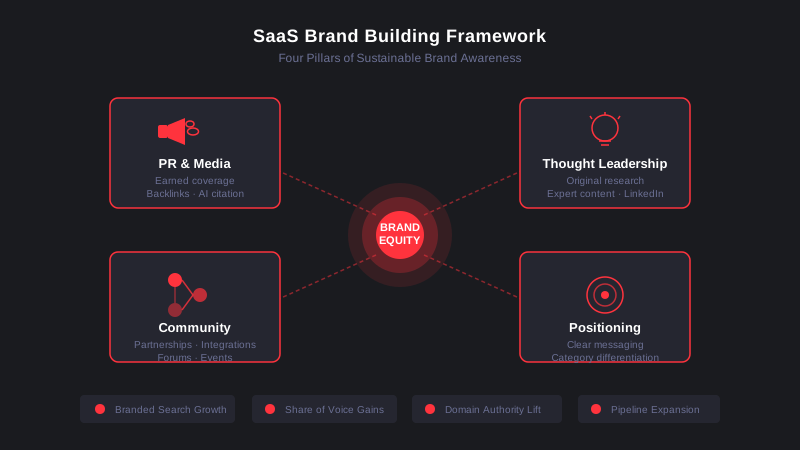
Traditional PR means pitching journalists. Modern SaaS PR is broader: it includes digital coverage, backlinks, podcast appearances, analyst relations, and any earned placement that builds credibility at scale.
A strong SaaS PR program starts with a clear editorial angle. Journalists covering SaaS do not want to write about software features. They want to write about market trends, founder perspectives, funding rounds, customer outcomes, and proprietary data. The companies that land consistent coverage are the ones that give journalists something worth writing about.
Practical starting points:
The SEO value of earned media is significant on its own. A placement in a high-authority publication generates backlinks that compound over time, improving your domain authority and the ranking potential of every other page on your site. For growth-stage SaaS companies, that dual benefit of brand and SEO is one of the strongest ROI arguments for investing in PR.
Thought leadership is not blogging more. It is publishing perspectives that only your company is positioned to share, because of your data, your customer base, or your founders' specific expertise.
Research from the B2B Institute shows that B2B decision-makers are 48% more likely to do business with a company that produced thought leadership content they found valuable, and 54% more likely to purchase from them. Those numbers reflect a buyer behavior that SaaS marketers often underestimate: content builds trust before a prospect is ready to evaluate products, and that trust influences vendor selection when they finally are ready.
Effective SaaS thought leadership looks like:
For a deeper look at how content fits into SaaS growth, see our guide to content marketing as a full-funnel channel.
Brand awareness builds fastest in communities where your buyers already spend time. That means participating in industry communities, partnering with non-competing tools your customers use, and showing up at the events, forums, and Slack groups that matter in your category.
Integration partnerships are especially effective for early and mid-stage SaaS. If your product connects to tools your customers already trust, being listed in those tools' marketplaces puts your brand in front of buyers who are already qualified by context. Being featured by a larger partner also carries implicit endorsement.
Community presence compounds. A SaaS brand that is consistently visible in the forums, newsletters, and podcasts that serve its target market builds familiarity that makes every downstream touchpoint more effective. Cold outreach converts better, demo requests require less explanation, and sales cycles shorten because the brand has already done part of the work.
PR and content only work if the underlying brand positioning is clear. According to SaaS branding experts surveyed by Overpass Studio, the biggest branding priority for SaaS companies in 2026 is clarity: being instantly understood, not louder. When a prospect encounters your brand for the first time, the message needs to answer three questions immediately: what problem do you solve, who do you solve it for, and why are you the best answer to that problem.
Vague positioning is a brand building killer. Generic messages like "the all-in-one platform for teams" or "the smarter way to manage X" do not create memory. Specific positioning does. If your messaging cannot fit on a single note card and be understood by a cold reader in under ten seconds, your PR and content spend will underperform because no amount of coverage fixes a blurry brand.
Brand building has a reputation for being expensive and slow. Neither is necessarily true for SaaS companies that are strategic about it.
The highest-leverage early moves tend to be:
For companies building a more complete go-to-market system, these PR and brand tactics connect directly to the broader frameworks we cover in our growth strategy consulting content.
Brand awareness is measurable, though the metrics require a different lens than performance campaigns. The key signals to track:
For a full breakdown of how to connect brand metrics to growth KPIs, see our SaaS marketing metrics and KPIs guide.
The brands that win in SaaS are not always the ones with the best product. They are the ones that made it easiest for buyers to trust them before the buying process started. PR and brand building are how you do that at scale, starting with a clear position, finding the channels where your buyers pay attention, and publishing content worth citing. The compounding effect takes time, but it builds a moat that paid channels cannot replicate.
Most SaaS teams run competitor analysis the wrong way. They compare feature lists, copy pricing pages, and call it strategy. What they miss is the underlying performance data that separates companies growing efficiently from those burning capital to maintain headcount. SaaS industry benchmarks give you that data, and a structured competitor analysis process gives you context for interpreting it.
This guide covers how to collect meaningful competitive intelligence, which SaaS benchmarks actually matter in 2026, and how to use both to set growth targets your team can execute against.
Competitive research typically surfaces product capabilities, messaging, and pricing. That information tells you what a competitor sells and how they position it. It rarely tells you how efficiently they acquire customers, how well they retain revenue, or whether their growth is sustainable.
SaaS benchmarks fill that gap. When you know that the median LTV:CAC ratio for B2B SaaS sits at 3:1, you can assess whether your own unit economics justify current acquisition spend. When you know that median CAC payback has extended to 18 months, you understand why your investors care so much about cash efficiency. Benchmarks convert raw competitive data into decisions.
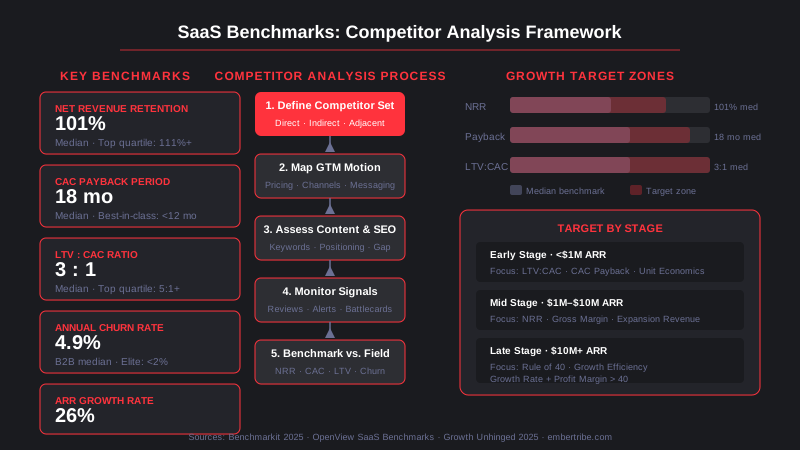
These figures represent industry medians and top-quartile ranges compiled from multiple research sources including Benchmarkit's 2025 SaaS Performance Metrics report, OpenView's annual SaaS benchmarks, and Growth Unhinged's 2025 benchmarks analysis.
NRR measures how much revenue you retain from existing customers over a period, including expansion from upgrades and cross-sells minus churn and downgrades. Industry median NRR sits at approximately 101%, while top performers sustain 111% or higher. Companies achieving NRR above 100% grow at roughly 2x the rate of companies below that threshold, according to Benchmarkit's 2025 data.
The NRR benchmark splits sharply by customer segment. Enterprise-focused SaaS companies, where expansion opportunities are larger and churn is stickier, achieve NRR far above SMB-focused products. If your NRR falls below 95%, expansion revenue or churn improvement should take priority over new acquisition spend.
CAC payback, the number of months to recover what you spent to acquire a customer, has lengthened across the industry. The median has reached 18 months, up from roughly 14 months two years prior. Best-in-class companies still maintain payback under 12 months regardless of segment.
A payback period above 24 months is a red flag for most growth-stage companies, particularly in uncertain macro environments. If you're in that range and raising capital, expect pressure to demonstrate a path toward 15 months or better before your next round.
The ratio of customer lifetime value to acquisition cost remains one of the most scrutinized SaaS metrics. The current median for growth-stage B2B SaaS is 3:1. Top quartile companies achieve 5:1 or better. By segment, enterprise SaaS averages closer to 4.5:1 while SMB SaaS averages 2.5:1, reflecting higher churn rates in the SMB cohort.
A 3:1 ratio is often cited as the minimum threshold for sustainable growth. Below 3:1, you're likely spending too much to acquire customers relative to what they return. Above 5:1, you may be under-investing in acquisition and leaving growth on the table.
B2B SaaS median annual churn sits around 4.9%, though this varies significantly by customer size. SMB churn runs 8x higher than enterprise churn on a percentage basis. If your customer base skews toward small businesses, expansion revenue from retained accounts becomes critical: losing 20% of your SMB cohort each year requires significant new business just to maintain flat ARR.
Top performers keep annual churn below 2% by investing in onboarding, customer success coverage, and product stickiness early in the customer lifecycle.
Median ARR growth for private SaaS companies has settled around 26%, with top performers reaching 50% or higher. Early-stage companies (under $1M ARR) can sustain top-quartile growth of 250% to 300% year-over-year. Context matters: a $50M ARR company growing at 40% is exceptional, while the same rate at $2M ARR is table stakes for raising a Series A.
The Rule of 40 (growth rate plus profit margin should exceed 40%) remains a common efficiency benchmark for Series B and beyond. In a tighter market, investors increasingly favor companies above 40 with a path to profitability over those burning capital for headline growth.
Understanding benchmarks is one thing. Applying them through a structured competitive analysis is another. Here is a repeatable process for gathering competitive intelligence that goes beyond surface-level product comparisons.
Sort competitors into three buckets: direct, indirect, and adjacent. Direct competitors sell the same product to the same buyer. Indirect competitors solve the same problem with a different approach. Adjacent competitors overlap on one dimension, often a single feature set or a shared buyer persona.
Aim for a field of 5 to 10 companies: three direct competitors, two to three indirect, and two to four adjacent. Trying to track more than 10 competitors dilutes your attention without adding strategic value.
For each competitor, identify how they acquire customers. Review their website messaging, pricing page structure, free trial or freemium availability, case study library, and content strategy. Tools like Semrush and Similarweb surface traffic data, keyword rankings, and estimated traffic volume that reveal where they invest for organic growth.
Pay particular attention to how they structure pricing tiers. Pricing architecture tells you who they're targeting and how they think about expansion revenue. A seat-based model with an enterprise tier suggests a land-and-expand motion. Flat-rate pricing suggests they're optimizing for simplicity over expansion.
For a deeper look at how pricing structure connects to growth strategy, see our guide to SaaS customer acquisition strategies.
Analyze what your competitors publish and where they rank. Look for keyword gaps where you can capture search intent they're missing. Examine how they frame their core value proposition: do they lead with ROI, ease of use, integrations, or category creation?
Category creation is worth flagging specifically. When a competitor positions around a problem frame they coined (think "revenue intelligence" or "product-led growth"), they're building brand equity in a space they define. That's harder to displace than competing on features.
Competitive intelligence isn't a quarterly exercise. Set up ongoing monitoring using tools like Crayon or Klue for AI-powered battlecards and win-loss analysis, Google Alerts for brand mentions, and review site tracking on G2 or Capterra for shifting customer sentiment.
Review aggregator data is underrated. Customer reviews often surface honest assessments of competitor weaknesses, including support gaps, product limitations, and pricing friction, that you won't find in any marketing material.
Once you've gathered competitive data, map your own metrics against industry benchmarks. This is where the two streams of analysis converge. If your NRR is 98% while the industry median is 101%, you know churn or contraction is eroding expansion gains. If your CAC payback is 22 months while best-in-class is under 12, you know acquisition efficiency is a prioritized problem.
For a broader look at how to build out your measurement framework, our SaaS marketing metrics and KPIs breakdown covers the full metric stack with context for each stage.
Benchmarks set a reference point. Growth targets require you to pick a position within or above those benchmarks and build a plan to reach it.
Early-stage companies (pre-$1M ARR) should obsess over CAC payback and LTV:CAC. If unit economics aren't working at this stage, growth amplifies a broken model. Mid-stage companies ($1M to $10M ARR) should shift attention toward NRR and gross margin as expansion revenue becomes a material part of the growth equation.
Late-stage companies ($10M+ ARR) need to balance growth rate with efficiency, particularly the Rule of 40. Investors at this stage expect a clear view of how the business reaches profitability while sustaining competitive growth.
A 3:1 LTV:CAC ratio is healthy for a company with a $10K ACV product selling to SMBs. The same ratio is underwhelming for an enterprise product with a $100K ACV and a two-year sales cycle. Use your segment and ACV as the lens for interpreting where industry benchmarks apply to your specific situation.
The most effective growth targets are set at the 75th percentile of your peer cohort. That's aspirational enough to require real improvement, but grounded enough in peer data to be defensible with your board and investors.
Once targets are set, trace the line back to marketing investment. If you need to reduce CAC payback from 22 months to 15 months, that's a lever question: do you reduce acquisition costs, improve conversion rates, or improve initial ACV? Each answer has a different marketing implication.
For a structured approach to connecting marketing investment to growth outcomes, our team at EmberTribe works specifically with growth-stage SaaS companies building data-driven acquisition programs that benchmark against these standards.
SaaS competitor analysis without benchmarks gives you a picture of what your competitors do. Adding benchmarks gives you a picture of how well they do it, and how your own performance compares to the field. The companies that win on this are the ones that run both streams in parallel, using competitive intelligence to understand positioning and market context, and benchmarks to evaluate efficiency and set targets that reflect where the industry is actually heading.
Start with the five metrics outlined above. Establish your current position on each. Then use the competitive analysis framework to understand who you're chasing and what their strengths actually are. That combination is where durable growth strategy gets built.

The best saas company examples share one thing: their growth was engineered, not accidental. Each company made a deliberate bet on a specific go-to-market motion, product mechanic, or distribution channel, then doubled down on what worked. Understanding those bets, and the underlying mechanics, gives you a replicable framework rather than a list of buzzwords.
This post covers five SaaS brands that built substantial, defensible businesses, breaking down not just what they did but how the mechanism actually worked.

No two of the companies below used the same growth motion. That's intentional. The goal here isn't to rank them but to show the range of viable approaches and what each one requires to function.
HubSpot's growth is inseparable from its content strategy, but "we published a lot of blogs" undersells the mechanism. The company built a flywheel in which free educational content attracted prospects, free tools converted them into leads, and the CRM product delivered enough value that customers became advocates who attracted new prospects.
The HubSpot blog publishes over 100 posts monthly and maintains evergreen content with ongoing optimization. Free lead magnets, templates, and the HubSpot Academy credential program created compounding organic reach. HubSpot's content-driven leads close at 14 times the rate of outbound leads, which means the economics improve the longer the flywheel spins. By 2022 the model had generated over $2 billion in ARR, and the company has continued scaling from there.
What made it work was specificity. HubSpot didn't produce generic marketing content; it produced content aimed at the exact persona it was selling to, with free tools that made those personas dependent on HubSpot before they ever paid a dollar.
Notion's growth story is a saas example of community-led product distribution at scale. The company created an Ambassador program that enrolled only the most passionate users (no monetary incentives, no low-bar entry) and turned them into a volunteer sales force. Those ambassadors built templates, YouTube tutorials, certified consulting practices, and an organic community that now exceeds 500,000 members on Reddit alone.
The product mechanics reinforced this. Collaboration features made every new workspace member a potential new user. Every shared Notion document pulled a non-user into the product. Notion hit an estimated $500 million ARR in September 2025, with roughly 95% of traffic arriving through organic and community channels and a free-to-paid conversion rate above 5% across 30 million users.
The lesson isn't "build a community." It's that community compounds when the product itself gives community members something worth sharing. Templates were the mechanism; the community was the distribution.
Figma is the textbook case for bottoms-up SaaS growth. A single designer shares a Figma URL with a product manager, that PM invites engineers, and the engineering team loops in a second designer. Before the company's IT department has approved any software procurement, Figma has six seats inside the organization.
Figma's S-1 filing showed that 70% of new Organization and Enterprise customers in 2024 and Q1 2025 included at least one user who had previously been on a Professional plan. Individual paid users became the entry point for six-figure enterprise contracts. Revenue reached $749 million in 2024, up 48% year-over-year, with $912 million in ARR as of Q1 2025. Notably, non-designers make up two-thirds of Figma's 13 million monthly active users, which means the product long ago escaped the "design tool" category and became a cross-functional collaboration platform.
The free tier wasn't a charity play. It was the top of a deliberate expansion funnel.
Calendly's growth model is elegant because the product advertises itself with every use. When someone books a meeting through Calendly, they see the Calendly branding on the scheduling page. That exposure converts recipients into users at a meaningful rate. Every booking link becomes an acquisition channel.
The company grew to $276 million in revenue while remaining bootstrapped for seven years, which is rare in SaaS. This is a saas marketing example worth studying because the acquisition cost was structurally embedded in the product workflow rather than layered on top through paid channels. No SDR team, no enterprise sales motion, just the product placed in front of new users every time an existing user sent a link.
The mechanic works because Calendly's core use case is inherently social. Scheduling requires two parties. That constraint became the growth engine.
Datadog represents a different class of saas growth examples: the land-and-expand motion executed at infrastructure scale. The company starts with a free or low-cost monitoring tier that developers adopt within a single team. Once the product proves its value, it expands into the full observability platform, logging, APM, security, and more, across the entire organization.
Datadog reached $3.4 billion in revenue for fiscal year 2025, up 28% year-over-year. The key to this model is that expansion revenue comes from existing customers, which compresses sales costs and produces strong net revenue retention. Datadog's NRR has historically run above 130%, meaning existing customers generate 30 cents of new ARR for every dollar of existing ARR without any new customer acquisition required.
The model requires genuine multi-product depth. Land-and-expand fails when there's nowhere to expand into. Datadog's decade-long investment in adjacent monitoring products created the expansion surface that makes the economics work.
These five examples aren't outliers. They reflect broader patterns visible in benchmark data. According to Benchmarkit's 2025 SaaS Benchmarks Report, median B2B SaaS ARR growth sits at 19 to 21 percent, with the CAC payback period at 15 months for the median company and under 12 months for best-in-class performers. The benchmark LTV-to-CAC ratio is 3:1, with enterprise SaaS ($100K+ ACV) averaging 4.5:1.
Net revenue retention is becoming the primary separator between strong and weak performers. Companies with NRR above 130% compound without needing proportional new acquisition spend. Companies with NRR below 100% are leaking revenue even while acquiring new customers.
The other standout data point: SaaS companies with AI deeply integrated into their products are growing roughly twice as fast as peers. This isn't AI as a marketing claim, it's AI embedded in onboarding, product features, and customer workflows in ways that drive measurable retention and expansion.
Every one of these saas brand examples succeeded because their growth mechanism matched their product's natural behavior. Figma's product is collaborative by design, so virality was built-in. Calendly's core use case requires two people, so distribution was built-in. Notion's product is highly personal and endlessly customizable, so community builders had something real to build around.
Choosing the wrong GTM motion for your product's natural behavior is one of the most common ways SaaS companies plateau. A product that is inherently single-player and private cannot rely on the same viral loops that Figma uses. A product with high setup complexity cannot expect PLG to carry it the way Calendly does.
The useful question isn't "which of these models should I copy" but "what does my product do naturally that I can turn into distribution?" That's the underlying pattern in every successful saas example above.
If you're building or scaling a SaaS company and want to develop a growth strategy grounded in how your product actually behaves, the posts on SaaS SEO and maximizing ROI for SaaS companies cover the channel-level tactics. For the business fundamentals underneath all of it, the SaaS business guide is the right place to start.
EmberTribe helps growth-stage SaaS companies build content and SEO programs that compound over time, not just generate traffic. If you want to talk through what the right motion looks like for your product, visit embertribe.com.
Most SaaS companies track too many numbers and act on too few. The teams growing fastest have made a deliberate choice: fewer metrics, tracked religiously, tied directly to decisions. This guide covers the SaaS marketing metrics and KPIs that separate high-growth companies from everyone else, along with 2026 benchmarks and practical ways to improve each one.
SaaS revenue compounds over time, which means the metrics that matter most are not the same ones that work for transactional businesses. A single customer acquired today can generate revenue for years. A single point of churn today erodes that compounding effect across your entire base. That asymmetry is why the right SaaS KPIs measure not just whether you acquired a customer, but whether you kept them, expanded them, and converted them into advocates.
The most effective SaaS marketing teams organize their metrics across five stages: awareness, acquisition, activation, retention, and revenue. Each stage has leading indicators that predict what happens downstream.

CAC is the total sales and marketing spend divided by the number of new customers acquired in a given period. It is one of the foundational saas marketing metrics because it anchors every efficiency calculation that follows.
The 2026 benchmarks vary significantly by go-to-market motion. Product-led growth companies in self-serve channels typically see CAC in the $50 to $200 range at growth stage, while sales-led enterprise SaaS routinely reaches $1,000 to $5,000 or more. What matters most is your CAC payback period: industry data from Baremetrics shows elite teams target payback under 12 months, with best-in-class companies recovering CAC in under 80 days.
To reduce CAC, focus on improving conversion rates at the bottom of the funnel before scaling spend at the top. A 20% improvement in trial-to-paid conversion has a larger CAC impact than a 20% increase in paid media budget.
Pipeline velocity tells you how much revenue your pipeline generates per day, using the formula: opportunities multiplied by win rate multiplied by average deal size, divided by sales cycle length in days. Research from A88Lab shows that B2B SaaS teams tracking this metric weekly report revenue growth of around 34%, compared to 11% for teams that track it irregularly.
Improving pipeline velocity does not require you to change all four inputs at once. Shortening your average sales cycle by 10% has the same mathematical effect as increasing your win rate by 10%. The most immediate lever is usually improving how quickly leads are followed up and how clearly qualification criteria are defined.
Conversion rate applies at every stage of your funnel: visitor to trial, trial to paid, free to premium. Aggregate conversion rate across the full funnel is one of the key saas marketing kpis for understanding where growth is actually breaking down.
Healthy SaaS trial-to-paid conversion rates sit between 15% and 25% for freemium products and 40% to 60% for time-limited free trials. If your rate falls below those ranges, the fix is almost never more traffic. It is a product, onboarding, or messaging problem.
Activation rate measures the percentage of new users who reach a predefined success milestone inside your product, usually within the first seven to thirty days. It is the most undertracked of all saas growth metrics despite being one of the strongest predictors of long-term retention.
Data from Visdum's 2026 SaaS benchmarks shows that feature adoption below 30% correlates with an 80% first-year churn rate. The implication is clear: if users do not experience value quickly, they leave, and no amount of marketing spend reverses that.
To improve activation, identify the specific action or outcome that most strongly correlates with long-term retention in your product. Build your onboarding sequence entirely around getting new users to that milestone as fast as possible.
Time to value is how long it takes a new user to experience the core benefit of your product for the first time. Shorter TTV consistently correlates with higher activation rates, lower early-stage churn, and larger expansion revenue over time.
The most effective way to reduce TTV is to remove friction from the initial setup experience, not to add more features. Guided onboarding checklists, in-app tooltips, and pre-built templates all reduce the cognitive load that causes users to abandon before they see results.
Churn rate is the percentage of customers or revenue lost in a given period. It is both a retention metric and a growth ceiling: even 2% monthly churn means you lose roughly 22% of your revenue base every year, which requires constant replacement just to stay flat.
The 2026 benchmark for healthy SaaS companies is annual churn below 3.5%, roughly 0.3% per month. Enterprise SaaS products with longer contracts and higher switching costs can sustain annual churn below 1%. If your churn rate sits above these levels, the problem is rarely in marketing: it almost always points to product-market fit gaps, onboarding failures, or customer success capacity constraints.
For deeper context on how to connect churn data to your analytics stack, see our guide on marketing analytics software.
NRR measures the percentage of recurring revenue retained from existing customers after accounting for churn, downgrades, and expansion. An NRR above 100% means your existing customer base is growing even before you acquire a single new customer, which is the defining characteristic of the fastest-growing SaaS businesses.
The 2026 benchmark is NRR above 100% for growth-stage companies, with best-in-class teams hitting 130% or higher. Stripe's SaaS metrics research shows those companies grow 1.5 to 3 times faster than peers with NRR below 100%. The primary driver of strong NRR is a deliberate expansion motion: proactive upsell and cross-sell triggered by product usage signals rather than periodic check-in calls.
NPS measures customer satisfaction by asking how likely customers are to recommend your product. Scores below 20 correlate with double the normal churn rate. NPS is a lagging indicator of retention health and a leading indicator of word-of-mouth growth.
The tactical value of NPS is not the aggregate score. It is the qualitative feedback from detractors and passives that reveals which specific problems are driving dissatisfaction before that dissatisfaction converts to cancellations.
MRR and ARR are the foundational revenue metrics for any subscription business. MRR is calculated as the total number of paying customers multiplied by average revenue per account. ARR is simply MRR multiplied by 12.
Tracking MRR movement by category, such as new MRR, expansion MRR, churned MRR, and reactivation MRR, gives you a precise picture of where growth is coming from and where it is leaking. Most SaaS teams that struggle with MRR growth are actually winning on new MRR but losing on churned and contraction MRR at a rate that offsets the gains.
Customer lifetime value divided by customer acquisition cost is one of the most important ratios in SaaS. The formula for LTV is average revenue per user multiplied by gross margin, divided by monthly churn rate. The healthy benchmark range is 3:1 to 5:1, where below 3:1 signals inefficient acquisition or excessive churn, and above 5:1 often indicates underinvestment in growth.
Understanding LTV:CAC at a segment level, broken down by channel, plan tier, or industry vertical, is where this metric becomes genuinely actionable. If your enterprise segment has a 6:1 ratio and your SMB segment has a 1.5:1 ratio, that is a strategic signal, not just a financial one. For teams building out their measurement infrastructure, our overview of analytics platforms covers the tools that make this kind of segmentation practical.
The Rule of 40 combines growth rate and profitability into a single efficiency score. Add your year-over-year ARR growth percentage to your EBITDA margin percentage. A combined score of 40 or higher signals a healthy, efficient business. A score below 40 raises questions about whether growth is being purchased at an unsustainable cost.
With median SaaS growth rates settling around 26% in recent years, efficiency metrics like the Rule of 40 have become as important to investors and acquirers as raw revenue growth. A company growing at 26% with a 20% EBITDA margin scores 46 and is in a strong position.
Tracking the right saas kpis matters less than building a system where those metrics drive decisions. The companies that use metrics most effectively set a small number of north-star metrics at the company level, cascade those into team-level leading indicators, and review them on a weekly cadence.
The practical failure mode is having too many dashboards that nobody acts on. Start with eight to ten metrics that span acquisition, activation, retention, and revenue. Assign clear ownership for each metric and connect every metric to at least one specific lever the team can pull. If you need help structuring the underlying analytics infrastructure to support this, our guide on the analytics dashboard framework covers how to build the reporting layer that makes these metrics visible and actionable across your organization.
The SaaS companies compounding fastest right now are not tracking more metrics than their competitors. They are acting on fewer, faster, with greater precision.
Most B2B SaaS pipelines have the same structural problem: turn off the paid ads, and the leads disappear. That's not a pipeline — it's a purchase order for attention.
SaaS demand generation done right creates pipeline that compounds. It builds brand presence in the channels where your buyers actually research decisions, generates inbound interest from content and community rather than from clicks, and produces leads that convert at higher rates because they already understand what you do and why it matters.
This guide covers how to build a SaaS demand generation strategy that doesn't collapse the moment your paid budget is cut.
These terms get used interchangeably, but they describe different activities with different timelines.
Lead generation is transactional. You run a campaign, someone fills out a form, you get a contact. The buyer may or may not be ready to purchase. The relationship starts at the conversion event.
Demand generation is upstream. It's about creating awareness, building credibility, and shaping how potential buyers think about the problem your product solves — before they're even in buying mode. When done well, demand generation means that when a buyer is finally ready to evaluate solutions, your brand is already in the consideration set.
The consensus among B2B marketers is that most demand generation budgets are heavily weighted toward demand capture — capturing people who are already searching — with far less going toward demand creation. That ratio is almost exactly backwards from what drives optimal pipeline.
The SaaS companies that are winning pipeline in 2026 have invested in demand creation. Here's how they're doing it.
Organic content is the most durable demand generation channel available to SaaS companies. Done correctly, a blog post, case study, or comparison page generates qualified traffic every month for years — with no incremental cost per visitor.
The key distinction: most SaaS content marketing is built around keywords, not around buyer education. Those are different strategies. Keyword-driven content targets people already searching for something; buyer education content creates awareness for people who don't yet know they have a problem your product solves.
A strong SaaS content strategy includes both. High-volume search terms bring in buyers at the evaluation stage. Educational content on adjacent topics pulls in buyers earlier in the journey and builds the brand authority that accelerates trust during the sales process.
For more on building this type of system, our post on SaaS content marketing strategy covers the framework in depth.
A significant share of B2B buyer research happens in channels you can't directly track: private Slack communities, LinkedIn DMs, peer conversations, and niche podcasts. This is "dark social" — influence that doesn't show up in your attribution model but drives purchase decisions constantly.
Getting into these channels requires investment in presence, not just in paid placement. Tactics that work:
The companies that win in dark social are consistently helpful before they're ever promotional.
If your product has a freemium tier or free trial, it's one of your most powerful demand generation assets — and often underused as such.
Product-led growth compresses the sales cycle by letting buyers experience value before the sales conversation begins — and free trials are consistently among the highest-converting demand generation tactics for B2B SaaS. The demo becomes a conversation about expansion, not a pitch from zero.
PLG also generates organic word-of-mouth when the product is good. Users recommend tools they use to peers in those dark social channels mentioned above. Every satisfied free-tier user is a potential demand generation asset in their professional network.
Being in the right ecosystem puts you in front of buyers who are already spending in your category.
Integrations with platforms like Salesforce, HubSpot, or Slack expose your product to buyers who are actively looking for complementary tools. A listing in a marketplace (HubSpot App Marketplace, Salesforce AppExchange) functions as inbound demand generation with no ongoing ad spend.
Co-marketing with adjacent SaaS products — joint webinars, co-authored guides, shared distribution lists — can reach audiences you'd otherwise need to pay to access. These partnerships work best when both products serve the same ICP without competing directly.
Traditional demand generation casts wide. Account-based marketing (ABM) reverses the funnel — you identify target accounts first, then build demand within those specific organizations.
For SaaS companies with a defined ICP and a sales team capable of working enterprise or mid-market accounts, ABM can dramatically improve pipeline quality. Rather than generating hundreds of low-fit MQLs, ABM generates fewer, higher-converting opportunities from accounts already identified as good fits.
ABM tactics include targeted LinkedIn campaigns to specific job titles at named accounts, direct outbound sequences triggered by intent signals, and personalized content delivered to specific organizations. A B2B demand generation agency with ABM experience can help structure this program without requiring a large internal operations team.
Organic demand generation requires infrastructure to capture and nurture the interest it creates:
Marketing automation. Email nurture sequences that educate buyers over weeks or months, not a single follow-up after a form submission.
Intent data. Tools like G2, Bombora, or 6sense identify accounts that are actively researching your category — even before they've visited your site. This turns demand generation activity into a signal you can act on with outbound.
Content distribution. Creating content is only half the work. Systematic distribution through LinkedIn, email newsletters, partnerships, and republication platforms determines how much of your audience actually sees it.
Attribution that accounts for dark social. Standard last-click attribution will chronically undervalue demand generation. Building in a self-reported attribution question ("How did you hear about us?") alongside your standard UTM tracking gives a more accurate picture of what's actually working.
Demand generation operates on longer timelines than lead generation, which means the metrics that matter are different:
If you're only measuring MQL volume and CAC, you're measuring demand capture, not demand generation. The upstream metrics reveal whether you're building durable pipeline or renting it.
This isn't an argument against paid advertising. It's an argument against building your entire pipeline on it.
Paid ads are excellent for amplifying content that's already performing, retargeting audiences who have engaged with your organic channels, and accelerating demand capture for buyers who are actively in-market. They're a poor foundation for demand generation because they generate no durable asset — the moment you stop paying, the exposure stops.
The optimal SaaS demand generation model uses paid as an accelerant on top of an organic foundation: content and community build brand presence and trust; paid distribution amplifies the content that's already resonating; retargeting converts the intent that organic has built.
Our team at EmberTribe structures demand generation programs for growth-stage SaaS companies around this model — building the organic infrastructure first, then layering in paid where it compounds existing momentum. For more on how pipeline generation fits into a broader B2B SaaS lead generation playbook, see our full guide on that topic.
The brands that win B2B SaaS pipeline in 2026 aren't the ones running the most ads. They're the ones that buyers already know, trust, and have heard about from peers — before the first sales conversation.
SaaS demand generation built on content, community, and product creates pipeline that compounds over time. It fills the top of funnel with buyers who already understand your value proposition, shortens sales cycles, and reduces dependence on paid channels that are getting more expensive every year.
The infrastructure takes longer to build than a Google Ads campaign. The returns last longer, too.
Start with one channel — typically content SEO or community — and build the distribution and automation to capture the demand it generates. Then add channels systematically. Three years from now, you'll have a pipeline that doesn't disappear when the quarterly budget gets cut.
Most SaaS founders can name their revenue number. Fewer can tell you their net revenue retention, their LTV:CAC ratio, or why their DAU/MAU ratio matters more than their user count. If you're building or scaling a SaaS product in 2026, mastering your SaaS KPIs is not optional — it's the difference between fundraising with leverage and scrambling to explain churn to investors.
This guide breaks down every metric that matters, with current industry benchmarks and guidance on what "good" actually looks like at each company stage.
In 2026, investors and acquirers have become far more selective. The era of growth-at-all-costs is behind us. Capital efficiency, retention, and unit economics now drive valuations more than raw ARR growth.
The SaaS companies trading at premium multiples share a common thread: they track the right metrics, benchmark against their peer group, and adjust strategy based on data rather than intuition. Understanding your SaaS data analytics isn't just a finance function — it's a growth function.
Tracking vanity metrics (page views, registered users, email opens) feels productive but obscures the signals that actually predict revenue trajectory. The KPIs in this guide are the ones that appear in every serious investor deck, every M&A diligence process, and every high-performing growth team's weekly review.
ARR and MRR are the foundation. MRR tracks your predictable subscription revenue in a given month; ARR is simply MRR multiplied by 12. Both should be tracked net of discounts and credits.
The components that build (or erode) MRR tell the real story:
Benchmarks for ARR growth rate: StageGoodGreatWorld-ClassSeed / Pre-Series A100%+ YoY150%+ YoY200%+ YoYSeries A50–80% YoY100%+ YoY150%+ YoYSeries B+30–50% YoY60%+ YoY80%+ YoYPublic / Scale20–30% YoY40%+ YoY60%+ YoY
The median public SaaS company grows ARR at roughly 26% annually. Consistent 30–50% YoY growth signals healthy, investable expansion.
As your growth rate matures, investors apply the Rule of 40 — your ARR growth rate plus your profit margin should exceed 40%. Companies scoring above 60% command 2–3x higher valuation multiples than those below the threshold.
These are the metrics that separate SaaS businesses from software resellers. Retention tells you whether your product is creating real value.
Churn rate measures the percentage of customers (or revenue) lost in a given period. Low churn is the single most important indicator of product-market fit.
Monthly churn benchmarks by segment: SegmentAcceptableGoodExceptionalSMB SaaS< 5%< 3%< 1.5%Mid-Market< 2%< 1.5%< 0.8%Enterprise< 1%< 0.5%< 0.3%
The average B2B SaaS company runs around 3.5% monthly churn — roughly 2.6% voluntary and 0.8% involuntary (failed payments). Involuntary churn is often underestimated and entirely fixable with dunning automation and payment retry logic.
NRR measures revenue from your existing customer base over time, accounting for expansion, contraction, and churn. It is arguably the most important single metric in SaaS.
An NRR above 100% means your existing customers are spending more over time — your business grows even without adding a single new customer. Public SaaS companies with NRR above 120% trade at 25% higher valuation multiples than those below 100%.
NRR benchmarks: RatingNRRBelow average< 100%Solid100–110%Strong110–120%World-class125%+
Companies like Snowflake and Atlassian have achieved NRR above 130%. For most growth-stage SaaS companies, targeting 110–120% is the right ambition.
Growth is not free. The quality of your customer acquisition determines whether your unit economics support sustainable scaling.
CAC is total sales and marketing spend divided by the number of new customers acquired in a period. Track it by channel — blended CAC hides where you're burning money.
This tells you how long it takes to recover what you spent to acquire a customer. Shorter payback periods mean faster capital recycling and less reliance on external funding.
CAC payback benchmarks: RatingPayback PeriodStrong< 12 monthsSolid12–18 monthsAcceptable18–24 monthsConcerning> 24 months
The median SaaS company runs a 15–18 month CAC payback period. Series A investors increasingly want to see sub-12 months as a prerequisite.
Lifetime Value (LTV) divided by Customer Acquisition Cost tells you the return on every dollar you invest in growth. This is the core efficiency metric for any SaaS sales funnel.
LTV is typically calculated as: Average Revenue Per Account / Monthly Churn Rate.
LTV:CAC benchmarks: RatingRatioMinimum viable3:1Solid4:1Excellent5:1+
A 3:1 ratio is the floor — below that, your unit economics make it very difficult to build a self-sustaining business. The best-performing SaaS companies hit 5:1 or higher, which unlocks aggressive reinvestment in acquisition without burning cash reserves.
For a deeper look at connecting acquisition metrics to revenue outcomes, the B2B SaaS Lead Generation Playbook covers how to structure your funnel to improve both CAC and close rate simultaneously.
Revenue metrics tell you what happened. Engagement metrics tell you what's about to happen.
The DAU/MAU ratio measures what percentage of your monthly active users return on any given day. It's the best proxy for product stickiness — how deeply embedded your software is in users' daily workflows.
DAU/MAU benchmarks: RatingRatioLow engagement< 10%Average10–25%Strong25–40%Exceptional40%+
A DAU/MAU above 25% indicates habitual daily use. Consumer apps like Slack and Notion target 40%+. For B2B workflow tools, 20–30% is typically strong.
Low DAU/MAU is an early churn warning signal — users who don't use the product regularly won't pay for it long.
MetricGoodGreatWorld-ClassMonthly Churn< 3%< 1.5%< 0.5%NRR100–110%110–120%125%+LTV:CAC3:14:15:1+CAC Payback< 18 months< 12 months< 9 monthsGross Margin65–70%70–75%80%+DAU/MAU15–25%25–40%40%+ARR Growth (Series A)50% YoY80% YoY100%+ YoYRule of 40 Score40+60+80+
Not every SaaS KPI deserves equal attention at every stage. Here's where to focus:
Obsess over churn and product engagement. Before you build a growth machine, you need to know your product retains users. Target monthly churn below 3% and DAU/MAU above 15% before doubling down on acquisition spend.
Nail unit economics. Investors want to see LTV:CAC above 3:1, CAC payback under 18 months, and NRR trending toward 110%. Your SaaS content marketing strategy should be generating predictable inbound pipeline that keeps your blended CAC healthy.
Shift focus to NRR and the Rule of 40. Expansion revenue — upsells, cross-sells, seat additions — should be contributing materially to ARR growth. Gross margin protection becomes critical as headcount and infrastructure costs scale.
Revenue quality, efficiency ratios, and free cash flow margin dominate. The Rule of 40 becomes the headline efficiency metric, and NRR above 120% becomes a prerequisite for premium multiple maintenance.
Tracking MRR but ignoring MRR movement. New MRR, expansion MRR, contraction MRR, and churned MRR are four separate signals. A flat MRR could mean everything is fine — or it could mean churned and new MRR are exactly canceling each other out.
Using blended CAC. Channel-level CAC reveals where you're acquiring customers efficiently and where you're overspending. Blended CAC hides both.
Ignoring involuntary churn. Failed payments account for roughly 23% of all SaaS churn. This is recoverable revenue that gets written off as lost customers when it shouldn't be.
Setting vanity NRR targets. NRR of 100% is not a win — it means you're running in place. Aim for 110%+ to build genuine net retention leverage.
Understanding your SaaS KPIs is step one. Acting on them — adjusting messaging, fixing funnel leaks, improving onboarding conversion, increasing expansion revenue — is where growth actually happens.
EmberTribe works with growth-stage SaaS companies to connect their analytics to their acquisition and retention strategy. From identifying which acquisition channels produce the lowest CAC to improving trial-to-paid conversion rates, we turn metric visibility into revenue movement.
Explore how our SaaS growth approach has helped B2B software companies improve unit economics and scale more efficiently.
Ready to turn your SaaS data into a growth engine? Talk to EmberTribe.

The global SaaS business market is projected to reach $375 billion in 2026, growing at roughly 20% annually—and that number accelerates to 40%+ when you isolate AI-powered SaaS. If you're building or scaling a saas business right now, you're operating in the most competitive and most opportunity-rich software environment in history.
But opportunity doesn't equal growth. The companies pulling ahead aren't just building good products—they're running smarter go-to-market motions, tracking the right metrics, and applying competitive frameworks that work at their specific growth stage.
This guide breaks down exactly what separates winning SaaS businesses from the ones that plateau.
At its core, a SaaS business sells recurring access to software. That recurring revenue is the engine—but what drives it differs significantly depending on your go-to-market motion.
B2B SaaS sells to businesses, typically through a sales team or marketing-led demand generation. Deal sizes are larger, sales cycles are longer, and success depends on deep integration with customer workflows. This is where most enterprise and mid-market software lives.
B2C SaaS sells directly to consumers. Lower average contract values but higher volume, faster sales cycles, and heavier reliance on product virality and brand. Think productivity apps, personal finance tools, creative software.
Product-Led Growth (PLG) is the model that's reshaping B2B SaaS. Instead of leading with sales outreach, PLG companies let the product itself drive acquisition, activation, and expansion. Users discover, try, and adopt the product before ever speaking to sales. PLG companies grow 30–50% faster on average and cut CAC by 40–60% through self-service product experiences.
In 2026, 58% of B2B SaaS companies report having an active PLG motion—and 91% of those plan to increase their investment in it. The hybrid model is emerging as the dominant pattern: PLG for top-of-funnel acquisition, inside sales for conversion and expansion.
The fundamental difference between a SaaS business and a traditional software company is predictability. Recurring contracts make revenue forecastable, which makes the business fundable, scalable, and ultimately more valuable. Every metric you track flows from this: how much revenue are you adding, how much are you keeping, and what does it cost to get there.
Most SaaS businesses track too many metrics and act on too few. These are the ones that actually predict outcomes.
Annual Recurring Revenue (ARR) and Monthly Recurring Revenue (MRR) are the foundational measures of your SaaS business health. ARR is the annualized value of all active subscriptions—it's your scoreboard.
The median ARR growth rate for SaaS companies sits around 26% in 2026. VC-backed companies hit a median of 25%, while bootstrapped companies track at 23%. Top-quartile performers are growing at 50%+, though median top-performer rates have compressed from the 60% highs seen in 2021–2022. Efficient growth is now valued over growth at all costs.
Churn is the rate at which customers cancel subscriptions. The average annual churn rate for B2B SaaS sits at 3.5%, with top performers keeping it below 3%. Monthly churn above 2% is a signal worth investigating immediately—it compounds fast.
There are two types: voluntary churn (customers who choose to leave) and involuntary churn (failed payments, credit card expirations). B2B SaaS data for 2025 shows voluntary churn at 2.6% and involuntary churn at 0.8% on average. Fixing involuntary churn is often the fastest lever—dunning automation alone can recover 0.3–0.5% of revenue.
NRR measures how much revenue you keep and grow from your existing customer base, accounting for expansions, contractions, and churn. An NRR above 100% means your existing customers are paying you more than they did last year, even before you add a single new logo.
Scale-stage SaaS companies target 110–120% NRR. Companies with NRR above 100% grow at least 1.5–3x faster than peers. The current market median has compressed to around 101%, reflecting tighter expansion budgets across enterprise buyers—which makes NRR optimization a meaningful competitive differentiator.
The ratio of customer lifetime value to customer acquisition cost is the single best measure of your growth engine efficiency. A healthy LTV:CAC ratio falls between 3:1 and 5:1. The market median landed at 3.6:1 in recent benchmarking data.
Below 3:1 means you're acquiring customers at a cost that's hard to justify. Above 5:1 often means you're under-investing in growth—leaving pipeline on the table.
How long does it take to recover what you spent to acquire a customer? The median CAC payback period across B2B SaaS is 15–18 months. Elite companies aim for under 12 months. PLG companies typically achieve payback within 6–12 months; sales-led models require 12–18; ABM-focused enterprise motions stretch to 18–24.
New customer acquisition costs rose 14% through 2025 while growth rates slowed—which puts pressure on payback periods across the board. Companies that win on efficiency here build structural advantages.
Most competitive analysis in SaaS is reactive—teams notice a competitor's new feature or price change and scramble to respond. A systematic framework turns competitive intelligence into a proactive asset.
Start by mapping competitors across four layers:
For direct competitors, track quarterly: pricing changes, product updates, G2/Capterra review themes, job postings (signal investment areas), and content topics (signal SEO strategy).
Review themes are underrated. Mining what customers say they love and hate about competitors gives you differentiation language that resonates because it's grounded in real buyer language.
The cleanest competitive signal comes from your own pipeline. A structured win/loss program—even 10 calls per quarter—surfaces why deals go to competitors and what objections you're not handling. This feeds directly into positioning, sales enablement, and product roadmap.
The playbook that gets you to $1M ARR is not the playbook that gets you to $10M. Most SaaS companies stall because they're running the wrong strategy for their stage.
At this stage, the goal is learning faster than you spend. Sales is founder-led. Marketing is mostly direct outreach, community, and content that demonstrates expertise. You're looking for 10–20 customers who genuinely need the product and will tell you why.
Key focus: Reduce time-to-value in your onboarding. Every day a user doesn't see value is a day closer to churn.
This is where most SaaS businesses get stuck. The founder-led model breaks, but the team isn't yet built to replace it. The priority here is systematizing what worked early: documenting the ICP, building a repeatable sales process, and investing in content and demand generation that compound over time.
For a deeper look at how to build content that drives consistent SaaS pipeline, see our guide to SaaS content marketing strategy.
At this stage, hiring your first marketing leader is a critical decision. A fractional CMO for B2B SaaS is often the right call—senior expertise without the full-time cost before the stage is ready for it.
Key focus: CAC payback. If it takes more than 18 months to recover acquisition cost at $5M ARR, the business model has a structural problem that scale will make worse.
At this stage, the question shifts from "how do we acquire customers" to "how do we build a growth system that works across segments." That means investing in demand gen, PLG motions, ABM for enterprise, and expansion revenue in parallel.
NRR becomes the dominant metric. The best SaaS companies at this stage grow their existing customer base fast enough that new logo acquisition is additive rather than essential.
Not all marketing channels work equally at every stage of a saas business. Here's what has real impact.
Long-form, keyword-targeted content is one of the highest-ROI marketing investments a SaaS business can make—because it compounds. A post that ranks for "saas competitive analysis" today will drive pipeline two years from now without ongoing spend.
The SaaS content strategy that works in 2026 is not blogging for blogging's sake. It's building a programmatic cluster of content that covers the full buyer journey, captures search demand at each stage, and converts through a logical internal linking structure. For B2B SaaS specifically, this means problem-aware and solution-aware content, not just brand-aware.
Content attracts traffic; lead generation converts it. For B2B SaaS, the highest-converting offers are usually gated tools, benchmark reports, and ROI calculators—assets that help buyers do their job, not just pitch your product. Our B2B SaaS lead generation playbook covers how to structure these offers for maximum conversion.
For SaaS companies with a self-serve or freemium motion, the product itself is a marketing channel. PLG models achieve visitor-to-lead conversion rates of 3–9%, versus 0.5–1.5% for sales-led models. When product-qualified leads (PQLs) are used, conversion rates for free accounts run 3x higher than standard MQL conversion.
The key: build onboarding that gets users to their first meaningful outcome in under 10 minutes. Every friction point in onboarding is a churn event waiting to happen.
Paid search and LinkedIn are the workhorses of B2B SaaS demand generation. Google Ads captures high-intent, in-market buyers. LinkedIn targets by job title, company size, and function. Both work, but both require tight attribution to manage CAC payback.
The mistake most SaaS companies make with paid is treating it as standalone. Paid works best when it amplifies existing content and offers—sending clicks to ungated resources that demonstrate value, then using retargeting to convert.
A saas business that scales isn't running tactics—it's running a system. That system has four components: a product people come back to, a go-to-market motion that scales acquisition efficiently, a retention engine that expands revenue from existing customers, and analytics that tell you which lever to pull next.
The benchmarks in this guide give you the targets. But the strategy that actually works depends on your ICP, your stage, your competitive position, and your team's strengths. That's where the real work happens—and where the biggest gains are.
If you're ready to build a more systematic growth engine for your SaaS business, EmberTribe works with growth-stage SaaS companies on exactly that: content strategy, demand generation, and the marketing infrastructure to scale. Get in touch with our team to start with a no-pressure growth audit.
Choosing the wrong pricing models can kill growth faster than almost any other strategic mistake in SaaS. Pricing is not just a revenue mechanic — it's a signal to the market, a filter for the right customers, and a primary driver of expansion revenue. Yet most founders spend less than ten hours on their initial pricing decision and years trying to undo the consequences.
In 2026, the landscape has shifted meaningfully. Hybrid pricing models are now used by 61% of SaaS companies, with those companies reporting 38% higher revenue growth than single-model competitors. Pure per-seat pricing is declining. Credits-based models grew 126% year-over-year. And outcome-based pricing — charging for results rather than access — is forecast to appear in 40% of enterprise SaaS contracts by year-end. Understanding your options before picking one has never mattered more.
This guide breaks down the six core software pricing models, how to evaluate them for your business stage, the mistakes that most often derail growth, and how to build pricing into a genuine competitive advantage.
Every pricing structure in B2B SaaS traces back to one of six core frameworks. Most mature products combine two or more, but you need to understand each on its own terms first.
| Model | Best For | Pros | Cons |
|---|---|---|---|
| Flat-Rate | Simple products with uniform value delivery | Easiest to communicate, low friction | No expansion revenue, underserves heavy users |
| Per-Seat / Per-User | Collaboration tools, productivity software | Predictable, scales with team growth | Caps natural growth, losing favor as AI shifts productivity |
| Usage-Based | APIs, infrastructure, communications tools | Aligns cost with value, low barrier to entry | Revenue unpredictability, hard to forecast |
| Tiered | Products serving multiple segments | Captures different willingness-to-pay, familiar structure | Complexity, analysis paralysis above 4 tiers |
| Freemium | High-volume consumer-adjacent SaaS, PLG plays | Fast acquisition, word-of-mouth, lower CAC | Conversion rate pressure, high infrastructure cost per free user |
| Value-Based | Mature, outcome-oriented B2B products | Highest revenue capture, aligns with customer success | Hard to implement early-stage, requires deep customer data |
Each model carries different implications for your sales motion, customer success investment, and long-term revenue trajectory.
These two models represent opposite ends of the pricing spectrum, and understanding the trade-off between them clarifies the logic of every model in between.
Flat-rate pricing is simple: one price, one set of features, every customer pays the same amount. It works when your product delivers roughly equivalent value across your customer base and when simplicity is a differentiator. For early-stage companies testing product-market fit, flat-rate removes friction from the buying decision. The problem is structural: there is no natural mechanism for revenue expansion. Your only growth lever is new customer acquisition.
Usage-based pricing — often called pay-as-you-go or consumption pricing — charges based on what customers actually use. API calls, data volume, emails sent, compute hours. The alignment between cost and value is tight, which tends to reduce buyer resistance and allows customers to start small and scale into higher spend as they get more value. The 2025 SaaS Pricing Benchmark study showed 26% year-over-year growth in usage-based adoption, concentrated in infrastructure, data, and communications software.
The catch: revenue becomes unpredictable. Customers who churn usage in a slow quarter take revenue with them in a way that seat-based customers don't. Usage-based companies typically pair consumption pricing with a committed base platform fee — which is the beginning of hybrid pricing.
The right starting point is an honest answer to two questions: does your product's value scale directly with usage, and can you absorb the revenue variance that usage-based models introduce? If both answers are yes, usage-based or hybrid deserves serious consideration.
The best enterprise SaaS pricing strategy for a Series B company with 500 customers is not the right model for a seed-stage product with 30 beta users. Stage shapes the decision.
In early stage, before you have deep data on customer behavior and willingness-to-pay, simplicity is your best asset. A flat-rate or simple tiered structure lets you close deals without complex pricing negotiations, iterate quickly when the model isn't working, and gather the usage data you'll need later to build a more sophisticated approach. Freemium can work here if your product has strong viral or network mechanics, but it requires runway to convert free users at volume.
In growth stage, you likely have enough customer data to segment by value delivered. This is when tiered pricing earns its keep. Three to four tiers — an entry point, a clear "most popular" tier priced to anchor decision-making, a premium tier, and optionally an enterprise custom tier — captures different willingness-to-pay without overwhelming buyers. The optimal number of tiers reported in pricing research is consistently three to four; above that, conversion rates drop.
In scale stage, value-based and hybrid models become accessible. You have the customer success infrastructure to understand which outcomes your product drives and for whom. You can begin tying pricing to those outcomes — not just access or consumption. This is where pricing becomes a genuine growth lever rather than a cost-recovery mechanism.
If you're working through B2B SaaS lead generation at scale, your pricing model has a direct effect on both your lead qualification criteria and your sales cycle length. Misalignment between pricing complexity and your sales motion is one of the more common causes of stalled pipeline.
The research here is unusually consistent. Founders make the same pricing mistakes at predictable stages.
Copying competitors without understanding their context is the most common. A competitor's pricing model was shaped by their customer base, their cost structure, their sales motion, and the moment they made the decision. Adopting it wholesale without that context usually means inheriting constraints you don't need and missing expansion opportunities that are available to you.
Too many tiers is the second most common error. More than four pricing tiers creates decision paralysis. Buyers default to the cheapest option or abandon the page. Every tier you add above four reduces conversion at the tier you most want customers to choose.
Artificial feature gating — withholding features that cost nothing to deliver just to differentiate tiers — is increasingly a trust problem. Buyers in 2026 are more sophisticated. They recognize when features are gated for pricing reasons rather than customer success reasons. Gating should reflect genuine differences in customer needs by stage and segment, not manufactured scarcity.
Ignoring expansion revenue is perhaps the most expensive long-term mistake. If your pricing model has no mechanism for customers to spend more as they grow — no usage component, no seat expansion, no tier upgrade path — you're leaving 40% to 60% of potential revenue on the table, according to pricing benchmarks. Acquisition costs more than expansion. A pricing model that captures neither is a structural ceiling on growth.
Finally, underpricing your product out of fear. Pricing research consistently shows that B2B SaaS founders underprice by 20% to 40% relative to the value they deliver. The market rarely tells you when your price is too low — customers just accept it gratefully.
Pricing is not a set-and-forget decision. The companies with the highest revenue growth treat pricing as a continuous experiment.
Start with win/loss analysis. Every deal you close or lose carries pricing signal. If you're closing 80% of deals without negotiation, you are almost certainly underpriced. If the primary objection is price, you may have a positioning problem more than a pricing problem — buyers need to understand value before they can accept price.
Run cohort analysis on expansion revenue. Which tier or plan do customers who expand most often start on? That entry point is where your pricing model is working. Build from there.
A/B testing on pricing pages is available to most SaaS businesses and underused. Test price points, tier names, the framing of your "most popular" tier, annual vs. monthly billing incentives, and the presence or absence of feature comparison tables. Each element has measurable impact on conversion.
A strong SaaS content marketing strategy plays a supporting role here: content that clearly communicates your product's value proposition reduces the work your pricing page has to do. When buyers arrive already understanding what you do and why it matters, price becomes a smaller obstacle.
For companies that have scaled beyond $5M ARR, annual pricing reviews with structured methodology — customer interviews, cohort data, win/loss analysis, and competitive benchmarking — typically return significant revenue uplift.
The most sophisticated operators treat pricing not as a static decision but as an active growth lever — one that requires the same analytical rigor and iteration as acquisition channels.
Value-based pricing, now used by 78% of enterprise SaaS companies (up from 62% in 2023), is the endpoint most companies are moving toward. It requires genuine understanding of the economic value your product delivers to customers: what they'd pay to solve the problem without you, what outcome your product enables, and how that outcome scales with the customer's business. Getting there requires customer success data, willingness-to-pay research, and a pricing operations function that didn't exist in most SaaS companies five years ago.
Hybrid models — a base subscription fee paired with usage-based or outcome-based components — are the dominant structure in high-growth SaaS. They provide the revenue predictability of subscriptions with the upside capture of consumption pricing.
For companies at the growth stage, revisiting pricing structure with outside perspective is often high-ROI work. The same is true of the broader go-to-market motion: if you're working with a fractional CMO for B2B SaaS, pricing strategy is one of the highest-leverage areas they can address quickly.
Pricing strategy is the kind of work that compounds. The right model, properly communicated and continuously optimized, accelerates every downstream metric — from trial conversion to NRR to the revenue multiples buyers assign your business.
If pricing is an area where you're looking for outside perspective — whether you're setting initial pricing, trying to move up-market, or rebuilding a model that isn't capturing the growth you're generating — EmberTribe works with growth-stage SaaS companies on exactly this kind of strategic work. Get in touch to talk through your situation.

Most growth-stage SaaS teams hire their first product marketer about two years too late, then ask that person to own three jobs that belong to three different functions. The result is a saas product marketing strategy that looks like a pile of launch checklists and one-pagers, not a system that actually moves pipeline or win rates. The b2b saas marketing stack gets more crowded every quarter, and the companies that cut through are the ones treating product marketing as a strategic discipline, not a production line.
This guide is the version we wish our SaaS clients had before they hired their first PMM. It covers what SaaS product marketing actually is, how to build positioning that cuts through, tiered launches that match real business impact, pricing and packaging as a PMM concern, win/loss as a continuous pulse check, and how product marketing should work with sales.
Product marketing sits at the intersection of product, sales, and marketing, and owns the translation layer between what the product can do and why any specific customer should care. In SaaS, that translation is the job. Features are easy to copy. Positioning, messaging, and the sales narrative are much harder to replicate, and they do more to protect margin than any feature roadmap.
A useful way to define the role is by what product marketing owns outright versus what it influences.
Product marketing owns:
Product marketing strongly influences:
A growth marketer owns acquisition channels and pipeline targets. A demand gen marketer owns the programs that fill the funnel. A product marketer owns the story that makes those programs actually convert. Confusing these roles is the most common way the first PMM hire fails, and it shows up as a talented operator drowning in ad copy requests while the positioning question no one has answered quietly kills win rates.
If your homepage says "the fastest, easiest, most intuitive platform for growing teams," your positioning does not exist. That sentence could be pasted onto five hundred SaaS websites without the reader noticing. Generic positioning loses deals before you ever get the call.
The framework we point SaaS clients to is April Dunford's, laid out in Obviously Awesome. The core insight is that positioning should start from your competitive alternatives, not from your features. What would your best customers use if you did not exist? A spreadsheet, a different tool, a consultant, an internal build.
The answer to that question frames how you should describe yourself, because buyers evaluate you against that specific alternative, not against an abstract ideal.
From there, positioning becomes a chain of decisions: the unique attributes you have that the alternative lacks, the value those attributes create for a buyer, and the specific market category you want to be compared to. Skip any step and you end up back in generic messaging territory.
A practical test. Pull five sentences from your current homepage. Replace your product name with three competitors' names, one at a time. If any of those sentences still feel true for the competitor, that sentence is not doing positioning work. Rewrite it until it only makes sense about your product.
This is the work most SaaS teams skip because it feels philosophical. It is not. Weak positioning shows up in messy sales calls, long sales cycles, high churn, and content that does not convert. Strong positioning does not guarantee growth, but trying to grow without it is a tax you pay every day in slow pipeline and lost deals.
The other thing a SaaS PMM does badly without a framework is treat every launch the same. A new AI copilot and a minor UI polish both get a blog post, a sales email, and a product update page. The copilot deserved a full go-to-market push, and the UI change deserved a changelog entry. Both got the same effort, and neither moved the needle.
Tiered launches solve this. Most teams we work with use a three-tier model, adapted loosely from the Product Marketing Alliance launch tier framework and the Pragmatic Institute launch tiers approach.
Tier 1. A strategic launch that changes the company story, opens a new market, or shifts the competitive narrative. Eight to twelve weeks of prep. Executive sponsorship. Full enablement, press, analyst briefings, and a coordinated campaign. Maybe two or three per year if you are honest about what qualifies.
Tier 2. An important feature or capability that expands what existing customers can do or unlocks a new segment. Two to four weeks of preparation. Updated sales collateral, an email to customers, a blog post, and an in-app announcement. Not a press cycle. Maybe one per month.
Tier 3. Incremental improvements, bug fixes, and quality-of-life updates. Release notes, a changelog entry, and an in-app notification. No sales enablement required unless it affects a live deal. Happens weekly, quietly, and that is exactly the point.
The gift of tiered launches is that the PMM can say no. Without the tiers, every engineering ticket that ships gets treated as a launch, the team burns out producing low-leverage assets, and the actually-important launches do not get the attention they deserve. With tiers, the PMM has a defensible filter, and the rest of the org understands why a minor update does not warrant a webinar.
In most growth-stage SaaS companies, pricing and packaging belong to everyone and no one. Finance cares about margin, product cares about adoption, sales cares about close rates, and the CEO rewrites the pricing page every six months based on the last board meeting. The result is a pricing structure that reflects internal politics, not buyer psychology.
Product marketing is the natural owner of pricing and packaging because the team already holds the buyer research, the win/loss data, the competitive landscape, and the positioning narrative. Pricing is the most concrete expression of positioning. Every tier boundary, every feature gate, every usage metric is a statement about what you think your buyer values and what they will pay for it. OpenView's deep dive on pricing and packaging missteps is worth reading for any PMM about to touch this area.
Packaging questions that PMMs should lead on:
A quarterly pricing review led by product marketing, with finance and sales at the table, is one of the highest-leverage meetings most SaaS teams do not hold.
The fastest way to find out whether your positioning, pricing, and sales narrative are actually working is to ask the people who just made a decision. Win/loss analysis is not a quarterly research project. In the companies where it actually moves the needle, it is a continuous intake that feeds messaging, enablement, and roadmap.
The mechanics are not complicated. You need a sample of ten or more closed deals on each side, structured interviews run by someone who was not in the sale, and a clear set of questions covering how the buyer discovered you, how they evaluated alternatives, what drove the decision, and what almost killed the deal. Klue's seven-step win/loss guide covers the process in practical detail.
What makes win/loss powerful is the pattern recognition across interviews. One lost deal is an anecdote. Ten lost deals where three buyers name the same competitor objection is a messaging problem you can fix this week. Win/loss also catches positioning drift: the moment your sales team starts describing the product differently from how marketing is positioning it, you have a leak, and win/loss interviews catch that leak faster than almost any other mechanism.
The output should not be a slide deck that gets presented once and filed. The output is a set of changes: updated battlecards, revised objection handling, new proof points on the website, and a feedback loop to product on the top two or three feature gaps driving losses.
The fastest way to tell whether your product marketing is working is to listen to a sales call. If the rep is telling your positioning story in their own words, badly, your enablement is broken. If the rep is reading from a deck slide by slide, your enablement is broken differently. The goal is a rep who has internalized the narrative and can riff on it based on the specific buyer in front of them.
That kind of enablement has three components. A message house that defines the problem, the stakes, the solution, and the proof points in plain language. A living deck that sellers can trust and adapt, not a 60-slide corporate brochure. And ongoing reinforcement, weekly or biweekly, that keeps the narrative fresh as the market moves.
The best SaaS PMMs we work with spend at least one day a week embedded with sales, listening to calls, joining deal reviews, and updating materials based on what actually closes deals. The PMMs who fail treat sales enablement as a one-time handoff and wonder why their beautiful narrative never makes it into a discovery call.
This is also where product marketing connects back to pipeline. We dig into the sales-side mechanics in our B2B SaaS lead generation playbook, and the hiring question of when to bring in senior marketing leadership in our guide to fractional CMOs for B2B SaaS.
If you are building a product marketing function from scratch, the order of operations matters. Start with positioning. Without it, launches fall flat, pricing decisions are guesswork, and sales enablement is a collection of slides no one trusts.
Once positioning is stable, layer in launch tiering so the team can say no to low-impact work. Then put win/loss on a continuous cadence so the feedback loop stays fresh. Pricing and packaging work comes next, because it should follow positioning rather than lead it.
The SaaS companies that get this right do not treat product marketing as a department that writes launch copy. They treat it as the discipline that decides what the company sounds like in the market and which deals it can win. Everything downstream, from acquisition spend to retention mechanics, gets easier when product marketing is doing its job.
If your current marketing feels like tactics without a core narrative, the gap is almost always here. When that foundation is in place, broader acquisition work, covered in our SaaS customer acquisition strategies guide, starts to compound instead of leak.

Most growth-stage SaaS founders we talk to built their first $1M to $3M in ARR on referrals, word of mouth, and a handful of warm intro sales. Then the well runs dry. The next million feels three times harder than the first, and the real cost of saas customer acquisition becomes painfully visible for the first time. Suddenly the question is no longer "how do we keep up with demand?" but "how do we create demand that doesn't depend on who our founder knows?"
This is the wall. Most SaaS companies hit it between $2M and $8M in ARR, and it's the hardest transition in the company's life. The businesses that get past it tend to share a clear-eyed view of what acquisition really costs, which channels actually work at their stage, and what to stop doing.
Before talking about strategies, it helps to look at the numbers. Acquisition is more expensive than it used to be, and anyone telling you otherwise is selling something.
The median B2B SaaS company is now spending about $2.00 to acquire every $1 of new ARR, a roughly 14% jump from 2023 driven by higher ad costs, more competition, and longer buying cycles. Median CAC payback sits around 6.8 months, and the average B2B SaaS CAC lands near $1,200 per customer across blended channels. Drill into specific motions and the picture is wider: organic channels average closer to $205, paid channels around $341, and outbound-heavy SaaS motions can push toward $1,900 or higher when loaded costs are included. These are directional numbers from Genesys Growth's customer acquisition cost benchmarks, not physical laws, but they reflect what most of our SaaS clients see when they audit honestly.
Here is the uncomfortable part. Most SaaS founders quote their cost per user acquisition based on platform-reported numbers from Google, LinkedIn, or their CRM. The real number, once you include sales salaries, tooling, content production, and attribution leakage, is usually 1.5 to 2x higher. We covered the full accounting picture in our customer acquisition cost guide, and the short version is that if you have not loaded fully burdened costs into your CAC, you do not actually know what your CAC is.
Early SaaS growth is deceptive. A founder with strong network credibility can sell their first 30 customers without ever running a single ad or hiring a single BDR. It feels like product-market fit, and sometimes it is. But it's also a narrow, non-repeatable distribution channel, and it hides the real work of building scalable acquisition.
The plateau arrives when warm intros dry up before you've built any cold systems. The symptoms are recognizable: new logos get lumpy, sales cycles lengthen as reps work less-qualified leads, and the founder gets pulled back into closing deals. Pipeline reviews turn into "we need more at the top of the funnel" meetings, and three quarters go by without a clear answer to where new customers should come from.
The fix is not a single silver bullet channel. It's a deliberate, stage-appropriate acquisition strategy that treats the transition from founder-sales to systematic demand as its own company-wide project.
Five motions move the needle for most growth-stage SaaS companies. None of them are new, and all of them take longer than founders want. The brands that win are the ones that pick two or three, invest seriously, and resist the urge to abandon ship at month four.
Organic search is still the highest-leverage inbound channel for SaaS, with SEO leads closing at roughly 14.6% compared to 1.7% for cold outbound, according to data summarized by TripleDart. The catch is that it takes 6 to 9 months to compound, which is precisely why most teams quit too early.
The strategy that works in 2026 is commercial-intent first, then topical authority. Start with bottom-funnel pages ranking for "{category} software," "{competitor} alternatives," and "{use case} tool" queries. Only after those are shipped should you build out top-funnel education content. Most SaaS blogs fail because they invert the order and spend a year writing "what is" posts that bring traffic but not buyers.
Google Ads on category and competitor terms is one of the few channels where you can buy pipeline within weeks. For growth-stage SaaS, the right structure is a small number of tightly-scoped campaigns on high-intent terms, paired with fast-loading landing pages tied to a specific offer.
Paid search gets a bad reputation in SaaS because teams run it without CRO discipline, dump traffic onto a generic homepage, and conclude it doesn't work. A well-structured paid search program can deliver a CAC within 1.5x of organic, and it starts producing signal in weeks instead of quarters.
Product-led growth has moved from novel strategy to default expectation, and the math explains why. Per OpenView's PLG research, PLG companies grow roughly 20 to 30% faster at comparable revenue levels than purely sales-led peers. A free trial or freemium tier turns the product into the top of the funnel and lets self-serve users pre-qualify themselves before sales ever touches the account.
PLG isn't the right fit for every product. Complex enterprise tools, anything with heavy implementation, or products that require admin setup typically need sales assist. But even in those cases, a lightweight PLG layer can serve as a lead generation engine that feeds the sales team higher-intent accounts. We wrote about the fuller mechanics of this approach in our product-led growth guide.
Outbound has been declared dead every year for a decade, and it still isn't. For SaaS products with ACVs above $15K, tightly targeted outbound remains one of the fastest ways to generate pipeline because you can start getting meetings within weeks instead of waiting for inbound to compound.
What has changed is the bar. Generic sequences hitting 10,000 contacts a month are spam and get filtered accordingly. The outbound that works in 2026 uses intent data, segment-specific messaging, multi-channel touches across email and LinkedIn, and tight ICP definitions that filter out most of the list before anyone gets an email. The tradeoff is clear: outbound CAC runs higher than inbound, but the payback is faster, which matters enormously when cash runway is tight.
Most SaaS teams obsess over the top of the funnel and leave the middle untouched. The result is wasted traffic, unconverted trials, and warm prospects who go cold because no one followed up. Lifecycle marketing, specifically trial conversion sequences, abandoned-signup retargeting, and re-engagement campaigns for dormant leads, often delivers a better return than any new acquisition channel. We cover the middle-of-funnel tactics in more depth in our B2B SaaS lead generation playbook.
Before adding channels, check whether your unit economics can carry them. CAC to LTV is the single most important metric in SaaS acquisition, and most companies either don't calculate it or calculate it wrong.
The benchmarks we see tracked across sources like Wall Street Prep and growth reports generally align: ARR StageTarget LTV:CACTarget PaybackUnder $2M ARR2.5:1 minimumUnder 18 months$2M to $10M ARR3:1 to 4:1Under 12 months$10M+ ARR3.8:1 to 5:1Under 12 months
If your ratio is below these numbers, adding more acquisition spend makes the problem worse, not better. You are not underinvested, you are leaking value, and the fix starts with retention, onboarding, expansion revenue, or pricing rather than new channels.
After advising SaaS growth clients across a wide range of stages, a handful of mistakes show up repeatedly.
There is no universal answer to SaaS customer acquisition, and anyone promising one is either inexperienced or selling a template. What works depends on ACV, ICP, product complexity, sales motion, and where you are in your ARR journey.
The companies that scale past the referrals plateau do three things in order. They audit their unit economics honestly, they pick a stage-appropriate channel mix and commit to it for at least two quarters, and they build the measurement discipline to know which channels are actually producing pipeline versus which ones are just producing activity.
When we work with SaaS growth clients inside EmberTribe's strategy consulting engagements, the first 30 days are almost always spent on the audit before a single new dollar gets deployed. It is slower than founders want and it saves them far more than it costs. The plateau is not a sign that growth is impossible, it is a sign that the old playbook has run out of room. Building the next one is harder, but it is also what turns a scrappy startup into a durable business.


.svg)