








Most SaaS companies focus heavily on performance channels: paid search, retargeting, sales sequences. Those channels produce leads, but they produce leads from people who already knew to look. Brand building is how you get on the radar before the search happens. SaaS PR is one of the most underused levers in growth-stage marketing, and the companies that master it build durable competitive advantages that performance spend alone cannot replicate.
This post breaks down how to build SaaS brand awareness through PR, thought leadership, and content, with specific tactics you can act on rather than principles you already know.
Why SaaS Brand Building Matters More Than It Used To
The SaaS market has matured significantly. In most categories, a prospect can name three to five competitors before they ever book a demo. When buyers research solutions, they are not discovering your product from scratch. They are filtering a pre-formed list.
Brand building determines whether you make that list. According to research cited by Growfusely, buyers in 2026 are also increasingly influenced by AI-generated responses when forming that shortlist. Getting cited by AI assistants like ChatGPT and Perplexity now functions similarly to getting coverage in top-tier media: it validates your brand as a credible source in your category. The companies that earn consistent brand mentions across trusted publications, analyst reports, and high-authority sites are the ones AI tools surface in response queries.
There is also a pipeline effect that operates over a longer arc. PRLab notes that most SaaS companies see non-referral inquiry increases within two to three months of active PR campaigns, with revenue impact materializing between months three and six. Brand building is not slow, but it rewards consistency over bursts.
The Four Pillars of SaaS Brand Awareness
SaaS brand building is not a single tactic. It is a coordinated system across four channels: media coverage, thought leadership content, community presence, and strategic positioning. Each one reinforces the others.
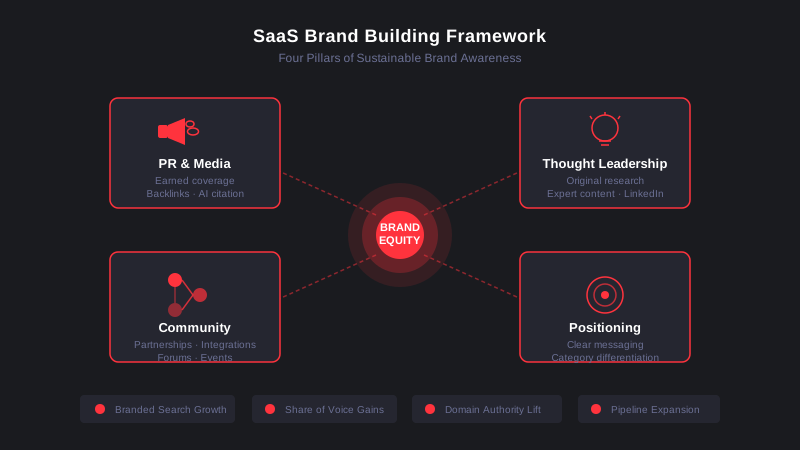
1. SaaS Public Relations and Media Coverage
Traditional PR means pitching journalists. Modern SaaS PR is broader: it includes digital coverage, backlinks, podcast appearances, analyst relations, and any earned placement that builds credibility at scale.
A strong SaaS PR program starts with a clear editorial angle. Journalists covering SaaS do not want to write about software features. They want to write about market trends, founder perspectives, funding rounds, customer outcomes, and proprietary data. The companies that land consistent coverage are the ones that give journalists something worth writing about.
Practical starting points:
- Original research: Conduct an annual survey or data study in your category. Publish the results as a report. Journalists and analysts cite original data. According to everything-pr.com, SaaS brands that share unique proprietary insights land stronger coverage in top-tier media and position themselves as sources rather than vendors.
- Founder commentary: Position your CEO or a domain expert as a go-to source for journalists covering your space. When a trend story breaks, you want to be the person a reporter calls for a quote.
- Newsworthy moments: Funding announcements, product milestones, and customer case studies all provide hooks for outreach. Time pitches to coordinate with those moments rather than pitching from a cold start.
The SEO value of earned media is significant on its own. A placement in a high-authority publication generates backlinks that compound over time, improving your domain authority and the ranking potential of every other page on your site. For growth-stage SaaS companies, that dual benefit of brand and SEO is one of the strongest ROI arguments for investing in PR.
2. Thought Leadership Content
Thought leadership is not blogging more. It is publishing perspectives that only your company is positioned to share, because of your data, your customer base, or your founders' specific expertise.
Research from the B2B Institute shows that B2B decision-makers are 48% more likely to do business with a company that produced thought leadership content they found valuable, and 54% more likely to purchase from them. Those numbers reflect a buyer behavior that SaaS marketers often underestimate: content builds trust before a prospect is ready to evaluate products, and that trust influences vendor selection when they finally are ready.
Effective SaaS thought leadership looks like:
- Point-of-view content: Take a position on a trend, a common practice, or a category assumption. Agree-with-everything content does not build brand.
- Customer outcome data: Aggregate anonymized outcome data from your customer base and publish it. This is content that requires actually running a product, which competitors cannot simply copy.
- Executive presence on LinkedIn: According to Martal, 89% of B2B marketers use LinkedIn for lead generation and 70% of B2B buyers consider it a trusted source of professional information. Executive content on LinkedIn gets meaningfully more organic reach than brand content and builds the kind of personal credibility that accelerates deals.
For a deeper look at how content fits into SaaS growth, see our guide to content marketing as a full-funnel channel.
3. Community and Partnership Presence
Brand awareness builds fastest in communities where your buyers already spend time. That means participating in industry communities, partnering with non-competing tools your customers use, and showing up at the events, forums, and Slack groups that matter in your category.
Integration partnerships are especially effective for early and mid-stage SaaS. If your product connects to tools your customers already trust, being listed in those tools' marketplaces puts your brand in front of buyers who are already qualified by context. Being featured by a larger partner also carries implicit endorsement.
Community presence compounds. A SaaS brand that is consistently visible in the forums, newsletters, and podcasts that serve its target market builds familiarity that makes every downstream touchpoint more effective. Cold outreach converts better, demo requests require less explanation, and sales cycles shorten because the brand has already done part of the work.
4. Category Positioning and Messaging Clarity
PR and content only work if the underlying brand positioning is clear. According to SaaS branding experts surveyed by Overpass Studio, the biggest branding priority for SaaS companies in 2026 is clarity: being instantly understood, not louder. When a prospect encounters your brand for the first time, the message needs to answer three questions immediately: what problem do you solve, who do you solve it for, and why are you the best answer to that problem.
Vague positioning is a brand building killer. Generic messages like "the all-in-one platform for teams" or "the smarter way to manage X" do not create memory. Specific positioning does. If your messaging cannot fit on a single note card and be understood by a cold reader in under ten seconds, your PR and content spend will underperform because no amount of coverage fixes a blurry brand.
Building SaaS Brand Awareness Without a Big Budget
Brand building has a reputation for being expensive and slow. Neither is necessarily true for SaaS companies that are strategic about it.
The highest-leverage early moves tend to be:
- Podcast guesting: Getting your founders or domain experts on established podcasts in your category builds credibility with an already-qualified audience at minimal cost. A single appearance on a well-subscribed industry podcast can reach more targeted buyers than most paid campaigns.
- Contributed content: Many trade publications in vertical SaaS categories accept contributed articles from practitioners. This is earned placement that builds authority, generates backlinks, and does not require a PR agency relationship to access.
- Data-driven press releases: Releasing proprietary benchmarks, usage data, or category insights through a press release paired with journalist outreach generates coverage that would otherwise require a paid placement. The data is the pitch.
For companies building a more complete go-to-market system, these PR and brand tactics connect directly to the broader frameworks we cover in our growth strategy consulting content.
Measuring SaaS Brand Building Effectiveness
Brand awareness is measurable, though the metrics require a different lens than performance campaigns. The key signals to track:
- Branded search volume: Are more people searching your brand name over time? This is one of the clearest indicators that brand building is working at scale.
- Direct traffic: Sustained growth in direct site visits suggests brand recall is increasing.
- Share of voice: How frequently is your brand mentioned in industry coverage relative to competitors? Tools like Mention, Brandwatch, or Meltwater track this.
- Referral traffic from earned placements: Which media mentions are actually sending visitors? Clicks from a single high-authority article often outperform a full month of lower-authority placements.
- Backlink domain authority gains: Track whether PR coverage is translating into links from high-authority domains.
For a full breakdown of how to connect brand metrics to growth KPIs, see our SaaS marketing metrics and KPIs guide.
The brands that win in SaaS are not always the ones with the best product. They are the ones that made it easiest for buyers to trust them before the buying process started. PR and brand building are how you do that at scale, starting with a clear position, finding the channels where your buyers pay attention, and publishing content worth citing. The compounding effect takes time, but it builds a moat that paid channels cannot replicate.

.webp)

.svg)


