








Most SaaS teams run competitor analysis the wrong way. They compare feature lists, copy pricing pages, and call it strategy. What they miss is the underlying performance data that separates companies growing efficiently from those burning capital to maintain headcount. SaaS industry benchmarks give you that data, and a structured competitor analysis process gives you context for interpreting it.
This guide covers how to collect meaningful competitive intelligence, which SaaS benchmarks actually matter in 2026, and how to use both to set growth targets your team can execute against.
Why Benchmarks Are the Missing Layer in Competitor Research
Competitive research typically surfaces product capabilities, messaging, and pricing. That information tells you what a competitor sells and how they position it. It rarely tells you how efficiently they acquire customers, how well they retain revenue, or whether their growth is sustainable.
SaaS benchmarks fill that gap. When you know that the median LTV:CAC ratio for B2B SaaS sits at 3:1, you can assess whether your own unit economics justify current acquisition spend. When you know that median CAC payback has extended to 18 months, you understand why your investors care so much about cash efficiency. Benchmarks convert raw competitive data into decisions.
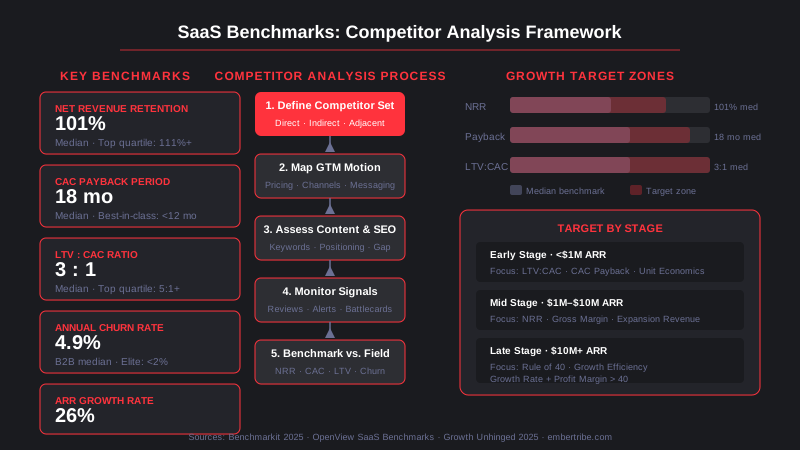
Current SaaS Benchmarks to Know in 2026
These figures represent industry medians and top-quartile ranges compiled from multiple research sources including Benchmarkit's 2025 SaaS Performance Metrics report, OpenView's annual SaaS benchmarks, and Growth Unhinged's 2025 benchmarks analysis.
Net Revenue Retention (NRR)
NRR measures how much revenue you retain from existing customers over a period, including expansion from upgrades and cross-sells minus churn and downgrades. Industry median NRR sits at approximately 101%, while top performers sustain 111% or higher. Companies achieving NRR above 100% grow at roughly 2x the rate of companies below that threshold, according to Benchmarkit's 2025 data.
The NRR benchmark splits sharply by customer segment. Enterprise-focused SaaS companies, where expansion opportunities are larger and churn is stickier, achieve NRR far above SMB-focused products. If your NRR falls below 95%, expansion revenue or churn improvement should take priority over new acquisition spend.
CAC Payback Period
CAC payback, the number of months to recover what you spent to acquire a customer, has lengthened across the industry. The median has reached 18 months, up from roughly 14 months two years prior. Best-in-class companies still maintain payback under 12 months regardless of segment.
A payback period above 24 months is a red flag for most growth-stage companies, particularly in uncertain macro environments. If you're in that range and raising capital, expect pressure to demonstrate a path toward 15 months or better before your next round.
LTV:CAC Ratio
The ratio of customer lifetime value to acquisition cost remains one of the most scrutinized SaaS metrics. The current median for growth-stage B2B SaaS is 3:1. Top quartile companies achieve 5:1 or better. By segment, enterprise SaaS averages closer to 4.5:1 while SMB SaaS averages 2.5:1, reflecting higher churn rates in the SMB cohort.
A 3:1 ratio is often cited as the minimum threshold for sustainable growth. Below 3:1, you're likely spending too much to acquire customers relative to what they return. Above 5:1, you may be under-investing in acquisition and leaving growth on the table.
Annual Churn Rate
B2B SaaS median annual churn sits around 4.9%, though this varies significantly by customer size. SMB churn runs 8x higher than enterprise churn on a percentage basis. If your customer base skews toward small businesses, expansion revenue from retained accounts becomes critical: losing 20% of your SMB cohort each year requires significant new business just to maintain flat ARR.
Top performers keep annual churn below 2% by investing in onboarding, customer success coverage, and product stickiness early in the customer lifecycle.
ARR Growth Rate
Median ARR growth for private SaaS companies has settled around 26%, with top performers reaching 50% or higher. Early-stage companies (under $1M ARR) can sustain top-quartile growth of 250% to 300% year-over-year. Context matters: a $50M ARR company growing at 40% is exceptional, while the same rate at $2M ARR is table stakes for raising a Series A.
The Rule of 40 (growth rate plus profit margin should exceed 40%) remains a common efficiency benchmark for Series B and beyond. In a tighter market, investors increasingly favor companies above 40 with a path to profitability over those burning capital for headline growth.
How to Structure a SaaS Competitor Analysis
Understanding benchmarks is one thing. Applying them through a structured competitive analysis is another. Here is a repeatable process for gathering competitive intelligence that goes beyond surface-level product comparisons.
Step 1: Define Your Competitor Set
Sort competitors into three buckets: direct, indirect, and adjacent. Direct competitors sell the same product to the same buyer. Indirect competitors solve the same problem with a different approach. Adjacent competitors overlap on one dimension, often a single feature set or a shared buyer persona.
Aim for a field of 5 to 10 companies: three direct competitors, two to three indirect, and two to four adjacent. Trying to track more than 10 competitors dilutes your attention without adding strategic value.
Step 2: Map Their Go-to-Market Motion
For each competitor, identify how they acquire customers. Review their website messaging, pricing page structure, free trial or freemium availability, case study library, and content strategy. Tools like Semrush and Similarweb surface traffic data, keyword rankings, and estimated traffic volume that reveal where they invest for organic growth.
Pay particular attention to how they structure pricing tiers. Pricing architecture tells you who they're targeting and how they think about expansion revenue. A seat-based model with an enterprise tier suggests a land-and-expand motion. Flat-rate pricing suggests they're optimizing for simplicity over expansion.
For a deeper look at how pricing structure connects to growth strategy, see our guide to SaaS customer acquisition strategies.
Step 3: Assess Their Content and Positioning
Analyze what your competitors publish and where they rank. Look for keyword gaps where you can capture search intent they're missing. Examine how they frame their core value proposition: do they lead with ROI, ease of use, integrations, or category creation?
Category creation is worth flagging specifically. When a competitor positions around a problem frame they coined (think "revenue intelligence" or "product-led growth"), they're building brand equity in a space they define. That's harder to displace than competing on features.
Step 4: Monitor for Ongoing Signals
Competitive intelligence isn't a quarterly exercise. Set up ongoing monitoring using tools like Crayon or Klue for AI-powered battlecards and win-loss analysis, Google Alerts for brand mentions, and review site tracking on G2 or Capterra for shifting customer sentiment.
Review aggregator data is underrated. Customer reviews often surface honest assessments of competitor weaknesses, including support gaps, product limitations, and pricing friction, that you won't find in any marketing material.
Step 5: Benchmark Yourself Against the Field
Once you've gathered competitive data, map your own metrics against industry benchmarks. This is where the two streams of analysis converge. If your NRR is 98% while the industry median is 101%, you know churn or contraction is eroding expansion gains. If your CAC payback is 22 months while best-in-class is under 12, you know acquisition efficiency is a prioritized problem.
For a broader look at how to build out your measurement framework, our SaaS marketing metrics and KPIs breakdown covers the full metric stack with context for each stage.
Using Benchmarks to Set Growth Targets
Benchmarks set a reference point. Growth targets require you to pick a position within or above those benchmarks and build a plan to reach it.
Prioritize the Metrics That Match Your Stage
Early-stage companies (pre-$1M ARR) should obsess over CAC payback and LTV:CAC. If unit economics aren't working at this stage, growth amplifies a broken model. Mid-stage companies ($1M to $10M ARR) should shift attention toward NRR and gross margin as expansion revenue becomes a material part of the growth equation.
Late-stage companies ($10M+ ARR) need to balance growth rate with efficiency, particularly the Rule of 40. Investors at this stage expect a clear view of how the business reaches profitability while sustaining competitive growth.
Set Targets Relative to Cohort Benchmarks
A 3:1 LTV:CAC ratio is healthy for a company with a $10K ACV product selling to SMBs. The same ratio is underwhelming for an enterprise product with a $100K ACV and a two-year sales cycle. Use your segment and ACV as the lens for interpreting where industry benchmarks apply to your specific situation.
The most effective growth targets are set at the 75th percentile of your peer cohort. That's aspirational enough to require real improvement, but grounded enough in peer data to be defensible with your board and investors.
Connect Benchmarks to Marketing Investment
Once targets are set, trace the line back to marketing investment. If you need to reduce CAC payback from 22 months to 15 months, that's a lever question: do you reduce acquisition costs, improve conversion rates, or improve initial ACV? Each answer has a different marketing implication.
For a structured approach to connecting marketing investment to growth outcomes, our team at EmberTribe works specifically with growth-stage SaaS companies building data-driven acquisition programs that benchmark against these standards.
Putting It Together
SaaS competitor analysis without benchmarks gives you a picture of what your competitors do. Adding benchmarks gives you a picture of how well they do it, and how your own performance compares to the field. The companies that win on this are the ones that run both streams in parallel, using competitive intelligence to understand positioning and market context, and benchmarks to evaluate efficiency and set targets that reflect where the industry is actually heading.
Start with the five metrics outlined above. Establish your current position on each. Then use the competitive analysis framework to understand who you're chasing and what their strengths actually are. That combination is where durable growth strategy gets built.

.webp)

.svg)


