
Your competitors are bidding on keywords right now, and some of those keywords are ones you've never tested. Every dollar they spend in Google Ads carries a signal: what they believe converts, what audiences they're chasing, and where they see margin. Knowing how to read those signals is one of the highest-leverage moves in paid search.
This guide covers the full playbook for competitor AdWords keyword research, from Google's built-in free tools to the paid platforms that surface historical bidding data. Whether you're launching a new campaign or looking to reclaim impression share you've been losing, this is where to start.
Google Ads CPCs have risen an average of 12.88% year-over-year across most industries, according to recent benchmark data. When your cost-per-click climbs, every keyword decision carries more weight. Understanding what your competitors are bidding on helps you avoid expensive keyword traps, identify gaps they've missed, and build a more defensible keyword strategy.
Competitors' keyword data also reveals their strategic priorities. A brand aggressively bidding on your branded terms is signaling intent. A competitor that suddenly appears in your Auction Insights report means they've entered your space or increased their budget. These are real business signals disguised as advertising data.
The important caveat upfront: there is no legal way to see a competitor's exact keyword list. What you can do is build a highly accurate picture of their strategy using publicly available ad data, third-party tools, and smart inference. That picture is more than enough to act on.
Before paying for any third-party platform, exhaust what Google already gives you.
The Auction Insights report is the most underutilized free tool in Google Ads. Found inside your active campaigns, it shows how your ads perform relative to competitors in the same auctions. Key metrics include Impression Share Overlap (how often you and a competitor appear in the same auction), Position Above Rate (how often they outrank you), and Top of Page Rate (how frequently they land in the premium positions).
Run this report at the ad group level, not the account level, for meaningful data. An account-level view blends too many campaigns and obscures which specific topics or product categories a competitor is targeting hard. Review it weekly for core campaigns rather than monthly so you catch emerging threats before they cost you meaningful impression share.
The Google Ads Transparency Center lets you search any domain and see all the ads they're currently running across Search, Display, and YouTube. For competitor keyword research, look at their search ad headlines and descriptions. The language they use is a direct window into which keywords they're bidding on, because their copy will align with the intent of those searches.
Pay attention to themes across multiple ads: product-focused ads suggest transactional keywords, comparison-focused copy suggests they're targeting bottom-funnel evaluation queries, and educational messaging suggests they're investing in top-of-funnel awareness terms. Building this thematic map takes 20 minutes and costs nothing.
Inside Google Keyword Planner, you can enter a competitor's website URL instead of a seed keyword to generate keyword suggestions. Google analyzes their content and returns keyword ideas based on what they rank for organically. This doesn't show what they're bidding on directly, but it surfaces the keyword universe they're operating in, and those organic rankings often mirror their paid strategy.
This approach works especially well for identifying long-tail keywords a competitor is targeting that you haven't considered. Low-competition terms in the 20-40 monthly search range can drive incremental revenue when grouped strategically into tightly themed ad groups.
Free tools give you directional signals. Paid platforms give you historical data, estimated spend, and keyword-level ad copy analysis.
SpyFu is built specifically for competitive PPC research. Enter any competitor domain and you'll see the keywords they're bidding on, their estimated monthly Google Ads spend, their ad history going back years, and which keywords are performing well enough for them to keep running. The historical data is particularly valuable because it filters out short-term tests and shows you the campaigns that actually work for them.
SpyFu's "Kombat" feature lets you overlap three domains and visualize where your keyword sets intersect and diverge. This is useful for finding the keywords your competitors bid on that you don't, which represents your clearest expansion opportunity.
SEMrush's Advertising Research module is part of a broader marketing suite, which makes it useful if you're already paying for it. Enter a competitor domain and you'll see their estimated paid keyword list, the ad copy they've run, which landing pages those ads point to, and CPC trend data over time. SEMrush also shows you the keywords they appear to be testing versus the ones they consistently run, which helps distinguish their core strategy from experimental campaigns.
The Position Changes report is worth bookmarking: it shows when competitors enter or exit specific keyword auctions, giving you a real-time view of how their strategy is shifting.
Ahrefs is primarily known for SEO, but its Site Explorer tool includes a Paid Keywords report that shows estimated paid search traffic, the keywords driving it, and the landing pages those campaigns point to. For brands that run tightly integrated SEO and PPC strategies, this is useful because it reveals where a competitor is willing to pay for traffic they can't fully capture organically.
The overlap between a competitor's top organic keywords and their paid keywords tells you which terms they've decided are so valuable they're investing in both channels. Those are almost always worth evaluating for your own campaigns.

Gathering intelligence is step one. The more important step is knowing what to do with it. Here is a practical framework.
Identify keyword gaps. Use SpyFu's Kombat feature or SEMrush's gap analysis to find keywords competitors are bidding on that you're not. Filter for terms with meaningful estimated volume and check whether you have a relevant landing page. If you do, these are fast additions to your existing campaigns.
Analyze their ad copy for messaging signals. Competitors spend money testing headlines. When you see the same value proposition repeated across dozens of their ads, that's a signal the market responds to it. Don't copy their copy, but understand the underlying promise they're making and decide whether you can make it better.
Watch for brand keyword targeting. If a competitor starts appearing in your branded search terms, you'll see it in Auction Insights. The appropriate response is usually to increase your own branded bid floors and strengthen your brand campaign ad copy, not necessarily to retaliate by bidding on their brand in return.
Use competitive data as inspiration, not a blueprint. A former Google account strategist with 10,000+ optimized accounts advises treating competitor keywords as starting points for your own research, not a list to replicate. What works for their offer, landing page, and margin structure may not work for yours.
Competitor keyword research is one input into a larger paid advertising system. If you're running Google Ads as part of a broader search engine marketing strategy, the competitive layer helps you prioritize where to invest first. High-competition keywords with multiple aggressive bidders may warrant testing more specific long-tail variations rather than fighting head-on for impression share.
For ecommerce brands specifically, the Merchant Center Price Competitiveness tool adds another dimension: it shows where your product pricing sits relative to industry benchmarks, which directly affects whether your shopping ads convert even when you win the auction. A 60-70% impression share is considered a strong benchmark, but if your pricing is 13% above the market average on a category page, winning more auctions won't solve the conversion problem. Pairing competitive keyword intelligence with competitive pricing data creates a more complete picture.
If you're building out a PPC strategy for ecommerce, start with Auction Insights to understand your current competitive position, then use SpyFu or SEMrush to identify expansion keywords, and revisit the Transparency Center monthly to track how competitors' messaging evolves season to season.
Most brands check on their competitors once when setting up a campaign and then forget about it. The brands that consistently gain ground treat competitor keyword research as a recurring process, not a one-time setup task.
CPCs rise when competitors get more aggressive. New entrants appear in your auctions. Categories shift.
Running a monthly Auction Insights pull, a quarterly SpyFu competitive review, and a biweekly Transparency Center check takes less than two hours per month total. That time investment gives you the context to make better bid decisions, smarter keyword expansions, and more relevant ad copy without relying on guesswork.
The information is available. The question is whether you build a system to use it consistently.
Want help building a competitive paid search strategy for your brand? Explore EmberTribe's Google Ads management services to see how we approach competitive intelligence for DTC and growth-stage brands.

Your competitors are bidding on keywords right now, and some of those keywords are ones you've never tested. Every dollar they spend in Google Ads carries a signal: what they believe converts, what audiences they're chasing, and where they see margin. Knowing how to read those signals is one of the highest-leverage moves in paid search.
This guide covers the full playbook for competitor AdWords keyword research, from Google's built-in free tools to the paid platforms that surface historical bidding data. Whether you're launching a new campaign or looking to reclaim impression share you've been losing, this is where to start.
Google Ads CPCs have risen an average of 12.88% year-over-year across most industries, according to recent benchmark data. When your cost-per-click climbs, every keyword decision carries more weight. Understanding what your competitors are bidding on helps you avoid expensive keyword traps, identify gaps they've missed, and build a more defensible keyword strategy.
Competitors' keyword data also reveals their strategic priorities. A brand aggressively bidding on your branded terms is signaling intent. A competitor that suddenly appears in your Auction Insights report means they've entered your space or increased their budget. These are real business signals disguised as advertising data.
The important caveat upfront: there is no legal way to see a competitor's exact keyword list. What you can do is build a highly accurate picture of their strategy using publicly available ad data, third-party tools, and smart inference. That picture is more than enough to act on.
Before paying for any third-party platform, exhaust what Google already gives you.
The Auction Insights report is the most underutilized free tool in Google Ads. Found inside your active campaigns, it shows how your ads perform relative to competitors in the same auctions. Key metrics include Impression Share Overlap (how often you and a competitor appear in the same auction), Position Above Rate (how often they outrank you), and Top of Page Rate (how frequently they land in the premium positions).
Run this report at the ad group level, not the account level, for meaningful data. An account-level view blends too many campaigns and obscures which specific topics or product categories a competitor is targeting hard. Review it weekly for core campaigns rather than monthly so you catch emerging threats before they cost you meaningful impression share.
The Google Ads Transparency Center lets you search any domain and see all the ads they're currently running across Search, Display, and YouTube. For competitor keyword research, look at their search ad headlines and descriptions. The language they use is a direct window into which keywords they're bidding on, because their copy will align with the intent of those searches.
Pay attention to themes across multiple ads: product-focused ads suggest transactional keywords, comparison-focused copy suggests they're targeting bottom-funnel evaluation queries, and educational messaging suggests they're investing in top-of-funnel awareness terms. Building this thematic map takes 20 minutes and costs nothing.
Inside Google Keyword Planner, you can enter a competitor's website URL instead of a seed keyword to generate keyword suggestions. Google analyzes their content and returns keyword ideas based on what they rank for organically. This doesn't show what they're bidding on directly, but it surfaces the keyword universe they're operating in, and those organic rankings often mirror their paid strategy.
This approach works especially well for identifying long-tail keywords a competitor is targeting that you haven't considered. Low-competition terms in the 20-40 monthly search range can drive incremental revenue when grouped strategically into tightly themed ad groups.
Free tools give you directional signals. Paid platforms give you historical data, estimated spend, and keyword-level ad copy analysis.
SpyFu is built specifically for competitive PPC research. Enter any competitor domain and you'll see the keywords they're bidding on, their estimated monthly Google Ads spend, their ad history going back years, and which keywords are performing well enough for them to keep running. The historical data is particularly valuable because it filters out short-term tests and shows you the campaigns that actually work for them.
SpyFu's "Kombat" feature lets you overlap three domains and visualize where your keyword sets intersect and diverge. This is useful for finding the keywords your competitors bid on that you don't, which represents your clearest expansion opportunity.
SEMrush's Advertising Research module is part of a broader marketing suite, which makes it useful if you're already paying for it. Enter a competitor domain and you'll see their estimated paid keyword list, the ad copy they've run, which landing pages those ads point to, and CPC trend data over time. SEMrush also shows you the keywords they appear to be testing versus the ones they consistently run, which helps distinguish their core strategy from experimental campaigns.
The Position Changes report is worth bookmarking: it shows when competitors enter or exit specific keyword auctions, giving you a real-time view of how their strategy is shifting.
Ahrefs is primarily known for SEO, but its Site Explorer tool includes a Paid Keywords report that shows estimated paid search traffic, the keywords driving it, and the landing pages those campaigns point to. For brands that run tightly integrated SEO and PPC strategies, this is useful because it reveals where a competitor is willing to pay for traffic they can't fully capture organically.
The overlap between a competitor's top organic keywords and their paid keywords tells you which terms they've decided are so valuable they're investing in both channels. Those are almost always worth evaluating for your own campaigns.
Gathering intelligence is step one. The more important step is knowing what to do with it. Here is a practical framework.
Identify keyword gaps. Use SpyFu's Kombat feature or SEMrush's gap analysis to find keywords competitors are bidding on that you're not. Filter for terms with meaningful estimated volume and check whether you have a relevant landing page. If you do, these are fast additions to your existing campaigns.
Analyze their ad copy for messaging signals. Competitors spend money testing headlines. When you see the same value proposition repeated across dozens of their ads, that's a signal the market responds to it. Don't copy their copy, but understand the underlying promise they're making and decide whether you can make it better.
Watch for brand keyword targeting. If a competitor starts appearing in your branded search terms, you'll see it in Auction Insights. The appropriate response is usually to increase your own branded bid floors and strengthen your brand campaign ad copy, not necessarily to retaliate by bidding on their brand in return.
Use competitive data as inspiration, not a blueprint. A former Google account strategist with 10,000+ optimized accounts advises treating competitor keywords as starting points for your own research, not a list to replicate. What works for their offer, landing page, and margin structure may not work for yours.
Competitor keyword research is one input into a larger paid advertising system. If you're running Google Ads as part of a broader search engine marketing strategy, the competitive layer helps you prioritize where to invest first. High-competition keywords with multiple aggressive bidders may warrant testing more specific long-tail variations rather than fighting head-on for impression share.
For ecommerce brands specifically, the Merchant Center Price Competitiveness tool adds another dimension: it shows where your product pricing sits relative to industry benchmarks, which directly affects whether your shopping ads convert even when you win the auction. A 60-70% impression share is considered a strong benchmark, but if your pricing is 13% above the market average on a category page, winning more auctions won't solve the conversion problem. Pairing competitive keyword intelligence with competitive pricing data creates a more complete picture.
If you're building out a PPC strategy for ecommerce, start with Auction Insights to understand your current competitive position, then use SpyFu or SEMrush to identify expansion keywords, and revisit the Transparency Center monthly to track how competitors' messaging evolves season to season.
Most brands check on their competitors once when setting up a campaign and then forget about it. The brands that consistently gain ground treat competitor keyword research as a recurring process, not a one-time setup task.
CPCs rise when competitors get more aggressive. New entrants appear in your auctions. Categories shift.
Running a monthly Auction Insights pull, a quarterly SpyFu competitive review, and a biweekly Transparency Center check takes less than two hours per month total. That time investment gives you the context to make better bid decisions, smarter keyword expansions, and more relevant ad copy without relying on guesswork.
The information is available. The question is whether you build a system to use it consistently.
Want help building a competitive paid search strategy for your brand? Explore EmberTribe's Google Ads management services to see how we approach competitive intelligence for DTC and growth-stage brands.
B2B keyword research is not a volume game. The brands that win organic search in competitive B2B categories are not targeting the highest-traffic terms. They are targeting the right terms: the ones that signal buyer intent, match specific funnel stages, and attract the decision-makers who control budget.
This guide walks through how B2B keyword research works, where it differs from B2C approaches, which tools to use, and how to build a prioritized keyword strategy that generates qualified pipeline rather than unqualified traffic.
The mechanics of B2B search are fundamentally different from consumer search. In B2C, a single person searches, decides, and converts, often within minutes. In B2B, a single deal might involve three to eight stakeholders, a buying cycle of weeks or months, and a sequence of searches that map across entirely different roles.
A VP of Operations searching for "automated inventory management" is not the same buyer as a CFO searching for "inventory management software ROI." Both are part of the same deal. Both use different language. Effective B2B keyword research surfaces both sets of queries and maps them to content that speaks to each role.
Volume also matters less in B2B than most marketers assume. A keyword with 200 monthly searches and strong commercial intent is worth more than a keyword with 20,000 searches and informational intent if your product costs $50,000 per year. High CPC bids (often $15 or more in competitive B2B categories) are a reliable signal that advertisers consider a keyword worth paying for because it converts. That signal belongs in your research process.
Effective B2B keyword strategies organize keywords into three layers that map to the buyer journey. Each layer requires different content formats and serves a different purpose in the funnel.
Top-of-funnel keywords attract buyers who are identifying a problem or starting to research a category. These terms tend to be educational and high-volume relative to the other layers. Examples include "what is revenue operations," "b2b demand generation strategies," or "how to reduce customer churn." Content here builds brand awareness and positions your company as a credible source.
Middle-of-funnel keywords attract buyers who understand the category and are evaluating approaches. These terms are more specific and often include modifiers like "best," "top," "how to choose," or "for [industry]." Examples include "best b2b seo tools," "keyword research for b2b saas," or "content strategy for manufacturing companies." The buying intent is higher here, and conversion rates from this layer tend to be meaningfully better than top-of-funnel traffic.
Bottom-of-funnel keywords attract buyers who are actively selecting a vendor or evaluating specific solutions. These include comparison searches ("vs." terms), pricing searches, review searches, and branded terms. While volume is lower, conversion rates are significantly higher. A single page ranking for "best b2b seo agency for saas" can drive more revenue than a dozen top-of-funnel posts.
The best B2B keyword research starts before you open any tool. Sales conversations, support tickets, and customer interviews reveal the specific language your buyers use to describe their problems, which is often different from the language your marketing team uses to describe your product.
Ask your sales team what questions prospects ask in early discovery calls. Ask customer success what problems customers were trying to solve when they first started searching. These answers surface the naturalistic keyword language that SEO tools often miss because the search volume is distributed across many variations.
Once you have that foundation, move into tool-based research.
Ahrefs and Semrush are the two most capable platforms for B2B keyword research. Both provide keyword volume estimates, keyword difficulty scores, CPC data, and SERP analysis. Semrush has stronger competitive gap analysis features. Ahrefs has a more reliable backlink index, which matters when evaluating keyword difficulty.
Google Search Console is underused for B2B research. If your site already has organic traffic, GSC shows exactly which queries are driving impressions and clicks. It surfaces real demand from real searchers at your site, which is more reliable than volume estimates from third-party tools.
Google Keyword Planner is useful for CPC data even if you are not running paid campaigns. High CPCs reliably signal commercial intent. A B2B keyword with a $25 CPC is worth investigating regardless of its monthly search volume.
For B2B-specific research, LinkedIn's search behavior and job postings are underused intelligence sources. The language companies use in job descriptions to describe problems they are hiring to solve often maps directly to the search queries their leaders are typing into Google.
Not every keyword deserves the same content format. Mapping keywords to their primary search intent before writing anything is one of the most important steps in a B2B keyword strategy, and one of the most commonly skipped.
Run a keyword through Google and study the current SERP carefully. The existing top results tell you what Google believes searchers want to find. If the top results are all long-form guides, a long-form guide is likely the right format. If the top results are tool comparison pages or listicles, that is the format Google is rewarding for that query.
Intent mapping also affects conversion strategy. A top-of-funnel informational post should convert to a lead magnet or newsletter, while a middle-of-funnel comparison page should convert to a demo or consultation. A bottom-of-funnel pricing page should convert to a sales conversation. Misaligning content format and conversion strategy is one of the main reasons B2B content generates traffic but not pipeline.
Individual keywords produce individual pages. Topic clusters produce authority. The brands that dominate B2B search are not publishing one post per keyword. They are building interconnected content systems where a pillar page covers a broad topic and supporting cluster posts cover specific subtopics, all linked together in a way that signals deep expertise to search engines.
For a B2B company in the CRM space, a cluster might look like this: a pillar page on "CRM for manufacturing" supported by cluster posts on "how to track customer orders in CRM," "CRM integration with ERP systems," and "CRM for mid-market manufacturers." Each cluster post reinforces the authority of the pillar, and the pillar passes that authority back to the cluster.
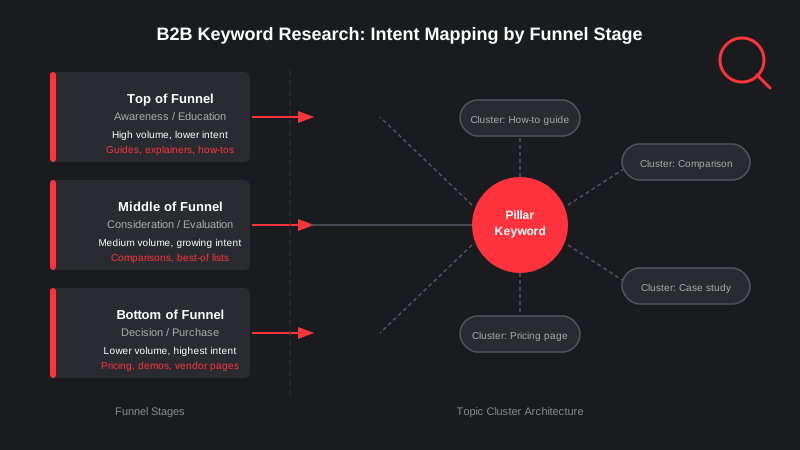
Building clusters requires deliberate internal linking. Every cluster post should link back to the pillar page, and the pillar should link forward to each supporting post. This architecture is one of the fastest ways to build topical authority in a competitive B2B category. Our guide to analytics for SEO covers how to measure topical authority gains over time.
Once you have a keyword list, prioritization determines where you spend content resources first. Use four criteria to score and rank keywords:
Search intent fit. Does this keyword map cleanly to a content format you can execute? High-intent keywords you can rank for are worth more than high-volume keywords where your content format is a poor fit for the SERP.
Keyword difficulty relative to your domain authority. A keyword difficulty of 30 is approachable for a site with meaningful backlinks. A keyword difficulty of 70 requires significant link equity. Target opportunities where your domain can compete within six to twelve months.
Business value. Keywords that attract buyers close to a purchase decision have higher business value than keywords that attract researchers. Weight your prioritization toward terms that appear in the middle and bottom of your funnel.
Competitive gap. Identify keywords where your competitors rank but you do not. These represent traffic you are currently losing to competitors and are often faster to capture than entirely new territory. Our post on competitor AdWords keywords covers how to find gaps in paid search that often mirror organic opportunities.
Effective keyword prioritization is covered in depth by resources like Moz's Keyword Research guide and Search Engine Land's B2B SEO coverage. Both are worth bookmarking as reference material.
B2B keyword research is the foundation of every content engagement we run. Before writing a single post, we map keywords to funnel stages, score intent, and build cluster architecture that compounds over time.
The brands that get the most out of B2B search are not the ones publishing the most content. They are the ones publishing the most targeted content, built on keyword research that reflects how their buyers actually search, not how the marketing team talks about the product.
If you are evaluating SEO partners and want to understand how strategic keyword research fits into a broader engagement, our guide to finding the best SEO firm walks through the evaluation criteria that matter most. And if you want to understand what the top B2B SEO companies actually do differently, our roundup of the best SEO companies in the USA covers the operational patterns that drive results.
B2B keyword research is not a one-time exercise. The B2B search landscape shifts as competitors publish, search engines evolve, and buyer language changes. Build your keyword strategy as a living document, revisit it quarterly, and let intent signals from your existing content guide where you expand next.

Most brands still treat keyword research like a volume report. They export a list from a tool, sort by search volume, pick the biggest numbers they think they can win, and hand the list off. Then they wonder why ranking pages do not convert and why the articles they published never built real authority.
That workflow was already breaking in 2022. In 2026, with AI Overviews appearing on a large share of informational queries and search engines reading entities instead of strings, it does not work at all. Modern keyword research is less about finding big numbers and more about mapping what people actually want, which pages should earn the clicks, and how each keyword fits into a cluster your brand can legitimately own.
This guide covers how we approach keyword research at EmberTribe for DTC brands and growth-stage SaaS companies, and the mistakes we see burning budget on content and paid search.
The short version: keyword research is the process of discovering the queries your potential customers type, ask, or prompt, then understanding the intent behind each one well enough to decide what type of asset should answer it.
The old definition stopped at "find search terms with good volume and low difficulty." The new definition has to account for four shifts:
Keyword research that ignores any of these produces the same thing it always did: a spreadsheet with big numbers and no plan.
The biggest upgrade you can make to your keyword research process is to lead with intent and treat volume as a tiebreaker, not a filter.
Every query sits in one of four traditional intent buckets: informational, navigational, commercial investigation, or transactional. In 2026, that classification is not granular enough. The pages that win now match narrower sub-intents, things like comparative, instructional, reassurance, and problem-solving intent, each of which calls for a different content format.
A keyword like "best running shoes for flat feet" looks transactional on the surface. Look at the SERP and you see listicles, shoe brand category pages, and a People Also Ask block full of medical questions. The real intent is comparative and reassurance-driven, so a product page will not win that query. A comparison guide built around pain points will.
The practical workflow we use:
This is slower than sorting a CSV. It stops you from chasing terms you cannot rank for, and it tells you exactly what kind of page to build.
General SEO advice falls apart fast when applied to an ecommerce catalog. Ecommerce brands do not need one keyword per post. They need an architecture that maps collections, products, and content to different layers of demand.
As an ecommerce SEO consultant, the first thing we do with a new DTC client is separate their keyword universe into three jobs:
Collection page queries. These are your category-level commercial terms, things like "merino wool base layers" or "leather crossbody bags." They have the broadest commercial intent and drive the most organic revenue per page. Each collection page should own one primary keyword and three to five secondary terms, with supporting content cleaned up so the collection is the clear canonical answer.
Product page queries. These are the narrower, often long-tail terms that signal a shopper near the bottom of the funnel. "Smartwool 250 base layer men's medium" converts at rates a generic category page cannot touch. Most brands underinvest here because the volume looks small, even though revenue per click is the highest in the catalog.
Informational queries. These are the upper-funnel questions, buying guides, and problem-led searches that feed category pages with topical authority. They rarely convert directly. They exist to help collections rank and to earn citations in AI answer engines. This is where most brands working with ecommerce seo companies fall short: they either skip informational content entirely, or publish it in isolation with no link path to the commercial pages.
The mistake we see most often is treating every keyword as equally valid for any page type. If product pages target the same terms as collection pages, you are competing with yourself. If blog content is not explicitly feeding topical authority into your collections, it is a cost center pretending to be ecommerce content marketing.
Clustering is where intent work turns into a content plan. A good cluster is a small set of related keywords that share a primary intent and can be answered by one page well enough to compete. A bad cluster is a dumping ground for anything that shares a noun.
Our rule of thumb: if you can write one honest answer that satisfies every keyword in the group without contradicting itself, it is a cluster. If you cannot, split it.
Inside a cluster, one keyword is the anchor. That is the term that drives the URL, the H1, and the canonical intent of the page. The rest are secondary terms you weave into H2s, FAQs, and body copy. This matches how search engines actually read pages in 2026, where entity relationships and semantic context matter more than exact-match keyword density.
Across a site, clusters roll up into pillars. A pillar is a broad topic your brand wants to be known for, supported by five to twenty interlinked cluster pages. That is how topical authority gets built, and why one-off posts rarely move rankings anymore.
For a SaaS company, a pillar might be "product-led growth" with clusters for activation metrics, freemium models, onboarding flows, and expansion revenue. We walk through how this shows up in practice inside our complete guide to SaaS SEO, and it is one of the specific things to ask about when you are vetting a SaaS SEO agency.
One quiet upgrade modern keyword research makes possible is using the same work to brief both SEO and paid search teams. They are usually treated as separate workstreams with separate keyword lists. That is wasted effort, and it creates inconsistent messaging across the funnel.
The paid team cares about commercial intent, cost per click, and conversion rate. The SEO team cares about volume, difficulty, and topical fit. Intent-tagged, clustered keyword research gives both teams what they need from one source of truth.
A few patterns we use consistently:
One well-built keyword map can inform ad group structure, negative keyword lists, ad copy angles, and a content calendar at the same time.
There is no shortage of keyword research tools. The honest answer is that most of the best data comes from combining two or three, not from buying the most expensive all-in-one platform.
The tool matters less than the workflow. A disciplined researcher with Search Console and the actual SERPs will beat a sloppy operator with a five-figure SaaS stack.
The mistakes we see most often when we audit a brand's keyword strategy:
If your current keyword research is a spreadsheet sorted by volume, start over. Pull your list, open the SERPs, tag intent, and regroup everything into clusters mapped to the page type that should own each group. That single exercise is usually worth more than a new tool subscription.
From there, decide which two or three clusters your brand can legitimately own in the next two quarters, map them to specific collection pages, product pages, or content hubs, and use the same research to sharpen your paid search targeting. The payoff is a keyword strategy that pulls its weight in both channels instead of living in isolation on a strategist's laptop.
EmberTribe runs keyword research as part of every integrated paid media and SEO engagement for DTC and SaaS clients, which means the work never sits on a shelf. If your keyword strategy feels more like a list than a plan, we can help you rebuild it around intent and clusters that hold up in AI search.

When am I going to start seeing results?
How fast can we scale to $25,000?
How much am I going to spend on testing?
These questions (and more) come up frequently as we're talking to companies who are considering working with us to grow their business. Whether they are just starting out on a new eCommerce store or looking to increase their app signups 3x in Q2, the underlying question is really the same.

Let's face it: digital marketers (and marketing agencies) have really turned their approach into a "black box" over the years. Whether they do it by hiding behind jargon, slapping clever branding over the top, or creating complex or confusing diagrams, the end result is confused business owners who don't really understand what their dollars are going towards, or why.
Now, take a deep breath.
For you, with us, that stops here.
We're about to open the box.
I have two little kids, one preschooler and one toddler. Both are (alarmingly) ambulatory, moving all over the house and getting into everything they aren't supposed to. The older one can unlock deadbolts, push open screen doors, climb ladders and stairs, while the younger is content with simple seeing how fast she can get her body moving in a single direction before she either topples forward or encounters an object that refuses to budge when she slams into it.
Why do I bring this up? Because they didn't start this way.
Yes, it's a tired cliche, but it's so true: you have to walk before you can run.
If your business has never run an ad before, never used marketing to sell, never attempted to convince someone unfamiliar with the brand, product, or service that they should part with their hard-earned Benjamin Franklins, then your first question should not be, "How much can I make?"
You don't have TRACTION yet.
By traction I mean a pattern of desired behavior occurring in a consistent, somewhat predictable fashion. This could mean generating leads, getting purchases, onboarding new users or whatever else your business goal, it doesn't matter. The point is that you need to be able to say that you can cause it to happen, repeatedly, with your efforts.
When we work with clients who have never run ads before, or who are just starting out, our first forays out into the marketplace are focused on finding who will buy and what will cause them to buy. Put another way, this is about audience and creative/offer.
Let's bust a myth: just because you have a product or service does not mean people will buy it. This is not Field of Dreams.
On the contrary, you have to wade through scores of unqualified or uninterested people to find your best candidates, and then test multiple different messages, angles, images, videos, taglines and more in order to find traction.
"Okay, but how long does that take?"
Well, that depends.
I know, that's not what you were hoping for. And if I can tell you that it would take 2 weeks or 2 months or whatever, I definitely would. Instead, here's what I can tell you:
When you work with us, you aren't hiring wizards (or gurus or ninjas) - you're hiring data-driven marketers. So we're going to test, and test, and test, and generate lots of data, and then we're going to do what the data tells us.
👉 Set up your campaigns to get more qualified leads. →
Sometimes it's fast, and we see traction in just a few weeks. Sometimes it takes less time, sometimes it takes longer. All the factors above impact that.
But the good news is, once you have TRACTION, you can move on to start thinking about...
Too many times we'll talk to a business owner who is putting money into ads and wants to see immediate return. If they don't get a certain CPA or ROAS in the first 3 weeks, they think there's something "wrong" with the ads. They don't realize they are trying to run before walking, that you can't build a house without the foundation, or whatever analogy you best identify with.
💡 ROAS isn't everything, it's just a part of the equation. →
Once we help our clients find TRACTION, then (and only then) is it time to start discussing PROFIT.
Why?
If you don't have enough data points, you can't optimize.
Put another way, if you don't have anyone buying from you, how do you know who your best customers are?
Getting this data and acting on it is the basis of improving your PROFIT metrics. If you want a better CPA, you need to find out which creative gets the best response and then test small optimizations on it - a new emoji, a different headline, a carousel vs a static image. If you want better ROAS, you can segment by device type or placement or time of day that gives you the best baseline.
The key to the PROFIT stage is having goals. And I don't mean "I want to retire and sleep on a bed of Andrew Jacksons every night" type goals, more like "If I can generate new users for $20 each that means I'm profitable and am basically printing money" goals.
We help our clients walk through some simple calculations to set their goals. For an eCommerce store this might include repeat purchase rate, average order value (AOV), and cost of goods sold (COGS). For a SaaS client, we would consider lifetime value (LTV), profit margins, and upsells. Whatever the case, we want to end up with a single number.
That number is our PROFIT goal. If we can hit that goal with consistency, it unlocks us to move on the third and final stage.
Ah yes, scaling. The magical, mystical land of unicorns and rainbows where you trade $1 for $4 ten thousand times while eating ice cream in your pajamas.
Okay, well, not quite, but that's how the "get rich quick" YouTube personalities pitch it. Sounds fun, huh?
Truth is, scaling isn't the end - it's the beginning.
When this client partnered with EmberTribe, their goal was to find strategies to scale sales. Now our client has experienced scale from $18K to $370K lifetime revenue, with an $111K lifetime spend.
You can't start putting more dollars into your campaigns until they are making you money back consistently, and you can't do that until you build a system of repeatable client generation. Hence the reason it's the final step. But there's another reason we counsel clients to be smart about getting to this stage: the game changes.
If you want to triple your investment in ads, especially on a channel like Facebook Ads, just about the worst thing you can do is start jacking your budgets up quickly.
😑 Facebook ads not working? This could be why. →
This causes the algorithm to have to start relearning, and oftentimes can tank your PROFIT, forcing you to go back to the drawing board. Instead, you have to be intentional, constantly revisiting your PROFIT goals and testing new TRACTION experiments to widen your funnel. And this is why we insist on walking through the process with clients - because failing to do the hard work on the front end ends up in a house of cards that falls apart, leaving everyone unhappy.
Some of our best success stories are clients who did things the right way, worked with us to build a repeatable system for growth and testing, and then let us run wild with new audiences, creative, automation, rules and more. Their accounts grew from 5 to 7 figures in ad spend profitably not by some mystical proprietary technology or the wizardry of a paid acquisition savant, but by being intentional, creating a solid foundation, and trusting the process.
It's not easy. It's not as fast as we'd like. But the results are worth it, and the potential that it opens up are amazing.
No black box. No magic. No single genius with the inside track on the algorithm.
Just lots of testing, patience, observation, analysis, failure, growth and consistency.
That's the secret sauce of EmberTribe, and it's one of the reasons we've had such great success for ourselves and our clients since our inception: a three-step process of TRACTION, PROFIT, SCALE that works across industries, across business models, regardless of the age or success of the business to date.


.svg)