






Sixty-eight percent of Shopify stores already run an active loyalty program, and 44% of those without one are actively implementing one, according to Rivo's 2026 Shopify loyalty statistics. Loyalty platforms have moved from a competitive differentiator to baseline infrastructure for ecommerce brands. The question is no longer whether to run a program; it is which platform serves your GMV stage, tech stack, and analytics requirements.
The loyalty platform market reached $12.89 billion in 2025 and is growing at a 13.1% CAGR, per Grand View Research. With that growth has come meaningful product differentiation: the right platform for a $3 million Shopify brand is not the right platform for a $30 million multi-channel retailer.
Why Platform Choice Compounds
The loyalty platform you choose determines the quality of data flowing into your marketing stack. Every platform can run points and tiers. What separates them is how deeply loyalty data integrates with your email and SMS platform, how much behavioral data they capture, and how easily you can act on that data without developer involvement.
Loyalty members who redeem rewards spend 67% more than non-members, and VIP members in tiered programs show 73% higher AOV and 3.6 times more purchases than non-VIP customers, per Rivo's VIP program benchmarks. Those numbers assume the program is actually driving behavior. A platform with weak Klaviyo integration, no tier urgency mechanics, or a redemption experience buried in a separate portal will underperform against those benchmarks regardless of how the program is structured on paper.
The Five Platforms Worth Evaluating
The market has consolidated around a small number of platforms that dominate Shopify installs. Each has a distinct GMV fit and a specific integration advantage.
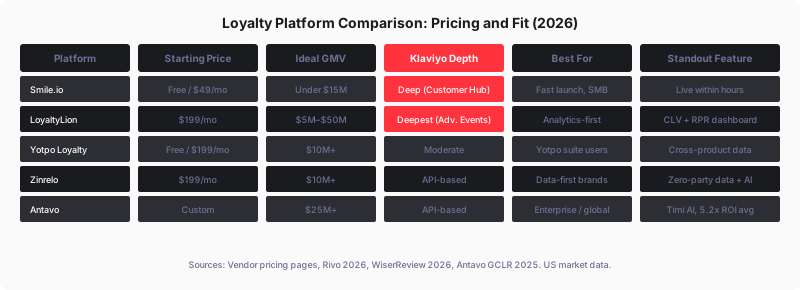
Smile.io is the most-installed loyalty app on the Shopify App Store and the default starting point for most ecommerce brands. Its free tier handles basic points and referrals for stores processing up to 200 orders per month. The Growth plan at $199 per month adds VIP tiers, points expiry, and the Klaviyo Customer Hub integration that surfaces loyalty data natively inside Klaviyo's account experience.
Smile.io can be live within hours and requires no developer involvement. The ideal profile is a Shopify brand under $15 million GMV that wants quick time-to-value without complex setup.
LoyaltyLion is the analytics-first choice for brands that will actually use program data to drive decisions. Its Advanced Klaviyo Events integration is the deepest in the category: loyalty triggers, tier changes, reward milestones, and points balances flow into Klaviyo in real time with conditional logic and A/B testing built into the flow architecture. The analytics dashboard surfaces CLV, repeat purchase rate, and program ROI by cohort. Starting at $199 per month with order-volume-based scaling, LoyaltyLion fits brands between $5 million and $50 million GMV with a dedicated marketing team.
Yotpo Loyalty makes the most sense for brands already using Yotpo Reviews or operating in the Yotpo product suite. Cross-product data sharing means review activity can unlock points and subscription status can affect tier placement. The free tier handles up to 100 orders per month, and the Pro plan at $199 per month covers most growth-stage needs. One important change: Yotpo discontinued its email and SMS products at the end of 2025, which means brands now need Klaviyo or Attentive separately for loyalty communications.
Zinrelo (recently rebranded TrueLoyal) targets mid-market to enterprise brands with a focus on zero and first-party data capture and AI-driven personalization. Its multi-dimensional loyalty framework covers transactional, social, referral, behavioral, and emotional engagement rather than just purchases.
Starting at $199 per month for up to 1,000 members, Zinrelo fits brands at $10 million or above that prioritize data strategy alongside program mechanics. The setup is more complex than Smile.io or LoyaltyLion, which requires allocating internal resources to implementation.
Antavo operates at the enterprise end of the market. Its Timi AI automates program management, and its Loyalty Planner reduces program design time by 10x according to the company. Clients include KFC, Skims, and Scandic Hotels. Antavo's own platform data shows an average 5.2x ROI across its client base, per the Antavo Global Customer Loyalty Report 2025, with 83% of programs reporting positive ROI.
Pricing is custom and requires a sales process. Antavo fits brands above $25 million GMV with complex multi-brand, multi-country, or experience-based loyalty requirements.
Platform Comparison at a Glance
Klaviyo Integration Depth Matters More Than It Did
For DTC brands running email and SMS through Klaviyo, the loyalty platform is only as useful as the data it sends to Klaviyo. A platform that sends basic triggered emails but does not feed real-time tier status, points balance, and reward milestone data into Klaviyo segments cannot power the personalized flows that drive the retention benchmarks above.
LoyaltyLion's Advanced Klaviyo Events integration is the current category leader. It passes event-level data that Klaviyo can use to trigger flows, build dynamic segments, and personalize content based on loyalty status. Smile.io's Customer Hub integration is less flexible but more accessible: it surfaces loyalty data directly inside the native Klaviyo customer account portal without requiring custom development. The customer loyalty campaigns that consistently outperform are the ones where loyalty data is fully wired into the email and SMS stack, not sitting in a separate platform dashboard.
Build vs. Buy Is a Settled Argument
Custom loyalty platform builds cost $10,000 to $20,000 at MVP and $20,000 to $60,000 for full-featured versions, per Raftlabs' loyalty development cost analysis. First-year total costs including integrations, hosting, compliance infrastructure, and support run $30,000 to $80,000. A SaaS platform average spend is $14,200 per year, according to Rivo's platform cost data.
For ecommerce brands under $50 million GMV, SaaS loyalty platforms consistently deliver lower total cost of ownership than custom builds. SaaS platforms also ship product updates continuously, which means AI features, new channel integrations, and platform algorithm changes get incorporated without internal engineering resources. Custom builds require ongoing maintenance investment to stay current.
The only cases where custom builds make sense are brands above $100 million GMV with coalition loyalty programs, multi-country compliance requirements, or highly unique program mechanics that no platform supports. That is a narrow slice of the ecommerce market.
Switching Costs and Migration Reality
Enterprise migrations from legacy loyalty platforms take 4 to 12 months from decision to full decommission, per Antavo's loyalty replatforming research. The primary blockers are points balance migration accuracy, tier mapping, customer communication during the transition, and engineering bandwidth. Poor integration architecture is cited as a major challenge by 71% of loyalty program owners globally, per the Antavo GCLR 2025.
Choosing the right platform at each growth stage reduces switching frequency. The practical migration path for most DTC brands: Smile.io from launch to $5 million GMV, LoyaltyLion from $5 million to $25 million, and an enterprise platform like Antavo or Zinrelo above that. Some brands stay on LoyaltyLion past $25 million when the analytics depth and Klaviyo integration justify the continuity over a complex migration.
What the ROI Data Actually Says
Across platforms and program types, the retention math is consistent. A 5% improvement in customer retention produces a 25 to 95% increase in profit, a benchmark rooted in Harvard Business School research. Customer loyalty programs that reach 40 to 60% of total revenue flowing through loyalty-eligible orders after 18 months are operating at the level that produces those margins.
For ecommerce brands evaluating their loyalty infrastructure alongside their demand generation programs, EmberTribe works on the acquisition side that fills the top of the funnel while retention programs improve the return on every customer acquired.

.webp)

.svg)


