








B2B keyword research is not a volume game. The brands that win organic search in competitive B2B categories are not targeting the highest-traffic terms. They are targeting the right terms: the ones that signal buyer intent, match specific funnel stages, and attract the decision-makers who control budget.
This guide walks through how B2B keyword research works, where it differs from B2C approaches, which tools to use, and how to build a prioritized keyword strategy that generates qualified pipeline rather than unqualified traffic.
Why B2B Keyword Research Is Different
The mechanics of B2B search are fundamentally different from consumer search. In B2C, a single person searches, decides, and converts, often within minutes. In B2B, a single deal might involve three to eight stakeholders, a buying cycle of weeks or months, and a sequence of searches that map across entirely different roles.
A VP of Operations searching for "automated inventory management" is not the same buyer as a CFO searching for "inventory management software ROI." Both are part of the same deal. Both use different language. Effective B2B keyword research surfaces both sets of queries and maps them to content that speaks to each role.
Volume also matters less in B2B than most marketers assume. A keyword with 200 monthly searches and strong commercial intent is worth more than a keyword with 20,000 searches and informational intent if your product costs $50,000 per year. High CPC bids (often $15 or more in competitive B2B categories) are a reliable signal that advertisers consider a keyword worth paying for because it converts. That signal belongs in your research process.
The Three-Layer B2B Keyword Taxonomy
Effective B2B keyword strategies organize keywords into three layers that map to the buyer journey. Each layer requires different content formats and serves a different purpose in the funnel.
Top-of-funnel keywords attract buyers who are identifying a problem or starting to research a category. These terms tend to be educational and high-volume relative to the other layers. Examples include "what is revenue operations," "b2b demand generation strategies," or "how to reduce customer churn." Content here builds brand awareness and positions your company as a credible source.
Middle-of-funnel keywords attract buyers who understand the category and are evaluating approaches. These terms are more specific and often include modifiers like "best," "top," "how to choose," or "for [industry]." Examples include "best b2b seo tools," "keyword research for b2b saas," or "content strategy for manufacturing companies." The buying intent is higher here, and conversion rates from this layer tend to be meaningfully better than top-of-funnel traffic.
Bottom-of-funnel keywords attract buyers who are actively selecting a vendor or evaluating specific solutions. These include comparison searches ("vs." terms), pricing searches, review searches, and branded terms. While volume is lower, conversion rates are significantly higher. A single page ranking for "best b2b seo agency for saas" can drive more revenue than a dozen top-of-funnel posts.
How to Find B2B Keywords That Actually Convert
The best B2B keyword research starts before you open any tool. Sales conversations, support tickets, and customer interviews reveal the specific language your buyers use to describe their problems, which is often different from the language your marketing team uses to describe your product.
Ask your sales team what questions prospects ask in early discovery calls. Ask customer success what problems customers were trying to solve when they first started searching. These answers surface the naturalistic keyword language that SEO tools often miss because the search volume is distributed across many variations.
Once you have that foundation, move into tool-based research.
Tools for B2B Keyword Research
Ahrefs and Semrush are the two most capable platforms for B2B keyword research. Both provide keyword volume estimates, keyword difficulty scores, CPC data, and SERP analysis. Semrush has stronger competitive gap analysis features. Ahrefs has a more reliable backlink index, which matters when evaluating keyword difficulty.
Google Search Console is underused for B2B research. If your site already has organic traffic, GSC shows exactly which queries are driving impressions and clicks. It surfaces real demand from real searchers at your site, which is more reliable than volume estimates from third-party tools.
Google Keyword Planner is useful for CPC data even if you are not running paid campaigns. High CPCs reliably signal commercial intent. A B2B keyword with a $25 CPC is worth investigating regardless of its monthly search volume.
For B2B-specific research, LinkedIn's search behavior and job postings are underused intelligence sources. The language companies use in job descriptions to describe problems they are hiring to solve often maps directly to the search queries their leaders are typing into Google.
Mapping Keywords to Intent
Not every keyword deserves the same content format. Mapping keywords to their primary search intent before writing anything is one of the most important steps in a B2B keyword strategy, and one of the most commonly skipped.
Run a keyword through Google and study the current SERP carefully. The existing top results tell you what Google believes searchers want to find. If the top results are all long-form guides, a long-form guide is likely the right format. If the top results are tool comparison pages or listicles, that is the format Google is rewarding for that query.
Intent mapping also affects conversion strategy. A top-of-funnel informational post should convert to a lead magnet or newsletter, while a middle-of-funnel comparison page should convert to a demo or consultation. A bottom-of-funnel pricing page should convert to a sales conversation. Misaligning content format and conversion strategy is one of the main reasons B2B content generates traffic but not pipeline.
Building a B2B Keyword Cluster Strategy
Individual keywords produce individual pages. Topic clusters produce authority. The brands that dominate B2B search are not publishing one post per keyword. They are building interconnected content systems where a pillar page covers a broad topic and supporting cluster posts cover specific subtopics, all linked together in a way that signals deep expertise to search engines.
For a B2B company in the CRM space, a cluster might look like this: a pillar page on "CRM for manufacturing" supported by cluster posts on "how to track customer orders in CRM," "CRM integration with ERP systems," and "CRM for mid-market manufacturers." Each cluster post reinforces the authority of the pillar, and the pillar passes that authority back to the cluster.
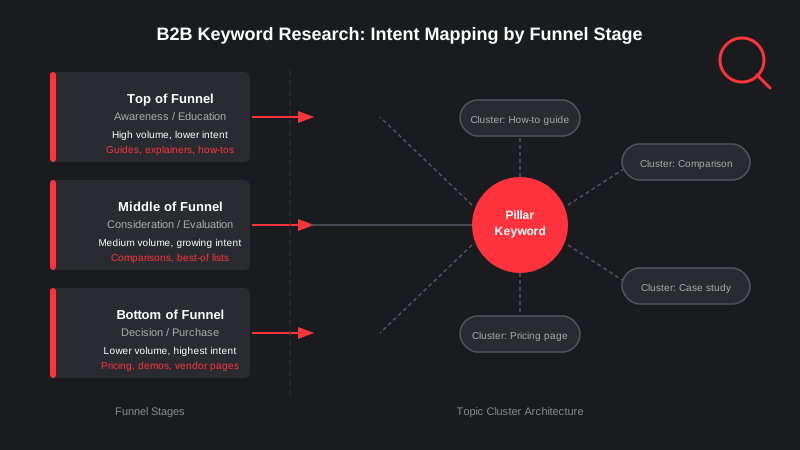
Building clusters requires deliberate internal linking. Every cluster post should link back to the pillar page, and the pillar should link forward to each supporting post. This architecture is one of the fastest ways to build topical authority in a competitive B2B category. Our guide to analytics for SEO covers how to measure topical authority gains over time.
Prioritizing Your B2B Keyword List
Once you have a keyword list, prioritization determines where you spend content resources first. Use four criteria to score and rank keywords:
Search intent fit. Does this keyword map cleanly to a content format you can execute? High-intent keywords you can rank for are worth more than high-volume keywords where your content format is a poor fit for the SERP.
Keyword difficulty relative to your domain authority. A keyword difficulty of 30 is approachable for a site with meaningful backlinks. A keyword difficulty of 70 requires significant link equity. Target opportunities where your domain can compete within six to twelve months.
Business value. Keywords that attract buyers close to a purchase decision have higher business value than keywords that attract researchers. Weight your prioritization toward terms that appear in the middle and bottom of your funnel.
Competitive gap. Identify keywords where your competitors rank but you do not. These represent traffic you are currently losing to competitors and are often faster to capture than entirely new territory. Our post on competitor AdWords keywords covers how to find gaps in paid search that often mirror organic opportunities.
Effective keyword prioritization is covered in depth by resources like Moz's Keyword Research guide and Search Engine Land's B2B SEO coverage. Both are worth bookmarking as reference material.
How EmberTribe Approaches B2B Keyword Strategy
B2B keyword research is the foundation of every content engagement we run. Before writing a single post, we map keywords to funnel stages, score intent, and build cluster architecture that compounds over time.
The brands that get the most out of B2B search are not the ones publishing the most content. They are the ones publishing the most targeted content, built on keyword research that reflects how their buyers actually search, not how the marketing team talks about the product.
If you are evaluating SEO partners and want to understand how strategic keyword research fits into a broader engagement, our guide to finding the best SEO firm walks through the evaluation criteria that matter most. And if you want to understand what the top B2B SEO companies actually do differently, our roundup of the best SEO companies in the USA covers the operational patterns that drive results.
B2B keyword research is not a one-time exercise. The B2B search landscape shifts as competitors publish, search engines evolve, and buyer language changes. Build your keyword strategy as a living document, revisit it quarterly, and let intent signals from your existing content guide where you expand next.

.webp)

.svg)


