








Unified commerce is not a marketing term for an upgraded omnichannel strategy. It is a fundamentally different architectural decision: instead of connecting separate systems after the fact, unified commerce runs all channels from a single backend data layer that handles orders, inventory, customers, pricing, and loyalty in real time.
The distinction matters because the problem omnichannel was designed to solve, that customers experience friction when moving between channels, cannot be fully solved at the experience layer. The friction originates in the backend.
Omnichannel vs. Unified Commerce: Where the Difference Lives
Omnichannel is a frontend experience strategy. The goal is to make the customer journey feel consistent across touchpoints: the same promotions online and in-store, the ability to return online purchases at physical locations, buy-online-pick-up-in-store functionality. That is valuable. It is also structurally limited.
The problem: achieving consistent experience across channels requires that separate, siloed systems stay in sync. The ecommerce platform, POS, inventory management, OMS, CRM, and loyalty program all communicate through API integrations and middleware. Every sync is a potential failure point, and every integration introduces latency.
Because each system holds its own version of truth, inventory counts, customer records, and order status can diverge in ways that only surface at checkout or fulfillment.
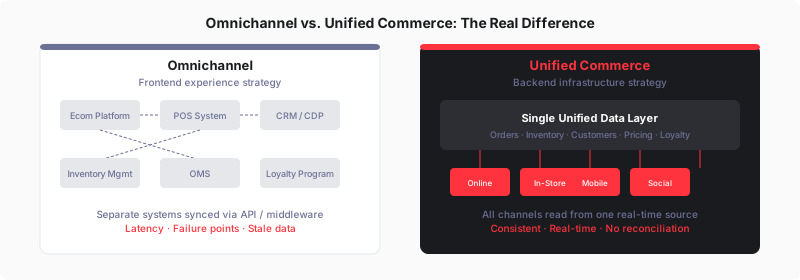
Unified commerce eliminates the sync problem by eliminating the silos. Every channel reads from and writes to the same data layer. When a customer buys in-store, inventory updates everywhere immediately, and when a loyalty point is earned online, it is visible at the register in real time.
There is no reconciliation because there is nothing to reconcile.
The practical consequence: omnichannel can tell a customer that an item is available for pickup. Unified commerce can guarantee it, because the inventory count is the same number the checkout system read half a second ago.
Why Only 7% of Retailers Have Achieved It
Despite being a recognized priority for years, unified commerce remains rare in practice. According to Manhattan Associates' Unified Commerce Benchmark, only approximately 7% of retailers have achieved true unified commerce maturity.
The gap between intent and execution is not primarily a technology problem. It is an organizational and migration problem.
Most retailers built their ecommerce operations by layering digital channels onto existing physical retail infrastructure. Each channel acquired its own system over time: the POS came first, the ecommerce platform was added later, the inventory management system predates both, and the loyalty program was bolted on after a rebrand.
Each system carries years of transaction history, customer records, and customizations built specifically for it. Replacing or consolidating them is a multi-year project with no clean phasing.
The specific challenges that block most implementations:
Data migration complexity. Consolidating customer records across systems that used different identifiers, address formats, and loyalty structures requires significant data modeling before a single line of migration code is written.
Organizational resistance. Different channels often have separate P&L owners. The ecommerce team and the retail operations team may not report to the same executive. Infrastructure decisions that require both to change their systems simultaneously run into jurisdictional friction that no vendor can resolve.
Platform misrepresentation. Not all platforms marketed as "unified" are architecturally unified. Some are middleware layers that create the appearance of a unified backend through faster syncing. The distinction requires examining the actual data model, not the marketing language.
What Unified Commerce Produces: Measured Outcomes
The business case for the investment is strong in verified implementations. Manhattan Associates' Unified Commerce Benchmark documents consistent results across retailers that have completed the transition.
Fulfillment cost reductions of 27 to 31% emerge from real-time inventory visibility across all locations. When the order management system knows exactly what is in every store and warehouse simultaneously, it routes fulfillment to the cheapest and fastest origin rather than defaulting to the distribution center for every order.
Cart abandonment rates run 18 to 20% lower compared to omnichannel implementations. The friction that drives abandonment, inaccurate inventory displays, inconsistent pricing, and failed cross-channel promotions, is structurally eliminated rather than patched.
Average order value and customer lifetime value improve 11 to 14%. Customers who shop without friction spend more per transaction and return more often. Loyalty program engagement improves when points are visible and usable across every channel without manual reconciliation.
These outcomes are not immediate. The ROI from unified commerce is backend-heavy: the infrastructure investment comes first, the revenue impact follows over 12 to 24 months as the customer experience compounds. Planning the business case around short-term payback periods understates the actual return.
Platform Options for Unified Commerce
The platform market has matured significantly. Three architectures dominate serious implementations.
Shopify Plus is the most accessible path for mid-market DTC brands. Shopify's native POS integration, combined with its unified order management and inventory layers, delivers genuine backend consolidation for brands operating a manageable number of store locations. Shopify's headless capabilities allow custom frontends without fragmenting the backend data model. The ceiling on customization is lower than composable alternatives, and brands with complex B2B or wholesale pricing structures often reach it.
Commercetools is the leading composable commerce platform for enterprise retailers that need full architectural flexibility. It is API-first and component-based: retailers assemble best-of-breed services connected to a unified commerce layer rather than buying a single-vendor platform. Implementation complexity and cost are significantly higher, but the ceiling for customization reflects that complexity. Enterprise brands with multi-region operations, complex pricing rules, and unique fulfillment models are the natural fit.
Salesforce Commerce Cloud sits between the two in implementation complexity and cost. It suits brands already operating in the Salesforce ecosystem (Service Cloud, Marketing Cloud, CRM) where native data sharing across those systems reduces integration work. The advantage is that customer data flows between commerce, service, and marketing without separate integrations. The trade-off is platform lock-in and licensing costs that are harder to justify below a certain revenue threshold.
Platform selection should be driven by three variables: the current tech stack and what stays versus gets replaced, the number and complexity of channels being unified, and the internal engineering capacity to manage implementation and ongoing maintenance.
The Implementation Path That Works
Organizations that succeed at unified commerce follow a phased approach that avoids the big-bang migration failure mode.
- Phase one: real-time inventory as the foundation. Before addressing customer data, loyalty, or cross-channel promotions, establish a single inventory truth. This is the highest-leverage starting point because it immediately addresses the two most customer-visible failure modes: showing out-of-stock items as available and failing BOPIS promises. A real-time inventory layer can often be implemented without replacing the full ecommerce or POS infrastructure.
- Phase two: unified customer identity. Merge customer records across channels into a single profile. This requires reconciling email, phone, and loyalty ID across systems, and is where most implementations slow down. Investing in data quality here rather than rushing forward on a dirty dataset prevents failures in every subsequent phase.
- Phase three: order and fulfillment routing. With inventory and customer data unified, distributed order management becomes possible: routing orders to the cheapest available fulfillment origin, enabling ship-from-store, and exposing accurate delivery estimates at checkout. This is the phase that produces the fulfillment cost reductions in the Manhattan Associates benchmarks.
- Phase four: commerce and marketing integration. Connect the commerce layer to channel marketing execution and performance data so that promotional planning, audience segmentation, and retention programs read from the same customer records and purchase history. This is where unified commerce compounds into acquisition and retention efficiency, not just operational savings.
The phasing matters because each layer depends on the one below it. Building loyalty programs on top of fragmented customer data produces poor results regardless of the platform. Optimizing fulfillment routing without real-time inventory produces more errors than it resolves.
When Unified Commerce Is the Right Investment
Unified commerce is not the right infrastructure decision for every brand at every stage. For brands operating one or two channels with manageable complexity, the coordination overhead of a unified backend may not justify the cost. Well-run omnichannel integrations remain a viable path.
For ecommerce brands operating four or more channels with significant cross-channel customer behavior, the math shifts. The compounding cost of maintaining API integrations, reconciling inventory discrepancies, and patching friction in cross-channel journeys eventually exceeds the cost of architectural consolidation. The question becomes not whether to consolidate, but when the business has the operational capacity to execute it correctly.
If you are evaluating whether unified commerce is the right next infrastructure investment for your brand, EmberTribe works with growth-stage DTC and B2B retailers on the strategy and implementation planning for commerce infrastructure decisions that affect acquisition, retention, and fulfillment economics.

.webp)

.svg)


