








The ecommerce statistics that matter most are not the ones that confirm what you already believe. They are the ones that force you to reconsider where to invest, how to price, and which channels to prioritize. This post compiles verified 2025-2026 data across market size, mobile, social commerce, and conversion benchmarks so you can make decisions grounded in evidence.
Key Ecommerce Stats at a Glance
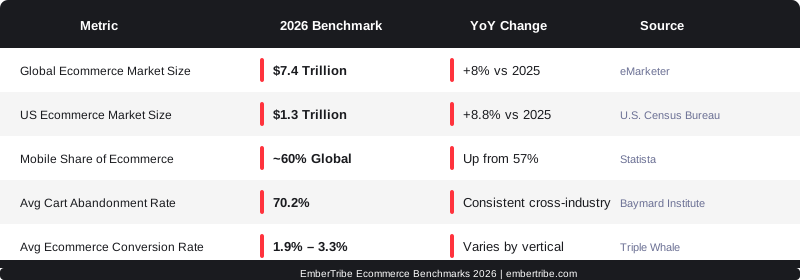
Before diving into each category, here is a summary of the most actionable benchmarks for DTC and growth-stage ecommerce brands in 2026.
Global Ecommerce Market Size and Growth
Global ecommerce sales are projected to reach $7.4 trillion in 2026, up roughly 8% from an estimated $6.86 trillion in 2025, according to eMarketer. Ecommerce now accounts for approximately 20.5% of all global retail sales, up from 19.9% in 2024. China's outsized online retail penetration is lifting the global average significantly.
For brands building long-term plans, Grand View Research projects a CAGR of 21.6% from 2026 to 2033 for the broader ecommerce ecosystem when alternative commerce models (marketplaces, social, B2B digital) are included. The takeaway: the market is expanding faster than most incumbent retail categories, but that also means competitive pressure on customer acquisition is rising in parallel.
If you are building an ecommerce strategy from scratch or looking to expand internationally, understanding the scope of the market is a prerequisite. See our guide to building an ecommerce business for a framework on how to position within this landscape.
US Ecommerce Statistics
The United States ecommerce market reached approximately $1.23 trillion in 2025, and 2026 projections point to $1.3 trillion, representing growth of around 8.8%, per the U.S. Census Bureau's quarterly retail ecommerce report. That compares to total retail sales growth of just 2.8% in the same period, underscoring how consistently ecommerce is outpacing in-store shopping.
US ecommerce penetration as a share of all retail is expected to reach 18% in 2026, up from approximately 17.1% in 2025. The gap between online and offline growth is narrowing year over year, which means brands that have already built their digital infrastructure are better positioned than those still catching up.
Mobile Commerce Is Now the Default
Mobile commerce accounted for approximately 60% of global ecommerce sales in 2026, up from 57% the prior year. In the US, mobile's share sits at 44.6%, reflecting a market where desktop still drives meaningful volume but mobile is clearly the channel of first contact. During the 2025 holiday season, mobile represented 56.4% of all online sales (November 1 through December 31), up from 54.5% in 2024.
Approximately 1.65 billion people will shop via smartphone in 2026, nearly one in three internet users globally. For DTC brands, that number has a direct implication: your mobile checkout experience is not a secondary priority. Slow load times, multi-step forms, and non-native payment options (no Apple Pay or Shop Pay) are conversion killers at scale.
The mobile commerce market itself is projected to grow from $2.42 trillion in 2026 to over $5 trillion by 2034 at a CAGR of 9.5%. Brands that invest in mobile-first site performance now are building durable advantages.
Social Commerce and TikTok Shop
Social commerce is maturing from a novelty into a reliable channel. TikTok Shop's global gross merchandise value (GMV) reached $64.3 billion in 2025, nearly doubling from $33.2 billion in 2024, and the platform is projected to hit $112.2 billion in GMV by 2026. In the US, TikTok Shop generated $15.82 billion in GMV in 2025, representing 120% annual growth.
TikTok Shop now holds approximately 20% of total social commerce in the US, per eMarketer. The platform counts over 15 million active merchants globally and 475,000 US-based shops as of 2026. Nearly 58% of TikTok's 2 billion active users have shopped directly within the app.
For DTC brands, TikTok Shop is no longer optional to evaluate. The brands capturing share are those building authentic content pipelines (not just paid ads) and integrating creator affiliate programs with real product economics. The channel also compresses the discovery-to-purchase funnel in ways that traditional paid social cannot replicate. For a broader view of how to integrate social into your full funnel, see our breakdown of ecommerce digital marketing.
Conversion Rates and Cart Abandonment
The global average ecommerce conversion rate sits between 1.9% and 3.3%, depending on vertical and traffic source. Shopify stores typically land in the 2.5% to 3% range. Reaching 4% or higher generally requires a combination of strong brand awareness, optimized UX, and consistent CRO investment, according to Triple Whale's 2025 benchmark data.
Industry-level variation is substantial. Food and beverage converts at 3.21% on average, beauty and personal care sits at 2.98%, and electronics drops to 2.71%, partly due to higher price points and longer consideration cycles.
AOV is one of the strongest predictors of conversion rate: stores selling products under $60 see median conversion rates of 4.63%, while stores with average orders above $200 see median rates closer to 0.95%.
Cart abandonment remains a persistent challenge. Baymard Institute's aggregated research, compiled from 50 studies, puts the average cart abandonment rate at 70.2%. The primary drivers are unexpected shipping costs at checkout (cited by 55% of abandoners), complicated checkout flows (21%), and trust concerns (17%). Abandoned cart email sequences still represent one of the highest-ROI recovery tactics available, with open rates around 41.8% and conversion rates near 10.7%.
Customer Retention Benchmarks
Acquisition cost pressure makes retention economics more critical than ever. The average ecommerce repeat purchase rate is 28.2%, meaning slightly over one in four customers returns without additional acquisition spend. Brands above 40% are typically operating with subscription mechanics or high-frequency consumable products.
The financial case for retention is straightforward: the top 20% of customers typically account for around 80% of sales, and retained customers spend up to 67% more than new ones over time. For DTC brands scaling past $5M in annual revenue, a retention strategy is not an optional optimization, it is a core P&L lever.
Understanding how to sustain this growth over time requires a clear view of the trajectory. See our analysis of ecommerce growth strategies for brands moving into their next revenue tier.
What These Numbers Mean for DTC Brands
The macro numbers confirm that ecommerce is growing, but the operational benchmarks are where the real decisions live. A 70% cart abandonment rate means that on average, seven out of ten shoppers who intend to buy do not complete the transaction. A 2% conversion rate means 98 out of 100 visitors leave without purchasing. These are not alarming outliers; they are the baseline most brands operate against.
The brands that compound growth are the ones that treat these benchmarks as specific problems to solve, not background noise. That means investing in mobile UX before mobile revenue justifies it, building TikTok Shop infrastructure before competitors saturate it, and building email and SMS retention programs before paid CAC forces the issue.
If you want to understand how your current metrics stack up and where to prioritize, EmberTribe works with DTC and growth-stage ecommerce brands to build data-driven marketing strategies that improve conversion, retention, and channel efficiency. The numbers above are the benchmark. The goal is to beat them.

.webp)

.svg)


