
In the age of rapid digital transformation, AI has seeped into almost every industry, revolutionizing how we conduct business, design products, and even create content. The ClusterMagic service is a great example, which seamlessly integrates AI for content generation in a hybrid model, providing significant benefits in the SEO results of brands seeking a massive increase in organic traffic. But while AI holds immense promise, it has its limitations. Let's explore the pros and cons of using AI for content creation and understand why a hybrid approach might be the way forward.
Major publishers in sensitive niches like CNET.com, Bankrate.com, and Creditcard.com have already integrated AI-generated content. Other large companies, such as CNN and Forbes, might also be doing so. Countless smaller companies and publishers are utilizing AI, not only on their websites but also on social media, in email marketing, and virtually everywhere else.
Google's stance on AI-generated content is neutral, emphasizing that content should primarily be user-centric. In fact, Google's September 2023 Helpful Content Update removed the mention of "written by people" from their helpful content system guidelines.
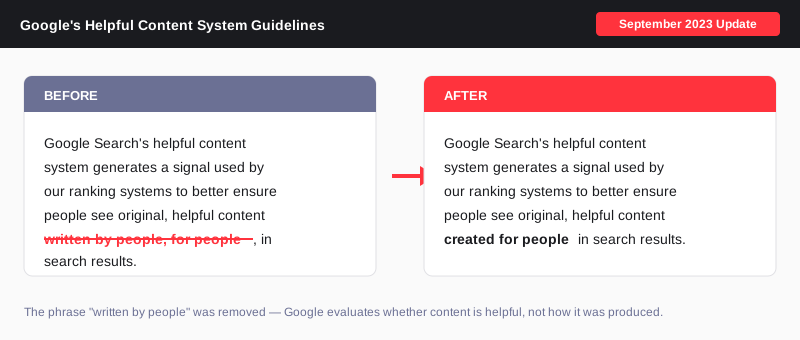
The message is clear: for content to rank well, it must be informative, answer users' queries satisfactorily, and showcase genuine expertise - regardless of how it's created.
AI Content Detectors like GPTZero, ZeroGPT, and many others are not reliable. Even OpenAI has said as much. They consistently produce false positives about human-written content. Conversely, they can be easily fooled with creative prompting or a bit of human editing.
An interesting note from OpenAI: "we found that it labeled human-written text like Shakespeare and the Declaration of Independence as AI-generated."
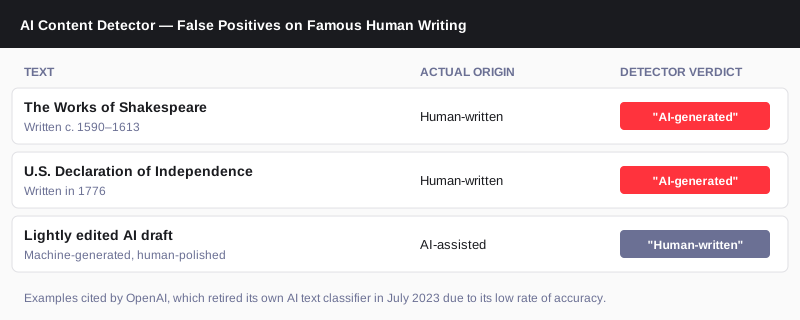
Anecdotal evidence and real-life ranking data suggest that while AI-generated content isn't penalized by search engines, it might only achieve high rankings if it meets the above criteria. The role of AI in content creation is still a developing narrative, and its significance is indispensable for maintaining a competitive edge in the future.
At EmberTribe, the understanding is clear - AI serves as a foundation, not the final product. With ClusterMagic, while AI aids in the initial draft based on expert-driven keyword research, human experts step in for the crucial phases of editing, fact-checking, and final review. This hybrid approach ensures the content is accurate and helpful, has the potential to rank, and truly represents their business.
Most brands have Google Analytics installed. Far fewer are using it to actually understand SEO performance. The gap between having data and acting on data is where organic growth stalls, and closing that gap starts with building the right SEO web analytics foundation.
This guide covers the tool stack, the metrics that matter, and the tracking mistakes that quietly cost brands rankings.
General web analytics tells you what happened on your site. SEO web analytics tells you why search traffic arrived, which queries drove it, which pages converted it, and where the funnel breaks down.
That distinction matters because organic search operates on a different timeline and logic than paid channels. A ranking improvement you made in February might not show up as meaningful traffic until April. Without dedicated SEO analytics discipline, those slow-moving signals get buried in aggregate dashboards.
The core difference comes down to combining two data sources: behavioral data from your site (GA4) and SERP data from search engines (Google Search Console). Neither is complete alone.
GA4 and Google Search Console are the non-negotiable starting point for any SEO measurement stack. Google has updated its documentation on how to integrate and interpret both tools, including new guidance on using Looker Studio to merge the datasets for more complete analysis.
Linking the two takes about five minutes. In GA4, go to Admin, scroll to the Property column, click Search Console Links, then select your verified GSC property. New integrations take 24 to 48 hours before data begins flowing. Once linked, you can see search queries alongside on-site engagement in a single report.
What each tool provides:
Google Search Console shows you what happens before the click: impressions, click-through rates, average position, and index coverage. It tells you whether Google can see your content and how users respond to it in search results.
GA4 shows you what happens after the click: sessions by landing page, engagement rate, conversions, and revenue attribution. It tells you whether organic visitors are actually converting to the outcomes you care about.
Together, they answer the complete question: which content ranks, who clicks, and what do they do next.
Tracking the wrong metrics creates the illusion of insight without the substance. The following are the metrics that directly connect to ranking performance and organic revenue.

Organic sessions measure non-paid search visits and live in GA4 under Acquisition > Traffic Acquisition. Filter by session source "Organic Search." Month-over-month growth is the target; a flat or declining trend warrants immediate investigation.
Click-through rate (CTR) is your ratio of clicks to impressions in Search Console. Position 1 averages 27.6% CTR according to 2025 SEO benchmark data. If your top-ranked pages are seeing CTR below 15 to 20%, your title tags and meta descriptions are underperforming and should be revised before additional content is produced.
Average position reflects your mean SERP ranking across queries. It should be evaluated at the page level, not just site-wide. A page sitting at position 8 to 12 is in a high-leverage zone where incremental content improvements and link building can push it to page one, often with far better ROI than targeting new keywords from scratch.
Engagement rate in GA4 replaced bounce rate as the primary on-page quality signal. It measures sessions where users actively interacted with the page (scrolled, clicked, or spent meaningful time). A healthy engagement rate for organic traffic is above 55%. Pages below that threshold often signal a mismatch between what the searcher expected and what the page delivers.
Core Web Vitals (LCP, INP, CLS) appear in both GSC and Google's PageSpeed Insights. For LCP, Google defines "Good" as under 2.5 seconds. INP should be under 200ms and CLS under 0.1. All three affect your Page Experience signal, which is a confirmed ranking factor.
Organic conversions tie your SEO traffic to revenue or lead outcomes. In GA4, create a segment for organic source traffic and filter your key conversion events. If organic sessions are growing but conversions are flat, the issue is likely landing page quality or conversion path friction.
GA4 and GSC form the foundation, but a complete SEO analytics setup typically adds one competitive intelligence layer and one technical audit layer.
For competitive and keyword intelligence, Semrush and Ahrefs are the two dominant options. Semrush integrates directly with GA4 for traffic data overlays, making it useful for brands that want unified visibility across on-page and off-page signals. Ahrefs has historically been stronger for backlink analysis and its Site Explorer remains the fastest way to understand the link profile of any competitor. Neither tool is a replacement for GSC or GA4; they complement the foundation with data that your own properties can't surface.
For technical audits, Screaming Frog is the standard for crawl analysis. It surfaces redirect chains, broken internal links, missing canonical tags, and pages blocked from indexing. Running a monthly crawl and cross-referencing with GSC's Coverage report catches technical issues before they compound into ranking losses.
Our breakdown of analytics platforms covers how to layer these tools together based on team size and budget.
The default GA4 setup captures organic sessions but misses several configurations that are important for SEO analysis.
First, set up landing page reports. In GA4, navigate to Reports > Engagement > Landing Page. Filter by session medium "organic" to see which specific URLs are receiving organic traffic and how those sessions behave. This view shows you which content is doing actual ranking work versus which pages look good in aggregate but are rarely discovered through search.
Second, configure conversion events for your key organic goals. If you're an ecommerce brand, "purchase" is the obvious event. Growth-stage companies should also track "generate_lead," "sign_up," or whatever micro-conversions indicate genuine intent. Linking these to the landing page report shows you not just which pages rank, but which pages earn revenue.
Third, create a custom comparison report in GA4 that pulls GSC query data alongside on-site behavior. The GSC dimensions (query, landing page, device) can be added to Looker Studio alongside GA4 metrics to build a single dashboard that eliminates the need to switch between tools for routine SEO reviews.
The most common tracking failure is treating GSC and GA4 data as interchangeable. GSC counts clicks from the SERP; GA4 records sessions using its attribution model. Discrepancies between the two are expected and do not indicate a tracking bug. Trying to reconcile the exact numbers wastes time better spent acting on trends.
The second common mistake is tracking rankings without tracking landing page engagement. A keyword at position 3 that delivers a 25% engagement rate and 0.3% conversion rate is underperforming relative to a keyword at position 7 with 68% engagement and 2.1% conversion. Rankings are a means to an end, not the end.
Third, brands regularly underuse the Coverage and Indexing reports in Search Console. Pages that aren't indexed can't rank. Checking the Coverage report monthly and investigating any "Excluded" or "Error" statuses is basic hygiene that many teams skip entirely.
For brands building on Shopify, WordPress, or other platforms, our guide on web analytics for SaaS and DTC brands covers platform-specific tracking configurations.
SEO analytics should close a feedback loop that informs every content decision. When you can see which pages are ranking, which queries trigger them, how users engage, and whether that engagement converts, you have a defensible answer to the question: what should we publish next?
The pages that rank well but have weak engagement are candidates for content refreshes. The pages that have strong engagement but sit at positions 8 to 15 are candidates for link building and on-page optimization. The queries that generate impressions but no clicks indicate title tag or meta description problems that are often fixed in under an hour.
That feedback loop is what separates brands that steadily compound organic traffic from those that produce content without a strategic basis. The data is already in your tools. The work is building the habit of reading and acting on it consistently.
For a broader look at how analytics tools fit together across marketing channels, see our guide to analytics platforms for growth-stage brands.
The brands that win in organic search are not the ones with the largest content libraries. They are the ones that understand their data well enough to prioritize correctly. SEO web analytics makes that prioritization possible.
If you need help building a measurement stack that connects organic performance to revenue, EmberTribe works with DTC and growth-stage companies to implement and interpret analytics frameworks that actually drive decisions. Visit embertribe.com to start the conversation.

Most marketing teams know Google Analytics 4 exists. Far fewer know how to use it for SEO in any meaningful way. GA4 surfaces organic traffic data, landing page performance, and Search Console signals, but only if you know where to look and how to connect the pieces. This guide covers exactly that: how to set up SEO tracking in Google Analytics, which reports actually matter, and how to turn the data into decisions that move rankings.
Search rankings are a means to an end. What matters is whether organic visitors take action when they land on your site. GA4 bridges that gap by connecting top-of-funnel discovery signals (impressions, clicks, search position) to on-site behavior (engagement, scroll depth, conversions). No other free tool does this in a single interface.
Without GA4, your SEO data lives in isolation: Google Search Console shows you what searchers see before they click, but nothing after. GA4 fills that gap. Together, they give you a complete picture of organic performance.
For DTC brands and growth-stage companies, this matters even more. Every organic visit has a cost (content, technical work, link building), and GA4 helps you calculate whether that investment is driving real business outcomes, not just traffic.
The most important step for tracking SEO in Google Analytics is linking Google Search Console to your GA4 property. Without this connection, GA4 shows organic traffic volumes but not the keyword and query data behind them.
How to link GSC to GA4:
Once linked, two new reports appear under Reports > Search Console: Google Organic Search Queries and Google Organic Search Traffic. These reports combine GSC metrics (impressions, clicks, CTR, position) with GA4 behavioral data. They are the foundation of any serious GA4 SEO tracking setup.
One important note: Search Console data carries a 48-72 hour delay, and data attribution models differ between GA4 and GSC. GA4 uses data-driven attribution by default, while GSC uses last non-direct click.
Expect small discrepancies between the two tools. Plan for a 3-day data lag before drawing conclusions from either report.
Once GSC is linked, your next reference point is the Traffic Acquisition report. This is where GA4 shows all sessions grouped by channel, including Organic Search.
Path: Reports > Acquisition > Traffic Acquisition
Look for the Organic Search row. The default metrics here are sessions, engaged sessions, engagement rate, average engagement time, and key events (what GA4 calls conversions). This view gives you a quick read on whether organic traffic is growing or declining, and how engaged those visitors are compared to other channels.
For a more complete view, add a secondary dimension. With "Session source / medium" as the secondary dimension, you can see which specific search engines are sending traffic, separating Google organic from Bing, DuckDuckGo, and others. For most brands, Google organic will dominate, but the breakdown is useful for auditing tracking accuracy.
What to look for:
This pairs well with the broader data principles covered in our guide to web analytics: what the data actually tells you.
The two Search Console reports unlocked by the GSC integration are where SEO-specific insights live.
Path: Reports > Search Console > Google Organic Search Queries
This report shows the search terms driving impressions and clicks to your site, alongside average position and CTR. It mirrors the Performance report in GSC but adds engagement context.
Sort by impressions to find queries where you rank but rarely get clicked. A query with 5,000 impressions and a 1% CTR has room to grow through title tag and meta description optimization. Sort by average position to find terms where you rank on page two, where small improvements in content quality or link authority could push you to page one.
Path: Reports > Search Console > Google Organic Search Traffic
This report shows organic performance by landing page. You can see which specific pages on your site receive organic clicks, their average search position, and how engaged those visitors are after landing.
Sort by clicks to confirm your highest-traffic organic pages. Then look at the engagement metrics alongside. A page receiving 3,000 organic clicks per month with a 35% engagement rate is a candidate for content improvement. The content is ranking, but something about the experience or content depth is failing visitors once they arrive.
The standard Engagement > Landing Page report in GA4 shows all channels together. To isolate SEO performance by landing page, you need to build a filtered report in Explorations.
How to create the report:
The result is a report showing every page that received at least one organic session, with engagement metrics alongside. This becomes one of your most actionable SEO reports: pages with high sessions but low engagement rate need content work; pages with high engagement rate but low sessions need link building or broader keyword targeting.
Set the date range to at least 90 days. Short windows create noise that obscures trends. Compare to the previous equivalent period to spot which pages are gaining organic traction and which are declining. This kind of analysis is covered in depth in our analytics for SEO practitioner guide.
Organic traffic that doesn't convert is just vanity traffic. GA4 makes it possible to measure whether SEO efforts drive real business outcomes, not just clicks.
Set up key events for SEO outcomes:
Once key events are configured, go back to the Traffic Acquisition report and look at the Key Events column for the Organic Search row. This tells you the total conversion volume attributable to organic traffic. You can also use Explorations to build a report that shows which specific organic landing pages are driving conversions, not just traffic.
Google's official Search Console integration documentation covers the technical setup in detail if you need to validate your configuration.
With the reports above in place, a regular SEO audit workflow in GA4 looks like this:
Weekly:
Monthly:
Quarterly:
For a broader view of how analytics choices affect performance measurement, our guide to analytics platforms walks through how GA4 fits alongside other tools in a modern marketing stack.
GA4 is powerful, but there are meaningful gaps. It does not show keyword rankings over time (you need Google Search Console or a dedicated rank tracker for that). It does not show backlink data.
GA4 also cannot attribute traffic changes to specific content updates or technical changes you made. For that level of attribution, you need timestamps and a changelog tracked separately.
For those signals, you need a complementary stack. GA4 handles behavioral and conversion data well. GSC handles query and impression data. Rank trackers like Ahrefs or Semrush handle position tracking and competitive analysis.
GA4 is not a replacement for these tools. It is the layer that connects organic traffic to business outcomes.
The brands that get the most from SEO analytics treat GA4 as the measurement layer and GSC as the discovery layer. Together, they answer the two questions that matter: what are people searching for, and what happens when they find you? Our full overview of SEO web analytics tracking goes deeper on how to align these two data sources into a single reporting workflow.
Tracking SEO in Google Analytics 4 requires a deliberate setup: GSC linked, organic filters applied, key events configured, and a regular review cadence in place. Most teams skip at least one of these steps and end up with data they cannot act on.
The payoff for getting it right is significant. You stop optimizing for rankings as an abstract metric and start optimizing for organic revenue, lead volume, and content quality. That shift in measurement is often what separates brands that plateau at organic traffic from those that compound it month over month.
If you want help building a GA4 setup that connects your SEO investment to measurable business outcomes, EmberTribe works with DTC and growth-stage brands to do exactly that.

Most SaaS companies track too many numbers and act on too few. The teams growing fastest have made a deliberate choice: fewer metrics, tracked religiously, tied directly to decisions. This guide covers the SaaS marketing metrics and KPIs that separate high-growth companies from everyone else, along with 2026 benchmarks and practical ways to improve each one.
SaaS revenue compounds over time, which means the metrics that matter most are not the same ones that work for transactional businesses. A single customer acquired today can generate revenue for years. A single point of churn today erodes that compounding effect across your entire base. That asymmetry is why the right SaaS KPIs measure not just whether you acquired a customer, but whether you kept them, expanded them, and converted them into advocates.
The most effective SaaS marketing teams organize their metrics across five stages: awareness, acquisition, activation, retention, and revenue. Each stage has leading indicators that predict what happens downstream.

CAC is the total sales and marketing spend divided by the number of new customers acquired in a given period. It is one of the foundational saas marketing metrics because it anchors every efficiency calculation that follows.
The 2026 benchmarks vary significantly by go-to-market motion. Product-led growth companies in self-serve channels typically see CAC in the $50 to $200 range at growth stage, while sales-led enterprise SaaS routinely reaches $1,000 to $5,000 or more. What matters most is your CAC payback period: industry data from Baremetrics shows elite teams target payback under 12 months, with best-in-class companies recovering CAC in under 80 days.
To reduce CAC, focus on improving conversion rates at the bottom of the funnel before scaling spend at the top. A 20% improvement in trial-to-paid conversion has a larger CAC impact than a 20% increase in paid media budget.
Pipeline velocity tells you how much revenue your pipeline generates per day, using the formula: opportunities multiplied by win rate multiplied by average deal size, divided by sales cycle length in days. Research from A88Lab shows that B2B SaaS teams tracking this metric weekly report revenue growth of around 34%, compared to 11% for teams that track it irregularly.
Improving pipeline velocity does not require you to change all four inputs at once. Shortening your average sales cycle by 10% has the same mathematical effect as increasing your win rate by 10%. The most immediate lever is usually improving how quickly leads are followed up and how clearly qualification criteria are defined.
Conversion rate applies at every stage of your funnel: visitor to trial, trial to paid, free to premium. Aggregate conversion rate across the full funnel is one of the key saas marketing kpis for understanding where growth is actually breaking down.
Healthy SaaS trial-to-paid conversion rates sit between 15% and 25% for freemium products and 40% to 60% for time-limited free trials. If your rate falls below those ranges, the fix is almost never more traffic. It is a product, onboarding, or messaging problem.
Activation rate measures the percentage of new users who reach a predefined success milestone inside your product, usually within the first seven to thirty days. It is the most undertracked of all saas growth metrics despite being one of the strongest predictors of long-term retention.
Data from Visdum's 2026 SaaS benchmarks shows that feature adoption below 30% correlates with an 80% first-year churn rate. The implication is clear: if users do not experience value quickly, they leave, and no amount of marketing spend reverses that.
To improve activation, identify the specific action or outcome that most strongly correlates with long-term retention in your product. Build your onboarding sequence entirely around getting new users to that milestone as fast as possible.
Time to value is how long it takes a new user to experience the core benefit of your product for the first time. Shorter TTV consistently correlates with higher activation rates, lower early-stage churn, and larger expansion revenue over time.
The most effective way to reduce TTV is to remove friction from the initial setup experience, not to add more features. Guided onboarding checklists, in-app tooltips, and pre-built templates all reduce the cognitive load that causes users to abandon before they see results.
Churn rate is the percentage of customers or revenue lost in a given period. It is both a retention metric and a growth ceiling: even 2% monthly churn means you lose roughly 22% of your revenue base every year, which requires constant replacement just to stay flat.
The 2026 benchmark for healthy SaaS companies is annual churn below 3.5%, roughly 0.3% per month. Enterprise SaaS products with longer contracts and higher switching costs can sustain annual churn below 1%. If your churn rate sits above these levels, the problem is rarely in marketing: it almost always points to product-market fit gaps, onboarding failures, or customer success capacity constraints.
For deeper context on how to connect churn data to your analytics stack, see our guide on marketing analytics software.
NRR measures the percentage of recurring revenue retained from existing customers after accounting for churn, downgrades, and expansion. An NRR above 100% means your existing customer base is growing even before you acquire a single new customer, which is the defining characteristic of the fastest-growing SaaS businesses.
The 2026 benchmark is NRR above 100% for growth-stage companies, with best-in-class teams hitting 130% or higher. Stripe's SaaS metrics research shows those companies grow 1.5 to 3 times faster than peers with NRR below 100%. The primary driver of strong NRR is a deliberate expansion motion: proactive upsell and cross-sell triggered by product usage signals rather than periodic check-in calls.
NPS measures customer satisfaction by asking how likely customers are to recommend your product. Scores below 20 correlate with double the normal churn rate. NPS is a lagging indicator of retention health and a leading indicator of word-of-mouth growth.
The tactical value of NPS is not the aggregate score. It is the qualitative feedback from detractors and passives that reveals which specific problems are driving dissatisfaction before that dissatisfaction converts to cancellations.
MRR and ARR are the foundational revenue metrics for any subscription business. MRR is calculated as the total number of paying customers multiplied by average revenue per account. ARR is simply MRR multiplied by 12.
Tracking MRR movement by category, such as new MRR, expansion MRR, churned MRR, and reactivation MRR, gives you a precise picture of where growth is coming from and where it is leaking. Most SaaS teams that struggle with MRR growth are actually winning on new MRR but losing on churned and contraction MRR at a rate that offsets the gains.
Customer lifetime value divided by customer acquisition cost is one of the most important ratios in SaaS. The formula for LTV is average revenue per user multiplied by gross margin, divided by monthly churn rate. The healthy benchmark range is 3:1 to 5:1, where below 3:1 signals inefficient acquisition or excessive churn, and above 5:1 often indicates underinvestment in growth.
Understanding LTV:CAC at a segment level, broken down by channel, plan tier, or industry vertical, is where this metric becomes genuinely actionable. If your enterprise segment has a 6:1 ratio and your SMB segment has a 1.5:1 ratio, that is a strategic signal, not just a financial one. For teams building out their measurement infrastructure, our overview of analytics platforms covers the tools that make this kind of segmentation practical.
The Rule of 40 combines growth rate and profitability into a single efficiency score. Add your year-over-year ARR growth percentage to your EBITDA margin percentage. A combined score of 40 or higher signals a healthy, efficient business. A score below 40 raises questions about whether growth is being purchased at an unsustainable cost.
With median SaaS growth rates settling around 26% in recent years, efficiency metrics like the Rule of 40 have become as important to investors and acquirers as raw revenue growth. A company growing at 26% with a 20% EBITDA margin scores 46 and is in a strong position.
Tracking the right saas kpis matters less than building a system where those metrics drive decisions. The companies that use metrics most effectively set a small number of north-star metrics at the company level, cascade those into team-level leading indicators, and review them on a weekly cadence.
The practical failure mode is having too many dashboards that nobody acts on. Start with eight to ten metrics that span acquisition, activation, retention, and revenue. Assign clear ownership for each metric and connect every metric to at least one specific lever the team can pull. If you need help structuring the underlying analytics infrastructure to support this, our guide on the analytics dashboard framework covers how to build the reporting layer that makes these metrics visible and actionable across your organization.
The SaaS companies compounding fastest right now are not tracking more metrics than their competitors. They are acting on fewer, faster, with greater precision.
Google Analytics cost is one of the most Googled questions in the analytics space, and the answer is rarely satisfying: "it depends." GA4, the current standard, is free for most users. But that free label can obscure real costs that show up in implementation, data infrastructure, and enterprise contracts. This post breaks down every layer so you can budget accurately.
The short answer: Google Analytics 4 is free to use. You create an account, add a tracking snippet or deploy via Google Tag Manager, and you're collecting data within minutes. No credit card, no trial period, no per-seat fee.
The free tier is genuinely capable. It supports event-based tracking across web and app, up to 25 custom dimensions, audience building for Google Ads, and data retention up to 14 months. For most small and mid-size brands, this covers the full analytics workflow.
Where the free tier runs out: data sampling. At high traffic volumes, GA4 starts returning sampled results in Explorations reports rather than processing every row. You also get limited export controls and no formal SLA from Google.
GA4 360 is Google's enterprise analytics tier, sold through Google's direct sales team or certified reseller partners. Google does not publish a self-serve price, so you need a quote. Based on current market data, pricing starts around $50,000 per year for lower-volume enterprise accounts and scales toward $150,000 or more annually at roughly 500 million monthly hits.
Key GA4 360 features beyond the free tier:
One pricing detail that catches enterprise buyers off guard: subproperties and roll-up properties carry their own billing. Events in each subproperty are charged at half the rate of the source property. For complex account structures, this can push total cost well above the base contract figure.
GA4 is free to license, but deploying it correctly at a growth-stage DTC brand is not free. These are the real costs you should plan for.
Implementation and setup. The shift from Universal Analytics to GA4's event-based model fundamentally changed how tracking is configured. Proper implementation requires defining an event taxonomy, setting up Google Tag Manager correctly, configuring conversions, and testing data integrity across devices. A developer or analytics consultant typically charges $2,000 to $10,000 for a complete implementation, depending on complexity.
BigQuery export fees. GA4's free tier includes a daily batch export to BigQuery (not streaming). According to Google's BigQuery pricing, the first 10 GB of storage per month is free. Beyond that, active logical storage costs $0.02 per GB per month. Query processing costs $5 per TB scanned, with the first 1 TB of queries per month free.
For brands with millions of monthly events, monthly BigQuery costs typically run $20 to $200. Poorly structured queries (running against full historical tables rather than partitioned date ranges) can push costs significantly higher, so proper query hygiene matters from day one.
Ongoing maintenance. Analytics configurations drift. Tracking breaks when developers update site code. New campaigns need new conversion events. A retainer for ongoing analytics management typically runs $500 to $3,000 per month depending on scope.
BI tool integrations. GA4 connects natively to Looker Studio for free, but connecting to Tableau, Power BI, or custom dashboards usually requires a third-party connector or engineering time.
| Tier | Annual Cost | Sampling | BigQuery Export | Support |
|---|---|---|---|---|
| GA4 Free | $0 | Yes (at scale) | Batch (daily, free) | Community only |
| GA4 360 | $50,000–$150,000+ | None | Streaming (real-time) | Dedicated SLA |
| Plausible (alternative) | ~$108–$2,400 | None | No | Email support |
| Mixpanel (alternative) | $0–$65,000+ | None | Limited | Varies by tier |
| Amplitude (alternative) | $0–$100,000+ | None | Yes (Growth+) | Varies by tier |
Pricing figures reflect 2026 market data. GA4 360 pricing is contract-based and varies by event volume and account structure.

If you are evaluating whether GA4 is the right tool or whether a paid alternative delivers better value, here is how the main options compare.
Plausible Analytics is a privacy-focused, open-source alternative. Plausible's pricing starts at $9 per month (billed annually) for up to 10,000 monthly pageviews, scaling to $19/month for 100,000 pageviews. It does not require cookie consent banners under GDPR, which reduces friction in European markets. The tradeoff: far less depth than GA4 for event-level analysis.
Mixpanel uses event-based pricing with a free tier up to 20 million monthly events. Paid plans start at $20 per month for self-serve. At 5 million events per month, you're looking at roughly $650 per month. Mixpanel shines for product analytics and funnel analysis, particularly for SaaS and mobile products.
Amplitude offers a free Starter tier up to 50,000 monthly tracked users (MTUs). The Plus plan starts at $49 per month. Mid-market Growth contracts typically run $30,000 to $100,000 per year depending on user volume. Amplitude provides deep behavioral cohort analysis and is favored by product teams at growth-stage companies.
For DTC brands focused on ecommerce attribution rather than product analytics, GA4's free tier combined with a solid analytics tracking setup typically outperforms these alternatives on a cost-per-insight basis.
The decision tree is simpler than the pricing landscape suggests.
If you are generating fewer than 500 million monthly events and your reporting needs are met by standard GA4 Explorations, the free tier is the right call. Invest the money you save into implementation quality and BigQuery hygiene instead.
If you are running a large ecommerce operation with high-volume traffic, need real-time streaming data into a warehouse, or require unsampled reports for executive dashboards, GA4 360 is worth the contract conversation. The jump to $50,000+ per year is significant, but the alternative (building workarounds for sampled data) costs engineering time and erodes confidence in your numbers.
If GA4's data model does not fit your use case (particularly for product-led growth or SaaS), a dedicated product analytics platform like Mixpanel or Amplitude may deliver more value despite the higher per-seat cost. See our marketing analytics software comparison for a deeper look at how these platforms stack up.
When you add up all the components for a mid-size DTC brand running GA4 free, a realistic annual budget looks like this:
Total real cost of "free" GA4: roughly $9,000 to $50,000 per year, depending on internal capability and scope. That is not a knock on GA4. It is a realistic framing for CFOs and marketing directors who assume free means zero budget impact.
If you are comparing this against marketing analytics services or a managed analytics stack, use those full-cost figures rather than just the software license.
GA4's zero license cost is genuinely attractive, but the value it delivers depends entirely on how well it is configured. Mis-fired events, duplicate sessions, and broken conversion tracking erode trust in data faster than any pricing decision.
EmberTribe works with DTC and growth-stage brands to design and implement analytics stacks that capture clean data and surface actionable insights, without the overhead of an in-house data team. Talk to our team at embertribe.com to scope what a properly built analytics infrastructure looks like for your brand.

Most DTC brands already collect data. The problem is that the data lives in five different places, tells five different stories, and rarely points to a clear action. Customer analytics software is supposed to solve that, but choosing the wrong platform creates more noise, not less.
This guide breaks down what customer analytics software actually does, which platforms are worth evaluating, and how to match a tool to where your brand is right now.
Customer analytics software collects, processes, and surfaces behavioral data about the people who interact with your brand. At the core, it answers three questions: who your customers are, how they behave, and what drives them to buy (or stop buying).
The best platforms track behavior across the full customer journey: from the first ad click to product page engagement, cart behavior, checkout completion, post-purchase patterns, and eventual churn signals. This is different from standard web analytics, which stops at sessions and pageviews. Customer data analytics tools go deeper, connecting individual user identities to sequences of actions over time.
Key data types that flow through a modern customer analytics stack include event data (every click, scroll, and interaction), transaction data (order history, AOV, refunds), product data (which SKUs drive LTV), and user profile data from your CRM or CDP. The richness of that data determines how actionable your reporting actually becomes.
Before evaluating platforms, get clear on the metrics that matter most for growth-stage ecommerce brands.
LTV is the total revenue a single customer generates over the full duration of their relationship with your brand. It's the north-star metric for DTC because it determines how much you can afford to spend acquiring a customer in the first place. LTV by cohort, acquisition channel, and first-product purchased gives you the granular view needed to make smarter paid media decisions.
Customer acquisition cost (CAC) in isolation tells you nothing useful. Measured against LTV, it becomes the most important unit-economics number in your business. A ratio above 3:1 is healthy; below 1:1 means you're systematically losing money on each customer acquired. Most brands scaling on paid social are operating at ratios far lower than they realize.
Cohort analysis groups customers by when they first purchased and tracks how they behave over subsequent months. Ecommerce analytics research consistently shows that retention curves reveal the true health of a brand: if month-2 repurchase rates are weak across every acquisition cohort, no amount of new customer acquisition will fix the underlying problem.
Cart abandonment exceeds 70% across ecommerce broadly in 2026. The metric itself is table stakes; the useful version is abandonment segmented by traffic source, device, product category, and customer segment. That segmentation is where customer behavior analytics separates from basic funnel tracking.
Proactive churn analysis looks at behavioral signals before a customer formally "churns": increasing time between orders, declining email engagement, browsing without purchasing. Platforms with predictive capabilities can score customers by churn probability, letting retention teams intervene early rather than after the fact.
Choosing the right platform depends on your team's technical capacity, your primary use case, and your current scale. Here's how the main options stack up.

Amplitude has established itself as the enterprise-grade leader for behavioral analytics and product-led growth. Its core strength is behavioral cohorts that persist across analytics, experimentation, and user surveys. Predictive cohorts score users by likelihood to activate, retain, or churn, and native A/B testing is built directly into the platform.
Amplitude ranked first across multiple categories in G2's Winter 2026 report. It's best suited for growth teams running frequent experiments who need deep retention analytics backed by enterprise governance and support. Pricing is event-based and scales with volume; expect significant investment at the mid-market level.
Mixpanel prioritizes real-time granular event analysis and an intuitive interface that non-technical users can navigate without engineering support. Its AI query assistant lets marketing and growth teams pull custom reports without writing SQL. The free tier covers 20 million events per month, the most generous in its category.
Mixpanel is a strong choice for scaling brands that need detailed user journey mapping and fast feedback loops on product or funnel changes. At higher volumes, pricing moves to $650-1,200+/month. It integrates well with Segment as a data routing layer, which matters if you're building a composable analytics stack. Learning how to pair the right analytics platforms is often more valuable than chasing the most feature-rich single tool.
Heap takes a fundamentally different approach: instead of requiring manual event instrumentation, it captures every click, form submission, and page interaction automatically from day one. No tracking code decisions upfront. This is a significant advantage for brands without dedicated engineering resources.
The retroactive analysis capability is Heap's real differentiator: you can define events after the fact and run analysis on historical behavior that predates your instrumentation. Minimum pricing starts around $2,000/month, which means it makes more sense for brands with established revenue and a data team that can act on what it surfaces.
For Shopify-first DTC brands, Triple Whale has become the dominant analytics layer. Its AI suite (Moby) answers data questions in plain language, runs attribution analysis, and generates forecasts without requiring a BI setup. The platform focuses on profit-oriented reporting: contribution margin, blended CAC, and channel-level ROAS, the metrics DTC operators actually use to make daily decisions.
Triple Whale is less useful as a general customer behavior analytics tool and more useful as an operational dashboard for performance marketing teams. If you're running Shopify and spending meaningfully on paid social, it's likely the fastest path to actionable daily reporting.
Segment is not a visualization tool; it's a customer data platform that routes event data from your website, app, and backend to every downstream tool in your stack. Think of it as the plumbing that connects your customer analytics software together. Using Segment upstream of Mixpanel or Amplitude means you instrument once and can swap analytics tools without re-engineering your tracking layer.
For brands building a serious analytics stack, Segment or a similar CDP is worth the investment early. It also enables real-time personalization and audience building across your ad platforms and email tools.
The mistake most brands make is choosing a platform based on feature lists rather than their actual operational context. A few frameworks that cut through the noise:
Early-stage (under $5M revenue): Mixpanel's free tier plus Google Analytics 4 covers most reporting needs. Focus on getting clean event tracking in place rather than adding platform complexity. The highest-value analytics work at this stage is fixing attribution gaps and tracking the right conversion events.
Growth-stage ($5M-$50M revenue): This is where investing in a real customer behavior analytics layer pays off. Triple Whale is a natural fit for Shopify brands. Mixpanel or Amplitude makes sense if you're building a product-led motion or need cohort-level retention analysis. Adding Segment as a CDP backbone is worth evaluating if you're running more than three analytics tools simultaneously.
Scale ($50M+): Amplitude or a full data warehouse setup (Snowflake plus Looker or Metabase) becomes the right investment. Enterprise analytics platforms earn their cost at this stage through governance, experimentation infrastructure, and the ability to build custom models on top of first-party data.
Understanding how marketing analytics software fits into a broader data strategy is the prerequisite to making the platform decision confidently. The tool is only as good as the data flowing into it and the team acting on it.
Platform comparisons focus on features, but the factors that determine long-term value are less visible on a feature matrix.
Data ownership: Where does your customer data live, and can you export it? Lock-in risk is real. Platforms that store your event data in a proprietary warehouse make it expensive to switch.
Engineering overhead: Platforms that require heavy instrumentation to get value will compound your technical debt over time. Auto-capture tools (Heap, PostHog) reduce ongoing maintenance. Event-based platforms (Mixpanel, Amplitude) offer more precision but demand more upfront investment.
Privacy and compliance: With third-party cookie deprecation and evolving privacy regulations, your customer insights software needs to be built around first-party data from the ground up. Evaluate how each platform handles consent management, data residency, and compliance with GDPR and CCPA requirements.
Integration depth: Your analytics platform needs to connect to your ad platforms, ESP, CRM, and Shopify store without requiring custom engineering for each connection. Check the native integration library before committing.
The right web analytics tool strategy starts with understanding your current data gaps, not your aspirational reporting needs. Pick the platform that solves today's most expensive blind spot, instrument it properly, and build from there.
Customer analytics software is infrastructure, not a shortcut. The brands that get the most value from these platforms share a common trait: they have a consistent practice of reviewing data, forming hypotheses, running experiments, and closing the loop.
The platform matters. The process matters more. Start with the metrics closest to revenue (LTV, LTV:CAC, cohort retention), build dashboards your team actually reviews weekly, and treat every reporting gap as a prioritized project. That discipline compounds faster than any platform upgrade.

Most SEO programs collect data. Few actually use it. The gap between teams that rank and teams that stall often comes down to one thing: whether analytics is guiding decisions or just filling dashboards.
Connecting the right data sources, tracking the metrics that signal real search performance, and building a repeatable workflow to act on what you find is what separates SEO programs that grow from ones that plateau. This guide covers exactly that.
Search engine optimization without analytics is guesswork. You might publish consistently, build links, and optimize pages, but without measurement you cannot tell which efforts are compounding and which are wasting budget.
The strongest SEO programs treat analytics as a feedback loop. Content goes live, data comes back, priorities shift based on what the numbers show. That cycle, done weekly, is what drives compounding organic growth. For a deeper look at how analytics fits into a broader web measurement strategy, the guide on SEO web analytics covers the foundational layer in detail.
Most SEO analytics workflows run on two free platforms: Google Analytics 4 and Google Search Console. Each tells a different part of the story, and they are most powerful when used together.
GA4 is an event-based analytics platform. Every interaction on your site, whether a scroll, a form fill, or a page view, is captured as an event. For SEO purposes, the most important GA4 reports are:
GA4's shift to event-based measurement also means conversions are now called "key events." You can mark specific actions, such as form submissions, purchases, or demo requests, as key events, then filter organic traffic data against those conversions to understand which organic pages actually drive business outcomes.
Search Console shows what happens in the SERP before users reach your site. The Performance report is the core tool, surfacing four metrics for every query and page combination:
The Google Search Central documentation notes that combining Search Console with GA4 gives you a more complete view of how audiences discover and experience your site. That integration is worth setting up immediately.
The integration is straightforward. Inside GA4, go to Admin, then Property Settings, then Search Console Links. You will need to be a verified owner of the property in Search Console and have Editor access in GA4.
Once linked, a Search Console collection appears in your GA4 reports under Reports Library. You get two reports: Queries (showing keyword data alongside GA4 engagement metrics) and Google Organic Search Traffic (landing page performance with Search Console signals layered in). New integrations can take 24 to 48 hours to populate data.
This linked view is where the most actionable insights come from. You can see not just which queries drive traffic, but whether that traffic engages and converts once it arrives.
Not every metric in GA4 or Search Console deserves weekly attention. The ones below have a direct line to rankings, traffic quality, and revenue.
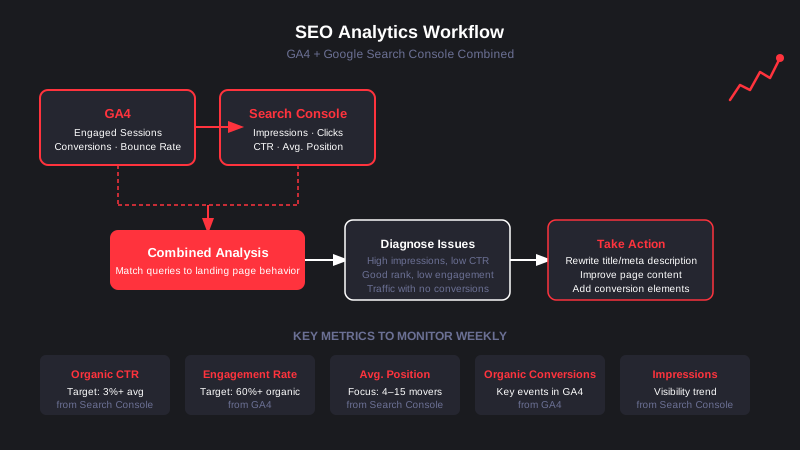
Click-through rate measures how often searchers choose your result after seeing it. A keyword with high impressions and low CTR is ranking but failing to earn the click, usually because the title tag or meta description is not compelling enough. The benchmark to watch: a CTR under 3 percent for positions 1 through 5 usually signals a weak title or mismatched intent.
If users arrive from organic search and immediately leave, that signals a mismatch between what the SERP promised and what the page delivered. A healthy engagement rate for organic traffic sits at 60 percent or higher. Pages below that threshold need a content or UX audit.
Pages ranking in positions 4 through 15 are the highest-leverage targets in any SEO program. They have already established relevance with Google but are not yet earning the click volume they could. A focused optimization effort on these pages, updating content, improving internal linking, and strengthening the page's topical depth, often produces meaningful traffic lifts within 60 to 90 days.
Raw traffic numbers are vanity metrics if they do not tie back to business outcomes. In GA4, segment key event completions by "Organic Search" to see which landing pages produce qualified leads, purchases, or sign-ups from search. According to AgencyAnalytics' 2026 SEO KPI guide, practitioners consistently rank conversions and revenue as the most valuable SEO metrics, while raw rankings are treated as secondary signals.
Impressions measure your overall search visibility. A growing impressions trend, even before clicks increase, often indicates that content is gaining traction and freshness in Google's index. A sudden impressions drop is an early warning signal worth investigating in the Coverage and Index reports inside Search Console.
The research process and publish cadence matter less than the review loop. A consistent weekly workflow turns data into action.
Step 1: Open Search Console Performance and filter the last 28 days. Sort by impressions. Identify pages with high impressions but CTR below 3 percent. These are rewrite candidates.
Step 2: Pull the same pages in GA4 under Reports, then Engagement, then Pages and Screens. Filter by organic traffic. Review engagement rate and key event conversion data for each page.
Step 3: Cross-reference. A page with strong impressions, decent position, but low engagement rate likely has an intent mismatch. A page with strong CTR but no conversions likely has a conversion barrier (weak CTA, poor UX, or misaligned offer).
Step 4: Prioritize fixes based on traffic potential and business value. A mid-funnel page driving 2,000 organic sessions per month with a 0.2 percent conversion rate has far more leverage than a top-of-funnel page with 300 sessions and 5 percent engagement.
This workflow scales. Once it is in muscle memory, running it takes 30 minutes a week and consistently surfaces the highest-ROI SEO work on your site.
GA4 and Search Console handle the core workflow. For teams that need more, a handful of tools layer in additional capability.
Looker Studio (free): Combines GA4 and Search Console data into visual dashboards that update automatically. Useful for presenting SEO performance to stakeholders without exporting spreadsheets.
Ahrefs / Semrush: Third-party rank trackers and backlink tools that supplement Search Console's keyword data with competitive benchmarks, keyword difficulty scores, and backlink monitoring. Neither replaces Search Console, but both add context that GSC cannot provide.
Screaming Frog: A technical SEO crawler that identifies indexing issues, broken links, duplicate content, and missing metadata at scale. Complements analytics data by showing what Search Console might flag in Coverage reports.
For a structured comparison of analytics platforms including GA4 alternatives, the analytics platforms guide breaks down the full stack with pricing and use cases.
Data has no value until it changes what you do. The teams that get the most from analytics for SEO are not the ones with the most sophisticated dashboards. They are the ones with the clearest decision rules.
If CTR drops below 3 percent on a page ranking in the top 5, rewrite the title tag. If engagement rate on an organic landing page falls below 50 percent, audit the content for intent match. If impressions grow but clicks plateau, check whether a Featured Snippet or AI Overview is intercepting the click. These rules, applied consistently, make analytics a decision engine rather than a reporting exercise.
Building that discipline takes time, but the compound effect is significant. Backlinko's 2026 SEO metrics hub notes that teams tracking organic conversion rate alongside traffic consistently outperform teams optimizing for rankings alone, because they optimize toward outcomes rather than vanity signals.
If you are building or auditing your analytics foundation, the web analytics tool comparison covers which platforms work best at different stages of growth, including when GA4 alone is sufficient and when to add a more specialized layer.
A mature SEO analytics practice has three characteristics: it measures both visibility (impressions, position) and quality (engagement, conversions), it connects those metrics to decisions on a regular cadence, and it is simple enough to run without a data analyst.
GA4 and Search Console, linked and reviewed weekly, give most teams everything they need to build that practice. The goal is not more data. It is clearer signals and faster action on what the data reveals.

Picking the right sem marketing agency is one of the highest-leverage decisions a growth-stage brand can make. Get it right and paid search becomes a scalable, predictable acquisition channel. Get it wrong and you burn budget on clicks that never convert while the agency sends you a PDF with a rising impressions chart. This guide breaks down exactly what to look for, what to avoid, and how to structure the conversation before you sign anything.
Search engine marketing agencies manage paid search campaigns across platforms such as Google Ads and Microsoft Advertising. The core work includes keyword research, bid strategy, ad copy creation, landing page recommendations, audience targeting, and ongoing optimization. Most agencies also handle conversion tracking setup, which is the foundation everything else depends on.
The scope varies considerably by agency size and specialty. A boutique paid search agency might embed directly in your growth team and act as a strategic partner. A larger, full-service shop might assign you to an account manager who runs dozens of accounts simultaneously. What matters most is the ratio of strategic attention to the retainer you are paying.
In-house teams have one advantage over agencies: institutional knowledge. They understand your product margins, your seasonal patterns, and your customer segments. A strong SEM agency closes that gap through a rigorous onboarding process, clear documentation, and regular communication. If an agency skips discovery and launches campaigns in week one, that is your first warning sign.
The paid search market has grown considerably. According to AgencyHandy's 2026 SEM statistics report, the global SEM services market is projected to expand from roughly $120 billion in 2024 to over $278 billion by 2034, a compound annual growth rate of approximately 8.8%. AI-powered campaign automation, smarter audience segmentation, and intensifying competition for high-intent keywords are all driving that growth.
For brands competing in ecommerce and direct-to-consumer categories, that growth in the market means more advertisers bidding on the same keywords. Cost-per-click rates have increased in most verticals over the past two years. A competent SEM agency helps you maintain profitable returns by tightening targeting, improving quality scores, and building out the long-tail keyword structure that most brands neglect.
Pricing is where a lot of brands get confused or, worse, overcharged. There are four common models. Understanding each one before your first agency conversation puts you in a much stronger negotiating position.
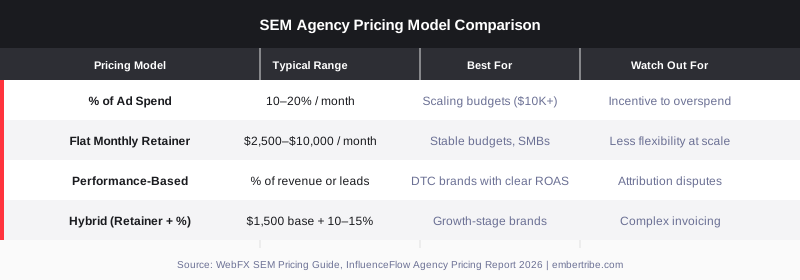
According to WebFX's SEM pricing guide, about 70% of businesses spend between $251 and $10,000 per month on SEM management, not including the actual ad spend. Most agencies charge either a flat retainer, a percentage of ad spend, or some combination of both.
Percentage of ad spend is the most common model for performance agencies. Rates typically fall between 10% and 20% monthly. At lower spend volumes (under $25K per month), you will often see a minimum fee apply because the account still requires the same hours regardless of how much you are spending. One structural downside of this model: an agency paid on percentage has a financial incentive to increase your budget even when the marginal return does not justify it.
Flat monthly retainers offer more predictability for brands with stable budgets. The InfluenceFlow 2026 agency pricing report puts the typical range for a small to mid-sized business SEM engagement at $2,500 to $10,000 per month. Mid-market companies managing $50,000 or more in monthly ad spend often pay $10,000 to $25,000 in management fees.
Performance-based pricing ties fees to results such as a target ROAS, cost per acquisition, or revenue generated. This model aligns incentives better, but attribution becomes a point of contention quickly. Clarify exactly how conversions are counted before agreeing to any performance clause.
Hybrid models combine a lower base retainer with a percentage component. This is increasingly common among growth-focused agencies because it reduces risk for both parties during ramp-up and scales fees alongside results.
Return on ad spend benchmarks vary widely by industry and by the maturity of your campaigns. A brand new to paid search will rarely hit efficient ROAS in month one. Healthy accounts take 60 to 90 days of learning before performance data is statistically meaningful.
According to First Page Sage's ROAS statistics report, ecommerce brands average approximately 2.05x ROAS on paid search. That number represents the mean across a broad range of verticals and campaign types. DTC brands with strong creative, tight audience targeting, and well-optimized landing pages routinely exceed that benchmark.
A more practical frame: calculate your break-even ROAS before you set any agency targets. If your gross margin is 50%, you need at least a 2x ROAS to break even on the ad spend alone, before accounting for management fees. Factor in the agency fee and you need to perform considerably higher just to stay profitable. Be explicit with any agency about your break-even ROAS, because an agency unwilling to anchor their strategy around your margin reality is not the right partner.
Evaluating a sem agency is not just about reviewing a pitch deck. The best agencies reveal themselves through the quality of their discovery questions, not their case study slides. Here is a practical framework for the evaluation process.
Ask every agency candidate the same set of questions and compare responses directly. The consistency of the process matters as much as any individual answer.
An agency that answers these questions with specificity and without hesitation has processes in place. An agency that pivots to case studies without addressing the mechanics of their process is giving you a sales pitch, not an operational preview.
According to Accelerated Digital Media's SEM agency red flags guide, the most consistent warning signs fall into three categories: communication, strategy, and reporting.
On communication: if you cannot get direct answers on calls and response times are consistently slow before you sign, expect that pattern to continue after you sign. On strategy: agencies that are always in "maintenance mode" without proactively testing new approaches are not earning their retainer. On reporting: if your monthly report is a static PDF showing impressions and click-through rate without connecting to revenue or conversions, your agency is optimizing for optics, not outcomes.
Other concrete red flags to watch for:
Owning your ad account is non-negotiable. If an agency insists on running campaigns through their own account rather than granting access to yours, walk away. You would be renting access to your own campaign history.
For most growth-stage brands spending under $500,000 per year in ad budget, a specialized digital marketing agency will outperform an in-house hire on a cost-adjusted basis. A senior paid search manager carries a total cost of $90,000 to $130,000 per year in salary plus benefits, and they still need tools, training, and management overhead.
An agency at a comparable cost brings a full team: strategist, account manager, conversion rate specialist, and creative support. The leverage is real, particularly in the early stages when your account needs more active optimization than a single in-house hire can provide.
The calculus shifts at scale. Brands spending $2 million or more annually in paid search often benefit from bringing core channel ownership in-house while using an agency for specific functions such as creative testing or international expansion.
Whatever pricing model you choose, get these terms in writing before you start:
Getting these terms defined before the relationship starts protects you from the most common agency disputes. Related reading: our full breakdown of what to look for in PPC companies covers the contract terms that matter most for paid channels.
Start by defining what "right" means for your specific situation. A brand spending $15,000 per month on Google Ads needs a different type of partner than one scaling toward $200,000 per month. Consider:
Once you have that picture, evaluate three to five agencies using the framework above. Ask for references from clients in similar verticals, not just from whoever they feature in the case study section of their website.
EmberTribe works specifically with DTC and ecommerce brands that are ready to scale paid search beyond the basics. Our approach is built around margin-aware ROAS targets, rigorous testing cadences, and transparent reporting that connects directly to revenue. If you are evaluating SEM partners for 2026, we would like to talk. Visit embertribe.com to learn more about how we work and what we focus on.

Paid social media advertising is a $227.95 billion global market in 2026, up from $202.63 billion in 2025, according to eMarketer's global social ad forecast. At that scale, the category includes agencies ranging from single-channel Meta specialists to multi-platform shops running creative production alongside media buying. Choosing a paid social media agency without understanding what separates these models costs most brands 60 to 90 days of wasted spend and a failed relationship before they make a better choice.
This guide covers platform benchmarks, creative evaluation criteria, pricing structures, and the specific signals that separate competent paid social agencies from ones that know how to win pitches.
The paid social landscape has fragmented significantly over the past three years. Meta, TikTok, Pinterest, LinkedIn, and YouTube each operate on distinct auction mechanics, content formats, and audience signals. An agency that runs all five with the same framework is running none of them well.
Meta remains the dominant paid social platform for DTC and ecommerce brands. Meta CPM averaged $16.80 in 2025, up 18.3% year-over-year, per Trendtrack's social advertising benchmarks. The median ROAS across 20,000-plus DTC brands tracked by Triple Whale is 1.93x.
Meta's Andromeda algorithm update has fundamentally changed how the platform distributes ads: where audience signals once drove distribution, creative signals now dominate. An agency that has not updated its Meta strategy post-Andromeda is running a 2022 playbook.
TikTok offers a different economic profile: CPM averaging $8.30 globally, with TikTok-reported ROAS of 2.21x for commerce-focused campaigns. The lower CPM creates more efficient reach, but TikTok demands a specific creative format. User-generated content outperforms brand-produced creative by two to three times on the platform, per Motion's creative benchmarking data. Agencies that run TikTok with polished brand creative consistently underperform agencies that produce native-style UGC content.
Creative is the single most important variable in paid social performance. Google's internal research, widely cited across the industry, attributes 70% of campaign success to creative quality rather than targeting or bidding. Meta's own platform data confirms that creative signals have replaced audience signals as the primary distribution driver.
This means evaluating a paid social media agency primarily on its creative process, not its media buying sophistication. The media buying side has been largely automated: Smart Bidding, Advantage+, and algorithmic audience optimization have compressed the performance differential between buyers. The creative production side has not been automated. The agency that generates more creative variants, tests them systematically, and scales winners faster wins.
Specific creative questions to ask before hiring: How many ad variants do you launch in the first 30 days? What is your creative iteration frequency? Do you produce creative in-house or through a third party? What is your process for identifying creative fatigue and rotating assets? Agencies that cannot answer these questions in specific, measurable terms are not operating a creative testing system.

The benchmark gap between Meta and TikTok CPMs creates a common misconception: that TikTok is automatically more efficient. Efficiency depends on whether your audience is on the platform and whether your creative converts in TikTok's native format. A brand with a 45-plus core demographic and a catalog-based product will underperform TikTok CPM benchmarks because the audience-product fit is wrong, not because the agency is failing.
LinkedIn's CPM of $33.80 to $45.00 looks expensive relative to Meta, but for B2B brands targeting specific job functions, company sizes, or industries, LinkedIn's targeting precision reduces wasted impressions in ways that justify the CPM premium. A paid social agency that runs both DTC and B2B accounts has likely accepted that it will underperform specialists in both categories.
Paid social agencies use two primary pricing models: percentage of ad spend and flat monthly retainer, with hybrid approaches becoming more common at the growth stage.
Percentage of spend (10 to 20% of monthly media budget) is the most common structure for accounts spending between $10,000 and $100,000 per month. The incentive misalignment risk is that the agency benefits financially from increasing your budget regardless of performance. Flat retainers ($3,000 to $10,000 per month for growth-stage brands) align incentives toward quality because the fee does not change with spend. Hybrid models typically include a flat management fee plus a smaller performance percentage tied to specific ROAS or CPA targets.
For brands evaluating whether to hire a specialist or a full-service digital marketing firm, the decision depends on channel complexity. If paid social is the primary acquisition channel and creative iteration speed matters, a specialist outperforms a generalist. If you need paid social to integrate closely with paid search and email attribution, a broader firm with coordinated reporting infrastructure may deliver better outcomes even if per-channel performance is slightly weaker.
The most predictive evaluation of a paid social agency is reviewing its existing creative output, not its pitch deck or case study performance metrics. Ask for examples of creative work produced in the last 60 days for a brand in your category. Evaluate: Is the creative thumb-stopping in the first two seconds? Does it communicate the offer within the first three seconds without requiring sound? Does the creative match the native aesthetic of the platform it was produced for?
Agencies that show you polished brand video as their primary paid social creative have not adapted to the UGC-first creative environment on TikTok and Reels. The best paid social agencies for ecommerce produce creative that looks indistinguishable from organic content because that is what performs.
Ask also about creative volume: how many net new creative variants are produced per month for a typical account at your spend level? Fewer than 8 to 10 new variants per month at $20,000 or more in monthly spend suggests creative testing is not a core part of the engagement.
Several patterns consistently appear in failing paid social relationships and are visible before signing a contract.
Agencies that lead with audience strategy and targeting segmentation are describing 2021 Meta. Platform algorithms now outperform manual audience segmentation for most objectives. An agency whose pitch centers on custom audience layering and lookalike structures is not operating a creative-first system.
Reporting that shows ROAS without clarifying attribution window is meaningless. A 7-day click, 1-day view attribution window tells a very different story than a 1-day click, 0-day view window. Agencies that report ROAS without specifying the attribution model are presenting the most favorable number rather than the most accurate one.
Monthly retainer agreements with 12-month lock-ins and no performance exit clause protect the agency, not the client. Strong agencies do not need 12-month contracts. If early exit requires penalty payments rather than 30-day notice, that clause exists because the agency expects underperformance complaints.
For growth-stage ecommerce and DTC brands building paid social alongside content and search programs, EmberTribe works on the demand generation infrastructure that reduces paid CAC by creating organic discovery alongside paid acquisition.

Revenue is growing but slower than it should. CAC keeps climbing while retention wobbles. Leadership debates whether the problem is the channel mix, the team, the positioning, or something upstream in the product. Nobody inside the building has a clean answer because everyone is too close to the work, and that is the exact moment companies start looking for growth strategy consulting.
The term gets used loosely, with some vendors applying it to paid media management and others using it for quarterly strategy decks with no implementation path. Real growth strategy consulting is something more specific: a structured process for diagnosing what is actually limiting growth, prioritizing the highest-leverage opportunities, and building a roadmap the internal team can execute against. Understanding what it is, and what separates useful engagements from expensive noise, is worth getting right before you open any conversation with a consultant.
Growth strategy consulting sits at the intersection of diagnosis and planning. A consultant's job is not to run your campaigns or manage your team. It is to figure out why growth is not compounding the way the model says it should, then design a system that changes the trajectory.
A typical engagement starts with a diagnostic phase. The consultant runs cohort analysis on acquisition and retention data, maps the full customer journey, interviews key customers and internal stakeholders, and benchmarks performance against comparable companies. The output is a clear picture of where value is being created, where it is leaking, and which constraints are structural versus fixable.
From that diagnostic, the consultant builds a prioritized growth roadmap. This document defines which levers to pull, in what sequence, with what success metrics and team accountabilities attached. The Ansoff matrix, the BCG growth-share framework, and the three-horizons model are common structural tools, but the useful consultant adapts these to your specific stage and market rather than applying a template. BCG's business strategy practice describes the process as identifying the intersection between market opportunity and organizational capability, which is a reasonable summary of what a strong engagement produces.
Deliverables typically include a diagnostic summary, a prioritized growth roadmap with timelines and owners, a measurement framework with KPI definitions and tracking infrastructure, and a summary of customer research findings. Some engagements include ongoing advisory support through implementation. Others are purely diagnostic, handing off a roadmap and exiting.
The distinction matters because buyers often conflate the two, end up with the wrong type of engagement, and then blame consulting as a category when the real problem was a mismatch in scope.
Management consulting focuses on internal operations: organizational structure, process efficiency, cost reduction, and team design. The question being answered is usually "how do we run this business better." Growth strategy consulting focuses on external trajectory: market positioning, acquisition, retention, and revenue expansion. The question being answered is "how do we grow faster and more efficiently."
A management consultant brought in to solve a growth problem is likely to audit your org chart and recommend a restructure. A growth strategy consultant brought in to solve an operational problem is likely to identify revenue opportunities that do not actually fix the underlying bottleneck. Clarity about which problem you have determines which type of engagement you need.
Growth marketing consultants, a related category, sit closer to execution and typically own specific channels or programs rather than the full strategic picture. If you need someone to run paid acquisition or optimize your email flows, that is a growth marketing consultant or an agency. If you need someone to tell you which of those channels deserves investment in the first place, that is a growth strategy consultant. Our guide on SEM marketing agencies covers what to look for when the paid search component specifically is what needs fixing.
The most effective growth strategy engagements follow a consistent arc regardless of company stage or market.
Week one through three: Discovery and data audit. The consultant collects existing performance data, customer research, financial models, and competitive intelligence. Gaps in data quality become visible immediately and are often themselves diagnostic. A company with no cohort-level retention data is operating blind on one of the most important growth levers available.
Week three through six: Diagnostic synthesis. Quantitative findings from the data audit get combined with qualitative findings from customer and stakeholder interviews. The goal is to identify the two or three constraints that are actually limiting growth, not the ten things that could theoretically be improved. Most companies have more opportunities than capacity, so prioritization is the real work.
Week six through eight: Roadmap development. The consultant builds a sequenced roadmap with defined milestones, success metrics, and resource requirements. This is where the Outcome-Driven Innovation framework becomes useful: defining growth opportunities around the specific jobs customers are trying to get done rather than around the company's existing product or channel assumptions. GrowthMentor's guide on growth consultants describes this as designing a custom growth system, which captures why roadmap quality depends heavily on the diagnostic work that precedes it.
Weeks eight through twelve (if applicable): Implementation support. Some engagements include a structured handoff period where the consultant works alongside the internal team to implement the first set of initiatives and establish measurement infrastructure. This phase is where most of the strategic value either compounds or evaporates depending on execution quality.
Understanding the metrics that matter at each stage is foundational to this process. Our breakdown of SaaS marketing metrics and KPIs covers the core performance indicators a growth consultant will use to assess health and track progress.
The market for growth consulting ranges from solo operators with strong track records to large strategy firms with brand names and commodity outputs. The consultant's pedigree matters less than a few specific signals.
Evidence of diagnosis before prescription. A consultant who presents a generic growth framework in the first sales conversation without understanding your specific data and market is a red flag. The diagnostic phase exists because the answer is almost never obvious without it.
Relevant stage and market experience. A consultant who has worked exclusively with enterprise software companies may not have useful mental models for a DTC brand navigating a crowded paid social environment. The frameworks transfer, but the benchmarks, the channel assumptions, and the customer behavior patterns often do not. Ask for specific examples of companies at a similar stage in a similar market.
Transparency about what they will not do. Good consultants are clear about the boundary between strategy and execution. If a consultant says they will handle both the strategic roadmap and the day-to-day channel management, get specific about how the hours are allocated. Strategy and execution require different cognitive modes and the work usually suffers when one person is expected to do both.
Measurement-first orientation. If a consultant cannot tell you precisely how you will know whether the engagement worked, the engagement is probably not structured around outcomes. Ask what the measurement framework looks like before you sign.
DesignRush's guide to business growth consultants notes that the best engagements define success criteria before work begins and build reporting infrastructure that outlasts the consulting relationship. That framing is useful when evaluating proposals.
Growth strategy consulting pricing varies significantly based on the consultant's track record, the engagement scope, and whether implementation support is included. These are realistic benchmarks for 2026.
Hourly rates for independent growth consultants with proven track records run between $150 and $400. Senior partners at established firms run higher.
Diagnostic projects, typically two to six weeks with a defined deliverable package, run between $10,000 and $40,000 depending on company complexity and the depth of data analysis required.
Full strategy engagements covering diagnosis, roadmap, and implementation support run between $30,000 and $150,000 for multi-month work with substantive deliverables.
Monthly retainers for ongoing advisory, typically eight to fifteen hours per month, run between $3,000 and $15,000 depending on seniority and scope.
Pricing at the lower end of these ranges typically reflects a narrower scope or a less experienced operator. Pricing at the higher end reflects either a firm with significant overhead or a consultant with a demonstrable track record of ROI that justifies the premium. Before comparing prices across options, align on exactly what deliverables are included and who owns implementation.
The build-versus-hire question comes down to time, capability gap, and how structural the problem is.
Hire a growth strategy consultant when: growth has plateaued despite reasonable product-market fit and you cannot identify the constraint internally; you lack a senior growth leader who has scaled a similar business and need to fill that gap while you decide whether to hire for it permanently; you are entering a new market or channel and need an outside perspective on prioritization before committing internal resources; or you are preparing for a fundraise and need a credible growth narrative backed by data.
Build in-house when: the strategic direction is clear and what you need is execution capacity; the growth problems are channel-specific rather than strategic; or you have the internal leadership to run a disciplined growth process and the consultant would be replicating work the team can do itself.
For B2B SaaS companies and growth-stage ecommerce brands, the decision often comes down to whether the constraint is strategic clarity or execution bandwidth. A consultant solves the first. An agency or internal hire solves the second. Our overview of ecommerce digital marketing covers the execution layer for brands where the channel strategy is already defined.
EmberTribe works with DTC brands and growth-stage companies to build data-driven growth systems that compound over time. Engagements start with a structured diagnostic that identifies the real growth constraint, not the symptoms, and build toward a prioritized roadmap the team can actually execute.
The difference between a useful engagement and an expensive slide deck is whether the work stays grounded in your specific data, your specific customer, and your specific market. That requires asking different questions before prescribing anything. If your growth has stalled and you want an outside read on why, connect with the EmberTribe team to start with the diagnostic.

The traditional full-time CMO hire is increasingly mismatched to the economics of growth-stage companies. Spencer Stuart's 2025 CMO Tenure Study found that only 66% of Fortune 500 companies maintained a named chief marketing officer in 2024, down from 71% the year before. The institutional market has already moved away from the traditional model. Growth-stage DTC and B2B SaaS brands are now making the same shift.
A fractional CMO agency is the most complete version of that shift: senior marketing leadership plus an integrated execution team, on a retainer structure that provides strategic ownership without the $600,000 to $1.2 million Year 1 cost of a full-time hire.
The distinction matters and is frequently blurred by vendors selling both.
An individual fractional CMO is a solo senior marketing executive who works part-time across several clients. They own strategy: setting direction, making decisions, leading your marketing team and any outside agencies. What they do not provide is execution. Whatever the fractional CMO recommends still needs someone to run it — your existing team, additional hires, or separate agency relationships you manage yourself.
A fractional CMO agency bundles the strategic leadership with an execution team. The CMO sets strategy and owns the marketing function at the executive level. Below them, the agency provides specialists: paid media, SEO, content, marketing automation, analytics, creative. One contract covers the entire function. The strategy and execution are aligned by design rather than coordinated across multiple vendors.

The cost gap between the two models is real. Solo fractional CMOs typically run $60,000 to $180,000 per year. Fractional CMO agencies run $180,000 to $480,000 per year depending on scope and execution depth. Both represent substantial savings against the $600,000 to $1.2 million all-in cost of a full-time CMO hire, per averi.ai's 2026 cost analysis, which includes salary, benefits, equity, and recruiting fees.
The model choice depends on what exists internally. Companies with a functioning marketing team that just needs senior strategic direction and executive accountability can work with a solo fractional CMO. Companies building marketing from scratch, or whose team lacks the channel expertise to execute independently, are better served by an agency model.
The scope of a fractional CMO agency engagement should be explicit in any proposal. The standard components:
Averi.ai's analysis documents a 42% failure rate for new full-time CMO hires within 18 months, sourcing data from Spencer Stuart. The failure rate is not primarily a talent problem. It reflects a structural mismatch: a full-time CMO at $300,000 base salary is calibrated for a company large enough to fully utilize that investment. At $5 million to $30 million in revenue, most growth-stage companies cannot absorb the cost and cannot provide the infrastructure a senior CMO needs to perform.
The Geisheker Group's 2026 fractional CMO research shows the fractional marketing leader market has doubled from 60,000 to 120,000 professionals between 2022 and 2024, with LinkedIn job postings mentioning "fractional" growing 400% in the same period. The institutional validation point: a 2024 EY Private Equity Pulse Survey found 73% of PE firms now recommend fractional executives to portfolio companies, up from 31% in 2020. The model works, and the market has moved.
The fractional engagement also shows paradoxically stronger tenure. Average fractional CMO engagements last approximately 71 months per Geisheker's research, compared to roughly 42 months for Fortune 500 full-time CMOs and considerably less at growth-stage companies. A fractional CMO who is consistently delivering outcomes has every incentive to stay.
The fit conditions for a fractional CMO agency cluster around a specific growth profile:
Revenue between $2 million and $50 million ARR, where senior marketing leadership is necessary but full-time CMO cost is disproportionate. The CEO or COO is still running marketing alongside their primary responsibilities. The company has tried individual channel agencies or freelancers without achieving alignment between channels and strategy. A new product launch or market entry requires integrated go-to-market execution that does not exist internally.
The model is also a strong bridge hire: a company between full-time CMO tenures that cannot afford the 90 to 150-day recruiting process for a senior executive, or that wants to de-risk the hire by seeing the strategy and team perform before committing to a full-time role.
Companies that should probably hire a full-time CMO instead: businesses above $100 million in revenue where the marketing function is large enough to require full-time executive presence, companies approaching an IPO where investors expect named C-suite leadership, and organizations where the CMO role involves significant internal politics or cross-functional management that requires daily presence.
Several questions reliably separate genuine fractional CMO agencies from traditional agencies rebranding the title.
Ask specifically: "Walk me through a company where you inherited no marketing infrastructure. What did you do in the first 30 days, and what did you measure?" Real CMO operators give specific answers: which audit they ran, which tools they set up, which decisions they made and why. Consultants give frameworks.
Confirm that the CMO reports directly to the CEO and attends executive team meetings. If the structure positions the CMO as a vendor relationship managed by an operations or finance lead, the executive accountability that justifies the fractional CMO model is not present.
Ask for references specifically from CEOs or founders. The question to ask those references: "Did this person own revenue outcomes? What happened when a channel underperformed?"
Ask what the transition plan looks like. A fractional CMO agency that builds dependency rather than capability is optimizing for their own contract length. The best engagements have a defined path toward building internal marketing competency that the company eventually owns.
Breakthrough3x's fractional CMO ROI research sets a 3:1 revenue-to-CMO-cost ratio as the minimum sustainability benchmark. If you are spending $120,000 per year on fractional CMO services, the program should be attributable to at least $360,000 in incremental pipeline or revenue impact.
In the first 90 days: marketing audit complete, ICP finalized, attribution model in place, channel strategy approved. Months three to six: MQL volume and quality trending up, pipeline contribution percentage defined, CAC benchmarked. Months six to twelve: CAC improving, LTV:CAC at or approaching 3:1, marketing accounting for a defined and growing percentage of ARR booked.
Companies with fractional CMOs report an average of 29% revenue growth, compared to 19% for companies without, per Breakthrough3x benchmark data. The gap is large enough to justify the cost model if the engagement is run correctly and measured against the right outcomes.
The fractional CMO agency model exists because the full-time marketing executive hire does not fit most growth-stage company economics, and the individual fractional CMO creates an execution gap that undermines the strategy it is supposed to enable. The agency model closes both problems: executive accountability for revenue outcomes and an execution team to run the programs that deliver them.
If you are evaluating whether a fractional CMO engagement is the right next step for your marketing function, EmberTribe works with growth-stage DTC and B2B brands at exactly this intersection — performance marketing strategy and execution under one structure, accountable to revenue.
The US digital marketing industry employs more than 200,000 people across 100,202 agencies as of 2026, up 14.9% year-over-year according to IBISWorld's digital advertising agency data. At that scale, choosing a digital marketing company in USA means evaluating everything from a two-person paid search shop in Austin to a 500-person full-service firm in New York. Navigating that range requires knowing what to look for, what questions to ask, and how to compare US-based options against the offshore alternatives that have become more compelling at the execution level.
The US digital advertising agency market was worth $58.2 billion in 2025 and has grown at 16.6% annually since 2021. The growth has been driven by two structural shifts: the continued migration of brand advertising budgets from traditional to digital, and the fragmentation of the media landscape across search, social, streaming, and retail media networks that requires specialized expertise to navigate.
Eighty-nine percent of US agencies now offer paid advertising as their most widely provided service, overtaking SEO and web design, per AgencyAnalytics' 2025 benchmarks. That near-universal adoption of paid media reflects where client demand has concentrated: measurable, performance-oriented channels where attribution is tractable.
Sixty-six percent of brands that report the highest satisfaction with their marketing results use multiple agency partners, combining a full-service firm for strategy with specialists for channel execution, according to AskNeedle's 2025 agency survey. That model reflects the practical reality that no single firm is best-in-class across all channels at all budget levels.
Offshore digital marketing agencies charge $800 to $3,500 per month for work priced at $6,000 to $10,000 at comparable US firms. The stated savings of 40 to 70% are real at the line-item level. What changes the calculation is the full cost of the engagement.
Only 34% of businesses cite cost savings as their primary outsourcing driver in 2024, down from 70% in 2020, per 1840 and Co.'s outsourcing guide. The shift reflects accumulated experience with offshore models: the cost reduction often comes with slower iteration cycles, cultural misalignment in ad creative and brand voice, and reduced real-time responsiveness for time-sensitive campaigns.
US agencies operate in matching business hours, enabling real-time collaboration on campaign launches, creative testing decisions, and crisis responses. For paid media campaigns where decisions compound in hours (a failing creative needs rotation before it drains budget, a spike in CPC needs an immediate structural response), the synchronous communication advantage is material, not theoretical. The privacy compliance dimension also favors US partners: US agencies operate under clear contract law with defined IP ownership, and navigating CCPA and the 19 distinct state privacy laws active in 2025 is substantially cleaner when your agency is subject to the same regulatory environment as your business.
The quality of available talent varies significantly by market, and understanding regional concentration helps match the firm's expertise to your business model.
New York City houses approximately 410,000 marketing professionals and dominates in media buying, brand strategy, B2B account-based marketing, and finance and fashion verticals. Los Angeles, with 190,000 marketing professionals, leads in creator marketing, lifestyle DTC, and entertainment-adjacent brand work. San Francisco and the Bay Area carry the highest salaries in the country and concentrate the strongest B2B SaaS demand generation, martech stack expertise, and product-led growth capability.
Austin has emerged as a high-density growth marketing hub at lower cost-of-living rates than coastal markets, making it a strong source of performance marketing firms for ecommerce and DTC brands. Dallas, Miami, and Chicago have established concentrations in ecommerce operations, LATAM-adjacent brand work, and B2B integrated campaigns respectively. Remote-first agencies expand the talent pool beyond any single market, which is why digital marketing agencies in the USA increasingly operate distributed teams regardless of their headquarters location.
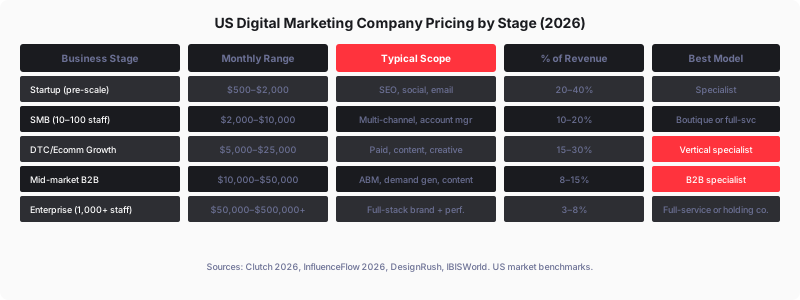
Two pricing trends are reshaping the 2026 market. AI tooling has reduced execution costs for content creation and reporting by 20 to 35% at agencies that have adopted it, creating downward pressure on execution-heavy retainers. Simultaneously, strategy, technical SEO, and conversion rate optimization pricing has held flat or increased, because those disciplines require human judgment that AI does not replace. Agencies that lead with execution are facing price compression; strategy-led firms are holding premium rates.
The practical implication: a $2,000 per month retainer with a US firm that uses AI tooling for execution can now deliver comparable output to a $3,000 retainer from two years ago. But a $2,000 retainer for strategic work (campaign architecture, channel mix decisions, creative brief development) is structurally insufficient regardless of AI adoption.
The seven criteria that consistently separate high-performing US digital marketing companies from ones that win pitches are specific and testable before signing a contract.
Require three case studies with named clients or independently verifiable outcomes. Generic logos with percentage improvements are not evidence. A firm that cannot produce real case studies in your category has not achieved the results it claims, or has not worked with brands comparable to yours.
Ask to meet the specific people who will work on your account before signing. The most common complaint in agency relationships is that senior sellers run the pitch and junior staff run the account. Confirming the actual execution team and their workload before onboarding prevents the most common failure mode.
Confirm that you will own all ad accounts, tracking pixels, and first-party data. Agencies that retain ownership of your accounts or resist giving direct platform access create dependency that is difficult and expensive to unwind. Any firm that resists this question is structurally misaligned with your interests.
Ask for the attribution methodology before the engagement starts. Firms that cannot articulate how they connect spend to revenue before onboarding will not be able to demonstrate it after. Attribution ambiguity protects the agency, not the client.
Require 30-day exit notice rather than 12-month lock-ins. Eight-figure US agencies retain 92% of clients annually versus 78% for seven-figure agencies, per Predictable Profits' agency benchmark report. Firms confident in their results do not need extended contracts to protect revenue.
Ask specifically about AI tooling and how it affects your account. AI-readiness now includes optimization for AI-driven search and LLM visibility, not just traditional SEO rankings. Firms that cannot explain their approach to emerging search formats are optimizing for a channel configuration that is actively changing.
Check client retention directly: ask for their average client relationship length over the last three years and whether you can speak to two current clients. The number below 18 months is a signal; the resistance to direct client contact is a disqualifier.
Best-in-class digital marketing firms across the US share the same structural characteristics regardless of size: senior execution on client accounts, clear attribution methodology, and performance-based contract terms that align incentives. The right marketing agency for your stage is the one with vertical pattern recognition in your business model and the operational capacity to act on what they find.
For growth-stage ecommerce and DTC brands evaluating US digital marketing partners, EmberTribe works on the demand generation programs that compound over time rather than producing isolated campaign results.

Hiring a Shopify Plus development company is a different exercise than hiring a standard Shopify developer. The platform, the project scope, and the stakes are all larger. A bad hire at the Plus level means six-figure mistakes, missed launch windows, and technical debt that slows down growth for years.
This guide covers what Shopify Plus development companies actually do, how to tell them apart from generalist Shopify shops, and the specific criteria you should use to vet candidates before signing anything.
Shopify Plus is Shopify's enterprise commerce tier, built for high-volume merchants who have outgrown the standard plan's feature set. The platform unlocks capabilities that require specialized development knowledge to implement correctly.
A qualified Shopify Plus development company handles work that standard Shopify developers typically cannot:
Custom checkout development. Shopify Plus grants direct access to checkout customization through Checkout UI Extensions and Shopify Functions -- the platform's system for running custom backend logic during checkout. This enables custom discount logic, tiered pricing rules, conditional shipping options, and cart validation that executes server-side at scale. Standard Shopify merchants cannot modify checkout beyond basic settings.
Shopify Functions implementation. Functions replace the older Script Editor and allow developers to write custom logic for discounts, delivery, payment methods, and cart transformations. The code runs within Shopify's infrastructure (compiled to WebAssembly), which means it's fast, scalable, and doesn't require a separate server. Building and deploying Functions correctly requires backend development experience most theme-focused agencies don't have.
B2B commerce builds. Shopify Plus includes a native B2B feature set: company accounts, customer-specific pricing catalogs, net payment terms (Net 30/60/90), purchase order support, and wholesale portals. Implementing these correctly -- with the right account hierarchy, pricing logic, and checkout flow -- is a distinct discipline from DTC store development.
Shopify Flow and Launchpad. Flow is Plus's automation engine for tagging customers, triggering loyalty actions, managing inventory alerts, and routing orders. Launchpad allows merchants to schedule and automate flash sales, product launches, and promotional events. Agencies that know Plus well have used both tools in production, not just in demo environments.
Multi-store architecture. Shopify Plus includes up to nine expansion stores. For brands operating across multiple regions, currencies, or distinct market segments, structuring these stores correctly -- shared product catalog vs. market-specific, unified reporting, cross-store analytics -- requires experience that only comes from having done it before.
ERP and third-party integrations. Plus merchants typically run more complex operational stacks: ERPs, 3PLs, custom inventory systems, loyalty platforms, and subscription engines. Plus-focused development companies have integration patterns established for these systems rather than building from scratch each time.
The distinction matters because the platforms diverge significantly at the API and architecture level. A developer who builds excellent standard Shopify stores may have never touched Checkout UI Extensions, deployed a Function, or configured a B2B company account.
For a deeper look at how Shopify developer types compare, the guide to hiring Shopify developers covers freelancer vs. agency tradeoffs and how to structure a vetting process by project type.
The short version: if your project involves custom checkout behavior, B2B functionality, Shopify Functions, or multi-store management, you need a developer or agency with Plus-specific experience -- not just Shopify experience in general.
Revenue thresholds are one signal, but not the only one. Shopify Plus starts at $2,300/month (3-year term) or $2,500/month (1-year term), and at high GMV volumes the pricing shifts to a revenue-based model. Most merchants find Plus financially justified around $500,000-$800,000/month in sales.
But revenue isn't always the trigger for needing Plus development expertise. Complexity indicators that matter more:
If any of these apply, a generalist Shopify agency is the wrong starting point regardless of where your revenue sits. On the comparison between Shopify and competing platforms, the post on Shopify vs. WooCommerce and BigCommerce covers the architectural tradeoffs that affect which development path makes sense.
Shopify's partner program has tiered levels: Registered, Select, Plus, Premier, and Platinum. An agency carrying the Plus or higher designation has been reviewed by Shopify and has a documented track record of successful Plus merchant launches. You can verify status through the Shopify Partner directory.
Partner status is a baseline requirement, not a differentiator. You want to see it, but it doesn't tell you whether the agency is a good fit for your specific project type.
Ask for URLs to live stores the agency has built on Shopify Plus -- not mockups, not Figma designs, not case study PDFs without links. Then actually visit those stores and test them.
What to look for in a live portfolio review:
Strong Plus agencies have structured processes for discovery, technical architecture, QA, and launch. Weak ones start writing code based on a brief.
Questions that reveal process quality:
Vague answers to these questions are a red flag. Agencies with experience have clear answers because they've solved these problems before.
Ask direct technical questions during the vetting process:
An agency that gives you confident, specific answers with real examples has the depth. An agency that speaks in generalities is telling you something important.
Ask for two or three reference merchants at similar revenue and complexity levels to your project. The right references are merchants who went through a project similar to yours -- not the agency's flagship showcase client if you're a mid-market brand.
Cost ranges for Plus development work vary significantly based on scope, but common project benchmarks:
Hourly rates for Plus-specialized agencies typically run $90-$175/hour in the US. Offshore agencies may be cheaper, but Plus-specific expertise is less common outside of established agency ecosystems, and the risk of misaligned expectations increases significantly.
These cost ranges assume you already have a Shopify Plus license. For context on broader Shopify development service structures and pricing models, the guide to Shopify development services covers how agencies price their work and what's included in different engagement types.
No live Plus portfolio. If an agency cannot show you live Shopify Plus stores they've built, they don't have relevant experience. Case studies without working URLs are a common substitute -- push for actual sites.
Generalist positioning. Agencies that claim expertise in Shopify, WooCommerce, Magento, and BigCommerce simultaneously are unlikely to have deep Plus specialization. Plus development is distinct enough that real expertise is usually focused.
No discovery process. An agency that gives you a fixed-price quote based on a brief without a dedicated scoping phase is either very experienced with highly standardized projects (unlikely at Plus level) or cutting corners on architecture.
Checkout customization via third-party apps only. Legitimate Plus developers use Checkout UI Extensions and Shopify Functions for checkout customization. If an agency's answer to checkout questions is always "there's an app for that," they're not building at the Plus level.
No post-launch support plan. Plus stores require ongoing maintenance: Shopify platform updates, Function compatibility, app conflicts, and performance monitoring. An agency with no post-launch offering is handing you a store without a safety net.
Unrealistically low quotes. A full Plus build quoted at $8,000 is not a deal -- it's a scope that doesn't match what Plus development actually requires. Low quotes at this level are either a bait-and-switch or a sign the agency doesn't understand what they're building.
After portfolio review, reference checks, and technical vetting, the shortlist usually comes down to fit: does the agency understand your business model, your operational complexity, and your growth trajectory? The best Shopify Plus development company for your project is the one that has solved your specific problems before -- not the one with the most impressive general credentials.
For brands focused on scaling ecommerce revenue alongside the development investment, the guide to ecommerce growth strategy covers the operational and marketing levers that compound with a well-built Plus store.
EmberTribe works with growth-stage ecommerce brands on the marketing strategy side of Plus builds -- if you're evaluating development partners, we're happy to share what we've seen work across our client base.


.svg)