








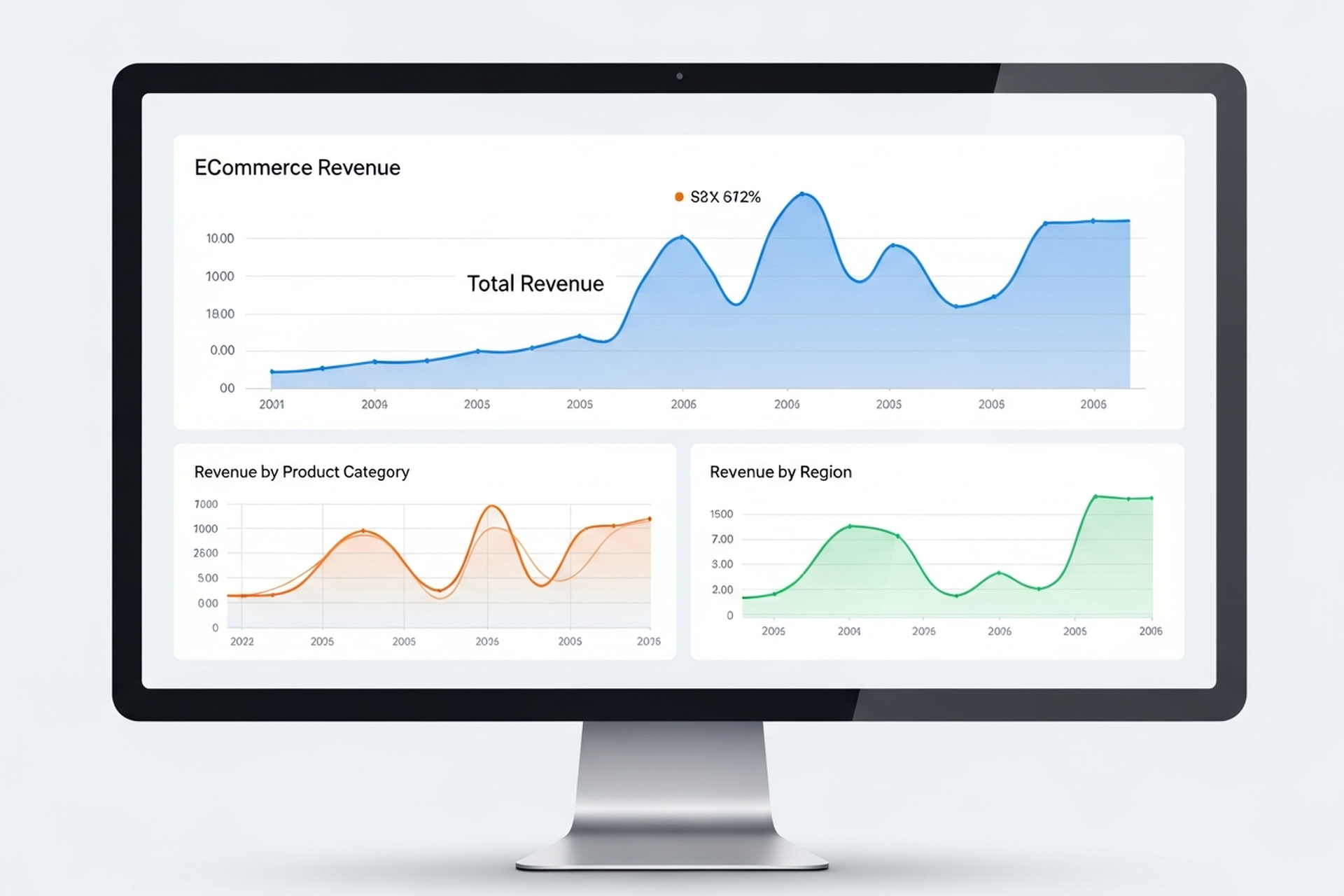
Most ecommerce stores are drowning in data and starving for insight. GA4 dashboards are full of sessions, bounce rates, and pageviews — numbers that describe what happened but don't tell you what to do next. Meanwhile, the metrics that actually drive growth decisions are either buried three reports deep or not being tracked at all.
Ecommerce analytics, done well, narrows your focus to the numbers that connect directly to revenue, margin, and sustainable growth. This guide covers the metrics worth your attention, the tools that surface them, and — most importantly — how to translate data into decisions.
Why Most Ecommerce Analytics Setups Fail
The problem isn't usually a lack of data. It's a lack of a measurement framework. Without one, teams end up tracking everything equally and acting on nothing consistently.
A useful ecommerce analytics setup starts with a clear hierarchy: a small number of primary KPIs that define whether the business is healthy, a second layer of diagnostic metrics that explain why those KPIs are where they are, and a third layer of operational metrics that guide day-to-day decisions.
Most stores invert this — they optimize for operational metrics (sessions, ad clicks, open rates) without connecting them to the primary KPIs that determine whether the business is actually growing.
The Primary Ecommerce Metrics That Drive Decisions
Conversion Rate (CVR)
CVR is the percentage of visitors who complete a purchase. It's the foundational measure of how well your store turns traffic into revenue.
Formula: (Orders / Sessions) × 100
Benchmark: ecommerce conversion rates by industry vary, but a 2–3% conversion rate is a reasonable baseline for most direct-to-consumer stores. Stores above 3.5% have typically invested meaningfully in CRO and UX.
A low CVR tells you that something between arrival and checkout is breaking down — whether that's product-market fit, pricing, trust signals, site speed, or checkout friction. CVR is the best single indicator of your store's health at the mid-funnel level.
Average Order Value (AOV)
AOV measures how much customers spend per transaction. It's one of the fastest levers to pull when you want to grow revenue without acquiring more customers.
Formula: Revenue / Number of Orders
Even a 10% improvement in AOV compounds quickly across your customer base. The highest-impact tactics for increasing AOV are typically product bundling, cross-sell recommendations at cart, free shipping thresholds set slightly above your average transaction size, and subscription upsells where the product fits.
The critical nuance: don't chase AOV at the expense of conversion rate. If discounting or offer changes are required to move AOV, you may be eroding the margin gains you're trying to create.
Customer Lifetime Value (LTV)
LTV predicts how much total revenue a customer will generate over their relationship with your brand. It's the most important metric for evaluating the long-term health of your acquisition strategy — and the one most often ignored in early-stage growth.
Basic formula: AOV × Purchase Frequency × Customer Lifespan
In 2026, sophisticated ecommerce teams go further: they segment LTV by acquisition channel, product category, and cohort to understand which customers are actually profitable — not just which ones ordered the most. A customer acquired through a 40%-off promotion often has a dramatically different LTV than one acquired through organic search.
LTV compared to CAC is the ratio that matters most for sustainable growth. A healthy benchmark is LTV:CAC of 3:1 or higher — meaning you recover your acquisition cost three times over. Below 2:1 and you're likely under-investing in retention. Above 5:1 and you may be under-investing in acquisition.
Customer Acquisition Cost (CAC)
CAC tells you how much you're spending to bring in each new customer. It's only meaningful in context — specifically in relation to LTV.
Formula: Total Marketing and Sales Spend / New Customers Acquired
A common mistake is calculating CAC only against paid channels. Blended CAC — total acquisition spend (paid media, influencer, affiliate, content, brand) divided by all new customers — gives a more accurate picture of what growth is actually costing you.
Tracking CAC by channel lets you see where acquisition efficiency is improving or degrading over time, which informs budget allocation decisions.
Return on Ad Spend (ROAS)
ROAS measures revenue generated per dollar of ad spend. It's useful for evaluating campaign-level efficiency but should never be used as a standalone measure of business health — it ignores margin, CAC, and LTV.
Formula: Revenue from Ads / Ad Spend
A 3× ROAS sounds strong but may be unprofitable if your gross margin is 30% and shipping costs are high. Focus on ROAS as a directional signal and contribution margin as the business truth.
Contribution Margin
This is the metric that most ecommerce brands undertrack and should be reporting first. Contribution margin is what remains after all variable costs — COGS, shipping, fulfillment, returns, and ad spend — are subtracted from revenue.
It tells you whether growing revenue is actually building value or just moving money through a leaky system at scale. If contribution margin is negative, growth is destruction. If it's positive and growing, you have a business worth scaling.
Diagnostic Metrics Worth Monitoring
Beyond the primary KPIs, a second layer of metrics helps explain why primary metrics are moving:
- Cart abandonment rate: Industry average is around 70%. Above that indicates checkout friction or price shock. Track which stage of checkout sees the highest drop-off.
- Repeat purchase rate: The percentage of customers who place a second order. Anything below 20% suggests a retention problem worth addressing before scaling acquisition.
- Email/SMS revenue contribution: What percentage of total revenue comes from owned channels. Healthy stores derive 25–40% from email and SMS — if yours is below 15%, there's likely significant margin improvement available.
- Product return rate: High return rates compress margin quickly and suppress LTV. Track by product, and investigate root cause — sizing issues, quality mismatches, or product-page misinformation.
The Right Ecommerce Analytics Tools
You don't need an expensive tech stack to get started. The hierarchy of tools:
Layer 1 — Traffic and Behavior (Free) Google Analytics 4 covers sessions, traffic source, conversion events, and basic funnel analysis. It requires setup investment to be useful (proper event tracking, conversion goals, channel groupings) but is the right starting point for stores under $1M in revenue.
Layer 2 — Attribution and Profit Analytics As ad spend scales, platform-reported ROAS becomes unreliable due to overlapping attribution windows. Tools like Triple Whale, Northbeam, or Rockerbox give you a unified view of channel contribution across Meta, Google, TikTok, and email. These are worth the investment once you're spending $20K+/month on paid media.
Layer 3 — Behavior Analytics Heatmaps and session recordings (Hotjar, Microsoft Clarity) show you where users drop off and why — information that quantitative analytics alone can't surface. Pair these with CRO testing methodology to systematically improve conversion.
Layer 4 — Customer Analytics Platforms like Klaviyo (for email/SMS data) and Lifetimely or Glew (for LTV and cohort analysis) layer customer intelligence on top of transaction data. They're essential for understanding which acquisition channels actually produce high-value customers over time.
How to Turn Ecommerce Analytics into Decisions
Data only earns its keep when it leads to action. A practical framework:
Weekly: Review CVR, ROAS, and ad spend pacing against targets. Flag outliers.
Monthly: Review AOV trends, return rate, email revenue contribution, and new vs. returning customer split. Identify one or two specific hypotheses for the month's optimization focus.
Quarterly: Run a cohort analysis. Compare LTV:CAC by acquisition channel. Evaluate where you're deploying budget relative to where your highest-LTV customers are actually coming from.
This rhythm prevents two failure modes: over-reacting to weekly noise and under-reacting to slow-moving problems (like a gradually declining repeat purchase rate) that only become obvious at the quarterly view.
Building the Foundation Before Scaling
The most common mistake growth-stage ecommerce brands make is scaling ad spend before their analytics foundation is solid. If you can't attribute revenue accurately, calculate a reliable CAC, or measure LTV by cohort, you're making acquisition decisions based on incomplete information — and the errors compound as spend increases.
Getting ecommerce analytics right — clean tracking, meaningful reporting, and a consistent review cadence — is the prerequisite for efficient growth. At EmberTribe, we treat the analytics audit as the first step in any engagement with an ecommerce brand, because the data quality determines the quality of every decision that follows.
The goal isn't more dashboards. It's fewer metrics, better understood, acted on consistently.
For more on turning your analytics into growth, see our framework for scaling your ecommerce store efficiently and our breakdown of ecommerce CRO tactics that improve conversion.

.webp)

.svg)


