
In the age of rapid digital transformation, AI has seeped into almost every industry, revolutionizing how we conduct business, design products, and even create content. The ClusterMagic service is a great example, which seamlessly integrates AI for content generation in a hybrid model, providing significant benefits in the SEO results of brands seeking a massive increase in organic traffic. But while AI holds immense promise, it has its limitations. Let's explore the pros and cons of using AI for content creation and understand why a hybrid approach might be the way forward.
Major publishers in sensitive niches like CNET.com, Bankrate.com, and Creditcard.com have already integrated AI-generated content. Other large companies, such as CNN and Forbes, might also be doing so. Countless smaller companies and publishers are utilizing AI, not only on their websites but also on social media, in email marketing, and virtually everywhere else.
Google's stance on AI-generated content is neutral, emphasizing that content should primarily be user-centric. In fact, Google's September 2023 Helpful Content Update removed the mention of "written by people" from their helpful content system guidelines.
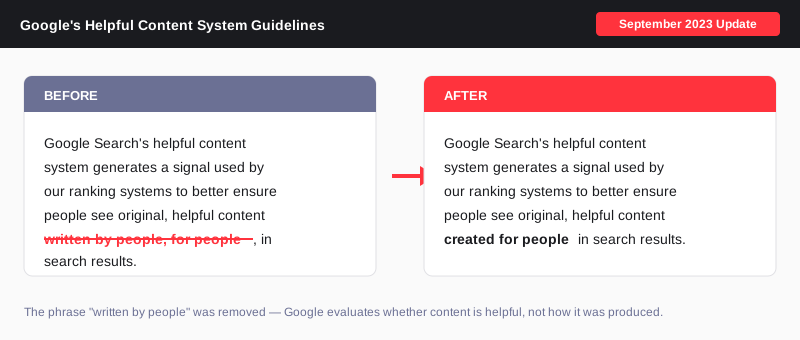
The message is clear: for content to rank well, it must be informative, answer users' queries satisfactorily, and showcase genuine expertise - regardless of how it's created.
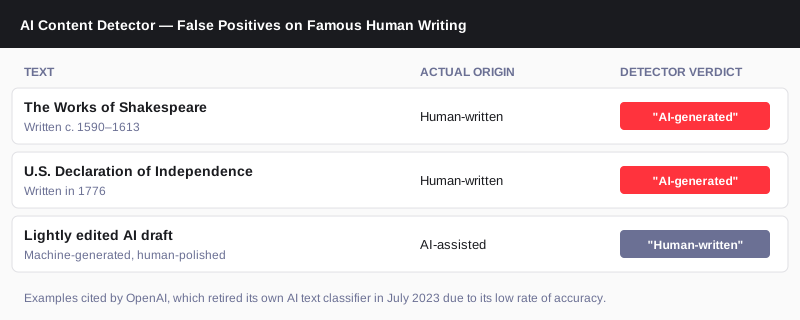
AI Content Detectors like GPTZero, ZeroGPT, and many others are not reliable. Even OpenAI has said as much. They consistently produce false positives about human-written content. Conversely, they can be easily fooled with creative prompting or a bit of human editing.
An interesting note from OpenAI: "we found that it labeled human-written text like Shakespeare and the Declaration of Independence as AI-generated."
Anecdotal evidence and real-life ranking data suggest that while AI-generated content isn't penalized by search engines, it might only achieve high rankings if it meets the above criteria. The role of AI in content creation is still a developing narrative, and its significance is indispensable for maintaining a competitive edge in the future.
At EmberTribe, the understanding is clear - AI serves as a foundation, not the final product. With ClusterMagic, while AI aids in the initial draft based on expert-driven keyword research, human experts step in for the crucial phases of editing, fact-checking, and final review. This hybrid approach ensures the content is accurate and helpful, has the potential to rank, and truly represents their business.

Shopping for ecommerce SEO packages is harder than it looks. Agencies present tiers with similar-sounding names, pricing ranges vary by a factor of ten, and the deliverables listed often describe activities rather than outcomes. For a store owner trying to evaluate options, the variation is genuinely confusing.
This guide breaks down what ecommerce website SEO packages actually contain, how tier structures are typically organized, what realistic pricing looks like, and which signals separate a credible package from one that will waste your budget.
A well-structured ecommerce SEO package covers five core service areas. If a proposal is missing any of them without a clear explanation, push back.
Technical SEO is the starting point for any legitimate package. For ecommerce sites specifically, this means addressing problems that content sites rarely face at scale: crawl budget waste from faceted navigation and filter parameters, duplicate content created by product variants and category pagination, site speed issues caused by large image libraries and unoptimized themes, and structured data markup for product schema and review snippets.
The audit phase produces a prioritized list of issues. Ongoing technical maintenance, which better packages include monthly, keeps new problems from accumulating as the catalog grows or platform updates roll out. Google's technical SEO requirements for site owners provide a useful baseline for what your site needs to meet before content and links can move the needle.
On-page work covers title tags, meta descriptions, heading structure, product descriptions, image alt text, and URL patterns across product and category pages. For ecommerce, this work is particularly impactful on category pages, which target higher-volume keywords and sit higher in the purchase funnel than individual product pages.
A meaningful on-page package specifies how many pages get optimized per month, not just that optimization is included. Vague deliverables here are a sign that the agency has not thought through execution at catalog scale.
Content supports ecommerce SEO by capturing informational intent, building topical authority, and creating internal linking opportunities to product and category pages. Buying guides, comparison posts, and how-to content that connects to product categories drive traffic with purchase intent that converts better than generic blog audiences.
Packages vary significantly here. Entry-level tiers might include two to four blog posts per month. Growth tiers typically include six to ten, plus optimization of existing content as the catalog and keyword landscape evolve.
Link acquisition is what separates sites that rank from sites that do not, all else being equal. Ecommerce link building targets editorial placements, digital PR, supplier and partner links, and category-relevant publications, not directory submissions or link farms.
The cadence matters: a package that promises ten links a month at $800/month total is not building quality links. A realistic growth-tier package might target four to eight high-quality placements per month, with transparency about targets, outreach process, and placement quality.
Every package should include monthly reporting that covers organic traffic, keyword rank movement for priority product and category pages, indexed page counts, and conversion data from organic sessions. Reporting that only shows traffic without tying movement to revenue or conversions is not enough for an ecommerce brand.
You should also have direct access to your own Search Console, analytics platform, and any rank tracking dashboard the agency uses. An agency that reports results through their own portal without giving you direct data access creates a dependency worth avoiding.
Most ecommerce SEO packages follow a three-tier model, though naming varies by agency.
Designed for smaller stores with under 500 SKUs, limited catalog complexity, and lower competition categories. Typical scope includes an initial technical audit, on-page optimization for priority pages, and two to four content pieces per month, usually without dedicated link building or with a minimal acquisition allotment.
Starter packages run $1,500 to $3,500 per month. They are appropriate for stores in early SEO investment stages, stores with clean technical foundations that need content and keyword strategy more than structural fixes, and brands whose categories have moderate organic competition.
The growth tier is where most mid-market ecommerce brands should be operating. Scope expands to include ongoing technical monitoring, broader on-page coverage across product and category pages, six to ten content pieces per month, active link building, and more detailed reporting tied to revenue metrics.
Growth tier pricing runs $3,500 to $7,500 per month. At this level, an agency should be assigning dedicated account management, not rotating staff, and deliverables should be scoped to your specific catalog and competitive landscape rather than a templated monthly checklist.
Enterprise packages serve stores with thousands of SKUs, complex technical environments (multi-market, multi-language, headless CMS, or custom platform builds), and competitive categories where organic visibility translates directly to significant revenue.
Enterprise-level ecommerce SEO starts at $7,500 per month and scales past $20,000 for large catalog operations or brands competing in categories with high organic competition density. At this tier, expect full-team engagement, platform engineers who understand your stack, and content production at a volume that builds meaningful topical authority month over month.
For a detailed breakdown of how these tiers are priced across agencies, ecommerce SEO pricing benchmarks offer a useful reference. WebFX also publishes ecommerce SEO pricing tiers with transparent tier comparisons.
Low-cost packages are not just a budget trade-off. Many create problems that cost more to fix than the money saved.
Guaranteed rankings. No agency controls Google's algorithm. Any package that guarantees specific rank positions is either uninformed or misleading. Rankings are an output of quality work over time, not a deliverable that can be promised.
Link volume without link quality. A package that promises 50 or 100 backlinks per month at entry-level pricing is building links through private blog networks, paid directories, or mass submission tools. These tactics generate short-term gains at best and manual penalty risk at worst. Quality link acquisition is slow, expensive, and relationship-driven by nature.
Templated deliverables. If a proposal describes the same monthly activities regardless of your store's size, platform, catalog structure, or category, the agency is not doing ecommerce SEO. They are running a playbook that may or may not apply to your situation. Ecommerce SEO is specific, and the deliverables should reflect your store's actual technical state and competitive position.
No attribution to revenue. Traffic growth alone is not a success metric for ecommerce. If an agency cannot explain how their work connects to organic revenue or assisted conversions, they are tracking the wrong things.
Vague reporting with no data access. You should own your data. If an agency summarizes results in a PDF without giving you direct access to Search Console, analytics, and rank tracking, they control information you have a right to see in real time.
Matching a package to your store comes down to three variables: catalog size, competitive pressure, and where you are in your SEO maturity curve.
Catalog size determines how much technical maintenance you need. A 50-product store with a clean URL structure has minimal ongoing technical work. A 5,000-SKU store with faceted navigation, seasonal inventory, and multiple product variants needs active technical oversight built into the retainer, not just a one-time audit.
Competitive pressure determines how much link building the package needs to include. Categories like apparel, supplements, consumer electronics, and home goods have well-funded competitors with years of domain authority. Competing in these verticals requires consistent link acquisition, not occasional outreach. Lower-competition niches can move rankings with less link investment and more content.
SEO maturity determines where the agency should focus first. If your site has never had a technical audit, the first several months of any engagement will be dominated by fixes. If your technical foundation is solid and you have some organic traction, the package can shift toward content and link building faster.
For stores just starting to invest in organic search, our ecommerce SEO guide covers the foundational concepts worth understanding before you sign a package. If you are also evaluating individual consultants vs. agency teams, our guide to ecommerce SEO consulting options walks through how to think about that decision.
When comparing packages across ecommerce SEO companies, treat the deliverable list as the minimum standard for evaluation, not the selling point. Ask agencies to explain how each deliverable connects to rankings and revenue for stores at your catalog size. Ask for examples of work at similar scale. Ask how they handle the technical challenges specific to your platform.
The right package is the one scoped to your actual situation, not the one with the most items on the list.
Understanding which package components actually drive results helps you evaluate proposals more honestly.
Technical SEO unlocks indexing. If Googlebot cannot efficiently crawl your category and product pages, content and links cannot help. Technical work is the prerequisite, not the value-add.
Content builds topical authority and captures informational intent. Stores that rank well in competitive categories almost always have content programs that match their product depth. A store selling running gear that publishes high-quality training, gear selection, and injury prevention content signals to search engines that it belongs in that category.
Link building accelerates authority accumulation. Content and technical SEO determine whether you should rank. Links determine whether you do rank, relative to competitors with similar technical quality and content depth.
Reporting that ties all of this to revenue closes the loop. The stores that get the most from SEO packages are the ones that review performance monthly, ask hard questions about which work moved which metrics, and adjust scope when the data suggests it.
EmberTribe works with ecommerce brands on SEO strategy and execution across each of these areas. If you are evaluating where to invest, our ecommerce growth strategy frameworks cover how organic search fits into a broader acquisition mix. For brands comparing agency options, our guide to top ecommerce marketing agencies covers what to look for beyond the SEO package pitch.

There is a meaningful difference between someone who does SEO and someone who specializes in ecommerce SEO. The tools overlap. The terminology is the same. But the specific problems an online store faces (crawl budget erosion from faceted navigation, duplicate content at scale, product page optimization for transactional queries, category architecture across thousands of SKUs) are not problems a generalist SEO encounters often enough to solve quickly.
This post covers what an ecommerce SEO specialist actually does, the technical and strategic skills that define the role, and how to tell whether someone calling themselves one has the depth to back it up.
Standard SEO advice (write good content, build links, fix technical errors) applies to ecommerce stores the same way it applies to any website. The difference is that ecommerce sites create SEO problems at a scale and speed that most other site types do not.
A 500-product store with size, color, and brand filters can generate hundreds of thousands of indexable URL combinations before a single piece of content is written. That is not a content problem. It is a structural problem that requires a specialist to solve. Category pages need to rank for head terms while product pages rank for long-tail, transactional queries, and both page types need to be optimized without cannibalizing each other.
Google's own SEO starter guide makes the point that the fundamentals apply across all site types, but ecommerce sites present execution challenges that require domain-specific experience to navigate at scale.
An ecommerce SEO specialist is a practitioner who has built enough experience working specifically with online stores that they can diagnose these problems accurately and prioritize work that moves revenue, not just rankings.
Technical SEO is where most ecommerce sites have the most leverage, and where the most experience is required. A qualified specialist understands:
Crawl budget management. Search engines allocate a finite crawl budget to each site. On large ecommerce sites, that budget can be exhausted on pagination, filter pages, and session-parameterized URLs before Googlebot reaches the product pages that actually matter. A specialist will audit which URLs are being crawled, configure robots.txt and canonical tags to direct crawl budget to high-value pages, and verify the result in Google Search Console.
Faceted navigation. Filtering by size, color, price, and brand creates URL permutations that often produce duplicate content at scale. The right approach depends on the platform, the number of filter combinations, and which filters have meaningful search volume. There is no universal rule: it requires judgment built on experience.
Site speed and Core Web Vitals. Slow product pages cost rankings and conversions simultaneously. An ecommerce specialist will identify the actual causes of page slowness, from uncompressed images and render-blocking scripts to third-party app overhead, and prioritize fixes by impact rather than by ease.
Structured data. Product schema, review aggregation markup, and availability data feed rich results directly in Google Search. A specialist knows how to implement these correctly and how to test them before deployment.
Keyword research for an online store is not the same as keyword research for a content site. The priority is identifying commercial and transactional intent at every level of the catalog: category-level head terms, subcategory midtail queries, and product-level long-tail searches where buyers are close to a purchase decision.
A strong ecommerce SEO specialist approaches keyword research with the store's catalog architecture in mind. The question is not just which keywords have volume. It is which keywords belong on category pages versus product pages, and whether the store's current architecture can support the targeting strategy without creating internal competition between pages.
They also understand seasonal demand patterns, which matter differently in ecommerce than in publishing. A product category that spikes 400% in November needs a different ranking timeline and content calendar than an evergreen category with steady monthly volume.
For a closer look at how keyword strategy fits into the broader discipline, our ecommerce SEO guide covers the full framework from technical foundation to content execution.
This is where ecommerce SEO differs most visibly from other forms of SEO. Ahrefs' research on ecommerce SEO fundamentals shows that category and product pages are where most of the ranking opportunity lives, and most stores underinvest in them relative to blog content.
A specialist will work through:
Category page copy. Most ecommerce platforms leave category pages with a product grid and no descriptive content. Adding unique, keyword-informed copy above or below the grid gives search engines context for the page's topic and can significantly lift rankings for category-level head terms.
Product page optimization. Title tags, meta descriptions, H1s, and product descriptions all need to work together for transactional keywords. Manufacturer descriptions duplicated across multiple retailers are a persistent problem. Unique descriptions written specifically for each product create both SEO differentiation and conversion benefit.
Shopify's breakdown of product page SEO best practices covers the mechanics of individual product page optimization in detail, from structured data to image alt text to internal link structure.
Internal link architecture. How category pages link to subcategory and product pages, and how product pages reference related items, is a meaningful ranking signal that most stores set and forget during site launch. A specialist audits and rebuilds this as the catalog grows.
Domain authority matters for ecommerce stores competing in crowded categories. A specialist understands the link-building strategies that work specifically for online retailers: product PR campaigns that earn coverage in vertical publications, digital asset development (size guides, comparison tools, buying guides) that attract links naturally, and supplier or manufacturer link programs.
The approach changes based on the store's niche, its current domain rating, and the competitive landscape. A specialist has a framework for assessing what kind of link profile is needed to compete for the target keywords and a realistic sense of how long it takes.
An ecommerce SEO specialist should be able to connect organic traffic to revenue in your analytics platform. That means configuring GA4 correctly for ecommerce tracking, setting up Google Search Console properly, and building reports that show which pages are driving sessions, which sessions are converting, and what that revenue attribution looks like against the baseline.
Without this, there is no way to know whether the SEO work is moving the right metrics. A specialist who cannot set up or interpret ecommerce analytics is missing a core competency.
The surface-level tasks look similar: keyword research, on-page optimization, link building, technical audits. The difference is in pattern recognition. An ecommerce specialist has seen the same categories of problems (duplicate content from variants, crawled-but-not-indexed product pages, cannibalizing category and product pages targeting the same keyword) enough times to diagnose them quickly and skip the experimentation that a generalist needs.
Time-to-diagnosis matters more than most brands expect when they first hire for SEO. A generalist might spend months ruling out causes that a specialist would have identified in the first audit. That gap translates directly into delayed results and wasted retainer months.
The distinction between an ecommerce SEO specialist and an agency or consultant is one of format, not necessarily skill.
A specialist can operate as an in-house hire, an independent consultant, or as a practitioner within a larger agency. What distinguishes any of these is whether the person doing the actual work has deep ecommerce-specific experience, not which employment arrangement they are under.
If you are evaluating agencies, our breakdown of ecommerce SEO companies covers what to look for before you sign a contract. If you are considering an independent practitioner, the ecommerce SEO consultant guide covers how to scope, vet, and price that engagement.
The key point: regardless of format, you want the person doing the SEO work to have direct, verifiable experience with online stores at a scale similar to yours.
When interviewing or vetting an ecommerce SEO specialist, the questions that reveal real depth are the ones that require specific, experience-based answers:
"Walk me through how you handle faceted navigation for a large catalog." There is no single correct answer, but the response should demonstrate that they understand the crawl budget and duplicate content tradeoffs and have made real decisions about them on real sites.
"What does your technical audit process look like for a new client?" A strong answer includes specific tooling (Screaming Frog, Google Search Console, PageSpeed Insights, a backlink analysis tool), a defined prioritization framework, and an output format, not a vague statement about "looking at everything."
"Can you show me a case where organic traffic improved and explain what drove it?" This one separates specialists from people who were present during a traffic increase. Look for specificity about which pages improved, which keywords moved, and what changes preceded the movement.
"How do you handle a site migration for a store moving platforms?" Ecommerce platform migrations carry enormous SEO risk. A specialist should have a clear pre-migration, redirect mapping, and post-migration monitoring process.
SEO timelines for ecommerce stores depend on the site's current technical state, the domain's existing authority, the competitive intensity of the target keywords, and how aggressively execution can move.
For stores with significant technical debt (crawl errors, duplicate content, thin product pages), the first three to six months should focus on remediation and on-page optimization. Ranking movement is possible in this phase but is not the primary signal. The primary signal is whether the underlying issues are being resolved.
For stores with a clean technical foundation, ranking movement on product and category keywords can begin within three to six months. Head terms in competitive categories take longer, often twelve to eighteen months of consistent work.
Anyone guaranteeing specific ranking outcomes within a fixed timeline is not being straight with you. A specialist who gives you a realistic timeline and shows you how they will measure progress is the one worth working with.
Ecommerce SEO done well compounds over time. The category pages optimized this quarter do not stop ranking when the retainer ends. A specialist who understands the role is building an asset, not running a campaign.
If you want to talk through what ecommerce SEO looks like in practice, EmberTribe works with growth-stage stores on exactly this. See ecommerce growth strategy guide to understand where it fits in the broader picture.

Not every ecommerce store needs to hire a full-service SEO agency. For many growth-stage brands, bringing in an ecommerce SEO consultant is the smarter, faster, and more cost-effective move. The question is knowing when that's true and how to find someone who can actually deliver.
This guide breaks down what ecommerce SEO consultants do, how they differ from agencies and in-house hires, when each model makes sense, what to pay, and how to vet candidates before signing anything.
An ecommerce SEO consultant is an independent practitioner who provides strategic SEO guidance, technical auditing, and execution support specifically for online stores. They typically work with a limited number of clients at a time and operate without the overhead of a full agency.
The core responsibilities of a qualified ecommerce SEO specialist include:
Technical SEO auditing. Identifying and prioritizing crawl errors, indexing problems, site speed issues, Core Web Vitals gaps, duplicate content from faceted navigation, and structured data gaps. Technical health is the foundation. Without it, content and links cannot move rankings.
Keyword and content strategy. Mapping search demand to product categories, collections, and informational content. Ecommerce keyword research requires understanding purchase intent at each stage of the funnel, not just search volume.
Product and category page optimization. Writing and optimizing title tags, meta descriptions, headings, and on-page copy for high-value pages where organic traffic converts directly to revenue.
Link profile analysis. Identifying gaps in domain authority and recommending link-building approaches appropriate for the store's niche and budget.
Analytics setup and reporting. Connecting organic traffic to revenue in GA4, configuring Google Search Console, and building dashboards that show whether SEO is actually working.
For a deeper look at the full discipline, our ecommerce SEO guide covers the complete framework from technical foundation to content execution.
These three models are not interchangeable. Each has a different cost structure, scope of capability, and fit for different stages of business.
Ecommerce SEO consultant. Works independently. Lower overhead, higher flexibility. Best for scoped projects, audits, strategy work, or situations where you need a senior practitioner without paying for an entire agency team. Consultants are accountable only to you and tend to communicate faster and more directly.
Full-service SEO agency. A team of specialists handling technical SEO, content, link building, and reporting under one contract. Better for brands that need full execution bandwidth across multiple workstreams simultaneously. The tradeoff is cost, longer onboarding, and account manager layers that can create distance from the actual work. If you're still evaluating this model, see our breakdown of what ecommerce SEO companies actually deliver before you choose.
In-house SEO hire. A full-time employee embedded in your team. Best suited for stores with significant organic revenue, a large content operation, or a complex technical stack that requires dedicated ongoing attention. The cost per year (salary, benefits, tools) typically exceeds $80,000 to $120,000 before considering training and ramp time.
Hiring a consultant tends to be the correct call in specific situations:
You need a diagnostic before committing to ongoing spend. If your organic traffic is flat or declining and you don't know why, an audit from an experienced ecommerce SEO consultant gives you a prioritized list of what's broken before you pay a retainer for execution work that may target the wrong problems.
Your scope is contained. Launching a new product line, migrating to a new platform, or optimizing a specific category for a key season are all bounded projects. A consultant can scope and execute these without a long-term agency contract.
You have an internal team that needs strategic direction. Many growth-stage ecommerce brands have marketing generalists who can execute SEO tasks but lack the expertise to set strategy. A consultant can work alongside your team as a fractional expert without replacing anyone.
Your budget does not support an agency retainer. Full-service ecommerce SEO agencies typically start at $3,000 to $5,000 per month. If that range exceeds your current growth budget, a consultant working on a project basis or a lower hourly engagement gives you access to senior expertise at a fraction of the cost.
Consultants have limits. If you need simultaneous execution across technical SEO, content production at scale, and active link building, a single consultant will hit capacity constraints quickly. Agencies are better suited when:
For guidance on evaluating agency candidates, our guide to finding SEO experts applies directly to agency vetting as well.
Pricing for ecommerce SEO consulting varies by engagement model, the consultant's track record, and the complexity of your store.
Hourly rates. Most experienced ecommerce SEO consultants charge between $150 and $300 per hour. Entry-level practitioners may charge $75 to $125, though this range often reflects limited ecommerce-specific experience. According to SEO consultant rate benchmarks, the most common range for senior SEO consulting is $150 to $250 per hour.
Project-based engagements. A full technical SEO audit for a mid-size ecommerce store typically runs $2,500 to $7,500 depending on catalog size and site complexity. A platform migration project can run $5,000 to $15,000 or more. Project fees give you a defined deliverable and a clear end point.
Monthly retainers. Consultants working on an ongoing basis typically charge $1,500 to $4,500 per month for a defined scope of hours and deliverables. This is lower than a full agency retainer but assumes the consultant is not doing full-bandwidth execution across all SEO channels.
For a broader look at how these numbers compare to full-agency pricing, this ecommerce SEO pricing breakdown and a detailed SEO cost guide both provide useful market context. An ecommerce SEO scope comparison covers what different price points typically include.
Credentials and testimonials are not sufficient. These are the criteria that actually indicate competence.
Live store results. Ask for specific examples of ecommerce stores they've worked on, the starting organic traffic and revenue, what they did, and the result over a defined period. Bonus points if they can show you the Google Search Console data directly. Anyone who cannot point to measurable outcomes from past clients is a risk.
Technical depth. Ask how they would approach a faceted navigation audit for a store with 10,000 SKUs. Or how they diagnose crawl budget problems on a large catalog. A consultant with real ecommerce SEO experience will give you a specific, structured answer. A generalist will give you a vague one.
Platform familiarity. Shopify, BigCommerce, Magento, and WooCommerce all have different technical SEO considerations. Confirm the consultant has hands-on experience with your specific platform, not just familiarity with ecommerce in general.
Process documentation. Ask what their audit deliverable looks like. Ask for a sample (redacted is fine). A well-structured ecommerce SEO audit includes prioritized findings tied to specific URLs, severity ratings, and recommended fixes. A printout from a free tool is not an audit.
Communication standards. How often will they report? What does a monthly update include? Who do you contact with questions? A consultant who is unclear about these basics before the engagement starts will be harder to manage once you're paying them.
These questions surface what you need to know before signing an agreement:
These signals should end the conversation or significantly increase your skepticism:
Guaranteed rankings. No one controls Google's algorithm. Legitimate consultants commit to process and effort, not specific rank positions. A guarantee of "page one in 30 days" is a sign of either deception or ignorance.
Traffic-only metrics. If their success metrics are visits and impressions without any connection to revenue, leads, or conversion rate, they're optimizing for inputs that look good in a deck but may not reflect business outcomes.
No ecommerce-specific examples. A general SEO background is not ecommerce SEO experience. The technical challenges of faceted navigation, product schema, crawl budget management, and category page optimization are distinct. If they cannot show ecommerce work specifically, assume they're learning on your dime.
Vague process answers. Experienced consultants can describe exactly what they do, in what sequence, and why. Vague answers about "holistic strategy" and "comprehensive optimization" suggest a lack of structured methodology.
Reluctance to share references. Any legitimate consultant should be able to connect you with one or two past clients willing to speak honestly. If references are unavailable or inaccessible, that is a meaningful signal.
Pricing that is dramatically below market. Very low rates may indicate the consultant is early in their career, outsourcing to junior labor, or using automated tools in place of real analysis. This is especially risky for ecommerce stores where technical errors can do measurable damage.
Whether you hire an ecommerce SEO consultant for a one-time audit, a platform migration, or ongoing strategic guidance, the engagement works best when the scope is specific and the success metrics are defined before work begins. Vague briefs produce vague outcomes.
Start with a bounded project. Get a technical audit. Evaluate the quality of the work before committing to a longer retainer. Consultants who are confident in their results welcome this structure because they know what they're capable of showing you.
EmberTribe works with ecommerce brands across both consultant-style strategy engagements and full content execution programs, depending on what the store actually needs.
For context on how ecommerce SEO fits into broader growth planning, see our ecommerce growth strategy guide and our deep dive into technical SEO agencies for stores that need hands-on execution beyond strategy.

Most online stores have tried SEO at some point. Many have hired someone to help. A smaller number have hired the right someone. The gap between a generic SEO agency and a specialist ecommerce SEO company is wide, and choosing the wrong one costs more than money: it costs 6 to 12 months of ranking ground that competitors are happy to take.
This guide breaks down what ecommerce SEO companies actually do, how to evaluate them, what packages and pricing look like, and which warning signs should end a conversation immediately.
General SEO agencies optimize websites for search visibility. Ecommerce SEO companies do that too, but the technical challenges are fundamentally different.
A content blog with 50 pages is a manageable SEO target. An online store with 500 SKUs, faceted navigation, color variants, and seasonal collections can generate tens of thousands of indexable URLs before anyone writes a single piece of content. The scale alone creates problems that most generalist agencies are not equipped to solve.
Ecommerce SEO also targets a different type of searcher. A shopper searching "black leather work boots size 11" is in the decision phase. A generalist blog reader searching "best boots for work" is still gathering information. The keyword strategies, page structures, and conversion priorities are entirely different.
For a deeper look at how ecommerce SEO operates as a discipline, see our ecommerce SEO guide.
A qualified ecommerce SEO company should offer a defined scope across five core areas. If any of these are missing from a proposal, ask why.
Technical SEO is the foundation. Before content or links can move rankings, search engines need to crawl and index your site without errors. For ecommerce sites, that means managing:
For more on what technical work looks like in practice, see our guide to technical SEO agencies before you hire.
Product pages are where ecommerce stores win or lose organic revenue. An ecommerce SEO specialist will audit and optimize:
Shopify's research on ecommerce product page SEO fundamentals shows how much ranking potential lives in page-level execution details most stores skip.
Category pages are often the highest-value pages on an ecommerce site. They target broader, higher-volume keywords and funnel traffic to the right products. A specialist will optimize category page copy, heading structure, internal links, and pagination handling, all work that generalist agencies routinely undervalue.
Ecommerce link building differs from content site link building. The goal is to build topical authority around product categories and brand, not just collect backlinks to blog posts. Look for agencies that pursue editorial placements, supplier links, and digital PR, not link farms or paid directories.
Blog content supports ecommerce SEO by capturing informational intent and building topical relevance. An ecommerce SEO company should tie content to the purchase funnel: comparison guides, gift guides, how-to content, and buying guides that link to category and product pages with commercial intent.
A generalist agency can do ecommerce SEO. The question is whether they do it well enough to compete in your category.
When a generalist agency makes sense:
When you need an ecommerce specialist:
The specialist premium is real: agencies with deep ecommerce expertise typically charge 30 to 50 percent more than generalists. In competitive categories, the ROI difference justifies it.
Pricing varies widely based on store size, catalog complexity, competition level, and scope of services. Here are the benchmarks to know.
Monthly retainers are the most common engagement model. For ecommerce brands:
Hourly rates for ecommerce SEO specialists typically run $75 to $150 per hour for agency teams. Freelance ecommerce SEO specialists can be found at $50 to $100/hour, though vetting requirements are higher.
Project-based work (technical audits, migration support, one-time optimization sprints) typically runs $2,500 to $15,000 depending on store size and scope.
A detailed ecommerce SEO pricing breakdown is worth reviewing before you budget. WebFX also publishes transparent ecommerce SEO pricing tiers by service level as a useful reference point.
Be cautious of packages priced significantly below these ranges. Sub-$1,000/month ecommerce SEO almost always means templated deliverables, offshore execution, or tactics that create technical debt.
Getting proposals is easy. Knowing which one to trust takes more work.
Ask for case studies that show results for stores, not content sites or SaaS companies. The metrics you want to see: organic revenue growth, keyword rank movement for category and product pages, indexed page counts, and conversion rate impact from organic traffic. A case study that only shows traffic growth without tying it to revenue is incomplete.
Specifically, ask how they handle faceted navigation, duplicate content from manufacturer descriptions, and out-of-stock product pages. These are table-stakes problems in ecommerce SEO. An agency that hedges or gives vague answers on any of these has not solved them at scale.
Before signing a retainer, ask for a sample technical audit or content brief from a previous client (redacted is fine). This shows the quality of their process and what you'll actually receive each month.
Ask whether they have specific experience with your platform, whether Shopify, WooCommerce, Magento, or BigCommerce. Platform-specific SEO work (URL structures, theme limitations, app conflicts) varies meaningfully. An agency that has only worked on one platform may struggle with another.
Google's technical SEO guidance for site owners is also useful context for understanding what baseline technical compliance looks like, so you can assess whether an agency's process covers it.
For a broader look at hiring for search, our guide to SEO expert evaluation covers frameworks that apply across specializations.
Ask what percentage of their link building is editorial vs. paid placement. Ask for examples of placements from the last 90 days. Link building that relies on paid directories, private blog networks, or mass outreach with templated pitches creates risk, not results.
Some signals are not worth investigating further:
Rank guarantees. No agency can guarantee specific rankings. Google's algorithm is not negotiable. Any agency promising "#1 rankings" for target keywords is either uninformed or deliberately misleading.
Vague deliverables. A proposal that lists "SEO optimization" without specifying what gets optimized, at what cadence, and measured by what metrics is not a plan. Push for a line-itemized scope.
No transparent reporting. You should own access to your own analytics, Search Console, and any rank tracking dashboards. An agency that resists sharing direct access to these tools is controlling information you have a right to.
Cheap link building. Links from link farms, paid directories, or private blog networks can trigger manual penalties that take months to recover from. If a package includes "500 backlinks" for $300, that is the entire budget going to tactics that damage your site.
No attribution to revenue. Traffic is not the goal. If an agency cannot explain how their work connects to organic revenue or conversion rate improvement, they are not operating at the level ecommerce brands need.
Search Engine Land's guide on hiring an SEO agency covers additional vetting criteria worth reviewing before you sign anything.
The best ecommerce SEO companies combine technical depth, platform expertise, and a clear content strategy. They ask about your catalog structure before they pitch. They want to understand your margin profile and which product categories have the most ranking potential. They tie everything back to revenue.
If you are comparing agencies, use the services list, pricing benchmarks, and red flags above as your filter. The right partner will pass every check.
EmberTribe works with DTC brands and growth-stage ecommerce companies on SEO strategy and execution. If you are building or fixing your organic search foundation, our ecommerce growth frameworks are a good starting point.

You're not short on options when it comes to social media advertising services. The harder problem is figuring out which option is actually right for your business — and what you'll get for the budget you're about to commit.
This guide breaks down what social media advertising services typically include, how service tiers differ in scope and price, which platforms matter for different business types, and what to scrutinize in a proposal before you sign.
The phrase "social media advertising services" gets used loosely. An agency might use it to describe a $1,500/month content retainer with boosted posts. Another might use it to describe a fully managed paid social program with dedicated creative production, audience strategy, and weekly performance reporting. Both technically qualify.
Understanding the components is the starting point for any meaningful comparison.
Platform management covers the day-to-day operation of your paid campaigns: building audiences, setting bids, adjusting budgets, running A/B tests on creative, and managing placements across Meta, TikTok, Pinterest, LinkedIn, or wherever your audience lives. Strong platform management is continuous — not a set-it-and-check-monthly operation.
Creative production includes static images, video ads, carousels, and copy. Some providers include creative in their service fee. Others charge separately, or expect you to supply assets. This distinction has a big impact on total cost and on creative quality, so clarify it before comparing quotes.
Audience targeting and segmentation is where a lot of performance diverges. Providers that invest time in audience architecture — building layered retargeting stacks, lookalike audiences from high-value customer data, and exclusion lists to avoid wasted spend — consistently outperform those running broad targeting with minimal refinement.
Attribution and reporting determines whether you actually understand what's working. Look for reporting that goes beyond impressions and clicks: cost per acquisition, return on ad spend by creative and audience, and a view of how social ads interact with other channels in your mix. Social media statistics consistently show that brands with structured measurement frameworks outperform those optimizing on surface metrics.
Social media advertising services are not one-size-fits-all, and price differences often reflect meaningful scope differences rather than arbitrary markup.
Entry-level managed social ($1,500–$3,500/month): Typically covers one or two platforms, basic campaign setup, and monthly reporting. Creative assets are usually limited or supplied by the client. This tier works for early-stage brands testing paid social for the first time — but it leaves a lot of optimization leverage untouched.
Mid-tier full-service ($3,500–$8,000/month): Includes active campaign management across two to three platforms, creative production (often 4–8 assets per month), audience testing, and bi-weekly or weekly performance reviews. This is the most common tier for growth-stage DTC brands with monthly ad spend in the $10,000–$50,000 range.
Full-stack growth programs ($8,000–$20,000+/month): Covers multi-platform paid social, integrated creative production at scale, advanced audience architecture, landing page recommendations, and reporting tied to revenue and LTV rather than just ROAS. Partners at this tier typically work with brands spending $50,000 or more per month on paid social and treat advertising as a core growth driver, not a standalone channel.
Ad spend is separate from service fees in nearly every case. When comparing proposals, always confirm what the quoted fee covers and what the expected ad spend investment looks like alongside it. A $4,000/month service fee managing $5,000 in monthly spend is a very different program than the same fee managing $40,000.
For brands evaluating how social media marketing packages are structured, the tier breakdown above maps closely to how most agencies package their retainers.
Not every platform deserves budget from every business. The right paid social strategy starts with choosing platforms based on where your actual buyers spend time — not where your competitors happen to be active.
DTC and ecommerce brands get the most leverage from Meta (Facebook and Instagram) and TikTok. Meta's conversion infrastructure remains the most mature in the industry, with deep pixel data, strong catalog integration for dynamic product ads, and the largest retargeting pool. TikTok's performance advertising has matured significantly, and for brands with younger demographics or strong visual products, it often delivers lower CPAs than Meta. Pinterest is underutilized for home, lifestyle, and fashion brands where visual discovery drives purchase intent. Our guide on ecommerce growth strategy covers how paid social fits into a broader acquisition framework for online stores.
B2B and SaaS companies operate in a different environment entirely. LinkedIn is the dominant platform for reaching buyers by job title, seniority, and company size — but CPMs run significantly higher than consumer platforms. A $50 CPM on LinkedIn is common; the tradeoff is precision targeting that eliminates wasted spend on irrelevant audiences. Meta can work for B2B retargeting (especially for remarketing to site visitors), but it's rarely the right top-of-funnel channel for complex or high-ACV products.
Local and service businesses often get strong results from geotargeted Facebook and Instagram campaigns, particularly for lead generation offers. Google Ads tends to dominate for high-intent local search, but social ads work well for building awareness within a defined geographic radius and driving form submissions.
Hootsuite's 2026 Social Trends report highlights that audience fragmentation across platforms is accelerating — making platform selection and budget allocation more consequential than it was even two years ago.
When you're reviewing proposals from social media advertising providers, the document itself tells you a lot about how the agency operates.
Specificity about platform and audience strategy. Vague commitments to "drive results on social" are not a strategy. Look for proposals that name the specific platforms they're recommending for your business, explain the audience architecture they plan to build, and outline how they'll approach creative testing in the first 30–60 days.
Creative scope and ownership. Confirm exactly how many creative assets are included per month, what formats are covered, and who owns the creative files at the end of the engagement. Some agencies retain ownership of creative assets — that's a significant issue if you switch providers.
Reporting cadence and format. Weekly or bi-weekly reporting with a defined set of KPIs is standard for quality providers. Monthly reporting with no mid-month visibility is a sign of lighter-touch account management than most growth-stage brands need.
Contract terms and exit provisions. A reasonable initial commitment is three to six months — enough time to run a meaningful testing cycle and gather performance data. Contracts longer than six months without performance milestones or exit clauses favor the agency over the client. If a proposal includes a 12-month lock-in with no out, push back or walk away.
Team structure transparency. Ask who specifically will manage your account on a day-to-day basis. The strategist presenting in the sales call and the account coordinator running your campaigns are often different people. Get names and understand the handoff before signing.
For brands considering the full range of social media marketing services beyond advertising, this evaluation framework applies across organic social, community management, and influencer programs as well.
A few patterns reliably indicate problems ahead.
Guaranteed ROAS or CPA targets before running any creative. Performance targets require data. Any agency guaranteeing specific results before they've run a single campaign in your account is overpromising to close the deal.
No clear creative testing process. If a provider can't explain how they'll test creative variables, identify winning variants, and scale what works, they're running campaigns by intuition rather than by a structured optimization process.
Reporting that relies entirely on platform-native data. Platform-reported ROAS is increasingly unreliable due to signal loss from privacy changes and attribution windows. Agencies that understand this will have solutions: server-side tracking, modeled attribution, or third-party tools. Agencies that don't will show you Meta's dashboard and call it a day.
No mention of creative fatigue management. Ad creative exhausts audiences faster than most clients expect. A provider without a process for refreshing creative on a defined cadence will let performance decay while the retainer keeps billing.
Statista's research on social media marketing consistently shows that brands increasing paid social investment are doing so with more structured measurement and creative operations — not just larger budgets.
The market for social media advertising services is large enough that you'll find providers at every price point, specialization, and capability level. The right filter isn't the cheapest retainer or the most impressive client logo on a case study slide.
The right filter is fit: does this provider have demonstrated results in your category, a creative process that matches your brand's needs, and a reporting framework that connects their work to your actual business outcomes?
For small and growing businesses evaluating entry-level options, our guide on social media marketing for small business covers what a realistic scope looks like at earlier stages. For ecommerce brands ready for full-scale paid social investment, the criteria above apply directly to finding a partner that can grow with your program.
EmberTribe works with DTC brands and growth-stage companies that need paid social integrated into a broader acquisition strategy — not treated as a standalone channel. If that's the direction you're evaluating, it's worth understanding what that model looks like in practice before locking into a proposal.
The quality gap between social media advertising providers is wide. Service tier, platform depth, creative process, and reporting rigor all vary substantially — and the differences don't always surface until you're three months into a contract.
Know what you need before you evaluate. Get specific answers about team structure, creative scope, and performance measurement before committing. And choose a partner whose definition of success aligns with yours: revenue and customer acquisition, not impressions and follower growth.

If you are actively evaluating a pay per click advertising company right now, you are probably past the awareness phase. You know what PPC is, you have a rough budget in mind, and you want to know what separates a strong agency from one that burns your spend and points to click volume as evidence of success.
This guide covers the decision practically: how a PPC advertising company differs from a freelancer or in-house team, what the major agency models look like, what to verify before signing, how pricing structures work, and the red flags that are worth walking away from.
Pay-per-click advertising is the model where advertisers pay each time a user clicks on an ad. The paid search channel runs primarily on Google Ads and Microsoft Ads, though the same CPC model also governs paid social placements on Meta, LinkedIn, and Pinterest.
A pay per click advertising company manages that complexity on your behalf. In practice, this includes campaign architecture (how accounts, campaigns, and ad groups are structured), keyword selection and match type strategy, bid management, ad copy testing, landing page alignment, conversion tracking, and reporting. At a well-run shop, all of these functions are connected. Bidding decisions feed landing page tests. Keyword data informs creative. Attribution reporting shapes where budget expands and where it pulls back.
Where a PPC company differs from an in-house hire or a freelancer is primarily in platform depth, team structure, and accountability. A strong agency has specialists who run accounts across dozens of clients in your vertical, which compresses the learning curve. An in-house hire can own context and relationships, but takes months to ramp and carries fixed cost regardless of performance. A freelancer offers flexibility but typically lacks the process infrastructure to run campaigns at scale or respond quickly when something breaks.
None of these options is universally superior. The right structure depends on your team's existing capabilities, your ad spend volume, and how much internal bandwidth you have for oversight.
The market for paid advertising agencies has matured, and there are now fairly distinct models worth understanding before you start conversations.
These firms run paid search alongside paid social, SEO, email, and sometimes conversion rate optimization under one roof. The advantage is integration: a team that understands your full funnel can make smarter decisions about where to invest. The trade-off is that PPC may not be the deepest capability in the house. If your primary need is Google Ads management at scale, a generalist firm may underperform a specialist on pure execution.
These agencies focus exclusively on paid search and sometimes paid social. They often run more disciplined testing frameworks, deeper negative keyword management, and tighter bid logic because paid media is their entire practice. The limitation is that they rarely think beyond the channel, which can lead to disconnected strategy if you also need organic growth or lifecycle marketing.
A subset of PPC specialists focus on a single platform, often Google Ads or Meta. For brands where one channel dominates revenue, this can be the right fit. For brands with multi-channel needs, it creates fragmentation across vendors and reporting systems.
Our PPC agency guide covers how to match agency type to your stage and spend level in more detail. If Google Ads is your primary channel, the Google Ads agency guide addresses platform-specific evaluation criteria.
When you start talking to agencies, three structural factors reveal more than any case study or pitch deck.
Google runs a certification program through Skillshop, and agencies that maintain Google Partner or Premier Partner status have cleared minimum ad spend thresholds and passed platform exams. Premier Partner status — granted to the top 3% of partners in each country — requires demonstrated client growth and retention in addition to spend minimums. Google's Partner program criteria are published and worth reviewing before you ask an agency about their status.
Certification is not a performance guarantee. An uncertified freelancer can outperform a certified agency on a given account. But certification does indicate that the agency has a real book of business and that their team stays current on platform changes, which in Google Ads is not trivial.
This is a non-negotiable. You should own your Google Ads account, your conversion tracking properties, and your audience lists. An agency should have access to your account, not the reverse. If an agency runs campaigns in their own manager account and you have read-only or no access, that is a structural problem: you lose your data, your history, and your audiences if the relationship ends. Verify this before you sign.
Strong agencies report on cost per acquisition, revenue attributed to paid, and return on ad spend — not just impressions, clicks, and CTR. They share campaign-level and ad group-level data, not just rolled-up summaries. And they connect paid performance to your CRM or analytics stack so you can see how paid leads move through pipeline.
For a comparison of how top-performing shops approach account structure and measurement, our best PPC agency comparison walks through the evaluation framework in detail.
Pricing structures vary significantly across the market, and the model shapes incentives in ways worth understanding.
The most common structure. Retainers for PPC management typically range from $2,500 to $8,000 per month for growth-stage brands, depending on scope, platform count, and account complexity. Retainers provide predictable agency revenue, which generally correlates with stable account staffing. The risk is that a flat fee creates no direct incentive to grow your results once the account is stable.
Common for larger accounts. Agencies typically charge 10 to 20 percent of managed spend, with minimums that vary by firm. This model aligns the agency's revenue with the scale of your investment, but it can create pressure to maintain or increase spend even when the marginal return on additional budget is diminishing. Watch for agencies that resist pulling back spend when efficiency deteriorates.
A growing model, especially among buyers who want shared risk. Structures include cost per qualified lead, revenue share (commonly 10 to 20 percent), or a base retainer plus performance bonuses. These models work well when attribution is clean and the agency has meaningful influence over the full conversion path. They work poorly when your sales cycle is long, your CRM is messy, or your landing pages are outside the agency's control.
Appropriate for discrete scopes: a Google Ads account audit, a campaign architecture buildout, or a landing page testing sprint. Useful when you have in-house execution capacity but need outside expertise for a specific phase.
Our PPC management companies overview covers how different pricing models play out across agency tiers and spend levels.
Most bad agency relationships are predictable. These signals appear early, usually in the sales process or in the first month of engagement.
Reporting in vanity metrics. If the first deliverable is a report dominated by impressions, reach, and click volume with no mention of CPA, ROAS, or revenue, that is the reporting you will get for the life of the engagement. Agencies that have confidence in their results lead with business outcomes.
No access to your own account. Any agency that wants to run your campaigns in their own account, or that delays providing you admin access, is structuring the relationship to benefit themselves at your expense.
Guaranteed results. No ethical agency can guarantee specific ROAS, CPAs, or rankings before they have run a day of campaigns in your account. Guarantees are a sales tactic, not an operational commitment.
One-size strategy across clients. If the agency can't explain how your campaign architecture differs from a client in a different category, they are likely running a templated approach. PPC strategy should reflect your margin structure, conversion funnel, competitive landscape, and seasonality.
Opaque fee structures. Legitimate agencies have clear contracts with defined scope, management fees separated from ad spend, and explicit terms around what happens to your account data if the engagement ends.
The first 60 to 90 days with a pay per click advertising company reveals whether they are actually structured to run accounts well or just to close business. A credible onboarding sequence typically includes:
Audit phase (weeks 1 to 2). The agency reviews your existing account structure, conversion tracking, audience setup, and historical performance data. If you are starting from scratch, they build a baseline from competitive research and keyword analysis.
Strategy alignment (week 2 to 3). The team presents their campaign architecture recommendations, targeting approach, and initial budget allocation. This is where you verify that they understand your margin structure and conversion economics, not just your ad spend budget.
Build and launch (weeks 3 to 4). Campaigns are built, tracking is verified end-to-end, and ads go live. A strong agency will not launch without confirming that conversion tracking is firing accurately, because bad data corrupts every optimization decision downstream.
Optimization cadence (months 2 and 3). Weekly or biweekly calls, regular negative keyword additions, A/B tests on ad copy and landing pages, and bid adjustments based on actual performance data. The agency should be making discrete, documented changes with clear rationale, not treating your account as a black box.
If you are evaluating multiple firms at this stage, our paid search agency guide includes a side-by-side comparison of how different engagement models approach account ramp and ongoing optimization.
The right pay per click advertising company for your business depends on three variables: your current spend level and how much you expect to scale it, your internal marketing team's capacity to provide strategic input and oversight, and the channel mix you need covered.
For brands spending under $20,000 per month in ad spend, a specialist boutique or a full-service growth agency with a dedicated paid search practice will generally outperform a large generalist shop where your account is managed by a junior team member. For brands at $50,000 per month or above, Premier Partner agencies with vertical-specific experience and dedicated account teams become worth the premium.
In either case, the evaluation questions that matter most are not about awards or client logos. They are about who will manage your account day-to-day, what your reporting will look like, whether you own your data, and how the agency has handled underperformance in the past.
EmberTribe runs paid search for DTC brands and growth-stage companies with a performance lens from the first week: cost-per-acquisition targets set at onboarding, full account ownership transferred to the client, and reporting that connects ad spend to revenue without burying the numbers in click metrics. If you are comparing options and want to understand how that approach maps to your specific situation, we are happy to walk through it.
Further reading: PPC advertising services explained and Google Ads management services.

Most brands launch a loyalty program because a competitor has one. That is not a strategy. Customer loyalty plans work when they are built around a specific business goal, structured for the right customer behavior, and measured like any other growth channel. When they are not, they become expensive discount machines that train customers to wait for rewards instead of paying full price.
This guide covers what customer loyalty plans actually are, the four structural models that dominate the market, the conditions that make each one succeed or fail, and how to measure whether yours is generating real return.
A customer loyalty plan is a structured system for rewarding repeat purchase behavior and deepening the relationship between a brand and its customers. The plan defines which behaviors earn rewards, what those rewards are worth, and how customers move through the program over time.
The core premise is straightforward: retaining an existing customer costs significantly less than acquiring a new one. Research published in Harvard Business Review on customer retention economics found that acquiring a new customer is five to twenty-five times more expensive than keeping one, and that a 5% improvement in retention can increase profits by 25% to 95%. A well-structured loyalty plan converts that math into a concrete revenue lever.
This is meaningfully different from a one-off promotion. A promotion captures short-term behavior. A loyalty plan shapes long-term buying patterns and, at its best, shifts how customers think about your brand relative to alternatives.
Understanding your customer acquisition cost is the baseline before designing any loyalty plan. If you do not know what it costs to win a customer, you cannot set rational thresholds for what it is worth to keep one.
There is no single right structure for customer loyalty plans. The right model depends on your product category, purchase frequency, average order value, and what your customers actually value.
Points programs are the most widely deployed model. Customers earn points on purchases (and often on ancillary actions like reviews, referrals, or social shares) and redeem them for discounts, free products, or exclusive access.
This model works well for brands with high purchase frequency, where customers have regular reasons to log in and check their balance. The challenge is perceived value erosion. If points feel hard to accumulate or the redemption process is confusing, engagement drops and the program becomes background noise.
Points programs also carry a liability risk: unredeemed points sit on the balance sheet as a future obligation. Brands that grow programs quickly without modeling redemption rates can create significant financial exposure.
Tiered programs assign customers to status levels based on spending volume, points accumulated, or engagement. Each tier unlocks progressively better benefits: free shipping, early access, dedicated support, or exclusive products.
The mechanism here is status aspiration. Customers in a tier just below the next level are more likely to consolidate spending with your brand to reach that threshold. This is why tiered programs tend to drive higher average order values than flat points programs.
The failure mode is over-engineering. Programs with five or six tiers, complex multipliers, and expiring statuses create confusion that discourages participation. Three tiers with clearly differentiated benefits is usually the ceiling before complexity starts working against you.
Your ecommerce CRM is the operational backbone of any tiered program. Without accurate tracking of lifetime spend, tier assignments break down and customer trust erodes fast.
Paid loyalty programs charge customers an upfront or recurring fee in exchange for guaranteed benefits. Amazon Prime is the canonical example, but paid programs appear across DTC categories from beauty to pet food.
The business case is compelling: customers who pay to join a program have a financial incentive to recoup that fee through purchases, which drives both frequency and average order value. Paid members also tend to have higher lifetime value and lower churn than free-program members.
The barrier is the ask. You have to demonstrate clear, tangible value before a customer will hand over a membership fee. Free shipping, members-only pricing, and exclusive product access are the most common value propositions. Brands with thin margins need to model the economics carefully, because free shipping for high-volume members can quickly become unprofitable without minimum order thresholds.
Most mature loyalty programs blend elements from multiple models: a points foundation, tiered status levels, and optional paid upgrades for customers who want premium access. Hybrid structures can accommodate a wide range of customers but require more sophisticated infrastructure and clearer communication to avoid confusion.
Shopify's overview of loyalty program types documents how brands like Sephora and Nordstrom run complex hybrid structures effectively because they invest heavily in making the program legible to customers at every touchpoint.
Structure alone does not determine whether a loyalty plan succeeds. Execution and design choices matter as much as the model.
Personalization is now a baseline expectation. McKinsey research on personalization and revenue growth found that 76% of consumers get frustrated when brands fail to deliver personalized interactions, and that companies excelling at personalization generate 40% more revenue from those activities than average. A loyalty plan that sends every member the same email with the same offer is leaving revenue on the table.
Redemption friction kills programs. If customers cannot figure out how to redeem their rewards, or if the process takes too many steps, they disengage. Brands that bury redemption behind account logins, minimum thresholds, and narrow expiration windows train customers to see the program as a trap rather than a benefit.
The reward has to feel worth earning. This sounds obvious, but many programs fail because the economics are structured for the brand's benefit, not the customer's. If a customer needs to spend $500 to earn a $10 reward, most of them will never bother. The sweet spot is a reward that feels attainable within a realistic purchase horizon.
Communication cadence matters. Loyalty members who receive no communication after joining forget they are enrolled. Regular, relevant touchpoints that report on points balances, upcoming tier thresholds, or member-exclusive offers keep the program front of mind without becoming noise.
For DTC brands, connecting your loyalty plan to your broader ecommerce marketing strategy determines how effectively you can recruit new members, reactivate lapsed ones, and use program data to improve targeting.
Customer loyalty plans are marketing investments. They need to be measured like one.
The core metrics fall into three categories:
Program engagement: enrollment rate, active member rate (members who earned or redeemed in the last 90 days), and redemption rate. Low redemption is often misread as a good thing because it lowers liability. In practice, low redemption signals that members are not engaged enough to care.
Customer behavior: purchase frequency, average order value, and repeat purchase rate for members versus non-members. If loyalty members do not buy more often or spend more per order than non-members, the program is not driving the behavior it is supposed to.
Financial return: incremental revenue attributable to the program, cost per enrolled member, and the ratio of reward liability to generated revenue. This requires clean attribution, which is why tracking these figures in your ecommerce analytics platform from program launch is essential.
A useful benchmark: your loyalty plan should move the ecommerce growth metrics that actually matter for your business model, whether that is repeat purchase rate, customer lifetime value, or referral volume. If none of those numbers improve after 90 days, the program design needs to be revisited before you scale it.
Launching without a control group. If you enroll every customer in the program at launch, you have no baseline to measure against. Segment a portion of your customer base out of the program initially so you can measure incremental impact.
Treating loyalty as a discount channel. Programs that primarily offer percentage discounts attract price-sensitive customers who will defect to the next brand running a better sale. The most defensible loyalty programs offer benefits that competitors cannot easily replicate: exclusive products, early access, or community membership.
Ignoring the data. Every interaction a loyalty member has with your program generates signal about what they value, when they are most likely to purchase, and where they are at risk of churning. Brands that do not build reporting and feedback loops into the program structure miss the analytical upside. Your marketing analytics stack should be pulling loyalty program data into the same view as your acquisition and retention metrics.
Overcomplicating the earn structure. Multiple points multipliers, category exclusions, and rotating bonus periods create cognitive load that reduces participation. The brands running the most effective programs tend to have the simplest earn mechanics.
Customer loyalty plans are not a standalone channel. They work best when integrated with your broader retention and acquisition strategy.
Loyalty data can improve paid acquisition targeting by identifying the characteristics of your highest-value customers. It can feed content personalization, inform your email and SMS segmentation, and surface early signals of churn risk. A well-instrumented program becomes a data asset, not just a retention tool.
For growth-stage DTC brands, the right time to invest in a formal loyalty plan is usually when repeat purchase rate plateaus despite strong acquisition volume. That signal indicates customers are not finding enough reason to return on their own, and a structured incentive system can close that gap.
If you are earlier in that process and still mapping the mechanics of your customer lifecycle, the customer loyalty program fundamentals post covers the foundational elements before you get into structural decisions.
The teams at EmberTribe work with DTC brands to design loyalty plans that tie directly to growth KPIs, including the tracking and reporting infrastructure needed to measure whether they are working. If you are building or rebuilding a program, that is a reasonable place to start the conversation.
Hiring a saas ppc agency is not the same as hiring a general PPC firm. The mechanics of software marketing -- longer sales cycles, multiple decision-makers, trial and demo conversion goals, and LTV-based economics -- require a fundamentally different approach than ecommerce or local service advertising.
This guide covers what separates SaaS paid search from other verticals, what a qualified agency should actually do, how to evaluate candidates, and what pricing to expect.
Most PPC agencies are built for direct-response: click, buy, done. That model breaks down in B2B software, where the average sales cycle runs four to five months and purchases require sign-off from stakeholders who were never in the original search session.
The differences stack up fast:
Conversion goals are not purchases. The end goal of a SaaS paid search campaign is typically a free trial signup, a product demo request, or a qualified lead handed to sales -- not a completed transaction. Optimizing for these events requires conversion tracking built specifically around software buying behavior.
Attribution is multi-touch and multi-session. A prospect may click an ad, read three comparison pages, attend a webinar, and only then request a demo. An agency that measures success by last-click conversions will misread which campaigns are actually working.
Keyword intent is more nuanced. Someone searching "project management software" is at a very different point in their journey than someone searching "Asana alternatives for remote teams." Matching keyword intent to funnel stage -- and bidding accordingly -- is a core competency for SaaS paid search, not an afterthought.
LTV drives bidding decisions. Because SaaS revenue is recurring, customer acquisition cost has to be evaluated against lifetime value, not just first-month revenue. An agency that optimizes for the lowest possible CPL without accounting for LTV will consistently bring in the wrong customers.
A qualified saas ppc agency handles more than ad copywriting. Here is what a full-service engagement should cover.
SaaS accounts need tightly segmented campaign structures: branded vs. non-branded, competitor terms, solution-aware keywords, problem-aware keywords, and retargeting -- all in separate campaigns with separate budgets and bid strategies.
Collapsing these into broad campaigns with mixed intent is one of the most common reasons SaaS Google Ads accounts underperform. The search query report ends up a mix of irrelevant terms, spend is wasted across intent levels, and Smart Bidding strategies get fed bad conversion signals that compound the problem.
B2B SaaS keyword strategy goes beyond volume and CPC. A specialist agency maps keywords to buyer stages:
Negative keyword lists are equally important. Without aggressive negatives, SaaS ad budgets hemorrhage spend on job seekers, students, and competitors researching your product.
The funnel for SaaS doesn't end at the ad click. A capable agency maps the entire path: ad to landing page to conversion action to CRM handoff. This means:
Tracking conversions accurately is the foundation of all of this. Google provides multiple ways to track conversions across websites, apps, and phone calls -- a SaaS agency should have a clear process for implementing and auditing this setup from day one.
SaaS buyers rarely convert on a first visit. Retargeting campaigns keep your product visible across the consideration period. This includes:
Good SaaS PPC reporting goes past impressions, clicks, and cost per click. The metrics that matter are cost per SQL (sales-qualified lead), demo-to-close rate by campaign, pipeline contribution, and CAC payback period. If an agency's reporting stops at CPL, they are optimizing for the wrong outcome. For a deeper look at how top agencies approach this, the paid search playbook for SaaS outlines the full attribution framework specialists use.
A freelance PPC specialist can be a cost-effective option for early-stage companies with simple account structures and monthly ad spend below $5,000. The trade-offs:
For B2B SaaS specifically, the complexity of multi-touch attribution, CRM integration, and audience segmentation tends to favor an agency once ad spend justifies the overhead. See our breakdown of PPC management companies for how agency pricing and service levels vary across the board.
Ask to see case studies from software companies -- ideally B2B, ideally at a similar stage and deal size as yours. Results from ecommerce or local service clients do not translate. Key questions:
Before any campaign goes live, a qualified agency should audit your existing tracking, identify gaps, and build a clean measurement foundation. Red flag: an agency that jumps straight to campaign setup without reviewing your conversion tracking and CRM integration first.
Google Premier Partner agencies have access to beta features, dedicated Google support, and benchmarking data across their client portfolio. This is not a guarantee of quality, but it is a baseline signal worth checking. You can verify partner status directly through Google.
Automated bidding is not set-and-forget. Ask the agency how they feed the algorithm -- what conversion actions they use, what minimum conversion volumes they require before switching to target CPA or target ROAS, and how they handle periods of low data. Vague answers here are a warning sign.
For more on evaluating B2B paid search specifically alongside broader lead generation channels, the B2B SaaS lead generation playbook covers how paid search fits into a full acquisition stack.
Pricing varies significantly based on ad spend, account complexity, and service scope. Here are the typical models:
Percentage of ad spend: 10--20% of monthly ad budget, with a minimum retainer. Common for accounts spending $5,000--$50,000/month.
Flat monthly retainer: $2,500--$8,000/month for defined deliverables. More predictable for both sides; common at mid-market agencies.
Performance-based: Fees tied to CPL or pipeline generated. Less common in B2B SaaS because of the attribution complexity; approach with caution unless the measurement methodology is airtight.
On the ad spend side, B2B SaaS benchmarks from adlabz put average CPC between $5--$30, CPL in the $80--$300 range, and cost per SQL at $400--$1,200 depending on market competitiveness. Most specialist SaaS PPC agencies recommend a minimum monthly ad budget of $10,000 to generate enough conversion data for meaningful optimization.
Optimizing for impressions or clicks. Any agency leading with click volume or impression share as their primary KPI does not understand SaaS performance marketing.
No CRM integration discussion. If the agency does not ask about your CRM in the first conversation, they are not planning to close the loop between ad spend and revenue.
Generic keyword lists. If their initial audit or proposal uses broad, generic SaaS keywords without segmentation by intent or buyer stage, expect similarly generic results.
Guaranteed rankings or leads. No agency can guarantee specific lead volumes in a competitive auction environment. Promises like these signal either dishonesty or inexperience.
One-size pricing. Agencies that quote a flat fee without asking about your ad spend, product complexity, or existing account history are not tailoring their approach to your situation.
If you are evaluating partners for a broader SaaS growth program -- not just paid search -- the SaaS SEO agency guide covers how to vet organic and content partners using a similar framework.
The right saas ppc agency starts with measurement, not ads. Before any budget is deployed, the foundation -- conversion tracking, CRM integration, campaign architecture -- needs to be in place. Agencies that skip this step in favor of fast campaign launches are optimizing for their own convenience, not your results.
EmberTribe works with growth-stage SaaS companies on paid search strategy alongside organic acquisition, helping teams build integrated programs that connect paid spend to pipeline.
For more context on how PPC agencies are structured and priced across different business types, see our full guide to PPC management companies.

When someone searches for "ppc marketing services," they're usually not looking for a definition. They already know what pay-per-click is. What they're trying to figure out is whether PPC fits into their marketing mix, what working with a provider actually looks like, and whether the investment makes sense for where their business is right now.
Those are the questions worth answering.
Paid search is one channel among several, and it plays a specific role that other channels don't replicate well.
SEO builds long-term organic visibility. Content marketing generates authority and educates prospects over time. Social media builds brand awareness and community. PPC does something different: it generates demand capture at the exact moment a buyer is searching for a solution. That immediacy is the core of what paid search offers that no other channel can match at the same speed.
The distinction matters because businesses sometimes approach PPC as a replacement for other channels, or as a last resort when organic growth is too slow. Neither framing serves them well. Pay-per-click fundamentals are straightforward: you bid for placement in search results, you pay per click, and you control targeting. But how PPC fits into your broader strategy depends on factors that go well beyond the mechanics of the channel itself.
At a strategic level, PPC works best when:
If any of those conditions aren't met, PPC spending can accelerate a problem rather than solve it. This is one reason evaluating channel fit before engaging PPC marketing services matters more than most agencies will tell you upfront.
A managed PPC engagement is not just someone logging into Google Ads on your behalf. Done well, it spans several distinct phases, each with its own deliverables.
Discovery and audit. Before any campaign launches or restructures, a good provider assesses your current account (if one exists), your competitive landscape, keyword opportunity, and your conversion infrastructure. This phase often surfaces issues that have been suppressing performance long before the engagement began. For a deeper look at how Google Ads actually works at the auction level, Google Ads auction mechanics provides useful grounding.
Strategy and structure. Campaign architecture matters as much as budget. How campaigns are segmented by intent, product line, or audience affects quality scores, cost efficiency, and reporting clarity. This phase also includes match type strategy, negative keyword development, and bidding framework decisions.
Creative and landing page alignment. Ad copy has to match the intent behind the keyword and the promise of the landing page. Mismatches at any point in this chain drive up cost-per-click without improving conversion rates. PPC marketing services that don't review landing page performance as part of their scope are leaving real efficiency gains on the table.
Execution and management. Once live, campaigns require ongoing management: bid adjustments, search term review, audience layering, ad testing, and budget pacing. Google's Smart Bidding strategies can automate some of this, but they need proper conversion signals to optimize against. Setting up conversion tracking correctly is non-negotiable before any automated bidding strategy will function as intended.
Reporting and iteration. The output of a PPC engagement should be more than a monthly PDF with impressions and clicks. Performance reporting should connect ad spend to business outcomes: leads generated, revenue attributed, cost per acquisition trends, and how results are shifting over time. Providers offering performance metrics beyond ROAS give clients a fuller picture of what the channel is actually contributing.
PPC is not stage-agnostic. The same mechanics that work for a mature ecommerce brand with a proven offer and established conversion rates can burn through budget fast for a business still figuring out product-market fit.
Consider the following before committing to a paid search investment:
Offer clarity. If you can't clearly articulate what you sell, who it's for, and why they should choose you over alternatives, no amount of ad spend will fix that. PPC amplifies your offer, for better or worse.
Conversion infrastructure. Traffic without a converting landing page is wasted spend. Before scaling paid search, you need a page that has been tested at some baseline traffic volume and converts at a rate that supports your economics.
Budget runway. PPC requires time to optimize. Campaigns need data to improve, and data takes clicks, and clicks cost money. Entering a PPC engagement expecting immediate profitability at minimal spend usually leads to disappointment and early exit, before the account has had time to learn.
Competitive environment. Some industries have high CPCs driven by well-funded incumbents. That doesn't mean PPC isn't viable, but it does mean your cost-per-acquisition math needs to account for realistic click costs, not idealized ones.
For businesses at an earlier stage where organic search is a viable path, the SEO and PPC services combination often makes more strategic sense than going all-in on paid before organic has been developed at all.
One dynamic worth understanding is how paid search and organic search interact as a marketing program matures.
Early in a business's life, PPC often carries more of the acquisition load. Organic rankings take months to establish, content authority builds slowly, and PPC provides the immediate traffic needed to generate revenue and learn from real customers. This is the phase where PPC marketing services are often most critical.
As organic search develops, the relationship shifts. Well-ranked organic pages capture lower-funnel searches at no marginal cost per click. PPC can then concentrate on higher-value queries, competitor terms, or new product lines where organic coverage doesn't yet exist. The two channels complement each other rather than compete.
Over time, a well-run ecommerce or lead gen program uses data from PPC, including which keywords convert and at what value, to inform content strategy and SEO priorities. The paid channel effectively becomes a real-time research tool that feeds the organic program. For businesses thinking through the full arc of a growth strategy, ecommerce growth strategy principles apply whether you're running paid, organic, or both.
Not all PPC agencies or service providers operate the same way. The differences that matter most tend to be structural and strategic rather than surface-level.
Transparency on strategy and access. You should own your Google Ads account, have admin access, and be able to see exactly what's happening and why. Providers who retain account ownership or obscure campaign logic are a risk to your business continuity.
Specialization that matches your model. B2B lead gen PPC looks different from ecommerce PPC. Service-based businesses have different conversion structures than product companies. A provider with experience in your specific model will move faster and make fewer expensive mistakes. See how PPC management company structures differ in practice.
Conversion-first thinking. Traffic is a means, not an end. Providers who lead with click volume or impression share as primary metrics are optimizing for the wrong outcomes. Conversion tracking, CPA targets, and ROAS goals should be part of any initial strategy conversation.
Clear scope and reporting cadence. What's included, what triggers additional cost, how often you'll meet, and how results will be communicated should be explicit upfront. Vague retainer agreements tend to lead to scope disputes and misaligned expectations.
Willingness to say when PPC isn't the right move. A provider confident enough in their positioning to tell you when paid search isn't the right channel for your current stage is one worth working with. One that pitches PPC regardless of your situation is optimizing for their revenue, not yours.
For a broader view of how paid search agencies structure engagements and what questions to ask in a selection process, that's a useful reference point before committing to any provider.
PPC marketing services cover a lot of ground, from initial audit through ongoing optimization and reporting. The businesses that get the most from the channel tend to enter it with a clear offer, proper conversion tracking, and a realistic timeline for optimization. Those that treat it as a quick fix often find themselves with a depleted budget and limited insight into why it didn't work.
If you're evaluating whether paid search fits your current strategy and want a direct assessment rather than a pitch, the team at EmberTribe is straightforward about both fit and scope before any engagement begins.

Choosing a PPC management company is one decision. Getting value from that relationship over months and years is a different challenge entirely.
Most content on this topic focuses on how to pick an agency. This guide covers what comes after: what a healthy ongoing engagement looks like, how to recognize when management has gone stale, and how to hold your agency accountable without micromanaging them.
If you're still in the selection stage, the PPC management companies overview covers what these agencies do and how to evaluate your options before hiring.
The first three months set the tone for everything that follows. A good PPC management company treats this period as structured onboarding, not a slow ramp.
Weeks 1–2: Account audit and strategic alignment. If you have an existing account, the agency should audit it and document what they found: campaign architecture issues, wasted spend, missing negative keywords, conversion tracking gaps. If it's a new account, they should be mapping out campaign structure, defining success metrics, and confirming conversion tracking setup before the first dollar is spent.
Weeks 3–4: Campaign launch or restructure. Not "we're still learning your business." A competent agency moves fast in the early weeks because the structure they build upfront determines how well the account can scale later.
Month 2–3: Performance baseline. Paid search needs time to collect data, especially if you're using Smart Bidding strategies that require conversion volume to optimize effectively. But "data collection" isn't a reason to avoid accountability. You should have a clear view of what metrics will be tracked, what targets the agency has committed to, and what the expected timeline to hitting those targets looks like.
By the end of month three, the relationship should feel like a partnership with a shared strategy, not a vendor relationship where you're waiting for monthly reports.
Once past the initial setup, a well-run PPC engagement follows a consistent operating rhythm. Here's what that looks like in practice.
Good agencies don't just send reports; they interpret them. A monthly report that lists impressions, clicks, and spend without explaining what changed and why is a report designed to look like work rather than communicate it.
You should receive, at minimum, a monthly summary that covers:
For higher-spend accounts, weekly check-ins or updates make sense. Understanding paid search agency standards helps you evaluate whether the reporting you're receiving is moving you in the right direction.
There's a common pattern where PPC management becomes account maintenance: the agency keeps things running, makes small optimizations, and responds to your questions. That's not management. That's caretaking.
Proactive management looks different. Your agency should be:
If you're consistently the one raising new ideas, the agency is behind the curve.
Spend, clicks, and CTR are easy to report. Cost per acquisition, lead quality, and revenue attribution are harder. A PPC management company that defaults to surface-level metrics may be avoiding a conversation about whether the account is actually producing business results.
This is especially relevant if you're in a B2B or long sales cycle context. A B2B PPC agency should be tracking metrics like MQL volume and pipeline contribution, not just form fills. A SaaS-focused PPC agency should be connecting paid traffic to trial signups and downstream conversion rates.
If your agency isn't pushing you toward better measurement, ask them to. The conversation about going beyond ROAS is one worth having early in an engagement.
Good paid search management includes ongoing testing. Ad copy tests, landing page variants, bid strategy experiments, and audience layering are all part of keeping an account improving over time.
Ask your agency how many tests are active in the account at any given time. A healthy answer is at least two or three. "We're not actively testing anything right now" is a signal that the account has shifted into maintenance mode.
If you've been working with a PPC management company for six months or more, you're in a position to evaluate the relationship honestly. Here are the questions worth asking.
Is the account performing better than when they took over? This sounds obvious, but many advertisers never run the comparison. Pull the account's performance data from before the agency started and compare key metrics: cost per conversion, conversion rate, impression share on priority campaigns. Improvement doesn't have to be dramatic in year one, but there should be a clear trajectory.
Can you articulate what the agency's strategy is? If you were asked to explain your current PPC strategy to your leadership team, could you do it? If not, the agency hasn't communicated clearly enough, or they don't have a clear strategy to communicate.
Are you learning anything from the relationship? A good agency raises your own understanding of the channel over time. If you understand paid search better now than when you started working with them, that's a sign of a healthy relationship.
Does your agency understand your business? A Google Ads agency that doesn't understand your sales cycle, margin structure, or competitive landscape will optimize for the wrong things. After six months, they should know your business well enough to make recommendations without being prompted.
Not every problem is a reason to switch agencies. Some issues are fixable with a direct conversation. Others are signs of a structural problem that won't resolve on its own.
Reasons to address, not switch:
Reasons to consider switching:
One diagnostic worth running: ask your agency whether they hold Google Partner status. Partner agencies meet Google's requirements for ad spend management and account performance, and the certification requires annual renewal. It's not a guarantee of quality, but it's a minimum bar worth checking.
The most common reason advertisers stay too long is inertia. Switching agencies has real costs: transition time, loss of account history context, a new ramp period. But staying with an agency that's delivering low value has costs too, they're just slower and harder to see. A useful benchmark on PPC management pricing models can help you assess whether what you're paying aligns with what you should be getting.
The goal isn't to manage your agency's day-to-day work. It's to create the conditions where accountability is built into the engagement.
A few practices that work well:
Agree on KPIs at the start. Before the first month is over, you and your agency should have written agreement on the metrics that matter, the current baseline, and the targets you're working toward. Revisit these quarterly.
Own your own access. Always maintain admin access to your Google Ads account. Your account history, campaign data, and audience lists belong to you. An agency that discourages direct access is a red flag.
Run quarterly reviews. Every three months, step back from the monthly reporting cycle and evaluate progress against the original targets. This creates a natural checkpoint for strategic decisions.
Separate operational updates from strategic conversation. A monthly report covers what happened. A quarterly review covers whether the strategy is working. Don't let one substitute for the other.
Paid search is a channel that rewards both technical precision and strategic thinking. The agencies that deliver long-term value are the ones that bring both, and that operate transparently enough for you to see the difference. EmberTribe works with clients at this strategic level, building paid search programs that connect to real business metrics rather than dashboard vanity.

PPC advertising services is a broad term. It gets used to describe everything from running a single Google Search campaign to managing multi-platform paid media programs across five different ad networks. Before you can meaningfully compare providers or evaluate what you're paying for, you need to understand what actually falls under the category and what the different service configurations look like in practice.
This post covers the platform landscape, the service types, what each configuration includes, and the metrics that actually matter when you're evaluating performance.
Pay-per-click advertising means you pay each time someone clicks your ad. But the platforms, formats, and targeting mechanisms vary substantially depending on where those ads run.
When someone offers PPC advertising services, they're typically referring to one or more of the following:
Google Search Ads. The core of most PPC programs. Text ads that appear when users search specific keywords. Targeting is intent-driven: your ad appears when someone actively searches for what you sell. Google Search is the highest-intent paid channel available for most product and service categories.
Google Shopping. Product-based ads that show images, prices, and store names directly in search results. Shopping campaigns are managed through a product feed linked to Google Merchant Center. Essential for ecommerce businesses; not relevant for service companies. Understanding how Google Ads work across both Search and Shopping is a prerequisite for managing either well.
Performance Max. Google's campaign type that serves ads across Search, Shopping, Display, YouTube, Gmail, and Maps from a single campaign. Google's automation controls placement and bidding. Performance Max campaigns require quality creative assets and strong conversion tracking to perform. Accounts with thin data or poor creative rarely see strong results from this format.
Microsoft Advertising. Bing, Yahoo, and DuckDuckGo search ad placements. Smaller audience than Google, but often lower CPCs and an older, higher-income demographic skew that matters in specific verticals. Many providers either exclude Microsoft entirely or treat it as an add-on. If your audience skews 35+, it's worth including.
LinkedIn Ads. The primary paid channel for B2B companies targeting by job title, company, seniority, or industry. CPCs are significantly higher than Google Search, but the targeting precision for B2B audiences is unmatched. LinkedIn advertising includes sponsored content, message ads, dynamic ads, and text ads, each suited to different funnel stages.
Amazon Ads. Relevant only if you sell products on Amazon. Amazon Sponsored Products are cost-per-click ads that promote individual listings inside Amazon search results. The mechanics differ from Google: bidding is keyword-based, but the "quality score" equivalent factors in conversion rate, sales velocity, and review count. Amazon advertising is a specialty that most Google-focused agencies don't have genuine depth in.
Each of these platforms requires different expertise. An agency that's strong on Google Search may have little actual experience with LinkedIn or Amazon. When you're evaluating PPC advertising services, the first question is which platforms are included and whether the provider has verifiable experience on each.
The term "PPC management" can describe vastly different service configurations. Here's how service scope typically breaks down:
The provider develops the account architecture, campaign structure, keyword strategy, bidding approach, and audience targeting plan. Execution is either handled in-house or by a separate team. This is uncommon for smaller accounts, but larger organizations sometimes hire strategic consultants to audit and rebuild their paid media strategy without transferring day-to-day management.
The most common engagement model. The provider handles everything: account setup or restructuring, campaign build-out, keyword selection, ad copywriting, bid management, audience targeting, landing page recommendations, and monthly reporting. Ongoing management includes monitoring performance, adjusting bids and budgets, testing new ad variations, managing negative keyword lists, and making structural changes as campaigns scale.
This is the default service model most businesses are buying when they hire a PPC management company.
Includes everything in full management plus paid social creative: static images, video scripts, ad design, or motion graphics. Most relevant for LinkedIn, Meta, and YouTube campaigns where creative quality drives performance more than targeting precision. For Google Search, creative usually means ad copy, which most management-only engagements include. For display and social, creative is often a separate workstream with separate pricing.
A one-time engagement where the provider audits an existing account, identifies structural problems, and rebuilds campaigns. Accounts that have been poorly managed for years often have significant waste built in: redundant keyword match types, missing negative keywords, poorly structured ad groups, and bidding strategies misaligned with actual business goals. An audit-and-rebuild is appropriate when you have an active account with budget but suspect (or know) that performance has been poor.
The provider helps your internal team improve their own management capabilities. This includes account reviews, keyword strategy sessions, and coaching on bidding and structure. Common in companies that have an internal marketing team but lack deep PPC expertise.
Before diving into how to evaluate providers, it's worth understanding the category landscape. A paid search agency is different from a large full-service digital agency that offers PPC as one of many services. The former typically has deeper paid-search specialization; the latter may have broader channel coverage but less technical depth.
Similarly, B2B PPC agencies operate differently from ecommerce-focused providers. B2B campaigns optimize toward pipeline and revenue, require integration with CRM systems, and involve significantly longer measurement cycles. SaaS PPC agencies have their own pattern: typically combining Google Search, LinkedIn Ads, and sometimes retargeting, with optimization toward trial signups or demo requests rather than direct purchase.
When comparing providers, here's what actually differentiates them:
Platform coverage vs. depth. Ask which platforms the provider actively manages and how many of their current accounts run on each. A provider claiming expertise across six platforms who has three active LinkedIn accounts is not a LinkedIn expert.
Account structure approach. How does the provider organize campaigns: by match type, by intent tier, by product line? Strong PPC practitioners have a coherent structural philosophy and can explain the reasoning behind it.
Bidding strategy. Manual bidding, target CPA, target ROAS, or Smart Bidding via Google's automated systems. Each has appropriate use cases, and a provider who defaults to automated bidding on every account without explaining why is using a shortcut, not a strategy.
Reporting and attribution. What gets reported, how often, and how it connects to business outcomes. Clicks and impressions are not business outcomes. Revenue, pipeline, cost per acquisition, and return on ad spend are. Ask to see an example of how the provider reports performance to a current client.
Integrated channel approach. Some buyers want PPC advertising services alongside SEO. If that's you, see our overview of SEO and PPC services combined for what integrated programs typically look like and where the two channels complement each other.
The metrics a provider focuses on tell you a lot about how they operate. Here's what's worth tracking versus what often gets reported in lieu of real results:
Click-through rate (CTR). A useful diagnostic metric. Low CTR on search ads usually signals a relevance problem: your ad isn't compelling enough for the query triggering it. But CTR is not a business outcome metric. High CTR with poor conversion rates means you're driving unqualified traffic.
Conversion rate. The percentage of clicks that convert into a desired action (form fill, purchase, call, trial signup). This measures the combination of targeting quality and landing page effectiveness. Improving conversion rate often requires landing page work, not just ad changes.
Cost per acquisition (CPA). What you pay, on average, for each conversion. CPA is meaningful only if your conversion event is meaningful. If you're optimizing toward form fills but your sales team qualifies out 80% of those leads, CPA is measuring the wrong thing.
Return on ad spend (ROAS). Revenue generated per dollar spent on ads. The most direct performance metric for ecommerce accounts where purchase value is trackable. Requires solid conversion tracking tied to actual revenue, not just purchase events without value data.
Cost per qualified lead (CPQL). More useful than CPA for B2B companies. Requires passing lead quality data from your CRM back to the advertising platform, which many providers don't set up. Providers who optimize toward CPQL rather than raw lead volume are typically running more sophisticated programs.
Impression share. The percentage of eligible impressions your ads are actually showing for. Low impression share can indicate a budget constraint, a Quality Score issue, or a bid that's too low for your target keywords. This is a diagnostic metric, not a success metric.
Attribution model. How credit gets assigned across touchpoints matters as much as any individual metric. Last-click attribution tends to over-credit bottom-funnel keywords and under-credit brand awareness activity. If you're running LinkedIn at the top of the funnel and Google Search at the bottom, last-click will make Search look better and LinkedIn look worse than either deserves.
A few questions that separate providers worth evaluating from those worth skipping:
The answers reveal whether a provider is running the same playbook for every account or building programs specific to how your business actually works.
If you're looking for a starting point on provider selection, the PPC agency overview covers the selection process in more detail. EmberTribe works with businesses across Google Ads, Microsoft Advertising, and LinkedIn, building paid media programs tied to pipeline and revenue rather than vanity metrics. Reach out if you want a direct conversation about what your specific situation warrants.

Most businesses shopping for paid search help are really shopping for someone to run their Google Ads account. They want cleaner campaigns, better Quality Scores, lower cost-per-click. Those are reasonable things to want. But they describe execution, not strategy.
A paid search marketing agency approaches the channel differently. It treats search advertising as a marketing discipline, one with implications for how you position your brand, what content you create, where you focus sales conversations, and how you measure success across every channel you run. The distinction sounds subtle. In practice, it changes nearly everything about what you get from the engagement.
Paid search is unique among digital channels because it captures intent at the moment it forms. When someone types "enterprise document management software" or "emergency HVAC repair near me," they are telling you exactly what problem they have, how urgently they have it, and roughly where they are in a buying decision.
A pure execution shop uses that signal to win auctions. A paid search marketing agency uses it to understand markets.
The search queries flowing through an account represent one of the most reliable demand datasets available to any marketing team. Which problems are people trying to solve? What language do they use to describe them? Are searches for your core category growing or contracting? Are competitor brand terms spiking in ways that suggest a pricing change or a product launch on their end?
These questions go well beyond bid management. The answers inform content strategy, landing page messaging, sales enablement, and even product positioning. An agency that reads search data as marketing intelligence, not just auction input, will surface insights that reshape how you think about your market, not just your campaigns.
This is where the gap between an execution shop and a true paid search marketing agency becomes most visible. Consider a few scenarios.
Content and SEO: The query-level data in a mature paid search account is a direct window into buyer language. If paid search is converting on "automated accounts payable for mid-market companies" but your blog and organic pages are all optimized around "AP automation software," there's a language mismatch that's hurting SEO reach and content relevance. A strategic agency flags that gap. An execution shop never sees it as their problem. SEO and PPC working together from a shared data pool consistently outperforms either channel running independently.
Sales enablement: High-converting search queries often reveal objections. "Is [competitor] better than [your product]" and "alternatives to [incumbent vendor]" tell you what deals are competitive and what doubts buyers carry into sales conversations. A paid search marketing agency shares this language with sales teams so they can address objections earlier in the process.
Brand strategy: Seasonal shifts in search volume for your category, or sudden spikes in informational queries, often signal a market education moment. A strategic agency identifies these patterns and recommends content or PR investment to capture the wave, rather than simply watching the auction dynamics change.
Campaign coordination across channels: When a prospect clicks a paid search ad, bounces, and later sees a retargeting display ad, the message in that display ad should reflect what the original search intent was. Agencies that think across channels design these handoffs intentionally. Agencies focused only on search don't.
When you interview a paid search marketing agency, the tactical questions are easy to ask: Which Smart Bidding strategies do you prefer for lead generation? How do you handle conversion tracking across long sales cycles? What's your approach to Performance Max?
Those questions have answers that distinguish experienced operators from novices. But they don't tell you whether the agency thinks strategically. For that, you need a different line of questioning.
Ask: "How does search data inform what you recommend outside the account?" An execution shop will pause at this question because their mandate ends at the account boundary. A strategic agency will have concrete examples: keyword gaps that became content briefs, query language that reshaped landing page copy, intent shifts that triggered a campaign pivot before performance dipped.
Ask: "How do you define success beyond ROAS?" Return on ad spend is a useful metric, but it's also incomplete. Looking beyond ROAS means understanding how paid search contributes to pipeline velocity, average deal size, and brand category share. Agencies that can only talk in ROAS terms are optimizing a dashboard, not a business.
Ask: "How do you structure campaigns to generate learning, not just conversions?" Strategic agencies design account structures that segment intent signals cleanly, so they can read market behavior from the data. That means thoughtful match type strategies, meaningful negative keyword taxonomy, and campaign segmentation that reflects how buyers actually move through a purchase.
Ask about their team structure. Does a strategist review the account alongside the campaign manager? Is there someone thinking about messaging and positioning, or just someone adjusting bids? The answer tells you what kind of thinking the agency has institutionalized.
For a more detailed guide to agency selection criteria, see our paid search agency selection guide and our Google Ads agency overview.
The mechanics of a well-run paid search engagement in 2026 look different from five years ago, partly because Google's automation has absorbed much of the manual bidding work that once defined the category.
Smart Bidding and automated campaign types handle real-time bid adjustments better than any human can at scale. Google Partner certification has become a baseline indicator of technical competence, not a differentiator. Performance Max has consolidated channel coverage within a single campaign type. The practical effect is that agencies competing purely on execution skill are increasingly competing on a commoditizing skill set. The agencies that remain genuinely valuable are the ones that have shifted their emphasis toward strategy, audience design, and cross-channel coordination.
In practice, a modern engagement at a strategic paid search marketing agency tends to include:
Discovery and positioning work. Before campaigns launch or restructure, a strategic agency audits the existing account for intent signal patterns, benchmarks query share against category volume, and aligns campaign structure to real buying stages. This is not just a technical audit. It's a marketing exercise.
Audience architecture alongside keyword strategy. B2B paid search in particular has shifted toward audience layering, where first-party CRM data, in-market audiences, and remarketing pools work alongside keyword targeting to sharpen relevance. Strategic agencies design these layers intentionally and update them as the account generates data.
Integrated reporting that connects search to revenue. Impression share, click-through rate, and conversion volume are campaign metrics. Pipeline contribution, cost per qualified lead, and influenced revenue are business metrics. A strategic agency builds reporting that connects the two, so the conversation with your leadership team is about business outcomes, not platform performance.
Regular strategy reviews, not just optimization updates. Execution-focused agencies send monthly reports showing what changed. Strategic agencies bring a point of view: here's what the data is telling us about the market, here's what we think you should do about it, here's what we want to test next quarter. The cadence of strategic review is what separates an agency partner from a vendor.
For a broader picture of what to expect from PPC management companies, the evaluation framework above applies across the category. The same strategic questions surface the same quality gaps.
When you hire a paid search marketing agency rather than a pure execution shop, you're making a specific bet: that the strategic value of reading search as a marketing signal is worth more to your business than marginal improvement in cost-per-click.
For most businesses running more than a few thousand dollars a month in paid search, that bet pays. The intent data flowing through a mature account is genuinely valuable. Most companies leave it mostly unread because their agency only looks at it through the lens of auction performance.
Understanding how Google Ads work at a mechanical level matters. But the teams that extract the most value from the channel are the ones who treat every search query as a question their market is asking, and who build their marketing strategy around answering those questions better than anyone else.
EmberTribe works with B2B and DTC brands as a paid search marketing agency focused on strategic account management and cross-channel coordination. If your current agency is optimizing your campaigns but not informing the rest of your marketing, that's worth a conversation.


.svg)