








The US digital marketing industry employs more than 200,000 people across 100,202 agencies as of 2026, up 14.9% year-over-year according to IBISWorld's digital advertising agency data. At that scale, choosing a digital marketing company in USA means evaluating everything from a two-person paid search shop in Austin to a 500-person full-service firm in New York. Navigating that range requires knowing what to look for, what questions to ask, and how to compare US-based options against the offshore alternatives that have become more compelling at the execution level.
The US Market in Context
The US digital advertising agency market was worth $58.2 billion in 2025 and has grown at 16.6% annually since 2021. The growth has been driven by two structural shifts: the continued migration of brand advertising budgets from traditional to digital, and the fragmentation of the media landscape across search, social, streaming, and retail media networks that requires specialized expertise to navigate.
Eighty-nine percent of US agencies now offer paid advertising as their most widely provided service, overtaking SEO and web design, per AgencyAnalytics' 2025 benchmarks. That near-universal adoption of paid media reflects where client demand has concentrated: measurable, performance-oriented channels where attribution is tractable.
Sixty-six percent of brands that report the highest satisfaction with their marketing results use multiple agency partners, combining a full-service firm for strategy with specialists for channel execution, according to AskNeedle's 2025 agency survey. That model reflects the practical reality that no single firm is best-in-class across all channels at all budget levels.
US vs. Offshore: The Honest Cost Comparison
Offshore digital marketing agencies charge $800 to $3,500 per month for work priced at $6,000 to $10,000 at comparable US firms. The stated savings of 40 to 70% are real at the line-item level. What changes the calculation is the full cost of the engagement.
Only 34% of businesses cite cost savings as their primary outsourcing driver in 2024, down from 70% in 2020, per 1840 and Co.'s outsourcing guide. The shift reflects accumulated experience with offshore models: the cost reduction often comes with slower iteration cycles, cultural misalignment in ad creative and brand voice, and reduced real-time responsiveness for time-sensitive campaigns.
US agencies operate in matching business hours, enabling real-time collaboration on campaign launches, creative testing decisions, and crisis responses. For paid media campaigns where decisions compound in hours (a failing creative needs rotation before it drains budget, a spike in CPC needs an immediate structural response), the synchronous communication advantage is material, not theoretical. The privacy compliance dimension also favors US partners: US agencies operate under clear contract law with defined IP ownership, and navigating CCPA and the 19 distinct state privacy laws active in 2025 is substantially cleaner when your agency is subject to the same regulatory environment as your business.
Where US Digital Marketing Talent Concentrates
The quality of available talent varies significantly by market, and understanding regional concentration helps match the firm's expertise to your business model.
New York City houses approximately 410,000 marketing professionals and dominates in media buying, brand strategy, B2B account-based marketing, and finance and fashion verticals. Los Angeles, with 190,000 marketing professionals, leads in creator marketing, lifestyle DTC, and entertainment-adjacent brand work. San Francisco and the Bay Area carry the highest salaries in the country and concentrate the strongest B2B SaaS demand generation, martech stack expertise, and product-led growth capability.
Austin has emerged as a high-density growth marketing hub at lower cost-of-living rates than coastal markets, making it a strong source of performance marketing firms for ecommerce and DTC brands. Dallas, Miami, and Chicago have established concentrations in ecommerce operations, LATAM-adjacent brand work, and B2B integrated campaigns respectively. Remote-first agencies expand the talent pool beyond any single market, which is why digital marketing agencies in the USA increasingly operate distributed teams regardless of their headquarters location.
Pricing Benchmarks by Stage
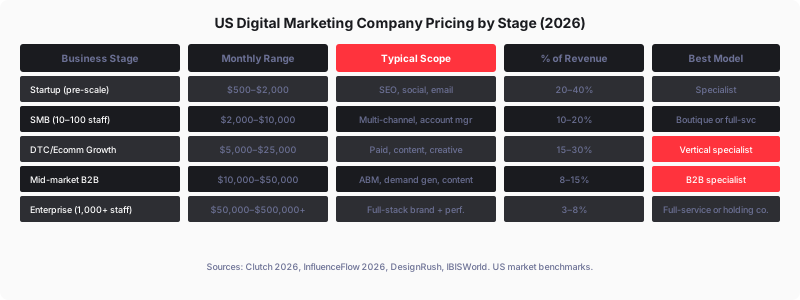
Two pricing trends are reshaping the 2026 market. AI tooling has reduced execution costs for content creation and reporting by 20 to 35% at agencies that have adopted it, creating downward pressure on execution-heavy retainers. Simultaneously, strategy, technical SEO, and conversion rate optimization pricing has held flat or increased, because those disciplines require human judgment that AI does not replace. Agencies that lead with execution are facing price compression; strategy-led firms are holding premium rates.
The practical implication: a $2,000 per month retainer with a US firm that uses AI tooling for execution can now deliver comparable output to a $3,000 retainer from two years ago. But a $2,000 retainer for strategic work (campaign architecture, channel mix decisions, creative brief development) is structurally insufficient regardless of AI adoption.
What to Evaluate Before Hiring
The seven criteria that consistently separate high-performing US digital marketing companies from ones that win pitches are specific and testable before signing a contract.
Require three case studies with named clients or independently verifiable outcomes. Generic logos with percentage improvements are not evidence. A firm that cannot produce real case studies in your category has not achieved the results it claims, or has not worked with brands comparable to yours.
Ask to meet the specific people who will work on your account before signing. The most common complaint in agency relationships is that senior sellers run the pitch and junior staff run the account. Confirming the actual execution team and their workload before onboarding prevents the most common failure mode.
Confirm that you will own all ad accounts, tracking pixels, and first-party data. Agencies that retain ownership of your accounts or resist giving direct platform access create dependency that is difficult and expensive to unwind. Any firm that resists this question is structurally misaligned with your interests.
Ask for the attribution methodology before the engagement starts. Firms that cannot articulate how they connect spend to revenue before onboarding will not be able to demonstrate it after. Attribution ambiguity protects the agency, not the client.
Require 30-day exit notice rather than 12-month lock-ins. Eight-figure US agencies retain 92% of clients annually versus 78% for seven-figure agencies, per Predictable Profits' agency benchmark report. Firms confident in their results do not need extended contracts to protect revenue.
Ask specifically about AI tooling and how it affects your account. AI-readiness now includes optimization for AI-driven search and LLM visibility, not just traditional SEO rankings. Firms that cannot explain their approach to emerging search formats are optimizing for a channel configuration that is actively changing.
Check client retention directly: ask for their average client relationship length over the last three years and whether you can speak to two current clients. The number below 18 months is a signal; the resistance to direct client contact is a disqualifier.
The Right Model for Your Stage
Best-in-class digital marketing firms across the US share the same structural characteristics regardless of size: senior execution on client accounts, clear attribution methodology, and performance-based contract terms that align incentives. The right marketing agency for your stage is the one with vertical pattern recognition in your business model and the operational capacity to act on what they find.
For growth-stage ecommerce and DTC brands evaluating US digital marketing partners, EmberTribe works on the demand generation programs that compound over time rather than producing isolated campaign results.

.webp)

.svg)


