
The search for the best digital marketing firms typically starts after a growth plateau or a failed agency relationship. By that point, most teams have already learned what a generic vendor looks like: broad service menus, account manager overhead, and reporting that describes activity rather than results. Finding a firm that actually moves revenue requires a different evaluation framework, starting with specialization and structure before getting to price.
The distinction between a "firm" and an "agency" is largely semantic in marketing, but it signals something about positioning. Firms tend to imply structured engagements, deeper specialization, and senior-level execution rather than delegated account management. What matters more than the label is whether the vendor demonstrates vertical experience in your business model.
Retainer engagements are the clearest proxy for client satisfaction. Clients on retainer contracts stay an average of 56 months versus 24 months for project-based clients, according to InfluenceFlow's 2026 agency benchmarking report, and retainer clients churn at 18% annually versus 42% for project clients. Firms with strong retainer books are building long-term relationships because they deliver measurable outcomes. Firms that default to project work often do so because their results do not justify ongoing investment.
Full-stack firms manage multiple channels: paid search, paid social, SEO, email, and content, all under one roof. They make sense for brands that want integrated execution and attribution without coordinating multiple vendors. The risk is diluted specialization: a firm that runs everything may not be best-in-class at any single channel.
Channel-specific specialists focus on one or two channels and go deep. A paid social firm that manages Meta, TikTok, and Pinterest campaigns exclusively develops pattern recognition across thousands of accounts that a generalist cannot replicate. SEM agencies operating purely in paid search build Google Ads account structures and bidding strategies that general firms rarely match. The tradeoff is coordination complexity when you need multiple channels covered simultaneously.
Vertical specialists focus on a specific business model: DTC ecommerce, B2B SaaS, healthcare, or local services. This is the highest-signal category when the vertical matches your business. A firm that has scaled 30 Shopify brands to $10 million understands creative fatigue cycles, contribution margin targets, and LTV models in ways that a generalist cannot replicate. At the $5 million to $20 million ARR inflection point for DTC brands, vertical expertise begins to matter more than channel depth, because strategic decisions require business model understanding, not just platform mechanics.
The evaluation framework differs significantly between B2B and DTC brands, and the best firms in each category are usually not the same firms.
For DTC and ecommerce brands, creative capability is the most important signal. Creative drives 60 to 70 percent of campaign performance on paid social platforms, according to internal Google data cited by Darkroom Agency. Meta's Andromeda algorithm has further shifted the platform away from audience signals toward creative signals, meaning a firm that produces strong ad creative outperforms one that excels at audience segmentation. Firms that combine performance media buying with in-house creative production are specifically built for this environment.
For B2B brands, account-based marketing capability is the differentiating factor. B2B companies that deploy ABM strategies see 87% higher ROI than those using broad-based approaches, per Forrester Research. The ABM services market reached $1.2 billion in 2024, reflecting how much B2B marketing has shifted toward precision targeting over volume. Firms with ABM-specific expertise (intent data integration, targeted account programs, and sales-marketing alignment) serve a fundamentally different need than firms optimized for DTC acquisition.
Digital marketing firms price in three main structures: flat monthly retainer, percentage of spend, or hybrid. The right structure depends on your stage and the channels being managed.

Flat retainers are common for content, SEO, and full-service engagements. Percentage of spend (typically 10 to 20 percent) is standard for paid media management, where the fee scales with the media budget. Hybrid models split a flat strategy fee from a variable media management fee. Seventy-eight percent of digital marketing firms use retainer pricing as their primary model, per InfluenceFlow 2026, which creates predictable cost for the client and stable revenue for the firm.
Pricing signals something beyond cost. A growth-stage firm charging $2,000 per month for full-service management is almost certainly understaffed or using offshore execution layers. Firms operating in the $3,000 to $7,000 monthly range for growth-stage brands can typically support senior execution on your account.
Boutique marketing agencies with narrow specializations often deliver more output per dollar at this tier than larger shops carrying account management overhead. Understanding how to choose the right marketing agency for your stage matters more than maximizing channel coverage per dollar spent.
The evaluation process should filter on fit, not just capability. These six questions surface the information that separates genuinely strong firms from ones that present well:
What is the average annual revenue of your current clients in my category? The answer reveals whether the firm has pattern recognition at your stage or is learning on your budget.
How many accounts does each strategist manage? More than eight accounts typically means reactive management rather than proactive optimization, regardless of how the firm describes its team structure.
Can you walk through your attribution methodology? Firms that cannot explain how they connect spend to pipeline or revenue are reporting activity, not outcomes.
What was your average client retention period over the last three years? A number below 18 months signals a client satisfaction problem. Strong firms can produce this number without hesitation.
Who specifically will work on my account, and can I meet them before signing? The most common complaint in agency relationships is senior sellers handing off to junior executors after the contract is signed. Insist on meeting the actual execution team.
What does success look like in 90 days, and how will you measure it? Firms that cannot define measurable 90-day milestones are not outcomes-oriented. Clear short-term benchmarks reveal whether the firm has realistic expectations for your category.
Guaranteed ROAS or ranking promises are the most visible red flag in any firm pitch. Results depend on competitive conditions, creative quality, and spend levels that no firm controls entirely. Long-term contracts of 12 or more months with no performance clauses lock clients into underperforming relationships with no recourse. Firms that lead with proprietary technology platforms rather than strategy are often selling software subscriptions with thin service wrappers on top.
Reporting dashboards that show impressions and clicks without connecting to revenue or pipeline are designed to demonstrate activity, not outcomes. A firm worth hiring can explain which dollars drove which results, even approximately. The best digital marketing agencies share the same quality signals regardless of size: they push back on unrealistic expectations, define measurable outcomes before starting, and surface problems before clients notice them.
The strongest predictor of a productive firm relationship is vertical alignment. A firm that has worked with 20 brands at your stage and business model has already encountered your specific problems. They know which channels work at your spend level, where creative bottlenecks typically appear, and what realistic performance looks like in your category. The evaluation time invested in finding vertical alignment pays back in avoided ramp time and failed experiments.
For growth-stage ecommerce and DTC brands evaluating demand generation partners, EmberTribe works on the content and paid media programs that build compounding pipeline rather than isolated campaign spikes.
In today's competitive B2B landscape, lead generation is the engine that powers sustainable revenue growth. One platform that has become a go-to solution for growth-focused teams is Apollo. By combining a massive B2B contact database with AI-powered outreach sequences, Apollo gives marketing and sales teams the infrastructure to generate qualified leads at scale while keeping cost per acquisition under control.
This guide breaks down how Apollo works, the strategies that drive results, and the metrics you should track to ensure every dollar spent delivers maximum return.
Apollo is a sales intelligence and engagement platform built for B2B lead generation. It provides access to a database of over 275 million contacts across 73 million companies, paired with tools for email sequencing, calling, task management, and analytics.
What sets Apollo apart from traditional prospecting tools is how it combines data enrichment with execution. Rather than purchasing a static list and importing it into a separate outreach tool, Apollo lets you identify prospects, enrich their profiles, build multi-step sequences, and track engagement - all inside a single platform.
For growth-stage companies that need to move quickly without hiring a large sales development team, Apollo eliminates the friction between research and action.
Getting results from Apollo starts with proper setup. A misconfigured instance leads to wasted emails, low reply rates, and poor data quality. Here is the foundational work that matters most.
Before running a single search, document your ideal customer profile (ICP) with specificity. Apollo's filters are powerful, but they only work when you know exactly who you are looking for. Key attributes to define include:
A tightly defined ICP reduces list size but dramatically increases conversion rates. Teams that skip this step often see open rates below 15% and reply rates below 1% - numbers that make outbound financially unviable.
Email deliverability is the silent killer of outbound campaigns. Apollo provides built-in tools to help, but you need to set them up proactively:
Bounce rates above 3% will damage your sender reputation and can land your domain on blocklists. This is one area where spending time upfront saves significant cost downstream.
Once your foundation is solid, the following strategies separate high-performing Apollo campaigns from average ones.
The days of single-touch outreach are over. Effective Apollo sequences typically include 5-8 touchpoints spread across 14-21 days, combining email, LinkedIn connection requests, and phone calls. A proven structure includes:
This multi-channel approach increases reply rates by 2-3x compared to email-only sequences because it meets prospects where they are most active.
Apollo's intent signals indicate when a company is actively researching topics related to your solution. Prospects showing buying intent convert at significantly higher rates than cold contacts because the timing aligns with their existing evaluation process.
Practical ways to leverage intent data include:
This approach is particularly effective for B2C and B2B lead generation teams that need to prioritize limited SDR capacity.
Generic templates get ignored. Apollo's AI features can help you personalize at scale by dynamically inserting company-specific data points, recent news mentions, and technographic details into your messaging. The key is balancing personalization with efficiency:
Generating leads is only valuable if you can prove the return. Here are the metrics that matter and how to track them effectively.
When evaluating your Apollo lead generation performance, track KPIs across three levels:
Activity metrics - These confirm your team is executing at the right volume:
Engagement metrics - These indicate whether your messaging resonates:
Revenue metrics - These connect outbound activity to business outcomes:
The most common mistake teams make is optimizing for activity metrics while ignoring revenue metrics. Sending more emails does not create value if those emails do not convert into pipeline.
Apollo's built-in analytics cover engagement metrics well, but you need additional tools for full-funnel visibility:
By analyzing data across these platforms, you gain a holistic view of which sequences, segments, and messaging strategies drive the highest return.
Even experienced teams make errors that erode performance. Watch for these common pitfalls:
Targeting too broadly. A list of 50,000 contacts feels productive but almost always underperforms a focused list of 2,000 well-researched prospects. Quality beats quantity in outbound.
Neglecting list hygiene. Contact data decays at roughly 30% per year. People change jobs, companies restructure, and email addresses go stale. Verify your lists regularly and remove contacts who have bounced or unsubscribed.
Sending without testing. A/B test subject lines, opening sentences, CTAs, and sequence length. Small improvements in open and reply rates compound significantly over thousands of sends.
Ignoring negative signals. When prospects unsubscribe, mark you as spam, or explicitly say they are not interested, respect those signals immediately. Continuing to contact them damages your domain reputation and brand.
Failing to align sales and marketing. Apollo works best when marketing and sales teams share a unified ICP, consistent messaging, and clear handoff processes. Misalignment leads to duplicated effort and conflicting outreach.
Once you have a proven sequence generating positive ROI, the next step is scaling without sacrificing quality. Key scaling levers include:
The goal is building a repeatable, measurable outbound engine that generates predictable pipeline month over month - not sporadic bursts of activity followed by periods of inaction.
Apollo lead generation offers B2B teams a powerful, consolidated platform to identify, engage, and convert qualified prospects. But the platform alone does not guarantee results. Success depends on precise targeting, disciplined execution, deliverability hygiene, and rigorous measurement.
Start with a tightly defined ICP, build multi-touch sequences that provide genuine value, track metrics at every stage of the funnel, and continuously optimize based on data. When these elements come together, Apollo becomes one of the highest-ROI investments in your growth stack.

& nbsp;

In this post:
This is the question Halley, our Director of Marketing, wants to help you figure out.
If you don’t know what we mean by “cashflow runway,” we’re definitely not talking about planes, trains, or automobiles. We’re talking about creating a strategic way to fund your eCommerce brand—this is your cash flow runway.
A lot of business owners don’t look at this. They just look at their bank accounts and see their balance, and take this information at face value. What they’re overlooking is the timeline for how long that cash is going to last. This is especially important to think about when you’re thinking about ways to grow your eCommerce business — and aligning your cash position with a clear ecommerce growth strategy ensures your runway actually funds the right bets.
Your cash flow runway is a crucial component of growth that a lot of founders and store owners ignore. Don’t be one of them!
In short, your cash flow is how much money you have, divided by the monthly costs of running your business (sometimes referred to as “burn rate”).

So if you have $200,000 in the bank and it costs $50,000 per month to keep your business running, you have a four-month cash flow runway.
This is a simple formula for a very important piece of information! Your cash flow calculation helps you see where (and when) you’re going to need a cash injection from an investor like Clearco. With an investment, you’re able to focus on growth without worrying about running out of critical funds.
You should check your cash flow runway frequently. Is your burn rate increasing? Do you have the funds on hand to keep your store live for 3 months? 6 months? 9 months? If you’re constantly short on cash and short on time trying to keep up with your invoices and billing, you should consider seeking opportunities to inject your business with additional cash.
This is a tough question! If you’re running out of money and your cash flow runway has become a cash flow parking lot, there are still steps you can take to keep your business afloat. First, you should look at cutting immediate expenses to save on costs. You can also look at what inventory you have existing and run a sale for a product you have a lot of inventory for to get a quick injection of cash. And, finally, if you qualify for funding from reputable eCommerce investors, like Clearco, we would encourage you to jump on the opportunity!
In short: it depends. The answer comes down to how realistic your goals are in relation to the channel fit. In other words, the less proven a channel is for a business, the more they should expect to spend on that channel before they start seeing positive returns.
There are so many digital advertising channels and, if you’re not careful, it can be easy to overspend on strategies that just aren’t working for you. There is such a thing as growing too fast, and that often comes from investing in too many channels that aren’t bringing returns
Maybe you're investing in Facebook, TikTok, Pinterest, and Snapchat, but in reality, you should only be investing in one. Usually, for our eCommerce clients, we recommend advertising on Facebook. Facebook (which also includes Instagram ads) is a powerful platform for testing and selling products. It’s a great starting point for testing a lot of messaging, position, and pricing. Ha.ving one solid platform that can give you valuable insights into how your funnel is performing gives key findings that can be used to expand to other channels. This approach also gives you early benchmarks to test against when you’re figuring out your advertising budget.
Before embarking on any new marketing initiative, you should consider what the impact would be if it:
If the result of those scenarios is that the business goes under or is irreparably damaged, don't do it. That's not experimenting or taking a risk, that's gambling.
If you’re curious about strategic ways to turn your cash flow runway into a growth runway with sustainable growth systems, book a discovery call with our team to get started!

Product-led growth (PLG) is a business strategy where the product itself serves as the primary driver of customer acquisition, activation, retention, and expansion. Instead of relying on sales teams or marketing campaigns to push prospects through a funnel, PLG companies let users experience the product first and convert themselves.
The model is not new, but it has become the dominant growth strategy for some of the fastest-growing software companies in the world. Slack, Dropbox, Zoom, Figma, and Notion all grew to billions in valuation by putting the product at the center of their go-to-market strategy.
For growth marketers, understanding PLG is essential because it fundamentally changes how you think about acquisition channels, conversion metrics, and the relationship between marketing and product.
Traditional sales-led growth follows a linear path: marketing generates leads, sales qualifies and closes them, and then customers begin using the product. In a PLG model, the sequence is inverted. Users start using the product first, often through a free trial or freemium tier, and commercial conversations happen after value has been demonstrated.
1. Acquisition Through the Product
In a PLG model, the product itself generates new users through built-in viral loops, referral mechanisms, and organic word-of-mouth. When a user shares a Figma design file with a colleague, that colleague becomes a new user. When a Slack workspace grows, every new team member becomes an active user without any marketing intervention.
This self-serve acquisition model dramatically reduces customer acquisition cost (CAC) because the product is doing work that would otherwise require paid advertising, content marketing, or outbound sales.
2. Activation and the "Aha Moment"
The most critical metric in any PLG strategy is time-to-value. How quickly can a new user experience the core benefit of your product? The best PLG companies obsess over removing friction from this path.
Activation rate, the percentage of new signups who reach a meaningful first action, is often the single most important metric for PLG companies. It directly correlates with long-term retention and willingness to pay.
Common activation benchmarks:
3. Expansion and Revenue Growth
PLG companies grow revenue primarily through expansion, not by acquiring new logos. Once a user is active and deriving value, the product naturally creates opportunities to upgrade:
This expansion motion is why PLG companies often have net revenue retention rates above 120%, meaning existing customers generate 20% more revenue year over year even before accounting for new customer acquisition.
PLG is not a universal solution. It works exceptionally well in specific conditions and poorly in others.
Many successful companies use a hybrid approach, running PLG for small and mid-market customers while maintaining a sales-led motion for enterprise deals. This is sometimes called a "product-led sales" model.
If you are considering a product-led growth strategy, the transition requires changes across product, marketing, and sales functions.
The foundation of PLG is giving users meaningful access to your product without requiring a purchase commitment. You have three primary models:
The key decision is how much value to give away for free. Too little and users never reach the activation moment. Too much and there is no reason to upgrade. The best PLG companies find the precise boundary where free users get enough value to stay engaged but need premium features to get maximum benefit.
You cannot optimize what you do not measure. PLG requires granular product analytics to understand how users move from signup to activation. Track:
Tools like Mixpanel, Amplitude, and Heap are purpose-built for this kind of product analytics. The data they provide becomes the foundation for optimizing your funnel and improving conversion at every stage.
Sustainable PLG growth comes from loops, not funnels. A growth loop is a mechanism where user activity generates inputs that drive more user acquisition. Common examples:
These loops compound over time, creating exponential growth trajectories that linear marketing campaigns cannot match.
PLG companies typically organize differently than sales-led organizations. Key structural elements include:
If you are running a PLG strategy, these are the metrics that tell you whether it is working: MetricWhat It MeasuresStrong BenchmarkActivation Rate% of signups reaching first value moment40-60%Free-to-Paid Conversion% of free users who upgrade5-7%Time to ValueHow quickly users experience core benefitUnder 5 minutesNet Revenue RetentionRevenue growth from existing customers120%+Viral CoefficientNew users generated per existing userAbove 0.5Product-Qualified LeadsFree users showing buying intentVaries by product
These metrics complement traditional growth marketing KPIs but reflect the product-centric nature of the PLG model.
While PLG originated in SaaS, its principles apply more broadly than most marketers realize. DTC ecommerce brands can adopt PLG thinking by:
The core principle is the same regardless of industry: reduce the barrier to experiencing your product, deliver value quickly, and let satisfied users become your most effective growth channel.
Product-led growth is not a tactic. It is a fundamental shift in how companies acquire and grow customers. The PLG model succeeds because it aligns the interests of the company with the interests of the user: deliver value first, capture revenue second.
For growth marketers, understanding PLG is no longer optional. Even if your organization runs a sales-led motion today, PLG principles around activation, time-to-value, and product-driven acquisition are shaping how every growth team operates. The companies that master this intersection of product and marketing will define the next era of growth.
Here at EmberTribe, we are continually running different tests and helping our clients find their best approach for their growth marketing. This is not a cut-and-dry approach because every brand and their target audience is different.
When it comes to some of ourbest-performing ads, you will notice they are all very diverse and customized for the brand they represent.
Here are some key ad creation concepts that are currently working to boost engagement for some of our clients.
Get a look inside how we develop ad angles, experiment with creative, and generate ads that get results with these 9 components of a high-performing ad.

This ad may not necessarily seem like a show-stopper, but it’s pulling in 80% of this client's email leads. Between the alluring look of the image with the message overlay and the direct call to the customer within the first two lines of the ad copy, people are drawn to stop.
The copy is direct and engaging for the people it’s supposed to be engaging for. The people who aren’t within the target audience will just scroll right by (which means fewer wasted clicks for the client).
You don’t need to target everyone. In fact, you shouldn’t target everyone. Pinpointing a very select audience is the best way to create the kind of ad that is going to speak to the right people.

Targeting the middle-of-the-funnel crowd worked well for Casa Pilates Equipment. Rather than shoot for those at the very beginning of the buyer’s journey, this ad is jumping right into that mid-point, where the targeted audience has beyond beginner knowledge about yoga and may be looking to add some equipment to their home studio.
Adding the title “My Self-Quarantine Savior!” resonated with the users who were feeling stuck at home. The copy stays focused on the buyer, clarifying how the Casa Pilates team is there to help, how customers are happy with the great service, and how the machines are made to be durable investments.
This ad worked well for remarketing purposes, targeting the crowd that was already somewhat familiar with Casa Pilates Equipment.

For this ad, the client clearly had an edge—they had their product on Kelly Ripa and we were able to include this 50-second clip of her raving about it. This was paired with a very short, interest-piquing quote from Kelly (“This is quite possibly the greatest thing ever”) and a quick two-liner about the product.
If you have a high-quality asset, like this video, you don’t have to try to add competing text. We let the asset shine on its own and it quickly became a high-performer for this client.
Essentially, you want to get out of the way and let a video like this do all the talking for you.

This ad is another one that might not seem like much at first glance, but all the elements are working for it.
These are top-sellers on the site and the ad plays blinking text that is just enough to catch someone’s eye as they are scrolling past. It is a great ad for a top-of-the-funnel lead because it showcases these products and offers a simple introduction to the brand.
“The best yard games for any age” is a title that communicates plenty of other game options. The text itself on the image “NEW GAMES, NEW ARRIVALS” is a call to novelty, which is often a great tool for piquing interest and getting the click-thru.
This example is the top-earning ad for this client.
A 10-second smack-in-the-face video of images with text overlay is very attention-grabbing for just about anyone, but really speaks to the Bulletprute audience.
We know that we're targeting a very cut-and-dry audience that is after quality and wants to know what they're getting for the money. Knowing your audience well is a huge asset that is crucial for a successful campaign.
An ad trying to evoke sadness, joy or excitement just wouldn’t go over nearly as well with this audience. This ad feels inspirational and gritty but places a lot of focus on the product's durability and value.
Including the link within the ad text offers a double CTA that often works well.

This product is targeting a very specific type of hair (3-4C curls), so the video of it in action offers a lot of impact. Showing the brush gently and easily slide through the thick, healthy hair is a huge selling point.
Anyone with this type of hair is familiar with how much the small bristles can get caught and tangle the hair. The thick nature of the product is a huge selling point and this ad centered in on that value. The ad copy backs this value with the 100% satisfaction guarantee promise.

This is a story-telling ad with a powerful video that reveals the story behind Combat Flags. Telling the audience about the company’s “why” often makes a big difference in how customers perceive the value.
There are a lot of people who make similar kinds of patches, but Dan is a veteran who creates patches from retired fatigues. His mission really sets apart his brand.
In the past, he was able to get traffic by just including product images. But, this story-telling ad really took the attention to the next level. People want to know about the companies they are supporting. They will choose a good story over a generic one just about every time.

This stunning image showcases everything beautiful about beachwear. The women pictured are in a natural element and look like they are just walking through the seagrass near beach dunes. From their hair to their outfits and surroundings—nothing looks contrived or overdone. They look comfortable and happy—which are huge selling points for swimsuits.
The ad copy mentions “luxe” which is then repeated in concept by the title, “Inspired by the lush textures found in a Moroccan market…”
This ad appeals to an unusual product value for this industry and it uses an authentic (but polished) approach that is very appealing to those in its target audience.

Don’t be afraid to let the focus fall directly on the product. This appealing image is very reminiscent of the flat lays that are popular on Instagram. It lets the coffee speak for itself. And, the audience targeted here is one seeking out simply good brands and love pour-over coffee.
The “FREE Shipping over $25” is an offer that is likely to pique some interest. Many free shipping promises start at $35 (Target) or higher, and $25 doesn’t sound like an unreasonable amount to spend on coffee to someone who will go through a few bags in just as many weeks.
Getting an offer into the ad can sometimes get a click-through. In this case, the product looks good, plus interests leads to check out how many bags they need to buy to get to the free shipping.
Are you trying to up your ad game? Our growth marketing agency team could help.
We work with clients spanning all industries to pinpoint their audience and increase their traffic through paid social. We focus on the metrics to find the growth marketing ads that work best for you.
If you're ready to outsource, we can help take the load off.
Talk to us today about how to get better results with your ad spend.
If you have a store on Shopify, you are in it to generate sales.
One of the best ways to drive revenue is through email marketing to your Shopify customers. Email marketing is a powerful tool for retaining customers and keeping them engaged with your brand long after the initial purchase.
A valuable feature of Shopify is that each time customers create an account at your eCommerce site, they are agreeing to receive messages from your store. That lays the foundation for using Shopify email marketing as a direct connection to your customers - one that you own and control entirely.
Unlike social media or paid ads, which customers may scroll past without noticing, emails are delivered directly to their inbox. Email marketing also provides an exceptionally high ROI. For every dollar you spend on email marketing, companies report an average return of $42 - a figure that consistently outperforms every other digital channel.
If you are looking for D2C (direct-to-consumer) email marketing templates to help ramp up sales, here is what you need to know.
Before diving into the specific templates, it is worth understanding why email deserves a central role in your Shopify marketing stack.
You own the channel. Unlike Facebook or Instagram, where algorithm changes can cut your reach overnight, your email list is an asset you fully control. No platform can throttle your access to subscribers who opted in.
Segmentation drives personalization. Shopify's native data - purchase history, browsing behavior, average order value - allows you to segment your audience and send highly relevant messages. Personalized emails generate transaction rates six times higher than generic broadcasts.
Email fuels the full funnel. From upper-funnel awareness through lower-funnel conversion, email meets customers at every stage. Welcome sequences introduce your brand, post-purchase flows build loyalty, and win-back campaigns re-engage lapsed buyers.
Timing is automated. The most effective Shopify email marketing strategies rely on behavioral triggers rather than manual sends. When a customer takes (or does not take) a specific action, the right message arrives automatically at the right moment.
There are many Shopify email marketing templates you may choose to test with your customers. However, the three most important Shopify emails you need in your toolbox are:
We are going to break down the purpose of each of these message types, provide examples, and give you free customizable email templates to use for your Shopify store.
The welcome email is your first formal introduction to your customers. They might have found you through an ad, through social media, or via organic search, but up until this point you have not had the opportunity to speak directly to your audience. With emails, you can send highly personalized messages to people who have entered your funnel.
This email should introduce your brand, define your unique selling proposition, and nudge people to become customers.
Key metrics to watch: Open rates for welcome emails typically range from 50-60%, far exceeding the 15-25% average for regular marketing emails. If your welcome email open rate falls below 40%, revisit your subject line and sender name.
Subject: Welcome to our family!
Janna, thanks for joining our community!
We believe in using only carbon-neutral raw materials and sustainable products to create a diverse line of distinct and colorful jewelry that will make you look great.
Check out our new springtime collection and get 10% off your first order.
SHOP NOW
Subject: Welcome to our family!
[FIRST NAME], thanks for joining our community!
We believe in [UNIQUE VALUE PROPOSITION].
Check out [PRODUCT or COLLECTION] and [OFFER] for your first order.
[Call-to-action button]
After a purchase, you should always send a thank you to your customer to solidify the relationship and reassure them that their order is being processed.
This email message should also include order and tracking information.
Order confirmation emails have the highest open rates in eCommerce - often exceeding 70%. Now that you have your customer's attention, you have a prime opportunity to upsell related products or offer an additional incentive to attract repeat business.
Subject: Your order confirmation
Lindsey, thanks for the order! We will process it as soon as possible and let you know when it is shipped.
Here is your order summary:
View your order online. If you have any questions about your order, please contact us.
Customers that bought this often purchased these items.
It is not too late to add them to your purchase and get them delivered together with no additional shipping charges.
If you order from us again, please use the discount code SUMMERTIME10 for 10% off your next order. Remember, shipping is always free!
SHOP NOW
Subject: Your order confirmation
[First Name], thanks for the order! We will process it as soon as possible and let you know when it is shipped.
Here is your order summary:
[LIST ORDER DETAILS]
View your order online [Include a link]. If you have any questions about your order, please contact us [Link to contact information].
Customers that bought this often purchased these items.
[LIST COMPATIBLE ITEMS]
It is not too late to add them to your purchase and get them delivered together with no additional shipping charges.
If you order from us again, please use this [OFFER] for [EXCLUSIVE BENEFIT], and remember [UNIQUE CUSTOMER SERVICE CALL OUT]!
[Call-to-action button]
When an item ships, you should also send a shipping email with an order update and tracking information. It is another effective touchpoint to seek additional sales.
Subject: Your Order Has Shipped
Logan, your order #1234567890 has shipped.
It is scheduled to arrive on May 3rd via UPS. Use tracking number 0000000000000456 to follow its journey to your door.
We want to thank you for being a loyal customer and offer you this exclusive discount code for your next order. Use code IMAHAPPYCUSTOMER to get 10% off your next purchase.
Subject: Your Order Has Shipped
[FIRST NAME], your order [ORDER NUMBER] has shipped. It is scheduled to arrive on [DATE] via UPS. Use tracking number [TRACKING NUMBER] to follow its journey to your door.
We want to thank you for being a loyal customer and offer you this exclusive discount code for your next order. Use code [UNIQUE CODE] to get [OFFER].
It is frustrating that so many shoppers select items and put them in their shopping carts but never complete the sale. More than 8 out of 10 online shopping orders were abandoned in recent years, according to industry data. These are prime targets for remarketing.
Think of the abandoned cart email in two stages. The first should be sent within an hour after the abandonment occurs. It should remind shoppers that they did not complete the sale. The second should occur a day or two after the first email to remind them again and offer them an incentive to convert.
Subject: Your cart is waiting
Trina, are you still thinking it over? We noticed you left some items in your shopping cart. Do not worry, they are still waiting for you!
Click here to keep shopping
Subject: Your cart is waiting
[FIRST NAME], are you still thinking it over?
We noticed you left some items in your shopping cart. Do not worry, they are still waiting for you!
[CALL-TO-ACTION]
Subject: Items in your cart are about to expire
Trina, those items you left in your shopping cart are about to expire. If you are ready to make your purchase, act now!
Still not sure? If you buy within the next 24 hours, you can use the special discount code 5OFFTODAY to get a 5% discount on your purchase.
USE DISCOUNT
[FIRST NAME], those items you left in your shopping cart are about to expire. If you are ready to make your purchase, act now!
Still not sure? If you [ACTION TO TAKE], you can use the [SPECIAL OFFER] on your purchase.
[CALL-TO-ACTION BUTTON]
If they have not acted after the second email, they are probably not going to convert on this purchase for the time being, but at least they have entered your funnel.
The difference between a mediocre abandoned cart sequence and a high-performing one comes down to timing and escalation:
Even modest recovery rates translate to significant revenue at scale. A store processing 1,000 abandoned carts per month that recovers just 10% is reclaiming 100 orders that would have otherwise been lost.
Launching email campaigns is only the beginning. To continuously improve your Shopify email marketing, track these core metrics:
For a deeper understanding of how email communications flow and impact deliverability, review our guide on email flow fundamentals.
Another effective email tactic is targeted at lapsed customers. It can be as simple as letting customers know you have missed them, highlighting a product or new promotion, and adding an incentive to entice them to re-engage.
You may also want to use email marketing for:
Consider pairing your email strategy with SMS marketing for time-sensitive offers and transactional updates. SMS open rates exceed 95%, making it an ideal complement to email for abandoned cart recovery and shipping notifications.
For brands exploring the ideal format for their regular newsletters, our analysis of newsletter length best practices provides data-driven guidance on keeping subscribers engaged without overwhelming them.
EmberTribe is an eCommerce Digital Marketing Agency that gets results. We use email marketing as part of our proven growth system that has driven hundreds of millions of dollars in eCommerce sales. While email marketing is an important part of your growth strategy, it takes a comprehensive marketing strategy to achieve greatness.
If you are ready to significantly increase conversions and revenue for your D2C eCommerce site, contact us at EmberTribe today and let us help you grow your business.
This post is part of a blog series, "Here Be Metrics," breaking down the primary aspects of the so-called pirate metrics for growth marketing. Keep up with this series and others by subscribing to our blog!
Seeing a skull and bones on the high seas sent people fleeing in fear of imminent attack, for pirates wasted little time once their presence was known.

Although they should not attack customers, corporations today should likewise waste little time taking action once a target sees their brand. The move from awareness to acquisition is a critical process in the customer lifecycle, and the businesses that master it build the foundation for sustainable, profitable growth.
In the pirate metrics framework (AAARRR: Awareness, Acquisition, Activation, Revenue, Retention, Referral), acquisition sits at a pivotal point. It is the moment when an anonymous audience member becomes a known contact, a lead, or a customer. Everything that follows in the growth engine depends on how effectively you execute this transition.
The goal of acquisition is to move people from undefined groups to individual leads or customers. It is the conversion from passive observer to active participant in your brand's ecosystem.
While cannons and swords were effective when pillaging ships and towns along the high seas, today's civilized markets call for a more nuanced approach. Corporations must entice, rather than force, customers to join their tribe.
Image Credit: 500 Hats
Acquisition can be defined as the moment of the very first transaction with a customer, or simply the act of bringing new customers and clients into your business. This transaction often is not a monetary payment for goods or services. Instead, it is normally an exchange of information and permission. The target audience volunteers their personal information with the understanding that the company will contact them in the future.
To entice customers to make this exchange, many companies offer immediate value in return. Coupons, PDF downloads, ebooks, free trials, and membership deals are all common offerings that serve as the catalyst for converting an interested visitor into an identifiable lead.
Image Credit: 500 Hats
With regard to metrics, acquisition focuses on data related to lead capture and the efficiency of your conversion process. Understanding these numbers is fundamental to optimizing your sales funnel and improving growth over time.
These metrics tell you how many potential customers you are bringing into your pipeline:
Volume alone tells an incomplete story. These metrics reveal how efficiently your acquisition engine operates:
The relationship between these metrics matters as much as the individual numbers. A low CPL is meaningless if those leads never convert to customers. A high CAC is acceptable if lifetime value is proportionally higher. Growth marketers obsess over the ratios and unit economics, not vanity metrics in isolation. This approach to understanding what truly matters beyond surface-level ROAS separates effective acquisition strategies from wasteful ones.
For online marketing campaigns, the volume of acquisition data available makes this metric category particularly powerful. In addition to the core metrics listed above, digital marketers can access highly granular data points including:
With such detailed information, the moment of acquisition can be fine-tuned to maximize the conversion rate and minimize the cost of acquisition. This data-driven approach is what separates modern growth marketing from traditional advertising.
Tracking metrics is necessary but not sufficient. You need a deliberate strategy for generating leads and converting them efficiently. Here is a framework for building acquisition systems that scale.
Relying on a single channel for customer acquisition is fragile. Algorithm changes, cost increases, or market shifts can devastate your pipeline overnight. The most resilient acquisition strategies spread effort across multiple growth marketing channels:
The gap between a visitor arriving at your site and that visitor becoming a lead is where acquisition happens. Every element of the lead capture experience affects your conversion rate:
Landing pages. Dedicated landing pages with a single CTA consistently outperform general website pages for lead capture. Remove navigation, minimize distractions, and focus every element on the conversion goal.
Forms. Ask for only the information you need at the point of capture. Every additional field reduces completion rates. You can always collect more data later in the relationship.
Lead magnets. The value exchange must feel fair to the prospect. A generic "subscribe to our newsletter" CTA underperforms a specific, high-value offer like "Download our 2026 DTC Growth Playbook" or "Get a free audit of your ad account."
Social proof. Testimonials, client logos, case study results, and review scores near your lead capture points reduce friction and increase trust. Showing real results, like the outcomes from proven case studies, gives prospects confidence to take the next step.
Acquisition does not exist in a vacuum. It is one step in a larger journey that begins with awareness and extends through activation, revenue, retention, and referral. The most effective acquisition strategies consider what happens before and after the lead capture moment.
Before acquisition: Invest in awareness-stage content and advertising that warms your target audience before asking for anything in return. Cold audiences who have had zero prior exposure to your brand convert at significantly lower rates than those who have engaged with your content.
After acquisition: Plan your activation sequence before you generate leads. A lead that sits in your database without a follow-up plan is a wasted acquisition. Automated email sequences, personalized outreach, and timely follow-up calls ensure that new leads move toward the next stage of the funnel rather than going cold.
Even experienced marketers make acquisition errors that limit growth. Watch for these common pitfalls:
Optimizing for the wrong metric. Maximizing lead volume while ignoring lead quality fills your pipeline with contacts who will never buy. Focus on qualified leads and downstream conversion rates, not raw numbers.
Ignoring channel attribution. If you cannot attribute leads to specific channels and campaigns, you cannot optimize your spend. Invest in proper tracking and attribution before scaling your budget. Understanding which audiences to target for lead generation requires solid attribution data.
Neglecting the post-capture experience. Acquisition is not the finish line. A lead captured without a clear activation path is money spent with no return. Build your nurture sequences and sales processes before you increase acquisition spend.
Over-investing in one channel. Even if one channel is performing well today, market conditions change. Allocate a portion of your budget to testing new channels continuously.
Do not waste time delaying acquisition. The moment your target demographic becomes aware of your brand, move toward actions that will acquire them as customers. The pirates of the high seas did not dally, and neither should you.
Start by auditing your current acquisition metrics. Calculate your CAC, measure your lead conversion rates by channel, and identify the biggest drop-off points in your funnel. Then prioritize the improvements that will have the highest impact on volume and efficiency.
Acquisition is the engine that powers every subsequent stage of the growth marketing framework. Master it, measure it relentlessly, and optimize it continuously, and you build the foundation for a business that scales predictably and profitably.
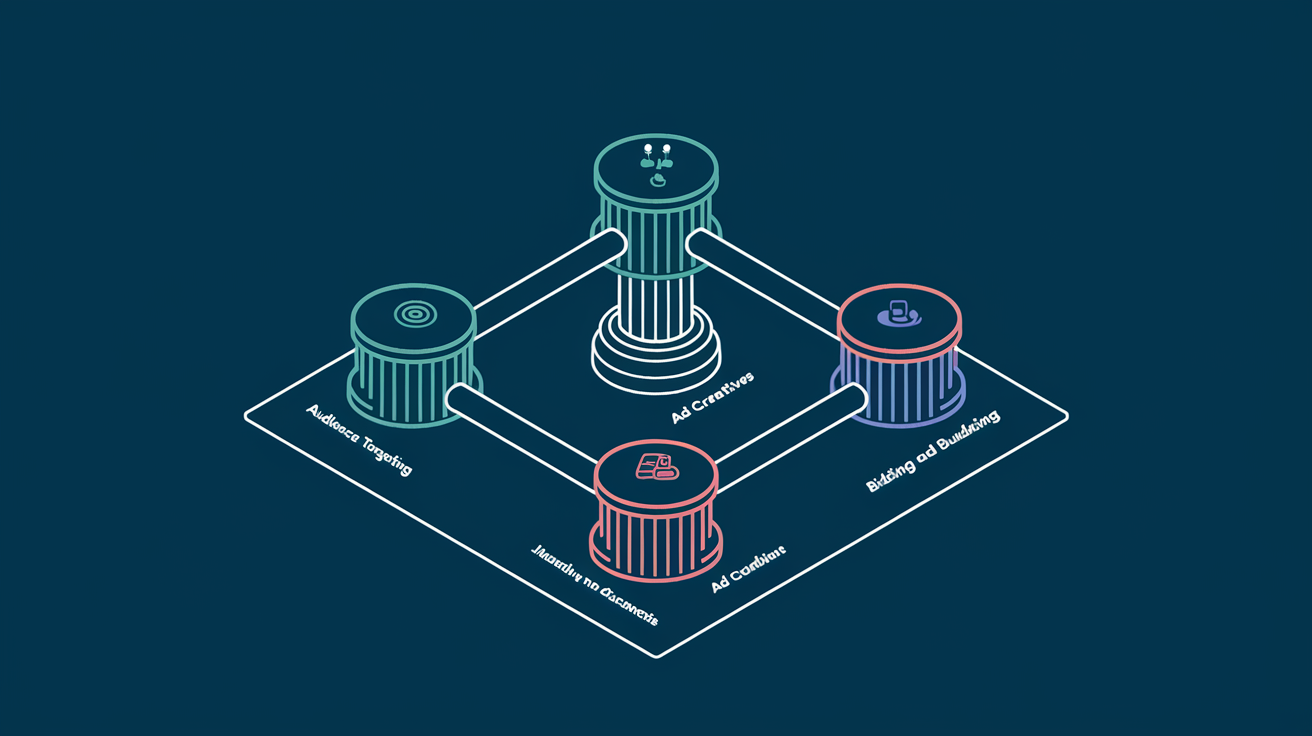
Facebook's Power 5 is a set of five automated advertising tactics that work together to improve campaign performance. Introduced by Meta as a best-practice framework, the Power 5 represents the platform's recommended approach to running ads that leverage machine learning effectively.
The five components are:
Each element works independently, but their real value emerges when used together. The Power 5 framework essentially asks advertisers to trust the algorithm with more decisions, in exchange for better performance at scale.
For Facebook advertisers who have been manually optimizing every aspect of their campaigns, this can feel counterintuitive. But the data consistently shows that advertisers who adopt these practices outperform those who insist on manual control across every variable.
Auto Advanced Matching (AAM) improves the connection between actions taken on your website and the Facebook users who took them. It works by automatically sending hashed customer information from your website, such as email addresses, phone numbers, names, and location data, to Facebook when a conversion event fires.
Without AAM enabled, Facebook relies solely on the pixel cookie to match website conversions to user profiles. As browser restrictions on third-party cookies tighten and users browse across multiple devices, cookie-based tracking misses a growing share of conversions.
AAM fills those gaps by sending additional identifiers that Facebook can use to match conversions to users. The result is more accurate attribution, larger retargeting audiences, and better optimization signals for the algorithm.
For ecommerce stores using Shopify or WooCommerce, AAM is typically enabled by default through their Facebook integrations. For custom-built sites, work with your development team to ensure the correct data layer variables are being captured.
The impact is significant. Enabling AAM typically increases custom audience match rates by 10-30% and improves attributed conversions by 5-15%.
Campaign Budget Optimization moves budget control from the ad set level to the campaign level. Instead of assigning a fixed daily budget to each ad set, you set one budget for the entire campaign and let Facebook's algorithm distribute spending across ad sets based on performance.
In a traditional setup, an advertiser might run five ad sets at $50/day each, spending $250/day total. If one ad set performs exceptionally well and another performs poorly, each still receives its fixed $50 allocation.
With CBO, the same $250/day budget is allocated dynamically. The high-performing ad set might receive $150 while the underperformer gets $20. The algorithm rebalances in real time based on which audiences are delivering the best results.
CBO is particularly powerful when combined with simplified account structure because fewer campaigns mean each campaign receives more budget, giving the algorithm more data to optimize with.
This is perhaps the most impactful and least intuitive element of the Power 5. Facebook's recommendation is to consolidate your account into fewer campaigns, fewer ad sets, and fewer ads rather than creating highly segmented structures.
Many advertisers instinctively create separate campaigns for every audience, every funnel stage, and every product line. A typical over-segmented account might have 20+ campaigns running simultaneously, each with 3-5 ad sets containing 2-3 ads.
This feels like control, but it actually works against you because:
A well-structured Facebook account for most advertisers needs only 3-5 campaigns:
Within each campaign, consolidate audiences rather than fragmenting them. Let the algorithm decide who within a broader audience set is most likely to convert.
This structure works especially well for ecommerce brands running catalog-based advertising, where dynamic ads can serve the right product to the right user without manual audience segmentation.
When you create an ad set, Facebook lets you choose where your ads appear: Feed, Stories, Reels, Marketplace, Audience Network, Messenger, and more. Automatic placements means letting Facebook decide where to show each ad based on where it is most likely to achieve your objective.
The hesitation is understandable. Advertisers worry about their carefully designed feed ads being stretched awkwardly into Stories format, or about budget being wasted on low-quality Audience Network placements.
These concerns were more valid in the early days. Facebook has significantly improved how creative adapts across placements, and the algorithm has gotten better at identifying which placements deliver actual results for each campaign.
Across our managed accounts, campaigns using automatic placements consistently achieved 10-25% lower cost per result compared to manual placement selection. The algorithm finds inventory pockets that manual selection misses, particularly in less competitive placements where CPMs are significantly lower.
Dynamic ads automatically show the right products to people who have expressed interest on your website, in your app, or elsewhere on the internet. Instead of manually creating individual ads for each product, you connect your product catalog and let Facebook generate ads dynamically.
The system connects three inputs:
When a user views a product on your site but does not purchase, Facebook can show them an ad featuring that exact product (and similar items) the next time they open the platform. This is dynamic retargeting at its most effective.
Dynamic ads are not limited to retargeting. Facebook's Dynamic Ads for Broad Audiences (DABA) uses machine learning to show products from your catalog to prospecting audiences who have never visited your site.
The algorithm analyzes user behavior patterns, product attributes, and conversion signals to predict which products each user is most likely to purchase. For catalogs with hundreds or thousands of products, this is far more efficient than manual ad creation.
The real value of the Power 5 framework is not any single element. It is how they compound when used together.
Consider the combined effect:
Each element reduces manual control in favor of algorithmic optimization. And each element provides better data to the others, creating a virtuous cycle of improving performance.
Here is a practical sequence for implementing the Power 5 in your account:
The Power 5 framework represents Facebook's clearest articulation of how advertisers should work with, rather than against, the platform's machine learning capabilities. Advertisers who embrace algorithmic optimization and feed the system with clean data and strong creative consistently outperform those who cling to manual control.
The platform has changed. The strategies that worked when manual optimization was superior, including hyper-segmented audiences, manual placement selection, and ad-set-level budgets, now actively hinder performance. The Power 5 is not just a recommendation. For serious Facebook advertisers, it is the operating system for modern campaign management.

Most growth-stage companies run their CRM and marketing automation as separate systems. The sales team works in the CRM. The marketing team works in the automation platform. Data flows between them inconsistently, if at all. This disconnection creates blind spots, wasted effort, and lost revenue.
Integrating your CRM with your marketing automation platform eliminates the gap between marketing and sales. It gives both teams a shared view of every lead and customer, enables smarter segmentation, and creates the feedback loops that drive continuous improvement. Below are the specific benefits and how to capture them.
Before diving into benefits, it helps to clarify what integration looks like in practice. A true integration is not just syncing contact lists between two platforms. It is a bidirectional data flow where:
This integration turns two isolated tools into a single growth engine that aligns marketing and sales around shared data and shared goals.
Without integration, marketing defines a "qualified lead" by one set of criteria and sales defines it by another. The result is predictable: marketing passes leads that sales ignores, and both teams blame each other for poor performance.
When marketing automation and CRM share data, you can build lead scoring models that incorporate both marketing engagement (behavioral data) and sales qualification (fit data). A lead who downloads three whitepapers, visits the pricing page, and matches your ideal customer profile in the CRM receives a higher score than a lead who only opened one email.
This composite scoring approach ensures that marketing only passes leads to sales when they meet both engagement and fit thresholds. The result is fewer wasted sales conversations and a higher conversion rate from SQL to closed deal.
Effective lead scoring is a foundational element of any strong lead generation program. Integration makes it possible to score based on the full picture rather than partial data.
Generic marketing campaigns produce generic results. The brands that outperform consistently are those that deliver the right message to the right person at the right time. CRM and marketing automation integration makes this possible at scale.
Personalization powered by CRM integration mirrors what we see in effective email marketing for ecommerce, where lifecycle triggers and behavioral data drive significantly higher engagement and revenue per recipient.
Long sales cycles cost money. Every additional week a deal sits in your pipeline consumes sales rep time, increases the probability of competitive loss, and delays revenue recognition. CRM and marketing automation integration compresses sales cycles by keeping leads warm and informed throughout the buying process.
The cumulative effect is a buyer who arrives at each sales conversation better informed, more confident, and closer to a decision. This is especially valuable for brands working to optimize their sales funnel end to end.
One of the most persistent challenges in marketing is proving ROI. Which campaigns actually influenced revenue? Which channels produce leads that close? Without CRM integration, marketing can only report on top-of-funnel metrics like leads generated and email engagement. With integration, marketing can trace revenue back to the campaigns, content, and channels that originated and nurtured the deal.
Closed-loop reporting transforms marketing from a cost center into a revenue contributor with provable impact. It also provides the data needed to maximize ROI by doubling down on campaigns that drive revenue and cutting those that do not.
Manual data entry is the silent killer of CRM adoption and marketing effectiveness. When reps must log every interaction manually and marketers must export and import lists between systems, data degrades quickly. Duplicate records, outdated information, and missing fields become the norm.
Clean, comprehensive data is the foundation of every other benefit on this list. Without it, scoring is inaccurate, personalization misfires, reporting is unreliable, and sales cycles drag.
The friction between marketing and sales is one of the oldest problems in business. Marketing complains that sales does not follow up on leads. Sales complains that marketing sends unqualified leads. This conflict is usually a data problem disguised as a people problem.
Alignment is not a soft benefit. Companies with tightly aligned sales and marketing teams consistently report higher revenue growth, shorter sales cycles, and better customer retention than those with misaligned teams.
The technical complexity of CRM and marketing automation integration varies depending on your stack. Native integrations (like HubSpot CRM with HubSpot Marketing Hub, or Salesforce with Pardot) require minimal setup. Cross-platform integrations (like Salesforce with Klaviyo or Pipedrive with ActiveCampaign) may require middleware like Zapier, Make, or custom API work.
For small businesses that want to skip the integration headache entirely, AI marketing tools that combine CRM and automation in one platform consolidate these functions so there's nothing to connect in the first place.
Integrating your CRM with marketing automation is not a technology project. It is a growth strategy. The benefits -- better lead quality, personalized journeys, shorter sales cycles, closed-loop reporting, operational efficiency, and team alignment -- compound over time.
The cost of maintaining disconnected systems is not just inefficiency. It is missed revenue: deals that stall because sales did not have context, leads that churn because marketing could not personalize, and campaigns that continue running because no one could prove they were not working.
Start with the integration, build the feedback loops, and let the data guide your growth.

Brand awareness is the foundation of every marketing funnel. Before a prospect can evaluate your product, request a demo, or make a purchase, they need to know you exist. Social media remains one of the most effective and cost-efficient channels for building that initial awareness, particularly for DTC brands and growth-stage companies operating with limited budgets.
But posting content and hoping for the best is not a strategy. Building brand awareness through social media requires deliberate choices about platforms, content formats, community management, and measurement. Below is a framework for doing it well.
Many growth teams focus exclusively on bottom-of-funnel metrics: cost per acquisition, ROAS, and conversion rates. These metrics matter, but they measure the output of a system that depends on a healthy top of funnel. Without sustained brand awareness efforts, your bottom-of-funnel campaigns gradually lose efficiency as audiences fatigue and acquisition costs climb.
Brand awareness creates three compounding advantages:
Understanding where awareness sits in the marketing funnel helps you allocate budget and creative resources appropriately across the customer journey.
Not every social platform serves every brand equally. The right platform depends on where your target audience spends time, what content format suits your product, and how much creative capacity your team can sustain.
The biggest mistake brands make is spreading themselves across every platform simultaneously. Start with one or two platforms where your audience is most concentrated, build a sustainable publishing cadence, then expand once you have validated your content approach.
Awareness content is not sales content. The goal at the top of the funnel is to deliver value, entertain, or educate, not to push a product. Brands that lead with value earn attention. Brands that lead with sales pitches get ignored.
Allocate roughly 80 percent of your social content to value-driven posts (education, entertainment, community engagement) and 20 percent to direct promotion (product launches, sales, offers). This ratio builds trust and keeps your audience engaged rather than fatigued by constant selling.
Educational Content. Teach your audience something useful that connects to your product category. A skincare brand might explain how to read ingredient labels. A marketing agency might share a framework for ad creative testing. Educational content positions your brand as an authority and creates shareability.
Behind-the-Scenes Content. Show how your product is made, introduce team members, or document the building of a new feature. This type of content humanizes your brand and creates emotional connection. People buy from brands they feel they know.
User-Generated Content (UGC). Customers sharing their experience with your product is the most credible form of social proof. Encourage UGC through branded hashtags, post-purchase emails requesting reviews, and re-sharing customer content with credit. UGC also performs exceptionally well as paid ad creative.
Trend Participation. Engaging with trending audio, challenges, and formats on TikTok and Reels puts your brand in front of audiences who are not yet following you. The key is relevance - participate in trends that connect naturally to your brand rather than forcing a fit.
Community and Engagement Posts. Polls, questions, this-or-that comparisons, and reply-bait posts generate comments and shares, which signal engagement to algorithms and extend organic reach.
There is a critical difference between an audience and a community. An audience watches. A community participates. Brands that build community around their product create a self-sustaining awareness engine where members introduce new people to the brand organically.
Community building is a long game. It does not produce overnight spikes in follower count. But the brands with the strongest communities have the lowest acquisition costs and the highest lifetime customer values.
Influencer marketing, when done correctly, is one of the fastest ways to generate brand awareness with a target audience you have not yet reached. The key phrase is "when done correctly." Poorly aligned partnerships waste budget and can damage brand perception.
Organic reach on most social platforms has declined significantly over the past several years. Brands that rely exclusively on organic posting limit their awareness ceiling. A smart paid amplification strategy extends the reach of your best-performing organic content to new, targeted audiences.
The combination of strong organic content and strategic paid amplification creates a growth marketing channel that scales efficiently. Organic builds the content engine. Paid extends its reach.
Brand awareness is harder to measure than direct response, but it is not unmeasurable. The key is identifying the right leading indicators and tracking them consistently over time.
Avoid vanity metrics in isolation. A million impressions mean nothing if those impressions do not reach your target audience. Align your awareness metrics with business outcomes by tracking the correlation between awareness activity and downstream conversion rates.
Social media brand awareness is not built overnight. It is built through consistent, value-driven content published on the right platforms, supported by community engagement and strategic paid amplification. The brands that invest in awareness today build the audience that sustains growth tomorrow.
Choose one or two platforms, commit to a sustainable content cadence, engage authentically with your community, and measure what matters. Brand awareness is not a vanity exercise. It is the foundation of a marketing engine that compounds over time.

A landing page has one job: convert a visitor into a lead or customer. Unlike a homepage, which serves multiple audiences and objectives, a landing page exists to drive a single action. That simplicity is its strength, but only when the page is built with deliberate, tested best practices.
Whether you are running paid ads, email campaigns, or organic content that funnels traffic to a dedicated page, the principles below will help you capture more conversions without increasing your traffic budget.
The number one reason landing pages underperform is message mismatch. When a visitor clicks an ad promising "50% Off Running Shoes," the landing page headline must reinforce that exact promise. If the visitor lands on a generic page with a headline about your brand story, they bounce.
A strong headline-to-ad match can improve your conversion rate by 30 percent or more simply by reducing cognitive friction.
Landing pages fail when they ask the visitor to do too many things. Every additional link, navigation item, or secondary CTA dilutes attention and reduces the probability that the visitor completes the primary action.
Visitors do not care about your product's technical specifications until they understand what those specifications do for them. Lead with the transformation or outcome, then support it with feature details.
Trust is the invisible barrier between a visitor and a conversion. Social proof, including customer testimonials, brand logos, review scores, and case study results, reduces perceived risk and validates the purchase decision.
Social proof is especially important for brands running cold traffic campaigns where the visitor has no prior relationship with your company. The principles of conversion rate optimization all point back to reducing friction, and social proof is one of the most effective friction reducers available.
Every additional second of load time costs conversions. Research consistently shows that pages loading in under two seconds convert at significantly higher rates than slower pages. For mobile traffic, which now accounts for the majority of clicks on most paid campaigns, speed is even more critical.
If more than half of your landing page traffic comes from mobile devices, and for most paid social campaigns it does, your page must be designed mobile-first rather than adapted from a desktop layout after the fact.
A well-designed landing page guides the visitor's eye from headline to supporting content to CTA in a natural, effortless flow. Poor visual hierarchy forces the visitor to work to understand what the page offers, and most will not bother.
Every form field is a micro-decision that requires effort from the visitor. The more effort required, the fewer completions you will see. The goal is to collect only the information you need to take the next step in the relationship.
Form optimization is a critical part of optimizing your sales funnel from top to bottom. Small reductions in form friction compound into significant conversion lifts over time.
No amount of best-practice advice replaces empirical testing on your specific audience. What works for a SaaS product may not work for a DTC supplement brand. The only way to know what converts is to test.
The conversion is not the finish line. What happens immediately after the visitor submits the form or clicks "Buy" shapes their perception of your brand and determines whether they become a repeat customer or a one-time transaction.
A strong post-conversion experience reduces buyer's remorse, increases lifetime value, and turns customers into advocates. It is also a factor that most competitors neglect, which makes it an easy differentiation point.
Landing page optimization is not a one-time project. It is an ongoing discipline of testing, measuring, and refining. The brands that treat landing pages as living assets, rather than static pages set and forgotten, consistently outperform competitors who spend more on traffic but neglect the conversion experience.
Start with the practices above, prioritize the areas where your current pages fall shortest, and build a cadence of continuous improvement. More traffic is expensive. Better conversion rates are earned through craft and attention to detail.

Managing over $200 million in Facebook ad spend across dozens of accounts and industries changes the way you think about paid social. Patterns emerge that you cannot see at smaller budgets. Assumptions get challenged. And the lessons that stick are rarely the ones you expect.
This is not a theoretical framework or a list of best practices pulled from documentation. These are the lessons we learned by spending real money, making real mistakes, and tracking real results across ecommerce, SaaS, and lead generation campaigns.
Whether you are spending $500 a month or $50,000, these principles apply. The scale may differ, but the underlying mechanics of what makes Facebook advertising work have remained remarkably consistent.
The single biggest threat to campaign performance is not audience saturation, algorithm changes, or rising CPMs. It is creative fatigue.
When the same audience sees the same ad too many times, performance does not decline gradually. It falls off a cliff. Click-through rates drop, cost per acquisition spikes, and the algorithm begins deprioritizing delivery because engagement signals weaken.
Across our accounts, we found that most static image ads begin to fatigue after 7-10 days of consistent delivery at moderate budgets. Video ads tend to last slightly longer, around 14-21 days, because they offer more visual variety within a single asset.
We built a creative rotation system that ensures fresh ads enter the mix before existing ones fatigue. The practical approach:
The brands that sustained performance at scale were the ones that treated creative production as an ongoing operation, not a one-time project.
One of the most common scaling mistakes we observed was trying to push more budget into audiences that were too small to absorb it. Facebook's auction system becomes less efficient when your audience pool is exhausted, driving up costs and reducing delivery quality.
Through testing across multiple accounts, we identified practical audience size thresholds:
When we hit scaling ceilings, the solution was almost never to increase the budget on the same audience. Instead, we expanded horizontally by adding new audience segments, testing new lookalike sources, or broadening interest targeting.
At high spend levels, audience overlap between ad sets becomes a significant issue. Two ad sets targeting different interest groups might share 60% or more of the same people. This creates internal auction competition, inflates CPMs, and wastes budget.
We learned to run overlap analyses monthly and consolidate ad sets that shared more than 30% of the same audience. This single practice consistently reduced CPMs by 10-20% across accounts.
At lower budgets, the difference between bid strategies is marginal. At higher spend levels, the wrong bid strategy can cost you thousands.
Our testing revealed clear patterns:
The critical mistake we saw repeatedly was using lowest cost bidding at scale. As budgets increase, Facebook's algorithm broadens its targeting to spend the full budget, which often means reaching less qualified users. Cost caps force the algorithm to maintain efficiency even at higher spend levels.
Every new ad set enters a learning phase where Facebook's algorithm is still figuring out who to show your ads to and when. During this phase, performance is volatile and CPAs are typically 20-50% higher than steady state.
We learned the hard way that interrupting the learning phase is one of the most expensive mistakes you can make. Making significant edits to an ad set, including budget changes greater than 20%, audience modifications, or creative swaps, resets the learning phase entirely.
Interest targeting, behavioral targeting, and demographic targeting all have value. But nothing comes close to the performance of custom audiences built from your own first-party data.
Across every account we managed, the highest ROAS consistently came from:
The accounts that invested in building and maintaining their first-party data assets, including keeping their pixel well-trained, uploading enriched customer lists, and segmenting email subscribers by engagement, consistently outperformed those relying primarily on Facebook's built-in targeting.
How you set your attribution window fundamentally changes what the data tells you. A 7-day click, 1-day view attribution window will show dramatically different ROAS numbers than a 1-day click only window.
After extensive testing, we standardized on these attribution practices:
The key insight is that your attribution window should match your buyer's actual purchase timeline. Using the wrong window either over-attributes or under-attributes revenue to your Facebook campaigns, leading to misallocated budget.
Over the course of managing $200 million in spend, we navigated iOS 14.5 privacy changes, the deprecation of detailed targeting options, the rise and maturation of Advantage+ campaigns, and multiple algorithm updates.
The accounts that maintained performance through these changes shared one trait: they adapted quickly. They did not cling to strategies that worked before the change. They tested new approaches aggressively and doubled down on what the new environment rewarded.
Specifically, the shift toward broader audiences, first-party data reliance, and creative volume has been the most significant strategic evolution. The advertisers who embraced these trends early gained a meaningful competitive advantage.
You do not need a massive budget to benefit from these insights. Here is how to apply them at any scale:
$200 million in ad spend did not teach us any single magic tactic. What it taught us is that sustainable Facebook advertising performance comes from systems, not hacks. The brands that win are the ones that build disciplined processes around creative production, audience management, data quality, and continuous testing.
The tactics will keep evolving. The fundamentals will not.
Your customers move between five or more channels before making a purchase. If those channels feel disconnected, you lose them. An omnichannel marketing strategy eliminates the gaps between touchpoints so every interaction builds toward conversion, not confusion.
For ecommerce brands scaling past seven figures, omnichannel is no longer a competitive advantage. It is the baseline expectation. The question is not whether to pursue it, but how to execute it without burning budget on channel sprawl.
Most ecommerce brands already operate across multiple channels. They run paid social, send email campaigns, maintain an organic search presence, and maybe show up on a marketplace or two. That is multichannel. But multichannel alone creates a fragmented experience.
Multichannel means being present on multiple platforms. Omnichannel means those platforms talk to each other. The distinction matters because customers do not think in channels. They think in experiences. A shopper who clicks a Facebook ad, browses on mobile, and completes a purchase on desktop expects the brand to recognize them at every step.
When channels operate in silos, you see these problems:
Avoiding common mistakes around channel consistency is step one. Building a connected system is step two.
A working omnichannel marketing strategy requires four structural elements. Miss any one of them and you end up with expensive multichannel instead of coordinated omnichannel commerce.
Every channel generates data. The problem is that most brands store it in separate systems. Your email platform knows purchase history. Your ad platform knows click behavior. Your site analytics know browsing patterns. None of them share the full picture.
A customer data platform (CDP) or a well-configured CRM solves this. Tools like Segment or Klaviyo can unify identity resolution across devices and channels, giving you a single customer view that powers every marketing decision.
What unified data enables:
Omnichannel does not mean identical content on every platform. It means a consistent brand story adapted to each channel's native format. Your Instagram creative should feel like it belongs to the same brand as your email campaigns and your product pages.
This requires:
Orchestration is the difference between sending a customer five disconnected messages and guiding them through a coordinated journey. It means your paid media, email, SMS, and on-site experience work together rather than competing for the same conversion.
Effective orchestration looks like this: StagePaid MediaEmail/SMSOn-SiteAwarenessProspecting ads with social proofWelcome sequence after lead captureBlog content with category CTAsConsiderationRetargeting with product-specific creativeBrowse abandonment flowsPersonalized recommendationsPurchaseDynamic product adsCart abandonment seriesUrgency messaging and reviewsRetentionLookalike suppression, loyalty offersPost-purchase and replenishment flowsAccount dashboard and reorder prompts
Choosing the right mix of channels matters enormously. Understanding how different growth marketing channels impact your business helps you prioritize where to invest before you orchestrate.
Single-channel attribution is a relic. If you only credit the last click, you will systematically undervalue the channels that introduce customers to your brand and overvalue the ones that close them.
Modern omnichannel measurement requires:
Tools like Triple Whale and Northbeam specialize in cross-channel attribution for ecommerce brands.
You do not need a single platform that does everything. You need a stack where data flows freely between tools. Here is a practical framework for assembling your omnichannel platform:
Data Layer: CDP or CRM that serves as the single source of truth. This is the hub that connects everything else.
Acquisition Layer: Paid social (Meta, TikTok), paid search (Google, Bing), and programmatic display. These channels should share audience and conversion data with your data layer.
Retention Layer: Email and SMS platforms with behavioral triggers. These should fire based on real-time customer actions, not static schedules.
Commerce Layer: Your ecommerce platform (Shopify, BigCommerce, or custom) feeding product, inventory, and order data back to the data layer.
Analytics Layer: Cross-channel attribution and reporting that pulls from all of the above.
The key criterion for every tool in the stack: does it integrate cleanly with the rest? A best-in-class tool that creates a data silo is worse than a good tool that plays well with others.
Even brands with the right intent get tripped up by execution errors. Here are the most common:
Expanding channels before mastering existing ones. Adding TikTok Shop because it is trending, while your email flows are still template-based and your paid social creative has not been refreshed in months, is a recipe for diluted effort. Master two or three channels before adding more.
Treating personalization as a feature, not a strategy. Dropping a first name into a subject line is not personalization. True personalization means adjusting the offer, the timing, and the channel based on where a customer sits in their journey. When done right, this keeps your sales funnel consistent across every touchpoint.
Ignoring post-purchase as a channel. The transaction is not the end of the customer relationship. Post-purchase email, SMS, and on-site experiences drive repeat purchase rate and lifetime value. Brands that treat omnichannel as an acquisition-only strategy leave significant revenue on the table.
Over-indexing on technology, under-indexing on process. Buying a CDP does not make you omnichannel. Having a clear process for how data flows, who owns each channel, and how campaigns are coordinated across teams is what makes it work.
Omnichannel marketing is not a project with a finish line. It is an operating model. The brands that win are not the ones with the most channels. They are the ones where every channel reinforces the same customer journey.
If you are running paid, email, and organic as separate workstreams with separate teams and separate dashboards, start here:
The shift from multichannel to omnichannel is not about doing more. It is about making what you already do work together. The brands that figure this out first will compound their advantage over the ones still running disconnected campaigns across disconnected platforms.
Omnichannel commerce is where ecommerce is heading. The only variable is how quickly your brand gets there.


.svg)