







What Is the Facebook Power 5 Framework
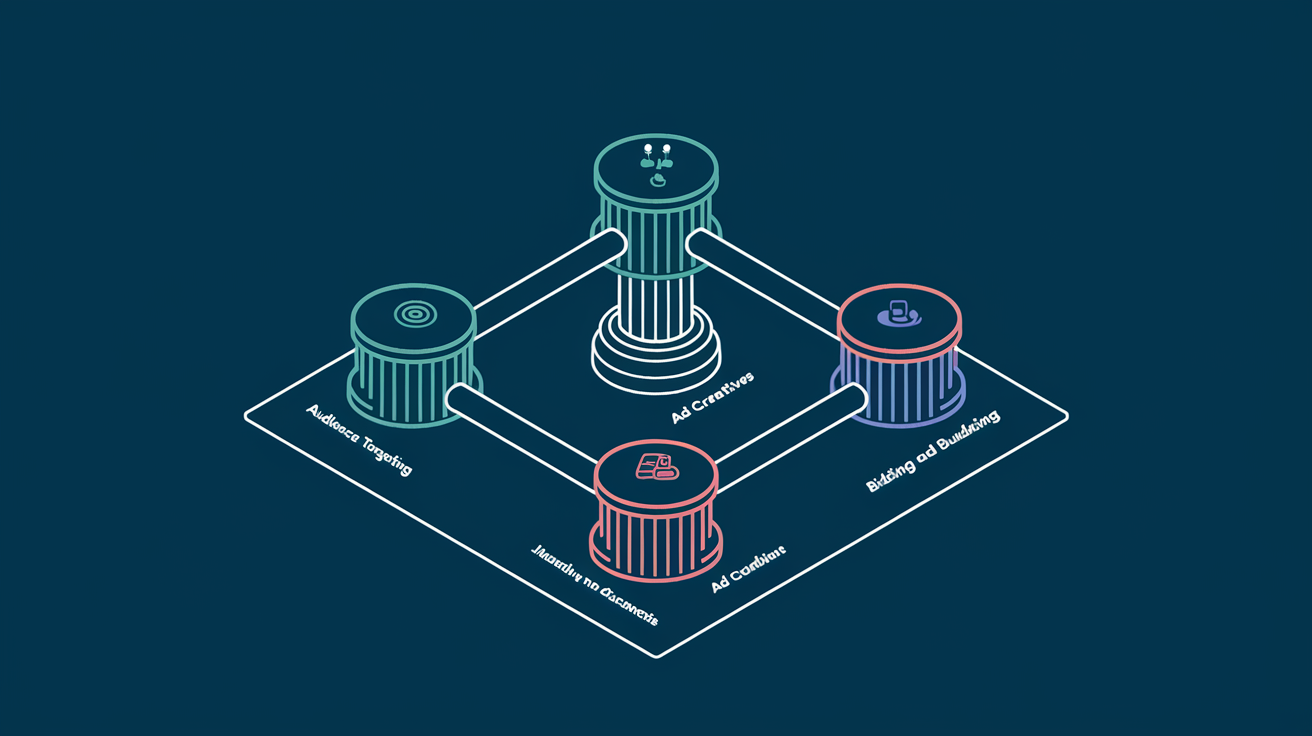
Facebook's Power 5 is a set of five automated advertising tactics that work together to improve campaign performance. Introduced by Meta as a best-practice framework, the Power 5 represents the platform's recommended approach to running ads that leverage machine learning effectively.
The five components are:
- Auto Advanced Matching
- Campaign Budget Optimization (CBO)
- Simplified Account Structure
- Automatic Placements
- Dynamic Ads
Each element works independently, but their real value emerges when used together. The Power 5 framework essentially asks advertisers to trust the algorithm with more decisions, in exchange for better performance at scale.
For Facebook advertisers who have been manually optimizing every aspect of their campaigns, this can feel counterintuitive. But the data consistently shows that advertisers who adopt these practices outperform those who insist on manual control across every variable.
Element 1: Auto Advanced Matching
Auto Advanced Matching (AAM) improves the connection between actions taken on your website and the Facebook users who took them. It works by automatically sending hashed customer information from your website, such as email addresses, phone numbers, names, and location data, to Facebook when a conversion event fires.
Why It Matters
Without AAM enabled, Facebook relies solely on the pixel cookie to match website conversions to user profiles. As browser restrictions on third-party cookies tighten and users browse across multiple devices, cookie-based tracking misses a growing share of conversions.
AAM fills those gaps by sending additional identifiers that Facebook can use to match conversions to users. The result is more accurate attribution, larger retargeting audiences, and better optimization signals for the algorithm.
How to Implement It
- Navigate to Events Manager in Facebook Ads Manager
- Select your pixel and go to Settings
- Toggle on Automatic Advanced Matching
- Review the data fields being sent (email, phone, first name, last name, city, state, zip, gender, date of birth)
- Verify that your website forms collect and pass this information correctly
For ecommerce stores using Shopify or WooCommerce, AAM is typically enabled by default through their Facebook integrations. For custom-built sites, work with your development team to ensure the correct data layer variables are being captured.
The impact is significant. Enabling AAM typically increases custom audience match rates by 10-30% and improves attributed conversions by 5-15%.
Element 2: Campaign Budget Optimization (CBO)
Campaign Budget Optimization moves budget control from the ad set level to the campaign level. Instead of assigning a fixed daily budget to each ad set, you set one budget for the entire campaign and let Facebook's algorithm distribute spending across ad sets based on performance.
How CBO Changes Your Strategy
In a traditional setup, an advertiser might run five ad sets at $50/day each, spending $250/day total. If one ad set performs exceptionally well and another performs poorly, each still receives its fixed $50 allocation.
With CBO, the same $250/day budget is allocated dynamically. The high-performing ad set might receive $150 while the underperformer gets $20. The algorithm rebalances in real time based on which audiences are delivering the best results.
CBO Best Practices
- Group ad sets with similar goals. CBO works best when all ad sets in a campaign share the same optimization event and similar target CPAs. Mixing prospecting and retargeting in the same CBO campaign creates conflicts.
- Use minimum spend floors sparingly. You can set minimum daily budgets per ad set to ensure every audience gets some delivery. Use this only for testing purposes. Over-constraining CBO defeats its purpose.
- Start with 3-5 ad sets per campaign. Too few and there is nothing to optimize between. Too many and the budget gets spread too thin during the learning phase.
- Give it time. CBO needs sufficient data to make smart allocation decisions. Allow at least 3-5 days before evaluating performance.
CBO is particularly powerful when combined with simplified account structure because fewer campaigns mean each campaign receives more budget, giving the algorithm more data to optimize with.
Element 3: Simplified Account Structure
This is perhaps the most impactful and least intuitive element of the Power 5. Facebook's recommendation is to consolidate your account into fewer campaigns, fewer ad sets, and fewer ads rather than creating highly segmented structures.
The Case Against Granular Segmentation
Many advertisers instinctively create separate campaigns for every audience, every funnel stage, and every product line. A typical over-segmented account might have 20+ campaigns running simultaneously, each with 3-5 ad sets containing 2-3 ads.
This feels like control, but it actually works against you because:
- Each ad set needs 50 conversions per week to exit the learning phase. Fragmented budgets across many ad sets mean most never reach this threshold.
- Audience overlap between ad sets causes internal auction competition, driving up costs.
- Reporting complexity increases exponentially with more campaigns, making it harder to identify what is actually working.
The Simplified Structure
A well-structured Facebook account for most advertisers needs only 3-5 campaigns:
- Prospecting campaign (cold audiences, lookalikes, broad targeting)
- Retargeting campaign (website visitors, engagers, video viewers)
- Retention campaign (existing customers, upsell and cross-sell)
- Testing campaign (new creative, new audiences, new offers)
Within each campaign, consolidate audiences rather than fragmenting them. Let the algorithm decide who within a broader audience set is most likely to convert.
This structure works especially well for ecommerce brands running catalog-based advertising, where dynamic ads can serve the right product to the right user without manual audience segmentation.
Element 4: Automatic Placements
When you create an ad set, Facebook lets you choose where your ads appear: Feed, Stories, Reels, Marketplace, Audience Network, Messenger, and more. Automatic placements means letting Facebook decide where to show each ad based on where it is most likely to achieve your objective.
Why Advertisers Resist Automatic Placements
The hesitation is understandable. Advertisers worry about their carefully designed feed ads being stretched awkwardly into Stories format, or about budget being wasted on low-quality Audience Network placements.
These concerns were more valid in the early days. Facebook has significantly improved how creative adapts across placements, and the algorithm has gotten better at identifying which placements deliver actual results for each campaign.
The Data Supports It
Across our managed accounts, campaigns using automatic placements consistently achieved 10-25% lower cost per result compared to manual placement selection. The algorithm finds inventory pockets that manual selection misses, particularly in less competitive placements where CPMs are significantly lower.
Making Automatic Placements Work
- Create placement-aware creative. Design ads that work in multiple aspect ratios: 1:1 for feed, 9:16 for Stories and Reels, and 16:9 for in-stream video. Upload multiple versions and let Facebook serve the right one.
- Monitor placement breakdowns. You can still review where your ads are delivering. If a specific placement consistently underperforms, you can exclude it while keeping the rest on automatic.
- Use asset customization. Facebook lets you upload different creative assets for different placements within the same ad. This gives you creative control while still benefiting from algorithmic placement optimization.
Element 5: Dynamic Ads
Dynamic ads automatically show the right products to people who have expressed interest on your website, in your app, or elsewhere on the internet. Instead of manually creating individual ads for each product, you connect your product catalog and let Facebook generate ads dynamically.
How Dynamic Ads Work
The system connects three inputs:
- Product catalog: Your full inventory uploaded as a data feed, including product images, titles, descriptions, prices, and availability
- Facebook pixel events: Signals from your website indicating which products users viewed, added to cart, and purchased
- Ad template: A framework that dynamically populates with the relevant product information for each user
When a user views a product on your site but does not purchase, Facebook can show them an ad featuring that exact product (and similar items) the next time they open the platform. This is dynamic retargeting at its most effective.
Beyond Retargeting: Dynamic Ads for Broad Audiences
Dynamic ads are not limited to retargeting. Facebook's Dynamic Ads for Broad Audiences (DABA) uses machine learning to show products from your catalog to prospecting audiences who have never visited your site.
The algorithm analyzes user behavior patterns, product attributes, and conversion signals to predict which products each user is most likely to purchase. For catalogs with hundreds or thousands of products, this is far more efficient than manual ad creation.
Dynamic Ad Optimization Tips
- Optimize your product feed. High-quality images, accurate titles with relevant keywords, and competitive pricing directly impact dynamic ad performance. Treat your product feed as a marketing asset, not just a data sync.
- Segment your catalog. Create product sets based on category, price point, margin, or best-seller status. This lets you allocate budget toward your most profitable products.
- Use dynamic creative alongside dynamic products. Layer in multiple headlines, descriptions, and CTAs and let Facebook test combinations to find the best performers.
Putting the Power 5 Together
The real value of the Power 5 framework is not any single element. It is how they compound when used together.
Consider the combined effect:
- AAM ensures more conversions are tracked and attributed, giving the algorithm better data
- CBO distributes budget to the highest-performing audiences automatically
- Simplified structure concentrates that budget into fewer campaigns, accelerating the learning phase
- Automatic placements finds the cheapest inventory across all ad surfaces
- Dynamic ads serve the right product to the right person without manual intervention
Each element reduces manual control in favor of algorithmic optimization. And each element provides better data to the others, creating a virtuous cycle of improving performance.
Implementation Checklist
Here is a practical sequence for implementing the Power 5 in your account:
- Enable Auto Advanced Matching in Events Manager and verify data is flowing correctly
- Audit your account structure and consolidate overlapping campaigns and ad sets
- Switch consolidated campaigns to CBO with appropriate budget levels
- Update creative assets to support multiple placements (1:1, 9:16, 16:9)
- Enable automatic placements and monitor placement breakdowns for the first two weeks
- Connect your product catalog and launch dynamic ad campaigns for retargeting
- Expand dynamic ads to broad audiences once retargeting is performing well
- Review performance after 14 days and adjust based on data, not assumptions
The Bottom Line
The Power 5 framework represents Facebook's clearest articulation of how advertisers should work with, rather than against, the platform's machine learning capabilities. Advertisers who embrace algorithmic optimization and feed the system with clean data and strong creative consistently outperform those who cling to manual control.
The platform has changed. The strategies that worked when manual optimization was superior, including hyper-segmented audiences, manual placement selection, and ad-set-level budgets, now actively hinder performance. The Power 5 is not just a recommendation. For serious Facebook advertisers, it is the operating system for modern campaign management.

.webp)

.svg)


