
In the age of rapid digital transformation, AI has seeped into almost every industry, revolutionizing how we conduct business, design products, and even create content. The ClusterMagic service is a great example, which seamlessly integrates AI for content generation in a hybrid model, providing significant benefits in the SEO results of brands seeking a massive increase in organic traffic. But while AI holds immense promise, it has its limitations. Let's explore the pros and cons of using AI for content creation and understand why a hybrid approach might be the way forward.
Major publishers in sensitive niches like CNET.com, Bankrate.com, and Creditcard.com have already integrated AI-generated content. Other large companies, such as CNN and Forbes, might also be doing so. Countless smaller companies and publishers are utilizing AI, not only on their websites but also on social media, in email marketing, and virtually everywhere else.
Google's stance on AI-generated content is neutral, emphasizing that content should primarily be user-centric. In fact, Google's September 2023 Helpful Content Update removed the mention of "written by people" from their helpful content system guidelines.
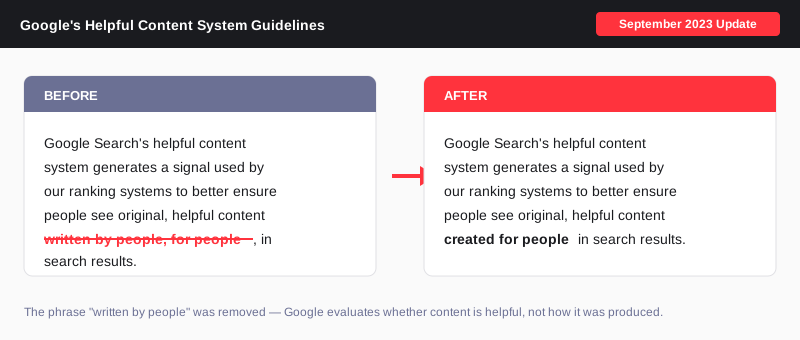
The message is clear: for content to rank well, it must be informative, answer users' queries satisfactorily, and showcase genuine expertise - regardless of how it's created.
AI Content Detectors like GPTZero, ZeroGPT, and many others are not reliable. Even OpenAI has said as much. They consistently produce false positives about human-written content. Conversely, they can be easily fooled with creative prompting or a bit of human editing.
An interesting note from OpenAI: "we found that it labeled human-written text like Shakespeare and the Declaration of Independence as AI-generated."
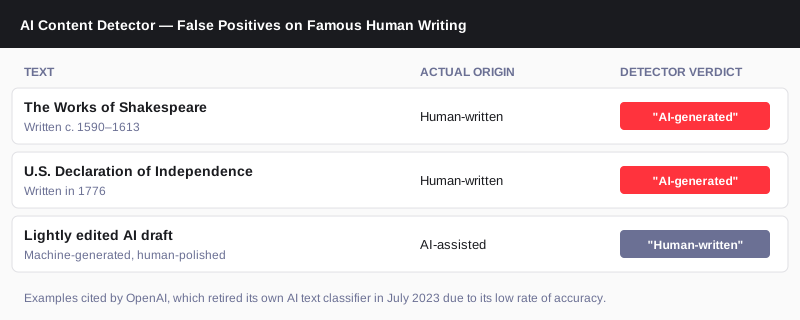
Anecdotal evidence and real-life ranking data suggest that while AI-generated content isn't penalized by search engines, it might only achieve high rankings if it meets the above criteria. The role of AI in content creation is still a developing narrative, and its significance is indispensable for maintaining a competitive edge in the future.
At EmberTribe, the understanding is clear - AI serves as a foundation, not the final product. With ClusterMagic, while AI aids in the initial draft based on expert-driven keyword research, human experts step in for the crucial phases of editing, fact-checking, and final review. This hybrid approach ensures the content is accurate and helpful, has the potential to rank, and truly represents their business.

Most SaaS founders assume SaaS SEO works the same way it does for any other business: pick keywords, publish blog posts, wait for traffic, watch signups climb. That mental model is the reason so many SaaS SEO programs underperform for 12 months and then get quietly defunded.
The buyer journey is longer, the intent signals are weirder, and the pages that actually generate pipeline rarely live on the blog. If your program is optimized around sessions, you are almost certainly measuring the wrong thing. This guide walks through how SaaS SEO is structurally different, what a full-funnel content strategy looks like, where technical foundations trip teams up, and how to measure the work so it survives the next budget cycle.
General SEO is about matching a query to a page. SaaS SEO is about matching a query to a buying committee that may take six to eighteen months to decide. Everything downstream, from keyword selection to content architecture to reporting, changes because of that.
B2B buyers are methodical by design. Gartner's research on the B2B buying journey describes a non-linear path where groups of stakeholders move in and out of jobs like problem identification, solution exploration, and supplier selection. Buyers spend only about 17% of their total purchase time meeting with vendors, which means the rest is spent reading, comparing, and filtering solutions on their own. Your organic content is the substitute for a sales rep during most of that window.
That single fact reshapes SaaS SEO strategy in four concrete ways:
If you remember one thing from this guide, it is this: SaaS SEO is a pipeline strategy disguised as a content strategy. Teams that treat it otherwise end up trapped in traffic charts that never translate to revenue.
Top-of-funnel content is where most programs start, and for good reason. Educational posts build topical authority and capture buyers before they know what category of product they need. The mistake is stopping there. A mature SaaS SEO program covers three clearly different jobs, and each job needs a different content type.
These searches use pain language, not product language. Think "how to forecast hiring budget" rather than "workforce planning software." The goal of top-funnel content is not to sell the product on the page. It is to show up in the reader's first three searches and establish your brand as a voice they trust when they move into the consideration phase. Top-funnel pieces work best when they solve the problem completely, even if the solution does not require your product.
By the time a buyer searches "project management software for remote teams" or "best customer onboarding tools," they have named the problem and are scoping the solution space. Middle-funnel content needs to shape the shortlist. Common formats include category roundups, feature comparisons, and use-case pages for specific job titles or team types. These pages are where a lot of SaaS SEO programs get their first meaningful MQLs, and they are the pages most often neglected in favor of blog volume.
Bottom-funnel SaaS SEO is where revenue lives, and it looks almost nothing like traditional content marketing. Effective bottom-funnel pages include "[your product] vs [competitor]," "[competitor] alternatives," integration pages, pricing explainers, and security or compliance documentation. These are the queries where buyers are already in the shortlist phase and need a final reason to move.
Reviews on sites like G2 also play an outsized role here. Branded comparison pages and alternative roundups on review platforms rank for many of the same queries your bottom-funnel pages target, which makes category presence on third-party review sites part of a serious SaaS SEO strategy, not an afterthought.
For a deeper framework on how content types map to the full buyer journey, our SaaS content marketing strategy guide covers the editorial planning side of this.
Most SaaS platforms run on JavaScript-heavy stacks. That is not a problem in itself, but it introduces failure modes a generalist SEO agency will miss entirely. Server-side rendering, pre-rendering, or hybrid approaches are usually necessary for pages that matter for rankings. Google's JavaScript SEO basics documentation is the canonical reference, and it is worth reading even if your engineering team swears React Helmet has the meta tags covered. Rendering bugs are the single most common technical issue we see in SaaS SEO audits.
A few other patterns cause recurring pain:
docs.yourdomain.comon a separate subdomain splits authority. Google treats subdomains as separate sites, so link equity does not flow between marketing and documentation. Subfolders almost always win.
These issues are fixable, but only if someone is actually looking. Monthly rank reports will not surface a rendering bug that is suppressing half your product pages from the index.
Link building for SaaS has changed substantially in the last two years, and the tactics that worked in 2020 are mostly dead. Guest posting on low-quality blogs and paid directory listings are now a net liability. What still works is earning links through assets worth linking to.
Three approaches consistently drive high-quality backlinks for growth-stage SaaS:
Original research and data reports. Surveys of your user base, aggregated benchmarks, and industry studies get cited by journalists because they fill a gap in the reporting ecosystem. A single well-executed industry report can generate more authoritative backlinks than six months of outreach.
Free tools and calculators. A product-led free tool that solves a specific problem (an ROI calculator, a compliance checker, a budget template) earns links because it provides utility. Tools also double as top-of-funnel acquisition assets. Competitive research platforms like Ahrefs are useful for finding which of your competitors' pages are earning links, and why.
Digital PR and thought leadership. Pitching founder expertise to journalists, landing quotes in trade publications, and contributing to industry conversations builds domain authority while shaping how your category perceives you. Slower than content outreach, but the compounding effect is higher.
Notice what is missing: link farms, PBNs, comment spam, and mass guest posting. Those tactics never built durable growth, and post-2024 Google updates have made them harmful. Agency selection matters here, which is why our SaaS SEO agency guide goes deep on separating specialists from generalists.
Ranking reports are a useful diagnostic tool and a terrible scorecard. A SaaS SEO program that cannot tie organic traffic to pipeline will be defunded the first time the CFO asks hard questions. The metrics that actually matter for SaaS SEO in 2026 look like this: MetricWhy it mattersOrganic-sourced pipelineDollar value of opportunities attributed to organic searchSQLs from organicSales-qualified leads, filtered for real buying intentOrganic-influenced ARRRevenue from deals where organic was a touchpointPipeline velocityHow long organic leads take to close vs other sourcesCAC payback from organicMonths until organic-acquired customers pay back their cost
These metrics require marketing, sales, and RevOps to agree on attribution, which is hard political work but the only way to make SEO accountable to revenue. Rankings, sessions, and impressions are fine as leading indicators. They should never be the headline numbers on a board deck.
A practical starting point: build a dashboard that shows organic traffic broken out by funnel stage, paired with MQL and SQL volume each stage produces. That view exposes most of the honest problems in a SaaS SEO program, including that most blog content drives sessions but not pipeline, and that a handful of bottom-funnel pages usually drive the majority of revenue impact. Our B2B SaaS lead generation playbook covers the measurement side of this in more depth.
Failure patterns across SaaS SEO programs are surprisingly consistent. If you are building or auditing a program, these are the traps worth guarding against.
If you are starting from scratch, the highest-leverage first move is to audit your product's bottom-funnel search landscape. Look at what buyers search in shortlist mode: alternatives, comparisons, integrations, and category roundups. Most SaaS companies find the pages with the highest potential revenue impact do not yet exist, and building them is a faster path to organic pipeline than any amount of blog content.
If you already have a program generating traffic but not pipeline, the diagnostic work is different. Audit which pages are producing MQLs, which are producing vanity sessions, and where the technical architecture is suppressing rankings on pages that matter. SaaS SEO rewards programs willing to look at their own reporting honestly, even when the honest answer is that half the blog archive is not pulling its weight.
Either way, the shift separating SaaS SEO programs that scale from those that stall is the same: stop treating organic search as a traffic channel and start treating it as a pipeline channel. That shift changes what you build, how you measure it, and ultimately whether it earns a seat at the budget table for the next five years.

Most growth-stage SaaS teams hire their first product marketer about two years too late, then ask that person to own three jobs that belong to three different functions. The result is a saas product marketing strategy that looks like a pile of launch checklists and one-pagers, not a system that actually moves pipeline or win rates. The b2b saas marketing stack gets more crowded every quarter, and the companies that cut through are the ones treating product marketing as a strategic discipline, not a production line.
This guide is the version we wish our SaaS clients had before they hired their first PMM. It covers what SaaS product marketing actually is, how to build positioning that cuts through, tiered launches that match real business impact, pricing and packaging as a PMM concern, win/loss as a continuous pulse check, and how product marketing should work with sales.
Product marketing sits at the intersection of product, sales, and marketing, and owns the translation layer between what the product can do and why any specific customer should care. In SaaS, that translation is the job. Features are easy to copy. Positioning, messaging, and the sales narrative are much harder to replicate, and they do more to protect margin than any feature roadmap.
A useful way to define the role is by what product marketing owns outright versus what it influences.
Product marketing owns:
Product marketing strongly influences:
A growth marketer owns acquisition channels and pipeline targets. A demand gen marketer owns the programs that fill the funnel. A product marketer owns the story that makes those programs actually convert. Confusing these roles is the most common way the first PMM hire fails, and it shows up as a talented operator drowning in ad copy requests while the positioning question no one has answered quietly kills win rates.
If your homepage says "the fastest, easiest, most intuitive platform for growing teams," your positioning does not exist. That sentence could be pasted onto five hundred SaaS websites without the reader noticing. Generic positioning loses deals before you ever get the call.
The framework we point SaaS clients to is April Dunford's, laid out in Obviously Awesome. The core insight is that positioning should start from your competitive alternatives, not from your features. What would your best customers use if you did not exist? A spreadsheet, a different tool, a consultant, an internal build.
The answer to that question frames how you should describe yourself, because buyers evaluate you against that specific alternative, not against an abstract ideal.
From there, positioning becomes a chain of decisions: the unique attributes you have that the alternative lacks, the value those attributes create for a buyer, and the specific market category you want to be compared to. Skip any step and you end up back in generic messaging territory.
A practical test. Pull five sentences from your current homepage. Replace your product name with three competitors' names, one at a time. If any of those sentences still feel true for the competitor, that sentence is not doing positioning work. Rewrite it until it only makes sense about your product.
This is the work most SaaS teams skip because it feels philosophical. It is not. Weak positioning shows up in messy sales calls, long sales cycles, high churn, and content that does not convert. Strong positioning does not guarantee growth, but trying to grow without it is a tax you pay every day in slow pipeline and lost deals.
The other thing a SaaS PMM does badly without a framework is treat every launch the same. A new AI copilot and a minor UI polish both get a blog post, a sales email, and a product update page. The copilot deserved a full go-to-market push, and the UI change deserved a changelog entry. Both got the same effort, and neither moved the needle.
Tiered launches solve this. Most teams we work with use a three-tier model, adapted loosely from the Product Marketing Alliance launch tier framework and the Pragmatic Institute launch tiers approach.
Tier 1. A strategic launch that changes the company story, opens a new market, or shifts the competitive narrative. Eight to twelve weeks of prep. Executive sponsorship. Full enablement, press, analyst briefings, and a coordinated campaign. Maybe two or three per year if you are honest about what qualifies.
Tier 2. An important feature or capability that expands what existing customers can do or unlocks a new segment. Two to four weeks of preparation. Updated sales collateral, an email to customers, a blog post, and an in-app announcement. Not a press cycle. Maybe one per month.
Tier 3. Incremental improvements, bug fixes, and quality-of-life updates. Release notes, a changelog entry, and an in-app notification. No sales enablement required unless it affects a live deal. Happens weekly, quietly, and that is exactly the point.
The gift of tiered launches is that the PMM can say no. Without the tiers, every engineering ticket that ships gets treated as a launch, the team burns out producing low-leverage assets, and the actually-important launches do not get the attention they deserve. With tiers, the PMM has a defensible filter, and the rest of the org understands why a minor update does not warrant a webinar.
In most growth-stage SaaS companies, pricing and packaging belong to everyone and no one. Finance cares about margin, product cares about adoption, sales cares about close rates, and the CEO rewrites the pricing page every six months based on the last board meeting. The result is a pricing structure that reflects internal politics, not buyer psychology.
Product marketing is the natural owner of pricing and packaging because the team already holds the buyer research, the win/loss data, the competitive landscape, and the positioning narrative. Pricing is the most concrete expression of positioning. Every tier boundary, every feature gate, every usage metric is a statement about what you think your buyer values and what they will pay for it. OpenView's deep dive on pricing and packaging missteps is worth reading for any PMM about to touch this area.
Packaging questions that PMMs should lead on:
A quarterly pricing review led by product marketing, with finance and sales at the table, is one of the highest-leverage meetings most SaaS teams do not hold.
The fastest way to find out whether your positioning, pricing, and sales narrative are actually working is to ask the people who just made a decision. Win/loss analysis is not a quarterly research project. In the companies where it actually moves the needle, it is a continuous intake that feeds messaging, enablement, and roadmap.
The mechanics are not complicated. You need a sample of ten or more closed deals on each side, structured interviews run by someone who was not in the sale, and a clear set of questions covering how the buyer discovered you, how they evaluated alternatives, what drove the decision, and what almost killed the deal. Klue's seven-step win/loss guide covers the process in practical detail.
What makes win/loss powerful is the pattern recognition across interviews. One lost deal is an anecdote. Ten lost deals where three buyers name the same competitor objection is a messaging problem you can fix this week. Win/loss also catches positioning drift: the moment your sales team starts describing the product differently from how marketing is positioning it, you have a leak, and win/loss interviews catch that leak faster than almost any other mechanism.
The output should not be a slide deck that gets presented once and filed. The output is a set of changes: updated battlecards, revised objection handling, new proof points on the website, and a feedback loop to product on the top two or three feature gaps driving losses.
The fastest way to tell whether your product marketing is working is to listen to a sales call. If the rep is telling your positioning story in their own words, badly, your enablement is broken. If the rep is reading from a deck slide by slide, your enablement is broken differently. The goal is a rep who has internalized the narrative and can riff on it based on the specific buyer in front of them.
That kind of enablement has three components. A message house that defines the problem, the stakes, the solution, and the proof points in plain language. A living deck that sellers can trust and adapt, not a 60-slide corporate brochure. And ongoing reinforcement, weekly or biweekly, that keeps the narrative fresh as the market moves.
The best SaaS PMMs we work with spend at least one day a week embedded with sales, listening to calls, joining deal reviews, and updating materials based on what actually closes deals. The PMMs who fail treat sales enablement as a one-time handoff and wonder why their beautiful narrative never makes it into a discovery call.
This is also where product marketing connects back to pipeline. We dig into the sales-side mechanics in our B2B SaaS lead generation playbook, and the hiring question of when to bring in senior marketing leadership in our guide to fractional CMOs for B2B SaaS.
If you are building a product marketing function from scratch, the order of operations matters. Start with positioning. Without it, launches fall flat, pricing decisions are guesswork, and sales enablement is a collection of slides no one trusts.
Once positioning is stable, layer in launch tiering so the team can say no to low-impact work. Then put win/loss on a continuous cadence so the feedback loop stays fresh. Pricing and packaging work comes next, because it should follow positioning rather than lead it.
The SaaS companies that get this right do not treat product marketing as a department that writes launch copy. They treat it as the discipline that decides what the company sounds like in the market and which deals it can win. Everything downstream, from acquisition spend to retention mechanics, gets easier when product marketing is doing its job.
If your current marketing feels like tactics without a core narrative, the gap is almost always here. When that foundation is in place, broader acquisition work, covered in our SaaS customer acquisition strategies guide, starts to compound instead of leak.

Most growth-stage SaaS founders we talk to built their first $1M to $3M in ARR on referrals, word of mouth, and a handful of warm intro sales. Then the well runs dry. The next million feels three times harder than the first, and the real cost of saas customer acquisition becomes painfully visible for the first time. Suddenly the question is no longer "how do we keep up with demand?" but "how do we create demand that doesn't depend on who our founder knows?"
This is the wall. Most SaaS companies hit it between $2M and $8M in ARR, and it's the hardest transition in the company's life. The businesses that get past it tend to share a clear-eyed view of what acquisition really costs, which channels actually work at their stage, and what to stop doing.
Before talking about strategies, it helps to look at the numbers. Acquisition is more expensive than it used to be, and anyone telling you otherwise is selling something.
The median B2B SaaS company is now spending about $2.00 to acquire every $1 of new ARR, a roughly 14% jump from 2023 driven by higher ad costs, more competition, and longer buying cycles. Median CAC payback sits around 6.8 months, and the average B2B SaaS CAC lands near $1,200 per customer across blended channels. Drill into specific motions and the picture is wider: organic channels average closer to $205, paid channels around $341, and outbound-heavy SaaS motions can push toward $1,900 or higher when loaded costs are included. These are directional numbers from Genesys Growth's customer acquisition cost benchmarks, not physical laws, but they reflect what most of our SaaS clients see when they audit honestly.
Here is the uncomfortable part. Most SaaS founders quote their cost per user acquisition based on platform-reported numbers from Google, LinkedIn, or their CRM. The real number, once you include sales salaries, tooling, content production, and attribution leakage, is usually 1.5 to 2x higher. We covered the full accounting picture in our customer acquisition cost guide, and the short version is that if you have not loaded fully burdened costs into your CAC, you do not actually know what your CAC is.
Early SaaS growth is deceptive. A founder with strong network credibility can sell their first 30 customers without ever running a single ad or hiring a single BDR. It feels like product-market fit, and sometimes it is. But it's also a narrow, non-repeatable distribution channel, and it hides the real work of building scalable acquisition.
The plateau arrives when warm intros dry up before you've built any cold systems. The symptoms are recognizable: new logos get lumpy, sales cycles lengthen as reps work less-qualified leads, and the founder gets pulled back into closing deals. Pipeline reviews turn into "we need more at the top of the funnel" meetings, and three quarters go by without a clear answer to where new customers should come from.
The fix is not a single silver bullet channel. It's a deliberate, stage-appropriate acquisition strategy that treats the transition from founder-sales to systematic demand as its own company-wide project.
Five motions move the needle for most growth-stage SaaS companies. None of them are new, and all of them take longer than founders want. The brands that win are the ones that pick two or three, invest seriously, and resist the urge to abandon ship at month four.
Organic search is still the highest-leverage inbound channel for SaaS, with SEO leads closing at roughly 14.6% compared to 1.7% for cold outbound, according to data summarized by TripleDart. The catch is that it takes 6 to 9 months to compound, which is precisely why most teams quit too early.
The strategy that works in 2026 is commercial-intent first, then topical authority. Start with bottom-funnel pages ranking for "{category} software," "{competitor} alternatives," and "{use case} tool" queries. Only after those are shipped should you build out top-funnel education content. Most SaaS blogs fail because they invert the order and spend a year writing "what is" posts that bring traffic but not buyers.
Google Ads on category and competitor terms is one of the few channels where you can buy pipeline within weeks. For growth-stage SaaS, the right structure is a small number of tightly-scoped campaigns on high-intent terms, paired with fast-loading landing pages tied to a specific offer.
Paid search gets a bad reputation in SaaS because teams run it without CRO discipline, dump traffic onto a generic homepage, and conclude it doesn't work. A well-structured paid search program can deliver a CAC within 1.5x of organic, and it starts producing signal in weeks instead of quarters.
Product-led growth has moved from novel strategy to default expectation, and the math explains why. Per OpenView's PLG research, PLG companies grow roughly 20 to 30% faster at comparable revenue levels than purely sales-led peers. A free trial or freemium tier turns the product into the top of the funnel and lets self-serve users pre-qualify themselves before sales ever touches the account.
PLG isn't the right fit for every product. Complex enterprise tools, anything with heavy implementation, or products that require admin setup typically need sales assist. But even in those cases, a lightweight PLG layer can serve as a lead generation engine that feeds the sales team higher-intent accounts. We wrote about the fuller mechanics of this approach in our product-led growth guide.
Outbound has been declared dead every year for a decade, and it still isn't. For SaaS products with ACVs above $15K, tightly targeted outbound remains one of the fastest ways to generate pipeline because you can start getting meetings within weeks instead of waiting for inbound to compound.
What has changed is the bar. Generic sequences hitting 10,000 contacts a month are spam and get filtered accordingly. The outbound that works in 2026 uses intent data, segment-specific messaging, multi-channel touches across email and LinkedIn, and tight ICP definitions that filter out most of the list before anyone gets an email. The tradeoff is clear: outbound CAC runs higher than inbound, but the payback is faster, which matters enormously when cash runway is tight.
Most SaaS teams obsess over the top of the funnel and leave the middle untouched. The result is wasted traffic, unconverted trials, and warm prospects who go cold because no one followed up. Lifecycle marketing, specifically trial conversion sequences, abandoned-signup retargeting, and re-engagement campaigns for dormant leads, often delivers a better return than any new acquisition channel. We cover the middle-of-funnel tactics in more depth in our B2B SaaS lead generation playbook.
Before adding channels, check whether your unit economics can carry them. CAC to LTV is the single most important metric in SaaS acquisition, and most companies either don't calculate it or calculate it wrong.
The benchmarks we see tracked across sources like Wall Street Prep and growth reports generally align: ARR StageTarget LTV:CACTarget PaybackUnder $2M ARR2.5:1 minimumUnder 18 months$2M to $10M ARR3:1 to 4:1Under 12 months$10M+ ARR3.8:1 to 5:1Under 12 months
If your ratio is below these numbers, adding more acquisition spend makes the problem worse, not better. You are not underinvested, you are leaking value, and the fix starts with retention, onboarding, expansion revenue, or pricing rather than new channels.
After advising SaaS growth clients across a wide range of stages, a handful of mistakes show up repeatedly.
There is no universal answer to SaaS customer acquisition, and anyone promising one is either inexperienced or selling a template. What works depends on ACV, ICP, product complexity, sales motion, and where you are in your ARR journey.
The companies that scale past the referrals plateau do three things in order. They audit their unit economics honestly, they pick a stage-appropriate channel mix and commit to it for at least two quarters, and they build the measurement discipline to know which channels are actually producing pipeline versus which ones are just producing activity.
When we work with SaaS growth clients inside EmberTribe's strategy consulting engagements, the first 30 days are almost always spent on the audit before a single new dollar gets deployed. It is slower than founders want and it saves them far more than it costs. The plateau is not a sign that growth is impossible, it is a sign that the old playbook has run out of room. Building the next one is harder, but it is also what turns a scrappy startup into a durable business.

Hiring a PPC agency in 2026 means hiring a partner who can operate across far more platforms than Google. Paid search has become a multi-surface discipline that includes Google Ads, Microsoft Advertising, Amazon Ads, retail media networks like Walmart Connect, and LinkedIn for B2B. The best agencies build strategy across that full surface area. The weakest still pitch "Google Ads management" as if the last five years of platform fragmentation never happened.
A narrow partner will under-index your spend on platforms where your buyers actually shop, miss the retail media shift, and leave incremental revenue on the table because their playbook stops at the Google auction. This guide covers what PPC actually includes today, what a great agency does, pricing, red flags, and the questions to ask before you sign.
PPC is no longer a synonym for Google Ads. Pay-per-click has expanded into a broader paid search and retail advertising discipline, and the platform mix that matters depends on where your customers search, browse, and buy.
Google Ads is still the dominant surface for most categories. Search, Performance Max, Shopping, YouTube, and Demand Gen run through Google Ads and together capture roughly three-quarters of global paid search spend. Any serious PPC agency leads with Google strategy, but leading with Google is not the same as stopping there.
Microsoft Advertising runs search and native placements across Bing, Yahoo, MSN, Outlook, and the Microsoft Audience Network. The Microsoft Advertising platform reaches over a billion users monthly and skews higher-income and desktop-heavy, which makes it especially valuable for B2B and considered-purchase advertisers. CPCs on Microsoft are often lower than Google for the same queries, so the channel usually beats its reputation once an agency actually tests it.
Amazon Ads has become a paid search discipline in its own right. Sponsored Products, Sponsored Brands, and Sponsored Display on Amazon Ads sit at the bottom of the ecommerce funnel, and conversion rates routinely clear 10 percent for well-structured campaigns. For any brand with a meaningful Amazon presence, ignoring Amazon PPC leaves the highest-intent clicks unbid.
Retail media networks (Walmart Connect, Target Roundel, Kroger Precision Marketing, Instacart Ads, and dozens more) capture the fastest-growing slice of retail ad spend. eMarketer forecasts US retail media spend at roughly $69 billion in 2026, up nearly 18 percent year over year, outpacing both search and social. If your brand sells through any of these retailers, retail media is part of PPC now.
LinkedIn Ads, specifically text ads, sponsored content, and message ads, round out the paid surface for B2B. LinkedIn advertising is the only meaningful paid channel with native firmographic targeting at the company and job-title level, which makes it essential for most SaaS and enterprise B2B programs.
The table stakes have shifted. A PPC agency in 2026 is not graded on keyword list depth or match type discipline. It is graded on cross-platform strategy, measurement that survives platform reporting bias, and creative output that keeps up with the AI-driven auction.
Cross-platform strategy and budget allocation. The core job is deciding how much of your budget goes to which platform, why, and when that mix should shift. A good agency builds a platform-level investment plan based on your funnel, margin profile, and competitive context, not a rigid "60 percent Google, 30 percent Meta" template.
Measurement beyond platform-reported numbers. Google, Amazon, and Microsoft all report conversion data in ways that flatter the platform. Sophisticated agencies reconcile those numbers with GA4, warehouse attribution, and incrementality tests to produce a blended CAC view. Understanding why ROAS alone underreports true performance is a baseline skill, not a value-add.
Feed, catalog, and creative execution. Shopping, Performance Max, Amazon Sponsored Products, and retail media all run on product data. A weak feed caps performance on every platform at once. Layer in frequent new copy and creative variants, because responsive ads and dynamic placements reward velocity.
Diagnostic craft. When performance dips, a strong agency can isolate whether the cause is auction inflation, creative fatigue, feed issues, landing page drop-off, attribution gaps, or inventory. Weaker agencies default to "the algorithm changed" and pitch a bigger budget.
PPC agency pricing in 2026 falls into four common patterns. Each has tradeoffs that matter more as your spend scales. ModelTypical CostBest ForWatch Out ForPercentage of spend10 to 20 percent of ad spendBrands scaling fast, $50K+ monthly budgetsAgency earns more as spend rises, even if results plateauFlat retainer$1,500 to $10,000 per monthPredictable budgets, mature accountsCost doesn't scale down during slow seasonsHybridBase $1,500 plus 5 to 10 percent of spendMid-market brands wanting balanceAsk how the base and variable pieces are justifiedPerformance-basedCommission on leads, sales, or ROAS targetsCash-constrained brands with clear attributionRare and risky; too many variables sit outside agency control
Setup fees are common on top of any of these models, typically $2,500 to $10,000 for account audit, conversion tracking rebuild, feed cleanup, and initial campaign builds. Pay that fee. Agencies that refuse setup work and promise to "hit the ground running" are usually the same ones that later blame the previous agency for everything they didn't fix in week one.
Percentage-of-spend remains the most common model, and its incentive problem is real: when your agency earns 15 percent of spend, they are rewarded for pushing budgets up regardless of your unit economics. Hybrid structures solve that misalignment best for most growth-stage brands.
Not every agency should run every platform. The right structure depends on where your spend is concentrated and how much coordination you need across channels.
A platform specialist (Google-only, Amazon-only, LinkedIn-only) makes sense when one platform is 70 percent or more of your paid mix, your team already has senior marketing leadership in place, and you want deep platform expertise over breadth. A dedicated Google Ads agency will usually beat a generalist on pure Google execution, and the same is true for Amazon specialists on Amazon.
A full-funnel PPC agency makes sense when you need one partner accountable for paid search strategy across Google, Microsoft, Amazon, retail media, and LinkedIn, integrated with creative, landing pages, and measurement. The downside is that no agency is equally strong on every platform, so diligence which ones they actually run at scale versus claim to support.
The wrong combination is hiring a Google specialist and expecting them to solve your Amazon PPC problem, or hiring a full-funnel agency that is actually three junior account managers in a trench coat. A focused ecommerce PPC management partner is the right call for DTC brands running across Google Shopping, Amazon, and retail media, while a narrower Facebook ads agency partner may be enough if Meta is where demand lives.
Two pitch conversations are usually enough to separate operators from resellers if you know what to listen for.
Red flags:
Green flags:
The evaluation conversation matters more than the proposal deck. These questions surface whether an agency is an operator or a reseller.
Listen for specificity. Vague answers about "optimizing the funnel" or "leveraging best practices" are a signal the pitch person isn't the person running accounts. Good operators answer in concrete, non-rehearsed detail.
Benchmarks vary by industry and margin, but a few ranges hold up across most growth-stage accounts. Use them as a sanity check, not as guarantees.
Any agency that can't contextualize these ranges against your specific margin profile and sales cycle is selling you their pitch deck, not their thinking.
If you're actively evaluating PPC agencies, do three things before your first pitch meeting.
Map your actual platform mix. Write down every platform you run today and the share of spend and revenue each carries. Note which platforms your buyers search or shop on that you are not running. That map is the starter for every serious agency interview.
Clarify your unit economics. Write down your monthly PPC budget, target CPA or CAC, contribution margin per order, and runway. These numbers decide which pricing model fits and which agency tier you belong to.
Ask for a paid audit first. Before committing to a 6 or 12-month retainer, pay for a diagnostic audit across your active PPC platforms. Good agencies welcome this and it surfaces fit problems before either side is locked in.
The right PPC agency isn't the one with the slickest deck or the loudest testimonials. It's the one whose answers to specific questions match the way you think about your business, and whose cross-platform experience is deep enough to allocate your spend where it actually compounds.

Most buying conversations about marketing automation software start the wrong way. A founder or VP reads a comparison article, shortlists HubSpot and Marketo, books two demos, and picks whichever rep answers the phone first. Six months later, the platform is half-configured, the data is dirty, and the reporting still runs through spreadsheets. The problem was never the tool. It was the decision itself.
Marketing automation software is one of the highest-leverage bets a growth-stage company makes, and also one of the easiest to get wrong. The category is crowded, the vendors sound identical in demos, and the pricing makes no sense until you understand what you are actually buying. This guide walks through what marketing automation does, when you actually need it, the real category landscape, pricing ranges, integration traps, and the pitfalls that sink most implementations.
Strip away the vendor marketing and marketing automation software does three things well: it stores contact data, it triggers messages based on behavior or lists, and it reports on what happened. Everything else (lead scoring, landing pages, chatbots, A/B testing) is a feature layered on top of that core.
The useful mental model is to think of automation as the muscle between your CRM and your customer. When a prospect fills out a form, downloads an asset, or abandons a cart, the automation platform is the thing that wakes up, looks at the context, and sends the right message through the right channel at the right moment. When it works, it feels like a conversation. When it does not, it feels like a conveyor belt of irrelevant emails.
What marketing automation is not good at is replacing strategy. The platform will execute whatever workflow you build, but it will not tell you which segments matter, which messages resonate, or whether your offer is weak. It is a megaphone, not a writer.
The honest answer is "later than you think." Small teams often buy marketing automation to feel sophisticated, then spend the first quarter discovering they do not have enough contacts, content, or process to feed the machine. The right trigger is not "we should have automation," it is "we have a repeatable workflow that is already working manually and is starting to hurt us to run by hand."
Good signals you are ready:
Bad signals you should wait:
The "marketing automation" label gets attached to four different product categories that do overlapping but distinct jobs. Picking the wrong category is the most expensive mistake in this space, because you end up paying enterprise prices for capabilities you cannot use or outgrowing a platform two quarters into the contract. CategoryWhat It Does BestTypical BuyerExample ToolsESPEmail sends, lists, simple flowsSmall business, publishersMailchimp, Campaign MonitorFull AutomationMulti-channel journeys, scoring, CRM syncGrowth-stage B2B and DTCHubSpot, Marketo, ActiveCampaignEcommerce AutomationCart flows, behavioral SMS, product triggersShopify and DTC brandsKlaviyo, Omnisend, AttentiveCDPUnified customer profile, activation to any toolMid-market and enterpriseSegment, mParticle, Rudderstack
An email service provider (ESP) is the entry tier. It sends email, manages lists, and runs a basic drip. It is perfect for publishers, newsletters, and early-stage companies whose whole marketing motion is "send the email." It breaks down as soon as you need tight CRM integration or cross-channel orchestration.
A full marketing automation platform is the category most people mean when they say "marketing automation." It handles email, landing pages, forms, lead scoring, behavioral workflows, and CRM sync in one codebase. HubSpot, Marketo Engage, and ActiveCampaign live here. This is the default for B2B SaaS marketing teams and any company with a real sales motion.
Ecommerce-specific automation platforms are a separate species. Klaviyo and Omnisend are built around product catalogs, browse and cart events, and SMS. A DTC brand trying to force-fit HubSpot into an ecommerce stack usually ends up miserable, and the inverse is also true for a B2B company on Klaviyo.
A customer data platform (CDP) like Twilio Segment is not the same thing as marketing automation, but the categories blur because modern CDPs now include activation features. A CDP's core job is to collect first-party data from every source, unify it into a persistent profile, and pipe it to whichever downstream tools need it. You buy one when you have multiple destinations and want to stop rebuilding audiences in every platform.
Pricing in this category is famously opaque, and published list prices rarely match what customers actually pay. The honest ranges for 2026 look roughly like this: TierMonthly RangeContactsTypical FitEntry ESP$20 to $150Up to 10,000Solo marketers, publishersMid-market$800 to $3,5005,000 to 50,000Growth-stage B2B and DTCEnterprise$3,500 to $15,000+50,000+Mid-market and up, complex stacksCDP layer$1,000 to $10,000+Event-basedCompanies with multiple destinations
Two things to watch for. First, contact-based pricing punishes success. Klaviyo and HubSpot both meter on active or marketing contacts, which means your bill grows as your list does, even if engagement stays flat. Budget for a 2x or 3x increase over a two-year horizon. Second, most mid-market and enterprise plans come with mandatory onboarding fees ($3,000 to $25,000 is common), annual commitments, and negotiated discounts that only appear if you push for them. Sticker prices are almost never real.
The demo will show you a beautiful workflow builder. The reality is that marketing automation software is only as good as the data flowing into it, and the data flowing into it depends on integrations that break. Half of marketing automation platform users cite technology integration complexity as their biggest obstacle to success, according to research compiled by MarTech on data quality and stack sprawl.
A few practical integration considerations before you sign:
If you are running a modern B2B SaaS stack, the integration question is even more pointed. Growth-stage companies tend to have product analytics, a data warehouse, a CRM, an ad tech layer, and a support tool that all need to talk to the automation platform. We covered this tension in more detail in our post on the benefits of integrating CRM with marketing automation, which is worth reading before you shortlist vendors.
After dozens of implementations across growth-stage B2B SaaS and DTC clients, the failure patterns are boring and repeatable. Very few teams fail because they picked the wrong vendor. Most fail because of one of these:
A lot of this comes back to the question of who owns it. If you do not have a dedicated marketing operations hire, that gap is often the single best argument for a fractional CMO or fractional marketing ops partner in the first year, specifically to get the platform running before a full-time hire takes it over.
Start with the workflows, not the vendors. Write down the five or six automations you would build in the first 90 days (welcome series, lead scoring to sales, abandoned cart, re-engagement, handoff from trial to paid). Then ask each vendor on your shortlist exactly how they would execute those workflows, what data is required, and what the implementation timeline looks like.
Pick the platform that fits your stage, your data, and the team you have (not the team you wish you had). A $150/month tool running clean, simple workflows will outperform a $3,000/month enterprise platform that nobody has time to configure. The best marketing automation software is the one you will actually use.
If you want a second opinion before you sign a multi-year contract, our strategy and consulting team works with growth-stage brands to scope martech stacks, audit existing implementations, and write the workflows that move revenue. The cheapest consulting hour is the one that saves you from a bad contract.

Most brands still treat keyword research like a volume report. They export a list from a tool, sort by search volume, pick the biggest numbers they think they can win, and hand the list off. Then they wonder why ranking pages do not convert and why the articles they published never built real authority.
That workflow was already breaking in 2022. In 2026, with AI Overviews appearing on a large share of informational queries and search engines reading entities instead of strings, it does not work at all. Modern keyword research is less about finding big numbers and more about mapping what people actually want, which pages should earn the clicks, and how each keyword fits into a cluster your brand can legitimately own.
This guide covers how we approach keyword research at EmberTribe for DTC brands and growth-stage SaaS companies, and the mistakes we see burning budget on content and paid search.
The short version: keyword research is the process of discovering the queries your potential customers type, ask, or prompt, then understanding the intent behind each one well enough to decide what type of asset should answer it.
The old definition stopped at "find search terms with good volume and low difficulty." The new definition has to account for four shifts:
Keyword research that ignores any of these produces the same thing it always did: a spreadsheet with big numbers and no plan.
The biggest upgrade you can make to your keyword research process is to lead with intent and treat volume as a tiebreaker, not a filter.
Every query sits in one of four traditional intent buckets: informational, navigational, commercial investigation, or transactional. In 2026, that classification is not granular enough. The pages that win now match narrower sub-intents, things like comparative, instructional, reassurance, and problem-solving intent, each of which calls for a different content format.
A keyword like "best running shoes for flat feet" looks transactional on the surface. Look at the SERP and you see listicles, shoe brand category pages, and a People Also Ask block full of medical questions. The real intent is comparative and reassurance-driven, so a product page will not win that query. A comparison guide built around pain points will.
The practical workflow we use:
This is slower than sorting a CSV. It stops you from chasing terms you cannot rank for, and it tells you exactly what kind of page to build.
General SEO advice falls apart fast when applied to an ecommerce catalog. Ecommerce brands do not need one keyword per post. They need an architecture that maps collections, products, and content to different layers of demand.
As an ecommerce SEO consultant, the first thing we do with a new DTC client is separate their keyword universe into three jobs:
Collection page queries. These are your category-level commercial terms, things like "merino wool base layers" or "leather crossbody bags." They have the broadest commercial intent and drive the most organic revenue per page. Each collection page should own one primary keyword and three to five secondary terms, with supporting content cleaned up so the collection is the clear canonical answer.
Product page queries. These are the narrower, often long-tail terms that signal a shopper near the bottom of the funnel. "Smartwool 250 base layer men's medium" converts at rates a generic category page cannot touch. Most brands underinvest here because the volume looks small, even though revenue per click is the highest in the catalog.
Informational queries. These are the upper-funnel questions, buying guides, and problem-led searches that feed category pages with topical authority. They rarely convert directly. They exist to help collections rank and to earn citations in AI answer engines. This is where most brands working with ecommerce seo companies fall short: they either skip informational content entirely, or publish it in isolation with no link path to the commercial pages.
The mistake we see most often is treating every keyword as equally valid for any page type. If product pages target the same terms as collection pages, you are competing with yourself. If blog content is not explicitly feeding topical authority into your collections, it is a cost center pretending to be ecommerce content marketing.
Clustering is where intent work turns into a content plan. A good cluster is a small set of related keywords that share a primary intent and can be answered by one page well enough to compete. A bad cluster is a dumping ground for anything that shares a noun.
Our rule of thumb: if you can write one honest answer that satisfies every keyword in the group without contradicting itself, it is a cluster. If you cannot, split it.
Inside a cluster, one keyword is the anchor. That is the term that drives the URL, the H1, and the canonical intent of the page. The rest are secondary terms you weave into H2s, FAQs, and body copy. This matches how search engines actually read pages in 2026, where entity relationships and semantic context matter more than exact-match keyword density.
Across a site, clusters roll up into pillars. A pillar is a broad topic your brand wants to be known for, supported by five to twenty interlinked cluster pages. That is how topical authority gets built, and why one-off posts rarely move rankings anymore.
For a SaaS company, a pillar might be "product-led growth" with clusters for activation metrics, freemium models, onboarding flows, and expansion revenue. We walk through how this shows up in practice inside our complete guide to SaaS SEO, and it is one of the specific things to ask about when you are vetting a SaaS SEO agency.
One quiet upgrade modern keyword research makes possible is using the same work to brief both SEO and paid search teams. They are usually treated as separate workstreams with separate keyword lists. That is wasted effort, and it creates inconsistent messaging across the funnel.
The paid team cares about commercial intent, cost per click, and conversion rate. The SEO team cares about volume, difficulty, and topical fit. Intent-tagged, clustered keyword research gives both teams what they need from one source of truth.
A few patterns we use consistently:
One well-built keyword map can inform ad group structure, negative keyword lists, ad copy angles, and a content calendar at the same time.
There is no shortage of keyword research tools. The honest answer is that most of the best data comes from combining two or three, not from buying the most expensive all-in-one platform.
The tool matters less than the workflow. A disciplined researcher with Search Console and the actual SERPs will beat a sloppy operator with a five-figure SaaS stack.
The mistakes we see most often when we audit a brand's keyword strategy:
If your current keyword research is a spreadsheet sorted by volume, start over. Pull your list, open the SERPs, tag intent, and regroup everything into clusters mapped to the page type that should own each group. That single exercise is usually worth more than a new tool subscription.
From there, decide which two or three clusters your brand can legitimately own in the next two quarters, map them to specific collection pages, product pages, or content hubs, and use the same research to sharpen your paid search targeting. The payoff is a keyword strategy that pulls its weight in both channels instead of living in isolation on a strategist's laptop.
EmberTribe runs keyword research as part of every integrated paid media and SEO engagement for DTC and SaaS clients, which means the work never sits on a shelf. If your keyword strategy feels more like a list than a plan, we can help you rebuild it around intent and clusters that hold up in AI search.

Hiring a Google Ads agency in 2026 is a different exercise than it was three years ago. Performance Max controls more budget than any campaign type before it, AI Max for Search is reshaping how queries get matched, and Smart Bidding handles in real time what manual bid adjustments used to handle in a week. The agencies winning today are not the ones with the deepest keyword spreadsheets. They are the ones who understand what to feed the machine and where human judgment still beats the algorithm.
The wrong pick is expensive in ways that show up months after you sign. A weak partner will let Performance Max consume budget on cannibalized branded traffic and report Google's in-platform conversion data as if it were the truth. This guide walks through what great looks like in 2026, what you should pay for it, and the diligence that separates real PPC operators from resellers.
The platform has changed more in the last 24 months than in the previous five years. Google's 2025 highlights release outlines a new generation of campaign types, asset systems, and AI-driven targeting that retired the old "build keyword lists, write three ads, set bids" workflow. Today, Performance Max campaigns blend Search, Display, YouTube, Discover, Gmail, and Maps into a single AI-managed surface, and the agency's job is to build the asset library, conversion structure, and audience signals the model uses to decide where your money goes.
Search itself has shifted too. Responsive search ads replaced expanded text ads and now accept up to 15 headlines and 4 descriptions that Google mixes and tests automatically. AI Max for Search layers on top of that, dynamically generating new ad copy and matching to queries beyond your keyword list. If your agency is still pitching tightly themed ad groups with manual bid management as their core value-add, that pitch is two product cycles out of date.
The third shift is bidding. Smart Bidding now reads hundreds of contextual signals per auction and adjusts bids in real time. Strong agencies still control the inputs that matter: conversion definitions, value rules, audience signals, and creative quality. Weak ones turn on tROAS, set a budget, and call it strategy.
The headline deliverables of a good Google Ads partner have not changed much. The craftsmanship inside each one has changed completely.
Conversion architecture. Smart Bidding is only as good as the signal you feed it. A great agency rebuilds your conversion tracking on day one, defining what counts as a conversion, applying value rules, deduplicating events, and feeding back lead quality data when the goal is qualified leads instead of ecommerce orders. If the input signal is junk, the AI optimizes toward junk faster than ever.
Asset library and creative production. Performance Max and Demand Gen campaigns demand a deep asset library of video, image, headline, and description variants tested in volume. The best partners ship new creative weekly across formats, not a quarterly refresh. Asset groups with strong video and structured data are now the unit of work.
Search query and PMax discipline. Performance Max is a black box if you let it be. A skilled agency runs weekly search term audits, adds aggressive negative keyword and brand exclusion lists, splits branded versus non-branded traffic, and pushes Google for placement reports. Without this work, PMax will quietly eat your branded search budget and call it incremental growth.
Diagnostic craft. When CPCs spike or conversion volume falls, a strong agency can isolate whether the cause is auction competition, query expansion drift, landing page issues, or tracking degradation. Weaker agencies blame "the algorithm" or recommend you increase budget.
Google Ads management fees fall into four patterns in 2026, and each has tradeoffs worth understanding before you sign. The right model depends on your spend level, growth stage, and how much predictability you need. ModelTypical CostBest ForWatch Out ForPercentage of spend10 to 20% of monthly ad spendBrands scaling fast, $25K+ monthly budgetsAgency earns more as you spend more, even when results plateauFlat retainer$1,500 to $10,000+ per monthPredictable budgets, mature accountsCost stays flat even if you reduce spend in slow seasonsHybridBase $1,000 to $2,500 plus 5 to 10% of spendMid-market brands wanting balanceMake sure base and variable pieces are clearly justifiedPerformance-basedCommission on leads, sales, or ROAS targetsEarly-stage brands with tight cashRare and risky; too many variables sit outside agency control
Percentage of spend is the most common model and the one with the obvious incentive problem. When your agency earns 15 percent of spend, they win every time you increase the budget, even when your unit economics say to pull back. Hybrid pricing is the most balanced fit for most growth-stage brands.
Setup fees are also back. Most agencies charge $500 to $5,000 to onboard, which usually covers the audit, conversion tracking rebuild, and account restructure. Pay for that work. It is the highest-leverage thing the agency will do in your first 90 days.
Six months on the wrong retainer is expensive. These are the signals worth filtering for in your first two conversations.
Red flags:
Green flags:
Google Ads expertise is different from Meta expertise. Google rewards conversion architecture, query intelligence, and value signals. Meta rewards creative velocity, hook testing, and incrementality measurement. The agency playbook for both platforms makes this distinction clear, and it is the most common reason brands need to think carefully about whether to hire one specialist agency or two.
A specialized Google Ads agency makes sense when search and shopping are 60 percent or more of your paid mix and you want deep platform expertise over breadth. The upside is focus. The downside is that they will always recommend more Google.
A full-service growth agency makes sense when you are earlier in your build-out, need coordinated strategy across channels, and want one partner accountable for blended CAC across Google, Meta, and organic. If you are evaluating a paid social partner in parallel, the Facebook ads agency selection guide walks through the same lens applied to Meta. Ecommerce buyers should also read our PPC management for ecommerce guide, which covers shopping feed and merchant center work that general agencies often miss.
The evaluation conversation matters more than the proposal deck. These questions surface whether an agency is an operator or a reseller.
Listen for specificity. Vague answers about "optimizing the funnel" or "leveraging Google's AI" are a signal the pitch person is not the person actually running accounts. Strong operators answer in concrete detail about what they would do in the first week, the first month, and the first quarter. The same diagnostic discipline applies to choosing the best paid social agency for ecommerce or any other channel partner.
Full disclosure: EmberTribe has managed over $250 million in paid media spend across Google, Meta, and emerging platforms, and a meaningful share of that has been Google Ads work for DTC and SaaS accounts. Three principles drive the work today.
First, we audit before we sell. Every engagement starts with a read-only audit of your existing account, conversion tracking, and feed setup. If the right answer is "fix these three things in-house first," we say so.
Second, conversion signal is the lever. Performance Max and Smart Bidding are only as good as what you feed them. We rebuild tracking on day one, add value rules, and connect lead quality scores or LTV cohorts back to Google so the AI optimizes for revenue, not just form fills. This is where Google's generative AI ad tools start to compound, when the underlying data they pull from is clean.
Third, we measure in blended dollars, not platform ROAS. Every client gets a blended CAC dashboard that reconciles Google's reporting with GA4, the Shopify or CRM source of truth, and incrementality observations from holdout tests.
That philosophy is not unique. It is what you should expect from any modern paid media partner running Google in 2026.
If you are actively evaluating Google Ads agencies, do three things before your first pitch meeting.
Audit your own account first. Pull a 90-day window and write down your blended CAC, your branded versus non-branded mix, and your top three conversion actions. Any agency that cannot walk through that data with you in the first call is not the right agency.
Clarify your budget reality. Write down your monthly Google budget, target CAC, contribution margin per order, and runway. These numbers determine which pricing model fits and which agency tier you belong to.
Ask for a paid audit first. Pay for a diagnostic audit before committing to a long retainer. Good agencies welcome this because it surfaces fit problems before either team is locked in.
The right Google Ads agency is not the one with the slickest deck. It is the one whose answers to specific questions match the way you think about your business, and whose incentives line up with your growth instead of their retainer.

Hiring a Facebook ads agency in 2026 looks nothing like it did in 2022. Meta's attribution stack is rebuilt around modeled conversions, Advantage+ is eating manual campaign structures alive, and the agencies that won in the pre-iOS era are getting replaced by operators who understand creative velocity, incrementality testing, and blended measurement. The buyer question is no longer "who can run my ads," but "who actually knows what performance means on this platform right now."
If you're evaluating agencies for Meta media, the wrong pick costs more than wasted retainer. A weak partner will burn six months of learning phase data, drain budget into campaigns Advantage+ would have already killed, and leave you with a deck of ROAS numbers that don't connect to actual business results. The right partner compounds. This guide walks through what great looks like in 2026, what to pay for it, and the specific diligence that separates real operators from resellers.
Despite five years of privacy changes, creator competition, and TikTok's rise, Meta is still the highest-volume performance channel for most DTC brands and a large share of growth-stage SaaS companies. The 3.2 billion daily active users across Facebook, Instagram, Messenger, and Threads give Meta a unique combination of reach, intent signal, and creative format variety that no other platform currently matches.
What changed is how performance actually gets produced. The post-iOS 14 era reshaped attribution so fundamentally that Meta's reported ROAS now underestimates true performance by 20 to 40 percent on most accounts, which is why Meta built Aggregated Event Measurement (AEM) as a privacy-preserving replacement for user-level tracking. Meta removed the old 8-event limit in 2025 and now auto-processes eligible events, which sounds like simplification but actually raises the bar on diagnostic skill. If your agency doesn't understand what AEM is modeling and what it's not, they're flying blind.
The second shift is AI-driven campaign structures. Advantage+ sales campaigns now test up to 150 creative combinations per campaign and reallocate budget dynamically, and advertisers using them are seeing meaningfully better cost-per-acquisition results than legacy ABO/CBO structures. Agencies still running 15 ad sets with manual interest targeting in 2026 are either behind the curve or billing you for work Meta now automates for free.
The core deliverables of a good Meta media partner haven't changed. The craftsmanship inside each deliverable has.
Creative production and testing velocity. The highest-leverage work an agency can do on your account is producing and testing creative at pace. User-generated content in motion graphics, founder-led video, and static iteration on hooks now out-produce polished brand spots in most categories. The best partners ship new creative variants weekly, not monthly, and they can tell you exactly which ad components are moving the needle across your account.
Measurement beyond platform ROAS. Sophisticated agencies don't report Meta's in-platform ROAS as the ground truth. They build blended CAC dashboards that reconcile platform data with GA4, warehouse attribution, and incrementality tests. If you want to understand why this matters, the economics of going beyond ROAS are non-obvious and change how you set bid caps.
Account structure discipline. Advantage+ handles a lot, but it doesn't replace strategy. A good agency still makes deliberate decisions about campaign consolidation, catalog setup, exclusions, seasonality planning, and when to split prospecting from retargeting versus let Meta blend them.
Diagnostic craft. When performance dips, a great agency can isolate whether the cause is creative fatigue, CPM inflation, auction competition, pixel degradation, landing page conversion drop, or inventory issues. Weaker agencies default to blaming the pixel or the algorithm.
Meta media fees fall into four patterns in 2026, and each has tradeoffs worth understanding before you sign. The right model depends on your ad spend level, growth stage, and how much you value predictability. ModelTypical CostBest ForWatch Out ForPercentage of spend10-20% of monthly ad spendBrands scaling fast, $50K+ monthly budgetsAgency earns more as you spend more, even if results plateauFlat retainer$2,500 to $10,000+ per monthPredictable budgets, mature accountsCost doesn't scale down if you reduce spend during slow seasonsHybridBase $1,500 to $2,500 plus 5-10% of spendMid-market brands wanting balanceAsk how the base and variable pieces are justifiedPerformance-basedCommission on leads, sales, or ROAS targetsEarly-stage brands with tight cashRare and risky; too many variables sit outside agency control
The percentage-of-spend model is the most common, and its incentive problem is real. When your agency earns 15 percent of spend, they are financially rewarded for pushing budget higher whether or not your unit economics support it. Flat retainers solve that misalignment but introduce a different one: if your spend drops, you're still paying the full fee for less work. Hybrid models are the most balanced for most growth-stage brands.
Full-service agencies working with larger budgets typically charge in the $3,500 to $7,500 monthly range, while smaller retainers starting around $1,500 monthly usually mean shared account management, fewer creative deliverables, and less senior strategy. Decide what you actually need before negotiating the price.
Six months on the wrong retainer is expensive. These are the signals worth filtering for in the first two conversations.
Red flags:
Green flags:
The evaluation conversation matters more than the proposal deck. These questions surface whether an agency is an operator or a reseller.
Listen for specificity. Vague answers about "optimizing the funnel" or "leveraging best practices" are a signal the pitch person isn't the person actually running accounts. Good operators answer in concrete, non-rehearsed detail.
Some agencies do Meta only. Others run Meta as part of a full-funnel growth retainer that includes Google, TikTok, email, CRO, and analytics. Neither is universally better, but the decision should be deliberate.
A specialized Meta agency makes sense when Meta is 70 percent or more of your paid mix, your team already has strong in-house marketing leadership, and you want deep platform expertise over breadth. The upside is focus. The downside is that they'll always recommend more Meta.
A full-service growth agency makes sense when you're earlier in your build-out, need coordinated strategy across channels, and want one partner accountable for blended CAC across Meta, Google, and organic. Look for a shop that has written how to evaluate a paid social agency the way you'd evaluate a full media partnership, not a single-platform vendor.
The wrong combination is hiring a specialized Meta agency and expecting them to solve Google attribution issues, or hiring a full-service agency and expecting them to have the same depth on Advantage+ creative signals as a specialist.
Full disclosure: EmberTribe has managed over $200 million in Facebook ad spend across DTC and SaaS accounts, and the lessons from that spend shape how we build retainers today. Three principles drive the work.
First, we audit before we sell. Every engagement starts with a read-only audit of your existing Meta account, attribution setup, and creative library. If the right answer is "don't hire us yet, fix these three things first," we say so.
Second, creative is the lever. We run structured creative tests weekly and treat the ad account as a system for learning which hooks, formats, and angles scale. Account structure matters, but creative output is what produces compounding returns at the budget levels most growth-stage brands operate in.
Third, we measure in blended dollars, not platform ROAS. Every client gets a blended CAC dashboard that reconciles Meta's reporting with GA4, the Shopify or CRM source of truth, and qualitative feedback from sales or support. When those numbers disagree, that's where the strategic conversation starts.
That philosophy isn't unique. It's the table stakes you should expect from any paid media partner in 2026.
If you're actively evaluating Facebook ads agencies, do three things before your first pitch meeting.
Audit your own account first. Pull a 90-day window in Ads Manager and calculate your own blended CAC against platform ROAS. Note the gap. Any agency that can't explain that gap in the pitch conversation is not the right agency.
Clarify your budget reality. Write down your monthly Meta budget, your target CAC, your contribution margin per order, and your runway. These numbers determine which pricing model makes sense and which agency tier you belong to.
Ask for a paid audit first. Before committing to a 6 or 12-month retainer, pay for a diagnostic audit. Good agencies welcome this. It protects both sides and surfaces fit problems before either team is locked in.
The right Facebook ads agency isn't the one with the slickest deck or the loudest testimonials. It's the one whose answers to specific questions match the way you think about your business, and whose incentives line up with your growth instead of their retainer.

If you searched ecommerce news today hoping for a feed of headlines, stop scrolling. The brands winning in 2026 are not reacting to yesterday's press release. They are quietly rebuilding around three or four structural shifts that will decide which DTC companies survive the next 18 months and which spend themselves into a corner. This is our version of the piece we wish someone had handed us at the start of the quarter: the stories that actually matter, filtered through a growth agency that watches where the money goes.
We will not pretend every trend is equal. A lot of "top ecommerce trends" content reads like a bingo card. The real picture is messier, and a handful of shifts matter more than the rest.
The ecommerce market keeps expanding. Depending on which analyst you trust, global ecommerce is projected at roughly 21 to 24 percent of total retail in 2026, with the total pie north of six trillion dollars. That is the headline. The subhead is less fun: customer acquisition costs are up roughly 40 to 60 percent from 2023 to 2025, and the average DTC brand now loses money on the first order.
That is the real story behind every other trend. The era when a founder could spin up a Shopify store, buy Meta ads, and ride performance marketing to a nine-figure exit is over. What replaces it is less glamorous and more durable: operators who understand the difference between growing and scaling and who build around unit economics instead of top-line revenue.
We have been hearing about AI shopping assistants for two years. In 2026, they stopped being a demo and started moving real money. ChatGPT Instant Checkout has been live since late 2025. Google's Universal Commerce Protocol launched in January with Walmart, Target, and Shopify already backing it. Bain and Company estimates 30 to 45 percent of US consumers are already using generative AI to research and compare products.
Here is the uncomfortable version. Agentic commerce breaks the classic funnel. When an AI agent is doing the browsing, comparing, and even the checkout, your beautiful product page, your retargeting stack, and your DTC brand storytelling all get bypassed. The agent reads structured data, compares price and reviews, and completes the purchase. Meta and Google have not priced this in yet. You should.
What we would do right now: audit your product feed, structured data, and review schema with the assumption that a machine, not a human, will make the next purchase decision. This is not a hypothetical. Conversions from AI referrals grew over 1,200 percent in late 2025 according to multiple retail analytics providers. If that trendline continues, AI-sourced traffic will be a real acquisition channel by Q4.
This fight gets framed as a platform war. It is actually a margin war. Amazon now accounts for roughly 40 percent of all US ecommerce, and four mass merchants (Amazon, Walmart, Target, Costco) take nearly 60 percent of all online sales. The platform is crushing independent brands on search, pricing, and logistics. And still, for most serious DTC operators, running everything on Amazon is a slow-motion business disaster.
Amazon keeps 15 to 45 percent of gross revenue depending on category and advertising. Shopify, for all its faults, charges a fraction of that and lets you own your customer data. Most brands that try to build on Amazon alone hit a ceiling around $3M to $5M because ad costs rise faster than revenue. The brands that scale past that line almost always use a hybrid: Shopify as the primary business that owns the relationship, Amazon as a fulfillment and discovery channel for buyers who were going to shop there anyway.
The question is not which platform to bet on. It is how to compare selling on Amazon to direct-to-consumer marketing and then decide what percentage of revenue you are willing to rent versus own.
TikTok Shop crossed $15 billion in US sales in 2025, up over 100 percent year over year. Big brands finally stopped pretending it was not a real channel. Crocs is the top footwear brand on the platform. Samsung, Disney, and Ralph Lauren all joined.
But let us be honest about the reality. TikTok Shop is not evenly easy. Beauty and wellness dominate. Apparel works. Food has real volume. For a lot of categories (furniture, electronics, anything with a considered purchase cycle), it is still mostly noise. And the platform is volatile: in February, TikTok reversed its plan to force sellers onto TikTok-controlled logistics after weeks of merchant pushback. That kind of whiplash is not great for brands trying to build a real channel strategy.
If your product fits the platform, TikTok Shop is probably the fastest new-customer-acquisition channel available in 2026. If it does not fit, stop forcing it. The opportunity cost of building content and ops for a channel that does not convert is real, and so is the distraction. For brands evaluating the question seriously, our broader view on why TikTok is reshaping brand marketing still holds, but the specific channel fit matters more than the hype.
Apple's iOS 26 update landed in September 2025 and tightened the screws again. Meta cut default attribution windows to 7 days view-through and 1 day click-through on iOS. Click IDs get stripped in more contexts. "Unknown source" conversions are climbing, and most dashboards that a brand looks at in the morning are quietly wrong.
The uncomfortable truth for operators: if you are still optimizing toward platform-reported ROAS, you are almost certainly over-allocating to lower-funnel campaigns that would have converted anyway and under-allocating to prospecting that is building the pipeline for next quarter. We wrote about this tension in more depth in our piece on going beyond ROAS as an ecommerce operator. The short version: first-party data, media-mix modeling, and incrementality testing are no longer nice-to-haves. They are table stakes for any brand spending over $50K per month.
What we would do right now: run a proper holdout test on one campaign this month. Not a correlation study. An actual geo-split or spend-cut holdout that tells you what would happen if the campaign went away. It will probably surprise you.
Here is the stat that rewires how we think about every brand we work with: roughly 60 percent of DTC revenue comes from returning customers. Loyal customers convert at 60 to 70 percent versus 5 to 20 percent for new prospects. Acquiring a new buyer still costs five to seven times what it costs to retain one, and that multiple keeps getting worse.
If paid acquisition has become unreliable and attribution is broken, the brands that win are the ones that squeeze more LTV from every customer they already paid to acquire. That means email and SMS flows that actually work, subscription programs for consumables, post-purchase experiences that generate reviews and referrals, and first-party data collection that survives cookie deprecation and iOS updates. Retention is not sexy. It is just where the margin lives.
Creator marketing in 2026 looks different from the influencer gold rush of 2022. The winners are not one-off posts from macro influencers with a bloated fee. They are nano and micro creators (1K to 100K followers) on long-term deals, tracked by CAC and AOV instead of impressions and likes. Creator storefronts and affiliate-style commission structures are replacing flat-fee sponsorships.
According to eMarketer's ongoing coverage of the creator economy, brands are treating creators less like media placements and more like distributed commerce partners. The measurable version of creator marketing is finally here, and the brands that scale it systematically are outperforming the ones still running it as a campaign line item.
If we zoom out, the signal underneath all six stories is the same: the ecommerce stack is re-pricing itself. Paid media is more expensive and less measurable. Retention is the new moat. AI is quietly rewriting the funnel. TikTok Shop and Amazon are eating share. The brands that thrive in 2026 will not be the ones chasing every new channel. They will be the ones who pick two or three levers and pull them hard, with clear unit economics underneath.
A few questions every founder should be able to answer by end of Q2:
We run the math on this almost every day for the brands we work with. The allocation we would push hardest right now, if someone handed us a growth-stage DTC P&L in April 2026, looks something like this:
Protect the acquisition engine, but stop pretending it scales linearly. Keep prospecting on Meta and Google at a level that feeds the funnel. Accept that blended CAC is going up and plan for it in pricing, not just in ads manager.
Reinvest in retention infrastructure. Email and SMS flows, subscription where it fits, loyalty programs that actually change behavior. This is where the next 10 points of margin come from.
Get serious about first-party data. Not just "we collect emails." Real profiles, real segmentation, real attribution models that do not depend on Meta's honor system.
Build a test budget for the new stuff. TikTok Shop if your product fits. Creator partnerships on long-term deals. AI-optimized product feeds and structured data. Small bets, real tracking, kill what does not work.
Every quarter some new headline claims to be the future of ecommerce. Most of them are not. The signal in spring 2026 is consistent with what has been true for 18 months: acquisition is harder, retention is the hidden leverage point, and the brands that build around unit economics will outlast the ones chasing the latest platform play. If you want a partner that thinks about growth this way, the EmberTribe strategy and consulting team spends its days helping DTC brands figure out exactly where the next dollar of spend belongs.
Pick two of these stories to act on this quarter. Let the rest be background noise.

If you've typed "digital marketing agency near me" into Google, you're probably at a decision point. Maybe in-house marketing has stalled, a freelancer disappeared mid-project, or your current agency stopped returning emails. Whatever the reason, you need a partner who can actually move the numbers, and you want to know someone reliable is on the other end of the call.
Here's the uncomfortable truth about that search phrase: proximity is the least reliable predictor of whether an agency will get you results. The difference between a good digital marketing agency near me and a bad one has almost nothing to do with the zip code and almost everything to do with process, transparency, and how they approach your unit economics.
This guide walks through what actually matters when evaluating a digital marketing partner, what "local" really buys you in 2026, realistic pricing, and the red flags that should send you running.
A decade ago, searching for a local agency made practical sense. You wanted someone you could meet in person, who understood your regional market, and who could walk into your office when a campaign went sideways. Those instincts weren't wrong.
What changed is the work itself. Paid media is platform-native and remote by definition. SEO work lives inside tools like Ahrefs and Semrush. Creative review happens in Figma and Frame.io. Reporting runs through dashboards you can open anywhere. The physical location of the people doing the work stopped mattering around the same time the dominant collaboration tools became cloud-based.
There are still legitimate reasons to want a local agency. If your business depends on hyper-local SEO, traditional media buying for a regional market, or field production with in-person shoots, proximity has real value. For almost everything else, you're optimizing for the wrong variable when you filter by geography first.
The better framing isn't "near me or remote." It's "which agency model fits the work I actually need done?"
The evaluation criteria that predict a good agency relationship are largely the same whether the agency is down the street or across the country. Here's what to dig into during the sales conversation.
Ask what percentage of the agency's clients look like you, in size, business model, and channel mix. A DTC skincare brand doing $3M on Shopify has radically different needs than a B2B SaaS company running LinkedIn ads, and an agency that serves both equally well is rare. Specialization matters more than breadth. If you're a growth-stage ecommerce brand, this guide to choosing the right ecommerce marketing agency goes deeper on what to look for in that specific fit.
Agencies sell deals through charismatic founders and close deals through account managers you never met during the pitch. Ask who will actually run your account day-to-day. Ask what the weekly cadence looks like. Ask how they document strategy decisions and how you'll see what's being tested and why. Process documentation is the single best predictor of whether the relationship will feel organized or chaotic six months in.
A good partner tells you which metrics matter, why, and how they'll be reported. They distinguish platform-reported ROAS from blended acquisition cost, and they're comfortable showing you data that makes them look bad when something isn't working. Vague reporting that focuses on "engagement" without tying it to revenue is one of the clearest warning signs in the business.
Read the contract carefully. Who owns the ad accounts, pixels, analytics properties, and creative files? The answer should always be "you." If an agency wants to own your domain, ad accounts, or data infrastructure, walk away. A trustworthy agency makes the offboarding path easy because they don't plan to use it as leverage.
Pricing varies more than most buyers realize, and "you get what you pay for" is only partially true. Some of the most expensive agencies deliver mediocre work, and some mid-market retainers buy genuine senior expertise. The honest ranges look roughly like this: Business StageTypical RetainerWhat It BuysSmall / local$1,000 to $5,000/moSingle-channel focus, often junior account managementGrowth-stage$5,000 to $15,000/moMulti-channel strategy, senior oversight, regular reportingMid-market DTC$10,000 to $25,000/moFull paid media plus CRO, creative, retentionEnterprise$25,000 to $75,000+/moDedicated team, custom analytics, executive access
Retainers have become the dominant model. Industry data shows the majority of digital agencies now price on retainer because clients want predictable costs and agencies need stable revenue for capacity planning.
Be skeptical of pricing at the extremes. Sub-$1,000 "agencies" are usually reselling white-label services from overseas teams, with the middleman adding no real strategic value. On the high end, a $40,000 retainer is only worth it if the team attached to it has the senior experience to justify it. Ask who specifically will work on your account, what their track record looks like, and how many other accounts they handle simultaneously.
The bad agency experiences that business owners describe at conferences and on Reddit share a surprisingly consistent pattern. Watch for these signals before you sign anything:
These aren't edge cases. They're the dominant failure modes, and they show up in agencies of every size and geographic location.
Remote-first agencies fit most use cases, but there are specific scenarios where local beats remote clearly. If your growth plan leans heavily on hyper-local search (multi-location restaurants, medical practices, home services), an agency that understands your specific market dynamics and Google Business Profile nuances can move faster than a generalist. If your marketing requires significant in-person production, product photography, video shoots, or event marketing, local logistics save real time and money.
For everyone else, the better question is whether you need a generalist or a specialist, and whether your stage fits the agency's sweet spot. If you're weighing whether to hire an agency at all, our breakdown of agencies vs freelancers vs in-house marketers covers the tradeoffs in more depth, and the SaaS-specific agency guide is useful if you're on the B2B side of that decision.
After dozens of discovery calls with prospects, the questions that separate serious agencies from smooth talkers are usually the simple ones. Bring these to any evaluation:
Agencies that answer these crisply are worth a second conversation. Ones that dodge, deflect, or reframe are telling you something important.
The search "digital marketing agency near me" is a reasonable starting point, but geography should be a tiebreaker, not a filter. Evaluate specialization, process, transparency, and contract terms first. Then, if a local agency clears those bars, proximity is a genuine bonus. If it doesn't, don't sign for the wrong reasons.
The goal isn't to find an agency. It's to find a partner whose process, expertise, and incentives align with your business trajectory. The best signal that you've found one is the discovery call itself. They ask sharper questions than you expected, they push back on assumptions politely but firmly, and you leave the conversation thinking about your business differently than you did going in.
At EmberTribe, we've worked with hundreds of growth-stage brands across paid media, SEO, and lifecycle marketing, and the pattern holds: the best relationships start with clear expectations and honest unit economics conversations, not with a zip code match. If you're evaluating agencies right now, focus on the fit questions above. The right partner is usually one or two phone calls away, wherever they happen to be sitting.

Most SaaS teams treat their customer onboarding strategy as a UX problem. It is actually a retention and unit economics problem wearing a UX costume. The fix is not a prettier welcome screen, it is a framework that gets new users to real value before the honeymoon window closes.
Here is the uncomfortable math. Research shows that roughly 23% of customer churn stems from ineffective onboarding, and structured onboarding programs can reduce churn by meaningful double-digit percentages. Meanwhile, the median SaaS company has a CAC payback period of around 11 months, while top-quartile performers recover acquisition costs in under seven. That gap is not an acquisition problem, it is an onboarding problem.
This guide covers the customer onboarding process we use with growth-stage SaaS clients: why onboarding is a retention lever, the first 30 days framework, how to define activation events, what to measure, and the common mistakes that quietly drain pipeline.
When a product team talks about onboarding, they usually mean the first-run experience: the signup flow, the tooltips, the empty state. When a growth team talks about onboarding, they mean the system that turns a signup into a habitual user before the trial ends or the first invoice posts.
These two definitions answer different questions. The product version asks "can the user find the button?" The growth version asks "does the user hit their first real outcome fast enough to justify the next login?" The growth version is the one that moves your retention curve.
Industry benchmarks suggest B2B SaaS teams should target 7 to 14 days for initial value realization, and the first 30 to 90 days after signup largely determine the lifetime of that account. Treating onboarding as a retention investment, not a UI polish pass, is the first strategic shift. The second is accepting that onboarding owns the CAC payback period, which means it sits at the intersection of growth, product, and finance rather than living inside design sprints.
The useful shape for a customer onboarding strategy is a three-phase structure anchored to the first 30 days. Each phase has a single job. When one phase fails, the next phase cannot compensate.
The first 72 hours are for getting a new user to their first meaningful outcome. Not a tour of every feature. Not a personalized welcome from the CEO. A real, usable, "this product just did something valuable for me" moment.
What this phase must do:
The enemy of this phase is feature tours. Three-step product tours have a completion rate of roughly 72%, while seven-step tours land around 16%. Every extra step costs you users. The design goal is ruthless subtraction, not comprehensive coverage.
Phase two is where a user either becomes a regular or ghosts. The activation event from phase one needs to get repeated, and the user needs to discover at least one additional use case that extends the initial value. This is where contextual guidance beats generic help.
The teams that do this well deploy in-product nudges at the moment they are relevant, not all at once on day one. They also use email and in-app messaging together rather than treating them as separate channels. When an activation milestone stalls, a well-timed email plus a contextual tooltip produces more movement than either alone.
Phase three is about making the product hard to leave. This looks like integrations, teammate invites, workflow automation, or data volume that would be painful to rebuild somewhere else. It is also where expansion revenue begins, which is why onboarding and account expansion are the same conversation in most PLG businesses.
Teammate invitation is a strong predictor. Accounts that add a second user within the first 30 days retain materially better than single-user accounts. If your onboarding process does not actively prompt invitations during the first two weeks, that is a free optimization you are leaving on the table.
Every customer onboarding process needs one specific activation event. Not a vibe, not a milestone, an event that can be logged in analytics and counted. The activation event is the in-product action that most strongly predicts long-term retention and paid conversion.
For different businesses, activation looks different:
The activation event is not guessed, it is found through cohort analysis. You look at users who retained past 30 days, work backwards, and find the shared behavior that distinguishes them from users who churned. That behavior is your activation event. Tools like Amplitude and Mixpanel are built for this analysis, and most SaaS teams already pay for one without running it rigorously.
The related concept is the aha moment, which is the subjective experience of the activation event from the user's point of view. Activation is the data, aha moment is the feeling. You need both, and the flow should be designed so the activation event produces the aha moment. Resources from Appcues and similar product-growth platforms are useful starting points.
Revenue is a lagging indicator of onboarding quality. By the time churn shows up in MRR, the fix is already months delayed. The metrics that matter for onboarding are earlier in the chain and directly actionable.
The core onboarding metrics to track: MetricWhat It MeasuresBenchmarkTime to valueDays from signup to activation event7 to 14 daysActivation ratePercent of signups hitting activation within 7 days25% to 40%30-day retentionPercent of signups still active after 30 daysVaries by segmentOnboarding completionPercent finishing the guided flow60% or higherEarly churnCancellations within the trial or first invoiceUnder 10%
These numbers tell a story together. A high onboarding completion rate with a low activation rate means your flow is pretty but not valuable. A high activation rate with weak 30-day retention means you are delivering a first win but not a habit. Reading them individually wastes the diagnostic power of the set.
Cohort analysis is the right lens here. Watching aggregate churn go up or down tells you almost nothing about what your recent changes actually did. Comparing the 30-day activation rate of the March cohort to the February cohort tells you whether the change you shipped in late February worked.
This is where the retention framing gets practical for the finance conversation. CAC payback is the time it takes for a customer's contribution margin to pay back the cost of acquiring them. The shorter the payback, the more efficiently you can reinvest into growth. CAC payback period benchmarks for healthy SaaS companies cluster under 12 months, with best-in-class under 7.
Onboarding affects CAC payback in three direct ways. Higher activation rates reduce early churn, which means more customers reach the point where they pay back acquisition costs. Faster time to value moves users from free trial to paid subscription sooner, and stronger phase-three embed behavior drives expansion revenue that pulls payback even closer. A 15% improvement in activation rate typically shows up as a meaningful drop in blended CAC payback within a quarter or two, which is why we treat onboarding as a growth strategy lever rather than a product detail.
The link to SaaS customer acquisition is worth naming directly. Brands that cannot onboard well should not scale paid acquisition. More volume into a leaky funnel just produces a bigger leak. If you are evaluating whether to invest in paid channels or product-led growth motions, your current activation rate is the gating question.
Across the SaaS teams we have advised, the same onboarding mistakes repeat with remarkable consistency. Here are the ones worth flagging.
These are not exotic problems. They are the default state of SaaS onboarding until a team decides to treat it as a system. The same patterns show up when we work with clients on broader SaaS growth questions, because onboarding is where most retention problems actually live.
The framework is only useful if it changes what your team does Monday morning. Here is the short version of what we recommend growth-stage SaaS clients implement first.
Run the cohort analysis, name the event, and make sure your analytics tool is actually tracking it. Then measure your current activation rate, time to value, and 30-day retention by cohort. You now have a baseline.
Look at the current experience against phase one. How many steps sit between signup and the activation event? Where do users drop off? Remove the steps that are not load-bearing.
Then build phase two and phase three deliberately: contextual in-product nudges tied to milestones, email sequences timed to behavioral triggers rather than arbitrary days, and invite prompts and integration suggestions surfaced at the moment of highest relevance. Review the metrics monthly and treat onboarding ship decisions the same way you treat acquisition channel decisions, with data, cohorts, and a clear hypothesis.
A customer onboarding strategy built this way is not a quick project. It is a compounding investment, and in SaaS it is one of the few investments where the returns keep growing without additional spend. If your team is scaling acquisition without a clear activation rate, that is where the real growth work starts, and the activation question is almost always where the highest-leverage fix lives.

Most founders we talk to can quote their ROAS to two decimals and have no idea what their real customer acquisition cost is. They have a number their ad platform shows them, a different number their finance team uses, and a gut feeling that neither is right. Customer acquisition cost is the number that actually decides whether a business grows or quietly runs out of money, which is why getting it wrong is so expensive.
After managing more than $200M in paid media across hundreds of DTC and SaaS brands, we see the same pattern repeatedly. CAC looks fine when it's calculated wrong, panics set in when it's calculated right, and the fix usually lives in three or four specific places inside the funnel. This guide walks through what CAC actually includes, how it breaks down by channel, what the benchmarks look like in 2026, and the levers that reliably bring it down.
At its simplest, customer acquisition cost is the total amount you spend on sales and marketing divided by the number of new customers you bring in during that period. The basic formula looks like this:
CAC = (Sales + Marketing Costs) / New Customers Acquired
That's the part everyone agrees on. The argument starts when you ask what counts as a sales and marketing cost. Most early-stage teams plug ad spend into the numerator, maybe add agency fees, and call it done. That's the number that flatters the deck and breaks the business.
A fully loaded CAC calculation includes everything you spend to turn a stranger into a paying customer:
According to this Amplitude guide to customer acquisition cost, leaving out indirect costs like salaries, software, and overhead typically understates true CAC by 30 to 50 percent. That's not a rounding error. That's the difference between a healthy unit economics story and a business that looks profitable on paper and bleeds cash in the bank account.
The simple rule: if you wouldn't have spent the money without a new-customer goal attached, it belongs in CAC.
Blended CAC is useful for boardroom conversations. Channel-level CAC is what you actually manage. The cost to acquire a new customer looks completely different across paid search, paid social, organic, and retention work, and understanding the mix is the difference between optimizing and guessing.
Here's how the major channels typically break down for growth-stage DTC and SaaS brands: ChannelTypical CAC RangeWhat Drives ItGoogle SearchMid to highCommercial-intent keywords, quality score, competitionGoogle ShoppingLow to midFeed quality, product-level bids, marginMeta prospectingMid to highCreative strength, iOS 14 attribution loss, audience saturationMeta retargetingLowWarm audience size, frequency capsTikTokMidCreative velocity, organic spilloverOrganic searchVery lowRequires time and compounding content investmentEmail and SMSVery lowAlready captured, mostly retention not acquisitionAffiliateVariableCommission structure, partner quality
Two things matter more than the numbers themselves. First, the cheapest channel is not the best channel, because the cheapest channels usually have the lowest volume ceilings. Second, channel CAC shifts constantly, especially on Meta, where the combination of iOS 14 attribution loss and creative fatigue can move a steady number 20 to 40 percent in a quarter.
One analysis of post-iOS 14 Facebook attribution found average CAC jumped roughly 12 percent after Apple's AppTrackingTransparency update forced Meta into a shortened window. The ads didn't get worse. The measurement did. Any CAC strategy built after 2021 has to account for this gap between platform-reported performance and what the bank account shows.
Benchmarks are a starting point, not a verdict. What looks expensive in one vertical is cheap in another, and margin structure matters more than the headline number. Here are the ranges we see across the brands and SaaS companies we work with, cross-referenced with public data from 2026: IndustryTypical CAC RangeNotesConsumer ecommerce (blended)$60 to $90Up roughly 40 percent over two yearsPremium and luxury DTC$130 to $380+Longer consideration, higher AOV requiredSMB SaaS$200 to $500Self-serve motion, lower ACVMid-market SaaS$1,000 to $5,000Longer sales cycle, AE-led motionEnterprise SaaS$10,000 to $15,000+Field sales, long evaluation cyclesFintech SaaS$1,400 to $14,700Highest in the category, driven by regulation
Ecommerce numbers are pulled from this 2026 ecommerce CAC vertical report, with SaaS ranges cross-checked against public benchmark data.
A $75 CAC on a $40 average order value is broken. A $300 CAC on a subscription product with a $1,200 lifetime value is healthy. Your industry benchmark only tells you whether you're in the neighborhood. Your LTV tells you whether the neighborhood is affordable.
Customer acquisition cost means nothing in isolation. The number that decides whether your acquisition math is sustainable is the LTV to CAC ratio, which compares the lifetime value of a customer to what it costs to get them in the door.
The accepted baseline is a 3:1 ratio, meaning every dollar spent on acquisition should return three dollars in lifetime value. This benchmark comes up in nearly every serious finance and operator resource, including this Harvard Business School breakdown of the LTV to CAC ratio.
What the benchmark really means in practice:
One nuance most benchmark posts skip: LTV is not a single number. Cohort LTV at 6, 12, and 24 months tells very different stories, and your CAC ratio should be anchored to the LTV number you can actually realize inside your planning horizon. Using a theoretical 5-year LTV to justify today's spend is how companies end up explaining away losses that never resolve.
We covered the broader measurement mistake in this breakdown of why ROAS alone is the wrong north-star metric, and the same principle applies here. The number on the platform dashboard is not the number your business runs on.
Reducing CAC is almost always a fix in one of four places: creative, targeting, landing experience, or retention. Everything else is a variation on these four. Here's where the actual gains live:
Creative is the single biggest lever in paid social CAC and one of the largest in paid search display. Brands running three to five new ad concepts per week reliably outperform brands cycling one or two per month. The win isn't just better CTR, it's the compounding effect of defeating audience fatigue before it settles in.
A CAC problem is often a conversion rate problem wearing a paid media costume. If your landing page converts at 1.5 percent and the category average is 3 percent, you are paying twice as much per customer as competitors with the exact same traffic. Product page speed, above-the-fold clarity, trust signals, and checkout friction move this number reliably.
Most brands spend too heavily on the channel that used to work and too lightly on the one that's working now. Quarterly channel reallocation, based on blended CAC and not platform-reported ROAS, usually uncovers a 15 to 25 percent efficiency gain within a single quarter.
This one surprises people. Raising your average order value, attach rate, or repeat purchase frequency mathematically lowers the CAC you can afford to pay. That often unlocks channels you thought were too expensive and shifts what "good" CAC looks like for your business.
Before optimizing anything, make sure the CAC number you're optimizing toward is real. Blended CAC from your finance team, not platform CAC from Ads Manager, should be the north star. The upper funnel vs lower funnel tradeoffs explain why the two numbers drift apart and how to reconcile them.
Most brands reach a point where fixing CAC internally stops being realistic. That point usually looks like one of these: paid media spend crosses roughly $50,000 a month, the team running it is part-time or junior, the channel mix has grown to three or more platforms, or creative has become the bottleneck. At that stage, the question stops being "can we bring CAC down" and becomes "what's the fastest way to get to a sustainable number."
A good outside partner brings three things: fresh eyes on a measurement stack that's probably been duct-taped together, creative throughput that internal teams rarely match, and the ability to make channel-level calls without internal politics. A bad partner brings spreadsheets and excuses. Our guide to PPC management for ecommerce brands breaks down what to look for if you're weighing that decision.
The decision isn't really agency versus in-house. It's whether your current setup can get to healthy unit economics in the next 90 days, and if not, what changes.
Customer acquisition cost is the number that decides whether the rest of your marketing program is worth running. Get the calculation right first, compare it to a realistic LTV second, and optimize the four levers that move it third. If the math isn't working after an honest look at those three steps, the problem usually isn't effort. It's expertise or capacity.
EmberTribe has been managing paid media and running unit economics work for growth-stage DTC brands and SaaS companies since 2012. If you want a second set of eyes on your CAC, your channel mix, or the measurement stack you're using to make decisions, our paid media team can walk through where the gains actually live for your business.


.svg)