
In the age of rapid digital transformation, AI has seeped into almost every industry, revolutionizing how we conduct business, design products, and even create content. The ClusterMagic service is a great example, which seamlessly integrates AI for content generation in a hybrid model, providing significant benefits in the SEO results of brands seeking a massive increase in organic traffic. But while AI holds immense promise, it has its limitations. Let's explore the pros and cons of using AI for content creation and understand why a hybrid approach might be the way forward.
Major publishers in sensitive niches like CNET.com, Bankrate.com, and Creditcard.com have already integrated AI-generated content. Other large companies, such as CNN and Forbes, might also be doing so. Countless smaller companies and publishers are utilizing AI, not only on their websites but also on social media, in email marketing, and virtually everywhere else.
Google's stance on AI-generated content is neutral, emphasizing that content should primarily be user-centric. In fact, Google's September 2023 Helpful Content Update removed the mention of "written by people" from their helpful content system guidelines.
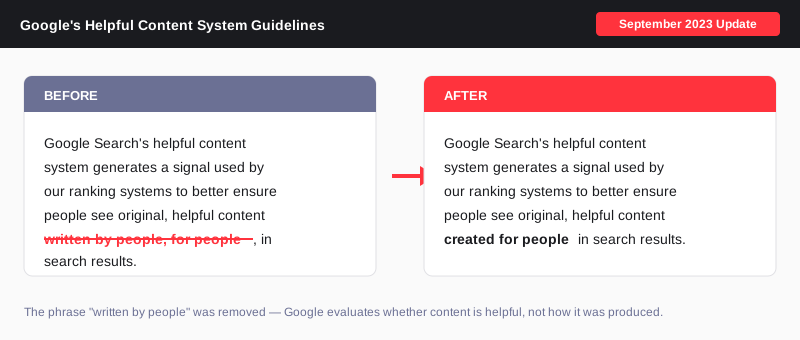
The message is clear: for content to rank well, it must be informative, answer users' queries satisfactorily, and showcase genuine expertise - regardless of how it's created.
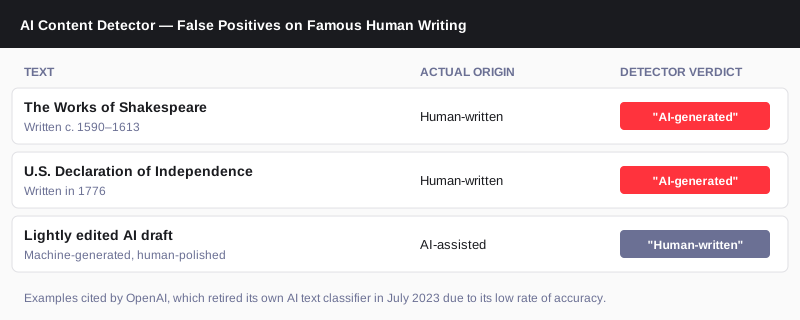
AI Content Detectors like GPTZero, ZeroGPT, and many others are not reliable. Even OpenAI has said as much. They consistently produce false positives about human-written content. Conversely, they can be easily fooled with creative prompting or a bit of human editing.
An interesting note from OpenAI: "we found that it labeled human-written text like Shakespeare and the Declaration of Independence as AI-generated."
Anecdotal evidence and real-life ranking data suggest that while AI-generated content isn't penalized by search engines, it might only achieve high rankings if it meets the above criteria. The role of AI in content creation is still a developing narrative, and its significance is indispensable for maintaining a competitive edge in the future.
At EmberTribe, the understanding is clear - AI serves as a foundation, not the final product. With ClusterMagic, while AI aids in the initial draft based on expert-driven keyword research, human experts step in for the crucial phases of editing, fact-checking, and final review. This hybrid approach ensures the content is accurate and helpful, has the potential to rank, and truly represents their business.
If you've spent any time reading about conversion optimization, you've probably seen the same recycled advice: test your button color, add urgency to your headline, tweak your hero image. That kind of content treats CRO like a bag of tricks. It isn't. Done well, conversion optimization is the most reliable way growth-stage brands turn existing traffic into more revenue without raising their ad budget by a dollar.
The problem is that most teams approach it as a series of one-off tests rather than a system. They run an experiment, see a flat result, lose interest, and move on. Six months later their conversion rate is the same and they blame "CRO doesn't work for us" instead of the approach. The brands that compound wins year after year do something different, and it has nothing to do with picking better button colors.
This guide walks through what conversion optimization actually means in 2026, where the highest-ROI work lives, the common mistakes that quietly kill programs, and how to know whether your team should run CRO in-house or bring in outside help.
At the surface level, the definition is simple. Conversion optimization is the practice of increasing the percentage of visitors who take a desired action on your site, whether that's a purchase, a free trial signup, a demo booking, or an email capture. The math is a basic ratio: conversions divided by sessions.
What makes it meaningful as a discipline is the method, not the math. Real CRO is a continuous, evidence-based process that combines analytics, user research, hypothesis-driven experimentation, and statistical rigor. Nielsen Norman Group has been writing about conversion rate work for two decades, and the throughline is consistent: the teams that improve sustainably are the ones treating CRO as user experience research, not as marketing "hacks."
The distinction matters because the two approaches produce very different outcomes. Tactic-chasing programs hit a ceiling around month three. Systematic programs get better over time because each experiment adds to your understanding of who your users are and how they behave, which makes the next hypothesis sharper than the last.
The easiest way to picture a functional CRO program is as a loop with four stages that feed each other.
Research: Before you touch a page, you need to know where users actually struggle. This comes from analytics drop-off data, session recordings from tools like Hotjar, heatmaps, customer support logs, on-site polls, and qualitative interviews. The goal at this stage is not to invent ideas. It is to collect evidence.
Hypothesis: A hypothesis takes the form "because we observed X, we believe that Y will improve the outcome by Z, and we'll know because of these metrics." A hypothesis without observed evidence is a guess. A guess without a measurable metric is a vibe.
Experiment: This is where most teams start, and that's the mistake. A well-designed experiment follows from research and hypothesis, runs long enough to reach statistical power, and measures the specific metric the hypothesis predicted, not whatever looks favorable after the fact.
Learn: Every result, win, loss, or flat, is information that sharpens the next iteration. Losses are often more valuable than wins because they correct flawed models of user behavior. Programs that only document winners lose half the learning.
When these stages are connected, the loop compounds. When any one stage is skipped, the program becomes a random-ideas factory and the conversion rate stays flat.
Not every page or funnel step is worth optimizing first. The sequencing below reflects what we see move the needle fastest for most DTC and growth-stage SaaS clients.
Checkout is where intent meets friction, which makes it the highest-impact surface in the entire funnel. Research from Baymard Institute shows the average large ecommerce site can gain up to a 35% increase in conversion rate through checkout design changes alone, and that 64% of desktop checkouts tested by their team rate "mediocre" or worse. Common wins live in the obvious places: guest checkout as the default path, forgiving password requirements, explicit delivery dates instead of vague shipping speeds, and error messages that tell users exactly what's wrong.
For SaaS, the equivalent is the signup and onboarding path. Friction between "I want to try this" and "I'm inside the product" costs more than any landing page headline ever will.
Product pages and paid-media landing pages are the second-highest leverage surfaces. This is where the customer decides whether the offer is credible, relevant, and worth the money. Clear value propositions, trust signals placed near the buying decision, well-organized social proof, and page speed under 2.5 seconds all tend to show up in winning tests.
Homepage and category-level optimization matters, but it matters less than most brands think. Fixing a leaky cart has a bigger compounding effect than redesigning a hero section. Work down the funnel first, then back up.
Most CRO programs don't fail because the team picked bad tests. They fail because the testing discipline underneath was broken in ways nobody caught.
Running underpowered tests. The experts at CXL have written extensively about this: most ecommerce sites simply don't have enough traffic to detect realistic lifts in a reasonable timeframe. If your "winner" only needed 400 visitors per variant to show significance, it wasn't actually a winner. It was noise.
Peeking at results and stopping early. Checking a test every day and calling it as soon as you see significance inflates your false positive rate dramatically. A test that looks like a 20% winner on day three can flatten to zero by day fourteen. Set your sample size up front, and leave the test alone until it hits the threshold. A good primer on statistical significance in A/B testing explains why that discipline matters mathematically.
Confusing statistical significance with business significance. A test can be statistically significant and practically useless. A 0.3% lift on a microconversion doesn't justify the engineering cost to implement it. Always check whether the effect size is large enough to matter to the business.
Testing tiny changes with no theory. Button colors, headline tweaks, and generic copy shuffles rarely produce meaningful lifts because the underlying user behavior isn't changing. Bigger, research-grounded hypotheses win more often. GoodUI has catalogued hundreds of evidence-based patterns from real tests, and the throughline is clear: bold changes rooted in behavioral research beat timid tweaks.
Claiming 200% lifts. If you see a case study claiming a 200% conversion lift, read it skeptically. Either the starting baseline was tiny, the test was underpowered, or the definition of "conversion" got stretched. Realistic wins on a mature program usually land between 3% and 15% per experiment. Those add up over a year. The clickbait "200% lift" usually doesn't hold up in a follow-up test.
Conversion rate as a single number hides more than it reveals. Segment it or you'll draw the wrong conclusions.
Segment by traffic source. Paid social, paid search, organic, email, and direct all behave differently. A test that looks flat in aggregate often has a clear winner inside one segment. Aggregate conversion rate is a vanity metric when you're trying to diagnose a problem.
Segment by device. Mobile and desktop users convert differently, sometimes dramatically. A design that works beautifully on desktop can tank on mobile. Run tests device-split from the start.
Segment by new versus returning. New users and returning users are solving different problems. A checkout tweak that helps one often hurts the other.
Track revenue per visitor, not just conversion rate. A test that raises conversion rate but lowers average order value can leave you worse off on the only metric that pays salaries. Revenue per visitor is the honest scoreboard.
Use cohorts for longer-term measurement. Some CRO wins show up in week-one conversion. Others show up in 30-day or 90-day repeat behavior. Cohort analysis catches the wins that simple aggregate reports miss.
CRO is one of the easier disciplines to start in-house and one of the harder ones to scale. Here's a rough framework for when to bring in outside help.
You can probably do it yourself if: your site gets enough traffic to run credible tests (roughly 25,000+ sessions per month per variant), someone on the team understands basic statistics, and the roadmap is research-driven rather than opinion-driven.
You probably need help if: you're trying to connect CRO to paid media strategy, your traffic is too thin for traditional A/B testing and you need a different experimentation model, or your team keeps running tests that come back flat and nobody can figure out why. At that point you're usually missing either the research muscle, the statistical discipline, or the integration with acquisition.
The mistake we see most often with brands hiring agencies is expecting month-one wins. Good CRO work in the first 90 days is mostly research, hypothesis development, and instrumentation. Tests that actually move revenue usually start landing in months three through six. Any partner promising big wins in month one should be treated with the same suspicion as any partner promising guaranteed rankings.
Conversion optimization rewards the teams willing to treat it as a discipline. The same traffic you're already paying for can produce meaningfully more revenue if the system underneath is working. The gap between mediocre and good CRO isn't access to fancy tools. It's the research, the statistical honesty, and the patience to let tests run their full course.
If you're running paid media, your CRO work and your acquisition work should be connected. The messaging on your landing pages should match the messaging in your ads, and the segments you're bidding on should be the segments you're testing for. Running them as separate workstreams is one of the most common and expensive mistakes brands make, and we covered it in depth in our ecommerce CRO guide for growth-stage DTC brands.
If your model is SaaS, the same logic applies across the B2B SaaS lead generation funnel, where message match between ad, landing page, and signup flow often decides whether a campaign returns anything at all.
If your conversion rate has been stuck and you want an honest read on where the real leverage is, that's the work we do every day at EmberTribe. Our team integrates CRO with paid media strategy so the experiments you run actually connect to the traffic you're buying, and so wins compound instead of evaporating between disconnected teams. You can see how that integrated approach fits into a larger ecommerce growth strategy that treats acquisition, conversion, and retention as one system.
The brands that pull ahead in 2026 won't be the ones chasing the latest "hack." They'll be the ones running disciplined programs, asking sharper questions, and letting real evidence drive the roadmap. That's a harder path than copying a template, but it's the only one that compounds. If you'd like to talk through what that could look like for your business, we're always glad to take the call.

The content marketing strategies that drove results in 2022 are quietly breaking. AI Overviews now intercept the click before a reader ever sees your blog post. Organic CTRs on informational queries have fallen sharply. And the SEO-first playbook that growth teams leaned on for a decade is no longer enough to generate pipeline on its own.
That doesn't mean content is dead. It means the work got harder and the winners look different. The brands outperforming right now are the ones that stopped treating content as "produce more articles" and started treating it as a system: authority, distribution, measurement, and a point of view that AI models can't reproduce. Our team runs programs for growth-stage DTC and SaaS brands, and the shift is obvious in the data we see every month.
This guide lays out the five content marketing strategies that actually work in 2026, plus how to measure them and the traps that stall most programs.
For years, the formula was simple. Pick a keyword, write a 2,000-word post, get a few backlinks, watch the traffic compound. That model relied on three assumptions that no longer hold.
First, Google sends less traffic per query. Research on the zero-click search landscape shows that roughly 80% of searches now end without a click, as AI summaries, featured snippets, and knowledge panels satisfy the query directly in the SERP. Second, buyers start their research in ChatGPT, Claude, Perplexity, and Google's AI Overviews, not on page one of a traditional search result. Third, the marginal value of another generic "what is X" article dropped to zero because AI can generate a competent version of it in seconds.
The implication is not "write less." It's "write differently, distribute harder, and measure what actually moves revenue."
We think of modern content programs as a five-part system. Miss any one part and the program underperforms. Run all five together and they compound on each other.
The unit of value is no longer a single ranking page. It's a coherent body of work that covers a topic thoroughly enough that search engines, language models, and human buyers all trust you as the authority.
This is the core logic behind topic clusters and pillar pages. A pillar page covers the topic at a high level, while cluster pages cover specific subtopics in depth. Every page links back to the pillar, and the pillar links out to every cluster. The structure signals comprehensive coverage rather than isolated keyword hunting.
The practical test: pick the three topics your business most needs to own, then audit whether you have 10 to 20 genuinely useful pieces on each. If the answer is no, you don't have a content strategy. You have a blog. For software companies, the shape of that work looks different from DTC, and our SaaS content marketing strategy framework walks through how topical authority plays out in a longer sales cycle.
The biggest mental shift in 2026 is that your content has two audiences now: the human reader and the retrieval model that decides whether to cite you. Getting cited inside an AI Overview or an LLM answer is the new page-one ranking.
What retrieval models reward looks different from what traditional SEO rewarded. Direct answers in the first 50 to 80 words, clear headings that frame a question, tables and lists that are easy to parse, entity-rich language, and specific claims with attribution. The 2026 B2B content marketing trends research shows a clear shift toward owned media and original research as the formats buyers trust most, which happens to be exactly what language models prefer to cite.
Stop burying the answer under 400 words of stage-setting. Lead with the conclusion, then defend it.
The assumption that Google would find your content and deliver readers is gone. If you want the work to compound, you need an active distribution layer across the channels your buyers actually use.
Owned channels and human-distributed content are absorbing the pipeline value that SEO-only strategies used to capture. The four channels that matter most for growth-stage brands:
A piece of content without a distribution plan is a draft, not a strategy.
Anything AI can generate from public sources, AI will generate. What it cannot generate is your data, your customers' outcomes, your opinion, or the specific way your product solves a problem. Those are the only angles that stay defensible as content supply inflates.
Original data means survey results, aggregated product usage trends, benchmark studies, and case study numbers you own. Point of view means taking a position competitors won't. Product-led angles mean teaching your buyer how to do something in a way that naturally introduces your product as the obvious tool. This is the lineage of our growth content framework, and it's become more important as generic educational content loses oxygen.
The question to ask before you publish: could a competitor with a different product write this exact piece with minor edits? If yes, it's not defensible.
Most content programs still report on sessions, rankings, and engagement. Those are activity metrics, not outcome metrics. The programs that survive board review in 2026 report on content-influenced pipeline, content-assisted conversions, and CAC payback attributed to organic channels.
This is the measurement discipline most growth teams skip, and it's the reason content budgets get cut first during downturns. If you can show that organic content generated a share of qualified pipeline, or shortened the sales cycle for leads who touched a specific pillar before converting, content becomes a growth lever that finance defends. If all you can show is traffic, it's a cost center.
Our team at EmberTribe builds this reporting into every content and SEO engagement from day one because retrofitting attribution later almost never works.
Your measurement stack should answer three questions: Is the audience growing? Is the audience converting? Is the content influencing revenue?
For audience growth, track owned metrics that correlate with intent: email subscribers, direct traffic, branded search volume, and share of voice inside AI retrieval (tools now track citation rates across models). Raw sessions matter less than they used to, and visibility-first measurement in the zero-click world is becoming the default framing for senior SEO teams.
For conversion, track content-assisted conversions in GA4, MQL-to-SQL rates segmented by first-touch content, and landing page conversion rates on your pillar pages. These numbers tell you whether the content is doing more than entertaining.
For revenue influence, build a simple multi-touch attribution view in your CRM. Tag every piece of content with a pillar and a funnel stage, then report on the pillars that appear most often in closed-won deal journeys. You don't need a perfect model. You need a defensible one that answers "does this program pay for itself."
The growth marketing channels analysis we've done shows that content's compounding value usually shows up 9 to 18 months in, which is why reporting on short-horizon metrics alone almost always misleads.
A few traps catch even experienced teams.
Optimizing for traffic at the expense of fit. Ranking for a high-volume term that doesn't match your ICP brings visitors who never convert. Measure qualified traffic, not raw traffic.
Publishing cadence as a KPI. "Four posts per week" is a vanity goal. Publishing less often with more original research, better distribution, and tighter ICP alignment beats a content treadmill every time.
Ignoring the gap between brand and performance content. Brand content builds trust over time. Performance content converts in the current quarter. Most programs do one or the other. The best do both, and they track them with different metrics.
Treating content as a solo function. Content compounds when it's connected to SEO, paid, email, sales enablement, and product. When it lives in isolation inside marketing, it underperforms its potential.
If you're running a growth-stage brand and your content is underperforming, the fix is almost never "hire more writers." It's usually some combination of narrower topical focus, stronger distribution, sharper POV, and better measurement tied to revenue.
Start with an honest audit. Which topics do you actually own, and where do your qualified leads first touch your content? Which pieces are getting cited by AI retrieval, and which are ghosts? What's your content-influenced pipeline number, and do you even track it?
When growth-stage brands partner with EmberTribe for content and SEO, the first 30 days are about that audit, not about producing more work. The programs that compound are the ones built on the right foundation, not the ones built on the highest word count. If you're ready to build a content strategy that reports in pipeline instead of pageviews, we'd love to talk about what that looks like for your business.

Most companies reach a point where growth stalls and nobody inside the building can explain why. Revenue flattens, CAC creeps up, the marketing team is busy but not compounding, and the founder starts wondering whether the problem is the strategy, the team, or the market. A business growth consultant is the outside operator companies bring in at exactly this moment, to diagnose what is actually broken and design a path forward that the in-house team can execute.
The role is often confused with fractional CMOs, management consultants, and agencies, partly because the labels overlap and partly because vendors use whatever title sounds most attractive to the buyer. This guide explains what a business growth consultant actually does, how engagements are typically structured, what they cost, and how to tell whether hiring one is the right move for your company.
A business growth consultant is a senior operator who works with leadership to identify growth constraints and build a plan to remove them. The work is almost always a mix of diagnosis, strategy, and guided execution, not pure advice delivered in a slide deck. HBR's research on growth strategy has consistently shown that the companies pulling out of stalls treat growth as a system problem, not a marketing problem, which is the mental model a good consultant brings to the engagement.
Most engagements cover some combination of these areas:
A good growth consultant will not promise to personally run your ad accounts, write all your content, or become your head of marketing. They bring judgment, frameworks, and an outside perspective, then hand the execution back to a team that is equipped to deliver it.
The three roles solve different problems, and the most common hiring mistake is picking the wrong one because the labels sound similar. Here is the practical breakdown. RolePrimary jobTime commitmentBest fitGrowth consultantDiagnose and planProject-based, 4 to 16 weeksOne specific growth problemFractional CMOLead marketing ongoing10 to 40 hours per monthNo marketing leadership in placeAgencyExecute in a specific channelMonthly retainerStrategy exists, execution needed
A growth strategy consulting engagement is typically scoped, finite, and output-oriented. You hire them to answer a specific question, such as why our paid media is stalling or what our next growth channel should be, and the output is a plan plus guidance during early implementation.
A fractional CMO is a longer-term relationship. They become part of the leadership team on a part-time basis, own marketing outcomes, and manage internal and external resources against a roadmap. If you are weighing this path, the deep dive on the fractional CMO model for B2B SaaS covers when it works and when it does not.
An agency executes. A good one will contribute strategic input, but its primary job is to run the campaigns, build the content, or deliver the technical work in a defined scope. The post on how to choose between an agency, freelancer, or in-house marketer goes deeper on this decision.
Many companies eventually use all three, in sequence or in parallel. A growth consultant diagnoses the problem, a fractional CMO or in-house hire owns the ongoing leadership, and one or more agencies execute the work.
Most growth strategy consulting services fall into one of four structures. Knowing which one you are buying matters, because the shape of the engagement determines what you can reasonably expect from the relationship.
Diagnostic sprint. A fixed-scope audit, typically 2 to 6 weeks, that produces a written growth diagnostic and a recommended action plan. This is the cleanest way to test whether a consultant is worth a longer engagement without committing to a six-figure contract.
Strategy engagement. Usually 8 to 16 weeks, this includes the diagnostic plus deeper work on positioning, channel strategy, and go-to-market planning. The consultant typically runs working sessions with leadership and leaves behind playbooks the internal team can execute.
Retainer advisory. A monthly commitment, usually 5 to 20 hours, where the consultant stays involved as a sounding board and reviews progress against the plan. This is most useful immediately after a strategy engagement, to keep the work on track during implementation.
Outcome-based. Less common, but growing. The consultant ties fees to specific metrics such as pipeline growth, CAC reduction, or qualified lead volume. This works when the metric is clearly attributable and the consultant has meaningful influence over execution, which is not always the case.
The structure matters more than the title. Ask any consultant you are considering to walk you through the exact shape of the engagement, including deliverables, timeline, and what happens after the initial scope ends.
Pricing varies widely based on experience, scope, and how much implementation support is included. Using public benchmarks from Clutch's consulting pricing guide and the Consulting Success fees guide, typical ranges in 2026 look like this:
Experienced operators who have run growth at a comparable company tend to price at the higher end. Earlier-career consultants or those running their first independent engagements may price significantly below these ranges. Price alone is a weak proxy for fit, but if the number feels far outside these ranges in either direction, that is worth asking about directly.
A growth consultant is the right hire when your problem is clarity, not capacity. Specifically, look for these signals:
Growth has stalled and nobody can explain why. Revenue is flat or declining, CAC is climbing, and the team is running the same plays that used to work. An outside operator can spot structural issues that internal teams are too close to see.
You are deciding between major strategic directions. Should you invest in outbound sales or content-led growth? Move from product-led to sales-led? Enter a new market segment? A consultant can stress-test the decision before you commit resources to the wrong direction.
You are preparing for a significant inflection. Fundraising, a new product launch, a market expansion, or a transition from founder-led marketing to a scaled team all benefit from a clean growth plan built before the inflection, not during it.
You do not have senior marketing leadership in place. If there is nobody on the team who has scaled growth at a similar company, a consultant can temporarily fill the strategic gap while you decide whether to hire a full-time executive.
A consultant is not the right hire when the problem is execution capacity. If you already know what to do and just need someone to run campaigns, write content, or manage ad accounts, you need an agency or an in-house hire, not a strategic advisor. The related post on growth marketing channels and business success covers how to tell these situations apart.
The biggest mistake companies make when hiring a business growth strategy consultant is picking on credentials instead of fit. A consultant with a strong resume can still be wrong for your stage, industry, or problem. Use these questions to pressure-test the match.
Beyond these questions, look for someone who has actually done the work at a company like yours. Advisors who have only ever consulted, without operational reps, tend to produce plans that are theoretically sound but difficult to execute in practice.
Hiring the wrong kind of growth help is expensive, not because of the fees but because of the months lost running the wrong plan. Before you start interviewing consultants, take a hard look at what is actually broken. If the problem is that the team does not know what to do, you need a consultant. If the team knows what to do but cannot get it done, you need execution capacity, whether that is an agency, a hire, or both.
The best business growth consultant engagements end with a leadership team that understands its own growth model better than when the consultant arrived. The plan is documented, the metrics are installed, the execution handoff is clean, and the relationship tapers off on a predictable schedule. If the engagement creates ongoing dependency instead of capability, something is off.
If you are early in this decision and still mapping out whether a consultant, agency, or in-house hire is the right fit, the companion post on how a business growth agency can help your company reach new heights is a good next read. It covers the agency side of the equation in more depth.
EmberTribe works with DTC brands and growth-stage SaaS companies on growth strategy and execution. If you want to talk through whether consulting, a fractional role, or an agency engagement is the right fit for your situation, learn more about our strategy consulting services.

Choosing a B2B marketing firm in 2026 is harder than it should be. Every agency deck looks the same, every case study promises 3x pipeline, and the gap between one that moves your numbers and one that quietly bills you for a year is almost impossible to spot from the outside.
The stakes are real. Recent B2B content marketing research shows 91% of B2B marketers use content marketing as a core channel, and budgets are tilting toward SEO, AI tooling, and owned media rather than pure paid spend. Pick the wrong partner at this point in the cycle and you're not just wasting retainer dollars, you're ceding ground to competitors whose firms actually know what they're doing.
This guide walks through what a B2B marketing firm actually does today, how the main firm types compare, realistic pricing, and the evaluation checks that separate firms worth hiring from firms worth avoiding.
A modern B2B marketing firm is less about ads and more about building the machinery that feeds pipeline. Research on the modern B2B buying journey shows most of the purchase decision now happens before a buyer ever talks to sales, which means the firm's real product is visibility and trust across the channels where buyers research on their own.
In practice, that work usually covers five areas:
Not every firm does all five well. The mistake buyers make is assuming a firm that nails paid media will also nail content and SEO, or that a great content firm can run an ABM program. The skill sets are different, and firms that claim everything usually specialize in nothing.
The right firm for you depends on your stage, your growth motion, and whether you need depth in one area or coverage across many. Here's how the main options compare. Firm TypeBest ForStrengthWatch Out ForSpecialist agencyCompanies with one clear channel gapDeep expertise in a single disciplineBlind spots outside their laneFull-service agencyMid-market companies needing coverageCoordinated strategy across channelsUneven quality by disciplineFreelancer or consultantEarly-stage or tactical needsSenior talent, low overheadNo bench, single point of failureIn-house teamStable, well-funded companiesDeep product knowledgeSlow to hire, expensive to scale
Specialists focus on one thing. A B2B SEO firm, a content firm, an ABM firm, a paid media firm. Their entire business depends on being genuinely good at that discipline, which usually means they are. If you already know your bottleneck, a specialist is usually the fastest path to fixing it.
The trade-off is coordination. You'll need either an in-house owner or a fractional CMO to keep multiple specialists pointed at the same goal. If nobody holds that seam, you end up with a content team, an SEO team, and a paid team running three separate strategies that never add up to a pipeline number.
A full-service professional services marketing agency bundles strategy, content, SEO, paid, and reporting under one roof. The pitch is coordination, a single account manager, and fewer vendors to manage.
That's the pitch. The reality is that most full-service firms are strong in two disciplines and mediocre in the others. Before signing, ask which two they're known for and who on the team would actually be running the weaker ones. If the answer is vague, you're about to pay retainer rates for someone's on-the-job training.
A senior freelancer with 15 years of operating experience can outperform a mid-tier agency on a narrow brief. You get direct access to the person doing the work, no account management layer, and usually faster turnarounds on strategy and execution.
What you give up is scale and redundancy. A freelancer can't run paid, content, SEO, and RevOps simultaneously, and if they get sick or take on a new client, your program pauses. For tactical projects and fractional roles, freelancers are often the right answer. For a full growth engine, they rarely are.
In-house teams have two advantages no agency can match: full product immersion and long-term memory. A senior in-house marketer knows the product, the sales team, the customers, and the internal politics in a way no outside firm ever will.
The downside is cost and speed. Building a senior in-house team takes 6-12 months before it's operational, and you commit to salaries and tooling that don't flex down when priorities shift. We break down the full trade-off in our guide on choosing between an agency, freelancer, or in-house marketer.
Pricing varies wildly, and "you get what you pay for" is only partly true. Some of the most expensive firms produce generic output, and some mid-market firms deliver genuine senior talent at half the cost. The honest ranges for a B2B marketing firm in 2026 look roughly like this: Engagement TypeTypical Monthly RangeWhat You Should ExpectTactical specialist$3,000 to $8,000Single-channel execution with senior oversightMid-market full-service$8,000 to $20,000Multi-channel strategy plus execution across 3-4 disciplinesEnterprise full-service$20,000 to $75,000+Dedicated pod, custom reporting, executive accessProject-based$10,000 to $75,000One-time strategy work, rebrand, or buildSenior freelancer$150 to $400/hourDirect access, no account management layer
Retainers dominate the market because predictability benefits both sides. Most reputable firms require a 3-6 month minimum commitment so the work has enough runway to show results. Be suspicious of firms pushing 12-month contracts before you've seen any output, and equally suspicious of firms under $2,500 a month, which usually means white-label reselling from overseas with a middleman taking the margin.
Current marketing budget statistics show B2B spend is rising across the board, but the winners aren't the companies spending more. They're the companies spending the same with firms that understand their specific motion.
The evaluation work is where most buyers drop the ball. The sales process is designed to make every firm look competent. Here's what to check before you sign.
Ask what percentage of the firm's clients look like you in size, revenue model, and growth stage. A firm that mostly serves $500M enterprises will bring the wrong instincts to a Series A startup, and a firm that mostly serves seed-stage startups will be out of its depth at a mid-market SaaS company. B2B marketing benchmark data points to vertical expertise as one of the strongest predictors of pipeline results, which tracks with what we see in practice.
Ask for two or three case studies from companies that closely match yours, not just logos on a wall. Specific numbers, specific time frames, specific starting conditions. If a firm can't produce that, assume they haven't done it.
Agencies sell deals through charismatic founders and deliver them through account managers you never met during the pitch. Ask directly who will run your account day-to-day, what their experience looks like, and how many other accounts they handle simultaneously. Ask to meet them before signing.
Then ask about the first 30, 60, and 90 days. A good firm can describe exactly what happens in each phase: audit, strategy, activation. A firm that waves their hands and says "we'll figure it out together" hasn't done this enough times to systematize it. That's fine for a freelancer, but not for a retainer.
A strong firm tells you which metrics matter, why, and how the reporting cadence works. They distinguish between marketing-sourced pipeline and marketing-influenced pipeline. They're comfortable showing you numbers that make them look bad when something isn't working.
Vague reporting focused on "engagement" and "brand lift" without a clear line back to pipeline or revenue is one of the clearest warning signs in the business. If you can't tie the firm's work to a business outcome after 90 days, either the firm can't measure it or doesn't want you to.
The firms worth hiring in 2026 have already moved on AI in two ways: they use it internally to move faster, and they optimize content for answer engines like ChatGPT and Perplexity, not just Google. Ask how the firm thinks about AEO and whether they've started tracking brand visibility in LLM responses. Firms that haven't thought about this are already behind the curve.
The bad agency stories you hear at conferences share a consistent pattern. If you spot any of these during evaluation, move on.
These aren't edge cases. They're the dominant failure modes, and they show up regardless of firm size or price point.
After hundreds of discovery calls with B2B buyers, the questions that separate serious firms from smooth talkers are usually the boring ones. Bring these to every evaluation.
Firms that answer these crisply are worth a second conversation. Firms that dodge, deflect, or reframe are telling you something important.
The B2B marketing firm you pick in 2026 should feel like a senior hire, not a vendor. You're bringing someone in to own a growth engine that needs to work in 12 months, not 12 weeks. Treat the evaluation like a hiring decision: references, stage-specific case studies, meetings with the people who will do the actual work, and a clear read on how the firm thinks about measurement.
Before shortlisting firms, answer two questions. What's your real bottleneck, and what stage are you at? A content and SEO problem calls for a different firm than a paid acquisition problem, and a $3M ARR company needs different things than a $30M one. Our breakdown of B2B lead generation in 2026 is a good next step if you're still framing the work.
At EmberTribe, we've spent years helping B2B companies build demand gen and SEO programs that compound over time rather than burn out at month four. The pattern is consistent across the best engagements: clear expectations, honest conversations about what the firm can and cannot move, and a shared definition of what success looks like at 90 days. Do the evaluation work upfront and you'll recognize the right partner when you're in the room.
B2B lead generation in 2026 does not reward the tactics that worked five years ago. Buyers research in private, AI summarizes your competitors before a prospect ever visits your site, and paid channels that once delivered cheap leads now price most mid-market teams out. The companies winning pipeline right now are not running harder at the old playbook. They are running a different one.
This guide is for B2B marketing leads and founders trying to understand the modern lead gen landscape before committing budget to it. We will cover the channels that produce qualified pipeline today, how to score and qualify leads without wasting sales capacity, and the common mistakes that keep teams stuck at flat growth.
Three structural shifts have changed how B2B buyers move and what it takes to reach them.
Buyers finish most of the research before they contact you. Research from Gartner shows that buyers now spend only about 17% of their purchase journey meeting with potential suppliers, and when comparing multiple vendors, that number drops closer to 5%. By the time a prospect requests a demo, they have already read your pricing page, your reviews, and at least three competitor comparisons.
Buying committees got bigger, and AI made them bigger still. Forrester's 2026 Buyer Insights research found that the typical B2B purchase now involves 13 internal stakeholders and 9 external influencers, and that number roughly doubles for purchases that include generative AI features. Marketing has to reach the economic buyer, the technical evaluator, legal, security, and the end user, often with different content and different messages.
AI search compressed the top of the funnel. ChatGPT, Perplexity, and AI Overviews in Google now answer many informational queries without sending a click. Traffic to broad top-of-funnel posts has dropped for most B2B publishers. What converts are deeper, more specific pages that an AI will cite or a buyer will bookmark.
The practical implication: raw lead volume is a worse signal than it used to be, and "top of funnel" no longer means "easy." The channels below are the ones producing pipeline in that environment.
Content still works. Generic content does not. The B2B SEO strategies that produce pipeline in 2026 skip the "what is" primers and go straight at commercial intent: comparison pages, "best X for Y" queries, integration guides, pricing guides, and problem-specific how-to content for a defined persona.
A few practical rules:
SEO is still the lowest-cost qualified channel once it is working. According to First Page Sage's 2026 benchmarks, organic search delivers cost per lead in the $30 to $80 range for most B2B categories, well below paid search or paid social.
Account-based marketing is no longer a separate program run by an enterprise team. For most mid-market B2B companies, it is the coordination layer that makes every other channel work harder. Instead of capturing whatever leads the funnel happens to produce, ABM starts with a defined list of fit accounts and aligns marketing, sales development, and content to reach them.
What that looks like in practice:
The data backs the approach. A roundup of ABM statistics from UserGems shows that 87% of B2B marketers say ABM delivers higher ROI than other marketing programs, and companies with mature ABM programs see meaningfully larger average deal sizes. The catch is that only a small share of teams run mature ABM. Most treat it as a list of accounts in a spreadsheet, not a coordinated motion.
LinkedIn is the highest-signal channel in B2B right now, and its role has shifted. Paid ads on LinkedIn are expensive, with cost per lead often landing in the $150 to $400 range depending on industry and seniority. What produces pipeline at a better rate is LinkedIn as a demand layer: executive and team content published consistently, commented on, and used to warm up target accounts.
Three patterns that work on LinkedIn for B2B:
Intent data is the single biggest unlock most B2B teams have not made full use of. Providers like 6sense and Bombora aggregate behavioral signals across the web, including which companies are researching your category, your competitors, and specific problem statements. When plugged into the rest of your stack, that data changes outreach from "everyone on the list" to "the 40 accounts that are actively in-market this month."
The practical setup:
Intent data is not magic, and the signal is noisy in categories with low search volume. But used well, it concentrates effort on the accounts most likely to buy next quarter.
Paid media in B2B has not died, but its role has narrowed. Paid search on branded and high-intent commercial terms is still one of the fastest paths to qualified pipeline. Paid social, particularly LinkedIn and Meta, works well for retargeting warm audiences and serving content to known buying committees inside target accounts.
Where paid struggles in 2026: broad prospecting for unknown audiences. Cost per click rose sharply after iOS 14 changes broke signal loss for Meta, and LinkedIn cost per lead climbed in parallel. Paid is now best used as a layer on top of a working organic and ABM motion, not as a substitute for them. For a deeper look at how paid channels compare across the funnel, our post on upper funnel vs lower funnel campaigns breaks the tradeoffs down in more detail.
Most B2B teams score leads on activity and route everything above a threshold to sales. That burns sales capacity on bad fit accounts and teaches reps to distrust marketing leads.
A cleaner model scores two axes independently: *Low IntentHigh IntentHigh FitNurture with contentRoute to sales immediatelyLow Fit*Do not pass to salesRoute with a context flag
Fit is firmographic: company size, industry, tech stack, geography. Intent is behavioral: pages visited, emails opened, content downloaded, meetings requested. A lead that hit both needs a different response than one that hit only intent.
Document the scoring rules explicitly, review them with sales every quarter, and adjust based on closed-won data. Teams that skip the revisit step end up scoring to a buyer profile that stopped matching reality two years ago. For related context, our post on lead generation pricing walks through how qualification directly affects the economics of each channel you run.
A short list of the patterns we see repeatedly with teams that are running hard and not producing pipeline.
Confusing traffic with demand. Traffic is a precondition for pipeline, not a substitute for it. A site that ranks for informational queries but has no commercial pages will generate impressions and no conversations.
Running SDRs on top of a broken ICP. Outbound amplifies whatever is already in the list. If the ICP is fuzzy, more SDRs produce more noise, not more meetings.
Treating lead quantity as the north star. The metrics that matter are sales accepted leads, pipeline created, and closed-won revenue by source. Lead count is a diagnostic, not a goal.
Forgetting the technical buyer. In most complex B2B purchases, the technical evaluator has effective veto power. Integration docs, security pages, and architecture content rarely appear in marketing plans. They should.
Underinvesting in the mid-funnel. Most teams have top-funnel content and a demo form. What lives between them is usually empty. Case studies, ROI calculators, comparison guides, and nurture sequences fill the gap, and without them, active buyers who are not yet ready for sales disappear from the funnel.
For a SaaS-specific view of the same problem, our B2B SaaS lead generation playbook goes deeper on funnel design for subscription businesses.
B2B lead generation in 2026 is not about choosing one channel and going all in. It is about building a system where ABM defines the accounts, SEO and content feed them authority, LinkedIn and intent data warm them, paid accelerates the ones closest to purchase, and scoring decides what gets a human touch. Each channel makes the others work better.
Most teams skip the system work and go straight to tactics. That is why so many B2B marketing budgets feel like they produce heat without light. The mix of growth channels you choose matters less than whether those channels are coordinated around a clear target account and a clear definition of what a qualified lead looks like.
If you are trying to get a clearer picture of which of these levers is the right first move for your stage and category, that is the kind of work our strategy consulting team does day to day. We audit the current funnel, map it against revenue goals, and identify which channels, scoring model, and content investments will compound fastest for your specific situation. The right starting point depends on what you already have in place, and the wrong starting point is the most expensive mistake in B2B growth.

Most B2B teams running ABM marketing in 2026 are running something else and calling it ABM. They bought a platform, uploaded a target account list, fired retargeting ads, and waited for meetings to appear. When the pipeline did not move, they blamed the tool. The tool was not the problem.
Account-based marketing is a pipeline strategy, not a campaign tactic. It only works when marketing, sales, and customer success operate from a shared account list, a shared definition of engagement, and a shared measurement framework. Everything else is just targeted outbound with extra steps.
This guide covers what modern ABM actually looks like, the three flavors worth running, how intent data powers the smart version of all of them, and the metrics that prove whether any of it is working.
The textbook definition still holds: concentrate marketing resources on a defined set of high-fit accounts rather than spreading them across a broad demand-gen audience. What has changed is everything around that definition.
In 2025 and 2026, the best ABM programs operate as a coordinated motion across marketing, sales, and customer success, fed by real-time intent data and measured against pipeline outcomes instead of lead volume. Directive's 2026 ABM strategy guide describes this shift as moving from campaign to operating philosophy, and that framing matches what we see working for high-ACV SaaS companies.
ABM is the right fit when your average deal size justifies concentrated effort. For most B2B SaaS companies, that means annual contract values of $25K or more, multi-stakeholder buying committees, and a finite universe of accounts that could realistically become customers. Below those thresholds, a broader B2B SaaS lead generation playbook usually produces better unit economics.
ABM is not the same thing as outbound sales. Outbound targets individuals with cold outreach. ABM targets a coordinated buying committee inside a named account with orchestrated touches across paid media, content, events, direct mail, and sales activity. The entire company shows up, not just the SDR.
Not every account deserves the same investment. Mature programs run a tiered model, borrowing the framework from ITSMA's original 1:1, 1:Few, 1:Many taxonomy that most ABM platforms still use today.
One-to-one ABM concentrates resources on a small set of named accounts, typically 5 to 25, where the potential deal value or strategic importance justifies fully custom treatment. Think microsites, custom research, executive events, and co-branded content built for a single logo.
This is the most expensive flavor to run, often costing $50K or more per account when you factor in creative, research, and sales time. Reserve it for accounts where a single win materially changes your quarter or where you need to break into a strategic industry anchor.
One-to-few ABM clusters accounts with similar buying triggers, often by industry, size, or use case. You build semi-customized campaigns that target 10 to 100 accounts within a cluster, reusing creative and messaging across the group while personalizing the top layer.
This is the most common ABM flavor for growth-stage B2B SaaS because it balances efficiency with relevance. A single industry playbook can cover 40 accounts in healthcare tech or 60 accounts in fintech without requiring the custom lift of 1:1 work.
One-to-many ABM uses technology to target hundreds or thousands of accounts with light personalization, typically through display advertising, retargeting, and dynamic content. It is the closest flavor to traditional paid media, but scoped to an account list instead of a broad persona.
Programmatic ABM is where most teams start because it is the easiest to operationalize, but it is also the flavor most likely to fail if the account list is wrong. Without intent data and sales orchestration, it collapses into expensive retargeting.
Most effective programs run all three in a pyramid: a small 1:1 tier at the top, a larger 1:few tier in the middle, and a wide 1:many base that warms the entire total addressable market.
The biggest change in ABM over the last two years is the maturation of intent data as the core targeting signal. Fit data tells you who the right account is. Intent data tells you when that account is in-market, which is the harder half of the problem.
Modern intent signals include: third-party research behavior on comparison sites and review platforms, first-party engagement on your owned properties, technographic changes like new tools in the stack, and people signals like leadership or hiring changes that indicate a reorg.
The best programs layer account-level intent for marketing orchestration with contact-level intent for sales engagement. Marketing uses the aggregate signal to sequence outreach and surface accounts showing research patterns. Sales uses the individual signal to personalize conversations with the specific buyer who visited three pricing pages this week.
The mistake to avoid: treating intent signals as buying signals. Most intent data reflects research behavior, which is top-of-funnel curiosity. A sudden spike in research across five stakeholders at one account is worth acting on, while a single page view from an unknown visitor is not. Our guide to B2B lead generation that actually builds pipeline covers how to qualify intent signals without over-reacting to noise.
ABM that only lives in marketing fails. The entire structural advantage of account-based marketing is that the whole revenue team works the same account list together, which means sales has to buy in before the first campaign ships.
Real orchestration means a shared account tier list updated weekly, a service-level agreement for how fast sales responds to engaged accounts, a coordinated sequence across paid media, sales outreach, and content, and a single dashboard that all three teams check. Without those pieces, ABM is just marketing shouting into a list and wondering why meetings are not getting booked.
Customer success belongs in the orchestration too. Existing accounts are the highest-probability pipeline a B2B company has, and running ABM expansion plays against strategic customers often produces faster wins than net-new acquisition. The best expansion programs look identical to a 1:few play, just pointed inward.
If your team does not have the strategic leadership to align marketing, sales, and CS around a shared ABM motion, bringing in a fractional CMO who specializes in B2B SaaS is often the fastest way to install the operating rhythm.
The single clearest signal that a team is doing ABM wrong is reporting on MQLs. Marketing qualified leads were built for a volume-based funnel where the goal is to hand off as many names as possible. ABM is the opposite. The goal is concentrated engagement on a finite account list.
The right metrics for ABM:
Organizations running coordinated ABM programs report materially higher win rates and faster sales cycles on engaged accounts, and Mutiny's guide to ABM measurement offers a more detailed framework for isolating influence from attribution. The numbers vary by source, but the direction is consistent: engaged target accounts convert better than cold ones, and engaged accounts with coordinated sales follow-up convert best of all.
A few patterns show up in almost every failed ABM program we audit.
None of these are tooling problems. They are operating-model problems, which is why ABM needs strategic ownership, not just a platform admin.
ABM marketing done right is one of the most durable pipeline strategies available to high-ACV B2B SaaS companies. Done wrong, it is an expensive way to run retargeting ads against a list. The difference is almost entirely in the operating model: shared accounts, shared intent signals, shared measurement, and a sales team that actually works the program.
If you are building or rebuilding an ABM motion, start with three questions before touching any platform. Is your ICP grounded in actual customer data? Does sales own the account list alongside marketing, and are you ready to measure on pipeline influenced instead of lead volume? If the answer to any of those is no, solve that first.
When the operating model is ready, the technology and the campaigns follow quickly. When it is not, no platform in the world will save the program.

Most SaaS content programs produce blog posts. Few produce pipeline. The gap between the two is almost always the same: a SaaS content marketing strategy that optimizes for publishing volume instead of buyer progression.
Content-led growth is real - Ahrefs, HubSpot, and Intercom all built dominant market positions on content before their competitors figured out paid was getting expensive. The data backs it up: First Page Sage puts average B2B SaaS SEO ROI at 702% over three years with a 7-month break-even, and organic search drives 44.6% of all B2B revenue - more than any other channel. But those outcomes came from systems, not just blog posts. This is the framework.
The instinct when building a SaaS content strategy is to start with a keyword list. That comes later. Start with the question: Who are we writing for, and what do they already believe?
In B2B SaaS, your audience typically includes three distinct profiles with different needs:
The Economic Buyer (VP, Director, C-suite): Cares about ROI, competitive risk, and strategic fit. Reads case studies, benchmark reports, and "how to evaluate" guides. Doesn't want to read tutorials.
The Technical Evaluator (engineer, IT, RevOps): Cares about security, integrations, implementation complexity, and edge cases. Reads documentation, technical comparisons, API guides.
The End User (the person using the product daily): Cares about workflow efficiency and solving the immediate problem. Reads how-tos, feature guides, use case walkthroughs.
Most SaaS content programs write only for the end user. The content gets traffic, but it fails to influence the people with budget authority or technical veto power. Map your content plan explicitly to each buyer profile before you write a single post.
Topic clusters are a useful SEO architecture, but they don't tell you what to prioritize. A "content hub" about project management can be almost entirely top-of-funnel and generate almost no pipeline - despite ranking well and driving traffic.
The more useful framework maps content by funnel stage: StageBuyer QuestionContent TypeAwareness"What is this problem called?"Explainers, trend posts, educational guidesConsideration"What are my options?"Comparisons, vendor roundups, evaluation checklistsDecision"Is this the right choice for us?"Case studies, ROI calculators, security docs, integrationsExpansion"How do we get more value?"Use case guides, feature deep-dives, customer stories
Most SaaS content plans are overweight at awareness and nearly empty at consideration and decision. That's exactly backwards from a pipeline standpoint. Consideration and decision content drives the highest-intent organic traffic - the searchers who already have the problem and are actively evaluating solutions.
A mature SaaS content marketing strategy targets all four stages, but deliberately overweights consideration and decision content because that's where conversion rates are highest and competition is often thinnest.
"[Your product] vs. [Competitor]" and "Best [Competitor] alternatives" pages consistently rank well and convert at high rates because the searcher is already in evaluation mode. Research from GenesysGrowth shows comparison pages convert at 3.2x the rate of standard feature pages. These pages require honesty - a one-sided comparison that pretends competitors have no strengths reads as a sales pitch and damages trust. Acknowledge tradeoffs, focus on fit, and let the positioning speak for itself.
"How [ICP job title] uses [your product] to [achieve outcome]" is the most neglected content type in SaaS. It's specific enough to attract qualified traffic, it maps directly to ICP conversations in sales, and it builds credibility that broad topic guides can't. If you serve five distinct use cases, each one deserves its own dedicated content.
"[Your product] + [popular tool in your ICP's stack]" content targets buyers who are already using connected tools. These are warm buyers: they have the budget, the workflow context, and often the exact problem your integration solves. This content also earns backlinks from partner pages.
Long-form, comprehensive guides on core topics in your space - the "complete guide to X" format - anchor your topic cluster strategy and generate consistent organic traffic over time. These aren't the fastest path to pipeline, but they're the compound interest of content: slow to build, durable once established.
Here's a number worth sitting with: most SaaS companies earn 60–70% of their revenue from existing customers through renewals, upsells, and expansion. Yet most SaaS content programs invest almost exclusively in acquisition.
Retention content isn't the same as a help center. It's proactive content that teaches customers to get more value from the product, surfaces use cases they haven't tried, and reinforces that the tool is evolving. Done well, it reduces churn, increases NPS, and generates the kind of organic word-of-mouth that no acquisition campaign can replicate.
Practical formats for retention content:
If your content plan has no entries for the expansion stage, you're optimizing the acquisition funnel while leaving the retention engine unmanned.
Content without distribution is just publishing. The post goes live, gets indexed, maybe earns some organic traffic over 6 months - but nothing happens in week one.
A working distribution stack for B2B SaaS content typically includes:
The internal linking piece is particularly easy to underinvest in. A new post that earns no links from existing content starts with zero internal authority. A deliberate backward linking pass - updating 3–5 relevant existing posts to reference the new one - meaningfully accelerates indexing and rankings.
Vanity metrics tell you whether publishing is happening. Revenue metrics tell you whether content is working. MetricWhat It MeasuresOrganic sessions by stageWhether traffic distribution is balanced or overweight at awarenessMQLs from organicWhether content is generating leads, not just readersContent-assisted pipelineRevenue where a content touchpoint appeared in the customer journeyTrial signups from blogWhether content is driving product engagementExpansion revenue influencedWhether retention content is contributing to upsell and renewalTime-on-page and scroll depthWhether content is being read or just visited
The single most useful reporting change most SaaS content teams can make: add UTM tracking to every internal CTA in blog posts and route those conversions into a dedicated attribution report. Most teams can't answer "how much pipeline came from content" - because they never built the tracking to know.
A SaaS content marketing strategy isn't a content calendar. It's a system: audience segmentation feeds topic selection, funnel mapping sets prioritization, content types match buyer intent, distribution multiplies reach, and metrics close the feedback loop.
The companies that invest early in this system - rather than publishing whatever seems interesting - build an organic pipeline machine that compounds year over year. SaaS-focused content SEO is the engine underneath; strategy is what decides what to put in it.
If you're building a B2B pipeline alongside this content foundation, the B2B SaaS lead generation playbook covers the channel and conversion layer that turns content readers into qualified leads.
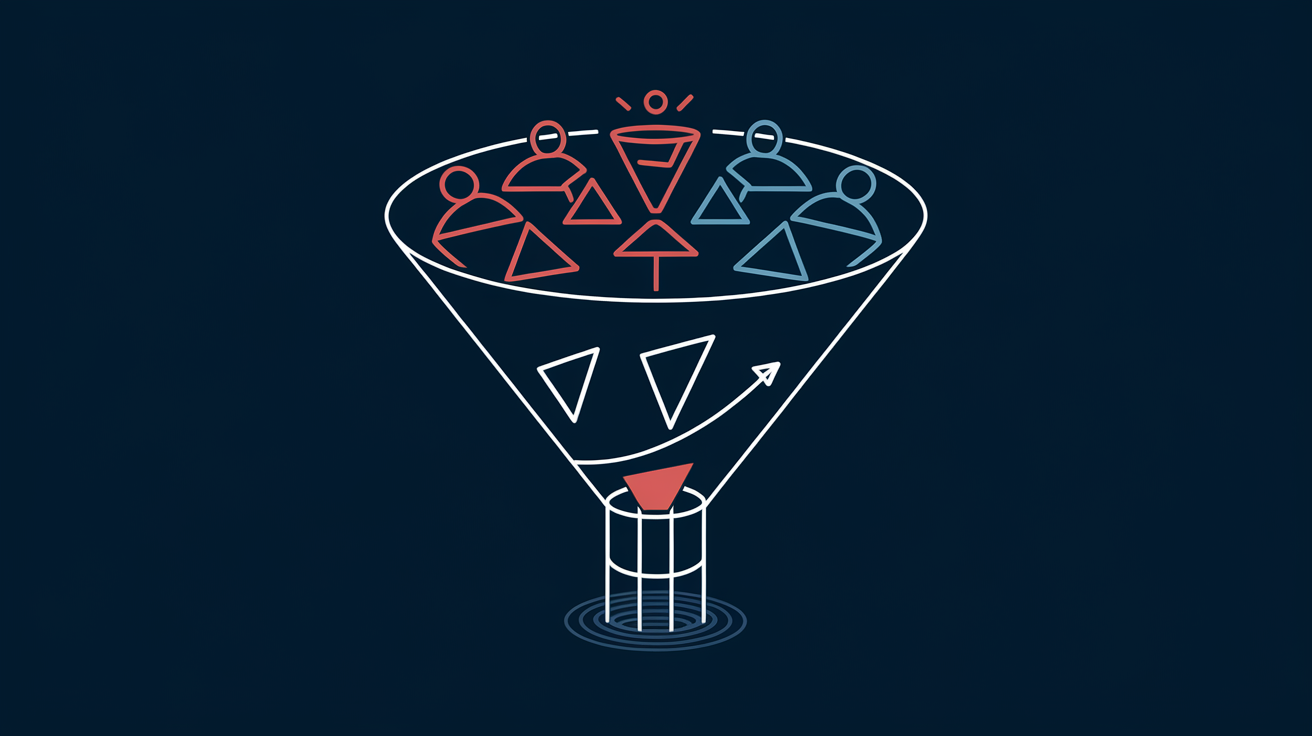
Most B2B SaaS companies don't have a lead generation problem. They have a lead quality problem. The top of the funnel is full - demo requests, MQLs, content downloads - but the pipeline stays thin because the wrong people are converting.
B2B SaaS lead generation done well is about attracting buyers at the right stage, moving them efficiently through the funnel, and handing sales a set of leads that are actually ready to evaluate. That requires more than adding a contact form and running ads. It requires a playbook.
Traditional B2B lead gen focuses on volume: get enough contacts, work the phones, close what sticks. SaaS doesn't work that way. The unit economics - CAC, LTV, payback period - are unforgiving. A high-CAC lead from a low-fit account doesn't just fail to close; it drags down metrics for months.
Three dynamics make SaaS lead generation distinct:
Subscription economics demand fit over volume. A closed deal from a poor-fit company churns in 6 months. The acquisition cost stays on the books; the revenue doesn't.
Trial and freemium create a parallel funnel. Product-qualified leads (PQLs) - users who've hit activation milestones - often convert at 2–5x the rate of marketing-qualified leads, according to OpenView Partners. If you're ignoring PQL data in your lead gen strategy, you're leaving the most reliable signal on the table.
Buying committees are larger than they look. Gartner research shows the average B2B purchase involves 6–10 decision makers. Your lead gen strategy has to reach the economic buyer, the technical evaluator, and the end user - often with different content and messages.
No SaaS company can be excellent at every channel. The most consistent pipeline comes from picking a primary channel and making it work before expanding.
The long game, but the one with the best compounding returns. B2B SaaS companies that invest in content early build a lead generation asset that doesn't stop working when ad spend stops. The key is targeting bottom-of-funnel and middle-of-funnel keywords - comparison pages, "best X for Y" queries, and integration guides - not just top-of-funnel informational content.
A well-executed SaaS SEO strategy targets keywords where the searcher already has a problem and is actively evaluating solutions. Those are the leads worth having.
The fastest path to qualified pipeline for most B2B SaaS companies, and the most expensive. Google Ads for SaaS works best when:
Paid search generates leads; it doesn't generate trust. Lead scoring and nurture sequences bridge the gap between a paid click and a sales-ready conversation.
Outbound isn't dead in SaaS - it's evolved. Cold email and LinkedIn outreach still work at the right ICP fit, with the right message, at the right volume. The modern approach is signal-based outreach: triggering sequences based on behavioral data (website visits, content downloads, G2 profile views) rather than spraying generic sequences at a contact list. Tools like Apollo.io and Clay make signal-based outbound accessible for teams without large SDR headcounts.
Most SaaS companies apply the same urgency to every lead regardless of fit or intent. That burns sales capacity and teaches reps to distrust marketing-generated leads.
A simple two-axis scoring model changes the dynamic: *Low IntentHigh IntentHigh FitNurture aggressivelyRoute to sales immediatelyLow Fit*Do not pass to salesRoute to sales with a flag
Fit scores on firmographic data: company size, industry, tech stack, and existing tooling. Intent scores on behavioral data: pages visited, emails opened, content downloaded, product trial actions.
The thresholds depend on your sales motion. A PLG company with a low-touch model has different routing rules than an enterprise company with a six-month sales cycle. Define the criteria explicitly, document them in your CRM, and revisit them quarterly.
Three gaps that show up repeatedly in B2B SaaS lead funnels:
The mid-funnel vacuum. Most companies have awareness content (blog posts, social) and a bottom-funnel offer (demo, free trial). There's nothing in between to capture leads who are interested but not ready to evaluate. Case studies, ROI calculators, comparison guides, and email sequences fill this gap.
No content for the technical buyer. In SaaS, the technical evaluator often has veto power. Integration documentation, security pages, API references, and architecture guides exist to win their trust - but they rarely appear in a marketing team's content plan. They should.
Weak activation-to-PQL path. If you have a trial or freemium tier, the journey from signup to first meaningful activation is your most important funnel. Track where users drop off and what actions correlate with conversion. Then engineer the product and messaging to get more users to those activation points.
Vanity metrics - site traffic, total leads, email list size - tell you what happened at the top of the funnel. Pipeline metrics tell you whether the funnel is working. MetricWhat It Tells YouMQL-to-SQL rateWhether marketing and sales are aligned on lead qualitySQL-to-opportunity rateWhether sales is qualifying effectivelyPipeline coverage ratioWhether you have enough pipeline to hit revenue targetsCAC by channelWhich acquisition channels are actually efficientPQL conversion rateHow well the product funnel is converting activated users
If you're only tracking traffic and lead volume, you can be wildly off on pipeline quality and not know it for quarters. Add SQL and opportunity conversion to your standard reporting and the picture changes fast.
Consistent B2B SaaS lead generation isn't a one-channel bet. It's a system: ICP clarity at the top, content and paid channels filling the funnel, lead scoring routing the right leads to the right next step, and pipeline metrics keeping the whole system honest.
The companies that get this right early - before Series B - build a compounding advantage. Every piece of content, every scored lead, every closed-won data point makes the model more precise. Start with one channel, get it working, then expand.
If you're still evaluating which marketing partner can help build this system for your stage, the post on choosing the right SaaS marketing agency covers the criteria that matter most for growth-stage companies.
Hiring a full-time CMO at a B2B SaaS company costs $200,000–$300,000 per year before equity and benefits. For most Series A companies - and nearly all post-seed startups - that's a budget-breaking decision that locks you into one hire before you fully know what you need from marketing leadership.
A fractional CMO for B2B SaaS is the alternative that actually gets used: senior marketing leadership at 10–40 hours per month, costing $5,000–$20,000/month depending on scope, according to Kalungi. The pitch sounds almost too good. And sometimes it is.
This guide covers when the fractional CMO model works, when it falls apart, and what separates a high-impact engagement from one that burns six months and leaves you back at square one.
The job description varies more than most people expect. In a SaaS context, a fractional CMO typically owns some combination of:
What they usually don't do: execute. A fractional CMO is strategic leadership, not a full-time producer. If your current problem is that nobody is writing content or running campaigns, a fractional CMO won't solve that alone - you still need execution capacity underneath them.
This distinction matters enormously when deciding whether a fractional CMO is actually what you need.
The most common trigger is a founder who has been doing all the marketing themselves and has hit the limit of what that model can scale. You've found product-market fit, you're closing deals, but marketing is ad hoc, undocumented, and completely bottlenecked on one person.
A fractional CMO can come in and build the systems, establish the playbook, and hire or direct the team that executes - without requiring the $250K+ of a full-time executive hire.
When a full-time CMO leaves, the typical hire cycle takes 3–6 months. A fractional CMO can fill the gap, stabilize the team, and even help scope the full-time hire correctly - so you don't walk into the same problems with a new person.
Switching your SaaS go-to-market strategy from product-led to sales-led (or the reverse) is a major motion that requires senior marketing judgment. A fractional CMO with SaaS-specific experience can own the transition strategy without requiring a full-time organizational shift.
The fractional CMO model fails in predictable ways. Watch for these conditions:
No execution capacity underneath. A fractional CMO spending 20 hours per month cannot also write all the content, run the campaigns, and manage the CRM. If there's no execution layer - whether in-house or through agencies - strategy documents pile up and nothing ships. Before bringing in fractional marketing leadership, audit your execution capacity honestly.
Founder doesn't buy in. In early-stage SaaS, the fractional CMO needs to work alongside the founder, not around them. If the founder continues to override messaging decisions, second-guess positioning, or bypass the marketing plan, the engagement stalls. The fractional CMO can only be as effective as the authority they're actually given.
SaaS-naive candidates. Not every fractional CMO has done this in a SaaS context. Someone with strong DTC or agency experience may not understand subscription economics, CAC:LTV ratios, or the difference between top-of-funnel brand plays and bottom-of-funnel activation content. Ask specifically: How many B2B SaaS engagements have you led? What were the ARR ranges? What channels drove the most pipeline?
Expecting short-term revenue. The fractional CMO builds the system - positioning, team, playbook, channel strategy. The revenue output of that system takes time. If you need immediate pipeline, a fractional CMO alone won't deliver it; you also need an agency or contractor who can execute campaigns immediately.
Fractional CMOMarketing AgencyFocusStrategy, positioning, team leadershipExecution: content, SEO, paid, creativeAccountabilityPipeline and MQL targetsDeliverables and channel KPIsTime commitment10–40 hours/monthDefined retainer scopeBest forCompanies without marketing leadershipCompanies with direction, needing executionCost range$5K–$20K/month$3K–$25K/month (varies by scope)
The cleanest setup in B2B SaaS is both: a fractional CMO owning strategy and managing a specialized agency (or agencies) for execution. EmberTribe works with exactly this kind of structure - a fractional or in-house marketing lead sets the content and SEO strategy, and we execute. When that coordination works, it's efficient and accountable.
If you're still figuring out how to choose the right SaaS marketing agency to pair with marketing leadership, the criteria overlap: you want SaaS-specific experience, pipeline accountability, and a clear scope of execution that complements strategy work.
A strong fractional CMO for B2B SaaS will typically structure the first engagement in three phases:
Days 1–30: Diagnosis. ICP audit, competitive positioning review, funnel analysis, team assessment. The output is usually a positioning document and a 6-month marketing plan. No major campaigns launch yet. GoFractional's SaaS CMO playbook calls this the "strategy sprint" - the period that determines whether the rest of the engagement succeeds.
Days 31–60: Foundation. Messaging framework finalized, channel strategy selected, execution vendors or hires in place. First campaigns planned and handed off to execution.
Days 61–90: Execution in motion. First pipeline-focused campaigns live. Metrics baseline established. Weekly reporting cadence in place with the founder or CEO.
If the engagement hasn't produced a clear positioning document, a defined channel plan, and at least one campaign in motion by day 90, something is off - either scope mismatch, poor fit, or execution capacity problems.
If you're at Series A or earlier, have founder-led marketing that's hit its ceiling, and need senior go-to-market judgment without a full-time commitment - a fractional CMO is often the right call.
If you have marketing direction but need more content, more campaigns, more pipeline - an agency that specializes in your stage and channel is usually the right first move. If you're not sure how your agency options stack up, the post on how to choose the best ecommerce marketing agency covers a transferable evaluation framework that applies equally well to SaaS.
The worst outcome is hiring the wrong model for the wrong problem. Get clear on whether you need strategic leadership or execution capacity - and in most cases, you'll eventually need both.
EmberTribe works with B2B brands and growth-stage SaaS companies on content strategy and execution. If you're building a marketing system that needs senior-level execution alongside leadership, explore our services.

Organic search drives 44.6% of all B2B SaaS revenue - more than paid, email, and social combined. Yet most SaaS companies either skip SEO entirely or hire a generic agency that treats their product like an e-commerce store. Both are expensive mistakes.
If you're evaluating a saas seo agency, the difference between a generalist and a specialist isn't subtle. It shows up in your pipeline within 12 months - or doesn't.
Here's what separates agencies that drive measurable growth from those that generate traffic that never converts.
General SEO optimizes for traffic. SaaS SEO optimizes for trials, demos, and MRR. That distinction changes everything downstream - keyword strategy, content architecture, success metrics, and what a good agency proposal looks like.
The buyer journey is non-linear and long. B2B software buyers run an average of 12 searches before making a purchase decision. They move through awareness (pain and problem content), consideration (comparison pages, "[category] software" roundups, G2 listings), and decision (competitor alternatives, integration pages, case studies). A proper SaaS SEO strategy has to serve all three stages with purpose-built content - not just a blog and a homepage.
Keyword strategy is product-specific. SaaS SEO targets solution-aware searches: "project management software for remote teams," "Salesforce alternative for small teams," "how to track employee time automatically." These are not keywords that surface in a generic keyword audit. They require understanding your product, your ICP, and your competitive landscape.
Technical SEO is more complex. Many SaaS platforms run on JavaScript-heavy stacks - React, Angular, Vue - which creates indexing and crawlability problems that most generalists miss. App subdomains, dynamic pricing tiers, integration directories, and localization all require specific handling. One misconfigured robots.txt can silently kill months of work.
Retention content is part of the picture. SaaS companies churn. SEO isn't only about acquisition - it also supports post-signup lifecycle content (help centers, onboarding guides, use case documentation) that reduces churn by keeping users educated and successful.
The numbers are compelling enough to be worth stating plainly:
The catch: these numbers reflect mature organic programs, not the first three months. Organic is the highest-ROI channel in SaaS when played long - and a poor investment when treated as a quick-win tactic.
If you're assessing proposals, here's what a comprehensive saas seo services engagement includes:
Technical SEO foundation. Crawlability audit, indexation review, Core Web Vitals, JavaScript rendering issues, site architecture, internal linking structure. This is table stakes - any agency that skips it is building on sand.
Full-funnel keyword strategy. Not just blog topics. A mature SaaS SEO program covers:
Content production and optimization. Most agencies handle either strategy or writing - ask upfront which one you're getting. The best ones do both, and they write for humans first, search engines second.
Link building within your niche. Saas link building agency work is specific - you want links from software review sites, tech publications, industry blogs, and product communities. Generic link farms and irrelevant directories do nothing for SaaS authority.
Pipeline-tied reporting. Traffic is a leading indicator. The final metric is demos, trials, and MQLs sourced from organic. Agencies that report only on rankings and sessions are not measuring what matters.
AI search visibility. Over 58% of U.S. Google searches now result in zero clicks, with AI Overviews answering queries directly. In 2026, a serious saas seo agency needs a strategy for LLM mentions, structured data, and visibility across AI-generated answers - not just traditional rankings.
Every agency pitches fast results. Here's what honest timelines look like: MilestoneTimeframeTechnical foundation live, initial content indexedMonth 1–2First keyword movements and traffic signalsMonth 3–4Measurable lead and trial attribution from organicMonth 6–9Compounding returns, channel self-sustainingMonth 12+
SaaS companies see initial measurable results in 3–6 months and meaningful pipeline contribution in 6–12 months. Agencies that promise faster results are either targeting very low-volume keywords or telling you what you want to hear. For a deeper look at how organic compounds over time, our ecommerce SEO guide covers the same compounding principle in a different vertical.
Pricing varies significantly by scope and agency size. Real ranges: Engagement TypeMonthly CostStarter / early-stage startup$1,500–$4,000/monthMid-market SaaS (Series A/B)$4,000–$10,000/monthFull-service at scale$10,000–$20,000+/month
For context: a single senior in-house SEO manager costs $80,000–$150,000/year before benefits - and doesn't come with a content team or link-building operation. A focused agency at $5,000–$8,000/month often delivers more total output at a lower blended cost.
Performance-based arrangements exist but are rare and usually constrained to specific deliverables (traffic milestones, ranking targets). Pure performance models tied to revenue are almost never offered because agencies don't control your product, pricing, or sales team.
A quality agency will answer these directly and specifically. Vague answers are your signal.
1. Can you show me a SaaS case study with pipeline or revenue outcomes - not just traffic? Traffic charts without conversion data are decoration. You want: organic trials generated, MQLs attributed to SEO, CAC impact, or ARR influenced.
2. Who will actually work on my account - and what's their SaaS experience? Not "the team" - names and background. Junior-staffed accounts after a senior pitch are a consistent failure pattern.
3. How do you handle the full keyword funnel - including competitor and alternative pages? Generic agencies stop at blog content. A SaaS specialist will immediately discuss BOFU pages. If they don't bring this up, they haven't done it.
4. What does your technical SEO process look like for JavaScript-heavy apps? If they can't explain Googlebot rendering or the difference between server-side and client-side rendering, they're not SaaS-ready.
5. How do you measure success and what's the 90-day milestone? You should hear specific metrics tied to trials, leads, or MQLs - not just "improved rankings."
6. What's your link-building approach - and can you show examples from relevant SaaS publications? Relevant niche links (G2, Capterra, tech publications, SaaS blogs) drive authority in your vertical. Generic link schemes won't.
7. How are you thinking about AI search and zero-click optimization in 2026? This is the dividing line between agencies that are current and those that are running a 2020 playbook.
The same evaluation discipline applies whether you're hiring for SEO, paid, or any other channel - it's why how you choose a SaaS marketing agency matters as much as which channel you prioritize first.
Not every seo agency for startups is the right fit for a Series B SaaS company - and vice versa.
Pre-PMF / very early stage: You need foundational SEO hygiene and positioning clarity more than aggressive content production. A small specialist or consultant is more appropriate than a full-service agency.
Series A ($1M–$5M ARR): This is when full-funnel content investment pays off. Your product is validated - SEO can now compound that. Look for agencies with strong content + technical SEO depth.
Series B and beyond ($5M–$30M ARR): You're scaling channels that are already working. Prioritize agencies with pipeline reporting infrastructure, RevOps integration experience, and the operational capacity to keep pace with your growth.
Building trust through organic search isn't just about rankings - it's one of the highest-leverage brand investments you can make. Our guide to building brand trust with SEO covers the long-term compounding in detail.
A specialized saas seo agency is one of the highest-ROI investments a growth-stage software company can make - when evaluated carefully and engaged at the right stage. The best ones speak fluent SaaS economics, build full-funnel architectures, and report on pipeline rather than pageviews.
The agencies to avoid are the ones that never ask about your sales cycle, propose generic content packages before understanding your ICP, and measure their own success in traffic rather than in demos booked.
Ask the right questions, check the right references, and give the engagement the 12-month runway it requires to compound.

The average B2B SaaS company now spends $2.00 in sales and marketing for every $1.00 of new ARR, according to Benchmarkit's 2025 SaaS benchmarks. CAC has risen 222% over the last eight years. The window for sloppy, generalist marketing is closed.
If you're evaluating a SaaS marketing agency right now, the real question isn't which one has the slickest case study deck - it's which one actually understands your growth motion, your funnel economics, and your stage.
This guide cuts through the noise. No manufactured rankings, no self-serving methodology. Just a practical framework for finding a SaaS marketing agency that can actually move your numbers.
Most marketing principles apply across the board. But SaaS has structural dynamics that trip up generalist agencies every time.
Recurring revenue changes the math. Winning a customer isn't the finish line - it's the starting line. A company churning 3% of ARR monthly is burning 30%+ annually. Agencies that optimize for acquisition without accounting for retention are solving the wrong problem.
Sales cycles are long and getting longer. The average B2B SaaS sales cycle is now 134 days, up from 107 the prior year. Campaigns that look flat in the first 60 days aren't necessarily failing - they may just be working through a naturally long buying process. An agency that panics and pivots too early will wreck your attribution.
Multiple stakeholders, multiple touchpoints. Enterprise SaaS deals involve an average of six to ten stakeholders. A marketing agency needs to understand how to build content and campaigns that serve the champion, the economic buyer, and the technical evaluator simultaneously.
PLG vs. sales-led motions require different playbooks. A product-led growth company needs organic, self-serve content that removes friction from a free trial. A sales-led enterprise SaaS company needs ABM, demand gen, and pipeline acceleration. These are not interchangeable strategies - and the best agencies specialize in one or the other.
The right saas marketing agency at Series A looks nothing like the right one at Series C. Stage mismatch is one of the most common (and expensive) mistakes growth-stage companies make.
Pre-PMF / Seed: You don't need a full-service agency. You need positioning, ICP validation, and channel experimentation. Look for a fractional strategist or small specialist firm that can move fast and isn't billing you for overhead you don't need.
Series A / Early traction ($1M–$5M ARR): This is where a focused agency earns its keep. You've found something that works - now you need to systematize it and build a repeatable pipeline engine. Prioritize agencies with strong content + SEO + paid combinations.
Series B and beyond ($5M–$30M ARR): You're scaling channels that are already validated. The agency should bring operational depth - campaign management, attribution modeling, RevOps alignment - not just strategy. Watch for agencies that over-index on strategy and underdeliver on execution.
$30M+ ARR: Most companies at this stage are shifting to in-house CMO and team, with agencies as specialized execution partners rather than generalist leads. We break down the full trade-off in agency vs. freelancer vs. in-house marketing.
Most SaaS marketing agency proposals lead with traffic, impressions, and "brand visibility." These are inputs, not outcomes. The metrics that matter are downstream: MetricWhy It MattersCAC by channelTells you where growth is efficient vs. subsidizedCAC payback periodHealthy benchmark is under 18 months; median is now 23 monthsLTV:CAC ratio3:1 is the floor; below it, you're growing at a lossPipeline sourcedRevenue influenced by marketing, measured in qualified opportunitiesARR influencedClosed-won deals where marketing touched the buyer journeyNRRNet revenue retention - expansion minus churn. Marketing affects this too.
Before signing any agency contract, agree on exactly which metrics define success. If an agency is resistant to that conversation, that's a red flag.
Understanding how SaaS marketing ROI compounds over time is critical context before you start holding agencies to the wrong benchmarks.
Beyond the pitch deck, here's what separates agencies that consistently move the needle from those that produce reports:
They speak fluent SaaS economics. CAC payback, LTV, NRR, ARR - these shouldn't need explanation. An agency that asks what LTV means in your onboarding call is the wrong agency.
They define success in pipeline, not traffic. Organic traffic that doesn't convert to trials, demos, or MQLs is a vanity metric. The right agency frames every channel in terms of pipeline contribution.
They have a defined onboarding process. The first 30–45 days should be a deep audit: ICP review, competitive positioning, channel audit, attribution setup. Agencies that skip directly to "content and campaigns" before understanding your funnel are guessing.
They push back. The best agency relationships feel like partnerships, not vendor relationships. If an agency agrees with everything you say in the sales process, they're telling you what you want to hear. Strong agencies will challenge your assumptions on channel mix, budget allocation, and messaging.
They can name-drop channel-specific results. Organic SEO carries a long-term CAC of ~$290 vs. outbound at ~$1,980 - good agencies can tell you where they'll move your numbers, not just how they'll spend your budget. "We helped a Series B PLG company reduce CAC by 34% by shifting budget from brand to bottom-of-funnel SEO and converting 3x more trial signups" - specific, falsifiable, meaningful. Vague outcome claims are not.
This is the number one thing buyers can't find online. Here are real ranges: Company StageMonthly Retainer RangeEarly-stage startup ($500K–$5M ARR)$3,000–$10,000/monthGrowth-stage ($5M–$30M ARR)$10,000–$25,000/monthScale-up / Enterprise ($30M+ ARR)$25,000–$75,000+/month
Most reputable agencies work on monthly retainers with 3–6 month minimum commitments. Performance-based models exist but are rare - most agencies won't accept pure performance arrangements because they don't control the product, sales team, or pricing.
Startups at early stages should budget 20–40% of revenue on marketing during active growth phases. If a $2M ARR company is allocating $40K/month to a full-service saas marketing agency and getting measurable pipeline contribution, that's a reasonable investment. The same spend for a company generating no pipeline return is a problem.
Before signing anything, get direct answers to these:
That last question is increasingly important. The shift from traditional SEO to answer-engine optimization (AEO) is underway. A saas marketing agency that hasn't thought about this is already behind.
Most agencies look polished in the sales process. Here's what to watch for underneath:
The same evaluation logic we use in choosing the best ecommerce marketing agency applies here - the fundamentals of vetting a growth partner don't change much by vertical.
Set clear expectations before the engagement starts. A quality SaaS marketing agency should deliver the following in the first 90 days:
If an agency is running paid spend on day one without completing an audit first, pause. That's a sign they're prioritizing activity over results.
There's no single "best" SaaS marketing agency for every company. A pre-PMF team of eight and a Series C company scaling toward $50M ARR have fundamentally different needs - and the agencies that serve each of them well are often completely different firms.
What the best ones share: deep SaaS economics fluency, pipeline-first measurement, a defined onboarding process, and a willingness to push back when the strategy isn't right.
For tips on building a SaaS growth engine that agencies can actually plug into, see marketing tips for growing your SaaS company.
The agency that's right for you knows your stage, understands your motion, and will tell you when the answer isn't "spend more on marketing."
Organic search still drives roughly a third of all ecommerce website traffic. Yet most online stores leave that channel underbuilt - relying on paid ads alone while competitors quietly capture high-intent buyers through search. A strong ecommerce SEO strategy changes that equation, turning your product catalog into a compounding traffic asset that reduces acquisition costs over time.
If you run a DTC brand or growth-stage store, this guide gives you the framework to build (or fix) your organic search foundation - from keyword research through technical execution to the emerging AI search surfaces that now influence how shoppers discover products.
SEO for ecommerce websites is fundamentally different from SEO for content sites or SaaS companies. The challenges are specific:
These realities mean you need a purpose-built approach, not a generic checklist. The payoff is significant: organic traffic compounds month over month, and unlike paid channels, it does not reset to zero when you pause spend. For a deeper look at how search engine positioning directly impacts traffic volume, the data is clear - ranking improvements translate directly to revenue.
Effective ecommerce keyword research starts with intent, not volume. Organize your keyword targets into three tiers: Intent TierExample KeywordsTarget Page TypeTransactional"buy organic cotton sheets queen"Product pageCommercial investigation"best organic cotton sheets 2026"Category or comparison pageInformational"organic cotton vs bamboo sheets"Blog post or buying guide
Practical steps to build your keyword map:
An experienced ecommerce SEO specialist will typically start here, because the keyword map dictates every optimization decision that follows.
Technical issues kill ecommerce sites quietly. A store can have great products and strong content, but if search engines cannot efficiently crawl and index the catalog, none of it surfaces in results.
Search engines allocate a finite crawl budget to each domain. Ecommerce sites waste that budget when faceted navigation creates thousands of parameter-based URLs that add no unique value. Address this by:
noindexor blocking them via robots.txt
Google's Core Web Vitals remain a ranking factor, and for ecommerce, speed directly affects conversion rates. Key metrics to monitor:
Schema markup is no longer optional for ecommerce stores. Implementing Product schema enables rich results that display price, availability, ratings, and shipping information directly in search results.
Priority schema types for ecommerce:
Proper technical execution is where comprehensive ecommerce SEO packages deliver the most immediate impact, because these fixes often unlock rankings that content alone cannot achieve.
Your product and category pages are your money pages. Optimizing them correctly determines whether search traffic converts.
Category pages often have the highest ranking potential for competitive head terms. Strengthen them by:
Building brand trust through your SEO presence matters here - shoppers who land on a well-structured category page with clear product information, reviews, and transparent policies are far more likely to convert.
Product pages alone will not capture the full range of search queries your buyers use. A content strategy fills the gaps, targeting informational and commercial investigation keywords that product pages cannot rank for.
High-performing content types for ecommerce:
Each piece should link to relevant product and category pages. This creates a content hub structure where blog posts feed authority and traffic into your commercial pages.
Content also plays a critical role in earning backlinks. Authoritative buying guides and original research attract links from publications, bloggers, and industry sites - which strengthens your entire domain's ability to rank.
Search behavior is shifting. Buyers now discover products through AI-powered surfaces like Google's AI Overviews, ChatGPT, and Perplexity. This means your SEO for ecommerce websites strategy needs to account for how AI systems select and cite sources.
Key principles for AI search visibility:
This is still an emerging area, but brands that invest in structured, authoritative content now will have a meaningful advantage as AI search adoption continues to grow.
The strongest ecommerce search strategies do not treat SEO and paid search as separate channels. They work together. Paid search data reveals which keywords convert, informing your organic priority list. Organic rankings reduce your dependence on ad spend for branded and high-volume terms, freeing budget for prospecting campaigns.
For a detailed breakdown of how to build a balanced search marketing plan that combines SEO and SEM, the integrated approach consistently outperforms either channel in isolation.
Many brands work with an ecommerce SEO consultant or dedicated ecommerce SEO services team to run this combined model, because it requires coordination between content, technical SEO, and media buying - disciplines that rarely sit in the same person's skillset. EmberTribe's SEO services are built around this integrated model, connecting organic performance directly to revenue outcomes.
Ecommerce SEO is not a one-time project. It is an ongoing system that compounds over time - each technical fix, each optimized product page, each piece of content strengthens your store's ability to capture organic demand.
The priority order is clear:
Stores that treat SEO as infrastructure - not a checkbox - consistently see lower customer acquisition costs, more resilient traffic, and stronger brand positioning in their category. The work is methodical, but the results compound in ways that paid channels simply cannot replicate.


.svg)