
The best saas company examples share one thing: their growth was engineered, not accidental. Each company made a deliberate bet on a specific go-to-market motion, product mechanic, or distribution channel, then doubled down on what worked. Understanding those bets, and the underlying mechanics, gives you a replicable framework rather than a list of buzzwords.
This post covers five SaaS brands that built substantial, defensible businesses, breaking down not just what they did but how the mechanism actually worked.

No two of the companies below used the same growth motion. That's intentional. The goal here isn't to rank them but to show the range of viable approaches and what each one requires to function.
HubSpot's growth is inseparable from its content strategy, but "we published a lot of blogs" undersells the mechanism. The company built a flywheel in which free educational content attracted prospects, free tools converted them into leads, and the CRM product delivered enough value that customers became advocates who attracted new prospects.
The HubSpot blog publishes over 100 posts monthly and maintains evergreen content with ongoing optimization. Free lead magnets, templates, and the HubSpot Academy credential program created compounding organic reach. HubSpot's content-driven leads close at 14 times the rate of outbound leads, which means the economics improve the longer the flywheel spins. By 2022 the model had generated over $2 billion in ARR, and the company has continued scaling from there.
What made it work was specificity. HubSpot didn't produce generic marketing content; it produced content aimed at the exact persona it was selling to, with free tools that made those personas dependent on HubSpot before they ever paid a dollar.
Notion's growth story is a saas example of community-led product distribution at scale. The company created an Ambassador program that enrolled only the most passionate users (no monetary incentives, no low-bar entry) and turned them into a volunteer sales force. Those ambassadors built templates, YouTube tutorials, certified consulting practices, and an organic community that now exceeds 500,000 members on Reddit alone.
The product mechanics reinforced this. Collaboration features made every new workspace member a potential new user. Every shared Notion document pulled a non-user into the product. Notion hit an estimated $500 million ARR in September 2025, with roughly 95% of traffic arriving through organic and community channels and a free-to-paid conversion rate above 5% across 30 million users.
The lesson isn't "build a community." It's that community compounds when the product itself gives community members something worth sharing. Templates were the mechanism; the community was the distribution.
Figma is the textbook case for bottoms-up SaaS growth. A single designer shares a Figma URL with a product manager, that PM invites engineers, and the engineering team loops in a second designer. Before the company's IT department has approved any software procurement, Figma has six seats inside the organization.
Figma's S-1 filing showed that 70% of new Organization and Enterprise customers in 2024 and Q1 2025 included at least one user who had previously been on a Professional plan. Individual paid users became the entry point for six-figure enterprise contracts. Revenue reached $749 million in 2024, up 48% year-over-year, with $912 million in ARR as of Q1 2025. Notably, non-designers make up two-thirds of Figma's 13 million monthly active users, which means the product long ago escaped the "design tool" category and became a cross-functional collaboration platform.
The free tier wasn't a charity play. It was the top of a deliberate expansion funnel.
Calendly's growth model is elegant because the product advertises itself with every use. When someone books a meeting through Calendly, they see the Calendly branding on the scheduling page. That exposure converts recipients into users at a meaningful rate. Every booking link becomes an acquisition channel.
The company grew to $276 million in revenue while remaining bootstrapped for seven years, which is rare in SaaS. This is a saas marketing example worth studying because the acquisition cost was structurally embedded in the product workflow rather than layered on top through paid channels. No SDR team, no enterprise sales motion, just the product placed in front of new users every time an existing user sent a link.
The mechanic works because Calendly's core use case is inherently social. Scheduling requires two parties. That constraint became the growth engine.
Datadog represents a different class of saas growth examples: the land-and-expand motion executed at infrastructure scale. The company starts with a free or low-cost monitoring tier that developers adopt within a single team. Once the product proves its value, it expands into the full observability platform, logging, APM, security, and more, across the entire organization.
Datadog reached $3.4 billion in revenue for fiscal year 2025, up 28% year-over-year. The key to this model is that expansion revenue comes from existing customers, which compresses sales costs and produces strong net revenue retention. Datadog's NRR has historically run above 130%, meaning existing customers generate 30 cents of new ARR for every dollar of existing ARR without any new customer acquisition required.
The model requires genuine multi-product depth. Land-and-expand fails when there's nowhere to expand into. Datadog's decade-long investment in adjacent monitoring products created the expansion surface that makes the economics work.
These five examples aren't outliers. They reflect broader patterns visible in benchmark data. According to Benchmarkit's 2025 SaaS Benchmarks Report, median B2B SaaS ARR growth sits at 19 to 21 percent, with the CAC payback period at 15 months for the median company and under 12 months for best-in-class performers. The benchmark LTV-to-CAC ratio is 3:1, with enterprise SaaS ($100K+ ACV) averaging 4.5:1.
Net revenue retention is becoming the primary separator between strong and weak performers. Companies with NRR above 130% compound without needing proportional new acquisition spend. Companies with NRR below 100% are leaking revenue even while acquiring new customers.
The other standout data point: SaaS companies with AI deeply integrated into their products are growing roughly twice as fast as peers. This isn't AI as a marketing claim, it's AI embedded in onboarding, product features, and customer workflows in ways that drive measurable retention and expansion.
Every one of these saas brand examples succeeded because their growth mechanism matched their product's natural behavior. Figma's product is collaborative by design, so virality was built-in. Calendly's core use case requires two people, so distribution was built-in. Notion's product is highly personal and endlessly customizable, so community builders had something real to build around.
Choosing the wrong GTM motion for your product's natural behavior is one of the most common ways SaaS companies plateau. A product that is inherently single-player and private cannot rely on the same viral loops that Figma uses. A product with high setup complexity cannot expect PLG to carry it the way Calendly does.
The useful question isn't "which of these models should I copy" but "what does my product do naturally that I can turn into distribution?" That's the underlying pattern in every successful saas example above.
If you're building or scaling a SaaS company and want to develop a growth strategy grounded in how your product actually behaves, the posts on SaaS SEO and maximizing ROI for SaaS companies cover the channel-level tactics. For the business fundamentals underneath all of it, the SaaS business guide is the right place to start.
EmberTribe helps growth-stage SaaS companies build content and SEO programs that compound over time, not just generate traffic. If you want to talk through what the right motion looks like for your product, visit embertribe.com.
Most SaaS companies focus heavily on performance channels: paid search, retargeting, sales sequences. Those channels produce leads, but they produce leads from people who already knew to look. Brand building is how you get on the radar before the search happens. SaaS PR is one of the most underused levers in growth-stage marketing, and the companies that master it build durable competitive advantages that performance spend alone cannot replicate.
This post breaks down how to build SaaS brand awareness through PR, thought leadership, and content, with specific tactics you can act on rather than principles you already know.
The SaaS market has matured significantly. In most categories, a prospect can name three to five competitors before they ever book a demo. When buyers research solutions, they are not discovering your product from scratch. They are filtering a pre-formed list.
Brand building determines whether you make that list. According to research cited by Growfusely, buyers in 2026 are also increasingly influenced by AI-generated responses when forming that shortlist. Getting cited by AI assistants like ChatGPT and Perplexity now functions similarly to getting coverage in top-tier media: it validates your brand as a credible source in your category. The companies that earn consistent brand mentions across trusted publications, analyst reports, and high-authority sites are the ones AI tools surface in response queries.
There is also a pipeline effect that operates over a longer arc. PRLab notes that most SaaS companies see non-referral inquiry increases within two to three months of active PR campaigns, with revenue impact materializing between months three and six. Brand building is not slow, but it rewards consistency over bursts.
SaaS brand building is not a single tactic. It is a coordinated system across four channels: media coverage, thought leadership content, community presence, and strategic positioning. Each one reinforces the others.
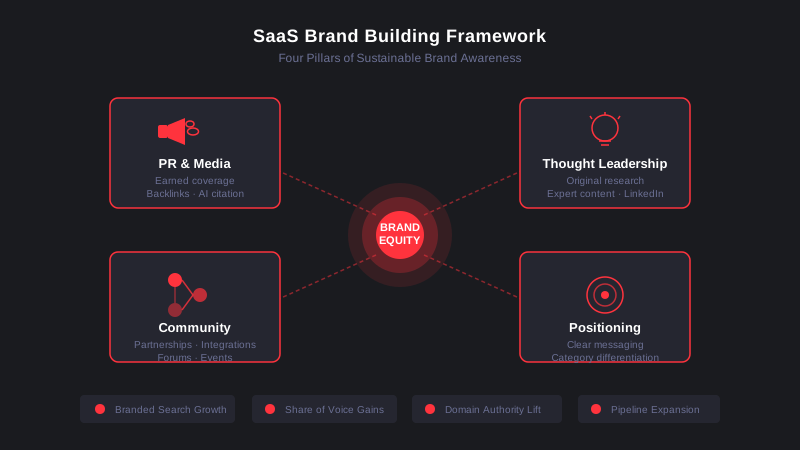
Traditional PR means pitching journalists. Modern SaaS PR is broader: it includes digital coverage, backlinks, podcast appearances, analyst relations, and any earned placement that builds credibility at scale.
A strong SaaS PR program starts with a clear editorial angle. Journalists covering SaaS do not want to write about software features. They want to write about market trends, founder perspectives, funding rounds, customer outcomes, and proprietary data. The companies that land consistent coverage are the ones that give journalists something worth writing about.
Practical starting points:
The SEO value of earned media is significant on its own. A placement in a high-authority publication generates backlinks that compound over time, improving your domain authority and the ranking potential of every other page on your site. For growth-stage SaaS companies, that dual benefit of brand and SEO is one of the strongest ROI arguments for investing in PR.
Thought leadership is not blogging more. It is publishing perspectives that only your company is positioned to share, because of your data, your customer base, or your founders' specific expertise.
Research from the B2B Institute shows that B2B decision-makers are 48% more likely to do business with a company that produced thought leadership content they found valuable, and 54% more likely to purchase from them. Those numbers reflect a buyer behavior that SaaS marketers often underestimate: content builds trust before a prospect is ready to evaluate products, and that trust influences vendor selection when they finally are ready.
Effective SaaS thought leadership looks like:
For a deeper look at how content fits into SaaS growth, see our guide to content marketing as a full-funnel channel.
Brand awareness builds fastest in communities where your buyers already spend time. That means participating in industry communities, partnering with non-competing tools your customers use, and showing up at the events, forums, and Slack groups that matter in your category.
Integration partnerships are especially effective for early and mid-stage SaaS. If your product connects to tools your customers already trust, being listed in those tools' marketplaces puts your brand in front of buyers who are already qualified by context. Being featured by a larger partner also carries implicit endorsement.
Community presence compounds. A SaaS brand that is consistently visible in the forums, newsletters, and podcasts that serve its target market builds familiarity that makes every downstream touchpoint more effective. Cold outreach converts better, demo requests require less explanation, and sales cycles shorten because the brand has already done part of the work.
PR and content only work if the underlying brand positioning is clear. According to SaaS branding experts surveyed by Overpass Studio, the biggest branding priority for SaaS companies in 2026 is clarity: being instantly understood, not louder. When a prospect encounters your brand for the first time, the message needs to answer three questions immediately: what problem do you solve, who do you solve it for, and why are you the best answer to that problem.
Vague positioning is a brand building killer. Generic messages like "the all-in-one platform for teams" or "the smarter way to manage X" do not create memory. Specific positioning does. If your messaging cannot fit on a single note card and be understood by a cold reader in under ten seconds, your PR and content spend will underperform because no amount of coverage fixes a blurry brand.
Brand building has a reputation for being expensive and slow. Neither is necessarily true for SaaS companies that are strategic about it.
The highest-leverage early moves tend to be:
For companies building a more complete go-to-market system, these PR and brand tactics connect directly to the broader frameworks we cover in our growth strategy consulting content.
Brand awareness is measurable, though the metrics require a different lens than performance campaigns. The key signals to track:
For a full breakdown of how to connect brand metrics to growth KPIs, see our SaaS marketing metrics and KPIs guide.
The brands that win in SaaS are not always the ones with the best product. They are the ones that made it easiest for buyers to trust them before the buying process started. PR and brand building are how you do that at scale, starting with a clear position, finding the channels where your buyers pay attention, and publishing content worth citing. The compounding effect takes time, but it builds a moat that paid channels cannot replicate.

The best saas company examples share one thing: their growth was engineered, not accidental. Each company made a deliberate bet on a specific go-to-market motion, product mechanic, or distribution channel, then doubled down on what worked. Understanding those bets, and the underlying mechanics, gives you a replicable framework rather than a list of buzzwords.
This post covers five SaaS brands that built substantial, defensible businesses, breaking down not just what they did but how the mechanism actually worked.
No two of the companies below used the same growth motion. That's intentional. The goal here isn't to rank them but to show the range of viable approaches and what each one requires to function.
HubSpot's growth is inseparable from its content strategy, but "we published a lot of blogs" undersells the mechanism. The company built a flywheel in which free educational content attracted prospects, free tools converted them into leads, and the CRM product delivered enough value that customers became advocates who attracted new prospects.
The HubSpot blog publishes over 100 posts monthly and maintains evergreen content with ongoing optimization. Free lead magnets, templates, and the HubSpot Academy credential program created compounding organic reach. HubSpot's content-driven leads close at 14 times the rate of outbound leads, which means the economics improve the longer the flywheel spins. By 2022 the model had generated over $2 billion in ARR, and the company has continued scaling from there.
What made it work was specificity. HubSpot didn't produce generic marketing content; it produced content aimed at the exact persona it was selling to, with free tools that made those personas dependent on HubSpot before they ever paid a dollar.
Notion's growth story is a saas example of community-led product distribution at scale. The company created an Ambassador program that enrolled only the most passionate users (no monetary incentives, no low-bar entry) and turned them into a volunteer sales force. Those ambassadors built templates, YouTube tutorials, certified consulting practices, and an organic community that now exceeds 500,000 members on Reddit alone.
The product mechanics reinforced this. Collaboration features made every new workspace member a potential new user. Every shared Notion document pulled a non-user into the product. Notion hit an estimated $500 million ARR in September 2025, with roughly 95% of traffic arriving through organic and community channels and a free-to-paid conversion rate above 5% across 30 million users.
The lesson isn't "build a community." It's that community compounds when the product itself gives community members something worth sharing. Templates were the mechanism; the community was the distribution.
Figma is the textbook case for bottoms-up SaaS growth. A single designer shares a Figma URL with a product manager, that PM invites engineers, and the engineering team loops in a second designer. Before the company's IT department has approved any software procurement, Figma has six seats inside the organization.
Figma's S-1 filing showed that 70% of new Organization and Enterprise customers in 2024 and Q1 2025 included at least one user who had previously been on a Professional plan. Individual paid users became the entry point for six-figure enterprise contracts. Revenue reached $749 million in 2024, up 48% year-over-year, with $912 million in ARR as of Q1 2025. Notably, non-designers make up two-thirds of Figma's 13 million monthly active users, which means the product long ago escaped the "design tool" category and became a cross-functional collaboration platform.
The free tier wasn't a charity play. It was the top of a deliberate expansion funnel.
Calendly's growth model is elegant because the product advertises itself with every use. When someone books a meeting through Calendly, they see the Calendly branding on the scheduling page. That exposure converts recipients into users at a meaningful rate. Every booking link becomes an acquisition channel.
The company grew to $276 million in revenue while remaining bootstrapped for seven years, which is rare in SaaS. This is a saas marketing example worth studying because the acquisition cost was structurally embedded in the product workflow rather than layered on top through paid channels. No SDR team, no enterprise sales motion, just the product placed in front of new users every time an existing user sent a link.
The mechanic works because Calendly's core use case is inherently social. Scheduling requires two parties. That constraint became the growth engine.
Datadog represents a different class of saas growth examples: the land-and-expand motion executed at infrastructure scale. The company starts with a free or low-cost monitoring tier that developers adopt within a single team. Once the product proves its value, it expands into the full observability platform, logging, APM, security, and more, across the entire organization.
Datadog reached $3.4 billion in revenue for fiscal year 2025, up 28% year-over-year. The key to this model is that expansion revenue comes from existing customers, which compresses sales costs and produces strong net revenue retention. Datadog's NRR has historically run above 130%, meaning existing customers generate 30 cents of new ARR for every dollar of existing ARR without any new customer acquisition required.
The model requires genuine multi-product depth. Land-and-expand fails when there's nowhere to expand into. Datadog's decade-long investment in adjacent monitoring products created the expansion surface that makes the economics work.
These five examples aren't outliers. They reflect broader patterns visible in benchmark data. According to Benchmarkit's 2025 SaaS Benchmarks Report, median B2B SaaS ARR growth sits at 19 to 21 percent, with the CAC payback period at 15 months for the median company and under 12 months for best-in-class performers. The benchmark LTV-to-CAC ratio is 3:1, with enterprise SaaS ($100K+ ACV) averaging 4.5:1.
Net revenue retention is becoming the primary separator between strong and weak performers. Companies with NRR above 130% compound without needing proportional new acquisition spend. Companies with NRR below 100% are leaking revenue even while acquiring new customers.
The other standout data point: SaaS companies with AI deeply integrated into their products are growing roughly twice as fast as peers. This isn't AI as a marketing claim, it's AI embedded in onboarding, product features, and customer workflows in ways that drive measurable retention and expansion.
Every one of these saas brand examples succeeded because their growth mechanism matched their product's natural behavior. Figma's product is collaborative by design, so virality was built-in. Calendly's core use case requires two people, so distribution was built-in. Notion's product is highly personal and endlessly customizable, so community builders had something real to build around.
Choosing the wrong GTM motion for your product's natural behavior is one of the most common ways SaaS companies plateau. A product that is inherently single-player and private cannot rely on the same viral loops that Figma uses. A product with high setup complexity cannot expect PLG to carry it the way Calendly does.
The useful question isn't "which of these models should I copy" but "what does my product do naturally that I can turn into distribution?" That's the underlying pattern in every successful saas example above.
If you're building or scaling a SaaS company and want to develop a growth strategy grounded in how your product actually behaves, the posts on SaaS SEO and maximizing ROI for SaaS companies cover the channel-level tactics. For the business fundamentals underneath all of it, the SaaS business guide is the right place to start.
EmberTribe helps growth-stage SaaS companies build content and SEO programs that compound over time, not just generate traffic. If you want to talk through what the right motion looks like for your product, visit embertribe.com.

Most growth-stage SaaS teams hire their first product marketer about two years too late, then ask that person to own three jobs that belong to three different functions. The result is a saas product marketing strategy that looks like a pile of launch checklists and one-pagers, not a system that actually moves pipeline or win rates. The b2b saas marketing stack gets more crowded every quarter, and the companies that cut through are the ones treating product marketing as a strategic discipline, not a production line.
This guide is the version we wish our SaaS clients had before they hired their first PMM. It covers what SaaS product marketing actually is, how to build positioning that cuts through, tiered launches that match real business impact, pricing and packaging as a PMM concern, win/loss as a continuous pulse check, and how product marketing should work with sales.
Product marketing sits at the intersection of product, sales, and marketing, and owns the translation layer between what the product can do and why any specific customer should care. In SaaS, that translation is the job. Features are easy to copy. Positioning, messaging, and the sales narrative are much harder to replicate, and they do more to protect margin than any feature roadmap.
A useful way to define the role is by what product marketing owns outright versus what it influences.
Product marketing owns:
Product marketing strongly influences:
A growth marketer owns acquisition channels and pipeline targets. A demand gen marketer owns the programs that fill the funnel. A product marketer owns the story that makes those programs actually convert. Confusing these roles is the most common way the first PMM hire fails, and it shows up as a talented operator drowning in ad copy requests while the positioning question no one has answered quietly kills win rates.
If your homepage says "the fastest, easiest, most intuitive platform for growing teams," your positioning does not exist. That sentence could be pasted onto five hundred SaaS websites without the reader noticing. Generic positioning loses deals before you ever get the call.
The framework we point SaaS clients to is April Dunford's, laid out in Obviously Awesome. The core insight is that positioning should start from your competitive alternatives, not from your features. What would your best customers use if you did not exist? A spreadsheet, a different tool, a consultant, an internal build.
The answer to that question frames how you should describe yourself, because buyers evaluate you against that specific alternative, not against an abstract ideal.
From there, positioning becomes a chain of decisions: the unique attributes you have that the alternative lacks, the value those attributes create for a buyer, and the specific market category you want to be compared to. Skip any step and you end up back in generic messaging territory.
A practical test. Pull five sentences from your current homepage. Replace your product name with three competitors' names, one at a time. If any of those sentences still feel true for the competitor, that sentence is not doing positioning work. Rewrite it until it only makes sense about your product.
This is the work most SaaS teams skip because it feels philosophical. It is not. Weak positioning shows up in messy sales calls, long sales cycles, high churn, and content that does not convert. Strong positioning does not guarantee growth, but trying to grow without it is a tax you pay every day in slow pipeline and lost deals.
The other thing a SaaS PMM does badly without a framework is treat every launch the same. A new AI copilot and a minor UI polish both get a blog post, a sales email, and a product update page. The copilot deserved a full go-to-market push, and the UI change deserved a changelog entry. Both got the same effort, and neither moved the needle.
Tiered launches solve this. Most teams we work with use a three-tier model, adapted loosely from the Product Marketing Alliance launch tier framework and the Pragmatic Institute launch tiers approach.
Tier 1. A strategic launch that changes the company story, opens a new market, or shifts the competitive narrative. Eight to twelve weeks of prep. Executive sponsorship. Full enablement, press, analyst briefings, and a coordinated campaign. Maybe two or three per year if you are honest about what qualifies.
Tier 2. An important feature or capability that expands what existing customers can do or unlocks a new segment. Two to four weeks of preparation. Updated sales collateral, an email to customers, a blog post, and an in-app announcement. Not a press cycle. Maybe one per month.
Tier 3. Incremental improvements, bug fixes, and quality-of-life updates. Release notes, a changelog entry, and an in-app notification. No sales enablement required unless it affects a live deal. Happens weekly, quietly, and that is exactly the point.
The gift of tiered launches is that the PMM can say no. Without the tiers, every engineering ticket that ships gets treated as a launch, the team burns out producing low-leverage assets, and the actually-important launches do not get the attention they deserve. With tiers, the PMM has a defensible filter, and the rest of the org understands why a minor update does not warrant a webinar.
In most growth-stage SaaS companies, pricing and packaging belong to everyone and no one. Finance cares about margin, product cares about adoption, sales cares about close rates, and the CEO rewrites the pricing page every six months based on the last board meeting. The result is a pricing structure that reflects internal politics, not buyer psychology.
Product marketing is the natural owner of pricing and packaging because the team already holds the buyer research, the win/loss data, the competitive landscape, and the positioning narrative. Pricing is the most concrete expression of positioning. Every tier boundary, every feature gate, every usage metric is a statement about what you think your buyer values and what they will pay for it. OpenView's deep dive on pricing and packaging missteps is worth reading for any PMM about to touch this area.
Packaging questions that PMMs should lead on:
A quarterly pricing review led by product marketing, with finance and sales at the table, is one of the highest-leverage meetings most SaaS teams do not hold.
The fastest way to find out whether your positioning, pricing, and sales narrative are actually working is to ask the people who just made a decision. Win/loss analysis is not a quarterly research project. In the companies where it actually moves the needle, it is a continuous intake that feeds messaging, enablement, and roadmap.
The mechanics are not complicated. You need a sample of ten or more closed deals on each side, structured interviews run by someone who was not in the sale, and a clear set of questions covering how the buyer discovered you, how they evaluated alternatives, what drove the decision, and what almost killed the deal. Klue's seven-step win/loss guide covers the process in practical detail.
What makes win/loss powerful is the pattern recognition across interviews. One lost deal is an anecdote. Ten lost deals where three buyers name the same competitor objection is a messaging problem you can fix this week. Win/loss also catches positioning drift: the moment your sales team starts describing the product differently from how marketing is positioning it, you have a leak, and win/loss interviews catch that leak faster than almost any other mechanism.
The output should not be a slide deck that gets presented once and filed. The output is a set of changes: updated battlecards, revised objection handling, new proof points on the website, and a feedback loop to product on the top two or three feature gaps driving losses.
The fastest way to tell whether your product marketing is working is to listen to a sales call. If the rep is telling your positioning story in their own words, badly, your enablement is broken. If the rep is reading from a deck slide by slide, your enablement is broken differently. The goal is a rep who has internalized the narrative and can riff on it based on the specific buyer in front of them.
That kind of enablement has three components. A message house that defines the problem, the stakes, the solution, and the proof points in plain language. A living deck that sellers can trust and adapt, not a 60-slide corporate brochure. And ongoing reinforcement, weekly or biweekly, that keeps the narrative fresh as the market moves.
The best SaaS PMMs we work with spend at least one day a week embedded with sales, listening to calls, joining deal reviews, and updating materials based on what actually closes deals. The PMMs who fail treat sales enablement as a one-time handoff and wonder why their beautiful narrative never makes it into a discovery call.
This is also where product marketing connects back to pipeline. We dig into the sales-side mechanics in our B2B SaaS lead generation playbook, and the hiring question of when to bring in senior marketing leadership in our guide to fractional CMOs for B2B SaaS.
If you are building a product marketing function from scratch, the order of operations matters. Start with positioning. Without it, launches fall flat, pricing decisions are guesswork, and sales enablement is a collection of slides no one trusts.
Once positioning is stable, layer in launch tiering so the team can say no to low-impact work. Then put win/loss on a continuous cadence so the feedback loop stays fresh. Pricing and packaging work comes next, because it should follow positioning rather than lead it.
The SaaS companies that get this right do not treat product marketing as a department that writes launch copy. They treat it as the discipline that decides what the company sounds like in the market and which deals it can win. Everything downstream, from acquisition spend to retention mechanics, gets easier when product marketing is doing its job.
If your current marketing feels like tactics without a core narrative, the gap is almost always here. When that foundation is in place, broader acquisition work, covered in our SaaS customer acquisition strategies guide, starts to compound instead of leak.

Most buying conversations about marketing automation software start the wrong way. A founder or VP reads a comparison article, shortlists HubSpot and Marketo, books two demos, and picks whichever rep answers the phone first. Six months later, the platform is half-configured, the data is dirty, and the reporting still runs through spreadsheets. The problem was never the tool. It was the decision itself.
Marketing automation software is one of the highest-leverage bets a growth-stage company makes, and also one of the easiest to get wrong. The category is crowded, the vendors sound identical in demos, and the pricing makes no sense until you understand what you are actually buying. This guide walks through what marketing automation does, when you actually need it, the real category landscape, pricing ranges, integration traps, and the pitfalls that sink most implementations.
Strip away the vendor marketing and marketing automation software does three things well: it stores contact data, it triggers messages based on behavior or lists, and it reports on what happened. Everything else (lead scoring, landing pages, chatbots, A/B testing) is a feature layered on top of that core.
The useful mental model is to think of automation as the muscle between your CRM and your customer. When a prospect fills out a form, downloads an asset, or abandons a cart, the automation platform is the thing that wakes up, looks at the context, and sends the right message through the right channel at the right moment. When it works, it feels like a conversation. When it does not, it feels like a conveyor belt of irrelevant emails.
What marketing automation is not good at is replacing strategy. The platform will execute whatever workflow you build, but it will not tell you which segments matter, which messages resonate, or whether your offer is weak. It is a megaphone, not a writer.
The honest answer is "later than you think." Small teams often buy marketing automation to feel sophisticated, then spend the first quarter discovering they do not have enough contacts, content, or process to feed the machine. The right trigger is not "we should have automation," it is "we have a repeatable workflow that is already working manually and is starting to hurt us to run by hand."
Good signals you are ready:
Bad signals you should wait:
The "marketing automation" label gets attached to four different product categories that do overlapping but distinct jobs. Picking the wrong category is the most expensive mistake in this space, because you end up paying enterprise prices for capabilities you cannot use or outgrowing a platform two quarters into the contract. CategoryWhat It Does BestTypical BuyerExample ToolsESPEmail sends, lists, simple flowsSmall business, publishersMailchimp, Campaign MonitorFull AutomationMulti-channel journeys, scoring, CRM syncGrowth-stage B2B and DTCHubSpot, Marketo, ActiveCampaignEcommerce AutomationCart flows, behavioral SMS, product triggersShopify and DTC brandsKlaviyo, Omnisend, AttentiveCDPUnified customer profile, activation to any toolMid-market and enterpriseSegment, mParticle, Rudderstack
An email service provider (ESP) is the entry tier. It sends email, manages lists, and runs a basic drip. It is perfect for publishers, newsletters, and early-stage companies whose whole marketing motion is "send the email." It breaks down as soon as you need tight CRM integration or cross-channel orchestration.
A full marketing automation platform is the category most people mean when they say "marketing automation." It handles email, landing pages, forms, lead scoring, behavioral workflows, and CRM sync in one codebase. HubSpot, Marketo Engage, and ActiveCampaign live here. This is the default for B2B SaaS marketing teams and any company with a real sales motion.
Ecommerce-specific automation platforms are a separate species. Klaviyo and Omnisend are built around product catalogs, browse and cart events, and SMS. A DTC brand trying to force-fit HubSpot into an ecommerce stack usually ends up miserable, and the inverse is also true for a B2B company on Klaviyo.
A customer data platform (CDP) like Twilio Segment is not the same thing as marketing automation, but the categories blur because modern CDPs now include activation features. A CDP's core job is to collect first-party data from every source, unify it into a persistent profile, and pipe it to whichever downstream tools need it. You buy one when you have multiple destinations and want to stop rebuilding audiences in every platform.
Pricing in this category is famously opaque, and published list prices rarely match what customers actually pay. The honest ranges for 2026 look roughly like this: TierMonthly RangeContactsTypical FitEntry ESP$20 to $150Up to 10,000Solo marketers, publishersMid-market$800 to $3,5005,000 to 50,000Growth-stage B2B and DTCEnterprise$3,500 to $15,000+50,000+Mid-market and up, complex stacksCDP layer$1,000 to $10,000+Event-basedCompanies with multiple destinations
Two things to watch for. First, contact-based pricing punishes success. Klaviyo and HubSpot both meter on active or marketing contacts, which means your bill grows as your list does, even if engagement stays flat. Budget for a 2x or 3x increase over a two-year horizon. Second, most mid-market and enterprise plans come with mandatory onboarding fees ($3,000 to $25,000 is common), annual commitments, and negotiated discounts that only appear if you push for them. Sticker prices are almost never real.
The demo will show you a beautiful workflow builder. The reality is that marketing automation software is only as good as the data flowing into it, and the data flowing into it depends on integrations that break. Half of marketing automation platform users cite technology integration complexity as their biggest obstacle to success, according to research compiled by MarTech on data quality and stack sprawl.
A few practical integration considerations before you sign:
If you are running a modern B2B SaaS stack, the integration question is even more pointed. Growth-stage companies tend to have product analytics, a data warehouse, a CRM, an ad tech layer, and a support tool that all need to talk to the automation platform. We covered this tension in more detail in our post on the benefits of integrating CRM with marketing automation, which is worth reading before you shortlist vendors.
After dozens of implementations across growth-stage B2B SaaS and DTC clients, the failure patterns are boring and repeatable. Very few teams fail because they picked the wrong vendor. Most fail because of one of these:
A lot of this comes back to the question of who owns it. If you do not have a dedicated marketing operations hire, that gap is often the single best argument for a fractional CMO or fractional marketing ops partner in the first year, specifically to get the platform running before a full-time hire takes it over.
Start with the workflows, not the vendors. Write down the five or six automations you would build in the first 90 days (welcome series, lead scoring to sales, abandoned cart, re-engagement, handoff from trial to paid). Then ask each vendor on your shortlist exactly how they would execute those workflows, what data is required, and what the implementation timeline looks like.
Pick the platform that fits your stage, your data, and the team you have (not the team you wish you had). A $150/month tool running clean, simple workflows will outperform a $3,000/month enterprise platform that nobody has time to configure. The best marketing automation software is the one you will actually use.
If you want a second opinion before you sign a multi-year contract, our strategy and consulting team works with growth-stage brands to scope martech stacks, audit existing implementations, and write the workflows that move revenue. The cheapest consulting hour is the one that saves you from a bad contract.
Most B2B SaaS companies don't have a lead generation problem. They have a lead quality problem. The top of the funnel is full - demo requests, MQLs, content downloads - but the pipeline stays thin because the wrong people are converting.
B2B SaaS lead generation done well is about attracting buyers at the right stage, moving them efficiently through the funnel, and handing sales a set of leads that are actually ready to evaluate. That requires more than adding a contact form and running ads. It requires a playbook.
Traditional B2B lead gen focuses on volume: get enough contacts, work the phones, close what sticks. SaaS doesn't work that way. The unit economics - CAC, LTV, payback period - are unforgiving. A high-CAC lead from a low-fit account doesn't just fail to close; it drags down metrics for months.
Three dynamics make SaaS lead generation distinct:
Subscription economics demand fit over volume. A closed deal from a poor-fit company churns in 6 months. The acquisition cost stays on the books; the revenue doesn't.
Trial and freemium create a parallel funnel. Product-qualified leads (PQLs) - users who've hit activation milestones - often convert at 2–5x the rate of marketing-qualified leads, according to OpenView Partners. If you're ignoring PQL data in your lead gen strategy, you're leaving the most reliable signal on the table.
Buying committees are larger than they look. Gartner research shows the average B2B purchase involves 6–10 decision makers. Your lead gen strategy has to reach the economic buyer, the technical evaluator, and the end user - often with different content and messages.
No SaaS company can be excellent at every channel. The most consistent pipeline comes from picking a primary channel and making it work before expanding.
The long game, but the one with the best compounding returns. B2B SaaS companies that invest in content early build a lead generation asset that doesn't stop working when ad spend stops. The key is targeting bottom-of-funnel and middle-of-funnel keywords - comparison pages, "best X for Y" queries, and integration guides - not just top-of-funnel informational content.
A well-executed SaaS SEO strategy targets keywords where the searcher already has a problem and is actively evaluating solutions. Those are the leads worth having.
The fastest path to qualified pipeline for most B2B SaaS companies, and the most expensive. Google Ads for SaaS works best when:
Paid search generates leads; it doesn't generate trust. Lead scoring and nurture sequences bridge the gap between a paid click and a sales-ready conversation.
Outbound isn't dead in SaaS - it's evolved. Cold email and LinkedIn outreach still work at the right ICP fit, with the right message, at the right volume. The modern approach is signal-based outreach: triggering sequences based on behavioral data (website visits, content downloads, G2 profile views) rather than spraying generic sequences at a contact list. Tools like Apollo.io and Clay make signal-based outbound accessible for teams without large SDR headcounts.
Most SaaS companies apply the same urgency to every lead regardless of fit or intent. That burns sales capacity and teaches reps to distrust marketing-generated leads.
A simple two-axis scoring model changes the dynamic: *Low IntentHigh IntentHigh FitNurture aggressivelyRoute to sales immediatelyLow Fit*Do not pass to salesRoute to sales with a flag
Fit scores on firmographic data: company size, industry, tech stack, and existing tooling. Intent scores on behavioral data: pages visited, emails opened, content downloaded, product trial actions.
The thresholds depend on your sales motion. A PLG company with a low-touch model has different routing rules than an enterprise company with a six-month sales cycle. Define the criteria explicitly, document them in your CRM, and revisit them quarterly.
Three gaps that show up repeatedly in B2B SaaS lead funnels:
The mid-funnel vacuum. Most companies have awareness content (blog posts, social) and a bottom-funnel offer (demo, free trial). There's nothing in between to capture leads who are interested but not ready to evaluate. Case studies, ROI calculators, comparison guides, and email sequences fill this gap.
No content for the technical buyer. In SaaS, the technical evaluator often has veto power. Integration documentation, security pages, API references, and architecture guides exist to win their trust - but they rarely appear in a marketing team's content plan. They should.
Weak activation-to-PQL path. If you have a trial or freemium tier, the journey from signup to first meaningful activation is your most important funnel. Track where users drop off and what actions correlate with conversion. Then engineer the product and messaging to get more users to those activation points.
Vanity metrics - site traffic, total leads, email list size - tell you what happened at the top of the funnel. Pipeline metrics tell you whether the funnel is working. MetricWhat It Tells YouMQL-to-SQL rateWhether marketing and sales are aligned on lead qualitySQL-to-opportunity rateWhether sales is qualifying effectivelyPipeline coverage ratioWhether you have enough pipeline to hit revenue targetsCAC by channelWhich acquisition channels are actually efficientPQL conversion rateHow well the product funnel is converting activated users
If you're only tracking traffic and lead volume, you can be wildly off on pipeline quality and not know it for quarters. Add SQL and opportunity conversion to your standard reporting and the picture changes fast.
Consistent B2B SaaS lead generation isn't a one-channel bet. It's a system: ICP clarity at the top, content and paid channels filling the funnel, lead scoring routing the right leads to the right next step, and pipeline metrics keeping the whole system honest.
The companies that get this right early - before Series B - build a compounding advantage. Every piece of content, every scored lead, every closed-won data point makes the model more precise. Start with one channel, get it working, then expand.
If you're still evaluating which marketing partner can help build this system for your stage, the post on choosing the right SaaS marketing agency covers the criteria that matter most for growth-stage companies.
Hiring a full-time CMO at a B2B SaaS company costs $200,000–$300,000 per year before equity and benefits. For most Series A companies - and nearly all post-seed startups - that's a budget-breaking decision that locks you into one hire before you fully know what you need from marketing leadership.
A fractional CMO for B2B SaaS is the alternative that actually gets used: senior marketing leadership at 10–40 hours per month, costing $5,000–$20,000/month depending on scope, according to Kalungi. The pitch sounds almost too good. And sometimes it is.
This guide covers when the fractional CMO model works, when it falls apart, and what separates a high-impact engagement from one that burns six months and leaves you back at square one.
The job description varies more than most people expect. In a SaaS context, a fractional CMO typically owns some combination of:
What they usually don't do: execute. A fractional CMO is strategic leadership, not a full-time producer. If your current problem is that nobody is writing content or running campaigns, a fractional CMO won't solve that alone - you still need execution capacity underneath them.
This distinction matters enormously when deciding whether a fractional CMO is actually what you need.
The most common trigger is a founder who has been doing all the marketing themselves and has hit the limit of what that model can scale. You've found product-market fit, you're closing deals, but marketing is ad hoc, undocumented, and completely bottlenecked on one person.
A fractional CMO can come in and build the systems, establish the playbook, and hire or direct the team that executes - without requiring the $250K+ of a full-time executive hire.
When a full-time CMO leaves, the typical hire cycle takes 3–6 months. A fractional CMO can fill the gap, stabilize the team, and even help scope the full-time hire correctly - so you don't walk into the same problems with a new person.
Switching your SaaS go-to-market strategy from product-led to sales-led (or the reverse) is a major motion that requires senior marketing judgment. A fractional CMO with SaaS-specific experience can own the transition strategy without requiring a full-time organizational shift.
The fractional CMO model fails in predictable ways. Watch for these conditions:
No execution capacity underneath. A fractional CMO spending 20 hours per month cannot also write all the content, run the campaigns, and manage the CRM. If there's no execution layer - whether in-house or through agencies - strategy documents pile up and nothing ships. Before bringing in fractional marketing leadership, audit your execution capacity honestly.
Founder doesn't buy in. In early-stage SaaS, the fractional CMO needs to work alongside the founder, not around them. If the founder continues to override messaging decisions, second-guess positioning, or bypass the marketing plan, the engagement stalls. The fractional CMO can only be as effective as the authority they're actually given.
SaaS-naive candidates. Not every fractional CMO has done this in a SaaS context. Someone with strong DTC or agency experience may not understand subscription economics, CAC:LTV ratios, or the difference between top-of-funnel brand plays and bottom-of-funnel activation content. Ask specifically: How many B2B SaaS engagements have you led? What were the ARR ranges? What channels drove the most pipeline?
Expecting short-term revenue. The fractional CMO builds the system - positioning, team, playbook, channel strategy. The revenue output of that system takes time. If you need immediate pipeline, a fractional CMO alone won't deliver it; you also need an agency or contractor who can execute campaigns immediately.
Fractional CMOMarketing AgencyFocusStrategy, positioning, team leadershipExecution: content, SEO, paid, creativeAccountabilityPipeline and MQL targetsDeliverables and channel KPIsTime commitment10–40 hours/monthDefined retainer scopeBest forCompanies without marketing leadershipCompanies with direction, needing executionCost range$5K–$20K/month$3K–$25K/month (varies by scope)
The cleanest setup in B2B SaaS is both: a fractional CMO owning strategy and managing a specialized agency (or agencies) for execution. EmberTribe works with exactly this kind of structure - a fractional or in-house marketing lead sets the content and SEO strategy, and we execute. When that coordination works, it's efficient and accountable.
If you're still figuring out how to choose the right SaaS marketing agency to pair with marketing leadership, the criteria overlap: you want SaaS-specific experience, pipeline accountability, and a clear scope of execution that complements strategy work.
A strong fractional CMO for B2B SaaS will typically structure the first engagement in three phases:
Days 1–30: Diagnosis. ICP audit, competitive positioning review, funnel analysis, team assessment. The output is usually a positioning document and a 6-month marketing plan. No major campaigns launch yet. GoFractional's SaaS CMO playbook calls this the "strategy sprint" - the period that determines whether the rest of the engagement succeeds.
Days 31–60: Foundation. Messaging framework finalized, channel strategy selected, execution vendors or hires in place. First campaigns planned and handed off to execution.
Days 61–90: Execution in motion. First pipeline-focused campaigns live. Metrics baseline established. Weekly reporting cadence in place with the founder or CEO.
If the engagement hasn't produced a clear positioning document, a defined channel plan, and at least one campaign in motion by day 90, something is off - either scope mismatch, poor fit, or execution capacity problems.
If you're at Series A or earlier, have founder-led marketing that's hit its ceiling, and need senior go-to-market judgment without a full-time commitment - a fractional CMO is often the right call.
If you have marketing direction but need more content, more campaigns, more pipeline - an agency that specializes in your stage and channel is usually the right first move. If you're not sure how your agency options stack up, the post on how to choose the best ecommerce marketing agency covers a transferable evaluation framework that applies equally well to SaaS.
The worst outcome is hiring the wrong model for the wrong problem. Get clear on whether you need strategic leadership or execution capacity - and in most cases, you'll eventually need both.
EmberTribe works with B2B brands and growth-stage SaaS companies on content strategy and execution. If you're building a marketing system that needs senior-level execution alongside leadership, explore our services.

The average B2B SaaS company now spends $2.00 in sales and marketing for every $1.00 of new ARR, according to Benchmarkit's 2025 SaaS benchmarks. CAC has risen 222% over the last eight years. The window for sloppy, generalist marketing is closed.
If you're evaluating a SaaS marketing agency right now, the real question isn't which one has the slickest case study deck - it's which one actually understands your growth motion, your funnel economics, and your stage.
This guide cuts through the noise. No manufactured rankings, no self-serving methodology. Just a practical framework for finding a SaaS marketing agency that can actually move your numbers.
Most marketing principles apply across the board. But SaaS has structural dynamics that trip up generalist agencies every time.
Recurring revenue changes the math. Winning a customer isn't the finish line - it's the starting line. A company churning 3% of ARR monthly is burning 30%+ annually. Agencies that optimize for acquisition without accounting for retention are solving the wrong problem.
Sales cycles are long and getting longer. The average B2B SaaS sales cycle is now 134 days, up from 107 the prior year. Campaigns that look flat in the first 60 days aren't necessarily failing - they may just be working through a naturally long buying process. An agency that panics and pivots too early will wreck your attribution.
Multiple stakeholders, multiple touchpoints. Enterprise SaaS deals involve an average of six to ten stakeholders. A marketing agency needs to understand how to build content and campaigns that serve the champion, the economic buyer, and the technical evaluator simultaneously.
PLG vs. sales-led motions require different playbooks. A product-led growth company needs organic, self-serve content that removes friction from a free trial. A sales-led enterprise SaaS company needs ABM, demand gen, and pipeline acceleration. These are not interchangeable strategies - and the best agencies specialize in one or the other.
The right saas marketing agency at Series A looks nothing like the right one at Series C. Stage mismatch is one of the most common (and expensive) mistakes growth-stage companies make.
Pre-PMF / Seed: You don't need a full-service agency. You need positioning, ICP validation, and channel experimentation. Look for a fractional strategist or small specialist firm that can move fast and isn't billing you for overhead you don't need.
Series A / Early traction ($1M–$5M ARR): This is where a focused agency earns its keep. You've found something that works - now you need to systematize it and build a repeatable pipeline engine. Prioritize agencies with strong content + SEO + paid combinations.
Series B and beyond ($5M–$30M ARR): You're scaling channels that are already validated. The agency should bring operational depth - campaign management, attribution modeling, RevOps alignment - not just strategy. Watch for agencies that over-index on strategy and underdeliver on execution.
$30M+ ARR: Most companies at this stage are shifting to in-house CMO and team, with agencies as specialized execution partners rather than generalist leads. We break down the full trade-off in agency vs. freelancer vs. in-house marketing.
Most SaaS marketing agency proposals lead with traffic, impressions, and "brand visibility." These are inputs, not outcomes. The metrics that matter are downstream: MetricWhy It MattersCAC by channelTells you where growth is efficient vs. subsidizedCAC payback periodHealthy benchmark is under 18 months; median is now 23 monthsLTV:CAC ratio3:1 is the floor; below it, you're growing at a lossPipeline sourcedRevenue influenced by marketing, measured in qualified opportunitiesARR influencedClosed-won deals where marketing touched the buyer journeyNRRNet revenue retention - expansion minus churn. Marketing affects this too.
Before signing any agency contract, agree on exactly which metrics define success. If an agency is resistant to that conversation, that's a red flag.
Understanding how SaaS marketing ROI compounds over time is critical context before you start holding agencies to the wrong benchmarks.
Beyond the pitch deck, here's what separates agencies that consistently move the needle from those that produce reports:
They speak fluent SaaS economics. CAC payback, LTV, NRR, ARR - these shouldn't need explanation. An agency that asks what LTV means in your onboarding call is the wrong agency.
They define success in pipeline, not traffic. Organic traffic that doesn't convert to trials, demos, or MQLs is a vanity metric. The right agency frames every channel in terms of pipeline contribution.
They have a defined onboarding process. The first 30–45 days should be a deep audit: ICP review, competitive positioning, channel audit, attribution setup. Agencies that skip directly to "content and campaigns" before understanding your funnel are guessing.
They push back. The best agency relationships feel like partnerships, not vendor relationships. If an agency agrees with everything you say in the sales process, they're telling you what you want to hear. Strong agencies will challenge your assumptions on channel mix, budget allocation, and messaging.
They can name-drop channel-specific results. Organic SEO carries a long-term CAC of ~$290 vs. outbound at ~$1,980 - good agencies can tell you where they'll move your numbers, not just how they'll spend your budget. "We helped a Series B PLG company reduce CAC by 34% by shifting budget from brand to bottom-of-funnel SEO and converting 3x more trial signups" - specific, falsifiable, meaningful. Vague outcome claims are not.
This is the number one thing buyers can't find online. Here are real ranges: Company StageMonthly Retainer RangeEarly-stage startup ($500K–$5M ARR)$3,000–$10,000/monthGrowth-stage ($5M–$30M ARR)$10,000–$25,000/monthScale-up / Enterprise ($30M+ ARR)$25,000–$75,000+/month
Most reputable agencies work on monthly retainers with 3–6 month minimum commitments. Performance-based models exist but are rare - most agencies won't accept pure performance arrangements because they don't control the product, sales team, or pricing.
Startups at early stages should budget 20–40% of revenue on marketing during active growth phases. If a $2M ARR company is allocating $40K/month to a full-service saas marketing agency and getting measurable pipeline contribution, that's a reasonable investment. The same spend for a company generating no pipeline return is a problem.
Before signing anything, get direct answers to these:
That last question is increasingly important. The shift from traditional SEO to answer-engine optimization (AEO) is underway. A saas marketing agency that hasn't thought about this is already behind.
Most agencies look polished in the sales process. Here's what to watch for underneath:
The same evaluation logic we use in choosing the best ecommerce marketing agency applies here - the fundamentals of vetting a growth partner don't change much by vertical.
Set clear expectations before the engagement starts. A quality SaaS marketing agency should deliver the following in the first 90 days:
If an agency is running paid spend on day one without completing an audit first, pause. That's a sign they're prioritizing activity over results.
There's no single "best" SaaS marketing agency for every company. A pre-PMF team of eight and a Series C company scaling toward $50M ARR have fundamentally different needs - and the agencies that serve each of them well are often completely different firms.
What the best ones share: deep SaaS economics fluency, pipeline-first measurement, a defined onboarding process, and a willingness to push back when the strategy isn't right.
For tips on building a SaaS growth engine that agencies can actually plug into, see marketing tips for growing your SaaS company.
The agency that's right for you knows your stage, understands your motion, and will tell you when the answer isn't "spend more on marketing."

Is a fact: SaaS marketing efforts will fail without a content marketing strategy. With the right approach, your content can help you attract and engage your target audience, differentiate from competition, drive conversions, and build a strong brand presence. In this publication, we'll explore four key tips to help you develop an effective B2B SaaS content marketing strategy.
Before diving into the tips and strategies, let's first take a moment to understand why a content marketing strategy is so important for B2B SaaS businesses.
In the world of B2B marketing, SaaS (Software as a Service) plays a significant role. SaaS companies provide businesses with cloud-based software solutions that help streamline operations, increase productivity, and solve complex challenges. However, with many companies offering similar products and services, standing out from the competition can be challenging. This is where content marketing comes into play.
SaaS has revolutionized the B2B marketing landscape by providing businesses with scalable, cost-effective solutions. With SaaS, businesses no longer need to invest in expensive hardware or software installations. Instead, they can access cloud-based solutions that can be easily customized to suit their unique needs.
By leveraging SaaS, businesses can increase efficiency of their processes, and ultimately drive conversions to stay ahead of the competition. SaaS offers a wide range of benefits, such as improved collaboration, enhanced data security, and seamless integration with existing systems. These advantages make SaaS an attractive option for businesses of all sizes and industries.
However, simply offering a great SaaS product isn't enough. To attract prospective customers and retain existing ones, it's crucial to have a solid content marketing strategy.
Content marketing allows SaaS businesses to establish themselves as thought leaders in their industry. By creating and sharing valuable, informative content, SaaS companies can build trust and credibility with their target audience. Moreover, content marketing helps drive organic traffic to your website, increase brand awareness, and generate leads. By consistently creating and promoting high-quality content, you can attract qualified leads who are more likely to convert into paying customers.

Effective content marketing involves understanding your target audience's pain points and providing them with relevant solutions. By addressing their challenges through your content, you position your SaaS business as a trusted advisor and problem solver.
In addition to building trust and driving traffic, content marketing also plays a crucial role in nurturing leads and guiding them through the buyer's journey. By creating content that aligns with each stage of the customer's decision-making process, you can effectively move them closer to making a purchase.
Likewise, content marketing allows you to showcase the unique features and benefits of your SaaS product. Through detailed product guides, case studies, and success stories, you can demonstrate how your solution solves specific problems and delivers tangible results. You can also foster a sense of community and create brand advocates who will spread the word about your product.
Now that we understand the importance of content marketing in the B2B SaaS space, let's dive into our tips for developing an effective strategy.
The first step in developing an effective B2B SaaS content marketing strategy is to establish clear goals. Without defined objectives, it's challenging to measure the success of your efforts and make necessary adjustments.
When setting your content marketing goals, it's important to consider the overall business objectives you want to achieve. Are you looking to increase brand awareness, generate more leads, or improve customer retention? By aligning your content marketing goals with your broader business goals, you can ensure that your efforts are focused and impactful.
Furthermore, it's crucial to take into account the current state of your content marketing efforts. Are you starting from scratch, or do you already have an existing content strategy in place? Understanding where you are in your content marketing journey can help you set realistic and attainable goals.
Before diving into content creation, it's essential to understand who your target audience is. Who are the decision-makers in your target companies? What challenges do they face? What type of content would resonate with them?
By conducting thorough market research and creating buyer personas, you can gain valuable insights into your target audience's needs, pain points, and preferences. This knowledge will enable you to create content that addresses their specific challenges and provides value.
When identifying your target audience, it's also important to consider the different stages of the buyer's journey. Are you targeting prospects who are just starting their research, or are you focusing on nurturing existing leads? Tailoring your content to each stage of the buyer's journey will help you engage and convert your audience effectively.
Once you have a clear understanding of your target audience, it's time to set measurable objectives for your content marketing efforts. These objectives could include increasing website traffic, boosting lead generation, or improving customer retention rates.
It's essential to set SMART goals - specific, measurable, achievable, relevant, and time-bound. SMART goals provide clarity and direction, helping you stay focused and motivated throughout your content marketing journey.

When setting your objectives, it's important to consider the available resources and budget. Are you working with a small team and limited resources, or do you have a dedicated content marketing department? Aligning your objectives with your resources will ensure that you can execute your strategy effectively.
In addition to setting overall objectives, it's also beneficial to establish key performance indicators (KPIs) to track your progress. These KPIs could include metrics such as website traffic, conversion rates, social media engagement, or email open rates. The content strategy also needs to connect with your broader demand generation approach for SaaS — content without a demand gen engine behind it rarely moves the pipeline. Regularly monitoring and analyzing these metrics will help you identify areas of improvement and optimize your content marketing efforts.
Now that you have established your goals and identified your target audience, it's time to create high-quality, relevant content that resonates with your audience.
As you know, B2B customers are looking for content that addresses their specific needs and challenges. They want actionable insights and practical solutions to improve their businesses. Therefore, it's crucial to create content that is relevant and provides value to your target audience.
When creating content, put yourself in your audience's shoes and ask yourself, "What information do they need? How can I help them overcome their challenges?" By focusing on relevance, you can ensure that your content resonates with your audience and drives engagement.
Producing high-quality SaaS content requires careful planning and execution. Here are a few tips to help you create content that stands out:
To maximize the reach and impact of your SaaS content, it's essential to leverage search engine optimization (SEO) best practices.
SEO involves optimizing your content and website to improve their visibility in search engine results pages (SERPs). By incorporating relevant keywords, optimizing meta tags, and improving website structure, you can increase organic traffic and reach a broader audience.
When developing your content strategy, consider the following SEO best practices:
In addition to creating great content and optimizing it for search engines, it's essential to leverage social media and email marketing to reach and engage your target audience.
Social media platforms provide an excellent opportunity to connect with your audience, share valuable content, and build brand awareness. By regularly posting relevant content, engaging with your followers, and joining conversations in your industry, you can establish a strong social media presence and attract potential customers.
Email marketing is a powerful tool for nurturing leads and driving conversions. By building an email list and sending targeted, personalized emails to your subscribers, you can stay top-of-mind and encourage them to take the desired actions, whether it's signing up for a free trial, requesting a demo, or making a purchase.
When implementing email marketing for your SaaS business, consider segmenting your audience, personalizing your emails, and providing valuable content and offers that align with their specific needs.
By following these four tips, you can develop an effective B2B SaaS content marketing strategy that helps you achieve your business goals. Remember, consistency, relevancy, and value are key to driving engagement and conversions through your content. Embrace these tips and adapt them to your unique business needs to unlock the full potential of content marketing in the B2B SaaS space.


.svg)