
In the age of rapid digital transformation, AI has seeped into almost every industry, revolutionizing how we conduct business, design products, and even create content. The ClusterMagic service is a great example, which seamlessly integrates AI for content generation in a hybrid model, providing significant benefits in the SEO results of brands seeking a massive increase in organic traffic. But while AI holds immense promise, it has its limitations. Let's explore the pros and cons of using AI for content creation and understand why a hybrid approach might be the way forward.
Major publishers in sensitive niches like CNET.com, Bankrate.com, and Creditcard.com have already integrated AI-generated content. Other large companies, such as CNN and Forbes, might also be doing so. Countless smaller companies and publishers are utilizing AI, not only on their websites but also on social media, in email marketing, and virtually everywhere else.
Google's stance on AI-generated content is neutral, emphasizing that content should primarily be user-centric. In fact, Google's September 2023 Helpful Content Update removed the mention of "written by people" from their helpful content system guidelines.
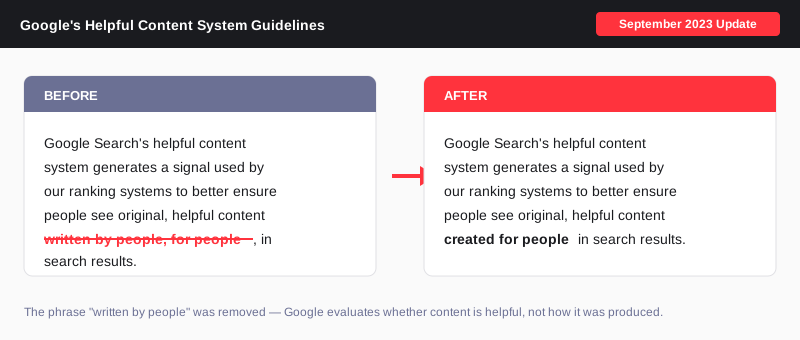
The message is clear: for content to rank well, it must be informative, answer users' queries satisfactorily, and showcase genuine expertise - regardless of how it's created.
AI Content Detectors like GPTZero, ZeroGPT, and many others are not reliable. Even OpenAI has said as much. They consistently produce false positives about human-written content. Conversely, they can be easily fooled with creative prompting or a bit of human editing.
An interesting note from OpenAI: "we found that it labeled human-written text like Shakespeare and the Declaration of Independence as AI-generated."
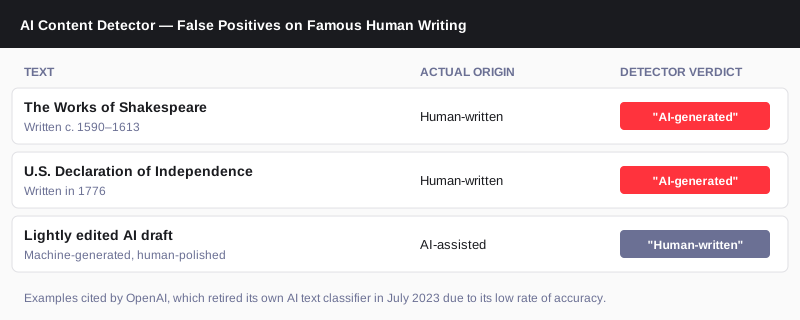
Anecdotal evidence and real-life ranking data suggest that while AI-generated content isn't penalized by search engines, it might only achieve high rankings if it meets the above criteria. The role of AI in content creation is still a developing narrative, and its significance is indispensable for maintaining a competitive edge in the future.
At EmberTribe, the understanding is clear - AI serves as a foundation, not the final product. With ClusterMagic, while AI aids in the initial draft based on expert-driven keyword research, human experts step in for the crucial phases of editing, fact-checking, and final review. This hybrid approach ensures the content is accurate and helpful, has the potential to rank, and truly represents their business.

Your competitors are bidding on keywords right now, and some of those keywords are ones you've never tested. Every dollar they spend in Google Ads carries a signal: what they believe converts, what audiences they're chasing, and where they see margin. Knowing how to read those signals is one of the highest-leverage moves in paid search.
This guide covers the full playbook for competitor AdWords keyword research, from Google's built-in free tools to the paid platforms that surface historical bidding data. Whether you're launching a new campaign or looking to reclaim impression share you've been losing, this is where to start.
Google Ads CPCs have risen an average of 12.88% year-over-year across most industries, according to recent benchmark data. When your cost-per-click climbs, every keyword decision carries more weight. Understanding what your competitors are bidding on helps you avoid expensive keyword traps, identify gaps they've missed, and build a more defensible keyword strategy.
Competitors' keyword data also reveals their strategic priorities. A brand aggressively bidding on your branded terms is signaling intent. A competitor that suddenly appears in your Auction Insights report means they've entered your space or increased their budget. These are real business signals disguised as advertising data.
The important caveat upfront: there is no legal way to see a competitor's exact keyword list. What you can do is build a highly accurate picture of their strategy using publicly available ad data, third-party tools, and smart inference. That picture is more than enough to act on.
Before paying for any third-party platform, exhaust what Google already gives you.
The Auction Insights report is the most underutilized free tool in Google Ads. Found inside your active campaigns, it shows how your ads perform relative to competitors in the same auctions. Key metrics include Impression Share Overlap (how often you and a competitor appear in the same auction), Position Above Rate (how often they outrank you), and Top of Page Rate (how frequently they land in the premium positions).
Run this report at the ad group level, not the account level, for meaningful data. An account-level view blends too many campaigns and obscures which specific topics or product categories a competitor is targeting hard. Review it weekly for core campaigns rather than monthly so you catch emerging threats before they cost you meaningful impression share.
The Google Ads Transparency Center lets you search any domain and see all the ads they're currently running across Search, Display, and YouTube. For competitor keyword research, look at their search ad headlines and descriptions. The language they use is a direct window into which keywords they're bidding on, because their copy will align with the intent of those searches.
Pay attention to themes across multiple ads: product-focused ads suggest transactional keywords, comparison-focused copy suggests they're targeting bottom-funnel evaluation queries, and educational messaging suggests they're investing in top-of-funnel awareness terms. Building this thematic map takes 20 minutes and costs nothing.
Inside Google Keyword Planner, you can enter a competitor's website URL instead of a seed keyword to generate keyword suggestions. Google analyzes their content and returns keyword ideas based on what they rank for organically. This doesn't show what they're bidding on directly, but it surfaces the keyword universe they're operating in, and those organic rankings often mirror their paid strategy.
This approach works especially well for identifying long-tail keywords a competitor is targeting that you haven't considered. Low-competition terms in the 20-40 monthly search range can drive incremental revenue when grouped strategically into tightly themed ad groups.
Free tools give you directional signals. Paid platforms give you historical data, estimated spend, and keyword-level ad copy analysis.
SpyFu is built specifically for competitive PPC research. Enter any competitor domain and you'll see the keywords they're bidding on, their estimated monthly Google Ads spend, their ad history going back years, and which keywords are performing well enough for them to keep running. The historical data is particularly valuable because it filters out short-term tests and shows you the campaigns that actually work for them.
SpyFu's "Kombat" feature lets you overlap three domains and visualize where your keyword sets intersect and diverge. This is useful for finding the keywords your competitors bid on that you don't, which represents your clearest expansion opportunity.
SEMrush's Advertising Research module is part of a broader marketing suite, which makes it useful if you're already paying for it. Enter a competitor domain and you'll see their estimated paid keyword list, the ad copy they've run, which landing pages those ads point to, and CPC trend data over time. SEMrush also shows you the keywords they appear to be testing versus the ones they consistently run, which helps distinguish their core strategy from experimental campaigns.
The Position Changes report is worth bookmarking: it shows when competitors enter or exit specific keyword auctions, giving you a real-time view of how their strategy is shifting.
Ahrefs is primarily known for SEO, but its Site Explorer tool includes a Paid Keywords report that shows estimated paid search traffic, the keywords driving it, and the landing pages those campaigns point to. For brands that run tightly integrated SEO and PPC strategies, this is useful because it reveals where a competitor is willing to pay for traffic they can't fully capture organically.
The overlap between a competitor's top organic keywords and their paid keywords tells you which terms they've decided are so valuable they're investing in both channels. Those are almost always worth evaluating for your own campaigns.

Gathering intelligence is step one. The more important step is knowing what to do with it. Here is a practical framework.
Identify keyword gaps. Use SpyFu's Kombat feature or SEMrush's gap analysis to find keywords competitors are bidding on that you're not. Filter for terms with meaningful estimated volume and check whether you have a relevant landing page. If you do, these are fast additions to your existing campaigns.
Analyze their ad copy for messaging signals. Competitors spend money testing headlines. When you see the same value proposition repeated across dozens of their ads, that's a signal the market responds to it. Don't copy their copy, but understand the underlying promise they're making and decide whether you can make it better.
Watch for brand keyword targeting. If a competitor starts appearing in your branded search terms, you'll see it in Auction Insights. The appropriate response is usually to increase your own branded bid floors and strengthen your brand campaign ad copy, not necessarily to retaliate by bidding on their brand in return.
Use competitive data as inspiration, not a blueprint. A former Google account strategist with 10,000+ optimized accounts advises treating competitor keywords as starting points for your own research, not a list to replicate. What works for their offer, landing page, and margin structure may not work for yours.
Competitor keyword research is one input into a larger paid advertising system. If you're running Google Ads as part of a broader search engine marketing strategy, the competitive layer helps you prioritize where to invest first. High-competition keywords with multiple aggressive bidders may warrant testing more specific long-tail variations rather than fighting head-on for impression share.
For ecommerce brands specifically, the Merchant Center Price Competitiveness tool adds another dimension: it shows where your product pricing sits relative to industry benchmarks, which directly affects whether your shopping ads convert even when you win the auction. A 60-70% impression share is considered a strong benchmark, but if your pricing is 13% above the market average on a category page, winning more auctions won't solve the conversion problem. Pairing competitive keyword intelligence with competitive pricing data creates a more complete picture.
If you're building out a PPC strategy for ecommerce, start with Auction Insights to understand your current competitive position, then use SpyFu or SEMrush to identify expansion keywords, and revisit the Transparency Center monthly to track how competitors' messaging evolves season to season.
Most brands check on their competitors once when setting up a campaign and then forget about it. The brands that consistently gain ground treat competitor keyword research as a recurring process, not a one-time setup task.
CPCs rise when competitors get more aggressive. New entrants appear in your auctions. Categories shift.
Running a monthly Auction Insights pull, a quarterly SpyFu competitive review, and a biweekly Transparency Center check takes less than two hours per month total. That time investment gives you the context to make better bid decisions, smarter keyword expansions, and more relevant ad copy without relying on guesswork.
The information is available. The question is whether you build a system to use it consistently.
Want help building a competitive paid search strategy for your brand? Explore EmberTribe's Google Ads management services to see how we approach competitive intelligence for DTC and growth-stage brands.

Most ecommerce brands waste significant ad budget before realizing the problem is structural, not tactical. The campaigns are live. The spend is real. But without the right service components in place, a Google Ads account becomes an expensive way to generate traffic that doesn't convert at a sustainable rate. Ecommerce PPC services are what bridge that gap between spending money on ads and building a repeatable acquisition engine.
This guide covers what those services actually include, what the right agency brings to the table, how pricing works, and what performance benchmarks you should hold your campaigns to.
Ecommerce pay per click management is not a single campaign type. It's a coordinated system of campaign structures, feed optimization, audience targeting, and conversion tracking that work together to drive profitable revenue. Top agencies build and manage all of these components.
Shopping campaigns are the foundation of most ecommerce Google Ads services. Unlike text search ads, Shopping ads pull directly from your product feed in Google Merchant Center, displaying product images, prices, and store names in search results.
Feed quality is what determines who sees your Shopping ads and how often. A strong ecommerce PPC agency audits your product titles, descriptions, GTINs, and category mappings before launching, because even well-structured campaigns underperform when the underlying feed has gaps. Google's Merchant Center Help Center outlines the technical requirements, but turning those requirements into competitive advantage is the agency's job.
SKU-level bidding is where experienced teams separate winners from losers. Segmenting campaigns by margin, conversion rate, and inventory level gives you precise control over which products get budget and at what cost.
Performance Max (PMax) gives Google's AI access to your entire inventory across Search, Shopping, Display, YouTube, Gmail, and Maps from a single campaign. It's powerful and increasingly dominant in ecommerce accounts, but it requires active management to prevent it from cannibalizing your branded terms and existing high-performing campaigns.
The core of effective PMax management is asset group architecture. A competent ecommerce PPC agency builds asset groups around product categories or customer segments, not as a single catch-all campaign. Audience signals guide the algorithm toward your best-fit customers rather than letting it learn from scratch on your budget. Negative keyword and brand exclusion lists prevent PMax from taking credit for sales that your other campaigns or organic search would have closed anyway.
For a deeper look at how PMax fits into a full paid search strategy, Store Growers' Performance Max guide is one of the most thorough independent resources available.
Text search ads complement Shopping and PMax in three specific ways: brand defense, competitor targeting, and long-tail keyword coverage. Brand campaigns protect your name in results when competitors bid against your terms. Competitor campaigns capture high-intent buyers who are actively evaluating alternatives. Long-tail campaigns reach shoppers with specific product intent that Shopping ads sometimes miss.
Search campaigns also give you direct control over messaging that Shopping and PMax don't. When you need to promote a specific offer, communicate a guarantee, or address a common objection, text ads let you say exactly what needs to be said.
Remarketing is where ecommerce PPC recaptures revenue that would otherwise leave permanently. Dynamic remarketing shows users the exact products they viewed, with current pricing and availability, as they browse other sites across Google's Display Network.
The three segments that matter most are cart abandoners, product viewers who didn't add to cart, and past customers primed for repeat purchases. Each requires different bid strategies and creative approaches. Cart abandonment campaigns typically justify the highest bids because purchase intent has already been demonstrated. Past customer campaigns often deliver the highest ROAS in an account because you're not paying to build trust from scratch.
For more on how remarketing fits into a full ecommerce Google Ads strategy, see our guide to ecommerce Google Ads agency selection.
No service component matters if you can't accurately measure what's working. Conversion tracking setup, verification, and maintenance is a core part of any serious ecommerce PPC service.
This includes confirming that purchase events fire correctly, that values pass accurately, that attribution windows align with your sales cycle, and that you have visibility into which campaigns drive new customers versus return purchases. Brands that rely on last-click attribution consistently make worse budget decisions than those with full-funnel measurement in place.
Understanding how agencies charge helps you evaluate proposals accurately and avoid structures that create misaligned incentives.
The most common model: the agency charges 10% to 20% of your monthly ad budget as a management fee. At $20,000 per month in spend, that's $2,000 to $4,000 in fees. This model scales naturally as your account grows, but it creates an incentive to increase spend before performance fully justifies it. Watch for agencies pushing budget increases before establishing strong ROAS at current spend levels.
A fixed fee regardless of spend volume, typically $1,500 to $10,000 per month depending on account complexity and agency tier. This model works well for brands with stable budgets and benefits you as spend grows without a corresponding fee increase. It also removes the perverse incentive to chase spend for its own sake.
Some agencies combine a lower base retainer with a performance bonus tied to revenue or ROAS above a threshold. When structured well, this aligns agency incentives with your actual business outcomes. When structured poorly, it can push short-term tactics over sustainable account health. Scrutinize what the performance triggers actually measure.
Resources like WordStream's PPC benchmarks and industry research from Search Engine Land can help you calibrate whether proposed fee structures are in line with market norms.
Return on ad spend is the primary performance metric for most ecommerce accounts, but raw ROAS numbers without context are easy to misread.
The standard benchmark is a 3:1 to 5:1 ROAS for ecommerce, meaning $3 to $5 in revenue for every $1 spent on ads. High-ticket categories like furniture or electronics can operate profitably at 3:1 to 4:1 because average order values are large. Fast-moving consumer goods and apparel often need 5:1 or higher to cover thin margins and return rates.
What matters more than hitting a benchmark is hitting your specific breakeven ROAS. That number comes from your gross margin: if your margins are 50%, you break even at 2:1 ROAS and become profitable above it. If your margins are 25%, you need 4:1 just to cover costs. A strong ecommerce PPC agency starts the engagement by calculating your target ROAS from your actual unit economics, not by quoting industry averages.
Attribution methodology also shifts apparent ROAS significantly. Brands measuring on last-click attribution will report higher ROAS than those using data-driven attribution or marketing mix modeling, because last-click gives full credit to the final touchpoint and ignores assists. Be skeptical of ROAS numbers from agencies that haven't disclosed how they're measuring.
For context on how PPC management fits into broader paid acquisition strategy, our guide to PPC management for ecommerce covers the full decision framework.
The service list above is table stakes. What differentiates high-performing agencies is how they apply those components to your specific business.
Business economics first. The first conversation with a serious agency covers your average order value, customer lifetime value, gross margins, and target CPA. An agency that jumps straight to campaign structure before understanding your unit economics is optimizing for activity rather than outcomes.
Feed quality as a competitive advantage. Most ecommerce brands treat their product feed as a technical requirement to satisfy, not a performance lever to optimize. Agencies that treat feed titles, attributes, and category mappings as creative and strategic inputs consistently outperform those that set and forget.
Creative involvement. In 2026, ad creative is where performance is increasingly won or lost, especially across Shopping, PMax asset groups, and remarketing display. Agencies that treat creative as something the client provides are operating with one hand tied.
Account ownership. You should own every ad account, pixel, audience list, and conversion event from day one. Agencies that house accounts under their own management umbrella and retain ownership when you leave create leverage that works against you. This is a non-negotiable.
Conversion rate perspective. The best ecommerce PPC teams treat your landing page performance as their problem, not yours. Traffic without conversion rate context leads to spend increases that improve revenue at the cost of efficiency. Look for agencies that raise CRO questions without being prompted.
For a broader view of how ecommerce digital marketing channels work together, our ecommerce marketing guide covers the full picture beyond paid search.
Ask for case studies with real numbers from brands in your category and at a comparable spend level. Broad claims about client growth don't tell you whether those results are repeatable in your competitive environment.
Request a sample reporting dashboard before you commit. The structure of an agency's reporting tells you what they think matters. Dashboards heavy on impressions and clicks with revenue buried five pages in signal a disconnect from business outcomes. Dashboards that lead with revenue, ROAS, CPA, and new customer percentage signal the right orientation.
Confirm technical setup standards: tag audits before launch, conversion testing protocols, and negative keyword management processes. Gaps in any of these create measurement errors and wasted spend that compound over time.
Finally, ask directly how they think about the relationship between PMax and Shopping campaigns. The answer reveals whether they're managing your account proactively or letting Google's automation run unattended. Both require budget.
Ecommerce PPC services done well are a systematic investment in repeatable revenue. The campaign types, the feed, the creative, and the measurement infrastructure all have to work together. When they do, paid search becomes one of the most predictable acquisition channels in your growth stack.
If you're evaluating what a structured ecommerce PPC engagement looks like, reach out to the EmberTribe team. We'll start with your unit economics and build from there.


Paid search accounts for a large share of ecommerce revenue for growth-stage brands, but running ads and running a profitable ecommerce PPC program are two different things. The channels have multiplied, automation has reshaped bidding, and customer acquisition costs have climbed 40 to 60 percent over the past two years. Brands that treat PPC as a simple traffic tap get squeezed. Those that build a structured, multi-channel strategy around real ROAS targets consistently outperform the market.
This guide covers how to build that kind of program, from channel selection to campaign structure to the benchmarks worth caring about.
Ecommerce pay per click advertising is any paid channel where you bid for placement and pay based on clicks, conversions, or impressions tied to a commercial action. The dominant channels for ecommerce brands are Google Search, Google Shopping, Performance Max, and Meta (Facebook and Instagram). Each serves a different role in the purchase funnel, and the strongest programs use all of them in combination rather than betting on a single channel.
Understanding what Google Ads is and how it works is a useful starting point before diving into ecommerce-specific strategy.
Google Shopping remains the most direct-intent ecommerce PPC channel available. Ads appear in the Shopping carousel when someone searches for a specific product, and clicks come from buyers who are already comparison shopping. The average Shopping CTR sits at 0.86 percent with an average CPC of $0.66, making it one of the more efficient traffic sources available. Conversion rates average 1.91 percent, and top-quartile ecommerce brands report Shopping ROAS above 6x.
Shopping campaigns are driven by your product feed, not keywords. Feed quality, accurate pricing, detailed product titles, and clean categorization determine who sees your ads and at what cost. Brands that invest in feed optimization see compounding gains that keyword-only campaigns cannot replicate.
Performance Max (PMax) is Google's AI-driven campaign type that runs across Search, Shopping, Display, YouTube, and Discover from a single campaign. As of 2026, PMax captures 62 percent of Shopping spend among ecommerce advertisers and is the primary campaign type for 72 percent of ecommerce brands running Google Ads. The results are real: PMax Shopping outperforms Standard Shopping by 15 to 20 percent on ROAS when conversion data is sufficient, typically 50 or more conversions per month.
The caveat is control. PMax limits keyword-level transparency and audience segmentation. Brands that run PMax alongside Standard Shopping campaigns rather than replacing them see the most consistent results. The hybrid approach lets Standard Shopping capture high-intent branded and product queries while PMax expands reach across Google's inventory.
Google's own documentation on Performance Max is available at support.google.com/google-ads.
Search ads are the right tool when you need to capture high-intent branded queries, competitor terms, or problem-aware searches that Shopping ads do not reach. Average Search CPC for ecommerce sits at $1.16, with a 4.9 percent CTR and a 2.81 percent conversion rate. The higher CPC compared to Shopping is usually justified when ads are tightly matched to transactional intent.
The most common mistake ecommerce brands make with Search campaigns is running broad match on product names without negative keyword discipline. Broad match has its place for discovery, but unchecked it inflates spend on irrelevant queries and dilutes ROAS. Exact and phrase match with a maintained negative keyword list should anchor any Search campaign before broad match is layered in.
Meta functions differently from Google. Google finds customers who are searching for what you sell. Meta finds customers by matching your offer to their interests and behaviors. For ecommerce brands, that distinction matters because Meta is better suited to cold audience acquisition, product discovery, and retargeting than it is to capturing in-market demand.
Average ecommerce CPC on Meta runs around $0.78, below Google's rates, but conversion intent is lower, so the comparison is not direct. The strongest use case for ecommerce pay per click on Meta is at the top of the funnel: building awareness for new products, reaching lookalike audiences, and retargeting site visitors who did not convert. Advantage+ Shopping campaigns now deliver 4.52x ROAS on average, 22 percent above manual campaigns, and account for 62 percent of ecommerce spend on Meta.
Meta's advertising tools and targeting options are documented at meta.com/business.
Our meta advertising guide covers campaign setup and creative strategy specific to ecommerce brands.
A high-performing ecommerce PPC budget allocation typically follows this structure:
This is a starting framework, not a fixed rule. Brands with strong brand recognition can shift more budget toward Shopping. Brands launching new products should weight Meta higher in the early stages.
Bidding strategy drives more of your ROAS outcome than most brands realize. The options that matter most for ecommerce:
Target ROAS (tROAS): Tell Google what ROAS to hit, and the algorithm adjusts bids in real time to meet it. This is the right choice once campaigns have 30 to 50 conversions per month. Campaigns with insufficient data will underdeliver because the algorithm lacks signal. Setting tROAS too aggressively restricts volume; a target of 90 to 95 percent of your actual historical ROAS gives the algorithm room to learn.
Maximize Conversion Value: Optimizes for the highest total revenue within your budget without a ROAS floor. Useful in scaling phases or when entering new product categories. Research from WordStream shows 95 percent of successful PMax campaigns use Maximize Conversion Value, achieving a median conversion rate of 2.22 percent versus 1.98 percent for Maximize Conversions.
Manual CPC: Gives precise control but demands constant monitoring. It is the right choice during campaign launches when there is no conversion history, and for branded campaigns where you want exact bid control.
Average ROAS benchmarks for ecommerce PPC in 2026:
| Channel | Average ROAS | Top Quartile |
|---|---|---|
| Google Shopping | 5.17x | 6x+ |
| Performance Max | 4.1x | 5x+ |
| Meta Advantage+ Shopping | 4.52x | 6x+ |
| Google Search (ecommerce) | 3.68x | 5x+ |
Break-even ROAS depends on your margins. A brand with a 40 percent gross margin needs at least 2.5x ROAS to cover ad spend before accounting for other costs. Most ecommerce brands need 3.5 to 4.5x on Google Search and 3.0 to 4.0x on PMax to maintain profitability. Chasing benchmark averages without anchoring targets to your own unit economics is one of the most common ways brands overspend on ecommerce pay per click.
Campaign structure determines how clearly the algorithm understands your goals. The principle is: separate campaigns with distinct intent levels should not share budgets or bidding logic.
A sound structure for an ecommerce brand running Google Ads:
Mixing branded and non-branded traffic in the same campaign lets high-converting branded queries mask poor performance from non-branded terms, which inflates apparent ROAS and hides waste.
The gap between the average ecommerce PPC program and a top-quartile one usually comes down to three factors. First, feed quality for Shopping and PMax campaigns. Second, the discipline of negative keyword management, which prevents budget from leaking into irrelevant queries. Third, consistent creative testing on Meta and Display, where ad fatigue erodes performance faster than brands expect.
Brands that track ROAS at the campaign level, monitor impression share trends weekly, and rotate creative on a set schedule tend to maintain profitability as they scale. Those that set campaigns and check results monthly tend to discover problems after they have already cost money.
If you are evaluating whether to manage ecommerce PPC in-house or with a partner, our ecommerce PPC services guide covers what a full-service program looks like and what to expect from an agency engagement.
Click-through rate and impressions are visibility metrics, not performance metrics. The numbers that drive ecommerce PPC decisions:
Attribution is a growing challenge as privacy changes have reduced Meta's pixel accuracy and multi-touch attribution has become harder to model. Brands running both Google and Meta should use data-driven attribution in Google Ads and supplement with platform reporting to build a composite picture of channel contribution.
If you are starting from zero, the sequence that works is: launch Shopping first to capture in-market demand, add Search once you have branded query volume, layer in PMax after Shopping campaigns have 50 or more conversions per month, and bring Meta in for prospecting once Google is profitable.
If you are scaling an existing program, the constraint is usually one of three things: insufficient conversion data limiting smart bidding performance, ad creative fatigue on Meta, or a product feed with gaps that limit Shopping reach. Fixing the constraint in your specific funnel produces more lift than adding new channels.
Ecommerce PPC is a compounding system, not a switch. The brands that treat it as a discipline rather than a media buy tend to build sustainable acquisition economics. Those that chase short-term ROAS by cutting bids at the wrong moment often sacrifice the volume that keeps algorithms performing.
For a broader look at how paid search fits into a full growth stack, our PPC advertising agency guide walks through what to look for in a managed program and how to evaluate performance over time.

If you've ever asked "what is Google AdWords," the short answer is: it's the original name for what is now called Google Ads, the world's largest paid search and digital advertising platform. Google renamed AdWords to Google Ads in July 2018, but the underlying engine, pay-per-click auctions, keyword targeting, and intent-based reach, remained the same. Understanding both names matters because most search traffic still uses "AdWords" as shorthand, even in 2026.
This guide covers everything you need to know: the rebrand history, how the auction works, which campaign types exist today, what it costs, and whether the platform fits your business goals.
Google launched AdWords in October 2000, initially offering 350 advertisers the ability to bid on keywords and show text ads in search results. For nearly two decades, "AdWords" was synonymous with paid search. But by 2018, the platform had expanded well beyond keyword-based text ads to include display banners, shopping listings, YouTube video ads, and app install campaigns.
On June 26, 2018, Google officially announced the AdWords rebrand to Google Ads, alongside a broader restructuring of its entire ads business. DoubleClick advertiser products and Analytics 360 were folded into Google Marketing Platform, while DoubleClick for Publishers became Google Ad Manager. The goal was to simplify a product lineup that had grown into an alphabet soup of overlapping brand names.
The name change did not affect campaign performance, reporting, or ad auction mechanics. If you had existing campaigns running in AdWords, they continued running unchanged under the new Google Ads interface. The rebrand was cosmetic and organizational, not technical.
Today, Google Ads generates over $265 billion in annual revenue for Alphabet, making it the dominant force in digital advertising globally.
Google Ads operates on a real-time auction that runs every time a user submits a search query. Understanding how that auction works is essential for anyone spending money on the platform.
Your ad's position in search results is not determined by bid alone. Google calculates an Ad Rank score for every eligible advertiser, and the highest Ad Rank wins the top spot. According to Google's own documentation, Ad Rank is determined by six primary factors: your bid amount, your ad quality, the Ad Rank thresholds for the auction, the competitiveness of that specific auction, the context of the search (device, location, time of day), and the expected impact of your ad extensions.
Quality Score is a 1-10 rating that reflects three components: expected click-through rate, ad relevance to the keyword, and landing page experience. A higher Quality Score means Google considers your ad more relevant to the user, which can lower your effective cost per click. Critically, Google now classifies Quality Score as a diagnostic tool, not a direct input into the live auction. It signals where your ads stand relative to competitors, but Ad Rank drives actual position.
The auction uses a second-price model. You pay the minimum amount needed to beat the Ad Rank of the advertiser below you, not your full bid. This structure rewards advertisers with high-quality, relevant ads because a strong Quality Score can achieve top placement at a lower cost than a competitor with a high bid but poor ad relevance.
Working with a qualified Google Ads management team can make a measurable difference in Quality Scores, which compounds over time into lower CPCs and better placements.
The platform has expanded significantly since its AdWords days. Here are the five core campaign types available in 2026:
| Campaign Type | Primary Channel | Best For | Funnel Stage |
|---|---|---|---|
| Search | Google Search results | High-intent keyword capture | Bottom |
| Shopping | Search + Shopping tab | Product-based ecommerce sales | Bottom |
| Performance Max | All Google channels | Full-funnel automation, scaling | Full funnel |
| Display | Google Display Network (3M+ sites) | Retargeting, brand awareness | Mid/Top |
| Demand Gen | YouTube, Gmail, Discover | Interest-based demand creation | Top |
Search campaigns remain the most direct route to capturing purchase intent. When someone searches "buy running shoes size 10," a well-structured Search campaign puts your product in front of them at exactly the right moment.
Shopping campaigns display product images, prices, and ratings directly in search results. They're essential for ecommerce brands with product catalogs, as they show before organic results and often generate strong conversion rates at competitive CPCs.
Performance Max (PMax) is Google's AI-driven campaign type that serves ads across Search, Display, YouTube, Gmail, Maps, and Discover from a single campaign. Google's recommended budget allocation for ecommerce puts PMax at 50 to 60% of total spend, with AI-optimized bidding across every placement. PMax works best when fed strong creative assets and clear conversion data.
Display campaigns reach users across more than 3 million websites in the Google Display Network. They work well for retargeting visitors who browsed your site but didn't convert, and for building visual brand awareness at scale.
Demand Gen campaigns replaced Discovery ads in 2023 and run across YouTube (including Shorts), Gmail, and the Google Discover feed. They're built for upper-funnel awareness and are particularly effective for DTC brands introducing new products to cold audiences.
Google now packages its most advanced campaign types into what it calls the "Power Pack": AI Max for Search, Performance Max, and Demand Gen, designed to cover the full customer journey from awareness to conversion.
Google Ads costs vary by industry, competition level, and campaign type. There is no fixed entry price: you set a daily budget and pay when users click (CPC), view a video (CPV), or complete a target action (CPA bidding).
According to 2026 benchmark data from WordStream and other sources, the cross-industry average CPC on Search reached $2.96 in Q1 2026, up 12% from $2.64 in Q1 2025. Industry-level costs vary widely. Legal services average $8.58 per click while ecommerce averages closer to $1.16. The steepest CPCs reflect sectors with high lifetime customer value, such as finance, insurance, and legal.
On the return side, ecommerce brands using Google Ads average a blended ROAS of approximately 3.68:1 across the platform, according to Triple Whale's dataset of 18,000+ brands. Search campaigns specifically average 5.17:1 ROAS, while Performance Max averages 2.57:1. Most sustainable DTC brands target a blended ROAS of 2.5x to 4x depending on category margins, and many premium brands aim for 5:1 or higher.
For context, the minimum effective daily budget to gather meaningful data from a Search campaign starts around $20 to $30 per day, though most growth-stage brands budget significantly more to generate statistically useful conversion data within a reasonable timeframe.
Partnering with a capable PPC company that understands auction mechanics and bidding strategy can compress the learning phase and reduce wasted spend.
Google Ads is most effective for businesses where customer intent is the primary driver of conversions. If your customers search for what you sell before buying, paid search captures that intent with precision that most other channels cannot match.
Google Ads tends to perform especially well for:
Google Ads is less ideal for businesses without measurable conversion events, companies with very low average order values where CPC costs compress margins, or brands whose customers do not search before buying (impulse categories often perform better on Meta or TikTok).
For businesses that want both paid search and broader channel management, working with a full-service SEM marketing agency or a search engine marketing company can help ensure budgets are allocated across channels in a way that maximizes blended return.
The platform's core structure has four levels: Account, Campaign, Ad Group, and Ad. Campaigns hold your settings and budget. Ad Groups contain sets of keywords and the ads triggered by those keywords. Ads are the creatives users see.
A basic Search campaign setup for an ecommerce brand typically includes: a keyword list organized by intent (branded, category, competitor, long-tail), match type settings to control how broadly keywords trigger your ads, negative keywords to filter irrelevant queries, and responsive search ads with multiple headline and description variants that Google automatically tests.
From there, bidding strategy, landing page optimization, and audience layering are the primary levers for improving performance over time.
Understanding Google Ads in theory is one step. Executing profitably at scale requires continuous testing, strong campaign architecture, and the ability to read auction signals and respond quickly.
EmberTribe specializes in Google Ads management for DTC and growth-stage brands, building and managing campaigns that are grounded in data and optimized for actual business outcomes, not just platform metrics. Visit embertribe.com to learn how we approach paid search.

According to Backlinko's SEO statistics research, 96.55% of all pages on the web receive zero organic traffic from Google. The problem is rarely that organic search does not work. It is that the execution, or the agency executing it, is not doing the things that actually move the needle in Google's current algorithm environment.
Hiring a Google SEO agency is not the same decision it was three or four years ago. The algorithm priorities have shifted fundamentally, and agencies that have not kept pace are burning budgets on tactics that have since been explicitly penalized.
General SEO as a category covers everything from Pinterest optimization to Amazon listing copy. A Google SEO agency is specifically focused on the signals Google measures, the tools Google provides, and the way Google's crawlers evaluate a site.
The four areas where Google-specific expertise is most consequential:
The playbook for SEO has changed substantially since 2022, and agencies that have not adapted are operating on outdated assumptions.
The Helpful Content System launched in August 2022 and was fully integrated into Google's core ranking algorithm by 2024. It now runs continuously rather than as discrete updates. Its effect: content that exists primarily to rank, rather than to genuinely serve a reader, has been systematically downranked. "SEO content" written without subject-matter input no longer works the way it once did.
The "Experience" addition to E-E-A-T was added in December 2022 and is widely interpreted as Google's direct response to the proliferation of AI-generated content. It rewards content that demonstrates first-hand experience or genuine expertise: bylines, case studies with verified data, original analysis. It deprioritizes content that could have been written by anyone about anything.
2025 Core Updates continued targeting scaled content abuse, link spam, and AI-generated content without human review or editorial value. According to Search Engine Journal's coverage of Google's guidance on hiring SEO agencies, Google's own engineers have made clear that any agency operating through link schemes or scaled templated content is building on unstable ground.
The practical implication: a Google SEO agency that has survived and grown client traffic through 2022 to 2025 without penalties has a materially different skillset than one that was riding pre-2022 tactics. Ask specifically about this.
Several patterns reliably indicate an agency that will underdeliver or create cleanup work down the road.
Guaranteed rankings are the clearest red flag. No agency can guarantee specific rankings: Google's systems are not predictable at that granularity, and Mueller has stated this explicitly. Any agency making guarantees is either misrepresenting their influence or planning to use tactics Google has specifically targeted.
Unsolicited outreach with a "free audit" is another signal. Google itself flags this practice as a marker of low-quality providers. Legitimate agencies with strong track records do not need to cold-email domain owners with manufactured urgency.
Links as the primary selling point indicates a misaligned strategy. Link building is a component of SEO, not a complete strategy. Agencies that lead with backlink volume rather than technical health and content quality are operating on a pre-2022 framework.
Traffic-only reporting (session volume without conversion data, rankings without CTR context) mirrors the same issue as traffic-only paid media reporting. If an agency cannot connect organic activity to revenue, they cannot tell you whether the program is working.
Ahrefs' SEO pricing research covering 439 practitioners provides the most granular current benchmarks. Monthly retainers are the dominant model, used by 78.2% of SEO providers.
For growth-stage DTC ecommerce and B2B SaaS brands operating in competitive verticals, the relevant range is $2,500 to $5,000 per month for a quality US-based agency delivering full-service work: technical monitoring, content strategy with brief development, on-page optimization, link building, and reporting tied to GSC and GA4. At this tier, 79.1% of US and Canada-based providers operate.
Entry-level retainers ($500 to $2,000/month) typically cover one or two service areas rather than a complete program, and are more appropriate for smaller sites with limited competition. Enterprise or highly competitive verticals typically run $5,000 to $15,000+ monthly, reflecting the content velocity and technical complexity required.
Project-based engagements are common for defined scopes: technical SEO audits run $1,000 to $10,000+ depending on site size, and site migration support typically runs $5,000 to $20,000+.
The pricing floor to watch: any agency offering comprehensive, full-service SEO for a growth-stage brand under $500/month is cutting corners on quality, coverage, or ethical standards. That price point does not cover the labor required to do the work correctly.
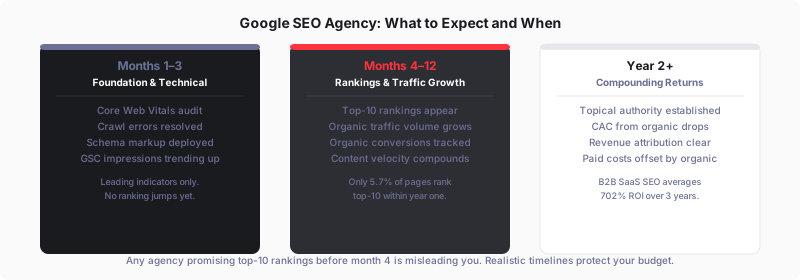
Setting expectations correctly at the start of an engagement prevents the most common failure mode: cutting a program before it has had time to work. B2B SaaS SEO data from Ahrefs' B2B SEO statistics research shows an average 702% ROI with a roughly seven-month break-even over a three-year horizon. Organic search also produces a lower customer acquisition cost ($147 average for SaaS versus $280 for paid search), which means the compounding value is in the long tail, not the first quarter.
For DTC ecommerce, the organic advantage compounds differently: brands with strong SEO reduce their dependence on paid acquisition during peak periods, creating margin protection when CPMs spike. This is the channel mix diversification case for organic, and it takes 12 to 18 months to materialize.
Organic search accounts for more than 57% of all web traffic globally, but nearly all of it concentrates in a small number of pages that are technically sound, genuinely authoritative, and aligned with how Google evaluates quality in 2026. Getting a B2B SaaS brand or DTC ecommerce site into that group is not a volume problem. It is a strategy and execution problem that a Google SEO agency with current expertise can solve.
If you want to evaluate where your organic program stands against Google's current technical and quality standards, EmberTribe works with growth-stage DTC and B2B brands on SEO strategy built around the signals that actually drive rankings today.
Hiring a Google Ads management agency is a bet on expertise you do not yet have. When that bet pays off, Google Ads becomes a predictable acquisition channel with compounding efficiency. When it does not, you spend months funding campaigns that generate traffic but not revenue, and trying to figure out whether the problem is the platform, the agency, or the strategy.
Most of the companies that end up in the second scenario did not vet their agency carefully before signing. This guide covers what to look for, what to ask, and what to walk away from.
Managing Google Ads is not the same as running Google Ads. The distinction matters because many agencies do the latter: they set up campaigns, press go, and report on what happened. A genuine management agency does something more operationally demanding.
The actual work spans six areas:
Strategy and account architecture. Translating business goals into campaign structure, budget allocation by funnel stage, and bidding strategies tied to actual conversion data. This includes attribution modeling and GA4 configuration so the numbers in reports reflect real revenue.
Technical infrastructure. Conversion tracking implementation, audience list building, Shopping feed management for DTC, and CRM integration for B2B lead quality optimization. Broken conversion tracking is the single most common inherited account problem. Any agency that does not audit tracking in week one is building on a broken foundation.
Ongoing optimization. Negative keyword harvesting, search term report analysis, bid adjustments by device and time of day, and Quality Score improvement. This work is continuous, not a one-time setup task. If the change history log in your account shows fewer than 20 documented changes per month, the account is on autopilot.
Three paths exist for managing Google Ads. Each has a different tradeoff profile.
An agency buys expertise and bandwidth at the cost of some internal context and control. The practical advantages: according to analysis from Echelonn, only 55% of in-house marketers managing Google Ads hold current Google certifications, compared to 92% at specialist agencies. Platform fluency degrades fast. Google made significant changes to match types, Smart Bidding, and Performance Max in 2023 through 2025; staying current is effectively a full-time job at an account with meaningful spend.
In-house management makes sense when budgets exceed $500,000 per month and justify a dedicated performance marketing team, when the product is complex enough that domain knowledge is hard to transfer, or when internal data infrastructure (clean CRM data, revenue attribution) gives an internal team a meaningful advantage.
Automation tools like Optmyzr or Skai reduce manual workload but require a skilled person to direct strategy. They solve bid management and pacing problems but do not solve negative keyword management, creative, attribution, or the judgment calls that separate efficient accounts from wasteful ones. Automation tools are a complement to expertise, not a replacement.
Google certifies agencies at two levels above baseline: Partner and Premier Partner. The distinction matters, but not for the reasons most agencies advertise.
Reaching Partner status requires $10,000 in managed ad spend over 90 days, a 70% optimization score across managed accounts, and at least 50% of strategists holding current Google Ads certifications. It is a baseline operational signal.
Reaching Premier Partner status requires $150,000 or more in managed ad spend over 90 days, 50% client revenue growth year-over-year, 90% client retention, and annual renewal. According to Google's Partner Program requirements, Premier Partners represent the top 3% of agencies globally.
What Premier status provides in practice: direct access to Google account managers, early access to beta features before public release, and dedicated technical support for complex tracking or billing issues. These are operational advantages, not performance guarantees.
What it does not guarantee: better results, lower CPCs, or ethical practices. A smaller specialist agency without Premier status but with deep vertical expertise may consistently outperform a large Premier Partner running your account with generalist managers. Use Partner status as a necessary-but-not-sufficient filter, not as a selection criterion.
Four pricing models are in active use. Each has a structural implication for how the agency behaves.
Percentage of ad spend (10 to 20%) is the most common model at mid-market spend levels. A DTC brand spending $20,000 per month should expect $2,000 to $4,000 in management fees on this model. The structural misalignment: the agency earns more when you spend more, regardless of whether efficiency improves. Watch for routine budget increase recommendations before demonstrating that current campaigns are working.
Flat monthly retainer ($1,500 to $10,000 per month depending on scope) is more common with B2B SaaS accounts, where campaign complexity does not scale linearly with spend. No incentive to inflate budgets, but fixed fees may not cover scope as an account grows.
Hybrid (flat base fee plus a lower percentage) is the most aligned structure. The base covers management; the percentage component scales with the work complexity at higher spend levels.
Setup fees of $500 to $5,000 are common and legitimate for account buildouts. The flag to watch is contract length: 3 to 6 months is standard. Nine to 12 month lock-ins without performance-based exit clauses are a red flag, not a commitment indicator.
According to LocaliQ's 2025 search advertising benchmarks, 87% of industries saw CPCs increase in 2025, with the cross-industry average reaching $5.26. In a rising-cost environment, management quality has a bigger impact on efficiency than it did when CPCs were lower.
These questions are not formalities. Each one reveals something specific about how the agency operates and whether they have managed accounts at your stage before.
On account ownership: "Will the account be created under my Google Ads account or yours? If we part ways, do we retain 100% of the account, history, and data?" The answer must be yes on both counts. Any hesitation is a dealbreaker. Losing campaign history and audience lists when switching agencies is a preventable and expensive problem.
On team structure: "Who manages my account day-to-day, what is their title, and how many accounts do they currently manage?" Strategist-to-account ratios above 20 reliably underperform on growth-stage accounts. The senior person in the sales conversation is rarely the person running your campaigns at a mid-size agency.
On Performance Max: "What role does PMax play in our account versus traditional Search? What brand exclusions will you apply, and how will you distinguish PMax conversions from branded traffic that would have converted anyway?" An agency that cannot answer these questions specifically is treating PMax as a black box, which means they are potentially claiming credit for organic or direct conversions.
For additional context on how these criteria apply when evaluating PPC advertising companies more broadly, the framework overlaps closely with Google Ads-specific evaluation.
Timeline expectations are the source of most costly misalignments with a new agency. Here is what a competent agency actually delivers across three phases.

The 90-day arc matters because Smart Bidding requires data to optimize effectively. Google's algorithms typically need 30 to 50 conversions per campaign per month to exit the "learning" phase and move to efficient optimization. Accounts that launch with low conversion volume or without proper tracking stay in learning mode indefinitely.
The red flag across all three phases is the same: if the change history log shows the same campaign structures from day one through day 90 with no documented optimization rationale, the agency is billing for activity that is not happening.
Performance Max is now the default Google recommendation for most campaign types. Understanding how a prospective agency approaches it reveals their depth quickly.
PMax runs across all Google channels (Search, Display, YouTube, Discover, Gmail, Maps) driven by machine learning. Traditional Search campaigns are keyword-controlled and channel-specific. The tradeoffs are real: DemandSage's analysis of Google Ads data shows Google's overall ad revenue grew 14% year-over-year in Q4 2025, driven largely by Performance Max adoption across ecommerce.
For DTC ecommerce, PMax typically converts 30 to 40% better than Search alone when properly configured. For B2B SaaS, traditional Search campaigns generally outperform PMax for high-intent term capture by a similar margin, because the intent-filtering that keywords provide is more valuable in longer sales cycle categories.
A credible agency should be able to explain clearly: what role PMax plays in your funnel, what brand exclusions and placement exclusions they apply, how they attribute PMax conversions without counting branded or organic conversions, and under what circumstances they would shift budget back to Search. An agency that "just uses PMax because Google recommends it" is delegating strategy to an algorithm.
Guaranteed rankings or ROAS targets before seeing account history. Google's auction is not controllable. Anyone promising specific performance numbers before running a single campaign either does not understand the platform or is telling you what closes deals.
Percentage-of-spend model with routine budget increase recommendations. This is not inherently disqualifying, but it requires explicit attention. Ask how the agency handles the structural conflict of interest between their fee model and your efficiency goals.
No documented optimization cadence in the contract. The statement of work should specify hours per week committed to the account and a minimum change cadence. Without this, "ongoing management" means whatever the agency decides it means.
According to Google's own economic impact data, businesses earn an average of $2 for every $1 spent on Google Ads. That return is an average across all advertisers.
Well-managed accounts perform substantially above that average. Poorly managed accounts perform below it, sometimes significantly. The management quality is the variable.
The companies that reach above-average returns share a common pattern: they vetted the agency on account ownership, reporting methodology, and team structure before signing. They reviewed the first 90-day plan and confirmed it included conversion tracking and campaign architecture work, not just campaign launch. And they held the engagement to CPA and ROAS targets, not impression counts.
If you want to see what a revenue-accountable Google Ads program looks like in practice, EmberTribe works with growth-stage DTC and B2B brands that need paid programs connected to real business outcomes.

Most small businesses hire the wrong PPC agency for the wrong reasons. They go with the lowest quote, the flashiest deck, or whoever called them first. Six months later, they've burned through budget, seen flat results, and written off paid search entirely.
The agency wasn't right for them. This guide will help you avoid that outcome.
A small business PPC agency manages your paid search campaigns so you don't have to become a Google Ads expert yourself. The right one will grow your revenue. The wrong one will drain your account and hand you a polished report explaining why it isn't their fault.
If you're new to paid search, understanding how Google Ads work is the right place to start. But here's the short version of what a PPC agency handles once you hand them the keys.
A competent agency takes ownership of your entire campaign lifecycle:
What most agencies won't do: build your landing pages, handle your SEO, run your social ads, or guarantee specific outcomes. Any agency promising a guaranteed ROAS before seeing your account has never managed a real campaign.
PPC makes sense before it's self-managing. You're ready to work with an agency when:
You have a minimum viable ad budget. Agencies generally need $2,000 to $3,000 per month in ad spend to run meaningful tests. Below that, there isn't enough data to optimize against. If you're working with $500/month, you're better off learning the basics yourself first.
Your unit economics support paid acquisition. If your average order value is $30 and your gross margin is 40%, paid search will be very difficult to make profitable. If your AOV is $200+ or you have strong repeat purchase rates, the math starts to work.
You've run ads and they're not working. Sometimes the signal is that you tried it yourself, wasted money, and concluded that Google Ads doesn't work for your category. Usually the real problem is poor campaign structure or mismatched landing pages. An agency can diagnose that.
You're scaling and need leverage. Paid search management is time-intensive. If you're running campaigns yourself and they're producing results, but you don't have the hours to optimize, an agency buys that time back.
Pricing varies more than most small businesses expect. There are three standard models, and each has a different risk profile for you.

Flat monthly retainer ranges from $1,000 to $4,000/month for most small business accounts. The fee is fixed regardless of what you spend on ads. This is predictable for you but can misalign incentives, since an agency on a flat fee has no reason to push you toward higher spend.
Percentage of ad spend typically runs 10–20% of your monthly budget. This aligns the agency's revenue with your investment, but it creates an incentive to spend more (not necessarily spend better). According to agency pricing research from AgencyAnalytics, the percentage model is most common for larger budgets.
Hybrid combines a base retainer (often $1,500 or more) with a smaller percentage of spend (6–10%). This is the most common structure at mid-market agencies and balances predictability with growth alignment.
For most small businesses spending $3,000–$8,000/month in ads, expect to pay $750–$1,600/month in management fees. That's a blended rate of roughly 15–20% of spend.
Vetting an agency before you sign is the most valuable 60 minutes you'll spend. These five questions separate capable teams from good sales teams.
1. "Can you walk me through a campaign you've built for a business like mine?" You want to see actual campaign structure, not a case study PDF. Ask them to screen share a real account (anonymized is fine). If they won't, that's a data point.
2. "Who specifically will manage my account?" Many agencies sell on senior talent and execute on junior talent. The person in the pitch meeting may never touch your account. Confirm the account manager, their experience level, and their typical client load.
3. "How do you handle negative keywords?" This is a litmus test. Strong PPC managers build exhaustive negative keyword lists before a campaign goes live and update them weekly from search term reports. If they give you a vague answer, they're not doing it.
4. "What's your reporting cadence and format?" You want a weekly or biweekly performance summary with cost, clicks, conversions, CPA, and ROAS, not a monthly PDF that buries the bad news. Ask to see a real report from an existing client.
5. "What do you need from us to be successful?" A thoughtful agency will ask for conversion tracking access, landing page control, and clear business goals. One that says "just give us the ad spend" isn't planning to optimize much.
Some agencies will waste your money faster than you can make it. The warning signs are predictable.
Guaranteed results. No one can guarantee a specific ROAS or CPL before running campaigns in your account. The competitive landscape, your landing pages, your product economics, and Google's auction system all interact in ways that make guarantees meaningless at best and fraudulent at worst.
Owning your ad account. Your Google Ads account should be under your billing account and in your name. Agencies that insist on managing from their own account hold your data and history hostage. If you leave, you start from zero. This is a deal-breaker. Review how PPC management companies should structure client accounts before you sign any agreement.
No clear onboarding process. Good agencies have a structured onboarding: access requests, audit period, strategy alignment, and a launch timeline. An agency that wants to "just get started" without a plan will run disorganized campaigns.
Vague attribution. If an agency can't clearly explain how they're tracking conversions (what counts as a conversion, how it's tagged, and how it ties to your actual revenue), their reporting means nothing.
Lock-in contracts longer than 3 months. A 90-day initial engagement is reasonable. A 12-month contract with an agency you've never worked with is not.
Benchmarks help calibrate expectations. According to WordStream's 2025 Google Ads industry benchmarks, the average click-through rate across industries is 6.66%, average conversion rate is 7.52%, and average cost per lead is $70.11. Your numbers will vary significantly by category, competition, and how well your landing pages convert.
For DTC and ecommerce brands, a realistic performance arc looks like this:
| Months | Expected ROAS | What's Happening |
|---|---|---|
| 1–2 | 1–2x | Learning phase. Algorithms need data. Budget is burn while signals accumulate. |
| 3–4 | 2–3x | Optimization takes hold. Negative lists mature. Best-performing segments emerge. |
| 5–6 | 3–5x | Stable performance. Smart Bidding strategies have enough conversion data to perform. |
| 6+ | 4–6x+ | Compound improvement. Remarketing layers work. Audience signals are strong. |
LocaliQ's benchmark report shows similar patterns across service businesses and local advertisers. Month one is rarely when you measure ROI.
The most important metric in months one and two isn't ROAS. It's whether conversion tracking is working correctly, whether search term reports are generating useful negative keywords, and whether the agency is communicating proactively when something isn't working.
Finding the right small business PPC agency is mostly about avoiding the wrong ones. The market has far more agencies that sell well than ones that execute well. Protect yourself by owning your ad account from day one, demanding real reporting, and holding agencies accountable to the optimization work, not just the spend.
A well-run paid search program is one of the highest-leverage growth channels available to a small business. Budget goes in, buyers come out, and the system gets smarter over time. It just requires the right team running it.
If you're evaluating paid search partners and want to talk through what a results-focused engagement looks like, EmberTribe works with DTC and ecommerce brands to build and manage Google Ads programs that compound over time.
Most brands shopping for search engine marketing services hit the same problem: every agency sounds identical. The deliverables list looks the same. The pricing page uses the same buzzwords. The difference only becomes obvious after a few wasted months and a depleted ad budget.
This post breaks down what SEM services actually include at each level of engagement, how the main pricing models work in practice, and what signals separate a service worth buying from one that will cost you more than it generates.
SEM is a paid channel. The core mechanism is bidding on keywords so your ads appear in search results ahead of organic listings. But the service wrapping that mechanism varies enormously depending on scope and provider.
A complete SEM engagement typically covers six functional areas:
Keyword research and intent mapping. This is the foundation. A provider should map keywords to buyer intent stages: informational, navigational, and transactional. Targeting only high-volume terms without intent qualification is one of the fastest ways to burn spend on clicks that never convert.
Campaign architecture. This covers how campaigns, ad groups, and keyword match types are structured. Poor architecture leads to keyword cannibalization, quality score problems, and ad relevance issues. Google's own campaign structure guidance emphasizes tight thematic grouping because it directly affects your Quality Score and cost per click.
Ad copy creation and testing. Effective services include ongoing A/B testing of headlines and descriptions, not just a single set of ads written at launch. Ad copy decays. What performs in month one rarely performs at month six.
Bid strategy management. This includes choosing the right bidding method (manual CPC, target ROAS, maximize conversions, target CPA) and adjusting it as campaign data matures. According to WordStream's research, average Google Ads conversion rates vary significantly by industry. Bidding strategy must be calibrated to your actual numbers, not category averages.
Conversion tracking and attribution. You cannot optimize what you cannot measure. A credible SEM service sets up and audits conversion tracking as a first-order priority, not an afterthought. This includes verifying that Google Ads conversion events match what's being tracked in GA4 or your analytics platform.
Reporting and strategic review. Monthly reports should go beyond impressions and clicks. Look for cost per acquisition (CPA), return on ad spend (ROAS), impression share, and quality score trends. Providers who lead with CTR as the headline metric are often obscuring underperformance elsewhere.
Pricing for SEM services reflects both scope and the level of strategic attention your account receives. Here's how it generally breaks down in 2026:
Starter ($1,500 to $3,000/month in management fees). This tier covers the basics: keyword research, initial campaign setup across one or two campaigns, and a monthly performance report. Ad copy testing is limited and bid management is largely manual. It works for brands with a single product line and a straightforward conversion path.
Growth ($3,000 to $7,000/month). At this level, providers can manage multiple campaigns across search and potentially shopping, run ongoing A/B tests on ad copy, build out audience targeting layers, and deliver more frequent optimization cycles. Conversion tracking setup and reporting become more rigorous. This tier fits brands scaling past $20,000 in monthly ad spend.
Full-service ($7,000+/month). This level includes everything in the growth tier plus Performance Max campaigns, Shopping feed management, custom attribution modeling, and a dedicated strategist. Some providers also integrate SEM with paid social for unified budget allocation. WebFX's 2025 SEM pricing research confirms that management fees above $7,000/month typically coincide with ad budgets over $50,000/month.
Note: these are management fees only. Ad spend is billed separately and typically represents the larger share of total SEM cost.
Three primary models dominate the market. Each has different incentive structures that affect how your account is managed.
Percentage of ad spend. The agency charges 10 to 20 percent of your monthly ad budget as a management fee. This model creates a structural misalignment: the agency earns more when you spend more, regardless of whether that spend produces proportional returns. Scrutinize it closely if your budget is being pushed upward without corresponding ROAS improvement.
Flat monthly retainer. A fixed fee regardless of ad spend. This aligns the agency's incentive with efficiency rather than volume, and works best when scope is well-defined and campaigns are stable. The risk: flat fees can cause agencies to under-resource fast-growing accounts that generate more management work than the retainer covers.
Hybrid (flat plus performance). Agencies combine a base retainer with a performance bonus tied to hitting CPA or ROAS targets. A 2026 agency pricing survey cited by get-ryze.ai found that 27% of agencies now use hybrid models. For DTC brands with clear revenue attribution, this structure surfaces the most honest read on whether an agency's work is generating returns.
Deliverables lists and case studies only go so far. The most reliable evaluation signal is how a provider talks about your account before they have it.
A credible provider will ask about your current conversion tracking setup on the first call, not after the contract is signed. They will ask what your acceptable CPA or target ROAS is, not assume they know what success looks like. They will tell you what they cannot do as readily as what they can.
Red flags worth noting: proposals that lead with impressions or traffic volume rather than conversion metrics; agencies that cannot show account-level ROAS data from comparable clients; and contracts that lock you into 12-month minimums before any performance data exists.
For brands evaluating whether SEM fits into a broader paid search strategy, our breakdown of Google Ads management covers how campaign types and budget allocation interact at the account level. If you're still deciding between building an in-house capability versus outsourcing, the SEM marketing agency comparison is a useful starting point.
One benchmark worth keeping in mind: Google Ads average cost per click reached $5.26 in 2025, a 12.88% year-over-year increase. Efficient campaign management is what separates brands that scale profitably from those that just spend more.
The SEM services market is crowded. Narrowing your evaluation comes down to three questions:
First, does the provider have category experience in your vertical? Bid dynamics, average CPCs, and conversion rates vary significantly by industry. An agency with demonstrated results in ecommerce or DTC carries less onboarding risk than a generalist.
Second, is their reporting built around your business metrics or their platform metrics? Providers who optimize toward your CPA and ROAS targets, not their own quality scores, are the ones who stay.
Third, how do they handle underperformance? The answer to this question tells you more about fit than any case study. Agencies that have clear protocols for diagnosing and reversing performance declines are worth more than agencies that only know how to scale what's already working.
If you're ready to pressure-test your current paid search setup or evaluate whether outsourcing makes sense for your stage of growth, EmberTribe works with DTC and growth-stage brands on SEM strategy, campaign management, and performance-focused search marketing. Start with a conversation about your current numbers and where you want them to go.
Hiring a saas ppc agency is not the same as hiring a general PPC firm. The mechanics of software marketing -- longer sales cycles, multiple decision-makers, trial and demo conversion goals, and LTV-based economics -- require a fundamentally different approach than ecommerce or local service advertising.
This guide covers what separates SaaS paid search from other verticals, what a qualified agency should actually do, how to evaluate candidates, and what pricing to expect.
Most PPC agencies are built for direct-response: click, buy, done. That model breaks down in B2B software, where the average sales cycle runs four to five months and purchases require sign-off from stakeholders who were never in the original search session.
The differences stack up fast:
Conversion goals are not purchases. The end goal of a SaaS paid search campaign is typically a free trial signup, a product demo request, or a qualified lead handed to sales -- not a completed transaction. Optimizing for these events requires conversion tracking built specifically around software buying behavior.
Attribution is multi-touch and multi-session. A prospect may click an ad, read three comparison pages, attend a webinar, and only then request a demo. An agency that measures success by last-click conversions will misread which campaigns are actually working.
Keyword intent is more nuanced. Someone searching "project management software" is at a very different point in their journey than someone searching "Asana alternatives for remote teams." Matching keyword intent to funnel stage -- and bidding accordingly -- is a core competency for SaaS paid search, not an afterthought.
LTV drives bidding decisions. Because SaaS revenue is recurring, customer acquisition cost has to be evaluated against lifetime value, not just first-month revenue. An agency that optimizes for the lowest possible CPL without accounting for LTV will consistently bring in the wrong customers.
A qualified saas ppc agency handles more than ad copywriting. Here is what a full-service engagement should cover.
SaaS accounts need tightly segmented campaign structures: branded vs. non-branded, competitor terms, solution-aware keywords, problem-aware keywords, and retargeting -- all in separate campaigns with separate budgets and bid strategies.
Collapsing these into broad campaigns with mixed intent is one of the most common reasons SaaS Google Ads accounts underperform. The search query report ends up a mix of irrelevant terms, spend is wasted across intent levels, and Smart Bidding strategies get fed bad conversion signals that compound the problem.
B2B SaaS keyword strategy goes beyond volume and CPC. A specialist agency maps keywords to buyer stages:
Negative keyword lists are equally important. Without aggressive negatives, SaaS ad budgets hemorrhage spend on job seekers, students, and competitors researching your product.
The funnel for SaaS doesn't end at the ad click. A capable agency maps the entire path: ad to landing page to conversion action to CRM handoff. This means:
Tracking conversions accurately is the foundation of all of this. Google provides multiple ways to track conversions across websites, apps, and phone calls -- a SaaS agency should have a clear process for implementing and auditing this setup from day one.
SaaS buyers rarely convert on a first visit. Retargeting campaigns keep your product visible across the consideration period. This includes:
Good SaaS PPC reporting goes past impressions, clicks, and cost per click. The metrics that matter are cost per SQL (sales-qualified lead), demo-to-close rate by campaign, pipeline contribution, and CAC payback period. If an agency's reporting stops at CPL, they are optimizing for the wrong outcome. For a deeper look at how top agencies approach this, the paid search playbook for SaaS outlines the full attribution framework specialists use.
A freelance PPC specialist can be a cost-effective option for early-stage companies with simple account structures and monthly ad spend below $5,000. The trade-offs:
For B2B SaaS specifically, the complexity of multi-touch attribution, CRM integration, and audience segmentation tends to favor an agency once ad spend justifies the overhead. See our breakdown of PPC management companies for how agency pricing and service levels vary across the board.
Ask to see case studies from software companies -- ideally B2B, ideally at a similar stage and deal size as yours. Results from ecommerce or local service clients do not translate. Key questions:
Before any campaign goes live, a qualified agency should audit your existing tracking, identify gaps, and build a clean measurement foundation. Red flag: an agency that jumps straight to campaign setup without reviewing your conversion tracking and CRM integration first.
Google Premier Partner agencies have access to beta features, dedicated Google support, and benchmarking data across their client portfolio. This is not a guarantee of quality, but it is a baseline signal worth checking. You can verify partner status directly through Google.
Automated bidding is not set-and-forget. Ask the agency how they feed the algorithm -- what conversion actions they use, what minimum conversion volumes they require before switching to target CPA or target ROAS, and how they handle periods of low data. Vague answers here are a warning sign.
For more on evaluating B2B paid search specifically alongside broader lead generation channels, the B2B SaaS lead generation playbook covers how paid search fits into a full acquisition stack.
Pricing varies significantly based on ad spend, account complexity, and service scope. Here are the typical models:
Percentage of ad spend: 10--20% of monthly ad budget, with a minimum retainer. Common for accounts spending $5,000--$50,000/month.
Flat monthly retainer: $2,500--$8,000/month for defined deliverables. More predictable for both sides; common at mid-market agencies.
Performance-based: Fees tied to CPL or pipeline generated. Less common in B2B SaaS because of the attribution complexity; approach with caution unless the measurement methodology is airtight.
On the ad spend side, B2B SaaS benchmarks from adlabz put average CPC between $5--$30, CPL in the $80--$300 range, and cost per SQL at $400--$1,200 depending on market competitiveness. Most specialist SaaS PPC agencies recommend a minimum monthly ad budget of $10,000 to generate enough conversion data for meaningful optimization.
Optimizing for impressions or clicks. Any agency leading with click volume or impression share as their primary KPI does not understand SaaS performance marketing.
No CRM integration discussion. If the agency does not ask about your CRM in the first conversation, they are not planning to close the loop between ad spend and revenue.
Generic keyword lists. If their initial audit or proposal uses broad, generic SaaS keywords without segmentation by intent or buyer stage, expect similarly generic results.
Guaranteed rankings or leads. No agency can guarantee specific lead volumes in a competitive auction environment. Promises like these signal either dishonesty or inexperience.
One-size pricing. Agencies that quote a flat fee without asking about your ad spend, product complexity, or existing account history are not tailoring their approach to your situation.
If you are evaluating partners for a broader SaaS growth program -- not just paid search -- the SaaS SEO agency guide covers how to vet organic and content partners using a similar framework.
The right saas ppc agency starts with measurement, not ads. Before any budget is deployed, the foundation -- conversion tracking, CRM integration, campaign architecture -- needs to be in place. Agencies that skip this step in favor of fast campaign launches are optimizing for their own convenience, not your results.
EmberTribe works with growth-stage SaaS companies on paid search strategy alongside organic acquisition, helping teams build integrated programs that connect paid spend to pipeline.
For more context on how PPC agencies are structured and priced across different business types, see our full guide to PPC management companies.

Choosing a paid search agency is one of the higher-stakes vendor decisions a growth-stage brand can make. Done right, search campaigns become a predictable, scalable revenue channel. Done wrong, you spend months of budget feeding an underperforming account while the agency points to impressions and click-through rates as evidence of progress.
This guide covers what paid search agencies actually do, how they differ from generalist digital marketing firms, what you should pay, and the questions that surface the real operators from the resellers.
A paid search agency manages advertising on search engines -- primarily Google Ads and Microsoft Advertising -- with the goal of capturing purchase-ready demand. When someone searches for a product or service you offer, search ads position your brand at the top of those results before organic listings appear.
The scope of work goes well beyond buying clicks. A strong paid search agency handles:
Campaign architecture. Structuring campaigns, ad groups, and keyword lists to match how your buyers search. This includes match type strategy, negative keyword management, and query mining to find new profitable terms.
Shopping and Performance Max. For ecommerce brands, Performance Max campaigns blend Search, Shopping, YouTube, Display, and Discover into a single AI-managed surface. A search specialist builds the asset library, conversion structure, and audience signals the model needs to allocate budget well.
Bid management. Smart Bidding strategies like Target ROAS and Target CPA automate in-auction bid adjustments based on hundreds of contextual signals. The agency's job is to set the right conversion definitions, value rules, and budget guardrails -- not just flip the strategy toggle and wait.
Ad copy and creative. Writing and testing headlines, descriptions, and extensions. With responsive search ads accepting up to 15 headlines that Google rotates and tests automatically, copy velocity matters. Weak agencies set it and forget it.
Conversion tracking. Defining what a conversion is, installing the tracking correctly, and reconciling platform-reported numbers with your actual CRM or revenue data. This is where most agencies cut corners.
Reporting and diagnosis. When performance dips, a qualified agency can isolate whether the cause is auction inflation, creative fatigue, landing page drop-off, feed errors, or attribution gaps. Generalists default to "the algorithm changed."
If you want a broader picture of how search advertising fits into a full pay-per-click program, PPC management companies often cover the same core services with different scopes depending on the firm.
A general digital marketing agency handles a wide range, including SEO, social, email, content, and sometimes paid ads as one of many service lines. That breadth is useful for brands that need a single vendor to manage multiple channels. But breadth usually means shallower execution on any single channel.
Paid search is technically specific. Google Ads changes more in 18 months than most channels change in five years. Performance Max, Smart Bidding, and AI Max for Search have rewritten the operating model in the last two years alone. An agency where paid search is one of eight service lines is unlikely to have a team tracking those changes closely enough to stay ahead of them.
Paid search vs. paid social is a separate distinction worth understanding. Paid social (Meta, TikTok, LinkedIn) runs on interest and behavior targeting -- you reach people who match a profile whether or not they are actively looking. Paid search captures people at the moment of expressed intent -- they typed a query. The skill sets overlap but the mechanics differ enough that specialists in each tend to outperform generalists in both. The right combination of SEO and PPC services can drive compounding returns because search intent data from paid campaigns informs organic strategy and vice versa.
A paid search specialist makes sense when:
A generalist agency can work earlier in the journey, when you are testing multiple channels simultaneously and do not yet have enough search spend to justify dedicated specialization. As spend scales and search becomes a primary channel, the case for a specialist grows.
Google Partner status requires agencies to maintain certified team members, meet minimum managed spend thresholds, and demonstrate portfolio performance. Premier Partner status goes further and is reserved for the top agencies by Google's metrics.
Partner status is a baseline check, not a guarantee of quality. It confirms the agency meets Google's minimums. It does not confirm they are the right fit for your category or budget level. Use it as a filter, not a decision.
Ask specifically: how do you set up conversion tracking for a new client, and how do you validate it? Strong agencies will talk about confirming firing conditions, deduplication, and reconciling platform numbers with GA4 or CRM data. Weak ones will mention installing a tag and moving on.
You should have direct access to your Google Ads account at all times. Reports should pull from raw account data, not a proprietary dashboard that abstracts the numbers. Ask to see a sample report before you sign -- the format reveals how an agency thinks about performance.
Non-negotiable: you own the account. The Google Ads account should be created under your own Google login or MCC, with the agency granted admin access. If the agency insists on owning the account, walk away. Agencies that hold account ownership hold your data, your history, and your leverage hostage if the relationship ends.
For more on what to ask and how different agency models structure their work, the Google Ads agency guide covers the evaluation process in depth.
Three pricing models are standard across the industry:
Percentage of spend. The agency charges 10-20% of your total monthly ad budget. This model scales with your investment and is common for accounts spending $10,000 per month or more. At higher spend levels, the percentage often steps down: 20% below $50K, 15% at $50-150K, 10% above $150K.
Flat retainer. A fixed monthly fee regardless of spend, typically $1,500-$10,000 per month for mid-market accounts. This model is cleaner for budget planning and avoids the conflict of interest where the agency benefits from inflating your spend. It is common for accounts with stable, predictable budgets.
Hybrid. A base retainer plus a percentage of spend above a threshold. For example, $2,000 per month plus 12% of spend. This structure aligns agency incentives with growth without exposing the client to unlimited fee scaling. Most established agencies settle here as accounts mature.
According to PPC management pricing research, mid-market accounts spending $10,000-$50,000 per month typically pay $1,500-$5,000 in management fees. Enterprise accounts above $100,000 in monthly spend commonly see fees of $8,000-$15,000 or more. PPC agency pricing benchmarks show that the percentage model remains most common at smaller budgets, while flat or hybrid structures dominate at scale.
Setup fees are normal. Expect $500-$2,500 for onboarding depending on account complexity.
If a candidate agency cannot give concrete, specific answers to the tracking and diagnosis questions, that is your signal to keep looking. Understanding how Google Ads work at a mechanical level helps you assess whether the agency's answers reflect real expertise or rehearsed talking points.
EmberTribe works with DTC brands and growth-stage companies on paid search strategy, and has found that the biggest performance gaps at new client onboards are almost always measurement problems: wrong conversion definitions, double-counted events, or platform-reported ROAS that has no relationship to back-end revenue.
The paid search landscape has more capable independent specialists and boutique agencies than it did five years ago, which makes the market both more competitive and harder to navigate. The firms worth working with tend to have strong opinions about measurement, take account ownership seriously, and can explain bid strategy decisions in plain language without hiding behind "the algorithm."
Use the questions and red flags above to structure your evaluation. A weak agency looks credible in a pitch deck. The gap shows up in the account.
For a broader look at how paid search fits into a multi-channel program, the PPC agency guide covers the full spectrum of pay-per-click services across Google, Microsoft, and retail media.

There is a meaningful difference between an agency that manages your Google Ads and one that uses Google Ads to help you grow. The first type will log in, adjust bids, report your ROAS, and move on. The second type asks what you are actually trying to build, where Google Ads fits in the broader picture, and whether what you are spending today is going toward the right customers at the right stage of their journey.
That distinction matters more now than it ever has. As the platform has automated more of the tactical layer, bid management and keyword selection are no longer where agencies earn their value. The agencies that consistently deliver real returns are the ones that bring strategic thinking: which products or services should be prioritized, which audiences signal long-term value, and how paid search connects to everything else you are doing in marketing.
If you already know the basics of how to choose an agency, the Google Ads agency guide covers the 2026 platform landscape in depth. This post is for a different question: what does it look like when you find an agency that operates as a true marketing partner, and how do you tell the difference before you sign?
The phrase gets used loosely. Almost every agency will describe itself as a strategic partner. What you want to look for is whether the agency behaves like one.
A marketing-oriented Google Ads agency cares about your business outcomes, not just your campaign metrics. They distinguish between the two. Clicks, impressions, and even ROAS are proxies for the outcomes you care about: revenue, profitable customer acquisition, repeat purchase rates, market share. An execution shop optimizes the proxies. A marketing partner keeps asking whether the proxies are pointing in the right direction.
In practical terms, that means they want to understand:
That last point is one of the clearest signals. An execution shop runs traffic to whatever URL you hand them. A marketing partner notices when the landing page undercuts the ad promise and says something about it. They may not rebuild your site, but they will give you the brief, flag the friction points, and help you prioritize what to fix.
For more on how paid search connects to the broader channel mix, the paid search agency guide covers how to evaluate agencies across both search and shopping, including how full-funnel thinking shows up in the work.
The most telling moment in any agency pitch is how they spend the first conversation. An execution-focused agency will ask for your ad account access and budget early. A marketing-oriented agency will ask questions about your business first.
Specifically, they will want to understand your conversion goals before recommending a campaign structure. Google's conversion tracking framework is flexible enough to track almost anything, but what you track shapes everything the platform optimizes toward. An agency that does not ask which conversions actually matter, or that accepts your existing conversion setup without scrutiny, is not thinking strategically. They are inheriting whatever you have built and calling it a starting point.
The same applies to campaign type selection. Performance Max campaigns give Google's AI broad control over where your budget goes across Search, Display, YouTube, Gmail, Maps, and Discover. That can be powerful, or it can cannibalize branded traffic and burn budget on low-intent queries, depending on how the campaign is set up and what signals you feed it. An agency that defaults to Performance Max without explaining the tradeoffs is not being strategic. An agency that walks you through when PMax is the right tool and when it is not is showing you what working with them looks like.
Smart Bidding follows the same logic. The automation is sophisticated, but it is only as good as the conversion values and audience signals you give it. A marketing partner knows how to configure those inputs to reflect what you actually care about, not just what the platform defaults to.
Most paid search agencies operate in the bottom of the funnel. They target people who are already searching for what you sell and try to capture that demand efficiently. That is a legitimate and important job. But it is not the whole picture.
A marketing-oriented agency thinks about demand beyond what already exists. They consider whether some of your budget should go toward building awareness, whether your branded search terms are protected, how your ads position you relative to competitors, and whether your messaging in paid search is consistent with what you are saying in email, social, and organic search.
This is where brand consideration comes in. The visual identity, the value proposition, the tone, the trust signals on your landing pages: a marketing partner notices when these are working against your paid ads and flags it. They understand that the ad is a promise and the landing page is where the promise gets kept or broken. They also understand that inconsistency across channels erodes trust even when individual channels perform.
Going beyond surface-level ROAS is covered in detail in the beyond ROAS metrics post, which walks through which KPIs actually connect to business health and how to set them with your agency.
If you are running an ecommerce business, the connection between paid acquisition and broader growth strategy is explored in the ecommerce growth strategy guide, which covers how Google Ads fits alongside retention, merchandising, and channel diversification.
This is an area where execution shops and growth partners diverge sharply in practice. An execution shop needs your budget, your ad account access, and a monthly check-in call. A marketing partner needs more, and gives more back.
Expect a marketing-oriented agency to:
Ask for access to more data. They will want to see your analytics, your CRM if you have one, your revenue by channel if you can share it. The more they understand about your business, the better they can configure the campaigns to optimize for what matters.
Participate in broader marketing conversations. The best agency relationships involve some overlap with your internal team, whether that is a growth lead, a content team, or a founder doing everything themselves. They contribute perspective on how paid search is interacting with other channels.
Give input beyond the ad account. Messaging feedback, landing page recommendations, audience segment ideas, seasonal strategy: these conversations should happen proactively, not just when you ask.
Report on business outcomes, not just platform metrics. Monthly reports should connect campaign activity to revenue trends, not just show a ROAS number and a click chart.
A useful way to think about this: an execution shop is a vendor. A marketing partner is a member of your extended marketing team who happens to specialize in paid search.
The PPC management companies overview includes a breakdown of how different agency models structure their client relationships, which is useful context when you are comparing options.
A marketing-oriented Google Ads agency will generally cost more than a pure execution shop. That is appropriate. You are paying for strategic depth, not just campaign hours.
Common pricing models:
Percentage of ad spend (typically 10–20%): Common at mid-market agencies. Scales with your budget, which aligns incentives in theory but can create pressure to spend more than the account actually warrants.
Flat monthly retainer (often $2,500–$8,000+ for mid-market accounts): Cleaner for budget planning and removes the incentive to inflate spend. More common at agencies that lead with strategy.
Performance-based components: Some agencies layer in bonuses tied to revenue or conversion growth. This signals confidence in their own work and aligns incentives well, but make sure the performance triggers are tied to business outcomes, not just platform metrics.
What you should not see: agencies that require long lock-in contracts without a performance review clause, opaque reporting that buries the actual spend and fees, or low-ball retainers that cover only one or two hours of real work per month.
The Google Partner badge is a minimum bar, not a differentiator. It confirms the agency meets Google's certification and spend requirements. Most reputable agencies have it. Use it to filter, not to choose.
What actually differentiates candidates:
Their discovery process. A marketing partner runs a discovery phase before recommending anything. If an agency sends you a proposal after a 20-minute call without asking about your customers, margins, and existing channel mix, that tells you something.
Their case studies. Look for results tied to business outcomes, not just ROAS improvements. "We grew revenue 40% year-over-year" is more meaningful than "we achieved a 6x ROAS," and an agency that leads with business results is probably tracking them.
Their questions. In the first meeting, who is asking more questions? An execution shop will answer your questions about their process. A marketing partner will be asking you questions about your business.
Their honesty about fit. A good agency will tell you if Google Ads is not the right priority for your stage of business, or if your budget is too low to run a meaningful test. That kind of candor is a signal.
For a side-by-side look at how different types of paid agencies position themselves and what the tradeoffs are, the SEO and PPC services guide and the how Google Ads work explainer both add useful context for evaluating proposals.
Most buyers evaluate agencies by asking "can they manage our campaigns?" The better question is "do they understand our business well enough to make our campaigns matter?"
The answer shows up early. It shows up in what they ask you in the first meeting, in whether they push back on your current conversion setup, in whether they notice the gap between your ad copy and your landing page. Those signals are more reliable than any case study or certification.
If you are looking for a Google Ads marketing agency that approaches paid search as part of a broader growth strategy, EmberTribe works with brands that want more from their paid channels than a campaign manager.

If you're paying someone to manage your Google Ads and you don't know exactly what they do every month, that's a problem. Google Ads management services cover a specific set of work: building and maintaining campaigns, testing creative, managing bids, tracking conversions, and reporting results. What gets included in that work, and how seriously it's executed, is what separates accounts that grow from accounts that stagnate.
This post covers what real Google Ads management looks like at each layer, what you should expect to pay, and how to tell whether you're getting active management or basic maintenance in disguise.
A managed Google Ads service handles everything required to run a paid search program: strategy, execution, and ongoing optimization. Most buyers focus on the surface layer (who writes the ads, how often they check the account) and miss the work underneath that determines whether campaigns actually perform.
Here's what the work breaks down into.
Before any ads go live, someone needs to structure the account correctly. This means deciding how many campaigns to run, how to divide budget across them, which campaign types to use, and how to organize ad groups within each campaign.
Poor architecture is one of the most common reasons accounts underperform. When search campaigns aren't segmented by intent, branded traffic bleeds into non-branded reporting. When Performance Max campaigns aren't properly fed with audience signals and asset groups, Google's automation defaults to whatever it can find. When campaign budgets aren't allocated by priority, high-value queries get starved while low-intent clicks eat spend.
Good architecture decisions made at the start save months of cleanup later. This is also where campaign type selection matters: Search, Shopping, Performance Max, Display, and YouTube each serve different goals and require different management approaches.
Keyword management is not a one-time task done at launch. It requires regular review of search term reports, addition of negative keywords to block irrelevant traffic, identification of new opportunities, and match type decisions as query patterns shift.
When an agency builds your initial keyword list and never revisits it, spend drifts toward poor matches. Google's broad match expansion alongside Smart Bidding means negative keyword discipline is more important now than it was when match types were strict. An account that isn't pruning search terms monthly is almost certainly wasting a meaningful portion of budget.
Strong keyword management also includes competitor monitoring, seasonal adjustments, and identifying when to expand into new terms based on conversion data.
Writing one set of ads and leaving them alone is not management. It's setup.
Real ad copy management means running structured tests: comparing headlines, rotating in new descriptions, testing different calls to action, and using pin positions in responsive search ads to control what gets shown. It also means reading the results correctly and making changes based on statistically meaningful data, not gut feel after two weeks.
Copy testing connects directly to Quality Score, which affects your cost per click and ad position. Accounts with strong, relevant ad copy pay less for the same placement than accounts with generic creative. Over time, that gap compounds.
Smart Bidding strategies like Target CPA, Target ROAS, and Maximize Conversions automate bid decisions at the auction level, but they only work as well as the signals you feed them. Conversion data quality, value rules, audience lists, and the learning period budget all shape how the algorithm performs.
A managed service is responsible for selecting the right bid strategy for your account's maturity and goals, monitoring its performance, and knowing when to override or switch strategies. Smart Bidding set up incorrectly, or left alone when conditions change, can spend aggressively toward the wrong outcomes.
This layer also includes manual bid adjustments where they still apply: device modifiers, location bid layers, ad scheduling, and audience bid multipliers.
None of the above matters without accurate conversion tracking. If your campaigns aren't measuring the right events, Smart Bidding optimizes toward the wrong signal, and your reporting is fiction.
Conversion tracking setup includes defining what counts as a conversion, implementing the tracking code correctly (Google tag, GA4 import, or both), setting conversion values where applicable, and verifying that data is flowing cleanly. It also means identifying when tracking breaks, which happens more often than most accounts catch.
One area that gets overlooked: imported conversions from GA4 and directly tracked Google conversions don't always agree, and the discrepancy matters for bid strategy performance. A capable management team audits this regularly, not just at setup.
Reporting should tell you what happened, why it happened, and what changes were made in response. A monthly PDF with impressions, clicks, and CTR is not reporting. It's noise.
Useful reports cover spend by campaign against goals, conversion volume and cost trends, search term and placement analysis, and a log of changes made during the period. If your reporting doesn't explain what your manager did that month and what impact it had, you're missing the accountability layer.
The metric mix matters too. An account optimizing toward performance signals beyond just ROAS, like lifetime value, new customer rate, or profit margin, is operating at a higher level than one chasing platform-reported numbers.
Optimization is the recurring work that happens between major changes: reviewing auction insights against competitors, adjusting audience targeting, testing landing page variants, updating ad extensions, responding to platform changes, and seasonally adjusting budgets and bids.
This is where the difference between active management and set-it-and-forget-it becomes obvious. An account being actively managed has a change log. It shows what was tested, what was adjusted, and what was paused. An account being passively maintained has a change log that's mostly empty.
Not all Google Ads management is equivalent. The range runs from strategic account partners who shape how you spend and why, down to freelancers who log in once a month to check for disapprovals. A few things separate the top end from the rest.
Strategic ownership. A high-quality managed service isn't just executing tactics. They're telling you what campaigns to run, how to allocate budget across them, and when the account strategy needs to change. If your manager only responds to what you ask for, that's execution-only, not strategy.
Proactive communication. You shouldn't have to ask what changed last month. Strong teams send change logs, flag issues before they become expensive, and surface insights you wouldn't have known to ask about.
Platform depth. Understanding how Google Partner certification works, what access levels unlock (like beta features and dedicated support), and how to use the platform's full capability signals whether an agency is invested in platform expertise or just running the basics.
Conversion integrity. If your manager's reports rely entirely on Google's in-platform conversion data without cross-referencing GA4, CRM, or revenue data, that's a red flag. The best teams measure what actually happened in the business, not just what Google says happened.
For a deeper look at what separates capable managed services from weak ones, the paid search agency guide covers evaluation criteria at the agency level.
Google Ads management pricing typically follows one of three models. Understanding each helps you evaluate what you're actually buying.
Percentage of ad spend. The most common model for mid-market accounts. Management fees typically run 10 to 20 percent of monthly ad spend, with minimums usually starting around $1,000 to $1,500 per month. The upside is that fees scale with account size. The downside is that the incentive structure rewards spending more, not necessarily spending better.
Flat monthly retainer. Common for accounts with consistent spend levels. Fees range from roughly $1,500 to $5,000 or more per month depending on account complexity and the level of service included. Flat fees align incentives better since the manager doesn't benefit from inflating your budget.
Performance-based fees. Less common but growing. The manager earns a base fee plus a bonus tied to ROAS, CPA improvement, or revenue growth. Works well when attribution is clean and both parties agree on success metrics.
This PPC pricing model comparison covers the pros and cons of each structure in more detail.
What you pay for matters as much as the dollar amount. At lower price points (under $1,000 per month), you're typically getting light maintenance: someone watching for disapprovals, making occasional bid adjustments, and sending a monthly report. At $2,500 to $5,000 per month, you should be getting active strategy, copy testing, conversion audits, and regular communication. Above that, expect full account ownership including landing page feedback, competitive analysis, and custom reporting.
For a broader picture of how management fees compare across providers, the PPC management companies guide walks through what different tiers of service actually look like in practice.
The fastest way to evaluate whether you're getting active management: ask for a change log.
A managed account should have a documented history of what changed, when, and why. If your provider can't produce a list of optimizations made in the last 30 days, that's your answer.
Other signals worth checking:
Search term report reviews. Ask when they last reviewed search terms and how many negatives were added in the past month. If they can't answer, keyword hygiene isn't happening.
Ad copy rotation. Ask how many ad variations are currently running and what's been tested in the last quarter. Responsive search ads should have multiple headline and description variants in rotation.
Conversion tracking audit. Ask them to walk you through how conversions are measured, where the data goes, and whether it matches your CRM or analytics data. Hesitation here is a warning sign.
Communication frequency. How often do they reach out proactively, not in response to something you flagged? Good managers surface issues before clients notice them.
For anyone weighing managed services against bringing PPC in-house, the PPC management company guide covers that comparison directly, including what level of internal resource you'd need to replicate what a strong external team provides.
If your current setup is underperforming or you're evaluating providers for the first time, the Google Ads agency guide covers how to evaluate partners and what questions to ask before signing.
For businesses running or considering both paid search and organic search together, the SEO and PPC services overview covers how the two programs interact and where they share infrastructure.
The first 30 to 60 days of a managed engagement should be structured: account audit, strategy document, onboarding timeline. If an agency goes quiet after billing starts, that's a warning sign.
New campaigns need time to exit Smart Bidding learning phases, and the first optimization cycles take a few weeks to produce meaningful data. Expect steady improvement over the first 90 days, with the clearest results visible in months two through four once conversion data has accumulated and the algorithm has enough signal to work with.
EmberTribe runs Google Ads management for clients who want a team that owns both strategy and execution, with clean reporting and a direct line to the people doing the work.


.svg)