
In the age of rapid digital transformation, AI has seeped into almost every industry, revolutionizing how we conduct business, design products, and even create content. The ClusterMagic service is a great example, which seamlessly integrates AI for content generation in a hybrid model, providing significant benefits in the SEO results of brands seeking a massive increase in organic traffic. But while AI holds immense promise, it has its limitations. Let's explore the pros and cons of using AI for content creation and understand why a hybrid approach might be the way forward.
Major publishers in sensitive niches like CNET.com, Bankrate.com, and Creditcard.com have already integrated AI-generated content. Other large companies, such as CNN and Forbes, might also be doing so. Countless smaller companies and publishers are utilizing AI, not only on their websites but also on social media, in email marketing, and virtually everywhere else.
Google's stance on AI-generated content is neutral, emphasizing that content should primarily be user-centric. In fact, Google's September 2023 Helpful Content Update removed the mention of "written by people" from their helpful content system guidelines.
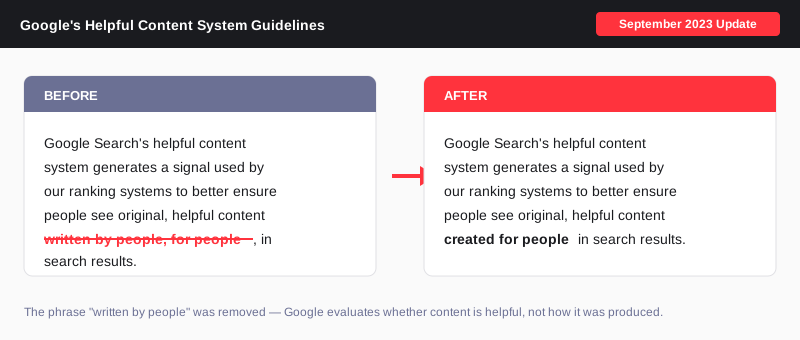
The message is clear: for content to rank well, it must be informative, answer users' queries satisfactorily, and showcase genuine expertise - regardless of how it's created.
AI Content Detectors like GPTZero, ZeroGPT, and many others are not reliable. Even OpenAI has said as much. They consistently produce false positives about human-written content. Conversely, they can be easily fooled with creative prompting or a bit of human editing.
An interesting note from OpenAI: "we found that it labeled human-written text like Shakespeare and the Declaration of Independence as AI-generated."
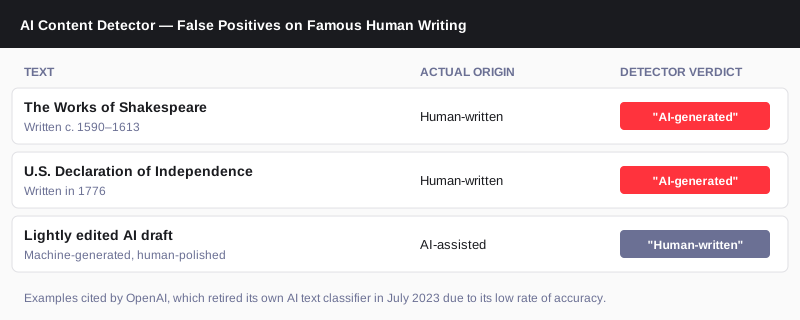
Anecdotal evidence and real-life ranking data suggest that while AI-generated content isn't penalized by search engines, it might only achieve high rankings if it meets the above criteria. The role of AI in content creation is still a developing narrative, and its significance is indispensable for maintaining a competitive edge in the future.
At EmberTribe, the understanding is clear - AI serves as a foundation, not the final product. With ClusterMagic, while AI aids in the initial draft based on expert-driven keyword research, human experts step in for the crucial phases of editing, fact-checking, and final review. This hybrid approach ensures the content is accurate and helpful, has the potential to rank, and truly represents their business.

If you're evaluating marketing partners, you've probably encountered the phrase "boutique marketing agency" more than once. But what does it actually mean — and more importantly, does it mean better results for your business?
For growth-stage brands and DTC companies, the answer is often yes. A boutique marketing agency typically offers something the major holding-company shops struggle to replicate: senior attention, genuine specialization, and the ability to move fast. In 2026, with marketing channels becoming more fragmented and performance accountability tighter than ever, these qualities matter.
This guide breaks down exactly what a boutique agency is, how it stacks up against larger firms, and how to evaluate one before you commit.
A boutique marketing agency is a smaller, independently operated firm that focuses on a defined set of services or industry verticals rather than trying to cover everything. Team sizes typically range from 5 to 30 people, though some go slightly larger while maintaining the same operating model.
What distinguishes a boutique isn't just headcount — it's the working model. At a boutique, the strategists who pitch your business are usually the same people executing your campaigns. There's no bait-and-switch where senior leaders close the deal and then hand you off to a junior team.
Boutique agencies are also sometimes called small marketing agencies, independent marketing agencies, or niche marketing agencies. These terms are largely interchangeable, though "niche" often implies a tighter vertical focus — for example, an agency that works exclusively with B2B SaaS companies or ecommerce brands in a specific category.
A boutique digital marketing agency specifically signals that the firm's core capabilities live in digital channels: paid media, SEO, content, email, social — rather than traditional advertising or PR.
The marketing agency landscape in 2026 sits at two ends of a wide spectrum, and the differences aren't just about team size.
Senior access
At large agencies, senior strategists are typically involved at the proposal stage and then step back. Day-to-day work is handled by account managers and junior staff. At a boutique, senior practitioners are often the people doing the work — reviewing ad creative, writing strategy briefs, reading the data. This distinction has a direct effect on output quality.
Speed and adaptability
Large agencies operate with layered approval chains. When a platform algorithm changes or a campaign isn't performing, getting approval to pivot can take days. Boutiques are built to move faster. Decisions happen in a conversation, not a committee.
Specialization depth
A boutique agency chooses what it's good at and builds around that. If you're a DTC brand evaluating a small agency that runs paid social and email exclusively, you're working with a team that has seen hundreds of campaigns in your category. Contrast that with a generalist agency where your paid social work is handled by someone also managing TV buys and out-of-home campaigns.
Transparency and pricing
Large agency retainers are frequently built around overhead — multiple account managers, project coordinators, enterprise tooling — that small clients don't necessarily benefit from. Boutique agencies typically have leaner cost structures and are more willing to show you what you're paying for. Monthly retainers for boutique digital marketing agencies commonly range from $2,500 to $10,000 for growth-stage brands, depending on scope and media budget.
Capacity constraints
The tradeoff is real: boutique agencies have limited bandwidth. A team of eight cannot execute an integrated global campaign across 20 markets simultaneously. If your needs require massive scale, parallel execution across many channels, or international coordination, a larger firm may be the right operational fit.
Most growth-stage and mid-market brands — particularly DTC brands scaling past their initial traction phase — are better served by a boutique agency than a large one. Here's when that's especially true:
You're past product-market fit but haven't yet built out an internal marketing function. You need expertise you don't have in-house, without paying large-agency overhead. Understanding how to choose between an agency, freelancer, or in-house marketer is a useful starting point before you evaluate agency size.
You're growing fast and need a team that can move with you. If your business is changing month over month — new SKUs, new channels, seasonal spikes — you need a partner that can adapt without a lengthy change-order process.
You want strategic thinking without a 12-month lag. Boutique agencies work in shorter feedback loops. You're not waiting for a quarterly business review to find out your campaigns need a change in direction.
You need someone who actually knows your industry. A niche marketing agency with deep experience in your category will spot opportunities and avoid pitfalls that a generalist firm might miss entirely. This is closely related to what separates good growth marketing channels execution from mediocre: channel expertise compounds over time.
Not all boutique agencies are equal. The following criteria separate the firms worth working with from the ones that are simply small.
Documented process
A credible boutique agency should be able to show you how they work — how they onboard clients, how they build strategy, how they report on performance. Vague answers about "custom approaches" without underlying frameworks are a red flag.
Relevant case studies
Ask for results from brands similar to yours in size, stage, and category. Revenue-stage context matters. A case study from a $500M brand isn't highly predictive of what they'll do for a company doing $5M in annual revenue.
Who actually works on your account
Get this in writing before you sign. Ask specifically which individuals will be assigned to your account, what their backgrounds are, and whether those people could change during your engagement.
Channel depth over breadth
Evaluate whether their depth in the specific channels you care about is real. A boutique agency claiming expertise in every major channel is often a boutique agency that's spread too thin. Focused expertise wins.
Reporting and visibility
You should have clear visibility into performance, spend, and decisions. Ask what your regular reporting cadence looks like, what data you'll have direct access to, and how quickly they respond when something isn't working.
Before committing to a boutique marketing agency, walk through these questions in your evaluation conversations:
That last question is telling. A strong agency will have a clear answer because they've thought seriously about fit. An agency that never fires clients is often one that doesn't have high standards for the work.
EmberTribe is a boutique digital marketing agency built specifically for DTC brands and growth-stage companies. We're small enough that senior strategists work directly on your account, and specialized enough that we've built repeatable frameworks across paid media, ecommerce growth, and performance creative.
We don't work with every company that comes to us. We work with brands where we can drive a measurable outcome, and we're transparent about when we're the right fit and when we're not.
For brands evaluating whether a fractional leadership model makes more sense than a retained agency, our guide on fractional CMO services for B2B SaaS covers when that model outperforms a traditional agency structure. And if you're specifically evaluating marketing agencies for SaaS growth, our breakdown of what to look for in a SaaS marketing agency covers the selection criteria in detail.
The right boutique agency won't promise you everything. They'll tell you what they're great at, show you the evidence, and give you a realistic picture of what results look like and how long they take. If that's the kind of partner you're looking for, we'd like to talk.
If you're shopping for SEO help, you already know the market is flooded with options. Every agency and freelancer claims to offer the best SEO services. But the gap between SEO that builds compounding organic revenue and SEO that burns your budget producing nothing measurable is enormous. This guide is about the services themselves — what the right ones look like, what results to expect, and what to skip entirely.
SEO services are professional activities designed to improve a website's visibility in organic search results. They span technical website health, on-page content optimization, off-page authority building, and ongoing measurement. Done well, SEO services work together as a system — technical foundations enable content to rank, content earns links, links strengthen authority, and analytics inform what to do next.
For growth-stage DTC brands and ecommerce companies, SEO is one of the few channels where the work compounds over time. Paid ads stop the moment you stop spending. A well-executed SEO program keeps generating traffic and revenue years after the initial investment.
A technical SEO audit evaluates everything search engines need to crawl and index your site correctly. This includes crawlability, Core Web Vitals, site architecture, URL structure, canonical tags, structured data, JavaScript rendering, mobile responsiveness, and internal linking.
The audit itself is only half the value. The other half is remediation — actually fixing the issues uncovered, prioritized by impact. Agencies that deliver a 60-page report and walk away are selling you a document, not a service. Top-tier technical SEO services include a prioritized remediation roadmap and ongoing monitoring.
For ecommerce sites specifically, technical SEO often surfaces duplicate content from faceted navigation, pagination problems, and orphaned product pages — issues that silently suppress rankings across your entire catalog.
Effective SEO services don't just find keywords — they build topical authority. That means mapping keywords to buying intent, identifying content gaps versus competitors, and sequencing production so that pillar pages and supporting content reinforce each other.
Generic agencies produce surface-level blog posts without a coherent strategy behind them. What separates professional SEO services is a framework that ties every piece of content to a specific keyword cluster, a funnel stage, and a measurable traffic goal.
For DTC brands, this also means aligning keyword strategy with customer acquisition economics — targeting searches that attract buyers, not just browsers.
On-page optimization covers title tags, meta descriptions, header hierarchy, image alt text, internal linking, schema markup, and content structure. For most sites, a thorough on-page audit of existing pages produces faster wins than publishing new content, because you're improving pages that already have some authority.
This service extends to content quality improvements: updating outdated information, improving topical depth, and restructuring pages that have high impressions but low click-through rates. Search engine positioning depends heavily on whether your pages fully satisfy the intent behind the query, not just whether they contain the target keyword.
Backlinks remain one of the strongest ranking signals in 2026. Link building services acquire editorial links from relevant, authoritative domains — through content partnerships, digital PR campaigns, resource page outreach, and broken link building.
What distinguishes quality link building from low-grade services is link relevance and editorial context. A single contextual link from a respected industry publication outperforms dozens of directory listings or low-authority guest posts.
For growth-stage brands, link building should be tied to competitive gap analysis: which domains link to your top competitors but not to you, and what content would earn those links.
For brands with physical locations or local service areas, local SEO is its own discipline. This includes Google Business Profile optimization, local citation building, review management, and geo-targeted content.
Local SEO delivers measurable results quickly — Google Business Profile improvements can lift local pack visibility within weeks. For multi-location brands, this service scales into a systematic process for each location.
Measurement is not an afterthought — it is a core SEO service. Professional SEO services include tracking rank positions, organic traffic by landing page, click-through rates from Google Search Console, conversion data tied to organic sessions, and share-of-voice versus competitors.
The best reporting connects SEO activity directly to business outcomes: revenue influenced by organic, leads generated, and pipeline contribution. If your reporting only shows keyword positions and monthly traffic, you are missing the data needed to make good decisions.
Realistic timelines matter. Here is what to expect:
Technical SEO improvements — site speed gains, crawl error fixes, canonical corrections — show results in weeks. Google reindexes frequently, and structural improvements are often reflected in Search Console data within a few weeks of deployment.
Content strategy and on-page optimization take longer: typically 3 to 6 months before new or improved pages rank competitively. Search engines need time to crawl, index, and evaluate content against competing pages.
Link building is the longest-cycle service. Building a meaningful backlink profile takes consistent effort over 6 to 12 months. Agencies promising first-page rankings from link building within 30 days are either targeting low-competition terms or using tactics that create long-term risk.
Local SEO sits between these timelines. Google Business Profile optimizations can produce visible local pack improvements within 4 to 8 weeks.
Not everything sold as an SEO service moves the needle.
Guaranteed rankings are a red flag, not a selling point. No one can guarantee rankings on competitive terms. Agencies making this promise are either targeting negligible keywords or using black-hat tactics that work briefly and then trigger penalties.
Bulk directory submissions were relevant in 2012. Today they contribute minimal authority and can create citation inconsistency problems that hurt local SEO.
Thin content packages — producing 10 or 20 blog posts per month with no strategic framework — produce traffic noise rather than qualified organic sessions. Volume without strategy is one of the most common ways companies waste SEO budgets.
PBN link building (private blog networks) is a high-risk tactic that violates Google's guidelines. The short-term gains are real; so are the manual penalties that erase them.
Results from professional SEO services should be visible in several places simultaneously. Organic traffic growth in Google Analytics is the most obvious signal, but it is not the only one.
Watch Google Search Console for improvements in total impressions, average position for target queries, and click-through rates. A well-optimized page should improve in all three metrics over 3 to 6 months.
Monitor your rankings for primary keywords monthly, but resist over-indexing on daily ranking fluctuations. Positions vary by data center, user location, and personalization signals. Trends over 30 to 60 days are more meaningful than daily snapshots.
The clearest signal that SEO services are working is organic-attributed revenue. If you have conversion tracking configured properly, you should see organic sessions converting at rates comparable to other high-intent channels. Our post on building brand trust with SEO covers how organic visibility compounds into brand authority over time.
If organic traffic is climbing but revenue is flat, the issue is usually misaligned keyword targeting — traffic from informational queries that do not convert rather than commercial-intent searches that do.
For a deeper look at how ecommerce sites should structure their SEO programs, see our complete ecommerce SEO guide, which covers site architecture, product page optimization, and category page strategy in detail.
EmberTribe works with DTC brands and growth-stage companies that are serious about building organic revenue as a durable growth channel. Our SEO services are built around the same framework described in this guide: technical foundation, content strategy tied to buying intent, on-page optimization for existing pages, link building through legitimate outreach, and reporting that connects organic traffic to actual revenue.
We do not offer volume-based content packages or generic link outreach. Every engagement starts with a technical audit and a content strategy built around your competitive landscape and customer acquisition goals.
If you are evaluating what professional SEO services should look like for a brand at your stage, our SEO agency guide walks through how to assess any provider against the criteria that actually predict performance.
Ready to see what a real SEO program looks like for your brand? Talk to EmberTribe.

Finding the best SEO company is harder than it should be. The market is crowded with agencies making similar promises, and the gap between a firm that builds lasting organic growth and one that burns your budget on vanity metrics is enormous. For DTC brands and growth-stage companies, choosing the wrong SEO partner costs more than just money — it costs time and competitive ground you may not recover.
This guide cuts through the noise. We'll walk through exactly what separates a top SEO company from a mediocre one in 2026, what warning signs to look for, what real SEO costs look like, and the questions that reveal whether an agency actually knows what they're doing.
The best SEO companies share a set of characteristics that distinguish them from agencies that chase shortcuts or sell the same templated approach to every client.
At the core, elite agencies focus on outcomes tied to your business — not just rankings. A position-1 keyword that drives zero conversions is not a win. A firm worth hiring understands your funnel, your customers' search intent, and how organic traffic needs to connect to revenue.
They also operate with full transparency. That means clear reporting on what's being done, why, and what's moving. If an agency can't explain its strategy in plain language, that's a signal.
Finally, the best agencies invest in the full SEO stack: technical health, content authority, and link equity. A firm that excels at content but ignores Core Web Vitals is leaving rankings on the table. One that focuses only on link building without a content strategy is building on sand.
Use these six lenses when assessing any agency — including the ones your peers recommend.
1. White-hat methodology
Ask directly: how do they build links? How do they handle content at scale? The right answer involves editorial outreach, digital PR, genuine content partnerships, and original research — not link farms, private blog networks, or AI content dumped without human review. Agencies that rely on black-hat tactics can produce fast early results that collapse (or worse, trigger a Google penalty) within months.
2. Technical SEO depth
Any competent SEO company should be running regular technical audits: crawlability, indexation issues, page speed, Core Web Vitals, structured data, and internal linking architecture. In 2026, technical capability also extends to AI readability — ensuring your content is structured in ways that generative search tools can parse and cite. Ask for a sample audit or a technical walkthrough of a past client's site.
3. Content quality and E-E-A-T
Google's E-E-A-T framework — Experience, Expertise, Authoritativeness, Trustworthiness — continues to define how content ranks. The best agencies build content with genuine subject matter input, not just keyword optimization. Ask to see examples of content they've produced and assess whether it actually serves the reader or simply hits a word count.
4. Link building approach
Not all backlinks are equal. A link from a high-traffic, editorially relevant publication carries significantly more weight than a link from a directory or paid placement that any site can buy. Ask about their link acquisition methodology: Are outreach emails personalized? Are placements contextual? Do they vet the sites they target? Volume means nothing if the links lack authority.
5. Reporting and attribution
Good SEO reporting ties organic traffic to business outcomes. Look for agencies that track keyword movement, traffic by intent, and conversion contribution — not just rank position. Access to your own data (Google Search Console, Analytics) should always be yours to keep, regardless of the agency relationship.
6. Track record and references
Case studies and testimonials are a starting point, but references you can actually call are more valuable. Ask for clients in a similar industry or company stage. Ask specifically about results at 6 months and 12 months — not just what the agency claims in a slide deck.
For a deeper look at how these criteria apply specifically to SaaS businesses, see our guide to choosing a SaaS SEO agency.
The warning signs below appear consistently in agencies that underdeliver. Treat any one of them as a reason to ask harder questions. Multiple flags together should end the conversation.
Guaranteed rankings. No legitimate SEO professional guarantees a #1 ranking — and Google itself has said this explicitly. Any agency promising specific positions within a defined timeframe is either misleading you or planning to use manipulative tactics that put your domain at risk. Algorithmic and manual penalties from Google can take 6 to 24 months to recover from, and sometimes can't be fully undone.
Vague strategy. If an agency can't describe what they'll actually do in the first 90 days — in specific terms — that's a problem. Phrases like "improve your online presence" or "boost your rankings" without substance signal that they don't have a real plan.
AI content at scale, without editorial oversight. Churning out 100 AI-generated blog posts a month with no human editing or subject matter input is a formula for content that neither Google nor your readers will trust. Ask about their editorial process.
No access to your own data. Agencies that keep you walled off from your Analytics and Search Console accounts are hiding something. You should always have direct access to your own platforms.
Lock-in contracts with no performance milestones. Long contracts without built-in check-ins or performance expectations protect the agency, not you. A confident firm will structure accountability into the engagement.
Suspiciously low pricing. SEO that costs $200 a month is not a bargain — it's a signal that what's being delivered either isn't real or relies on tactics that will backfire.
Pricing varies by scope, market competitiveness, and agency tier. Here's what the 2026 market actually looks like:
Monthly retainers for professional SEO typically run $1,500 to $5,000 for mid-market businesses and $7,500 to $20,000+ for competitive industries or enterprise-scale sites. The average monthly engagement across agencies is approximately $3,200.
Hourly consulting rates fall in the $100 to $300 range, with senior strategists at specialist agencies typically at the higher end.
Project-based work — a technical audit, a content strategy engagement, or a site migration — generally runs $5,000 to $30,000 depending on scope.
What should concern you isn't spending $4,000 a month; it's spending $4,000 a month without clarity on where it goes. One industry study found that only 25% of the average US SEO retainer goes toward core SEO work. Ask for a breakdown of how your budget is allocated — and hold the agency to it.
These questions surface the information that agency presentations tend to obscure.
An agency that hesitates on these questions or deflects with generalities is telling you something important.
If you're scaling an ecommerce business, the considerations are similar but the technical complexity increases. Our ecommerce SEO guide covers the full framework in detail.
EmberTribe works with DTC brands and growth-stage companies that need SEO to function as a real revenue channel — not a line item that produces quarterly reports and little else.
Our approach starts with strategy: understanding your commercial keywords, your competitors' gaps, and where organic search can drive qualified traffic that converts. From there, we build on three pillars: technical foundations that search engines can crawl and AI tools can parse, content built around E-E-A-T principles with genuine editorial oversight, and link acquisition through actual editorial placements — not bought links or link farms.
Every engagement includes transparent reporting tied to business outcomes, full client access to all data, and a team that can explain every decision in plain language.
The best SEO company for your business is one that behaves like a growth partner. If you're evaluating agencies and want to understand what a results-oriented SEO engagement actually looks like, let's talk.
SEO done right compounds over time. The firms worth hiring know this — and they'll prove it with transparency, methodology, and a track record that holds up under scrutiny. The ones to avoid will promise rankings and deliver excuses. The criteria above give you the framework to tell the difference before you sign.

Finding the best PPC agency is harder than it looks. The market is crowded with agencies that promise top ROAS, certified experts, and transparent reporting — but deliver dashboards full of vanity metrics and campaigns that burn budget without moving revenue. Whether you're searching for a top pay per click agency to scale a DTC brand or a best Google Ads agency to fix a broken account, the framework for choosing well is the same: skip the pitch decks and evaluate on the things that actually predict outcomes.
This guide breaks down exactly what separates the best PPC agencies from average ones — including the six criteria to use, the questions to ask, and the warning signs that tell you to walk away.
The best PPC agencies share a common orientation: they treat your ad spend as capital to be deployed for maximum return, not a budget to be spent. That sounds obvious, but it's not how most agencies operate. Most agencies optimize for keeping accounts active and hitting platform-level benchmarks. The best agencies optimize for your business outcomes — customer acquisition cost, revenue per visitor, contribution margin.
Practically, that difference shows up in a few specific ways. The best agencies build campaign structures that match your funnel, not Google's or Meta's recommended defaults. They test creative and copy systematically rather than running one set of ads until performance decays. They report on metrics that connect to your P&L — not impressions, not CTR, not "quality score improvements."
They also earn the relationship by showing their work. When a campaign underperforms, they explain why and what they changed. When performance improves, they document what drove it so the insight compounds over time.
Use these six criteria when you're comparing agencies. Each one is designed to surface how the agency actually operates — not how they present.
1. Platform certifications and active expertise
Google Partner and Google Premier Partner status matters, but it's a floor, not a ceiling. Confirm the agency holds current certifications in every platform you need — Google Ads, Microsoft Advertising, and any paid social channels relevant to your business. More importantly, verify that the people managing your account are the ones with the credentials, not just a senior team member who earned them.
2. Case studies with business-level outcomes
Any agency can show you a ROAS chart. The best agencies can show you what happened downstream — how paid traffic converted into customers, what the payback period looked like, how CAC trended over a six-month engagement. Ask for case studies from accounts that resemble yours in business model and spend level. If they can't produce them, that's signal.
3. Campaign structure and account architecture
Strong PPC agencies come into a discovery call with a point of view on how your account should be structured. They ask about your funnel, your margins, your average order value, your best customer profile. Agencies that skip this and jump straight to ad formats or platform features are optimizing for platform metrics rather than your business.
4. Reporting transparency
You should have real-time access to your account data — not just a monthly PDF summary. The best agencies give clients live dashboard access and use that data as the basis for their reporting conversations, not as something to narrate over. Ask specifically: who owns the accounts, what data can I access independently, and what happens to the account data if we part ways?
5. Communication cadence and responsiveness
PPC moves fast. Campaigns that need to be paused, budgets that need to shift during a sale window, creative that needs to be swapped after a product change — all of these require an agency that responds in hours, not days. Ask about average response time for urgent requests and who your named point of contact will be.
6. Alignment on success metrics
Before any engagement starts, you and the agency should agree on what success looks like — and it should not be measured in clicks or impressions. Define target ROAS, target CAC, or target CPA before the first invoice. If an agency resists defining these upfront, they're protecting their ability to declare success on their own terms later.
These questions are designed to cut through polished sales presentations and reveal how an agency actually works. Pay as much attention to how they answer as to what they say.
Who will actually manage my account day to day? Agencies often sell on the strength of senior leadership and deliver accounts to junior associates. Know exactly who is hands-on-keyboard for your campaigns.
Can I see a sample reporting dashboard from a current client? Redacted is fine. This shows you what you'll actually receive, not what they promise.
How do you handle underperforming campaigns? Listen for specificity: do they describe a structured testing process, or do they say they "optimize continuously"? The former suggests a methodology; the latter is a hedge.
What is your process for new account onboarding? The best agencies spend the first two to four weeks in deep audit mode — understanding your historical data, your funnel, and your competitive landscape — before changing anything.
What happens if we part ways? Make sure you own the ad accounts, the creative assets, the historical data, and the audiences. No exceptions.
What does your contract commit to, and what does it not? Some agencies commit to activity (campaigns launched, ads tested) rather than outcomes. Understand what you're paying for before you sign.
PPC agency pricing in 2026 falls into three primary models, each with different tradeoffs.
Percentage of ad spend is the most common model. Agencies typically charge 10% to 20% of total monthly ad spend, with rates decreasing at higher spend levels. This model aligns the agency's revenue with your investment but can create incentives to grow spend rather than improve efficiency.
Flat monthly retainers range from $1,500 to $10,000 per month depending on scope, account complexity, and the number of platforms managed. This model is predictable and creates clearer incentives around performance rather than spend volume.
Hybrid models combine a base retainer with a smaller percentage-of-spend component — for example, $2,000 per month plus 5% of ad spend above $20,000. These are increasingly common at mid-market and above.
Setup fees for new account builds or major restructures typically run $2,500 to $10,000 depending on complexity. This is legitimate — a proper account architecture takes real work — but should come with a clear deliverable: a documented campaign structure, audience strategy, and conversion tracking setup.
For context, industry data suggests that brands spending $10,000 to $50,000 per month on ad spend should expect to pay $1,500 to $5,000 per month in management fees. Brands spending above $50,000 often negotiate lower percentage rates in exchange for volume.
What you should not pay for: opaque "platform fees," unexplained third-party tool subscriptions, or any arrangement where you don't own the ad accounts outright.
For a broader look at how paid channels fit into a full-funnel strategy, PPC Management for Ecommerce: Finding the Right Agency covers the ecommerce-specific version of this evaluation in depth.
These are not edge cases — they are common patterns that surface regularly in agency relationships that go wrong.
They focus on traffic, not revenue. If the agency leads every conversation with impressions, clicks, and CTR — and struggles to connect those metrics to your actual sales data — you are paying for activity, not outcomes.
You don't own your accounts. Some agencies create ad accounts under their own management and retain ownership when a client leaves. This is a major red flag. You should own every account, every pixel, every audience, every conversion event.
Reporting is always delayed. If you have to ask for performance data and it takes days to receive it, the agency either doesn't have a live reporting infrastructure or is managing too many accounts to give yours proper attention.
They can't explain what changed. When results shift — better or worse — the agency should be able to tell you exactly what variable moved and why. Vague explanations like "we made some optimizations" indicate either a lack of methodology or a lack of transparency.
They recommend increasing spend as the first solution to every problem. More budget accelerates a working system. It does not fix a broken one.
Your point of contact changes constantly. High account manager turnover is a sign of organizational problems that will eventually affect your campaigns.
If you're also evaluating paid social alongside paid search, Best Paid Social Agency for Ecommerce: Finding the Right Fit applies the same rigorous framework to the Meta and TikTok side of paid media.
EmberTribe works with DTC brands and growth-stage companies that have outgrown the generic-agency model. Our clients are not looking for an agency that launches campaigns and reports on them — they are looking for a growth partner that connects every paid dollar to a business outcome.
What that looks like in practice: we build account structures around your customer acquisition economics, not around platform defaults. We run structured creative testing that generates compounding learnings, not one-off experiments. We report on contribution margin and CAC alongside platform metrics, so you always know whether paid is working for the business, not just for the dashboard.
We also believe in full transparency: you own every account, every audience, every pixel, and every dollar of historical data — always.
If you're evaluating growth marketing partners more broadly, How to Choose the Best Ecommerce Marketing Agency (2026) walks through the full agency selection framework for DTC brands.
The difference between an average PPC agency and the best one is not the size of their team or the length of their client list — it's whether they operate as a true growth partner or as a vendor managing a budget.
If you're ready to work with an agency that measures success the same way you do, talk to EmberTribe. We'll audit your current account, show you exactly where budget is leaking, and outline a strategy built around your specific growth targets — before you commit to anything.

Every growth-stage brand eventually faces the same inflection point: internal marketing has hit its ceiling, and the path forward requires outside expertise. The search for the best digital marketing agency seems straightforward until you're fielding proposals that all look roughly the same — big promises, vague deliverables, and case studies that raise more questions than they answer.
This guide cuts through that noise. We'll cover what actually separates top digital marketing agencies from the ones that burn budget and disappear, the services that move the needle, the questions that reveal an agency's real capabilities, and how to measure whether you're getting a return on your investment.
The best digital marketing agencies share a specific set of operating principles that distinguish them from vendors who are simply filling capacity.
Data before strategy. Top agencies build campaigns around analytics, not assumptions. Before recommending a channel mix, they want to understand your current attribution model, your customer acquisition cost, and where you're losing customers in the funnel. If an agency pitches a channel before asking about your data, that's a signal about how they operate.
Accountability over activity. There's a meaningful difference between an agency that reports on impressions and one that reports on revenue. The best agencies connect every marketing activity to a business outcome — whether that's new customer revenue, qualified pipeline, or repeat purchase rate. They use tools like GA4 event tracking, CRM integrations, and multi-touch attribution to show you exactly which channels are pulling weight.
Specialization at scale. Generalist agencies spread attention thin. The strongest firms have deep expertise in specific channels or verticals, which means their recommendations are refined through concentrated experience rather than borrowed playbooks. When a full service digital marketing agency claims to be excellent at everything, it's worth probing how deep that expertise actually runs.
Transparent communication. The best agencies set clear expectations before onboarding, maintain consistent reporting cadences, and flag issues before they become crises. If an agency is vague about who will handle your account day-to-day, or can't tell you the exact team members assigned to your work, that's worth noting.
Not every brand needs the same marketing mix. But the strongest full service digital marketing agencies offer a coherent set of capabilities that work together rather than in silos.
SEO. Organic search remains one of the highest-ROI channels for brands with long purchase cycles. Look for agencies that can demonstrate technical SEO capability (site architecture, Core Web Vitals, schema markup) alongside content strategy. An agency that only offers keyword lists isn't doing SEO — they're doing keyword research.
Paid media. This includes Google Ads, Meta, TikTok, and programmatic. The best paid media teams understand bidding strategy, audience architecture, and creative testing as interconnected systems — not separate functions. They also know when a channel isn't working and aren't afraid to say so.
Content marketing. Content is the connective tissue between SEO and conversion. Strong agencies build content that serves multiple functions: it ranks, it educates, and it moves prospects through the funnel. Ask to see examples of content that drove measurable pipeline, not just traffic.
Email and lifecycle marketing. For DTC and ecommerce brands especially, email and SMS are where revenue compounds. Top agencies treat lifecycle marketing as a revenue channel with measurable impact, not a "nice to have" that gets attention after the paid channels are managed.
Conversion rate optimization (CRO). Driving traffic is only half the equation. CRO — systematic testing of landing pages, checkout flows, and on-site messaging — ensures that traffic converts. Agencies that offer CRO alongside acquisition channels tend to produce better economics for their clients over time.
Some agency behaviors are reliable indicators of poor partnership ahead.
Guaranteed rankings or guaranteed leads. No legitimate agency guarantees #1 Google rankings or a specific lead volume. Digital marketing involves variables — competitors, algorithm shifts, market conditions — that no agency controls. Guarantees are either naive or dishonest.
Vanity metrics as the primary KPI. If an agency's reporting centers on impressions, followers, and reach without connecting those metrics to revenue, they're optimizing for the appearance of activity. Real growth partners talk in terms of CAC, LTV, and conversion rate.
Opaque data ownership. You should own your ad accounts, your analytics properties, and your CRM data — always. Agencies that maintain ownership of your accounts are creating leverage over you. Request clarity on data ownership before signing anything.
Vague team structure. You deserve to know who is actually working on your account. If a pitch involves senior talent but the day-to-day work will be handled by junior staff you've never met, that's a mismatch worth addressing upfront. The question of agency versus freelancer versus in-house marketer often comes down to exactly this kind of accountability.
Cookie-cutter proposals. A strong agency will ask substantive questions before submitting a proposal. If the strategy deck they send looks like it could apply to any brand in any category, it probably does.
These questions are designed to surface real information, not rehearsed responses.
"How do you measure ROI, and how will I see it?" A strong answer includes specific tools (GA4, CRM integration, attribution modeling), reporting frequency, and a clear description of what success looks like at 30, 90, and 180 days.
"Who specifically will work on our account, and what are their backgrounds?" Ask for LinkedIn profiles. Ask for the account manager's client load. An overextended account manager is a structural problem, not a personal one.
"Can you share a case study where a campaign underperformed, and how you handled it?" This question is more revealing than any success story. How an agency handles failure tells you everything about how they'll communicate when things aren't working.
"What's excluded from the retainer?" Setup fees, creative production, platform fees, and reporting tools can add substantial cost above the quoted retainer. Get the full picture before signing.
"What does the first 90 days look like?" The onboarding period is where agency-client relationships succeed or fail. A structured plan for the first 90 days — including audit, strategy development, and initial campaign activation — is a sign of operational maturity.
ROI measurement in digital marketing requires connecting channel-level data to business-level outcomes. Here's a practical framework.
Establish baseline metrics before launch. Before an agency makes changes, document your current CAC by channel, your average LTV, your conversion rate by landing page, and your revenue by acquisition source. This baseline makes attribution credible.
Agree on primary KPIs in writing. The KPIs in your contract should map directly to revenue impact — not channel-specific vanity metrics. Common options include new customer revenue, pipeline generated, cost per qualified lead, and return on ad spend (ROAS).
Build shared reporting infrastructure. Top agencies will configure shared dashboards in tools like Looker Studio, HubSpot, or Triple Whale, giving you direct access to real-time data. If you have to request access to your own data, that's a red flag.
Evaluate quarterly, not monthly. Campaigns often need 60–90 days to exit the learning phase and optimize effectively. Monthly evaluation is appropriate for identifying problems, but quarterly evaluation is more useful for strategic decisions.
Track incrementality, not just attribution. Last-click attribution consistently undervalues top-of-funnel channels and overvalues bottom-of-funnel ones. The best agencies run incrementality tests — turning channels on and off in controlled ways — to measure actual contribution rather than modeled attribution.
The brands that work best with EmberTribe share a specific profile: they've moved past the early validation stage, they have a product that converts when it reaches the right audience, and they need a partner who can build the growth infrastructure — paid acquisition, SEO, content, and conversion optimization — without the overhead of a large agency that doesn't know their business.
EmberTribe operates as a full service digital marketing agency built specifically for DTC brands and growth-stage companies. Our approach is rooted in frameworks that connect channel activity to revenue outcomes, not impressions. We build the dashboards, run the tests, and make the recommendations that move a brand from plateau to compounding growth.
If you're evaluating top digital marketing agencies and want to understand what working with a performance-focused partner actually looks like, we'd like to show you what we've built for brands like yours.
For brands considering whether an agency is the right move at all, our breakdown of when to hire a fractional CMO versus a full-service agency is a good starting point.
Ready to find out if EmberTribe is the right fit for your growth stage? Book a strategy call and we'll walk through your current acquisition model and where we see the highest-leverage opportunities.

Selling on Amazon has never been more competitive. Organic ranking alone is not enough — brands that win on the platform pair strong listings with a disciplined advertising strategy managed by people who live and breathe Amazon data. Hiring the right Amazon PPC agency can be the difference between a profitable channel and a cash drain. This guide breaks down what these agencies actually do, how they price their services, and how to evaluate them before you sign a contract.
An Amazon PPC agency manages your paid advertising campaigns inside the Amazon Ads platform. Their core job is to make sure your products appear in front of shoppers who are ready to buy, at a cost that preserves your margins.
In practice, that means building out campaign structures across ad types, conducting ongoing keyword research, optimizing bids daily or weekly, writing ad copy, and producing performance reports. The best agencies go further — they tie advertising performance back to organic rank, monitor competitor activity, and adjust strategy based on seasonality and inventory levels.
What separates a strong agency from a mediocre one is how they handle the relationship between paid spend and organic velocity. Amazon's algorithm rewards products that sell frequently. Smart advertising accelerates sales rank, which compounds into lower long-term advertising costs. Agencies that understand this flywheel build campaigns very differently than those who simply optimize for immediate ROAS.
If you're also running paid channels outside Amazon, it's worth reading how ecommerce PPC management agencies approach multi-channel strategy — many of the evaluation principles overlap.
A capable Amazon advertising agency should be proficient across all major ad types. Here is what each one does and why it matters:
Sponsored Products are the foundation of any Amazon ad program. They appear in search results and on product detail pages, target shoppers at the bottom of the funnel, and typically drive the highest conversion rates. If an agency ignores Sponsored Products or runs them without tight keyword segmentation, that is a problem.
Sponsored Brands appear at the top of search results and feature your brand logo, a custom headline, and multiple products. They are particularly valuable for brand building and capturing share-of-voice in competitive categories. Well-run Sponsored Brands campaigns can lift Sponsored Products performance by raising brand recognition earlier in the shopping journey.
Sponsored Display lets you reach shoppers on and off Amazon — across Amazon-owned properties and third-party websites. Audience targeting options include product views, purchase history, and lifestyle segments. Sponsored Display is especially useful for retargeting shoppers who visited your listing but did not convert.
Amazon DSP (Demand-Side Platform) is programmatic display advertising that reaches audiences across the web, not just on Amazon. DSP gives agencies access to Amazon's first-party shopper data, which is among the most valuable in digital advertising. A full-funnel Amazon strategy uses DSP to build awareness earlier in the journey, then converts through Sponsored Products at the bottom. DSP typically requires a minimum monthly commitment and is better suited for brands spending at scale.
Understanding how agencies measure performance on Amazon is essential to evaluating whether yours is actually doing their job.
ACOS (Advertising Cost of Sale) is the percentage of ad-attributed revenue that you spend on advertising. An ACOS of 25% means you spent $25 for every $100 in sales driven by ads. Good ACOS benchmarks vary by category and margin structure, but most agencies target 20–35% for mature campaigns. Product launch campaigns may run 30–50% intentionally, to accelerate velocity and build rank.
TACOS (Total Advertising Cost of Sale) is where things get more interesting. Unlike ACOS, which only counts ad-attributed sales, TACOS measures your ad spend against total revenue — including organic sales. When TACOS trends down while ad spend holds steady, it signals that advertising is building organic momentum. A brand with a 30% ACOS but a 10% TACOS is in a strong position: advertising is paying for itself and driving organic growth on top of it.
ROAS (Return on Ad Spend) is the inverse of ACOS and more familiar to brands running Google or Meta ads. A 4x ROAS means you generated $4 in ad-attributed revenue for every $1 spent. While ROAS is a useful benchmark, experienced Amazon agencies lean on ACOS and TACOS because they reflect Amazon's ecosystem more accurately.
Average CPCs on Amazon have climbed to roughly $1.12 as of early 2026, up more than 15% year over year. Category competitiveness varies widely — high-demand niches like supplements and electronics run significantly higher. A good agency will benchmark your CPCs against category averages and adjust bidding strategy accordingly.
Agency pricing on Amazon follows a few common models, each with trade-offs:
Percentage of ad spend is the most common model. Agencies typically charge 15–25% of your monthly ad spend. At $30,000/month in ad spend, that means $4,500–$7,500 in management fees. The risk with this model is misaligned incentives — an agency that profits from spend volume has less motivation to improve efficiency.
Flat monthly retainer is a fixed fee regardless of spend, usually ranging from $3,000 to $15,000/month depending on account complexity. This model creates better alignment because the agency's revenue does not increase by growing your budget. For brands planning to scale aggressively, flat fees also become more cost-effective over time.
Hybrid models combine a base retainer with a smaller percentage of spend or performance bonuses. A common structure is a flat monthly fee plus 3–5% of ad-attributed revenue above a baseline. This ties agency compensation to results rather than budget size.
For most brands spending under $200,000/month, agency management delivers better ROI than building an in-house team. The math shifts at higher spend levels, where in-house specialists plus agency strategy support becomes more cost-effective.
The right Amazon advertising agency for your brand will have demonstrated expertise, clean reporting, and a point of view on strategy — not just execution.
When evaluating agencies, look for these indicators:
Category experience matters more than general credentials. An agency that has managed Amazon ads in your product vertical understands competitive dynamics, seasonal patterns, and listing optimization nuances that a generalist will miss.
Ask for a sample reporting dashboard. Strong agencies report on ACOS, TACOS, ROAS, conversion rate, click-through rate, and organic rank movement — not just spend and impressions. If a prospective agency cannot show you how they report on organic impact from paid campaigns, they likely are not measuring it.
Understand their campaign architecture philosophy. The best agencies run tightly segmented campaigns — separating exact match, phrase match, and broad match keywords into distinct campaigns with separate bid strategies. This level of structure allows for precise optimization. Blended match types in a single campaign is a sign of shortcuts.
Look for a clear onboarding and audit process. A credible agency will audit your existing account before proposing changes. They should be able to identify specific inefficiencies — wasted spend, duplicate keywords, missing negative keyword lists — within the first 30 days.
Evaluate communication cadence. Monthly reporting is the bare minimum. Agencies that proactively flag issues, share competitive intelligence, and connect strategy to business goals are worth paying more for. This also applies to how you evaluate any ecommerce marketing agency — responsiveness and transparency are non-negotiables.
Not every agency that claims Amazon expertise delivers it. Watch for these warning signs:
Guaranteed results. No credible agency can guarantee specific ACOS targets or sales numbers. Amazon's auction is dynamic and influenced by factors outside any agency's control. Guarantees are a sales tactic, not a service promise.
No access to your own ad account. You should always own your Amazon Ads account. Any agency that insists on running campaigns through their own account — where you cannot see data or switch providers without losing history — is structuring the relationship to benefit themselves, not you.
Vanity metrics reporting. If an agency leads with impressions and clicks without connecting them to revenue, margin, and organic rank, they may not have a meaningful grasp on what drives profitable Amazon growth.
Low retainers with vague scope. Amazon PPC management requires consistent time investment. Agencies charging unusually low fees for full account management are almost certainly spreading resources thin across too many clients or cutting corners on optimization frequency.
No mention of negative keywords. Negative keyword management is one of the highest-leverage activities in Amazon advertising. It prevents wasted spend on irrelevant queries. An agency that does not proactively discuss negatives has gaps in their process.
Understanding these red flags applies beyond Amazon — if you're running paid campaigns across channels, ecommerce growth strategy decisions like channel mix and budget allocation matter just as much as execution quality.
Choosing the right Amazon PPC agency is not just a vendor decision — it is a strategic one that affects your margins, your organic rank, and your long-term position in an increasingly expensive marketplace.
EmberTribe works with DTC brands and growth-stage companies to build advertising programs that are accountable to real business outcomes. If you're evaluating Amazon advertising management or want a second opinion on your current account performance, we'd welcome the conversation.
Explore EmberTribe's paid advertising services or get in touch to talk through your Amazon strategy.

Most brands launch their first advertising ad campaign with the wrong starting point. They pick a platform, set a budget, and start designing creative — when the real work should happen before any of that. The difference between a campaign that generates consistent returns and one that drains budget quietly comes down to structure. This guide breaks down every layer of that structure so you can build ad campaigns that actually perform.
High-converting ad campaigns share a common architecture: a clearly defined objective that shapes every downstream decision, an audience that matches the message, creative that stops the scroll and earns the click, a budget strategy that funds growth without wasting spend, and measurement that closes the feedback loop.
Remove any one of these elements and performance degrades. A great creative served to the wrong audience converts poorly. A strong audience signal with weak creative loses to competitors. Budget misalignment starves campaigns during the learning phase, before the algorithm has enough data to optimize.
In 2026, all major platforms — Google, Meta, and TikTok — have shifted toward AI-driven automation. That means your job as a marketer has changed. You are no longer manually adjusting bids and micromanaging placements. You are feeding the algorithm the right inputs: clean conversion data, focused objectives, and strong creative assets. The brands winning on paid media right now understand this shift and structure their campaigns accordingly.
Your objective is the foundation of every other decision. Platforms surface different features, bidding options, and optimization signals depending on the goal you select — and selecting the wrong one is one of the fastest ways to burn budget without results.
Be specific about what success looks like before you open the campaign builder. Are you driving purchases, generating leads, building email lists, or growing brand awareness? Each objective requires a different structure and a different measurement approach.
A few ground rules:
Audience quality directly determines how efficiently your budget converts. The right message served to the wrong audience is invisible.
On Google, audience targeting has shifted with AI Max campaigns, which use Gemini to match landing page content with user intent signals rather than relying on keyword lists alone. This gives you broader reach but requires tighter creative and landing page alignment.
On Meta, the current best practice is to consolidate. Combine cold and warm audiences into a single campaign and let Meta's algorithm determine who sees which message based on where they are in the purchase journey. The "Power of One" structure — one campaign and one ad set per offer — gives the algorithm the freedom it needs to find your lowest-cost conversions without competing against itself.
On TikTok, audience targeting is less granular by design. The platform's algorithm surfaces content based on behavioral signals rather than declared interests. This means your creative is your targeting — content that resonates with your ideal customer will find them organically through the feed.
For DTC brands, layer in first-party data wherever possible. CRM uploads and customer match lists sharpen audience signals significantly, particularly on Meta and Google.
Creative is now the single highest-leverage variable in paid advertising. With platform algorithms handling bidding and placement, creative differentiation is where campaigns are won or lost.
What works in 2026:
Authenticity over polish. User-generated content and lo-fi, creator-led video consistently outperform studio-produced ads across all major platforms. This is especially pronounced on TikTok, where content that looks too corporate flatlines regardless of the audience or budget behind it.
Platform-native formats. Each platform has an aesthetic that users expect. Reels-style vertical video on Meta. Fast-paced, hook-first content on TikTok. Product-forward imagery and clear calls to action for Google shopping. Creative that ignores platform context underperforms, even if the concept is strong.
The hook is everything. On social platforms, you have roughly two seconds to stop someone from scrolling. Lead with the most compelling element of your offer — a dramatic result, a bold claim, an unexpected visual — before you explain anything.
For a deeper look at how platform-specific creative strategy applies to paid social in particular, see our guide on finding the right paid social agency for ecommerce — it covers what strong performance-focused creative operations actually look like in practice.
Underfunding a campaign during the learning phase is one of the most common reasons otherwise sound strategies fail. Google recommends a daily budget of at least 10 times your target CPA to give the algorithm enough conversion data to optimize. Running below that threshold extends the learning phase and delays performance.
A few budget principles to apply across platforms:
Set learning-phase budgets deliberately. The algorithm needs data before it can optimize. Budget conservatively means slow data accumulation, which means slower results.
Separate campaigns by product margin where possible. On Google, mixing high-margin and low-margin products in a single campaign causes the algorithm to optimize toward an average that serves neither product well. Separate campaigns give you cleaner signals and more control over where budget flows.
Reserve 10–20% of total ad spend for testing. Allocate a dedicated test budget to new creative, new audiences, or new platforms. Run tests for 7–14 days before drawing conclusions. This is how you build a compounding creative library rather than repeatedly relaunching from zero.
On bidding strategy, start with a target CPA or target ROAS bid strategy if you have sufficient conversion history. Manual bidding is rarely the right call in 2026 — it limits the algorithm's ability to find low-cost opportunities across the full range of auctions it participates in.
A campaign that isn't measured can't be improved. Before launch, confirm that conversion tracking is firing correctly and that your attribution window aligns with your buying cycle. For ecommerce brands, the setup process for conversion tracking has platform-specific nuances — see our step-by-step breakdown on PPC management for ecommerce for what proper tracking infrastructure looks like at each stage.
Once campaigns are live, build a structured testing cadence:
Test one variable at a time. If you change creative, audience, and landing page simultaneously, you can't identify which change drove the performance shift. Isolate variables and run clean tests.
Let data accumulate before making decisions. Cutting a campaign after three days of poor performance is almost always wrong. Most campaigns need at least 7–14 days and a minimum number of conversion events before the algorithm stabilizes.
Create a creative iteration loop. The best-performing ad today will fatigue. Build a system for regularly producing new creative variants based on what your data shows about hooks, messaging angles, and formats that resonate with your audience.
Monitor beyond platform metrics. Platform-reported ROAS is a lagging indicator. Track downstream metrics — revenue per customer, repeat purchase rate, contribution margin — to understand whether your advertising is building a profitable customer base or acquiring customers at a loss.
Even well-resourced teams make the same structural errors. Here are the ones that cause the most damage:
Launching without sufficient creative volume. Running a single ad creative gives the algorithm nothing to test and you nothing to learn from. Launch with at least three to five creative variants per ad set.
Optimizing for vanity metrics. Click-through rate and impressions tell you about engagement, not profitability. Stay anchored to conversion metrics that connect directly to revenue.
Scaling too quickly. Doubling budget on a working campaign can shock the algorithm back into a learning phase. Scale budgets gradually — 20–30% increases every few days — and monitor performance closely during each step.
Ignoring audience overlap. Running multiple ad sets targeting overlapping audiences causes your campaigns to compete against each other in the auction. Audit for overlap regularly, especially as you add retargeting layers.
Failing to connect ad spend to business outcomes. Clicks are not customers. Build reporting that follows spend through to revenue, margin, and customer lifetime value so you can make decisions based on real business impact.
A well-structured advertising ad campaign is not a one-time project — it's a compounding system. Each test generates data. Each creative iteration improves performance. Each optimization cycle brings your CPA down and your ROAS up.
EmberTribe specializes in building and managing paid advertising campaigns for DTC brands and growth-stage companies. From campaign architecture to creative strategy to performance optimization, we handle the full stack so your ad spend generates returns instead of questions.
Talk to our team about what a high-performing paid advertising campaign looks like for your brand.

If you've been researching new growth channels, you've probably run into the phrase everywhere. So what is affiliate marketing, really, and why does every DTC brand with a Shopify store seem to have an "Affiliates" link buried in the footer? The short answer is that it's a performance-based channel where other people get paid to send you customers. The longer answer, and the one that actually matters when you're deciding whether to build a program, involves economics, partner types, and a few compliance landmines most beginners miss.
This guide covers what the channel is, how it works under the hood, the major program types, who it's right for, and what it realistically costs. We pulled it together based on what we've seen work, and fail, across our clients' programs.
Affiliate marketing is a revenue-sharing arrangement between a brand (the merchant) and an external partner (the affiliate) who promotes the brand's products in exchange for a cut of each sale they drive. The partner is given a unique tracking link or promo code. When a customer clicks through and buys, the system attributes the sale to that partner and pays them a commission.
It's sometimes described as the oldest form of online marketing because the model predates modern digital advertising. Amazon launched its affiliate program in 1996, and the basic mechanics haven't changed much since. What has changed is the scale: U.S. affiliate spend is projected to hit roughly $13.2 billion in 2026, and about 81% of brands worldwide now run some form of affiliate program, according to recent affiliate commission rate data.
The key word in the definition is performance-based. Unlike paid media, where you spend first and hope the campaign converts, affiliate marketing only costs you when revenue actually happens. That's why it shows up so often in lean DTC budgets: the risk profile is fundamentally different from Google Ads or Meta.
Under the hood, every affiliate relationship involves the same three or four parties moving through the same basic flow.
The merchant is the brand selling the product. They set the commission rate, define the terms, provide creative assets, and handle fulfillment and customer service.
The affiliate is the partner promoting the product. They can be a blogger, a YouTube creator, a coupon site, an email newsletter, a comparison review site, or a TikTok account. Their job is to create content, build an audience, and drive qualified traffic through their tracked links.
The customer clicks the affiliate's link, lands on the merchant's site, and makes a purchase. The merchant's affiliate platform drops a cookie on the customer's browser so the attribution sticks for a defined window, typically 30 to 90 days.
The affiliate network is the infrastructure layer that handles tracking, reporting, and payouts. Platforms like Impact sit between merchants and their affiliate partners, handling the tracking and payout mechanics so brands don't have to build the tech from scratch. Other major networks in the category include Awin, CJ Affiliate, Rakuten Advertising, and ShareASale.
Here's what a single transaction looks like in practice:
The operational simplicity is the point. Once the program is set up, the merchant doesn't have to pre-fund campaigns or negotiate individual deals. Affiliates opt in, promote, and get paid when they produce.
Not every affiliate program looks the same, and understanding the categories matters because they attract different partners and produce very different unit economics.
These are bloggers, review sites, and publishers who write informational content and monetize it with affiliate links. The classic example is a "best X for Y" roundup that earns commission when a reader clicks through to buy. Traditional content affiliates tend to drive high-intent traffic and convert well, but they're also the slowest to ramp because you're relying on someone else's SEO strategy.
The line between "influencer marketing" and "affiliate marketing" has almost disappeared. Creators on Instagram, TikTok, and YouTube increasingly want hybrid deals: a flat fee plus a revenue share on attributable sales. Roughly $12 billion flowed into creator partnerships in 2025, and the performance-based portion of those deals is the fastest-growing segment of affiliate revenue.
Sites like Honey or Rakuten's consumer-facing cashback product sit at the bottom of the funnel. They catch customers who are already ready to buy and looking for a discount. The controversy with this category is that you're often paying a commission on customers you already acquired through paid media, which can distort your real cost of acquisition if you don't watch the attribution logic carefully.
This is a newer category where banks and loyalty apps surface offers to their users based on spending patterns. The affiliate partner is effectively a financial platform with a distribution advantage, and the payouts tend to be smaller per transaction but highly reliable.
Software companies often run affiliate programs that pay recurring commissions on subscription revenue. Percentages can climb as high as 30% to 50% of monthly recurring revenue, which is why SaaS affiliate economics look nothing like DTC affiliate economics. A single loyal partner can become a meaningful revenue line.
Affiliate marketing is not a magic channel and it's not right for every business. Brands that do well with it usually share a few characteristics.
You need a product with clear value, a healthy margin, and a conversion rate that's already reasonable on cold traffic. Affiliates are effectively commissioned salespeople. They will not waste their audience on a product that doesn't convert. If your unit economics are thin or your landing pages aren't persuading anyone, the program will underperform before you can diagnose why.
Brands with a strong organic content angle also tend to have more success because review sites and creators can build editorial stories around the product without it feeling forced. Commodity products with a thousand identical competitors are much harder to promote. Affiliate also plays nicely with brands that already run a coordinated omnichannel ecommerce approach, because the channel adds a new touchpoint rather than replacing what's already working.
If you're a growth-stage DTC brand thinking about whether to layer an affiliate program onto a broader channel mix, the question is less "should we do it?" and more "where does it fit alongside our other levers?" We've written a deeper breakdown of how to build a multi-channel ecommerce growth strategy that walks through where affiliate typically sits in the portfolio.
Commission structures vary wildly by category, which is why benchmarking your own program against industry averages can be misleading. CategoryTypical CommissionNotesApparel and accessories8 to 15%Tiered bumps for top creatorsBeauty and personal care10 to 18%Often flat $10 to $15 on new customersPhysical goods (general)1 to 10%Amazon category rates sit hereSaaS and digital products20 to 50%Often recurring on subscriptionsFinancial servicesFlat fees$50 to $200+ per qualified lead
A useful rule of thumb is that your commission should sit at roughly 20 to 30% of your gross margin. Go higher and the program eats into profitability. Go lower and you won't attract serious partners in a competitive category.
Beyond the commission itself, there are platform fees (networks typically charge 20 to 30% on top of what you pay the affiliate), content production costs if you're providing creative assets, and internal management time. A healthy program also requires someone in-house or at your agency to recruit partners, negotiate deals with top creators, and weed out fraud. The channel isn't free, it's just better correlated with actual revenue.
The single most common mistake we see new affiliate programs make is underestimating the FTC's disclosure requirements. U.S. law requires affiliates to clearly disclose their financial relationship with any brand they promote. The FTC's Endorsement Guides spell out exactly what "clear and conspicuous" means, and the agency has been actively enforcing the rules.
In practice, this means:
In January 2026, the FTC issued its first round of warning letters under the Consumer Review Rule targeting fake reviews and undisclosed affiliate relationships. Enforcement is active. Building a program means writing clear disclosure requirements into your affiliate agreements and auditing your top partners to make sure they're following them.
If you've decided the channel fits, the launch sequence is roughly the same for most DTC brands:
Most programs take six to twelve months to become a meaningful revenue contributor. The ones that fail tend to fail because the brand treated it as a "set and forget" channel. The ones that succeed have someone actively managing relationships and tuning the program every quarter.
Affiliate marketing is a legitimate, mature channel with a real place in a modern growth mix. It isn't a shortcut to scale, and it won't fix a broken funnel. But for brands with solid margins, a defensible product, and the operational bandwidth to manage partner relationships, it can deliver some of the best unit economics in the paid media stack.
The honest question isn't whether affiliate marketing works. It's whether your business is positioned to actually harvest the returns. If your conversion rate is weak, if your margins are thin, or if your team has nobody to run the program, the answer is usually "not yet."
For brands that are ready, an affiliate program pairs well with other performance channels and can take meaningful pressure off paid acquisition over time. If you're weighing how it fits alongside your existing mix, we've covered how different growth marketing channels compound on each other in a separate piece, and our team helps clients stand up affiliate programs as part of a broader paid media strategy that treats the channel as one lever among several rather than a silver bullet.

Choosing a web development agency for an ecommerce business is one of those decisions that feels like a tech problem and turns out to be a growth problem. The site you ship determines how fast you can test offers, how cleanly your paid media converts, and how much leverage your marketing team has for the next two years. Get the build wrong and every downstream dollar works harder than it should.
We see this from the other side of the equation. As a paid media and SEO partner to DTC brands, we inherit sites that were built beautifully but broke the instant anyone tried to scale them. Pages that took six seconds to load. Checkout flows the marketing team couldn't edit without filing a ticket. The build looks finished on launch day, then quietly taxes every campaign for the next 24 months.
This guide walks through how to evaluate an ecommerce web dev agency with growth in mind. Agency types, Shopify versus custom, real 2026 pricing, red flags, and how your developer and marketing team should work together after launch.
The term "web development agency" covers a lot of ground. For an ecommerce brand, it usually means a team that builds, customizes, or rebuilds the storefront, whether that lives on Shopify, BigCommerce, a headless stack, or a fully custom framework. Scope typically covers platform setup, theme or frontend development, integrations with ERP, CRM, and fulfillment tools, and performance optimization before launch.
What the scope often leaves out, and what matters more than buyers realize, is the ongoing relationship after launch. A new store is never done. It needs updates when Shopify ships a new checkout, when your email platform changes its API, when a product team wants to test a new PDP layout. The real question isn't "can this agency build the site?" It's "can this agency keep it alive in a way that supports growth?"
Not all ecommerce web dev shops are the same. Picking the wrong category is the fastest way to end up with a build that doesn't match your stage. Agency TypeWhat They BuildBest FitTypical CostShopify theme customizersCustomized Shopify themes, basic appsEarly DTC, under $1M GMV$5K to $25KFull-service Shopify PlusPlus builds, custom sections, checkout extensions$1M to $20M DTC brands$25K to $150KHeadless specialistsHydrogen, Next.js storefronts on Shopify or composable stacksBrands needing speed and custom UX$75K to $250K+Custom build shopsFully bespoke storefronts, often on custom frameworksComplex B2B or edge-case requirements$150K to $500K+Dev-plus-marketing hybridsSite plus paid media, SEO, or CRO in-houseBrands wanting one partner across dev and growthVaries, often retainer
Dev-only shops are great at shipping pixels. Hybrids are usually better at shipping sites that grow. A brand with a strong internal marketing team may want a specialist dev shop. A leaner team benefits from a partner who understands what the site needs to do for paid traffic before the first wireframe lands.
Before evaluating agencies, get honest about what kind of build you actually need. This question trips up more brands than any other, usually because the temptation to go custom is status-driven rather than strategic.
Shopify and Shopify Plus is the default answer for most DTC brands. It handles checkout, inventory, payments, and compliance out of the box, and apps like Klaviyo, Rebuy, and Gorgias integrate in minutes. Your marketing team can edit landing pages without a dev ticket. If your roadmap is "sell more of what we already sell, faster," Shopify is almost always right.
Custom builds on Next.js, Remix, or similar frameworks make sense when you have a genuinely unusual customer experience. Interactive configurators, subscription logic Shopify can't model, marketplace-style multi-vendor dynamics. Custom buys flexibility at the cost of speed, marketing autonomy, and ongoing dev dependency. Most brands who went custom five years ago are currently migrating back.
Headless commerce sits between the two. You keep Shopify as the commerce backend but build a custom frontend, usually for speed or personalization. Headless can work beautifully for brands that need sub-second page loads. It can also become a money pit when nobody set up a real content management layer and every seasonal update requires a developer.
A test we use with clients: if your marketing team can't update a product page without Slack-ing the dev team, your stack is holding your growth back regardless of how technically elegant it is.
Pricing ranges are wider than most buyers expect, and the variation usually reflects scope rather than quality.
Public pricing data from agencies like Weaverse confirms a similar shape: most serious DTC builds land between $50K and $150K, and variance above that reflects custom scope more than agency prestige.
The cheap end is cheaper for a reason. Sub-$5,000 "Shopify developers" on freelance marketplaces usually use prebuilt templates with minor edits and no strategic input. That works for a brand hitting its first $10K month. It breaks fast after that.
These are the warning signs we see most often when a brand comes to us frustrated with a recent dev engagement.
The pattern underneath all of these: agencies that treat the site as a deliverable rather than an operating asset. The sites that scale are the ones whose builders thought about month 18, not just launch day.
The most expensive mistake ecommerce brands make is treating development and marketing as separate workstreams. The dev agency ships the site, hands over the keys, and moves on. The marketing team inherits an asset they don't fully understand, with no authority to change the parts that hurt conversion.
A better model: dev and marketing overlap during the final third of the build, not just at handoff. Landing page templates are structured for the way the marketing team actually runs tests. Tracking is implemented collaboratively. Page speed budgets are set with the paid media team's conversion costs in mind, not just Google's benchmarks.
After launch, someone owns the site as a living asset. That might be a maintenance retainer with the dev agency, an in-house developer, or a growth partner who handles dev and marketing together. What doesn't work is the gap between "dev is done" and "marketing takes over." That gap is where conversion rate decay lives.
Our guide to ecommerce CRO and storewide optimization covers the handoff from dev to growth, and the complete ecommerce growth strategy framework explains how the three growth levers depend on a site that can actually support them.
Bring these to every discovery call. The answers tell you more than any portfolio page.
The agencies that answer these crisply get a second meeting. The ones that hand-wave are telling you something important.
Picking a web development agency is really a bet on how easily your business will grow for the next two years. The technology, the team, and the post-launch posture matter more than the portfolio. A stunning site that slows your marketing team down is a worse asset than an average site they can iterate on daily.
Ask the growth questions first. How will this site support acquisition? How will our marketing team maintain velocity after launch? How does this build fit our unit economics? An agency that can answer these alongside the technical questions is a different kind of partner than one that only talks about design systems and frameworks.
At EmberTribe, we work with DTC brands on paid media, SEO, and growth strategy consulting, and we see the downstream effect of dev decisions every week. The brands that scale fastest tend to pick development partners who understood their growth plan before the first mockup, then stayed involved long enough for the site to evolve with the business. If you're evaluating agencies right now, make sure the people building your store are asking as many questions about your growth model as they are about your brand guidelines. That alignment is usually the difference between a launch that feels great and a site that performs for years.

Typing "social media marketing agency near me" into Google usually means one of two things. Either you've outgrown a single person running your social channels, or you hired a freelancer, watched the results flatten, and are ready to step up to a team. In both cases, you're looking for a specific kind of partner: a social media marketing agency near me that can run strategy, content, paid social, community, and reporting as one connected system, not five disconnected tasks.
The word that matters in that search is agency. An agency is not a solo social media manager with a nicer website. It is a team of specialists working off a shared strategy, and it exists because the modern version of social media marketing is too big a job for one person to do well.
This guide covers when you actually need an agency (versus a solo manager or generalist marketing firm), what a real SMMA delivers, honest pricing tiers, whether local matters, red flags to walk away from, and the questions that will separate a good fit from a bad one.
The three options that show up in your search results are not interchangeable. Picking the wrong one is the most expensive mistake in this category.
A solo social media manager, whether in-house or freelance, is one person. They can usually handle 1-3 platforms, do competent content production, publish on schedule, and run light community management. They are the right hire for a brand that needs steady execution on a clear plan and has budget in the $2,000-$6,000 per month range for the person alone.
A generalist marketing agency covers everything from SEO to email to paid ads to web design. They will have a social media line item on the proposal, but social is usually a secondary deliverable staffed by whoever on the team has bandwidth. The right hire when you need one partner for a lot of things and social media is not your primary growth lever.
A social media marketing agency, by contrast, is built specifically around social as a growth channel. You get a strategist, a content team, a paid social media buyer, a community manager, and an analyst, all pointed at the same outcome. You are buying depth in one channel, not breadth across many.
The honest rule of thumb: if social media drives meaningful revenue for your brand, or you need to scale it so that it does, you need a social media marketing agency. If social is a supporting channel and you have a clear content plan, a solo manager is almost always the better spend. For a broader look at that choice, our guide on hiring a solo social media manager covers the pricing and fit logic in more detail.
A good SMMA bundles five functions. If a prospective agency is only pitching you one or two, you are paying agency prices for freelance scope.
Strategy and brand voice. Audience mapping, platform selection, content pillars, tone guidelines, and how social ties into the rest of the funnel. This is the layer that separates an agency from a posting service.
Content production at scale. Not just captions. Short-form vertical video, still photography, motion graphics, carousel design, UGC sourcing and editing, and a content calendar that maps to campaigns and launches. Most agencies produce 20-40 pieces of content per month for mid-market brands, with volume and format mix defined in the scope.
Paid social media buying. The reason most serious brands upgrade from a solo manager to an agency is paid social. Running efficient Meta, TikTok, and LinkedIn campaigns is a discipline unto itself, and it compounds with organic content when both are managed by the same team. Meta's ad platform alone has enough levers that full-time specialization is usually the only way to stay competitive.
Community management and social listening. Responding to comments and DMs at volume, monitoring brand mentions, catching customer service issues before they escalate, and feeding audience insights back into strategy. Sprout Social's 2026 research continues to show that consumers expect responses within hours, not days, and a solo manager rarely has the coverage to hit that bar consistently.
Analytics, reporting, and optimization. Monthly or bi-weekly reporting that ties social performance to actual business outcomes, not follower counts. A real agency report shows cost per lead, cost per acquisition, blended CAC impact, and content performance tied to attribution data.
A useful sanity check before you sign: ask the agency to walk you through the deliverables for a single existing client in a single month. If they can do it clearly in five minutes, they have a process. If they can't, you're buying hope.
Pricing varies widely, but there are honest bands that most agencies fall into based on scope and brand size. These ranges assume U.S.-based agencies with senior talent on the account. TierMonthly spendWhat you getStarter$2,500-$5,0001-2 platforms, 12-20 posts/mo, basic community, light reportingGrowth$5,000-$10,0003 platforms, 20-30 posts, short-form video, paid social, biweekly reportingScale$10,000-$20,000Full-funnel strategy, 30-60 posts, paid social at scale, influencer, full analyticsEnterprise$20,000+Multi-brand, integrated content and paid, dedicated team, custom dashboards
For context, WebFX's 2026 pricing benchmarks put most small-to-mid-market businesses in the $1,000-$5,000 per month range for management alone, with paid media budgets layered on top. Agencies typically charge a 10-20% management fee on ad spend above the retainer.
Two things to watch for in pricing. First, the retainer usually does not include ad spend. A $5,000 retainer with $10,000 in monthly ad budget is a very different commitment than $5,000 all-in. Second, content production volume is the easiest thing to cut and the hardest thing to verify. A "20 posts per month" scope with templated graphics is not comparable to a "20 posts per month" scope with original video.
The instinct to search "near me" is understandable, but it matters less than most brands think. Social media agency work is mostly digital: strategy sessions happen on Zoom, content calendars live in shared docs, ads are managed through cloud dashboards, and reporting is delivered on a call or in a slide deck.
Local agencies are worth a premium when you need frequent on-site content capture (founder-led brands, product-heavy retail, event-driven businesses), want in-person quarterly business reviews, or operate in a regional market where cultural context is a real factor. Outside of those cases, the best agency for your account is almost certainly not the closest one.
For most growth-stage brands, a remote-first agency with a content capture solution (contracted local videographers, quarterly brand shoots, or a UGC sourcing process) delivers the same practical benefit as a local shop without the price premium that comes with picking from a smaller pool. The same logic applies to broader marketing hires, which we cover in our breakdown of how to evaluate a digital marketing agency near me.
Most bad agency hires were visible in the sales call. These are the ones worth walking away from.
Once you've ruled out the red flags, the decision usually comes down to fit. Ask these questions in every discovery call.
Who exactly will work on my account? Get names, roles, and experience levels. Agencies often sell with senior talent and deliver with junior execution. Confirm who's doing the work before you sign.
What does your typical first 90 days look like? A serious agency has a defined onboarding: audit, strategy development, content system setup, then execution. If the answer is "we'll get posting right away," the strategy layer is missing.
How do you tie social performance to business outcomes? You want a clear methodology, not buzzwords. The answer should mention UTMs, attribution modeling, or at minimum cost per lead by channel.
Can I speak with two current clients in my stage? References from brands at your size and category tell you more than a case study deck. If the agency won't share them, move on.
The fit factor also runs in the other direction. A $5M DTC brand trying to hire a top-10 agency that works with enterprise retailers will be the smallest, least-profitable client on the roster. You want an agency where you are a meaningful account, not an afterthought. For ecommerce brands specifically, our piece on choosing a paid social agency for ecommerce covers the category fit question in more depth.
If you made it this far, you already know more than the average buyer in this category. The decision isn't really about proximity, and it isn't really about cheap versus expensive. It is about matching the scope of work to the size of the problem, then finding an agency that can execute it transparently with senior people actually on your account.
At EmberTribe, we build paid and organic social media programs for DTC brands and growth-stage SaaS companies. Our approach starts with strategy and measurement, not templates, because that is the only way social media marketing compounds into real revenue over time.
If you are evaluating partners and want an outside read on whether an agency, a solo manager, or a hybrid setup is the right next move for your brand, our strategy and consulting team can help you think it through.

If you're Googling "social media manager near me," you're probably past the stage of wondering whether your brand needs one. Something already broke. Posts are sporadic, engagement is flat, or the founder is still writing captions at 11pm between investor calls. You need someone to own this, and you want to know a real human is on the other end of the hire.
Here's the thing most of those search results won't tell you: the variable that actually predicts whether a social media manager near me hire works out has almost nothing to do with proximity. It has everything to do with scope, experience level, and whether the person (or team) you hire is solving the problem you actually have.
This guide covers what a social media manager actually does in 2026, realistic pricing across in-house, freelance, and agency models, how to evaluate fit, the red flags to walk away from, and when a strategy-led agency is the smarter move than a solo hire.
Before you decide who to hire, get clear on what you're hiring them for. "Social media manager" is one of the most overloaded job titles in marketing, and the gap between what brands expect and what the person can actually deliver is where most bad hires happen.
A real social media manager handles five buckets of work:
In 2026, the role has shifted meaningfully. According to Sprout Social's latest job description guide, AI-assisted content production and data analysis are now table stakes. The manual scheduling work is largely automated, which means the human value sits in judgment calls: what to post, when to pivot, and how to translate engagement into revenue.
The trap: most brands hire one person and expect all five buckets to get done well. A truly senior social media manager can cover strategy and analytics. A truly strong creator can produce great content. Finding both in the same person for under six figures is rare.
There are real reasons to want a local social media manager, and there are reasons that sound real but fall apart under scrutiny. Sort them honestly before you narrow your search.
Local genuinely matters when:
Local does not matter when:
The honest answer for most growth-stage brands is that remote works fine for 80% of the job. The part that genuinely benefits from local is the content capture layer, and that can often be solved with a contracted photographer or videographer who does not need to be the same person running your strategy. For a deeper look at how this logic applies across marketing hires more broadly, our breakdown of what matters when evaluating a digital marketing agency near me covers the tradeoffs.
Pricing for social media management is wide and confusing, partly because the title spans everyone from a part-time college student to a senior strategist running a team of eight. Here are the honest ranges based on current market data. ModelMonthly CostWhat You GetJunior freelancer$500 to $1,500Basic posting and scheduling, limited strategyMid-level freelancer$1,500 to $3,500Content, community management, light reportingIn-house hire$3,500 to $7,000Full-time employee, loaded cost including benefitsBoutique agency$2,000 to $6,000Team coverage, strategy, creative, reportingMid-market agency$6,000 to $15,000Senior strategy, paid social integration, creative team
Freelance hourly rates land between $25 and $75 per hour in 2026, according to Planable's pricing benchmarks, with beginners at the low end and seasoned strategists at the top. WebFX's analysis confirms that agency retainers typically run between $1,000 and $6,000 per month, depending on scope. In-house average salaries cluster around $58,000 before benefits, which means the true loaded cost to the business is closer to $75,000 to $85,000 per year.
The takeaway: there is no "correct" price. There is only the right model for the work you actually need. Paying $1,500 a month to a freelancer for a job that really needs a three-person team produces the same disappointing outcome as hiring a $12,000 agency for a problem that only needed a part-time contractor.
Each hiring path has genuine strengths and real tradeoffs. Here is how they compare on the dimensions that matter most. FactorIn-HouseFreelancerAgencyBrand immersionHighestMediumLowestSpeed of executionFastFastMediumStrategic depthVariesVariesUsually strongerScalabilityLowLowHighContinuity riskLow (unless they quit)High (burnout, client churn)LowCost efficiencyExpensive at senior levelsCheapestMiddleCreative breadthOne person's tasteOne person's tasteTeam of specialists
Hire in-house when your brand's voice is so distinctive that outsourcing it is risky, when social is central enough to your growth that you need someone thinking about it every day, and when your budget supports a senior hire rather than a stretched junior.
Hire a freelancer when the scope is narrow (one or two channels, steady rhythm, minimal creative production), when you already have brand guidelines, and when you can absorb the occasional gap in availability.
Hire an agency when social is part of a larger paid and organic funnel, when you need strategy plus execution plus creative plus reporting in one engagement, or when the brand has scaled past what a single person can realistically manage. Our deeper look at the tradeoffs between agencies, freelancers, and in-house marketers goes into more nuance on when each model wins.
The patterns of a bad social media hire are remarkably consistent, regardless of whether you are interviewing an employee, contractor, or agency. Walk away if you see any of these.
These are the dominant failure modes, and they show up in hires of every size and location.
For serious brands, the question often is not "which social media manager do I hire" but "is social the right lever to pull right now, and what else needs to happen around it?" Social media rarely exists in isolation. It feeds email lists, warms paid retargeting audiences, builds the search demand that SEO eventually captures, and shapes the brand perception that affects direct traffic.
A solo hire, no matter how talented, is usually too close to the content layer to make those bigger calls. They are heads-down writing captions and managing comments, not zoomed out on how this week's posts move the needle on quarterly revenue.
An agency with strategic depth can sit above the work. They can decide when to push organic, when to redirect that budget into paid social, when to pause posting and invest in creative testing, and when to tie the whole thing back into email and retention. That is a different kind of role than scheduling three Reels a week, and it is usually the one that moves the business. If your growth plan already depends on paid social, our guide to finding the right paid social agency for ecommerce maps out what that upgrade looks like.
If you landed on this page because you are actively hiring, slow down for a moment before you filter by zip code. The right question is not "who is nearby" but "what scope of work do I actually need, and which model delivers it best at my stage." Geography becomes a tiebreaker at the very end of the process, not a filter at the start.
Get the scope right, set honest expectations about what the role covers, budget for the experience level the work demands, and screen hard for the red flags. The best signal you will find a great partner is not a LinkedIn location badge. It is the quality of the questions they ask you during the first conversation.
At EmberTribe, we work with growth-stage DTC brands and SaaS companies where social media sits inside a larger paid, organic, and retention strategy. Most of the brands who find us through searches like "social media manager near me" do not actually need a solo hire. They need a strategy-led team that can connect social to the rest of the funnel and move the unit economics. If that sounds like where you are, our strategy consulting team can walk you through whether an agency engagement is the right fit for your stage, or whether a freelancer or in-house hire would serve you better. Either way, you will leave the conversation clearer on what you actually need.

If you typed "SEO optimization near me" into Google, you already know what you want: someone who can actually move your organic rankings, revenue, and qualified traffic. The harder question is whether "near me" is the right filter to start with, or whether you're optimizing for the wrong variable before you've even taken the first call.
Here's the honest version most agencies won't tell you. For a lot of businesses, the best SEO partner is not the one geographically closest. For some, local really does matter. The difference comes down to what kind of SEO you actually need, and the answer is not obvious from the search phrase you used.
This guide walks through how to decide between local and remote SEO help, what modern SEO services actually include, realistic 2026 pricing, red flags that should end the call, and the questions that separate a credible operator from someone riding a trend.
Not everyone who searches "SEO optimization near me" needs the same thing, and the phrase hides a meaningful split in intent.
One group is a local service business. Think plumbers, HVAC contractors, dentists, medical practices, and single-location retailers. They need to show up in map packs, manage their Google Business Profile, and earn reviews in the cities they serve. For this group, local SEO is not a preference, it is the entire point of the work.
The other group is a growing brand or SaaS company. They might be DTC ecommerce, a B2B software company, a regional service firm with national ambitions, or a marketplace. They need technical cleanup, content that ranks for commercial intent, and link building tied to real revenue. For this group, "near me" is mostly a reflex, because the actual work lives inside tools and cloud dashboards and the agency can be anywhere.
Before you shortlist a single vendor, decide which group you're in. A local SEO specialist will struggle with enterprise site architecture, and a national agency will usually be weaker on citation cleanup and review workflows. Choosing the wrong category is the most common mistake buyers make in this search.
Local SEO has a legitimate home, and it is bigger than most buyers think. If your revenue depends on customers within a 25-mile radius, if foot traffic or service-area booking is your primary conversion event, and if your competitors are showing up in Google's map pack while you're not, you need someone whose daily work is Google Business Profile optimization, local citations, and review generation.
For that kind of business, proximity still has some value. A local firm may understand your regional competitor set, know which directories matter in your metro, and speak the same language as your customer base. They may also be cheaper for the work, because local SEO pricing genuinely runs lower than national campaigns. Ahrefs' SEO pricing survey found that local SEO averages around $1,557 per month, roughly half what worldwide-serving SEOs charge.
For almost everyone else, geography is a distraction. Technical SEO, content production, link outreach, and analytics all happen in cloud tools that work the same from any zip code. If you're running a growth-stage brand that needs sophisticated search strategy, the best SEO partner is the one whose process, track record, and specialization fit your business. Not the one that happens to be in your area code.
There's a middle scenario worth naming. Some businesses need both local and national SEO at once, for example, a multi-location retailer with an ecommerce arm. In that case, the right answer is usually one strong operator who understands both, not two separate vendors trying to coordinate.
"SEO" is an umbrella term, and buyers who don't know what sits underneath the word get sold packages that look expensive but move nothing. A credible SEO engagement in 2026 covers four pillars, and you should expect your partner to be explicit about which ones they're handling.
This is the plumbing. Site speed, crawlability, indexing, structured data, canonical tags, internal linking architecture, Core Web Vitals, and anything else that determines whether search engines can efficiently understand your site. Without this foundation, the rest of the work is pouring water into a leaky bucket.
Keyword research that maps to real buyer intent, page-level optimization, content creation aligned to commercial search queries, and information architecture that helps Google connect topics together. Content is where most traffic is won or lost, and the best SEO teams treat it as strategy, not an afterthought.
Link authority still matters. The right kind of links, from relevant, credible sources, earned through outreach or real editorial placements. Be skeptical of anyone selling bulk link packages at cheap per-link prices. That's the fastest way to a Google penalty.
Rankings, traffic, assisted conversions, and pipeline impact, tied back to real business outcomes. A good partner reports on metrics that connect to revenue, not vanity numbers like "impressions up 40 percent" with no context. If you want to see Google's own guidance on what matters structurally, their Search Essentials documentation is the canonical reference.
If a prospective agency can't clearly articulate what they do inside each of these four buckets, that's a signal. Either they specialize in one area (which is fine, if you know you only need that), or their service offering is vague enough to mean whatever they need it to mean in any given sales call.
Pricing varies more than most buyers realize. Some of the most expensive agencies deliver mediocre work, and some mid-market retainers buy senior expertise. The honest ranges look roughly like this. Engagement TypeTypical RetainerWhat It BuysLocal SEO$1,000 to $2,500/moMap pack, citations, reviews, single-location focusSmall business$1,500 to $3,000/moOn-page, basic technical, some contentGrowth-stage$3,000 to $7,500/moTechnical, content, link building, strategic oversightMid-market$7,500 to $15,000/moFull-stack SEO with senior team and dedicated resourcesEnterprise$15,000 to $50,000+/moMulti-site, multi-region, custom analytics, executive access
The Ahrefs survey of 439 SEO providers pegged the all-in average at roughly $2,917 per month, with U.S. and Canada-based operators pulling higher. Experience matters, too. Providers with more than five years in business charge meaningfully more, and the data suggests that premium is generally earned.
Be skeptical at the extremes. A $300 per month "SEO package" is usually a content farm, an offshore link dump, or both. At the top end, a $20,000 retainer is only worth it if the team attached to it has the senior experience to justify it. Ask who specifically will work on your account, what their track record looks like, and how many other clients they handle at once.
Bad SEO experiences share a consistent pattern. If any of the following show up in a sales conversation, treat it as a reason to walk away.
WebFX's breakdown of bad SEO agency warning signs covers several of these in more depth and is worth skimming before your first evaluation call. Our own take on 3 reasons to hire an SEO audit agency goes into what a credible operator should actually deliver when they inspect a site.
After hundreds of discovery calls, the questions that separate serious SEO operators from smooth talkers are usually the simple ones. Bring these to every evaluation.
Serious operators answer these crisply. People who dodge are telling you something important about how the next twelve months will go.
There are also non-geographic filters worth applying. Specialization beats breadth. An agency that serves mostly DTC ecommerce will outperform a generalist for a Shopify brand, and an agency built for B2B SaaS will outperform a generalist for a technical software company. If you're weighing broader questions about agency versus in-house versus freelance, our breakdown of agencies, freelancers, and in-house marketers goes deeper on the tradeoffs.
The search "SEO optimization near me" is a reasonable starting point, but geography should be a tiebreaker, not a filter. Figure out whether you actually need local SEO, and if you do, prioritize specialists with real map pack experience. If you don't, ignore zip codes and evaluate partners on specialization, process, transparency, and the quality of the work you can see.
The best SEO engagements start with honest conversations about your site's current state, your realistic growth targets, and the tradeoffs between different investment levels. They don't start with pricing or promises. And they almost never start with "where are you located?"
At EmberTribe, we work with growth-stage DTC brands and B2B SaaS companies as a remote-first SEO and search strategy partner, and we often tell prospects that the right fit for their business might be somebody else. That's the kind of conversation worth having before you sign anything. The best SEO partner for your next phase is usually one or two phone calls away, wherever they happen to sit.


.svg)