







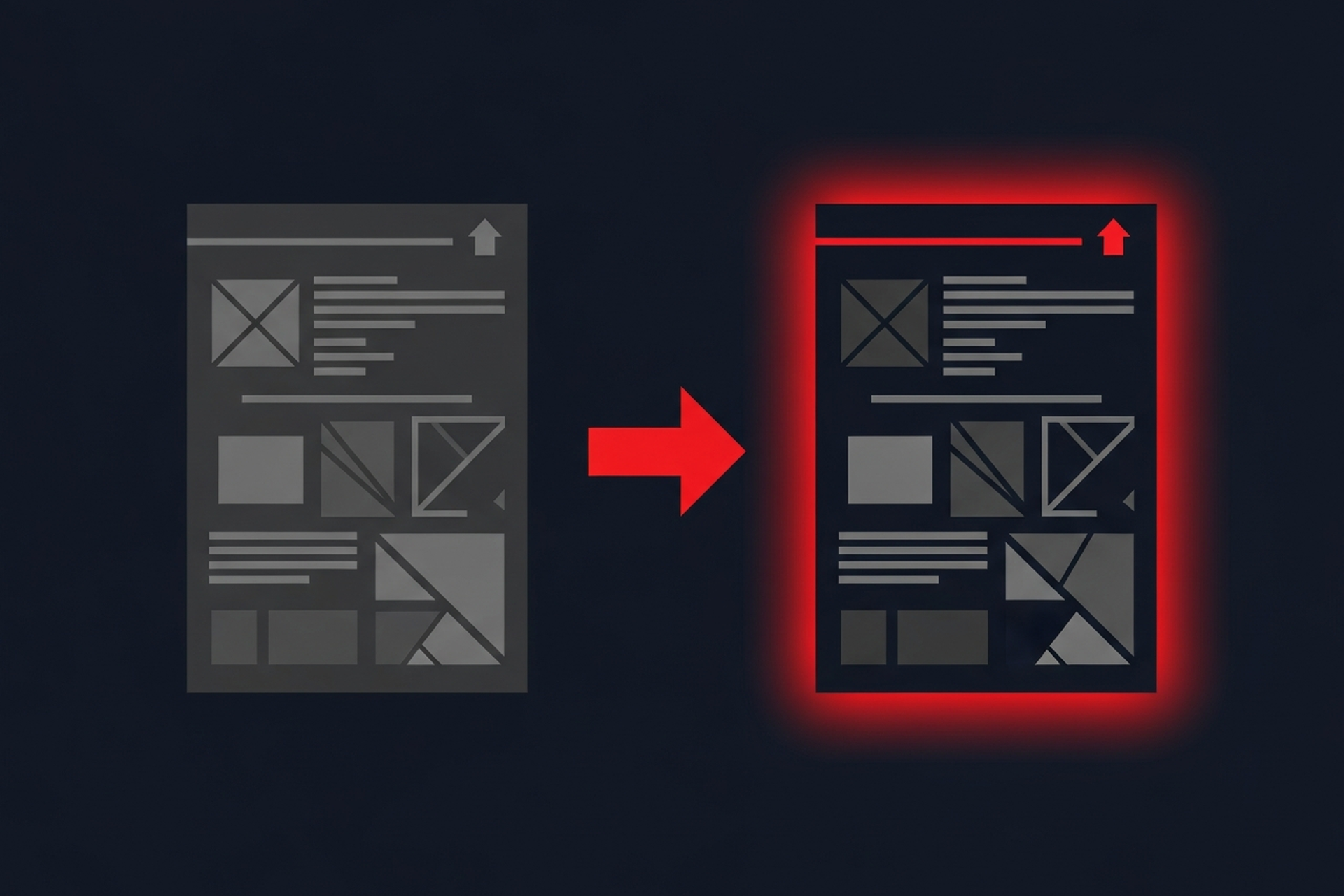
If you've spent any time reading about conversion optimization, you've probably seen the same recycled advice: test your button color, add urgency to your headline, tweak your hero image. That kind of content treats CRO like a bag of tricks. It isn't. Done well, conversion optimization is the most reliable way growth-stage brands turn existing traffic into more revenue without raising their ad budget by a dollar.
The problem is that most teams approach it as a series of one-off tests rather than a system. They run an experiment, see a flat result, lose interest, and move on. Six months later their conversion rate is the same and they blame "CRO doesn't work for us" instead of the approach. The brands that compound wins year after year do something different, and it has nothing to do with picking better button colors.
This guide walks through what conversion optimization actually means in 2026, where the highest-ROI work lives, the common mistakes that quietly kill programs, and how to know whether your team should run CRO in-house or bring in outside help.
What Conversion Optimization Really Means
At the surface level, the definition is simple. Conversion optimization is the practice of increasing the percentage of visitors who take a desired action on your site, whether that's a purchase, a free trial signup, a demo booking, or an email capture. The math is a basic ratio: conversions divided by sessions.
What makes it meaningful as a discipline is the method, not the math. Real CRO is a continuous, evidence-based process that combines analytics, user research, hypothesis-driven experimentation, and statistical rigor. Nielsen Norman Group has been writing about conversion rate work for two decades, and the throughline is consistent: the teams that improve sustainably are the ones treating CRO as user experience research, not as marketing "hacks."
The distinction matters because the two approaches produce very different outcomes. Tactic-chasing programs hit a ceiling around month three. Systematic programs get better over time because each experiment adds to your understanding of who your users are and how they behave, which makes the next hypothesis sharper than the last.
CRO as a System, Not a Tactic List
The easiest way to picture a functional CRO program is as a loop with four stages that feed each other.
Research: Before you touch a page, you need to know where users actually struggle. This comes from analytics drop-off data, session recordings from tools like Hotjar, heatmaps, customer support logs, on-site polls, and qualitative interviews. The goal at this stage is not to invent ideas. It is to collect evidence.
Hypothesis: A hypothesis takes the form "because we observed X, we believe that Y will improve the outcome by Z, and we'll know because of these metrics." A hypothesis without observed evidence is a guess. A guess without a measurable metric is a vibe.
Experiment: This is where most teams start, and that's the mistake. A well-designed experiment follows from research and hypothesis, runs long enough to reach statistical power, and measures the specific metric the hypothesis predicted, not whatever looks favorable after the fact.
Learn: Every result, win, loss, or flat, is information that sharpens the next iteration. Losses are often more valuable than wins because they correct flawed models of user behavior. Programs that only document winners lose half the learning.
When these stages are connected, the loop compounds. When any one stage is skipped, the program becomes a random-ideas factory and the conversion rate stays flat.
Where to Start: The Highest-ROI Areas
Not every page or funnel step is worth optimizing first. The sequencing below reflects what we see move the needle fastest for most DTC and growth-stage SaaS clients.
Fix the checkout and signup flow first
Checkout is where intent meets friction, which makes it the highest-impact surface in the entire funnel. Research from Baymard Institute shows the average large ecommerce site can gain up to a 35% increase in conversion rate through checkout design changes alone, and that 64% of desktop checkouts tested by their team rate "mediocre" or worse. Common wins live in the obvious places: guest checkout as the default path, forgiving password requirements, explicit delivery dates instead of vague shipping speeds, and error messages that tell users exactly what's wrong.
For SaaS, the equivalent is the signup and onboarding path. Friction between "I want to try this" and "I'm inside the product" costs more than any landing page headline ever will.
Then product pages and key landing pages
Product pages and paid-media landing pages are the second-highest leverage surfaces. This is where the customer decides whether the offer is credible, relevant, and worth the money. Clear value propositions, trust signals placed near the buying decision, well-organized social proof, and page speed under 2.5 seconds all tend to show up in winning tests.
Then the top of the funnel
Homepage and category-level optimization matters, but it matters less than most brands think. Fixing a leaky cart has a bigger compounding effect than redesigning a hero section. Work down the funnel first, then back up.
The Common Mistakes That Quietly Sink CRO Programs
Most CRO programs don't fail because the team picked bad tests. They fail because the testing discipline underneath was broken in ways nobody caught.
Running underpowered tests. The experts at CXL have written extensively about this: most ecommerce sites simply don't have enough traffic to detect realistic lifts in a reasonable timeframe. If your "winner" only needed 400 visitors per variant to show significance, it wasn't actually a winner. It was noise.
Peeking at results and stopping early. Checking a test every day and calling it as soon as you see significance inflates your false positive rate dramatically. A test that looks like a 20% winner on day three can flatten to zero by day fourteen. Set your sample size up front, and leave the test alone until it hits the threshold. A good primer on statistical significance in A/B testing explains why that discipline matters mathematically.
Confusing statistical significance with business significance. A test can be statistically significant and practically useless. A 0.3% lift on a microconversion doesn't justify the engineering cost to implement it. Always check whether the effect size is large enough to matter to the business.
Testing tiny changes with no theory. Button colors, headline tweaks, and generic copy shuffles rarely produce meaningful lifts because the underlying user behavior isn't changing. Bigger, research-grounded hypotheses win more often. GoodUI has catalogued hundreds of evidence-based patterns from real tests, and the throughline is clear: bold changes rooted in behavioral research beat timid tweaks.
Claiming 200% lifts. If you see a case study claiming a 200% conversion lift, read it skeptically. Either the starting baseline was tiny, the test was underpowered, or the definition of "conversion" got stretched. Realistic wins on a mature program usually land between 3% and 15% per experiment. Those add up over a year. The clickbait "200% lift" usually doesn't hold up in a follow-up test.
How to Actually Measure CRO
Conversion rate as a single number hides more than it reveals. Segment it or you'll draw the wrong conclusions.
Segment by traffic source. Paid social, paid search, organic, email, and direct all behave differently. A test that looks flat in aggregate often has a clear winner inside one segment. Aggregate conversion rate is a vanity metric when you're trying to diagnose a problem.
Segment by device. Mobile and desktop users convert differently, sometimes dramatically. A design that works beautifully on desktop can tank on mobile. Run tests device-split from the start.
Segment by new versus returning. New users and returning users are solving different problems. A checkout tweak that helps one often hurts the other.
Track revenue per visitor, not just conversion rate. A test that raises conversion rate but lowers average order value can leave you worse off on the only metric that pays salaries. Revenue per visitor is the honest scoreboard.
Use cohorts for longer-term measurement. Some CRO wins show up in week-one conversion. Others show up in 30-day or 90-day repeat behavior. Cohort analysis catches the wins that simple aggregate reports miss.
When to DIY vs. When to Hire
CRO is one of the easier disciplines to start in-house and one of the harder ones to scale. Here's a rough framework for when to bring in outside help.
You can probably do it yourself if: your site gets enough traffic to run credible tests (roughly 25,000+ sessions per month per variant), someone on the team understands basic statistics, and the roadmap is research-driven rather than opinion-driven.
You probably need help if: you're trying to connect CRO to paid media strategy, your traffic is too thin for traditional A/B testing and you need a different experimentation model, or your team keeps running tests that come back flat and nobody can figure out why. At that point you're usually missing either the research muscle, the statistical discipline, or the integration with acquisition.
The mistake we see most often with brands hiring agencies is expecting month-one wins. Good CRO work in the first 90 days is mostly research, hypothesis development, and instrumentation. Tests that actually move revenue usually start landing in months three through six. Any partner promising big wins in month one should be treated with the same suspicion as any partner promising guaranteed rankings.
What This Means for Your Business
Conversion optimization rewards the teams willing to treat it as a discipline. The same traffic you're already paying for can produce meaningfully more revenue if the system underneath is working. The gap between mediocre and good CRO isn't access to fancy tools. It's the research, the statistical honesty, and the patience to let tests run their full course.
If you're running paid media, your CRO work and your acquisition work should be connected. The messaging on your landing pages should match the messaging in your ads, and the segments you're bidding on should be the segments you're testing for. Running them as separate workstreams is one of the most common and expensive mistakes brands make, and we covered it in depth in our ecommerce CRO guide for growth-stage DTC brands.
If your model is SaaS, the same logic applies across the B2B SaaS lead generation funnel, where message match between ad, landing page, and signup flow often decides whether a campaign returns anything at all.
Next Steps
If your conversion rate has been stuck and you want an honest read on where the real leverage is, that's the work we do every day at EmberTribe. Our team integrates CRO with paid media strategy so the experiments you run actually connect to the traffic you're buying, and so wins compound instead of evaporating between disconnected teams. You can see how that integrated approach fits into a larger ecommerce growth strategy that treats acquisition, conversion, and retention as one system.
The brands that pull ahead in 2026 won't be the ones chasing the latest "hack." They'll be the ones running disciplined programs, asking sharper questions, and letting real evidence drive the roadmap. That's a harder path than copying a template, but it's the only one that compounds. If you'd like to talk through what that could look like for your business, we're always glad to take the call.

.webp)

.svg)


