








Sixty-two percent of ecommerce businesses plan to hire within the next six months, and 55% of ecommerce professionals plan to explore new opportunities in the same period, per Cranberry Panda's 2025 hiring survey. The market is active on both sides. The brands that win the talent competition are not necessarily offering the highest salaries. They are hiring for clearly scoped roles, moving through the process quickly, and onboarding in ways that make strong candidates want to stay.
This guide covers the roles ecommerce brands are hiring most in 2025 and 2026, salary benchmarks by position, the decision between in-house and fractional talent, how specialized ecommerce recruitment agencies work, and the seven hiring mistakes that cost growth-stage brands the most.
The Ecommerce Roles in Highest Demand
Ecommerce hiring maps closely to revenue stage. A brand at $500,000 in annual revenue needs different roles than a brand at $10 million. Constant Hire's DTC ecommerce staffing roadmap provides a practical framework:
At $0 to $1 million: a customer service representative to handle support volume, a digital marketer to own acquisition, and a fulfillment or 3PL relationship. At $1 million to $5 million: an ecommerce manager as the P&L owner, channel specialists in paid social, email, and SEO, and a designer or copywriter for creative production. At $5 million to $15 million: a supply chain or operations manager, a retention and CRM specialist with Klaviyo fluency, and a data analyst. At $15 million and above: a CMO or head of marketing, director of operations, VP of customer experience, and a finance manager.
The roles hardest to fill regardless of stage: performance marketing managers with cross-platform fluency across Google, Meta, and TikTok Shop; ecommerce data analysts who can script, manage GA4, and interpret attribution data; and hybrid profiles who can move between channel management and creative strategy. Mid-level and specialized roles frequently extend to 31 to 60 days, with senior and technical hires often exceeding 90, per Mitratech's 2025 hiring benchmarks.
Salary Benchmarks: 2025–2026
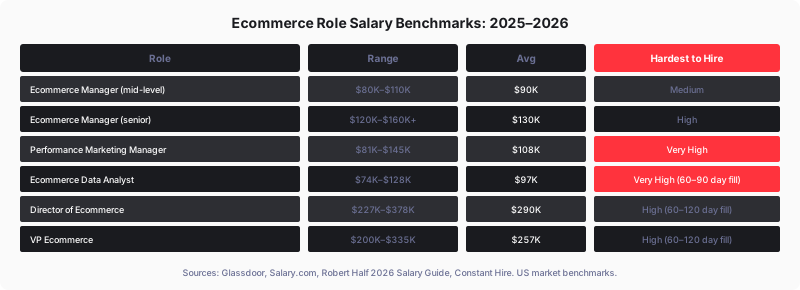
Robert Half's 2026 Salary Guide documents that 78% of marketing and creative leaders now offer higher salaries for candidates with specialized skills in AI, analytics, and automation. The premium for analytics fluency is growing faster than base salary: marketing analytics is seeing 3.3% year-over-year salary growth, the strongest category in the marketing function.
Geographic premium matters for senior roles. An ecommerce marketing manager averages $114,445 nationally but reaches $132,630 in New York City, per Salary.com. Brands hiring remotely can access talent priced at national rather than coastal rates, which is one reason remote ecommerce roles fill 16% faster than in-person roles, according to hiring data analyzed by Second Talent.
In-House, Agency, or Fractional: The Three Models
The hiring model decision depends on revenue stage and execution velocity requirements.
In-house hiring is the right choice for brands past $10 million to $50 million that need continuous campaign management, permanent marketing leadership, and forecasting beyond a single quarter. The fully-loaded cost is significant: a senior ecommerce manager runs $130,000 to $160,000 in salary alone, plus 25% to 30% for benefits, and recruiting fees of 15% to 31% of first-year compensation. A bad hire costs at least 30% of the employee's first-year pay to correct, per Soocial's bad hire statistics, and that figure rises sharply at the manager and director level.
Fractional talent is the right model for brands between $1 million and $10 million that need senior expertise without permanent overhead. A full-time marketing team might run $481,000 per year in total compensation; the equivalent fractional configuration runs approximately $220,500, a 54% savings, per ATTN Agency's fractional DTC analysis. Brands using fractional performance marketers and creative strategists report 35% faster campaign launches and 45% higher marketing efficiency at the sub-$10 million stage. The graduation threshold to full-time is typically $10 million to $50 million in revenue, where continuity and institutional knowledge become worth the permanent investment.
Recruitment agency support is appropriate for brands at $10 million or above that need to hire multiple roles annually and lack the internal recruiting infrastructure to source, screen, and close competitive candidates. Contingency recruiters charge 15% to 25% of placed first-year base salary. Retained search for director and VP level roles runs 25% to 31% of projected first-year compensation, paid in milestones.
Specialized Ecommerce Recruitment Agencies
General recruitment firms rarely understand platform-specific requirements well enough to vet ecommerce candidates accurately. A recruiter who cannot assess Shopify Plus fluency, GA4 attribution configuration, or triple-attribution tool experience (Triple Whale, Northbeam) will surface candidates with the right job titles and the wrong competencies.
Several agencies specialize in ecommerce and DTC talent. Constant Hire focuses on DTC and CPG brands and was founded by operators who scaled Shopify brands to $30 million and sold Amazon brands, giving them the operator-level vetting capability that generalist recruiters lack. eCommerce Placement covers US, Canada, and UK ecommerce from ICs to directors. Talentfoot claims a 98% placement success rate defined as placed candidates staying twelve months or longer.
Using a specialist significantly reduces the cost of a wrong hire at senior levels. The vetting gap between a generalist and a specialist recruiter matters most for roles that require hands-on platform expertise.
The Seven Hiring Mistakes Growth Brands Keep Making
Constant Hire's analysis of ecommerce hiring failures documents the most consistent failure patterns:
Generic job descriptions. Vague scope with no tools specified, no budget ownership defined, and no KPIs listed. The result is a pipeline of candidates who match the title but not the actual role. Strong candidates self-select out when they cannot assess fit from the description.
Role overloading. Expecting one hire to own paid ads, email, SEO, design, and reporting. Each function requires scoped ownership. Overloaded roles attract generalists who will underperform at each function, or strong candidates who negotiate the role down after starting.
Chasing big-brand logos. Candidates from large corporations often struggle in lean, fast-moving DTC environments. The operator who scaled a Shopify brand from $3 million to $15 million with a team of four is a better fit than someone who managed a single channel at a Fortune 500 with a 20-person support staff.
Slow process. The US average time to fill a role is 36 to 44 days. Competitive ecommerce candidates are fielding multiple offers. A process that takes longer than 10 business days to reach a decision is losing candidates to faster-moving competitors.
Skipping onboarding. No 30/60/90-day plan, no documentation, no playbooks. Even strong hires underperform without context. Poor onboarding is the primary cause of failed in-house hires that otherwise had the right competencies.
Skipping reference checks. Especially common under time pressure. References reveal collaboration style and real results better than any interview process.
Hiring too late. Most DTC founders wait until they are overwhelmed to hire, which compresses the search, inflates the offer, and creates a poor onboarding environment. The right time to hire is when the role scope is clear and the outcomes are defined, not when the workload becomes unmanageable.
What This Means for You
Ecommerce recruitment is a specialized discipline, and brands that treat it like general hiring lose their best candidates to faster, better-prepared competitors. The fractional model is the most underutilized tool in the growth-stage hiring toolkit: access to senior expertise at 46% to 54% of the fully-loaded cost, with a clear graduation path to full-time when revenue and organizational complexity justify it.
For growth-stage ecommerce brands evaluating whether their marketing function needs a full-time hire, an agency, or a fractional performance marketing team, EmberTribe works with DTC and B2B brands on the demand generation programs that generate the pipeline justifying those investments.

.webp)

.svg)


