








Customer acquisition costs in ecommerce have risen 40% to 60% from 2023 to 2025 across major DTC categories, with CAC up 222% over eight years, per Yotpo's ecommerce benchmarks. That pressure is why 79% of DTC brands now employ external marketing partners, per AskNeedle's full-service vs. specialist agency research.
The question is not whether to work with an agency. It is which type, at what budget, and at what stage.
This guide covers the six types of ecommerce agencies, what each costs, how to evaluate them, and a revenue-stage framework for deciding between a full-service partner and a network of specialists.
The Six Types of Ecommerce Agencies
Not every agency that describes itself as an ecommerce agency does the same work. Understanding the distinctions saves significant evaluation time.
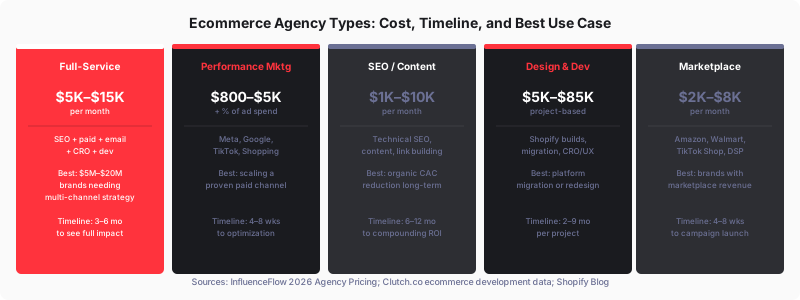
Full-service growth agencies cover the full acquisition and retention stack: paid media, SEO, email, CRO, and often development under one contract. Monthly retainers run $5,000 to $15,000 for growth-stage brands, per InfluenceFlow's 2026 agency pricing guide. The case for full-service is integrated cross-channel strategy: when paid and organic teams share data, when email nurture sequences are built from the same customer insights as acquisition campaigns, the sum is greater than the parts. The risk is depth: a shop that does everything may do nothing as well as a specialist.
Performance marketing agencies specialize in paid channels: Meta, Google, TikTok, and shopping campaigns. Fee structures typically combine a monthly management fee of $800 to $5,000 with 10% to 20% of ad spend. For brands with a proven channel they need to scale, or brands testing a new channel with aggressive ROAS targets, a performance specialist delivers faster optimization cycles than a generalist.
SEO and content agencies focus on organic acquisition: technical SEO, product page optimization, content programs, and link building. Monthly retainers run $1,000 to $10,000. The timeline to compounding ROI is six to twelve months, but the CAC differential is substantial. Ecommerce SEO packages from strong agencies produce organic traffic that compounds without proportional reinvestment, while paid acquisition cost stays linear.
Design and development agencies handle platform builds, migrations, and conversion-focused redesigns. They bill project-based: $5,000 to $85,000 per project, with average project durations of two to nine months. Brands moving from a legacy platform to Shopify Plus, building headless commerce infrastructure, or investing in checkout optimization as a standalone project are the natural fit.
Marketplace agencies manage Amazon, Walmart, and TikTok Shop presence: listings, DSP advertising, review management, and Buy Box strategy. Monthly retainers typically run $2,000 to $8,000. For brands generating significant marketplace revenue, a specialist creates substantially better outcomes than a generalist who manages the channel as an afterthought.
Strategy and consulting firms provide positioning, international expansion planning, P&L audits, and supplier strategy without execution. They serve brands needing senior-level guidance on specific decisions rather than ongoing execution partnerships.
What Ecommerce Agencies Cost
The global digital marketing agency market is valued at $8.27 billion in 2026 and projected to reach $27.57 billion by 2035, per Business Research Insights. Retail and ecommerce command approximately 20% of US agency revenues.
The pricing range within that market is wide and reflects genuine scope differences.
Clutch's ecommerce development pricing data documents the average project cost at $51,943 over nine months for development work, with smaller builds commonly under $10,000. US-based development agencies bill $100 to $149 per hour; offshore firms below $25 per hour. For ongoing marketing retainers, the Clutch average across social media and content engagements runs $5,107 per month, or approximately $61,000 annually.
The pricing range by tier:
- Startup and boutique agencies: $500 to $2,000 per month
- Small-to-mid agencies: $2,000 to $10,000 per month
- Mid-market agencies: $10,000 to $50,000 per month
- Enterprise agencies: $50,000 and above
The in-house comparison matters here. A digital marketer costs $60,000 to $80,000 in annual salary, a social media manager $55,000 to $75,000, and a content manager $65,000 to $85,000, per Shopify's ecommerce agency guide.
An agency retainer at $5,000 to $8,000 per month replaces what would cost $180,000 to $240,000 annually in full-time staff across those three roles, before benefits, management overhead, and recruiting costs.
Full-Service vs. Specialist: Which Model Fits Your Stage
AskNeedle's research shows that 56% of brands work with two to three agencies simultaneously, and 66% of the most satisfied brands use multiple partners. The implication is that neither full-service nor specialist is universally correct.
The revenue-stage framework:
Under $2 million ARR: A single specialist agency maximizes ROI. Full-service overhead exceeds its value at this stage. Pick the highest-leverage channel, exhaust it, and add channels sequentially.
$2 million to $5 million ARR: One or two specialist agencies, with brand coordination managed internally. Test channel mix, identify what compounds, and build the internal marketing infrastructure that allows eventual full-service coordination.
$5 million to $20 million ARR: The inflection point. Too many channels to manage through single specialists, not enough internal infrastructure to coordinate a multi-agency stack. Full-service or an orchestrated two-to-three-agency configuration with clear internal ownership makes sense here.
Above $20 million ARR: A hybrid model: internal team plus specialist agencies for specific gaps. Build internal strategic capability; use agencies for channel-specific depth.
10 Questions to Ask Every Ecommerce Agency
The questions that reveal the most about agency quality before signing a contract:
What specific results have you achieved for brands at our revenue stage and in our product category, and can you connect those results to business outcomes rather than channel metrics? Who will actually work on our account, and will we have access to that person? How do you attribute results across channels: what attribution model, what tracking setup, what does the reporting show?
How do your paid and organic teams share data? (Agencies that keep channels in silos produce worse outcomes than agencies with integrated data.) What happens in the first 30, 60, and 90 days? What is your process if a channel underperforms for two consecutive months?
Who owns our ad accounts, analytics, and content assets if we end the engagement? Can you show us a real client reporting dashboard? Can we speak with two CEO or founder references from comparable brands?
Red Flags That Signal the Wrong Agency
Guaranteed rankings or guaranteed ROAS. No agency can guarantee search rankings or a specific return on ad spend: channels are too variable and the variables outside any agency's control are too numerous. Pressure to sign immediately signals a poorly run sales process.
Vague case studies with no client-verifiable metrics or reference contacts. Reporting that centers on impressions, clicks, and follower counts rather than revenue, pipeline, or CAC. Cookie-cutter strategy with no customization to your product category.
An agency pitching the same channel mix to a $200 ACV software company and a $50 apparel brand does not understand the fundamental economics that should drive channel selection. Lack of clarity on who does the actual work day-to-day. High account manager turnover means your institutional knowledge walks out the door every eight months.
What Results to Expect
Channel-specific ROAS benchmarks from Foundry CRO's 2026 ecommerce marketing data: email generates $36 to $79 per dollar spent; SMS generates $71 to $79 per dollar; Google Shopping averages 5.17:1 ROAS; Meta standard campaigns average 1.86 to 2.19:1 ROAS.
Blended ROAS across channels averages 2.87:1 and is declining 4% to 10% annually as platforms capture more of the value they create.
Retention economics deserve equal weight. A 5% increase in customer retention correlates with 25% to 95% profitability gains, per Yotpo benchmarks. Existing customers convert at 60% to 70% versus 5% to 20% for new prospects.
Agencies that build acquisition-only programs and ignore retention economics produce top-line growth that does not compound into profitability.
What This Means for You
The right ecommerce agency model depends on revenue stage, existing internal capability, and which channels have proven economics at your current CAC and ROAS. The common failure is hiring a full-service agency before the brand has enough scale to utilize the full scope, or hiring specialist agencies without the internal coordination infrastructure to make them work together.
For growth-stage DTC and ecommerce brands evaluating their agency stack, EmberTribe works at the intersection of paid acquisition and organic demand programs, building channel strategies accountable to revenue rather than managed in isolated reporting silos.

.webp)

.svg)


