








Most growth-stage brands treat channel marketing as a reach problem. They add channels to increase exposure and assume more distribution means more revenue. The brands that end up over-extended, margin-thin, or locked into platform dependency usually made that assumption.
Channel marketing is actually two separate problems that most companies conflate: where your product is sold (distribution channels) and how you reach buyers (marketing channels). Treating them as the same question causes allocation mistakes that compound over time.
The Two Meanings of Channel Marketing
Distribution channels are the pathways through which a product moves from brand to buyer: your own direct website, Amazon and Walmart marketplaces, wholesale and retail partners, social commerce storefronts like TikTok Shop and Instagram Shopping. The question here is where the transaction happens.
Marketing channels are how you reach and influence buyers before the transaction: paid social, SEO, email, SMS, influencer, retail media networks. The question here is how you drive awareness and conversion.
These two dimensions interact in ways that create strategic blind spots. Amazon is simultaneously a distribution channel (where people buy) and a marketing channel (where you run Sponsored Product ads to drive discovery). A brand that runs paid social to drive DTC traffic while its own Amazon listing shows the same product at a lower price is spending against itself. Most brands discover this conflict after the fact.
The strategic framework that works: decide your distribution channel mix first, based on contribution margin and customer ownership goals. Then build the marketing channel mix to serve that distribution strategy, not the other way around.
How to Choose Channels: Contribution Margin, Not Gross Margin
The single most common channel selection mistake is evaluating channels by gross margin. The same $50 product can show 65% gross margin on Shopify, 60% on Amazon, and 48% at wholesale. Gross margin says DTC wins by a mile. Contribution margin, which accounts for all variable costs including CAC, platform fees, fulfillment, and returns, often tells a very different story.
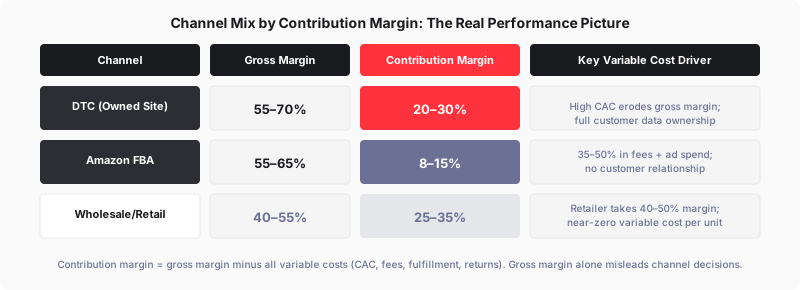
The implication is counterintuitive: Amazon's fee structure consumes 35 to 50% of revenue depending on category, but the customer acquisition cost is embedded in the platform. DTC's higher gross margin often narrows to a lower contribution margin once blended paid media CAC is included. Wholesale shows the lowest gross margin but often the highest contribution margin per unit because the variable cost per unit sold approaches zero.
Brands with strong omnichannel engagement retain 89% of customers versus 33% for single-channel brands, and omnichannel buyers show 13% higher average order value, according to research aggregated by Capital One Shopping. But reaching those retention rates requires that each channel is economically defensible first.
Channel Sequencing by Stage
Early-stage and growth-stage brands face different channel problems. The right sequencing matters more than the right mix.
Early stage (pre-PMF or early traction): Marketplaces offer immediate access to existing demand without requiring you to build traffic from scratch. Amazon and TikTok Shop can prove demand faster than DTC because the platform supplies the audience. The tradeoff is that marketplace customers belong to the platform, not to you. Use early marketplace traction to validate demand, not as a long-term customer acquisition strategy.
Growth stage: DTC investment begins to compound. An email list, organic search presence, and returning customer base start delivering acquisition that does not depend on ad spend. Build owned channels in parallel before marketplace dependency becomes structural. The target allocation for most growth-stage DTC brands is roughly 60 to 70% DTC, 20 to 30% marketplace, with wholesale entering the mix once the brand has pricing leverage.
Scale stage: Wholesale and retail partnerships make sense when the brand can command premium shelf placement and pricing concessions rather than being commoditized. Omnichannel customers at this stage spend 13% more per order and have 30% higher LTV than single-channel customers.
Social Commerce: The Channel Growth No One Planned For
US social commerce hit $87 billion in 2025, up 21.5% year-over-year, according to eMarketer. TikTok Shop alone grew 108% to $15.8 billion, representing 18.2% of total US social commerce.
TikTok Shop converts at 4.7% compared to Instagram Shopping at 2.1%. For mid-price visual products in beauty, wellness, and apparel, social commerce has become a first-tier channel, not an experiment.
The platform dependency risk is equally significant. TikTok's regulatory uncertainty in early 2025 demonstrated what happens when a channel that represents 15 to 20% of a brand's revenue faces potential shutdown. Brands with first-party data assets (email lists, SMS subscribers, loyalty programs) had a mitigation path. Brands without them had no way to reach those customers outside the platform.
The rule that applies to every channel: no single platform should exceed 60% of total revenue. This is not just a margin rule. It is a business continuity rule.
Channel Conflict: The Predictable Strategic Error
Channel conflict is one of the most expensive and most preventable mistakes for growth brands. It happens when distribution channel expansion creates direct competition between the brand's own channels or between the brand and its partners.
The Amazon versus DTC conflict is the most common form. If a third-party seller lists your product on Amazon at a lower price than your DTC site, customers find you through paid ads, check Amazon for the price, and buy there at lower margin. If you discount to win the Amazon Buy Box, retail partners demand matching price concessions. Margin pressure cascades.
The wholesale versus direct conflict creates similar tension. Retailers who carry your product will pull back, demand exclusivity, or reduce shelf space when they see aggressive DTC pricing. This is why many brands run channel-exclusive SKUs or colorways to prevent direct price comparison across channels.
Practical approaches that manage this without eliminating channel diversification:
- MAP (Minimum Advertised Price) policies enforced rigorously and contractually across all channels
- Channel-exclusive product variants: different colorways, bundle configurations, or SKU suffixes for each channel that prevent direct price comparison
- Tiered distribution: premium and flagship product lines sold DTC, commodity lines through wholesale
- Amazon Brand Registry to block unauthorized third-party sellers who undercut pricing
The brands that manage channel conflict effectively address it in channel policy before expansion, not in crisis management after a partner complaint.
Platform Dependency Risk and How to Reduce It
Brands with 90% or more Amazon concentration trade at 3.0 to 3.5x EBITDA at acquisition, compared to 4.5 to 5.5x for brands with meaningful off-Amazon channels, per Canopy Management's analysis of ecommerce brand acquisitions. Single-channel dependency carries a roughly 40% valuation discount.
Platform risk includes algorithm changes, fee increases, policy shifts, regulatory action, account suspension, and competitive moves (Amazon launching a private-label product in your category). The mitigation is building owned channels that the platform cannot take away.
Owned channels worth prioritizing in order of defensibility: email list, SMS subscribers, loyalty program membership, organic search presence. These compound over time and do not reset when a platform changes its algorithm or fee structure.
For DTC brands building their ecommerce marketing strategy, channel diversification is not about pursuing every available channel. It is about building the owned-channel foundation that makes all other channels less risky.
B2B Channel Marketing: Partners, Resellers, and the Indirect GTM
In B2B SaaS, channel marketing refers specifically to indirect go-to-market through partner ecosystems. The structural logic is the same as ecommerce channel strategy, with different vocabulary.
Partner types include resellers and value-added resellers (VARs), managed service providers (MSPs), independent software vendors (ISVs) who integrate your product, referral and affiliate partners, and system integrators for enterprise deployments.
The economics make indirect channels necessary at certain ACV thresholds. If your average contract value is below $15,000 to $25,000, a direct enterprise sales rep for every deal is not economically viable. Partners cover that market cost-effectively. Forrester research cited across B2B practitioners estimates that nearly 70% of B2B buyers purchase through an indirect channel partner rather than directly from the vendor.
The same channel conflict logic applies: if your direct sales team sells into territories where a partner is also working, conflict erupts. Deal registration systems, territory exclusivity agreements, and Partner Relationship Management (PRM) tools like PartnerStack or Impartner are the B2B equivalent of MAP policies.
For brands building a broader omnichannel marketing strategy, the underlying principle across both DTC and B2B is identical: distribution channel decisions constrain and enable marketing channel decisions. Building them in the right sequence, with contribution margin as the scorecard, is what separates brands that scale profitably from those that grow into a margin problem.
What This Means for You
Channel strategy is one of the highest-leverage decisions a growth-stage brand makes and one of the hardest to reverse once distribution commitments are made. Wholesale relationships, Amazon seller accounts, and retail partnerships create obligations and dependencies that take years to unwind.
Getting channel strategy right requires contribution margin visibility by channel, clear policies against conflict before it starts, and a disciplined ceiling on any single platform's share of revenue. The brands that compound fastest are not the ones that found the best single channel. They are the ones that built a mix where each channel reinforces the others without undermining their economics.
If you want to audit your current channel mix and build a program that protects contribution margin at scale, EmberTribe works with growth-stage DTC and B2B brands on the kind of channel strategy that holds up as the brand grows.

.webp)

.svg)


