
When brands start shopping for SEO help, the category feels deceptively simple: you want to rank higher, get more traffic, and convert that traffic into revenue. But the term "SEO services" covers a wide range of activities with very different cost structures, timelines, and fit depending on where your site is in its growth cycle.
This guide breaks down the recommended SEO services categories worth your budget, how to evaluate providers, and what you should expect to pay in 2026.
Not all SEO providers offer the same thing. A freelancer specializing in keyword research is a different product from a full-service agency managing your entire organic channel. Before evaluating vendors, you need to know which category of service you actually need.
The five core service types are technical SEO, on-page optimization, content SEO, link building, and local SEO. Most growth-stage brands need at least three of these working in concert. Choosing only one without the others is a common reason campaigns plateau.
According to Backlinko's analysis of SEO services, providers that deliver consistent results operate with an integrated approach: technical foundations, content production, and authority building working together rather than in isolation.
Technical SEO is the foundation. Without it, every other service you invest in produces diminished returns. This category covers site architecture, crawlability, page speed, Core Web Vitals, structured data, canonical tags, and indexation hygiene.
For most sites, technical SEO starts with a comprehensive audit, followed by a prioritized remediation roadmap. A good audit surfaces issues you didn't know existed and ranks them by likely impact. Google's own documentation emphasizes that content quality and technical accessibility work together: neither is sufficient alone.
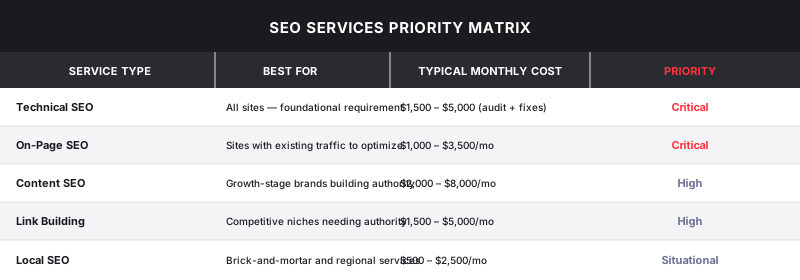
What to expect to pay: One-time technical audits run $1,500 to $5,000 for most small to mid-size sites. Ongoing technical maintenance is typically bundled into a retainer at $1,000 to $2,500 per month.
Who should prioritize this: Every site, without exception. If your technical SEO is broken, no amount of content or links will compensate.
On-page SEO covers the optimization of individual pages: title tags, meta descriptions, header hierarchy, internal linking structure, keyword alignment, and content relevance signals. It is distinct from content creation; on-page SEO can be applied to existing pages without producing new content.
This service type is particularly valuable for sites that already have traffic and rankings but are leaving conversion opportunities on the table. An on-page audit will often uncover quick wins: pages ranking on page two that can be pushed to page one with targeted optimization, or pages cannibalizing each other because keyword targeting was never coordinated.
Pairing on-page work with a clear internal linking strategy compounds results. For more on building that structure, see our guide to SEO agency services.
What to expect to pay: On-page optimization services typically run $1,000 to $3,500 per month as a standalone service, though most agencies bundle it into a broader retainer.
Content SEO is where most of the sustainable, long-term organic growth comes from. This service covers keyword research, content strategy, brief development, article production, and ongoing optimization of the content library. For growth-stage DTC brands, content SEO is usually the highest-leverage investment after the technical foundation is solid.
Quality content SEO goes beyond writing blog posts. It means building topical authority across a pillar-and-cluster structure and aligning content to search intent at every funnel stage. Providers should produce material that satisfies Google's E-E-A-T standards (Experience, Expertise, Authority, Trustworthiness). Surface-level content that covers a keyword without genuine depth has become reliably ineffective.
What to expect to pay: Content SEO retainers run $2,000 to $8,000 per month depending on output volume and whether the provider handles strategy, writing, and optimization as a bundle.
Who should prioritize this: Brands building a content moat in a competitive category. If you are in a niche where every major competitor is publishing substantive content, you need to match or exceed that output to compete.
For DTC and ecommerce specifically, see our breakdown of best SEO companies for small business to understand how content investment scales with company size.
Link building remains one of the most impactful SEO signals, and also one of the most misunderstood. Quality matters far more than volume. A single link from a well-regarded industry publication is worth more than dozens of directory submissions or purchased links. Providers who pitch link volume without discussing link quality should be disqualified.
Legitimate link building in 2026 means digital PR, content-driven outreach, strategic partnerships, and contributing expert commentary to publications that already have domain authority. This work is time-intensive, which is why it commands a meaningful budget.
Siege Media's SEO pricing research shows that link building typically runs $1,500 to $5,000 per month for quality outreach-based programs, with enterprise campaigns running significantly higher.
Warning signs: Any provider guaranteeing a specific number of links per month without discussing source quality, or any package priced at a flat rate per link, is likely cutting corners in ways that create algorithmic risk.
Local SEO is a distinct service category for businesses that serve customers in a specific geographic area: retail locations, service providers, restaurants, and regional professional services. It covers Google Business Profile optimization, citation building, local schema markup, and managing location-specific keyword targeting.
If your business doesn't have a physical location or serve a defined geographic area, local SEO is not a priority. If you do, it is one of the highest-ROI investments available, because local intent queries ("near me" searches, city-specific searches) convert at significantly higher rates than broad informational queries.
What to expect to pay: Local SEO services typically run $500 to $2,500 per month depending on the number of locations and competitiveness of the market.
The matrix below maps each service type to its typical use case, cost range, and priority level for growth-stage brands:
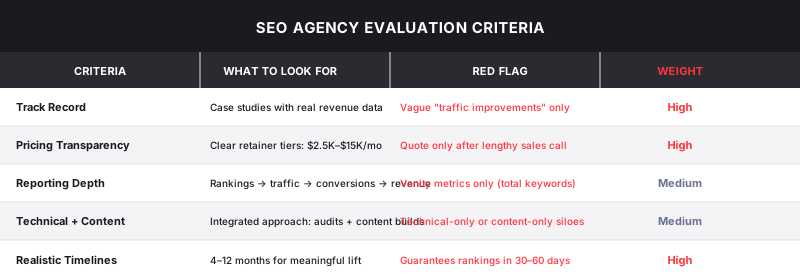
Knowing which services you need is the first step. Selecting the right provider for each is the second. These criteria separate credible providers from the rest.
Track record with comparable companies. Case studies should show specific metrics: keyword ranking improvements tied to traffic growth tied to revenue. Vague claims of "improved visibility" are not sufficient. Ask for examples from businesses in your category or with your revenue profile.
Realistic timelines. Google has stated it takes four to twelve months for professional SEO changes to produce meaningful results. Any provider guaranteeing significant traffic or ranking improvements in under 60 days is either misleading you or planning to use tactics that create future risk.
Integrated strategy across service types. The best SEO outcomes come from technical, content, and authority signals working together. A provider who only operates in one lane will hit a ceiling quickly.
Transparent reporting. Monthly reports should show rankings, organic traffic, conversion events, and revenue attribution where trackable. If a provider only reports on keyword counts or impressions, that is a signal they are optimizing for optics rather than outcomes.
Pricing that reflects real work. According to 2026 SEO pricing benchmarks, quality full-service SEO retainers run $3,000 to $10,000 per month for most small and mid-size businesses. Services priced below $1,000 per month are almost always automated or templated with minimal results. Enterprise campaigns routinely exceed $20,000 per month.
Use this checklist when evaluating any SEO service provider:
Early-stage companies with limited SEO budgets should prioritize technical SEO first, then on-page optimization of their highest-traffic or highest-intent pages. Content SEO and link building can be phased in as the foundation is established and budget expands.
Growth-stage brands that already have some organic traction should invest in content SEO to build topical authority and link building to accelerate domain authority in competitive categories. On-page optimization should be continuous.
For a deeper look at how full-service providers structure these offerings, see our guide to best SEO agency options, which covers evaluation frameworks and red flags in detail.
Selecting the right combination of recommended SEO services is not about finding the cheapest option or the most comprehensive package. It is about matching the service mix to your site's current state, competitive landscape, and growth objectives. The brands that treat SEO as a compounding investment rather than a line-item expense are the ones that build durable organic channels over time.
If you want to build that kind of organic engine, EmberTribe works with DTC brands and growth-stage companies on integrated SEO and content strategies. We focus on outcomes that connect to revenue, not vanity metrics.

According to Backlinko's SEO statistics research, 96.55% of all pages on the web receive zero organic traffic from Google. The problem is rarely that organic search does not work. It is that the execution, or the agency executing it, is not doing the things that actually move the needle in Google's current algorithm environment.
Hiring a Google SEO agency is not the same decision it was three or four years ago. The algorithm priorities have shifted fundamentally, and agencies that have not kept pace are burning budgets on tactics that have since been explicitly penalized.
General SEO as a category covers everything from Pinterest optimization to Amazon listing copy. A Google SEO agency is specifically focused on the signals Google measures, the tools Google provides, and the way Google's crawlers evaluate a site.
The four areas where Google-specific expertise is most consequential:
The playbook for SEO has changed substantially since 2022, and agencies that have not adapted are operating on outdated assumptions.
The Helpful Content System launched in August 2022 and was fully integrated into Google's core ranking algorithm by 2024. It now runs continuously rather than as discrete updates. Its effect: content that exists primarily to rank, rather than to genuinely serve a reader, has been systematically downranked. "SEO content" written without subject-matter input no longer works the way it once did.
The "Experience" addition to E-E-A-T was added in December 2022 and is widely interpreted as Google's direct response to the proliferation of AI-generated content. It rewards content that demonstrates first-hand experience or genuine expertise: bylines, case studies with verified data, original analysis. It deprioritizes content that could have been written by anyone about anything.
2025 Core Updates continued targeting scaled content abuse, link spam, and AI-generated content without human review or editorial value. According to Search Engine Journal's coverage of Google's guidance on hiring SEO agencies, Google's own engineers have made clear that any agency operating through link schemes or scaled templated content is building on unstable ground.
The practical implication: a Google SEO agency that has survived and grown client traffic through 2022 to 2025 without penalties has a materially different skillset than one that was riding pre-2022 tactics. Ask specifically about this.
Several patterns reliably indicate an agency that will underdeliver or create cleanup work down the road.
Guaranteed rankings are the clearest red flag. No agency can guarantee specific rankings: Google's systems are not predictable at that granularity, and Mueller has stated this explicitly. Any agency making guarantees is either misrepresenting their influence or planning to use tactics Google has specifically targeted.
Unsolicited outreach with a "free audit" is another signal. Google itself flags this practice as a marker of low-quality providers. Legitimate agencies with strong track records do not need to cold-email domain owners with manufactured urgency.
Links as the primary selling point indicates a misaligned strategy. Link building is a component of SEO, not a complete strategy. Agencies that lead with backlink volume rather than technical health and content quality are operating on a pre-2022 framework.
Traffic-only reporting (session volume without conversion data, rankings without CTR context) mirrors the same issue as traffic-only paid media reporting. If an agency cannot connect organic activity to revenue, they cannot tell you whether the program is working.
Ahrefs' SEO pricing research covering 439 practitioners provides the most granular current benchmarks. Monthly retainers are the dominant model, used by 78.2% of SEO providers.
For growth-stage DTC ecommerce and B2B SaaS brands operating in competitive verticals, the relevant range is $2,500 to $5,000 per month for a quality US-based agency delivering full-service work: technical monitoring, content strategy with brief development, on-page optimization, link building, and reporting tied to GSC and GA4. At this tier, 79.1% of US and Canada-based providers operate.
Entry-level retainers ($500 to $2,000/month) typically cover one or two service areas rather than a complete program, and are more appropriate for smaller sites with limited competition. Enterprise or highly competitive verticals typically run $5,000 to $15,000+ monthly, reflecting the content velocity and technical complexity required.
Project-based engagements are common for defined scopes: technical SEO audits run $1,000 to $10,000+ depending on site size, and site migration support typically runs $5,000 to $20,000+.
The pricing floor to watch: any agency offering comprehensive, full-service SEO for a growth-stage brand under $500/month is cutting corners on quality, coverage, or ethical standards. That price point does not cover the labor required to do the work correctly.
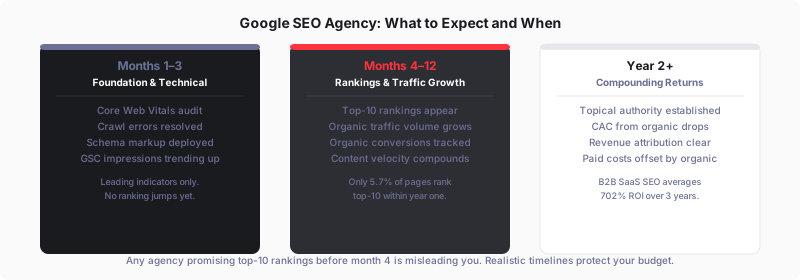
Setting expectations correctly at the start of an engagement prevents the most common failure mode: cutting a program before it has had time to work. B2B SaaS SEO data from Ahrefs' B2B SEO statistics research shows an average 702% ROI with a roughly seven-month break-even over a three-year horizon. Organic search also produces a lower customer acquisition cost ($147 average for SaaS versus $280 for paid search), which means the compounding value is in the long tail, not the first quarter.
For DTC ecommerce, the organic advantage compounds differently: brands with strong SEO reduce their dependence on paid acquisition during peak periods, creating margin protection when CPMs spike. This is the channel mix diversification case for organic, and it takes 12 to 18 months to materialize.
Organic search accounts for more than 57% of all web traffic globally, but nearly all of it concentrates in a small number of pages that are technically sound, genuinely authoritative, and aligned with how Google evaluates quality in 2026. Getting a B2B SaaS brand or DTC ecommerce site into that group is not a volume problem. It is a strategy and execution problem that a Google SEO agency with current expertise can solve.
If you want to evaluate where your organic program stands against Google's current technical and quality standards, EmberTribe works with growth-stage DTC and B2B brands on SEO strategy built around the signals that actually drive rankings today.

The search for the best SEO agency is one of the most consequential decisions a DTC brand or growth-stage company makes. Get it right and you build a compounding organic channel that pays dividends for years. Get it wrong and you lose six to twelve months of budget while your competitors pull ahead in the SERPs.
This guide is direct and practical. No rankings, no sponsored placements, no vague advice to "look for experience." What follows are the actual criteria, pricing benchmarks, and evaluation questions you need to make a confident decision in 2026.
Most agencies offer the same surface-level services: keyword research, on-page optimization, link building, monthly reports. The difference between the best and the mediocre is not what they offer on paper. It is how they execute and how they connect activity to outcomes.
The agencies worth your budget share a few defining traits. They treat SEO as a revenue channel, not a traffic channel. They can explain exactly how a keyword ranking connects to a conversion event. And they build strategies that work across traditional search results, AI-generated overviews, and voice-based queries simultaneously, because search behavior in 2026 demands all three.
According to Backlinko's SEO pricing research, agencies that deliver consistent results typically operate with a full-stack approach: technical audits, content production, and authority building working in concert. Firms that specialize in only one layer tend to plateau.
Specialization also matters more than most buyers realize. The best SEO company for a B2B SaaS startup is not the best one for a fashion DTC brand. Vertical expertise shapes keyword strategy, content format, and the backlink profile that makes sense for your category. Ask any agency you're evaluating where the majority of their clients operate. If the answer is vague, that tells you something.
Pricing clarity is itself a quality signal. The best agencies publish their retainer structure or give a straight answer on a first call. The ones that hide pricing behind lengthy discovery processes often do so because the number is not defensible.
Here is what the market looks like in 2026, based on data from Digital Applied and Search Scale AI's agency pricing analysis:
The average agency retainer for a growth-stage company lands around $3,200 to $5,000 per month. Rates below $1,500 per month typically indicate either highly automated output or a junior team. Rates above $10,000 are justified for companies in competitive verticals or those needing technical depth at scale.
One pricing shift worth noting: AI tools have compressed the labor cost of routine SEO tasks. Agencies that have not passed any of those savings on to clients while raising rates are worth questioning.
For more on building a full evaluation framework before hiring, our SEO agency guide covers the due diligence process in detail.
1. Case studies with revenue data, not just traffic data
Traffic is a leading indicator. Revenue is the outcome. Any agency calling itself a top SEO agency should be able to show you a case study that traces organic traffic growth to pipeline or revenue, not just to a ranking milestone. Ask for a client in your vertical.
2. Transparency in strategy and reporting
Request a sample report before signing. A strong report connects keyword ranking changes to traffic deltas to conversion events. A weak report shows total keywords ranking, total sessions, and a green arrow. If the report cannot explain why numbers moved, the agency cannot either.
3. Realistic timeline commitments
SEO takes four to twelve months to produce meaningful results. This is not a caveat: it is a structural reality of how search engines evaluate authority. Any agency promising top rankings in 30 to 60 days is using tactics that will erode rather than build equity over time.
4. Technical plus content capabilities under one roof
The best agencies handle both. Technical SEO without content creates a structurally sound site with nothing to rank. Content without technical SEO creates well-written pages that load slowly, have poor crawlability, and lose ground on Core Web Vitals. Ask specifically how their technical and content teams collaborate on a typical engagement.
5. Communication cadence and access to senior strategists
You should know who is working on your account. Junior analysts executing templated strategies with no senior oversight is a common failure mode at mid-sized agencies. Ask who attends your monthly calls and who is responsible for strategy decisions.
Some signals should end the conversation before it goes further.
Guaranteed rankings. No agency has a relationship with Google's algorithm. Guarantees on specific positions or timelines are either naive or dishonest. Either one is disqualifying.
No clarity on who does the work. Many agencies pitch senior strategists and deliver junior execution. Ask directly: who runs your account day-to-day? If the answer is vague, the answer is a junior team member following a template.
Reporting that only shows vanity metrics. Total keywords ranking, total impressions, and total sessions are not outcomes. An agency that cannot connect their work to conversions either does not track that data or does not want you to see it.
White-labeled services. Some agencies resell generic SEO packages from a third party and present them as proprietary strategy. Ask who produces the content, who conducts technical audits, and what tools they use. If the answer is vague, you may be paying a markup for commodity work.
Contracts with no performance benchmarks. A 12-month contract with no defined KPIs is a contract that protects the agency, not you. Reasonable milestones should be agreed upon at the start, even with the understanding that SEO results vary.
The metrics you track determine whether you can hold an agency accountable. Focus on these:
Organic revenue or qualified lead volume from organic: This is the ultimate KPI. If the agency cannot connect their work to revenue or pipeline, the engagement is missing its purpose.
Keyword ranking changes for target terms: Track specific keywords tied to buying intent, not just broad informational terms. Informational traffic is valuable for awareness but rarely converts at the rates that justify an SEO investment for growth-stage companies.
Conversion rate on organic landing pages: Rankings and traffic matter less if users bounce without converting. A strong agency pays attention to what happens after the click.
Organic share of total pipeline: As SEO compounds, the share of deals sourced from organic should grow. This is one of the clearest indicators of whether the investment is paying off at the business level.
For companies evaluating multiple service providers as part of a broader growth stack, our guide on best digital marketing firms covers how SEO fits alongside paid, content, and conversion work.
Use these questions in your final evaluation conversations:
The answers reveal process, accountability, and whether the agency thinks about your business or their deliverable list.
For SaaS companies in particular, the evaluation has additional layers given the nuances of free-trial funnels and product-led growth. Our SaaS SEO guide covers the specific criteria relevant to that segment.
The best SEO agencies are not always the most visible ones. Agencies that spend heavily on their own marketing sometimes do so because it is easier than retaining clients through results. Start with referrals from companies at a similar growth stage. Ask who they use and whether they would sign again.
Supplement referrals with research. Review sites like Clutch and G2 publish verified client reviews. Look specifically at companies that match your size and vertical. A five-star review from a Fortune 500 enterprise tells you little about how the agency handles a $4,000-per-month DTC brand account.
Finally, use the evaluation framework above as a filter, not a checklist. Every strong agency will have a gap somewhere. What matters is whether their strengths align with your biggest growth lever right now.
EmberTribe works with DTC brands and growth-stage companies to build organic search programs that connect to revenue, not just rankings. We combine technical audits, content strategy, and authority building into a single integrated program with reporting that ties activity to business outcomes.
If you are evaluating your options for 2026, embertribe.com is a good place to start.

When brands start shopping for SEO help, the category feels deceptively simple: you want to rank higher, get more traffic, and convert that traffic into revenue. But the term "SEO services" covers a wide range of activities with very different cost structures, timelines, and fit depending on where your site is in its growth cycle.
This guide breaks down the recommended SEO services categories worth your budget, how to evaluate providers, and what you should expect to pay in 2026.
Not all SEO providers offer the same thing. A freelancer specializing in keyword research is a different product from a full-service agency managing your entire organic channel. Before evaluating vendors, you need to know which category of service you actually need.
The five core service types are technical SEO, on-page optimization, content SEO, link building, and local SEO. Most growth-stage brands need at least three of these working in concert. Choosing only one without the others is a common reason campaigns plateau.
According to Backlinko's analysis of SEO services, providers that deliver consistent results operate with an integrated approach: technical foundations, content production, and authority building working together rather than in isolation.
Technical SEO is the foundation. Without it, every other service you invest in produces diminished returns. This category covers site architecture, crawlability, page speed, Core Web Vitals, structured data, canonical tags, and indexation hygiene.
For most sites, technical SEO starts with a comprehensive audit, followed by a prioritized remediation roadmap. A good audit surfaces issues you didn't know existed and ranks them by likely impact. Google's own documentation emphasizes that content quality and technical accessibility work together: neither is sufficient alone.
What to expect to pay: One-time technical audits run $1,500 to $5,000 for most small to mid-size sites. Ongoing technical maintenance is typically bundled into a retainer at $1,000 to $2,500 per month.
Who should prioritize this: Every site, without exception. If your technical SEO is broken, no amount of content or links will compensate.
On-page SEO covers the optimization of individual pages: title tags, meta descriptions, header hierarchy, internal linking structure, keyword alignment, and content relevance signals. It is distinct from content creation; on-page SEO can be applied to existing pages without producing new content.
This service type is particularly valuable for sites that already have traffic and rankings but are leaving conversion opportunities on the table. An on-page audit will often uncover quick wins: pages ranking on page two that can be pushed to page one with targeted optimization, or pages cannibalizing each other because keyword targeting was never coordinated.
Pairing on-page work with a clear internal linking strategy compounds results. For more on building that structure, see our guide to SEO agency services.
What to expect to pay: On-page optimization services typically run $1,000 to $3,500 per month as a standalone service, though most agencies bundle it into a broader retainer.
Content SEO is where most of the sustainable, long-term organic growth comes from. This service covers keyword research, content strategy, brief development, article production, and ongoing optimization of the content library. For growth-stage DTC brands, content SEO is usually the highest-leverage investment after the technical foundation is solid.
Quality content SEO goes beyond writing blog posts. It means building topical authority across a pillar-and-cluster structure and aligning content to search intent at every funnel stage. Providers should produce material that satisfies Google's E-E-A-T standards (Experience, Expertise, Authority, Trustworthiness). Surface-level content that covers a keyword without genuine depth has become reliably ineffective.
What to expect to pay: Content SEO retainers run $2,000 to $8,000 per month depending on output volume and whether the provider handles strategy, writing, and optimization as a bundle.
Who should prioritize this: Brands building a content moat in a competitive category. If you are in a niche where every major competitor is publishing substantive content, you need to match or exceed that output to compete.
For DTC and ecommerce specifically, see our breakdown of best SEO companies for small business to understand how content investment scales with company size.
Link building remains one of the most impactful SEO signals, and also one of the most misunderstood. Quality matters far more than volume. A single link from a well-regarded industry publication is worth more than dozens of directory submissions or purchased links. Providers who pitch link volume without discussing link quality should be disqualified.
Legitimate link building in 2026 means digital PR, content-driven outreach, strategic partnerships, and contributing expert commentary to publications that already have domain authority. This work is time-intensive, which is why it commands a meaningful budget.
Siege Media's SEO pricing research shows that link building typically runs $1,500 to $5,000 per month for quality outreach-based programs, with enterprise campaigns running significantly higher.
Warning signs: Any provider guaranteeing a specific number of links per month without discussing source quality, or any package priced at a flat rate per link, is likely cutting corners in ways that create algorithmic risk.
Local SEO is a distinct service category for businesses that serve customers in a specific geographic area: retail locations, service providers, restaurants, and regional professional services. It covers Google Business Profile optimization, citation building, local schema markup, and managing location-specific keyword targeting.
If your business doesn't have a physical location or serve a defined geographic area, local SEO is not a priority. If you do, it is one of the highest-ROI investments available, because local intent queries ("near me" searches, city-specific searches) convert at significantly higher rates than broad informational queries.
What to expect to pay: Local SEO services typically run $500 to $2,500 per month depending on the number of locations and competitiveness of the market.
The matrix below maps each service type to its typical use case, cost range, and priority level for growth-stage brands:
Knowing which services you need is the first step. Selecting the right provider for each is the second. These criteria separate credible providers from the rest.
Track record with comparable companies. Case studies should show specific metrics: keyword ranking improvements tied to traffic growth tied to revenue. Vague claims of "improved visibility" are not sufficient. Ask for examples from businesses in your category or with your revenue profile.
Realistic timelines. Google has stated it takes four to twelve months for professional SEO changes to produce meaningful results. Any provider guaranteeing significant traffic or ranking improvements in under 60 days is either misleading you or planning to use tactics that create future risk.
Integrated strategy across service types. The best SEO outcomes come from technical, content, and authority signals working together. A provider who only operates in one lane will hit a ceiling quickly.
Transparent reporting. Monthly reports should show rankings, organic traffic, conversion events, and revenue attribution where trackable. If a provider only reports on keyword counts or impressions, that is a signal they are optimizing for optics rather than outcomes.
Pricing that reflects real work. According to 2026 SEO pricing benchmarks, quality full-service SEO retainers run $3,000 to $10,000 per month for most small and mid-size businesses. Services priced below $1,000 per month are almost always automated or templated with minimal results. Enterprise campaigns routinely exceed $20,000 per month.
Use this checklist when evaluating any SEO service provider:
Early-stage companies with limited SEO budgets should prioritize technical SEO first, then on-page optimization of their highest-traffic or highest-intent pages. Content SEO and link building can be phased in as the foundation is established and budget expands.
Growth-stage brands that already have some organic traction should invest in content SEO to build topical authority and link building to accelerate domain authority in competitive categories. On-page optimization should be continuous.
For a deeper look at how full-service providers structure these offerings, see our guide to best SEO agency options, which covers evaluation frameworks and red flags in detail.
Selecting the right combination of recommended SEO services is not about finding the cheapest option or the most comprehensive package. It is about matching the service mix to your site's current state, competitive landscape, and growth objectives. The brands that treat SEO as a compounding investment rather than a line-item expense are the ones that build durable organic channels over time.
If you want to build that kind of organic engine, EmberTribe works with DTC brands and growth-stage companies on integrated SEO and content strategies. We focus on outcomes that connect to revenue, not vanity metrics.

Most online stores have tried SEO at some point. Many have hired someone to help. A smaller number have hired the right someone. The gap between a generic SEO agency and a specialist ecommerce SEO company is wide, and choosing the wrong one costs more than money: it costs 6 to 12 months of ranking ground that competitors are happy to take.
This guide breaks down what ecommerce SEO companies actually do, how to evaluate them, what packages and pricing look like, and which warning signs should end a conversation immediately.
General SEO agencies optimize websites for search visibility. Ecommerce SEO companies do that too, but the technical challenges are fundamentally different.
A content blog with 50 pages is a manageable SEO target. An online store with 500 SKUs, faceted navigation, color variants, and seasonal collections can generate tens of thousands of indexable URLs before anyone writes a single piece of content. The scale alone creates problems that most generalist agencies are not equipped to solve.
Ecommerce SEO also targets a different type of searcher. A shopper searching "black leather work boots size 11" is in the decision phase. A generalist blog reader searching "best boots for work" is still gathering information. The keyword strategies, page structures, and conversion priorities are entirely different.
For a deeper look at how ecommerce SEO operates as a discipline, see our ecommerce SEO guide.
A qualified ecommerce SEO company should offer a defined scope across five core areas. If any of these are missing from a proposal, ask why.
Technical SEO is the foundation. Before content or links can move rankings, search engines need to crawl and index your site without errors. For ecommerce sites, that means managing:
For more on what technical work looks like in practice, see our guide to technical SEO agencies before you hire.
Product pages are where ecommerce stores win or lose organic revenue. An ecommerce SEO specialist will audit and optimize:
Shopify's research on ecommerce product page SEO fundamentals shows how much ranking potential lives in page-level execution details most stores skip.
Category pages are often the highest-value pages on an ecommerce site. They target broader, higher-volume keywords and funnel traffic to the right products. A specialist will optimize category page copy, heading structure, internal links, and pagination handling, all work that generalist agencies routinely undervalue.
Ecommerce link building differs from content site link building. The goal is to build topical authority around product categories and brand, not just collect backlinks to blog posts. Look for agencies that pursue editorial placements, supplier links, and digital PR, not link farms or paid directories.
Blog content supports ecommerce SEO by capturing informational intent and building topical relevance. An ecommerce SEO company should tie content to the purchase funnel: comparison guides, gift guides, how-to content, and buying guides that link to category and product pages with commercial intent.
A generalist agency can do ecommerce SEO. The question is whether they do it well enough to compete in your category.
When a generalist agency makes sense:
When you need an ecommerce specialist:
The specialist premium is real: agencies with deep ecommerce expertise typically charge 30 to 50 percent more than generalists. In competitive categories, the ROI difference justifies it.
Pricing varies widely based on store size, catalog complexity, competition level, and scope of services. Here are the benchmarks to know.
Monthly retainers are the most common engagement model. For ecommerce brands:
Hourly rates for ecommerce SEO specialists typically run $75 to $150 per hour for agency teams. Freelance ecommerce SEO specialists can be found at $50 to $100/hour, though vetting requirements are higher.
Project-based work (technical audits, migration support, one-time optimization sprints) typically runs $2,500 to $15,000 depending on store size and scope.
A detailed ecommerce SEO pricing breakdown is worth reviewing before you budget. WebFX also publishes transparent ecommerce SEO pricing tiers by service level as a useful reference point.
Be cautious of packages priced significantly below these ranges. Sub-$1,000/month ecommerce SEO almost always means templated deliverables, offshore execution, or tactics that create technical debt.
Getting proposals is easy. Knowing which one to trust takes more work.
Ask for case studies that show results for stores, not content sites or SaaS companies. The metrics you want to see: organic revenue growth, keyword rank movement for category and product pages, indexed page counts, and conversion rate impact from organic traffic. A case study that only shows traffic growth without tying it to revenue is incomplete.
Specifically, ask how they handle faceted navigation, duplicate content from manufacturer descriptions, and out-of-stock product pages. These are table-stakes problems in ecommerce SEO. An agency that hedges or gives vague answers on any of these has not solved them at scale.
Before signing a retainer, ask for a sample technical audit or content brief from a previous client (redacted is fine). This shows the quality of their process and what you'll actually receive each month.
Ask whether they have specific experience with your platform, whether Shopify, WooCommerce, Magento, or BigCommerce. Platform-specific SEO work (URL structures, theme limitations, app conflicts) varies meaningfully. An agency that has only worked on one platform may struggle with another.
Google's technical SEO guidance for site owners is also useful context for understanding what baseline technical compliance looks like, so you can assess whether an agency's process covers it.
For a broader look at hiring for search, our guide to SEO expert evaluation covers frameworks that apply across specializations.
Ask what percentage of their link building is editorial vs. paid placement. Ask for examples of placements from the last 90 days. Link building that relies on paid directories, private blog networks, or mass outreach with templated pitches creates risk, not results.
Some signals are not worth investigating further:
Rank guarantees. No agency can guarantee specific rankings. Google's algorithm is not negotiable. Any agency promising "#1 rankings" for target keywords is either uninformed or deliberately misleading.
Vague deliverables. A proposal that lists "SEO optimization" without specifying what gets optimized, at what cadence, and measured by what metrics is not a plan. Push for a line-itemized scope.
No transparent reporting. You should own access to your own analytics, Search Console, and any rank tracking dashboards. An agency that resists sharing direct access to these tools is controlling information you have a right to.
Cheap link building. Links from link farms, paid directories, or private blog networks can trigger manual penalties that take months to recover from. If a package includes "500 backlinks" for $300, that is the entire budget going to tactics that damage your site.
No attribution to revenue. Traffic is not the goal. If an agency cannot explain how their work connects to organic revenue or conversion rate improvement, they are not operating at the level ecommerce brands need.
Search Engine Land's guide on hiring an SEO agency covers additional vetting criteria worth reviewing before you sign anything.
The best ecommerce SEO companies combine technical depth, platform expertise, and a clear content strategy. They ask about your catalog structure before they pitch. They want to understand your margin profile and which product categories have the most ranking potential. They tie everything back to revenue.
If you are comparing agencies, use the services list, pricing benchmarks, and red flags above as your filter. The right partner will pass every check.
EmberTribe works with DTC brands and growth-stage ecommerce companies on SEO strategy and execution. If you are building or fixing your organic search foundation, our ecommerce growth frameworks are a good starting point.

Finding the best SEO company is harder than it should be. The market is crowded with agencies making similar promises, and the gap between a firm that builds lasting organic growth and one that burns your budget on vanity metrics is enormous. For DTC brands and growth-stage companies, choosing the wrong SEO partner costs more than just money — it costs time and competitive ground you may not recover.
This guide cuts through the noise. We'll walk through exactly what separates a top SEO company from a mediocre one in 2026, what warning signs to look for, what real SEO costs look like, and the questions that reveal whether an agency actually knows what they're doing.
The best SEO companies share a set of characteristics that distinguish them from agencies that chase shortcuts or sell the same templated approach to every client.
At the core, elite agencies focus on outcomes tied to your business — not just rankings. A position-1 keyword that drives zero conversions is not a win. A firm worth hiring understands your funnel, your customers' search intent, and how organic traffic needs to connect to revenue.
They also operate with full transparency. That means clear reporting on what's being done, why, and what's moving. If an agency can't explain its strategy in plain language, that's a signal.
Finally, the best agencies invest in the full SEO stack: technical health, content authority, and link equity. A firm that excels at content but ignores Core Web Vitals is leaving rankings on the table. One that focuses only on link building without a content strategy is building on sand.
Use these six lenses when assessing any agency — including the ones your peers recommend.
1. White-hat methodology
Ask directly: how do they build links? How do they handle content at scale? The right answer involves editorial outreach, digital PR, genuine content partnerships, and original research — not link farms, private blog networks, or AI content dumped without human review. Agencies that rely on black-hat tactics can produce fast early results that collapse (or worse, trigger a Google penalty) within months.
2. Technical SEO depth
Any competent SEO company should be running regular technical audits: crawlability, indexation issues, page speed, Core Web Vitals, structured data, and internal linking architecture. In 2026, technical capability also extends to AI readability — ensuring your content is structured in ways that generative search tools can parse and cite. Ask for a sample audit or a technical walkthrough of a past client's site.
3. Content quality and E-E-A-T
Google's E-E-A-T framework — Experience, Expertise, Authoritativeness, Trustworthiness — continues to define how content ranks. The best agencies build content with genuine subject matter input, not just keyword optimization. Ask to see examples of content they've produced and assess whether it actually serves the reader or simply hits a word count.
4. Link building approach
Not all backlinks are equal. A link from a high-traffic, editorially relevant publication carries significantly more weight than a link from a directory or paid placement that any site can buy. Ask about their link acquisition methodology: Are outreach emails personalized? Are placements contextual? Do they vet the sites they target? Volume means nothing if the links lack authority.
5. Reporting and attribution
Good SEO reporting ties organic traffic to business outcomes. Look for agencies that track keyword movement, traffic by intent, and conversion contribution — not just rank position. Access to your own data (Google Search Console, Analytics) should always be yours to keep, regardless of the agency relationship.
6. Track record and references
Case studies and testimonials are a starting point, but references you can actually call are more valuable. Ask for clients in a similar industry or company stage. Ask specifically about results at 6 months and 12 months — not just what the agency claims in a slide deck.
For a deeper look at how these criteria apply specifically to SaaS businesses, see our guide to choosing a SaaS SEO agency.
The warning signs below appear consistently in agencies that underdeliver. Treat any one of them as a reason to ask harder questions. Multiple flags together should end the conversation.
Guaranteed rankings. No legitimate SEO professional guarantees a #1 ranking — and Google itself has said this explicitly. Any agency promising specific positions within a defined timeframe is either misleading you or planning to use manipulative tactics that put your domain at risk. Algorithmic and manual penalties from Google can take 6 to 24 months to recover from, and sometimes can't be fully undone.
Vague strategy. If an agency can't describe what they'll actually do in the first 90 days — in specific terms — that's a problem. Phrases like "improve your online presence" or "boost your rankings" without substance signal that they don't have a real plan.
AI content at scale, without editorial oversight. Churning out 100 AI-generated blog posts a month with no human editing or subject matter input is a formula for content that neither Google nor your readers will trust. Ask about their editorial process.
No access to your own data. Agencies that keep you walled off from your Analytics and Search Console accounts are hiding something. You should always have direct access to your own platforms.
Lock-in contracts with no performance milestones. Long contracts without built-in check-ins or performance expectations protect the agency, not you. A confident firm will structure accountability into the engagement.
Suspiciously low pricing. SEO that costs $200 a month is not a bargain — it's a signal that what's being delivered either isn't real or relies on tactics that will backfire.
Pricing varies by scope, market competitiveness, and agency tier. Here's what the 2026 market actually looks like:
Monthly retainers for professional SEO typically run $1,500 to $5,000 for mid-market businesses and $7,500 to $20,000+ for competitive industries or enterprise-scale sites. The average monthly engagement across agencies is approximately $3,200.
Hourly consulting rates fall in the $100 to $300 range, with senior strategists at specialist agencies typically at the higher end.
Project-based work — a technical audit, a content strategy engagement, or a site migration — generally runs $5,000 to $30,000 depending on scope.
What should concern you isn't spending $4,000 a month; it's spending $4,000 a month without clarity on where it goes. One industry study found that only 25% of the average US SEO retainer goes toward core SEO work. Ask for a breakdown of how your budget is allocated — and hold the agency to it.
These questions surface the information that agency presentations tend to obscure.
An agency that hesitates on these questions or deflects with generalities is telling you something important.
If you're scaling an ecommerce business, the considerations are similar but the technical complexity increases. Our ecommerce SEO guide covers the full framework in detail.
EmberTribe works with DTC brands and growth-stage companies that need SEO to function as a real revenue channel — not a line item that produces quarterly reports and little else.
Our approach starts with strategy: understanding your commercial keywords, your competitors' gaps, and where organic search can drive qualified traffic that converts. From there, we build on three pillars: technical foundations that search engines can crawl and AI tools can parse, content built around E-E-A-T principles with genuine editorial oversight, and link acquisition through actual editorial placements — not bought links or link farms.
Every engagement includes transparent reporting tied to business outcomes, full client access to all data, and a team that can explain every decision in plain language.
The best SEO company for your business is one that behaves like a growth partner. If you're evaluating agencies and want to understand what a results-oriented SEO engagement actually looks like, let's talk.
SEO done right compounds over time. The firms worth hiring know this — and they'll prove it with transparency, methodology, and a track record that holds up under scrutiny. The ones to avoid will promise rankings and deliver excuses. The criteria above give you the framework to tell the difference before you sign.

If you typed "SEO optimization near me" into Google, you already know what you want: someone who can actually move your organic rankings, revenue, and qualified traffic. The harder question is whether "near me" is the right filter to start with, or whether you're optimizing for the wrong variable before you've even taken the first call.
Here's the honest version most agencies won't tell you. For a lot of businesses, the best SEO partner is not the one geographically closest. For some, local really does matter. The difference comes down to what kind of SEO you actually need, and the answer is not obvious from the search phrase you used.
This guide walks through how to decide between local and remote SEO help, what modern SEO services actually include, realistic 2026 pricing, red flags that should end the call, and the questions that separate a credible operator from someone riding a trend.
Not everyone who searches "SEO optimization near me" needs the same thing, and the phrase hides a meaningful split in intent.
One group is a local service business. Think plumbers, HVAC contractors, dentists, medical practices, and single-location retailers. They need to show up in map packs, manage their Google Business Profile, and earn reviews in the cities they serve. For this group, local SEO is not a preference, it is the entire point of the work.
The other group is a growing brand or SaaS company. They might be DTC ecommerce, a B2B software company, a regional service firm with national ambitions, or a marketplace. They need technical cleanup, content that ranks for commercial intent, and link building tied to real revenue. For this group, "near me" is mostly a reflex, because the actual work lives inside tools and cloud dashboards and the agency can be anywhere.
Before you shortlist a single vendor, decide which group you're in. A local SEO specialist will struggle with enterprise site architecture, and a national agency will usually be weaker on citation cleanup and review workflows. Choosing the wrong category is the most common mistake buyers make in this search.
Local SEO has a legitimate home, and it is bigger than most buyers think. If your revenue depends on customers within a 25-mile radius, if foot traffic or service-area booking is your primary conversion event, and if your competitors are showing up in Google's map pack while you're not, you need someone whose daily work is Google Business Profile optimization, local citations, and review generation.
For that kind of business, proximity still has some value. A local firm may understand your regional competitor set, know which directories matter in your metro, and speak the same language as your customer base. They may also be cheaper for the work, because local SEO pricing genuinely runs lower than national campaigns. Ahrefs' SEO pricing survey found that local SEO averages around $1,557 per month, roughly half what worldwide-serving SEOs charge.
For almost everyone else, geography is a distraction. Technical SEO, content production, link outreach, and analytics all happen in cloud tools that work the same from any zip code. If you're running a growth-stage brand that needs sophisticated search strategy, the best SEO partner is the one whose process, track record, and specialization fit your business. Not the one that happens to be in your area code.
There's a middle scenario worth naming. Some businesses need both local and national SEO at once, for example, a multi-location retailer with an ecommerce arm. In that case, the right answer is usually one strong operator who understands both, not two separate vendors trying to coordinate.
"SEO" is an umbrella term, and buyers who don't know what sits underneath the word get sold packages that look expensive but move nothing. A credible SEO engagement in 2026 covers four pillars, and you should expect your partner to be explicit about which ones they're handling.
This is the plumbing. Site speed, crawlability, indexing, structured data, canonical tags, internal linking architecture, Core Web Vitals, and anything else that determines whether search engines can efficiently understand your site. Without this foundation, the rest of the work is pouring water into a leaky bucket.
Keyword research that maps to real buyer intent, page-level optimization, content creation aligned to commercial search queries, and information architecture that helps Google connect topics together. Content is where most traffic is won or lost, and the best SEO teams treat it as strategy, not an afterthought.
Link authority still matters. The right kind of links, from relevant, credible sources, earned through outreach or real editorial placements. Be skeptical of anyone selling bulk link packages at cheap per-link prices. That's the fastest way to a Google penalty.
Rankings, traffic, assisted conversions, and pipeline impact, tied back to real business outcomes. A good partner reports on metrics that connect to revenue, not vanity numbers like "impressions up 40 percent" with no context. If you want to see Google's own guidance on what matters structurally, their Search Essentials documentation is the canonical reference.
If a prospective agency can't clearly articulate what they do inside each of these four buckets, that's a signal. Either they specialize in one area (which is fine, if you know you only need that), or their service offering is vague enough to mean whatever they need it to mean in any given sales call.
Pricing varies more than most buyers realize. Some of the most expensive agencies deliver mediocre work, and some mid-market retainers buy senior expertise. The honest ranges look roughly like this. Engagement TypeTypical RetainerWhat It BuysLocal SEO$1,000 to $2,500/moMap pack, citations, reviews, single-location focusSmall business$1,500 to $3,000/moOn-page, basic technical, some contentGrowth-stage$3,000 to $7,500/moTechnical, content, link building, strategic oversightMid-market$7,500 to $15,000/moFull-stack SEO with senior team and dedicated resourcesEnterprise$15,000 to $50,000+/moMulti-site, multi-region, custom analytics, executive access
The Ahrefs survey of 439 SEO providers pegged the all-in average at roughly $2,917 per month, with U.S. and Canada-based operators pulling higher. Experience matters, too. Providers with more than five years in business charge meaningfully more, and the data suggests that premium is generally earned.
Be skeptical at the extremes. A $300 per month "SEO package" is usually a content farm, an offshore link dump, or both. At the top end, a $20,000 retainer is only worth it if the team attached to it has the senior experience to justify it. Ask who specifically will work on your account, what their track record looks like, and how many other clients they handle at once.
Bad SEO experiences share a consistent pattern. If any of the following show up in a sales conversation, treat it as a reason to walk away.
WebFX's breakdown of bad SEO agency warning signs covers several of these in more depth and is worth skimming before your first evaluation call. Our own take on 3 reasons to hire an SEO audit agency goes into what a credible operator should actually deliver when they inspect a site.
After hundreds of discovery calls, the questions that separate serious SEO operators from smooth talkers are usually the simple ones. Bring these to every evaluation.
Serious operators answer these crisply. People who dodge are telling you something important about how the next twelve months will go.
There are also non-geographic filters worth applying. Specialization beats breadth. An agency that serves mostly DTC ecommerce will outperform a generalist for a Shopify brand, and an agency built for B2B SaaS will outperform a generalist for a technical software company. If you're weighing broader questions about agency versus in-house versus freelance, our breakdown of agencies, freelancers, and in-house marketers goes deeper on the tradeoffs.
The search "SEO optimization near me" is a reasonable starting point, but geography should be a tiebreaker, not a filter. Figure out whether you actually need local SEO, and if you do, prioritize specialists with real map pack experience. If you don't, ignore zip codes and evaluate partners on specialization, process, transparency, and the quality of the work you can see.
The best SEO engagements start with honest conversations about your site's current state, your realistic growth targets, and the tradeoffs between different investment levels. They don't start with pricing or promises. And they almost never start with "where are you located?"
At EmberTribe, we work with growth-stage DTC brands and B2B SaaS companies as a remote-first SEO and search strategy partner, and we often tell prospects that the right fit for their business might be somebody else. That's the kind of conversation worth having before you sign anything. The best SEO partner for your next phase is usually one or two phone calls away, wherever they happen to sit.
Organic search drives 44.6% of all B2B SaaS revenue - more than paid, email, and social combined. Yet most SaaS companies either skip SEO entirely or hire a generic agency that treats their product like an e-commerce store. Both are expensive mistakes.
If you're evaluating a saas seo agency, the difference between a generalist and a specialist isn't subtle. It shows up in your pipeline within 12 months - or doesn't.
Here's what separates agencies that drive measurable growth from those that generate traffic that never converts.
General SEO optimizes for traffic. SaaS SEO optimizes for trials, demos, and MRR. That distinction changes everything downstream - keyword strategy, content architecture, success metrics, and what a good agency proposal looks like.
The buyer journey is non-linear and long. B2B software buyers run an average of 12 searches before making a purchase decision. They move through awareness (pain and problem content), consideration (comparison pages, "[category] software" roundups, G2 listings), and decision (competitor alternatives, integration pages, case studies). A proper SaaS SEO strategy has to serve all three stages with purpose-built content - not just a blog and a homepage.
Keyword strategy is product-specific. SaaS SEO targets solution-aware searches: "project management software for remote teams," "Salesforce alternative for small teams," "how to track employee time automatically." These are not keywords that surface in a generic keyword audit. They require understanding your product, your ICP, and your competitive landscape.
Technical SEO is more complex. Many SaaS platforms run on JavaScript-heavy stacks - React, Angular, Vue - which creates indexing and crawlability problems that most generalists miss. App subdomains, dynamic pricing tiers, integration directories, and localization all require specific handling. One misconfigured robots.txt can silently kill months of work.
Retention content is part of the picture. SaaS companies churn. SEO isn't only about acquisition - it also supports post-signup lifecycle content (help centers, onboarding guides, use case documentation) that reduces churn by keeping users educated and successful.
The numbers are compelling enough to be worth stating plainly:
The catch: these numbers reflect mature organic programs, not the first three months. Organic is the highest-ROI channel in SaaS when played long - and a poor investment when treated as a quick-win tactic.
If you're assessing proposals, here's what a comprehensive saas seo services engagement includes:
Technical SEO foundation. Crawlability audit, indexation review, Core Web Vitals, JavaScript rendering issues, site architecture, internal linking structure. This is table stakes - any agency that skips it is building on sand.
Full-funnel keyword strategy. Not just blog topics. A mature SaaS SEO program covers:
Content production and optimization. Most agencies handle either strategy or writing - ask upfront which one you're getting. The best ones do both, and they write for humans first, search engines second.
Link building within your niche. Saas link building agency work is specific - you want links from software review sites, tech publications, industry blogs, and product communities. Generic link farms and irrelevant directories do nothing for SaaS authority.
Pipeline-tied reporting. Traffic is a leading indicator. The final metric is demos, trials, and MQLs sourced from organic. Agencies that report only on rankings and sessions are not measuring what matters.
AI search visibility. Over 58% of U.S. Google searches now result in zero clicks, with AI Overviews answering queries directly. In 2026, a serious saas seo agency needs a strategy for LLM mentions, structured data, and visibility across AI-generated answers - not just traditional rankings.
Every agency pitches fast results. Here's what honest timelines look like: MilestoneTimeframeTechnical foundation live, initial content indexedMonth 1–2First keyword movements and traffic signalsMonth 3–4Measurable lead and trial attribution from organicMonth 6–9Compounding returns, channel self-sustainingMonth 12+
SaaS companies see initial measurable results in 3–6 months and meaningful pipeline contribution in 6–12 months. Agencies that promise faster results are either targeting very low-volume keywords or telling you what you want to hear. For a deeper look at how organic compounds over time, our ecommerce SEO guide covers the same compounding principle in a different vertical.
Pricing varies significantly by scope and agency size. Real ranges: Engagement TypeMonthly CostStarter / early-stage startup$1,500–$4,000/monthMid-market SaaS (Series A/B)$4,000–$10,000/monthFull-service at scale$10,000–$20,000+/month
For context: a single senior in-house SEO manager costs $80,000–$150,000/year before benefits - and doesn't come with a content team or link-building operation. A focused agency at $5,000–$8,000/month often delivers more total output at a lower blended cost.
Performance-based arrangements exist but are rare and usually constrained to specific deliverables (traffic milestones, ranking targets). Pure performance models tied to revenue are almost never offered because agencies don't control your product, pricing, or sales team.
A quality agency will answer these directly and specifically. Vague answers are your signal.
1. Can you show me a SaaS case study with pipeline or revenue outcomes - not just traffic? Traffic charts without conversion data are decoration. You want: organic trials generated, MQLs attributed to SEO, CAC impact, or ARR influenced.
2. Who will actually work on my account - and what's their SaaS experience? Not "the team" - names and background. Junior-staffed accounts after a senior pitch are a consistent failure pattern.
3. How do you handle the full keyword funnel - including competitor and alternative pages? Generic agencies stop at blog content. A SaaS specialist will immediately discuss BOFU pages. If they don't bring this up, they haven't done it.
4. What does your technical SEO process look like for JavaScript-heavy apps? If they can't explain Googlebot rendering or the difference between server-side and client-side rendering, they're not SaaS-ready.
5. How do you measure success and what's the 90-day milestone? You should hear specific metrics tied to trials, leads, or MQLs - not just "improved rankings."
6. What's your link-building approach - and can you show examples from relevant SaaS publications? Relevant niche links (G2, Capterra, tech publications, SaaS blogs) drive authority in your vertical. Generic link schemes won't.
7. How are you thinking about AI search and zero-click optimization in 2026? This is the dividing line between agencies that are current and those that are running a 2020 playbook.
The same evaluation discipline applies whether you're hiring for SEO, paid, or any other channel - it's why how you choose a SaaS marketing agency matters as much as which channel you prioritize first.
Not every seo agency for startups is the right fit for a Series B SaaS company - and vice versa.
Pre-PMF / very early stage: You need foundational SEO hygiene and positioning clarity more than aggressive content production. A small specialist or consultant is more appropriate than a full-service agency.
Series A ($1M–$5M ARR): This is when full-funnel content investment pays off. Your product is validated - SEO can now compound that. Look for agencies with strong content + technical SEO depth.
Series B and beyond ($5M–$30M ARR): You're scaling channels that are already working. Prioritize agencies with pipeline reporting infrastructure, RevOps integration experience, and the operational capacity to keep pace with your growth.
Building trust through organic search isn't just about rankings - it's one of the highest-leverage brand investments you can make. Our guide to building brand trust with SEO covers the long-term compounding in detail.
A specialized saas seo agency is one of the highest-ROI investments a growth-stage software company can make - when evaluated carefully and engaged at the right stage. The best ones speak fluent SaaS economics, build full-funnel architectures, and report on pipeline rather than pageviews.
The agencies to avoid are the ones that never ask about your sales cycle, propose generic content packages before understanding your ICP, and measure their own success in traffic rather than in demos booked.
Ask the right questions, check the right references, and give the engagement the 12-month runway it requires to compound.

In competitive digital markets, consumer skepticism is at an all-time high. Buyers research brands thoroughly before making purchasing decisions, and the signals they encounter during that research directly influence whether they trust you enough to convert.
One of the most effective ways to build that trust at scale is through SEO. When done strategically, search engine optimization does more than drive traffic. It positions your brand as a credible, authoritative presence in your industry, and that perception compounds over time.

Brand trust is the confidence consumers place in your ability to deliver on your promises consistently. It is not built through a single interaction. It is earned over time through repeated, positive experiences across every touchpoint.
Trust drives three critical business outcomes:
The foundations of brand trust rest on several pillars. Reliability means consistently delivering on what you promise. Transparency means communicating openly, especially when things go wrong. Consistency means maintaining uniform messaging, visual identity, and quality standards across every channel your audience encounters.
Each of these pillars has a direct connection to how your brand appears in search results, and that is where SEO becomes a trust-building engine.
Think about your own behavior as a consumer. When you search for a product, service, or answer to a question, you naturally assign more credibility to the brands that appear at the top of the results page. This is not accidental. It is a deeply ingrained psychological pattern.
Ranking prominently in search results sends several trust signals simultaneously:
When a potential customer searches for a solution and finds your brand multiple times across different queries, they begin to perceive you as an established player. This is especially powerful in B2B and SaaS markets where purchase decisions involve significant research and multiple stakeholders.
A comprehensive keyword strategy is foundational to trust-building through SEO. The goal is not simply to rank for high-volume terms. It is to align your content with the specific language, questions, and intent patterns your ideal customers use throughout their buying journey.
Different search queries reflect different stages of awareness and intent. A strong trust-building keyword strategy addresses all of them:
Long-tail keywords that reflect your brand's unique value proposition are particularly effective for trust-building. They attract highly qualified traffic, meaning the visitors who arrive through these searches are more likely to find exactly what they need. That alignment between search intent and content delivery is itself a trust-building mechanism.
Conduct keyword research using tools like Ahrefs, Semrush, or Google Search Console to identify the specific phrases your target audience uses. Integrate these terms naturally into your content, headers, meta descriptions, and URL structures.
Understanding user intent behind search queries is crucial for creating content that resonates with your audience. When someone searches "how to improve ecommerce conversion rates," they want actionable guidance, not a sales pitch. When someone searches "best growth marketing agency," they want honest comparisons and proof points.
Matching content format and depth to search intent builds trust because it demonstrates that you genuinely understand what your audience needs.

Beyond keyword strategy, several technical and content-driven SEO practices directly reinforce brand credibility.
Backlinks from reputable, relevant websites serve as third-party endorsements of your brand. Each quality link is essentially another trusted source vouching for your expertise. Focus on earning links through original research, data-driven content, and genuinely useful resources rather than manipulative link schemes that can damage trust.
Google's emphasis on Experience, Expertise, Authoritativeness, and Trustworthiness means that the content signals you send directly impact both rankings and brand perception. Practical steps include:
A fast, mobile-friendly, secure website is a baseline expectation for modern consumers. Poor site speed, broken pages, and security warnings erode trust instantly. Ensure your site loads quickly, uses HTTPS, and delivers a seamless experience across devices. These technical factors influence both search rankings and visitor confidence.
Consistency in content publishing signals that your brand is active, invested, and committed to serving your audience. A strong content strategy that delivers value on a regular cadence builds the kind of long-term trust that converts visitors into loyal customers.
Building trust through SEO is not a one-time project. It requires continuous monitoring, auditing, and optimization to ensure your brand's credibility remains intact as algorithms evolve and competitors adjust their strategies.
Perform comprehensive SEO audits quarterly to assess the health and effectiveness of your website and content. Key audit areas include:
One of the most telling indicators of growing brand trust is an increase in branded search queries. When more people search for your company by name, it signals growing awareness and confidence in your brand. Monitor branded search volume in Google Search Console as a key trust metric.

Search engine algorithms are constantly evolving, and what builds trust today may need adjustment tomorrow. Stay informed about major algorithm updates and industry trends. Brands that adapt quickly to changes in best practices maintain their credibility, while those that rely on outdated tactics risk losing both rankings and trust.
SEO credibility is not an abstract concept. It drives measurable business outcomes that compound over time.
Higher conversion rates - Visitors who arrive through organic search and find relevant, authoritative content convert at higher rates than those from most other channels. The trust established through search rankings carries through to the conversion decision.
Lower customer acquisition costs - As your organic visibility grows, you reduce dependence on paid channels for customer acquisition. The trust equity you build through SEO continues generating results without ongoing ad spend.
Stronger competitive positioning - In crowded markets, the brand that owns the top search positions for key terms has a significant advantage. That visibility creates a perception of market leadership that is difficult for competitors to overcome.
Increased customer lifetime value - Trust reduces friction throughout the customer relationship. Customers who discover your brand through authoritative content tend to have higher lifetime values because the relationship started from a position of credibility.

Building brand trust through SEO requires a strategic, sustained effort that combines keyword research, high-quality content creation, technical optimization, and continuous monitoring. The brands that invest in this approach build a foundation of credibility that drives customer loyalty, organic growth, and long-term competitive advantage.
Start by auditing your current SEO performance and identifying gaps between your content and your audience's search behavior. Develop a keyword strategy that addresses every stage of the buyer journey. Create content that demonstrates genuine expertise and delivers real value. Then measure, iterate, and improve continuously.
The compounding effect of SEO-driven trust is one of the most powerful growth levers available to brands willing to play the long game. Every piece of optimized content, every quality backlink, and every positive search experience adds another layer of credibility that strengthens your brand's position in the market.
Search engine positioning refers to where your website appears in organic search results for a given query. It is one of the most measurable, highest-leverage factors in digital marketing, and for growth-stage brands, getting it right can mean the difference between a steady stream of qualified traffic and near-total invisibility.
This guide breaks down what search engine positioning actually is, the role it plays in driving traffic, the factors that influence it, and the strategies your team can use to improve it.
Search engine positioning is the specific rank a webpage holds on a search engine results page (SERP) for a particular keyword or query. If your page shows up third when someone searches "DTC retention strategies," your position for that term is 3.
This is different from search engine optimization (SEO) as a whole. SEO is the practice; positioning is the outcome. You optimize your site so that your positioning improves.
Positioning is always relative. Your rank depends not just on how well your page is optimized, but on how it stacks up against every other page competing for the same query. That competitive dimension is what makes it both challenging and strategically valuable.
It is common to see these terms used interchangeably, but they are not the same thing.
Think of SEO as the input and positioning as the output. You can run a strong SEO and SEM strategy without obsessing over individual positions, but tracking positioning gives you a concrete metric to gauge whether your efforts are working.
Position is not just a vanity metric. It has a direct, measurable impact on traffic volume and quality.
The relationship between search engine position and click-through rate (CTR) is well-documented and steep. Research consistently shows that the top organic result captures the largest share of clicks, with a sharp drop-off after the first few positions. By the time you reach page two (positions 11 and beyond), CTR approaches zero for most queries.
This is why moving from position 36 to position 10 may generate some impressions but still almost no clicks. The real traffic gains come from breaking into the top five, and ideally the top three.
For brands focused on growth marketing channels, organic search is one of the few channels that compounds over time. A page that reaches a strong position can deliver traffic for months or years without additional spend.
Users trust top-ranked results more than lower-ranked ones. This is partly a function of how search engines work: Google's algorithm is designed to surface the most relevant, authoritative content. When your brand consistently appears at the top, it reinforces the perception that you are a credible source.
This credibility effect extends beyond the click itself. A brand that shows up in the top results for multiple related queries builds a stronger association with the topic in the minds of potential customers. For DTC and growth-stage companies working to build brand trust through SEO, this compounding authority is a significant competitive advantage.
The math is straightforward. Higher position means higher CTR, and higher CTR on a high-impression keyword means substantially more traffic.
Consider a keyword with 20,000 monthly impressions. At position 36, you might generate zero clicks (which is exactly what happens in practice). Move that same page to position 5, and you could realistically capture 3-5% of those impressions, translating to 600-1,000 monthly visits from a single keyword. Reach position 1, and that number could climb above 5,000.
This is why search engine positioning improvement is not an incremental game. The gains are nonlinear: small position changes near the top of the SERP produce outsized traffic results.
Google evaluates hundreds of signals when determining positioning. The ones that matter most fall into a few categories.
Content remains the most important on-page factor. Google is looking for content that thoroughly addresses the searcher's intent, provides original value, and demonstrates expertise in the subject.
For positioning purposes, this means:
A strong content strategy is the foundation for any positioning improvement effort.
Even the best content will struggle to rank if the technical foundation is weak. Key technical factors include:
An SEO audit can identify technical issues that may be holding your positioning back.
Backlinks remain one of the strongest off-page ranking signals. When authoritative websites link to your content, it signals to search engines that your page is trustworthy and valuable.
Quality matters more than quantity. A single link from a high-authority industry publication carries more weight than dozens of links from low-quality directories. Building a backlink profile takes time, but it is one of the most durable ways to improve positioning across your entire site.
Google pays attention to how users interact with your page after clicking. High bounce rates, short dwell times, and low engagement can signal that a page is not delivering on its promise, which can erode positioning over time.
Factors that support strong engagement include:
Improving positioning requires a combination of on-page optimization, off-page authority building, and ongoing measurement.
On-page optimization is where most positioning improvement efforts should start, because these are the factors you control directly.
Off-page SEO focuses on building your site's authority and reputation beyond your own domain.
One of the most efficient positioning strategies is to focus on keywords where you already rank in the striking distance zone, typically positions 5 through 20. These are terms where Google has already determined your page is relevant; it just needs a push to break into the top results.
Identify these opportunities using Google Search Console, then optimize the corresponding pages by:
This approach often yields faster results than trying to rank for entirely new terms.
You cannot improve what you do not measure. Tracking your positioning over time is essential for understanding what is working and where to focus next.
Several tools provide reliable positioning data:
Position alone does not tell the full story. Track these metrics together to get a complete picture:
Look for patterns rather than reacting to daily fluctuations. Positioning naturally shifts as competitors publish new content, algorithms update, and search behavior evolves. The goal is to see a sustained upward trend over weeks and months, not to chase position changes day by day.
When you see a position drop, investigate the possible causes: was there an algorithm update? Did a competitor publish stronger content? Has your page become outdated? Data-driven diagnosis leads to more effective responses than guesswork.
Understanding how positioning works in practice helps clarify the strategy.
Example 1: The high-impression, low-position problem. A page ranks at position 36 for a keyword with 20,000+ monthly impressions. It generates zero clicks because almost no one scrolls past the first page. The fix: a complete content overhaul to match search intent, combined with targeted backlink building to improve authority.
Example 2: The striking distance opportunity. A page ranks at position 16 for a long-tail query like "the role of search engine positioning." With 109 monthly impressions and a position just outside page one, small improvements (better content depth, an optimized title tag, a few internal links) could push it to page one and start capturing clicks.
Example 3: The top-position compounding effect. A well-optimized page reaches position 3 for a competitive term. Over time, the high CTR and strong engagement signals reinforce the ranking, making it increasingly difficult for competitors to displace. This is the compounding effect that makes organic search such a powerful acquisition channel.

Search engine positioning is the bridge between SEO effort and measurable traffic outcomes. For brands that depend on organic growth, tracking and improving positioning is not optional; it is foundational.
The playbook is clear: audit your current positions, identify the highest-impact opportunities (especially striking distance keywords), strengthen your content and technical foundation, and build authority over time. The brands that treat positioning as an ongoing discipline, rather than a one-time project, are the ones that consistently capture the most valuable organic traffic.
If you want to see what a data-driven approach to positioning looks like in practice, take a look at our SEO methodology or explore how we have helped brands transform their search rankings.

Achieving sustainable growth requires careful planning, strategic execution, and specialized knowledge. This is where a business growth agency plays a pivotal role. A business growth agency can be the springboard that launches your business to new heights. By understanding the role and functions of a business growth agency, as well as the importance of business growth for your company, you can harness the expertise of these agencies to take your organization to new heights.
A business growth agency is a strategic partner that works closely with your company to identify growth opportunities and develop tailored strategies to achieve them. They possess a deep understanding of your industry and market dynamics, allowing them to provide valuable insights and guidance.
When it comes to understanding the role of a business growth agency, it is crucial to recognize their ability to analyze your current business landscape. By conducting a thorough evaluation, they can identify areas for improvement and growth potential. This analysis involves studying market trends, consumer behavior, and competitor strategies.
Furthermore, a business growth agency goes beyond just identifying growth opportunities. They also play a crucial role in developing comprehensive strategies to maximize your company's growth potential. These strategies may involve marketing and branding, sales optimization, and operational efficiency improvement.
You can check an example of 5 proven strategies to boost lead generation [here].
Business growth is not just a desirable outcome; it is essential for the long-term success and sustainability of your company. Without continuous growth, businesses can quickly fall victim to stagnation, which can have detrimental effects.
When a business remains stagnant and fails to adapt to changing market conditions, it can experience stagnation. Stagnation often leads to declining sales, loss of market share, and reduced profitability. The inability to keep up with the ever-evolving business landscape puts stagnant businesses at risk of becoming obsolete.
However, continuous growth paves the way for numerous benefits. It enables your company to stay ahead of the competition, seize new market opportunities, and attract top talent. By embracing growth, your business can expand its reach and explore untapped markets, ensuring its relevance and longevity.
One of the key advantages of business growth is the increased revenue and profitability it brings. As your company expands, it can tap into new customer segments and generate more sales. This influx of revenue provides the financial resources necessary to invest in further expansion and innovation.
Moreover, continuous growth allows your company to build a strong brand reputation. As you expand your operations and reach, you can establish yourself as a market leader and gain the trust and loyalty of customers. A reputable brand not only attracts more customers but also opens doors to strategic partnerships and collaborations.
Business growth also creates a positive ripple effect throughout the organization. It fosters a culture of innovation and creativity, as employees are motivated by the exciting opportunities that come with expansion. This, in turn, attracts top talent who are eager to be part of a dynamic and growing company.
Additionally, growth provides the opportunity to diversify your product or service offerings. By expanding your portfolio, you can cater to a wider range of customer needs and preferences. This diversification not only strengthens your market position but also mitigates the risks associated with relying too heavily on a single product or service.
A business growth agency follows a structured approach to drive growth for your company. The process typically involves an initial assessment and strategy development phase, followed by the implementation of growth strategies.
But what exactly happens during each phase? Let's dive deeper into the workings of a business growth agency.
During the initial assessment phase, the business growth agency conducts a thorough analysis of your company's current performance, market position, and growth potential. They gather data, conduct market research, and assess your competitive landscape to identify the most viable growth opportunities.
But it doesn't stop there. The agency's team of experts goes beyond the surface-level analysis. They dig deep into your company's strengths, weaknesses, opportunities, and threats (SWOT analysis) to gain a comprehensive understanding of your business.
Additionally, they also examine industry trends, consumer behavior, and emerging technologies to identify potential disruptors or innovative strategies that can propel your company forward.

Based on these findings, they develop a tailored growth strategy that aligns with your company's vision and objectives. This strategy is not a one-size-fits-all approach. Instead, it is customized to address your specific challenges and leverage your unique strengths.
Once the growth strategy is developed, the business growth agency collaborates with your team to implement the identified strategies. This collaboration is crucial as it ensures that the agency's expertise is combined with your team's knowledge of the business.
The agency takes a hands-on approach, working closely with your team to ensure successful execution and ongoing monitoring and optimization of the growth initiatives. They provide guidance, support, and resources to implement marketing and branding campaigns, optimize sales processes, or improve operational efficiency.
But it doesn't end there. The agency continuously monitors the progress of the growth initiatives and collects data to measure their effectiveness. They analyze the results, identify areas for improvement, and make necessary adjustments to maximize the impact of the strategies.
Moreover, the agency also keeps a close eye on market dynamics, consumer preferences, and industry trends to ensure that the implemented strategies remain relevant and effective in the ever-changing business landscape.
So, as you can see, a business growth agency goes above and beyond to drive growth for your company. Their structured methodologies (as this one for SEO), thorough analysis, and hands-on implementation ensure that your company is equipped with the right strategies to thrive in today's competitive business environment.
Business growth agencies offer a wide range of services designed to fuel growth in various aspects of your business. Let's explore some of the key services provided by these agencies:
A strong marketing and branding strategy is essential for reaching your target audience and driving growth. Business growth agencies provide expertise in developing and executing effective marketing campaigns, creating impactful branding assets, and leveraging digital channels to maximize your brand's visibility and reach. If you're evaluating what a full-service marketing agency actually does and how engagements are structured, that resource walks through the full scope of services and pricing models.
Optimizing your sales processes and equipping your sales team with the necessary skills and knowledge is crucial for driving revenue growth. Business growth agencies offer comprehensive sales optimization services, including sales process analysis, sales training, and CRM implementation, to enhance your company's sales performance.
Improving operational efficiency is a key driver of growth. Business growth agencies help identify inefficiencies in your operational processes and develop strategies to streamline operations, reduce costs, and enhance productivity. This allows your organization to operate more efficiently, freeing up resources that can be allocated to growth initiatives.
Choosing the right business growth agency is vital to ensure a successful growth journey for your company. Consider the following factors when selecting an agency:
While cost is an important consideration, it is equally crucial to assess the value you will gain from the agency's services. Look for an agency that offers a comprehensive suite of services tailored to your specific growth needs and provides ongoing support and monitoring to ensure the success of your growth initiatives.

With expertise and a strategic approach, a growth agency can help you navigate the complexities of today's business landscape and achieve sustainable growth in various aspects of your operations. By understanding the role of a business growth agency, the importance of business growth, and the services they offer, you can make an informed decision when selecting the right agency to partner with. Embrace the power of a business growth agency and take your company to new heights.
In today's interconnected and digital age, having a strong presence on social media is essential for businesses and individuals alike. One platform that has garnered immense popularity is Instagram, with its stunning visuals and engaged user base. However, growing your number of Instagram followers can be a challenge. That's where Facebook ads come in. By leveraging the power of Facebook's ads with Instagram ads, you can effectively boost your Instagram growth and reach a wider audience.
Before diving into the specifics, it's important to understand the symbiotic relationship between Facebook ads and Instagram growth. Since Facebook owns Instagram, they have seamlessly integrated their ad platforms, making it easier than ever to target Instagram users. By utilizing Facebook ads, you can tap into the massive user base of both platforms and increase your chances of growing your Instagram followers.
But what exactly is the connection between Facebook ads and Instagram growth? Let's explore further.
One of the key advantages of using Facebook ads for Instagram growth is the ability to cross-promote your content on both platforms. By running ads simultaneously on Facebook and Instagram, you can create a cohesive brand presence and reach a wider audience.
Imagine this scenario: you have a stunning visual ad that perfectly captures the essence of your brand. By promoting this ad on both Facebook and Instagram, you not only increase its visibility but also create a consistent brand experience for your audience. This cross-promotion strategy allows you to maximize your ad campaign's impact and increase the likelihood of gaining new Instagram followers.
Cross-promotion can also help you leverage the strengths of each platform. Facebook, with its extensive targeting options, allows you to reach a specific audience based on demographics, interests, and behaviors. On the other hand, Instagram's visually-driven nature makes it ideal for showcasing your brand's aesthetics and engaging with users through captivating images and videos.
Facebook's ad platform offers a robust set of tools and features that can help you optimize your Instagram growth strategy. From advanced targeting options to detailed analytics, Facebook ads provide invaluable insights that can guide your decision-making process.
With Facebook's targeting options, you can narrow down your audience to specific demographics, interests, and even behaviors. This level of precision allows you to create ad campaigns that specifically target your desired audience on Instagram. For example, if you're a fashion brand targeting young adults interested in sustainable fashion, you can use Facebook's ad platform to reach this specific audience on Instagram.
Moreover, Facebook's analytics provide you with valuable data on the performance of your ads. You can track metrics such as reach, engagement, and conversions, allowing you to measure the effectiveness of your Instagram growth strategy. Armed with these insights, you can make data-driven decisions to optimize your ad campaigns and achieve better results. By cross-promoting your content on both platforms and leveraging Facebook's ad platform, you can increase your chances of growing your Instagram followers and expanding your brand's reach. So, if you're looking to take your Instagram growth strategy to the next level, consider incorporating Facebook ads into your marketing efforts, or working with a specialized growth agency.
Now that you understand the connection between Facebook ads and Instagram growth, it's time to set up your ads for maximum impact.
But before we dive into the nitty-gritty of setting up your Facebook ads for Instagram growth, let's take a moment to explore why this strategy is so effective.
Instagram has become one of the most popular social media platforms, with over 1 billion monthly active users. It's a visually-driven platform that allows users to share photos and videos, making it the perfect place for businesses to showcase their products or services.
By leveraging Facebook ads, you can tap into Instagram's massive user base and reach a wider audience. Facebook's powerful targeting options allow you to connect with people who are most likely to be interested in your content, increasing the chances of gaining new Instagram followers.
When creating your Facebook ads, it's crucial to select the right ad format to capture the attention of your target audience on Instagram.
Instagram offers various ad formats, including photo ads, video ads, and carousel ads. Each format has its own unique advantages and can be used to convey different messages.
Photo ads are great for showcasing a single product or highlighting a specific feature. They allow you to capture your audience's attention with a visually appealing image.
Video ads, on the other hand, give you the opportunity to tell a story and engage your audience on a deeper level. With videos, you can demonstrate how your product works or share customer testimonials.
Carousel ads are perfect for showcasing multiple products or telling a more comprehensive brand story. They allow users to swipe through a series of images or videos, providing a more interactive and immersive experience.
When choosing the right ad format, it's important to align it with your brand and resonate with your audience. Experiment with different formats to see which ones perform best and drive the most Instagram follows.
One of the greatest strengths of Facebook ads is their ability to target specific demographics, interests, and behaviors. To maximize your Instagram growth, ensure that you are targeting the right audience.
Facebook's robust targeting options allow you to narrow down your target audience and reach those most likely to be interested in your content. You can target people based on their age, gender, location, interests, and even their online behaviors.
For example, if you're a fitness brand selling workout equipment, you can target people who are interested in fitness, follow fitness influencers, or have previously purchased fitness-related products.
By reaching the right people, you increase the chances of gaining new Instagram followers who are genuinely interested in what you have to offer.
It's important to regularly analyze and optimize your targeting strategy. Keep an eye on the performance of your ads and make adjustments as needed. Test different targeting options to see which ones yield the best results and help you achieve your Instagram growth goals.
When it comes to ad campaigns, content is king. To maximize your Instagram growth, you need to create compelling ad content that captures the attention of your audience and drives engagement.
But what exactly makes ad content compelling? How can you craft ad copy and visuals that stand out from the crowd and entice users to follow you on Instagram? Let's dive deeper into the art of creating compelling ad content.
Your ad copy plays a crucial role in convincing users to follow you on Instagram. It's not just about writing a few lines of text; it's about crafting engaging and persuasive copy that clearly communicates the value proposition of following your account.
One effective strategy is to highlight the benefits and unique selling points of your content. What makes your account different from others? Is it your expertise in a specific niche? Is it the exclusive content you provide to your followers? Whatever it is, make sure to emphasize it in your ad copy.

Another important aspect of crafting engaging ad copy is to understand your target audience. What are their pain points, desires, and aspirations? Tailor your copy to resonate with their needs and aspirations, showing them how following your account can help them achieve their goals.
Instagram is known for its visually stunning content, so it's essential to use high-quality visuals in your ads. Investing in eye-catching imagery or videos can make a significant difference in attracting new Instagram followers.
When selecting visuals for your ads, pay attention to detail. Choose images or videos that not only showcase your brand or products but also evoke emotions and tell a story. Visual storytelling can be a powerful tool in capturing the attention of your audience and making your ad content memorable.
Moreover, consider the aesthetics of your visuals. Instagram users are drawn to visually appealing content, so make sure your visuals are well-composed, well-lit, and visually pleasing. Experiment with different styles and themes to find what resonates best with your target audience.
By crafting engaging ad copy and utilizing high-quality visuals, you can create compelling ad content that stands out on Instagram. Remember, the key is to understand your audience, highlight the unique value you provide, and capture their attention with visually stunning content. Start experimenting and refining your ad content strategy to drive more engagement and grow your Instagram following.
To ensure your Instagram growth strategy is effective, you need to measure the success of your Facebook ads and make data-driven decisions.
Identify key performance indicators (KPIs) to track the success of your ad campaigns. Metrics such as click-through rate, conversion rate, and cost per follower are essential to understanding the effectiveness of your ads. Regularly analyze these metrics and make necessary adjustments to optimize your campaigns for Instagram growth.
Data analytics provide valuable insights into the performance of your Facebook ads. Monitor the analytics closely and adjust your strategy accordingly. If certain ads are not performing as expected, experiment with different visuals, copy, or targeting options. Use the data at your disposal to refine your approach and maximize your Instagram growth potential.
While Facebook ads provide a powerful tool for growing your Instagram following, there are additional tips and tricks you can implement to further maximize your ad impact.
Timing plays a crucial role in the success of your Facebook ads. Experiment with different posting schedules to determine when your audience is most active and engaged. By posting your ads when your target audience is most likely to be online, you increase the chances of capturing their attention and gaining new Instagram followers.
A clear and compelling call-to-action (CTA) can significantly impact whether a user decides to follow you on Instagram. Encourage users to take action by including a strong CTA in your ad copy. Use phrases like "follow us on Instagram for more" or "join our growing community on Instagram" to prompt users to click that follow button.

As you see, utilizing Facebook ads is a powerful strategy to grow your Instagram followers. By understanding the connection between Facebook ads and Instagram growth, setting up your ads effectively, creating compelling ad content, measuring success, and implementing tips and tricks, you can maximize the impact of your ad campaigns. Leverage the power of Facebook's ad platform to reach a wider audience and achieve exponential Instagram growth.
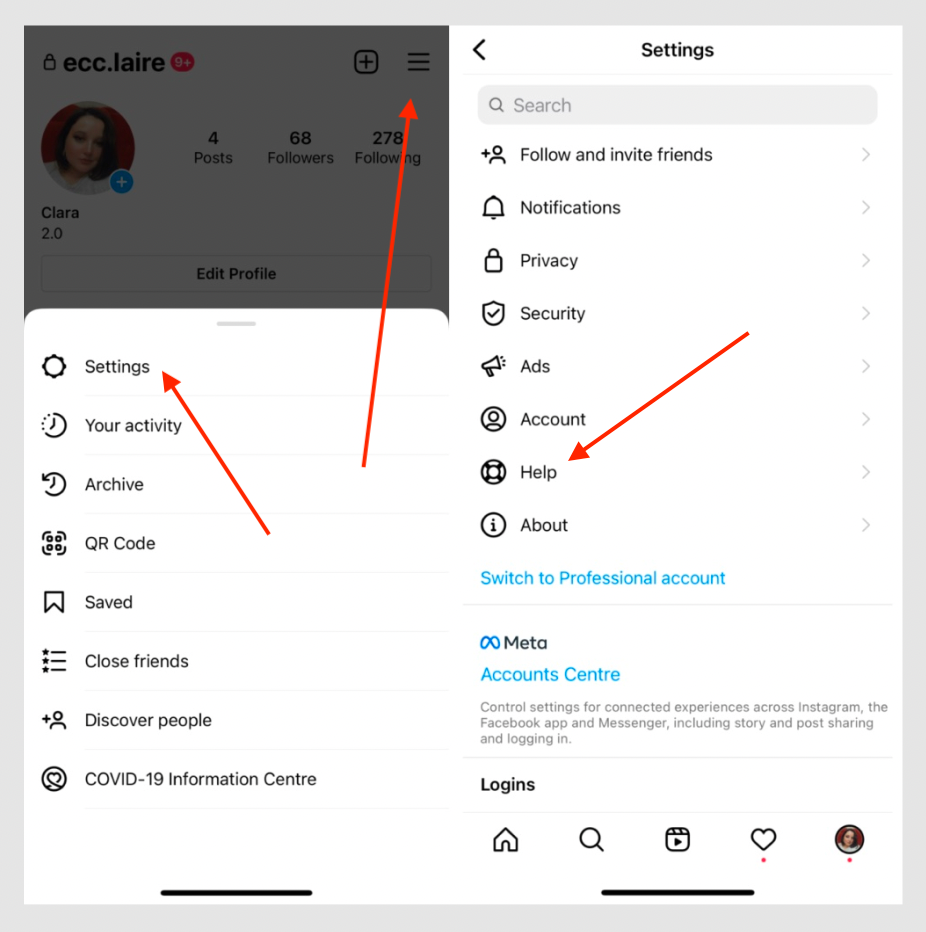
-----------2022-05-06---15.30.35.png" seoTitle: "What to Do When Your Instagram Ad Account Is Not Found" seoDescription: "Instagram Ad Account Missing? Don't Panic! Here's How to Fix It Fast." ---

When you encounter the error message indicating that your Instagram ad account is not found, it's essential to understand the possible reasons behind this inconvenience.
Having an Instagram ad account is crucial for businesses and individuals looking to promote their products or services on the platform and engaging with its customers. However, sometimes you may come across situations where your ad account seems to have disappeared. In such cases, we must investigate the matter further to determine the cause and find a solution.
There are several potential reasons why your Instagram ad account may disappear. Understanding these reasons can help you troubleshoot the issue more effectively. Here are a few common causes:
When your Instagram ad account is not found, you might encounter different error messages, each indicating a specific issue. Understanding these error messages can provide insights into the nature of the problem. Here are a few common error messages and their meanings:
Dealing with an Instagram ad account not found issue can be frustrating, but understanding the possible reasons and error messages can help you navigate through the problem more effectively. Remember to review your account settings, ensure compliance with Instagram's advertising policies, and report any technical issues to Instagram's support team for prompt resolution.
When faced with a missing Instagram ad account, there are a few initial steps you should take to assess and address the situation.
The first step is to verify the current status of your Instagram ad account. Check whether your account is still active or if it has been suspended or disabled for any reason.
Next, it's important to ensure that your account information is accurate and up to date. Make sure that your email address, contact information, and payment details associated with the account are correct.
If you are unable to address the issue on your own, reaching out to Instagram support can provide you with the necessary guidance and assistance to resolve the problem.
Instagram support is a dedicated team of professionals who are well-equipped to handle various user concerns. Whether you are experiencing login issues, encountering errors, or facing any other technical difficulties, reaching out to Instagram support can be the key to finding a solution.
You can contact Instagram support through their Help Center or by using the "Report a Problem" feature within the Instagram app. Accessing the Help Center will provide you with access to Frequently Asked Questions (FAQs) and troubleshooting guides.
The Help Center, as indicated above, is a comprehensive resource that covers a wide range of topics related to Instagram. From account security to privacy settings, you can find detailed information and step-by-step instructions to resolve common issues. It is a valuable tool that empowers users to troubleshoot problems independently.
If you are unable to find a solution through the Help Center, you can directly contact Instagram support by using the "Report a Problem" feature within the app. This feature allows you to submit a detailed description of the issue you are facing, providing Instagram support with the necessary information to assist you effectively.
When contacting Instagram support, it's important to provide them with relevant information to help them understand your issue better. Include details such as your account username, the error message you are seeing, and any steps you have taken to address the problem.
By providing accurate and detailed information, you increase the chances of receiving a prompt and accurate response from Instagram support. It allows them to assess the situation thoroughly and provide you with tailored guidance to resolve the issue.
Additionally, if you have encountered any error messages or unusual behavior on the app, make sure to include them in your communication with Instagram support. These details can provide valuable insights into the root cause of the problem and help the support team identify any ongoing technical issues.
Remember, Instagram support is there to assist you, so don't hesitate to reach out if you need help. They are committed to ensuring a seamless user experience and will work diligently to resolve any issues you may encounter.
While dealing with a missing ad account can be challenging, taking preventive measures can help you avoid similar issues in the future.
Here are a few preventive measures you should consider:
Ensure that you regularly review and update your account information, including your contact details and payment information. This will help maintain the accuracy and validity of your account.
By regularly updating your account information, you can ensure that any changes to your contact details or payment information are accurately reflected. This will help prevent any potential issues that may arise from outdated or incorrect information. Additionally, keeping your account information up to date will make it easier for Instagram or any other platform to reach out to you if there are any concerns or updates regarding your account.
Adhere to Instagram's advertising policies to prevent violations that could lead to your ad account being suspended or disabled. Familiarize yourself with these policies and ensure compliance with them at all times.
Instagram's advertising policies are designed to maintain a safe and positive experience for users. By familiarizing yourself with these policies, you can ensure that your ads meet the platform's guidelines and avoid any potential violations. This includes understanding the rules regarding prohibited content, targeting restrictions, and disclosure requirements. Staying informed about any updates or changes to these policies is also crucial to maintaining compliance.
Additionally, it is important to regularly review your ad campaigns to ensure they are aligned with Instagram's policies. This includes monitoring the content, targeting options, and engagement metrics to identify any potential issues or areas for improvement. By proactively addressing any concerns, you can prevent your ad account from being suspended or disabled, thus avoiding future issues.
Once you have identified the issue and contacted Instagram support, you may need to navigate the reinstatement process to regain access to your missing ad account.
When it comes to reinstating your ad account on Instagram, there are a few important steps to keep in mind. It's crucial to follow these steps closely to ensure a smooth and successful reinstatement process.
The first step in the reinstatement process is to reach out to Instagram support. They will guide you through the necessary steps to regain access to your missing ad account. It's important to provide them with all the relevant information and details about your account.
Once you have contacted Instagram support, they may require additional information or documentation to verify the ownership and legitimacy of your account. This could include providing proof of identity, proof of ownership, or any other documents that can support your case.
After submitting the required information, it's crucial to be patient. The reinstatement process may take some time as Instagram support reviews your case and makes a decision. During this waiting period, it's essential to be prepared for potential requests for further information or clarification.

During the reinstatement process, it's important to manage your expectations. While you may be eager to regain access to your ad account, it's crucial to understand that the process may take some time and patience.
Instagram support will carefully review your case and assess the information and documentation you have provided. They will consider factors such as the nature of the issue, the legitimacy of your account, and any previous violations or warnings.
It's important to note that every case is unique, and the reinstatement process may vary depending on the specific circumstances. Instagram support will communicate with you throughout the process, providing updates and requesting any additional information if necessary.
Remember to check your email regularly during the reinstatement process, as Instagram support may reach out to you for further details or clarification. It's crucial to respond promptly and provide the requested information to expedite the process.
While waiting for the reinstatement decision, it's a good idea to review your account and ensure that you are in compliance with Instagram's policies and guidelines. This includes reviewing your ad content, ensuring it meets the platform's advertising standards, and addressing any potential issues or violations.
You can always leave your social media advertising Sarategy in the hands of the experts, ideally a social media agency. But, by following the instructions provided by Instagram support and being patient throughout the reinstatement process, you increase your chances of successfully managing any problems, like a missing ad account.
Experiencing a missing Instagram ad account can be a frustrating situation. By following the steps outlined above and reaching out to Instagram support for assistance, you can increase your chances of regaining access to your account. Additionally, taking preventive measures and staying compliant with Instagram's advertising policies can help you avoid similar issues in the future. Remember to remain patient and cooperative throughout the process, as reinstating your ad account may take some time.


.svg)