
In the age of rapid digital transformation, AI has seeped into almost every industry, revolutionizing how we conduct business, design products, and even create content. The ClusterMagic service is a great example, which seamlessly integrates AI for content generation in a hybrid model, providing significant benefits in the SEO results of brands seeking a massive increase in organic traffic. But while AI holds immense promise, it has its limitations. Let's explore the pros and cons of using AI for content creation and understand why a hybrid approach might be the way forward.
Major publishers in sensitive niches like CNET.com, Bankrate.com, and Creditcard.com have already integrated AI-generated content. Other large companies, such as CNN and Forbes, might also be doing so. Countless smaller companies and publishers are utilizing AI, not only on their websites but also on social media, in email marketing, and virtually everywhere else.
Google's stance on AI-generated content is neutral, emphasizing that content should primarily be user-centric. In fact, Google's September 2023 Helpful Content Update removed the mention of "written by people" from their helpful content system guidelines.
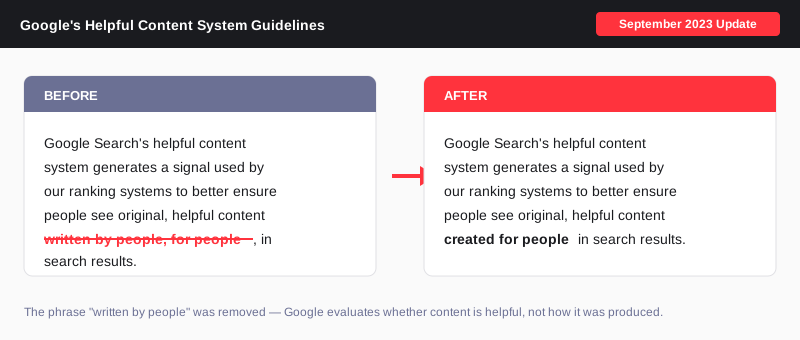
The message is clear: for content to rank well, it must be informative, answer users' queries satisfactorily, and showcase genuine expertise - regardless of how it's created.
AI Content Detectors like GPTZero, ZeroGPT, and many others are not reliable. Even OpenAI has said as much. They consistently produce false positives about human-written content. Conversely, they can be easily fooled with creative prompting or a bit of human editing.
An interesting note from OpenAI: "we found that it labeled human-written text like Shakespeare and the Declaration of Independence as AI-generated."
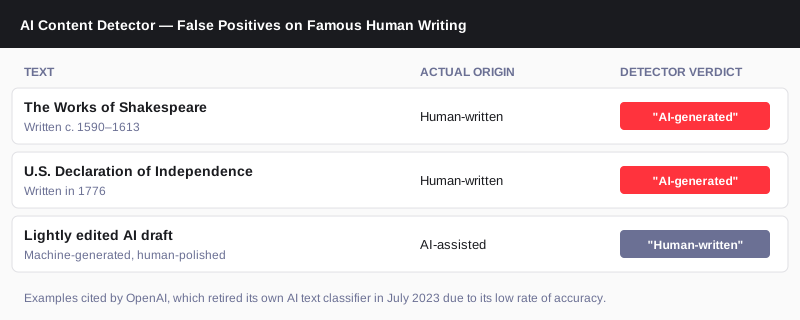
Anecdotal evidence and real-life ranking data suggest that while AI-generated content isn't penalized by search engines, it might only achieve high rankings if it meets the above criteria. The role of AI in content creation is still a developing narrative, and its significance is indispensable for maintaining a competitive edge in the future.
At EmberTribe, the understanding is clear - AI serves as a foundation, not the final product. With ClusterMagic, while AI aids in the initial draft based on expert-driven keyword research, human experts step in for the crucial phases of editing, fact-checking, and final review. This hybrid approach ensures the content is accurate and helpful, has the potential to rank, and truly represents their business.

The debate between SEO and PPC has been running for over a decade, and it largely misses the point. The real question isn't which channel to choose — it's how to sequence and combine them to maximize results across different time horizons.
Most growth-stage companies either go all-in on paid search (fast traffic, high cost, zero long-term equity) or commit exclusively to SEO (slow ramp, compounding returns, poor short-term results). The businesses that outperform their competitors in search understand that SEO and PPC services serve different functions in the same growth system, and that they're more effective together than either is alone.
This guide breaks down when each approach works, when to combine them, and what a coordinated SEO and PPC strategy actually produces.
Before comparing them, it's worth being precise about what each channel does.
SEO (Search Engine Optimization) improves your organic search rankings through content quality, technical site health, and authority signals (backlinks). It costs primarily in time and labor, delivers no results for months, and then compounds as rankings accumulate and traffic grows without additional spend.
PPC (Pay-Per-Click) places paid ads at the top of search results through Google Ads or Microsoft Advertising. You pay each time someone clicks. Results are immediate and highly controllable, but the moment you stop spending, the traffic stops completely. There's no residual asset.
The core trade-off: PPC buys attention now; SEO builds ownership of attention over time.
PPC services are the right primary investment when:
You need immediate traffic or leads. A new product launch, a seasonal campaign, or a business that simply can't wait 6–12 months for organic results. Google Ads can deliver first-page visibility the same day a campaign goes live.
You're testing messaging and offers. PPC is the fastest feedback loop in digital marketing. You can test five different value propositions, landing page variants, and calls to action against real buyer behavior within weeks — data that would take months to accumulate organically.
You're targeting high-intent, bottom-of-funnel searches. Terms like "buy [product] online," "emergency [service] near me," or "[software] pricing" signal immediate purchase intent. Capturing these through paid ads while your organic rankings develop is a sound strategy.
The competitive landscape makes fast organic gains unlikely. If you're entering a category dominated by established brands with years of SEO investment, the gap to organic Page 1 may be too large to close quickly. PPC lets you compete in the meantime.
SEO services deliver the best returns when:
You're playing a long-term game. Research consistently shows that beyond the 12-month mark, organic traffic typically costs significantly less per lead than paid traffic — because you've already made the investment and rankings continue generating traffic without additional spend.
Your content can create demand, not just capture it. Some buying journeys start with educational questions, not product searches. A potential customer searching "how do I reduce customer churn" is earlier in the funnel than one searching "best customer success software," but they're still a valuable audience. SEO content targeting these earlier-stage queries builds brand awareness and trust before the buying decision happens.
Your category has high sustained search volume. Industries where buyers consistently search for the same terms — ecommerce, SaaS, professional services — have the stable search demand that SEO compounds best against.
For a deeper look at organic search strategy for online retailers, our ecommerce SEO guide covers the full framework.
The most significant insight from running both channels is what happens when you appear in both paid and organic positions on the same keywords.
Aligning SEO and PPC on the same queries means your brand occupies more real estate on the SERP — and the combined presence is greater than the sum of its parts. Dominant presence in both organic and paid results creates authority signals that increase trust, reduces the share of clicks going to competitors, and compounds the value of ranking in either channel.
One of the most underused benefits of running SEO and PPC services simultaneously is the intelligence flow between them.
PPC campaigns generate granular conversion data at the keyword level within days. You can see exactly which search terms are generating form submissions, calls, or purchases — and at what cost. This data is directly actionable for SEO: the highest-converting PPC keywords are the ones most worth pursuing in organic, because you've already validated they convert.
Running both channels simultaneously creates a compounding data advantage. PPC validates which organic terms to pursue. Organic data shows which content topics resonate with your audience, which informs better PPC ad copy. Each channel improves the other.
The right balance between SEO and PPC investment changes over time:
Early stage (0–6 months): PPC-heavy. Get traffic and conversion data quickly. Use that data to identify which organic content to build. Begin foundational SEO work in parallel.
Growth stage (6–18 months): Balanced. Continue PPC for high-intent terms while organic rankings start delivering for mid-funnel content terms. Shift budget from PPC toward SEO on any terms where organic has achieved Page 1 ranking.
Mature stage (18+ months): SEO-heavy with PPC as amplifier. Use paid search for competitive terms where organic ranking is difficult, seasonal campaigns, and new offer launches. Let organic carry the bulk of consistent traffic at lower cost.
Beyond budget allocation, here are the specific ways coordinated SEO and PPC services produce better results than either channel managed in isolation:
Keyword intelligence sharing. PPC keyword reports identify converting terms for SEO targeting. Organic ranking data identifies terms worth bidding on for brand protection.
Landing page testing. PPC campaigns can A/B test landing pages at a pace SEO can't match. High-converting PPC landing pages become templates for organic content pages.
Retargeting organic visitors. Users who found you through organic search can be retargeted with paid ads — bringing them back into your funnel with a more specific offer than their original informational search.
Coverage on competitor terms. SEO can't rank for a competitor's brand name organically. PPC can run ads on competitor keywords, capturing buyers who are actively evaluating alternatives.
Seasonal and launch campaigns. Even brands with strong organic rankings benefit from PPC for product launches, limited-time offers, or seasonal spikes where you need to reach people who aren't already in your organic audience.
When looking for agencies or consultants to manage these services, a few key questions separate good providers from mediocre ones:
For growth-stage ecommerce brands, our post on PPC management for ecommerce covers how to evaluate paid search partners for your specific context.
When SEO and PPC run in parallel, the metrics that matter most are cross-channel:
The goal of combined SEO and PPC services isn't to reduce one channel while growing the other — it's to grow total search-driven revenue while improving efficiency over time as organic compounding reduces dependence on paid spend.
The brands winning in search in 2026 aren't choosing between SEO and PPC — they're sequencing them intelligently and using each to improve the other.
PPC delivers immediate results and conversion data. SEO builds compounding organic equity. Run together, they create SERP dominance that neither channel achieves alone, plus an intelligence-sharing feedback loop that makes both more efficient.
The right balance depends on your stage, timeline, and available budget. But in most cases, the answer to "should we do SEO or PPC?" is: start with both, calibrate the ratio over time, and let the data from each channel drive the strategy in the other.
The SEO industry has a credibility problem. It's one of the few disciplines where almost anyone can claim expertise, promise dramatic results, and collect payment for months before it becomes clear they're not delivering. By the time you realize a bad hire isn't working, you've lost time, budget, and organic ground.
Finding genuine SEO experts requires knowing what separates real skill from convincing sales pitch. This guide gives you a framework for doing that.
Before you can evaluate SEO experts, it helps to know what you're evaluating for. In 2026, effective SEO requires competence across several distinct areas:
Technical SEO: Site architecture, crawlability, indexing, Core Web Vitals, schema markup, and the ability to identify and fix problems that prevent Google from reading and ranking your content.
Content strategy: Keyword research that connects to search intent, content gap analysis, and the ability to build topical authority — not just individual pages that rank in isolation.
Link acquisition: Understanding how to earn editorially placed links through content, PR, and relationships — not link schemes that trigger penalties.
Analytics and measurement: GA4, Google Search Console, and the ability to connect organic traffic changes to actual business outcomes like revenue and leads.
AI search optimization: In 2026, search engine positioning increasingly includes being cited by AI tools like Google's AI Overviews, ChatGPT, and Gemini. Competent SEO experts understand how to optimize for this new layer of discoverability.
Generalist "we do everything" operators rarely have deep skill in more than one or two of these areas. The best SEO experts either go deep in a specific area or build teams with distinct specializations.
The answer you want: a clear narrative that includes the initial state, the diagnosis, the strategy, specific tactics executed, and measurable outcomes — ideally over a 6–12 month period. They should be able to explain causality, not just correlation.
The answer to be wary of: vague references to "driving traffic" or "improving rankings" without specific numbers, timelines, or attribution.
Strong SEO experts will ask clarifying questions before answering — your CMS, hosting setup, site size, and history of technical problems all shape the approach. If they launch into a generic answer immediately, they're reciting a script.
Ask for an example technical audit they've done. A real audit includes prioritized findings, specific URLs, and a clear diagnosis — not a printout from a free online tool.
Organic revenue matters more than traffic volume. An SEO expert worth hiring connects their work to business outcomes: revenue from organic, leads generated, cost-per-acquisition from organic vs. paid. If the primary success metrics are rankings and impressions, that's a signal they're optimizing for inputs rather than outputs.
This is where pretenders usually reveal themselves. Legitimate answers involve content-driven link acquisition, digital PR, and building assets worth linking to. Red flags include promises of guaranteed DA-60+ links, link packages sold at fixed prices, or vague references to "our network."
Google's E-E-A-T guidelines — Experience, Expertise, Authoritativeness, Trustworthiness — are the framework Google uses to evaluate content quality. Content written and edited by skilled human writers with genuine subject matter expertise consistently outperforms AI-generated bulk content. Ask any SEO expert how they ensure content quality, and what role AI plays in their workflow vs. human editorial oversight.
Guaranteed rankings. No legitimate SEO expert guarantees page-one rankings. Anyone who does is either lying or planning to use tactics that will eventually trigger a Google penalty.
"Results in 30 days." Technical fixes can show impact quickly. Meaningful organic traffic growth takes 3–6 months at minimum, often longer in competitive categories. Fast promises are almost always false.
Vague case studies. "We've worked with companies like yours" without verifiable examples — named clients, actual metrics, or references you can contact — is not a case study. It's a placeholder.
No interest in your business. Competent SEO experts need to understand your customers, purchase journey, competitive landscape, and existing site before they can build a useful strategy. If the sales process skips this entirely and goes straight to a proposal, the proposal is generic.
One-size-fits-all packages. SEO for a 5,000-page ecommerce site looks nothing like SEO for a 30-page SaaS site. Fixed packages that don't account for your specific situation are a sign that work will be templated, not tailored.
They want to own your analytics accounts. A legitimate SEO partner works within accounts you own — Google Analytics, Google Search Console, Google Business Profile. If they want to create or control these assets under their accounts, they're creating leverage over you, not delivering service.
An SEO expert who can't rank their own site deserves skepticism. Run their domain through a tool like Ahrefs or Semrush to see their traffic trends, top pages, and backlink profile. This takes five minutes and tells you a lot.
Get 2–3 client references and call them. Don't just ask "are you happy with the work?" Ask: "What did organic revenue look like before and after working with them?" and "Were there any surprises or moments where they got something wrong, and how did they handle it?"
Ask to see an example technical audit, content brief, or keyword research document before signing. This shows you the quality of their thinking before you're committed.
A credible SEO partner will set up access to your Google Search Console and Analytics before starting work, conduct a thorough onboarding to understand your business, and commit to regular reporting that you can verify independently. Opacity is a red flag at every stage.
For most DTC and growth-stage companies, a specialist — an agency or expert who focuses specifically on ecommerce SEO or your industry vertical — outperforms a generalist. The tactics that work for a local restaurant are different from those that drive traffic for a $5M Shopify brand competing nationally.
That said, specialists can create blind spots. An expert who only thinks about SEO in isolation, without considering how organic integrates with paid, email, and conversion rate optimization, will miss opportunities that a more integrated growth marketing approach would catch.
The best configuration for most growth-stage brands: a specialist for execution, with strategic oversight that connects SEO to the broader acquisition and retention picture. Google Search Console should be set up and accessible to you before any engagement begins.
Setting realistic expectations is part of evaluating SEO experts. In a competitive category, here's a reasonable timeline:
Any expert who promises dramatically faster results should explain precisely why your situation is different from the norm. Vague optimism isn't a strategy.
The difference between SEO experts who drive results and those who burn budget comes down to specificity: specific case studies, specific diagnoses, specific metrics. Vagueness at the evaluation stage is a reliable predictor of vagueness in the work.
Hire based on demonstrated outcomes in relevant contexts, verified references, and a clear methodology for connecting their work to business results. Run from anyone promising guarantees, fast results, or link packages.
Done right, SEO compounds in a way few other channels match — organic traffic you build this year becomes baseline traffic next year, without paying for every click.

Hiring the wrong paid search help is expensive — not just in fees, but in wasted ad spend. If you're evaluating whether to bring in a search engine marketing consultant, you've probably already noticed that the market is noisy: freelancers, boutique agencies, and generalist consultants all claim to do the same work. They don't.
This guide breaks down what a search engine marketing consultant actually does, how they differ from an agency, what realistic costs look like, and the specific qualities that separate effective consultants from expensive ones.
A search engine marketing (SEM) consultant is a specialist who manages, optimizes, and strategizes paid search programs — primarily Google Ads and Microsoft Ads — for companies that want measurable returns from their ad spend.
Unlike a general digital marketing consultant who operates at a broad strategic level, an SEM consultant goes deep on a single channel. Their core responsibilities typically include:
Some SEM consultants also handle SEO, but the best ones specialize. If you need both, you'll often get better results hiring specialists for each or working with an integrated growth agency.
This is the most common question brands ask when they're scaling their paid search. Here's an honest breakdown.
Consultants tend to be more agile, more affordable, and more personally invested in results. The tradeoff is capacity: a solo consultant has limits on how many accounts they can actively manage at quality.
The middle ground — boutique growth marketing agencies — often gives you the best of both worlds: specialist-level expertise with the team infrastructure to execute at scale.
Pricing varies significantly based on experience, scope, and engagement type. Current benchmarks:
Hourly rates: $75–$200/hour is the typical range for experienced SEM consultants. Junior consultants start around $50/hour; seasoned specialists with a strong track record bill $150–$250+.
Monthly retainers: For ongoing account management and optimization, expect $1,500–$5,000/month for small-to-mid-size accounts. Accounts with $50K+ in monthly ad spend often warrant $5,000–$10,000/month.
Project-based work: One-time audits typically run $500–$2,500 depending on account complexity. Full strategy buildouts and onboarding projects generally fall in the $2,000–$8,000 range.
In-house alternative: For comparison, a full-time paid search manager in the US costs $70,000–$110,000 in annual salary before benefits, tools, and management overhead. A consultant is almost always more cost-efficient until your account volume justifies a dedicated hire.
The credentials that matter aren't always the ones consultants lead with. Here's what to actually evaluate:
Ask for real examples — not case studies, not screenshots, but a live walkthrough of an account they've managed. You want to see how they think about structure, how they handle underperforming campaigns, and what questions they ask before making changes.
If a consultant can't tell you exactly how they'll verify your conversion tracking before touching your campaigns, walk away. Bad attribution is the source of most wasted ad spend, and it requires a methodical approach to fix.
Paid search isn't instant. New campaigns typically need 60–90 days to exit the learning phase and generate reliable data. Any consultant promising results in two weeks is either managing expectations poorly or setting you up for disappointment.
You should own your data. The consultant should be working in your Google Ads account (not a separate one they control), and reporting should be tied to metrics that connect to revenue — not just impressions or clicks.
Google Ads certification is a baseline, not a differentiator. More meaningful signals include: active management of at least 5–10 live accounts, direct experience in your industry vertical, and a track record of improving ROAS or CPA over a 6–12 month window.
At EmberTribe, we work with growth-stage DTC brands that need their paid search programs tied directly to revenue — not managed in isolation from their broader marketing system. That means SEM strategy built around conversion tracking, landing page performance, and audience segmentation that connects paid and organic channels together.
If you're evaluating whether paid search is underperforming or if you're starting from scratch, the first step is usually an account audit — diagnosing what's working, what's wasted, and where the clearest growth levers are.
The best SEM consultants are usually too busy to be actively promoting themselves. The most reliable sourcing paths:
Before hiring, run a paid interview: pay them for a 2-hour account audit. You'll learn more from that session than from any proposal or reference call.
A skilled search engine marketing consultant can deliver significant ROI — but only if the fit is right for your stage, scope, and goals. The consultant-vs-agency decision isn't about prestige; it's about matching the level of execution you need with someone who can actually deliver it. Vet on process, track record, and transparency. The right hire makes your ad spend dramatically more efficient; the wrong one costs you months and budget you won't easily recover.
For brands that want SEM embedded in a broader paid and organic growth system, exploring how paid search integrates with channels like ecommerce CRO and conversion optimization and ecommerce growth strategy often surfaces the fastest wins.
Most B2B SaaS pipelines have the same structural problem: turn off the paid ads, and the leads disappear. That's not a pipeline — it's a purchase order for attention.
SaaS demand generation done right creates pipeline that compounds. It builds brand presence in the channels where your buyers actually research decisions, generates inbound interest from content and community rather than from clicks, and produces leads that convert at higher rates because they already understand what you do and why it matters.
This guide covers how to build a SaaS demand generation strategy that doesn't collapse the moment your paid budget is cut.
These terms get used interchangeably, but they describe different activities with different timelines.
Lead generation is transactional. You run a campaign, someone fills out a form, you get a contact. The buyer may or may not be ready to purchase. The relationship starts at the conversion event.
Demand generation is upstream. It's about creating awareness, building credibility, and shaping how potential buyers think about the problem your product solves — before they're even in buying mode. When done well, demand generation means that when a buyer is finally ready to evaluate solutions, your brand is already in the consideration set.
The consensus among B2B marketers is that most demand generation budgets are heavily weighted toward demand capture — capturing people who are already searching — with far less going toward demand creation. That ratio is almost exactly backwards from what drives optimal pipeline.
The SaaS companies that are winning pipeline in 2026 have invested in demand creation. Here's how they're doing it.
Organic content is the most durable demand generation channel available to SaaS companies. Done correctly, a blog post, case study, or comparison page generates qualified traffic every month for years — with no incremental cost per visitor.
The key distinction: most SaaS content marketing is built around keywords, not around buyer education. Those are different strategies. Keyword-driven content targets people already searching for something; buyer education content creates awareness for people who don't yet know they have a problem your product solves.
A strong SaaS content strategy includes both. High-volume search terms bring in buyers at the evaluation stage. Educational content on adjacent topics pulls in buyers earlier in the journey and builds the brand authority that accelerates trust during the sales process.
For more on building this type of system, our post on SaaS content marketing strategy covers the framework in depth.
A significant share of B2B buyer research happens in channels you can't directly track: private Slack communities, LinkedIn DMs, peer conversations, and niche podcasts. This is "dark social" — influence that doesn't show up in your attribution model but drives purchase decisions constantly.
Getting into these channels requires investment in presence, not just in paid placement. Tactics that work:
The companies that win in dark social are consistently helpful before they're ever promotional.
If your product has a freemium tier or free trial, it's one of your most powerful demand generation assets — and often underused as such.
Product-led growth compresses the sales cycle by letting buyers experience value before the sales conversation begins — and free trials are consistently among the highest-converting demand generation tactics for B2B SaaS. The demo becomes a conversation about expansion, not a pitch from zero.
PLG also generates organic word-of-mouth when the product is good. Users recommend tools they use to peers in those dark social channels mentioned above. Every satisfied free-tier user is a potential demand generation asset in their professional network.
Being in the right ecosystem puts you in front of buyers who are already spending in your category.
Integrations with platforms like Salesforce, HubSpot, or Slack expose your product to buyers who are actively looking for complementary tools. A listing in a marketplace (HubSpot App Marketplace, Salesforce AppExchange) functions as inbound demand generation with no ongoing ad spend.
Co-marketing with adjacent SaaS products — joint webinars, co-authored guides, shared distribution lists — can reach audiences you'd otherwise need to pay to access. These partnerships work best when both products serve the same ICP without competing directly.
Traditional demand generation casts wide. Account-based marketing (ABM) reverses the funnel — you identify target accounts first, then build demand within those specific organizations.
For SaaS companies with a defined ICP and a sales team capable of working enterprise or mid-market accounts, ABM can dramatically improve pipeline quality. Rather than generating hundreds of low-fit MQLs, ABM generates fewer, higher-converting opportunities from accounts already identified as good fits.
ABM tactics include targeted LinkedIn campaigns to specific job titles at named accounts, direct outbound sequences triggered by intent signals, and personalized content delivered to specific organizations. A B2B demand generation agency with ABM experience can help structure this program without requiring a large internal operations team.
Organic demand generation requires infrastructure to capture and nurture the interest it creates:
Marketing automation. Email nurture sequences that educate buyers over weeks or months, not a single follow-up after a form submission.
Intent data. Tools like G2, Bombora, or 6sense identify accounts that are actively researching your category — even before they've visited your site. This turns demand generation activity into a signal you can act on with outbound.
Content distribution. Creating content is only half the work. Systematic distribution through LinkedIn, email newsletters, partnerships, and republication platforms determines how much of your audience actually sees it.
Attribution that accounts for dark social. Standard last-click attribution will chronically undervalue demand generation. Building in a self-reported attribution question ("How did you hear about us?") alongside your standard UTM tracking gives a more accurate picture of what's actually working.
Demand generation operates on longer timelines than lead generation, which means the metrics that matter are different:
If you're only measuring MQL volume and CAC, you're measuring demand capture, not demand generation. The upstream metrics reveal whether you're building durable pipeline or renting it.
This isn't an argument against paid advertising. It's an argument against building your entire pipeline on it.
Paid ads are excellent for amplifying content that's already performing, retargeting audiences who have engaged with your organic channels, and accelerating demand capture for buyers who are actively in-market. They're a poor foundation for demand generation because they generate no durable asset — the moment you stop paying, the exposure stops.
The optimal SaaS demand generation model uses paid as an accelerant on top of an organic foundation: content and community build brand presence and trust; paid distribution amplifies the content that's already resonating; retargeting converts the intent that organic has built.
Our team at EmberTribe structures demand generation programs for growth-stage SaaS companies around this model — building the organic infrastructure first, then layering in paid where it compounds existing momentum. For more on how pipeline generation fits into a broader B2B SaaS lead generation playbook, see our full guide on that topic.
The brands that win B2B SaaS pipeline in 2026 aren't the ones running the most ads. They're the ones that buyers already know, trust, and have heard about from peers — before the first sales conversation.
SaaS demand generation built on content, community, and product creates pipeline that compounds over time. It fills the top of funnel with buyers who already understand your value proposition, shortens sales cycles, and reduces dependence on paid channels that are getting more expensive every year.
The infrastructure takes longer to build than a Google Ads campaign. The returns last longer, too.
Start with one channel — typically content SEO or community — and build the distribution and automation to capture the demand it generates. Then add channels systematically. Three years from now, you'll have a pipeline that doesn't disappear when the quarterly budget gets cut.

PPC management companies run and optimize pay-per-click advertising campaigns on behalf of businesses. But "management" covers a wide range of actual services — and two agencies with identical pricing and similar pitches can deliver dramatically different results.
This guide explains what PPC management companies actually do, how they price their work, and what to look for when you're evaluating your options.
The core scope of a PPC management engagement covers more than just "running ads." A full-service PPC management company typically handles:
Before any campaign goes live, a PPC company should be building the structural foundation: defining campaign types (Search, Shopping, Display, Performance Max), segmenting by intent (branded, non-branded, competitor), organizing ad groups around tightly themed keyword clusters, and setting match type strategies.
Poor campaign architecture is one of the most common reasons accounts underperform. An account with a handful of broad-match ad groups will waste a significant portion of its budget on irrelevant traffic — and many businesses never diagnose the root cause because the reporting looks acceptable on the surface. Understanding Google's ad auction system is essential context for evaluating whether an agency's structural decisions actually serve your goals.
Initial keyword research identifies the terms your potential customers are actually searching. Ongoing refinement — reviewing the search terms report weekly, adding negative keywords, and identifying emerging opportunities — is what keeps an account efficient as time goes on. How an auction-based system like Google Ads works directly affects which keywords are worth bidding on and at what price.
Whether using manual bidding or Google's Smart Bidding strategies (Target CPA, Target ROAS, Maximize Conversions), bid management requires active oversight. Automated bidding isn't set-and-forget — it needs sufficient conversion data to work, and it needs monitoring to catch cases where the algorithm optimizes for the wrong signals.
Search ads live and die by their copy. PPC management companies write, test, and iterate on headlines and descriptions across Responsive Search Ads. For display and shopping campaigns, they manage asset libraries and test creative variations to identify what drives the strongest click-through and conversion rates.
The best PPC companies review and often guide improvements to landing pages, because ad click → landing page → conversion is a single funnel. An ad that generates strong CTR but sends traffic to a generic page bleeds conversion rate. Some agencies offer landing page design as a service; most at minimum consult on page structure, messaging, and CTA.
Monthly (minimum) reporting that goes beyond automated dashboards. Good reporting tells you what changed, why, and what the agency is doing about it — not just a data dump of the same metrics.
There's no single standard pricing model. Here are the four main structures you'll encounter:
The most common model. The agency charges 10–20% of your monthly ad spend as their management fee. At lower spend levels, there's usually a minimum retainer to make the engagement viable for the agency — typically $500–$1,000/month.
Who it works for: Growing brands where ad spend is likely to increase over time. As you scale, the percentage often decreases.
Watch out for: Incentives to increase spend without a corresponding increase in efficiency. Ask how your agency measures success — if it's primarily spend volume, that's misaligned.
A fixed fee regardless of spend level. Often $500–$2,500/month for small-to-mid accounts.
Who it works for: Businesses with stable, predictable budgets who want cost certainty.
Watch out for: Retainers that are too low to justify genuine management time. A $500/month retainer might mean your account gets a few hours of attention. Ask what the deliverables include and how many hours are built in.
A base retainer covering core management work plus a performance percentage above a spend threshold. This structure attempts to align agency incentives with client growth — they earn more when you scale, but you're not paying inflated percentages on high ad spend from day one.
Who it works for: Mid-market brands with ambition to grow spend significantly over a 12-month period.
The agency is compensated based on results — conversions, leads generated, or revenue attributed. In theory, this aligns incentives perfectly. In practice, it's uncommon with reputable agencies because too many variables outside the agency's control (product quality, price competitiveness, site experience, demand seasonality) affect conversion outcomes.
If a PPC company leads with performance-based pricing, ask exactly how attribution is measured and what happens when external factors suppress results.
Management fees are only part of the total cost of working with a PPC management company. Factor in:
With dozens of agencies in any geographic market and hundreds more operating nationally, the evaluation process is where most businesses get stuck. Here's a practical framework:
Before evaluating agencies, get specific about what success looks like for you. Not "more leads" — but: what's your target cost per lead or CPA? What's your current performance baseline? What's your monthly ad budget? What verticals and geographies matter?
Agencies that receive a clear brief produce better proposals. More importantly, a clear brief exposes which agencies actually tailored their response versus sent a template.
PPC strategy varies significantly by vertical. The keyword intent, funnel dynamics, and competitive landscape for B2B SaaS lead generation are completely different from ecommerce PPC management. An agency that has managed campaigns in your category — with case studies at comparable spend levels — will ramp faster and avoid learning-curve mistakes on your budget.
Confirm upfront that you will own your Google Ads account and all the data in it. Some agencies build campaigns in their own manager accounts and retain control of your campaign history, audiences, and conversion data. Google's manager account structure means ownership can be transferred — but only if it was set up correctly from the start. Losing that data when you leave an agency can cost months of performance.
Ask to see a sample monthly report. You're looking for: was this generated automatically, or did a human analyze it? Does it explain changes in performance, not just report the numbers? Does it include recommendations for the coming month?
A report that a machine generated in 30 seconds costs you in decision-making quality. A report that required an analyst to sit with your data costs more but produces better outcomes.
Specifically: who will manage your account, how many accounts do they run, and what is their background? An account manager handling 40 clients cannot give any one account meaningful strategic attention. The ratio that predicts quality work is roughly 10–15 accounts per manager, depending on complexity.
Once you've shortlisted two or three agencies:
At EmberTribe, our paid search engagements start with a thorough audit of existing campaign structure and conversion tracking before we touch bids or budgets. The most expensive thing you can do is spend money on a broken foundation — and auditing first is the fastest way to know what you're actually working with.
When you find the right partner, PPC management fees become one of your better investments — because expert management compounds over time. Better campaign architecture, more efficient bids, stronger creative, and cleaner conversion data build on each other quarter over quarter.
The goal isn't to find the cheapest PPC management company. It's to find the one where the output value exceeds the input cost by a margin that justifies the engagement.
That math is very achievable with the right partner and very difficult with the wrong one.
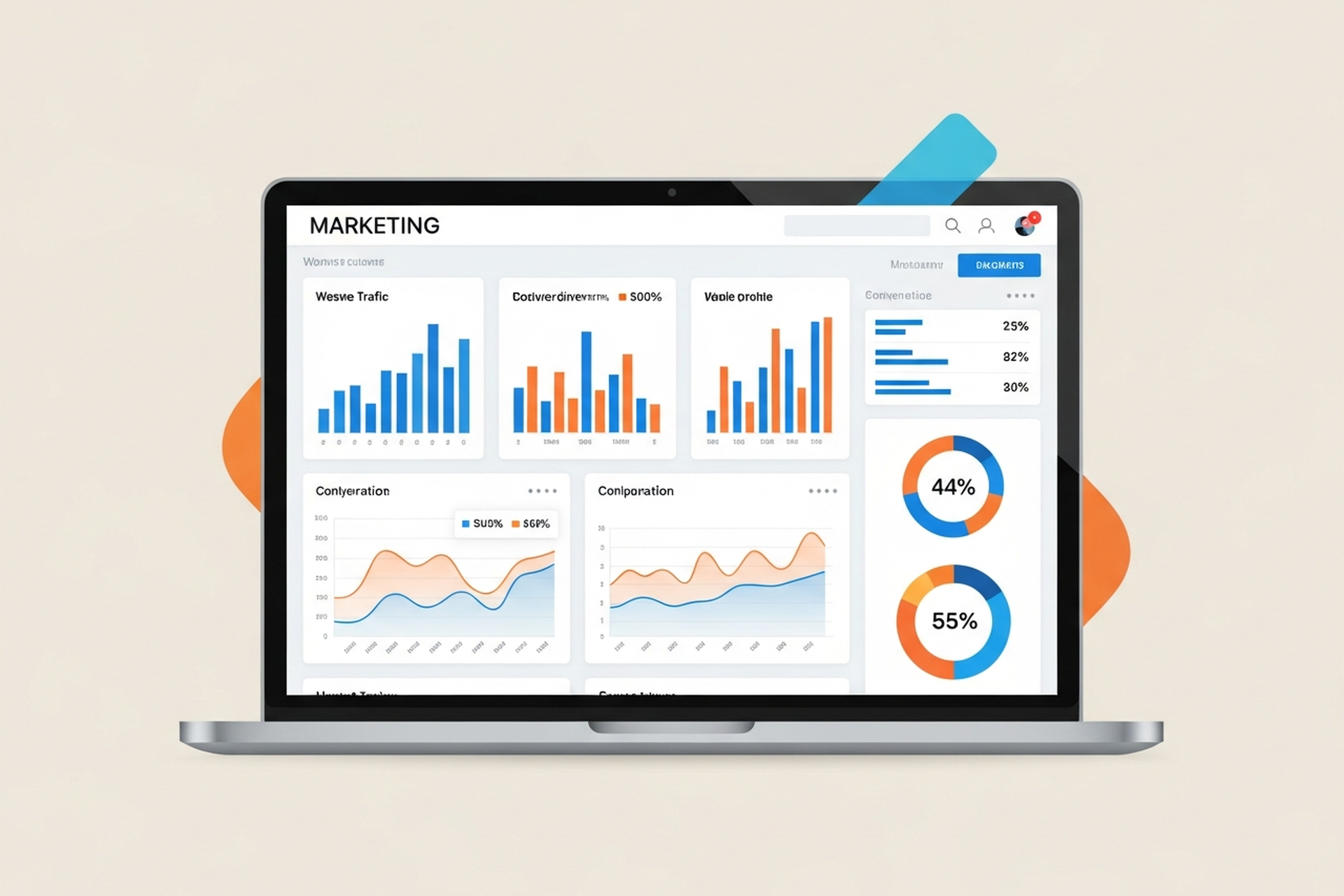
The marketing analytics tools market hit $5.4 billion in 2026, nearly doubling from $3.1 billion five years earlier. That growth reflects both increased demand for data-driven decision-making and an increasingly fragmented landscape of tools competing for budget.
The result: most marketing teams have too many analytics tools, not too few — and still don't have clear answers to the questions that matter most.
This guide cuts through the stack bloat. It covers the core categories of marketing analytics tools, what each does well, and how to evaluate what your business actually needs at its current stage.
Marketing analytics tools fall into three distinct functional categories. Understanding what each category does prevents the most common mistake: buying attribution software when you need better web analytics, or layering on a dashboard tool when the underlying data is broken.
Web analytics platforms track what happens on your website — pages visited, sessions, bounce rates, on-site behavior, and conversion events. They're the foundation layer of your measurement stack.
Google Analytics 4 (GA4) is the dominant free option and the starting point for most businesses. Its event-based model is significantly more flexible than Universal Analytics, but the setup requires more intentionality — the default configuration tracks very little that's actually useful.
Adobe Analytics is the enterprise alternative: more customizable, more expensive, and built for large organizations with dedicated analytics teams. For most growth-stage brands, it's overkill.
Heap and Mixpanel take a different approach — retroactive event tracking means you can analyze user behavior that happened before you thought to track it. These are particularly useful for SaaS and subscription businesses trying to understand product engagement.
What to look for: accurate session attribution, custom event tracking, and the ability to build conversion funnels that map to your actual customer journey — not just generic page views.
Attribution platforms answer the question web analytics can't: which marketing touchpoints actually drove revenue? In a world of multi-channel acquisition, understanding how channels interact is the difference between doubling down on what works and cutting budget from channels that are quietly driving sales.
The challenge is that attribution is fundamentally hard. iOS privacy changes, browser restrictions on third-party cookies, and the inherent complexity of multi-touch journeys mean no attribution model is perfectly accurate. The goal is "directionally correct" — accurate enough to make better budget decisions.
Key platforms in 2026:
Triple Whale — Built specifically for Shopify brands. Pulls in ad platform data, on-site analytics, and post-purchase surveys into a unified view. Strong for DTC brands running paid social, Google, and email.
Northbeam — Deterministic attribution with media mix modeling. Well-suited for brands spending $500K+ per year across channels who need accurate cross-channel attribution that doesn't rely on cookies.
SegmentStream — Incrementality-focused attribution using machine learning. Particularly strong for brands where last-click attribution consistently undercredits upper-funnel channels like YouTube or branded search.
Rockerbox — A solid mid-market option that centralizes ad spend data with multi-touch attribution models and solid integrations.
One critical insight: attribution accuracy depends more on data infrastructure than the model itself. A sophisticated model applied to poor data produces poor insights. Get your event tracking right before investing in an advanced attribution platform.
Dashboards aggregate data from multiple sources — ad platforms, web analytics, CRM, email — into unified views that make cross-channel performance visible without running exports from six different tools.
Looker Studio is free and integrates natively with Google products. For teams already running GA4 and Google Ads, it's often sufficient.
Supermetrics is a data connector that pulls ad platform and analytics data into spreadsheets, Looker Studio, or BI tools. Useful for teams that want custom reporting without full BI infrastructure.
Power BI and Tableau are full business intelligence platforms. They're appropriate when you have a dedicated analyst or data team and need to blend marketing data with CRM, inventory, or financial data.
Domo and Klipfolio sit in the middle — more powerful than basic dashboards, less complex than full BI tools, and well-suited for marketing teams that want automated reporting without an analytics engineering function.
The most useful framework for choosing marketing analytics tools is to start with the decisions you need to make, not the data you'd like to have.
Ask: What business question does this tool help me answer?
Before adding any tool to your stack, define the specific question it answers. "We want more data visibility" is not a question. "We want to know whether Meta or Google drives more first-order revenue for customers who didn't come through direct search" is a question — and that points specifically toward an attribution platform.
Ask: Is our current data accurate?
More tools don't fix bad data. If your GA4 events aren't firing correctly, your UTM parameters are inconsistent, or your Shopify/CRM integration is incomplete, adding an attribution platform will produce confidently wrong answers. Fix the foundation first.
Consider your stage:
Buying attribution software before fixing event tracking. GA4 out of the box tracks a fraction of what you need. Before adding more tools, instrument your site correctly: purchase events, add-to-cart, checkout steps, and lead form submissions should all be firing accurately.
Paying for dashboards that nobody uses. Dashboard tools are often sold on the premise that everyone will have access to the same data. In practice, dashboards only add value if the team is disciplined about using them to make decisions. A weekly data review ritual matters more than which dashboard tool you're using.
Over-relying on last-click attribution. Google Ads and Meta both default to last-click or last-touch attribution models, which credit the final touchpoint before conversion. This systematically undervalues upper-funnel content, email nurture, and organic channels. Any ecommerce growth strategy that relies solely on platform-reported attribution will over-invest in bottom-funnel channels and starve the top.
Adding tools to solve what processes should solve. If your team doesn't review performance data weekly and adjust spend accordingly, another analytics tool won't change that. Analytics tools enable better decisions — they don't make decisions automatic.
The purpose of marketing analytics tools isn't to produce reports. It's to surface insights that change what you do next. At EmberTribe, we've seen growth-stage brands completely transform their channel mix — and their acquisition costs — once they have attribution that accurately reflects how customers actually move through their funnel.
B2B lead generation and DTC ecommerce look different from an attribution standpoint, but the underlying principle is the same: connect every dollar spent to a downstream revenue outcome, and allocate accordingly.
The brands that do this well treat analytics as an operational function, not a reporting function. Data review is part of weekly planning, not a monthly ritual someone does the day before a board meeting.
A practical starting stack for most DTC brands:
Add dashboard tooling and BI infrastructure as your team grows and reporting needs become more complex. The goal at every stage is decision-quality data — not comprehensive data.
Marketing analytics tools only deliver value if they improve the decisions you make. Start with the questions that matter to your business, ensure your foundational data is accurate, and add tools that specifically answer those questions at your current scale.
The marketing analytics tools market is full of sophisticated products that promise complete visibility. Most brands need less than they think, configured better than it currently is.
Build the foundation right. The rest follows.

Hiring a marketing agency is one of the highest-stakes vendor decisions a growth-stage company makes. Get it right and you compress months of channel development into weeks. Get it wrong and you spend a quarter paying for deliverables that don't move the needle, then burn more time unwinding the relationship.
The challenge is that "marketing agency" describes an enormous range of organizations — from a two-person boutique specializing in email sequences to a 400-person integrated firm managing nine-figure ad budgets. Picking between them without a clear framework leads to mismatched expectations on both sides.
This guide gives you that framework: what types of marketing agencies exist, when it makes more sense to hire in-house, and what separates agencies worth working with from the rest.
Understanding agency types is the first step to knowing which one fits your situation.
Full-service agencies cover strategy, creative, paid media, SEO, content, and analytics under one roof. The appeal is coordination — you get one account team managing an integrated program rather than juggling multiple vendors.
The tradeoff is depth. Full-service agencies spread their expertise across many disciplines, which means they're rarely the sharpest practitioners in any single channel. They work best for companies with diverse channel needs and large enough budgets to warrant the overhead.
Performance agencies specialize in paid acquisition — Google Ads, Meta, programmatic display, and increasingly connected TV. They're built around ROAS, CAC, and MER optimization and tend to operate with tighter feedback loops and more rigorous testing than generalist shops.
For ecommerce brands and DTC companies where paid media drives the majority of revenue, a performance specialist often outperforms a full-service agency on the channels that matter most. Google's own Smart Bidding documentation underscores how much campaign-level strategic oversight matters — automation amplifies good structure, but it doesn't replace it.
These agencies focus on organic growth — keyword strategy, content production, technical SEO, and link building. The economics are compelling over a 12-to-24-month horizon (traffic compounds without ongoing ad spend), but the timeline to meaningful results is longer than most early-stage companies can tolerate.
SEO agencies work best for companies with at least 6–12 months of runway and a content-driven customer acquisition model.
Social agencies specialize in organic social content, community management, paid social (sometimes), and influencer partnerships. The best ones understand both the creative and the distribution sides of social — the worst ones produce content without any performance accountability.
Be cautious of agencies that separate "organic social" and "paid social" into entirely different offerings — the two should inform each other.
Growth agencies operate across the full funnel — acquisition, conversion, retention — and are defined less by channel and more by a testing-and-iteration methodology. They're typically a better fit for companies that need strategic direction alongside execution, rather than pure channel specialists.
The distinction from a full-service agency: growth agencies are generally smaller, more senior, and more accountable to business outcomes rather than deliverable volume.
This is the question companies get wrong most often, and the answer depends almost entirely on your growth stage.
Before you've validated your core message and conversion funnel, an agency is almost always the wrong move. Agencies require clear direction to be effective — if you don't yet know who your customer is, what drives their decision, and what messaging resonates, you'll spend months paying for campaigns that teach you very little.
At this stage, hire a versatile in-house marketer (or a fractional CMO) who can run experiments quickly and is close enough to the product to iterate the message in real time.
This is the sweet spot for agency engagement. You know your customer, your conversion funnel is working at a basic level, and the question is how to scale acquisition efficiently across channels. An agency can compress the learning curve significantly — they've seen what works across dozens of similar businesses and can apply that pattern recognition to your situation.
At this stage, look for agencies with demonstrable experience in your category and a clear testing-and-optimization methodology. The best ones will tell you within the first 60 days what's working, what isn't, and why. The DTC landscape in particular is demanding: customer acquisition costs have risen 222% over the past eight years, which means a poorly structured agency relationship compounds the damage quickly.
At scale, the value of an agency shifts from execution to decision-quality. You likely have in-house capability on your core channels. What you need is a partner who can improve measurement infrastructure, accountability frameworks, and coordination across a more complex channel mix.
At this stage, a specialist agency that improves one channel meaningfully often generates more ROI than a full-service relationship that spreads across everything.
Regardless of type, strong agencies share a common set of operational characteristics.
Clear accountability to revenue metrics: The agency's reporting should speak the language of your P&L — CAC, LTV, ROAS, pipeline contribution — not just traffic and impressions. If their default reporting is engagement-focused, their incentives are misaligned with your growth. For ecommerce brands, that means tying reporting to actual purchase conversion rates, which vary widely by category and traffic source — not blended traffic metrics that hide where problems actually live.
Documented process, not just talent: Great agencies have repeatable systems — for onboarding, creative testing, campaign management, and performance review. Agencies that depend entirely on individual talent are fragile; the process matters more than any single person.
Relevant experience in your category: Case studies from companies with similar business models, price points, and customer demographics are worth more than impressive names in a deck. Ask for references from clients with a profile similar to yours and follow up.
Transparency over access and data: You should own your ad accounts, analytics properties, and content. Agencies that maintain ownership of campaign infrastructure are creating leverage over you — that's a red flag regardless of their performance.
Honest timelines: Legitimate agencies set realistic expectations. SEO takes 6–12 months. Paid media requires 60–90 days of optimization before you can evaluate performance fairly — Google's Smart Bidding, for instance, needs at least 30 conversions to evaluate performance accurately. Any agency promising significant results in two to four weeks is either misleading you or inheriting a well-built account and claiming credit for existing momentum.
The answers reveal how the agency actually operates. Specificity is a good sign; vagueness is not.
A common mistake is treating in-house and agency as binary choices. Most growth-stage companies run a hybrid: one or two senior in-house marketers who own strategy, channel mix, and reporting — paired with a specialist agency that executes on one or two high-leverage channels. Sagefrog's 2026 B2B Marketing Mix Report confirms this shift — 46% of B2B companies now use a hybrid model, up from 36% the year before, with "faster execution" overtaking "specialized expertise" as the top reason companies bring agencies in.
This structure keeps strategy under your control while getting the benefit of agency expertise and capacity on the execution side. It also gives you a cleaner offboarding path if the agency relationship doesn't work out — because your strategy stays in-house regardless.
At EmberTribe, we've found this hybrid model produces the best outcomes for DTC and ecommerce brands: an internal owner who understands the business deeply, paired with an external team that brings channel-specific depth and creative velocity.
The agencies that consistently deliver are the ones that:
That last point is the most important. A marketing agency should make your marketing program more capable over time, not more dependent on the agency's continued involvement.
The "right" marketing agency isn't necessarily the largest or most well-known. It's the one that has solved the specific problem you're facing, speaks the language of your business stage, and operates with the transparency and accountability you need to make confident decisions.
Take the time to verify claims with real references, review actual reporting (not a sample dashboard), and understand exactly who will be doing the work before you sign.
For more on evaluating specific agency types, see our guides to the best SaaS marketing agencies and the best ecommerce marketing agencies, along with our breakdown of when a fractional CMO makes sense for B2B SaaS companies.

Los Angeles is one of the most competitive search markets in the country. Restaurants, law firms, ecommerce brands, entertainment companies, real estate agencies, and healthcare providers are all competing for the same limited real estate on Google's first page — often in the same neighborhoods, sometimes for the same customers.
This makes choosing a Los Angeles SEO company a genuinely consequential decision. The right partner compounds your organic visibility over time. The wrong one burns months of budget without moving the needle, or worse, uses tactics that trigger a Google penalty and cost you rankings you've earned.
Here's what to look for before you sign anything.
Not every SEO agency is equipped to compete in Los Angeles. The city's search landscape has characteristics that create real differentiation between agencies with genuine local expertise and those applying generic tactics:
Geographic granularity matters. Searching for "best coffee shop Los Angeles" and "best coffee shop Silver Lake" produce very different results, with very different competition levels. Effective local SEO targets specific neighborhoods — Koreatown, Culver City, The Valley, DTLA — not just the metro area. An agency that doesn't understand this distinction will underperform on the searches most likely to convert.
Industry clustering is intense. LA has deep industry verticals: entertainment, fashion, tech, food and beverage, real estate, fitness, and aesthetics. Competing in these verticals requires category-specific content and link acquisition strategies — not general-purpose SEO.
Multilingual optimization is often required. Los Angeles is one of the most linguistically diverse markets in the US. Spanish, Korean, Mandarin, Armenian, and Tagalog are all significant search languages in specific communities. For businesses serving these audiences, multilingual SEO is a real opportunity that generic agencies miss entirely.
AI search is now part of the equation. Generative Engine Optimization — being cited by Google's AI Overviews, ChatGPT, and Gemini — is a meaningful new layer of visibility in 2026. Agencies that are still optimizing exclusively for traditional SERPs are missing an increasingly important channel.
The first test is whether they actually know Los Angeles. Ask them to describe the competitive landscape in your specific neighborhood or industry vertical. If the answer is generic ("we've worked with businesses in California"), they're not the right fit.
Strong agencies will speak to specific local search dynamics: where the ranking opportunities are, which competitors are dominant and why, and how local intent signals differ from broader searches. They understand the difference between ranking for "personal injury lawyer Los Angeles" (extremely competitive, high CPC) and ranking for a more specific neighborhood or practice area.
Technical SEO is the foundation. A site that can't be properly crawled and indexed won't rank regardless of content quality or backlinks. Google's Search Central documentation outlines the core technical requirements every site should meet. Ask any candidate agency to show you an example technical audit they've produced for a comparable client.
What to look for in a real technical audit:
If the "audit" is a PDF export from a free online tool, that agency isn't doing deep technical work.
Ecommerce SEO and local SEO both require content that maps to search intent — but local search intent has geographic specificity that requires additional research. What are people in your area searching for? What questions do they ask before choosing a provider like you?
Strong Los Angeles SEO agencies build content strategies that address hyper-local queries, not just broad category terms. They'll understand that a restaurant in Los Feliz needs different content than one in Brentwood — different demographic signals, different competitive set, different purchasing context.
Rankings and traffic are inputs. Revenue is the output. The right Los Angeles SEO company reports on both — and can explain how the organic traffic they're driving connects to actual business results.
At minimum, expect:
An agency that only reports on metrics it controls — and avoids conversations about revenue impact — is optimizing for its own retention, not your results.
Ask for case studies from LA businesses in categories comparable to yours. Look for specifics: what was the starting organic traffic, what was it after 6 months, what content and technical work drove the change?
Verifiable references matter more than testimonials. Ask to speak to a current or past client in your category. The questions that reveal the most: "How did their work connect to your revenue?" and "Was there ever a period where results stalled, and how did they handle it?"
"We guarantee page-one rankings." No Los Angeles SEO company can guarantee rankings. Search results are determined by Google's algorithm, not by an agency. Any guarantee is either misleading or backed by tactics (keyword stuffing, purchased links, private blog networks) that will trigger a penalty.
They want to control your digital assets. A legitimate SEO partner works within your accounts: your Google Analytics, your Search Console, your Google Business Profile. If they insist on creating or owning these assets in their accounts, they're creating leverage over you. Walk away.
Vague case studies. "We've worked with businesses like yours and seen great results" is not a case study. Ask for named clients, real metrics, and a clear explanation of what drove the results. If they can't produce it, the results didn't happen.
No interest in your business before the proposal. Real SEO strategy requires understanding your customers, competitive landscape, site history, and goals. If an agency goes straight to a proposal without asking substantive questions about your business, the proposal will be generic — and so will the work.
Unusually low pricing. Quality SEO in the LA market costs money. Agencies offering comprehensive SEO at $300–$500 per month are almost certainly producing templated deliverables, using outsourced content at low quality, or not doing the work described. Realistic pricing for a capable Los Angeles SEO company typically starts at $1,500–$3,000/month for local SEO and $3,000–$8,000/month for competitive ecommerce or multi-location businesses.
Before signing with any Los Angeles SEO company, get clear answers to:
There's a legitimate debate about whether a Los Angeles-based agency is necessarily better than a remote agency with strong local SEO capabilities. The honest answer: what matters is demonstrated results in your market, not the zip code of the agency's office.
That said, agencies rooted in the LA market bring genuine advantages: they understand the competitive dynamics firsthand, they often have relationships with local media and link partners, and they're more likely to understand the nuanced differences between serving a Westside consumer brand versus a Downtown B2B services firm.
The best configuration for many LA businesses: a specialist agency with demonstrable local experience, plus enough breadth to connect SEO strategy to the broader growth marketing picture — paid, content, and conversion.
A capable Los Angeles SEO company is one of the highest-leverage investments an LA business can make. Organic search traffic is durable — rankings you earn this year compound into baseline visibility next year, without paying for every click.
But the market for SEO services is full of providers who talk a better game than they play. Evaluate based on demonstrated local results, technical capability, transparent reporting, and a clear methodology for connecting their work to your revenue.
The agencies worth hiring won't promise you the world. They'll show you what they've actually done — and explain exactly how they plan to do it for you.
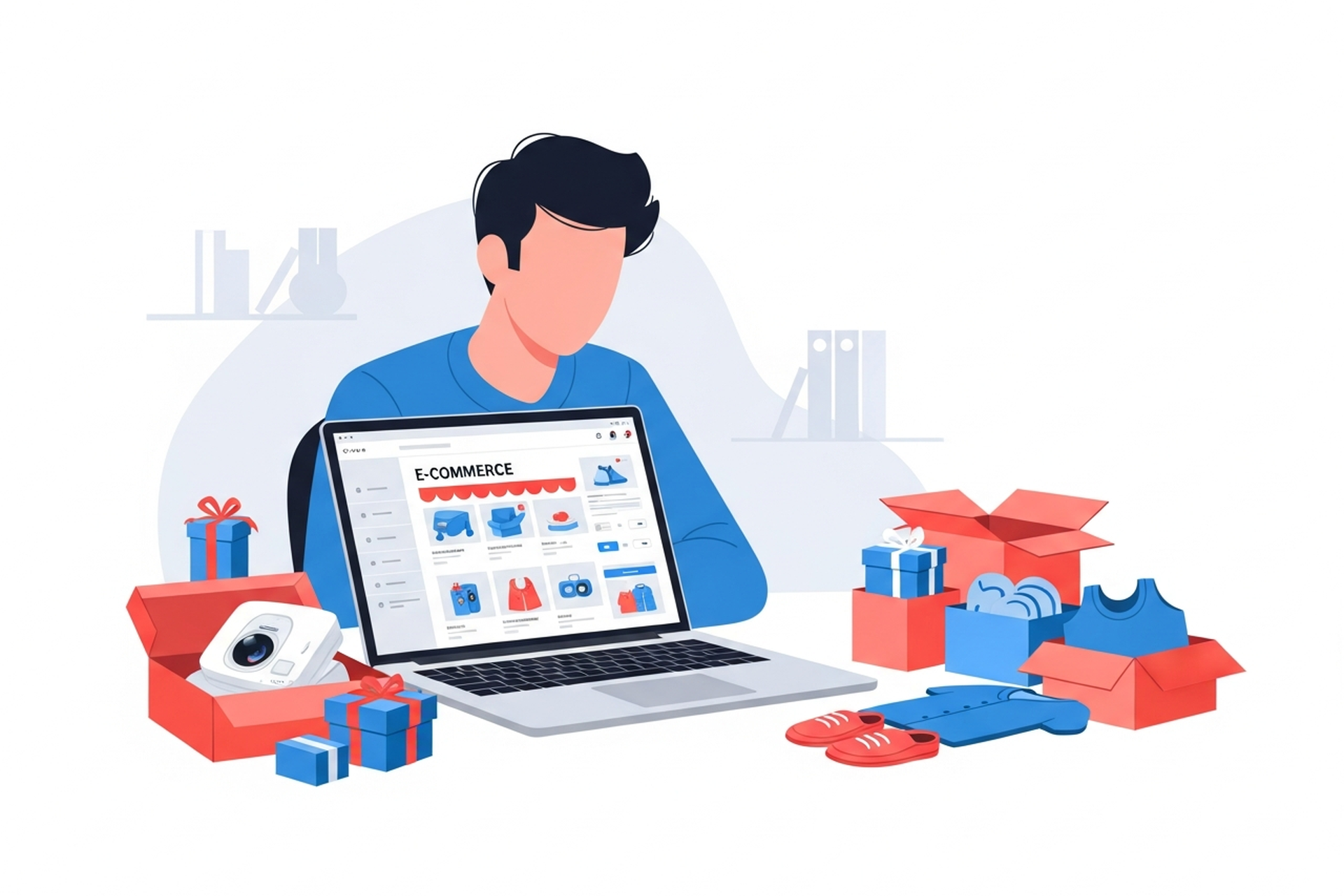
Getting into ecommerce in 2026 has never been more accessible — and never more competitive. Platforms like Shopify have removed most of the technical barriers, payment processing is plug-and-play, and global supplier networks make product sourcing relatively straightforward. The challenge isn't launching a store. The challenge is building one that actually sells.
This guide walks through how to get into ecommerce step by step: picking a model that fits your goals and resources, choosing the right platform, sourcing products, and driving your first traffic.
Before you pick a product or build a store, you need a clear picture of what kind of ecommerce business you're actually building. The model determines your economics, your operational requirements, and your growth ceiling.
You manufacture or source a product, brand it, and sell it directly to consumers through your own online store. No retail middlemen, no marketplace fees — you control the customer relationship, the pricing, and the data.
DTC has the highest margin potential and the highest brand-building ceiling, but it also requires upfront investment in inventory, branding, and customer acquisition. The global DTC market is projected to reach $319.57 billion in 2026, which signals both the opportunity and the competition.
Best for: Entrepreneurs with a specific product idea, domain expertise in a category, or a genuine brand angle.
You list products from a supplier in your store. When a customer orders, the supplier ships directly to them. You never touch inventory.
The appeal is obvious: low startup costs, no inventory risk. The reality is equally obvious: lower margins (typically 15–30%), less control over quality and shipping times, and products that are available from dozens of other stores. Dropshipping can work as a starting point or for validating product demand, but it's difficult to build a defensible brand on a dropshipping-only model.
Best for: Testing product demand before committing to inventory, or supplementing an existing brand with extended product range.
Rather than building your own store, you list products on existing marketplaces with built-in traffic. Lower barrier to entry — you skip the challenge of driving traffic from scratch — but you're competing on a crowded platform with thin differentiation and marketplace fees of 8–15%.
Best for: Validating products quickly, or businesses where marketplace SEO (particularly Amazon) is a core acquisition strategy.
You source generic products from manufacturers (often overseas), brand them with your own labels and packaging, and sell under your brand name. Lower development cost than custom products, higher margin and brand control than dropshipping.
Best for: Entrepreneurs who want brand equity without product development complexity.
If you don't have a specific product idea, the evaluation framework is:
Demand: Is there demonstrable search volume or marketplace demand for this product? Use Google Trends, Amazon bestseller lists, and keyword research tools to validate interest before committing.
Margin viability: Can you source the product at a cost that leaves enough margin to cover shipping, returns, ad spend, and operational costs while remaining price-competitive? As a rough guide, DTC businesses typically target 60–70% gross margin to make paid acquisition economics work.
Repeat purchase potential: Products that get reordered — consumables, supplements, pet food, beauty — have dramatically better lifetime value economics than one-time purchases. If your product is high-ticket and single-purchase, you'll need to prioritize AOV from day one.
Differentiation: What's your angle? "We sell yoga mats" isn't a business. "We sell yoga mats designed specifically for travel athletes, made from recycled materials" is closer to a brand.
For most new ecommerce businesses, the platform decision comes down to Shopify vs. everything else — because Shopify has become the default infrastructure for DTC brands at every stage from $0 to $100M+.
The dominant ecommerce platform for a reason. Shopify handles payments, inventory, shipping integrations, and has thousands of apps for every conceivable use case. The learning curve is gentle — you can have a functional store live in a weekend.
Shopify plans start at $39/month (Basic) through $399/month (Advanced), with Shopify Plus at $2,300+/month for enterprise brands. Transaction fees apply if you don't use Shopify Payments.
Best for: Almost everyone getting started in DTC ecommerce.
WordPress's ecommerce plugin. Highly customizable and no platform fees, but requires more technical comfort than Shopify. Hosting, security, and performance are your responsibility.
Best for: Businesses that already operate a WordPress site or need deep technical customization.
Solid alternatives to Shopify with different feature sets and pricing. Worth evaluating if you have specific requirements Shopify doesn't meet natively.
If marketplace selling is your model, Amazon FBA (Fulfillment by Amazon) is the most powerful distribution option available. FBA handles storage, picking, packing, and shipping. Your products become Prime-eligible. The tradeoff: referral fees of 8–15%, plus FBA fulfillment fees, plus you're building on rented land.
Once model and platform are locked, the foundational setup covers:
Legal structure: Register your business entity (LLC is the most common for US-based ecommerce). Open a separate business bank account. Consult a tax professional on sales tax obligations — nexus rules are complex and vary by state.
Domain and branding: Your domain, logo, brand colors, and brand voice should be established before launch. First impressions are expensive to redo.
Payment processing: Shopify Payments is the simplest option for Shopify stores (includes Visa, Mastercard, Amex, Apple Pay, Google Pay). PayPal is a useful secondary option since some customers trust it more than unfamiliar processors.
Shipping setup: Define your shipping zones, rates, and carriers. Free shipping is often table stakes for conversion — build your pricing to absorb it rather than adding it at checkout.
Return policy: A clear, customer-friendly return policy removes one of the biggest conversion barriers. It also affects how you're rated on marketplaces.
The pages every ecommerce store needs:
Before launch, run through your own checkout as a customer on both desktop and mobile. Mobile drives the majority of ecommerce traffic, and a clunky mobile checkout will kill your conversion rate from day one.
Traffic is the universal challenge for new stores. The options in roughly ascending order of effort and time:
Short-form video on TikTok, Instagram Reels, and YouTube Shorts is the highest-leverage free traffic channel for ecommerce in 2026. The platforms reward authentic, product-focused content — showing how the product works, behind-the-scenes sourcing, before-and-after demonstrations. User-generated content performs particularly well.
The caveat: organic social builds slowly. It's worth starting on day one, but don't bank on it for revenue in months 1–3.
The fastest way to get qualified traffic to a new store. Meta (Facebook/Instagram) and TikTok allow you to target audiences by interest, behavior, and demographics, then test your product-market fit in real time with real dollars.
Start with a small budget ($20–$50/day), test multiple creative angles, and treat early ad spend as product and market research. If you can't get your CPA below your gross margin at small scale, fix the funnel before you scale.
Once you have some product and category page SEO in place, Google Shopping campaigns capture high-intent buyers actively searching for products like yours. Slightly more complex to set up than social ads but often more efficient for established products with clear search demand.
Search engine optimization takes time — typically 6–12 months before meaningful organic traffic — but becomes one of your highest-ROI acquisition channels once established. A solid ecommerce SEO strategy built into your store architecture from the start means you're compounding free traffic while you spend on paid channels.
Build your email list from the first day. A welcome discount popup (10–15% off first order) is the standard entry point. Your email list is the only audience you actually own — social platforms can disappear, ad costs can spike, but your email subscribers remain yours.
Most new ecommerce businesses try to do everything at once. Here's what actually matters first:
Once you have early traction and a converting store, growth becomes about the four core levers of ecommerce growth: traffic, conversion rate, average order value, and retention. The brands that scale to $1M and beyond are the ones that build systems around all four — not just pour money into acquisition.
If you're building something with real product-market fit and are ready to scale paid channels, that's typically where an ecommerce marketing agency partnership starts to make economic sense — because the cost of a strategic partner is small relative to the cost of mismanaged ad spend at meaningful scale.
The technical and logistical barriers to starting an ecommerce business have never been lower. The competitive barrier — building something customers actually prefer, marketing it effectively, and keeping them coming back — is as high as it's ever been.
The businesses that succeed in 2026 aren't the ones with the most sophisticated technology stack. They're the ones with a clear brand angle, a product customers genuinely love, and a disciplined approach to growth.
Start with those fundamentals. Everything else is figure-outable.

How do Google Ads work? It's a question most business owners ask before running their first campaign — and one many experienced advertisers still don't have a complete answer to, because Google's system is more nuanced than it first appears.
The short version: Google Ads is an auction-based advertising platform where businesses bid for placement in search results and across Google's network. But the winner of each auction isn't necessarily the highest bidder — it's the advertiser with the strongest combination of bid, ad quality, and relevance. Understanding that distinction is the foundation of effective Google Ads management.
Every time someone searches on Google, an ad auction takes place in milliseconds to determine which ads appear and in what order. This isn't a simple highest-bidder-wins system — it's a real-time calculation that weighs multiple factors simultaneously.
Google's auction evaluates six variables for each participating ad:
The output of this calculation is your Ad Rank — a score that determines whether your ad shows and where it appears relative to competitors.
Ad Rank = Bid × Quality Score × (expected extension impact)
The practical implication: a higher bid doesn't guarantee a better position. An advertiser with a lower bid but a significantly higher Quality Score can outrank a higher-spending competitor. This is why understanding and improving Quality Score is central to effective PPC management.
Here's a detail that surprises many first-time advertisers: you rarely pay your maximum bid. Actual CPC is determined by the Ad Rank of the advertiser below you, divided by your Quality Score, plus one cent. In most auctions, you pay just enough to maintain your position over the next competitor — not your full maximum bid.
Quality Score is Google's rating (on a 1–10 scale) of the relevance and quality of your keywords, ads, and landing pages. It's calculated per keyword and consists of three components:
Google predicts how likely your ad is to get clicked when shown for a given keyword, compared to historical performance data across all advertisers. Strong ad copy that clearly addresses search intent drives better expected CTR.
How closely your ad copy matches the intent behind the keyword. An ad for "commercial cleaning services" that runs on a keyword for "office cleaning near me" should reflect that specific intent in the headline — generic copy about "professional cleaning solutions" will score lower on relevance.
Google evaluates whether your landing page is relevant, transparent, and easy to navigate. Specifically: does the page deliver on what your ad promised, does it load quickly, and does it provide useful information to visitors?
Landing page experience is the component most advertisers overlook. You can have excellent ad copy and still have a low Quality Score if traffic is landing on a slow, irrelevant page.
Why Quality Score matters financially: A Quality Score of 8 versus a Quality Score of 4 on the same keyword can result in a 50%+ difference in CPC, with the higher-Quality Score advertiser paying less while appearing in a better position.
Google offers several campaign types suited to different business objectives:
Text ads that appear in Google search results when users search for specific keywords. The highest-intent ad type — you're reaching people who are actively looking for what you sell.
Best for: Lead generation, direct response, capturing demand that already exists.
Product listing ads that show product images, prices, and store names in search results and Google Shopping. Essential for ecommerce. Performance Max extends this by showing ads across all Google surfaces — Search, Shopping, YouTube, Display, Gmail, and Maps — using Google's machine learning to allocate budget.
Best for: Ecommerce brands selling physical products.
Image and banner ads shown across Google's Display Network of over 2 million websites. Lower intent than search, but effective for brand awareness and retargeting.
Best for: Building awareness, remarketing to past visitors, promoting to interest-based audiences.
Video ads on YouTube and Google's video partners. Skippable, non-skippable, and bumper formats. Increasingly important for top-of-funnel brand building.
Best for: Brand awareness, product demonstrations, audience building for remarketing.
In Search campaigns, match types control which searches can trigger your ads. Getting this right significantly affects both reach and efficiency.
Broad Match: Your ad can show for searches related to your keyword, including synonyms and variations Google's system deems relevant. Broadest reach, lowest precision. Requires active negative keyword management to stay efficient.
Phrase Match: Your ad shows for searches that include the meaning of your keyword phrase. More controlled than broad match — good for capturing intent variations while limiting irrelevant traffic.
Exact Match: Your ad shows for searches that match your keyword's meaning very closely. Highest precision, lowest volume. Best for high-value, high-intent keywords where conversion rate justifies the limited reach.
Most well-structured campaigns use a combination — exact match for proven high-performers, phrase match for discovery, and controlled broad match with aggressive negative keyword lists.
You set a maximum bid for each keyword individually. Gives you the most control, but requires more active management and doesn't react to real-time auction signals.
Google's machine learning optimizes bids in real time based on your campaign goal. Smart Bidding strategies include:
Smart Bidding works best when your campaigns have sufficient conversion data — generally 30–50 conversions per month, per campaign. Without adequate data, the algorithm makes poor bid decisions. This is one reason why working with an experienced PPC company matters: they know when to use Smart Bidding, when to stay manual, and how to structure campaigns to feed the algorithm what it needs.
How you organize your Google Ads account directly affects performance, manageability, and the quality of your data.
A standard account hierarchy:
Best practice campaign structure:
Ad assets (formerly called extensions) are additional pieces of information that expand your ad without adding to cost per click. They include:
Extensions improve click-through rate by making ads larger and more informative, and Google factors expected extension impact into Ad Rank calculations. Using all relevant extensions is one of the easiest optimizations available.
There's no minimum spend on Google Ads — technically you could start with $5/day. But practical minimum budgets for meaningful data collection and optimization depend on your target CPA and how many conversions per day you need for Smart Bidding to work.
A rough framework:
The question isn't "what's the minimum I can spend" but "what ad spend level lets me collect enough data to optimize effectively while maintaining a viable CPA?"
Understanding how Google Ads work is the first step. Running campaigns that consistently generate profitable results is a different skill set — one that requires ongoing testing, analysis, and adjustment as the auction landscape shifts.
Many businesses run their own Google Ads with mixed results, then bring in professional PPC management once they realize the gap between "ads running" and "ads working." The system is learnable, but it has enough depth that expertise matters — especially when you're competing against other advertisers who have years of account history and optimization data behind them.
The fundamentals covered here — auction mechanics, Quality Score, match types, Smart Bidding, and campaign structure — are what every competent Google Ads practitioner has internalized. They're also the lens through which you should evaluate any agency or in-house team managing your campaigns.

Choosing the wrong Google PPC agency is one of the most expensive mistakes a growth-stage company can make. The damage compounds fast: wasted ad spend, poor conversion data, months of underperformance, and the time cost of switching partners mid-funnel.
The challenge is that agencies are better at pitching than performing. A polished deck, a few case study logos, and a Google Partner badge are easy to assemble. What's harder to spot during a sales process is whether the team behind the pitch has the operational depth to actually run your account well.
This guide is a practical selection framework for 2026 — what to look for, what to ask, what the red flags actually look like in practice, and what you should expect to pay.
At its core, a Google PPC agency manages your presence in Google's paid search ecosystem — Google Search Ads, Shopping Ads, Performance Max, Display, YouTube, and Demand Gen campaigns. The specific scope varies significantly by agency and engagement.
The core services of a capable Google PPC agency include:
The gap between agencies is often less about which services they offer and more about how deeply they execute each one. Budget management on autopilot is not the same as active optimization.
Before any spend scales, an accountable Google PPC agency will ensure conversion tracking is accurate. Ask specifically:
Conversion tracking setup is the foundational infrastructure for everything else. An agency that moves fast on spending but is vague on tracking is managing your budget blind.
You should own the Google Ads account. The agency should have access. This is a structural requirement, not a preference.
If an agency creates and controls your Google Ads account, they own your historical data, your audiences, your conversion history, and your quality scores. When the relationship ends — and it will eventually — you lose everything. This is one of the most commonly cited red flags among businesses that have had poor agency experiences.
Any agency that resists giving you full admin access to your own account should not be hired.
Ask who specifically will be managing your campaigns. The person presenting in the sales process is often not the junior account manager who will be assigned to your account post-signing. Get names and verify experience where possible.
A good rule: if you're spending $20,000+/month on Google Ads, your account should have a dedicated specialist — not be pooled with a dozen others managed by someone with 18 months of experience.
Also ask about tool access: Google Analytics, Search Console, any third-party platforms. If they're managing your paid search in isolation from your broader site data, they're flying partially blind.
A high-quality Google PPC agency invests time in understanding your business before proposing anything. That means a discovery conversation about your ICP, sales cycle, average order value, competitive landscape, and existing marketing stack.
If an agency sends a proposal with specific cost-per-lead guarantees based on a 20-minute intake call, treat that as a red flag. No reputable PPC agency guarantees specific results — too many variables outside their control affect campaign performance.
A good proposal includes a strategy that acknowledges your specific situation, realistic outcome ranges based on comparable accounts, and a testing period assumption before drawing performance conclusions.
Google has significantly reduced manual control in the platform over the past three years. Performance Max campaigns now often consume the majority of budget for most advertisers, and smart bidding strategies rely on Google's machine learning rather than manual bid management.
A capable Google PPC agency in 2026 understands how to work with Google's automation rather than against it — how to feed the algorithm the right signals through proper asset groups, audience lists, and conversion data rather than trying to override automation with outdated manual tactics.
Ask any prospective agency about their Performance Max strategy. If they're dismissive of it or don't have a coherent framework for managing these campaigns, they're behind on how the platform actually operates today.
Google PPC agency pricing typically follows one of three models:
Percentage of ad spend. The most common structure. Typically 10–20% of monthly ad spend. At $10,000/month ad spend, expect $1,000–$2,000/month in management fees. This model aligns incentives well — the agency earns more as your spend grows.
Flat monthly retainer. A fixed fee regardless of spend level. Ranges from $1,500/month for small accounts to $7,500+/month for mid-market. Better for accounts with stable spend levels.
Performance-based. A smaller base fee plus a percentage of revenue or leads generated above a baseline. Less common, harder to structure fairly, but can align incentives well when configured correctly.
Most mid-market accounts pay $2,500–$7,500/month in management fees, with setup fees of $2,500–$10,000 for new account builds or major rebuilds.
Be cautious of pricing significantly below these ranges. Underpriced management usually means underdedicated management — your account is one of many being touched minimally each week.
Beyond the structural criteria above, these questions reveal how an agency actually operates:
"Walk me through how you'd approach the first 90 days on our account." Good agencies have a structured onboarding process: audit, tracking verification, account restructure where needed, then systematic testing. Vague answers suggest vague execution.
"How often will we communicate, and what does reporting look like?" Expect at least monthly strategy calls with access to real-time dashboards. Quarterly reviews for account structure. Weekly or biweekly updates during active testing periods.
"Show me an account where you took over from a previous agency and improved performance." This is a high-signal question. Turnarounds require real diagnostic skill and the discipline not to blow up what's working.
"How do you handle underperforming campaigns?" Look for a structured test-and-learn process — hypothesis, change, measurement window, decision. Avoid agencies that respond to underperformance by immediately increasing budget or changing too many variables at once.
"What metrics do you use to define campaign success, and how do they connect to our business goals?" Clicks and impressions aren't success metrics. Revenue, ROAS, CPL, and CPA against your business model are success metrics. Agencies that speak primarily in platform metrics (CTR, Quality Score) rather than business outcomes may be optimizing for the wrong things.
"We guarantee [specific result] within [specific timeframe]." No legitimate Google PPC agency makes unconditional performance guarantees. Market conditions, bid auctions, Quality Scores, and landing page performance all affect outcomes in ways no agency fully controls.
They're slow to answer pre-sales questions. If communication is polished during the sales process and deteriorates after signing, that's a preview of the relationship. How fast they respond to your questions before you're a client is often how fast they'll respond after.
Set-and-forget management. Google Ads requires continuous active management — regular bid adjustments, negative keyword expansion, creative testing, and audience refinement. An agency that logs in once a week to check dashboards is not actively managing your campaigns.
They talk about ad spend without mentioning landing pages. Clicks land somewhere. If an agency is optimizing for clicks but not for what happens after the click, they're managing half the conversion equation. PPC management without landing page accountability is a common performance leak.
Long contracts with no performance reviews. A 12-month commitment with no performance checkpoints benefits the agency. A fair contract includes defined performance reviews and a reasonable exit provision if targets are substantially missed.
For ecommerce brands, Google Shopping and Performance Max often drive the majority of paid search revenue — make sure any agency you evaluate has specific, measurable experience managing product feed optimization and Shopping campaigns at scale.
For SaaS and B2B companies, the sales cycle complexity means PPC should connect directly to CRM data. Agencies that can configure lead quality tracking and close-rate measurement by ad group are significantly more valuable than those reporting on raw lead volume.
Our guide to PPC management for ecommerce covers how to evaluate these partnerships specifically for DTC and retail brands.
For search programs that include both paid and organic, it's also worth reading our breakdown of how SEO and PPC services work together — running them in coordination rather than in isolation is where the compound returns come from.
A good Google PPC agency won't just manage your ad spend — they'll improve the efficiency of every dollar you spend on Google. That means better conversion data, tighter audience targeting, more relevant ad creative, and a consistent improvement in ROAS over time.
The evaluation process requires real diligence. Get specific on team structure, account ownership, tracking setup, and performance expectations before any contract is signed. Ask for case studies from comparable accounts. Verify their Performance Max and smart bidding experience.
The wrong partner costs you time, money, and months of bad data. The right one becomes one of your highest-leverage growth investments.

You may still call it Google AdWords — the legacy name stuck around long after Google rebranded the platform to Google Ads in 2018. Whatever you call it, the fundamentals of hiring an agency to manage your paid search haven't changed: you're trusting someone with real ad budget, and a bad partnership costs more than just the agency fee.
This guide covers what genuinely matters when evaluating a Google Ads agency — the criteria that separate accountable, skilled partners from agencies that optimize for their own retention rather than your results.
When people search for "google adwords agency," they're usually looking for the same thing: an agency that manages Google's paid search platform professionally. The name is outdated (Google retired the AdWords brand in 2018), but the intent behind the search is clear — find someone who knows Google Ads well enough to manage campaigns against a real budget.
Any agency worth working with will acknowledge the rebrand and speak fluently about the modern Google Ads interface, campaign types (Search, Performance Max, Shopping, Display, YouTube), and the platform's ongoing evolution. If an agency still leads with "AdWords" as a primary identifier, that's a minor signal worth noting — but what matters more is whether they can demonstrate current, hands-on expertise.
A legitimate Google Ads agency provides:
The last two points — reporting and testing — are where agencies most commonly underdeliver. Fancy dashboards with week-over-week click trends don't tell you whether the campaigns are working. Revenue-anchored reporting with clear attribution does.
This is the single most important thing to verify. Your Google Ads account should be created under your Google account — not the agency's. If the agency creates the account under their own manager account (MCA) and you don't have admin access, you have no real data portability, no ability to audit historical performance, and a painful exit path.
Any reputable agency will grant you admin-level access from the first day of the engagement. Full stop.
The percentage-of-spend model misaligns incentives fundamentally: the agency earns more when you spend more, regardless of whether that increased spend is producing proportionally better results. Look for flat monthly retainers with clear scope definitions, or performance-based models tied to revenue outcomes — not spend volume.
Google Ads campaigns need a meaningful data accumulation period before Smart Bidding algorithms can optimize effectively. Expect 60–90 days before you have enough data to evaluate campaign performance fairly. Any agency promising significant ROAS improvements within two to four weeks is either overpromising or inheriting a well-built account and claiming credit for it.
Legitimate agencies set realistic timelines and communicate clearly about what the first 30, 60, and 90 days will look like.
These are inputs, not outcomes. A click that doesn't convert is a cost, not a result. Agency reporting should lead with conversion metrics, CPA or ROAS relative to target, revenue contribution, and quality score trends — not reach and click volume. If the sample report an agency shows you during the sales process is impression-heavy, their actual reporting will be too.
Twelve-month contracts with new agencies are high risk. A three-to-six month initial engagement with a monthly option to continue is a fair ask from any established agency. Long lock-ins benefit the agency's revenue stability, not your campaign performance. If an agency insists on a year-plus commitment before you've seen any results, walk away.
Large agencies routinely win new business with senior talent and hand it off to junior account managers. Ask explicitly: "Who will be managing our account day to day, and can I speak with them before we sign?" The account manager who will handle your campaigns should be able to speak fluently about campaign structure, bidding strategy, and creative testing. If you get a sales rep instead of the practitioner, that's a flag.
Before signing, verify that the contract addresses these elements clearly:
Account ownership: Explicit language stating that the Google Ads account, all campaign data, and all creative assets belong to you — not the agency.
Termination terms: Reasonable notice periods (30 days is standard) with no early termination fees after the initial engagement period. Multi-year contracts on first-time relationships are unusual and should be questioned.
Scope of services: Specific deliverables per month — campaign types managed, ad copy cycles, landing page recommendations, reporting cadence — rather than vague language like "ongoing optimization."
Fee structure: Transparent breakdown of management fee vs. ad spend. No hidden fees for creative production, reporting tools, or account access.
Performance review cadence: At minimum, monthly reporting calls with QBRs at 90 days and 6 months. Clear definition of the KPIs that define success.
Data and tool access: You should retain access to all analytics properties, call tracking platforms, and any third-party tools used in the management of your account.
Use these in your evaluation calls:
Strong practitioners answer these questions with specifics. Generalists answer them with generalities. The difference is obvious within a few minutes.
Management fees vary significantly by scope and agency size:
These are rough ranges. The right question isn't "what's the cheapest management fee" — it's "what's the total investment relative to the revenue I should expect the campaigns to generate." An agency charging $5,000/month that improves your ROAS from 2.5× to 4.0× on $50,000/month of spend generates far more value than a $1,500/month manager who maintains flat performance.
Even after you've selected a strong agency and signed a solid contract, manage your expectations for the first quarter:
At the 90-day mark, you should have enough data to evaluate whether the agency's approach is working. That's the conversation to have before committing to an extended engagement.
Google Ads managed well is one of the most reliable acquisition channels for growth-stage ecommerce and DTC brands. The difference between a mediocre agency and a great one isn't marginal — it's often the difference between a channel that drains budget and one that compounds your customer acquisition over time.
Take the time to verify account ownership terms, understand the reporting you'll receive, and speak directly with the person managing your campaigns before you sign anything.
For more on evaluating paid media partners, see our complete guide to ecommerce PPC management agencies and our breakdown of how to choose the best ecommerce marketing agency.


.svg)