
In the age of rapid digital transformation, AI has seeped into almost every industry, revolutionizing how we conduct business, design products, and even create content. The ClusterMagic service is a great example, which seamlessly integrates AI for content generation in a hybrid model, providing significant benefits in the SEO results of brands seeking a massive increase in organic traffic. But while AI holds immense promise, it has its limitations. Let's explore the pros and cons of using AI for content creation and understand why a hybrid approach might be the way forward.
Major publishers in sensitive niches like CNET.com, Bankrate.com, and Creditcard.com have already integrated AI-generated content. Other large companies, such as CNN and Forbes, might also be doing so. Countless smaller companies and publishers are utilizing AI, not only on their websites but also on social media, in email marketing, and virtually everywhere else.
Google's stance on AI-generated content is neutral, emphasizing that content should primarily be user-centric. In fact, Google's September 2023 Helpful Content Update removed the mention of "written by people" from their helpful content system guidelines.
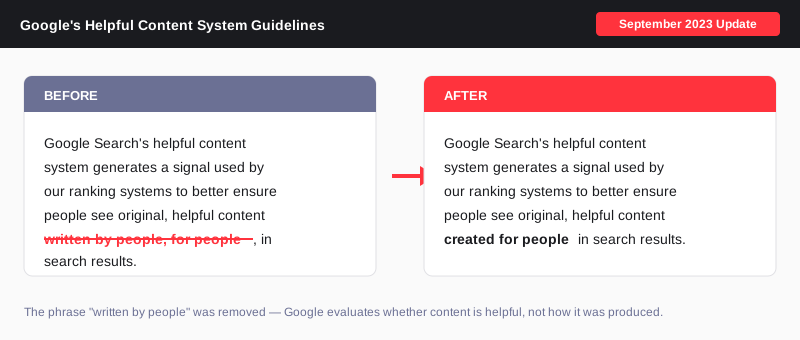
The message is clear: for content to rank well, it must be informative, answer users' queries satisfactorily, and showcase genuine expertise - regardless of how it's created.
AI Content Detectors like GPTZero, ZeroGPT, and many others are not reliable. Even OpenAI has said as much. They consistently produce false positives about human-written content. Conversely, they can be easily fooled with creative prompting or a bit of human editing.
An interesting note from OpenAI: "we found that it labeled human-written text like Shakespeare and the Declaration of Independence as AI-generated."

Anecdotal evidence and real-life ranking data suggest that while AI-generated content isn't penalized by search engines, it might only achieve high rankings if it meets the above criteria. The role of AI in content creation is still a developing narrative, and its significance is indispensable for maintaining a competitive edge in the future.
At EmberTribe, the understanding is clear - AI serves as a foundation, not the final product. With ClusterMagic, while AI aids in the initial draft based on expert-driven keyword research, human experts step in for the crucial phases of editing, fact-checking, and final review. This hybrid approach ensures the content is accurate and helpful, has the potential to rank, and truly represents their business.
Most SaaS founders can name their revenue number. Fewer can tell you their net revenue retention, their LTV:CAC ratio, or why their DAU/MAU ratio matters more than their user count. If you're building or scaling a SaaS product in 2026, mastering your SaaS KPIs is not optional — it's the difference between fundraising with leverage and scrambling to explain churn to investors.
This guide breaks down every metric that matters, with current industry benchmarks and guidance on what "good" actually looks like at each company stage.
In 2026, investors and acquirers have become far more selective. The era of growth-at-all-costs is behind us. Capital efficiency, retention, and unit economics now drive valuations more than raw ARR growth.
The SaaS companies trading at premium multiples share a common thread: they track the right metrics, benchmark against their peer group, and adjust strategy based on data rather than intuition. Understanding your SaaS data analytics isn't just a finance function — it's a growth function.
Tracking vanity metrics (page views, registered users, email opens) feels productive but obscures the signals that actually predict revenue trajectory. The KPIs in this guide are the ones that appear in every serious investor deck, every M&A diligence process, and every high-performing growth team's weekly review.
ARR and MRR are the foundation. MRR tracks your predictable subscription revenue in a given month; ARR is simply MRR multiplied by 12. Both should be tracked net of discounts and credits.
The components that build (or erode) MRR tell the real story:
Benchmarks for ARR growth rate: StageGoodGreatWorld-ClassSeed / Pre-Series A100%+ YoY150%+ YoY200%+ YoYSeries A50–80% YoY100%+ YoY150%+ YoYSeries B+30–50% YoY60%+ YoY80%+ YoYPublic / Scale20–30% YoY40%+ YoY60%+ YoY
The median public SaaS company grows ARR at roughly 26% annually. Consistent 30–50% YoY growth signals healthy, investable expansion.
As your growth rate matures, investors apply the Rule of 40 — your ARR growth rate plus your profit margin should exceed 40%. Companies scoring above 60% command 2–3x higher valuation multiples than those below the threshold.
These are the metrics that separate SaaS businesses from software resellers. Retention tells you whether your product is creating real value.
Churn rate measures the percentage of customers (or revenue) lost in a given period. Low churn is the single most important indicator of product-market fit.
Monthly churn benchmarks by segment: SegmentAcceptableGoodExceptionalSMB SaaS< 5%< 3%< 1.5%Mid-Market< 2%< 1.5%< 0.8%Enterprise< 1%< 0.5%< 0.3%
The average B2B SaaS company runs around 3.5% monthly churn — roughly 2.6% voluntary and 0.8% involuntary (failed payments). Involuntary churn is often underestimated and entirely fixable with dunning automation and payment retry logic.
NRR measures revenue from your existing customer base over time, accounting for expansion, contraction, and churn. It is arguably the most important single metric in SaaS.
An NRR above 100% means your existing customers are spending more over time — your business grows even without adding a single new customer. Public SaaS companies with NRR above 120% trade at 25% higher valuation multiples than those below 100%.
NRR benchmarks: RatingNRRBelow average< 100%Solid100–110%Strong110–120%World-class125%+
Companies like Snowflake and Atlassian have achieved NRR above 130%. For most growth-stage SaaS companies, targeting 110–120% is the right ambition.
Growth is not free. The quality of your customer acquisition determines whether your unit economics support sustainable scaling.
CAC is total sales and marketing spend divided by the number of new customers acquired in a period. Track it by channel — blended CAC hides where you're burning money.
This tells you how long it takes to recover what you spent to acquire a customer. Shorter payback periods mean faster capital recycling and less reliance on external funding.
CAC payback benchmarks: RatingPayback PeriodStrong< 12 monthsSolid12–18 monthsAcceptable18–24 monthsConcerning> 24 months
The median SaaS company runs a 15–18 month CAC payback period. Series A investors increasingly want to see sub-12 months as a prerequisite.
Lifetime Value (LTV) divided by Customer Acquisition Cost tells you the return on every dollar you invest in growth. This is the core efficiency metric for any SaaS sales funnel.
LTV is typically calculated as: Average Revenue Per Account / Monthly Churn Rate.
LTV:CAC benchmarks: RatingRatioMinimum viable3:1Solid4:1Excellent5:1+
A 3:1 ratio is the floor — below that, your unit economics make it very difficult to build a self-sustaining business. The best-performing SaaS companies hit 5:1 or higher, which unlocks aggressive reinvestment in acquisition without burning cash reserves.
For a deeper look at connecting acquisition metrics to revenue outcomes, the B2B SaaS Lead Generation Playbook covers how to structure your funnel to improve both CAC and close rate simultaneously.
Revenue metrics tell you what happened. Engagement metrics tell you what's about to happen.
The DAU/MAU ratio measures what percentage of your monthly active users return on any given day. It's the best proxy for product stickiness — how deeply embedded your software is in users' daily workflows.
DAU/MAU benchmarks: RatingRatioLow engagement< 10%Average10–25%Strong25–40%Exceptional40%+
A DAU/MAU above 25% indicates habitual daily use. Consumer apps like Slack and Notion target 40%+. For B2B workflow tools, 20–30% is typically strong.
Low DAU/MAU is an early churn warning signal — users who don't use the product regularly won't pay for it long.
MetricGoodGreatWorld-ClassMonthly Churn< 3%< 1.5%< 0.5%NRR100–110%110–120%125%+LTV:CAC3:14:15:1+CAC Payback< 18 months< 12 months< 9 monthsGross Margin65–70%70–75%80%+DAU/MAU15–25%25–40%40%+ARR Growth (Series A)50% YoY80% YoY100%+ YoYRule of 40 Score40+60+80+
Not every SaaS KPI deserves equal attention at every stage. Here's where to focus:
Obsess over churn and product engagement. Before you build a growth machine, you need to know your product retains users. Target monthly churn below 3% and DAU/MAU above 15% before doubling down on acquisition spend.
Nail unit economics. Investors want to see LTV:CAC above 3:1, CAC payback under 18 months, and NRR trending toward 110%. Your SaaS content marketing strategy should be generating predictable inbound pipeline that keeps your blended CAC healthy.
Shift focus to NRR and the Rule of 40. Expansion revenue — upsells, cross-sells, seat additions — should be contributing materially to ARR growth. Gross margin protection becomes critical as headcount and infrastructure costs scale.
Revenue quality, efficiency ratios, and free cash flow margin dominate. The Rule of 40 becomes the headline efficiency metric, and NRR above 120% becomes a prerequisite for premium multiple maintenance.
Tracking MRR but ignoring MRR movement. New MRR, expansion MRR, contraction MRR, and churned MRR are four separate signals. A flat MRR could mean everything is fine — or it could mean churned and new MRR are exactly canceling each other out.
Using blended CAC. Channel-level CAC reveals where you're acquiring customers efficiently and where you're overspending. Blended CAC hides both.
Ignoring involuntary churn. Failed payments account for roughly 23% of all SaaS churn. This is recoverable revenue that gets written off as lost customers when it shouldn't be.
Setting vanity NRR targets. NRR of 100% is not a win — it means you're running in place. Aim for 110%+ to build genuine net retention leverage.
Understanding your SaaS KPIs is step one. Acting on them — adjusting messaging, fixing funnel leaks, improving onboarding conversion, increasing expansion revenue — is where growth actually happens.
EmberTribe works with growth-stage SaaS companies to connect their analytics to their acquisition and retention strategy. From identifying which acquisition channels produce the lowest CAC to improving trial-to-paid conversion rates, we turn metric visibility into revenue movement.
Explore how our SaaS growth approach has helped B2B software companies improve unit economics and scale more efficiently.
Ready to turn your SaaS data into a growth engine? Talk to EmberTribe.

The global SaaS business market is projected to reach $375 billion in 2026, growing at roughly 20% annually—and that number accelerates to 40%+ when you isolate AI-powered SaaS. If you're building or scaling a saas business right now, you're operating in the most competitive and most opportunity-rich software environment in history.
But opportunity doesn't equal growth. The companies pulling ahead aren't just building good products—they're running smarter go-to-market motions, tracking the right metrics, and applying competitive frameworks that work at their specific growth stage.
This guide breaks down exactly what separates winning SaaS businesses from the ones that plateau.
At its core, a SaaS business sells recurring access to software. That recurring revenue is the engine—but what drives it differs significantly depending on your go-to-market motion.
B2B SaaS sells to businesses, typically through a sales team or marketing-led demand generation. Deal sizes are larger, sales cycles are longer, and success depends on deep integration with customer workflows. This is where most enterprise and mid-market software lives.
B2C SaaS sells directly to consumers. Lower average contract values but higher volume, faster sales cycles, and heavier reliance on product virality and brand. Think productivity apps, personal finance tools, creative software.
Product-Led Growth (PLG) is the model that's reshaping B2B SaaS. Instead of leading with sales outreach, PLG companies let the product itself drive acquisition, activation, and expansion. Users discover, try, and adopt the product before ever speaking to sales. PLG companies grow 30–50% faster on average and cut CAC by 40–60% through self-service product experiences.
In 2026, 58% of B2B SaaS companies report having an active PLG motion—and 91% of those plan to increase their investment in it. The hybrid model is emerging as the dominant pattern: PLG for top-of-funnel acquisition, inside sales for conversion and expansion.
The fundamental difference between a SaaS business and a traditional software company is predictability. Recurring contracts make revenue forecastable, which makes the business fundable, scalable, and ultimately more valuable. Every metric you track flows from this: how much revenue are you adding, how much are you keeping, and what does it cost to get there.
Most SaaS businesses track too many metrics and act on too few. These are the ones that actually predict outcomes.
Annual Recurring Revenue (ARR) and Monthly Recurring Revenue (MRR) are the foundational measures of your SaaS business health. ARR is the annualized value of all active subscriptions—it's your scoreboard.
The median ARR growth rate for SaaS companies sits around 26% in 2026. VC-backed companies hit a median of 25%, while bootstrapped companies track at 23%. Top-quartile performers are growing at 50%+, though median top-performer rates have compressed from the 60% highs seen in 2021–2022. Efficient growth is now valued over growth at all costs.
Churn is the rate at which customers cancel subscriptions. The average annual churn rate for B2B SaaS sits at 3.5%, with top performers keeping it below 3%. Monthly churn above 2% is a signal worth investigating immediately—it compounds fast.
There are two types: voluntary churn (customers who choose to leave) and involuntary churn (failed payments, credit card expirations). B2B SaaS data for 2025 shows voluntary churn at 2.6% and involuntary churn at 0.8% on average. Fixing involuntary churn is often the fastest lever—dunning automation alone can recover 0.3–0.5% of revenue.
NRR measures how much revenue you keep and grow from your existing customer base, accounting for expansions, contractions, and churn. An NRR above 100% means your existing customers are paying you more than they did last year, even before you add a single new logo.
Scale-stage SaaS companies target 110–120% NRR. Companies with NRR above 100% grow at least 1.5–3x faster than peers. The current market median has compressed to around 101%, reflecting tighter expansion budgets across enterprise buyers—which makes NRR optimization a meaningful competitive differentiator.
The ratio of customer lifetime value to customer acquisition cost is the single best measure of your growth engine efficiency. A healthy LTV:CAC ratio falls between 3:1 and 5:1. The market median landed at 3.6:1 in recent benchmarking data.
Below 3:1 means you're acquiring customers at a cost that's hard to justify. Above 5:1 often means you're under-investing in growth—leaving pipeline on the table.
How long does it take to recover what you spent to acquire a customer? The median CAC payback period across B2B SaaS is 15–18 months. Elite companies aim for under 12 months. PLG companies typically achieve payback within 6–12 months; sales-led models require 12–18; ABM-focused enterprise motions stretch to 18–24.
New customer acquisition costs rose 14% through 2025 while growth rates slowed—which puts pressure on payback periods across the board. Companies that win on efficiency here build structural advantages.
Most competitive analysis in SaaS is reactive—teams notice a competitor's new feature or price change and scramble to respond. A systematic framework turns competitive intelligence into a proactive asset.
Start by mapping competitors across four layers:
For direct competitors, track quarterly: pricing changes, product updates, G2/Capterra review themes, job postings (signal investment areas), and content topics (signal SEO strategy).
Review themes are underrated. Mining what customers say they love and hate about competitors gives you differentiation language that resonates because it's grounded in real buyer language.
The cleanest competitive signal comes from your own pipeline. A structured win/loss program—even 10 calls per quarter—surfaces why deals go to competitors and what objections you're not handling. This feeds directly into positioning, sales enablement, and product roadmap.
The playbook that gets you to $1M ARR is not the playbook that gets you to $10M. Most SaaS companies stall because they're running the wrong strategy for their stage.
At this stage, the goal is learning faster than you spend. Sales is founder-led. Marketing is mostly direct outreach, community, and content that demonstrates expertise. You're looking for 10–20 customers who genuinely need the product and will tell you why.
Key focus: Reduce time-to-value in your onboarding. Every day a user doesn't see value is a day closer to churn.
This is where most SaaS businesses get stuck. The founder-led model breaks, but the team isn't yet built to replace it. The priority here is systematizing what worked early: documenting the ICP, building a repeatable sales process, and investing in content and demand generation that compound over time.
For a deeper look at how to build content that drives consistent SaaS pipeline, see our guide to SaaS content marketing strategy.
At this stage, hiring your first marketing leader is a critical decision. A fractional CMO for B2B SaaS is often the right call—senior expertise without the full-time cost before the stage is ready for it.
Key focus: CAC payback. If it takes more than 18 months to recover acquisition cost at $5M ARR, the business model has a structural problem that scale will make worse.
At this stage, the question shifts from "how do we acquire customers" to "how do we build a growth system that works across segments." That means investing in demand gen, PLG motions, ABM for enterprise, and expansion revenue in parallel.
NRR becomes the dominant metric. The best SaaS companies at this stage grow their existing customer base fast enough that new logo acquisition is additive rather than essential.
Not all marketing channels work equally at every stage of a saas business. Here's what has real impact.
Long-form, keyword-targeted content is one of the highest-ROI marketing investments a SaaS business can make—because it compounds. A post that ranks for "saas competitive analysis" today will drive pipeline two years from now without ongoing spend.
The SaaS content strategy that works in 2026 is not blogging for blogging's sake. It's building a programmatic cluster of content that covers the full buyer journey, captures search demand at each stage, and converts through a logical internal linking structure. For B2B SaaS specifically, this means problem-aware and solution-aware content, not just brand-aware.
Content attracts traffic; lead generation converts it. For B2B SaaS, the highest-converting offers are usually gated tools, benchmark reports, and ROI calculators—assets that help buyers do their job, not just pitch your product. Our B2B SaaS lead generation playbook covers how to structure these offers for maximum conversion.
For SaaS companies with a self-serve or freemium motion, the product itself is a marketing channel. PLG models achieve visitor-to-lead conversion rates of 3–9%, versus 0.5–1.5% for sales-led models. When product-qualified leads (PQLs) are used, conversion rates for free accounts run 3x higher than standard MQL conversion.
The key: build onboarding that gets users to their first meaningful outcome in under 10 minutes. Every friction point in onboarding is a churn event waiting to happen.
Paid search and LinkedIn are the workhorses of B2B SaaS demand generation. Google Ads captures high-intent, in-market buyers. LinkedIn targets by job title, company size, and function. Both work, but both require tight attribution to manage CAC payback.
The mistake most SaaS companies make with paid is treating it as standalone. Paid works best when it amplifies existing content and offers—sending clicks to ungated resources that demonstrate value, then using retargeting to convert.
A saas business that scales isn't running tactics—it's running a system. That system has four components: a product people come back to, a go-to-market motion that scales acquisition efficiently, a retention engine that expands revenue from existing customers, and analytics that tell you which lever to pull next.
The benchmarks in this guide give you the targets. But the strategy that actually works depends on your ICP, your stage, your competitive position, and your team's strengths. That's where the real work happens—and where the biggest gains are.
If you're ready to build a more systematic growth engine for your SaaS business, EmberTribe works with growth-stage SaaS companies on exactly that: content strategy, demand generation, and the marketing infrastructure to scale. Get in touch with our team to start with a no-pressure growth audit.
Choosing the wrong pricing models can kill growth faster than almost any other strategic mistake in SaaS. Pricing is not just a revenue mechanic — it's a signal to the market, a filter for the right customers, and a primary driver of expansion revenue. Yet most founders spend less than ten hours on their initial pricing decision and years trying to undo the consequences.
In 2026, the landscape has shifted meaningfully. Hybrid pricing models are now used by 61% of SaaS companies, with those companies reporting 38% higher revenue growth than single-model competitors. Pure per-seat pricing is declining. Credits-based models grew 126% year-over-year. And outcome-based pricing — charging for results rather than access — is forecast to appear in 40% of enterprise SaaS contracts by year-end. Understanding your options before picking one has never mattered more.
This guide breaks down the six core software pricing models, how to evaluate them for your business stage, the mistakes that most often derail growth, and how to build pricing into a genuine competitive advantage.
Every pricing structure in B2B SaaS traces back to one of six core frameworks. Most mature products combine two or more, but you need to understand each on its own terms first.
| Model | Best For | Pros | Cons |
|---|---|---|---|
| Flat-Rate | Simple products with uniform value delivery | Easiest to communicate, low friction | No expansion revenue, underserves heavy users |
| Per-Seat / Per-User | Collaboration tools, productivity software | Predictable, scales with team growth | Caps natural growth, losing favor as AI shifts productivity |
| Usage-Based | APIs, infrastructure, communications tools | Aligns cost with value, low barrier to entry | Revenue unpredictability, hard to forecast |
| Tiered | Products serving multiple segments | Captures different willingness-to-pay, familiar structure | Complexity, analysis paralysis above 4 tiers |
| Freemium | High-volume consumer-adjacent SaaS, PLG plays | Fast acquisition, word-of-mouth, lower CAC | Conversion rate pressure, high infrastructure cost per free user |
| Value-Based | Mature, outcome-oriented B2B products | Highest revenue capture, aligns with customer success | Hard to implement early-stage, requires deep customer data |
Each model carries different implications for your sales motion, customer success investment, and long-term revenue trajectory.
These two models represent opposite ends of the pricing spectrum, and understanding the trade-off between them clarifies the logic of every model in between.
Flat-rate pricing is simple: one price, one set of features, every customer pays the same amount. It works when your product delivers roughly equivalent value across your customer base and when simplicity is a differentiator. For early-stage companies testing product-market fit, flat-rate removes friction from the buying decision. The problem is structural: there is no natural mechanism for revenue expansion. Your only growth lever is new customer acquisition.
Usage-based pricing — often called pay-as-you-go or consumption pricing — charges based on what customers actually use. API calls, data volume, emails sent, compute hours. The alignment between cost and value is tight, which tends to reduce buyer resistance and allows customers to start small and scale into higher spend as they get more value. The 2025 SaaS Pricing Benchmark study showed 26% year-over-year growth in usage-based adoption, concentrated in infrastructure, data, and communications software.
The catch: revenue becomes unpredictable. Customers who churn usage in a slow quarter take revenue with them in a way that seat-based customers don't. Usage-based companies typically pair consumption pricing with a committed base platform fee — which is the beginning of hybrid pricing.
The right starting point is an honest answer to two questions: does your product's value scale directly with usage, and can you absorb the revenue variance that usage-based models introduce? If both answers are yes, usage-based or hybrid deserves serious consideration.
The best enterprise SaaS pricing strategy for a Series B company with 500 customers is not the right model for a seed-stage product with 30 beta users. Stage shapes the decision.
In early stage, before you have deep data on customer behavior and willingness-to-pay, simplicity is your best asset. A flat-rate or simple tiered structure lets you close deals without complex pricing negotiations, iterate quickly when the model isn't working, and gather the usage data you'll need later to build a more sophisticated approach. Freemium can work here if your product has strong viral or network mechanics, but it requires runway to convert free users at volume.
In growth stage, you likely have enough customer data to segment by value delivered. This is when tiered pricing earns its keep. Three to four tiers — an entry point, a clear "most popular" tier priced to anchor decision-making, a premium tier, and optionally an enterprise custom tier — captures different willingness-to-pay without overwhelming buyers. The optimal number of tiers reported in pricing research is consistently three to four; above that, conversion rates drop.
In scale stage, value-based and hybrid models become accessible. You have the customer success infrastructure to understand which outcomes your product drives and for whom. You can begin tying pricing to those outcomes — not just access or consumption. This is where pricing becomes a genuine growth lever rather than a cost-recovery mechanism.
If you're working through B2B SaaS lead generation at scale, your pricing model has a direct effect on both your lead qualification criteria and your sales cycle length. Misalignment between pricing complexity and your sales motion is one of the more common causes of stalled pipeline.
The research here is unusually consistent. Founders make the same pricing mistakes at predictable stages.
Copying competitors without understanding their context is the most common. A competitor's pricing model was shaped by their customer base, their cost structure, their sales motion, and the moment they made the decision. Adopting it wholesale without that context usually means inheriting constraints you don't need and missing expansion opportunities that are available to you.
Too many tiers is the second most common error. More than four pricing tiers creates decision paralysis. Buyers default to the cheapest option or abandon the page. Every tier you add above four reduces conversion at the tier you most want customers to choose.
Artificial feature gating — withholding features that cost nothing to deliver just to differentiate tiers — is increasingly a trust problem. Buyers in 2026 are more sophisticated. They recognize when features are gated for pricing reasons rather than customer success reasons. Gating should reflect genuine differences in customer needs by stage and segment, not manufactured scarcity.
Ignoring expansion revenue is perhaps the most expensive long-term mistake. If your pricing model has no mechanism for customers to spend more as they grow — no usage component, no seat expansion, no tier upgrade path — you're leaving 40% to 60% of potential revenue on the table, according to pricing benchmarks. Acquisition costs more than expansion. A pricing model that captures neither is a structural ceiling on growth.
Finally, underpricing your product out of fear. Pricing research consistently shows that B2B SaaS founders underprice by 20% to 40% relative to the value they deliver. The market rarely tells you when your price is too low — customers just accept it gratefully.
Pricing is not a set-and-forget decision. The companies with the highest revenue growth treat pricing as a continuous experiment.
Start with win/loss analysis. Every deal you close or lose carries pricing signal. If you're closing 80% of deals without negotiation, you are almost certainly underpriced. If the primary objection is price, you may have a positioning problem more than a pricing problem — buyers need to understand value before they can accept price.
Run cohort analysis on expansion revenue. Which tier or plan do customers who expand most often start on? That entry point is where your pricing model is working. Build from there.
A/B testing on pricing pages is available to most SaaS businesses and underused. Test price points, tier names, the framing of your "most popular" tier, annual vs. monthly billing incentives, and the presence or absence of feature comparison tables. Each element has measurable impact on conversion.
A strong SaaS content marketing strategy plays a supporting role here: content that clearly communicates your product's value proposition reduces the work your pricing page has to do. When buyers arrive already understanding what you do and why it matters, price becomes a smaller obstacle.
For companies that have scaled beyond $5M ARR, annual pricing reviews with structured methodology — customer interviews, cohort data, win/loss analysis, and competitive benchmarking — typically return significant revenue uplift.
The most sophisticated operators treat pricing not as a static decision but as an active growth lever — one that requires the same analytical rigor and iteration as acquisition channels.
Value-based pricing, now used by 78% of enterprise SaaS companies (up from 62% in 2023), is the endpoint most companies are moving toward. It requires genuine understanding of the economic value your product delivers to customers: what they'd pay to solve the problem without you, what outcome your product enables, and how that outcome scales with the customer's business. Getting there requires customer success data, willingness-to-pay research, and a pricing operations function that didn't exist in most SaaS companies five years ago.
Hybrid models — a base subscription fee paired with usage-based or outcome-based components — are the dominant structure in high-growth SaaS. They provide the revenue predictability of subscriptions with the upside capture of consumption pricing.
For companies at the growth stage, revisiting pricing structure with outside perspective is often high-ROI work. The same is true of the broader go-to-market motion: if you're working with a fractional CMO for B2B SaaS, pricing strategy is one of the highest-leverage areas they can address quickly.
Pricing strategy is the kind of work that compounds. The right model, properly communicated and continuously optimized, accelerates every downstream metric — from trial conversion to NRR to the revenue multiples buyers assign your business.
If pricing is an area where you're looking for outside perspective — whether you're setting initial pricing, trying to move up-market, or rebuilding a model that isn't capturing the growth you're generating — EmberTribe works with growth-stage SaaS companies on exactly this kind of strategic work. Get in touch to talk through your situation.
Choosing the right PPC advertising agency is one of the highest-leverage decisions a growth-stage brand can make. Done well, paid search compounds your customer acquisition engine. Done poorly, it burns budget and stalls growth. With hundreds of agencies competing for your retainer, knowing what separates a great PPC advertising agency from a mediocre one is essential before you sign any contract.
This guide breaks down exactly what PPC agencies do, how they charge, what credentials matter, and what metrics you should hold them accountable to.
A PPC agency manages your paid advertising campaigns end to end — from initial strategy through daily optimization and reporting. The core scope typically includes:
What distinguishes a strong ecommerce PPC management agency is not just execution — it's strategic thinking. The best agencies connect paid performance to your broader unit economics, not just your ad account dashboard.
Understanding the fee structure matters because it shapes incentives. The most common pricing models in 2026 are:
Percentage of ad spend. The industry standard. Agencies charge 10%–20% of your monthly advertising budget. At $20,000/month in spend, that's $2,000–$4,000 in management fees. This model aligns the agency's income with your investment but can create perverse incentives to scale spend before performance justifies it.
Flat monthly retainer. A fixed fee — typically $1,500–$10,000/month — regardless of spend volume. This works well for brands with stable budgets and benefits the agency when ad spend grows without a corresponding fee increase. For clients, it offers predictability.
Performance-based pricing. The agency earns per conversion — a fixed amount per qualified lead or a percentage of attributed revenue. This model demands rigorous tracking and agreed-upon attribution standards. It sounds ideal but can distort agency behavior toward easy-to-convert traffic rather than high-LTV customers.
Hybrid models. The most sophisticated agencies use combinations: a lower base retainer plus a performance bonus tied to ROAS or CPA thresholds. This aligns short-term execution incentives with long-term growth goals.
For DTC brands with high seasonal variation, a flat fee or hybrid structure often makes more sense than a pure percentage model that inflates costs during peak months.
The right agency demonstrates expertise before you sign, not after.
Google Premier Partner status. Google's Premier Partner designation is reserved for agencies in the top 3% of Google Partners globally. It requires meeting performance benchmarks, ad spend thresholds, and certification requirements. It's not a guarantee of quality, but its absence is a data point.
Relevant vertical experience. An agency that has run campaigns for SaaS companies is not the same as one that has scaled DTC ecommerce brands. Ask for specific case studies with ROAS outcomes, not just traffic metrics.
Transparent reporting. A quality agency gives you direct access to your ad account — you own the data regardless of the relationship. If an agency wants to retain ownership of campaign assets, walk away.
Clear communication cadence. Ask how often you'll receive reports, how quickly they respond to account issues, and whether you'll have a dedicated account manager or get rotated through generalists.
Landing page thinking. Paid traffic converts on your landing pages, not in your ad account. Agencies that approach PPC without discussing landing page optimization are solving half the problem. If you're building out your paid search strategy alongside SEO, review how SEO and SEM work together in a balanced search plan to avoid siloed thinking.
These patterns indicate an agency that is optimizing for retention over your results:
Reporting on vanity metrics. Clicks and impressions describe activity, not outcomes. If an agency's reports lead with CTR while burying CPA and ROAS, they are managing optics rather than performance.
Lack of brand vs. non-brand segmentation. Branded search campaigns capture demand that already exists — they're easier to run and produce flattering numbers. An agency that blends branded and non-branded performance into a single ROAS figure is obscuring how hard they're actually working.
No clear testing cadence. Great agencies run structured tests — new ad copy variants, bid adjustments, audience exclusions. If your account has the same ads running for six months without documented tests, that's stagnation dressed up as stability.
Blaming the algorithm. Google's algorithm changes are real, but good agencies anticipate them. An agency that responds to every performance dip with "it was a platform update" without a corresponding adaptation plan is making excuses.
Resistance to account access. Your ad account, your data. Any agency that resists granting you admin access to your own Google Ads account is operating from a conflict of interest.
Industry benchmarks give you a baseline, but context matters. According to 2026 Google Ads data, average search CTR is 6.11%, average CPC is $4.22, average CPA is $53.52, and average conversion rate is 7.04%. The median ROAS across Google Ads campaigns sits around 3.5:1.
These averages are starting points. What matters for your business is performance relative to your margin structure.
The metrics a rigorous agency tracks include:
An agency that tracks leading indicators (Quality Score trends, CTR on new ad variants, impression share changes) alongside lagging indicators (ROAS, CPA) gives you the clearest picture of whether the account is building momentum or just coasting.
For ecommerce brands looking to improve lead volume through paid channels, these PPC tips for lead generation offer practical tactics your agency should already be implementing.
At EmberTribe, paid advertising management is built around one question: what does it cost to acquire a customer who will stay? That means connecting Google Ads performance to cohort LTV, not just session-level ROAS.
Our Google Ads practice is structured around transparent account ownership, documented testing frameworks, and reporting that surfaces the metrics that actually move your business — CPA, ROAS by product line, impression share on high-intent terms, and new customer rate.
We work with DTC brands and growth-stage companies that have proven their offer and are ready to scale paid channels efficiently. If that sounds like where you are, we'd like to show you what systematic paid search management looks like in practice.
Ready to stop guessing and start scaling? Talk to EmberTribe about your paid advertising strategy.

Hiring a paid social agency is one of the highest-leverage decisions a growth-stage brand can make — and one of the easiest to get wrong. The right paid social agency accelerates your customer acquisition across Meta, TikTok, LinkedIn, and Pinterest. The wrong one burns budget on vanity metrics while your competitors pull ahead. This guide breaks down exactly what these agencies do, how they charge, and the questions you need to ask before signing anything.
A paid social agency manages your advertising campaigns across social platforms — from creative strategy and audience segmentation to campaign build-out, daily optimization, and performance reporting.
The core service stack typically includes:
What separates a capable paid social agency from a basic media buyer is the creative-performance loop. In 2026, creative quality has replaced audience targeting as the primary performance lever on Meta — a skilled agency understands that ad creative is the targeting, not an afterthought to it.
Not all paid social platforms deliver the same results for the same business types. Platform specialization matters.
Meta (Facebook + Instagram) remains the most mature platform for direct-to-consumer advertising. Meta's Advantage+ Shopping campaigns now average 3.8x ROAS compared to 2.5x for standard Shopping campaigns, with broad targeting consistently outperforming manual audience builds by 15–25% in ROAS. Any paid social agency working with DTC brands needs genuine Meta depth.
TikTok delivers the lowest average CPA for DTC brands — typically $12–28 — driven by CPMs in the $4–8 range and a discovery algorithm that extends organic reach beyond your ad spend. UGC-style creative outperforms polished brand creative by 2–3x in conversion rate on TikTok, which means your agency's creative guidance on this platform will make or break results. For a deeper breakdown of TikTok ad budgeting, see our guide to TikTok Advertising 101: Budgeting for Winning Campaigns.
LinkedIn carries the highest CPMs — $20–45 — but dominates B2B lead quality for deals with average contract values above $10,000. If you're selling to other businesses, LinkedIn's targeting precision (job title, company size, industry) routinely justifies the premium.
Pinterest is underutilized but powerful for lifestyle, home, fashion, and beauty brands with longer purchase consideration windows. Average CPMs run $5–10, and intent signals on Pinterest are uniquely high because users actively plan purchases.
When evaluating an agency, ask for case studies on the specific platforms relevant to your business. Platform expertise doesn't transfer automatically — a strong Meta team isn't necessarily a strong TikTok team.
Pricing models vary, and understanding the structure matters as much as the number.
Monthly retainer is the most common model — 78% of digital agencies use it as their primary structure. For DTC and growth-stage companies, retainers typically run $3,000–$15,000 per month for management fees, separate from your media spend. Enterprise brands spending $100,000+ monthly often negotiate tiered rates.
Percentage of ad spend charges 10–20% of your total media budget. On a $25,000 monthly ad spend, that's $2,500–$5,000 in management fees. This model creates alignment between agency effort and your spend levels but can incentivize higher spend over efficiency.
Performance-based or hybrid arrangements tie a portion of the fee to results — usually ROAS targets or CPA thresholds. These are harder to negotiate but worth pursuing once you have baseline performance data.
What to watch for: Ensure your contract clearly separates management fees from ad spend. Any agency that cannot produce a line-item breakdown of where your media budget goes is a red flag. Some agencies mark up ad spend or take platform rebates — get explicit confirmation that your budget goes entirely to media.
The criteria that matter most have shifted. Here's what to prioritize in 2026.
Creative capability and process. Creative is the single largest performance variable in paid social today. Ask how the agency develops and tests creative concepts, what their production cadence looks like, and who owns creative direction. An agency that treats creative as a commodity vendor relationship will underperform one that builds creative strategy into the core of their media buying.
Platform-native expertise. Each platform's algorithm, ad format mix, and optimization logic is distinct. Ask the agency how their Meta strategy differs from their TikTok strategy — if the answer is generic, that's telling.
Attribution literacy. With iOS privacy changes now fully integrated into the market, first-party data and multi-touch attribution models have become mandatory competencies. Ask specifically how the agency handles attribution across a 7–14 day window and whether they use media mix modeling or incrementality testing.
Reporting tied to business outcomes. Impressions and engagement rate are not business metrics. Your agency should report on cost per acquisition, return on ad spend, customer lifetime value impact, and blended ROAS across the full funnel. For a broader look at how to evaluate agency partners across channels, see our guide on how to choose the best ecommerce marketing agency.
References and category experience. Ask for three client references in your category — not testimonials, but actual conversations. Ask those references about communication quality, how the agency responded to underperformance periods, and whether they'd renew.
A paid social agency should report on metrics that connect to revenue, not just activity. The core set:
ROAS (Return on Ad Spend): The ratio of revenue generated to ad spend. For DTC e-commerce, a healthy blended ROAS is 3–4x, with prospecting campaigns typically running 2–3x and retargeting campaigns reaching 6–10x.
CAC (Customer Acquisition Cost): Total spend divided by new customers acquired. This should be benchmarked against your product's average order value and customer lifetime value — not evaluated in isolation.
CPM (Cost Per Thousand Impressions): Indicates auction efficiency and creative quality. Rising CPMs on static creative often signal creative fatigue; your agency should be cycling new creative before CPMs spike.
CTR (Click-Through Rate): A diagnostic metric for creative and copy effectiveness. On Meta, average CTR runs 0.9–1.5% for cold audiences — persistently lower rates indicate creative or targeting problems.
Frequency: How often the same user sees your ad. High frequency (above 3–4x for prospecting) combined with flat or declining ROAS is the clearest signal that an audience is exhausted and creative needs to refresh.
CAC Payback Period: How many months of customer revenue it takes to recover acquisition cost. This connects paid social performance directly to unit economics — the metric your finance team actually cares about.
Your agency should surface these in a clean dashboard, provide week-over-week trend data, and be able to explain the "why" behind any significant movement — not just report the numbers.
At EmberTribe, paid social is built into the full-funnel growth model — not managed as a standalone channel. We run Meta and TikTok for DTC and growth-stage brands using a creative-first methodology: every campaign begins with creative strategy, and performance data continuously informs the next creative iteration.
Our media buying is grounded in first-party data, incrementality testing where budgets support it, and a reporting cadence that ties spend directly to revenue outcomes. We don't optimize for platform metrics. We optimize for your business metrics.
If you're evaluating a paid social agency partner, we're happy to walk through our approach and what it would look like applied to your specific acquisition challenges. You can also review what makes a strong paid social agency for ecommerce brands to benchmark your evaluation criteria before the conversation.
For brands earlier in the process of building out their paid media stack, our overview of how to find the right Facebook ads agency for your ecommerce business covers the foundational evaluation framework in detail.
Choosing the right paid social agency comes down to three things: genuine platform expertise, a creative-driven methodology, and reporting that connects to revenue. Take your time with the evaluation. The agency you choose will shape your customer acquisition cost, your brand perception, and your ability to scale — and those outcomes compound quickly in either direction.
Ready to see what a focused paid social strategy can do for your brand? Talk to EmberTribe.

If you've ever Googled "online marketing consultant," you already know the signal you're sending: you need strategic marketing help, and you're not sure whether to hire a person or a team. That's a meaningful distinction, and the answer depends entirely on where your business is and what you actually need right now.
This guide cuts through the noise. We'll explain what an online marketing consultant does, how their model differs from a full-service agency, what to look for, how pricing works, and the questions worth asking before you sign anything.
An online marketing consultant is a specialist who analyzes your current marketing performance, identifies gaps and opportunities, and builds a strategy to improve results across digital channels. Depending on their background and scope, they might focus on paid media, SEO, content, email, conversion rate optimization, or the full-funnel picture.
The key distinction from an agency: consultants operate at the strategic layer. They are typically brought in to diagnose, recommend, and advise — not to run campaigns day-to-day. Some consultants also provide execution, but their core value is expertise and objectivity. They are not tied to any particular platform or channel, which means their recommendations are driven by what's right for your business, not what they're set up to sell.
Common deliverables from an internet marketing consultant engagement include:
For growth-stage companies and DTC brands, the typical use case is someone who can function as a senior marketing voice without the cost of a full-time hire.
This is the question most brands skip past, and it leads to expensive mismatches.
A digital marketing consultant is the right fit when you need strategic clarity. If you're unsure which channels to prioritize, why your current campaigns aren't converting, or what your marketing org should look like in 12 months, a consultant brings the analytical depth to answer those questions. They are also the right choice when you have internal execution capacity but lack a senior strategist to direct it.
A full-service agency is the right fit when you need execution at scale. Agencies bring designers, copywriters, media buyers, analysts, and project managers under one roof. When you need daily creative output, multi-channel campaign management, or fast ramp-up across new channels, an agency has the bandwidth that a solo consultant does not.
The trap most growth-stage companies fall into: they hire a consultant, receive a strong strategy document, and then have no one to execute it. A plan that sits on a shelf produces zero results. Before hiring a marketing consultant, confirm that you have the internal team or an agency partner who can act on their recommendations.
The hybrid model — a consultant directing strategy while an agency handles execution — is increasingly common for companies that have outgrown founder-led marketing but are not ready for a full VP of Marketing. This approach gives you executive-level oversight without the overhead of a senior in-house hire. If you're evaluating whether that model fits your situation, it's worth reading our breakdown of what a fractional CMO does for B2B SaaS companies, since the two roles frequently overlap in scope.
Not all marketing consultants are equal, and the market is crowded with people who have run a few Facebook campaigns and rebranded themselves as strategists. These are the filters that matter.
Demonstrated results in your category matter most. Look for consultants who have worked with companies at your stage, in your revenue range, or in your vertical. DTC brands have different attribution problems than B2B SaaS. A consultant who specializes in one is not automatically equipped for the other.
Channel depth should match your actual needs. If your biggest gap is paid acquisition, you want someone who has managed significant ad budgets, not someone who dabbles in ads as part of a general practice. If SEO is the priority, verify they understand technical SEO, content strategy, and link acquisition — not just keyword research.
Look for a process, not just opinions. Good consultants follow a defined methodology: audit, prioritize, recommend, measure. If their pitch is entirely about their experience and contains no description of how they'll actually work with you, that is a red flag.
Ask for references you can actually call. Two or three client references in situations similar to yours is a reasonable ask. If they hesitate or provide names but no contact information, keep moving.
Pay attention to honest scope boundaries. A consultant who claims expertise in every channel is either a team or is overstating their abilities. The best ones know their lane.
Pricing varies significantly based on scope, seniority, and engagement model. Here is what the market looks like in 2026:
Hourly rates run from $75 to $300 per hour for most engagements. Execution-focused work sits at the lower end; senior strategic consulting commands $150 to $300 per hour or more. Specialists in high-demand areas like paid search or growth strategy often price above $250.
Monthly retainers are the most common structure for ongoing engagements. Expect $2,500 to $8,000 per month for a mid-market consultant providing regular advisory, reporting review, and strategic direction. Senior consultants working with larger organizations charge $10,000 to $20,000 per month.
Project-based fees are typical for defined deliverables like a full channel audit, a go-to-market strategy, or a channel launch plan. Project fees generally range from $3,000 for a focused audit to $25,000 or more for a comprehensive strategy engagement.
One thing to budget for that many brands overlook: a consultant's fee does not include ad spend, tools, or any execution costs. Their fee covers their time and expertise. Media budgets, creative production, and tooling are separate line items.
The intake conversation with a marketing consultant tells you everything you need to know, if you ask the right questions.
Ask how they measure success. A strong consultant will immediately discuss leading indicators tied to revenue — pipeline velocity, customer acquisition cost, return on ad spend — not vanity metrics like impressions or follower counts. If their answer centers on output metrics, probe further.
Ask what the engagement looks like week-to-week. How many hours are they committing? Who do they meet with, and how often? What decisions are in their scope versus yours? Vague answers here often indicate a lack of structure.
Ask what they won't do. Understanding the edges of their scope tells you whether you need additional resources. A consultant who is transparent about their limits is more trustworthy than one who claims to cover everything.
Ask for examples of strategies that did not work and what they learned from them. Marketing is inherently experimental. Consultants who can only talk about wins have either a selective memory or limited experience.
Ask what happens at the end of the engagement. A good consultant should be building toward a handoff — either to your internal team or to an agency — rather than creating dependency on themselves indefinitely.
EmberTribe operates as a growth marketing partner, not a traditional consulting firm. That means we bring the strategic rigor of a digital marketing consultant alongside the execution capability of a full agency team. For DTC brands and growth-stage companies, this eliminates the execution gap that makes standalone consulting so risky.
Our model works best for brands that have proven product-market fit and need a systematic approach to scaling acquisition — across paid social, search, content, and retention channels. We operate as an extension of your team, which means our recommendations come with the team to execute them.
If you're evaluating agencies alongside consultants, our guide on how to choose the best ecommerce marketing agency covers the evaluation criteria in detail, including the questions that separate strong partners from expensive disappointments.
We're also transparent about fit. If a standalone consultant is a better match for your stage and budget, we'll tell you that rather than oversell the scope of an engagement that won't deliver.
If you're ready to talk through where you are and what would actually move the needle, reach out to EmberTribe. We'll start with a diagnostic, not a pitch.

The marketing landscape in 2026 looks fundamentally different from just two years ago. Marketing trends that were once experiments—AI-driven personalization, social commerce, generative search—have become table stakes. Brands that anticipated these shifts are pulling ahead; those that didn't are scrambling to catch up.
This guide covers the eight most significant marketing trends shaping strategy and spend in 2026, with actionable takeaways for DTC brands and growth-stage companies ready to compete on the channels that actually convert.
In 2026, AI is no longer a productivity add-on. It is embedded in the core of how growth teams operate. From building automated flows and testing creative variations to predicting churn and identifying high-value segments, AI functions as a co-pilot for marketers who know how to direct it.
The practical impact is speed. Campaigns that once took weeks to build and test now ship in days. Brands using AI for creative personalization and audience segmentation report 30–50% improvements in engagement compared to static campaign approaches.
Takeaway: The competitive advantage is not in having AI—everyone does. It is in building the data infrastructure and team workflows that let AI make better decisions faster than your competitors.
Third-party cookies are effectively gone. Stricter regulations in the EU, Apple's privacy changes, and browser-level tracking restrictions have forced a full pivot. In 2026, the brands winning on personalization are those that built robust first-party data engines early.
First-party data comes from direct customer interactions: purchases, email signups, loyalty programs, quiz flows, and post-purchase surveys. Unlike borrowed third-party signals, this data reflects real intent and real behavior—and it compounds. The longer you collect it, the more precise your targeting becomes.
Zero-party data—information customers voluntarily share, like preferences and self-reported goals—is emerging as the highest-signal input for personalization at scale.
Takeaway: Audit your first-party data collection across every touchpoint. If you are still relying heavily on third-party targeting, the gap between you and data-rich competitors will widen throughout 2026.
Consumers in 2026 expect brands to remember them. Generic email blasts and one-size-fits-all landing pages produce diminishing returns. The expectation is contextual relevance: the right message, channel, and offer based on where a customer is in the relationship.
This is where AI and first-party data converge. Brands using behavioral data and AI to deliver hyper-personalized product recommendations, dynamic email content, and tailored ad experiences consistently outperform those relying on broad segmentation.
Takeaway: Start with email and owned channels where personalization is technically accessible today. Build toward dynamic web experiences and predictive recommendations as your data layer matures.
Short-form video has already won the content consumption battle. In 2026, the evolution is commerce integration. Shoppable video—where users move from discovery to checkout without leaving the platform—is one of the strongest commerce bets of the year.
Social commerce revenues are projected to surpass $1 trillion globally by 2028. Live shopping, shoppable posts, and in-stream checkout are scaling fast, particularly on TikTok Shop, Instagram, and YouTube Shopping. AI is now powering hyper-personalized product recommendations within these video experiences, making the path from interest to purchase shorter than ever.
For ecommerce brands, the implication is clear: video is not a brand-building luxury. It is a direct-response channel.
Takeaway: Invest in short-form video content with a commerce-first lens. Test shoppable formats and live shopping events. Measure cost-per-acquisition, not just reach.
Google AI Overviews, ChatGPT Search, Perplexity, and Claude are changing how users find and consume information. Instead of returning a list of links, generative search delivers synthesized answers—often without sending the user to any specific website.
This has real consequences for organic traffic. But it also creates a new opportunity: brands that are cited in AI-generated summaries gain authority signals that convert. Research shows AI-driven search platforms are influencing between 9.7% of B2B revenue and 11.4% of B2C revenue.
The content strategy shift is significant. Optimizing for keywords is no longer sufficient. Content must be optimized for inclusion in AI-generated answers, which means prioritizing authority, comprehensiveness, and E-E-A-T (Experience, Expertise, Authoritativeness, Trustworthiness). For ecommerce brands navigating this shift, a strong ecommerce SEO foundation is the prerequisite.
Takeaway: Audit your highest-traffic content for E-E-A-T signals. Structured data, author credentials, original data, and comprehensive coverage all increase the likelihood of being cited in generative search results.
Customers in 2026 interact with brands across a dozen touchpoints before converting. They read an email, browse a product page, see a retargeting ad on Instagram, check reviews on Reddit, and ask ChatGPT for a comparison. They expect the experience to be consistent and contextually aware across all of it.
Brands operating in disconnected channels—where email says one thing, ads say another, and the website doesn't reflect either—are creating friction that erodes trust and conversion rates. The omnichannel marketing imperative is not just about being present everywhere. It is about creating a coherent, personalized experience that meets customers where they are.
The infrastructure requirement is real: a unified customer data platform (CDP), consistent creative systems across channels, and clear attribution logic that tells you which touchpoints are actually driving revenue.
Takeaway: Map the full customer journey for your top-converting segments. Identify where the experience breaks down across channels and prioritize closing those gaps before expanding to new platforms.
The era of paying influencers to post is giving way to something more durable: genuine co-creation. In 2026, the brands seeing the strongest influencer ROI are building long-term creator partnerships where the creator has real input on product, campaign direction, and community building.
Nano- and micro-influencers (1,000–100,000 followers) continue to outperform mega-influencers on engagement rates and conversion metrics. Their audiences are more niche, more trusting, and more responsive to genuine recommendations. AI tools are now used to identify creators with strong brand-audience alignment beyond follower count alone.
User-generated content (UGC) sits alongside influencer partnerships as a high-trust signal. Brands seeding products strategically to generate authentic UGC at scale are building social proof that paid ads cannot replicate.
Takeaway: Shift budget toward fewer, deeper creator relationships. Prioritize micro-influencers with high engagement rates in your product category. Build UGC systematically, not opportunistically.
In an environment where every brand can generate content at scale using AI, the differentiator is not volume—it is depth, originality, and authority. The content marketing trends for 2026 favor brands building genuine topical expertise over those publishing thin, keyword-targeted articles.
Google's continued quality updates and the rise of generative search both reward expertise. Brands that develop proprietary research, deep-dive guides, and expert-led content are building assets that compound in value over time. A well-executed content marketing strategy is one of the few growth investments that generates returns years after publication.
For growth-stage brands, this means focusing content investment on a defensible niche rather than trying to cover every topic at surface depth.
Takeaway: Audit your content library for depth. Identify your highest-authority topic clusters and invest in making those posts genuinely comprehensive. Quantity without depth is a losing strategy in 2026.
The common thread running through all of these marketing trends is compounding advantage. First-party data gets more valuable over time. Authority content ranks and earns citations in AI summaries for years. Creator relationships deepen and become harder to replicate. Omnichannel infrastructure, once built, becomes a structural advantage.
The brands that move on these trends now—before they become universally adopted—will have a meaningful head start. Those that wait will find themselves paying a premium to catch up on every channel simultaneously.
If your brand is navigating how to prioritize across these trends and build a growth engine that compounds, EmberTribe works with DTC and growth-stage companies to turn strategy into execution. Learn how we approach growth marketing for brands that are ready to scale.

Choosing the right Instagram marketing agency in 2026 is one of the highest-leverage decisions a growth-stage brand can make. Instagram now reaches over 2 billion monthly active users, and its ad formats have matured far beyond the simple image post. But with hundreds of agencies claiming Instagram expertise, knowing what separates a genuine performance partner from a vanity metrics shop takes more than a quick Google search.
This guide breaks down what a qualified Instagram advertising agency actually does, the formats they need to master, how they should approach organic versus paid strategy, and the performance benchmarks you should hold them to.
An Instagram marketing agency manages every layer of your brand's presence and advertising on the platform. At the execution level, that means creative strategy, audience targeting, campaign setup, bid management, and ongoing performance optimization. At the strategic level, it means understanding where Instagram fits within your full paid social mix and how it connects to business outcomes — not just platform metrics.
Specifically, a full-service Instagram agency will typically handle:
Agencies that limit their scope to "posting and boosting" are not the same as those managing sophisticated paid campaigns. When evaluating a partner, understanding which of these functions they own versus subcontract is essential.
Instagram's ad inventory in 2026 spans several distinct formats, each suited to a different stage of the funnel. A strong Instagram ads agency knows when to deploy each one and why.
Reels Ads are the current high-reach format on the platform. Meta has aggressively expanded Reels inventory, which keeps CPMs competitive — often 30 to 50 percent lower than Feed placements. Reels ads reach approximately 726 million users and generate about 22 percent higher engagement than Stories. For DTC brands, Reels is where upper-funnel creative needs to win in the first 1.5 seconds or it gets scrolled past.
Stories Ads operate as a mid-funnel engine. The full-screen vertical format creates an immersive environment that works well for narrative sequences and limited-time offers. Stories maintain a 29 percent higher click-through rate than standard Feed placements, making them effective for driving direct response.
Feed Ads (photo and carousel) remain useful for habitual feed scrollers and high-intent retargeting. Carousel formats in particular allow for multi-product showcase or sequential storytelling, which works well for DTC brands with defined product lines.
Shopping Ads integrate directly with a brand's product catalog and allow users to browse and purchase without leaving the app. Over 62 percent of Instagram users report discovering products through ads, and native checkout with AI-personalized Reels has shown roughly 3.1 percent conversion rates compared to 0.9 percent for static link-out ads.
An agency that only pitches one format is not approaching Instagram strategically. The best campaigns use format diversity to move users through the funnel efficiently.
The most effective Instagram social media agencies do not treat organic and paid as separate tracks. They treat organic as the foundation that makes paid more efficient.
A strong organic content presence does several concrete things for paid performance. It builds a warm audience that's more likely to engage with ads. It provides a credibility signal when users click through and see an active, authentic brand profile. And it generates content performance data — engagement rates, saves, shares — that informs which creative angles are worth investing in with budget.
Brands with strong organic foundations typically see 20 to 40 percent better ROI from their paid campaigns. That gap exists because cold audiences respond differently to brands with visible social proof versus brands with sparse profiles.
In practice, the best agencies either manage both channels or coordinate closely with whoever manages organic. They use organic content to test hooks and creative concepts at zero cost before putting budget behind proven performers. This is especially relevant for Reels, where organic and paid content live in the same inventory environment.
If an agency you're evaluating treats paid and organic as entirely separate conversations with no connection between them, that's a signal they're not maximizing efficiency.
The evaluation process for an Instagram growth agency should go well beyond reviewing a portfolio of pretty ads. Here is what actually matters:
Platform-specific case studies. Ask for Instagram-specific results, not broad "paid social" numbers. Request starting metrics, ending metrics, and the attribution model used. Look for performance ranges like "2.5x to 4x ROAS" rather than cherry-picked single-campaign numbers.
Creative strategy depth. The agency should be able to articulate a clear creative testing framework — what they test, how many variations they run, and how they use data to iterate. Agencies that produce creative in bulk without a structured testing process are wasting ad budget on guesswork. EmberTribe's approach to ad creative testing is covered in detail in our post on what we learned after managing $200M in Facebook ad spend.
Transparency in reporting. Monthly performance reports should clearly outline revenue-tied KPIs — ROAS, cost per acquisition, revenue attributed — not just impressions and reach. If an agency leads with vanity metrics, push back.
Pricing model clarity. Most agencies charge either a flat monthly retainer or a percentage of ad spend (typically 10 to 20 percent), with ad spend billed separately. Retainer-based pricing is now the dominant model — roughly 78 percent of agencies use it. Performance-based arrangements are less common but can work for established ecommerce brands with predictable AOV.
Contract flexibility. Avoid signing 12-month agreements without performance milestones. A 90-day evaluation period with defined KPIs is a reasonable starting point that protects both sides.
Walk away from any agency that guarantees follower counts, refuses to share references, cannot explain their attribution model, or has no active presence on their own Instagram account.
For a broader look at how to evaluate paid social partners across platforms, see our guide on finding the right paid social agency for ecommerce.
Performance benchmarks give you a baseline for evaluating whether an Instagram agency is delivering. Here is what the current data shows for well-managed campaigns in 2026:
CPM (Cost Per Thousand Impressions): Feed ads average around $7.68 CPM, Stories around $6.25. Reels CPMs are often 30 to 50 percent lower as Meta continues building out that inventory. Anything significantly above these averages warrants investigation.
CTR (Click-Through Rate): Feed ads typically land between 0.22 and 0.88 percent. Stories run between 0.33 and 0.54 percent. CTR alone is not a performance indicator — it must be read alongside conversion rate and cost per acquisition to have meaning.
ROAS (Return on Ad Spend): Well-optimized Instagram campaigns average around 4.2x ROAS. Campaigns leveraging Meta's Advantage+ AI-optimized delivery see ROAS improvements of 21 to 22 percent over manually managed campaigns. For ecommerce brands, anything below 2x warrants a creative and targeting audit.
Conversion Rate: Instagram's average ad conversion rate sits between 1 and 3 percent. Native checkout experiences using personalized Reels push the upper end of that range. If your agency is sending traffic to a poorly optimized landing page, they may be solving the wrong problem.
Understanding these benchmarks lets you hold an agency accountable to real performance rather than accepting activity reports as results. If an agency cannot tell you their clients' average ROAS by vertical, that is a red flag.
EmberTribe manages Instagram advertising for DTC brands and ecommerce companies where performance is non-negotiable. Our approach is built around three principles: structured creative testing, funnel-stage format matching, and attribution clarity.
We do not treat Instagram as an isolated channel. Every campaign we run is part of a broader paid social strategy that accounts for where Instagram fits relative to Facebook, TikTok, and other acquisition channels. When a brand's Facebook campaigns need a rethink, that informs how we structure Instagram retargeting. When Instagram Reels creative outperforms, we feed those learnings back into the broader creative process.
For brands looking to understand how Facebook and Instagram work together at the campaign level, our analysis of dynamic ads for broad audiences (DABA) covers the mechanics of how Meta's catalog-based campaigns scale across both platforms.
If your Instagram campaigns are generating impressions without revenue, or if you are working with an agency that cannot explain why your ROAS is where it is, EmberTribe offers a free paid social audit. We will review your account structure, creative strategy, and attribution setup and tell you exactly what we see.
Book a free audit with EmberTribe to get a clear picture of what your Instagram advertising is actually worth — and what it could be.

Starting an ecommerce business in 2026 is more accessible than it has ever been — and more competitive. The barrier to launch has dropped to a few hundred dollars and a weekend of focused work. The barrier to building a brand that actually grows is another matter entirely. This guide covers both: a clear, actionable framework for how to start an ecommerce business, and the strategic decisions that separate stores that stall at $10K/month from those that scale past it.
The single most common reason ecommerce businesses fail early is selling to an audience that does not exist at the size the founder imagined. Niche selection is not a branding exercise — it is a demand exercise.
Start with a category you understand. Your knowledge of the customer, the product, and the purchasing language gives you a durable edge over generalist competitors. Then validate with data before you invest in inventory or branding.
Use Google Trends to assess search trajectory. Look for niches with steady or rising interest, not declining ones. Plug your target keywords into a keyword research tool to check monthly search volume and competition density. Browse the relevant subreddits, Facebook groups, and TikTok comment sections to understand what problems buyers are trying to solve and what current products fail to deliver.
For 2026, categories with strong demand signals include functional wellness products, sustainable goods, personalized home goods, and specialty pet products. These are not easy niches — they are populated niches. The opportunity lives in the specific angle, not the broad category.
Validation checklist before you move forward:
Your business model determines your margins, your cash requirements, and your operational complexity from day one. There is no universally correct choice — only the right fit for your capital, timeline, and product vision.
Direct-to-consumer (DTC) with owned inventory gives you the highest margins and the most control over product quality and brand experience. It also requires upfront capital to purchase stock and somewhere to store it. This model is best for founders with validated product-market fit who are ready to commit to a SKU set.
Dropshipping eliminates inventory risk by fulfilling orders directly from a supplier. Your margins are lower (typically 15–30%) and you have limited control over shipping times and product quality. It is a legitimate way to validate demand before committing to inventory, but it is rarely a long-term competitive moat.
Wholesale and private label sit in the middle. You purchase products in bulk from a manufacturer, often adding your own branding. Minimum order quantities typically start at $500–$5,000. This is the path most growth-stage DTC brands are on: they own the brand, contract the manufacturing, and control the customer relationship.
Print-on-demand (POD) is ideal for design-driven or creator-led brands. You upload designs; a fulfillment partner prints and ships on demand. Margins are tight, but capital requirements are minimal and the model scales without inventory risk.
Whatever model you choose, understand your unit economics before you launch. Know your cost of goods, your target blended margin, your average order value, and how much customer acquisition will cost you at your expected conversion rate.
Platform selection is a foundational decision that affects your development costs, your marketing integrations, and your ability to scale. The wrong choice creates technical debt you pay for years.
Shopify remains the dominant choice for new and growth-stage DTC brands in 2026. Plans start at $29/month. The platform is fast to deploy — a complete store can go live in a weekend — and it connects natively to Meta, Google, TikTok, and the major shipping carriers. Its app ecosystem covers virtually every use case. The trade-off is transaction fees (unless you use Shopify Payments) that become meaningful at volume.
WooCommerce is the right choice if you are already running WordPress, have development resources, and want maximum flexibility with no transaction fees. Setup is more complex — expect two to four weeks and potentially $2,000–$5,000 in developer costs if you are not doing it yourself. At high revenue volumes, the fee savings make this worthwhile.
BigCommerce offers a strong middle ground for brands with complex catalogs or B2B requirements. It charges no transaction fees and handles multi-currency and multi-storefront scenarios well.
For most founders starting out, Shopify is the correct default. The platform tax is worth paying for the speed, support, and ecosystem access you get in return. You can revisit the platform decision once you have built meaningful revenue and a clear picture of your technical requirements.
For a detailed comparison, see our breakdown of BigCommerce, Shopify, or WooCommerce.
With your platform chosen, execution is largely sequential. Work through these in order.
Secure your domain. Use your brand name if available — .com is still the credibility standard. If your exact brand name is taken, consider a variation rather than a different TLD. Domain cost is typically $10–$15/year.
Select a theme built for conversion. Avoid heavily customized themes in the early stage — they slow launch and rarely outperform clean, fast-loading defaults. Shopify's default themes convert. Add your brand colors, typography, and photography, then launch.
Configure payments. Enable Shopify Payments or connect Stripe. Add Shop Pay for one-click checkout — it meaningfully lifts mobile conversion rates. Activate the payment methods your audience expects: Apple Pay, Google Pay, and at least one buy-now-pay-later option if your AOV is above $75.
Write product pages that sell. This is where most new stores underinvest. Each product page needs a benefit-led headline, a description that addresses the specific objection the buyer has before they add to cart, and photography that shows the product in use — not just on a white background. Add reviews from day one, even if you have to manually import them from supplier samples.
Build the foundational pages: About, FAQ, Shipping & Returns, and Contact. These pages are trust signals. Buyers check them before they purchase, especially from an unfamiliar brand.
A store with no traffic is not a business — it is a website. Marketing is not something you bolt on after launch. It is something you architect before it.
SEO starts before you go live. Structure your URL hierarchy cleanly. Write meta titles and descriptions for every product and collection page. Identify the keywords your buyers use when they are ready to purchase and build those terms into your product and category copy naturally. For a thorough framework, see The Complete Ecommerce SEO Guide for Online Stores.
Email is your highest-ROI owned channel. Set up your core automations before you send a single paid click to your store: welcome series, abandoned cart, post-purchase, and win-back. These four flows alone can recover 10–20% of revenue you would otherwise leave on the table.
Paid social and search are how you accelerate acquisition once your foundation is in place. Do not run paid media before your store converts — you will burn budget proving that paid traffic cannot fix a broken funnel. When your conversion rate is at or above 2%, paid media becomes a lever. Below that, it is a distraction.
Choose one paid channel to start. Meta (Facebook and Instagram) gives you the broadest reach and the most granular audience targeting for DTC brands. TikTok Ads is strong for impulse and lifestyle products. Google Ads captures high-intent buyers who are actively searching for what you sell. Master one channel before you expand.
Understanding how to build a full ecommerce growth strategy will help you sequence these channels correctly as you scale.
Your launch is a hypothesis, not a conclusion. The goal is to get real purchase data as quickly as possible so you can iterate on the things that matter: your product positioning, your conversion rate, your customer acquisition cost, and your repeat purchase rate.
Before you launch publicly, run through a full transaction test from a different device and browser. Check every email automation. Verify your shipping rates are correct. Confirm your analytics tracking is firing on purchases.
For your first traffic, exhaust your owned network before you pay for it. Post on your personal social accounts. Email your existing contacts. Post in relevant communities where self-promotion is permitted. This gives you your first reviews, your first customer feedback, and your first real conversion data — for free.
Set a 30-day post-launch review. Pull your conversion rate, your top traffic sources, your most-viewed products, and your cart abandonment rate. Let the data tell you where to focus. Most first stores need work on either the product pages (where interest drops) or the checkout (where intent drops).
Launching without a conversion-ready store. Paid traffic sent to a slow-loading, low-trust store is wasted. Get your site speed above 80 on PageSpeed Insights and your product pages to a professional standard before you run ads.
Ignoring unit economics until it is too late. Know your numbers before you scale. If your customer acquisition cost exceeds your first-purchase margin, you are paying to acquire customers you will never recoup — unless your LTV justifies it, which requires a data-backed retention strategy.
Choosing a niche based on passion rather than demand. Passion keeps you motivated; demand keeps you solvent. Both matter, but demand is the non-negotiable.
Scaling ad spend before the funnel is proven. The most expensive mistake in ecommerce marketing is pouring budget into a leaky funnel. Fix conversion first. Scale second.
Neglecting post-purchase experience. Your most profitable customer is one who already bought from you. Brands that build retention programs — loyalty, email, SMS, repeat purchase incentives — outperform acquisition-only brands at every revenue tier. For a broader view of how to connect these touchpoints, see our guide on omnichannel marketing for ecommerce.
Knowing how to start an ecommerce business is step one. Building one that grows past the first $100K — and keeps growing — requires a performance marketing infrastructure that most founders do not have the bandwidth to build alone.
EmberTribe works with DTC brands and ecommerce operators who are ready to move past the early-stage grind and build a scalable acquisition and retention engine. If you are at the stage where strategy and execution matter, talk to our team about what that looks like for your store.
If you run a DTC brand and you're still managing customer data in spreadsheets — or relying on your email platform's contact list to stand in for a real strategy — you're leaving money on the table. A purpose-built ecommerce CRM is the infrastructure that separates brands scaling past seven figures from those stuck on a revenue plateau.
This guide covers what an ecommerce CRM actually does, how it differs from traditional CRM software, which platforms lead the market in 2026, and how growth-stage brands use CRM to systematically increase customer lifetime value.
An ecommerce CRM (customer relationship management system) is software built specifically to manage relationships with online shoppers at scale. Unlike a generic CRM designed for B2B sales teams, an ecommerce CRM is built around the realities of high-volume online transactions: rapid purchase cycles, anonymous-to-known customer journeys, and the constant need to predict who will buy again and when.
At its core, an ecommerce CRM consolidates every customer signal into a unified profile: order history, browsing behavior, email engagement, support tickets, product reviews, and referral data. From that unified view, it enables segmentation, automation, and reporting that would be impossible to manage manually across hundreds of thousands of customers.
The best ecommerce CRM platforms don't just store data — they activate it. They trigger the right message at the right moment based on customer behavior, and they give your team the analytics to understand where LTV is growing and where it's leaking.
Traditional CRMs — tools like Salesforce Sales Cloud or HubSpot CRM in its base form — were designed for B2B sales teams managing long, human-driven deal cycles. They track leads through pipelines, log call notes, assign account owners, and manage relationships that unfold over weeks or months.
Ecommerce operates on entirely different mechanics:
An ecommerce CRM is architected around these realities. It connects natively with Shopify, BigCommerce, or WooCommerce. It ingests behavioral events from your storefront in real time. It automatically calculates metrics like purchase frequency, days between orders, predicted next purchase date, and customer LTV segments. And it triggers automations based on those signals without requiring manual intervention.
Traditional CRMs can be configured to handle some of this, but the customization cost is significant. Ecommerce-native platforms ship these capabilities out of the box.
Not all tools marketed as ecommerce CRMs are created equal. These are the features that actually move the needle for DTC brands:
Unified customer profiles. Every customer should have a single record that consolidates purchase history, email activity, on-site behavior, support interactions, and channel attribution. Without this, your segmentation is built on incomplete data.
Behavioral segmentation. The ability to build audiences based on what customers do — not just who they are. Segments like "purchased twice in the last 90 days," "viewed a product category 3+ times but never purchased," or "last order was 120+ days ago" are where CRM-driven revenue actually lives.
Purchase history tracking. Your CRM should give you visibility into what customers bought, when they bought it, how much they spent, and what they've been browsing since. This is the foundation of replenishment campaigns, cross-sell sequences, and LTV modeling.
Email and SMS automation. Ecommerce CRMs typically include or integrate tightly with email and SMS tools. Abandoned cart sequences, post-purchase flows, win-back campaigns, and VIP retention series should all run automatically based on CRM triggers.
LTV prediction and RFM analysis. Recency, Frequency, and Monetary value analysis segments customers by their purchase patterns to identify who's most valuable, who's at risk of churning, and who's on a trajectory to become a high-LTV customer. Predictive LTV modeling takes this further by estimating future value based on early behavioral signals.
Shopify (or platform) integration. Native integration with your storefront is non-negotiable. Real-time order sync, product catalog access, and storefront event tracking are table stakes.
Reporting and attribution. Your CRM should show you which campaigns, segments, and automations are actually driving revenue — not just open rates.
The market has matured significantly. Here are the platforms leading the category for DTC and growth-stage ecommerce brands:
Klaviyo remains the dominant choice for Shopify-native brands. Its data model is built entirely around ecommerce events, its segmentation is best-in-class, and its flow builder handles complex behavioral automations without requiring developer support. If you're on Shopify and scaling past $1M, Klaviyo is the default starting point.
HubSpot is the right choice for brands that need a true CRM — not just email automation — alongside marketing and sales tooling. HubSpot's ecommerce integrations have matured considerably, and for brands with a consultative or wholesale element alongside DTC, it offers a unified view that pure email platforms can't match.
Drip positions itself as an affordable email CRM for ecommerce with strong behavioral segmentation and automation capabilities. It's a solid option for brands in the $500K–$3M range that want more than a basic email tool without the complexity of enterprise platforms.
Omnisend competes on omnichannel capability — email, SMS, push notifications, and web popups managed from a single platform. It integrates well with Shopify, BigCommerce, and WooCommerce, and its automation templates are well-suited to standard ecommerce flows.
Salesforce Commerce Cloud is built for enterprise-scale operations. It handles colossal data volumes, complex multi-brand architectures, and custom data models that off-the-shelf tools can't accommodate. For brands doing $50M+ or managing multiple retail and DTC channels simultaneously, Salesforce is the enterprise standard.
Gorgias sits at a different point in the stack — it's a customer support platform that functions as a CRM for support-heavy brands. Every ticket includes full purchase history, previous conversations, and customer value context. For brands where post-purchase support is a retention lever, Gorgias often works alongside a dedicated email CRM rather than replacing it.
The right choice depends on your revenue stage, tech stack, and how much of your CRM functionality you need natively versus through integrations. Understanding how CRM integrates with marketing automation is worth reviewing before you commit to a platform.
Acquiring a customer once is a marketing expense. Getting them to buy again — and again — is where margin is made. Your ecommerce CRM is the system that makes retention systematic rather than reactive.
The most effective CRM-driven LTV strategies follow a consistent pattern:
Segment by purchase stage, not just demographics. First-time buyers, two-time buyers, and customers with three or more purchases have meaningfully different churn risk and engagement patterns. Your CRM should treat them differently — and your automations should reflect that.
Build replenishment and cross-sell sequences. If you know what someone bought and roughly when they'll run out or want to upgrade, you can time outreach accordingly. This is one of the highest-ROI automations available to consumable or repeat-purchase brands.
Run active win-back campaigns. Customers who haven't purchased in 90–180 days are at risk, but not lost. A properly segmented win-back series — with a compelling offer and a clear reason to return — can recover 10–20% of churning customers. Without a CRM tracking lapse behavior, most brands simply let those customers disappear.
Identify and protect your VIP segment. Your top 10–20% of customers by LTV likely represent 40–60% of your revenue. Your CRM should surface this segment automatically, and your retention strategy should treat them differently: early access, exclusive offers, proactive support outreach.
Use cohort analysis to spot problems early. Comparing 90-day repeat purchase rates across acquisition cohorts reveals which channels and campaigns are bringing in customers who actually come back — and which ones are optimizing for first-order ROAS at the expense of LTV. Your ecommerce growth strategy should be informed by this data, not built around single-touch attribution.
CRM also powers the omnichannel marketing approach that the highest-performing DTC brands run — connecting email, SMS, paid retargeting, and on-site personalization into a coherent customer experience rather than a set of disconnected campaigns.
The technology is only as valuable as the strategy behind it. These are the mistakes that most often undermine CRM results for DTC brands:
Treating CRM as a broadcast tool. Using your CRM to send the same email to your entire list is just email marketing with a more expensive system. The value is in segmentation and automation — if you're not using both, you're underutilizing the platform.
Neglecting data hygiene. CRM data degrades over time. Email addresses go invalid, purchase records get duplicated, segments get stale. Brands that don't audit and clean their CRM data regularly find that their automation performance erodes without obvious cause.
Building flows and never updating them. A welcome series written in 2023 may not reflect your current product line, messaging, or offer strategy. CRM automations require periodic review and optimization — not just setup.
Optimizing for open rates instead of revenue. Deliverability and engagement metrics matter, but the north star for CRM should be revenue per recipient and repeat purchase rate. Brands that optimize purely for open rates often end up suppressing their best customers to protect metrics.
Skipping conversion rate optimization on the post-click experience. Getting customers to click from a CRM email is only half the job. If the landing page or product page isn't converting, CRM-driven traffic won't generate returns. Ecommerce CRO and CRM strategy need to be coordinated.
Not connecting CRM data to paid media. Your CRM's customer segments are some of the most valuable audiences you can feed into Facebook, Instagram, and Google. Suppressing recent purchasers from acquisition campaigns and creating lookalikes from high-LTV segments are basic applications that many brands still skip.
An ecommerce CRM is only as effective as the strategy behind it. At EmberTribe, we help DTC brands turn customer data into compounding retention revenue — connecting CRM strategy, email automation, and paid media into a growth system that scales.
If you're evaluating platforms, rebuilding your retention program, or looking for a partner who understands how all the pieces fit together, talk to our team. We work with growth-stage ecommerce brands who are ready to move beyond one-time acquisition and build something that lasts.

Choosing the right digital marketing agency in USA is one of the most consequential decisions a growth-stage brand can make. Get it right and you have a team that accelerates your revenue, tightens your positioning, and builds compounding channel momentum. Get it wrong and you burn budget, time, and executive attention on a partner that was never built for your stage.
This guide gives you a practical framework for evaluating US-based digital marketing agencies in 2026 — what to look for, how to compare them, what pricing actually looks like, and the questions you should ask before signing anything.
There are more than a few reasons why DTC brands and growth-stage companies specifically seek a US digital marketing agency rather than an offshore or international alternative.
Time zone alignment is the practical one. When campaigns are live, paid channels are misfiring, or a creative test needs a fast pivot, real-time communication matters. Working with a US-based team means your agency's active hours overlap with yours — you're not waiting 12 hours for a response during a critical launch window.
Cultural fluency is equally important but harder to quantify. American consumers respond to specific cultural references, seasonal moments, regional nuances, and communication norms that a team embedded in that same market understands instinctively. For DTC brands, where brand voice and cultural resonance are core competitive advantages, this alignment is not a nice-to-have.
Regulatory and platform familiarity also tilts in favor of a US-based partner. FTC disclosure requirements, state-level data privacy laws like CCPA, and the compliance expectations of major ad platforms are well understood by agencies operating in the American market. For brands running direct response advertising or collecting first-party data, working with an agency that already navigates these requirements is considerably less risky.
Finally, the USA remains the primary market for digital marketing innovation. The talent pool is deep — specialists in paid media, SEO, CRO, email, content, and analytics who have worked across diverse verticals and know what leading-edge strategy looks like in practice.
Most full-service digital marketing agencies in the USA offer a range of channel-specific and cross-channel services. What distinguishes the best ones is not the breadth of their service menu — it is how they integrate those services into a coherent growth strategy.
Common services include:
For growth-stage brands, the agencies worth considering are those who can operate across paid acquisition and owned channels simultaneously — because durable growth rarely comes from a single channel.
With thousands of agencies operating across the country, the challenge is not finding one — it is evaluating them honestly. Here is what separates a strong partner from a compelling sales pitch.
Relevant case studies, not impressive logos. Ask for examples from clients at your stage and in your category. A boutique DTC beauty brand and a mid-market SaaS company have different growth mechanics. An agency that has scaled brands like yours will ask different questions and build different strategies than one that is learning on your budget.
Specificity in their discovery process. A good agency will ask about your average order value, customer acquisition costs, lifetime value, and current channel mix before they propose anything. Agencies that lead with their capabilities deck rather than your business context are telling you something important about how they operate.
Ownership of your accounts and data. You should always own your ad accounts, your Google Analytics property, your email list, and any creative assets produced for your brand. Agencies that hold these hostage — intentionally or through disorganization — create serious problems when the relationship ends.
Transparent reporting. The best agency reports are concise and oriented around business outcomes: revenue, ROAS, CAC, and LTV trends. If an agency's reporting is heavy on impressions and reach with little connection to actual business results, treat it as a signal about their priorities.
Communication structure. Know who your day-to-day contact will be, how escalations are handled, and what your access to senior strategists looks like. High partner-to-client ratios are a common source of frustration — the team that wins your business is often not the team running your account.
If you are weighing agency work against freelancer or in-house options, our breakdown of how to choose between an agency, freelancer, or in-house marketer covers the tradeoffs in detail.
Pricing for US digital marketing agencies varies considerably depending on agency size, specialization, and the scope of work. Here is a realistic view of the market in 2026.
Monthly retainers are the most common pricing structure. Retainer-based pricing is the dominant model for US agencies, with most mid-market engagements landing between $3,000 and $15,000 per month for a defined set of channels and deliverables. Enterprise-level engagements — where agencies are managing large paid media budgets or running comprehensive cross-channel programs — regularly exceed $25,000 per month.
Performance-based models are increasingly common in direct-to-consumer work. Some agencies structure a portion of their fee as a percentage of new revenue generated, typically in the 5–15% range. This aligns incentives well but requires robust attribution infrastructure to work fairly for both parties.
Project-based fees are standard for one-time work: SEO audits, website redesigns, campaign launches, or content production sprints. These typically range from $2,500 to $25,000 depending on scope.
A few things to understand about pricing: lower rates do not always mean better value, and higher rates do not guarantee results. The most important question is whether the agency's pricing reflects the actual expertise and hours being applied to your business — not what their rate card looks like on a proposal.
Be cautious of agencies whose pricing seems unusually low. Cookie-cutter work, junior account management, and performance gaps often hide behind attractive monthly fees. As with most things in business, you are paying for expertise and attention.
Before committing to a US digital marketing agency, run through this list:
About their process and team:
About strategy and performance:
About data and ownership:
About fit:
These questions will tell you significantly more than any credentials page or awards list. The agency that engages with them seriously — that asks good questions back and takes time to understand your business — is demonstrating how they will actually work with you.
For DTC brands specifically, it is also worth evaluating whether a general digital marketing agency or a more specialized ecommerce-focused partner is the better fit. Our guide to choosing the best ecommerce marketing agency walks through that distinction in depth.
EmberTribe works with DTC and growth-stage companies that have real revenue, real acquisition costs, and a genuine need for a partner who operates at the intersection of strategy and execution.
Our work is data-driven from day one. We build attribution infrastructure, establish channel-specific KPIs, and design testing frameworks before we touch a single ad dollar — because growth built on assumptions collapses when conditions change.
We are also selective. EmberTribe is not built to serve every brand that can write a retainer check. We focus on brands where our model creates compounding value: ambitious teams, strong unit economics, and a willingness to test, learn, and iterate. If that sounds like your business, we should talk.
The right digital marketing agency in the USA is not just a vendor — it is a growth partner. Take the time to evaluate them the same way you would evaluate any senior hire. Ask hard questions, pressure-test their process, and look for evidence that they have helped businesses like yours solve problems like yours.
The agencies worth working with will welcome the scrutiny.
Building a strong customer loyalty program is one of the highest-ROI investments a DTC brand can make in 2026. As customer acquisition costs continue to rise — up 40–60% over the past two years — retaining the customers you already have has become a central growth lever, not an afterthought. Loyalty programs are the mechanism that makes retention systematic, measurable, and scalable.
This guide covers everything you need to know: the types of programs that work, how to design one for your brand, which metrics matter, the best platforms available, and the mistakes that sink most programs before they deliver results.
The economics of DTC ecommerce have shifted. Acquiring a new customer now costs 5 to 7 times more than retaining an existing one. The average ecommerce CAC sits between $68 and $84, and that number keeps climbing. Meanwhile, 60% of DTC brand revenue already comes from returning customers.
Loyalty programs directly address this dynamic. Members generate 12–18% more incremental revenue annually than non-members. Loyal customers convert at 60–70%, compared to 5–20% for first-time visitors. A 5% increase in customer retention correlates with a 25% increase in profit. Those are not marginal improvements — they are structural advantages that compound over time.
Beyond revenue, loyalty programs have become a primary vehicle for first-party data collection. As the third-party cookie era winds down, the data generated through loyalty interactions — purchase behavior, preferences, engagement patterns — gives brands the foundation for personalization that paid channels simply cannot replicate.
For DTC brands executing a broader ecommerce growth strategy, loyalty programs belong at the center of your retention infrastructure, not on the periphery.
Not every loyalty structure fits every brand. The right program type depends on your purchase frequency, average order value, and customer relationship model.
Points-Based Programs
The most common structure. Customers earn points for purchases (and often for other actions like reviews or referrals) and redeem them for discounts, free products, or exclusive perks. Points programs work best for brands with frequent purchase cycles — monthly replenishment products, consumables, or any category where customers buy regularly. The mechanics are familiar to most shoppers, which reduces friction at enrollment.
Tiered Programs
Tiered programs layer status levels on top of a base rewards structure. Customers unlock progressively better benefits as they spend more — typically Gold, Platinum, and VIP tiers with increasing rewards and exclusivity. These programs are particularly effective at driving aspirational behavior: the next tier becomes a purchase motivator. They work well for mid-to-high AOV categories where spending differentiation across the customer base is significant.
Subscription Loyalty Programs
Paid membership models — think Amazon Prime applied to a single brand — charge customers a monthly or annual fee in exchange for premium benefits. Free shipping, early access, exclusive pricing, and members-only content are common perks. These programs work best when the perceived value of benefits clearly exceeds the membership cost. The upside is substantial: members who pay to participate have a dramatically higher commitment level and often become the brand's most valuable segment.
Coalition Programs
Coalition loyalty programs involve partnerships between two or more brands, allowing customers to earn and redeem rewards across a network. Starbucks and Delta's partnership is one well-known example. For DTC brands, coalition structures can expand perceived program value without deeper discounting — a complementary brand partner extends utility and reach.
Cash-Back Programs
Simple and transactional. A percentage of every purchase comes back to the customer as store credit or cash. Lower engagement ceiling than tiered or points programs, but straightforward to implement and easy for customers to understand. Works best when simplicity is a priority and the brand's purchase frequency supports it.
Most loyalty programs underperform not because the concept is flawed, but because the design doesn't account for how customers actually behave.
Start with your purchase frequency. A points program makes no sense for a brand where customers buy once or twice a year — there aren't enough touch points for points to accumulate meaningfully. In that scenario, a tiered or subscription model creates a longer-term relationship anchor.
Match the reward to the customer's motivations. Data consistently shows that customers prioritize discounts and convenience features above emotional brand messaging when evaluating loyalty program value. Lead with tangible, immediate rewards and layer in experiential perks for higher tiers.
Make enrollment obvious and the first reward fast. Programs that take months to deliver any value suffer from high dropout rates before customers experience a single benefit. Design a quick win into the first 30 days — a welcome bonus, a first-purchase multiplier, or an immediate threshold reward.
Incorporate behavioral psychology. The most effective programs use reciprocity (give something first), progress mechanics (showing how close a customer is to the next tier or reward), and occasional surprise rewards to sustain engagement. Gamification elements — streaks, badges, milestone rewards — elevate programs beyond simple transactional structures.
Keep the rules simple. Complexity is the enemy of enrollment. If customers need to read three paragraphs to understand how their points work, you have already lost most of them.
A loyalty program that isn't measured isn't managed. These are the metrics that matter most.
Repeat Purchase Rate
The percentage of customers who make more than one purchase. This is the most direct measure of whether your program is changing behavior. Track it against a baseline before the program launched and segment it by loyalty tier.
Customer Lifetime Value (LTV)
LTV is the ultimate north star for any retention initiative. Measure LTV for loyalty members vs. non-members and across program tiers. A well-designed program should produce a measurable LTV lift within 6–12 months.
Retention Rate
What percentage of customers are still active after 90, 180, and 365 days? Loyalty programs should move these numbers — if they don't, the program structure or reward value needs review.
Redemption Rate
A high enrollment count with a low redemption rate signals that customers are signing up but not engaging. Redemption is the proof point that the program is delivering perceived value. Industry benchmarks vary by program type, but sustained engagement requires active redemption.
Program ROI
Total incremental revenue attributed to loyalty members minus the cost of rewards and program operation. Benchmarks suggest 90% of loyalty program owners report positive ROI, with an average return of 4.8x. If your program isn't approaching that range within the first year, audit the reward structure and enrollment flow.
Pair loyalty data with your Shopify email marketing flows to create automated re-engagement sequences triggered by loyalty milestones — tier upgrades, expiring points, and inactivity windows.
Platform selection should follow program strategy, not the other way around. Define what your program needs to do before evaluating vendors.
Yotpo Loyalty
Yotpo is a premium platform built for mid-market and enterprise ecommerce brands. Its strength is integration: Yotpo connects loyalty with reviews, SMS, and email in a unified retention stack. The platform offers AI-powered personalization, robust analytics, and a sophisticated rules engine. Best suited for brands that view loyalty as core infrastructure and have the resources to configure and manage a complex program.
LoyaltyLion
LoyaltyLion leads on data and customization. It offers predictive analytics, advanced segmentation, and deep control over program rules. Pricing scales from $159 to $1,650+ monthly. The right choice for established brands that need granular reporting and want to build loyalty into their broader data strategy.
Smile.io
Smile.io prioritizes simplicity and speed. Most stores can launch a basic points and rewards program in under an hour with minimal configuration. Pricing starts free and scales to $999+ monthly. It's the practical choice for earlier-stage DTC brands that want proven loyalty mechanics without a long implementation timeline.
Each of these platforms integrates natively with Shopify, and all support the core program structures described above. Evaluate based on the complexity of your program design, your existing tech stack, and your internal capacity to manage the platform ongoing.
Launching before the retention basics are in place. A loyalty program cannot compensate for a poor post-purchase experience. If your fulfillment is inconsistent, your customer service is slow, or your product quality is variable, a loyalty program will accelerate churn by amplifying disappointment. Fix the fundamentals first.
Over-discounting. Programs that rely entirely on discount-based rewards train customers to buy only when something is free or reduced. This erodes margin and attracts deal-seekers rather than loyal customers. Layer in experiential rewards, early access, and recognition to reduce dependency on discounting.
Ignoring the enrolled-but-inactive segment. Most programs have a substantial group of members who enrolled but never meaningfully engaged. These customers are not lost — they just haven't been activated. Build automated win-back sequences triggered by inactivity thresholds.
Tracking enrollment instead of engagement. Enrollment numbers are a vanity metric. Redemption rate, repeat purchase rate, and LTV delta are the metrics that tell you whether the program is working.
Treating loyalty as a set-and-forget channel. Programs that aren't actively managed — with regular reward structure reviews, seasonal promotions, and tier adjustments — decay. Loyalty requires the same ongoing optimization as any other growth channel.
A well-designed customer loyalty program doesn't just reduce churn — it changes the economics of your entire business. When retained customers generate more revenue per year and cost a fraction of acquired customers to keep, the compounding effect on profit is substantial.
The brands winning on retention in 2026 are treating loyalty as a strategic asset, not a promotional tool. They're connecting program data to their paid media, email, and CRO initiatives to build a customer relationship that extends well beyond the first purchase.
If you're ready to build a loyalty strategy that integrates with your full growth stack, EmberTribe's growth marketing services are built for exactly this. We work with DTC and ecommerce brands to design, implement, and optimize retention programs that drive measurable LTV growth. Get in touch with our team to start the conversation.


.svg)