








The search for the best SEO agency is one of the most consequential decisions a DTC brand or growth-stage company makes. Get it right and you build a compounding organic channel that pays dividends for years. Get it wrong and you lose six to twelve months of budget while your competitors pull ahead in the SERPs.
This guide is direct and practical. No rankings, no sponsored placements, no vague advice to "look for experience." What follows are the actual criteria, pricing benchmarks, and evaluation questions you need to make a confident decision in 2026.
What Separates the Best SEO Agencies from the Rest
Most agencies offer the same surface-level services: keyword research, on-page optimization, link building, monthly reports. The difference between the best and the mediocre is not what they offer on paper. It is how they execute and how they connect activity to outcomes.
The agencies worth your budget share a few defining traits. They treat SEO as a revenue channel, not a traffic channel. They can explain exactly how a keyword ranking connects to a conversion event. And they build strategies that work across traditional search results, AI-generated overviews, and voice-based queries simultaneously, because search behavior in 2026 demands all three.
According to Backlinko's SEO pricing research, agencies that deliver consistent results typically operate with a full-stack approach: technical audits, content production, and authority building working in concert. Firms that specialize in only one layer tend to plateau.
Specialization also matters more than most buyers realize. The best SEO company for a B2B SaaS startup is not the best one for a fashion DTC brand. Vertical expertise shapes keyword strategy, content format, and the backlink profile that makes sense for your category. Ask any agency you're evaluating where the majority of their clients operate. If the answer is vague, that tells you something.
SEO Agency Pricing: What You Should Actually Pay
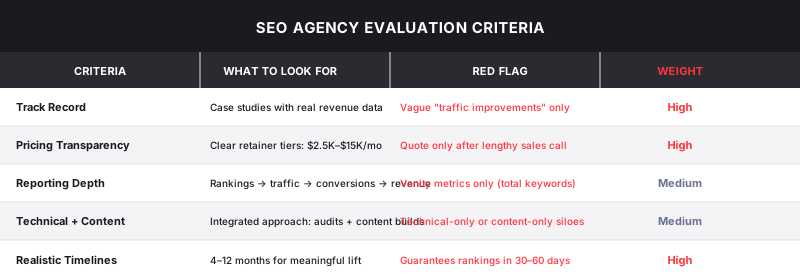
Pricing clarity is itself a quality signal. The best agencies publish their retainer structure or give a straight answer on a first call. The ones that hide pricing behind lengthy discovery processes often do so because the number is not defensible.
Here is what the market looks like in 2026, based on data from Digital Applied and Search Scale AI's agency pricing analysis:
- Small business / local SEO: $1,500 to $3,500 per month
- Growth-stage DTC and mid-market: $3,500 to $8,000 per month
- Enterprise or competitive verticals: $8,000 to $25,000+ per month
- Hourly consulting: $75 to $300 per hour depending on specialization
The average agency retainer for a growth-stage company lands around $3,200 to $5,000 per month. Rates below $1,500 per month typically indicate either highly automated output or a junior team. Rates above $10,000 are justified for companies in competitive verticals or those needing technical depth at scale.
One pricing shift worth noting: AI tools have compressed the labor cost of routine SEO tasks. Agencies that have not passed any of those savings on to clients while raising rates are worth questioning.
How to Evaluate a Best SEO Agency: Five Criteria That Actually Matter
For more on building a full evaluation framework before hiring, our SEO agency guide covers the due diligence process in detail.
1. Case studies with revenue data, not just traffic data
Traffic is a leading indicator. Revenue is the outcome. Any agency calling itself a top SEO agency should be able to show you a case study that traces organic traffic growth to pipeline or revenue, not just to a ranking milestone. Ask for a client in your vertical.
2. Transparency in strategy and reporting
Request a sample report before signing. A strong report connects keyword ranking changes to traffic deltas to conversion events. A weak report shows total keywords ranking, total sessions, and a green arrow. If the report cannot explain why numbers moved, the agency cannot either.
3. Realistic timeline commitments
SEO takes four to twelve months to produce meaningful results. This is not a caveat: it is a structural reality of how search engines evaluate authority. Any agency promising top rankings in 30 to 60 days is using tactics that will erode rather than build equity over time.
4. Technical plus content capabilities under one roof
The best agencies handle both. Technical SEO without content creates a structurally sound site with nothing to rank. Content without technical SEO creates well-written pages that load slowly, have poor crawlability, and lose ground on Core Web Vitals. Ask specifically how their technical and content teams collaborate on a typical engagement.
5. Communication cadence and access to senior strategists
You should know who is working on your account. Junior analysts executing templated strategies with no senior oversight is a common failure mode at mid-sized agencies. Ask who attends your monthly calls and who is responsible for strategy decisions.
SEO Agency Evaluation Criteria at a Glance
Red Flags That Rule Out an Agency Immediately
Some signals should end the conversation before it goes further.
Guaranteed rankings. No agency has a relationship with Google's algorithm. Guarantees on specific positions or timelines are either naive or dishonest. Either one is disqualifying.
No clarity on who does the work. Many agencies pitch senior strategists and deliver junior execution. Ask directly: who runs your account day-to-day? If the answer is vague, the answer is a junior team member following a template.
Reporting that only shows vanity metrics. Total keywords ranking, total impressions, and total sessions are not outcomes. An agency that cannot connect their work to conversions either does not track that data or does not want you to see it.
White-labeled services. Some agencies resell generic SEO packages from a third party and present them as proprietary strategy. Ask who produces the content, who conducts technical audits, and what tools they use. If the answer is vague, you may be paying a markup for commodity work.
Contracts with no performance benchmarks. A 12-month contract with no defined KPIs is a contract that protects the agency, not you. Reasonable milestones should be agreed upon at the start, even with the understanding that SEO results vary.
KPIs That Actually Measure SEO Agency Performance
The metrics you track determine whether you can hold an agency accountable. Focus on these:
Organic revenue or qualified lead volume from organic: This is the ultimate KPI. If the agency cannot connect their work to revenue or pipeline, the engagement is missing its purpose.
Keyword ranking changes for target terms: Track specific keywords tied to buying intent, not just broad informational terms. Informational traffic is valuable for awareness but rarely converts at the rates that justify an SEO investment for growth-stage companies.
Conversion rate on organic landing pages: Rankings and traffic matter less if users bounce without converting. A strong agency pays attention to what happens after the click.
Organic share of total pipeline: As SEO compounds, the share of deals sourced from organic should grow. This is one of the clearest indicators of whether the investment is paying off at the business level.
For companies evaluating multiple service providers as part of a broader growth stack, our guide on best digital marketing firms covers how SEO fits alongside paid, content, and conversion work.
SEO Agency Comparison: Questions to Ask Before You Commit
Use these questions in your final evaluation conversations:
- Can you walk me through a case study for a company in my category, including the revenue or pipeline impact?
- Who will be on my account team and how often will I have direct access to the strategist?
- What does your reporting package look like? Can I see a sample?
- How do you handle algorithm updates that cause temporary ranking drops?
- What does the first 90 days look like, and what deliverables will I see before month four?
- How do you measure success for this engagement specifically, not generically?
The answers reveal process, accountability, and whether the agency thinks about your business or their deliverable list.
For SaaS companies in particular, the evaluation has additional layers given the nuances of free-trial funnels and product-led growth. Our SaaS SEO guide covers the specific criteria relevant to that segment.
How to Find the Best SEO Agencies for Your Business
The best SEO agencies are not always the most visible ones. Agencies that spend heavily on their own marketing sometimes do so because it is easier than retaining clients through results. Start with referrals from companies at a similar growth stage. Ask who they use and whether they would sign again.
Supplement referrals with research. Review sites like Clutch and G2 publish verified client reviews. Look specifically at companies that match your size and vertical. A five-star review from a Fortune 500 enterprise tells you little about how the agency handles a $4,000-per-month DTC brand account.
Finally, use the evaluation framework above as a filter, not a checklist. Every strong agency will have a gap somewhere. What matters is whether their strengths align with your biggest growth lever right now.
Work With an Agency That Treats SEO as a Growth Channel
EmberTribe works with DTC brands and growth-stage companies to build organic search programs that connect to revenue, not just rankings. We combine technical audits, content strategy, and authority building into a single integrated program with reporting that ties activity to business outcomes.
If you are evaluating your options for 2026, embertribe.com is a good place to start.

.webp)

.svg)


