








Most SaaS companies that fail at SEO don't fail because organic search doesn't work for them. They fail because they hired the wrong kind of agency, budgeted for the wrong tier, or started expecting results before the engine had time to build momentum.
SaaS SEO services aren't a commodity, and the agencies that sell them aren't interchangeable. The difference between a generic SEO retainer and a genuinely SaaS-native strategy is the difference between traffic that looks good in a dashboard and traffic that converts to signups and MRR.
Why SaaS SEO Is Its Own Discipline
Generic SEO advice doesn't translate to SaaS. The buyer journey is different, the content architecture is different, and what "success" looks like is measured in activated trials and reduced CAC, not just keyword rankings.
A few things that make SaaS SEO structurally different:
- Buyer sophistication. SaaS buyers research extensively before touching a sales team. They compare tools, read reviews, and look for proof of results (often over weeks or months). Content needs to work across that entire arc, not just drive top-of-funnel clicks.
- Multiple acquisition models. A product-led growth (PLG) SaaS needs different content than a sales-led one. PLG content puts the product in the answer. Sales-led content builds credibility for an AE to close later. Most agencies don't make this distinction.
- Programmatic scale opportunities. SaaS products often have natural content inventory that can be built systematically at scale: integration pages, use-case landing pages, vertical-specific pages. Standard agency playbooks rarely include this capability.
- AI search. In 2026, significant informational traffic now goes to AI-generated summaries rather than clicked links. SaaS companies that don't optimize for LLM citation (GEO/AEO) are losing discovery surface they can't get back through traditional SEO alone.
For a deeper look at content architecture, see the complete SaaS SEO guide.
The Four SaaS SEO Content Pillars
Not all SaaS SEO content is built the same. The most effective programs use four distinct pillar types, each serving a different role in the buyer journey.
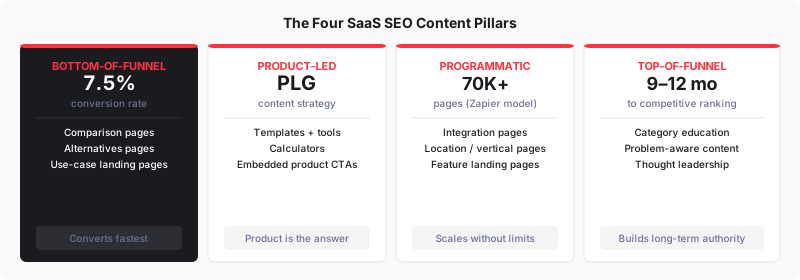
Bottom-of-funnel: comparison and alternatives pages. These convert at roughly 7.5% because the searcher is already in buying mode. Someone searching "Intercom vs Zendesk" or "best Salesforce alternatives for mid-market" is days from a decision, not months. Most SaaS companies under-invest here, building awareness content while their pipeline leaks at the bottom.
Product-led content. This is content where your product is the actual answer, not just mentioned in a paragraph. A template library that requires a signup to download. A free calculator that showcases your product's methodology.
A tool comparison landing page where your product wins. Product-led content drives qualified visits because users are self-selecting into your workflow before they've committed to anything.
Programmatic SEO. Zapier's approach is the canonical example: 70,000+ integration pages (each following a template) generating millions of monthly visitors. Your SaaS has the same opportunity at whatever scale fits your product: integration pages for every tool in your stack, vertical pages for every industry you serve, feature-specific landing pages for every use case. Most agencies don't offer programmatic build capability, so this is worth asking about directly.
Top-of-funnel category content. Blog posts, guides, and thought leadership that capture buyers who are problem-aware but not yet solution-aware. These take 9–12 months to compete for meaningful rankings, but they build the authority that makes everything else work harder. This is where most SaaS companies start, and where most SEO agencies camp out permanently.
A credible SaaS SEO service builds across all four. An agency only doing one isn't running a SaaS SEO program: they're running a content calendar.
What SaaS SEO Services Actually Include
Setting scope expectations early prevents the most common disappointments. A full-service SaaS SEO engagement should cover:
Technical SEO. Crawl health, page speed, indexing issues, structured data, and Core Web Vitals. Many agencies deprioritize this in favor of content, which is backwards: if your technical foundation is broken, the content investment is partially wasted. Companies looking for specialists in this area should read our breakdown of what a technical SEO agency actually does.
Keyword and content strategy. Not just a keyword list: a buying-stage-mapped content architecture that identifies what to produce for each phase of your funnel, in priority order.
The remaining deliverables that separate full-service from partial-service engagements:
- Content production: Ghostwritten or co-created articles, landing pages, and long-form guides. The best SaaS SEO agencies staff writers with domain expertise in your category, not generalists.
- Link acquisition: Digital PR, data studies, and strategic partner placements. Agencies that avoid talking about link building are leaving a major ranking factor unaddressed.
- CRO alignment: Landing page recommendations that connect rankings to trial starts and MQLs. Organic traffic that doesn't convert is expensive brand awareness, nothing more.
- Revenue reporting: Organic trial starts, demo requests, and pipeline attributed to SEO. Impressions and rankings are proxy metrics.
- GEO/AEO in 2026: Structured data, entity optimization, and content built to be cited by LLMs. This is still emerging but already a meaningful traffic variable for informational queries.
Pricing Tiers and What You Get
SaaS SEO services price across a wide range. Here's a realistic map of what each tier delivers:
| Tier | Monthly Range | What's Included |
|---|---|---|
| Startup | $3,000–$5,000 | Keyword research, on-page optimization, 2–4 content pieces/month |
| Growth | $5,000–$12,000 | Technical SEO, link building, 4–8 content pieces/month, reporting |
| Scale | $12,000–$25,000+ | Dedicated team, programmatic builds, digital PR, international expansion |
| AI-assisted boutique | $499–$2,000 | Productized, lower-touch, limited strategy and customization |
Budget mismatch is the leading cause of early SEO churn. A SaaS company with a $10M ARR target that's spending $1,500/month on SEO is not running an SEO program. They're running a content calendar with a strategy problem.
For most growth-stage SaaS companies, the $5,000–$8,000/month range is the minimum to build a compound program. Below that, output is too thin to generate real data about what's working. The economics still hold: organic CAC for SaaS typically runs $480–$942 in year one, declining to around $290 as the program matures, compared to $800+ for paid search.
The SaaS SEO Timeline You Should Actually Expect
Timelines are where the most expectation-setting work needs to happen. A well-documented SaaS content strategy helps set internal benchmarks, but here's the practical month-by-month arc:
| Phase | Months | What's Happening |
|---|---|---|
| Foundation | 1–2 | Technical audit, keyword mapping, content architecture. Zero traffic impact expected. |
| First signals | 3–4 | Long-tail rankings start appearing. Branded search improves. Early organic sessions. |
| BOFU traction | 4–6 | Comparison and alternatives pages begin ranking. First attributable trials. |
| Compound growth | 6–12 | Well-performing content updated and expanded. Internal link equity builds. Pipeline impact measurable. |
| Competitive TOFU | 9–12+ | Informational content starts competing for non-branded terms at volume. Category authority established. |
SaaS companies publishing 9 or more posts per month see 35.8% higher year-over-year organic traffic growth. The compounding is real, but only if the output is high-quality and strategically directed. Volume without quality or strategy accelerates nothing.
Red Flags When Evaluating SaaS SEO Services
Choosing the wrong partner is expensive in multiple ways: the direct fee, the opportunity cost, and the time lost before you course-correct. These signals predict problems before you sign.
They lead with rankings, not pipeline. If the pitch is all about keyword positions and domain authority, ask them directly: "How do you connect SEO to trial starts or MRR?" If they can't answer clearly, they're measuring the wrong things.
No discussion of technical SEO. Agencies that treat technical SEO as an afterthought or a one-time audit are underselling what's often the highest-ROI work. Crawl issues, indexing problems, and Core Web Vitals failures can cut organic traffic in half regardless of how much content you produce.
Three more signals to end the conversation:
- Generic content strategies. If the sample content plan could have been written for any SaaS company in any category, it wasn't built for you. Strategies should map to your buyer's job-to-be-done, your category maturity, and your competitive landscape.
- No programmatic capability. If your product naturally generates integration or vertical-specific content at scale and the agency can't build it, you're leaving a major growth lever untouched.
- No conversation about AI search. Agencies that don't mention GEO, LLM optimization, or AI Overviews in 2026 are behind. According to B2B SaaS SEO data tracked by Powered by Search, informational content page visits for SaaS declined roughly 18% as AI-generated snippets proliferated. A credible partner addresses this directly.
What This Means for You
B2B SaaS companies report a median 702% ROI on SEO, with break-even at around seven months. Powered by Search's B2B SaaS SEO benchmarks show the channel delivers 44.6% of B2B revenue and generates leads at roughly one-sixth the cost of paid search. Those numbers are available to companies that build the program correctly.
The firms that don't see those numbers are usually either spending at the wrong tier, working with an agency running a generic playbook, or measuring the wrong metrics and concluding SEO doesn't work.
If you're evaluating SaaS SEO services and want to talk through what a growth-stage engagement actually looks like in practice, EmberTribe works with SaaS and DTC brands to build organic programs that connect directly to pipeline and revenue.

.webp)

.svg)


