








According to Backlinko's SEO statistics research, 96.55% of all pages on the web receive zero organic traffic from Google. The problem is rarely that organic search does not work. It is that the execution, or the agency executing it, is not doing the things that actually move the needle in Google's current algorithm environment.
Hiring a Google SEO agency is not the same decision it was three or four years ago. The algorithm priorities have shifted fundamentally, and agencies that have not kept pace are burning budgets on tactics that have since been explicitly penalized.
What a Google SEO Agency Does Differently
General SEO as a category covers everything from Pinterest optimization to Amazon listing copy. A Google SEO agency is specifically focused on the signals Google measures, the tools Google provides, and the way Google's crawlers evaluate a site.
The four areas where Google-specific expertise is most consequential:
- Core Web Vitals. Google officially uses three page experience metrics as ranking signals: Largest Contentful Paint (LCP, which should be under 2.5 seconds), Cumulative Layout Shift (CLS, under 0.1), and Interaction to Next Paint (INP, under 200 milliseconds). INP replaced First Input Delay in March 2024, and agencies still reporting FID are using an obsolete metric. Only 33% of websites currently pass all Core Web Vitals thresholds, which means technical performance is a genuine differentiator, not a hygiene baseline.
- Google Search Console. GSC is the only data source that reflects how Google's crawlers actually see your site: impressions, click-through rates, indexing coverage, Core Web Vitals by URL group, and manual action notices. Agencies that rely exclusively on third-party rank trackers are missing the signal Google is directly providing. A Google SEO agency should be building strategy from GSC data, not around it.
- Structured data and schema markup. Properly implemented schema makes content eligible for rich results in SERPs: star ratings, FAQ dropdowns, product pricing, and HowTo panels. These directly increase click-through rates. Schema is also increasingly important for how Google surfaces content in AI Overviews, as structured data provides the semantic clarity that generative AI features rely on to attribute and cite content.
- E-E-A-T signals. Experience, Expertise, Authoritativeness, and Trustworthiness are the quality framework Google's evaluators use. For growth-stage DTC and B2B SaaS brands, this translates to content strategy that builds topical authority through named authors, original research, transparent sourcing, and subject-matter depth, not content volume.
How Google Algorithm Updates Changed What Good Work Looks Like
The playbook for SEO has changed substantially since 2022, and agencies that have not adapted are operating on outdated assumptions.
The Helpful Content System launched in August 2022 and was fully integrated into Google's core ranking algorithm by 2024. It now runs continuously rather than as discrete updates. Its effect: content that exists primarily to rank, rather than to genuinely serve a reader, has been systematically downranked. "SEO content" written without subject-matter input no longer works the way it once did.
The "Experience" addition to E-E-A-T was added in December 2022 and is widely interpreted as Google's direct response to the proliferation of AI-generated content. It rewards content that demonstrates first-hand experience or genuine expertise: bylines, case studies with verified data, original analysis. It deprioritizes content that could have been written by anyone about anything.
2025 Core Updates continued targeting scaled content abuse, link spam, and AI-generated content without human review or editorial value. According to Search Engine Journal's coverage of Google's guidance on hiring SEO agencies, Google's own engineers have made clear that any agency operating through link schemes or scaled templated content is building on unstable ground.
The practical implication: a Google SEO agency that has survived and grown client traffic through 2022 to 2025 without penalties has a materially different skillset than one that was riding pre-2022 tactics. Ask specifically about this.
What to Look for When Evaluating a Google SEO Agency
- Methodology documentation. Ask the agency to walk through their process from kickoff to month six. A credible answer includes: a technical audit with Core Web Vitals and crawl analysis, keyword and topical gap research, a content roadmap tied to search intent, an approach to link acquisition that does not involve link farms or purchasing, and a reporting cadence tied to business metrics. If the answer is vague or leans heavily on "our proprietary process," that is a gap.
- Case studies with GSC data. The difference between a ranking report and a GSC export is the difference between self-reported performance and Google's actual data. Request case studies that include GSC impressions and click-through rate trends, not just position history from a third-party tracker. This is the single clearest indicator of a legitimate track record.
- Reporting on revenue, not rankings. According to Google's own guidance on hiring SEO professionals, Google's John Mueller has stated directly that the ultimate measure of SEO success should be revenue impact, not keyword positions. Agencies that deliver ranking reports without connecting them to traffic, conversions, and revenue are measuring inputs while ignoring outputs.
- Realistic timelines. Google's data from Ahrefs shows that only 5.7% of pages reach the top 10 within their first year. Quality agencies require four to six month minimum engagements before expecting meaningful ranking movement. An agency promising top-10 rankings in 60 to 90 days is either misrepresenting the timeline or planning to use tactics that will not hold.
Red Flags That Signal an Underperforming Agency
Several patterns reliably indicate an agency that will underdeliver or create cleanup work down the road.
Guaranteed rankings are the clearest red flag. No agency can guarantee specific rankings: Google's systems are not predictable at that granularity, and Mueller has stated this explicitly. Any agency making guarantees is either misrepresenting their influence or planning to use tactics Google has specifically targeted.
Unsolicited outreach with a "free audit" is another signal. Google itself flags this practice as a marker of low-quality providers. Legitimate agencies with strong track records do not need to cold-email domain owners with manufactured urgency.
Links as the primary selling point indicates a misaligned strategy. Link building is a component of SEO, not a complete strategy. Agencies that lead with backlink volume rather than technical health and content quality are operating on a pre-2022 framework.
Traffic-only reporting (session volume without conversion data, rankings without CTR context) mirrors the same issue as traffic-only paid media reporting. If an agency cannot connect organic activity to revenue, they cannot tell you whether the program is working.
Pricing Benchmarks for 2026
Ahrefs' SEO pricing research covering 439 practitioners provides the most granular current benchmarks. Monthly retainers are the dominant model, used by 78.2% of SEO providers.
For growth-stage DTC ecommerce and B2B SaaS brands operating in competitive verticals, the relevant range is $2,500 to $5,000 per month for a quality US-based agency delivering full-service work: technical monitoring, content strategy with brief development, on-page optimization, link building, and reporting tied to GSC and GA4. At this tier, 79.1% of US and Canada-based providers operate.
Entry-level retainers ($500 to $2,000/month) typically cover one or two service areas rather than a complete program, and are more appropriate for smaller sites with limited competition. Enterprise or highly competitive verticals typically run $5,000 to $15,000+ monthly, reflecting the content velocity and technical complexity required.
Project-based engagements are common for defined scopes: technical SEO audits run $1,000 to $10,000+ depending on site size, and site migration support typically runs $5,000 to $20,000+.
The pricing floor to watch: any agency offering comprehensive, full-service SEO for a growth-stage brand under $500/month is cutting corners on quality, coverage, or ethical standards. That price point does not cover the labor required to do the work correctly.
What to Expect and When
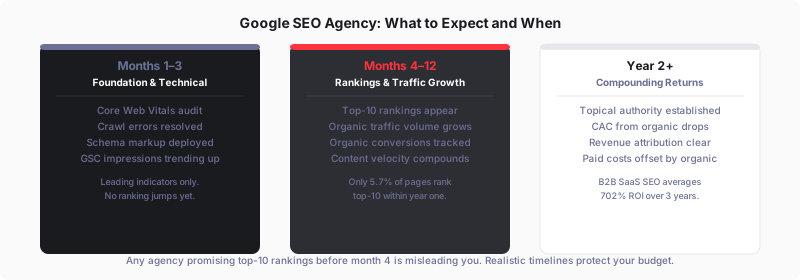
Setting expectations correctly at the start of an engagement prevents the most common failure mode: cutting a program before it has had time to work. B2B SaaS SEO data from Ahrefs' B2B SEO statistics research shows an average 702% ROI with a roughly seven-month break-even over a three-year horizon. Organic search also produces a lower customer acquisition cost ($147 average for SaaS versus $280 for paid search), which means the compounding value is in the long tail, not the first quarter.
For DTC ecommerce, the organic advantage compounds differently: brands with strong SEO reduce their dependence on paid acquisition during peak periods, creating margin protection when CPMs spike. This is the channel mix diversification case for organic, and it takes 12 to 18 months to materialize.
What This Means for You
Organic search accounts for more than 57% of all web traffic globally, but nearly all of it concentrates in a small number of pages that are technically sound, genuinely authoritative, and aligned with how Google evaluates quality in 2026. Getting a B2B SaaS brand or DTC ecommerce site into that group is not a volume problem. It is a strategy and execution problem that a Google SEO agency with current expertise can solve.
If you want to evaluate where your organic program stands against Google's current technical and quality standards, EmberTribe works with growth-stage DTC and B2B brands on SEO strategy built around the signals that actually drive rankings today.

.webp)

.svg)


