








When brands start shopping for SEO help, the category feels deceptively simple: you want to rank higher, get more traffic, and convert that traffic into revenue. But the term "SEO services" covers a wide range of activities with very different cost structures, timelines, and fit depending on where your site is in its growth cycle.
This guide breaks down the recommended SEO services categories worth your budget, how to evaluate providers, and what you should expect to pay in 2026.
What Recommended SEO Services Actually Cover
Not all SEO providers offer the same thing. A freelancer specializing in keyword research is a different product from a full-service agency managing your entire organic channel. Before evaluating vendors, you need to know which category of service you actually need.
The five core service types are technical SEO, on-page optimization, content SEO, link building, and local SEO. Most growth-stage brands need at least three of these working in concert. Choosing only one without the others is a common reason campaigns plateau.
According to Backlinko's analysis of SEO services, providers that deliver consistent results operate with an integrated approach: technical foundations, content production, and authority building working together rather than in isolation.
1. Technical SEO Services
Technical SEO is the foundation. Without it, every other service you invest in produces diminished returns. This category covers site architecture, crawlability, page speed, Core Web Vitals, structured data, canonical tags, and indexation hygiene.
For most sites, technical SEO starts with a comprehensive audit, followed by a prioritized remediation roadmap. A good audit surfaces issues you didn't know existed and ranks them by likely impact. Google's own documentation emphasizes that content quality and technical accessibility work together: neither is sufficient alone.
What to expect to pay: One-time technical audits run $1,500 to $5,000 for most small to mid-size sites. Ongoing technical maintenance is typically bundled into a retainer at $1,000 to $2,500 per month.
Who should prioritize this: Every site, without exception. If your technical SEO is broken, no amount of content or links will compensate.
2. On-Page SEO Services
On-page SEO covers the optimization of individual pages: title tags, meta descriptions, header hierarchy, internal linking structure, keyword alignment, and content relevance signals. It is distinct from content creation; on-page SEO can be applied to existing pages without producing new content.
This service type is particularly valuable for sites that already have traffic and rankings but are leaving conversion opportunities on the table. An on-page audit will often uncover quick wins: pages ranking on page two that can be pushed to page one with targeted optimization, or pages cannibalizing each other because keyword targeting was never coordinated.
Pairing on-page work with a clear internal linking strategy compounds results. For more on building that structure, see our guide to SEO agency services.
What to expect to pay: On-page optimization services typically run $1,000 to $3,500 per month as a standalone service, though most agencies bundle it into a broader retainer.
3. Content SEO Services
Content SEO is where most of the sustainable, long-term organic growth comes from. This service covers keyword research, content strategy, brief development, article production, and ongoing optimization of the content library. For growth-stage DTC brands, content SEO is usually the highest-leverage investment after the technical foundation is solid.
Quality content SEO goes beyond writing blog posts. It means building topical authority across a pillar-and-cluster structure and aligning content to search intent at every funnel stage. Providers should produce material that satisfies Google's E-E-A-T standards (Experience, Expertise, Authority, Trustworthiness). Surface-level content that covers a keyword without genuine depth has become reliably ineffective.
What to expect to pay: Content SEO retainers run $2,000 to $8,000 per month depending on output volume and whether the provider handles strategy, writing, and optimization as a bundle.
Who should prioritize this: Brands building a content moat in a competitive category. If you are in a niche where every major competitor is publishing substantive content, you need to match or exceed that output to compete.
For DTC and ecommerce specifically, see our breakdown of best SEO companies for small business to understand how content investment scales with company size.
4. Link Building Services
Link building remains one of the most impactful SEO signals, and also one of the most misunderstood. Quality matters far more than volume. A single link from a well-regarded industry publication is worth more than dozens of directory submissions or purchased links. Providers who pitch link volume without discussing link quality should be disqualified.
Legitimate link building in 2026 means digital PR, content-driven outreach, strategic partnerships, and contributing expert commentary to publications that already have domain authority. This work is time-intensive, which is why it commands a meaningful budget.
Siege Media's SEO pricing research shows that link building typically runs $1,500 to $5,000 per month for quality outreach-based programs, with enterprise campaigns running significantly higher.
Warning signs: Any provider guaranteeing a specific number of links per month without discussing source quality, or any package priced at a flat rate per link, is likely cutting corners in ways that create algorithmic risk.
5. Local SEO Services
Local SEO is a distinct service category for businesses that serve customers in a specific geographic area: retail locations, service providers, restaurants, and regional professional services. It covers Google Business Profile optimization, citation building, local schema markup, and managing location-specific keyword targeting.
If your business doesn't have a physical location or serve a defined geographic area, local SEO is not a priority. If you do, it is one of the highest-ROI investments available, because local intent queries ("near me" searches, city-specific searches) convert at significantly higher rates than broad informational queries.
What to expect to pay: Local SEO services typically run $500 to $2,500 per month depending on the number of locations and competitiveness of the market.
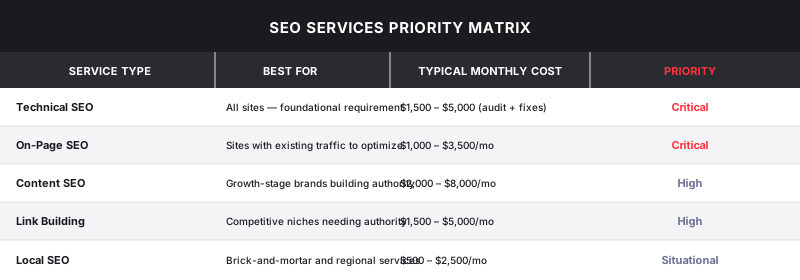
SEO Services Priority Matrix
The matrix below maps each service type to its typical use case, cost range, and priority level for growth-stage brands:
How to Evaluate SEO Service Providers
Knowing which services you need is the first step. Selecting the right provider for each is the second. These criteria separate credible providers from the rest.
Track record with comparable companies. Case studies should show specific metrics: keyword ranking improvements tied to traffic growth tied to revenue. Vague claims of "improved visibility" are not sufficient. Ask for examples from businesses in your category or with your revenue profile.
Realistic timelines. Google has stated it takes four to twelve months for professional SEO changes to produce meaningful results. Any provider guaranteeing significant traffic or ranking improvements in under 60 days is either misleading you or planning to use tactics that create future risk.
Integrated strategy across service types. The best SEO outcomes come from technical, content, and authority signals working together. A provider who only operates in one lane will hit a ceiling quickly.
Transparent reporting. Monthly reports should show rankings, organic traffic, conversion events, and revenue attribution where trackable. If a provider only reports on keyword counts or impressions, that is a signal they are optimizing for optics rather than outcomes.
Pricing that reflects real work. According to 2026 SEO pricing benchmarks, quality full-service SEO retainers run $3,000 to $10,000 per month for most small and mid-size businesses. Services priced below $1,000 per month are almost always automated or templated with minimal results. Enterprise campaigns routinely exceed $20,000 per month.
A Practical Checklist Before You Commit
Use this checklist when evaluating any SEO service provider:
- [ ] They can show case studies with specific revenue or traffic outcomes
- [ ] They explain their strategy in plain language without jargon
- [ ] They set realistic timelines (4 to 12 months for meaningful lift)
- [ ] They do not guarantee specific rankings
- [ ] Their pricing is transparent and benchmarks within market range
- [ ] Their reporting connects activity to business outcomes, not just rankings
- [ ] They address technical, content, and authority together (or are clear about what they do not cover)
- [ ] They have experience with your business type or industry
Matching Services to Your Stage
Early-stage companies with limited SEO budgets should prioritize technical SEO first, then on-page optimization of their highest-traffic or highest-intent pages. Content SEO and link building can be phased in as the foundation is established and budget expands.
Growth-stage brands that already have some organic traction should invest in content SEO to build topical authority and link building to accelerate domain authority in competitive categories. On-page optimization should be continuous.
For a deeper look at how full-service providers structure these offerings, see our guide to best SEO agency options, which covers evaluation frameworks and red flags in detail.
Selecting the right combination of recommended SEO services is not about finding the cheapest option or the most comprehensive package. It is about matching the service mix to your site's current state, competitive landscape, and growth objectives. The brands that treat SEO as a compounding investment rather than a line-item expense are the ones that build durable organic channels over time.
If you want to build that kind of organic engine, EmberTribe works with DTC brands and growth-stage companies on integrated SEO and content strategies. We focus on outcomes that connect to revenue, not vanity metrics.

.webp)

.svg)


