








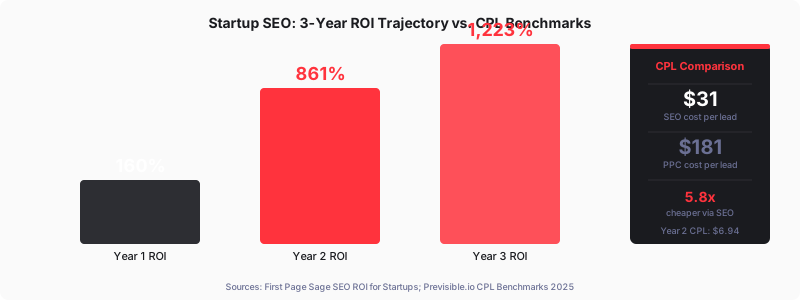
Most startup companies approach SEO the same way they approach paid acquisition: spend, measure immediately, cut what does not convert in 90 days. That mental model produces mediocre results from a channel that rewards patience with compounding returns. First Page Sage's SEO ROI research for startups puts Year 1 ROI at 160%, Year 2 at 861%, and Year 3 at 1,223%.
The compounding dynamic is not a promise. It is the mathematical consequence of rankings that continue generating leads without proportional reinvestment.
This post covers how SEO startup companies should think about the channel, what the cost economics actually look like, which strategies compound fastest at the growth stage, and how to decide between an agency and an in-house hire.
Why SEO Economics Favor Startups Who Start Early
The argument for startups starting SEO earlier than feels comfortable: the break-even point for a well-run program is typically 7 to 12 months, and the opportunity cost of starting late is the 12-18 months of compounding you give up. A program started at $2 million ARR that is still running at $15 million ARR has built an organic asset that paid acquisition cannot replicate.
Previsible's CPL benchmarks document the cost per lead comparison: SEO generates leads at $31 average CPL versus $181 for PPC. By Year 2, as rankings consolidate and content compounds, the effective CPL drops to $6.94. The paid acquisition benchmark stays constant. The divergence is the economic case for prioritizing SEO at the growth stage.
The 94% figure from B2B buying research is important context: 94% of B2B buying groups now use large language models during purchase decisions, per recent buyer behavior data. The implication is that organic content is no longer just ranking in Google. Well-structured, authoritative content surfaces in AI-assisted research sessions. Startups that build content depth now are positioning for both traditional search and AI-assisted discovery.
What SEO for Startups Actually Looks Like in Year One
The most common startup SEO failure is treating the channel as a content blog with keyword optimization. The companies that see meaningful pipeline from SEO in the first year take a different approach.
- Bottom-of-funnel first. Comparison pages, alternative pages, and use-case landing pages target buyers with active purchase intent. A buyer searching "Competitor X alternative" is in a decision moment. Ranking for that query is worth more than ranking for an educational post about a general topic in your category. BOFU content converts at 8-20% against sub-1% for most awareness content. Startups with limited content production capacity should concentrate there.
- Cluster architecture over isolated posts. Search engines rank sites with topical authority. A startup that publishes 30 loosely related posts gets less organic traction than one that builds 5 tightly structured topic clusters with clear hierarchy and internal linking. The cluster model also makes the site more useful to actual buyers navigating a decision.
- Programmatic SEO for product-adjacent queries. When the product integrates with other tools, serves specific industries, or has a geographically relevant use case, programmatic pages can scale coverage efficiently. Zapier built 63,000 integration pages that account for a significant share of their organic traffic. Notion's template library generates substantial organic discovery. The investment is engineering time plus SEO strategy, but the output is scalable content that compounds without proportional editorial cost.
- Technical foundations before content volume. A site with crawl issues, slow load times, or poor mobile performance will underperform regardless of content quality. Before publishing the 20th blog post, the startup should have clean URL architecture, fast page speed, proper internal linking, and schema markup in place. Fixing these issues later, when there is more content to deal with, is more expensive.
The Programmatic SEO Opportunity Startups Miss
The programmatic SEO playbook is underutilized by startups for a predictable reason: it feels like an engineering project, not a marketing project. Most growth teams do not own the engineering relationship.
The opportunity is substantial. Ahrefs' analysis of SaaS SEO documents how companies like Zapier and Notion have turned product data into organic traffic machines. The pattern: identify a class of queries that share a structure (app + integration, template + use case, city + product category), build a scalable page template, populate with product data, and let the search index do the rest.
For early-stage startups, this might mean city-based landing pages if the product has geographic relevance, integration pages if the product connects to a large ecosystem, or use-case pages segmented by industry vertical. The entry point is usually lower than teams assume. A well-structured template and 200 pages of product data can generate meaningful organic traffic within six months.
Organic vs. Paid: Choosing the Right Startup SEO Mix
The binary "SEO or paid" framing is wrong for startups. The correct framing is sequencing. Most growth-stage startups need paid acquisition to generate immediate pipeline while SEO compounds. The mistake is either ignoring SEO until paid costs become unsustainable, or abandoning paid prematurely because the SEO program is showing early signals.
A common effective configuration: paid acquisition carries 60-70% of pipeline in Year 1 while SEO infrastructure and early rankings build. By Year 2, organic's share grows as content matures and programmatic pages index. By Year 3, the channels reach parity in pipeline contribution but SEO's effective CPL is a fraction of paid. The total acquisition cost structure improves significantly.
B2B SEO companies that specialize in growth-stage work understand this sequencing. Agencies that treat SEO as a standalone channel, disconnected from the paid media strategy, produce programs that are harder to measure and harder to justify to a board that is watching paid CAC closely.
Hiring Criteria: Agency vs. In-House SEO for Startups
The hire-or-outsource decision for startup SEO comes down to three variables: how much execution capacity exists internally, what the monthly SEO budget justifies, and how quickly the startup needs organic to contribute to pipeline.
An in-house SEO hire at the seed or early Series A stage typically means a generalist who can own content strategy and some technical execution. The risk is limited specialization: a single hire cannot be excellent at technical SEO, content strategy, link building, and programmatic development simultaneously. The fully-loaded cost of a US-based SEO specialist runs $120,000 to $180,000 annually. At that price point, a SaaS SEO agency often provides more specialized depth for the same or lower total cost.
An agency or specialist engagement makes sense when the startup needs the full stack (technical, content, programmatic, link building) without building a four-person team. The key evaluation criteria for a startup SEO agency:
Do they report to pipeline and revenue, or to traffic and rankings? Any agency still reporting primarily on keyword position improvements is measuring inputs, not outputs. Ask specifically: how do you attribute organic traffic to MQL and pipeline contribution in the client CRM?
What is their process for BOFU content? Can they walk through a specific example where comparison pages or alternative pages generated measurable pipeline for a startup client? This is the differentiation that compounds fastest and requires the most strategic sophistication.
Do they have programmatic SEO capability? For SaaS startups in particular, the leverage from scalable page templates is often 3-5x higher than equivalent editorial investment. If the agency does not have a specific process and examples here, that lever stays unexercised.
What This Means for You
The case for startup SEO is a compounding ROI argument: 160% in Year 1, 861% in Year 2, 1,223% in Year 3. The case for starting earlier rather than later is that every month of delay is a month of compounding foregone. The case for doing it correctly is that a program optimized around traffic rather than pipeline will eventually disappoint the same board that funded it.
For growth-stage SaaS and B2B companies building organic alongside paid acquisition, EmberTribe works with startups on programs where SEO investment is measured against the same revenue metrics as paid, not tracked in a separate reporting silo.

.webp)

.svg)


