








When someone in the UK searches "SEO York," they are looking for an agency that understands the local competitive landscape: the density of professional services firms in the city centre, the tourism-driven seasonal search patterns, the businesses competing for "solicitor York" and "accountant York" and "hotel near York Minster" simultaneously. When someone in Pennsylvania searches the same phrase, they are looking at a smaller, less competitive market with a different industry mix entirely.
This post addresses both. York, UK is the primary focus, a £5 billion economy with 8,900 businesses and a distinctive set of local SEO dynamics. York, PA receives coverage for US-market readers. The underlying principles apply to both.
What "SEO York" Actually Means
SEO for York businesses operates at two levels, and the failure to separate them is the most common source of wasted budget.
Local SEO handles the queries that contain geographic intent: "restaurants in York," "plumber York," "IT support York UK." These queries trigger the Google local pack, the three-business map result that appears above organic results and captures 42% of searcher clicks, according to Backlinko's local search research cited by BrightLocal. Ranking in the local pack depends on Google Business Profile optimization, citation consistency, reviews, and local backlinks. It is managed through Google's local infrastructure, not through standard organic ranking signals alone.
National and technical SEO handles everything else: the informational and commercial queries that are not location-bounded. A York-based B2B SaaS company wants to rank for "[software category] for manufacturers" nationally, not just locally. A York DTC brand selling pottery wants organic visibility across the UK. These require the same technical SEO foundation, Core Web Vitals, site architecture, schema markup, authoritative backlinks, that any national competitor needs.
Most York businesses need both. The mistake is optimizing for one while neglecting the other.
Why York Businesses Face Distinct Local SEO Competition
York, UK's economy creates a specific competitive density that makes local SEO more consequential than in smaller regional cities.
Tourism accounts for a significant share of York's commercial activity, with 8.4 million annual visitors pre-pandemic. This creates an unusual dynamic: local pack competition is not just between businesses serving residents, it is between businesses competing for visitors searching from outside the city. A York hotel competes for "boutique hotels in York" queries coming from London, Manchester, and Edinburgh. A York restaurant competes for "best places to eat in York" queries from travelers planning a day trip.
This out-of-town intent means local visibility has national customer acquisition value.
The professional services sector, solicitors, accountants, financial advisers, management consultants, is dense for a city of York's size, partly because of York's role as an administrative hub for North Yorkshire. The top three positions in the local pack for "solicitor York" attract the substantial majority of inbound calls. Being in position four or below is effectively invisible for most searchers.
The rail industry cluster around York (including several major rail operators and Network Rail functions) adds a B2B layer: vendors serving that cluster compete for procurement-adjacent searches with a professional services format.
In York, PA, the competitive dynamics are different. The market is smaller and less saturated digitally. Healthcare, manufacturing, and professional services dominate by employment. For businesses willing to invest consistently in structured local SEO, the opportunity to dominate "[service] York PA" queries is achievable with less effort than comparable UK-market competition.
The Five Local SEO Factors That Drive Pack Rankings
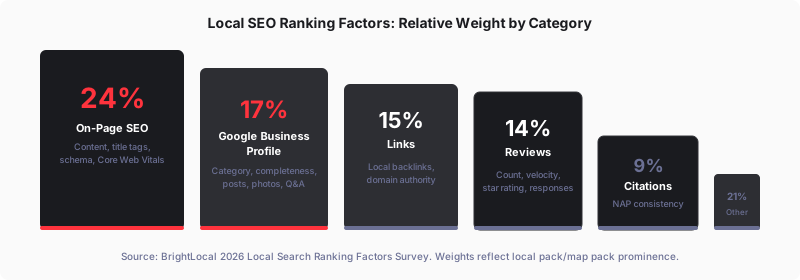
BrightLocal's 2026 Local Search Ranking Factors survey identifies on-page SEO as the single largest factor at 24%, followed by Google Business Profile signals at 17%, links at 15%, reviews at 14%, and citations at 9%.
- On-page SEO at 24% means a business's website is the foundation. Slow pages, thin content, missing schema, and poor technical health limit how far local optimizations can go. A perfectly managed Google Business Profile pointing to a poorly built site does not rank well. Core Web Vitals and structured data, the same technical factors that matter for national SEO, directly influence local pack performance.
- Google Business Profile is where many York businesses are underinvested. Only 35% of SMBs have a Google Business Profile at all, according to BrightLocal's 2025 data. Of those that do, most are incomplete or unmanaged. Active GBP management, accurate categories, regular posts, photo uploads, Q&A monitoring, review responses, is one of the highest-leverage local SEO activities. Google's own data shows that a complete, actively managed profile makes a business 2.7 times more likely to be considered reputable.
- Local links at 15% reflect geographic relevance signals. For York businesses, this means links from York-specific sources: The York Press, York Mix, Visit York, York BID, the University of York, York St John University, and local chambers of commerce. These local backlinks tell Google's algorithm that the business has genuine ties to the area, not just a keyword in the address.
- Reviews have grown in weighting, from 16% in 2023 to an estimated 20% of local ranking factors in 2026. Consistent review velocity matters as much as total count. BrightLocal's research shows that 97% of consumers read local business reviews before visiting, with 71% using Google specifically. A review strategy that generates two to three new reviews weekly outperforms sporadic bursts at the algorithm level and builds a more credible impression for prospective customers.
- Citation consistency means that the business name, address, and phone number are identical across every directory and listing. In the UK, relevant directories include Yell.com, Thomson Local, Scoot, FreeIndex, and Checkatrade (for trades). Any discrepancy, even a minor one like "St." versus "Street," creates a data conflict that reduces the algorithm's confidence in the business's location. 62% of consumers actively avoid businesses with incorrect online information, according to BrightLocal.
What to Look for When Hiring an SEO Agency in York
Most evaluation criteria for a Google SEO agency apply here: no guaranteed rankings, transparent methodology, case studies with verified data, reporting tied to business outcomes rather than vanity metrics. For local SEO specifically, two additional questions matter.
Do they actively manage Google Business Profiles? Not set-up-and-leave management, but ongoing optimization: updating seasonal hours, posting regularly, monitoring and responding to reviews, building out the Q&A section, uploading fresh photos. This is operational work that many agencies underprice or underdescribe in proposals. Ask for specifics on what GBP management actually includes.
Do they build local citations and links, or just national ones? A York business benefits from links in The York Press more than links in a generic UK business directory. An agency with genuine local market knowledge will have a list of York-specific and Yorkshire-specific sources they work with. If their link-building pitch focuses on generic DA30+ placements without mentioning any local publications, they are not optimized for local pack rankings.
Red flags in local SEO proposals are consistent with those in any SEO engagement: guarantees of map pack positions within 30 days, pricing under £500/month for comprehensive coverage, reports that only show impressions without clicks or conversions, and agencies that will not grant access to the client's own Google Business Profile account.
How to Measure Whether Local SEO Is Working
Local SEO results operate on a longer timeline than paid search. Meaningful local pack movement typically takes three to six months from the start of consistent optimization. The measurement framework breaks into two layers.
Leading indicators (months 1-3): GBP completeness score improving, citations audited and corrected, new review velocity established, Core Web Vitals passing thresholds. These do not directly show business impact but confirm the inputs are in place.
Lagging indicators (months 3-12): Local pack rankings for target "[service] York" queries, organic traffic to location-specific landing pages, GBP website clicks and call clicks, direction requests from Google Maps. For DTC brands, organic-attributed revenue from GA4. For B2B SaaS companies with York offices, organic pipeline contribution.
The framing that matters: local SEO should ultimately be measured by leads, calls, footfall, or revenue, not by ranking position alone. A position-one map pack result for a query that generates no commercial intent produces nothing. Tracking the connection from visibility to conversion is what separates an SEO agency that manages rankings from one that manages growth.
What This Means for You
For York businesses in competitive local categories, whether tourism and hospitality in York, UK or healthcare and professional services in York, PA, local SEO is not optional, it is the primary mechanism through which new customers find you. The 42% map pack click share means that businesses outside the top three are effectively invisible to nearly half of all searchers with local intent.
Getting into and staying in the top three is a sustained technical and operational commitment. If you want to evaluate where your local presence stands against competitors and what the highest-leverage improvements are, EmberTribe works with growth-stage DTC and B2B brands on local and national SEO programs built around measurable business outcomes.

.webp)

.svg)


