








A generalist SEO practitioner and a SaaS SEO expert are not interchangeable. The mechanics of keyword research and technical audits carry over, but the strategy layer is fundamentally different. SaaS buyers take three to twelve months to convert, they research across dozens of intent signals, and the pages that generate pipeline are often not the ones that rank for high-volume keywords. Getting those things wrong for twelve months is how SEO programs at SaaS companies get defunded.
This post covers what a SaaS SEO expert actually does, what makes SaaS SEO structurally different, which specializations separate strong candidates from general practitioners, and how to evaluate whether someone has the depth to deliver results on a SaaS timeline.
What Makes SaaS SEO Different From General SEO
SaaS SEO is optimized around a buying journey that general SEO frameworks were not built for. The fundamental differences:
- Longer conversion windows. B2B SaaS trials and demos rarely close in a single session. Most SaaS buyers interact with five to seven pieces of content before requesting a demo, and the buying committee averages three to five stakeholders. SEO programs need to map content to each stage of that journey, not just the initial discovery query.
- Pipeline as the primary metric. Generalist SEO often measures success in sessions and rankings. SaaS SEO is measured in MQL volume, MQL-to-SQL conversion rate, and ultimately pipeline contribution. HubSpot's 2022 CPL and CAC benchmarks put B2B SaaS organic MQL-to-SQL rate at 51%, compared to 26% for paid channels. That gap is why SEO ROI compounds over time while paid acquisition remains linear.
- Bottom-of-funnel content priority. The pages that most reliably generate qualified pipeline in SaaS are not top-of-funnel educational posts. Comparison pages, alternative pages, and pricing-adjacent content target buyers with high purchase intent and convert at 8-20% versus sub-1% for most awareness content. A SaaS SEO expert builds the BOFU foundation first, then layers awareness content to fill the top of the funnel.
- Product-led SEO integration. SaaS companies often have product surfaces that create indexable content at scale. Zapier has built over 63,000 integration pages that account for 44.69% of their organic traffic, per Ahrefs' SaaS SEO analysis. Identifying and executing this kind of programmatic SEO opportunity requires SaaS-specific expertise that generalist practitioners miss entirely.
The ROI Case for SaaS SEO
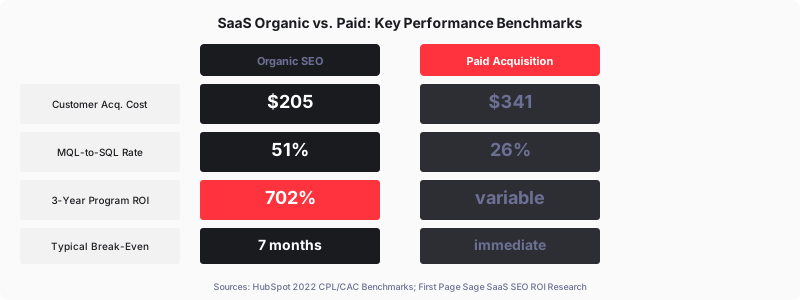
First Page Sage's SaaS SEO ROI research puts the 3-year program ROI at 702% with a 7-month break-even. Backlinko's B2B SEO statistics show that organic search drives 53% of total website traffic across B2B sectors, compared to 15% from paid. The CAC differential is substantial: HubSpot benchmarks put B2B SaaS organic CAC at $205 versus $341 for paid acquisition channels.
The compounding effect is the economic argument that most SaaS founders underweight. Paid acquisition cost is linear: double spend, roughly double leads, roughly double CAC. Organic compound: rankings built in Year 1 continue generating traffic and leads in Year 2 and 3 without proportional reinvestment. The ROI curves diverge sharply after the break-even point.
Core Responsibilities of a SaaS SEO Expert
A SaaS SEO expert owns a set of interconnected responsibilities that most job descriptions underspecify:
- Funnel-mapped keyword strategy. Keyword research scoped to the SaaS buying journey: TOFU educational queries, MOFU comparison queries, BOFU decision queries, and branded queries. Each cluster maps to a content type and a conversion objective. The expert decides which clusters to prioritize based on search volume, competitive gap, and conversion proximity.
- Technical SEO for SaaS applications. SaaS products generate complex URL structures, dynamic content, and JavaScript-heavy interfaces that create indexation and crawl issues specific to web applications. Core Web Vitals, JavaScript rendering, crawl budget management, and site architecture for SaaS are all within scope.
- Content strategy and editorial direction. A SaaS SEO expert is not a content writer, but they direct the content program: deciding what topics to cover, what structure drives engagement and conversion, how to differentiate from competing content, and which formats (guides, comparison pages, programmatic pages, tools) generate the most qualified traffic.
- Conversion rate optimization for organic. Ranking is a prerequisite. Converting ranked traffic into trials, demos, or qualified leads is the actual goal. SaaS SEO experts optimize landing pages, CTAs, internal linking funnels, and content upgrades to maximize the conversion rate from organic visitors.
- Measurement and attribution. Reporting that connects SEO activity to pipeline: which pages are sourcing MQLs, what the SEO-attributed MQL-to-SQL rate is, what percentage of closed ARR has an organic touch. This requires proper UTM architecture, CRM integration, and attribution model configuration that most generalist SEOs do not set up by default.
SaaS SEO Specializations Worth Understanding
The role contains several distinct specializations. Evaluating a SaaS SEO expert requires understanding which of these they are strongest in and whether your current growth stage needs.
Technical SEO is the infrastructure layer: indexation, site architecture, Core Web Vitals, schema markup, and crawl efficiency. Companies in the 0 to 5 million session range often have significant technical debt that limits the impact of any content program.
Content strategy and cluster building is the publishing layer: defining the topics, formats, and sequences that build topical authority in a specific SaaS category. This is where B2B SaaS experts often have the most differentiated skill relative to generalists who optimize single pages.
Programmatic SEO is the product-adjacent layer: building scalable page templates using product data, integrations, use cases, or locations. It requires both SEO judgment and enough technical fluency to collaborate with engineering.
Link building for SaaS requires a different strategy than for e-commerce or media sites. SaaS link programs typically center on original research, product integrations, and digital PR rather than the guest post and link exchange approaches common in other verticals.
How to Evaluate a SaaS SEO Expert
The evaluation criteria that reliably separate SaaS-fluent practitioners from generalists who have worked with one SaaS client:
- Ask for attribution-level case studies, not traffic graphs. Anyone can show a traffic chart that goes up and to the right. The question is whether they can show you the pipeline contribution of that traffic: which pages sourced qualified leads, what the conversion rates were, and what percentage of closed ARR had an organic first touch. If they cannot produce this, they have either been working in the wrong measurement environment or they have not been held accountable to business outcomes.
- Ask specifically about BOFU content architecture. How do they approach comparison pages, alternative pages, and category-specific landing pages? Can they walk you through a specific example where a BOFU cluster generated measurable pipeline? Generalist SEOs often deprioritize this content because it has lower search volume. SaaS SEO experts build it first.
- Ask about their experience with your product category. SaaS SEO for a developer tool is different from SaaS SEO for HR software. The search intent, the buyer vocabulary, the competitive content landscape, and the sales cycle length all differ. An expert who has worked extensively in adjacent SaaS categories will have a faster ramp.
- Ask how they handle the traffic-to-pipeline measurement gap. Most SaaS companies have a disconnected analytics stack: Google Analytics tracks sessions, the CRM tracks leads, and attribution between them is manually constructed. A strong SaaS SEO expert has a default answer to this problem. They know which tools to use, how to structure UTMs, and how to set up the CRM reporting that makes organic contribution visible to the executive team.
Solo Consultant vs. Embedded Team
The hiring model matters as much as the individual. Three configurations are common:
A solo SaaS SEO consultant owns strategy and may direct execution through your internal team or freelancers. This works when you have content production capacity internally and need the strategic layer filled. It breaks down when execution bandwidth is the bottleneck.
A SaaS SEO agency embeds both strategy and an execution team. The SEO expert sets direction; specialists handle technical work, content, and link building. The all-in cost is higher, but the execution gap that undermines solo consultant engagements does not exist.
An in-house SEO hire is appropriate when organic is large enough to justify full-time specialization, typically above 100,000 monthly organic sessions or above $20 million in ARR where SEO is a primary acquisition channel. Below that threshold, the fractional or agency model usually produces better outcomes per dollar.
What This Means for You
SaaS SEO expertise is specific enough that hiring for it requires looking past the general SEO credential. The pipeline attribution question, the BOFU architecture question, and the technical SEO-for-web-applications knowledge are the filters that matter. A program run by someone with genuine SaaS depth returns 702% over three years and generates MQLs at half the cost of paid. A program run by a competent generalist often does not compound the same way.
For SaaS and B2B brands that need performance marketing and organic working from the same strategic layer, EmberTribe works with growth-stage companies on demand programs where organic and paid are measured against the same pipeline outcomes.

.webp)

.svg)


