
In the age of rapid digital transformation, AI has seeped into almost every industry, revolutionizing how we conduct business, design products, and even create content. The ClusterMagic service is a great example, which seamlessly integrates AI for content generation in a hybrid model, providing significant benefits in the SEO results of brands seeking a massive increase in organic traffic. But while AI holds immense promise, it has its limitations. Let's explore the pros and cons of using AI for content creation and understand why a hybrid approach might be the way forward.
Major publishers in sensitive niches like CNET.com, Bankrate.com, and Creditcard.com have already integrated AI-generated content. Other large companies, such as CNN and Forbes, might also be doing so. Countless smaller companies and publishers are utilizing AI, not only on their websites but also on social media, in email marketing, and virtually everywhere else.
Google's stance on AI-generated content is neutral, emphasizing that content should primarily be user-centric. In fact, Google's September 2023 Helpful Content Update removed the mention of "written by people" from their helpful content system guidelines.
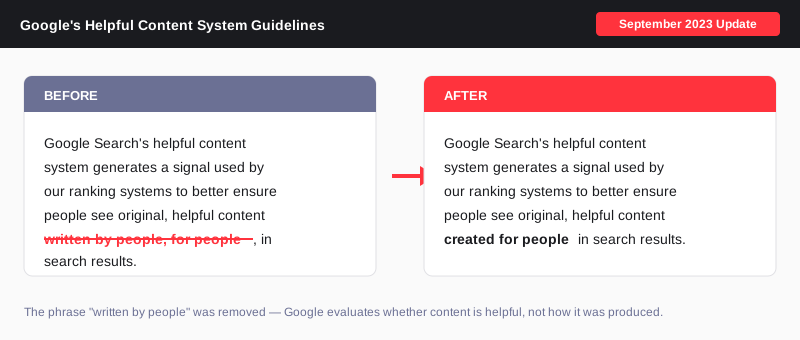
The message is clear: for content to rank well, it must be informative, answer users' queries satisfactorily, and showcase genuine expertise - regardless of how it's created.
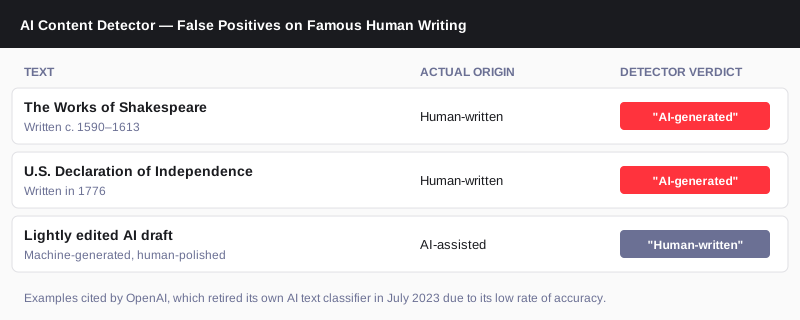
AI Content Detectors like GPTZero, ZeroGPT, and many others are not reliable. Even OpenAI has said as much. They consistently produce false positives about human-written content. Conversely, they can be easily fooled with creative prompting or a bit of human editing.
An interesting note from OpenAI: "we found that it labeled human-written text like Shakespeare and the Declaration of Independence as AI-generated."
Anecdotal evidence and real-life ranking data suggest that while AI-generated content isn't penalized by search engines, it might only achieve high rankings if it meets the above criteria. The role of AI in content creation is still a developing narrative, and its significance is indispensable for maintaining a competitive edge in the future.
At EmberTribe, the understanding is clear - AI serves as a foundation, not the final product. With ClusterMagic, while AI aids in the initial draft based on expert-driven keyword research, human experts step in for the crucial phases of editing, fact-checking, and final review. This hybrid approach ensures the content is accurate and helpful, has the potential to rank, and truly represents their business.

Cost per user acquisition (also called customer acquisition cost, or CAC) is the single metric that determines whether a growth strategy is sustainable or just fast. Companies that grow their revenue while holding or reducing CAC build durable businesses. Companies that grow revenue while CAC climbs quietly are building a funding dependency.
Most companies calculate it wrong, benchmark it against the wrong reference points, and address it with the wrong levers. This guide covers all three.
CAC is not one number. It is three different calculations that serve three different purposes, and conflating them causes expensive decisions.
Blended CAC is total sales and marketing spend divided by all new customers acquired in the same period, regardless of channel. This includes customers from organic search, word-of-mouth, referrals, and direct traffic alongside paid acquisition. Blended CAC is what investors and finance teams typically want to see. It reflects the true average cost of growth.
Because it absorbs "free" customers from organic channels, blended CAC is always lower than paid CAC.
Paid CAC is only paid-channel spend divided by customers attributable to those channels. Paid CAC is consistently higher than blended CAC. The gap between the two quantifies how much your organic acquisition is subsidizing your paid media.
A company with a $200 blended CAC and a $600 paid CAC has a strong organic engine. If that organic engine weakens, the true cost of growth surfaces fast.
Channel-level CAC breaks acquisition cost out per channel: paid search, paid social, email, organic SEO, referral, outbound SDR. This is the most operationally useful view for budget allocation. A blended CAC of $400 can mask a paid social CAC of $900 and an organic SEO CAC of $80. Without channel-level breakdowns, you are allocating budget based on averaged-out noise.
The practical rule: use blended CAC to benchmark and communicate. Use paid CAC to evaluate paid media efficiency. Use channel-level CAC to allocate budget and cut underperforming channels.
The formula is simple: total sales and marketing spend divided by new customers acquired. The application is where teams go wrong.
What belongs in the numerator (spend): ad spend, marketing software and tools, sales team salaries and commissions, marketing team salaries, content production costs, and overhead allocated to those teams. Personnel costs represent 50 to 70% of true acquisition cost in most companies, yet many teams only count ad spend. Excluding salaries understates true CAC by 30 to 50%.
What belongs in the denominator (customers): net-new customers only. Reactivated churned customers and expanded accounts should not go here. If they do, CAC is artificially deflated and the business looks more efficient than it is.
Time-period mismatches are the other common error. Attributing one quarter's marketing spend against that same quarter's new customer count ignores conversion lag: campaigns take weeks or months to produce closed customers. A rolling three-month average, or lagging the denominator by one period, produces more accurate numbers.
Benchmarks are only useful when compared at the right level of specificity. Industry-wide averages obscure category and motion differences that determine whether a given CAC is healthy or alarming.
DTC Ecommerce benchmarks (2025-2026):
According to Userpilot's CAC benchmark research, fully loaded CAC across tracked ecommerce businesses averages significantly higher once personnel costs are included.
B2B SaaS benchmarks by motion:
The 16x gap between PLG and sales-led acquisition reflects the fundamental cost difference between product-driven trial conversion and outbound-heavy enterprise selling. Most SaaS companies should know which motion dominates their revenue and benchmark accordingly, not against a blended SaaS average that mixes both.
By acquisition channel (B2B SaaS, per First Page Sage's CAC report):
The channel-level data is the most actionable benchmarking layer. If your paid search CAC is $1,400 and the benchmark is $802, the gap is a diagnostic: you have a conversion problem, a targeting problem, or both.
CAC in isolation is incomplete. A $1,000 CAC for a customer worth $10,000 in lifetime gross profit is excellent. A $200 CAC for a customer worth $350 is a slow bleed.

The standard benchmark is a 3:1 LTV:CAC ratio as the minimum for sustainability: for every $1 spent acquiring a customer, the customer should generate $3 in lifetime gross profit. The median across tracked SaaS companies is approximately 3.2:1.
The ratio is only as good as the LTV estimate. Gross profit LTV, not revenue LTV, is the correct input. A SaaS company with 40% gross margins calculating LTV on revenue is overstating the ratio by 2.5x. A DTC brand calculating LTV on 12-month windows without modeling declining repurchase probability is making the same error in a different form.
The ratio also sets a per-customer budget ceiling: if average customer LTV is $10,000, maximum allowable CAC is $3,333 to maintain 3:1. This gives marketing a hard number to optimize toward, rather than an abstract efficiency goal.
The payback period answers a different question than LTV:CAC: not whether acquisition is profitable, but when it becomes profitable. For capital-constrained companies, this is often the more important metric.
Formula: CAC divided by (average monthly revenue per customer multiplied by gross margin percentage).
SaaS benchmarks:
According to The SaaS CFO's analysis of CAC payback benchmarks, self-serve B2B SaaS typically achieves 8.6-month payback while sales-led enterprise averages 14 to 24 months, reflecting the higher CAC and longer ramp to recognized revenue.
A rising payback period is a leading indicator of capital inefficiency before it shows up in the P&L. A company with 24-month payback is effectively lending its CAC to each new customer for two years. In a high-growth environment with available capital, that is fundable. In a capital-scarce environment, it becomes an existential constraint.
For DTC ecommerce, subscription conversion is the single biggest lever on payback period. A brand selling consumables with a 20% subscription take rate recovers CAC in 2 to 3 purchases; a brand with no subscription mechanic may need 5 to 7.
According to Paddle's analysis of CAC trends over time, average CAC has increased approximately 60% across B2B and B2C businesses since 2021. The proximate cause was Apple's iOS 14.5 ATT rollout in April 2021, which allowed approximately 75% of iOS users to opt out of cross-app tracking.
The downstream effect: Meta and Instagram lost the attribution layer their performance advertising was built on. Advertisers could not prove ROI with precision, so they bid more conservatively, CPMs rose, and acquisition costs climbed. Meta Q1 2025 CPMs hit $10.88, up 19.2% year-over-year.
The structural problem is broader than a single policy change. More brands compete on fewer dominant platforms. Cookie deprecation in Chrome has extended attribution gaps beyond mobile. Lookalike audiences are saturated from heavy use, forcing advertisers into colder inventory.
Creative fatigue cycles have shortened from 6 to 8 weeks to 2 to 3 weeks, increasing creative production cost as a share of total acquisition cost.
An important distinction: some of the observed CAC increase is real (higher CPMs, more competition) and some is measurement noise (lost attribution making conversion tracking incomplete, so reported CAC rises without actual costs rising equivalently). Both are real problems, but they require different solutions.
Not all CAC reduction levers are equivalent. Three have disproportionate impact.
Conversion rate optimization. Improving landing page or checkout conversion from 1% to 2% cuts CAC by 50% with zero change in spend. A 20% improvement at the highest-drop-off funnel stage has the same CAC impact as cutting the entire marketing budget by 20%. This is consistently the highest-ROI intervention available and the most neglected.
Referral programs. Referral CAC in B2B SaaS averages approximately $150, compared to $802 for paid search. Referred customers also show 16% higher lifetime value and 37% higher retention than non-referred customers. Referral programs are underused because the attribution is lagged and the economics only become obvious in hindsight.
Organic channel investment. Organic SEO CAC runs materially below paid equivalents in every measured category. The tradeoff is time: organic channels take 6 to 18 months to ramp, but they compound and do not reprice with every platform auction. As paid CAC continues climbing, the comparative economics of organic improve each year. For companies with a long enough horizon, investing in customer acquisition through organic channels produces the widest CAC differential over time.
Channel mix optimization, first-party data improvement, and retention investment all contribute as well. But the leverage hierarchy matters: fix conversion rates first, then build referral mechanics, then invest in organic, then optimize channel mix. Doing them in reverse order optimizes around a leaking funnel.
Cost per user acquisition is not just a marketing metric. It is the variable that determines how much capital a business needs to grow, how long investors will stay patient, and whether a company can reach profitability before its runway ends. The brands and SaaS companies that get this right are not necessarily spending less than their competitors. They are spending on channels with better unit economics, converting more of the traffic they already have, and building acquisition motions that improve over time.
If you want to audit your acquisition economics and identify where the highest-leverage improvements are, EmberTribe works with growth-stage DTC and B2B brands on programs designed to grow revenue without proportionally growing the cost to acquire it.

Ironpaper is a B2B growth agency founded in 2003 and based in New York City with a 70-person team. They specialize in lead generation, demand generation, account-based marketing, and sales enablement for B2B companies with complex, long-cycle sales processes. Understanding what they actually do, and what they do not do, is a useful starting point for any company evaluating B2B lead generation options.
This post covers Ironpaper's model specifically, then maps the broader landscape of B2B lead generator types so you can evaluate fit across the category.
Ironpaper positions itself as a systems builder rather than a campaign vendor. Their stated differentiation: they treat marketing as an interconnected growth ecosystem rather than a series of individual tactics. The practical translation of that framing is a service model that spans strategy, content, demand generation, ABM, and sales enablement under one retainer.
Their core service lines:
Ironpaper's primary client profile is mid-market and enterprise B2B companies in technology-adjacent sectors: SaaS, IoT, IT services, energy, fleet management, and recruiting. They report a 50/50 split between mid-market and enterprise clients. The common thread across their client base is a long or complex sales cycle: deals that involve multiple stakeholders, 3 to 18 months to close, and a sales process that requires significant buyer education before the first qualified conversation.
Ironpaper's approach to B2B lead generation references the Gartner finding that B2B buyers spend only 17% of their purchase process time interacting with potential vendors. The implication they draw: the 83% of the buying journey that happens without vendor contact is shaped almost entirely by content. Their model is built around owning that phase.
Minimum engagement size starts at $25,000+ per project at $200 to $300 per hour based on Clutch data, which positions them solidly in the mid-market and enterprise tier. Early-stage startups and SMBs with limited marketing budgets will not find a natural fit here.
Ironpaper occupies one segment of a market with at least four distinct agency types, each serving a different need.

Full-service growth agencies like Ironpaper are suited for companies investing in a compounding, systems-based approach to B2B pipeline. The timeline to meaningful results is 6 to 12 months, which is the right expectation to set going in.
Demand generation specialists focus on paid media and pipeline metrics with shorter feedback loops. For SaaS companies that need to generate qualified pipeline in four to eight weeks while longer-term organic programs ramp, a demand gen specialist operating alongside a content agency is a common configuration.
SDR-as-a-service firms handle outbound: cold email sequences, cold calling, and appointment booking. Ironpaper does not run outbound cold outreach programs. Companies that need a BDR function without the cost of hiring in-house ($150,000 to $200,000 annually for a fully loaded US-based SDR) will need a separate partner for that layer.
ABM-specific agencies concentrate on enterprise named account programs, often integrating with intent data platforms like Demandbase, 6sense, or Terminus. This is highest-investment, highest-target-size territory.
Understanding which layer of the stack you actually need shapes which type of agency makes sense, and whether a single partner or a combination is the right answer.
Several things Ironpaper does well are worth noting regardless of whether they are the right fit for your company.
Their 20-plus years of B2B-only focus is genuine domain depth. B2B sales cycles, multi-stakeholder dynamics, and the content types that actually move enterprise buyers differ materially from B2C. Agencies that have worked across both tend to underestimate how different these environments are.
Their original research is a credible signal. Publishing a proprietary study on B2B messaging effectiveness, and building service lines around fixing the problem that data identifies, is the kind of thought leadership that separates a domain expert from a content mill. It also tells you something about how they approach client engagements.
Their integrated model reduces coordination overhead. A single agency managing strategy, content, demand gen, and sales enablement means fewer handoff failures than a multi-agency configuration.
A $25,000 minimum engagement is the clearest filter. Growth-stage companies with annual marketing budgets under $200,000 will find the cost structure difficult to justify, particularly in the first six months before the content and demand gen programs compound into consistent pipeline.
Companies that need immediate pipeline, such as a fundraising round that requires demonstrated revenue growth in the next 90 days, may need performance marketing tactics with shorter feedback loops alongside or instead of a content-ecosystem approach.
Companies outside Ironpaper's primary verticals (SaaS, IT, IoT, energy, tech) will find fewer directly relevant case studies and may encounter a steeper ramp as the team learns their market dynamics.
High-velocity sales motions with small deal sizes are a structural mismatch. Ironpaper's model is calibrated for complex, considered purchases. If you are selling $10,000 ACV SaaS with a product-led growth motion, an agency that thinks in terms of nurturing long buying journeys may add friction rather than remove it.
Before committing to any B2B lead generator, the questions that matter most:
How do you define a qualified lead, and how does that definition align with our sales team's? How does your reporting connect marketing spend to pipeline and revenue, not just MQLs? What does the first 90 days look like before results materialize?
What industries and deal sizes do you have documented results in? How does your team structure support both strategy and execution, and who is doing the work day-to-day?
The answers to those five questions reveal more about fit and likely outcomes than any case study on the agency's website.
Ironpaper is a well-constructed B2B growth agency for mid-market and enterprise technology companies with complex sales cycles and the budget to invest in a compounding content and demand system. For companies that match that profile, they are worth serious evaluation.
For growth-stage B2B companies that need a performance marketing layer focused on measurable pipeline metrics alongside content strategy, EmberTribe works with DTC and B2B brands on programs that connect demand generation investment directly to revenue, not activity reports.

According to SeoProfy's lead generation statistics research, 80% of new leads never convert to sales. For companies paying business lead generation companies by volume, that number is the most important context in the decision: you are not buying leads. You are buying the fraction of leads that will eventually become customers, and the agency you choose determines whether that fraction is 5% or 25%.
The problem is that the category called "lead generation companies" covers at least five fundamentally different service models. An outbound appointment-setting firm and an inbound SEO agency both call themselves lead generation companies. They do completely different work, serve different sales motions, and produce different lead quality. Choosing without that distinction in mind produces the misalignment that drives the 80% non-conversion rate.
Not all lead generation companies are solving the same problem. Understanding the model is the first step to knowing whether a company can actually help you.
The differences between B2B and B2C lead generation are structural, not just tactical.
B2C generates roughly seven times more leads per month than B2B (an average of 196.5 leads per month at B2C companies versus 28 for B2B), but individual B2B leads carry far higher lifetime value. B2C conversions are often impulse-driven with short decision cycles. B2B deals involve 12 or more average touchpoints before a sales-qualified lead is created.
The platform split reflects this: 89% of B2B marketers use LinkedIn for lead gen, and 62% say LinkedIn generates leads at twice the rate of other platforms, per SeoProfy's research. B2C lead generation runs primarily through Meta (Facebook and Instagram), Google Shopping, and increasingly TikTok. An agency optimized for one side of this divide is not automatically equipped for the other.
The evaluation framework differs too. B2B lead quality is assessed by job title, company size, budget authority, and pain signal, criteria that take time to verify and require ICP-specific targeting. B2C lead quality is assessed faster, by behavioral signals: email open rates, click patterns, abandon cart events. Agencies that conflate these frameworks produce misaligned results in both directions.

The pricing model is the first signal. Retainer arrangements ($2,500 to $12,000 or more per month) indicate a strategic partnership focused on program quality. Pay-per-lead models create an incentive toward volume over quality, since the vendor gets paid the same whether the lead converts or not. Pay-per-appointment aligns incentives better for outbound firms, since the vendor only gets paid when a qualified meeting is booked.
Regardless of the model, several green flags indicate a trustworthy vendor:
The agency discloses exactly how leads are sourced and how contact data is verified. It provides sample lead records before signing. It can show historical MQL-to-SQL rates with real client data, not just industry averages. It offers CRM integration with real-time delivery and a defined policy for replacing invalid contacts.
Red flags that reliably predict future problems: the vendor refuses to disclose lead sourcing methodology. The pricing and volume promises look too good relative to industry CPL benchmarks. The case studies only show anonymous testimonials without named clients or specific metrics. The leads being sold are non-exclusive and shared across multiple buyers in your category.
There is no minimum contract length (which means they are not confident in results) or there is an unusually long lock-in with no performance-based exit clause.
One of the most costly red flags is a vendor that sells recycled lists. Recycled leads have already been contacted by competitors and are statistically much less likely to convert. If an agency cannot explain specifically how their contact database is sourced and refreshed, assume the data quality is poor.
First Page Sage's B2B conversion rate data shows website visitor-to-lead conversion averaging 1.1% for B2B SaaS and up to 7.4% for legal services. These are the starting points for evaluating funnel performance.
The metrics that matter from a lead generation company relationship:
Digitechniks' outsourced lead generation analysis shows outsourced campaigns launching in two to four weeks versus three to six months for in-house builds, with 71% of organizations that outsource reporting higher conversion rates than purely in-house management.
Outsourcing makes sense when the fully loaded cost of an in-house SDR ($150,000 to $200,000 annually in the US) exceeds the cost of an outsourced program ($7,000 to $12,000 per month for mid-market coverage). It also makes sense when you are entering a new market, when the sales team is prospecting instead of closing, or when you want to test a channel before committing to headcount.
Building in-house makes sense when brand narrative is highly complex and requires deep product knowledge, when you have a product-led growth motion that requires sophisticated lifecycle nurturing, or when lead volume is high enough to support and manage a dedicated SDR team effectively.
The reality for most growth-stage companies is a hybrid: outsource pipeline acceleration while building internal content and nurture capability in parallel. 82% of companies plan to outsource at least part of their lead generation in 2025, which is consistent with programs that treat outsourced agencies as a complement to in-house capability rather than a replacement.
Lead generation companies are not interchangeable. The model, the channel focus, the pricing structure, and the lead sourcing methodology all determine whether an engagement produces pipeline or just activity. Companies that treat lead gen as a commodity purchase, choosing on price per lead, reliably end up with the 80% non-conversion problem the industry is defined by.
If you want to evaluate which lead generation approach best fits your current stage, budget, and sales motion, EmberTribe works with growth-stage DTC and B2B brands on performance programs that connect lead generation spend directly to revenue outcomes.

Pricing is one of the highest-leverage decisions a SaaS company makes. Get it right and you accelerate growth, reduce churn, and attract the right customers. Get it wrong and even a strong product can stall out at scale. Yet most SaaS founders spend more time on their go-to-market motion than on the pricing model that underlies it.
The good news: benchmarks from 100+ SaaS companies show clear patterns in what works at each stage. This guide breaks down the core software pricing models, when each fits, and how to avoid the traps that slow growth.
Most teams obsess over the number on the pricing page. The model that number sits inside matters far more. The wrong model creates misaligned incentives, confusing packaging, and a sales cycle that fights itself. The right model aligns what you charge with how customers experience value, which is the foundation of any sustainable growth strategy.
According to OpenView Partners, SaaS companies that use value metrics to set pricing grow at twice the rate of companies that don't. That's a structural advantage you can build in from day one.
If you're also thinking through how pricing connects to broader acquisition strategy, our guide on SaaS customer acquisition strategies covers the full top-of-funnel picture.

Per-seat pricing charges a fixed amount per user per month. It's the most widely adopted model, used by 57% of SaaS companies, though that share is declining as hybrid models grow.
The appeal is predictability: customers know exactly what they'll pay, and vendors get a clean revenue signal tied to organizational growth.
Works best for: Collaboration tools, project management, and CRM platforms where value scales with the number of users.
Examples: Salesforce, HubSpot, Notion, Linear.
Pros:
Cons:
The median per-seat price across SaaS companies is $45/month at the entry tier, with a year-over-year increase of about 11% as of 2025.
Usage-based pricing (also called consumption pricing) charges customers based on how much they use: API calls, messages sent, data processed, or transactions run. This model has moved from niche to mainstream fast.
Roughly 38% of SaaS companies now use it in some form, up significantly from just a few years ago.
Works best for: Infrastructure, APIs, communication tools, and any product where usage varies significantly across customers.
Examples: Twilio charges per SMS and voice call. Stripe takes a percentage of each transaction. AWS prices every compute resource by consumption. All three have built multi-billion dollar businesses on this model.
Pros:
Cons:
For SaaS companies targeting developers or technical buyers, usage-based pricing often outperforms seat-based models because it removes the commitment friction that slows initial adoption.
Tiered pricing offers multiple plans at different price points, each with a defined feature set. It's the dominant structure for packaging: 68% of SaaS companies use tiered packaging in some form, often combined with another model.
Works best for: Companies with a broad customer base spanning SMB, mid-market, and enterprise, where different segments have meaningfully different needs.
Examples: Intercom, Mailchimp, Zapier, Zendesk.
Pros:
Cons:
The data on tier count is clear: companies with three tiers convert at 1.4x the rate of those with two tiers and at 1.8x the rate of those with four or more.
Three tiers with a visible "Most Popular" badge on the middle plan is the highest-converting structure by a wide margin.
For a deeper look at the metrics that pricing strategy should connect to, see our breakdown of SaaS marketing metrics and KPIs.
Flat-rate pricing charges one price for full access, regardless of users or usage. Basecamp is the canonical example: a single fixed monthly fee for unlimited users. It's simple to communicate and easy for customers to budget.
Works best for: Products with a defined feature set targeting a narrow, homogeneous customer segment.
Pros:
Cons:
Flat-rate pricing works well at early stage when you're targeting one specific customer profile. As your product and customer base diversify, it typically gets replaced by tiered or hybrid models.
Freemium gives users a free tier with limited features or capacity, with paid plans unlocking more. It's a top-of-funnel strategy as much as a pricing model. Only 19% of SaaS companies rely on pure freemium, because conversion rates are notoriously low: typically 2-5% of free users convert to paid.
Works best for: Products with strong network effects, viral loops, or a large addressable market where free distribution has real compounding value.
Examples: Slack, Dropbox, Figma, Calendly.
Pros:
Cons:
The freemium trap is building a great free product that users love but never upgrade. The free tier must be genuinely useful while leaving a clear, felt gap that the paid plan fills.
The biggest shift in SaaS pricing over the past two years is the move to hybrid models that combine elements of multiple approaches. As of 2025, 61% of SaaS companies use some form of hybrid pricing, up from 49% in 2024.
A common hybrid: a base platform fee (flat-rate) plus per-seat charges plus usage overages. HubSpot uses this structure. So does Salesforce at the enterprise tier. The combination lets you capture predictable base revenue while still expanding with customer growth.
High-growth SaaS companies (those growing more than 40% year-over-year) show a 21% higher median growth rate when using hybrid models compared to pure single-model approaches. That gap is significant enough to revisit if you're still on a purely flat or purely seat-based structure.
No model is universally correct. The right choice depends on four factors:
1. Where does value live in your product? If customers experience value every time they use a specific action or output, usage-based fits. If value comes from access and collaboration, seat-based fits. If value is in capabilities unlocked, tiered fits.
2. Who is your buyer? Technical buyers and developer-led companies tend to respond well to usage-based because it removes commitment risk. Business buyers and procurement-driven organizations often prefer predictable flat or seat-based costs.
3. What does your expansion motion look like? Per-seat grows with headcount. Usage-based grows with adoption depth. Tiered grows through upgrades. Align your model to how you actually want customers to expand.
4. What stage is your company at? Early-stage companies benefit from simplicity (flat or tiered). Growth-stage companies often need usage or hybrid models to capture more of the value they're delivering to larger customers.
If you're working through how pricing fits into a broader go-to-market build, our team covers this in depth through growth strategy consulting.
Even well-designed products lose revenue to avoidable pricing errors. The most common:
Pricing to cost, not value. Cost-plus pricing tells you what you need to break even, not what customers will pay. The gap between those two numbers is your margin opportunity.
Too many tiers. Four or more plans reduce conversions, confuse prospects, and create internal support overhead. If you have four tiers, cut one.
Hiding complexity. Every hidden fee or usage cap discovered post-purchase damages retention. Transparent pricing, even if complex, outperforms obscured simplicity in LTV because it builds trust at the start of the relationship.
Never testing price. Pricing pages are among the highest-leverage things to A/B test, and most SaaS companies never run a single pricing experiment. Even a modest optimization can produce an 11-15% revenue increase according to pricing research from ProfitWell.
Pricing is not a one-time decision. The best SaaS companies revisit their model as they learn more about their customers, expand into new segments, and develop new product capabilities. Start with the model that fits your current stage and customer profile, then build the instrumentation to know when it's time to evolve.
The companies that get this right don't just convert better at the top of the funnel. They retain longer, expand faster, and build the kind of unit economics that make every other growth investment more effective. For SaaS teams building toward that outcome, getting the pricing model right is one of the most important moves you can make.

Finding the best SEO companies for small business is harder than it looks. The market is crowded with agencies that promise the same things, charge wildly different rates, and rarely explain how they'll actually move the needle for a business your size. This guide cuts through that noise with specific criteria, real pricing data, and the questions you need to ask before signing anything.

Large enterprise brands have dedicated in-house teams, established domain authority, and budgets that can absorb 12-month ramp periods. Small businesses operate under very different constraints: tighter budgets, faster ROI pressure, and usually a single decision-maker who's also handling everything else.
The right SEO company for a small business is not just a scaled-down version of an enterprise agency. It's one that understands your market footprint (often local or regional), speaks to your customer's specific search intent, and can show meaningful traction within 3 to 6 months. Local SEO specifically tends to produce faster early results than broad national campaigns, which matters when cash flow is on the line.
Small business SEO also tends to focus on a narrower keyword set. Rather than chasing thousands of terms, effective small business SEO identifies the 20 to 50 keywords that actually drive qualified leads, then builds content and authority around those. That kind of focus requires an agency that asks good questions upfront about your business goals, not one that jumps straight to a keyword list without understanding your funnel.
The strongest small business SEO agencies share a few non-negotiable practices. Understanding these will help you separate agencies that earn their retainer from those that produce reports without results.
They tie strategy to business outcomes. Rankings are a means to an end. An agency worth hiring will frame its work around revenue, leads, or conversions, not just keyword positions. If the first conversation is entirely about traffic and impressions with no mention of your actual business goals, that's a signal.
They operate with full transparency. You should have direct access to your Google Analytics and Google Search Console accounts at all times. According to Clutch's agency selection guide, agencies that restrict data access or only share curated reports are a consistent red flag across industries. Your data belongs to you, not your vendor.
They cover the full SEO stack. Content without technical health leaks rankings. Links without content have nowhere to send authority. The best small business SEO companies address all three pillars: technical site health, content depth, and link equity. Agencies that focus on only one tend to hit a ceiling quickly.
They give you a realistic timeline. Meaningful organic traffic growth typically begins at the 3 to 6 month mark, with significant ROI usually materializing between 6 and 12 months. Research from First Page Sage puts median SEO ROI at approximately 748%, meaning roughly $7.48 returned for every $1 spent, but that return compounds over time rather than arriving immediately. Any agency promising dramatic results within 30 days is either overpromising or using shortcuts that will cost you later.
Pricing has increased since 2023, driven partly by the additional scope that Answer Engine Optimization (AEO) and Generative Engine Optimization (GEO) now require. AI-driven search results in platforms like Google AI Overviews, ChatGPT, and Perplexity have expanded what "full-service SEO" means, and that expanded scope is reflected in retainer rates.
Here's where the market sits in 2026:
Budget below $500 per month almost always means templated work, automated reporting, and minimal human strategy. It's not that affordable SEO can't work. Below a certain threshold, the inputs simply aren't there to produce meaningful results in a competitive market.
Knowing which agencies to avoid saves as much money as finding the right one. These are the warning signs that appear consistently across industry evaluations:
Guaranteed rankings. No SEO agency can guarantee a #1 position. Google's own guidance is explicit: any company making this promise is either misrepresenting how search works or planning to use tactics that will eventually trigger a penalty. Walk away from any agency that leads with a guarantee.
Vague strategy language. "We use proprietary techniques" and "our process is proven" are ways of saying nothing. A legitimate agency can explain, in plain terms, what they're going to do in months one through three. If they can't, they probably don't have a real plan.
Cookie-cutter packages. A local restaurant and a regional SaaS company do not need the same SEO package. Agencies that sell identical plans to every client are optimizing for their own margins, not your results.
No access to your own data. You should always have direct access to your Google Analytics, Search Console, and any platform they set up on your behalf. An agency that controls access to your accounts has misaligned incentives.
Pricing that seems too low. The floor for real SEO work in 2026 is around $500 per month, and that's for very local, low-competition situations. If someone's pitching a full-service plan at $200 per month, the math doesn't support actual human work being done.
On the other side, the agencies worth hiring tend to share these characteristics:
They ask about your business before talking tactics. A strong SEO partner wants to understand your revenue model, your customer acquisition funnel, and where organic search fits into your growth plan. If the first call goes straight to keywords, they're starting in the wrong place.
They provide case studies in your vertical. Ranking a local dentist and ranking a DTC skincare brand require different skill sets. Relevant portfolio work shows the agency understands your market dynamics, not just generic SEO theory.
They report on metrics that matter to you. Monthly reports should connect SEO activity to business outcomes: leads generated, revenue attributed to organic, conversion rates by landing page. Traffic-only reporting is a distraction from what actually matters.
They communicate proactively. Algorithm updates, ranking fluctuations, and technical issues happen. A good agency reaches out before you notice a problem, not after you send an anxious email asking what's going on.
For more on evaluating SEO partners generally, the EmberTribe guide on finding the best SEO agency covers the full evaluation framework. And if you're weighing SEO against paid channels, the marketing agency overview breaks down how different agency types fit different growth stages.
Before committing to any retainer, get clear answers to these five questions:
Vague, deflective, or overly salesy answers to any of these are informative. A confident, specific agency will answer all five without hesitation.
The right SEO company for your small business depends on where you are in your growth trajectory.
If you're a new or very local business with limited competition, a Starter-tier engagement ($500 to $1,000 per month) focused on technical cleanup and Google Business Profile optimization can produce real results within 90 days. The ROI potential is high because the competition bar is low.
If you're competing regionally or in a moderately competitive vertical, a Growth-tier engagement ($1,000 to $2,000 per month) with active content production and link outreach is the right starting point. You're building topical authority and should see meaningful organic lead growth by month six.
If you're a DTC brand or a multi-location business competing at a national level, the Competitive tier ($2,000 to $3,500 per month) is where you need to operate. Anything less and you're bringing a limited budget to a fight where your competitors are spending more. The EmberTribe SEO agency guide goes deeper on what full-service SEO looks like at this level.
The key is matching your investment to your competitive environment, not just your budget ceiling. Underfunding SEO in a competitive market produces nothing. Funding it appropriately in a local market can deliver outsized returns faster than almost any other channel.
EmberTribe works with DTC brands and growth-stage companies that are serious about organic search as a revenue channel. We handle the full SEO stack: technical audits, content strategy, link development, and performance reporting, all connected to your actual business metrics.
If you're evaluating SEO partners for your small business, embertribe.com is a good place to start. We'll show you what the work actually looks like before you commit to anything.

Finding the best SEO firm requires a different lens than finding a large agency. A firm, by definition, is smaller, more specialized, and consulting-forward. The word signals something specific: strategic ownership, senior-level execution, and a tighter client-to-strategist ratio. If you are a DTC brand or growth-stage company evaluating your options, that distinction matters more than it might seem.
This guide covers what defines a top SEO firm, how to evaluate quality, and the specific questions that separate a capable partner from a capable-sounding one.
The terms "firm" and "agency" are often used interchangeably, but they describe meaningfully different operating models. A large agency typically employs 50 or more specialists across multiple service lines. An SEO firm is usually under 20 people, focused primarily or exclusively on search, and structured so that senior strategists remain accountable for client outcomes throughout an engagement.
According to research compiled by NinjaPromo, boutique SEO firms consistently deliver 30 to 40 percent increases in organic traffic compared to the 12 to 15 percent average at large agencies. The gap is not about resources. It is about attention, accountability, and the absence of layers between strategy and execution.
At a large agency, the strategist who sells you the engagement is rarely the person who runs it. Account managers coordinate between specialists, and junior staff handle the day-to-day work. At a well-run SEO firm, the senior strategist who scoped your project is the same person writing your content brief, reviewing your technical audit, and presenting results in the quarterly review.
That continuity compounds over time. It means faster iteration, fewer handoff errors, and a partner who genuinely understands your business model rather than managing it from a dashboard. For brands where organic search is a primary acquisition channel, this is not a marginal difference.
The best SEO firms share a set of operational habits that separate their results from the field. These are not claims you can assess from a website. They are behaviors you surface through a proper evaluation process.
They diagnose before prescribing. A quality firm will slow down your initial conversation, ask about your revenue model, your current traffic mix, and your conversion funnel before recommending anything. Firms that lead with a standard deliverable list are not doing strategy. They are selling a package.
They connect SEO to revenue, not just rankings. Search Engine Land's benchmarking guidance is clear that traffic volume is a lagging indicator. The firms worth hiring define success in terms of pipeline contribution, lead quality, and conversion data, not monthly position reports.
They have demonstrable track records in your category. General SEO expertise is table stakes. The firms that move the needle for DTC brands have run campaigns for DTC brands before. They know the content formats that convert, the technical issues that surface on commerce platforms, and the link-building approaches that work at that scale.
They are honest about timelines. Legitimate SEO takes three to six months to show meaningful movement and twelve or more months to compound. Firms that promise fast results are either using tactics that create short-term gains followed by penalties, or they are not being truthful about how search works.
The table below summarizes the five criteria that matter most when evaluating any SEO firm, including what to look for and what signals a problem.

Use these criteria as a structured checklist during your evaluation calls. Each one surfaces a different risk: track record catches firms that are better at selling than delivering; senior ownership reveals staffing realities; reporting depth shows whether their definition of success aligns with yours; specialization fit identifies category-specific gaps; and client retention is the most honest proxy for actual satisfaction, because clients who are not getting results leave.
On retention specifically: strong SEO firms average client relationships of 18 months or more. If a firm cannot point you to clients who have been with them for at least two years, ask why.
The quality of a firm's answers to specific questions tells you more than any case study. These are the questions worth asking in your evaluation conversation.
Who specifically will own my account, and what is their experience level? You want a name, a title, and a description of their background. If the answer is "our team" or "we assign based on fit," push for specifics.
How do you define success for an engagement like mine? A firm that immediately pivots to rankings is telling you something. The right answer names a business outcome: qualified traffic growth, lead volume, revenue from organic, or some combination.
Can I speak with a current client in a similar category? References are table stakes, but the key word is "current." Past clients speak to what the firm was capable of before. Current clients reflect what they are doing now, under current search conditions.
What is your approach to AI-generated overviews and zero-click searches? Gartner research has noted the shift in search behavior as AI-assisted results absorb a growing share of informational queries. Firms that have not adapted their content strategy to account for this are operating on an outdated playbook.
What does the first 90 days look like? Strong firms have a defined onboarding sequence: a technical audit in weeks one and two, a content and keyword strategy by week four, and initial optimizations live by day 60. Vague answers here typically mean vague execution later.
Pricing for a quality SEO firm typically ranges from $2,000 to $6,000 per month for growth-stage DTC and SaaS brands. That range reflects senior-level access, a meaningful content output cadence, and active link-building, not just maintenance.
Firms priced below $1,500 per month are generally running templated processes at scale. That model can produce results for low-competition niches, but it does not work for brands operating in competitive categories where differentiation and content depth are the actual ranking factors.
Firms priced above $8,000 per month without a clear deliverable structure should be asked to justify the overhead. You are not necessarily getting better strategy at that price point. You may be paying for a brand name and an account management layer.
The middle range ($3,000 to $5,000 per month) is where most top-performing boutique SEO firms operate. At that price, you should receive direct access to a named senior strategist, a monthly content delivery, an ongoing technical monitoring process, and quarterly business reviews tied to revenue metrics.
If you want a broader comparison of how SEO firms fit into the larger agency landscape, see our post on finding the best SEO agency, which covers the full spectrum from boutique firms to enterprise shops. For brands specifically evaluating the U.S. market, our guide to the best SEO company in the USA covers regional considerations and how to assess domestic expertise.
The short version: if your business needs a strategic partner who will be accountable for outcomes from month one, a firm is the right structure. If you need a full-service marketing department with multiple specializations under one contract, a larger agency may be a better fit, with different tradeoffs on attention and execution depth.
EmberTribe is a specialized SEO firm working with DTC brands and growth-stage companies. Our engagements are structured around a small client roster so that every account gets senior-level attention throughout, not just during onboarding.
We build content strategies grounded in keyword intent, competitive analysis, and conversion data, and we report on outcomes that connect to your revenue model. If you want to understand what that looks like for your specific situation, embertribe.com is the right place to start.
Most ecommerce SEO packages are built for content sites with shopping carts bolted on. They default to blog post counts and keyword ranking PDFs because those are easy to produce and easy to report. Meanwhile, your category pages sit under-optimized, your faceted navigation burns through crawl budget, and your product schema hasn't been touched since launch.
A real ecommerce SEO package is built differently. It treats your catalog as an organic growth asset, prioritizes the pages that actually convert, and reports on revenue, not traffic.
A standard SEO engagement manages a few hundred pages. An ecommerce engagement manages thousands, with structural challenges that don't exist on content sites. Four specific issues make ecommerce SEO a different problem:
Most agencies pitch packages heavy on blog posts because they're easy to produce and easy to count. But here's where ecommerce organic revenue actually comes from.

Category pages generate 3–5x more organic revenue than individual product pages, yet most packages treat them as an afterthought. A well-optimized category page targets high-volume commercial terms, includes supporting copy that doesn't bury the products, and is structured for faceted filtering without creating crawl waste. For most DTC brands, ranking a handful of high-priority category pages is worth more than ranking 50 long-tail blog posts.
Product detail pages capture long-tail, purchase-ready traffic. Someone searching "women's merino wool crew neck sweater grey medium" is not browsing. They're buying. PDP optimization covers title tags, meta descriptions, structured data, UGC integration (reviews, Q&A as indexable content), and image alt text at scale. Research on ecommerce SEO benchmarks shows only 73% of top ecommerce brands systematically optimize UGC for SEO. The other 27% leave that traffic on the table.
Blog and buying guide content supports category authority and captures pre-purchase research queries. It's valuable, but it's the last place most DTC brands should invest their first ecommerce SEO dollars. It's also the first thing most packages lead with.
The right tier depends on your catalog size, competitive intensity, and technical baseline, not just your monthly budget.
Best for stores under 500 SKUs with a clean technical baseline and moderate competition.
Covers: initial technical audit, priority on-page fixes, 2–4 content pieces per month, basic keyword tracking, and a monthly traffic + rankings report.
What's typically missing at this tier: active link building, schema implementation at scale, crawl budget governance, and any work on category page architecture. If your catalog is simple and your competition is low, this is a reasonable starting point. If you're in a competitive DTC vertical, it's not enough.
Best for stores with 500–5,000 SKUs in competitive verticals: apparel, beauty, supplements, home goods.
Covers: ongoing technical monitoring including crawl governance and Core Web Vitals tracking, broader on-page coverage across category and PDP pages, 6–10 content pieces per month, active link building (5–15 links monthly), schema implementation (Product, Breadcrumb, FAQ), and organic revenue reporting tied to your actual checkout data.
This is where the DTC-specific work lives. The difference between a good and average package at this tier comes down to crawl budget strategy, how faceted navigation is handled, and whether the monthly report shows organic-attributed revenue or just traffic and rankings.
Best for stores with 5,000+ SKUs, multi-site or international operations, highly competitive markets, or upcoming platform migrations.
Covers everything in the Growth tier plus dedicated development support, large-scale content operations (often 20+ pieces per month), aggressive link acquisition, international SEO with hreflang implementation, log file analysis to find crawl waste, and full migration support with pre/post traffic monitoring.
Most enterprise engagements also include a one-time setup fee of $1,000–$5,000 for the initial technical audit and foundational fixes before the ongoing retainer begins.
A proposal that looks comprehensive can still be built for the wrong store. These questions reveal whether it's actually scoped for yours.
"How do you handle faceted navigation and crawl budget?" If the answer is vague or nonexistent, the agency hasn't thought about your catalog structure. This is a technical problem that directly affects how quickly your pages rank, and it requires a specific solution.
"What's your approach to product schema implementation?" A meaningful answer names the schema types they'll implement (Product, Offer, AggregateRating), describes the implementation method (manual, plugin, custom feed), and explains how it's maintained as your catalog changes.
"How do you report on organic revenue, not just traffic?" You want to see a methodology that connects organic sessions to purchases in your analytics platform. GA4 + Google Search Console can do this. Any agency that can't describe this connection is measuring the wrong thing.
"What do you prioritize: category pages, PDPs, or content?" If the answer is immediately "content," push back. For most ecommerce stores, category and PDP optimization has higher revenue leverage than blog content, especially in the first six months.
Some proposals sound thorough but have structural weaknesses that predict poor results.
No mention of crawl budget or technical architecture. A package scoped only for on-page and content work will quietly fail for any catalog over a few hundred pages. Technical infrastructure is not optional at scale.
Link building listed as "available on request" or priced separately. Organic rankings for competitive ecommerce terms require domain authority. A package that treats link acquisition as an add-on isn't built to compete in tough markets.
Reporting that shows only rankings and traffic. According to First Page Sage's ecommerce SEO ROI report, ecommerce SEO delivers 317% ROI with a 9-month break-even. You can only verify those numbers with revenue attribution, not keyword position charts.
Content-first proposals for large catalogs. If 80% of the proposed deliverables are blog posts and the catalog has thousands of SKUs with thin category pages, the priorities are backwards. Ask specifically how many hours per month are allocated to technical and on-page work versus content.
Organic search drives 43% of all ecommerce traffic and is expected to reach 53% of all web traffic by 2026. According to ecommerce SEO benchmarks from Charle Agency, organic traffic converts at roughly 2.8–4%, outperforming social, display, and most paid channels outside of branded search.
Those conversion rates hold because organic traffic is intent-driven. Someone who found your site by searching a specific product query has already done most of their buying research. The page just needs to complete the job.
The timeline to those returns requires patience. Most ecommerce SEO programs reach break-even around nine months, with compound returns building from there. The brands that stick with it long enough to reach that inflection point are the ones that see the channel become their most cost-efficient acquisition source.
The right ecommerce SEO package for a 200-SKU DTC brand looks nothing like the right package for a 5,000-SKU multi-site operation. Price comparison without catalog context is meaningless. What matters is whether the package you're evaluating is built for how your store actually works: catalog architecture, competitive intensity, and revenue attribution included.
If you want to audit what your current or prospective ecommerce SEO package is actually optimizing for, EmberTribe works with DTC and growth-stage ecommerce brands to build organic programs that trace directly to checkout.

Choosing the wrong search engine marketing company doesn't just cost you agency fees. It costs you months of wasted ad spend, missed revenue, and the time it takes to undo a poorly structured account. The market is crowded with firms that call themselves SEM specialists, but the differences in scope, structure, and accountability are significant.
This guide breaks down what SEM companies actually do, how they differ from one another and from SEO agencies, what pricing looks like in 2026, and the specific questions you should ask before signing a contract.
A search engine marketing company manages paid advertising on search engines, primarily Google Ads and Microsoft Advertising (Bing Ads). The core work includes keyword strategy, campaign architecture, bid management, ad copy, conversion tracking, and ongoing optimization to hit a target return on ad spend (ROAS) or cost per acquisition (CPA).
SEM is distinct from SEO. Where SEO builds organic rankings over months, paid search drives traffic within 24 to 72 hours of campaign launch. The tradeoff: average Google Ads CPC reached $5.26 in 2025, up nearly 13% year-over-year, which makes execution quality more important than ever. A poorly managed account at $10,000 per month in ad spend can burn budget on irrelevant clicks while a well-managed one at the same budget drives profitable customer acquisition.
Beyond Google and Bing, most SEM companies also handle YouTube ads, Google Shopping campaigns, and Performance Max, since these campaigns run through the same Google Ads platform.
Not all SEM firms are the same. Before you start evaluating vendors, it helps to know which type of firm you're looking for.

Pure-play SEM firms specialize exclusively in paid search. They run Google Ads and Microsoft Ads, and that's it. If you already have strong organic traffic and a functioning content strategy, a pure-play firm can be an efficient choice. You're paying for deep specialization, not breadth.
Full paid media agencies extend beyond search into Meta, TikTok, programmatic display, and sometimes connected TV. They're built for brands that want cross-channel coordination, where search data informs social creative and vice versa. If you're a scaling DTC brand running multiple acquisition channels, this structure tends to reduce silos and improve attribution clarity.
Full-service growth agencies combine paid search with SEO, CRO, email, and broader strategy. According to Stackmatix's SEM agency selection guide, the strongest agencies blend SEM with conversion rate optimization and content to sync data across channels. This approach is worth considering when your paid search performance is being limited by landing page quality or organic search gaps, not just bid strategy.
For more on how these agency types compare in scope and structure, see our breakdown of SEM marketing agencies.
Most growth-stage brands need both, but the allocation depends on where you are in your growth trajectory. A common split is roughly 75% of search budget toward SEO and 25% toward SEM, though this shifts significantly based on how competitive your category is organically and how quickly you need to acquire customers.
SEM makes sense as the primary channel when you're launching a new product, entering a new market, or need immediate revenue while organic rankings build. SEO makes more sense as a long-term foundation because organic customer acquisition cost is approximately 65% lower than paid search CAC once it matures.
If your question is how to find a quality SEO-focused firm alongside your paid search work, our guide to PPC companies covers the paid side, and we've also written on how to evaluate a best SEO agency for the organic side.
Understanding how SEM companies charge is critical for evaluating bids and avoiding misaligned incentives.
Percentage of ad spend is the most common model. Agencies typically charge 10% to 20% of your monthly ad spend. This works well when your budget is scaling, since the agency's fee grows with your investment. The risk is that it can create an incentive to spend more rather than spend efficiently.
Fixed monthly retainer gives you predictable costs regardless of ad spend volume. Retainers typically range from $2,500 to $10,000 per month for mid-market brands. This model works best when your budget is stable and you want clear deliverables per billing period.
Performance-based pricing ties a portion of fees to specific outcomes: leads generated, revenue driven, or ROAS targets hit. This can align incentives well, but only if the performance metrics are defined precisely and attributed accurately. Vague performance clauses are a red flag.
Hourly consulting ranges from $100 to $300 per hour and is most appropriate when you have an in-house paid search team that needs strategic guidance rather than full execution.
For small businesses, total monthly spend including ad budget and management fees typically lands between $2,000 and $8,000. For mid-market and enterprise brands, expect $15,000 to $50,000 or more per month depending on account complexity.
For context on how Google Ads management is priced and structured separately from full SEM retainers, that post covers platform-specific considerations in more detail.
The market for SEM services is noisy. These are the criteria that actually separate strong firms from expensive ones.
Proven results in your category. Ask for case studies with specific metrics: ROAS improvement, CPA reduction, revenue growth attributed to paid search. Generic claims about "increased traffic" are not a useful signal. Concrete numbers tied to accounts similar to yours in size and industry are.
Account ownership clarity. Some agencies retain ownership of your Google Ads account when you leave. Make sure your contract specifies that you own the account, the data, and the conversion history. Losing account history when you switch agencies can cost months of optimization data.
Conversion tracking rigor. A surprising number of SEM firms inherit broken conversion tracking and either don't notice or don't fix it. Before any strategy conversation, a competent firm should audit your existing tracking setup and identify gaps. If they skip this step, that's a meaningful signal about how they'll manage your account.
Transparent reporting. Ask what reporting cadence they use, what metrics appear in every report, and whether you'll have direct dashboard access. Agencies that only share curated PDFs once a month make it difficult to verify what's actually happening in your account.
Strategic integration. Ask how their paid search work connects to your landing pages. Sending high-intent traffic to a weak landing page is one of the most common ways ad spend gets wasted. A strong SEM firm either handles CRO recommendations directly or works closely with whoever does.
Before you sign with any search engine marketing company, get clear answers to these:
These questions won't guarantee a good outcome, but they will quickly filter out firms that are operating with outdated practices, limited transparency, or insufficient specialization.
A well-run SEM engagement typically follows a predictable ramp. The first 30 days should cover account audit, conversion tracking verification, keyword research, campaign architecture, and initial ad copy. Days 30 to 60 are usually the learning phase for automated bidding strategies, where Google's algorithm gathers conversion data. Days 60 to 90 are when meaningful optimization decisions should start based on real performance data.
If an agency promises dramatic ROAS improvements in the first two weeks, be skeptical. Smart Bidding requires statistical volume to perform well, and aggressive changes in the first month often reset the learning phase unnecessarily.
The right search engine marketing company for your brand depends on where paid search sits in your overall growth strategy. A pure-play SEM firm makes sense if you need deep specialization in a mature account. A full-service agency makes sense if your paid search performance is limited by factors outside the ad account itself, like weak landing pages, poor creative, or organic gaps that are driving up CPCs.
EmberTribe works with DTC and growth-stage brands to build paid search programs that are efficient, transparent, and built to scale. If you're evaluating your current SEM setup or looking for a new partner, get in touch with our team at embertribe.com to walk through what an engagement looks like.

Hiring the right search engine marketing firm is a different decision from hiring an agency. The distinction is not just terminology. Firms typically operate with a consulting-led model, meaning senior practitioners handle accounts directly rather than delegating execution to junior staff. For growth-stage and DTC brands running five- to six-figure monthly ad budgets, that difference in structure can determine whether paid search becomes a scalable acquisition channel or an expensive monthly bill.
This guide breaks down how to evaluate and select an SEM firm in 2026, including how firms differ from agencies and in-house teams, what engagement structures and pricing to expect, and the specific questions that separate strategic partners from volume shops.
The word "firm" carries a specific connotation in professional services. A law firm, a consulting firm, an accounting firm: these are practices built around senior expertise applied directly to client engagements. An SEM firm operates on the same principle.
Where a traditional SEM agency may assign an account manager who oversees a portfolio of 30 clients and hands execution to junior analysts, a paid search firm typically keeps strategic and tactical work at the senior level. The strategist who presents your quarterly roadmap is also the one pulling optimization levers day to day. This structure tends to produce better results for accounts that require nuanced decision-making, such as brands with complex product catalogs, thin margin windows, or competitive ROAS targets.
The Google Ads platform has also grown significantly more complex since the broad rollout of AI-powered campaign types. Performance Max, demand gen, and smart bidding require someone who understands how to structure campaigns to feed the algorithm correctly, not just monitor dashboards. A firm model ensures that judgment stays with experienced practitioners.
The right structure depends on your budget, your internal marketing capacity, and how much strategic depth you need.

The comparison above highlights the structural differences. SEM firms occupy a specific middle ground: more strategic depth than most agencies, more external perspective than an in-house hire, and faster to activate than building an internal function.
In-house teams carry one major advantage that neither firms nor agencies can fully replicate: institutional knowledge. An in-house specialist understands your product margins, seasonality, and customer segments without onboarding. The tradeoff is cost and coverage. A single mid-level paid search hire costs $80,000 to $140,000 per year in salary alone, before tools, benefits, and management overhead.
One person also cannot cover Google Search, Shopping, Performance Max, Microsoft Advertising, and Amazon Ads with equal depth simultaneously.
SEM agencies at the larger end often serve enterprise accounts across dozens of verticals. Their resources are broad, but account attention tends to be distributed. A search engine marketing company operating at scale may rotate your account between analysts as team composition changes, breaking the continuity that good optimization requires.
A boutique SEM firm hits the right balance for most growth-stage brands: dedicated senior attention, multi-platform expertise, and a consulting engagement model that makes strategic alignment part of the recurring workflow rather than an annual QBR.
SEM firm pricing generally follows one of three models, and the structure you agree to shapes the incentives on both sides.
Retainer-based pricing is the most common. According to Swydo's 2026 agency pricing analysis, nearly 80% of agencies now use some form of retainer, providing predictable costs and continuous optimization cycles. For SEM firms specifically, monthly retainers typically range from $3,000 to $12,000 for growth-stage accounts, with enterprise engagements running higher.
Percentage-of-spend models tie the firm's fee to a percentage of your monthly media budget, typically 10% to 20%. This model aligns the firm's revenue with your investment level, but it can create a subtle incentive to increase spend rather than improve efficiency. If a firm operating on this model recommends scaling budget, ask them to show the supporting data before agreeing.
Hybrid structures combine a base retainer with a performance bonus tied to specific KPIs, typically ROAS or CPA targets. InfluenceFlow's 2026 agency pricing guide notes that hybrid models are gaining traction specifically because they align incentives across both parties. The base fee covers core management; the bonus rewards results that exceed targets.
Most reputable SEM firms require a minimum engagement of three to six months. Paid search optimization takes time: account history accumulates, Smart Bidding algorithms need conversion data to stabilize, and creative testing requires statistically significant sample sizes. Any firm offering month-to-month contracts with no minimum is likely managing accounts reactively rather than strategically.
The quality of a firm's answers to these questions reveals more than any case study.
Who will manage my account day to day, and what is their experience level? Ask for the specific person, not a team description. Understand their seniority, how many accounts they manage simultaneously, and whether they will be your primary point of contact or whether an account manager will be in that role.
How do you approach account structure for a brand at my spend level? A strong answer involves campaign architecture decisions specific to your goals, such as how they would allocate budget across campaign types, whether they would use Performance Max or campaign-by-campaign structures, and how they handle brand vs. non-brand separation.
What does your reporting cover, and how do you connect it to revenue? As Gartner's Digital IQ research on search marketing benchmarks notes, firms that report activity without connecting to financial outcomes are showing effort, not results. Demand reports that include ROAS, CPA, and contribution to pipeline or revenue, not just impressions and clicks.
Can you walk me through a campaign you restructured and what the outcome was? This question separates firms that execute from firms that think. A firm worth hiring can describe the specific reasoning behind a structural change, not just point to a before-and-after screenshot.
What platforms do you actively manage, and do you have certifications? In 2026, a capable SEM firm should be active across Google Ads, Microsoft Advertising, and ideally have experience with Google Shopping and Performance Max. Google's official certification program is a baseline indicator, not a differentiator on its own, but the absence of active certifications is a flag.
Some agencies adopt firm-style language without firm-style operations. Watch for these warning signs.
A discovery process that lasts less than one week before campaign launch means the firm is not building strategy from your data. Effective onboarding includes access to historical account data, a review of existing creative and landing page performance, audience definition, and goal alignment before a single campaign goes live.
Reporting focused on vanity metrics such as impressions, clicks, and quality scores without revenue correlation is a sign the firm is optimizing for what looks good in a deck rather than what drives your business. Ask to see a sample report before signing.
Contracts with aggressive auto-renewal clauses or vague scope definitions should trigger a legal review. Reputable SEM firms define deliverables clearly, including reporting cadence, meeting frequency, response time commitments, and what happens if performance benchmarks are not met.
Account access held by the agency rather than the client is non-negotiable. Your Google Ads account, your data, and your conversion history belong to you. Any firm that cannot give you full admin access to your own account at any point in the engagement should be disqualified immediately.
The first 90 days of an SEM firm engagement establish the baseline. Expect the following milestones as indicators that the engagement is on track.
By the end of week two, conversion tracking should be verified and firing correctly across all campaigns. By the end of month one, campaign architecture should be finalized and initial bid strategies set based on your historical data. By the end of month three, performance should be trending toward your ROAS or CPA targets, with creative tests in progress and an optimization log documenting what changes were made and why.
If a firm cannot show you a detailed optimization log by the end of month two, ask directly what work was performed and when. Firms that operate strategically document their decisions. Shops that execute mechanically do not.
If your SEM program also needs to integrate with organic search efforts, it is worth reviewing how a search engine marketing services model coordinates paid and SEO channels. The two strategies share keyword data, landing page infrastructure, and conversion rate insights. Firms that can inform both sides of search tend to produce better overall results than those narrowly focused on paid alone.
EmberTribe works with DTC and growth-stage brands that need senior-level paid search strategy without the overhead of building an in-house function. Our engagements are structured around direct access to experienced practitioners, transparent reporting tied to revenue outcomes, and clear accountability at every stage of the funnel.
If you are evaluating SEM firms and want to understand what a strategy-first engagement looks like for your account, visit embertribe.com to start the conversation.

Seattle's business landscape is genuinely distinct from most US markets. A city where 290,000 tech workers represent nearly 30% of the regional economy, and where Amazon, Boeing, and Microsoft anchor an information sector generating $134 billion in output, creates a buyer who approaches marketing content with more skepticism and more sophistication than most. Generic social media content performs poorly here. Olive Group's Seattle digital marketing analysis documents that Seattle audiences have a measurably stronger preference for authentic over polished content and are among the most likely in the US to disengage from templates and stock-photo aesthetics.
Choosing a Seattle social media company means evaluating not just capability but cultural fluency. This guide covers the platform benchmarks that matter, when local presence creates a real advantage, what social media management costs, and the questions that separate genuine local expertise from agencies that simply have a Seattle mailing address.
The Seattle market concentrates several industries that each require distinct social media strategies. Tech and SaaS companies need LinkedIn-first content that demonstrates technical authority for B2B buyer audiences. Healthcare and biotech organizations navigate HIPAA-compliant content requirements with educational thought leadership. Hospitality, food and beverage, and retail brands operate in a strong shop-local culture where community roots and sustainability positioning move the needle in ways they do not in most other markets.
Seattle's TikTok adoption among local businesses grew 56% in the past year, per local business data compiled by Visualwebz. The platform split that works in this market runs TikTok for discovery, Instagram for lifestyle and visual brand building, YouTube for research-stage content, and LinkedIn for B2B tech buyer audiences. A social media company without platform-specific expertise for each of these is building a one-size strategy for a market that rewards specialization.
The sustainability orientation of Seattle consumers also affects content directly. Brands that communicate environmental credentials authentically earn engagement and loyalty at rates above national averages. Brands that greenwash face audience backlash more quickly than in less values-driven markets.

Buffer's 2026 social media benchmarks show LinkedIn at 6.5% to 8% median engagement, TikTok at 4.86%, Instagram at 4.3%, Facebook at 3.6% (down 36% year over year), and X at 2.15% (down 48% year over year). Emplifi's 2026 report puts TikTok brand engagement at 27.6% in Q4 2025, with 200% year-over-year brand follower growth. For B2B-oriented Seattle companies, LinkedIn carousel and document posts generate a 21.77% median engagement rate, the highest of any single content format on any platform.
The organic reach context is critical for setting expectations. Sprout Social's organic reach data shows Facebook organic reach at under 2.2% of followers without paid amplification, down from 16% in 2012. Instagram sits at 2% to 4% of followers, down 12% year over year. LinkedIn organic reach declined 34% year over year.
These numbers do not mean social media is less valuable. They mean that algorithm expertise, content format selection, and posting cadence are the primary differentiators between agencies that generate results and those that maintain activity metrics.
Paid social ad costs are rising simultaneously. Affect Group's Meta ad benchmark data shows CPM costs rising 8% to 38% across industries in 2025. For Seattle businesses with physical locations or geo-targeted campaigns, the cost-per-result math increasingly favors organic content quality over raw paid reach, making the agency's content and community expertise more valuable than their media buying efficiency.
The case for a Seattle-based social media company is real for specific business types. Local agencies have established relationships with Seattle micro-influencers, community groups, and neighborhood-specific accounts that national agencies cannot replicate. They can react to local events in real time: a Seahawks playoff run, a Capitol Hill Block Party tie-in, or a story in the Seattle Times that creates a content moment a local team sees and a distributed team misses. For brands with physical locations running event-based content or photo shoots, in-person collaboration with a local agency eliminates a coordination layer.
The case for a national or distributed team is equally real for other scenarios. Brands whose target audience is national or international do not benefit from local cultural fluency in their content. Distributed agencies can assemble specialists across paid media, video production, and platform expertise without being constrained to the talent available in one metro area. For B2B technology companies in Seattle targeting buyers in New York, Chicago, and San Francisco, a local agency's neighborhood knowledge is irrelevant to the actual content strategy.
The honest answer for most Seattle businesses: local presence matters most for consumer-facing brands with physical locations, healthcare practices targeting local patients, hospitality and retail with strong "Seattle-made" brand positioning, and professional services firms pursuing local B2B clients. It matters less for product or software companies with national or global buyers.
Hawk SEM's social media pricing data and Clutch's agency project benchmarks set the range:
Boutique agencies run $1,500 to $3,000 per month for strategy and content across two to three platforms. Mid-sized agencies run $3,000 to $10,000 per month for full strategy, content production, community management, and reporting. Full-service agencies with paid media integration run $10,000 to $20,000 or more per month. Clutch's average across agency engagements lands at $5,107 per month, or approximately $61,000 annually.
The pricing structure distinction matters: management fees and ad spend are separate. An agency charging $4,000 per month in management fees is not including ad budget. Most agencies recommend a minimum of $2,500 per platform per month in ad spend alongside organic management.
US-based agency hourly rates run $100 to $149 per hour. For project-based work (strategy audits, brand voice development, platform setup), hourly billing is common before a monthly retainer begins.
The questions that reveal the most about actual capability and fit:
Do they conduct a formal discovery phase of two to four weeks before touching your content, or do they begin posting immediately? Starting without a brand voice audit, audience research, and competitive analysis is a strong signal that the agency is executing templates rather than strategy.
Do they recommend two or three platforms to begin with, or promise to manage every channel? The right answer is focused. Promising everything means diluting attention across platforms where your audience does not actually spend time.
Can they show documented results for a Seattle-area business or a brand in your specific industry? Case studies should include business outcomes: traffic, leads, or sales generated, not engagement rates and follower growth in isolation.
Is their own social media active, consistent, and high-quality? An agency that cannot maintain its own presence is not credibly managing yours.
How do you attribute social media activity to business outcomes, traffic, or pipeline? If the reporting stops at impressions and engagement, the agency is measuring inputs rather than outputs.
Who owns your ad accounts, content assets, and analytics access if you end the engagement? The answer should be: you do. Agencies that retain ownership of client accounts as leverage are structuring a dependency relationship.
Guaranteed follower counts, guaranteed engagement rates, or guaranteed sales from social media. Platforms change their algorithms without notice and no agency controls reach or conversion independent of content quality. Agencies making these guarantees are either misrepresenting the business or measuring metrics that do not connect to business value.
An agency whose own social media is dormant, inconsistent, or uses stock photo aesthetics cannot credibly make the argument that they understand organic social performance. Ask to see their most recent month of content before signing.
Lock-in contracts of twelve months or more with no exit clause. Strong agencies earn renewal. Agencies that require long lock-ins are protecting against churn rather than earning loyalty through results.
No documented onboarding or discovery process. The absence of a structured onboarding means the agency is not investing the time to understand your brand before representing it publicly.
The declining organic reach environment, rising paid ad costs, and Seattle's particularly discerning audience mean that the agency's content strategy and platform expertise matter more now than they did three years ago. The right Seattle social media company has documented results in your industry, a discovery process before strategy development, reporting tied to business outcomes rather than vanity metrics, and the cultural fluency to make content that resonates with a highly skeptical tech-adjacent audience.
For Seattle-area brands and growth-stage companies evaluating their social media and paid channel strategy, EmberTribe works with DTC and B2B brands on demand programs where organic and paid social are measured against the same revenue outcomes, not tracked in separate agency reporting silos.

Picking the right shopify website design company is one of the most consequential decisions a DTC brand makes before launch. A well-designed Shopify store is not just a pretty front end; it is a conversion system built around how real shoppers browse, decide, and buy. This guide covers what design companies actually deliver, how to evaluate them, what projects cost, and the mistakes that derail brands every year.
A Shopify website design company is distinct from a Shopify development agency. Where development agencies focus on code, integrations, and platform engineering (covered in our Shopify development agency guide), design companies lead with user experience, visual identity, and conversion architecture.
The core deliverables fall into three categories:
Custom theme design. This means creating a storefront that matches your brand at the component level: typography, color system, product grid layouts, sticky headers, mobile navigation, and page hierarchy. The output is a design system, not just a Figma file. Agencies translate that system into Shopify Liquid, either by extending a base theme (Dawn, Prestige, Impulse) or building from scratch.
UX and information architecture. How a customer moves from landing page to product page to checkout is a design problem before it is a technical one. A strong design company maps out that journey, identifies friction points, and structures the site so each page answers the right question at the right moment. According to Shopify's conversion rate data, even modest UX improvements can push conversion rates from the 1.4% industry average toward 3 to 6% for optimized stores.
Conversion rate optimization (CRO) integrated into the design process. Agencies that treat design as an aesthetic exercise and agencies that treat it as a revenue lever produce very different stores. The better firms make decisions based on heatmaps, session recordings, A/B test data, and purchase funnel analytics, not just brand preferences. This distinction is what separates a design company worth hiring from one that will hand you a beautiful but underperforming store.
The Shopify Partner Program tiers agencies into five levels: Registered, Select, Plus, Premier, and Platinum. Partner status confirms the agency has met Shopify's requirements and has access to the right development tools. It is a filter, not a guarantee of quality, but it rules out agencies that lack legitimate platform experience.
In 2025 and 2026, Shopify updated its Partner Program to align tiers more closely with performance metrics. An agency at the Select or Plus tier has a verified track record of completing client projects on the platform.
A portfolio of good-looking stores tells you almost nothing about whether those stores actually sell. When reviewing agency portfolios, ask for:
If an agency's portfolio is full of fashion brands and you sell home goods, ask specifically whether they have experience with your category. Shopify design patterns for high-volume SKU catalogs differ significantly from single-product landing pages.
Visually compelling design that ignores conversion mechanics is a common failure mode. Ask each agency how they handle the following before any design work begins: buyer journey mapping, mobile-first wireframing, above-the-fold hierarchy, and checkout flow simplification. Agencies that cannot give specific answers to these questions are likely aesthetic-first, results-second. The right partner references data, user testing, and iteration cycles as a core part of their process, not an add-on.
Many brands discover too late that their design agency disappears after final payment. Before signing, confirm what post-launch support looks like: is there a defined support window, hourly rate for changes, or retainer option? Also test communication responsiveness during the sales process. An agency that takes four days to reply to a proposal inquiry will not get faster once you are a client.
Pricing ranges widely depending on project complexity, agency tier, and geographic market. The table below reflects current US-based agency rates.

Theme customization is the entry point for brands that already have a functioning store but need stronger brand alignment or UX improvements. Custom builds are appropriate for brands launching fresh or replatforming, where the store needs to serve as a long-term design foundation. Shopify Plus projects add checkout extensibility, custom storefronts, and enterprise-grade UX that the standard plan does not support. According to OuterBox's 2026 Shopify pricing breakdown, hourly rates for specialized Shopify Plus agencies range from $150 to $250 per hour.
CRO retainers are often the highest-ROI engagement after launch. Ongoing testing and iteration based on real traffic data compounds over time. For brands generating meaningful revenue, a $3,000 monthly retainer that lifts conversion rate by half a point can pay for itself within weeks.
Prioritizing aesthetics over conversion metrics. An agency's portfolio should include data, not just screenshots. If they cannot tell you what happened to the stores they designed after launch, they are not measuring what matters.
Confusing design companies with development agencies. Some brands hire a Shopify design company expecting them to also build custom app integrations or handle complex data migrations. Most design-focused firms are not equipped for that work. Clarify scope before signing. If you need both, look for an agency that has explicit expertise in both disciplines, or plan to bring in a separate development partner.
Skipping the discovery phase. Agencies that skip formal discovery and jump straight to design are a red flag. A proper discovery process includes stakeholder interviews, competitive analysis, current site analytics review, and customer behavior data. Without it, design decisions are based on assumptions rather than evidence. Brands that build ecommerce businesses with strong data foundations from the start give their design partners far better material to work with.
Not scoping ongoing support. Many brands launch a new Shopify store and immediately need small updates: a seasonal homepage banner, a new collection page, a modified product layout. If post-launch support is not in the contract, every change becomes a new negotiation. Build a clear support model into the agreement before work begins.
Choosing based on price alone. Low-cost design work frequently leads to themes that do not meet Shopify's Online Store 2.0 standards, load slowly, or require a full rebuild within 12 months. The cost of redoing design work typically exceeds what a mid-tier agency would have charged to do it right the first time.
The brands that consistently outperform on ecommerce growth metrics treat design and conversion as one discipline, not two parallel tracks. Visual decisions (font weight, button placement, image aspect ratio, mobile spacing) are also conversion decisions. An agency that separates "design" from "optimization" is missing how the best-performing stores are actually built.
The practical implication: when evaluating a Shopify web design company, ask specifically how their design process incorporates conversion data. Do they review your Google Analytics before wireframing? Do they run A/B tests post-launch? Do they hand off documented design rationale so your team understands why each element was built the way it was?
The answers will tell you whether you are hiring a creative studio or a revenue-focused design partner.
EmberTribe works with DTC brands and growth-stage ecommerce companies to build Shopify stores that are designed for conversion from the first wireframe. Every project starts with analytics review and buyer journey mapping, not a mood board. If you are evaluating a Shopify website design company and want to understand what a data-first design process looks like in practice, visit embertribe.com to see our approach.

Hiring a shopify development agency is one of the highest-leverage decisions a growing ecommerce brand can make. The right partner accelerates your roadmap; the wrong one costs you months of rework and a codebase that no one else wants to touch. This guide covers what Shopify dev agencies actually do, what they charge, how to evaluate their credentials, and the red flags that signal you should keep looking.
Most brands assume any agency that mentions Shopify can do everything. That is rarely true. A specialized Shopify developer agency typically operates in four core areas:
Custom theme development. Agencies build bespoke Liquid themes from the ground up or extend existing themes (Dawn, Prestige, Impulse) with custom sections, metafield-driven layouts, and performance-tuned assets. This is distinct from simply installing a theme from the Theme Store.
App integrations and custom app development. Connecting Shopify to ERPs, 3PLs, subscription platforms, loyalty programs, and review tools requires precise API work. Some agencies also build private Shopify apps when no off-the-shelf solution fits. According to Shopify's partner documentation, certified technology partners are vetted specifically for this kind of integration expertise.
Platform migrations. Moving from WooCommerce, Magento, or BigCommerce to Shopify involves product data migration, URL redirect mapping, order history preservation, and post-launch SEO validation. This work is scoped as a fixed project and typically runs 6 to 14 weeks depending on catalog size.
Shopify Plus architecture. Shopify Plus unlocks Checkout Extensibility, Shopify Functions, Flow automation, and B2B features that are simply unavailable on standard plans. A qualified Shopify Plus development company understands how to architect these capabilities, not just enable them in the admin.
What agencies generally do not handle: ongoing paid media, SEO copywriting, product photography, or fulfillment strategy. If an agency pitches you on all of those plus development, ask pointed questions about who actually executes each service.
Pricing varies widely based on agency size, geography, and project complexity. Here is a practical framework:
Theme customization covers layout edits, typography, color system updates, and homepage section builds. Budget $1,000 to $3,500 for this scope. It is a fixed project engagement and should have a defined deliverable list.
Custom theme builds include a full design-to-development workflow: wireframes, mockups, Liquid development, and third-party app integration. Established agencies price these between $5,000 and $20,000. Agencies charging less than $4,000 for a "custom" build are usually delivering a modified Shopify theme with minimal original work.
Platform migrations carry a wide range. A mid-size catalog migrating from WooCommerce might run $8,000 to $15,000. A complex Magento 2 migration with custom pricing rules and multi-currency support can reach $25,000 or more.
Shopify Plus builds start around $40,000 and scale past $120,000 for full enterprise implementations with ERP sync, custom checkout logic, and B2B portal development, according to Storetasker's 2025 developer rate analysis.
Retainer engagements typically run $3,000 to $15,000 per month and cover continuous feature development, conversion rate optimization, A/B testing, and platform maintenance. Retainers make sense once your store is live and generating enough revenue to fund iterative improvements.
Agency hourly rates range from $95 to $200 per hour for US-based firms. Offshore agencies run $30 to $70 per hour but introduce communication overhead and QA risk that you should factor into the total cost.
Credentials alone do not tell you whether an agency can execute on your specific project. Use these evaluation criteria:
Shopify Partner and Plus Partner status. Shopify's partner directory lists agencies that have met minimum qualification thresholds. Shopify Plus Partners operate in five tiers (Registered through Platinum), with Platinum reserved for a small number of agencies globally. Verify status directly in the Shopify Partner directory, not just from the agency's website.
Portfolio specificity. Ask to see case studies from brands in your vertical and at your revenue scale. A portfolio full of fashion brands tells you little about B2B wholesale capability. Look for before-and-after metrics: load time improvements, conversion rate lifts, or migration timelines.
Team composition and continuity. Some agencies staff projects with rotating contractors. Ask directly who will work on your project and whether those individuals hold Shopify developer certifications. Individual certifications through the Shopify Partner Academy carry more weight than company-level claims.
Discovery process. Quality agencies run a structured discovery phase before scoping. If an agency sends you a proposal within 24 hours of an initial call without asking detailed questions about your tech stack, integrations, and growth roadmap, that is a warning sign.
Post-launch support terms. Define what "support" means in writing. Does it include bug fixes for 30 days? Ongoing SLA? Emergency response time? Ambiguity here creates conflict later.
If you are earlier in your ecommerce journey and evaluating broader strategy before committing to a development partner, our guide on how to start an ecommerce business provides a useful foundation.
Yes, significantly. Shopify Plus is not a faster version of standard Shopify. It is a different product with a different API surface. Checkout Extensibility, Shopify Functions, and the B2B commerce suite require developers who have built with these tools before, not ones who are learning on your project budget.
If you are on standard Shopify plans (Basic, Grow, Advanced), most experienced Shopify agencies can handle your work. Once you move to Plus, the agency must hold Shopify Plus Partner status and be able to demonstrate specific Plus project experience. Ask for references from current Plus merchants, and call those references.
The stakes also change at Plus. A poorly architected checkout extension on a store doing $10M per year costs real money in lost conversions and engineering rework. The premium for a qualified Plus agency is justified at that scale.
Guaranteed rankings or conversion rates. No agency can guarantee specific outcomes. Promises of guaranteed revenue lifts or SEO results are either misleading or tied to clauses that void the guarantee easily.
No clear scoping process. If an agency cannot articulate what is in scope versus out of scope before signing a contract, change orders will surprise you mid-project.
All-in-one pitches without specialization. An agency pitching development, SEO, paid media, email, and influencer marketing with a ten-person team is unlikely to execute any of them at a high level. Specialization matters. Pair a focused Shopify dev agency with a marketing agency that has a distinct specialty.
Vague portfolio metrics. "We increased conversions" without a baseline and timeframe is not a case study. It is a marketing claim. Ask for specific numbers and verify them with a reference call.
Fixed price with no change-order policy. Every complex project encounters scope changes. An agency without a clear change-order process will either absorb cost silently and cut corners, or surprise you with large unexpected invoices.
Choosing a Shopify development agency is not a one-time procurement decision. The best brands treat their dev agency as a long-term partner that grows with them. Start with a well-scoped fixed project to evaluate execution quality before committing to a retainer, define success metrics before kickoff, and make sure your internal team has someone who can review technical decisions, not just approve invoices.
For a broader look at how development fits into your overall ecommerce growth strategy, see our ecommerce growth resource.
If you are evaluating development partners alongside other agency needs, our breakdown of best digital marketing firms covers what to look for in a broader agency stack.
EmberTribe works with DTC brands at the growth stage to connect technical development decisions with revenue outcomes. If you are ready to discuss your Shopify roadmap, reach out at embertribe.com.


.svg)