
In the age of rapid digital transformation, AI has seeped into almost every industry, revolutionizing how we conduct business, design products, and even create content. The ClusterMagic service is a great example, which seamlessly integrates AI for content generation in a hybrid model, providing significant benefits in the SEO results of brands seeking a massive increase in organic traffic. But while AI holds immense promise, it has its limitations. Let's explore the pros and cons of using AI for content creation and understand why a hybrid approach might be the way forward.
Major publishers in sensitive niches like CNET.com, Bankrate.com, and Creditcard.com have already integrated AI-generated content. Other large companies, such as CNN and Forbes, might also be doing so. Countless smaller companies and publishers are utilizing AI, not only on their websites but also on social media, in email marketing, and virtually everywhere else.
Google's stance on AI-generated content is neutral, emphasizing that content should primarily be user-centric. In fact, Google's September 2023 Helpful Content Update removed the mention of "written by people" from their helpful content system guidelines.
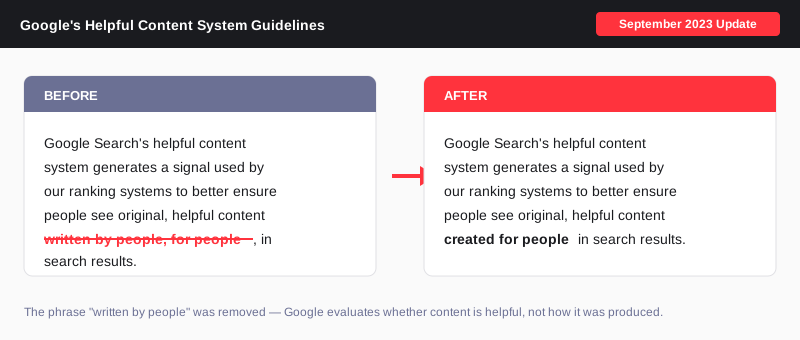
The message is clear: for content to rank well, it must be informative, answer users' queries satisfactorily, and showcase genuine expertise - regardless of how it's created.
AI Content Detectors like GPTZero, ZeroGPT, and many others are not reliable. Even OpenAI has said as much. They consistently produce false positives about human-written content. Conversely, they can be easily fooled with creative prompting or a bit of human editing.
An interesting note from OpenAI: "we found that it labeled human-written text like Shakespeare and the Declaration of Independence as AI-generated."
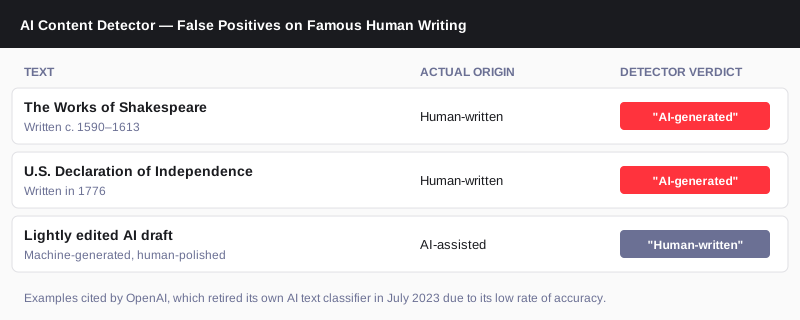
Anecdotal evidence and real-life ranking data suggest that while AI-generated content isn't penalized by search engines, it might only achieve high rankings if it meets the above criteria. The role of AI in content creation is still a developing narrative, and its significance is indispensable for maintaining a competitive edge in the future.
At EmberTribe, the understanding is clear - AI serves as a foundation, not the final product. With ClusterMagic, while AI aids in the initial draft based on expert-driven keyword research, human experts step in for the crucial phases of editing, fact-checking, and final review. This hybrid approach ensures the content is accurate and helpful, has the potential to rank, and truly represents their business.
Search engine positioning refers to where your website appears in organic search results for a given query. It is one of the most measurable, highest-leverage factors in digital marketing, and for growth-stage brands, getting it right can mean the difference between a steady stream of qualified traffic and near-total invisibility.
This guide breaks down what search engine positioning actually is, the role it plays in driving traffic, the factors that influence it, and the strategies your team can use to improve it.
Search engine positioning is the specific rank a webpage holds on a search engine results page (SERP) for a particular keyword or query. If your page shows up third when someone searches "DTC retention strategies," your position for that term is 3.
This is different from search engine optimization (SEO) as a whole. SEO is the practice; positioning is the outcome. You optimize your site so that your positioning improves.
Positioning is always relative. Your rank depends not just on how well your page is optimized, but on how it stacks up against every other page competing for the same query. That competitive dimension is what makes it both challenging and strategically valuable.
It is common to see these terms used interchangeably, but they are not the same thing.
Think of SEO as the input and positioning as the output. You can run a strong SEO and SEM strategy without obsessing over individual positions, but tracking positioning gives you a concrete metric to gauge whether your efforts are working.
Position is not just a vanity metric. It has a direct, measurable impact on traffic volume and quality.
The relationship between search engine position and click-through rate (CTR) is well-documented and steep. Research consistently shows that the top organic result captures the largest share of clicks, with a sharp drop-off after the first few positions. By the time you reach page two (positions 11 and beyond), CTR approaches zero for most queries.
This is why moving from position 36 to position 10 may generate some impressions but still almost no clicks. The real traffic gains come from breaking into the top five, and ideally the top three.
For brands focused on growth marketing channels, organic search is one of the few channels that compounds over time. A page that reaches a strong position can deliver traffic for months or years without additional spend.
Users trust top-ranked results more than lower-ranked ones. This is partly a function of how search engines work: Google's algorithm is designed to surface the most relevant, authoritative content. When your brand consistently appears at the top, it reinforces the perception that you are a credible source.
This credibility effect extends beyond the click itself. A brand that shows up in the top results for multiple related queries builds a stronger association with the topic in the minds of potential customers. For DTC and growth-stage companies working to build brand trust through SEO, this compounding authority is a significant competitive advantage.
The math is straightforward. Higher position means higher CTR, and higher CTR on a high-impression keyword means substantially more traffic.
Consider a keyword with 20,000 monthly impressions. At position 36, you might generate zero clicks (which is exactly what happens in practice). Move that same page to position 5, and you could realistically capture 3-5% of those impressions, translating to 600-1,000 monthly visits from a single keyword. Reach position 1, and that number could climb above 5,000.
This is why search engine positioning improvement is not an incremental game. The gains are nonlinear: small position changes near the top of the SERP produce outsized traffic results.
Google evaluates hundreds of signals when determining positioning. The ones that matter most fall into a few categories.
Content remains the most important on-page factor. Google is looking for content that thoroughly addresses the searcher's intent, provides original value, and demonstrates expertise in the subject.
For positioning purposes, this means:
A strong content strategy is the foundation for any positioning improvement effort.
Even the best content will struggle to rank if the technical foundation is weak. Key technical factors include:
An SEO audit can identify technical issues that may be holding your positioning back.
Backlinks remain one of the strongest off-page ranking signals. When authoritative websites link to your content, it signals to search engines that your page is trustworthy and valuable.
Quality matters more than quantity. A single link from a high-authority industry publication carries more weight than dozens of links from low-quality directories. Building a backlink profile takes time, but it is one of the most durable ways to improve positioning across your entire site.
Google pays attention to how users interact with your page after clicking. High bounce rates, short dwell times, and low engagement can signal that a page is not delivering on its promise, which can erode positioning over time.
Factors that support strong engagement include:
Improving positioning requires a combination of on-page optimization, off-page authority building, and ongoing measurement.
On-page optimization is where most positioning improvement efforts should start, because these are the factors you control directly.
Off-page SEO focuses on building your site's authority and reputation beyond your own domain.
One of the most efficient positioning strategies is to focus on keywords where you already rank in the striking distance zone, typically positions 5 through 20. These are terms where Google has already determined your page is relevant; it just needs a push to break into the top results.
Identify these opportunities using Google Search Console, then optimize the corresponding pages by:
This approach often yields faster results than trying to rank for entirely new terms.
You cannot improve what you do not measure. Tracking your positioning over time is essential for understanding what is working and where to focus next.
Several tools provide reliable positioning data:
Position alone does not tell the full story. Track these metrics together to get a complete picture:
Look for patterns rather than reacting to daily fluctuations. Positioning naturally shifts as competitors publish new content, algorithms update, and search behavior evolves. The goal is to see a sustained upward trend over weeks and months, not to chase position changes day by day.
When you see a position drop, investigate the possible causes: was there an algorithm update? Did a competitor publish stronger content? Has your page become outdated? Data-driven diagnosis leads to more effective responses than guesswork.
Understanding how positioning works in practice helps clarify the strategy.
Example 1: The high-impression, low-position problem. A page ranks at position 36 for a keyword with 20,000+ monthly impressions. It generates zero clicks because almost no one scrolls past the first page. The fix: a complete content overhaul to match search intent, combined with targeted backlink building to improve authority.
Example 2: The striking distance opportunity. A page ranks at position 16 for a long-tail query like "the role of search engine positioning." With 109 monthly impressions and a position just outside page one, small improvements (better content depth, an optimized title tag, a few internal links) could push it to page one and start capturing clicks.
Example 3: The top-position compounding effect. A well-optimized page reaches position 3 for a competitive term. Over time, the high CTR and strong engagement signals reinforce the ranking, making it increasingly difficult for competitors to displace. This is the compounding effect that makes organic search such a powerful acquisition channel.

Search engine positioning is the bridge between SEO effort and measurable traffic outcomes. For brands that depend on organic growth, tracking and improving positioning is not optional; it is foundational.
The playbook is clear: audit your current positions, identify the highest-impact opportunities (especially striking distance keywords), strengthen your content and technical foundation, and build authority over time. The brands that treat positioning as an ongoing discipline, rather than a one-time project, are the ones that consistently capture the most valuable organic traffic.
If you want to see what a data-driven approach to positioning looks like in practice, take a look at our SEO methodology or explore how we have helped brands transform their search rankings.

It has become increasingly important for medical practices to establish a strong online presence in order to attract new patients and stay competitive. One of the most effective ways to achieve this is through search engine optimization (SEO). Implementing SEO strategies can boost your website's visibility on search engine results pages (SERPs), driving more organic traffic to your practice's website. However, navigating the complexities of SEO can be daunting, which is why partnering with a reputable medical SEO agency is crucial. Here, we will explore the key factors to consider when choosing the right medical SEO agency for your practice.

Healthcare marketing is a unique field that requires a delicate balance between promoting services and providing valuable information. With SEO, you can achieve this balance by optimizing your website's content to cater to both search engines and patients. By incorporating relevant keywords and phrases into your website's copy, meta tags, and headings, you can increase your chances of appearing in search results when potential patients are looking for specific medical services or information.
Implementing SEO strategies can bring a range of benefits to medical professionals, such as:
Once you have a clear understanding of the importance of SEO for your medical practice, the next step is to identify your specific SEO needs and goals. This involves assessing your current online presence, identifying areas for improvement, and outlining your objectives.
Start by analyzing your website's performance metrics, such as the number of visitors, bounce rate, and average time on site. This will give you insights into how well your website is currently performing and areas that may need improvement.
In addition to analyzing your website, it is also crucial to evaluate your social media presence. Social media platforms can play a significant role in boosting your online visibility and driving traffic to your website. Assess your engagement levels, follower count, and the effectiveness of your social media campaigns.
Once you have a clear picture of your current online presence, it's time to identify areas for improvement. This could include optimizing your website's loading speed, improving the user experience, enhancing your website's design and layout, or creating high-quality and relevant content.
Defining your SEO goals is equally important. Start by considering the specific objectives you want to achieve through SEO. Do you want to increase your website's organic traffic? Improve your search engine rankings for specific keywords? Generate more patient inquiries through your website? By clearly defining your goals, you can tailor your SEO strategies accordingly.

Before implementing SEO strategies, it is important to define your target audience. Understanding who your ideal patients are will help you tailor your SEO efforts to attract the right demographic. Consider factors such as age, gender, location, and specific medical needs. This information will guide your keyword research and content creation.
When defining your target audience, it is also crucial to consider their online behavior and preferences. Are they more likely to use search engines to find medical information? Do they frequently engage with social media platforms? By understanding how your target audience interacts with the online world, you can optimize your SEO strategies to reach them effectively.
conducting market research can also provide valuable insights into your target audience's needs, preferences, and pain points. This information can help you create content that resonates with your audience and positions your medical practice as a trusted source of information and solutions.
Setting measurable SEO goals is crucial for tracking the success of your SEO efforts. Whether your goal is to increase website traffic, improve your search engine rankings, or generate more patient inquiries, it is important to establish specific, measurable, achievable, relevant, and time-bound (SMART) goals.
When setting your SEO goals, consider using key performance indicators (KPIs) to track your progress. KPIs can include metrics such as organic search traffic, keyword rankings, conversion rates, and the number of patient inquiries generated through your website.
Additionally, it is important to regularly monitor and analyze your SEO data to identify trends, patterns, and areas for improvement. This can involve using tools such as Google Analytics to track website traffic, behavior flow, and conversion rates. By continuously analyzing your SEO data, you can make data-driven decisions and refine your strategies for optimal results.
Remember, SEO is an ongoing process, and it requires consistent effort and monitoring. By setting measurable goals and regularly evaluating your progress, you can ensure that your SEO strategies are effective and aligned with your medical practice's objectives.
Now that you have a clear understanding of your SEO needs and goals, it's time to evaluate potential medical SEO agencies. Consider the following factors to ensure you select the right agency for your practice:
When choosing a medical SEO agency, it is important to consider their experience in the healthcare industry. A specialized medical SEO agency will have a deep understanding of the unique challenges and regulations that medical practices face. They will be familiar with medical terminology, compliance requirements, and the nuances of healthcare marketing.
Another important factor to consider is the range of SEO services offered by the agency. A comprehensive SEO strategy involves various components, including on-page optimization, off-page optimization, content creation, link building, and technical SEO. Ensure that the agency you choose offers a holistic approach to SEO and can tailor their services to meet your specific needs. A right combination of services can take your business to the next level. Here is an example of a business that used SEO to surpass the 10M barrier.
Medical SEO is a highly specialized field that requires a thorough understanding of medical terminology and compliance regulations. The agency you choose should have a team of SEO experts who are well-versed in medical terminology and can create content that is accurate, informative, and compliant with applicable regulations.
Once you have shortlisted potential medical SEO agencies based on the above factors, the next step is to evaluate their SEO strategies. Keep in mind the following considerations:
A cookie-cutter approach to SEO is not effective in the medical industry. Each medical practice is unique and requires a customized SEO strategy that aligns with their specific goals and target audience. The agency you choose should be capable of tailoring their SEO strategies to meet your practice's individual needs.
Keyword research is a crucial component of medical SEO. It involves identifying the most relevant and high-value keywords that potential patients are using when searching for medical services online. The agency you choose should have a solid keyword research strategy, ensuring that the right keywords are incorporated into your website content and meta tags.
For medical practices, local SEO plays a vital role in attracting patients in specific geographic areas. The agency you choose should have expertise in local SEO, helping your practice rank higher in local search results and targeting patients in your area.
Before making a final decision, it is important to assess the performance and reporting capabilities of the medical SEO agency. This will ensure that you can measure the success of your SEO efforts and make data-driven decisions. Consider the following:
The agency should have a solid understanding of SEO metrics and key performance indicators (KPIs) used to evaluate the success of SEO campaigns. These may include website traffic, search engine rankings, organic leads, conversion rate, and return on investment (ROI). Ensure that the agency can provide meaningful insights and reports on these metrics.
Transparent reporting is essential when working with a medical SEO agency. They should provide regular reports that outline the progress of your SEO campaigns, explain the strategies implemented, and highlight areas for improvement. An agency that values transparency will keep you informed and involved in the optimization process.

Choosing the right medical SEO agency for your practice is a crucial decision that can significantly impact your online visibility, patient acquisition, and overall success. By understanding the importance of SEO, identifying your needs and goals, and considering key factors such as the agency's experience, range of services, and SEO methodology, you can make an informed choice. Remember to evaluate the agency's performance and reporting capabilities to ensure that you can track the progress of your SEO efforts. With the right medical SEO agency by your side, you can take your practice to new heights and attract a steady stream of qualified patients.

Having a strong online presence is essential for the success of any business, but knowing exactly what is holding your website back in search rankings is a different challenge entirely. An SEO audit is a comprehensive analysis of your website's search engine optimization performance, identifying the specific issues that are limiting your visibility and providing a clear roadmap for improvement.
While you can attempt to perform an SEO audit in-house, hiring an SEO audit agency provides significant advantages that directly impact your bottom line. Below, we explore three core reasons why partnering with a specialized agency is a smart investment for your online business.
An SEO audit is the process of systematically analyzing your website's performance across every factor that influences search engine rankings. It evaluates on-page optimization, off-page authority, technical infrastructure, and user experience to identify weaknesses and opportunities.

A thorough audit examines several critical dimensions of your site.
On-page optimization includes meta tags, keyword usage, heading structure, content relevance, and internal linking. Auditors assess whether your content is properly optimized for the search queries your audience actually uses, and whether your pages are structured in a way that search engines can easily interpret.
Off-page optimization involves analyzing your backlink profile, social media presence, and online reputation. The quality, relevance, and diversity of sites linking to yours directly influence how much authority search engines assign to your domain. A weak or toxic backlink profile can actively suppress your rankings.
Technical SEO covers site speed, mobile-friendliness, crawlability, indexation, structured data, and security. These are the infrastructure elements that determine whether search engines can efficiently access and understand your content. Technical issues are often invisible to site owners but can have an outsized impact on search engine positioning.
User experience factors include page load speed, mobile responsiveness, navigation clarity, and overall usability. Google has made it clear that user experience signals, including Core Web Vitals, are direct ranking factors. A site that frustrates visitors will struggle to rank regardless of how strong the content is.
An SEO audit provides a baseline understanding of where your website currently stands and what specific changes will have the greatest impact on visibility and traffic.
Without an audit, most businesses operate on assumptions about what is working and what is not. They might invest heavily in content production while a technical crawl error is preventing half their pages from being indexed. Or they might chase new backlinks while their existing content fails to target keywords with meaningful search volume.
An audit eliminates guesswork. It provides data-driven priorities that allow you to allocate time and budget to the changes that will move the needle most. Brands that conduct regular audits also stay ahead of algorithm updates and shifting competitive dynamics, maintaining their edge in search results over time.
An SEO audit agency brings specialized tools, experience, and objectivity that are difficult to replicate in-house. Their role extends beyond identifying problems to providing strategic recommendations, implementation guidance, and ongoing performance monitoring.
The primary function of an audit agency is to uncover the specific weaknesses limiting your search performance. This involves a systematic review of every SEO-relevant element of your website, from individual page-level optimization to site-wide technical health.
Agencies use enterprise-grade tools to crawl your entire site, analyze your backlink profile, benchmark your performance against competitors, and identify patterns that indicate underlying issues. They examine content quality and relevance, keyword targeting effectiveness, internal link structure, page speed across devices, and dozens of other factors.
The result is a comprehensive picture of your SEO health, with specific, prioritized issues ranked by their impact on performance.
Identifying problems is only half the equation. A strong audit agency translates findings into actionable recommendations with clear implementation steps.
These recommendations might include rewriting meta tags to improve click-through rates, restructuring site navigation to improve crawl efficiency, updating content strategy to target higher-value keywords, compressing images to improve page speed, or building a link acquisition plan to strengthen domain authority.
Effective agencies prioritize recommendations by expected impact and implementation difficulty, giving you a clear roadmap for which changes to tackle first. This strategic framework ensures that every dollar and hour invested in SEO improvements produces measurable results.
SEO is not a one-time project. Search algorithms evolve, competitors adjust their strategies, and user behavior shifts. A quality audit agency monitors key performance indicators including organic traffic, keyword rankings, conversion rates, and technical health metrics on an ongoing basis.
This continuous monitoring allows the agency to identify emerging issues before they become problems, spot new ranking opportunities, and adjust strategy in response to competitive or algorithmic changes. The result is a website that maintains and improves its search performance over time rather than experiencing the common cycle of improvement followed by gradual decline.
SEO is a complex and rapidly evolving field. The algorithms that determine search rankings incorporate hundreds of signals, and those signals change regularly. Keeping up with these changes while also running a business is a significant challenge.
An audit agency provides access to a team of specialists who dedicate their careers to understanding search engine behavior. These professionals have experience across dozens or hundreds of client sites, which gives them pattern recognition abilities that are impossible to develop working on a single website.
They understand the nuances of different industries, the competitive dynamics of various keyword landscapes, and the specific technical configurations that influence crawling and indexing. This depth of knowledge allows them to identify issues and opportunities that an in-house team without specialized SEO experience would likely miss.
The difference between generic SEO advice and expert analysis can be substantial. A specialist might identify that your site's JavaScript rendering is preventing Google from seeing your content, that your internal linking structure is diluting authority from your most important pages, or that your content is cannibalizing itself by targeting the same keywords across multiple pages. These are not issues that surface through basic analysis.
Google makes thousands of algorithm updates each year, including several major core updates that can dramatically shift rankings overnight. An audit agency actively monitors these changes, understands their implications, and adjusts recommendations accordingly.
This matters because SEO best practices evolve continuously. Tactics that were effective two years ago may be neutral or even harmful today. An agency ensures your strategy reflects the current state of search rather than outdated assumptions.
For example, Google's increasing emphasis on E-E-A-T (Experience, Expertise, Authoritativeness, Trustworthiness) has changed how content needs to be structured and attributed. An agency that understands these shifts can help you adapt your content strategy proactively rather than reactively.
Running an online business demands attention across product development, customer acquisition, operations, and support. Attempting to conduct a comprehensive SEO audit internally pulls focus from these core activities and often produces incomplete results.
Outsourcing your SEO audit allows you to maintain focus on what you do best while experts handle the technical analysis. The time savings extend beyond the audit itself. Without specialized knowledge, an in-house team might spend weeks researching and implementing changes that an agency can identify and recommend in days.
This is particularly relevant for growth-stage companies where the leadership team's time is the scarcest resource. Every hour spent trying to diagnose SEO issues is an hour not spent on product improvement, customer relationships, or strategic planning.
Audit agencies have established processes, specialized tools, and experienced teams that allow them to conduct thorough audits efficiently. What might take an in-house team weeks of trial and error, an agency can complete in a fraction of the time with greater accuracy.
They also have access to premium tools that would represent a significant investment for a single company. Enterprise crawlers, rank tracking platforms, backlink analysis databases, and competitive intelligence tools are all part of the standard agency toolkit. These tools provide data that is simply unavailable through free alternatives.
The perception that hiring an SEO audit agency is expensive often prevents businesses from making this investment. In reality, the cost of not having expert guidance typically far exceeds the cost of the agency engagement.
SEO mistakes can have serious and long-lasting consequences. A poorly executed site migration can destroy years of accumulated organic authority overnight. Targeting the wrong keywords can waste months of content production effort. Building low-quality backlinks can trigger penalties that take months to recover from.
An agency's expertise prevents these mistakes before they happen. They have seen what works and what backfires across hundreds of engagements, and they apply that experience to protect your investment. The cost of a single major SEO mistake, measured in lost traffic and revenue, can easily exceed the cost of years of agency partnership.
The ultimate measure of any marketing investment is ROI, and SEO consistently delivers some of the highest returns available. Unlike paid advertising where every visitor has an associated cost, organic traffic from SEO compounds over time. A single well-optimized page can drive thousands of visitors per month for years after it is published.
An audit agency helps you maximize this return by ensuring your SEO efforts are focused on the highest-impact opportunities. Rather than spreading resources thin across dozens of minor improvements, they help you identify the changes that will drive the most significant gains in traffic and conversions.
Consider this scenario: your site receives 10,000 organic visitors per month at a 2% conversion rate. An audit identifies technical issues and content optimization opportunities that improve both traffic and conversion rate. Even modest improvements, say 20% more traffic and a 0.5 percentage point increase in conversion rate, translate into meaningful revenue gains that far exceed the cost of the audit.
Not all agencies deliver equal value. When evaluating potential partners, look for these qualities:
Hiring an SEO audit agency for your online business is a strategic decision that pays dividends across every dimension of your digital presence. The combination of specialized expertise, time savings, and cost-effective strategy makes it one of the highest-ROI investments available to growth-stage brands.
The brands that consistently win in search are the ones that invest in understanding their current position, identifying the highest-impact opportunities, and executing systematically against a data-driven plan. An experienced audit agency provides all three.
The first step is straightforward: get a clear picture of where your website stands today. From there, every improvement is measurable, every investment is defensible, and every gain compounds over time.

In the age of rapid digital transformation, AI has seeped into almost every industry, revolutionizing how we conduct business, design products, and even create content. The ClusterMagic service is a great example, which seamlessly integrates AI for content generation in a hybrid model, providing significant benefits in the SEO results of brands seeking a massive increase in organic traffic. But while AI holds immense promise, it has its limitations. Let's explore the pros and cons of using AI for content creation and understand why a hybrid approach might be the way forward.
Major publishers in sensitive niches like CNET.com, Bankrate.com, and Creditcard.com have already integrated AI-generated content. Other large companies, such as CNN and Forbes, might also be doing so. Countless smaller companies and publishers are utilizing AI, not only on their websites but also on social media, in email marketing, and virtually everywhere else.
Google's stance on AI-generated content is neutral, emphasizing that content should primarily be user-centric. In fact, Google's September 2023 Helpful Content Update removed the mention of "written by people" from their helpful content system guidelines.
The message is clear: for content to rank well, it must be informative, answer users' queries satisfactorily, and showcase genuine expertise - regardless of how it's created.
AI Content Detectors like GPTZero, ZeroGPT, and many others are not reliable. Even OpenAI has said as much. They consistently produce false positives about human-written content. Conversely, they can be easily fooled with creative prompting or a bit of human editing.
An interesting note from OpenAI: "we found that it labeled human-written text like Shakespeare and the Declaration of Independence as AI-generated."
Anecdotal evidence and real-life ranking data suggest that while AI-generated content isn't penalized by search engines, it might only achieve high rankings if it meets the above criteria. The role of AI in content creation is still a developing narrative, and its significance is indispensable for maintaining a competitive edge in the future.
At EmberTribe, the understanding is clear - AI serves as a foundation, not the final product. With ClusterMagic, while AI aids in the initial draft based on expert-driven keyword research, human experts step in for the crucial phases of editing, fact-checking, and final review. This hybrid approach ensures the content is accurate and helpful, has the potential to rank, and truly represents their business.

In today's competitive B2B landscape, lead generation is the engine that powers sustainable revenue growth. One platform that has become a go-to solution for growth-focused teams is Apollo. By combining a massive B2B contact database with AI-powered outreach sequences, Apollo gives marketing and sales teams the infrastructure to generate qualified leads at scale while keeping cost per acquisition under control.
This guide breaks down how Apollo works, the strategies that drive results, and the metrics you should track to ensure every dollar spent delivers maximum return.
Apollo is a sales intelligence and engagement platform built for B2B lead generation. It provides access to a database of over 275 million contacts across 73 million companies, paired with tools for email sequencing, calling, task management, and analytics.
What sets Apollo apart from traditional prospecting tools is how it combines data enrichment with execution. Rather than purchasing a static list and importing it into a separate outreach tool, Apollo lets you identify prospects, enrich their profiles, build multi-step sequences, and track engagement - all inside a single platform.
For growth-stage companies that need to move quickly without hiring a large sales development team, Apollo eliminates the friction between research and action.
Getting results from Apollo starts with proper setup. A misconfigured instance leads to wasted emails, low reply rates, and poor data quality. Here is the foundational work that matters most.
Before running a single search, document your ideal customer profile (ICP) with specificity. Apollo's filters are powerful, but they only work when you know exactly who you are looking for. Key attributes to define include:
A tightly defined ICP reduces list size but dramatically increases conversion rates. Teams that skip this step often see open rates below 15% and reply rates below 1% - numbers that make outbound financially unviable.
Email deliverability is the silent killer of outbound campaigns. Apollo provides built-in tools to help, but you need to set them up proactively:
Bounce rates above 3% will damage your sender reputation and can land your domain on blocklists. This is one area where spending time upfront saves significant cost downstream.
Once your foundation is solid, the following strategies separate high-performing Apollo campaigns from average ones.
The days of single-touch outreach are over. Effective Apollo sequences typically include 5-8 touchpoints spread across 14-21 days, combining email, LinkedIn connection requests, and phone calls. A proven structure includes:
This multi-channel approach increases reply rates by 2-3x compared to email-only sequences because it meets prospects where they are most active.
Apollo's intent signals indicate when a company is actively researching topics related to your solution. Prospects showing buying intent convert at significantly higher rates than cold contacts because the timing aligns with their existing evaluation process.
Practical ways to leverage intent data include:
This approach is particularly effective for B2C and B2B lead generation teams that need to prioritize limited SDR capacity.
Generic templates get ignored. Apollo's AI features can help you personalize at scale by dynamically inserting company-specific data points, recent news mentions, and technographic details into your messaging. The key is balancing personalization with efficiency:

Generating leads is only valuable if you can prove the return. Here are the metrics that matter and how to track them effectively.
When evaluating your Apollo lead generation performance, track KPIs across three levels:
Activity metrics - These confirm your team is executing at the right volume:
Engagement metrics - These indicate whether your messaging resonates:
Revenue metrics - These connect outbound activity to business outcomes:
The most common mistake teams make is optimizing for activity metrics while ignoring revenue metrics. Sending more emails does not create value if those emails do not convert into pipeline.
Apollo's built-in analytics cover engagement metrics well, but you need additional tools for full-funnel visibility:
By analyzing data across these platforms, you gain a holistic view of which sequences, segments, and messaging strategies drive the highest return.
Even experienced teams make errors that erode performance. Watch for these common pitfalls:
Targeting too broadly. A list of 50,000 contacts feels productive but almost always underperforms a focused list of 2,000 well-researched prospects. Quality beats quantity in outbound.
Neglecting list hygiene. Contact data decays at roughly 30% per year. People change jobs, companies restructure, and email addresses go stale. Verify your lists regularly and remove contacts who have bounced or unsubscribed.
Sending without testing. A/B test subject lines, opening sentences, CTAs, and sequence length. Small improvements in open and reply rates compound significantly over thousands of sends.
Ignoring negative signals. When prospects unsubscribe, mark you as spam, or explicitly say they are not interested, respect those signals immediately. Continuing to contact them damages your domain reputation and brand.
Failing to align sales and marketing. Apollo works best when marketing and sales teams share a unified ICP, consistent messaging, and clear handoff processes. Misalignment leads to duplicated effort and conflicting outreach.
Once you have a proven sequence generating positive ROI, the next step is scaling without sacrificing quality. Key scaling levers include:
The goal is building a repeatable, measurable outbound engine that generates predictable pipeline month over month - not sporadic bursts of activity followed by periods of inaction.
Apollo lead generation offers B2B teams a powerful, consolidated platform to identify, engage, and convert qualified prospects. But the platform alone does not guarantee results. Success depends on precise targeting, disciplined execution, deliverability hygiene, and rigorous measurement.
Start with a tightly defined ICP, build multi-touch sequences that provide genuine value, track metrics at every stage of the funnel, and continuously optimize based on data. When these elements come together, Apollo becomes one of the highest-ROI investments in your growth stack.

GIFs have become a universal language on the internet. From blog posts and email newsletters to social media and internal communications, animated GIFs add personality, break up long-form content, and convey reactions in ways that static images and plain text simply cannot match.
But for teams that take SEO seriously, the question is valid: are GIFs helping your content strategy, or are they quietly undermining your search rankings?
The short answer is that GIFs, when used thoughtfully and optimized properly, can enhance your content without damaging your SEO performance. The longer answer involves understanding how Google handles animated images, where the risks actually lie, and what optimization techniques keep your site fast while preserving the engagement benefits that GIFs provide.

Google crawls GIFs the same way it crawls any other image format. The search engine reads the file name, alt text, surrounding context, and page metadata to determine what the image represents and how relevant it is to a given search query.
This means the standard image SEO best practices apply to GIFs just as they do to JPEGs and PNGs:
email-marketing-workflow.gif is far more useful to Google than giphy-12345.gifWhere GIFs differ from static images is in file size and rendering behavior, both of which have indirect but significant effects on SEO through page performance metrics.
GIFs do not directly hurt your search rankings. What hurts your rankings is slow page load times, and GIFs are one of the most common contributors to bloated page weight.
A single unoptimized GIF can easily reach 5-10 MB - larger than entire web pages should be. When a page loads multiple uncompressed GIFs, the cumulative effect on Core Web Vitals can be severe:
Google has made page experience a ranking factor, which means anything that degrades load speed - including oversized GIFs - can pull your content down in search results.
The solution is not to stop using GIFs. It is to optimize them properly so you get the engagement benefits without the performance penalty.
There are several proven techniques for keeping GIFs fast-loading without sacrificing quality or visual impact.
The most straightforward optimization is reducing file size through compression. Several approaches work well:
A well-compressed GIF should typically be under 1 MB. If your GIF exceeds 2 MB, it is worth revisiting the source material or considering an alternative format.
For larger or longer animations, converting GIFs to HTML5 video formats (MP4 or WebM) is one of the most effective optimizations available. Video formats use modern compression codecs that deliver the same visual output at a fraction of the file size.
A 5 MB GIF can often be converted to a 200-500 KB MP4 that looks identical to the viewer. The implementation uses the HTML tag with autoplay and loop attributes to replicate the GIF experience:
<video autoplay loop muted playsinline>
  <source src="animation.webm" type="video/webm">
  <source src="animation.mp4" type="video/mp4">
</video>
This approach is particularly valuable for hero sections and above-the-fold content where page speed has the greatest impact on both SEO and user experience.
Lazy loading defers the loading of GIFs that are below the fold until the user scrolls to them. This reduces initial page load time and improves Core Web Vitals scores without removing any content.
Modern browsers support native lazy loading through a simple attribute:
<img src="reaction.gif" alt="Description" loading="lazy">For more granular control, JavaScript-based lazy loading libraries like lazysizes offer features like placeholder images, fade-in effects, and custom threshold settings.
GZIP compression at the server level can reduce GIF transfer sizes by up to 70% without any change to the original file. Most modern web servers and CDNs support GZIP or Brotli compression, and enabling it is typically a one-time configuration change.
Check with your hosting provider or CDN to confirm that compression is enabled for image assets. This optimization benefits all images on your site, not just GIFs.
GIF optimization is not purely an SEO concern. Accessibility compliance affects both user experience and search performance, and Web Content Accessibility Guidelines (WCAG) have specific requirements for animated content.
WCAG 2.1 requires that any animation that starts automatically and lasts longer than five seconds must include a mechanism for the user to pause, stop, or hide it. This matters for SEO because:
Practical ways to meet accessibility requirements for GIFs:
prefers-reduced-motion CSS media query to serve static alternatives to users who have requested reduced motion in their system settingsAlt text for GIFs should describe both the content and the action depicted. Unlike static images where you describe what is shown, GIF alt text should convey what is happening:
Descriptive alt text serves double duty: it makes your content accessible to screen reader users and gives Google additional context for understanding and ranking your content.
While the risks of GIFs are primarily performance-related, the benefits are engagement-related - and engagement signals do influence search rankings.
Content with well-placed GIFs tends to keep readers on the page longer. Animated visuals break up walls of text and give readers visual anchors that maintain interest. Since time on page is a behavioral signal that search engines monitor, GIFs can indirectly support your rankings when they contribute to a better reading experience.
Pages that use GIFs strategically - as visual explanations, process demonstrations, or reaction moments - tend to have lower bounce rates than text-only pages. When readers stay and scroll rather than bouncing, Google interprets this as a positive quality signal.
Google's quality evaluators look at whether content provides a good user experience. Pages that use multimedia elements thoughtfully - including GIFs, images, and video - score higher on user experience criteria than pages with minimal visual content.
This is particularly relevant for content marketing strategies where the goal is creating comprehensive, authoritative resources on a topic. GIFs can serve as visual evidence, process demonstrations, or data visualizations that add genuine informational value to the page.
Content that includes GIFs is more likely to be shared on social media and linked to from other websites. While social signals themselves are not a confirmed ranking factor, backlinks from other sites remain one of the strongest ranking signals in Google's algorithm. Content that earns natural backlinks through shareability and engagement value will outperform content that does not.
Based on the data and best practices covered above, here is a framework for incorporating GIFs into your content development strategy without compromising SEO performance:
GIFs will not ruin your SEO - but unoptimized GIFs absolutely can. The format itself is neutral in terms of search rankings. What matters is how you implement it.
When GIFs are compressed, properly tagged with alt text, lazy-loaded, and used strategically to enhance the reader experience, they become an asset to your content strategy. They keep readers engaged, reduce bounce rates, and make your content more shareable - all signals that support stronger search performance over time.
The key is treating GIFs as a deliberate content element rather than decoration. Every GIF on the page should earn its place by adding informational value, illustrating a concept, or enhancing the reader's experience in a way that static content cannot.


Admit it, marketer or not we have all talked about algorithms being (scarily) artificially intelligent, real-life Skynet, and a sinister machine that monitors all our actions and knows us better than we know ourselves.

But do we even know what algorithms are?
We assume there is this one algorithm in a top-secret file at Google Headquarters that’s prized for listening in on our conversations and reading our minds.
But there isn’t just one algorithm, there are many algorithms—each one personalized to produce a result we care about.
For example, putting a pan of water on the stove at a certain temperature for a certain time is a way to reach the result of boiling hot water. This is one equation, or rule, or sequence. Adding eggs to the boiling water and letting them stay in for a certain period of time leads to hard-boiled eggs. This is another sequence that leads to a result.
Continuing with that metaphor, when you type a query into the Google search bar, it doesn’t just fire one sequence to get your result, it fires up an entire kitchen of line cooks. 🍳
Algorithms are excellent tools for optimizing your marketing campaign because they provide what we love best: data. They can help you pick apart your audiences’ complex decisions. Here are a few examples of how you can use algorithms as a marketer.
Algorithms help monitor the behavior of your demographic and suggest the likely hours during the day when your leads are browsing online.
Having a pool of valuable behavioral data can help you remarket to the right people at the right time. If you share that information with your broader marketing team you can even use it to design a unique campaign that incorporates highly targeted information about your audience.
Algorithms can help you personalize the way you show an ad to your consumer or a lead. Remember that song that played on Spotify shuffle? Wasn’t it exactly the kind of tune you were looking for? Now how did that happen? Or that ad about artisanal potato chips made from handpicked Idaho potatoes...how did they know that’s just what you were craving?
Google uses algorithms to show you information that you are likely going to be interested in, such as targeted news articles and tutorials. That means you’re not just being delivered the answer to your query, but information about your query targeted for you based on your search habits.
Targeting is what allows the internet to predict what you may feel like eating the next day. It has consumed so much of your behavioral pattern that you start panicking Google is reading your mind. It’s not…
Or is it?

No seriously, that's just how proactive algorithms are. They make use of something that we hear a lot: Machine learning, aka another way of saying artificial intelligence.
Machine learning helps figure out what your customer is thinking. Are they browsing? Are they going to spend soon? Are they looking to spend now? Basically, it helps you determine the stage of your buyer’s journey so you can address it.
🛠️ Find out how you can build a better funnel with retargeting. →
Sounds great right? By now you feel ready to drive your entire digital marketing campaign based on algorithms. We’ve said a lot of great things about them so far, but are algorithms really the bee’s knees?
The answer to that is yes and no. Google algorithm and machine learning is great at monitoring behavior and 7 times out of 10 it does strike true, but the times it does not is because algorithms cannot grasp context. AI can predict a customer’s response to likely be a certain way, but what if the routine context is changed (as it is in life), rendering the data ineffective?

That being said, algorithms remain the foremost tools to learn about humans and their actions. They have brought us far in the way marketers engage with audiences and it has proven effective. For that reason, we have to raise our glass to algorithms that make our lives as marketers just a little easier and more data-driven.


.svg)